EP0927776B1 - Sliding member, method of treating surface of the sliding member and rotary compressor vane - Google Patents
Sliding member, method of treating surface of the sliding member and rotary compressor vane Download PDFInfo
- Publication number
- EP0927776B1 EP0927776B1 EP98900430A EP98900430A EP0927776B1 EP 0927776 B1 EP0927776 B1 EP 0927776B1 EP 98900430 A EP98900430 A EP 98900430A EP 98900430 A EP98900430 A EP 98900430A EP 0927776 B1 EP0927776 B1 EP 0927776B1
- Authority
- EP
- European Patent Office
- Prior art keywords
- electroless
- weight
- plating coating
- sliding member
- plating
- Prior art date
- Legal status (The legal status is an assumption and is not a legal conclusion. Google has not performed a legal analysis and makes no representation as to the accuracy of the status listed.)
- Expired - Lifetime
Links
Images




Classifications
-
- F—MECHANICAL ENGINEERING; LIGHTING; HEATING; WEAPONS; BLASTING
- F16—ENGINEERING ELEMENTS AND UNITS; GENERAL MEASURES FOR PRODUCING AND MAINTAINING EFFECTIVE FUNCTIONING OF MACHINES OR INSTALLATIONS; THERMAL INSULATION IN GENERAL
- F16C—SHAFTS; FLEXIBLE SHAFTS; ELEMENTS OR CRANKSHAFT MECHANISMS; ROTARY BODIES OTHER THAN GEARING ELEMENTS; BEARINGS
- F16C33/00—Parts of bearings; Special methods for making bearings or parts thereof
- F16C33/02—Parts of sliding-contact bearings
- F16C33/04—Brasses; Bushes; Linings
- F16C33/06—Sliding surface mainly made of metal
- F16C33/12—Structural composition; Use of special materials or surface treatments, e.g. for rust-proofing
- F16C33/121—Use of special materials
-
- C—CHEMISTRY; METALLURGY
- C23—COATING METALLIC MATERIAL; COATING MATERIAL WITH METALLIC MATERIAL; CHEMICAL SURFACE TREATMENT; DIFFUSION TREATMENT OF METALLIC MATERIAL; COATING BY VACUUM EVAPORATION, BY SPUTTERING, BY ION IMPLANTATION OR BY CHEMICAL VAPOUR DEPOSITION, IN GENERAL; INHIBITING CORROSION OF METALLIC MATERIAL OR INCRUSTATION IN GENERAL
- C23C—COATING METALLIC MATERIAL; COATING MATERIAL WITH METALLIC MATERIAL; SURFACE TREATMENT OF METALLIC MATERIAL BY DIFFUSION INTO THE SURFACE, BY CHEMICAL CONVERSION OR SUBSTITUTION; COATING BY VACUUM EVAPORATION, BY SPUTTERING, BY ION IMPLANTATION OR BY CHEMICAL VAPOUR DEPOSITION, IN GENERAL
- C23C18/00—Chemical coating by decomposition of either liquid compounds or solutions of the coating forming compounds, without leaving reaction products of surface material in the coating; Contact plating
- C23C18/16—Chemical coating by decomposition of either liquid compounds or solutions of the coating forming compounds, without leaving reaction products of surface material in the coating; Contact plating by reduction or substitution, e.g. electroless plating
- C23C18/48—Coating with alloys
- C23C18/50—Coating with alloys with alloys based on iron, cobalt or nickel
-
- C—CHEMISTRY; METALLURGY
- C23—COATING METALLIC MATERIAL; COATING MATERIAL WITH METALLIC MATERIAL; CHEMICAL SURFACE TREATMENT; DIFFUSION TREATMENT OF METALLIC MATERIAL; COATING BY VACUUM EVAPORATION, BY SPUTTERING, BY ION IMPLANTATION OR BY CHEMICAL VAPOUR DEPOSITION, IN GENERAL; INHIBITING CORROSION OF METALLIC MATERIAL OR INCRUSTATION IN GENERAL
- C23C—COATING METALLIC MATERIAL; COATING MATERIAL WITH METALLIC MATERIAL; SURFACE TREATMENT OF METALLIC MATERIAL BY DIFFUSION INTO THE SURFACE, BY CHEMICAL CONVERSION OR SUBSTITUTION; COATING BY VACUUM EVAPORATION, BY SPUTTERING, BY ION IMPLANTATION OR BY CHEMICAL VAPOUR DEPOSITION, IN GENERAL
- C23C18/00—Chemical coating by decomposition of either liquid compounds or solutions of the coating forming compounds, without leaving reaction products of surface material in the coating; Contact plating
- C23C18/16—Chemical coating by decomposition of either liquid compounds or solutions of the coating forming compounds, without leaving reaction products of surface material in the coating; Contact plating by reduction or substitution, e.g. electroless plating
- C23C18/31—Coating with metals
- C23C18/32—Coating with nickel, cobalt or mixtures thereof with phosphorus or boron
- C23C18/34—Coating with nickel, cobalt or mixtures thereof with phosphorus or boron using reducing agents
- C23C18/36—Coating with nickel, cobalt or mixtures thereof with phosphorus or boron using reducing agents using hypophosphites
-
- F—MECHANICAL ENGINEERING; LIGHTING; HEATING; WEAPONS; BLASTING
- F16—ENGINEERING ELEMENTS AND UNITS; GENERAL MEASURES FOR PRODUCING AND MAINTAINING EFFECTIVE FUNCTIONING OF MACHINES OR INSTALLATIONS; THERMAL INSULATION IN GENERAL
- F16C—SHAFTS; FLEXIBLE SHAFTS; ELEMENTS OR CRANKSHAFT MECHANISMS; ROTARY BODIES OTHER THAN GEARING ELEMENTS; BEARINGS
- F16C33/00—Parts of bearings; Special methods for making bearings or parts thereof
- F16C33/02—Parts of sliding-contact bearings
- F16C33/04—Brasses; Bushes; Linings
- F16C33/06—Sliding surface mainly made of metal
- F16C33/12—Structural composition; Use of special materials or surface treatments, e.g. for rust-proofing
-
- F—MECHANICAL ENGINEERING; LIGHTING; HEATING; WEAPONS; BLASTING
- F16—ENGINEERING ELEMENTS AND UNITS; GENERAL MEASURES FOR PRODUCING AND MAINTAINING EFFECTIVE FUNCTIONING OF MACHINES OR INSTALLATIONS; THERMAL INSULATION IN GENERAL
- F16C—SHAFTS; FLEXIBLE SHAFTS; ELEMENTS OR CRANKSHAFT MECHANISMS; ROTARY BODIES OTHER THAN GEARING ELEMENTS; BEARINGS
- F16C2204/00—Metallic materials; Alloys
- F16C2204/20—Alloys based on aluminium
-
- F—MECHANICAL ENGINEERING; LIGHTING; HEATING; WEAPONS; BLASTING
- F16—ENGINEERING ELEMENTS AND UNITS; GENERAL MEASURES FOR PRODUCING AND MAINTAINING EFFECTIVE FUNCTIONING OF MACHINES OR INSTALLATIONS; THERMAL INSULATION IN GENERAL
- F16C—SHAFTS; FLEXIBLE SHAFTS; ELEMENTS OR CRANKSHAFT MECHANISMS; ROTARY BODIES OTHER THAN GEARING ELEMENTS; BEARINGS
- F16C2223/00—Surface treatments; Hardening; Coating
- F16C2223/02—Mechanical treatment, e.g. finishing
- F16C2223/08—Mechanical treatment, e.g. finishing shot-peening, blasting
-
- F—MECHANICAL ENGINEERING; LIGHTING; HEATING; WEAPONS; BLASTING
- F16—ENGINEERING ELEMENTS AND UNITS; GENERAL MEASURES FOR PRODUCING AND MAINTAINING EFFECTIVE FUNCTIONING OF MACHINES OR INSTALLATIONS; THERMAL INSULATION IN GENERAL
- F16C—SHAFTS; FLEXIBLE SHAFTS; ELEMENTS OR CRANKSHAFT MECHANISMS; ROTARY BODIES OTHER THAN GEARING ELEMENTS; BEARINGS
- F16C2223/00—Surface treatments; Hardening; Coating
- F16C2223/10—Hardening, e.g. carburizing, carbo-nitriding
- F16C2223/18—Hardening, e.g. carburizing, carbo-nitriding with induction hardening
-
- F—MECHANICAL ENGINEERING; LIGHTING; HEATING; WEAPONS; BLASTING
- F16—ENGINEERING ELEMENTS AND UNITS; GENERAL MEASURES FOR PRODUCING AND MAINTAINING EFFECTIVE FUNCTIONING OF MACHINES OR INSTALLATIONS; THERMAL INSULATION IN GENERAL
- F16C—SHAFTS; FLEXIBLE SHAFTS; ELEMENTS OR CRANKSHAFT MECHANISMS; ROTARY BODIES OTHER THAN GEARING ELEMENTS; BEARINGS
- F16C2223/00—Surface treatments; Hardening; Coating
- F16C2223/30—Coating surfaces
-
- Y—GENERAL TAGGING OF NEW TECHNOLOGICAL DEVELOPMENTS; GENERAL TAGGING OF CROSS-SECTIONAL TECHNOLOGIES SPANNING OVER SEVERAL SECTIONS OF THE IPC; TECHNICAL SUBJECTS COVERED BY FORMER USPC CROSS-REFERENCE ART COLLECTIONS [XRACs] AND DIGESTS
- Y10—TECHNICAL SUBJECTS COVERED BY FORMER USPC
- Y10S—TECHNICAL SUBJECTS COVERED BY FORMER USPC CROSS-REFERENCE ART COLLECTIONS [XRACs] AND DIGESTS
- Y10S384/00—Bearings
- Y10S384/90—Cooling or heating
- Y10S384/912—Metallic
-
- Y—GENERAL TAGGING OF NEW TECHNOLOGICAL DEVELOPMENTS; GENERAL TAGGING OF CROSS-SECTIONAL TECHNOLOGIES SPANNING OVER SEVERAL SECTIONS OF THE IPC; TECHNICAL SUBJECTS COVERED BY FORMER USPC CROSS-REFERENCE ART COLLECTIONS [XRACs] AND DIGESTS
- Y10—TECHNICAL SUBJECTS COVERED BY FORMER USPC
- Y10T—TECHNICAL SUBJECTS COVERED BY FORMER US CLASSIFICATION
- Y10T428/00—Stock material or miscellaneous articles
- Y10T428/12—All metal or with adjacent metals
- Y10T428/12493—Composite; i.e., plural, adjacent, spatially distinct metal components [e.g., layers, joint, etc.]
- Y10T428/12736—Al-base component
- Y10T428/1275—Next to Group VIII or IB metal-base component
-
- Y—GENERAL TAGGING OF NEW TECHNOLOGICAL DEVELOPMENTS; GENERAL TAGGING OF CROSS-SECTIONAL TECHNOLOGIES SPANNING OVER SEVERAL SECTIONS OF THE IPC; TECHNICAL SUBJECTS COVERED BY FORMER USPC CROSS-REFERENCE ART COLLECTIONS [XRACs] AND DIGESTS
- Y10—TECHNICAL SUBJECTS COVERED BY FORMER USPC
- Y10T—TECHNICAL SUBJECTS COVERED BY FORMER US CLASSIFICATION
- Y10T428/00—Stock material or miscellaneous articles
- Y10T428/12—All metal or with adjacent metals
- Y10T428/12493—Composite; i.e., plural, adjacent, spatially distinct metal components [e.g., layers, joint, etc.]
- Y10T428/12771—Transition metal-base component
- Y10T428/12861—Group VIII or IB metal-base component
- Y10T428/12944—Ni-base component
Definitions
- the present invention relates to a sliding member used under high load, which is brought into one-sided contact and to which a local load is applied, such as the vane of a rotary-type compressor, differential gear, washer of the transmission, and the like. More particularly, the present invention relates to a sliding member, in which the aluminum alloy used as its material is subjected to surface treatment for the purpose of enhancing the sliding characteristics. In addition, the present invention relates to the surface treatment method of an aluminum alloy.
- both the sliding member and the opposite member are made of aluminum.
- the aluminum members slide with one another, the following surface-treatments are applied on the vanes which are a sliding member.
- an electroless Ni-P plating or electroless Ni-B plating which exhibits good wear resistance, is applied on the surface of the vanes.
- hard additives, a solid lubricant and the like are dispersed in the electroless Ni-P plating coating to enhance the sliding characteristics. Enhancement of wear resistance is also achieved by heating the electroless Ni-P plating coating to 300°C or lower, and hence, hardening the coating.
- the electroless Ni-P plating used for the surface treatment of the sliding member has usually P content of 6 to 10% and is, hence, of medium or high P type.
- the enhancement of sliding characteristics is attained by hardening, that is, increasing Hv 450 - 500 of hardness after the plating to extremely high hardness of from Hv 700 - 800 by means of heating to a temperature of 300°C or lower.
- the electroless Ni-P plating coating with 8 to 10% of P is formed on vanes, and its hardness is increased to approximately Hv 700 - 800 by heat treatment.
- the temperature of heat treatment for obtaining the coating hardening to as much as Hv 700 - 800 is high, the material strength of the aluminum alloy is lowered. The temperature of heat treatment is, therefore, limited. Actually, the hardness of coating attained is only from approximately Hv 500 - 600.
- a sliding member which is an aluminum-alloy substrate and a Ni-P-B based electroless plating which contains P - from 0.5 to 3.0 wt% and B - from 0.05 to 2.0 wt% and is applied on the substrate.
- a feauture of the electroless plating coating is that it is hardened to an extremely high hardness of Hv 800 or more by heat treatment at a temperature which does not lead to appreciable reduction in the hardness of the aluminum alloy.
- the electroless Ni-B plating used for the surface treatment of the sliding member has from 0.3 to 0.8% by weight of B content.
- the hardness of electroless Ni-B plating coating is enhanced to approximately Hv 800 by heat treatment, blister defects on the plating coating are liable to be caused by the heat treatment. Abnormal wear of the plating coating may, therefore, occur under particularly severe testing conditions.
- the medium or high P type Ni-P plating coating has been applied on the surface of a sliding member, since high hardness is attained by heat treatment.
- the expected level of wear resistance of the NiP plating coating used is not attained.
- abnormal wear of the high-P type electroless plating coating occurred when the Al-Si alloy of a rotor or housing, i.e., the opposite material of the vanes, had coarse primary Si crystals of 50 ⁇ m or more and/or numerous Si particle-number of more than 300/mm 2 .
- the load was increased to augment the surface pressure of vanes, the abnormal wear occurred.
- the known Ni-P-B electroless plating coating has usually lower P content than that of the known Ni-P electroless plating coating.
- the crystallinity of Ni-P-B electroless plating coating is considerably disordered, problems in the sliding characteristics are incurred. It turned out that these problems are attributable to even a small amount of B disordering the crystallinity of Ni.
- an object of the present invention to apply a Ni-based electroless plating coating having excellent sliding characteristics on an aluminum-based sliding member, and to provide an aluminum-based sliding member which can be used under a high load.
- the present inventors intensively undertook research to improve the sliding characteristics of a material, which consists of an aluminum alloy and the electroless Ni-P and Ni-P-B plating coating applied thereon. Unexpectedly, it was discovered that crystallinity disordering is negligible slight and high hardness is obtained at a low heat-treating temperature, when the electroless plating coating is a low-P type electroless plating with a small addition of B.
- the sliding member of the present invention completed by the above discovery resides in that the material consists of an aluminum alloy and, further, an electroless Ni-P-B plating coating containing from 0.05 to 5% by weight of P and from 0.01 to 0.05% by weight of B is formed on the sliding surface of the material.
- the first method for surface treating of the sliding member according to the present invention resides in that the barrel polishing treatment is applied on an electroless Ni-P-B plating coating containing from 0.05 to 5% by weight of P and from 0.01 to 0.05% by weight of B and formed on the sliding surface of the material of a sliding member which consists of an aluminum alloy.
- the second method for surface treating of the sliding member according to the present invention resides in that the shot-blasting treatment is applied on an electroless Ni-P-B plating coating containing from 0.05 to 5% by weight of P and from 0.01 to 0.04% by weight of B and formed on the sliding surface of the material of a sliding member which consists of an aluminum alloy.
- the third method for surface treating of the sliding member according to the present invention resides in that laser beam is irradiated on an electroless Ni-P-B plating coating containing from 0.05 to 5% by weight of P and from 0.01 to 0.04% by weight of B and formed on the sliding surface of the material of a sliding member which consists of an aluminum alloy.
- the fourth method for surface treating of the sliding member according to the present invention resides in that high-frequency induction heat-treatment is applied on an electroless Ni-P-B plating coating containing from 0.05 to 5% by weight of P and from 0.01 to 0.04% by weight of B and formed on the sliding surface of the material of a sliding member which consists of an aluminum alloy.
- Ni-P-B plating coating mentioned above may further contain from 0.1 to 1.0% by weight of Co and/or from 0.05 to 1.0% by weight of W which are incorporated in the Ni crystals and hence enhance the hardness of the coating.
- the low-P type electroless Ni-P-B plating coating having from 0.05 to 5% by weight of the P content according to the present invention has low P content such that the Ni crystal lattices of the plating coating is of low strain, and hence the plating coating is of excellent crystallinity.
- the B content lies within the range of from 0.01 to 0.04% by weight, because the compatibility is unsatisfactory at a B content of less than 0.01% by weight and, further, the plating coating is liable to non-uniformly deform against external force, so that cracks and fatigue may result when the B content is more than 0.04% by weight.
- the crystal grains are recognized on the coating surface after the plating, the crystal grains diminish in the vicinity of the surface and a more smooth and hard state is realized, while the surface is squeezed by means of, for example, barrel polishing and shot blasting.
- the P content of electroless Ni-P-B plating coating is less than 0.05%, the plating per se becomes difficult and the sliding characteristics are poor in view of the seizure resistance.
- the structure when the P content exceeds 5% by weight, the structure is liable to become a complex Ni-P-B compound of amorphous structure. Since there is a number of such sites as the precipitation interfaces of the Ni-P-B compounds and grain boundaries, which are easily deformable, in the structure, non-uniform deformation is liable to occur, when external force is imparted. Since there is a large difference between the liquidus and solidus of the melt, the post-solidification segregation becomes great when a high-density energy beam is applied by laser beam. Furthermore, the melt so vigorously flows that the crystal strains are increased.
- a preferable P content is from 1.5 to 2.5% by weight.
- Thickness of the electroless Ni-P-B plating coating is generally from 5 to 40 ⁇ m, more preferably from 10 to 20 ⁇ m.
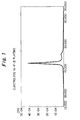
- Fig. 1 shows an X-ray diffraction chart of the electroless Ni-P-B plating coating (a) which contains 2.0% by weight of P and 0.02% by weight of B.
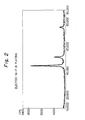
- Fig. 2 shows an X-ray diffraction chart of the electroless Ni-P-B plating film (b) which contains 8% by weight of P and 3% by weight of B.
- the coating (a) of Fig. 1 has the P and B contents lying within the inventive ranges, while the coating (b) of Fig. 2 has these contents outside the inventive ranges. It is understood by comparing these drawings that the former has sharper (111) peaks than the latter.
- the samples having these two kinds of film were subjected to a flat-disc rotary wear test under the condition of 9.8N.
- the wear amounts (mg/1000 rotations) were as follows.
- the orientation of the electroless Ni-P-B plating coating is enhanced by lowering the P and B amounts; and, the wear resistance is enhanced corresponding to the enhancement of orientation.
- the electroless Ni-P-B plating coating (b) has higher P and B contents and the same hardness as coating (a) and is of lower orientation than the coating (a).
- the orientation of the coating (b) is different from that of the (111) crystal.
- the surface area of the grain boundaries is large, and, further, the proportion of crystals, in which the lattice mis-matching occurs, is increased. This seems to be a reason for the wear to be liable to occur.
- the barrel polishing employed in the first method according to the present invention is a treatment, in which the vanes, a polyester-based material as the polishing media, barreled material and water are admitted in a rotary vessel and rotated or vibrated, thereby smoothening and hardening the surface of the plating coating.
- a preferably employed polishing condition is 240 rpm of rotation and 5 minutes of time.
- the low P - low B electroless Ni plating coating was barrel polished and the post-barrel polished structure was observed by a scanning electron microscope.
- the structure of post-barrel-polished low P - low B electroless Ni plating coating exhibited completely different uniformity from that of the high P electroless Ni plating coating without addition of B.
- the shot-blasting employed in the second method of the present invention is a treatment in which such particles as steel are impinged on the electroless plating surface at high speed to generate compressional stress on the surface.
- a more preferable condition is such that the temperature of the electroless Ni-P-B plating coating is elevated to the recrystallization temperature or higher and, further, somewhat plastic deformation is created on the surface of the plating coating; hence, fine and different crystal morphology from that obtained directly after plating is generated.
- the shot particles used are hard beads, such as steel or Al 2 O 3 , having Hv 600 or more of hardness, or carbon or the like.
- the particle size is in a range of from 0.03 to 0.4 ⁇ m.
- the projecting speed is 80 m/sec or more.
- Fig. 3 is shown a photograph (magnification 1000 times) of observation of the low P - low B electroless plating coating.
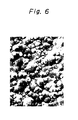
- Fig. 6 is shown the photograph (magnification 1000 times) of observation of the high P - B electroless plating coating. It is understood from the comparison of these drawings that the structure of low P - low B electroless plating coating became fine and dense.
- Fig. 4 is shown a photograph (magnification 1000 times) of observation of the post shot-blasting
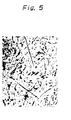
- Fig. 5 is shown a photograph (magnification 1000 times) of observation of the post barrel-polishing. It is understood that these treatments furthermore refine and densify the structure.
- the laser irradiation employed in the third method of the present invention is a treatment in which the electroless Ni-P-B plating coating is instantaneously and locally melted; as a result, the heat of melt is withdrawn by the surrounding Ni-P-B and substrate and the melt solidifies. In this case, since the melting occurs locally, the heat absorption withdrawal amount from the melt is very large so that the solidification occurs at a high rate. As a result, P and B are forcibly dissolved in the Ni crystals to harden them and refine the crystal grains.
- the kind of laser is not limited. YAG pulse laser having from approximately 100 to 400 W/cm 2 (beam area) of output can be preferably used.
- An appropriate jig is used in the operation of laser irradiation to relatively displace a laser gun and a sliding member in such a manner that spots are successively irradiated on the sliding portions of the latter.
- the laser irradiation condition was as follows.
- the high-frequency heat-treatment employed in the fourth method of the present invention is to carry out the above-mentioned forced solution of P and B by means of the high-frequency induction heating. It is necessary in the high-frequency heating that the temperature of the aluminum-alloy material is maintained at preferably 200°C or lower and, further, the temperature of the plating coating does not exceed the Curie point of Ni (631K), so as not to concentrate the eddy current in the plating coating but let the eddy current flow as much as possible in the materials. Frequency of the high frequency is preferably 70 kHz or more.
- an electroless Ni-P-B plating coating is hardened by high-frequency heat treatment.
- Frequency 100 kHz
- Output of high frequency 80 kW
- Electroless Ni-P plating coating 0.02 mm of thickness Hardness of plating coating (Hv) P Content (wt%) B Content (wt%) Before high-frequency heat treatment After high-frequency heat treatment 1.5 0.02 660 865 2.2 0.02 650 820 3.6 0.03 610 750 (6.2 0.05 570 640) (2.5 0.05* 540 615)
- the low P - low B added electroless Ni plating coating to which the above-mentioned first through fourth treatments are applied, can have enhanced adhesivity with the substrate material
- medium or high P electroless Ni-P plating coating may be applied as the underlying coating.
- orientation of the high P-type electroless Ni-P plating coating is low and the relative (111) intensity is approximately 60% at the highest.
- the orientation of the low P - low B type electroless Ni plating coating which is formed in contact with the underlying coating, is slightly lowered under the influence of the latter.
- the medium-or high-P coating is, therefore, used as the underlying coating of the low-P/low-B type electroless Ni plating coating in a case where the orientation may be sacrified but the adhesivity should be improved.
- the P content of the high P electroless Ni-P plating coating is preferably from 0.5 to 15% by weight, more preferably from 5 to 8% by weight. From 0.1 to 1.0% by weight of Co may be added.
- the low-P and low-B type electroless Ni plating coating, to which the inventive first through fourth treatment methods are applied, can also be heat-treated to surface-harden and hence to enhance the wear resistance.
- Figure. 7 is a graph showing the relationship between the heat treating temperature (1 hour holding) and surface hardness of an electroless Ni-P-B plating coating which contains 2.8% by weight of P and 0.02% by weight of B.
- Figure. 8 is a graph showing the relationship between the hardness of the aluminum alloy substrate and the heat-treating temperature.
- the surface hardness was obtained by using a Vickers hardness tester (0.1 kg of load), and hardness was obtained by using a Rockwell B harness tester. The hardness was obtained by measuring the surface hardness of the respective samples. That is, the fact that the indentation depth is different depending upon the measuring load, is utilized to differentiate the measuring depth.
- the symbols ⁇ , ⁇ ⁇ , ⁇ in Figs. 7 and 8 indicate three samples. It is understood from these drawings that, although the surface hardness is slightly increased by heat treatment, the hardness of the aluminum-alloy substrate virtually does not change at the heat-treating temperature of 220°C or lower.
- Figure 9 is a graph showing the relationship between the P and B contents and the surface hardness of electroless Ni-P-B plating coating which contains 2.8 to 12% by weight of P and 0.02% by weight of B, and the heat-treating time at 200°C. It is understood from this drawing that, when the P content of the electroless Ni-P-B plating coating is as low as 2.8% by weight, its surface hardness is elevated to approximately Hv 1000 at prolonged holding of 20 hours or longer.
- Al-Si eutectic powder to which a large amount of heavy metals such as Fe, Ni, Mo and the like is added, and which is shaped by the powder-metallurgical method.
- Such powder-metallugically shaped material is sold under the trade name of SHORIK (Showa Denko K.K.) and Sumialtaco (Sumitomo Electric Co., Ltd.)
- the pre-treatments are successively carried out to enhance the adhesivity of electroless Ni-P-B plating coating on the aluminum-alloy material.
- Alkali degreasing 50°C x 5 minutes with the use of alkaline degreasing agent
- Alkali etching 50°C x 40 seconds, NaOH bath
- Removal of smut 27°C x 40 seconds, detergent bath mainly composed of nitric acid
- Zinc-replacing plating treatment (1) (27°C x 25 seconds, zincate bath) Peeling of zinc (270°C x 60 seconds, 50% nitric acid) Zinc-replacing plating treatment (2) (27°C x 25 seconds, zincate bath)
- the as-treated surface may be used as the sliding surface.
- the polishing treatment and the like may be carried out.
- the materials as treated above can be used as vanes of a rotary compressor, radial plane bearings, thrust plane bearings and the like.
- the aluminum-alloy materials treated by the methods of the present invention were tested under conditions which reproduced a load high and local contact. Result of the test is next described.
- FIG. 10 is a schematic drawing for illustrating the test method in the present examples.
- 10 is an aluminum alloy material (AHS-3-T 7 ) treated by the inventive methods and the comparative methods
- 11 is a block (A 390 aluminum-alloy, and the average particle diameter of 30 ⁇ m of primary Si crystals).
- the material 10 is 35 x 14 x 3 mm in size.
- the angle ⁇ 1°
- the load P was 150 kgf (15.3N)
- the testing time was 5 hours
- the reciprocating sliding frequency was 10 Hz
- the stroke was 6 mm
- the oil feeding was 30 mL/h.
- the materials were not subjected to the above described pre-surface treatments or subjected to the pre-surface treatments, followed by forming on the entire surface a 15 ⁇ m thick electroless plating coating which had 2.8% by weight of P content and 0.02% by weight of B content.
- the ingredients of the plating liquor were nickel sulfate, hypophosphorous acid, sodium hydroxide, cobalt sulfate and the like.
- the pH and temperature of the plating liquor were 6.5 and 80°C, respectively.
- the post-plating surface hardness was Hv 710.
- the surface treatments used for the test were as follows.
- Example 1 The materials treated in Examples 1 and 2 (Treatment 1) were mounted in an actual compressor as vanes, and the wear test was carried out under the following conditions.
- Testing machine rotary type compressor (actual machine was used as a tester) Rotation number: 800 rpm Exhausting power/Suction pressure(kg/cm 2 ): 28/4.0 Exhausting temperature/Suction temperature (°C): 127/24 Time: 100 hours
- the wear amount of the vanes were 1 - 2 ⁇ m and very slight.
- the low-P type electroless Ni-P-B plating coating provided by the present invention is superior in sliding property to the conventional coating of the same kind, the former coating can enhance the sliding performance of the sliding parts, which are liable to be in one-sided contact and are used under high local load. The reliability of various machines and apparatuses such as a compressor can, therefore, be enhanced.
Landscapes
- Chemical & Material Sciences (AREA)
- Engineering & Computer Science (AREA)
- Mechanical Engineering (AREA)
- General Chemical & Material Sciences (AREA)
- Chemical Kinetics & Catalysis (AREA)
- Materials Engineering (AREA)
- Metallurgy (AREA)
- Organic Chemistry (AREA)
- General Engineering & Computer Science (AREA)
- Chemically Coating (AREA)
Description
Kind of laser: YAG pulse
Output of laser: 100 - 400 W/cm2
Diameter of laser beam: 2 cm
Scanning speed of laser: 10cm/sec
Electroless Ni-P-B plating coating: 20µm of thickness
| Hardness of plating coating (Hv) | |||
| P Content (wt%) | B Content (wt%) | Before laser irradiation | After laser irradiation |
| 1.5 | 0.02 | 660 | 850 |
| 2.2 | 0.02 | 650 | 810 |
| 3.6 | 0.03 | 610 | 745 |
| (6.2 | 0.05* | 570 | 640) |
| (2.5 | 0.05* | 540 | 615) |
Frequency: 100 kHz
Output of high frequency: 80 kW
Electroless Ni-P plating coating: 0.02 mm of thickness
| Hardness of plating coating (Hv) | |||
| P Content (wt%) | B Content (wt%) | Before high-frequency heat treatment | After high-frequency heat treatment |
| 1.5 | 0.02 | 660 | 865 |
| 2.2 | 0.02 | 650 | 820 |
| 3.6 | 0.03 | 610 | 750 |
| (6.2 | 0.05 | 570 | 640) |
| (2.5 | 0.05* | 540 | 615) |
Alkali degreasing (50°C x 5 minutes with the use of alkaline degreasing agent)
Alkali etching (50°C x 40 seconds, NaOH bath)
Removal of smut (27°C x 40 seconds, detergent bath mainly composed of nitric acid)
Zinc-replacing plating treatment (1) (27°C x 25 seconds, zincate bath)
Peeling of zinc (270°C x 60 seconds, 50% nitric acid)
Zinc-replacing plating treatment (2) (27°C x 25 seconds, zincate bath)
Kind of polishing media: polyester resin + zirkon
Amount of polishing media: 1.5 kg
Amount of liquid: 1.0 kg (water)
Number of materials: 20
Volume of rotary vessel: 0.01m3
Rotation number of rotary vessel: 200 rpm
Treating time: 5 minutes
Material of shot grains: Al2O3, hardness Hv 1000
Diameter of shot grains: 200 µm in average
Projecting speed of shots: 150 m/second
Projecting amount: 50kg/m2/sec
Kind of laser: YAG pulse (product of Toshiba)
Output of laser: 10 kW
Output per beam diameter: 100 - 400 W/m2
Heat treatment was carried out at 200°C for 60 minutes.
Heat treatment was carried out at 200°C for 60 minutes.
Treatment 2 was then carried out.
Heat treatment was carried out at 200°C for 60 minutes.
Treatment 3 was then carried out. A 15 µm-thick electroless Ni-P-B plating coating, the composition of which was 0.5% by weight of Co and 0.1% by weight of W being added to the above-described electroless Ni-P-B plating coating, was formed on the 2 µm thick intermediate plating coaing. This coating was plated by using plating liquid produced by Okuno Seiyaku Industries (trade name - TOPNICKORON TOM) having 6% by weight of P content. The following surface treatments were then carried out.
| Treatment method | Post treating surface hardness (Hv) | Specific wear amount of test specimens (10-9mm2kg-1) | Specific wear amount of block (10-9mm2kg-1) | Remarks |
| P | 710 | 4.5 | 1.0 | Invention only plating |
| 1 | 750 | 4.3 | 1.0 | Invention |
| 2 | 780 | 4.1 | 1.0 | Invention |
| 3 | 790 | 3.6 | 1.0 | Invention |
| 4 | 820 | 3.3 | 0.9 | Invention |
| 5 | 850 | 3.1 | 0.9 | Invention |
| 6 | 810 | 3.8 | 1.0 | Invention |
| 7 | 755 | 3.5 | 0.8 | Invention |
| 8 | 800 | 3.2 | 0.7 | Invention |
| 9 | 810 | 3.2 | 0.8 | |
| 10 | 850 | 2.9 | 0.7 | |
| 11 | 870 | 2.6 | 0.6 | |
| 12 | 830 | 2.9 | 0.8 | Invention |
| a | 670 | 5.8 | 1.2 | Comparative |
| b | 637 | 12.0 | 3.5 | Comparative |
| c | 599 | 9.0 | 2.0 | Comparative |
Testing machine: rotary type compressor (actual machine was used as a tester)
Rotation number: 800 rpm
Exhausting power/Suction pressure(kg/cm2): 28/4.0
Exhausting temperature/Suction temperature (°C): 127/24
Time: 100 hours
Claims (12)
- A sliding member characterized in that an electroless Ni-P-B plating coating containing from 0.05 to 5% by weight of P and from 0.01 to 0.04% by weight of B is formed on the sliding surface of the material consisting of an aluminum alloy.
- A sliding member according to claim 1, characterized in that said aluminum alloy contains at least one of from 0.1 to 1.0% by weight of Co and from 0.05 to 1.0% by weight of W.
- A sliding member according to claim 1 or 2, characterized in that, as an underlying layer of said electroless Ni-P-B plating coating, an underlying electroless Ni-P plating coating, having more than 5% by weight of the P content and 15% by weight of the P content, is applied.
- A surface treatment method of a sliding member characterized in that a barrel polishing treatment is applied on an electroless Ni-P-B plating coating containing from 0.05 to 5% by weight of P and from 0.01 to 0.04% by weight of B formed on the material consisting of an aluminum alloy.
- A surface treatment method of a sliding member characterized in that a shot-blasting treatment is applied on an electroless Ni-P-B plating coating containing from 0.05 to 5% by weight of P and from 0.01 to 0.04% by weight of B formed on the material consisting of an aluminum alloy.
- A surface treatment method of a sliding member according to claim 4, wherein said shot blasting treatment is carried out by projecting grains, which have approximately the same hardness as or higher hardness than that of said electroless Ni-P-B plating coating, at a speed of 80 m/sec or more.
- A surface treatment method of a sliding member characterized in that a laser beam is irradiated on an electroless Ni-P-B plating coating containing from 0.05 to 5% by weight of P and from 0.01 to 0.04% by weight of B formed on the material consisting of an aluminum alloy.
- A surface treatment method of a sliding member characterized in that a high-frequency induction heating is applied to an electroless Ni-P-B plating coating containing from 0.05 to 5% by weight of P and from 0.01 to 0.04% by weight of B formed on the material consisting of an aluminum alloy.
- A surface treatment method according to any one of claims 4 through 8, characterized in that said electroless Ni-P-B plating coating contains at least one of from 0.1 to 1.0% by weight of Co and from 0.05 to 1.0% by weight of W.
- A surface treatment method according to any one of claims 3 through 9, characterized in that, as an underlying layer of said electroless Ni-P-B plating coating, an underlying electroless Ni-P plating-coating, having more than 5% by weight of of the P content and 15% by weight of the P content, is applied.
- A surface treatment method according to any one of claims 1 through 8, characterized in that, a heat treatment at 100 - 200°C is applied to said electroless Ni-P-B plating coating.
- A vane of a rotary compressor, wherein the sliding member treated by any one of the methods 3 through 11 is used as the vane.
Applications Claiming Priority (5)
| Application Number | Priority Date | Filing Date | Title |
|---|---|---|---|
| JP2103697 | 1997-01-20 | ||
| JP2103697 | 1997-01-20 | ||
| JP23170297 | 1997-08-13 | ||
| JP23170297 | 1997-08-13 | ||
| PCT/JP1998/000185 WO1998031849A1 (en) | 1997-01-20 | 1998-01-20 | Sliding member, method of treating surface of the sliding member and rotary compressor vane |
Publications (3)
| Publication Number | Publication Date |
|---|---|
| EP0927776A1 EP0927776A1 (en) | 1999-07-07 |
| EP0927776A4 EP0927776A4 (en) | 2001-01-10 |
| EP0927776B1 true EP0927776B1 (en) | 2005-06-01 |
Family
ID=26358046
Family Applications (1)
| Application Number | Title | Priority Date | Filing Date |
|---|---|---|---|
| EP98900430A Expired - Lifetime EP0927776B1 (en) | 1997-01-20 | 1998-01-20 | Sliding member, method of treating surface of the sliding member and rotary compressor vane |
Country Status (6)
| Country | Link |
|---|---|
| US (1) | US6146774A (en) |
| EP (1) | EP0927776B1 (en) |
| JP (1) | JP3231336B2 (en) |
| KR (1) | KR100504205B1 (en) |
| DE (1) | DE69830381T2 (en) |
| WO (1) | WO1998031849A1 (en) |
Cited By (1)
| Publication number | Priority date | Publication date | Assignee | Title |
|---|---|---|---|---|
| CN103834936A (en) * | 2012-11-27 | 2014-06-04 | 大连经济技术开发区圣洁真空技术开发有限公司 | Ni-P chemical composite plating process |
Families Citing this family (15)
| Publication number | Priority date | Publication date | Assignee | Title |
|---|---|---|---|---|
| EP0927776B1 (en) * | 1997-01-20 | 2005-06-01 | Taiho Kogyo Co., Ltd. | Sliding member, method of treating surface of the sliding member and rotary compressor vane |
| JP3457519B2 (en) | 1997-09-19 | 2003-10-20 | 株式会社日立産機システム | Oil-free scroll compressor and method of manufacturing the same |
| JP2003184743A (en) * | 2001-12-12 | 2003-07-03 | Toyota Industries Corp | Swash plate compressor shoe and swash plate compressor provided with the same |
| JP5104208B2 (en) * | 2007-10-24 | 2012-12-19 | 株式会社Ihi | Abrasion-resistant reinforcing method and sliding structure |
| US8794941B2 (en) | 2010-08-30 | 2014-08-05 | Oscomp Systems Inc. | Compressor with liquid injection cooling |
| US9267504B2 (en) | 2010-08-30 | 2016-02-23 | Hicor Technologies, Inc. | Compressor with liquid injection cooling |
| JP5700846B2 (en) * | 2012-03-28 | 2015-04-15 | 本田技研工業株式会社 | Internal combustion engine |
| ITCO20120015A1 (en) | 2012-04-12 | 2013-10-13 | Nuovo Pignone Srl | METHOD FOR THE PREVENTION OF CORROSION AND COMPONENT OBTAINED THROUGH THIS METHOD |
| US9885347B2 (en) | 2013-10-30 | 2018-02-06 | Emerson Climate Technologies, Inc. | Components for compressors having electroless coatings on wear surfaces |
| WO2016147310A1 (en) | 2015-03-17 | 2016-09-22 | 三菱重工業株式会社 | Impeller for rotary machine, compressor, turbocharger, and method for manufacturing impeller for rotary machine |
| JP2017222922A (en) * | 2016-06-17 | 2017-12-21 | アイテック株式会社 | Method for surface modification of plating film |
| JP6951175B2 (en) * | 2017-09-25 | 2021-10-20 | 株式会社ヴァレオジャパン | Sliding member for compressor |
| DE102017125096B4 (en) | 2017-10-26 | 2022-05-19 | Hanon Systems | Method of making a scroll compressor and scroll compressor made with the method |
| JP7232452B2 (en) * | 2018-09-03 | 2023-03-03 | アイテック株式会社 | Plating film surface modification method and apparatus |
| CN115786912B (en) * | 2022-06-28 | 2023-11-07 | 同济大学 | A method for preparing composite modified layer by combining laser two-step method and electroless plating process |
Family Cites Families (13)
| Publication number | Priority date | Publication date | Assignee | Title |
|---|---|---|---|---|
| US4042382A (en) * | 1974-12-10 | 1977-08-16 | Rca Corporation | Temperature-stable non-magnetic alloy |
| JPS51109224A (en) * | 1975-03-20 | 1976-09-28 | Satosen Co Ltd | TAINETSUSEICHOKO GOKINHIFUKUOJUSURU KOZOTAI |
| JPS5252828A (en) * | 1975-10-27 | 1977-04-28 | Sumitomo Metal Ind | Continuous casting mould for iron and steel |
| JPS5250733A (en) * | 1975-10-21 | 1977-04-23 | Furukawa Electric Co Ltd:The | Preparation of sleeve |
| JPS5549939A (en) * | 1978-09-30 | 1980-04-11 | Tokyo Shibaura Electric Co | Stabilized power supply system |
| JPS63109182A (en) * | 1986-10-24 | 1988-05-13 | Mazda Motor Corp | Production of wear resistant member |
| JP2631658B2 (en) * | 1987-06-15 | 1997-07-16 | 中央発條株式会社 | Surface treatment method of steel spring |
| JPH0261024A (en) * | 1988-08-27 | 1990-03-01 | Furukawa Alum Co Ltd | Heat-resistant and wear-resistant aluminum alloy material and its manufacture |
| JP3354567B2 (en) * | 1990-07-17 | 2002-12-09 | 大豊工業株式会社 | Plain bearing |
| JP3027515B2 (en) * | 1994-11-29 | 2000-04-04 | 日本カニゼン株式会社 | Ni-PB-based electroless plating film and mechanical parts using this film |
| JPH08290213A (en) * | 1995-04-20 | 1996-11-05 | Sumitomo Metal Ind Ltd | Manufacturing method of metal double tube |
| JPH10196531A (en) * | 1997-01-07 | 1998-07-31 | Zexel Corp | Variable displacement swash plate compressor and surface treatment method thereof |
| EP0927776B1 (en) * | 1997-01-20 | 2005-06-01 | Taiho Kogyo Co., Ltd. | Sliding member, method of treating surface of the sliding member and rotary compressor vane |
-
1998
- 1998-01-20 EP EP98900430A patent/EP0927776B1/en not_active Expired - Lifetime
- 1998-01-20 WO PCT/JP1998/000185 patent/WO1998031849A1/en not_active Ceased
- 1998-01-20 US US09/155,108 patent/US6146774A/en not_active Expired - Lifetime
- 1998-01-20 JP JP53411998A patent/JP3231336B2/en not_active Expired - Fee Related
- 1998-01-20 KR KR1019980707352A patent/KR100504205B1/en not_active Expired - Fee Related
- 1998-01-20 DE DE69830381T patent/DE69830381T2/en not_active Expired - Lifetime
Cited By (1)
| Publication number | Priority date | Publication date | Assignee | Title |
|---|---|---|---|---|
| CN103834936A (en) * | 2012-11-27 | 2014-06-04 | 大连经济技术开发区圣洁真空技术开发有限公司 | Ni-P chemical composite plating process |
Also Published As
| Publication number | Publication date |
|---|---|
| EP0927776A4 (en) | 2001-01-10 |
| KR20000064641A (en) | 2000-11-06 |
| US6146774A (en) | 2000-11-14 |
| WO1998031849A1 (en) | 1998-07-23 |
| DE69830381D1 (en) | 2005-07-07 |
| EP0927776A1 (en) | 1999-07-07 |
| DE69830381T2 (en) | 2005-10-13 |
| KR100504205B1 (en) | 2006-01-12 |
| JP3231336B2 (en) | 2001-11-19 |
Similar Documents
| Publication | Publication Date | Title |
|---|---|---|
| US6146774A (en) | Sliding member, method for treating surface of the sliding member and rotary compressor vane | |
| US4927715A (en) | Overlay alloy used for a surface layer of sliding material | |
| EP0505172A1 (en) | Wear-resistant copper-base alloy | |
| JPWO2008111617A1 (en) | Plain bearing | |
| EP0577062B1 (en) | Oil pump made of aluminum alloys | |
| JPWO1998031849A1 (en) | Sliding member, surface treatment method therefor, and rotary compressor vane | |
| JPH03219098A (en) | Compositely plated film of sliding member | |
| JPH09118985A (en) | Nonelectrolytic nickel/cobalt/phosphorus composition and plating method | |
| US3779720A (en) | Plasma sprayed titanium carbide tool steel coating | |
| Raghavendra et al. | Wear and material characterization of CuSn10 additively manufactured using directed energy deposition | |
| GB2369162A (en) | Multi-layered plain bearing and method of production | |
| JP3066798B2 (en) | Surface treatment method for sliding members | |
| CN108326285B (en) | powder for laser additive manufacturing of iron-based alloy with tough inside and hard outside and wear resistance | |
| KR101049679B1 (en) | Iron-based parts and its manufacturing method | |
| JPH03149304A (en) | Valve lifter made of aluminium alloy | |
| WO2004085705A1 (en) | Sliding material | |
| Sasaki | Tribological properties of coating films synthesised by laser assisted plasma spraying | |
| JP3009527B2 (en) | Aluminum material excellent in wear resistance and method for producing the same | |
| JPH04331817A (en) | Sliding bearing having composite plating film | |
| JPS63109182A (en) | Production of wear resistant member | |
| JP3664100B2 (en) | Aluminum pulley | |
| CN1080770C (en) | Wear-resistant die-cast aluminum alloy | |
| JPH0480991B2 (en) | ||
| JP3218956B2 (en) | Surface treatment method for aluminum material and treated film | |
| Dong et al. | A new hybrid process for surface modification by combining brush plating with nitrocarburizing |
Legal Events
| Date | Code | Title | Description |
|---|---|---|---|
| PUAI | Public reference made under article 153(3) epc to a published international application that has entered the european phase |
Free format text: ORIGINAL CODE: 0009012 |
|
| 17P | Request for examination filed |
Effective date: 19980919 |
|
| AK | Designated contracting states |
Kind code of ref document: A1 Designated state(s): DE |
|
| RBV | Designated contracting states (corrected) |
Designated state(s): DE |
|
| A4 | Supplementary search report drawn up and despatched |
Effective date: 20001128 |
|
| AK | Designated contracting states |
Kind code of ref document: A4 Designated state(s): DE |
|
| 17Q | First examination report despatched |
Effective date: 20040405 |
|
| GRAP | Despatch of communication of intention to grant a patent |
Free format text: ORIGINAL CODE: EPIDOSNIGR1 |
|
| GRAS | Grant fee paid |
Free format text: ORIGINAL CODE: EPIDOSNIGR3 |
|
| GRAA | (expected) grant |
Free format text: ORIGINAL CODE: 0009210 |
|
| AK | Designated contracting states |
Kind code of ref document: B1 Designated state(s): DE |
|
| REF | Corresponds to: |
Ref document number: 69830381 Country of ref document: DE Date of ref document: 20050707 Kind code of ref document: P |
|
| PLBE | No opposition filed within time limit |
Free format text: ORIGINAL CODE: 0009261 |
|
| STAA | Information on the status of an ep patent application or granted ep patent |
Free format text: STATUS: NO OPPOSITION FILED WITHIN TIME LIMIT |
|
| 26N | No opposition filed |
Effective date: 20060302 |
|
| PGFP | Annual fee paid to national office [announced via postgrant information from national office to epo] |
Ref country code: DE Payment date: 20140115 Year of fee payment: 17 |
|
| REG | Reference to a national code |
Ref country code: DE Ref legal event code: R119 Ref document number: 69830381 Country of ref document: DE |
|
| PG25 | Lapsed in a contracting state [announced via postgrant information from national office to epo] |
Ref country code: DE Free format text: LAPSE BECAUSE OF NON-PAYMENT OF DUE FEES Effective date: 20150801 |