EP0924682A1 - System for displaying data on a screen - Google Patents
System for displaying data on a screen Download PDFInfo
- Publication number
- EP0924682A1 EP0924682A1 EP98123026A EP98123026A EP0924682A1 EP 0924682 A1 EP0924682 A1 EP 0924682A1 EP 98123026 A EP98123026 A EP 98123026A EP 98123026 A EP98123026 A EP 98123026A EP 0924682 A1 EP0924682 A1 EP 0924682A1
- Authority
- EP
- European Patent Office
- Prior art keywords
- cell
- cells
- line
- screen
- cmn
- Prior art date
- Legal status (The legal status is an assumption and is not a legal conclusion. Google has not performed a legal analysis and makes no representation as to the accuracy of the status listed.)
- Withdrawn
Links
- 238000000034 method Methods 0.000 claims abstract description 15
- 230000015654 memory Effects 0.000 claims description 32
- 101100259988 Chlamydomonas reinhardtii TUBG gene Proteins 0.000 claims description 3
- 101150024649 TFG2 gene Proteins 0.000 claims description 3
- 101150034969 tfg1 gene Proteins 0.000 claims description 3
- 101150032536 FL1 gene Proteins 0.000 claims 2
- 101001062535 Homo sapiens Follistatin-related protein 1 Proteins 0.000 description 2
- 101001122162 Homo sapiens Overexpressed in colon carcinoma 1 protein Proteins 0.000 description 2
- 102100027063 Overexpressed in colon carcinoma 1 protein Human genes 0.000 description 2
- 238000010586 diagram Methods 0.000 description 2
- 239000011159 matrix material Substances 0.000 description 2
- 230000008520 organization Effects 0.000 description 2
- 239000003086 colorant Substances 0.000 description 1
- 238000011161 development Methods 0.000 description 1
- 230000018109 developmental process Effects 0.000 description 1
- 230000006870 function Effects 0.000 description 1
Images


Classifications
-
- G—PHYSICS
- G09—EDUCATION; CRYPTOGRAPHY; DISPLAY; ADVERTISING; SEALS
- G09G—ARRANGEMENTS OR CIRCUITS FOR CONTROL OF INDICATING DEVICES USING STATIC MEANS TO PRESENT VARIABLE INFORMATION
- G09G5/00—Control arrangements or circuits for visual indicators common to cathode-ray tube indicators and other visual indicators
- G09G5/42—Control arrangements or circuits for visual indicators common to cathode-ray tube indicators and other visual indicators characterised by the display of patterns using a display memory without fixed position correspondence between the display memory contents and the display position on the screen
-
- G—PHYSICS
- G09—EDUCATION; CRYPTOGRAPHY; DISPLAY; ADVERTISING; SEALS
- G09G—ARRANGEMENTS OR CIRCUITS FOR CONTROL OF INDICATING DEVICES USING STATIC MEANS TO PRESENT VARIABLE INFORMATION
- G09G5/00—Control arrangements or circuits for visual indicators common to cathode-ray tube indicators and other visual indicators
- G09G5/22—Control arrangements or circuits for visual indicators common to cathode-ray tube indicators and other visual indicators characterised by the display of characters or indicia using display control signals derived from coded signals representing the characters or indicia, e.g. with a character-code memory
- G09G5/30—Control of display attribute
-
- G—PHYSICS
- G09—EDUCATION; CRYPTOGRAPHY; DISPLAY; ADVERTISING; SEALS
- G09G—ARRANGEMENTS OR CIRCUITS FOR CONTROL OF INDICATING DEVICES USING STATIC MEANS TO PRESENT VARIABLE INFORMATION
- G09G5/00—Control arrangements or circuits for visual indicators common to cathode-ray tube indicators and other visual indicators
- G09G5/36—Control arrangements or circuits for visual indicators common to cathode-ray tube indicators and other visual indicators characterised by the display of a graphic pattern, e.g. using an all-points-addressable [APA] memory
- G09G5/39—Control of the bit-mapped memory
Definitions
- the invention relates to a method for displaying screen elements on a reproduction screen according to the preamble of Patent Claim 1.
- the first method is based on the display of characters and the second method is based on the display of pixels.
- the character form of the individual characters is stored in a ROM table and all the character attributes such as foreground/background colour, flashing, etc. are calculated by a character generator and implemented for an entire character, an entire column or an entire screen.
- Graphical images can be realized exclusively by means of a dynamically alterable character set. This means that instead of a predetermined character memory, such as a ROM, the character matrix has to be processed in a dynamic alterable manner in a RAM.
- a predetermined character memory such as a ROM
- a character-based screen display system generally requires little use of software, a small RAM, but, on the other hand, complex hardware and is limited in terms of its possibilities for displaying graphical elements.
- Window technology and vertical shifting are pixel-oriented. Overwriting windows or objects are usually realized using multiple-level technology.
- a pixel-based screen display system generally requires very complex software, large memories, but relatively simple hardware. Whole-picture-frame pixel graphics can advantageously be created.
- the invention is based on the object of specifying a method for displaying characters which has flexibility in the method of display and requires simple hardware.
- a specific number of pixels of a reproduction line are combined horizontally to form a cell.
- a cell may comprise for example 4, 6, 8 or 12 pixels.
- the number of pixels combined to form a cell is determined by a superordinate reproduction mode.
- the length of a cell is preferably constant, for example the length is determined by the processing width of a microprocessor that is used, and is thus 32 bits wide given a 32-bit processor. Consequently, the width can be 64 bits if a 64-bit processor is used. However, division into 2 x 32 bits or 4 x 16 bits is likewise possible.
- attributes such as colour, foreground and background colour, flashing or transparency display may also be contained in a cell, in addition to the pixel contents.
- the cells are stored in a picture memory with a respective dedicated, assigned address.
- the required storage capacity is equal to the requisite number of cells of the reproduction mode chosen.
- the addressing of the cells in the memory takes place linearly.
- the number of addresses corresponds to the number of cells to be reproduced.
- linear addressing which is obtained by the inventive storage of the cells advantageously affords a reduction in hardware complexity.
- the latter can easily be defined by simple addressing. It is thus possible to shift or to copy entire objects or to scroll screen areas.
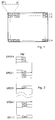
- Figure 1 shows a reproduction screen with cell display.
- the screen display consists of lines L 1 - L m . n cells C 11 - C 1n to C m1 - C mn are present per line L 1 - L m .
- Each cell C 11 - C mn contains j pixels P 1 - P j .
- the area of a screen can be described by a total of m x n cells.
- Figure 2 shows a picture memory PM, in which the cells C 11 - C mn are stored linearly. It is possible for particular entry points EP for specific objects to be defined which are newly evaluated in each line. Thus, for a first object (No. 0), the picture memory PM starts with the entry point EP0m1 and has its last entry point EP0m1 at the beginning of the last line, if the first object involves the entire contents of the screen. In Figure 2, an entry point EP111 at the end of the picture memory area for the first object indicates that a picture memory area for a second object (No. 1) follows.
- a character for example a letter
- corresponding cells which are arranged vertically one above the other in the case of the screen display have to be stored in the picture memory PM after the corresponding entry points with an offset in the memory.
- the lines are read out without an offset, that is to say linearly as they are displayed from left to right.
- the offset corresponds to the number of cells up to the horizontal recommencement of the character to be displayed, and is a constant value given a desired horizontal pixel and colour resolution.
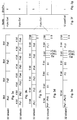
- Figures 3a to 3g show an exemplary embodiment of a cell organization given the use of a 32-bit processor.
- the first cell is constructed by four pixels Pa1 - Pa4, each pixel having 8-bit resolution.
- Figure 3f specifies the number of pixels per cell of the cell organization proposed, and Figure 3g specifies the associated resolution per pixel Bits/Pix.
- a second cell is constructed by 8 pixels Pb1 - Pb8, each pixel having 4-bit resolution.
- a third cell is constructed by 6 pixels Pc1 to Pc6 with a resolution of in each case 5 bits per pixel. The last two bits may serve to identify the type of cell.
- a fourth cell likewise has 6 pixels Pd1 - Pd6.
- the pixels Pd1 - Pd6 are followed by a block R1 having 6 bits which serves as a reserve, for example.
- a block F1 which may serve to determine the foreground colour.
- the next block B1 may serve to define the background colour.
- Both blocks F1 and B1 are each 5 bits wide.
- the following 3 bits are attributes, in this exemplary embodiment the first bit R2 serving as a reserve, the next bit TBG1 serving for a setting as transparent background and the third bit TFG1 serving as transparent foreground.
- a block FL1 which is 5 bits wide and may contain information regarding a flashing mode. The last two bits in this case also serve the purpose of identification again.
- the cells illustrated in Figures 3c and 3d are preferably used for teletext display or for the mixed mode of picture and text.
- a fifth cell is constructed by 12 pixels each having a resolution of 1 bit per pixel. This is followed by blocks similar to those in Figure 3d, namely 5 bits for foreground colour F2, 5 bits for background colour B2, 1 reserve bit R3, 1 bit for transparent background TBG2, 1 bit for transparent foreground TFG2, 5 bits for a flashing mode FL2 as well as 2 identification bits.
- This example may preferably be used in a 32-bit computer system.
- the cells proposed in the example can be processed twice in one computation step.
- Other cell structures are conceivable depending on the type of application and/or on the computer architecture used.
- Figure 4 shows a block diagram of an object processing device. Objects are to be understood as those elements which are to be processed independently, irrespective of other picture contents.
- Each object is written cell by cell to the picture memory PM.
- Objects can be part of the main picture or part of another object.
- the main picture can also be regarded as an independent object.
- each object preferably occupies a picture memory area which is separately assigned to it.
- the object processing device is constructed as follows.
- the four corner points of an object on the screen are stored in position memories VSTAn for the vertical start position, VENDn for the vertical end position, HSTAn for the horizontal start position and HENDn for the horizontal end position.
- the base object address BOA which refers to the first cell of an object and thus represents the address in the picture memory PM is specified in an address memory BOAn.
- the position memories VSTAn and VENDn are connected to a first comparator CP1 and the position memories HSTAn and HENDn are connected to a second comparator CP2.
- the data of a line counter TVLC are fed to the first comparator CP1 and the data of a cell counter LCC are fed to the second comparator CP2.
- the object cell counter OCCn is activated in that the signal IN is fed to the AND gate 10, to whose second input a cell clock signal CCL is applied. This clock signal CCL corresponds to the cell read-out clock signal.
- the output of the AND gate 10 is connected to a control input of the object cell counter OCCn.
- the position memory VENDn is connected to the address memory BOAn via a control line RLD. Data outputs of the address memory BOAn leads to the object cell counter OCCn.
- the object cell counter OCCn is set to the value of the address memory BOAn if the value of the line counter TVLC exceeds the value of the position memory VENDn. This resetting is effected via the control line RLD between position memory VENDn and address memory BOAn.
- the cell clock signal CCLn which is fed to the AND gate 10 simultaneously serves as counting signal for the cell counter LCC and the line counter TVLC.
- the cell counter LCC counts from 0 - 127, for example, if a line is described by 128 cells, and the line counter TVLC counts from 0 - 259 in the case of a TV system having 260 active lines.
- the data of the cell counter LCC and of the line counter TVLC are fed to an address multiplexer, which switches through either the addresses from the object cell counter or those from the counters TVLC and LCC, depending on the signal "IN".
- the output signal of the address multiplexer 11 then supplies an address of the picture memory in accordance with Figure 2.
- Each object to be displayed requires its own object processing device. However, the structure is identical for each object processing device. If a plurality of objects are present in one line, a simple priority logic arrangement activates one object processing device after the other.
- the number of object processing devices is arbitrary, depending on the desired diversity or available chip area. Parts of the object processing device, such as, for example, the line counter TVLC, the cell counter LCC and the address multiplexer, can be combined to form a cell access address generator CAAG and preferably be used jointly for the remaining parts of the object processing devices.
- the object processing elements VSTA, HSTA, VEND, HEND, BOA and OCC are combined to form an object processing device OH (Object Handler).
- Figure 5 shows an illustration of the processing of different objects.
- Identically constructed object processing devices OH1 ... OHn are present altogether.
- the individual object processing devices OH1 ... OHn are connected to the outputs of the line counter TVLC and of the cell counter LCC of the cell access address generator CAAG.
- the content of the object cell counter OCCN and the IN signal are then fed to the cell access address generator CAAG via a priority control PC.
- the object cell counter OCCN is within the object window - the IN signal is active - the multiplexer OCCn switches through as addressing for the picture memory PM.
- Figure 6 shows an example of a storage arrangement of two objects O1, O2.
- the object O1 represents the total available visible screen.
- the picture memory PM is then read out with the data of the object O1 until, at the instant VSTA2 / HSTA2, a further object O2 is to be displayed.
- the data at the address a, determined by the object cell counter OCC1 are read out and reproduced on the screen. This is done until the instant tb.
- the object processing device reveals for the object O1 that the content of the active line AL lies outside the area of the object O1.
- the priority control PC then switches to the next object processing device, responsible for the object O2.
- the memory area b which is defined by the object cell counter OCC2, is then read out. This is done until the instant tc, since here it is again established that the content of the active line AL lies outside the area of the object O2.
- the priority control PC then switches back again to the object processing device for the object O1 at the instant tc of the object cell counter OCC1.
Landscapes
- Engineering & Computer Science (AREA)
- Physics & Mathematics (AREA)
- Computer Hardware Design (AREA)
- General Physics & Mathematics (AREA)
- Theoretical Computer Science (AREA)
- Controls And Circuits For Display Device (AREA)
- Transforming Electric Information Into Light Information (AREA)
Applications Claiming Priority (2)
| Application Number | Priority Date | Filing Date | Title |
|---|---|---|---|
| DE19756365A DE19756365A1 (de) | 1997-12-18 | 1997-12-18 | Bildschirmdarstellungssystem |
| DE19756365 | 1997-12-18 |
Publications (1)
| Publication Number | Publication Date |
|---|---|
| EP0924682A1 true EP0924682A1 (en) | 1999-06-23 |
Family
ID=7852415
Family Applications (1)
| Application Number | Title | Priority Date | Filing Date |
|---|---|---|---|
| EP98123026A Withdrawn EP0924682A1 (en) | 1997-12-18 | 1998-12-07 | System for displaying data on a screen |
Country Status (8)
| Country | Link |
|---|---|
| US (1) | US6642937B2 (enExample) |
| EP (1) | EP0924682A1 (enExample) |
| JP (1) | JPH11259058A (enExample) |
| KR (1) | KR100569805B1 (enExample) |
| CN (1) | CN1097814C (enExample) |
| DE (1) | DE19756365A1 (enExample) |
| MY (1) | MY121705A (enExample) |
| ZA (1) | ZA9811329B (enExample) |
Families Citing this family (3)
| Publication number | Priority date | Publication date | Assignee | Title |
|---|---|---|---|---|
| DE10330329A1 (de) * | 2003-07-04 | 2005-02-17 | Micronas Gmbh | Verfahren zur Darstellung von Teletextseiten auf einer Anzeigevorrichtung |
| US20050280659A1 (en) * | 2004-06-16 | 2005-12-22 | Paver Nigel C | Display controller bandwidth and power reduction |
| US20110234636A1 (en) * | 2010-03-24 | 2011-09-29 | Dsp Group Ltd. | Method and integrated circuit for image manipulation |
Citations (3)
| Publication number | Priority date | Publication date | Assignee | Title |
|---|---|---|---|---|
| US4752893A (en) * | 1985-11-06 | 1988-06-21 | Texas Instruments Incorporated | Graphics data processing apparatus having image operations with transparent color having a selectable number of bits |
| GB2226938A (en) * | 1986-06-04 | 1990-07-11 | Apple Computer | Video display apparatus |
| EP0601535A2 (en) * | 1992-12-07 | 1994-06-15 | Brooktree Corporation | Apparatus for, and methods of, providing a universal format of pixels and for scaling fields in the pixels |
Family Cites Families (6)
| Publication number | Priority date | Publication date | Assignee | Title |
|---|---|---|---|---|
| GB2207029A (en) * | 1987-07-14 | 1989-01-18 | Silicongraphics Inc | Computer system for converting a higher resolution image to a lower resolution image |
| GB2218881B (en) * | 1988-05-16 | 1992-07-22 | Ardent Computer Corp | Graphics control planes |
| JPH02134687A (ja) * | 1988-11-15 | 1990-05-23 | Sharp Corp | 表示制御装置 |
| US6208325B1 (en) * | 1993-10-01 | 2001-03-27 | Cirrus Logic, Inc. | Image rotation for video displays |
| US5539428A (en) * | 1993-12-30 | 1996-07-23 | Cirrus Logic, Inc. | Video font cache |
| US5598181A (en) * | 1994-09-26 | 1997-01-28 | Xerox Corporation | Method and apparatus for rotating a digital image ninety degrees using a small auxiliary buffer |
-
1997
- 1997-12-18 DE DE19756365A patent/DE19756365A1/de not_active Withdrawn
-
1998
- 1998-12-02 KR KR1019980052628A patent/KR100569805B1/ko not_active Expired - Fee Related
- 1998-12-07 EP EP98123026A patent/EP0924682A1/en not_active Withdrawn
- 1998-12-09 MY MYPI98005558A patent/MY121705A/en unknown
- 1998-12-10 ZA ZA9811329A patent/ZA9811329B/xx unknown
- 1998-12-14 US US09/211,230 patent/US6642937B2/en not_active Expired - Fee Related
- 1998-12-15 CN CN98122845A patent/CN1097814C/zh not_active Expired - Fee Related
- 1998-12-16 JP JP10357876A patent/JPH11259058A/ja not_active Withdrawn
Patent Citations (3)
| Publication number | Priority date | Publication date | Assignee | Title |
|---|---|---|---|---|
| US4752893A (en) * | 1985-11-06 | 1988-06-21 | Texas Instruments Incorporated | Graphics data processing apparatus having image operations with transparent color having a selectable number of bits |
| GB2226938A (en) * | 1986-06-04 | 1990-07-11 | Apple Computer | Video display apparatus |
| EP0601535A2 (en) * | 1992-12-07 | 1994-06-15 | Brooktree Corporation | Apparatus for, and methods of, providing a universal format of pixels and for scaling fields in the pixels |
Also Published As
| Publication number | Publication date |
|---|---|
| US6642937B2 (en) | 2003-11-04 |
| KR100569805B1 (ko) | 2006-09-27 |
| ZA9811329B (en) | 1999-06-14 |
| CN1097814C (zh) | 2003-01-01 |
| DE19756365A1 (de) | 1999-06-24 |
| HK1020098A1 (en) | 2000-03-10 |
| KR19990062737A (ko) | 1999-07-26 |
| CN1229970A (zh) | 1999-09-29 |
| US20020089510A1 (en) | 2002-07-11 |
| JPH11259058A (ja) | 1999-09-24 |
| MY121705A (en) | 2006-02-28 |
Similar Documents
| Publication | Publication Date | Title |
|---|---|---|
| US4490797A (en) | Method and apparatus for controlling the display of a computer generated raster graphic system | |
| US4907174A (en) | Z-buffer allocated for window identification | |
| US5515494A (en) | Graphics control planes for windowing and other display operations | |
| US4591842A (en) | Apparatus for controlling the background and foreground colors displayed by raster graphic system | |
| US5493637A (en) | Video buffer recycling method and apparatus | |
| JPS62191918A (ja) | デ−タ表示方法及びデ−タ表示制御装置 | |
| JPH04106593A (ja) | 静止画像表示装置およびそれに用いる外部記憶装置 | |
| JPS6049391A (ja) | ラスタ走査表示システム | |
| EP0215984A1 (en) | Graphic display apparatus with combined bit buffer and character graphics store | |
| US5050102A (en) | Apparatus for rapidly switching between output display frames using a shared frame gentification memory | |
| US4677574A (en) | Computer graphics system with low memory enhancement circuit | |
| EP0951694B1 (en) | Method and apparatus for using interpolation line buffers as pixel look up tables | |
| EP0924682A1 (en) | System for displaying data on a screen | |
| US5870074A (en) | Image display control device, method and computer program product | |
| GB2223651A (en) | Overwriting display memory without clearing speeds computer animation | |
| US6249273B1 (en) | Method of and device for displaying characters with a border | |
| US5847700A (en) | Integrated apparatus for displaying a plurality of modes of color information on a computer output display | |
| EP0413363A2 (en) | Circuit for generating data of a letter to be displayed on a screen | |
| JPS6150318B2 (enExample) | ||
| US4647923A (en) | True object generation system and method for a video display generator | |
| US6002391A (en) | Display control device and a method for controlling display | |
| JPH0469908B2 (enExample) | ||
| JP3292960B2 (ja) | フレーム・バッファに記憶されている画素データをコンピュータ装置の出力表示装置に表示する画素データへ翻訳する回路 | |
| JPS6194090A (ja) | グラフイツクデイスプレイ装置 | |
| JPH0337025Y2 (enExample) |
Legal Events
| Date | Code | Title | Description |
|---|---|---|---|
| PUAI | Public reference made under article 153(3) epc to a published international application that has entered the european phase |
Free format text: ORIGINAL CODE: 0009012 |
|
| AK | Designated contracting states |
Kind code of ref document: A1 Designated state(s): DE FR GB IE IT |
|
| AX | Request for extension of the european patent |
Free format text: AL;LT;LV;MK;RO;SI |
|
| 17P | Request for examination filed |
Effective date: 19991105 |
|
| AKX | Designation fees paid |
Free format text: DE FR GB IE IT |
|
| RIN1 | Information on inventor provided before grant (corrected) |
Inventor name: SCHWEER, RAINER Inventor name: GYARMATI, SANDOR |
|
| RAP1 | Party data changed (applicant data changed or rights of an application transferred) |
Owner name: THOMSON |
|
| RAP1 | Party data changed (applicant data changed or rights of an application transferred) |
Owner name: THOMSON LICENSING, S.A. |
|
| RAP1 | Party data changed (applicant data changed or rights of an application transferred) |
Owner name: THOMSON LICENSING |
|
| STAA | Information on the status of an ep patent application or granted ep patent |
Free format text: STATUS: THE APPLICATION IS DEEMED TO BE WITHDRAWN |
|
| 18D | Application deemed to be withdrawn |
Effective date: 20090701 |