EP0921738B1 - Method and equipment for rapid manufacture of loop material - Google Patents
Method and equipment for rapid manufacture of loop material Download PDFInfo
- Publication number
- EP0921738B1 EP0921738B1 EP97934972A EP97934972A EP0921738B1 EP 0921738 B1 EP0921738 B1 EP 0921738B1 EP 97934972 A EP97934972 A EP 97934972A EP 97934972 A EP97934972 A EP 97934972A EP 0921738 B1 EP0921738 B1 EP 0921738B1
- Authority
- EP
- European Patent Office
- Prior art keywords
- sheet
- fibers
- forming
- portions
- forming member
- Prior art date
- Legal status (The legal status is an assumption and is not a legal conclusion. Google has not performed a legal analysis and makes no representation as to the accuracy of the status listed.)
- Expired - Lifetime
Links
- 239000000463 material Substances 0.000 title claims description 80
- 238000000034 method Methods 0.000 title claims description 38
- 238000004519 manufacturing process Methods 0.000 title description 8
- 239000000835 fiber Substances 0.000 claims description 168
- 238000001816 cooling Methods 0.000 claims description 27
- 239000012815 thermoplastic material Substances 0.000 claims description 25
- 230000002093 peripheral effect Effects 0.000 claims description 23
- 238000010438 heat treatment Methods 0.000 claims description 8
- 238000009960 carding Methods 0.000 claims description 7
- -1 etc. Polymers 0.000 description 7
- 239000007788 liquid Substances 0.000 description 6
- 229920001169 thermoplastic Polymers 0.000 description 5
- 239000004416 thermosoftening plastic Substances 0.000 description 5
- 239000004743 Polypropylene Substances 0.000 description 4
- 229920001155 polypropylene Polymers 0.000 description 4
- 230000000717 retained effect Effects 0.000 description 4
- VYZAMTAEIAYCRO-UHFFFAOYSA-N Chromium Chemical compound [Cr] VYZAMTAEIAYCRO-UHFFFAOYSA-N 0.000 description 3
- 239000000853 adhesive Substances 0.000 description 3
- 230000001070 adhesive effect Effects 0.000 description 3
- 239000010432 diamond Substances 0.000 description 3
- XLYOFNOQVPJJNP-UHFFFAOYSA-N water Substances O XLYOFNOQVPJJNP-UHFFFAOYSA-N 0.000 description 3
- 239000004698 Polyethylene Substances 0.000 description 2
- 239000011248 coating agent Substances 0.000 description 2
- 238000000576 coating method Methods 0.000 description 2
- 239000007921 spray Substances 0.000 description 2
- 241000251468 Actinopterygii Species 0.000 description 1
- 241000272517 Anseriformes Species 0.000 description 1
- 101100008050 Caenorhabditis elegans cut-6 gene Proteins 0.000 description 1
- 241000086550 Dinosauria Species 0.000 description 1
- 239000004831 Hot glue Substances 0.000 description 1
- 241001465754 Metazoa Species 0.000 description 1
- 230000003466 anti-cipated effect Effects 0.000 description 1
- 230000015572 biosynthetic process Effects 0.000 description 1
- 238000007664 blowing Methods 0.000 description 1
- 239000005025 cast polypropylene Substances 0.000 description 1
- 229910003460 diamond Inorganic materials 0.000 description 1
- 230000000694 effects Effects 0.000 description 1
- 229920001971 elastomer Polymers 0.000 description 1
- 239000000806 elastomer Substances 0.000 description 1
- 239000012634 fragment Substances 0.000 description 1
- 230000006698 induction Effects 0.000 description 1
- 238000009940 knitting Methods 0.000 description 1
- 239000011159 matrix material Substances 0.000 description 1
- 239000000155 melt Substances 0.000 description 1
- 238000002844 melting Methods 0.000 description 1
- 230000008018 melting Effects 0.000 description 1
- 238000005065 mining Methods 0.000 description 1
- 238000012986 modification Methods 0.000 description 1
- 230000004048 modification Effects 0.000 description 1
- 229920000573 polyethylene Polymers 0.000 description 1
- 229920005989 resin Polymers 0.000 description 1
- 239000011347 resin Substances 0.000 description 1
- 238000005507 spraying Methods 0.000 description 1
- 229920006224 tie layer resin Polymers 0.000 description 1
- 238000009941 weaving Methods 0.000 description 1
- 238000005303 weighing Methods 0.000 description 1
Images



Classifications
-
- D—TEXTILES; PAPER
- D04—BRAIDING; LACE-MAKING; KNITTING; TRIMMINGS; NON-WOVEN FABRICS
- D04H—MAKING TEXTILE FABRICS, e.g. FROM FIBRES OR FILAMENTARY MATERIAL; FABRICS MADE BY SUCH PROCESSES OR APPARATUS, e.g. FELTS, NON-WOVEN FABRICS; COTTON-WOOL; WADDING ; NON-WOVEN FABRICS FROM STAPLE FIBRES, FILAMENTS OR YARNS, BONDED WITH AT LEAST ONE WEB-LIKE MATERIAL DURING THEIR CONSOLIDATION
- D04H13/00—Other non-woven fabrics
- D04H13/001—Making non-woven fabrics from staple fibres, filaments or yarns, bonded to at least one web-like material, e.g. woven, knitted non-woven fabric, paper, leather, during consolidation
- D04H13/007—Making non-woven fabrics from staple fibres, filaments or yarns, bonded to at least one web-like material, e.g. woven, knitted non-woven fabric, paper, leather, during consolidation strengthened or consolidated by welding together the various components
-
- C—CHEMISTRY; METALLURGY
- C08—ORGANIC MACROMOLECULAR COMPOUNDS; THEIR PREPARATION OR CHEMICAL WORKING-UP; COMPOSITIONS BASED THEREON
- C08J—WORKING-UP; GENERAL PROCESSES OF COMPOUNDING; AFTER-TREATMENT NOT COVERED BY SUBCLASSES C08B, C08C, C08F, C08G or C08H
- C08J5/00—Manufacture of articles or shaped materials containing macromolecular substances
- C08J5/18—Manufacture of films or sheets
-
- A—HUMAN NECESSITIES
- A44—HABERDASHERY; JEWELLERY
- A44B—BUTTONS, PINS, BUCKLES, SLIDE FASTENERS, OR THE LIKE
- A44B18/00—Fasteners of the touch-and-close type; Making such fasteners
- A44B18/0003—Fastener constructions
- A44B18/0011—Female or loop elements
-
- B—PERFORMING OPERATIONS; TRANSPORTING
- B32—LAYERED PRODUCTS
- B32B—LAYERED PRODUCTS, i.e. PRODUCTS BUILT-UP OF STRATA OF FLAT OR NON-FLAT, e.g. CELLULAR OR HONEYCOMB, FORM
- B32B27/00—Layered products comprising a layer of synthetic resin
- B32B27/12—Layered products comprising a layer of synthetic resin next to a fibrous or filamentary layer
-
- B—PERFORMING OPERATIONS; TRANSPORTING
- B32—LAYERED PRODUCTS
- B32B—LAYERED PRODUCTS, i.e. PRODUCTS BUILT-UP OF STRATA OF FLAT OR NON-FLAT, e.g. CELLULAR OR HONEYCOMB, FORM
- B32B3/00—Layered products comprising a layer with external or internal discontinuities or unevennesses, or a layer of non-planar shape; Layered products comprising a layer having particular features of form
- B32B3/26—Layered products comprising a layer with external or internal discontinuities or unevennesses, or a layer of non-planar shape; Layered products comprising a layer having particular features of form characterised by a particular shape of the outline of the cross-section of a continuous layer; characterised by a layer with cavities or internal voids ; characterised by an apertured layer
- B32B3/28—Layered products comprising a layer with external or internal discontinuities or unevennesses, or a layer of non-planar shape; Layered products comprising a layer having particular features of form characterised by a particular shape of the outline of the cross-section of a continuous layer; characterised by a layer with cavities or internal voids ; characterised by an apertured layer characterised by a layer comprising a deformed thin sheet, i.e. the layer having its entire thickness deformed out of the plane, e.g. corrugated, crumpled
-
- B—PERFORMING OPERATIONS; TRANSPORTING
- B32—LAYERED PRODUCTS
- B32B—LAYERED PRODUCTS, i.e. PRODUCTS BUILT-UP OF STRATA OF FLAT OR NON-FLAT, e.g. CELLULAR OR HONEYCOMB, FORM
- B32B38/00—Ancillary operations in connection with laminating processes
- B32B38/0012—Mechanical treatment, e.g. roughening, deforming, stretching
-
- B—PERFORMING OPERATIONS; TRANSPORTING
- B32—LAYERED PRODUCTS
- B32B—LAYERED PRODUCTS, i.e. PRODUCTS BUILT-UP OF STRATA OF FLAT OR NON-FLAT, e.g. CELLULAR OR HONEYCOMB, FORM
- B32B5/00—Layered products characterised by the non- homogeneity or physical structure, i.e. comprising a fibrous, filamentary, particulate or foam layer; Layered products characterised by having a layer differing constitutionally or physically in different parts
- B32B5/02—Layered products characterised by the non- homogeneity or physical structure, i.e. comprising a fibrous, filamentary, particulate or foam layer; Layered products characterised by having a layer differing constitutionally or physically in different parts characterised by structural features of a fibrous or filamentary layer
- B32B5/04—Layered products characterised by the non- homogeneity or physical structure, i.e. comprising a fibrous, filamentary, particulate or foam layer; Layered products characterised by having a layer differing constitutionally or physically in different parts characterised by structural features of a fibrous or filamentary layer characterised by a layer being specifically extensible by reason of its structure or arrangement, e.g. by reason of the chemical nature of the fibres or filaments
-
- D—TEXTILES; PAPER
- D04—BRAIDING; LACE-MAKING; KNITTING; TRIMMINGS; NON-WOVEN FABRICS
- D04H—MAKING TEXTILE FABRICS, e.g. FROM FIBRES OR FILAMENTARY MATERIAL; FABRICS MADE BY SUCH PROCESSES OR APPARATUS, e.g. FELTS, NON-WOVEN FABRICS; COTTON-WOOL; WADDING ; NON-WOVEN FABRICS FROM STAPLE FIBRES, FILAMENTS OR YARNS, BONDED WITH AT LEAST ONE WEB-LIKE MATERIAL DURING THEIR CONSOLIDATION
- D04H11/00—Non-woven pile fabrics
- D04H11/08—Non-woven pile fabrics formed by creation of a pile on at least one surface of a non-woven fabric without addition of pile-forming material, e.g. by needling, by differential shrinking
-
- B—PERFORMING OPERATIONS; TRANSPORTING
- B32—LAYERED PRODUCTS
- B32B—LAYERED PRODUCTS, i.e. PRODUCTS BUILT-UP OF STRATA OF FLAT OR NON-FLAT, e.g. CELLULAR OR HONEYCOMB, FORM
- B32B2307/00—Properties of the layers or laminate
- B32B2307/70—Other properties
- B32B2307/726—Permeability to liquids, absorption
- B32B2307/7265—Non-permeable
-
- B—PERFORMING OPERATIONS; TRANSPORTING
- B32—LAYERED PRODUCTS
- B32B—LAYERED PRODUCTS, i.e. PRODUCTS BUILT-UP OF STRATA OF FLAT OR NON-FLAT, e.g. CELLULAR OR HONEYCOMB, FORM
- B32B2555/00—Personal care
- B32B2555/02—Diapers or napkins
-
- Y—GENERAL TAGGING OF NEW TECHNOLOGICAL DEVELOPMENTS; GENERAL TAGGING OF CROSS-SECTIONAL TECHNOLOGIES SPANNING OVER SEVERAL SECTIONS OF THE IPC; TECHNICAL SUBJECTS COVERED BY FORMER USPC CROSS-REFERENCE ART COLLECTIONS [XRACs] AND DIGESTS
- Y10—TECHNICAL SUBJECTS COVERED BY FORMER USPC
- Y10T—TECHNICAL SUBJECTS COVERED BY FORMER US CLASSIFICATION
- Y10T156/00—Adhesive bonding and miscellaneous chemical manufacture
- Y10T156/10—Methods of surface bonding and/or assembly therefor
- Y10T156/1002—Methods of surface bonding and/or assembly therefor with permanent bending or reshaping or surface deformation of self sustaining lamina
- Y10T156/1007—Running or continuous length work
-
- Y—GENERAL TAGGING OF NEW TECHNOLOGICAL DEVELOPMENTS; GENERAL TAGGING OF CROSS-SECTIONAL TECHNOLOGIES SPANNING OVER SEVERAL SECTIONS OF THE IPC; TECHNICAL SUBJECTS COVERED BY FORMER USPC CROSS-REFERENCE ART COLLECTIONS [XRACs] AND DIGESTS
- Y10—TECHNICAL SUBJECTS COVERED BY FORMER USPC
- Y10T—TECHNICAL SUBJECTS COVERED BY FORMER US CLASSIFICATION
- Y10T156/00—Adhesive bonding and miscellaneous chemical manufacture
- Y10T156/10—Methods of surface bonding and/or assembly therefor
- Y10T156/1002—Methods of surface bonding and/or assembly therefor with permanent bending or reshaping or surface deformation of self sustaining lamina
- Y10T156/1007—Running or continuous length work
- Y10T156/1008—Longitudinal bending
Definitions
- the present invention relates to methods and equipment for making sheets of loop materials adapted to be cut into pieces to form the loop portions for fasteners of the type including releasably engageable hook and loop portions that can be used on garments such as disposable diapers.
- sheets of loop materials are known that are adapted to be cut into pieces to form the loop portions for fasteners of the type comprising releasably engageable hook and loop portions.
- Such sheets of loop materials typically comprise a backing and a multiplicity of loops formed from longitudinally oriented polymeric fibers bonded to or anchored in the backing and projecting from a front surface of the backing so that they may be releasably engaged with the hooks on the hook portion of such a fastener, and can be made by many methods including conventional weaving, or knitting techniques.
- Sheets of loop materials in which the loops are stitched into the backing are described in U.S. Patents Nos. 4,609,581 and 4,770,917.
- loop fastener portions made from many such sheets of loop materials work well with many different hook fastener portions, many of the processes by which the sheets of loop material are made are more expensive than may be desired, particularly when the loop fastener portions are intended for a limited amount of use, such as to attach a disposable diaper, brief or garment to a person.
- U.S. Patent No. 5,256,231 discloses a sheet of loop material and a method and equipment for making it that provide effective loop fastener portions for such fasteners while being very inexpensive to manufacture either in a form intended for a limited amount of use, such as to releasably attach a disposable diaper or other disposable garment to a person, or in a form intended to be used a larger number of times.
- That sheet of loop material includes a backing comprising a thermoplastic backing layer with generally uniform morphology, and a sheet of longitudinally oriented fibers having generally non-deformed anchor portions bonded or fused in the thermoplastic backing layer at spaced bonding locations, and arcuate portions projecting from a front surface of the backing between the bonding locations; and is made by forming a sheet of longitudinally oriented polymeric fibers so that the sheet of fibers has arcuate portions projecting in the same direction from spaced anchor portions of the sheet of fibers, and then forming at least a portion of a backing around the spaced anchor portions of the sheet of fibers by extruding thermoplastic material onto the anchor portions of the sheet of fibers so that the arcuate portions of the sheet of fibers project from a front surface of the newly formed backing.
- Such forming of the sheet of fibers is done by providing first and second generally cylindrical corrugating or forming members each including a plurality of uniformly spaced ridges defining its periphery, mounting the corrugating members in axially parallel relationship with portions of the ridges of the corrugating members in mesh with each other, rotating at least one of the corrugating members, feeding the sheet of fibers between the meshed portions of the ridges of the rotating corrugating members to generally conform the sheet of fibers to the periphery of the first corrugating member, thereby forming the arcuate portions of the sheet of fibers in spaces between the ridges of the first corrugating member and the anchor portions of the sheet of fibers along outer surfaces of the ridges of the first corrugating member, and retaining the formed sheet of fibers along the periphery of the first corrugating member after it has moved past the meshing portions of the ridges.
- At least a portion of the backing is then formed around the anchor portions of the sheet of fibers by extruding the molten thermoplastic material onto the anchor portions of the sheet of fibers while those anchor portions are on the end surfaces of the ridges on the first corrugating member.
- U.S. Patent No. 5,256,231 discloses that the ridges of the corrugating members can be elongate and generally parallel so that the bonding locations are also elongate and generally parallel and are continuous in one direction across the front surface of the backing so that continuous rows of the arcuate portions extend across the backing of the sheet of loop material; or alternately the ridges can be elongate, generally parallel, and in a regular pattern of discontinuous lengths so that the parallel bonding locations are also in a regular pattern of discontinuous lengths to form a regular pattern of discontinuous rows of the arcuate portions of the sheet of fibers along the front surface of the backing. Also, U.S. Patent No.
- the ridges of the first corrugating member could form interlocking closed patterns (e.g., in the shape of circles, diamonds, octagons, letters, numbers, etc.) to form corresponding patterns for the arcuate portions of the fibers along the front surface of the backing, in which case the second corrugating member would be formed with post like ridges to press the sheet of fibers into the centers of the closed patterns.
- interlocking closed patterns e.g., in the shape of circles, diamonds, octagons, letters, numbers, etc.
- this form of the corrugating or forming members can be used to form suitable loop materials when used as disclosed in U.S. Patent No. 5,256,231.
- the present invention provides improvements in the method and equipment contemplated in U.S. Patent No. 5,256,231 (Gorman et al) for forming interlocking closed patterns (e.g., in the shape of circles, diamonds, hexagons, octagons, rectangles, letters, numbers, bird, fish or animal shapes such as ducks or dinosaurs, etc.) for the arcuate portions of fibers along the front surface of a backing that facilitate its use at the high speeds desired for production equipment (e.g., preferably at least 0.8 meters per second)
- interlocking closed patterns e.g., in the shape of circles, diamonds, hexagons, octagons, rectangles, letters, numbers, bird, fish or animal shapes such as ducks or dinosaurs, etc.
- a method for forming a sheet of loop material adapted to be cut into pieces to form loop portions for fasteners of the type having releasably engageable hook and loop portions which method, includes the steps of:
- the step of providing the elongate sheet of fibers may comprise the step of carding cut fibers to provide a sheet of fibers having a basis weight in the range of 30 to 50 grams per square meter with over 90% of the fibers extending longitudinally of the sheet. Furthermore, the sheet of backing material may be printed with graphics along one of its surfaces prior to the positioning step.
- the lattice surface and the recessed surfaces defining the sockets are shaped so that they will not engage and pull fibers from the sheet of fibers
- the first forming member has surfaces defining air passageways through the recessed surfaces within the sockets
- the formed sheet of fibers is retained along the peripheral surface of the first forming member for a predetermined distance after movement past the meshing portions of the posts and recessed surfaces primarily by drawing air through those air passageways.
- the first forming member can be heated so that it will not act as a heat sink and solidify the thermoplastic material before the extruded thermoplastic material and the anchor portions of the fibers are fully bonded together.
- the peripheral surface of the first forming member in contact with the formed sheet of fibers may preferably be heated to a temperature in the range of about 49 to 204°C or 120 to 400°F.
- a source of heated air substantially above ambient temperature can be supplied to be drawn into the air passageways so that the fibers can be retained in their desired shape and the air being drawn into the air passageways will not cool the first forming member below its desired temperature.
- a preferred temperature range for the heated air is between about 49 to 204°C or 120 to 400°F.
- the heated air may be recycled to provide at least a portion of the source of heated air.
- thermoplastic material will have less time in contact with the first forming member so that it will have less heat sink effect, however, heating of the first forming member and the air being drawn into the air passageways should still be desirable.
- thermoplastic material and the fibers may comprise the same thermoplastic material and the extruding step may fuse the thermoplastic material extruded onto the anchor portions of the sheet of fibers to the surface of the fibers.
- the method may further include a step of moving the sheet of loop material for a predetermined distance around the periphery of the cooling roll past the nip with the backing of the sheet of loop material in contact with the cooling roll to cool and solidify the backing. Furthermore, the molten thermoplastic material may contact the peripheral surface of the cooling roller so that the cooling roller forms a rear surface for the backing opposite the sheet of fibers. The method may further include feeding a sheet of backing material along the peripheral surface of the cooling roller so that the sheet of backing material moves through the nip, and the molten thermoplastic material contacts and adheres to a major surface of the sheet of backing material opposite the cooling roll to incorporate the sheet of backing material in the backing.
- the means for providing the elongate sheet of fibers comprises a carding machine for carding cut fibers to provide to sheet of fibers. It is also possible that the means for providing the elongate sheet of fibers comprises a spunbond machine for producing fibers from resin to provide the sheet of fibers.
- the lattice surface on the intersecting ridges should have widths of at least 0.06 centimeter or 0.025 inch and should be disposed to define an array of inlet openings to the sockets (e.g., hexagonal, rectangular, diamond shaped, or circular openings) with the inlet openings to the sockets having a width in the range of about 0.25 to 1.3 centimeters (0.1 to 0.5 inch).
- the lattice surfaces may have a generally uniform width in the range of about 0.06 to 0.10 cm (0.025 to 0.04 in).
- a sheet material formed by the above method can have arcuate portions of fibers along and projecting above a front surface of a liquid impermeable breathable backing layer.
- Such sheet materials can be used as the loop fastener portion of a hook and loop attachment system that could be used on a disposable diaper.
- the breathable but liquid impermeable sheet of loop material produced could be used as the entire outer backsheet of a disposable diaper, thereby providing, with the use of a length of hook material, both part of means for refastenably attaching the diaper to a person and means for securing the diaper in a tightly wrapped condition for disposal after the diaper has been soiled.
- the length of hook material is of a polymeric material and has one end portion thermally bonded to the backing layer.
- Figure 1 schematically illustrates a first embodiment of a method and equipment according to the present invention for forming a sheet of loop material 10 (see Figure 5) adapted to be cut into pieces to form loop portions for fasteners of the type having releasably engageable hook and loop portions.
- the method generally comprises forming longitudinally oriented polymeric fibers into an elongate sheet 12 of fibers, forming the sheet 12 of fibers so that it has arcuate portions 14 projecting in the same direction from anchor portions 15 of the sheet 12 of fibers, and bonding the spaced anchor portions 15 of the sheet of fibers 12 in a backing layer 16 with the arcuate portions 14 of the sheet 12 of fibers projecting from the front surface of the backing layer 16.
- the elongate sheet 12 of fibers can be formed from cut polymeric fibers using a carding machine 17.
- the sheet 12 of fibers is then formed by providing first and second generally cylindrical forming members or rollers 18 and 19.
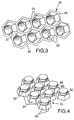
- the first forming roller 18 includes an outer shell 23 having a peripheral surface (Figure 3 illustrates a small segment of the peripheral surface of the first forming roller 18) including a lattice surface 20 on intersecting ridges, a multiplicity of recessed surfaces defining sockets 21 in a predetermined pattern recessed from the lattice surface 20, and surfaces defining air passageways 22 generally centrally through the recessed surfaces within the sockets 21 that extend to the inner surface of the shell 23.
- the second forming roller 19 ( Figure 4 illustrates a small segment of the peripheral surface of the second forming roller 19) includes a multiplicity of posts 24 radially projecting in the same predetermined pattern in which the sockets 21 are disposed and having distal end portions adapted to project into the sockets 21 in meshing relationship with the sheet 12 of fibers therebetween.
- the forming rollers 18 and 19 are mounted in axially parallel relationship with some of the posts 24 in meshing relationship with some of the sockets 21 in the manner of gear teeth.
- the forming rollers 18 and 19 are rotated and the sheet 12 of fibers is fed longitudinally between the meshed portions of the posts 24 and sockets 21 to generally conform the sheet 12 of fibers to the periphery of the first forming roller 18, thereby forming the arcuate portions 14 of the sheet 12 of fibers in the spaces between the distal ends of the posts 24 and the recessed surfaces defining the sockets 21 and the anchor portions 15 of the sheet 12 of fibers along the lattice surface 20.
- the formed sheet 12 of fibers is then retained along the peripheral surface of the first forming roller 18 for a predetermined distance after movement past the meshing portions of the posts 24 and sockets 21 primarily by drawing air into the first forming roller 18 through the air passageways 22.
- Molten thermoplastic material melted in an extruder 26 is extruded through a slot die 27 onto the anchor portions 15 of the sheet 12 of fibers along that predetermined distance to form at least a portion of the backing layer 16 around the anchor portions 15 of the sheet 12 of fibers with the arcuate portions 14 of the sheet 12 of fibers projecting from a front surface of the backing layer 16.
- the thermoplastic material in the backing layer 16 is then cooled and solidified by passing it around the surface of a cooling roll 30.
- the extruder could be adapted so that the extrudate is multi layer with tie layer resins known to those skilled in the art such as EAA, EVA, PE, etc., or an elastomer layer with polypropylene skins.
- the peripheral shell 23 of the first forming roller 18 is heated (e.g., to about 127 degrees Centigrade or 260 degrees Fahrenheit) by fixed radiant heaters 32 and 33 on its opposite sides, so that the peripheral shell 23 will not act as a heat sink which solidifies the thermoplastic material before the extruded thermoplastic material and the anchor portions of the fibers are fully bonded together.
- the inner surface of the shell 23 has a black oxide coating to facilitate heating by the heater 33 which is the primary heat source.
- a chrome coating on the peripheral surface of the forming roller, that aids release of the formed sheet of fibers, is resistive to heating by the radiant heater 32.
- Air heated to a temperature substantially above ambient temperature is supplied along the peripheral surface of the shell 23 between the second forming roller 19 and the cooling roller 30 to prevent the first forming roller 18 from being cooled excessively by air being drawn into the air passageways 22 to help retain the formed sheet 12 of fibers along that peripheral surface.
- That heated air is supplied along that peripheral surface by a heater fan 38 blowing the air through a heater 39 and out a nozzle 40 spaced closely above it so that heated air will be drawn into the air passageways 22.
- the source of air for the heater fan 38 can be only the atmosphere as illustrated, or the heated air which is pulled through the air passageways 22 into the first forming roller 18 by a suction fan 36 can be recycled by means not shown to provide at least a portion or all of the supply air for the heater fan 38.
- the peripheral shell 23 could be heated by means other than the fixed heaters 32 and 33, such as induction heating.
- the first forming roller includes the outer shell 23, circular end plates 41 attached to the opposite ends of the shell 23, and bearings 42 that afford rotation of the shell 23 and circular end plates 41 on a hollow cylindrical shaft 43 included in a fixed central air handling portion 44.
- the fixed central air handling portion 44 includes means for allowing air to be pulled through the air passageways 22 along a portion of the shell 23 moving from the second forming roller 19 to the cooling roller 30, and for restricting movement of air into the air passageways 22 along the rest of the shell 23.
- That means includes two radially projecting axially extending baffles 46 mounted on the shaft 43 which extend from the shaft 43 to the inner surface of the shell 23, one extending toward the second forming roller 19 and the other extending toward the cooling roller 30, and an axially extending air inlet slot 48 through the shaft 43 between the baffles 46. Air can be pulled by the suction fan 36 through the air passageways 22 between the baffles 46 and through the slot 48 into the opening at the center of the shaft 43 which is connected by a hose 50 to the inlet to the suction fan 36.
- the means in the fixed central air handling portion 44 for restricting movement of air into the air passageways 22 along the rest of the shell 23 comprises the baffles 46 which separate those air passageways from the slot 48.
- the sockets 21 have hexagonal inlet openings and are disposed in an array so that the lattice surface 20 has a uniform width between the sockets 21. It has been found that to get good bonding between the fibers and the backing layer 16 along that lattice surface 20, the lattice surface 20 should have a width of at least 0.025 inch or 0.063 centimeter between adjacent sockets 21, with a width of at least about 0.028 inch or 0.071 centimeter between adjacent sockets 21 being preferred.
- the sockets are defined by planar surfaces disposed in hexagonal patterns, which planar surfaces are tapered inwardly toward the inner portions of the sockets 21, and the air passageways 22 are defined by a cylindrical surface.
- the air passageways 22 have a cross sectional area that is large compared to the area of the sockets 21 in the plane of the lattice surface 20, and could be almost as large as that inlet area.
- the surfaces defining the sockets 21 are smooth and are chrome plated to facilitate release of a formed sheet 12 of fibers from within the sockets.
- the posts 24 have hexagonal tapered side surfaces 60 around their bases and cylindrical surfaces 62 around their distal ends that are adapted to project into the sockets 21 with the sheet 12 of fibers therebetween.
- the posts 24 are disposed in the same array as the sockets 21.
- the first and second forming members are biased together with air cylinders (not shown) so that the sheet 12 of fibers provides the spacing between the surfaces of the posts 24 and sockets as the sheet 12 of moves therebetween. Alternatively, a fixed gap could provide that spacing.
- the surfaces 60 and 62 of the posts 24 are also smooth and chrome plated to facilitate release from the formed sheet 12 of fibers.
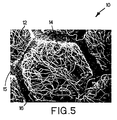
- Figure 5 is a photograph at 15 times magnification of a fragment of a sheet of loop material 10 according to the present invention that was made using the cavities 21 and posts 24 illustrated in Figures 3 and 4.
- the sheet of loop material 10 has arcuate portions 14 of the sheet 12 of fibers projecting in generally a hexagonal pattern in the same direction from anchor portions 15 of the sheet 12 of fibers, and spaced anchor portions 15 of the sheet of fibers 12 bonded in a backing layer 16 with the arcuate portions 14 of the sheet 12 of fibers projecting from the front surface of the backing layer 16.
- a sheet of loop material according to the present invention was made using the method illustrated in figure 1. Cut 6 denier polypropylene fibers 4.76 centimeters (1.875 inches) long obtained under the commercial designation "6d, T-110 1 7/8" from Hercules Inc., Covington, GA were formed, using the carding machine 17, into the longitudinal continuous sheet 12 of fibers which had a basis weight of 42 grams per square meter with the majority of the fibers (i.e. at least 90 percent) oriented in its longitudinal or machine direction. That sheet 12 of fibers was fed into the nip between the first and second forming rolls 18 and 19.
- the recessed surfaces defining the sockets and the posts 24 of the intermeshing forming rolls 18 and 19 were shaped to form along the length of the sheet 12 of fibers a honeycomb matrix of hexagonal pillowed projecting arcuate portions 14 of the sheet 12 of fibers, with each projecting arcuate portion 14 being hexagonal in shape around its periphery, about 5 mm wide, and 2 mm high, surrounded by an anchor portion 15 about 1 mm wide (see figures 4 and 5).
- the formed sheet 12 of fibers had a basis weight of 42 grams per square meter.
- Polypropylene material commercially designated Shell SRD7-560 was extruded by the extruder 26 through the die 27 at a melt temperature of 508 degrees F. and onto the anchor portions 15 of the formed sheet 12 of fibers at the nip between the first forming roller 18 and the cooling roller 30 in an amount appropriate to form a thermoplastic backing layer 16 weighing 50 grams per square meter with anchor portions 15 of the formed sheet 12 of fibers embedded therein.
- the outer shell 23 of the first forming roller 18 was heated by the heaters 32 and 33 to an outer surface temperature of approximately 263 F while running at a line speed of 60 fpm.
- Heating the outer surface of the first forming roller 18 was found necessary in order to securely bond the anchor portions 15 of the formed sheet 12 of fibers to the thermoplastic backing layer 16, with an outer surface temperature in the range of 260 to 268 degrees Fahrenheit or 127 to 131 degrees Centigrade being required under the conditions described above to get an adequate bond without melting the fibers in the arcuate portions 14 of the sheet 12 of fibers.
- the bond thus produced was uniform, translucent and film-like.
- air heated to about 104 degrees Centigrade or 220 degrees Fahrenheit was supplied at the surface of the first forming roll 18.
- the sheet of loop material 10 formed at the nip between the first forming roll 18 and the cooling roller 30 was then moved 200 degrees around the periphery of the cooling roller 30 which was at a temperature of about 32 degrees Centigrade or 90 degrees Fahrenheit to ensure adequate cooling of the thermoplastic backing layer 16.
- the resultant sheet of loop material 10 had soft, pillow like arcuate portions 14 due to the ability of air moving into the air passageways to hold the arcuate portions 14 of the formed sheet 12 of fibers away from the harsh heat of the molten thermoplastic material before it solidified.
- the finished sheet of loop material 10 was easily and firmly engaged by the hook material of the type described in U.S. Patent No. 4,894,060 issued Jan. 16, 1990.
- a sheet of loop material was formed in the same manner described in the above example except that the suction fan 36 was shut off so that no air was drawn through the air passageways 22.
- the sheet of loop material formed was not acceptable because acceptable uniform pillow-like projecting arcuate portions of the sheet of fibers could not be made at speeds greater than 0.3 meters per second.
- Loop material was formed in the same manner described in the above example, except that a 1.8 mil cast polypropylene film with a pre-printed pattern was fed around the cooling roll 30 along the path indicated by the dotted line 52 and became a portion of the backing layer 16 that was laminated by the extruded layer of thermoplastic material to the anchor portions 15 of the sheet 12 of fibers.
- the pre-printed pattern was found to be easily visible through the fibers.
- cut fibers could be used in the above example, particularly including cut bi-component fibers 4.76 centimeters (1.875 inches) long having a polyethylene sheath and a polypropylene core such as the fibers commercially designated 6d "T-425 1 7/8" available from Hercules Corporation, Wilmington, DE.
- Such fibers used at about the same basis weight to form a sheet of loop material that had improved bond strength and affinity for certain hook materials.
- the types and materials of the fibers that could be used in the sheet 12 of fibers, the basis weights for sheets 12 of fibers that could be used, and the material for the backing layer 16 are generally the same as those discussed in U.S. Patent No. 5,256,231 (Gorman et al).
- Figure 6 illustrates a second embodiment of a method and equipment for making a loop material 70 in which the method and equipment for forming the sheet of fibers and carrying it on the surface of the first forming roller 18 is the same as that described above and is indicated by the same reference numeral, but in which there is illustrated a different means for attaching a layer of material 72 to the anchor portions of the sheet of 12 fibers to form at least a portion of a backing attached to the anchor portions of the sheet of fibers with the arcuate portions of the sheet of fibers projecting from a front surface of the backing.
- the layer of material 72 which could be a woven or non-woven layer of fibers or a polymeric film that is either non-porous, porous, or microporous so that it is impermeable to liquid but passes air and vapor, is attached to those anchor portions in a nip either by heat and pressure applied by a heated roller 74, or, alternatively, by spraying an adhesive, such as a hot melt adhesive, from a spray assembly 76 over the surface of the layer of material 72 to be attached to the anchor portions.
- an adhesive such as a hot melt adhesive
- a sheet of loop material according to the present invention was made using the method illustrated in Figure 6.
- the longitudinal sheet 12 of fibers was formed in the same manner described in the first example above.
- the layer of material 72 was the water impermeable, water vapor permeable microporous polypropylene film sold under the trade designation "XMP 5031" by Minnesota Mining and Manufacturing Company, St. Paul, Minnesota. That microporous film used for the layer of material 72 is similar to the microporous films described in the U.S. Patents Nos. 4,539,256; 4,726,989; 4,824,718; 4,902,553; 5,260,360; and 5,352,513.
- the microporous film layer 72 was attached to the anchor portions of the sheet 12 of fibers by thermal bonding by heating the roller 74 to temperature in the range of about 180 to 200 degrees Fahrenheit and without the use of adhesive from the spray assembly 76.
- the sheet of loop material 70 produced was breathable (i.e., it could pass air or water vapor) but was liquid impermeable. It was suitable for use as the loop fastener portion of a hook and loop attachment system on a disposable diaper.
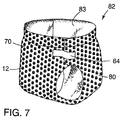
- the breathable but liquid impermeable sheet of loop material 70 produced could be used as the entire outer backsheet 80 of a disposable diaper 82 with the fibers 12 along its outer surface.
- the diaper 82 includes a conventional inner liquid absorbing layer 83.
- the backsheet 80 for the diaper 82 formed by the loop material 70 provides, with the use of a length of hook material 84, both part of means for refastenably attaching the diaper 82 to an individual and means for securing the diaper 82 in a tightly wrapped condition for disposal after the diaper 82 has been soiled.
- the length of hook material 84 is of a polymeric material that can be thermally bonded to the layer of microporous film material 72 and to the sheet 12 of fibers, it can be attached by having one of its end portions thermally bonded to the sheet of loop material 70, thereby eliminating need to use adhesive for that purpose.
- first and second forming members could be made with axially extending ridges like the axially extending ridges 28 on the corrugating members or rollers 26 and 27 described in U.S. Patent No. 5,256,231 (Gorman et al) with the air passageways opening into the recesses between the ridges and would help in high speed formation of sheet material of the type illustrated in U.S. Patent No. 5,256,231.
- a sheet of loop material having arcuate portions projecting from both sides of a backing could be formed by providing first and second forming rollers on both sides of the extruder die, and forming a sheet of fibers on each set of forming rollers so that the backing layer is extruded or otherwise attached onto the anchor portions of both sheets of fibers, in which case, if needed, cooling of the backing layer could be caused by air currents directed against its opposite sides.
Landscapes
- Engineering & Computer Science (AREA)
- Chemical & Material Sciences (AREA)
- Textile Engineering (AREA)
- Manufacturing & Machinery (AREA)
- Organic Chemistry (AREA)
- Chemical Kinetics & Catalysis (AREA)
- Medicinal Chemistry (AREA)
- Polymers & Plastics (AREA)
- Health & Medical Sciences (AREA)
- Materials Engineering (AREA)
- Mechanical Engineering (AREA)
- Nonwoven Fabrics (AREA)
- Slide Fasteners, Snap Fasteners, And Hook Fasteners (AREA)
- Laminated Bodies (AREA)
- Control Of Metal Rolling (AREA)
- Absorbent Articles And Supports Therefor (AREA)
- Lining Or Joining Of Plastics Or The Like (AREA)
Applications Claiming Priority (3)
| Application Number | Priority Date | Filing Date | Title |
|---|---|---|---|
| US698282 | 1991-05-10 | ||
| US08/698,282 US5904793A (en) | 1996-08-14 | 1996-08-14 | Method and equipment for rapid manufacture of loop material |
| PCT/US1997/012387 WO1998006290A1 (en) | 1996-08-14 | 1997-07-16 | Method and equipment for rapid manufacture of loop material |
Publications (2)
| Publication Number | Publication Date |
|---|---|
| EP0921738A1 EP0921738A1 (en) | 1999-06-16 |
| EP0921738B1 true EP0921738B1 (en) | 2002-03-13 |
Family
ID=24804620
Family Applications (1)
| Application Number | Title | Priority Date | Filing Date |
|---|---|---|---|
| EP97934972A Expired - Lifetime EP0921738B1 (en) | 1996-08-14 | 1997-07-16 | Method and equipment for rapid manufacture of loop material |
Country Status (14)
| Country | Link |
|---|---|
| US (1) | US5904793A (enExample) |
| EP (1) | EP0921738B1 (enExample) |
| JP (1) | JP2001502928A (enExample) |
| KR (1) | KR100488262B1 (enExample) |
| CN (1) | CN1227473A (enExample) |
| AR (1) | AR009042A1 (enExample) |
| AU (1) | AU715930B2 (enExample) |
| BR (1) | BR9711143A (enExample) |
| CA (1) | CA2261734A1 (enExample) |
| DE (1) | DE69711057T2 (enExample) |
| ES (1) | ES2170406T3 (enExample) |
| IL (1) | IL128168A (enExample) |
| TW (1) | TW344654B (enExample) |
| WO (1) | WO1998006290A1 (enExample) |
Families Citing this family (63)
| Publication number | Priority date | Publication date | Assignee | Title |
|---|---|---|---|---|
| US6387471B1 (en) * | 1999-03-31 | 2002-05-14 | Kimberly-Clark Worldwide, Inc. | Creep resistant composite elastic material with improved aesthetics, dimensional stability and inherent latency and method of producing same |
| KR20010077591A (ko) * | 2000-02-03 | 2001-08-20 | 복성해 | 아라니콜라 프로테오리티쿠스에서 분리한 신규 금속성단백질 분해효소 및 그의 유전자 |
| US20020042962A1 (en) * | 2000-02-24 | 2002-04-18 | Willman Kenneth William | Cleaning sheets comprising a polymeric additive to improve particulate pick-up and minimize residue left on surfaces and cleaning implements for use with cleaning sheets |
| US6453591B1 (en) * | 2000-07-20 | 2002-09-24 | Cooley, Incorporated | System and method for creating a message display |
| US6756327B2 (en) | 2000-10-31 | 2004-06-29 | Kimberly-Clark Worldwide, Inc. | Loop fastening component made from thermally retracted materials |
| DE10126143A1 (de) | 2001-05-30 | 2002-12-12 | Freudenberg Carl Kg | Schichtstoff und Verfahren zu seiner Herstellung |
| ES2291509T3 (es) * | 2001-06-12 | 2008-03-01 | Velcro Industries B.V. | Materiales de bucle para cierre por contacto. |
| DE10161744A1 (de) * | 2001-12-15 | 2003-06-18 | Werner Jahn | Verfahren zur Herstellung eines Haftverschlußteiles |
| US20030171051A1 (en) * | 2002-03-08 | 2003-09-11 | 3M Innovative Properties Company | Wipe |
| DE20209263U1 (de) | 2002-06-14 | 2002-08-29 | MicroTac Systems AG, 08525 Plauen | Vorrichtung zur Herstellung eines Haftverschlußteiles |
| KR100850458B1 (ko) * | 2002-06-28 | 2008-08-07 | 삼성테크윈 주식회사 | 스마트라벨 및 그 제조방법 |
| US20040063369A1 (en) * | 2002-09-30 | 2004-04-01 | Jung Yeul Ahn | Nonwoven loop material and process and products relating thereto |
| US7547469B2 (en) | 2002-12-03 | 2009-06-16 | Velcro Industries B.V. | Forming loop materials |
| US20050196583A1 (en) * | 2002-12-03 | 2005-09-08 | Provost George A. | Embossing loop materials |
| US7465366B2 (en) * | 2002-12-03 | 2008-12-16 | Velero Industries B.V. | Needling loops into carrier sheets |
| EP1575390B1 (en) * | 2002-12-03 | 2008-03-26 | Velcro Industries B.V. | Needling through carrier sheets to form loops |
| US20050196580A1 (en) * | 2002-12-03 | 2005-09-08 | Provost George A. | Loop materials |
| US20050217092A1 (en) * | 2002-12-03 | 2005-10-06 | Barker James R | Anchoring loops of fibers needled into a carrier sheet |
| US7052565B2 (en) * | 2003-01-27 | 2006-05-30 | 3M Innovative Properties Company | Web constructions with severed elongate strands |
| ES2270205T3 (es) * | 2004-03-22 | 2007-04-01 | Nordenia Deutschland Gronau Gmbh | Material compuesto para cierres de tipo velcro, especialmente cierres para pañales. |
| GB0409253D0 (en) * | 2004-04-26 | 2004-05-26 | Lewmar Ltd | Winch and winch drum |
| FR2870436B1 (fr) * | 2004-05-21 | 2006-07-14 | Aplix Sa | Film a filaments individuels ancres |
| US20060019579A1 (en) * | 2004-07-26 | 2006-01-26 | Braunschweig Ehrich J | Non-loading abrasive article |
| US7329175B2 (en) * | 2004-12-30 | 2008-02-12 | 3M Innovative Properties Company | Abrasive article and methods of making same |
| US7562426B2 (en) * | 2005-04-08 | 2009-07-21 | Velcro Industries B.V. | Needling loops into carrier sheets |
| MY146975A (en) * | 2005-04-11 | 2012-10-15 | Oji Nepia Co Ltd | Disposable pant-type diaper |
| US7252694B2 (en) * | 2005-08-05 | 2007-08-07 | 3M Innovative Properties Company | Abrasive article and methods of making same |
| US7258705B2 (en) * | 2005-08-05 | 2007-08-21 | 3M Innovative Properties Company | Abrasive article and methods of making same |
| US8241263B2 (en) | 2005-08-26 | 2012-08-14 | Medline Industries, Inc. | Absorbent article |
| US7393269B2 (en) * | 2005-09-16 | 2008-07-01 | 3M Innovative Properties Company | Abrasive filter assembly and methods of making same |
| US7244170B2 (en) * | 2005-09-16 | 2007-07-17 | 3M Innovative Properties Co. | Abrasive article and methods of making same |
| US7390244B2 (en) * | 2005-09-16 | 2008-06-24 | 3M Innovative Properties Company | Abrasive article mounting assembly and methods of making same |
| EP1902698A1 (en) * | 2006-09-22 | 2008-03-26 | 3M Innovative Properties Company | Landing zone for mechanical fasteners of disposable products, process for manufacturing thereof and process for manufacturing disposable products |
| JP2008087082A (ja) * | 2006-09-29 | 2008-04-17 | Three M Innovative Properties Co | 吸塵用研磨具 |
| PL1915977T3 (pl) | 2006-10-27 | 2015-09-30 | Hartmann Paul Ag | Chłonny artykuł na nietrzymanie moczu z ulepszonym systemem zapinania |
| US20080113152A1 (en) * | 2006-11-14 | 2008-05-15 | Velcro Industries B.V. | Loop Materials |
| US7452265B2 (en) * | 2006-12-21 | 2008-11-18 | 3M Innovative Properties Company | Abrasive article and methods of making same |
| EP2514505B1 (en) | 2007-02-02 | 2018-06-27 | Donaldson Company, Inc. | Air filtration media pack and filter element |
| WO2008154303A1 (en) * | 2007-06-07 | 2008-12-18 | Velcro Industries B.V. | Needling loops into carrier sheets |
| WO2008154300A1 (en) * | 2007-06-07 | 2008-12-18 | Velcro Industries B.V. | Anchoring loops of fibers needled into a carrier sheet |
| EP2170488B1 (en) | 2007-06-26 | 2014-05-14 | Donaldson Company, Inc. | Filtration media pack, filter elements, and methods |
| EP2386279A3 (de) | 2007-08-02 | 2015-01-21 | Paul Hartmann AG | Absorbierende Inkontinenzwegwerfwindel |
| BRPI0907653B1 (pt) | 2008-02-04 | 2019-07-02 | Donaldson Company, Inc | Método para formar meios de filtração encanelados |
| JP5757868B2 (ja) | 2008-07-25 | 2015-08-05 | ドナルドソン カンパニー,インコーポレイティド | 空気ろ過媒体パック、フィルタエレメント、空気ろ過媒体および方法(ひだ付きろ過媒体、媒体パック、フィルタエレメントおよび流体ろ過方法) |
| JP5711230B2 (ja) * | 2009-08-03 | 2015-04-30 | ドナルドソン カンパニー,インコーポレイティド | テーパ付き縦溝流路を有する縦溝流路付き濾過媒体を形成する方法および装置 |
| EP2528675B2 (en) | 2010-01-25 | 2021-12-22 | Donaldson Company, Inc. | Pleated filtration media having tapered flutes |
| MX344365B (es) | 2010-10-19 | 2016-12-14 | Medline Ind Inc * | Articulos absorbentes y metodos para fabricarlos. |
| CN102454050A (zh) * | 2010-10-26 | 2012-05-16 | 台湾百和工业股份有限公司 | 粘扣带用毛面的制造方法,制造设备及粘扣带用毛面 |
| TWI457088B (zh) | 2010-10-26 | 2014-10-21 | Taiwan Paiho Ltd | Velcro with hair surface manufacturing methods, manufacturing equipment and velcro hair surface |
| EP2747726B1 (en) | 2011-08-25 | 2015-10-28 | Velcro Industries B.V. | Hook-engageable loop fasteners and related systems and methods |
| CN103889261B (zh) | 2011-08-25 | 2017-05-10 | 维尔克有限公司 | 可接合环的紧固件及相关的系统和方法 |
| USD716938S1 (en) | 2011-10-19 | 2014-11-04 | Medline Industries, Inc. | Absorbent core |
| USD695097S1 (en) | 2011-11-03 | 2013-12-10 | 3M Innovative Properties Company | Corrugated loop for a hook and loop fastener |
| KR101135136B1 (ko) * | 2011-11-17 | 2012-04-16 | 주식회사 폴리쉘 | 포장용 완충재의 제조장치 |
| WO2013170480A1 (en) * | 2012-05-18 | 2013-11-21 | 3M Innovative Properties Company | Method of making a mechanical fastener and apparatus including a roller with protrusions |
| US9486368B2 (en) | 2013-12-05 | 2016-11-08 | Medline Industries, Inc. | Disposable hygienic article with means for diagnostic testing |
| US10722093B2 (en) | 2013-12-18 | 2020-07-28 | 3M Innovative Properties Company | Cleaning article |
| US10226388B2 (en) | 2014-04-21 | 2019-03-12 | Medline Industries, Inc. | Stretch breathable protective absorbent article using tri-laminate |
| US9622922B2 (en) | 2014-04-21 | 2017-04-18 | Medline Industries, Inc. | Stretch breathable protective absorbent article using bilaminate |
| ES2887828T3 (es) * | 2015-07-07 | 2021-12-28 | Mitsubishi Chem Corp | Método para la producción de material de moldeo de resina reforzado con fibra |
| EP3496562A1 (en) | 2016-08-08 | 2019-06-19 | 3M Innovative Properties Company | Sheet of loop material, method and apparatus for forming same |
| CN109394421B (zh) * | 2018-10-12 | 2021-07-06 | 宜城成雄织造有限公司 | 一种基于多层尿布生产用杀毒压实设备 |
| CN114619640B (zh) * | 2022-04-22 | 2024-05-10 | 天宫氢能材料科技(东莞)有限公司 | 一种全氟磺酸质子膜的制备设备及制备方法 |
Citations (1)
| Publication number | Priority date | Publication date | Assignee | Title |
|---|---|---|---|---|
| WO1992020251A1 (en) * | 1991-05-20 | 1992-11-26 | The Procter & Gamble Company | Nonwoven female component for refastenable fastening device and method of making the same |
Family Cites Families (22)
| Publication number | Priority date | Publication date | Assignee | Title |
|---|---|---|---|---|
| US3182346A (en) * | 1963-04-29 | 1965-05-11 | Gen Foods Corp | Cleaning article and method of manufacture |
| US3546754A (en) * | 1968-08-12 | 1970-12-15 | George H Erb | Separable fastener |
| US3723213A (en) * | 1970-08-18 | 1973-03-27 | Rohm & Haas | Method of making non-woven pile fabric |
| US3867243A (en) * | 1970-12-22 | 1975-02-18 | Phillips Petroleum Co | Laminate structure suitable for carpet use and method of making |
| US3892613A (en) * | 1971-07-22 | 1975-07-01 | Int Paper Co | Method of making corrugated paperboard |
| GB1376782A (en) * | 1972-02-22 | 1974-12-11 | Atomic Energy Authority Uk | Apparatus for welding together superimposed sheets of thermoplastic material |
| BR7905400A (pt) * | 1978-10-05 | 1980-05-20 | Mitsubishi Heavy Ind Ltd | Cilindro inferior em uma maquina faceadora unica |
| US4761318A (en) * | 1985-04-15 | 1988-08-02 | Minnesota Mining And Manufacturing Company | Loop fastener portion with thermoplastic resin attaching and anchoring layer |
| US4609581A (en) * | 1985-04-15 | 1986-09-02 | Minnesota Mining And Manufacturing Company | Coated abrasive sheet material with loop attachment means |
| US4770917A (en) * | 1985-07-31 | 1988-09-13 | Minnesota Mining And Manufacturing Company | Sheet material used to form portions of fasteners |
| US5032122A (en) * | 1987-04-24 | 1991-07-16 | The Procter & Gamble Company | Loop fastening material for fastening device and method of making same |
| US5380313A (en) * | 1987-06-19 | 1995-01-10 | The Proctor & Gamble Company | Loop fastening material for fastening device and method of making same |
| AU622171B2 (en) * | 1988-05-13 | 1992-04-02 | Minnesota Mining And Manufacturing Company | Sheet material for forming the loop portion for hook and loop fasteners |
| US5256231A (en) * | 1988-05-13 | 1993-10-26 | Minnesota Mining And Manufacturing Company | Method for making a sheet of loop material |
| US5254194A (en) * | 1988-05-13 | 1993-10-19 | Minnesota Mining And Manufacturing Company | Coated abrasive sheet material with loop material for attachment incorporated therein |
| FR2663621B2 (fr) * | 1990-04-30 | 1993-05-21 | Capy Gilbert | Dispositif de resserrage progressif de plis dissymetriques, realises a partir d'un film, prealablement preformes sur une roue dentee. |
| DE4016348C2 (de) * | 1990-05-21 | 1995-12-21 | Bp Chemicals Plastec Gmbh | Verfahren zur Herstellung eines Verbundvlieses sowie Verwendung eines so hergestellten Verbundvlieses |
| US5316828A (en) * | 1991-04-25 | 1994-05-31 | Miller Ray R | Reinforced fluted medium and corrugated fiberboard made using the medium |
| PL171000B1 (en) * | 1991-05-20 | 1997-02-28 | Procter & Gamble | Disposable moisture absorbing article with a fastening element |
| JPH07213554A (ja) * | 1994-02-04 | 1995-08-15 | New Oji Paper Co Ltd | シート状弾性複合体の製造方法 |
| US5547531A (en) * | 1994-06-06 | 1996-08-20 | The Proctor & Gamble Company | Nonwoven female component for refastenable fastening device and method of making the same |
| US5614281A (en) * | 1995-11-29 | 1997-03-25 | Kimberly-Clark Corporation | Creped nonwoven laminate loop fastening material for mechanical fastening systems |
-
1996
- 1996-08-14 US US08/698,282 patent/US5904793A/en not_active Expired - Fee Related
-
1997
- 1997-07-16 EP EP97934972A patent/EP0921738B1/en not_active Expired - Lifetime
- 1997-07-16 ES ES97934972T patent/ES2170406T3/es not_active Expired - Lifetime
- 1997-07-16 BR BR9711143A patent/BR9711143A/pt not_active IP Right Cessation
- 1997-07-16 IL IL12816897A patent/IL128168A/en not_active IP Right Cessation
- 1997-07-16 JP JP10509711A patent/JP2001502928A/ja not_active Ceased
- 1997-07-16 DE DE69711057T patent/DE69711057T2/de not_active Expired - Fee Related
- 1997-07-16 WO PCT/US1997/012387 patent/WO1998006290A1/en not_active Ceased
- 1997-07-16 AU AU38016/97A patent/AU715930B2/en not_active Ceased
- 1997-07-16 CA CA002261734A patent/CA2261734A1/en not_active Abandoned
- 1997-07-16 KR KR10-1999-7001191A patent/KR100488262B1/ko not_active Expired - Fee Related
- 1997-07-16 CN CN97197222A patent/CN1227473A/zh active Pending
- 1997-07-22 TW TW086110382A patent/TW344654B/zh active
- 1997-08-11 AR ARP970103632A patent/AR009042A1/es active IP Right Grant
Patent Citations (1)
| Publication number | Priority date | Publication date | Assignee | Title |
|---|---|---|---|---|
| WO1992020251A1 (en) * | 1991-05-20 | 1992-11-26 | The Procter & Gamble Company | Nonwoven female component for refastenable fastening device and method of making the same |
Also Published As
| Publication number | Publication date |
|---|---|
| JP2001502928A (ja) | 2001-03-06 |
| DE69711057D1 (de) | 2002-04-18 |
| ES2170406T3 (es) | 2002-08-01 |
| AU3801697A (en) | 1998-03-06 |
| DE69711057T2 (de) | 2002-07-18 |
| US5904793A (en) | 1999-05-18 |
| TW344654B (en) | 1998-11-11 |
| BR9711143A (pt) | 1999-08-17 |
| KR100488262B1 (ko) | 2005-05-11 |
| CN1227473A (zh) | 1999-09-01 |
| CA2261734A1 (en) | 1998-02-19 |
| AR009042A1 (es) | 2000-03-08 |
| EP0921738A1 (en) | 1999-06-16 |
| KR20000029956A (ko) | 2000-05-25 |
| IL128168A0 (en) | 1999-11-30 |
| AU715930B2 (en) | 2000-02-10 |
| IL128168A (en) | 2001-07-24 |
| WO1998006290A1 (en) | 1998-02-19 |
Similar Documents
| Publication | Publication Date | Title |
|---|---|---|
| AU715930B2 (en) | Method and equipment for rapid manufacture of loop material | |
| US5256231A (en) | Method for making a sheet of loop material | |
| US5616394A (en) | Sheet of loop material, and garments having such loop material incorporated therein | |
| US5611791A (en) | Sheet of loop material, and garments having such loop material incorporated therein | |
| US6942894B2 (en) | Methods for producing composite webs with reinforcing discrete polymeric regions | |
| KR100489474B1 (ko) | 기계적 패스너 및 기계적 패스너용 핑거 그립의 제조 방법 | |
| KR100263360B1 (ko) | 암형(female)루프고착성분을포함하는재고착성고착시스템의제조방법및이로부터제조된제품 | |
| US6875710B2 (en) | Composite webs with reinforcing polymeric regions and elastic polymeric regions | |
| US6136405A (en) | Sheet material having a fibrous surface and method of making the same | |
| US20040178544A1 (en) | Polymer transfer apparatus, methods, and composite webs | |
| CA2109621C (en) | Screen printing method for manufacturing a refastenable mechanical fastening system and fastening system produced therefrom | |
| EP0925770B1 (en) | Fastening device of disposable diaper | |
| JP3133045B2 (ja) | ファスナーシステム |
Legal Events
| Date | Code | Title | Description |
|---|---|---|---|
| PUAI | Public reference made under article 153(3) epc to a published international application that has entered the european phase |
Free format text: ORIGINAL CODE: 0009012 |
|
| 17P | Request for examination filed |
Effective date: 19990305 |
|
| AK | Designated contracting states |
Kind code of ref document: A1 Designated state(s): BE CH DE ES FR GB IT LI NL |
|
| 17Q | First examination report despatched |
Effective date: 20000307 |
|
| GRAG | Despatch of communication of intention to grant |
Free format text: ORIGINAL CODE: EPIDOS AGRA |
|
| GRAG | Despatch of communication of intention to grant |
Free format text: ORIGINAL CODE: EPIDOS AGRA |
|
| GRAG | Despatch of communication of intention to grant |
Free format text: ORIGINAL CODE: EPIDOS AGRA |
|
| GRAH | Despatch of communication of intention to grant a patent |
Free format text: ORIGINAL CODE: EPIDOS IGRA |
|
| GRAH | Despatch of communication of intention to grant a patent |
Free format text: ORIGINAL CODE: EPIDOS IGRA |
|
| REG | Reference to a national code |
Ref country code: GB Ref legal event code: IF02 |
|
| GRAA | (expected) grant |
Free format text: ORIGINAL CODE: 0009210 |
|
| AK | Designated contracting states |
Kind code of ref document: B1 Designated state(s): BE CH DE ES FR GB IT LI NL |
|
| PG25 | Lapsed in a contracting state [announced via postgrant information from national office to epo] |
Ref country code: NL Free format text: LAPSE BECAUSE OF FAILURE TO SUBMIT A TRANSLATION OF THE DESCRIPTION OR TO PAY THE FEE WITHIN THE PRESCRIBED TIME-LIMIT Effective date: 20020313 Ref country code: LI Free format text: LAPSE BECAUSE OF FAILURE TO SUBMIT A TRANSLATION OF THE DESCRIPTION OR TO PAY THE FEE WITHIN THE PRESCRIBED TIME-LIMIT Effective date: 20020313 Ref country code: CH Free format text: LAPSE BECAUSE OF FAILURE TO SUBMIT A TRANSLATION OF THE DESCRIPTION OR TO PAY THE FEE WITHIN THE PRESCRIBED TIME-LIMIT Effective date: 20020313 Ref country code: BE Free format text: LAPSE BECAUSE OF FAILURE TO SUBMIT A TRANSLATION OF THE DESCRIPTION OR TO PAY THE FEE WITHIN THE PRESCRIBED TIME-LIMIT Effective date: 20020313 |
|
| REG | Reference to a national code |
Ref country code: CH Ref legal event code: EP |
|
| REF | Corresponds to: |
Ref document number: 69711057 Country of ref document: DE Date of ref document: 20020418 |
|
| NLV1 | Nl: lapsed or annulled due to failure to fulfill the requirements of art. 29p and 29m of the patents act | ||
| REG | Reference to a national code |
Ref country code: ES Ref legal event code: FG2A Ref document number: 2170406 Country of ref document: ES Kind code of ref document: T3 |
|
| ET | Fr: translation filed | ||
| REG | Reference to a national code |
Ref country code: CH Ref legal event code: PL |
|
| PLBE | No opposition filed within time limit |
Free format text: ORIGINAL CODE: 0009261 |
|
| STAA | Information on the status of an ep patent application or granted ep patent |
Free format text: STATUS: NO OPPOSITION FILED WITHIN TIME LIMIT |
|
| 26N | No opposition filed |
Effective date: 20021216 |
|
| PGFP | Annual fee paid to national office [announced via postgrant information from national office to epo] |
Ref country code: ES Payment date: 20050727 Year of fee payment: 9 |
|
| PGFP | Annual fee paid to national office [announced via postgrant information from national office to epo] |
Ref country code: GB Payment date: 20060726 Year of fee payment: 10 |
|
| PGFP | Annual fee paid to national office [announced via postgrant information from national office to epo] |
Ref country code: DE Payment date: 20070831 Year of fee payment: 11 |
|
| PGFP | Annual fee paid to national office [announced via postgrant information from national office to epo] |
Ref country code: IT Payment date: 20070727 Year of fee payment: 11 |
|
| GBPC | Gb: european patent ceased through non-payment of renewal fee |
Effective date: 20070716 |
|
| PGFP | Annual fee paid to national office [announced via postgrant information from national office to epo] |
Ref country code: FR Payment date: 20070717 Year of fee payment: 11 |
|
| PG25 | Lapsed in a contracting state [announced via postgrant information from national office to epo] |
Ref country code: GB Free format text: LAPSE BECAUSE OF NON-PAYMENT OF DUE FEES Effective date: 20070716 |
|
| REG | Reference to a national code |
Ref country code: ES Ref legal event code: FD2A Effective date: 20070717 |
|
| PG25 | Lapsed in a contracting state [announced via postgrant information from national office to epo] |
Ref country code: ES Free format text: LAPSE BECAUSE OF NON-PAYMENT OF DUE FEES Effective date: 20070717 |
|
| PG25 | Lapsed in a contracting state [announced via postgrant information from national office to epo] |
Ref country code: DE Free format text: LAPSE BECAUSE OF NON-PAYMENT OF DUE FEES Effective date: 20090203 |
|
| REG | Reference to a national code |
Ref country code: FR Ref legal event code: ST Effective date: 20090331 |
|
| PG25 | Lapsed in a contracting state [announced via postgrant information from national office to epo] |
Ref country code: IT Free format text: LAPSE BECAUSE OF NON-PAYMENT OF DUE FEES Effective date: 20080716 Ref country code: FR Free format text: LAPSE BECAUSE OF NON-PAYMENT OF DUE FEES Effective date: 20080731 |