EP0914480B1 - Verfahren zur erzeugung eines kaltgewalzten stahlbleches oder -bandes mit guter umformbarkeit - Google Patents
Verfahren zur erzeugung eines kaltgewalzten stahlbleches oder -bandes mit guter umformbarkeit Download PDFInfo
- Publication number
- EP0914480B1 EP0914480B1 EP97922915A EP97922915A EP0914480B1 EP 0914480 B1 EP0914480 B1 EP 0914480B1 EP 97922915 A EP97922915 A EP 97922915A EP 97922915 A EP97922915 A EP 97922915A EP 0914480 B1 EP0914480 B1 EP 0914480B1
- Authority
- EP
- European Patent Office
- Prior art keywords
- maximum
- cold
- temperature
- strip
- hot
- Prior art date
- Legal status (The legal status is an assumption and is not a legal conclusion. Google has not performed a legal analysis and makes no representation as to the accuracy of the status listed.)
- Expired - Lifetime
Links
Images
Classifications
-
- C—CHEMISTRY; METALLURGY
- C21—METALLURGY OF IRON
- C21D—MODIFYING THE PHYSICAL STRUCTURE OF FERROUS METALS; GENERAL DEVICES FOR HEAT TREATMENT OF FERROUS OR NON-FERROUS METALS OR ALLOYS; MAKING METAL MALLEABLE, e.g. BY DECARBURISATION OR TEMPERING
- C21D8/00—Modifying the physical properties of ferrous metals or ferrous alloys by deformation combined with, or followed by, heat treatment
- C21D8/02—Modifying the physical properties of ferrous metals or ferrous alloys by deformation combined with, or followed by, heat treatment during manufacturing of plates or strips
- C21D8/04—Modifying the physical properties of ferrous metals or ferrous alloys by deformation combined with, or followed by, heat treatment during manufacturing of plates or strips to produce plates or strips for drawing, e.g. for deep-drawing
-
- C—CHEMISTRY; METALLURGY
- C21—METALLURGY OF IRON
- C21D—MODIFYING THE PHYSICAL STRUCTURE OF FERROUS METALS; GENERAL DEVICES FOR HEAT TREATMENT OF FERROUS OR NON-FERROUS METALS OR ALLOYS; MAKING METAL MALLEABLE, e.g. BY DECARBURISATION OR TEMPERING
- C21D8/00—Modifying the physical properties of ferrous metals or ferrous alloys by deformation combined with, or followed by, heat treatment
- C21D8/02—Modifying the physical properties of ferrous metals or ferrous alloys by deformation combined with, or followed by, heat treatment during manufacturing of plates or strips
- C21D8/04—Modifying the physical properties of ferrous metals or ferrous alloys by deformation combined with, or followed by, heat treatment during manufacturing of plates or strips to produce plates or strips for drawing, e.g. for deep-drawing
- C21D8/0447—Modifying the physical properties of ferrous metals or ferrous alloys by deformation combined with, or followed by, heat treatment during manufacturing of plates or strips to produce plates or strips for drawing, e.g. for deep-drawing characterised by the heat treatment
- C21D8/0473—Final recrystallisation annealing
-
- C—CHEMISTRY; METALLURGY
- C23—COATING METALLIC MATERIAL; COATING MATERIAL WITH METALLIC MATERIAL; CHEMICAL SURFACE TREATMENT; DIFFUSION TREATMENT OF METALLIC MATERIAL; COATING BY VACUUM EVAPORATION, BY SPUTTERING, BY ION IMPLANTATION OR BY CHEMICAL VAPOUR DEPOSITION, IN GENERAL; INHIBITING CORROSION OF METALLIC MATERIAL OR INCRUSTATION IN GENERAL
- C23C—COATING METALLIC MATERIAL; COATING MATERIAL WITH METALLIC MATERIAL; SURFACE TREATMENT OF METALLIC MATERIAL BY DIFFUSION INTO THE SURFACE, BY CHEMICAL CONVERSION OR SUBSTITUTION; COATING BY VACUUM EVAPORATION, BY SPUTTERING, BY ION IMPLANTATION OR BY CHEMICAL VAPOUR DEPOSITION, IN GENERAL
- C23C2/00—Hot-dipping or immersion processes for applying the coating material in the molten state without affecting the shape; Apparatus therefor
- C23C2/02—Pretreatment of the material to be coated, e.g. for coating on selected surface areas
-
- C—CHEMISTRY; METALLURGY
- C23—COATING METALLIC MATERIAL; COATING MATERIAL WITH METALLIC MATERIAL; CHEMICAL SURFACE TREATMENT; DIFFUSION TREATMENT OF METALLIC MATERIAL; COATING BY VACUUM EVAPORATION, BY SPUTTERING, BY ION IMPLANTATION OR BY CHEMICAL VAPOUR DEPOSITION, IN GENERAL; INHIBITING CORROSION OF METALLIC MATERIAL OR INCRUSTATION IN GENERAL
- C23C—COATING METALLIC MATERIAL; COATING MATERIAL WITH METALLIC MATERIAL; SURFACE TREATMENT OF METALLIC MATERIAL BY DIFFUSION INTO THE SURFACE, BY CHEMICAL CONVERSION OR SUBSTITUTION; COATING BY VACUUM EVAPORATION, BY SPUTTERING, BY ION IMPLANTATION OR BY CHEMICAL VAPOUR DEPOSITION, IN GENERAL
- C23C2/00—Hot-dipping or immersion processes for applying the coating material in the molten state without affecting the shape; Apparatus therefor
- C23C2/02—Pretreatment of the material to be coated, e.g. for coating on selected surface areas
- C23C2/022—Pretreatment of the material to be coated, e.g. for coating on selected surface areas by heating
- C23C2/0224—Two or more thermal pretreatments
-
- C—CHEMISTRY; METALLURGY
- C21—METALLURGY OF IRON
- C21D—MODIFYING THE PHYSICAL STRUCTURE OF FERROUS METALS; GENERAL DEVICES FOR HEAT TREATMENT OF FERROUS OR NON-FERROUS METALS OR ALLOYS; MAKING METAL MALLEABLE, e.g. BY DECARBURISATION OR TEMPERING
- C21D8/00—Modifying the physical properties of ferrous metals or ferrous alloys by deformation combined with, or followed by, heat treatment
- C21D8/02—Modifying the physical properties of ferrous metals or ferrous alloys by deformation combined with, or followed by, heat treatment during manufacturing of plates or strips
- C21D8/04—Modifying the physical properties of ferrous metals or ferrous alloys by deformation combined with, or followed by, heat treatment during manufacturing of plates or strips to produce plates or strips for drawing, e.g. for deep-drawing
- C21D8/0421—Modifying the physical properties of ferrous metals or ferrous alloys by deformation combined with, or followed by, heat treatment during manufacturing of plates or strips to produce plates or strips for drawing, e.g. for deep-drawing characterised by the working steps
- C21D8/0426—Hot rolling
-
- C—CHEMISTRY; METALLURGY
- C21—METALLURGY OF IRON
- C21D—MODIFYING THE PHYSICAL STRUCTURE OF FERROUS METALS; GENERAL DEVICES FOR HEAT TREATMENT OF FERROUS OR NON-FERROUS METALS OR ALLOYS; MAKING METAL MALLEABLE, e.g. BY DECARBURISATION OR TEMPERING
- C21D8/00—Modifying the physical properties of ferrous metals or ferrous alloys by deformation combined with, or followed by, heat treatment
- C21D8/02—Modifying the physical properties of ferrous metals or ferrous alloys by deformation combined with, or followed by, heat treatment during manufacturing of plates or strips
- C21D8/04—Modifying the physical properties of ferrous metals or ferrous alloys by deformation combined with, or followed by, heat treatment during manufacturing of plates or strips to produce plates or strips for drawing, e.g. for deep-drawing
- C21D8/0421—Modifying the physical properties of ferrous metals or ferrous alloys by deformation combined with, or followed by, heat treatment during manufacturing of plates or strips to produce plates or strips for drawing, e.g. for deep-drawing characterised by the working steps
- C21D8/0436—Cold rolling
Definitions
- the invention relates to a method for generating a with cold-rolled high-strength steel sheet or strip good formability, especially stretchability for Manufacture of pressed parts with high dent resistance.
- the pressed parts should have a high basic material strength have and after an additional heat treatment, such as it is usually used for painting, one additional material hardening ("bake hardening") receive. This gives excellent buckling stiffness properties reached.
- Pressed parts with high Stretch-drawing components are e.g. flat body parts in the Automotive industry, such as doors, hoods, roofs.
- An unalloyed LC steel can be used in continuous furnaces Have aging parts in line, also as bake-hardening Steel can be produced by chemical Steel composition, cooling rate and aging condition be precisely coordinated. This The process is already being used on an industrial scale.
- a Optimization of the generation conditions is e.g. of Hayashida et al. (T. Hayashida, M. Oda, T. Yamada, Y. Matsukawa, J. Tanaka: "Development and applications of continuous-annealed low-carbon Al-killed BH steel sheets ", Poc. Of the Symp. On High-Strength Sheet steels for the Automotive Industry, Baltimore, October 16-19, 1994, p.135).
- low-carbon steels so-called ultra-low-carbon (ULC) steels
- ULC ultra-low-carbon
- the carbon content should be between 15 and 25 ppm.
- the titanium content is adjusted to the nitrogen and sulfur contents with 48/14 N ⁇ Ti ⁇ 48 (N / 14 + S / 32).
- the aim is to completely bind the nitrogen in titanium nitrides, but to ensure the bake-hardening effect, a small amount of carbon must remain in solution. Generation in vacuum degassing plants is necessary.
- the advantage of this process is that there is no aging annealing, which makes it suitable for hot-dip coating systems.
- the bake-hardening parameters determined in the tensile test after 2% pre-stretching (BH 2 value) reach approximately 40 N / mm 2 for the steels produced in this way.
- the yield strengths are around 200 N / mm 2
- the values for the mean vertical anisotropy (r value) are around 1.8.
- EP 0 620 288 A1 discloses a process for producing only cold-rolled or fire-coated cold-rolled steel strip in continuous strip lines, which, in addition to being resistant to aging, has high bake-hardening properties and good deep-drawing properties due to high r values.
- a ULC steel itself or a ULC steel is annealed with either a titanium or a niobium alloy above the Ac 3 transformation temperature, ie in the austenite area.
- the bake-hardening values in this process reach 100 N / mm 2 .
- An aging glow is not necessary.
- ULC steel the steel must be manufactured in a vacuum degassing plant. Difficulties with regard to strip flatness are caused by the high annealing temperatures required in this process. A large-scale application of this method is not known.
- processes previously used or described in the literature for the production of readily deformable cold sheet with bake-hardening properties in continuous strip systems either include the additional annealing treatment described above in the case of using a soft, unalloyed A1-soaked deep-drawing steel, which is a production in a common one Fire coating system is not allowed, or the more complex to produce ULC steels with very low carbon contents must be used.
- the above-described methods based on ULC steels mainly include steels with yield strengths in the lower range up to 240 N / mm 2 . Due to the high average r-values (> 1.5), they are suitable for pressed parts with a high proportion of deep-drawn parts.
- thermomechanical Rolling of Hot strip made of microalloyed structural steels steel and iron 111 (1991) No. 5, known, thermomechanically rolled To produce hot strips from low-pearlite special structural steels.
- the hot strips are due to low alloy contents high yield strength and good cold formability characterized.
- To influence the grain size are the Steels added to the nitrogen setting Ti and Nb. The Levels of these alloying elements are in each case well above the stoichiometric setting of the Amount of nitrogen required.
- EP 0 432 498 B1 describes a method for Production of a high tensile strength cold-rolled steel sheet known, which a has improved stretch flanging properties.
- the Sheet steel has to produce a uniform, fine structure contents of Nb in the range from 0.005 to 0.045%.
- Manufactured by the known method Steel sheets have high cold-rolled condition Tensile strengths so that they can only be applied relatively high forces can be deformed. Due to their high strength, the after known methods produced sheets in particular for Manufacture of rust-resistant reinforcement elements suitable for automobiles.
- the task is derived from this ab, a well formable, high-strength cold-rolled Steel sheet or strip in a continuous Belt plant without a subsequent aging annealing treatment manufacture aging-resistant, which also has good bake hardening properties.
- the combination of the high basic material strength and The bake hardening potential is said to be excellent Bulge stiffness of the pressed parts.
- the steel achieves its aging resistance through a titanium addition matched to the nitrogen content. This leads to an early complete setting of nitrogen, which as a the aging resistance severely impairing element is known.
- the Aging tests see examples below
- the volume fraction and however, the number of titanium carbides must never be increased be high so that the steel is used for high forming requirements necessary hardening characteristics and sufficient stretch and toughness properties has. Therefore, the amount of nitrogen should not bound nitride formers are 0.003 to 0.015% Ti. This limitation of the amount of nitride is guaranteed uniform mechanical properties that opposite process-related fluctuations in hot strip temperature control (Influencing the excretion distribution) are largely invariant.
- the silicon content should be used for hot-dip galvanized sheet preferably to max. 0.15% may be limited.
- the economic advantage of the method according to the invention is that the additional process step aging annealing to achieve aging resistance not applicable, although the steel composition Based on the analysis of soft, unalloyed Al-calmed (LC) steels based. Steel production can be due to this Analysis concept without complex metallurgical production processes respectively. In addition, Titan is only in small amounts needed, so the steel too with regard to the alloy additions generate is.
- the cold strip should preferably be at a speed in Range from 5 to 10 K / s on the temperature of the recrystallization annealing be heated.
- the recrystallizing Annealing can preferably be in line with one Hot dip galvanizing plant can be made.
- the steel strips or sheets produced by the process according to the invention are distinguished by an initial yield point (greater than 240 N / mm 2 ) which is favorable with regard to the subsequent deformation and a high strengthening capacity in the range of small plastic expansions. Together with low values of the vertical anisotropy, which characterize a preferred flow from the thickness, pressed parts with a high stretch-drawing proportion, for example automobile outer skin parts, are the ideal area of application.
- the strong solidification of this material which occurs even with small plastic deformations and is expressed in very high work hardening values, is an essential point for the properties of the product. The strong solidification favors the transmission of force to neighboring material areas, which prevents local premature material failure, eg constriction.
- the material can therefore flow more evenly over the entire surface of the pressed part.
- the small differences in the r values depending on the angle to the rolling direction have a favorable effect on uniform forming behavior. This isotropic behavior is evidenced by small values of the planar anisotropy.
- the slabs produced by continuous casting according to the invention manufactured steels A and B, their chemical Compositions listed in Table 1 were found in reheated in a pusher furnace to temperatures of approx. 1200 ° C and to final thicknesses of 2.8 - 3.3 mm above the
- Ar 3 temperature hot rolled Ar 3 temperature hot rolled.
- the finish rolling and reel temperatures are shown in Table 2.
- Two reel temperature classes were used for the strips of steels A and B: 730 ° C (steels A1 and B1) and 600 ° C (steels A2 and B2).
- the strips were cold-rolled with degrees of deformation between 65 and 75% to thicknesses between 0.8 and 1.0 mm and then first recrystallized in a hot-dip coating plant and then hot-dip galvanized.
- the strip temperature in the recrystallization furnace was 800 ° C.
- the cooling rates after the recrystallizing annealing were between 10 and 50 K / s.
- the galvanized belts were treated with 1.8% and were then free from elongation limit.
- the BH 0 value corresponds to the increase in the lower yield strength after a heat treatment of 20 minutes at 170 ° C.
- the size WH indicates the amount of deformation hardening when the tensile test is stretched by 2%. It is calculated by subtracting the yield strength Rp 0.2 from the measured stress at 2% deformation.
- the size BH 2 corresponds to the increase in the lower yield strength after a heat treatment of 20 minutes at 170 ° C, measured on the 2% pre-stretched tensile test.
- the hot-dip galvanized cold-rolled strips made of steels A and B show an almost unchanged level of the lower or upper yield strength after artificial aging of 60 minutes at 100 ° C (Table 3).
- the extent of the yield point elongation also remains below 0.5%, which means that the aging resistance is sufficient for processing without flow figures even after long periods of storage.
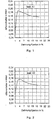
- the course of the differential (instantaneous) hardening exponent (n value) over the total strain is plotted in FIG. 1 for steel A1 (reel temperature 730 ° C.) and in FIG. 2 for steel A2 (reel temperature 600 ° C.).
- the maxima of the differential n values are listed in Table 2; For steels A and B, they reach at least 0.170 for both reel temperature classes, and at least 0.180 for high reel temperatures.
- the n value maximum of steels A and B is in the range of low total strains between 2 and 5%.
- the yield strengths are approximately 50 N / mm 2 larger for the higher-coiled variants A1 and B1 than for the low-coiled variants A2 and B2, so that the starting position of the yield strength can be determined by the choice of the coiling temperature.
- the values for the mean vertical anisotropy for the steels A1, A2, B1 and B2 according to the invention are low at 1.0-1.1.
- the reel temperature Regardless of the reel temperature, they have isotropic properties with ⁇ r values between 0 and 0.3.
- the work-hardening values which are a measure of the hardening by plastic deformation, are very high at approx. 50 N / mm 2 .
- the parameters for bake hardening with or without pre-deformation in all cases reach at least 45 N / mm 2 .
- the increase in yield strength after the painting treatment of a pressed part can be estimated by the sum WH + BH 2 .
- At high reel temperatures (steels A1 and B1) these values are at least 100 N / mm 2 .
- the sum WH + BH 2 with at least 60 N / mm 2 is still cheap.
- Tables 1, 2 and 3 also list steels C to E for comparison, which, in contrast to steels A and B, either contain no titanium (steel E) or have titanium contents that are substoichiometric in relation to the nitrogen content (steels C and D with Ti / N ⁇ 3.4).
- the increase in the lower yield strength (R e1 ) and the yield strength expansions after artificial aging are significantly higher in these comparative steels than in the steels A and B produced according to the invention.
- the upper yield strength (deer) increases
Landscapes
- Chemical & Material Sciences (AREA)
- Engineering & Computer Science (AREA)
- Mechanical Engineering (AREA)
- Organic Chemistry (AREA)
- Metallurgy (AREA)
- Materials Engineering (AREA)
- Chemical Kinetics & Catalysis (AREA)
- Physics & Mathematics (AREA)
- Thermal Sciences (AREA)
- Crystallography & Structural Chemistry (AREA)
- Heat Treatment Of Sheet Steel (AREA)
- Lubricants (AREA)
- Continuous Casting (AREA)
Description
vorgeschlagen, bestehend aus
- Vorwärmen der gegossenen Bramme auf eine Temperatur oberhalb von 1050 °C,
- Warmwalzen mit einer Endtemperatur im Bereich von oberhalb Ar3 bis 950 °C,
- Haspeln des warmgewalzten Bandes bei einer Temperatur im Bereich von 550 bis 750 °C,
- Kaltwalzen mit einem Gesamtverformungsgrad von 40 bis 85 %,
- rekristallisierendem Glühen des Kaltbandes bei einer Temperatur von mind. 720 °C in einem Durchlaufofen,
- Abkühlen mit Abkühlraten von 5 bis 70 K/s und
- abschließendem Dressieren.
- Vorwärmen der gegossenen Bramme auf eine Temperatur oberhalb von 1050 °C,
- Warmwalzen mit einer Endtemperatur im Bereich von > Ar3 bis 950 °C,
- Haspeln des warmgewalzten Bandes im Temperaturbereich von 550 bis 750 °C,
- Kaltwalzen mit einem Gesamtverformungsgrad von 40 bis 85%,- Rekristallisierendes Glühen des Kaltbandes bei mindestens 720 °C in einem Durchlaufofen
- Abkühlen mit Abkühlraten von 5 bis 70 K/s und
- Dressieren.
| Stahl | C | Mn | Si | P | S | Al | N | Ti | Nb | Ti/N |
| A | 0.042 | 0.24 | 0.01 | 0.009 | 0.005 | 0.037 | 0.0028 | 0.016 | - | 5.7 |
| B | 0.041 | 0.24 | 0.05 | 0.009 | .0.005 | 0.042 | 0.0025 | 0.015 | - | 6.0 |
| C | 0.050 | 0.25 | 0.01 | 0.009 | 0.010 | 0.030 | 0.0042 | 0.009 | - | 2.1 |
| D | 0.044 | 0.26 | 0.01 | 0.011 | 0.007 | 0.036 | 0.0034 | 0.009 | - | 2.6 |
| E | 0.031 | 0.23 | 0.01 | 0.010 | 0.011 | 0.039 | 0.0045 | - | - | - |
| Stahl | Endwalztemperatur (°C) | Haspeltemperatur (°C) | Kallwalzgrad (%) | Kallbanddicke (mm) | Rpo2 (N/mm2) | Rm (N/mm7) | A (%) | mittlerer r-Wert | Δ r | Korngröße in µm2 |
| A1 | 910 | 730 | 70 | 1.0 | 262 | 375 | 33 | 1.1 | 0.25 | 180 |
| A2 | 870 | 600 | 70 | 1.0 | 315 | 390 | 35 | 1.0 | 0.18 | 130 |
| B1 | 900 | 730 | 73 | 0.8 | 265 | 375 | 31 | 1.0 | 0.28 | 170 |
| B2 | 870 | 600 | 70 | 1.0 | 318 | 305 | 34 | 1.1 | 0.15 | 130 |
| C | 870 | 570 | 61 | 1.5 | 285 | 373 | 33 | |||
| D | 880 | 600 | 65 | 1.0 | 298 | 390 | 33 | |||
| E | 900 | 760 | 68 | 0.9 | 232 | 365 | 32 | 250 |

Claims (5)
- Verfahren zur Erzeugung eines kaltgewalzten Stahlbleches oder -bandes mit guter Umformbarkeit, insbesondere Streckziehbarkeit zur Herstellung von Preßteilen mit hoher Beulsteifigkeit aus einem Stahl folgender Zusammensetzung (in Masse-%):ferner max. 0,15 % insgesamt eines oder mehrerer aus der Gruppe Kupfer, Vanadium, Nickel, Rest Eisen und unvermeidbare Verunreinigungen, einschließlich max. 0,08 % P, max. 0,02 % S,C: 0,01 - 0,08 %,Mn: 0,10 - 0,80 %,Si: max. 0,60 %,Al: 0,015 - 0,08 %,N: max. 0,005 %,Ti: 0,01 - 0,04 %, wobei der über die zur stöchiometrischen Abbindung von Stickstoff notwendige Menge hinausgehende Gehalt im Bereich von 0,003 bis 0,015 % Ti liegt,bestehend aus Vorwärmen der gegossenen Bramme auf eine Temperatur oberhalb von 1050 °C,Warmwalzen mit einer Endtemperatur im Bereich von oberhalb Ar3 bis 950 °C,Haspeln des warmgewalzten Bandes bei einer Temperatur im Bereich von 550 bis 750 °C,Kaltwalzen mit einem Gesamtverformungsgrad von 40 bis 85 %,rekristallisierendes Glühen des Kaltbandes bei einer Temperatur von mind. 720 °C in einem Durchlaufofen,Abkühlen mit Abkühlraten von 5 bis 70 K/s undabschließendem Dressieren.
- Verfahren nach Anspruch 1, dadurch gekennzeichnet, daß das Kaltband mit einer Geschwindigkeit im Bereich von 5 bis 10 K/s auf die Temperatur der Rekristallisationsglühung erhitzt wird.
- Verfahren nach einem der Ansprüche 1 oder 2, dadurch gekennzeichnet, daß das rekristallisierende Glühen des kaltgewalzten Bandes in Linie mit einer Feuerverzinkungsanlage vorgenommen wird.
- verfahren nach Anspruch 3, dadurch gekennzeichnet, daß der SiliziumGehalt auf max. 0,15 % begrenzt ist.
- Verfahren nach Anspruch 1, dadurch gekennzeichnet, daß das Endwalzen bei einer Temperatur im Bereich von 870 bis 950 °C erfolgt.
Applications Claiming Priority (3)
| Application Number | Priority Date | Filing Date | Title |
|---|---|---|---|
| DE19622164 | 1996-06-01 | ||
| DE19622164A DE19622164C1 (de) | 1996-06-01 | 1996-06-01 | Verfahren zur Erzeugung eines kaltgewalzten Stahlbleches oder -bandes mit guter Umformbarkeit |
| PCT/EP1997/002169 WO1997046720A1 (de) | 1996-06-01 | 1997-04-26 | Verfahren zur erzeugung eines kaltgewalzten stahlbleches oder -bandes mit guter umformbarkeit |
Publications (2)
| Publication Number | Publication Date |
|---|---|
| EP0914480A1 EP0914480A1 (de) | 1999-05-12 |
| EP0914480B1 true EP0914480B1 (de) | 2004-09-29 |
Family
ID=7795967
Family Applications (1)
| Application Number | Title | Priority Date | Filing Date |
|---|---|---|---|
| EP97922915A Expired - Lifetime EP0914480B1 (de) | 1996-06-01 | 1997-04-26 | Verfahren zur erzeugung eines kaltgewalzten stahlbleches oder -bandes mit guter umformbarkeit |
Country Status (11)
| Country | Link |
|---|---|
| US (1) | US6162308A (de) |
| EP (1) | EP0914480B1 (de) |
| JP (1) | JP3875725B2 (de) |
| KR (1) | KR20000016309A (de) |
| AT (1) | ATE278040T1 (de) |
| BR (1) | BR9709633A (de) |
| CA (1) | CA2251354A1 (de) |
| DE (2) | DE19622164C1 (de) |
| ES (1) | ES2229352T3 (de) |
| PL (1) | PL183911B1 (de) |
| WO (1) | WO1997046720A1 (de) |
Families Citing this family (22)
| Publication number | Priority date | Publication date | Assignee | Title |
|---|---|---|---|---|
| DE19740148C1 (de) * | 1997-09-12 | 1999-07-15 | Thyssenkrupp Stahl Ag | Verfahren zur Herstellung von beulfesten einbrennlackierten Bauteilen aus alterungsempfindlichem Stahl |
| FR2795741B1 (fr) * | 1999-07-01 | 2001-08-03 | Lorraine Laminage | Tole d'acier a bas carbone calme a l'aluminium pour emballage |
| FR2795742B1 (fr) * | 1999-07-01 | 2001-08-03 | Lorraine Laminage | Tole d'acier a moyen carbone calme a l'aluminium pour emballage |
| FR2795740B1 (fr) * | 1999-07-01 | 2001-08-03 | Lorraine Laminage | Tole d'acier a bas carbone calme a l'aluminium pour emballage |
| FR2795743B1 (fr) | 1999-07-01 | 2001-08-03 | Lorraine Laminage | Tole d'acier a basse teneur en aluminium pour emballage |
| DE10020118B4 (de) * | 2000-04-22 | 2009-11-12 | Schaeffler Kg | Wälzlagerbauteil |
| DE10102932C1 (de) * | 2001-01-23 | 2002-08-22 | Salzgitter Ag | Verfahren zur Herstellung eines kalt gewalzten Bandes oder Bleches aus Stahl und nach dem Verfahren herstellbares Band oder Blech |
| FR2820150B1 (fr) * | 2001-01-26 | 2003-03-28 | Usinor | Acier isotrope a haute resistance, procede de fabrication de toles et toles obtenues |
| US6635127B2 (en) * | 2001-08-02 | 2003-10-21 | Illinois Tool Works Inc. | Steel strapping and method of making |
| SE526120C2 (sv) | 2002-03-13 | 2005-07-05 | Avestapolarit Ab | Förfarande för tillverkning av en ultrahöghållfast sträckpressad eller sträckbockad produkt av stål |
| FR2845694B1 (fr) * | 2002-10-14 | 2005-12-30 | Usinor | Procede de fabrication de toles d'acier durcissables par cuisson, toles d'acier et pieces ainsi obtenues |
| KR20060028909A (ko) * | 2004-09-30 | 2006-04-04 | 주식회사 포스코 | 형상 동결성이 우수한 고강도 냉연강판 및 그 제조방법 |
| DE102005058658A1 (de) * | 2005-12-07 | 2007-06-14 | Kermi Gmbh | Verfahren zur Wanddickenreduzierung von Stahlheizkörpern |
| US9127329B2 (en) | 2010-08-31 | 2015-09-08 | Tata Steel Ijmuiden B.V. | Method for hot forming a coated metal part and formed part |
| UA109963C2 (uk) * | 2011-09-06 | 2015-10-26 | Катана сталь, яка затвердіває внаслідок виділення часток після гарячого формування і/або загартовування в інструменті, яка має високу міцність і пластичність, та спосіб її виробництва | |
| JP5618431B2 (ja) | 2013-01-31 | 2014-11-05 | 日新製鋼株式会社 | 冷延鋼板およびその製造方法 |
| US20140261903A1 (en) * | 2013-03-15 | 2014-09-18 | Am/Ns Calvert Llc | High strength bake hardenable low alloy steel and process for manufacture thereof |
| CN103276172B (zh) * | 2013-05-14 | 2015-01-21 | 武汉钢铁(集团)公司 | 基于临界温度的低合金钢节能型轧制方法 |
| ES2716937T5 (en) * | 2014-10-09 | 2025-02-12 | Thyssenkrupp Steel Europe Ag | Cold rolled steel sheet and recrystallisation-annealed steel flat product and method for producing the same |
| EP4339304A1 (de) | 2016-09-20 | 2024-03-20 | ThyssenKrupp Steel Europe AG | Verfahren zum herstellen von stahlflachprodukten und stahlflachprodukt |
| CN112131528B (zh) * | 2020-09-10 | 2023-08-04 | 东北大学 | 一种钢带异步冷连轧过程张力分配设定方法 |
| CN112853212B (zh) * | 2021-01-05 | 2022-06-07 | 广西柳钢华创科技研发有限公司 | 一种低成本工具柜用冷轧高强钢 |
Family Cites Families (4)
| Publication number | Priority date | Publication date | Assignee | Title |
|---|---|---|---|---|
| JPS5246323A (en) * | 1975-10-10 | 1977-04-13 | Nisshin Steel Co Ltd | Process for producing cold rolled high tensile strength steel plate ha ving excellent flange pressed drawability |
| DE3803064C2 (de) * | 1988-01-29 | 1995-04-20 | Preussag Stahl Ag | Kaltgewalztes Blech oder Band und Verfahren zu seiner Herstellung |
| KR0121737B1 (ko) * | 1992-08-31 | 1997-12-04 | 다나까 미노루 | 소부 경화성, 상온 비시효성 및 가공성이 우수한 냉연강판 및 용융아연 도금 냉연강판 및 그의 제조방법 |
| DE19547181C1 (de) * | 1995-12-16 | 1996-10-10 | Krupp Ag Hoesch Krupp | Verfahren zur Herstellung eines kaltgewalzten, höherfesten Bandstahles mit guter Umformbarkeit bei isotropen Eigenschaften |
-
1996
- 1996-06-01 DE DE19622164A patent/DE19622164C1/de not_active Expired - Lifetime
-
1997
- 1997-04-26 WO PCT/EP1997/002169 patent/WO1997046720A1/de not_active Ceased
- 1997-04-26 US US09/171,837 patent/US6162308A/en not_active Expired - Fee Related
- 1997-04-26 ES ES97922915T patent/ES2229352T3/es not_active Expired - Lifetime
- 1997-04-26 KR KR1019980709882A patent/KR20000016309A/ko not_active Ceased
- 1997-04-26 AT AT97922915T patent/ATE278040T1/de active
- 1997-04-26 JP JP50012198A patent/JP3875725B2/ja not_active Expired - Fee Related
- 1997-04-26 DE DE59711972T patent/DE59711972D1/de not_active Expired - Lifetime
- 1997-04-26 CA CA002251354A patent/CA2251354A1/en not_active Abandoned
- 1997-04-26 EP EP97922915A patent/EP0914480B1/de not_active Expired - Lifetime
- 1997-04-26 BR BR9709633A patent/BR9709633A/pt not_active IP Right Cessation
- 1997-04-26 PL PL97330318A patent/PL183911B1/pl unknown
Also Published As
| Publication number | Publication date |
|---|---|
| JP2000514499A (ja) | 2000-10-31 |
| ES2229352T3 (es) | 2005-04-16 |
| DE19622164C1 (de) | 1997-05-07 |
| PL183911B1 (pl) | 2002-08-30 |
| KR20000016309A (ko) | 2000-03-25 |
| US6162308A (en) | 2000-12-19 |
| JP3875725B2 (ja) | 2007-01-31 |
| CA2251354A1 (en) | 1997-12-11 |
| ATE278040T1 (de) | 2004-10-15 |
| DE59711972D1 (de) | 2004-11-04 |
| WO1997046720A1 (de) | 1997-12-11 |
| PL330318A1 (en) | 1999-05-10 |
| EP0914480A1 (de) | 1999-05-12 |
| BR9709633A (pt) | 1999-08-10 |
Similar Documents
| Publication | Publication Date | Title |
|---|---|---|
| DE19622164C1 (de) | Verfahren zur Erzeugung eines kaltgewalzten Stahlbleches oder -bandes mit guter Umformbarkeit | |
| DE60116477T2 (de) | Warm-, kaltgewalzte und schmelz-galvanisierte stahlplatte mit exzellentem reckalterungsverhalten | |
| DE60121233T2 (de) | Hochfestes Kaltgewalztes Stahlblech mit hoch r-Wert, exzellenter Reckalterungseigenschaften und Alterungsbeständigkeit sowie Verfahren zur dessen Herstellung | |
| DE69329236T2 (de) | Kaltgewalztes stahlblech mit guter einbrennhärtbarkeit, ohne kaltalterungserscheinungen und exzellenter giessbarkeit, tauchzink-beschichtetes kaltgewalztes stahlblech und deren herstellungsverfahren | |
| EP2553133B1 (de) | Stahl, stahlflachprodukt, stahlbauteil und verfahren zur herstellung eines stahlbauteils | |
| EP0966547B1 (de) | Verfahren zur herstellung eines bandstahles mit hoher festigkeit und guter umformbarkeit | |
| DE2607646C2 (de) | Kaltgewalztes und geglühtes Stahlband und Stahlblech, dessen Verwendung und Verfahren zu seiner Herstellung | |
| DE69317470T3 (de) | Hochfester, kaltgewalzter Stahlblech mit ausgezeichneten Tiefzieheigenschaften und Verfahren zu dessen Herstellung | |
| DE19610675C1 (de) | Mehrphasenstahl und Verfahren zu seiner Herstellung | |
| DE69002661T2 (de) | Emaillierfähige Stahlbleche und Verfahren zu ihrer Herstellung. | |
| DE3142403C2 (de) | ||
| DE3046941C2 (de) | Verfahren zur Herstellung eines Stahlblechs mit Zweiphasen-Struktur | |
| EP2094876B1 (de) | Verfahren zur herstellung eines stahlbandes aus einem höherfesten dualphasenstahl | |
| EP3221484B1 (de) | Verfahren zur herstellung eines hochfesten lufthärtenden mehrphasenstahls mit hervorragenden verarbeitungseigenschaften | |
| EP3974554A1 (de) | Stahlflachprodukt mit guter alterungsbeständigkeit und verfahren zu seiner herstellung | |
| DE69716518T2 (de) | Stahlblech mit gut aussehender Oberfläche und Beulfestigkeit nach der Verformung | |
| DE2324788A1 (de) | Kohlenstoffarmer stahl und verfahren zu seiner herstellung | |
| DE69713639T2 (de) | Stahl, Stahlblech mit hervorragender Bearbeitbarkeit und dessen Herstellungsverfahren durch Elektrostahlofen und Vakuumentgasung | |
| DE69014532T2 (de) | Verfahren zur Herstellung eines Stahlbleches. | |
| DE69130555T2 (de) | Hochfestes Stahleinblech zur Umformung durch Pressen und Verfahren zur Herstellung dieser Bleche | |
| DE69228403T2 (de) | Hochfestes, kaltgewalztes, bei Raumtemperatur alterungsbeständiges, tiefziehbares Stahlblech und Herstellungsverfahren | |
| DE69329696T2 (de) | Kaltgewalztes Stahlblech, gegebenenfalls feuerverzinkt, mit guter Einbrenn-härtbarkeit, gute Kaltalterungsbeständigkeit und Formbarkeit und Verfahrenzur Herstellung dieser Bleche | |
| DE1558720B1 (de) | Verfahren zur herstellung eines kalt gewalzten stahlbleches mit ausgezeichneter tiefziehfaehigkeit und duktilitaet | |
| DE69230447T2 (de) | Hochfeste,kaltgewalzte stahlplatte mit exzellenter umformbarkeit,feurverzinktes,kaltgewalztes stahlblech und verfahren zur herstellung dieser bleche | |
| EP1399598B1 (de) | Verfahren zum herstellen von hochfesten, aus einem warmband kaltverformten stahlprodukten mit guter dehnbarkeit |
Legal Events
| Date | Code | Title | Description |
|---|---|---|---|
| PUAI | Public reference made under article 153(3) epc to a published international application that has entered the european phase |
Free format text: ORIGINAL CODE: 0009012 |
|
| 17P | Request for examination filed |
Effective date: 19980918 |
|
| AK | Designated contracting states |
Kind code of ref document: A1 Designated state(s): AT BE DE ES FR GB IT NL SE |
|
| 17Q | First examination report despatched |
Effective date: 20000317 |
|
| APAB | Appeal dossier modified |
Free format text: ORIGINAL CODE: EPIDOS NOAPE |
|
| APAB | Appeal dossier modified |
Free format text: ORIGINAL CODE: EPIDOS NOAPE |
|
| RAP1 | Party data changed (applicant data changed or rights of an application transferred) |
Owner name: THYSSEN KRUPP STAHL AG |
|
| APAD | Appeal reference recorded |
Free format text: ORIGINAL CODE: EPIDOS REFNE |
|
| RAP1 | Party data changed (applicant data changed or rights of an application transferred) |
Owner name: THYSSENKRUPP STAHL AG |
|
| APBT | Appeal procedure closed |
Free format text: ORIGINAL CODE: EPIDOSNNOA9E |
|
| GRAP | Despatch of communication of intention to grant a patent |
Free format text: ORIGINAL CODE: EPIDOSNIGR1 |
|
| GRAS | Grant fee paid |
Free format text: ORIGINAL CODE: EPIDOSNIGR3 |
|
| GRAA | (expected) grant |
Free format text: ORIGINAL CODE: 0009210 |
|
| AK | Designated contracting states |
Kind code of ref document: B1 Designated state(s): AT BE DE ES FR GB IT NL SE |
|
| REG | Reference to a national code |
Ref country code: GB Ref legal event code: FG4D Free format text: NOT ENGLISH |
|
| REF | Corresponds to: |
Ref document number: 59711972 Country of ref document: DE Date of ref document: 20041104 Kind code of ref document: P |
|
| REG | Reference to a national code |
Ref country code: SE Ref legal event code: TRGR |
|
| GBT | Gb: translation of ep patent filed (gb section 77(6)(a)/1977) |
Effective date: 20050310 |
|
| REG | Reference to a national code |
Ref country code: ES Ref legal event code: FG2A Ref document number: 2229352 Country of ref document: ES Kind code of ref document: T3 |
|
| ET | Fr: translation filed | ||
| PLBE | No opposition filed within time limit |
Free format text: ORIGINAL CODE: 0009261 |
|
| STAA | Information on the status of an ep patent application or granted ep patent |
Free format text: STATUS: NO OPPOSITION FILED WITHIN TIME LIMIT |
|
| 26N | No opposition filed |
Effective date: 20050630 |
|
| APAH | Appeal reference modified |
Free format text: ORIGINAL CODE: EPIDOSCREFNO |
|
| PGFP | Annual fee paid to national office [announced via postgrant information from national office to epo] |
Ref country code: ES Payment date: 20080428 Year of fee payment: 12 |
|
| PGFP | Annual fee paid to national office [announced via postgrant information from national office to epo] |
Ref country code: SE Payment date: 20080423 Year of fee payment: 12 Ref country code: NL Payment date: 20080428 Year of fee payment: 12 |
|
| EUG | Se: european patent has lapsed | ||
| NLV4 | Nl: lapsed or anulled due to non-payment of the annual fee |
Effective date: 20091101 |
|
| PG25 | Lapsed in a contracting state [announced via postgrant information from national office to epo] |
Ref country code: NL Free format text: LAPSE BECAUSE OF NON-PAYMENT OF DUE FEES Effective date: 20091101 |
|
| REG | Reference to a national code |
Ref country code: ES Ref legal event code: FD2A Effective date: 20090427 |
|
| PG25 | Lapsed in a contracting state [announced via postgrant information from national office to epo] |
Ref country code: ES Free format text: LAPSE BECAUSE OF NON-PAYMENT OF DUE FEES Effective date: 20090427 |
|
| PG25 | Lapsed in a contracting state [announced via postgrant information from national office to epo] |
Ref country code: SE Free format text: LAPSE BECAUSE OF NON-PAYMENT OF DUE FEES Effective date: 20090427 |
|
| REG | Reference to a national code |
Ref country code: FR Ref legal event code: PLFP Year of fee payment: 20 |
|
| PGFP | Annual fee paid to national office [announced via postgrant information from national office to epo] |
Ref country code: DE Payment date: 20160422 Year of fee payment: 20 Ref country code: GB Payment date: 20160422 Year of fee payment: 20 |
|
| PGFP | Annual fee paid to national office [announced via postgrant information from national office to epo] |
Ref country code: BE Payment date: 20160426 Year of fee payment: 20 Ref country code: FR Payment date: 20160429 Year of fee payment: 20 Ref country code: AT Payment date: 20160422 Year of fee payment: 20 Ref country code: IT Payment date: 20160426 Year of fee payment: 20 |
|
| REG | Reference to a national code |
Ref country code: DE Ref legal event code: R071 Ref document number: 59711972 Country of ref document: DE |
|
| REG | Reference to a national code |
Ref country code: GB Ref legal event code: PE20 Expiry date: 20170425 |
|
| REG | Reference to a national code |
Ref country code: AT Ref legal event code: MK07 Ref document number: 278040 Country of ref document: AT Kind code of ref document: T Effective date: 20170426 |
|
| PG25 | Lapsed in a contracting state [announced via postgrant information from national office to epo] |
Ref country code: GB Free format text: LAPSE BECAUSE OF EXPIRATION OF PROTECTION Effective date: 20170425 |