EP0911059B1 - Ablation catheter with sensing electrodes - Google Patents
Ablation catheter with sensing electrodes Download PDFInfo
- Publication number
- EP0911059B1 EP0911059B1 EP98308643A EP98308643A EP0911059B1 EP 0911059 B1 EP0911059 B1 EP 0911059B1 EP 98308643 A EP98308643 A EP 98308643A EP 98308643 A EP98308643 A EP 98308643A EP 0911059 B1 EP0911059 B1 EP 0911059B1
- Authority
- EP
- European Patent Office
- Prior art keywords
- ablation
- heart
- probe
- signals
- electrode
- Prior art date
- Legal status (The legal status is an assumption and is not a legal conclusion. Google has not performed a legal analysis and makes no representation as to the accuracy of the status listed.)
- Expired - Lifetime
Links
- 238000002679 ablation Methods 0.000 title claims description 94
- 210000005003 heart tissue Anatomy 0.000 claims description 30
- 239000000523 sample Substances 0.000 claims description 24
- 210000001519 tissue Anatomy 0.000 claims description 22
- 238000001816 cooling Methods 0.000 claims description 7
- 230000003902 lesion Effects 0.000 claims description 6
- 238000003780 insertion Methods 0.000 claims description 4
- 230000037431 insertion Effects 0.000 claims description 4
- 230000004913 activation Effects 0.000 description 37
- 238000001994 activation Methods 0.000 description 37
- 230000002159 abnormal effect Effects 0.000 description 29
- 206010003658 Atrial Fibrillation Diseases 0.000 description 23
- 238000000034 method Methods 0.000 description 16
- 210000001174 endocardium Anatomy 0.000 description 12
- 210000002837 heart atrium Anatomy 0.000 description 8
- 230000000747 cardiac effect Effects 0.000 description 6
- 230000001746 atrial effect Effects 0.000 description 5
- 230000006378 damage Effects 0.000 description 5
- 238000011282 treatment Methods 0.000 description 5
- 206010061592 cardiac fibrillation Diseases 0.000 description 4
- 230000008602 contraction Effects 0.000 description 4
- 230000002596 correlated effect Effects 0.000 description 4
- 230000000875 corresponding effect Effects 0.000 description 4
- 230000002600 fibrillogenic effect Effects 0.000 description 4
- 238000013507 mapping Methods 0.000 description 4
- 238000005259 measurement Methods 0.000 description 4
- 238000007674 radiofrequency ablation Methods 0.000 description 4
- 230000008859 change Effects 0.000 description 3
- 238000003745 diagnosis Methods 0.000 description 3
- 210000004165 myocardium Anatomy 0.000 description 3
- 210000001087 myotubule Anatomy 0.000 description 3
- 230000003071 parasitic effect Effects 0.000 description 3
- 230000004044 response Effects 0.000 description 3
- 238000001228 spectrum Methods 0.000 description 3
- 238000012360 testing method Methods 0.000 description 3
- 208000027418 Wounds and injury Diseases 0.000 description 2
- 238000011298 ablation treatment Methods 0.000 description 2
- 230000005856 abnormality Effects 0.000 description 2
- 238000004364 calculation method Methods 0.000 description 2
- 230000001934 delay Effects 0.000 description 2
- 208000037265 diseases, disorders, signs and symptoms Diseases 0.000 description 2
- 230000000694 effects Effects 0.000 description 2
- 208000014674 injury Diseases 0.000 description 2
- 230000010354 integration Effects 0.000 description 2
- 230000008520 organization Effects 0.000 description 2
- 230000008569 process Effects 0.000 description 2
- 230000009467 reduction Effects 0.000 description 2
- 230000036279 refractory period Effects 0.000 description 2
- 206010003662 Atrial flutter Diseases 0.000 description 1
- 235000016936 Dendrocalamus strictus Nutrition 0.000 description 1
- LFQSCWFLJHTTHZ-UHFFFAOYSA-N Ethanol Chemical compound CCO LFQSCWFLJHTTHZ-UHFFFAOYSA-N 0.000 description 1
- 206010047281 Ventricular arrhythmia Diseases 0.000 description 1
- 239000008280 blood Substances 0.000 description 1
- 210000004369 blood Anatomy 0.000 description 1
- 210000004204 blood vessel Anatomy 0.000 description 1
- 210000004027 cell Anatomy 0.000 description 1
- 230000000739 chaotic effect Effects 0.000 description 1
- 230000003750 conditioning effect Effects 0.000 description 1
- 230000001276 controlling effect Effects 0.000 description 1
- 230000007423 decrease Effects 0.000 description 1
- 239000003814 drug Substances 0.000 description 1
- 229940079593 drug Drugs 0.000 description 1
- 238000002651 drug therapy Methods 0.000 description 1
- 238000002001 electrophysiology Methods 0.000 description 1
- 230000007831 electrophysiology Effects 0.000 description 1
- 230000010102 embolization Effects 0.000 description 1
- 239000000835 fiber Substances 0.000 description 1
- 208000019622 heart disease Diseases 0.000 description 1
- 230000000004 hemodynamic effect Effects 0.000 description 1
- 238000002513 implantation Methods 0.000 description 1
- 230000002401 inhibitory effect Effects 0.000 description 1
- 238000002347 injection Methods 0.000 description 1
- 239000007924 injection Substances 0.000 description 1
- 230000001788 irregular Effects 0.000 description 1
- 230000003287 optical effect Effects 0.000 description 1
- 238000011369 optimal treatment Methods 0.000 description 1
- 238000012545 processing Methods 0.000 description 1
- 238000000718 qrs complex Methods 0.000 description 1
- 230000002441 reversible effect Effects 0.000 description 1
- 230000033764 rhythmic process Effects 0.000 description 1
- 238000007619 statistical method Methods 0.000 description 1
- 238000001356 surgical procedure Methods 0.000 description 1
- 230000001360 synchronised effect Effects 0.000 description 1
- 230000001225 therapeutic effect Effects 0.000 description 1
- 238000002560 therapeutic procedure Methods 0.000 description 1
- 230000001052 transient effect Effects 0.000 description 1
Images

Classifications
-
- A—HUMAN NECESSITIES
- A61—MEDICAL OR VETERINARY SCIENCE; HYGIENE
- A61B—DIAGNOSIS; SURGERY; IDENTIFICATION
- A61B5/00—Measuring for diagnostic purposes; Identification of persons
- A61B5/06—Devices, other than using radiation, for detecting or locating foreign bodies ; Determining position of diagnostic devices within or on the body of the patient
-
- A—HUMAN NECESSITIES
- A61—MEDICAL OR VETERINARY SCIENCE; HYGIENE
- A61B—DIAGNOSIS; SURGERY; IDENTIFICATION
- A61B18/00—Surgical instruments, devices or methods for transferring non-mechanical forms of energy to or from the body
- A61B18/04—Surgical instruments, devices or methods for transferring non-mechanical forms of energy to or from the body by heating
-
- A—HUMAN NECESSITIES
- A61—MEDICAL OR VETERINARY SCIENCE; HYGIENE
- A61N—ELECTROTHERAPY; MAGNETOTHERAPY; RADIATION THERAPY; ULTRASOUND THERAPY
- A61N1/00—Electrotherapy; Circuits therefor
- A61N1/02—Details
- A61N1/04—Electrodes
- A61N1/05—Electrodes for implantation or insertion into the body, e.g. heart electrode
- A61N1/056—Transvascular endocardial electrode systems
-
- A—HUMAN NECESSITIES
- A61—MEDICAL OR VETERINARY SCIENCE; HYGIENE
- A61N—ELECTROTHERAPY; MAGNETOTHERAPY; RADIATION THERAPY; ULTRASOUND THERAPY
- A61N1/00—Electrotherapy; Circuits therefor
- A61N1/02—Details
- A61N1/04—Electrodes
- A61N1/06—Electrodes for high-frequency therapy
-
- A—HUMAN NECESSITIES
- A61—MEDICAL OR VETERINARY SCIENCE; HYGIENE
- A61N—ELECTROTHERAPY; MAGNETOTHERAPY; RADIATION THERAPY; ULTRASOUND THERAPY
- A61N1/00—Electrotherapy; Circuits therefor
- A61N1/40—Applying electric fields by inductive or capacitive coupling ; Applying radio-frequency signals
- A61N1/403—Applying electric fields by inductive or capacitive coupling ; Applying radio-frequency signals for thermotherapy, e.g. hyperthermia
-
- A—HUMAN NECESSITIES
- A61—MEDICAL OR VETERINARY SCIENCE; HYGIENE
- A61B—DIAGNOSIS; SURGERY; IDENTIFICATION
- A61B18/00—Surgical instruments, devices or methods for transferring non-mechanical forms of energy to or from the body
- A61B18/04—Surgical instruments, devices or methods for transferring non-mechanical forms of energy to or from the body by heating
- A61B18/12—Surgical instruments, devices or methods for transferring non-mechanical forms of energy to or from the body by heating by passing a current through the tissue to be heated, e.g. high-frequency current
- A61B18/14—Probes or electrodes therefor
- A61B18/1492—Probes or electrodes therefor having a flexible, catheter-like structure, e.g. for heart ablation
-
- A—HUMAN NECESSITIES
- A61—MEDICAL OR VETERINARY SCIENCE; HYGIENE
- A61B—DIAGNOSIS; SURGERY; IDENTIFICATION
- A61B18/00—Surgical instruments, devices or methods for transferring non-mechanical forms of energy to or from the body
- A61B2018/00005—Cooling or heating of the probe or tissue immediately surrounding the probe
- A61B2018/00041—Heating, e.g. defrosting
-
- A—HUMAN NECESSITIES
- A61—MEDICAL OR VETERINARY SCIENCE; HYGIENE
- A61B—DIAGNOSIS; SURGERY; IDENTIFICATION
- A61B34/00—Computer-aided surgery; Manipulators or robots specially adapted for use in surgery
- A61B34/20—Surgical navigation systems; Devices for tracking or guiding surgical instruments, e.g. for frameless stereotaxis
- A61B2034/2046—Tracking techniques
- A61B2034/2051—Electromagnetic tracking systems
-
- A—HUMAN NECESSITIES
- A61—MEDICAL OR VETERINARY SCIENCE; HYGIENE
- A61B—DIAGNOSIS; SURGERY; IDENTIFICATION
- A61B5/00—Measuring for diagnostic purposes; Identification of persons
- A61B5/06—Devices, other than using radiation, for detecting or locating foreign bodies ; Determining position of diagnostic devices within or on the body of the patient
- A61B5/061—Determining position of a probe within the body employing means separate from the probe, e.g. sensing internal probe position employing impedance electrodes on the surface of the body
- A61B5/062—Determining position of a probe within the body employing means separate from the probe, e.g. sensing internal probe position employing impedance electrodes on the surface of the body using magnetic field
Definitions
- the present invention relates generally to cardiac therapeutic devices, and specifically to catheter devices for treating electrical disorders of the heart by endocardial ablation.
- Atrial fibrillation is a well-known disorder of the heart, which causes hemodynamic efficiency to be reduced and, in serious cases, can lead to cardiac embolization, stroke, ventricular arrhythmias and other potentially fatal complications.
- AF is frequently engendered by abnormal electrical conduction paths within the heart muscle.
- electrical activation signals are conducted in an orderly way through the atrium and into the ventricle, passing each point in the heart only once in each heart cycle.
- Electrical activation signals at different locations in the heart are well correlated, taking into account normal propagation delays from one region of the heart to another.
- the atrial muscle fibers contract in proper synchrony, to pump blood through the atrium.
- this orderly contraction is lost, it is believed, as multiple, changing, spatially disorganized activation wavelets sweep across the surface of the atria, resulting in irregular patterns of electrical activation.
- a given atrial muscle fiber is activated to contract multiple times in each heart cycle, and fibrillation takes the place of normal contraction.
- Fig. 1 schematically illustrates abnormal activation paths as encountered in atrial tissue 10 of a heart undergoing AF, following the description of Botteron and Smith.
- Multiple wavelets 12 are generated by reentrant activation signals, following circuitous paths in tissue 10.
- Each wavelet dominates a corresponding one of a plurality of spatial domains 14, so that within a given domain, the activation signals will generally be highly mutually correlated, while there will be little or no correlation between signals in different domains.
- the boundaries between domains 14, shown as dashed lines in the figure are generally not fixed. Rather, the paths of wavelets 12 and domains 14 typically vary over time.
- the minimum size of any one of the domains 14 is generally controlled by the minimum circumference of the circle described by the corresponding wavelet 12, which is roughly equal to a tissue dimension value D (referred to by Botteron and Smith as the tissue wavelength), given by the product of the tissue's conduction velocity and its refractory period. Typically D is on the order of 18 mm.
- a catheter having an RF ablation electrode is passed percutaneously through a blood vessel into the atrium of the heart.
- the electrode at the catheter tip is brought into contact with one or more sites in the endocardium where an abnormal conduction path is believed to pass, and the electrode is activated to ablate the site(s) and, it is hoped, break the abnormal path(s).
- U.S. patent 5,450,846 whose disclosure describes a catheter, which may be repeatedly repositioned inside the heart, comprising an ablator at its distal tip and pairs of noncontacting sensing electrodes arrayed around the outside of the catheter near the distal end.
- Each electrode pair senses local electrogram signals generated in the endocardium in a small area near the side of the catheter that it faces. Differences in the activation times in the signals sensed by the pairs of electrodes are used to estimate the direction of the activation vector in the vicinity of the catheter, so as to guide the operator in positioning the ablator.
- This catheter is useful, however, only when electrical activation paths within the heart are relatively orderly, and not in the chaotic jumble of activation paths that generally characterizes AF.
- the present invention provides an intracardiac apparatus as defined in claim 1.
- the effectiveness of the ablation in interrupting the abnormal path can be determined by observing and comparing a correlation between the electrical signals at two points on either side of the site, before the ablation and again after the ablation. If the correlation is substantially changed, then the ablation is judged to have been effective.
- a cardiac catheter has a distal end that can be inserted into a chamber of the heart of a subject.
- the catheter includes an ablation device, preferably an RF ablation electrode, near its distal end, and first and second electrodes, preferably bipolar electrodes, for sensing electrical signals in the heart tissue.
- first and second electrodes preferably bipolar electrodes, for sensing electrical signals in the heart tissue.
- one electrode is positioned on either side of the ablation device, spaced by a suitable distance.
- the proximal end of the catheter outside the subject's body, is connected to a control console, which receives signals from the electrodes and includes signal processing circuitry for analyzing the signals, and which also supplies energy to the ablation device upon command of a user.
- the first and second electrodes are spaced far enough apart on the catheter, and the distal end of the catheter is suitably positioned in contact with the endocardium, so that there will be a measurable propagation delay between the activation signals at the locations of the first and second electrodes under conditions of normal conduction.
- This normal propagation delay is different from the delay encountered in the presence of AF.
- the correlation of the signals generally decreases exponentially with the distance between the electrodes, the electrodes should be close enough together to sense this correlation.
- the distance between the first and second electrodes is preferably larger than the width of lesions to be created in the heart tissue by the ablation device, but smaller than the tissue dimension value D, as described in the Background of the Invention.
- the catheter further includes a position sensor, which is used to determine the position of the distal end of the catheter and/or the ablation device relative to the heart or to another external frame of reference.
- the position sensor comprises one or more coils, which generate electrical signals in response to an externally-applied magnetic field, for example, as described in PCT patent publication number WO96/05768 and in U.S. patent 5,391,199.
- other types of position sensors known in the art may be used.
- the catheter includes a pre-ablation testing device, adjacent to the ablation device, near its distal end, as described, for example, in U.S. patent 5,281,213.
- the testing device comprises a miniature cooler, for example a thermoelectric cooler, which is operated from the control console to cool the suspected site of the abnormal conduction path.
- cooling the heart tissue to a temperature of approximately 5°C reversibly interrupts the conduction of activation signals therethrough.
- Correlation coefficients before and after cooling, or other reversible testing are calculated and used as described above, to assess the potential effectiveness of ablating the site, before the ablation device is activated. In this way damage to the heart tissue may be limited to that which is actually needed and effective to interrupt abnormal conduction paths.
- the preferred embodiments described herein provide for both diagnosis and ablation of abnormal conduction paths, it will be appreciated that the present invention may be used to perform diagnosis and/or mapping of electrical conduction in the heart, without necessarily treating the abnormal conduction paths.
- apparatus for endocardiac therapy including:
- the probe includes a position sensor adjacent to the ablation device, which generates signals responsive to the position of the probe with respect to an external frame of reference.
- the ablation device includes an ablation electrode, and one of the at least two sensing electrodes includes the ablation electrode.
- the ablation device is positioned over the outer surface of the probe, substantially covering the distal end thereof.
- the ablation device and electrodes are positioned along an outer, radial surface of the probe, wherein one electrode is axially proximal to the ablation device, and the other electrode is axially distal to the ablation device.
- the system includes a cooler, for cooling the heart tissue, adjacent to the ablation device.
- the cooler is thermally coupled to the ablation device, which cools the heart tissue.
- apparatus for determining the effectiveness of treatment of abnormal conduction in the heart of a subject including:
- the probe includes a position sensor near the distal end thereof, which generates signals responsive to the position of the probe with respect to an external frame of reference.
- the probe is positioned at a plurality of locations in the heart, and the signal analyzer circuitry produces a map of the correlation measures determined at the plurality of locations.
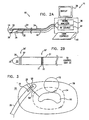
- Fig. 2A schematically illustrates a catheter system 18, including a catheter 20, for insertion into the heart of a subject, and an accompanying control unit 22 coupled to the proximal end of the catheter, in accordance with a preferred embodiment of the present invention.
- catheter 20 Near its distal end 24, catheter 20 includes an ablation device 26, preferably an RF ablation electrode, and two electrodes 28 and 30, preferably bipolar electrodes, for sensing electrical activation signals in the endocardium.
- one electrode 28 is distal to ablation device 26, and the other electrode 30 is proximal to it.
- Catheter 20 preferably also includes a position sensor 32, similarly adjacent to its distal end 24.
- Sensor 32 preferably comprises a plurality of coils, which generate signals responsive to externally-applied magnetic fields, as described in the above-mentioned W096/05768 PCT patent publication.
- the magnetic fields are preferably generated by field generators outside the body of the subject (not shown in the figures).
- the signals generated by the coils are used to continuously determine six-dimensional position and orientation information regarding distal end 24 of catheter 20.
- Other types of position sensors known in the art which are capable of determining three-dimensional position coordinates and one or two angular orientation coordinates, can also be used in the practice of the invention.
- Circuitry 36 processes the signals from electrodes 28 and 30 and calculates correlation coefficients, as will be described below. Circuitry 36 also determines the position of distal end 24 of catheter 20.
- Console 22 preferably also includes a display 38, on which the activation signal and position information is presented to a user, and user controls 40.
- the user controls are used to activate and de-activate an RF source 42 as desired, which source provides RF power to ablation electrode 26 over power wires 44.
- catheter 20 and console 22 also include means, known in the art, for steering distal end 24 of catheter 20, preferably controlled via the console.
- Fig. 2B schematically illustrates the distal portion of a catheter 21, which may be used in system 18 in place of catheter 20, in accordance with an alternative preferred embodiment of the present invention.
- catheter 21 includes wires 34 and 44 and, preferably, contains a position sensor, such as sensor 32, and a steering device, substantially as described above.
- catheter 21 is preferably 1-3 mm in diameter.
- Ablation electrode 26 comprises a conductive external layer 23 on catheter 21, extending proximally along the catheter from distal end 24 for a length of 2-8 mm.
- a bipolar electrode 28' comprises ablation electrode 26 and ring electrode 27, mutually coupled in bipolar fashion, as is known in the art.
- a second bipolar electrode 30' similarly comprises ring electrodes 31 and 33.
- device 26 is coupled via signal wires 34 to the circuitry, and thus functions as a sensing electrode.
- device 26 is coupled to RF source 42 and, preferably, disconnected from circuitry 36, so that the device functions as an ablation electrode.
- references to electrodes 28 and 30 will be understood to apply as well, wherever appropriate, to electrodes 28' and 30', mutatis mutandis.
- the electrical activation signals measured at two locations in the endocardium, for example using electrodes 28 and 30, will generally exhibit a high degree of correlation. This correlation is reflected in the two signals having similar frequency spectra and in the normalized correlation coefficient C of the two signals having a value close to one, where in which E 1 (t) and E 2 (t) are the respective activation signals sensed by electrodes 28 and 30; T is an integration time preferably corresponding to a number of cardiac cycles; ⁇ is a delay much smaller than T, corresponding generally to the difference in the arrival time of the activation signal at the position of electrode 28 from that at electrode 30; and
- the delay ⁇ will be approximately in the range 3-240 msec, given by the quotient of the distance separating electrodes 28 and 30, preferably about 12 mm, divided by the local conduction velocity in the heart, typically 0.05 to 4 m/sec.
- circuitry 36 determines and resolves values of ⁇ down to a resolution limit less than or equal to 2 msec.
- the circuitry preferably includes a band-pass filter, which removes low-frequency background and high-frequency transients in the electrogram signals received by the electrodes, prior to performing correlation calculations, as well as other pre-correlation signal conditioning circuitry.
- the electrogram signals may be passed through a 40-250 Hz bandpass filter, followed by an absolute value operation and a 20 Hz low-pass filter, as described in the above-mentioned articles by Botteron and Smith.
- the high correlation coefficient of the electrical activation signals is characteristic of the normal, cooperative contraction of the heart muscle fibers.
- this cooperative contraction is reduced or lost entirely within at least a portion of the heart muscle.
- a high correlation coefficient between the activation signals sensed at two points in the endocardium may be indicative of the presence of an abnormal conduction path.
- catheter 20 or 21 is, preferably, first used to create a correlation map of at least a portion of the atrium in which ablation is to take place.
- circuitry 36 receives signals from electrodes 28 and 30 and determines the correlation between the signals.
- the correlation mapping is performed in conjunction with measurements of the tissue conduction velocity and refractory period, so as to determine and map local values of the tissue dimension value, D, as described in the parent application to this one, U.S. Patent Application no. 08/476,200, (Patent no. US-A-5, 718, 241, International Patent Application WO 96/39929).
- areas of normal conduction will generally be characterized by consistent, high correlation coefficients at an appropriate delay ⁇ .
- the correlation coefficients will typically vary chaotically, and/or the delay ⁇ that gives a high correlation between the signals will differ from that expected for normal conduction.
- a consistently low correlation coefficient at a site may be indicative of a conduction block in the area of the site.
- Fig. 3 schematically illustrates possible reentrant conduction paths 52 and 54 in the vicinity of a conduction block 56 in heart tissue 10, for example within the atrium of the heart as illustrated in Fig. 1, and the operation of catheter 20 in ablating portions of the heart tissue in relation to these paths.
- paths 52 and 54 represent only two out of many possible paths for wavelets 12 (as shown in Fig. 1). Such paths generally need only to have a length greater than the local dimension value D and a curvature no less than a minimum radius a, as described in the parent application.
- Paths 52 and 54 are generally not fixed conduction paths, but rather transient paths, along which activation signals may be conducted, either around block 56 (path 54) or adjacent to it (path 52). As described above, activation signals traveling along path 52 or 54 will cause muscle fibers in the path to be activated at inappropriate times, frequently with multiple activations during the period of a single heart beat, leading to fibrillation.
- catheter 20 is shown to have already ablated a circumferential ablation line 58 (referred to as a ⁇ -type ablation line in the parent application), which interrupts path 52 and other, similar paths adjacent to block 56.
- Line 58 does not interrupt paths around block 56, such as path 54, however. Therefore, in Fig. 3, catheter 20 is shown in the course of ablating a radial ( ⁇ -type) ablation line 59.
- the catheter is positioned so that ablation electrode 26 can ablate a series of points in succession along line 59, until all paths such as path 54 have been interrupted.
- position sensor 32 shown in Fig. 2A, but omitted in Fig. 3 for simplicity
- the correlation coefficient C between the signals sensed by electrodes 28 and 30 along path 54 generally has a relatively high value. As described above, this value will commonly fluctuate, due to variations in the reentrant conduction currents during AF.
- the value of ⁇ in equation (1) is adjusted so as to maximize the value of C .
- ablation electrode 26 When the RF source is activated, ablation electrode 26 selectively ablates the heart tissue adjacent to the electrode, thereby gradually extending line 59. After the ablation, signals are again sensed by electrodes 28 and 30, and the correlation coefficient C is calculated, preferably while maintaining ⁇ at its pre-ablation value, and compared to the pre-ablation coefficient. If the coefficient has not changed substantially, catheter 20 is repositioned, and line 59 is extended further. Once line 59 has been extended sufficiently, the correlation coefficient between the signals from electrodes 28 and 30 is generally substantially reduced. The reduction in the correlation coefficient indicates that path 54 has been successfully interrupted.
- the correlation coefficient will increase to a value close to 1 for an appropriate choice of ⁇ .
- catheter 20 will preferably be repositioned to form an additional radial line, on the opposite side of block 56, for example, and the signal correlation measurements and ablation will be repeated.
- catheter system 18 allows the progress of the ablation procedure to be tracked, assessed and adjusted in real time, so as to provide optimal treatment for AF while minimizing unnecessary damage to the heart tissue.
- catheter 20 may be used to ablate a group of sites defining a complex shape, in order to completely cut an abnormal path.
- Ablation device 26 may comprise a standard ablation electrode, which generally produces ablation lesions at least 1 cm wide. In this case, electrodes 28 and 30 are placed about 2 cm apart.
- the average correlation coefficient between the signals sensed by these electrodes in the presence of AF, before ablation, will typically be no more than 0.3, since the correlation drops exponentially with distance, as described above (whereas in a normally-conducting heart, high correlation coefficients, approaching 1, are obtained even for mutually distant points, by appropriate choice of ⁇ ). Consequently, it may be difficult to observe the change in correlation that occurs after the ablation.
- ablation device 26 is preferably configured to ablate thin lesions, preferably no more than 3 to 5 mm wide, such as those shown in Fig. 3.
- device 26 may comprise, for example, a thin ablation electrode or, alternatively, an optical device for applying laser irradiation to heart tissue 50, as is known in the art. Electrodes 28 and 30 are then preferably placed no more than about 1 cm apart. The average correlation coefficient between the signals sensed by the electrodes at this distance, under conditions of AF, will typically be about 0.8. Thus, changes in the correlation may be more easily and accurately observed.
- Fig. 3 is drawn and described with reference to catheter 20, it will be understood that catheter 21, as shown in Fig. 2B, may be used in a substantially similar fashion.
- catheter 21 should be advanced distally so that electrodes 28' and 30' are on opposite sides of the lesion that has been ablated.
- the catheter may be drawn back in a proximal direction, for example, to determine whether the ablation has enhanced conduction along a normal path on the proximal side of the lesion.
- the magnitude of the correlation coefficient C is used as the indicator of changes in the correlation between signals E 1 and E 2
- other indicators may be used. For example, a change in the relative phases of E 1 and E 2 may be determined, by finding a first delay value ⁇ b , which gives the highest value of C before ablation, and then finding a second delay value ⁇ a , which gives the highest value of C after ablation, and comparing the two delay values.
- frequency spectra of E 1 and E 2 , ⁇ 1 ( ⁇ ) and ⁇ 2 ( ⁇ ) respectively may be calculated before and after ablation, for example, by means of a Fast Fourier Transform (FFT).
- FFT Fast Fourier Transform
- the correlation coefficient of ⁇ 1 and ⁇ 2 is then determined using a formula similar to equation (1), but with integration over ⁇ , rather than t, before and after ablation. Changes in the correlation coefficient are noted and used as described above.
- Other statistical properties of the spectra may similarly be analyzed and compared, before and after ablation, in order to assess the effectiveness of the ablation.
- signals E 1 and E 2 are simultaneously acquired by circuitry 36 from bipolar electrodes 28 and 30.
- the two signals may be acquired in sequence, preferably in sequential heart cycles, both before and after ablation. This technique may afford greater ease in signal acquisition and reduction of the electrical component count.
- acquisition of the signals is preferably synchronized with the heart beat, for example using the QRS complex of the heart's ECG as a trigger pulse.
- This synchronization is generally necessary if the correlation of E 1 and E 2 is to be analyzed in the time domain, as described above in reference to equation (1). Synchronization may usually be dispensed with, however, if the correlation or other statistical analysis is performed in the frequency domain, as long as the FFT or other transform is taken over a period that is much longer than a single heart beat.
- the present invention typically allows a physician to interrupt abnormal conduction paths more rapidly and with less unnecessary injury to the heart tissue than invasive methods known in the art, because it provides direct feedback as to the effectiveness of the operation at each site in the endocardium chosen for ablation. In the preferred embodiments of the present invention described above, however, there may still be sites in the heart tissue that are unnecessarily ablated.
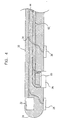
- Fig. 4 therefore, schematically illustrates, in sectional view, another preferred embodiment of the present invention in which the potential effectiveness of ablating a suspected site of an abnormal conduction path in the heart tissue is reversibly evaluated before ablation.
- catheter 20 is substantially similar to that shown in Fig. 1 and described with reference thereto, but with the addition of a thermoelectric cooler 60, which is thermally coupled to ablation electrode 26. Cooler 60 receives electrical power via wires 62 from a suitable power supply (not shown in the figures), as is known in the art, in console 22.
- catheter 20 as shown in Fig. 4 is positioned so that ablation electrode 26 is in contact with the endocardium at the site of a suspected abnormal conduction path.
- the correlation of activation signals sensed by bipolar electrodes 28 and 30 is measured by signal analyzer circuitry 36.
- Cooler 60 is then activated, by providing electrical current through wires 62, so as to cool ablation electrode 26, preferably to about -10°C.
- the cooled electrode chills the heart tissue adjacent thereto to a suitable temperature, preferably around 5°C.
- thermoelectric cooler 60 located generally in contact with ablation electrode 26 and cooling the heart tissue through the electrode
- the cooler may be placed in any convenient position alongside electrode 26, as long as it can adequately cool the tissue adjacent to the electrode.
- Other methods of reversibly interrupting the electrical conduction of the tissue may similarly be used, for example, by locally injecting a conduction-inhibiting drug into the endocardium.
- ablation electrode 26 is disposed axially along a radial outer surface of catheter 20, with bipolar electrodes 28 and 30 similarly disposed, one distal and one proximal. In other preferred embodiments of the present invention, however, electrodes 26, 28 and 30 may be placed in any convenient configuration.
- electrodes 26, 28 and 30 may be suitably mounted on a substantially rigid structure at the distal end of catheter 20, as described, for example, in PCT patent application no. PCT/IL97/00009, Publication no. WO 97/24983, filed January 8, 1997, which is assigned to the assignee of the present patent application and whose disclosure is incorporated herein by reference.
- three or more bipolar sensing electrodes may be mounted on the structure, and the mutual correlations of the activation signals that they receive may be compared in order to more precisely position the ablation electrode.
- the correlation information may be combined with conduction velocity information, determined as described in the '009 PCT application.
- the combined information is preferably used for mapping electrical activity in the heart before ablation treatment and, additionally or alternatively, for identifying suitable sites for ablation and determining the efficacy of ablation treatment carried out at the sites, as described herein.
Landscapes
- Health & Medical Sciences (AREA)
- Life Sciences & Earth Sciences (AREA)
- Engineering & Computer Science (AREA)
- Veterinary Medicine (AREA)
- Biomedical Technology (AREA)
- Animal Behavior & Ethology (AREA)
- General Health & Medical Sciences (AREA)
- Public Health (AREA)
- Nuclear Medicine, Radiotherapy & Molecular Imaging (AREA)
- Heart & Thoracic Surgery (AREA)
- Radiology & Medical Imaging (AREA)
- Surgery (AREA)
- Physics & Mathematics (AREA)
- Medical Informatics (AREA)
- Molecular Biology (AREA)
- Pathology (AREA)
- Plasma & Fusion (AREA)
- Biophysics (AREA)
- Otolaryngology (AREA)
- Vascular Medicine (AREA)
- Cardiology (AREA)
- Human Computer Interaction (AREA)
- Surgical Instruments (AREA)
- Measurement And Recording Of Electrical Phenomena And Electrical Characteristics Of The Living Body (AREA)
- Media Introduction/Drainage Providing Device (AREA)
Applications Claiming Priority (2)
| Application Number | Priority Date | Filing Date | Title |
|---|---|---|---|
| US956687 | 1997-10-23 | ||
| US08/956,687 US5954665A (en) | 1995-06-07 | 1997-10-23 | Cardiac ablation catheter using correlation measure |
Publications (3)
| Publication Number | Publication Date |
|---|---|
| EP0911059A2 EP0911059A2 (en) | 1999-04-28 |
| EP0911059A3 EP0911059A3 (en) | 2000-04-12 |
| EP0911059B1 true EP0911059B1 (en) | 2003-09-03 |
Family
ID=25498553
Family Applications (1)
| Application Number | Title | Priority Date | Filing Date |
|---|---|---|---|
| EP98308643A Expired - Lifetime EP0911059B1 (en) | 1997-10-23 | 1998-10-22 | Ablation catheter with sensing electrodes |
Country Status (8)
| Country | Link |
|---|---|
| US (1) | US5954665A (https=) |
| EP (1) | EP0911059B1 (https=) |
| JP (1) | JP4245707B2 (https=) |
| AU (1) | AU735274B2 (https=) |
| CA (1) | CA2250805C (https=) |
| DE (1) | DE69817723T2 (https=) |
| ES (1) | ES2206851T3 (https=) |
| IL (1) | IL126611A (https=) |
Cited By (1)
| Publication number | Priority date | Publication date | Assignee | Title |
|---|---|---|---|---|
| WO2014012133A1 (en) * | 2012-07-16 | 2014-01-23 | Lions Eye Institute Limited | Irradiation method and apparatus |
Families Citing this family (152)
| Publication number | Priority date | Publication date | Assignee | Title |
|---|---|---|---|---|
| US6096037A (en) | 1997-07-29 | 2000-08-01 | Medtronic, Inc. | Tissue sealing electrosurgery device and methods of sealing tissue |
| US6176857B1 (en) * | 1997-10-22 | 2001-01-23 | Oratec Interventions, Inc. | Method and apparatus for applying thermal energy to tissue asymmetrically |
| US6319241B1 (en) * | 1998-04-30 | 2001-11-20 | Medtronic, Inc. | Techniques for positioning therapy delivery elements within a spinal cord or a brain |
| US6161047A (en) * | 1998-04-30 | 2000-12-12 | Medtronic Inc. | Apparatus and method for expanding a stimulation lead body in situ |
| US6245062B1 (en) | 1998-10-23 | 2001-06-12 | Afx, Inc. | Directional reflector shield assembly for a microwave ablation instrument |
| US7226446B1 (en) | 1999-05-04 | 2007-06-05 | Dinesh Mody | Surgical microwave ablation assembly |
| US6277113B1 (en) | 1999-05-28 | 2001-08-21 | Afx, Inc. | Monopole tip for ablation catheter and methods for using same |
| US6546271B1 (en) | 1999-10-01 | 2003-04-08 | Bioscience, Inc. | Vascular reconstruction |
| US7033352B1 (en) | 2000-01-18 | 2006-04-25 | Afx, Inc. | Flexible ablation instrument |
| US6447443B1 (en) | 2001-01-13 | 2002-09-10 | Medtronic, Inc. | Method for organ positioning and stabilization |
| US6892091B1 (en) | 2000-02-18 | 2005-05-10 | Biosense, Inc. | Catheter, method and apparatus for generating an electrical map of a chamber of the heart |
| US6673068B1 (en) | 2000-04-12 | 2004-01-06 | Afx, Inc. | Electrode arrangement for use in a medical instrument |
| US6546935B2 (en) | 2000-04-27 | 2003-04-15 | Atricure, Inc. | Method for transmural ablation |
| US20020107514A1 (en) | 2000-04-27 | 2002-08-08 | Hooven Michael D. | Transmural ablation device with parallel jaws |
| US6458123B1 (en) * | 2000-04-27 | 2002-10-01 | Biosense Webster, Inc. | Ablation catheter with positional sensor |
| US6932811B2 (en) | 2000-04-27 | 2005-08-23 | Atricure, Inc. | Transmural ablation device with integral EKG sensor |
| US6905498B2 (en) | 2000-04-27 | 2005-06-14 | Atricure Inc. | Transmural ablation device with EKG sensor and pacing electrode |
| US6511500B1 (en) | 2000-06-06 | 2003-01-28 | Marc Mounir Rahme | Use of autonomic nervous system neurotransmitters inhibition and atrial parasympathetic fibers ablation for the treatment of atrial arrhythmias and to preserve drug effects |
| EP1463437B1 (en) * | 2000-07-31 | 2012-01-04 | Galil Medical Ltd. | Facilitation system for cryosurgery |
| JP2004505748A (ja) | 2000-08-23 | 2004-02-26 | ミクロニックス ピーティーワイ リミテッド | カテーテル位置表示装置およびその使用法 |
| US20020087151A1 (en) | 2000-12-29 | 2002-07-04 | Afx, Inc. | Tissue ablation apparatus with a sliding ablation instrument and method |
| US7740623B2 (en) | 2001-01-13 | 2010-06-22 | Medtronic, Inc. | Devices and methods for interstitial injection of biologic agents into tissue |
| US7628780B2 (en) | 2001-01-13 | 2009-12-08 | Medtronic, Inc. | Devices and methods for interstitial injection of biologic agents into tissue |
| US20040138621A1 (en) | 2003-01-14 | 2004-07-15 | Jahns Scott E. | Devices and methods for interstitial injection of biologic agents into tissue |
| US6743225B2 (en) | 2001-03-27 | 2004-06-01 | Uab Research Foundation | Electrophysiologic measure of endpoints for ablation lesions created in fibrillating substrates |
| US6740083B2 (en) * | 2001-07-09 | 2004-05-25 | Scimed Life Systems, Inc. | Distal catheter assembly with proximal mounting member |
| US6623514B1 (en) * | 2001-08-01 | 2003-09-23 | Origin Medsystems, Inc. | Method of cooling an organ |
| US6671533B2 (en) * | 2001-10-11 | 2003-12-30 | Irvine Biomedical Inc. | System and method for mapping and ablating body tissue of the interior region of the heart |
| US8974446B2 (en) | 2001-10-11 | 2015-03-10 | St. Jude Medical, Inc. | Ultrasound ablation apparatus with discrete staggered ablation zones |
| US20070038056A1 (en) | 2001-10-11 | 2007-02-15 | Carlo Pappone | System and methods for locating and ablating arrhythomogenic tissues |
| US7099717B2 (en) | 2002-01-03 | 2006-08-29 | Afx Inc. | Catheter having improved steering |
| US7967816B2 (en) | 2002-01-25 | 2011-06-28 | Medtronic, Inc. | Fluid-assisted electrosurgical instrument with shapeable electrode |
| JP4994573B2 (ja) * | 2002-02-12 | 2012-08-08 | オラテック インターベンションズ インコーポレイテッド | 鏡視下高周波切除装置 |
| US7192427B2 (en) | 2002-02-19 | 2007-03-20 | Afx, Inc. | Apparatus and method for assessing transmurality of a tissue ablation |
| US7291161B2 (en) | 2002-10-02 | 2007-11-06 | Atricure, Inc. | Articulated clamping member |
| GB2395620B (en) * | 2002-11-19 | 2004-09-29 | Nec Technologies | Cellular network acquisition method and apparatus |
| US7288092B2 (en) | 2003-04-23 | 2007-10-30 | Atricure, Inc. | Method and apparatus for ablating cardiac tissue with guide facility |
| US7367970B2 (en) * | 2003-11-11 | 2008-05-06 | Biosense Webster Inc. | Externally applied RF for pulmonary vein isolation |
| DE10355275B4 (de) * | 2003-11-26 | 2009-03-05 | Siemens Ag | Kathedereinrichtung |
| US7530980B2 (en) | 2004-04-14 | 2009-05-12 | Atricure, Inc | Bipolar transmural ablation method and apparatus |
| US10258285B2 (en) | 2004-05-28 | 2019-04-16 | St. Jude Medical, Atrial Fibrillation Division, Inc. | Robotic surgical system and method for automated creation of ablation lesions |
| US8755864B2 (en) | 2004-05-28 | 2014-06-17 | St. Jude Medical, Atrial Fibrillation Division, Inc. | Robotic surgical system and method for diagnostic data mapping |
| US10863945B2 (en) | 2004-05-28 | 2020-12-15 | St. Jude Medical, Atrial Fibrillation Division, Inc. | Robotic surgical system with contact sensing feature |
| US8528565B2 (en) | 2004-05-28 | 2013-09-10 | St. Jude Medical, Atrial Fibrillation Division, Inc. | Robotic surgical system and method for automated therapy delivery |
| US9782130B2 (en) | 2004-05-28 | 2017-10-10 | St. Jude Medical, Atrial Fibrillation Division, Inc. | Robotic surgical system |
| EP1750608B1 (en) | 2004-06-02 | 2012-10-03 | Medtronic, Inc. | Ablation device with jaws |
| US10413188B2 (en) * | 2004-11-17 | 2019-09-17 | Lawrence Livermore National Security, Llc | Assessment of tissue or lesion depth using temporally resolved light scattering spectroscopy |
| EP1658818A1 (en) | 2004-11-23 | 2006-05-24 | Biosense Webster, Inc. | Externally applied rf for pulmonary vein isolation |
| US7976518B2 (en) | 2005-01-13 | 2011-07-12 | Corpak Medsystems, Inc. | Tubing assembly and signal generator placement control device and method for use with catheter guidance systems |
| US8155910B2 (en) | 2005-05-27 | 2012-04-10 | St. Jude Medical, Atrial Fibrillation Divison, Inc. | Robotically controlled catheter and method of its calibration |
| US8583220B2 (en) * | 2005-08-02 | 2013-11-12 | Biosense Webster, Inc. | Standardization of catheter-based treatment for atrial fibrillation |
| US7681579B2 (en) | 2005-08-02 | 2010-03-23 | Biosense Webster, Inc. | Guided procedures for treating atrial fibrillation |
| US7877128B2 (en) * | 2005-08-02 | 2011-01-25 | Biosense Webster, Inc. | Simulation of invasive procedures |
| US7918847B2 (en) * | 2005-08-29 | 2011-04-05 | Washington University | Method and associated system for the interventional treatment of atrial fibrillation |
| US8038625B2 (en) * | 2005-09-15 | 2011-10-18 | St. Jude Medical, Atrial Fibrillation Division, Inc. | System and method for three-dimensional mapping of electrophysiology information |
| US8229545B2 (en) * | 2005-09-15 | 2012-07-24 | St. Jude Medical, Atrial Fibrillation Division, Inc. | System and method for mapping complex fractionated electrogram information |
| WO2007038861A1 (en) * | 2005-10-04 | 2007-04-12 | Hopital Du Sacre-Coeur De Montreal | Method and apparatus for predicting potential occurrence of atrial fibrillation events |
| US8403925B2 (en) | 2006-12-06 | 2013-03-26 | St. Jude Medical, Atrial Fibrillation Division, Inc. | System and method for assessing lesions in tissue |
| US8369922B2 (en) | 2005-12-06 | 2013-02-05 | St. Jude Medical Atrial Fibrillation Division, Inc. | Method for displaying catheter electrode-tissue contact in electro-anatomic mapping and navigation system |
| US8449535B2 (en) * | 2005-12-06 | 2013-05-28 | St. Jude Medical, Atrial Fibrillation Division, Inc. | System and method for assessing coupling between an electrode and tissue |
| WO2007070361A2 (en) | 2005-12-06 | 2007-06-21 | St. Jude Medical, Atrial Fibrillation Division, Inc. | Assessment of electrode coupling for tissue ablation |
| US8406866B2 (en) * | 2005-12-06 | 2013-03-26 | St. Jude Medical, Atrial Fibrillation Division, Inc. | System and method for assessing coupling between an electrode and tissue |
| US20090177111A1 (en) * | 2006-12-06 | 2009-07-09 | Miller Stephan P | System and method for displaying contact between a catheter and tissue |
| US9492226B2 (en) | 2005-12-06 | 2016-11-15 | St. Jude Medical, Atrial Fibrillation Division, Inc. | Graphical user interface for real-time RF lesion depth display |
| US10362959B2 (en) * | 2005-12-06 | 2019-07-30 | St. Jude Medical, Atrial Fibrillation Division, Inc. | System and method for assessing the proximity of an electrode to tissue in a body |
| US8603084B2 (en) | 2005-12-06 | 2013-12-10 | St. Jude Medical, Atrial Fibrillation Division, Inc. | System and method for assessing the formation of a lesion in tissue |
| US9254163B2 (en) | 2005-12-06 | 2016-02-09 | St. Jude Medical, Atrial Fibrillation Division, Inc. | Assessment of electrode coupling for tissue ablation |
| US7918850B2 (en) * | 2006-02-17 | 2011-04-05 | Biosense Wabster, Inc. | Lesion assessment by pacing |
| ES2366046T3 (es) * | 2006-02-22 | 2011-10-14 | Custom Medical Applications, Inc. | Instrumento de ablación. |
| US20070232949A1 (en) * | 2006-03-31 | 2007-10-04 | Ep Medsystems, Inc. | Method For Simultaneous Bi-Atrial Mapping Of Atrial Fibrillation |
| WO2007129310A2 (en) | 2006-05-02 | 2007-11-15 | Galil Medical Ltd. | Cryotherapy insertion system and method |
| US20090171203A1 (en) * | 2006-05-02 | 2009-07-02 | Ofer Avital | Cryotherapy Insertion System and Method |
| US7774051B2 (en) * | 2006-05-17 | 2010-08-10 | St. Jude Medical, Atrial Fibrillation Division, Inc. | System and method for mapping electrophysiology information onto complex geometry |
| US7988639B2 (en) * | 2006-05-17 | 2011-08-02 | St. Jude Medical, Atrial Fibrillation Division, Inc. | System and method for complex geometry modeling of anatomy using multiple surface models |
| US7515954B2 (en) | 2006-06-13 | 2009-04-07 | Rhythmia Medical, Inc. | Non-contact cardiac mapping, including moving catheter and multi-beat integration |
| US7729752B2 (en) * | 2006-06-13 | 2010-06-01 | Rhythmia Medical, Inc. | Non-contact cardiac mapping, including resolution map |
| US8010186B1 (en) * | 2006-07-19 | 2011-08-30 | Pacesetter, Inc. | System and related methods for identifying a fibrillation driver |
| US8197494B2 (en) | 2006-09-08 | 2012-06-12 | Corpak Medsystems, Inc. | Medical device position guidance system with wireless connectivity between a noninvasive device and an invasive device |
| WO2008045877A2 (en) | 2006-10-10 | 2008-04-17 | St. Jude Medical, Atrial Fibrillation Division, Inc. | Electrode tip and ablation system |
| US9585586B2 (en) | 2006-12-29 | 2017-03-07 | St. Jude Medical, Atrial Fibrillation Division, Inc. | Navigational reference dislodgement detection method and system |
| US9220439B2 (en) | 2006-12-29 | 2015-12-29 | St. Jude Medical, Atrial Fibrillation Division, Inc. | Navigational reference dislodgement detection method and system |
| US20080190438A1 (en) * | 2007-02-08 | 2008-08-14 | Doron Harlev | Impedance registration and catheter tracking |
| US7825925B2 (en) * | 2007-03-09 | 2010-11-02 | St. Jude Medical, Atrial Fibrillation Division, Inc. | Method and system for repairing triangulated surface meshes |
| US9549689B2 (en) * | 2007-03-09 | 2017-01-24 | St. Jude Medical, Atrial Fibrillation Division, Inc. | System and method for correction of inhomogeneous fields |
| US10433929B2 (en) | 2007-03-09 | 2019-10-08 | St. Jude Medical, Atrial Fibrillation Division, Inc. | System and method for local deformable registration of a catheter navigation system to image data or a model |
| KR101000320B1 (ko) | 2008-04-15 | 2010-12-13 | (주) 태웅메디칼 | 바이폴라 전극 방식의 가이드 와이어 및 이를 이용한카테터 시스템 |
| US8386014B2 (en) * | 2007-06-21 | 2013-02-26 | The Trustees Of Columbia University In The City Of New York | Systems and methods for implementing heart geometrical measurements |
| US8175679B2 (en) * | 2007-12-26 | 2012-05-08 | St. Jude Medical, Atrial Fibrillation Division, Inc. | Catheter electrode that can simultaneously emit electrical energy and facilitate visualization by magnetic resonance imaging |
| US8103327B2 (en) | 2007-12-28 | 2012-01-24 | Rhythmia Medical, Inc. | Cardiac mapping catheter |
| US8290578B2 (en) * | 2007-12-28 | 2012-10-16 | St. Jude Medical, Atrial Fibrillation Division, Inc. | Method and apparatus for complex impedance compensation |
| US9675410B2 (en) | 2007-12-28 | 2017-06-13 | St. Jude Medical, Atrial Fibrillation Division, Inc. | Flexible polymer electrode for MRI-guided positioning and radio frequency ablation |
| US10660690B2 (en) | 2007-12-28 | 2020-05-26 | St. Jude Medical, Atrial Fibrillation Division, Inc. | System and method for measurement of an impedance using a catheter such as an ablation catheter |
| US9204927B2 (en) | 2009-05-13 | 2015-12-08 | St. Jude Medical, Atrial Fibrillation Division, Inc. | System and method for presenting information representative of lesion formation in tissue during an ablation procedure |
| US8538509B2 (en) | 2008-04-02 | 2013-09-17 | Rhythmia Medical, Inc. | Intracardiac tracking system |
| US8676303B2 (en) | 2008-05-13 | 2014-03-18 | The Regents Of The University Of California | Methods and systems for treating heart instability |
| US8357149B2 (en) * | 2008-06-05 | 2013-01-22 | Biosense Webster, Inc. | Filter for simultaneous pacing and ablation |
| US8206385B2 (en) * | 2008-06-09 | 2012-06-26 | St. Jude Medical, Atrial Fibrillation Division, Inc. | Catheter assembly with front-loaded tip and multi-contact connector |
| CA2739838C (en) | 2008-10-09 | 2016-11-01 | The Regents Of The University Of California | Methods, system and apparatus for the detection, diagnosis and treatment of biological rhythm disorders |
| US8137343B2 (en) | 2008-10-27 | 2012-03-20 | Rhythmia Medical, Inc. | Tracking system using field mapping |
| US9320565B2 (en) * | 2008-12-31 | 2016-04-26 | St. Jude Medical, Atrial Fibrillation Division, Inc. | Ablation devices, systems and method for measuring cooling effect of fluid flow |
| KR101164887B1 (ko) * | 2009-03-19 | 2012-07-19 | 서울대학교병원 | 양극형 고주파 절제술용 카테터 |
| US9398862B2 (en) | 2009-04-23 | 2016-07-26 | Rhythmia Medical, Inc. | Multi-electrode mapping system |
| US8905968B2 (en) | 2009-04-29 | 2014-12-09 | Encephalon Technologies, Llc | System for cooling and pressurizing fluid |
| US8103338B2 (en) | 2009-05-08 | 2012-01-24 | Rhythmia Medical, Inc. | Impedance based anatomy generation |
| US8571647B2 (en) | 2009-05-08 | 2013-10-29 | Rhythmia Medical, Inc. | Impedance based anatomy generation |
| US10398326B2 (en) | 2013-03-15 | 2019-09-03 | The Regents Of The University Of California | System and method of identifying sources associated with biological rhythm disorders |
| US10434319B2 (en) | 2009-10-09 | 2019-10-08 | The Regents Of The University Of California | System and method of identifying sources associated with biological rhythm disorders |
| US9392948B2 (en) | 2011-12-09 | 2016-07-19 | The Regents Of The University Of California | System and method of identifying sources for biological rhythms |
| US9332915B2 (en) | 2013-03-15 | 2016-05-10 | The Regents Of The University Of California | System and method to identify sources associated with biological rhythm disorders |
| AU2011237661B2 (en) | 2010-04-08 | 2015-05-21 | The Regents Of The University Of California | Methods, system and apparatus for the detection, diagnosis and treatment of biological rhythm disorders |
| US9002442B2 (en) | 2011-01-13 | 2015-04-07 | Rhythmia Medical, Inc. | Beat alignment and selection for cardiac mapping |
| US8948837B2 (en) | 2011-01-13 | 2015-02-03 | Rhythmia Medical, Inc. | Electroanatomical mapping |
| US10918307B2 (en) | 2011-09-13 | 2021-02-16 | St. Jude Medical, Atrial Fibrillation Division, Inc. | Catheter navigation using impedance and magnetic field measurements |
| US9901303B2 (en) | 2011-04-14 | 2018-02-27 | St. Jude Medical, Atrial Fibrillation Division, Inc. | System and method for registration of multiple navigation systems to a common coordinate frame |
| US10362963B2 (en) | 2011-04-14 | 2019-07-30 | St. Jude Medical, Atrial Fibrillation Division, Inc. | Correction of shift and drift in impedance-based medical device navigation using magnetic field information |
| CN103718191B (zh) | 2011-05-02 | 2018-02-02 | 加利福尼亚大学董事会 | 使用成形消融术来靶向心律紊乱的系统和方法 |
| US9107600B2 (en) | 2011-05-02 | 2015-08-18 | The Regents Of The University Of California | System and method for reconstructing cardiac activation information |
| US9050006B2 (en) | 2011-05-02 | 2015-06-09 | The Regents Of The University Of California | System and method for reconstructing cardiac activation information |
| US8165666B1 (en) | 2011-05-02 | 2012-04-24 | Topera, Inc. | System and method for reconstructing cardiac activation information |
| US9028441B2 (en) | 2011-09-08 | 2015-05-12 | Corpak Medsystems, Inc. | Apparatus and method used with guidance system for feeding and suctioning |
| ES2727868T3 (es) | 2011-09-22 | 2019-10-21 | Univ George Washington | Sistemas para visualizar el tejido ablacionado |
| CN104066368B (zh) | 2011-09-22 | 2017-02-22 | 乔治华盛顿大学 | 用于使经消融组织可视化的系统和方法 |
| US10456196B2 (en) * | 2011-12-15 | 2019-10-29 | Biosense Webster (Israel) Ltd. | Monitoring and tracking bipolar ablation |
| US9402556B2 (en) * | 2012-06-11 | 2016-08-02 | Biosense Webster (Israel) Ltd. | Compensation for heart movement in a body coordinate system |
| US9031642B2 (en) | 2013-02-21 | 2015-05-12 | Medtronic, Inc. | Methods for simultaneous cardiac substrate mapping using spatial correlation maps between neighboring unipolar electrograms |
| US8715199B1 (en) | 2013-03-15 | 2014-05-06 | Topera, Inc. | System and method to define a rotational source associated with a biological rhythm disorder |
| CN105324067B (zh) | 2013-05-06 | 2017-10-24 | 波士顿科学医学有限公司 | 实时或回放电生理数据可视化期间的最近的跳动特性的持续显示 |
| EP2996550B1 (en) | 2013-05-14 | 2019-07-31 | Boston Scientific Scimed Inc. | Representation and identification of activity patterns during electro-physiology mapping using vector fields |
| US10368764B2 (en) * | 2013-09-12 | 2019-08-06 | Topera, Inc. | System and method to select signal segments for analysis of a biological rhythm disorder |
| EP3057488B1 (en) | 2013-10-14 | 2018-05-16 | Boston Scientific Scimed, Inc. | High resolution cardiac mapping electrode array catheter |
| US11246654B2 (en) * | 2013-10-14 | 2022-02-15 | Boston Scientific Scimed, Inc. | Flexible renal nerve ablation devices and related methods of use and manufacture |
| JP6737705B2 (ja) | 2013-11-14 | 2020-08-12 | ザ・ジョージ・ワシントン・ユニバーシティThe George Washingtonuniversity | 損傷部位の深さを決定するシステムの動作方法及び心臓組織の画像を生成するシステム |
| US20150141847A1 (en) | 2013-11-20 | 2015-05-21 | The George Washington University | Systems and methods for hyperspectral analysis of cardiac tissue |
| WO2015187386A1 (en) | 2014-06-03 | 2015-12-10 | Boston Scientific Scimed, Inc. | Electrode assembly having an atraumatic distal tip |
| EP3151773B1 (en) | 2014-06-04 | 2018-04-04 | Boston Scientific Scimed, Inc. | Electrode assembly |
| US10925511B2 (en) | 2014-07-24 | 2021-02-23 | Cardiosolv Ablation Technologies, Inc. | System and method for cardiac ablation |
| JP6771731B2 (ja) | 2014-11-03 | 2020-10-21 | 460メディカル・インコーポレイテッド460Medical, Inc. | 接触性評価システム及び方法 |
| EP3215002B1 (en) | 2014-11-03 | 2024-03-20 | The George Washington University | Systems for lesion assessment |
| EP3267955B1 (en) * | 2015-03-10 | 2025-06-04 | PAVmed Inc. | Continuous flow balloon catheter systems and methods of use |
| US10779904B2 (en) | 2015-07-19 | 2020-09-22 | 460Medical, Inc. | Systems and methods for lesion formation and assessment |
| WO2017031197A1 (en) | 2015-08-20 | 2017-02-23 | Boston Scientific Scimed Inc. | Flexible electrode for cardiac sensing and method for making |
| WO2017041892A1 (en) | 2015-09-07 | 2017-03-16 | Ablacon Inc. | System for analyzing electrophysiological data and method for analyzing electrophysiological data |
| US10405766B2 (en) | 2015-09-26 | 2019-09-10 | Boston Scientific Scimed, Inc. | Method of exploring or mapping internal cardiac structures |
| EP3352648B1 (en) | 2015-09-26 | 2022-10-26 | Boston Scientific Scimed Inc. | Multiple rhythm template monitoring |
| WO2017053927A1 (en) | 2015-09-26 | 2017-03-30 | Boston Scientific Scimed Inc. | Systems and methods for anatomical shell editing |
| US10271758B2 (en) | 2015-09-26 | 2019-04-30 | Boston Scientific Scimed, Inc. | Intracardiac EGM signals for beat matching and acceptance |
| US10576263B2 (en) * | 2017-04-03 | 2020-03-03 | Biosense Webster (Israel) Ltd. | Tissue conduction velocity |
| US10635577B2 (en) | 2017-04-07 | 2020-04-28 | International Business Machines Corporation | Integration times in a continuous integration environment based on statistical modeling |
| CN107260297A (zh) * | 2017-06-30 | 2017-10-20 | 上海微创电生理医疗科技股份有限公司 | 一种射频消融导管及射频消融系统 |
| US12076081B2 (en) | 2020-01-08 | 2024-09-03 | 460Medical, Inc. | Systems and methods for optical interrogation of ablation lesions |
| WO2021243061A1 (en) | 2020-05-27 | 2021-12-02 | The George Washington University | Lesion visualization using dual wavelength approach |
| US20250177055A1 (en) * | 2023-11-30 | 2025-06-05 | Biosense Webster (Israel) Ltd. | Medical probe for navigating small diameter blood vessels |
Citations (1)
| Publication number | Priority date | Publication date | Assignee | Title |
|---|---|---|---|---|
| EP0499491A2 (en) * | 1991-02-15 | 1992-08-19 | Cardiac Pathways Corporation | Endocardial mapping and ablation system and catheter probe and method |
Family Cites Families (58)
| Publication number | Priority date | Publication date | Assignee | Title |
|---|---|---|---|---|
| US4173228A (en) * | 1977-05-16 | 1979-11-06 | Applied Medical Devices | Catheter locating device |
| US4304239A (en) * | 1980-03-07 | 1981-12-08 | The Kendall Company | Esophageal probe with balloon electrode |
| US4431005A (en) * | 1981-05-07 | 1984-02-14 | Mccormick Laboratories, Inc. | Method of and apparatus for determining very accurately the position of a device inside biological tissue |
| US4444195A (en) * | 1981-11-02 | 1984-04-24 | Cordis Corporation | Cardiac lead having multiple ring electrodes |
| US4499493A (en) * | 1983-02-22 | 1985-02-12 | The Board Of Trustees Of The Leland Stanford Junior University | Multiple measurement noise reducing system using artifact edge identification and selective signal processing |
| US4613866A (en) * | 1983-05-13 | 1986-09-23 | Mcdonnell Douglas Corporation | Three dimensional digitizer with electromagnetic coupling |
| US4812976A (en) * | 1983-07-22 | 1989-03-14 | Lundy Research Laboratories, Inc. | Method and apparatus for characterizing the unknown state of a physical system |
| US4522212A (en) * | 1983-11-14 | 1985-06-11 | Mansfield Scientific, Inc. | Endocardial electrode |
| US4573473A (en) * | 1984-04-13 | 1986-03-04 | Cordis Corporation | Cardiac mapping probe |
| US4697595A (en) * | 1984-07-24 | 1987-10-06 | Telectronics N.V. | Ultrasonically marked cardiac catheters |
| US4628937A (en) * | 1984-08-02 | 1986-12-16 | Cordis Corporation | Mapping electrode assembly |
| CA1265586A (en) * | 1984-08-14 | 1990-02-06 | Consiglio Nazionale Delle Ricerche | Method and device for quick location of starting site of ventricular arrhythmias |
| US4699147A (en) * | 1985-09-25 | 1987-10-13 | Cordis Corporation | Intraventricular multielectrode cardial mapping probe and method for using same |
| US4821731A (en) * | 1986-04-25 | 1989-04-18 | Intra-Sonix, Inc. | Acoustic image system and method |
| US4945305A (en) * | 1986-10-09 | 1990-07-31 | Ascension Technology Corporation | Device for quantitatively measuring the relative position and orientation of two bodies in the presence of metals utilizing direct current magnetic fields |
| US4940064A (en) * | 1986-11-14 | 1990-07-10 | Desai Jawahar M | Catheter for mapping and ablation and method therefor |
| US4922912A (en) * | 1987-10-21 | 1990-05-08 | Hideto Watanabe | MAP catheter |
| FR2622098B1 (fr) * | 1987-10-27 | 1990-03-16 | Glace Christian | Procede et sonde azimutale pour reperer le point d'emergence des tachycardies ventriculaires |
| US4777955A (en) * | 1987-11-02 | 1988-10-18 | Cordis Corporation | Left ventricle mapping probe |
| GB2212267B (en) * | 1987-11-11 | 1992-07-29 | Circulation Res Ltd | Methods and apparatus for the examination and treatment of internal organs |
| US4899750A (en) * | 1988-04-19 | 1990-02-13 | Siemens-Pacesetter, Inc. | Lead impedance scanning system for pacemakers |
| US5000190A (en) * | 1988-06-22 | 1991-03-19 | The Cleveland Clinic Foundation | Continuous cardiac output by impedance measurements in the heart |
| US5054496A (en) * | 1988-07-15 | 1991-10-08 | China-Japan Friendship Hospital | Method and apparatus for recording and analyzing body surface electrocardiographic peak maps |
| US5025786A (en) * | 1988-07-21 | 1991-06-25 | Siegel Sharon B | Intracardiac catheter and method for detecting and diagnosing myocardial ischemia |
| CA1292572C (en) * | 1988-10-25 | 1991-11-26 | Fernando C. Lebron | Cardiac mapping system simulator |
| US4945912A (en) * | 1988-11-25 | 1990-08-07 | Sensor Electronics, Inc. | Catheter with radiofrequency heating applicator |
| US5056517A (en) * | 1989-07-24 | 1991-10-15 | Consiglio Nazionale Delle Ricerche | Biomagnetically localizable multipurpose catheter and method for magnetocardiographic guided intracardiac mapping, biopsy and ablation of cardiac arrhythmias |
| US5104393A (en) * | 1989-08-30 | 1992-04-14 | Angelase, Inc. | Catheter |
| US5220924A (en) * | 1989-09-28 | 1993-06-22 | Frazin Leon J | Doppler-guided retrograde catheterization using transducer equipped guide wire |
| EP0419729A1 (de) * | 1989-09-29 | 1991-04-03 | Siemens Aktiengesellschaft | Ortung eines Katheters mittels nichtionisierender Felder |
| US5012814A (en) * | 1989-11-09 | 1991-05-07 | Instromedix, Inc. | Implantable-defibrillator pulse detection-triggered ECG monitoring method and apparatus |
| US5172699A (en) * | 1990-10-19 | 1992-12-22 | Angelase, Inc. | Process of identification of a ventricular tachycardia (VT) active site and an ablation catheter system |
| US5154501A (en) * | 1990-10-19 | 1992-10-13 | Angelase, Inc. | Process for identification of an active site of ventricular tachycardia and for electrode attachment of an endocardial defibrilator |
| US5054492A (en) * | 1990-12-17 | 1991-10-08 | Cardiovascular Imaging Systems, Inc. | Ultrasonic imaging catheter having rotational image correlation |
| US5161536A (en) * | 1991-03-22 | 1992-11-10 | Catheter Technology | Ultrasonic position indicating apparatus and methods |
| US5246016A (en) * | 1991-11-08 | 1993-09-21 | Baxter International Inc. | Transport catheter and multiple probe analysis method |
| US5222501A (en) * | 1992-01-31 | 1993-06-29 | Duke University | Methods for the diagnosis and ablation treatment of ventricular tachycardia |
| US5281213A (en) * | 1992-04-16 | 1994-01-25 | Implemed, Inc. | Catheter for ice mapping and ablation |
| US5295484A (en) * | 1992-05-19 | 1994-03-22 | Arizona Board Of Regents For And On Behalf Of The University Of Arizona | Apparatus and method for intra-cardiac ablation of arrhythmias |
| US5341807A (en) * | 1992-06-30 | 1994-08-30 | American Cardiac Ablation Co., Inc. | Ablation catheter positioning system |
| US5311873A (en) * | 1992-08-28 | 1994-05-17 | Ecole Polytechnique | Comparative analysis of body surface potential distribution during cardiac pacing |
| DE69315354T2 (de) * | 1992-09-23 | 1998-03-19 | Endocardial Solutions Inc | Endokard-mapping system |
| US5297549A (en) * | 1992-09-23 | 1994-03-29 | Endocardial Therapeutics, Inc. | Endocardial mapping system |
| US5335663A (en) * | 1992-12-11 | 1994-08-09 | Tetrad Corporation | Laparoscopic probes and probe sheaths useful in ultrasonic imaging applications |
| US5385146A (en) * | 1993-01-08 | 1995-01-31 | Goldreyer; Bruce N. | Orthogonal sensing for use in clinical electrophysiology |
| US5433198A (en) * | 1993-03-11 | 1995-07-18 | Desai; Jawahar M. | Apparatus and method for cardiac ablation |
| WO1996005768A1 (en) * | 1994-08-19 | 1996-02-29 | Biosense, Inc. | Medical diagnosis, treatment and imaging systems |
| US5391199A (en) * | 1993-07-20 | 1995-02-21 | Biosense, Inc. | Apparatus and method for treating cardiac arrhythmias |
| US5782824A (en) * | 1993-09-20 | 1998-07-21 | Abela Laser Systems, Inc. | Cardiac catheter anchoring |
| US5582609A (en) * | 1993-10-14 | 1996-12-10 | Ep Technologies, Inc. | Systems and methods for forming large lesions in body tissue using curvilinear electrode elements |
| US5487385A (en) * | 1993-12-03 | 1996-01-30 | Avitall; Boaz | Atrial mapping and ablation catheter system |
| US5487391A (en) * | 1994-01-28 | 1996-01-30 | Ep Technologies, Inc. | Systems and methods for deriving and displaying the propagation velocities of electrical events in the heart |
| US5529067A (en) * | 1994-08-19 | 1996-06-25 | Novoste Corporation | Methods for procedures related to the electrophysiology of the heart |
| WO1996025094A1 (en) * | 1995-02-17 | 1996-08-22 | Ep Technologies, Inc. | Systems and methods for analyzing biopotential morphologies in body tissue |
| EP0944350B1 (en) * | 1996-01-08 | 2003-12-03 | Biosense Inc. | Cardiac electro-mechanics |
| US5605159A (en) * | 1996-02-16 | 1997-02-25 | Smith; Joseph M. | System and method for determining spatial organization of atrial activation |
| US5741249A (en) * | 1996-10-16 | 1998-04-21 | Fidus Medical Technology Corporation | Anchoring tip assembly for microwave ablation catheter |
| US5792140A (en) * | 1997-05-15 | 1998-08-11 | Irvine Biomedical, Inc. | Catheter having cooled multiple-needle electrode |
-
1997
- 1997-10-23 US US08/956,687 patent/US5954665A/en not_active Expired - Lifetime
-
1998
- 1998-10-15 IL IL12661198A patent/IL126611A/xx not_active IP Right Cessation
- 1998-10-21 AU AU89447/98A patent/AU735274B2/en not_active Expired
- 1998-10-21 CA CA002250805A patent/CA2250805C/en not_active Expired - Lifetime
- 1998-10-22 DE DE69817723T patent/DE69817723T2/de not_active Expired - Lifetime
- 1998-10-22 JP JP31983798A patent/JP4245707B2/ja not_active Expired - Lifetime
- 1998-10-22 EP EP98308643A patent/EP0911059B1/en not_active Expired - Lifetime
- 1998-10-22 ES ES98308643T patent/ES2206851T3/es not_active Expired - Lifetime
Patent Citations (1)
| Publication number | Priority date | Publication date | Assignee | Title |
|---|---|---|---|---|
| EP0499491A2 (en) * | 1991-02-15 | 1992-08-19 | Cardiac Pathways Corporation | Endocardial mapping and ablation system and catheter probe and method |
Cited By (1)
| Publication number | Priority date | Publication date | Assignee | Title |
|---|---|---|---|---|
| WO2014012133A1 (en) * | 2012-07-16 | 2014-01-23 | Lions Eye Institute Limited | Irradiation method and apparatus |
Also Published As
| Publication number | Publication date |
|---|---|
| EP0911059A2 (en) | 1999-04-28 |
| CA2250805C (en) | 2009-09-01 |
| JPH11239581A (ja) | 1999-09-07 |
| JP4245707B2 (ja) | 2009-04-02 |
| AU735274B2 (en) | 2001-07-05 |
| US5954665A (en) | 1999-09-21 |
| DE69817723D1 (de) | 2003-10-09 |
| IL126611A0 (en) | 1999-08-17 |
| DE69817723T2 (de) | 2004-07-01 |
| IL126611A (en) | 2003-03-12 |
| EP0911059A3 (en) | 2000-04-12 |
| CA2250805A1 (en) | 1999-04-23 |
| AU8944798A (en) | 1999-05-13 |
| ES2206851T3 (es) | 2004-05-16 |
Similar Documents
| Publication | Publication Date | Title |
|---|---|---|
| EP0911059B1 (en) | Ablation catheter with sensing electrodes | |
| US11213347B2 (en) | Monitoring and tracking bipolar ablation | |
| EP1343427B1 (en) | Apparatus for mapping | |
| US8668686B2 (en) | Sensing contact of ablation catheter using differential temperature measurements | |
| CA2475919C (en) | Lasso for pulmonary vein mapping and ablation | |
| US7047068B2 (en) | Microelectrode catheter for mapping and ablation | |
| RU2526964C2 (ru) | Двухцелевой катетер лассо с ирригацией | |
| CN111449747B (zh) | 定时能量递送 | |
| US6391024B1 (en) | RF ablation apparatus and method having electrode/tissue contact assessment scheme and electrocardiogram filtering | |
| US20040092806A1 (en) | Microelectrode catheter for mapping and ablation | |
| CN110573100B (zh) | 具有多功能感测元件的治疗设备和使用方法 | |
| US20090112199A1 (en) | Ep signal mapping-based optical ablation for patient monitoring and medical applications | |
| WO2004073535A2 (en) | Apparatus and method for assessing tissue ablation transmurality | |
| WO2008083113A2 (en) | Devices and methods for ablating near av groove | |
| Fisher | Ablation for Ventricular Tachycardia Related to Coronary Artery Disease | |
| HK1070544A (en) | Apparatus for pulmonary vein mapping and ablation |
Legal Events
| Date | Code | Title | Description |
|---|---|---|---|
| PUAI | Public reference made under article 153(3) epc to a published international application that has entered the european phase |
Free format text: ORIGINAL CODE: 0009012 |
|
| AK | Designated contracting states |
Kind code of ref document: A2 Designated state(s): DE ES FR GB IT NL |
|
| AX | Request for extension of the european patent |
Free format text: AL;LT;LV;MK;RO;SI |
|
| PUAL | Search report despatched |
Free format text: ORIGINAL CODE: 0009013 |
|
| AK | Designated contracting states |
Kind code of ref document: A3 Designated state(s): AT BE CH CY DE DK ES FI FR GB GR IE IT LI LU MC NL PT SE |
|
| AX | Request for extension of the european patent |
Free format text: AL;LT;LV;MK;RO;SI |
|
| 17P | Request for examination filed |
Effective date: 20000918 |
|
| AKX | Designation fees paid |
Free format text: DE ES FR GB IT NL |
|
| 17Q | First examination report despatched |
Effective date: 20020826 |
|
| GRAH | Despatch of communication of intention to grant a patent |
Free format text: ORIGINAL CODE: EPIDOS IGRA |
|
| GRAS | Grant fee paid |
Free format text: ORIGINAL CODE: EPIDOSNIGR3 |
|
| GRAA | (expected) grant |
Free format text: ORIGINAL CODE: 0009210 |
|
| AK | Designated contracting states |
Kind code of ref document: B1 Designated state(s): DE ES FR GB IT NL |
|
| REG | Reference to a national code |
Ref country code: GB Ref legal event code: FG4D |
|
| REF | Corresponds to: |
Ref document number: 69817723 Country of ref document: DE Date of ref document: 20031009 Kind code of ref document: P |
|
| REG | Reference to a national code |
Ref country code: ES Ref legal event code: FG2A Ref document number: 2206851 Country of ref document: ES Kind code of ref document: T3 |
|
| ET | Fr: translation filed | ||
| PLBE | No opposition filed within time limit |
Free format text: ORIGINAL CODE: 0009261 |
|
| STAA | Information on the status of an ep patent application or granted ep patent |
Free format text: STATUS: NO OPPOSITION FILED WITHIN TIME LIMIT |
|
| 26N | No opposition filed |
Effective date: 20040604 |
|
| REG | Reference to a national code |
Ref country code: GB Ref legal event code: 732E |
|
| NLS | Nl: assignments of ep-patents |
Owner name: BIOSENSE WEBSTER, INC. Effective date: 20050603 |
|
| REG | Reference to a national code |
Ref country code: FR Ref legal event code: TP |
|
| REG | Reference to a national code |
Ref country code: FR Ref legal event code: PLFP Year of fee payment: 19 |
|
| REG | Reference to a national code |
Ref country code: FR Ref legal event code: PLFP Year of fee payment: 20 |
|
| PGFP | Annual fee paid to national office [announced via postgrant information from national office to epo] |
Ref country code: FR Payment date: 20170918 Year of fee payment: 20 |
|
| PGFP | Annual fee paid to national office [announced via postgrant information from national office to epo] |
Ref country code: DE Payment date: 20171018 Year of fee payment: 20 |
|
| PGFP | Annual fee paid to national office [announced via postgrant information from national office to epo] |
Ref country code: GB Payment date: 20171018 Year of fee payment: 20 Ref country code: NL Payment date: 20171016 Year of fee payment: 20 Ref country code: ES Payment date: 20171102 Year of fee payment: 20 Ref country code: IT Payment date: 20171024 Year of fee payment: 20 |
|
| REG | Reference to a national code |
Ref country code: DE Ref legal event code: R071 Ref document number: 69817723 Country of ref document: DE |
|
| REG | Reference to a national code |
Ref country code: NL Ref legal event code: MK Effective date: 20181021 |
|
| REG | Reference to a national code |
Ref country code: GB Ref legal event code: PE20 Expiry date: 20181021 |
|
| PG25 | Lapsed in a contracting state [announced via postgrant information from national office to epo] |
Ref country code: GB Free format text: LAPSE BECAUSE OF EXPIRATION OF PROTECTION Effective date: 20181021 |
|
| REG | Reference to a national code |
Ref country code: ES Ref legal event code: FD2A Effective date: 20200724 |
|
| PG25 | Lapsed in a contracting state [announced via postgrant information from national office to epo] |
Ref country code: ES Free format text: LAPSE BECAUSE OF EXPIRATION OF PROTECTION Effective date: 20181023 |