EP0906737B1 - Stahlträgerprofil - Google Patents
Stahlträgerprofil Download PDFInfo
- Publication number
- EP0906737B1 EP0906737B1 EP98115592A EP98115592A EP0906737B1 EP 0906737 B1 EP0906737 B1 EP 0906737B1 EP 98115592 A EP98115592 A EP 98115592A EP 98115592 A EP98115592 A EP 98115592A EP 0906737 B1 EP0906737 B1 EP 0906737B1
- Authority
- EP
- European Patent Office
- Prior art keywords
- steel
- support profile
- material thickness
- profile
- wall
- Prior art date
- Legal status (The legal status is an assumption and is not a legal conclusion. Google has not performed a legal analysis and makes no representation as to the accuracy of the status listed.)
- Expired - Lifetime
Links
- 239000002184 metal Substances 0.000 title 1
- 229910000831 Steel Inorganic materials 0.000 claims abstract description 51
- 239000010959 steel Substances 0.000 claims abstract description 51
- 239000000463 material Substances 0.000 claims abstract description 49
- 238000000034 method Methods 0.000 claims description 12
- 230000015572 biosynthetic process Effects 0.000 claims description 5
- 239000007858 starting material Substances 0.000 claims description 4
- XEEYBQQBJWHFJM-UHFFFAOYSA-N Iron Chemical compound [Fe] XEEYBQQBJWHFJM-UHFFFAOYSA-N 0.000 description 78
- 229910052742 iron Inorganic materials 0.000 description 39
- 238000004519 manufacturing process Methods 0.000 description 9
- 239000011324 bead Substances 0.000 description 5
- 238000000465 moulding Methods 0.000 description 5
- 238000005452 bending Methods 0.000 description 4
- 238000010276 construction Methods 0.000 description 2
- 230000003068 static effect Effects 0.000 description 2
- 235000003332 Ilex aquifolium Nutrition 0.000 description 1
- 241000209027 Ilex aquifolium Species 0.000 description 1
- 238000010521 absorption reaction Methods 0.000 description 1
- 238000007796 conventional method Methods 0.000 description 1
- 238000011161 development Methods 0.000 description 1
- 230000018109 developmental process Effects 0.000 description 1
- 238000009434 installation Methods 0.000 description 1
- 235000000396 iron Nutrition 0.000 description 1
- 239000002994 raw material Substances 0.000 description 1
- 230000006641 stabilisation Effects 0.000 description 1
- 238000011105 stabilization Methods 0.000 description 1
Images


Classifications
-
- E—FIXED CONSTRUCTIONS
- E04—BUILDING
- E04B—GENERAL BUILDING CONSTRUCTIONS; WALLS, e.g. PARTITIONS; ROOFS; FLOORS; CEILINGS; INSULATION OR OTHER PROTECTION OF BUILDINGS
- E04B9/00—Ceilings; Construction of ceilings, e.g. false ceilings; Ceiling construction with regard to insulation
- E04B9/06—Ceilings; Construction of ceilings, e.g. false ceilings; Ceiling construction with regard to insulation characterised by constructional features of the supporting construction, e.g. cross section or material of framework members
- E04B9/065—Ceilings; Construction of ceilings, e.g. false ceilings; Ceiling construction with regard to insulation characterised by constructional features of the supporting construction, e.g. cross section or material of framework members comprising supporting beams having a folded cross-section
-
- A—HUMAN NECESSITIES
- A47—FURNITURE; DOMESTIC ARTICLES OR APPLIANCES; COFFEE MILLS; SPICE MILLS; SUCTION CLEANERS IN GENERAL
- A47B—TABLES; DESKS; OFFICE FURNITURE; CABINETS; DRAWERS; GENERAL DETAILS OF FURNITURE
- A47B96/00—Details of cabinets, racks or shelf units not covered by a single one of groups A47B43/00 - A47B95/00; General details of furniture
- A47B96/14—Bars, uprights, struts, or like supports, for cabinets, brackets, or the like
- A47B96/1433—Hollow members
-
- A—HUMAN NECESSITIES
- A47—FURNITURE; DOMESTIC ARTICLES OR APPLIANCES; COFFEE MILLS; SPICE MILLS; SUCTION CLEANERS IN GENERAL
- A47B—TABLES; DESKS; OFFICE FURNITURE; CABINETS; DRAWERS; GENERAL DETAILS OF FURNITURE
- A47B96/00—Details of cabinets, racks or shelf units not covered by a single one of groups A47B43/00 - A47B95/00; General details of furniture
- A47B96/14—Bars, uprights, struts, or like supports, for cabinets, brackets, or the like
- A47B96/1466—Bars, uprights, struts, or like supports, for cabinets, brackets, or the like with longitudinal grooves
-
- E—FIXED CONSTRUCTIONS
- E04—BUILDING
- E04C—STRUCTURAL ELEMENTS; BUILDING MATERIALS
- E04C3/00—Structural elongated elements designed for load-supporting
- E04C3/02—Joists; Girders, trusses, or trusslike structures, e.g. prefabricated; Lintels; Transoms; Braces
- E04C3/04—Joists; Girders, trusses, or trusslike structures, e.g. prefabricated; Lintels; Transoms; Braces of metal
- E04C3/06—Joists; Girders, trusses, or trusslike structures, e.g. prefabricated; Lintels; Transoms; Braces of metal with substantially solid, i.e. unapertured, web
- E04C3/07—Joists; Girders, trusses, or trusslike structures, e.g. prefabricated; Lintels; Transoms; Braces of metal with substantially solid, i.e. unapertured, web at least partly of bent or otherwise deformed strip- or sheet-like material
-
- F—MECHANICAL ENGINEERING; LIGHTING; HEATING; WEAPONS; BLASTING
- F16—ENGINEERING ELEMENTS AND UNITS; GENERAL MEASURES FOR PRODUCING AND MAINTAINING EFFECTIVE FUNCTIONING OF MACHINES OR INSTALLATIONS; THERMAL INSULATION IN GENERAL
- F16B—DEVICES FOR FASTENING OR SECURING CONSTRUCTIONAL ELEMENTS OR MACHINE PARTS TOGETHER, e.g. NAILS, BOLTS, CIRCLIPS, CLAMPS, CLIPS OR WEDGES; JOINTS OR JOINTING
- F16B12/00—Jointing of furniture or the like, e.g. hidden from exterior
- F16B12/10—Jointing of furniture or the like, e.g. hidden from exterior using pegs, bolts, tenons, clamps, clips, or the like
- F16B12/28—Jointing of furniture or the like, e.g. hidden from exterior using pegs, bolts, tenons, clamps, clips, or the like for metal furniture parts
- F16B12/32—Jointing of furniture or the like, e.g. hidden from exterior using pegs, bolts, tenons, clamps, clips, or the like for metal furniture parts using clamps, clips, wedges, sliding bolts, or the like
-
- F—MECHANICAL ENGINEERING; LIGHTING; HEATING; WEAPONS; BLASTING
- F16—ENGINEERING ELEMENTS AND UNITS; GENERAL MEASURES FOR PRODUCING AND MAINTAINING EFFECTIVE FUNCTIONING OF MACHINES OR INSTALLATIONS; THERMAL INSULATION IN GENERAL
- F16B—DEVICES FOR FASTENING OR SECURING CONSTRUCTIONAL ELEMENTS OR MACHINE PARTS TOGETHER, e.g. NAILS, BOLTS, CIRCLIPS, CLAMPS, CLIPS OR WEDGES; JOINTS OR JOINTING
- F16B37/00—Nuts or like thread-engaging members
- F16B37/04—Devices for fastening nuts to surfaces, e.g. sheets, plates
- F16B37/045—Devices for fastening nuts to surfaces, e.g. sheets, plates specially adapted for fastening in channels, e.g. sliding bolts, channel nuts
-
- E—FIXED CONSTRUCTIONS
- E04—BUILDING
- E04C—STRUCTURAL ELEMENTS; BUILDING MATERIALS
- E04C3/00—Structural elongated elements designed for load-supporting
- E04C3/02—Joists; Girders, trusses, or trusslike structures, e.g. prefabricated; Lintels; Transoms; Braces
- E04C3/04—Joists; Girders, trusses, or trusslike structures, e.g. prefabricated; Lintels; Transoms; Braces of metal
- E04C2003/0404—Joists; Girders, trusses, or trusslike structures, e.g. prefabricated; Lintels; Transoms; Braces of metal beams, girders, or joists characterised by cross-sectional aspects
- E04C2003/0408—Joists; Girders, trusses, or trusslike structures, e.g. prefabricated; Lintels; Transoms; Braces of metal beams, girders, or joists characterised by cross-sectional aspects characterised by assembly or the cross-section
- E04C2003/0421—Joists; Girders, trusses, or trusslike structures, e.g. prefabricated; Lintels; Transoms; Braces of metal beams, girders, or joists characterised by cross-sectional aspects characterised by assembly or the cross-section comprising one single unitary part
-
- E—FIXED CONSTRUCTIONS
- E04—BUILDING
- E04C—STRUCTURAL ELEMENTS; BUILDING MATERIALS
- E04C3/00—Structural elongated elements designed for load-supporting
- E04C3/02—Joists; Girders, trusses, or trusslike structures, e.g. prefabricated; Lintels; Transoms; Braces
- E04C3/04—Joists; Girders, trusses, or trusslike structures, e.g. prefabricated; Lintels; Transoms; Braces of metal
- E04C2003/0404—Joists; Girders, trusses, or trusslike structures, e.g. prefabricated; Lintels; Transoms; Braces of metal beams, girders, or joists characterised by cross-sectional aspects
- E04C2003/0426—Joists; Girders, trusses, or trusslike structures, e.g. prefabricated; Lintels; Transoms; Braces of metal beams, girders, or joists characterised by cross-sectional aspects characterised by material distribution in cross section
- E04C2003/043—Joists; Girders, trusses, or trusslike structures, e.g. prefabricated; Lintels; Transoms; Braces of metal beams, girders, or joists characterised by cross-sectional aspects characterised by material distribution in cross section the hollow cross-section comprising at least one enclosed cavity
-
- E—FIXED CONSTRUCTIONS
- E04—BUILDING
- E04C—STRUCTURAL ELEMENTS; BUILDING MATERIALS
- E04C3/00—Structural elongated elements designed for load-supporting
- E04C3/02—Joists; Girders, trusses, or trusslike structures, e.g. prefabricated; Lintels; Transoms; Braces
- E04C3/04—Joists; Girders, trusses, or trusslike structures, e.g. prefabricated; Lintels; Transoms; Braces of metal
- E04C2003/0404—Joists; Girders, trusses, or trusslike structures, e.g. prefabricated; Lintels; Transoms; Braces of metal beams, girders, or joists characterised by cross-sectional aspects
- E04C2003/0443—Joists; Girders, trusses, or trusslike structures, e.g. prefabricated; Lintels; Transoms; Braces of metal beams, girders, or joists characterised by cross-sectional aspects characterised by substantial shape of the cross-section
- E04C2003/0465—Joists; Girders, trusses, or trusslike structures, e.g. prefabricated; Lintels; Transoms; Braces of metal beams, girders, or joists characterised by cross-sectional aspects characterised by substantial shape of the cross-section square- or rectangular-shaped
Definitions
- the present invention relates to a steel beam profile in the form of a Spars with an approximately box-shaped cross section, this being produced is from a band iron by profiling.
- Steel beam profiles are endeavored to be as high as possible Achieve force absorption and bending strength, at the same time use as little material as possible. If you have a one-piece Want to make Kastenholm more stable, the most obvious way is to make the wall thicker. But the steel girder profile made by profiling from a band iron, then is normally the thickness of the material is uniformly large everywhere and therefore becomes a correspondingly higher when the material thickness increases Use of material necessary.
- box spars Such a box spar basically consists of two individual spar shells, each of which is profiled for itself. Then the profiled two spar shells together nested, d. H. so intertwined that the spars are in Partial areas overlap. So you have in this Overlap areas a greater material thickness of the finished Holms, while in the remaining areas, namely where it is not only the simple material thickness is necessary.
- US-A-5014487 describes spar-like steel beam profiles for shelves or the like, where you get a higher stability achieved that the steel beam profile from a Output band irons e.g. deformed by roll forming so that the Band iron overlaps at the ends and thus in the finished one Steel girder profile is double-layered in some areas, so that there results in a double wall thickness for the profile.
- a Output band irons e.g. deformed by roll forming so that the Band iron overlaps at the ends and thus in the finished one Steel girder profile is double-layered in some areas, so that there results in a double wall thickness for the profile.
- DE-A-3513382 also describes one made from a band iron producible profile, in which one the band iron in several Deformed steps so that there is a closed beam with roughly box-shaped profile, the longitudinal grooves in the walls having. Two overlapping ends of the band iron lie in the finished profile flat against each other and form a kind of flange. In this double-layered area of the flange becomes the profile layers welded together so that there is a double Material thickness results.
- both previously known steel girder profiles is assumed from band iron with a constant Material thickness. The greater material thickness in the final profile results only in that the band iron in certain areas lies in two layers. As a result, only those profiles can be produced where the material thickness in some areas is twice that Material thickness in the other areas of the profile is.
- the object of the present invention is therefore Steel girder profiles of the aforementioned type with larger ones Stability and resilience to be more variable, with this with the least possible use of material and comparatively low Have the workload profiled.
- a solution according to the invention provides this object Steel girder profile of the type mentioned with the characteristic features of the main claim.
- the steel girder profile is made from a band iron in one Profiling operation made, the resulting Steel beam profile nevertheless in certain wall sections has greater material thickness than in the other wall sections. It makes sense to have larger wall sections Material thickness those that particularly increase the Bending moment and thus the resilience of the steel beam profile contribute. It is preferably within the scope of the invention an upright box-shaped cross section of the Steel beam profile and the narrow top wall and / or the narrow lower wall have a greater material thickness than one or several of the right and left side wall sections.
- such a steel beam profile can be used manufacture by profiling an output band iron that already Areas of greater material thickness and areas of lesser Has material thickness. So this initial band iron is from the start rolled and can then be done in just one profiling operation as a rule, of course, as is customary with conventional methods includes several forming steps to the desired Steel beam profile to be formed. According to a variant of the the inventive method is formed the steel beam profile again from a single exit band that so is pre-profiled that there is a molding z. B. in the form of a loop or the like.
- this pre-profiled band iron will be profiled further preferably such that the above-mentioned molding of the Output band iron in the area of the lower wall of the profiled Steel beam profile with an approximately box-shaped cross section. in the In the area of this molding, more material is then available, which leads to an increase in the moment of inertia of the finished steel beam profile leads.
- the band iron is preferably profiled in such a way that end regions of the starting band iron partially overlap and these overlapping regions preferably lie in the region of the upper wall of the finished steel girder profile, so that this upper wall is double-layered.
- the present invention further relates to a method for producing a steel girder profile with an approximately box-shaped cross section, which has areas of the wall with greater material thickness and areas of the wall with less material thickness.
- the object of the invention is to provide a method for producing such a steel beam profile that is simpler than the previously known methods.
- the solution is provided by a method according to the invention of the type mentioned with the features of claim 2.
- the method according to the invention enables the production of steel girder profiles with good static cross-sectional values and therefore good load-bearing behavior with at the same time minimal use of material, which leads to a reduction in the weight of such steel girder profiles.
- the method according to the invention further enables simple and rapid production of these steel support profiles and therefore lead to reduced production costs.
- Steel girder profiles of this type can be used, for example, in shelf construction. For example, you can use them for shelf spars on pallet racks, where there are naturally high load-bearing requirements.
- the features mentioned in subclaims 3 and 4 or 5 and 6 relate to further developments of the steel girder profile according to the invention or the manufacturing method. Further advantages of the invention result from the following detailed description.
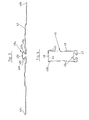
- FIGS. 1 and 2 show a cross section by an inventive profile 10. This will produced starting from a band iron 19 as shown in FIG. 2 is shown in cross section.
- This band iron 19 has a total of five sections, namely two outer sections 19a or 19c with a lower material thickness and one middle section 19b also with the same smaller Material thickness. Each between sections 19a and 19b with a lower material thickness there is a section 19d greater material thickness. Likewise lies between the middle Section 19b and the right outer one in the drawing Section 19c with a lesser material thickness is a section of the Band iron 19 with greater material thickness 19e.
- a profile 10 is produced by roll forming as shown in FIG. 1 is shown.
- the roll forming is usually done in several successive operations until the finished one Profile is rolled.
- the finished profile 10 is shown in Fig. 1. How one see it is an approximately rectangular profile 10 with an upper wall 16 and a lower wall 17 and two Sidewalls. Both the right side wall and the left one Sidewall have about in the middle area for stabilization the profile has a bead 13 each. This creates the right one Side wall from an upper side wall section 11 above the bead 13 and a lower side wall section 14 below the bead 13. There is also the left side wall from an upper side wall section 12 above the bead and a lower side wall section 15 below the bead. The respective side wall sections 11, 12 and 14, 15 have as you can see a lower material thickness. Besides, that is Profile seam 18 recognizable, with this profile seam 18th the ends of the outer portions 19a, 19c of the Band iron 19, which is assumed to meet.
- the band iron 19 according to FIG. 2 is mostly made by roll forming profiled several process steps so that the closed rectangular profile 10 according to FIG. 1 is formed. How one 2 areas 19d and 19e can be seen with stronger material thickness already in the band iron 19th provided, which is assumed. These two sections 19d, 19e of greater material thickness form in the profile 10 upper wall 16 and the lower wall 17. These sections with greater material thickness are in the finished profile 10 arranged where they are to achieve an increased Bending moments are required while the side walls 12, 15 or 11, 14 are made with a lower material thickness can, so that material for the profile 10 is saved, because the side walls both carry 10 in profile when it is arranged upright as shown in FIG. 1 less to the bending moment.
- FIG. 3 shows another Output band iron 49 from which a steel beam profile according to the Invention can be profiled.
- This output band iron 49 is already by pre-profiling from a flat band iron been obtained. With this pre-profiling it has Output band iron 49 a molding approximately in the middle obtained in the form of a loop 49a. As you can see, this is approximately loop-shaped projection 49a formed such that a Section 49d of the band iron in the central area of the Forming approximately parallel to the other largely flat Areas of the band iron runs. Approximately at right angles at the bottom connect to the two side wall sections 49e, 49f of the loop.
- the approximately loop-shaped formation in the area of the lower one Wall 47 of the steel beam profile 40 has applications additional advantages.
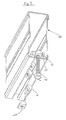
- a possible application is in FIG. 5 shown.
- this molding is due to the loop shape similar to a dovetail shape Use the groove to z. B. nuts 41 of helical Insert fasteners 42.
- Such one Steel beam profile 40 can e.g. B. use as a shelf rail find and then has the advantage that an additional Operation for the installation of such a groove or Slot can be omitted.
- the mother 41 of the As you can see, the fastening screw is replaced by a Swiveling movement inserted into the groove and when exercising a pulling force by tightening the screw 42 becomes the nut 41 held in the groove.
Landscapes
- Engineering & Computer Science (AREA)
- Architecture (AREA)
- General Engineering & Computer Science (AREA)
- Civil Engineering (AREA)
- Mechanical Engineering (AREA)
- Structural Engineering (AREA)
- Physics & Mathematics (AREA)
- Electromagnetism (AREA)
- Rod-Shaped Construction Members (AREA)
- Coating With Molten Metal (AREA)
- Supports For Pipes And Cables (AREA)
- Gripping Jigs, Holding Jigs, And Positioning Jigs (AREA)
- Joining Of Building Structures In Genera (AREA)
Description
Die vorliegende Erfindung betrifft weiterhin ein Verfahren zur Herstellung eines Stahlträgerprofils mit etwa kastenförmigen Querschnitt, das Bereiche der Wandung mit größerer Materialstärke und Bereiche der Wandung mit geringerer Materialstärke aufweist. Aufgabe der Erfindung ist es, ein Verfahren zur Herstellung eines solchen Stahlträgerprofils zu schaffen, das einfacher ist als die bislang bekannten Verfahren. Die Lösung liefert ein erfindungsgemäßes Verfahren der genannten Art mit den Merkmalen des Anspruchs 2. Das erfindungsgemäße Verfahren ermöglicht die Herstellung von Stahlträgerprofilen mit guten statischen Querschnittswerten und daher gutem Tragverhalten bei gleichzeitig minimalem Materialeinsatz was zu einer Verringerung des Gewichts solcher Stahlträgerprofile führt. Das erfindungsgemäße Verfahren ermöglicht weiter eine einfache und rasche Herstellung dieser Stahlträgerprofile und führen daher zu verringerten Fertigungskosten. Stahlträgerprofile dieser Art können beispielsweise im Regalbau zur Anwendung kommen. Beispielsweise kann man diese für Regalholme von Palettenregalen verwenden, wo naturgemäß hohe Anforderungen an die Tragfähigkeit bestehen. Die in den Unteransprüchen 3 und 4 bzw. 5 und 6 genannten Merkmale betreffen Weiterbildungen des erfindungsgemäßen Stahlträgerprofils beziehungsweise des Herstellungsverfahrens. Weitere Vorteile der Erfindung ergeben sich aus der nachfolgenden Detailbeschreibung.
- Fig. 1
- einen Querschnitt durch ein erfindungsgemäßes Profil;
- Fig. 2
- einen Querschnitt durch ein Bandeisen aus dem ein Profil gemäß Fig. 1 hergestellt wird;
- Fig. 3
- einen Querschnitt durch ein Bandeisen das als Ausgangsmaterial zur Herstellung eines Profils gemäß einer weiteren Variante der Erfindung dient.
- Fig. 4
- einen Querschnitt durch ein erfindungsgemäßes Profil gemäß einer weiteren Variante der Erfindung.
- Fig. 5
- zeigt eine mögliche Anwendung eines in Fig. 4 dargestellten Stahlträgerprofils z. B. im Regalbau.
Claims (6)
- Stahlträgerprofil in Form eines Holms mit etwa kastenförmigem Querschnitt, wobei dieses hergestellt ist ausgehend von Bandeisen durch Profilieren und das Stahlträgerprofil in wenigstens einem Wandabschnitt eine größere Materialstärke aufweist als in den übrigen Wandabschnitten,
wobei das Stahlträgerprofil weiterhin einen hochkant angeordneten kastenförmigen Querschnitt hat,
dadurch gekennzeichnet, daß die schmale obere Wand (16) und/oder die schmale untere Wand (17) eine größere Materialstärke aufweisen als einer oder mehrere der rechten beziehungsweise linken Seitenwandabschnitte (11, 12),
wobei das Stahlträgerprofil hergestellt wurde durch Profilieren eines Ausgangsbandeisens (19), das Bereiche (19d, 19e) größerer Materialstärke und Bereiche (19a, 19b, 19c) geringerer Materialstärke aufweist. - Verfahren zur Herstellung eines Stahlträgerprofils in Form eines Holms mit etwa kastenförmigem Querschnitt, bei dem man ausgeht von Bandeisen und dieses durch Umformen zu einem etwa kastenförmigen Profil profiliert, wobei das Stahlträgerprofil in wenigstens einem Wandabschnitt eine größere Materialstärke aufweist als in den übrigen Wandabschnitten und das Stahlträgerprofil einen hochkant angeordneten kastenförmigen Querschnitt hat und die schmale obere Wand und/oder die schmale untere Wand eine größere Materialstärke aufweisen als einer oder mehrere der rechten beziehungsweise linken Seitenwandabschnitte,
dadurch gekennzeichnet, daß man ausgeht von einem einstückigen Bandeisen (19) mit wenigstens einem Bereich (19d, 19e) größerer Materialstärke und wenigstens einem Abschnitt (19a, 19b, 19c) geringerer Materialstärke und dieses durch Umformen zu dem etwa kastenförmigen Profil (10) profiliert. - Stahlträgerprofil nach Anspruch 1, dadurch gekennzeichnet, daß das Stahlträgerprofil (40) wenigstens im Bereich einer schmalen oberen Wandung sich überlappende doppellagige Abschnitte (44, 46) aufweist.
- Stahlträgerprofil nach Anspruch 3, dadurch gekennzeichnet, daß dieses im Bereich seiner unteren Wandung (47) eine vorzugsweise schlaufenförmige Anformung nach innen aufweist, die eine nach außen hin offene Nut des Stahlträgerprofils (47) vorzugsweise zur Aufnahme von Befestigungselementen (41) oder dergleichen bildet.
- Verfahren zur Herstellung eines Stahlträgerprofils nach Anspruch 2, dadurch gekennzeichnet, daß man zunächst ausgeht von einem Bandeisen (49) mit durchgehend gleichbleibender Materialstärke und man anschließend das Bandeisen (49) so zu einem Stahlträgerprofil (40) profiliert, daß sich die endseitigen Abschnitte (49b, 49c) des Ausgangsbandeisens (49) im Stahlträgerprofil (40) im Bereich der oberen Wandung zu doppellagigen Abschnitten (44, 46) überlappen.
- Verfahren zur Herstellung eines Stahlträgerprofils nach Anspruch 5, dadurch gekennzeichnet, daß dieses hergestellt wird aus einem Ausgangsbandeisen (49), das vorprofiliert wurde und in seinem etwa mittleren Abschnitt wenigstens eine vorzugsweise etwa schlaufenförmige Anformung (49a) aufweist und dann das Ausgangsbandeisen (49) so profiliert wird, daß diese etwa schlaufenförmige Anformung die untere Wandung (47) des Stahlträgerprofils bildet und darunter eine nach außen offene Nut gebildet ist.
Applications Claiming Priority (2)
| Application Number | Priority Date | Filing Date | Title |
|---|---|---|---|
| DE19743643A DE19743643A1 (de) | 1997-10-02 | 1997-10-02 | Stahlträgerprofil |
| DE19743643 | 1997-10-02 |
Publications (2)
| Publication Number | Publication Date |
|---|---|
| EP0906737A1 EP0906737A1 (de) | 1999-04-07 |
| EP0906737B1 true EP0906737B1 (de) | 2003-04-16 |
Family
ID=7844441
Family Applications (1)
| Application Number | Title | Priority Date | Filing Date |
|---|---|---|---|
| EP98115592A Expired - Lifetime EP0906737B1 (de) | 1997-10-02 | 1998-08-19 | Stahlträgerprofil |
Country Status (3)
| Country | Link |
|---|---|
| EP (1) | EP0906737B1 (de) |
| AT (1) | ATE237252T1 (de) |
| DE (2) | DE19743643A1 (de) |
Cited By (1)
| Publication number | Priority date | Publication date | Assignee | Title |
|---|---|---|---|---|
| RU2763815C2 (ru) * | 2017-07-26 | 2022-01-11 | Фишерверке Гмбх Унд Ко.Кг | Монтажный профиль с крепежным элементом |
Families Citing this family (12)
| Publication number | Priority date | Publication date | Assignee | Title |
|---|---|---|---|---|
| ES2173039B2 (es) * | 2000-11-24 | 2004-08-01 | Encofrados Inde-K, S.A. | Mejoras introducidas en los sistemas de encofrado. |
| IT1319711B1 (it) * | 2000-12-29 | 2003-11-03 | Antonello Briosi | Elemento di struttura portante,specie per scaffalature |
| DE10154706A1 (de) * | 2001-11-09 | 2003-05-22 | Abb Patent Gmbh | Hohlprofil |
| DE10207625A1 (de) * | 2002-02-22 | 2003-09-04 | Hilti Ag | Längliches Hohlprofil zum Abhängen von Gegenständen |
| AU2002952221A0 (en) * | 2002-10-23 | 2002-11-07 | Grant Charlwood | A beam |
| DE10322755A1 (de) * | 2003-05-19 | 2005-01-05 | Hilti Ag | Hohlprofil |
| DE102007056644A1 (de) * | 2007-11-24 | 2009-05-28 | Dr. Ing. H.C. F. Porsche Aktiengesellschaft | Träger, insbesondere Schweller für ein Kraftfahrzeug |
| DE102007047875A1 (de) * | 2007-11-28 | 2009-06-04 | Hilti Aktiengesellschaft | Profil |
| DE102009022090A1 (de) * | 2009-04-28 | 2010-11-11 | Kocher Regalbau Gmbh | Hochregallager sowie Stütze für ein Hochregallager und Verfahren zur Herstellung der Stütze |
| DE102009020969A1 (de) * | 2009-05-12 | 2010-11-25 | Heinrich J. Kesseböhmer KG | Schrankauszug |
| CN215888959U (zh) * | 2021-09-06 | 2022-02-22 | 昊恒(福建)建材科技有限公司 | 一体成型式钢梁 |
| DE102024118909A1 (de) * | 2024-07-03 | 2026-01-08 | Kesseböhmer Holding Kg | Regalständer für Kragarmregale |
Family Cites Families (9)
| Publication number | Priority date | Publication date | Assignee | Title |
|---|---|---|---|---|
| FR1532887A (fr) * | 1967-07-27 | 1968-07-12 | Neunkircher Eisenwerk Ag | Profilé creux en acier et son procédé de fabrication |
| DK125512B (da) * | 1970-11-11 | 1973-03-05 | Kramme & Zeuthen As | Kassedrager, navnlig til lagerreoler. |
| DE3513382A1 (de) * | 1985-04-15 | 1986-10-23 | Moeller automation GmbH, 5303 Bornheim | Tragprofile fuer montageeinrichtungen, stuetzkonstruktionen und transportbaender und verfahren fuer deren herstellung |
| SE462173B (sv) * | 1985-04-30 | 1990-05-14 | Gunnebo Ab | Roerformig stolpe |
| US5014487A (en) * | 1989-11-01 | 1991-05-14 | S&K Enterprises, Inc. | Rack beams and method of making same |
| US5194199A (en) * | 1991-02-20 | 1993-03-16 | Volkswagen Ag | Method of producing a beam-like structural part having a core of light-weight material |
| US5514432A (en) * | 1993-07-14 | 1996-05-07 | Lisec; Peter | Hollow profile for spacer frames for insulating glass panes |
| DE9400878U1 (de) * | 1994-01-20 | 1994-04-14 | Vulart Riera, Jose Maria, Barcelona | Träger |
| DE19549268C1 (de) * | 1995-12-28 | 1997-07-31 | Mannesmann Ag | Träger in Kastenbauweise, insbesondere Kranausleger bzw. Teleskopausleger und Verfahren zum Herstellen eines Trägers |
-
1997
- 1997-10-02 DE DE19743643A patent/DE19743643A1/de not_active Ceased
-
1998
- 1998-08-19 DE DE59807944T patent/DE59807944D1/de not_active Expired - Lifetime
- 1998-08-19 EP EP98115592A patent/EP0906737B1/de not_active Expired - Lifetime
- 1998-08-19 AT AT98115592T patent/ATE237252T1/de not_active IP Right Cessation
Cited By (1)
| Publication number | Priority date | Publication date | Assignee | Title |
|---|---|---|---|---|
| RU2763815C2 (ru) * | 2017-07-26 | 2022-01-11 | Фишерверке Гмбх Унд Ко.Кг | Монтажный профиль с крепежным элементом |
Also Published As
| Publication number | Publication date |
|---|---|
| EP0906737A1 (de) | 1999-04-07 |
| ATE237252T1 (de) | 2003-05-15 |
| DE59807944D1 (de) | 2003-05-22 |
| DE19743643A1 (de) | 1999-04-08 |
Similar Documents
| Publication | Publication Date | Title |
|---|---|---|
| EP1479842B1 (de) | Hohlprofil | |
| DE3513382A1 (de) | Tragprofile fuer montageeinrichtungen, stuetzkonstruktionen und transportbaender und verfahren fuer deren herstellung | |
| EP0906737A1 (de) | "Stahlträgerprofil" | |
| DE10326554A1 (de) | Verfahren zum Herstellen einer Stossstangenverstärkung | |
| DE4240970A1 (de) | Verfahren zum Fügen von flächig aufeinanderliegenden Blechen, Blechteilen oder Platten | |
| DE3144736A1 (de) | Streckmetallwerkstueck und verfahren zu seiner herstellung | |
| EP1335148B1 (de) | Stützkörper, insbesondere zur elastischen Abstützung eines Sitz- oder Liegeelements | |
| DE2313041A1 (de) | Mit einem gleichartigen zu einem geschlossenen kastenprofil zusammensteckbares profil | |
| DE2154519B2 (de) | Kastenträger, insbesondere für Lagerregale | |
| CH459117A (de) | Verfahren und Vorrichtung zum Kaltziehen von massivem Draht | |
| CH654805A5 (de) | Flachpalette und deren verwendung. | |
| WO2012113548A1 (de) | Verfahren zur herstellung rechteckiger oder quadratischer wandelemente aus flachblech und damit hergestellte wandelemente | |
| DE69422567T2 (de) | Herstellungsverfahren für einen Farbwahlelektrode-Einbaurahmen für Kathodenstrahlröhre und Kathodenstrahlröhre mit einem derartigen Farbwahlelektrode-Einbaurahmen | |
| DE3022085A1 (de) | Betonbewehrungsstab, insbesondere ankerstab, und verfahren zu seiner herstellung | |
| DE69621531T2 (de) | Regal, insbesondere für Metallregaleinheiten | |
| DE102019124019A1 (de) | Stoßfängerquerträger für ein Kraftfahrzeug | |
| DE2063230B2 (de) | Verbindung für zwei ineinandergesteckte Teile | |
| DE3243936A1 (de) | Fassadeneinheit | |
| EP0525661B1 (de) | Schalung für den Betonbau sowie Verfahren zum Herstellen der Schalung | |
| DE3346624A1 (de) | Tuerfutter aus metall, profilblechstueck und verfahren zu seiner herstellung | |
| WO2017198855A1 (de) | Gerüststiel sowie verfahren zum herstellen eines gerüststiels | |
| EP1624100A1 (de) | Gestell für eine stickmaschine und verwendung derselben mit einem gestellfundament | |
| EP0809546A1 (de) | Walzenständer in geschlossener rahmenbauweise | |
| EP1545846A1 (de) | Formrahmen für eine maschine zur herstellung von betonformteilen | |
| EP0432518B1 (de) | Profil aus formgepressten pflanzlichen Kleinteilen |
Legal Events
| Date | Code | Title | Description |
|---|---|---|---|
| PUAI | Public reference made under article 153(3) epc to a published international application that has entered the european phase |
Free format text: ORIGINAL CODE: 0009012 |
|
| AK | Designated contracting states |
Kind code of ref document: A1 Designated state(s): AT BE CH CY DE DK ES FI FR GB GR IE IT LI LU MC NL PT SE |
|
| AX | Request for extension of the european patent |
Free format text: AL;LT;LV;MK;RO;SI |
|
| 17P | Request for examination filed |
Effective date: 19990618 |
|
| AKX | Designation fees paid |
Free format text: AT BE CH CY DE DK ES FI FR GB GR IE IT LI LU MC NL PT SE |
|
| AXX | Extension fees paid |
Free format text: AL PAYMENT 19990618;LT PAYMENT 19990618;LV PAYMENT 19990618;MK PAYMENT 19990618;RO PAYMENT 19990618;SI PAYMENT 19990618 |
|
| 17Q | First examination report despatched |
Effective date: 20011212 |
|
| GRAH | Despatch of communication of intention to grant a patent |
Free format text: ORIGINAL CODE: EPIDOS IGRA |
|
| GRAH | Despatch of communication of intention to grant a patent |
Free format text: ORIGINAL CODE: EPIDOS IGRA |
|
| GRAA | (expected) grant |
Free format text: ORIGINAL CODE: 0009210 |
|
| AK | Designated contracting states |
Designated state(s): AT BE CH CY DE DK ES FI FR GB GR IE IT LI LU MC NL PT SE |
|
| AX | Request for extension of the european patent |
Extension state: AL LT LV MK RO SI |
|
| PG25 | Lapsed in a contracting state [announced via postgrant information from national office to epo] |
Ref country code: NL Free format text: LAPSE BECAUSE OF FAILURE TO SUBMIT A TRANSLATION OF THE DESCRIPTION OR TO PAY THE FEE WITHIN THE PRESCRIBED TIME-LIMIT Effective date: 20030416 Ref country code: IT Free format text: LAPSE BECAUSE OF FAILURE TO SUBMIT A TRANSLATION OF THE DESCRIPTION OR TO PAY THE FEE WITHIN THE PRE;WARNING: LAPSES OF ITALIAN PATENTS WITH EFFECTIVE DATE BEFORE 2007 MAY HAVE OCCURRED AT ANY TIME BEFORE 2007. THE CORRECT EFFECTIVE DATE MAY BE DIFFERENT FROM THE ONE RECORDED.SCRIBED TIME-LIMIT Effective date: 20030416 Ref country code: IE Free format text: LAPSE BECAUSE OF NON-PAYMENT OF DUE FEES Effective date: 20030416 Ref country code: GB Free format text: LAPSE BECAUSE OF FAILURE TO SUBMIT A TRANSLATION OF THE DESCRIPTION OR TO PAY THE FEE WITHIN THE PRESCRIBED TIME-LIMIT Effective date: 20030416 Ref country code: FR Free format text: LAPSE BECAUSE OF FAILURE TO SUBMIT A TRANSLATION OF THE DESCRIPTION OR TO PAY THE FEE WITHIN THE PRESCRIBED TIME-LIMIT Effective date: 20030416 Ref country code: FI Free format text: LAPSE BECAUSE OF FAILURE TO SUBMIT A TRANSLATION OF THE DESCRIPTION OR TO PAY THE FEE WITHIN THE PRESCRIBED TIME-LIMIT Effective date: 20030416 |
|
| REG | Reference to a national code |
Ref country code: GB Ref legal event code: FG4D Free format text: NOT ENGLISH |
|
| REG | Reference to a national code |
Ref country code: CH Ref legal event code: EP |
|
| REF | Corresponds to: |
Ref document number: 59807944 Country of ref document: DE Date of ref document: 20030522 Kind code of ref document: P |
|
| REG | Reference to a national code |
Ref country code: IE Ref legal event code: FG4D Free format text: GERMAN |
|
| PG25 | Lapsed in a contracting state [announced via postgrant information from national office to epo] |
Ref country code: SE Free format text: LAPSE BECAUSE OF FAILURE TO SUBMIT A TRANSLATION OF THE DESCRIPTION OR TO PAY THE FEE WITHIN THE PRESCRIBED TIME-LIMIT Effective date: 20030716 Ref country code: PT Free format text: LAPSE BECAUSE OF FAILURE TO SUBMIT A TRANSLATION OF THE DESCRIPTION OR TO PAY THE FEE WITHIN THE PRESCRIBED TIME-LIMIT Effective date: 20030716 Ref country code: GR Free format text: LAPSE BECAUSE OF FAILURE TO SUBMIT A TRANSLATION OF THE DESCRIPTION OR TO PAY THE FEE WITHIN THE PRESCRIBED TIME-LIMIT Effective date: 20030716 Ref country code: DK Free format text: LAPSE BECAUSE OF FAILURE TO SUBMIT A TRANSLATION OF THE DESCRIPTION OR TO PAY THE FEE WITHIN THE PRESCRIBED TIME-LIMIT Effective date: 20030716 |
|
| PG25 | Lapsed in a contracting state [announced via postgrant information from national office to epo] |
Ref country code: LU Free format text: LAPSE BECAUSE OF NON-PAYMENT OF DUE FEES Effective date: 20030819 Ref country code: CY Free format text: LAPSE BECAUSE OF FAILURE TO SUBMIT A TRANSLATION OF THE DESCRIPTION OR TO PAY THE FEE WITHIN THE PRESCRIBED TIME-LIMIT Effective date: 20030819 Ref country code: AT Free format text: LAPSE BECAUSE OF NON-PAYMENT OF DUE FEES Effective date: 20030819 |
|
| PG25 | Lapsed in a contracting state [announced via postgrant information from national office to epo] |
Ref country code: MC Free format text: LAPSE BECAUSE OF NON-PAYMENT OF DUE FEES Effective date: 20030831 Ref country code: LI Free format text: LAPSE BECAUSE OF NON-PAYMENT OF DUE FEES Effective date: 20030831 Ref country code: CH Free format text: LAPSE BECAUSE OF NON-PAYMENT OF DUE FEES Effective date: 20030831 Ref country code: BE Free format text: LAPSE BECAUSE OF NON-PAYMENT OF DUE FEES Effective date: 20030831 |
|
| LTIE | Lt: invalidation of european patent or patent extension |
Effective date: 20030416 |
|
| NLV1 | Nl: lapsed or annulled due to failure to fulfill the requirements of art. 29p and 29m of the patents act | ||
| GBV | Gb: ep patent (uk) treated as always having been void in accordance with gb section 77(7)/1977 [no translation filed] |
Effective date: 20030416 |
|
| PG25 | Lapsed in a contracting state [announced via postgrant information from national office to epo] |
Ref country code: ES Free format text: LAPSE BECAUSE OF FAILURE TO SUBMIT A TRANSLATION OF THE DESCRIPTION OR TO PAY THE FEE WITHIN THE PRESCRIBED TIME-LIMIT Effective date: 20031030 |
|
| REG | Reference to a national code |
Ref country code: IE Ref legal event code: FD4D Ref document number: 0906737E Country of ref document: IE |
|
| PLBE | No opposition filed within time limit |
Free format text: ORIGINAL CODE: 0009261 |
|
| STAA | Information on the status of an ep patent application or granted ep patent |
Free format text: STATUS: NO OPPOSITION FILED WITHIN TIME LIMIT |
|
| BERE | Be: lapsed |
Owner name: *META-REGALBAU G.M.B.H. & CO. K.G. Effective date: 20030831 |
|
| 26N | No opposition filed |
Effective date: 20040119 |
|
| REG | Reference to a national code |
Ref country code: CH Ref legal event code: PL |
|
| EN | Fr: translation not filed | ||
| PGFP | Annual fee paid to national office [announced via postgrant information from national office to epo] |
Ref country code: DE Payment date: 20090831 Year of fee payment: 12 |
|
| REG | Reference to a national code |
Ref country code: DE Ref legal event code: R119 Ref document number: 59807944 Country of ref document: DE Effective date: 20110301 |
|
| PG25 | Lapsed in a contracting state [announced via postgrant information from national office to epo] |
Ref country code: DE Free format text: LAPSE BECAUSE OF NON-PAYMENT OF DUE FEES Effective date: 20110301 |