EP0904435B1 - Fibres en polyamide fortement ramifiees - Google Patents
Fibres en polyamide fortement ramifiees Download PDFInfo
- Publication number
- EP0904435B1 EP0904435B1 EP97924397A EP97924397A EP0904435B1 EP 0904435 B1 EP0904435 B1 EP 0904435B1 EP 97924397 A EP97924397 A EP 97924397A EP 97924397 A EP97924397 A EP 97924397A EP 0904435 B1 EP0904435 B1 EP 0904435B1
- Authority
- EP
- European Patent Office
- Prior art keywords
- polyamide
- fibre according
- polyamide fibre
- arms
- core
- Prior art date
- Legal status (The legal status is an assumption and is not a legal conclusion. Google has not performed a legal analysis and makes no representation as to the accuracy of the status listed.)
- Revoked
Links
- 239000004952 Polyamide Substances 0.000 title claims abstract description 147
- 229920002647 polyamide Polymers 0.000 title claims abstract description 147
- 239000000835 fiber Substances 0.000 claims abstract description 64
- 238000009987 spinning Methods 0.000 claims abstract description 44
- 125000000524 functional group Chemical group 0.000 claims abstract description 11
- 239000002253 acid Substances 0.000 claims abstract description 8
- 125000003178 carboxy group Chemical group [H]OC(*)=O 0.000 claims abstract description 6
- 150000007513 acids Chemical class 0.000 claims abstract description 3
- 150000003951 lactams Chemical class 0.000 claims abstract description 3
- 238000006068 polycondensation reaction Methods 0.000 claims abstract description 3
- 238000007151 ring opening polymerisation reaction Methods 0.000 claims abstract description 3
- JBKVHLHDHHXQEQ-UHFFFAOYSA-N epsilon-caprolactam Chemical compound O=C1CCCCCN1 JBKVHLHDHHXQEQ-UHFFFAOYSA-N 0.000 claims description 12
- 238000009826 distribution Methods 0.000 claims description 11
- 150000001875 compounds Chemical class 0.000 claims description 7
- 229910052757 nitrogen Inorganic materials 0.000 claims description 6
- 125000002843 carboxylic acid group Chemical group 0.000 claims description 4
- -1 1,3,5-triazine compound Chemical class 0.000 claims description 3
- 125000004433 nitrogen atom Chemical group N* 0.000 claims description 3
- 150000003973 alkyl amines Chemical group 0.000 claims description 2
- 150000002391 heterocyclic compounds Chemical group 0.000 claims description 2
- HWWHQRSEHDDWPO-UHFFFAOYSA-N 2,4,6-triaminohexanoic acid;1,3,5-triazine Chemical group C1=NC=NC=N1.NCCC(N)CC(N)C(O)=O HWWHQRSEHDDWPO-UHFFFAOYSA-N 0.000 claims 1
- 125000005842 heteroatom Chemical group 0.000 claims 1
- 238000002844 melting Methods 0.000 claims 1
- 230000008018 melting Effects 0.000 claims 1
- 229920002292 Nylon 6 Polymers 0.000 abstract description 23
- 238000002474 experimental method Methods 0.000 description 12
- XLYOFNOQVPJJNP-UHFFFAOYSA-N water Substances O XLYOFNOQVPJJNP-UHFFFAOYSA-N 0.000 description 11
- 239000000975 dye Substances 0.000 description 8
- 238000000034 method Methods 0.000 description 8
- SLXKOJJOQWFEFD-UHFFFAOYSA-N 6-aminohexanoic acid Chemical compound NCCCCCC(O)=O SLXKOJJOQWFEFD-UHFFFAOYSA-N 0.000 description 7
- 229960002684 aminocaproic acid Drugs 0.000 description 7
- 238000005227 gel permeation chromatography Methods 0.000 description 7
- 239000000155 melt Substances 0.000 description 7
- 125000002924 primary amino group Chemical group [H]N([H])* 0.000 description 7
- QAOWNCQODCNURD-UHFFFAOYSA-N Sulfuric acid Chemical compound OS(O)(=O)=O QAOWNCQODCNURD-UHFFFAOYSA-N 0.000 description 6
- 238000004132 cross linking Methods 0.000 description 6
- 239000004677 Nylon Substances 0.000 description 5
- MGNCLNQXLYJVJD-UHFFFAOYSA-N cyanuric chloride Chemical compound ClC1=NC(Cl)=NC(Cl)=N1 MGNCLNQXLYJVJD-UHFFFAOYSA-N 0.000 description 5
- 229920001778 nylon Polymers 0.000 description 5
- 239000004753 textile Substances 0.000 description 5
- JYEUMXHLPRZUAT-UHFFFAOYSA-N 1,2,3-triazine Chemical compound C1=CN=NN=C1 JYEUMXHLPRZUAT-UHFFFAOYSA-N 0.000 description 4
- 229920006045 Akulon® Polymers 0.000 description 4
- IJGRMHOSHXDMSA-UHFFFAOYSA-N Atomic nitrogen Chemical compound N#N IJGRMHOSHXDMSA-UHFFFAOYSA-N 0.000 description 4
- 238000010521 absorption reaction Methods 0.000 description 4
- 230000008901 benefit Effects 0.000 description 4
- BDAGIHXWWSANSR-UHFFFAOYSA-N methanoic acid Natural products OC=O BDAGIHXWWSANSR-UHFFFAOYSA-N 0.000 description 4
- 229920000642 polymer Polymers 0.000 description 4
- VEXZGXHMUGYJMC-UHFFFAOYSA-N Hydrochloric acid Chemical compound Cl VEXZGXHMUGYJMC-UHFFFAOYSA-N 0.000 description 3
- HEMHJVSKTPXQMS-UHFFFAOYSA-M Sodium hydroxide Chemical compound [OH-].[Na+] HEMHJVSKTPXQMS-UHFFFAOYSA-M 0.000 description 3
- 239000007983 Tris buffer Substances 0.000 description 3
- 125000003277 amino group Chemical group 0.000 description 3
- 238000004458 analytical method Methods 0.000 description 3
- 230000015572 biosynthetic process Effects 0.000 description 3
- 230000000052 comparative effect Effects 0.000 description 3
- 238000004043 dyeing Methods 0.000 description 3
- 230000003301 hydrolyzing effect Effects 0.000 description 3
- 239000000178 monomer Substances 0.000 description 3
- 238000006116 polymerization reaction Methods 0.000 description 3
- 230000035945 sensitivity Effects 0.000 description 3
- 238000003786 synthesis reaction Methods 0.000 description 3
- OSWFIVFLDKOXQC-UHFFFAOYSA-N 4-(3-methoxyphenyl)aniline Chemical compound COC1=CC=CC(C=2C=CC(N)=CC=2)=C1 OSWFIVFLDKOXQC-UHFFFAOYSA-N 0.000 description 2
- HMJBXEZHJUYJQY-UHFFFAOYSA-N 4-(aminomethyl)octane-1,8-diamine Chemical compound NCCCCC(CN)CCCN HMJBXEZHJUYJQY-UHFFFAOYSA-N 0.000 description 2
- UJOBWOGCFQCDNV-UHFFFAOYSA-N 9H-carbazole Chemical compound C1=CC=C2C3=CC=CC=C3NC2=C1 UJOBWOGCFQCDNV-UHFFFAOYSA-N 0.000 description 2
- 229920000877 Melamine resin Polymers 0.000 description 2
- 229920001007 Nylon 4 Polymers 0.000 description 2
- GLUUGHFHXGJENI-UHFFFAOYSA-N Piperazine Chemical compound C1CNCCN1 GLUUGHFHXGJENI-UHFFFAOYSA-N 0.000 description 2
- NQRYJNQNLNOLGT-UHFFFAOYSA-N Piperidine Chemical compound C1CCNCC1 NQRYJNQNLNOLGT-UHFFFAOYSA-N 0.000 description 2
- JUJWROOIHBZHMG-UHFFFAOYSA-N Pyridine Chemical compound C1=CC=NC=C1 JUJWROOIHBZHMG-UHFFFAOYSA-N 0.000 description 2
- SMWDFEZZVXVKRB-UHFFFAOYSA-N Quinoline Chemical compound N1=CC=CC2=CC=CC=C21 SMWDFEZZVXVKRB-UHFFFAOYSA-N 0.000 description 2
- WNLRTRBMVRJNCN-UHFFFAOYSA-N adipic acid Chemical compound OC(=O)CCCCC(O)=O WNLRTRBMVRJNCN-UHFFFAOYSA-N 0.000 description 2
- 125000000129 anionic group Chemical group 0.000 description 2
- 125000004429 atom Chemical group 0.000 description 2
- QMKYBPDZANOJGF-UHFFFAOYSA-N benzene-1,3,5-tricarboxylic acid Chemical compound OC(=O)C1=CC(C(O)=O)=CC(C(O)=O)=C1 QMKYBPDZANOJGF-UHFFFAOYSA-N 0.000 description 2
- 150000001732 carboxylic acid derivatives Chemical class 0.000 description 2
- 150000001735 carboxylic acids Chemical class 0.000 description 2
- 239000003795 chemical substances by application Substances 0.000 description 2
- 125000001309 chloro group Chemical group Cl* 0.000 description 2
- 238000009833 condensation Methods 0.000 description 2
- 230000005494 condensation Effects 0.000 description 2
- 235000019253 formic acid Nutrition 0.000 description 2
- 230000014759 maintenance of location Effects 0.000 description 2
- 238000004519 manufacturing process Methods 0.000 description 2
- 239000000463 material Substances 0.000 description 2
- JDSHMPZPIAZGSV-UHFFFAOYSA-N melamine Chemical compound NC1=NC(N)=NC(N)=N1 JDSHMPZPIAZGSV-UHFFFAOYSA-N 0.000 description 2
- 239000000203 mixture Substances 0.000 description 2
- 239000003505 polymerization initiator Substances 0.000 description 2
- 238000002360 preparation method Methods 0.000 description 2
- CYIDZMCFTVVTJO-UHFFFAOYSA-N pyromellitic acid Chemical compound OC(=O)C1=CC(C(O)=O)=C(C(O)=O)C=C1C(O)=O CYIDZMCFTVVTJO-UHFFFAOYSA-N 0.000 description 2
- XSCHRSMBECNVNS-UHFFFAOYSA-N quinoxaline Chemical compound N1=CC=NC2=CC=CC=C21 XSCHRSMBECNVNS-UHFFFAOYSA-N 0.000 description 2
- 239000002994 raw material Substances 0.000 description 2
- 239000007790 solid phase Substances 0.000 description 2
- 239000000126 substance Substances 0.000 description 2
- 239000001117 sulphuric acid Substances 0.000 description 2
- 235000011149 sulphuric acid Nutrition 0.000 description 2
- 229920002994 synthetic fiber Polymers 0.000 description 2
- 238000004804 winding Methods 0.000 description 2
- BYEAHWXPCBROCE-UHFFFAOYSA-N 1,1,1,3,3,3-hexafluoropropan-2-ol Chemical compound FC(F)(F)C(O)C(F)(F)F BYEAHWXPCBROCE-UHFFFAOYSA-N 0.000 description 1
- HYZJCKYKOHLVJF-UHFFFAOYSA-N 1H-benzimidazole Chemical compound C1=CC=C2NC=NC2=C1 HYZJCKYKOHLVJF-UHFFFAOYSA-N 0.000 description 1
- JVERADGGGBYHNP-UHFFFAOYSA-N 5-phenylbenzene-1,2,3,4-tetracarboxylic acid Chemical compound OC(=O)C1=C(C(O)=O)C(C(=O)O)=CC(C=2C=CC=CC=2)=C1C(O)=O JVERADGGGBYHNP-UHFFFAOYSA-N 0.000 description 1
- JHWNWJKBPDFINM-UHFFFAOYSA-N Laurolactam Chemical compound O=C1CCCCCCCCCCCN1 JHWNWJKBPDFINM-UHFFFAOYSA-N 0.000 description 1
- KWYHDKDOAIKMQN-UHFFFAOYSA-N N,N,N',N'-tetramethylethylenediamine Chemical compound CN(C)CCN(C)C KWYHDKDOAIKMQN-UHFFFAOYSA-N 0.000 description 1
- 229920000571 Nylon 11 Polymers 0.000 description 1
- 229920000299 Nylon 12 Polymers 0.000 description 1
- SJEYSFABYSGQBG-UHFFFAOYSA-M Patent blue Chemical compound [Na+].C1=CC(N(CC)CC)=CC=C1C(C=1C(=CC(=CC=1)S([O-])(=O)=O)S([O-])(=O)=O)=C1C=CC(=[N+](CC)CC)C=C1 SJEYSFABYSGQBG-UHFFFAOYSA-M 0.000 description 1
- 239000005700 Putrescine Substances 0.000 description 1
- CZPWVGJYEJSRLH-UHFFFAOYSA-N Pyrimidine Chemical compound C1=CN=CN=C1 CZPWVGJYEJSRLH-UHFFFAOYSA-N 0.000 description 1
- 238000002441 X-ray diffraction Methods 0.000 description 1
- 239000000980 acid dye Substances 0.000 description 1
- 230000002378 acidificating effect Effects 0.000 description 1
- 125000002015 acyclic group Chemical group 0.000 description 1
- 239000000654 additive Substances 0.000 description 1
- 239000001361 adipic acid Substances 0.000 description 1
- 235000011037 adipic acid Nutrition 0.000 description 1
- 150000001412 amines Chemical class 0.000 description 1
- 150000001413 amino acids Chemical class 0.000 description 1
- 239000012736 aqueous medium Substances 0.000 description 1
- ALSPKRWQCLSJLV-UHFFFAOYSA-N azanium;acetic acid;acetate Chemical compound [NH4+].CC(O)=O.CC([O-])=O ALSPKRWQCLSJLV-UHFFFAOYSA-N 0.000 description 1
- 229910052799 carbon Inorganic materials 0.000 description 1
- 125000004432 carbon atom Chemical group C* 0.000 description 1
- 125000003262 carboxylic acid ester group Chemical group [H]C([H])([*:2])OC(=O)C([H])([H])[*:1] 0.000 description 1
- 238000006243 chemical reaction Methods 0.000 description 1
- 238000007334 copolymerization reaction Methods 0.000 description 1
- 238000002425 crystallisation Methods 0.000 description 1
- 230000008025 crystallization Effects 0.000 description 1
- 230000001419 dependent effect Effects 0.000 description 1
- 238000001514 detection method Methods 0.000 description 1
- 238000010586 diagram Methods 0.000 description 1
- 150000004985 diamines Chemical class 0.000 description 1
- 150000001991 dicarboxylic acids Chemical class 0.000 description 1
- 238000010790 dilution Methods 0.000 description 1
- 239000012895 dilution Substances 0.000 description 1
- 239000003480 eluent Substances 0.000 description 1
- 238000005516 engineering process Methods 0.000 description 1
- 230000007613 environmental effect Effects 0.000 description 1
- 238000011067 equilibration Methods 0.000 description 1
- 238000011049 filling Methods 0.000 description 1
- 239000008187 granular material Substances 0.000 description 1
- ALBYIUDWACNRRB-UHFFFAOYSA-N hexanamide Chemical group CCCCCC(N)=O ALBYIUDWACNRRB-UHFFFAOYSA-N 0.000 description 1
- 238000004128 high performance liquid chromatography Methods 0.000 description 1
- IXCSERBJSXMMFS-UHFFFAOYSA-N hydrogen chloride Substances Cl.Cl IXCSERBJSXMMFS-UHFFFAOYSA-N 0.000 description 1
- 229910000041 hydrogen chloride Inorganic materials 0.000 description 1
- 230000007062 hydrolysis Effects 0.000 description 1
- 238000006460 hydrolysis reaction Methods 0.000 description 1
- 239000005457 ice water Substances 0.000 description 1
- 230000006872 improvement Effects 0.000 description 1
- 239000012535 impurity Substances 0.000 description 1
- 239000011261 inert gas Substances 0.000 description 1
- 230000031700 light absorption Effects 0.000 description 1
- 239000007788 liquid Substances 0.000 description 1
- 238000004811 liquid chromatography Methods 0.000 description 1
- 238000002074 melt spinning Methods 0.000 description 1
- 150000007522 mineralic acids Chemical group 0.000 description 1
- 238000002156 mixing Methods 0.000 description 1
- QJGQUHMNIGDVPM-UHFFFAOYSA-N nitrogen group Chemical group [N] QJGQUHMNIGDVPM-UHFFFAOYSA-N 0.000 description 1
- 238000005457 optimization Methods 0.000 description 1
- 238000003918 potentiometric titration Methods 0.000 description 1
- 239000000843 powder Substances 0.000 description 1
- 230000008569 process Effects 0.000 description 1
- UMJSCPRVCHMLSP-UHFFFAOYSA-N pyridine Natural products COC1=CC=CN=C1 UMJSCPRVCHMLSP-UHFFFAOYSA-N 0.000 description 1
- 238000003908 quality control method Methods 0.000 description 1
- 230000035484 reaction time Effects 0.000 description 1
- 230000009257 reactivity Effects 0.000 description 1
- 230000009467 reduction Effects 0.000 description 1
- 238000007363 ring formation reaction Methods 0.000 description 1
- 238000010008 shearing Methods 0.000 description 1
- PYODKQIVQIVELM-UHFFFAOYSA-M sodium;2,3-bis(2-methylpropyl)naphthalene-1-sulfonate Chemical compound [Na+].C1=CC=C2C(S([O-])(=O)=O)=C(CC(C)C)C(CC(C)C)=CC2=C1 PYODKQIVQIVELM-UHFFFAOYSA-M 0.000 description 1
- 239000000243 solution Substances 0.000 description 1
- 239000002904 solvent Substances 0.000 description 1
- 239000003381 stabilizer Substances 0.000 description 1
- 125000001424 substituent group Chemical group 0.000 description 1
- 238000006467 substitution reaction Methods 0.000 description 1
- 238000005406 washing Methods 0.000 description 1
Images

Classifications
-
- D—TEXTILES; PAPER
- D01—NATURAL OR MAN-MADE THREADS OR FIBRES; SPINNING
- D01F—CHEMICAL FEATURES IN THE MANUFACTURE OF ARTIFICIAL FILAMENTS, THREADS, FIBRES, BRISTLES OR RIBBONS; APPARATUS SPECIALLY ADAPTED FOR THE MANUFACTURE OF CARBON FILAMENTS
- D01F6/00—Monocomponent artificial filaments or the like of synthetic polymers; Manufacture thereof
- D01F6/58—Monocomponent artificial filaments or the like of synthetic polymers; Manufacture thereof from homopolycondensation products
- D01F6/60—Monocomponent artificial filaments or the like of synthetic polymers; Manufacture thereof from homopolycondensation products from polyamides
-
- C—CHEMISTRY; METALLURGY
- C08—ORGANIC MACROMOLECULAR COMPOUNDS; THEIR PREPARATION OR CHEMICAL WORKING-UP; COMPOSITIONS BASED THEREON
- C08G—MACROMOLECULAR COMPOUNDS OBTAINED OTHERWISE THAN BY REACTIONS ONLY INVOLVING UNSATURATED CARBON-TO-CARBON BONDS
- C08G69/00—Macromolecular compounds obtained by reactions forming a carboxylic amide link in the main chain of the macromolecule
- C08G69/02—Polyamides derived from amino-carboxylic acids or from polyamines and polycarboxylic acids
- C08G69/08—Polyamides derived from amino-carboxylic acids or from polyamines and polycarboxylic acids derived from amino-carboxylic acids
-
- C—CHEMISTRY; METALLURGY
- C08—ORGANIC MACROMOLECULAR COMPOUNDS; THEIR PREPARATION OR CHEMICAL WORKING-UP; COMPOSITIONS BASED THEREON
- C08G—MACROMOLECULAR COMPOUNDS OBTAINED OTHERWISE THAN BY REACTIONS ONLY INVOLVING UNSATURATED CARBON-TO-CARBON BONDS
- C08G69/00—Macromolecular compounds obtained by reactions forming a carboxylic amide link in the main chain of the macromolecule
- C08G69/02—Polyamides derived from amino-carboxylic acids or from polyamines and polycarboxylic acids
- C08G69/08—Polyamides derived from amino-carboxylic acids or from polyamines and polycarboxylic acids derived from amino-carboxylic acids
- C08G69/14—Lactams
-
- C—CHEMISTRY; METALLURGY
- C08—ORGANIC MACROMOLECULAR COMPOUNDS; THEIR PREPARATION OR CHEMICAL WORKING-UP; COMPOSITIONS BASED THEREON
- C08G—MACROMOLECULAR COMPOUNDS OBTAINED OTHERWISE THAN BY REACTIONS ONLY INVOLVING UNSATURATED CARBON-TO-CARBON BONDS
- C08G69/00—Macromolecular compounds obtained by reactions forming a carboxylic amide link in the main chain of the macromolecule
- C08G69/02—Polyamides derived from amino-carboxylic acids or from polyamines and polycarboxylic acids
- C08G69/36—Polyamides derived from amino-carboxylic acids or from polyamines and polycarboxylic acids derived from amino acids, polyamines and polycarboxylic acids
-
- C—CHEMISTRY; METALLURGY
- C08—ORGANIC MACROMOLECULAR COMPOUNDS; THEIR PREPARATION OR CHEMICAL WORKING-UP; COMPOSITIONS BASED THEREON
- C08L—COMPOSITIONS OF MACROMOLECULAR COMPOUNDS
- C08L77/00—Compositions of polyamides obtained by reactions forming a carboxylic amide link in the main chain; Compositions of derivatives of such polymers
- C08L77/02—Polyamides derived from omega-amino carboxylic acids or from lactams thereof
Definitions
- the invention relates to polyamide fibres, comprising branched polyamide.
- Such fibres are known from EP 672 703 A1 (DSM N.V.), in which is disclosed that fibres may be spun from a star-branched polyamide obtained from meltmixing nylon-6 and 1,4-diaminobutane-N,N'-tetra-1-propylamine.
- said polyamide was found to be unsuitable for spinning fibers, especially at high speed, because of its very wide molecular distribution.
- polyamides in particular nylon-6, are now being successfully spun for textile yarns at spinning speeds of 6000 metres per minute and sometimes even higher.
- the spinning process is very susceptible to variations, especially to variations in the melt viscosity of the polyamide presented and even small variations result in fibre rupture.
- an appreciable difference in molecular weight and, therefore in the properties of the fibre from the remaining spinnerets of a production line will occur.
- the fibre bestows its characteristics on the yarn of which it forms a single strand, so does the fibre derive its properties from the thread-like molecules of the substance it is made . But it is only the very special types of long molecule that are able to form fibres. They must, for example, be fairly regular in shape with a repeating pattern of atoms in the molecule. They must not have large pendant groups of atoms sticking out from the sides.”
- the inventors have, however, found very surprisingly that a fibre having comparable mechanical properties to those of a fibre composed of linear polyamide is obtained with heavily branched polyamide in a very reproducible way with a lower sensitivity to faults, as for instance fibre rupture during spinning.
- a further advantage of the fibre made of branched polyamide according to the invention is that it can be obtained with a lower melt temperature at the same spinning speed or a higher spinning speed at the same temperature as the fibre composed of linear polyamide having the same relative viscosity.
- the polyamide fibre according to the invention is characterized in that the polyamide from which the fibre is obtained is a branched polyamide.
- branched polyamide is understood as meaning a polyamide which is composed of at least 3 linear chain arms and of which the chain arms are formed on a core molecule whose size is less than the average length of the polyamide arms joined thereto.
- This kind of branched polyamides generally are named star-branched.
- the core molecule being derived from a molecule having at least 3 functional groups at which the linear polyamide arms are fixed.
- the functional groups are chosen from the group of amine or carboxylic acid groups.
- the molecular weight of the core molecule is less than 2000, more preferably less than 1000, and most preferable is a core molecule having a molecular weight of less than 500.
- EP-A-672 703 describes a method of preparing star branched polyamides by mixing a linear polyamide for a short time with an at least 3-functional compound in the melt.
- the polyamide obtained by this method is, however, unsuitable as raw material for the purpose of the invention because its molecular weight distribution is very wide, the polyamide comprises, in contrast to what is stated in the description, a mole fraction of linear polyamide which is, in very many cases, greater than the mole fraction of star branched polyamides and, moreover, the melt viscosity is unstable.
- polyamides of the AB type which can be obtained, inter alia, by polycondensation of amino acids, preferably ⁇ , ⁇ -amino acids, or by ring-opening polymerization of lactams, copolyamides thereof and, if desired, polyamides which contain substituted monomers to a limited extent.
- polyamides are nylon-4, nylon-6, nylon-8, nylon-11 and nylon-12. Of these, nylon-6 is preferred in view of the versatility of the possible applications.
- star-branched polyamide of the AABB type for instance obtainable from diamines and dicarboxylic acids are difficult to obtain without appreciable crosslinking. However, if once obtainable without appreciable crosslinking, fibres will show the same advantage as those of the presently preferred AB polyamides.
- the branched polyamides of the AB type for large-scale applications preference is given to the method in which the branched polyamide is obtained by copolymerization of the core molecule with the monomer for the chain units of the polyamide under the standard reaction conditions for the synthesis of the linear polyamide and preferably in the absence of a chain length regulator.
- a linear polyamide will also be produced. If the polymerization initiator and the functional groups of the core molecule are the same, the chain length of the linear polyamide formed will generally correspond, given sufficient reaction time, to the length of the polyamide arms in the branched polyamide.
- Such a mixture also appears eminently spinnable to form a fibre, a substantial improvement in the spinning conditions and a lower sensitivity to faults being obtained with respect to the linear polyamide.
- the greatest preference in such a case is to convert, by means of a postcondensation, preferably in the solid phase under inert gas conditions, the linear polyamide present into the branched polyamide, a polyamide having an exceptionally good melt stability and a very reproducible spinnability thereby being obtained. If desired, this solid-phase postcondensation is followed by an equilibration in the melt.
- the number of arms should not be too high.
- a polyamide which crystallizes well is not obtained with a degree of branching higher than 20.
- Such a high degree of branching presents problems during spinning and stretching.
- the number of arns is not more than 10, still more preferably not more than 8. The best results are obtained with 3 - 6 arms on the core molecule.
- the length of the arms may vary within wide limits and is, inter alia, dependent on the extent to which the polyamide is branched.
- the length of the arms at least corresponds to a number-average molecular weight of approximately 4000, more preferably at least 5000.
- Branched polyamides which are obtained with a core molecule having one type of functional groups yield the best results.
- compounds which contain only amine groups for example 4-aminomethyl-1,8-octanediamine, as core molecule with nylon-6, yield a branched polyamide which is excellently spinnable.
- Particular advantage is offered by the use of a core molecule containing identical functional groups which are reactive only with the amine groups of the polyamide. In this case, a branched polyamide is produced which has a very low amino end groups content, its fibres having a very high thermal and hydrolytic stability.
- Examples of such functional groups which are reactive only for the amine groups are carboxylic acid groups or carboxylic acid ester groups.
- core molecules containing 3 or more carboxylic acid groups are trimesic acid or ⁇ , ⁇ '-bis(adipic acid), 1,2,4,5-benzenetetracarboxylic acid and biphenyltetracarboxylic acid.
- the reactive functional groups are accessible to the same extent for the growth of polyamide arms.
- Fibres of polyamides having a very low amino end group content are very difficult to dye with anionic dyestuffs, which can mean a serious drawback in practice, for example, for textile applications.
- the core molecule containing at least 3 carboxylic groups is an alkaline, nonreactive group, for example a secondary or tertiary (cyclo)alkylamine or a heterocyclic compound containing at least one nitrogen atom in the ring
- this drawback does not exist and the affinity for dyestuffs of the fibre with anionic dyestuffs is very good and is also very reproducible and has, for example, low sensitivity to faults in the spinning process.
- the colour-fastness is also very good, generally even better than for the linear polyamides terminated by amino end groups.
- nitrogen-containing compounds are derived from pyrimidine, triazine, quinoxaline, piperidine, pyridine, piperazine, carbazole, benzimidazole and quinoline.
- Very suitable are trifunctional or more highly functional carboxylic acids derived from triazine. Such acids are simple to prepare starting from cyanuric chloride by substituting the three chlorine atoms with carboxylic acid.
- the carboxylic acid to be substituted contains at least 2 carbon atoms.
- Very suitable is the substitution of the three chlorine atoms of cyanuric chloride with aminocaproic acid.
- the carboxyl groups are joined via an acyclic chain to the core molecule.
- This offers the advantage that the risk of steric hindrance is appreciably reduced and a wide molecular weight distribution of the polyamide arms in the branched polyamide is avoided as a consequence thereof.
- the core molecules on which the various carboxylic groups are present preferably have a symmetrical structure, as a result of which an equal reactivity of the carboxyl groups is promoted.
- the core molecule for the branched polyamide is sufficiently stable under the conditions of polymerization and the spinning conditions. For this reason, diverse core molecules which are known from the literature on branched polyamides are unsuitable in practice.
- the spinning process is most reproducible if the molecular weight distribution of the polyamide is as narrow as possible.
- the fibre is obtained from a polyamide having a molecular weight distribution Mz/Mw of ⁇ 1.5, Mz/Mw preferably being ⁇ 1.4.
- Mz/Mw a molecular weight distribution of ⁇ 1.5, Mz/Mw preferably being ⁇ 1.4.
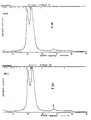
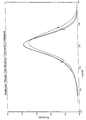
- Preference is given to the ratio Mz/Mw as parameter for the molecular weight distribution instead of Mw/Mn because Mz can be determined more definitely than Mn, it being possible to determine Mz and Mw by means of gel permeation chromatography (GPC) with the universal calibration method.
- GPC gel permeation chromatography
- nylon-6 it will be clear to the person skilled in the art that another nylon, for example nylon-4, -8, -10, -12 etc., could be used instead, as could a copolyamide thereof.
- the dynamic viscosity of some of the above polyamides was measured with a Rheometrics 800 apparatus going from high to low frequency.
- the extrapolated value of the viscosity for the shearing force at a frequency 0, ⁇ o is presented in the tables.
- the viscosity was measured after various time intervals.
- nylon B1 In the postcondensed state, nylon B1 has an appreciably better stability of the melt viscosity.
- Polyamide A.1. was spun on a Fourné spinning tester apparatus at a temperature of 240°C and a winding speed of 550 m/min.
- the yarn titre was 70/10 dtex.
- This yarn was stretched at various stretch ratios and stretch temperatures.
- the polyamide A.1. is obviously not stable and still undergoes changes during the melt spinning, as a result of which the spinning process will be difficult to reproduce and sensitive to interruptions.
- Fibre was spun and stretched from polyamide B.1. and C.1. under the conditions specified below on the same Fourné spinning tester apparatus and Erdmann-Fourné stretching apparatus.
- the production rate was 15.1 g/min.
- the winding speed 500 m/min.
- the fibres were stretched at 160°C with stretch ratios of 1.08 and 3.47 to a total of 3.75 at maximum friction.
- the stretching speed was 1000 m/min.
- the mechanical properties of the yarns obtained differ very little.
- the strength is at the same level
- the elongation of the yarn of the linear polyamide is approximately 8% better
- the modulus of elasticity of the yarn according to the invention is, on the other hand, approximately 25% higher. Since optimization of spinning conditions has not been carried out for the fibre of the invention, it can only be stated at present that the fibre according to the invention has at least comparable mechanical properties with respect to fibres based on linear polyamide having the same relative viscosity.
- the water-soluble extract is surprisingly low, as a result of which less stringent environmental requirements are necessary during spinning and application for the foodstuffs industry, for example, meets fewer problems.
- the fibres obtained from experiment 3 were immersed for a fairly long time in water and in water to which 0.25 ml of concentrated sulphuric acid per litre had been added.
- the dyestuff content of the fibres was determined by dissolving the fibres in concentrated formic acid and determining the light absorption of these solutions with a spectrophotometer; the absorption value was kept between 0.2 and 1.2 by adequate dilution.
- the fibre of the branched nylon has a dyestuff absorption comparable with a standard textile fibre.
- this core molecule of the branched polyamide can be protonated in the dyeing bath by the presence of the triazine ring.
- the spinning was performed on a MEX-BARMAG SW46SD apparatus. Spinning speed was 5000-5500 m/min. The same avivage and moisture agent as in the preceding experiments were used.
- the fibres of the branched polyamide are equal to the stabilized C.1 and far superior over those of the unstabilized GL 1030.
Landscapes
- Chemical & Material Sciences (AREA)
- Chemical Kinetics & Catalysis (AREA)
- Health & Medical Sciences (AREA)
- Medicinal Chemistry (AREA)
- Polymers & Plastics (AREA)
- Organic Chemistry (AREA)
- General Chemical & Material Sciences (AREA)
- Engineering & Computer Science (AREA)
- Textile Engineering (AREA)
- Life Sciences & Earth Sciences (AREA)
- Proteomics, Peptides & Aminoacids (AREA)
- Polyamides (AREA)
- Artificial Filaments (AREA)
- Compositions Of Macromolecular Compounds (AREA)
Claims (21)
- Fibre polyamide, obtenue par une opération de filage haute vitesse, caractérisée en ce que le polyamide dont la fibre est constituée est un polyamide ramifié en étoile, comprenant un noyau et un certain nombre de bras et ayant une distribution de poids moléculaire Mz/Mw de moins de 1,5.
- Fibre polyamide selon la revendication 1, caractérisée en ce que le nombre de bras du polyamide est de 3 à 20.
- Fibre de polyamide selon la revendication 2 , caractérisée en ce que le nombre de bras est de 3 à 10.
- Fibre polyamide selon la revendication 1 ou 3, caractérisée en ce que les bras du polyamide sont réunis à un noyau dont la taille est plus petite que celle de la longueur moyenne des bras du polyamide.
- Fibre polyamide selon la revendication 1, caractérisé en ce que le composé du noyau est stable au point de fusion du polyamide.
- Fibre polyamide selon la revendication 1, 4 ou 5, caractérisée en ce que les bras du polyamide proviennent d'un molécule centrale contenant au moins trois groupes fonctionnels dans lesquels les groupes fonctionnels sont identiques.
- Fibre polyamide selon la revendicaton 6, caractérisé en ce que les groupes fonctionnels sont des groupes acide carboxylique.
- Fibre polyamide selon la revendication 1, caractérisée en ce que le polyamide est choisi dans le groupe des polyamides qui sont produits par polycondensation de α,ω-acides aminocarboxyliques ou par polymérisation d'ouverture du cycle de lactames.
- Fibre polyamide obtenue par une opération de filage haute vitesse, caractérisée en ce que le polyamide dont la fibre est constituée comprend un polyamide linéaire en plus du polyamide ramifié en étoile et la longueur de chaíne moyenne du polyamide linéaire est au plus égale à la longueur de chaíne moyenne des bras du polyamide dans- le polyamide ramifié en étoile.
- Fibre polyamide selon la revendication 9, caractérisée en ce que la teneur en polyamide linéaire est inférieure à la teneur en polyamide ramifié en étoile.
- Fibre polyamide selon la revendication 1, caractérisée en ce que le poids moléculaire en nombre moyen des bras est d'au moins 4000.
- Fibre polyamide selon la revendication 8, caractérisée en ce que le polyamide est une poly-ε-caprolactame.
- Fibre de polyamide selon la revendication 1, caractérisée en ce que le noyau comporte au moins trois groupes carboxyles.
- Fibre polyamide selon la revendication 13, caractérisée en ce que les groupes carboxyles ne sont pas entravés stériquement.
- Fibre polyamide selon la revendication 7, caractérisée en ce que le composé de noyau contient également des sites alcalins qui ne sont pas réactifs.
- Fibre polyamide selon la revendication 15, caractérisée en ce que le composé de noyau contient au moins un hétéroatome.
- Fibre polyamide selon la revendication 16, caractérisée en ce que le composé de noyau contient au moins un atome d'azote à liaison secondaire ou à liaison tertiaire.
- Fibre polyamide selon la revendication 17, caractérisée en ce que le noyau est choisi dans le groupe comprenant des alkylamines secondaires ou tertiaires et des composés hétérocycliques contenant au moins un atome d'azote dans le cycle.
- Fibre polyamide selon la revendication 18, caractérisée en ce que le noyau est un composé 1,3,5-triazine.
- Fibre polyamide selon la revendication 19, caractérisée en ce que le noyau est une 2,4,6-trisamino acide caproïque 1,3,5-triazine.
- Fibre polyamide selon l'unique revendication 1-20, caractérisée en ce que la vitesse de filage du processus de filage haute vitesse est égale ou supérieure à 5000 m/min.
Applications Claiming Priority (3)
| Application Number | Priority Date | Filing Date | Title |
|---|---|---|---|
| BE9600512 | 1996-06-06 | ||
| BE9600512A BE1010330A3 (nl) | 1996-06-06 | 1996-06-06 | Vezels van sterk vertakt polyamide. |
| PCT/NL1997/000324 WO1997046747A1 (fr) | 1996-06-06 | 1997-06-06 | Fibres en polyamide fortement ramifiees |
Publications (2)
| Publication Number | Publication Date |
|---|---|
| EP0904435A1 EP0904435A1 (fr) | 1999-03-31 |
| EP0904435B1 true EP0904435B1 (fr) | 2001-12-12 |
Family
ID=3889787
Family Applications (1)
| Application Number | Title | Priority Date | Filing Date |
|---|---|---|---|
| EP97924397A Revoked EP0904435B1 (fr) | 1996-06-06 | 1997-06-06 | Fibres en polyamide fortement ramifiees |
Country Status (21)
| Country | Link |
|---|---|
| EP (1) | EP0904435B1 (fr) |
| JP (1) | JP2000511600A (fr) |
| KR (1) | KR20000016467A (fr) |
| CN (1) | CN1081687C (fr) |
| AT (1) | ATE210749T1 (fr) |
| AU (1) | AU2982397A (fr) |
| BE (1) | BE1010330A3 (fr) |
| BG (1) | BG62943B1 (fr) |
| BR (1) | BR9709538A (fr) |
| CA (1) | CA2257388A1 (fr) |
| CZ (1) | CZ398998A3 (fr) |
| DE (1) | DE69709096T2 (fr) |
| EA (1) | EA001451B1 (fr) |
| ES (1) | ES2167747T3 (fr) |
| HU (1) | HUP0001016A3 (fr) |
| PL (1) | PL330404A1 (fr) |
| SK (1) | SK167298A3 (fr) |
| TR (1) | TR199802530T2 (fr) |
| TW (1) | TW505711B (fr) |
| WO (1) | WO1997046747A1 (fr) |
| YU (1) | YU55298A (fr) |
Cited By (2)
| Publication number | Priority date | Publication date | Assignee | Title |
|---|---|---|---|---|
| US9416270B2 (en) | 2011-11-14 | 2016-08-16 | Honeywell International Inc. | Polyamide composition for low temperature applications |
| EP4310228A4 (fr) * | 2021-03-16 | 2025-07-30 | Toray Industries | Fibres de nylon 6 et pastilles de résine de polycaproamide en matériau recyclé et leur procédé de production |
Families Citing this family (16)
| Publication number | Priority date | Publication date | Assignee | Title |
|---|---|---|---|---|
| FR2779730B1 (fr) * | 1998-06-11 | 2004-07-16 | Nyltech Italia | Polyamides a fluidite elevee, son procede de fabrication, compositions comprenant ce copolyamide |
| NL1010819C2 (nl) * | 1998-12-16 | 2000-06-19 | Dsm Nv | Intrinsiek gelvrij random vertakt polyamide. |
| EP1065236B1 (fr) | 1999-06-29 | 2003-09-24 | Degussa AG | Copolyamides greffés hautement ramifiés |
| EP1065232B1 (fr) | 1999-06-29 | 2003-09-24 | Degussa AG | Copolyamides greffés |
| EP1078949A1 (fr) | 1999-08-26 | 2001-02-28 | Bayer Aktiengesellschaft | Ramification de polyamides à l'aide d'esters d'acide carboxylique |
| DE10064338A1 (de) | 2000-12-21 | 2002-06-27 | Degussa | Formmasse mit guter Blasformbarkeit |
| CN1246512C (zh) * | 2001-02-22 | 2006-03-22 | 罗狄亚聚酰胺中间体公司 | 制造纱、纤维和丝的方法 |
| FR2821088B1 (fr) * | 2001-02-22 | 2003-04-11 | Rhodianyl | Procede de fabrication de fils, fibres et filaments |
| FR2831189B1 (fr) * | 2001-10-23 | 2003-12-12 | Rhodianyl | Procede de fabrication de fils, fibres et filaments |
| DE102007058320A1 (de) * | 2006-12-23 | 2008-06-26 | Evonik Degussa Gmbh | Membranen zur Trennung von Gasen |
| JP4952846B2 (ja) * | 2008-03-26 | 2012-06-13 | 東レ株式会社 | ポリアミド56フィラメント、およびそれを含有する繊維構造体、ならびにエアバッグ用基布 |
| US20120145632A1 (en) * | 2009-07-15 | 2012-06-14 | Konraad Albert Louise Hector Dullaert | Electrospinning of polyamide nanofibers |
| KR20140051920A (ko) * | 2011-07-01 | 2014-05-02 | 디에스엠 아이피 어셋츠 비.브이. | 상이한 블럭들을 가진 분지형 폴리아마이드 |
| CN102432869A (zh) * | 2011-08-15 | 2012-05-02 | 株洲时代新材料科技股份有限公司 | 一种支链尼龙树脂的制备方法 |
| MY197689A (en) * | 2017-04-05 | 2023-07-05 | Advansix Resins & Chemicals Llc | Branched, terminated polyamide compositions |
| CN114940755B (zh) * | 2022-07-04 | 2024-03-01 | 华润化学材料科技股份有限公司 | 一种聚酰胺弹性体及其制备方法 |
Family Cites Families (15)
| Publication number | Priority date | Publication date | Assignee | Title |
|---|---|---|---|---|
| GB750629A (en) * | 1953-10-07 | 1956-06-20 | Ici Ltd | Manufacture of moulded articles from polyamides |
| NL302296A (fr) * | 1962-12-21 | |||
| US3296214A (en) * | 1963-10-10 | 1967-01-03 | Monsanto Co | Piperidine-nu-acetic acid modified polyamides of improved dyeabilty |
| US3651023A (en) * | 1968-07-02 | 1972-03-21 | Stamicarbon | Preparation of polyamides with special properties |
| US3549601A (en) * | 1968-08-20 | 1970-12-22 | Peter A Fowell | Polyamide molding resin obtained by polymerizing polyamide precursors in the presence of a critical proportion of end capping agent: branching agent |
| US3687904A (en) * | 1970-12-04 | 1972-08-29 | Ici Ltd | Polyamides |
| US4075271A (en) * | 1975-09-10 | 1978-02-21 | Allied Chemical Corporation | Production of polycaproamide fiber wherein polycaproamide is reacted with phenylene bis-(3-butane-1,2-dicarboxylic anhydride) |
| NL90940C (fr) * | 1980-12-20 | |||
| BR8600091A (pt) * | 1985-01-11 | 1986-09-23 | Monsanto Co | Fio de vestuario,processo para fiar em fusao um fio de poliamida,processo para a producao de um fio,e fio texturizado com estiramento |
| DE58909415D1 (de) * | 1988-06-07 | 1995-10-12 | Inventa Ag | Thermoplastisch verarbeitbare Polyamide. |
| DE4100909A1 (de) * | 1991-01-15 | 1992-07-16 | Bayer Ag | Teilverzweigte, thermoplastische verarbeitbare polyamide und deren herstellung |
| BE1008134A3 (nl) * | 1994-03-16 | 1996-01-23 | Dsm Nv | Bereiding van stervormig vertakte polymeren. |
| EP0682057A1 (fr) * | 1994-05-09 | 1995-11-15 | Dsm N.V. | Procédé d'amélioration des caractéristiques de mise en oeuvre de compositions polymères, compositions ainsi obtenues |
| CN1189174A (zh) * | 1995-05-03 | 1998-07-29 | Dsm有限公司 | 星形支化聚酰胺 |
| ATE325152T1 (de) * | 1995-12-29 | 2006-06-15 | Rhodia Eng Plastics Srl | Polyamid und verfahren zu dessen herstellung |
-
1996
- 1996-06-06 BE BE9600512A patent/BE1010330A3/nl not_active IP Right Cessation
-
1997
- 1997-06-06 JP JP10500447A patent/JP2000511600A/ja active Pending
- 1997-06-06 CZ CZ983989A patent/CZ398998A3/cs unknown
- 1997-06-06 EP EP97924397A patent/EP0904435B1/fr not_active Revoked
- 1997-06-06 KR KR1019980710051A patent/KR20000016467A/ko not_active Ceased
- 1997-06-06 ES ES97924397T patent/ES2167747T3/es not_active Expired - Lifetime
- 1997-06-06 HU HU0001016A patent/HUP0001016A3/hu unknown
- 1997-06-06 PL PL97330404A patent/PL330404A1/xx unknown
- 1997-06-06 DE DE69709096T patent/DE69709096T2/de not_active Revoked
- 1997-06-06 AT AT97924397T patent/ATE210749T1/de not_active IP Right Cessation
- 1997-06-06 SK SK1672-98A patent/SK167298A3/sk unknown
- 1997-06-06 CN CN97197097A patent/CN1081687C/zh not_active Expired - Fee Related
- 1997-06-06 BR BR9709538A patent/BR9709538A/pt unknown
- 1997-06-06 AU AU29823/97A patent/AU2982397A/en not_active Abandoned
- 1997-06-06 YU YU55298A patent/YU55298A/sh unknown
- 1997-06-06 WO PCT/NL1997/000324 patent/WO1997046747A1/fr not_active Ceased
- 1997-06-06 CA CA002257388A patent/CA2257388A1/fr not_active Abandoned
- 1997-06-06 EA EA199801081A patent/EA001451B1/ru not_active IP Right Cessation
- 1997-06-06 TR TR1998/02530T patent/TR199802530T2/xx unknown
- 1997-06-18 TW TW086108526A patent/TW505711B/zh not_active IP Right Cessation
-
1998
- 1998-12-03 BG BG102985A patent/BG62943B1/bg unknown
Cited By (2)
| Publication number | Priority date | Publication date | Assignee | Title |
|---|---|---|---|---|
| US9416270B2 (en) | 2011-11-14 | 2016-08-16 | Honeywell International Inc. | Polyamide composition for low temperature applications |
| EP4310228A4 (fr) * | 2021-03-16 | 2025-07-30 | Toray Industries | Fibres de nylon 6 et pastilles de résine de polycaproamide en matériau recyclé et leur procédé de production |
Also Published As
| Publication number | Publication date |
|---|---|
| AU2982397A (en) | 1998-01-05 |
| TW505711B (en) | 2002-10-11 |
| ES2167747T3 (es) | 2002-05-16 |
| BR9709538A (pt) | 1999-08-10 |
| YU55298A (sh) | 2000-03-21 |
| DE69709096D1 (de) | 2002-01-24 |
| ATE210749T1 (de) | 2001-12-15 |
| BG62943B1 (bg) | 2000-11-30 |
| PL330404A1 (en) | 1999-05-10 |
| EA199801081A1 (ru) | 1999-04-29 |
| BE1010330A3 (nl) | 1998-06-02 |
| CZ398998A3 (cs) | 1999-05-12 |
| TR199802530T2 (xx) | 1999-03-22 |
| CN1227615A (zh) | 1999-09-01 |
| KR20000016467A (ko) | 2000-03-25 |
| EA001451B1 (ru) | 2001-04-23 |
| DE69709096T2 (de) | 2002-09-05 |
| JP2000511600A (ja) | 2000-09-05 |
| SK167298A3 (en) | 1999-07-12 |
| BG102985A (en) | 1999-08-31 |
| HUP0001016A3 (en) | 2000-11-28 |
| HUP0001016A2 (hu) | 2000-08-28 |
| CA2257388A1 (fr) | 1997-12-11 |
| CN1081687C (zh) | 2002-03-27 |
| WO1997046747A1 (fr) | 1997-12-11 |
| EP0904435A1 (fr) | 1999-03-31 |
Similar Documents
| Publication | Publication Date | Title |
|---|---|---|
| EP0904435A1 (fr) | Fibres en polyamide fortement ramifiees | |
| CA1162348A (fr) | Methode de preparation de polyamides possedant une affinite tinctoriale modifiee | |
| CA2323611A1 (fr) | Polyamides photostabilises et thermostabilises de maniere intrinseque, presentant une resistance amelioree au mouille | |
| US6051312A (en) | Fibers of strongly branched polyamide | |
| RU2265090C2 (ru) | Способ получения синтетических нитей, волокон и филаментов на основе полиамида | |
| JP2552858B2 (ja) | 芳香族ポリアミド混合物より成る繊維 | |
| US4835223A (en) | Fibres and yarns from a blend of aromatic polyamides | |
| US4844834A (en) | Molecular weight controller for polymerization of lactams to polyamides | |
| EP0904434B1 (fr) | Fibre a teinture par colorant acide | |
| US5739262A (en) | Ternary copolyamide | |
| US5006635A (en) | Molecular weight controller composition for aqueous polymerization of lactam to polyamide | |
| JPH0593063A (ja) | 末端カルボキシル基量の増加したポリアミドの製造方法 | |
| BG107377A (bg) | Полиамиди |
Legal Events
| Date | Code | Title | Description |
|---|---|---|---|
| PUAI | Public reference made under article 153(3) epc to a published international application that has entered the european phase |
Free format text: ORIGINAL CODE: 0009012 |
|
| 17P | Request for examination filed |
Effective date: 19981116 |
|
| AK | Designated contracting states |
Kind code of ref document: A1 Designated state(s): AT BE CH DE ES FR GB GR IE IT LI LU NL PT SE |
|
| AX | Request for extension of the european patent |
Free format text: LT PAYMENT 981116;LV PAYMENT 981116;SI PAYMENT 981116 |
|
| 17Q | First examination report despatched |
Effective date: 19990527 |
|
| GRAG | Despatch of communication of intention to grant |
Free format text: ORIGINAL CODE: EPIDOS AGRA |
|
| GRAG | Despatch of communication of intention to grant |
Free format text: ORIGINAL CODE: EPIDOS AGRA |
|
| GRAH | Despatch of communication of intention to grant a patent |
Free format text: ORIGINAL CODE: EPIDOS IGRA |
|
| GRAH | Despatch of communication of intention to grant a patent |
Free format text: ORIGINAL CODE: EPIDOS IGRA |
|
| GRAA | (expected) grant |
Free format text: ORIGINAL CODE: 0009210 |
|
| AK | Designated contracting states |
Kind code of ref document: B1 Designated state(s): AT BE CH DE ES FR GB GR IE IT LI LU NL PT SE |
|
| AX | Request for extension of the european patent |
Free format text: LT PAYMENT 19981116;LV PAYMENT 19981116;SI PAYMENT 19981116 |
|
| PG25 | Lapsed in a contracting state [announced via postgrant information from national office to epo] |
Ref country code: LI Free format text: LAPSE BECAUSE OF FAILURE TO SUBMIT A TRANSLATION OF THE DESCRIPTION OR TO PAY THE FEE WITHIN THE PRESCRIBED TIME-LIMIT Effective date: 20011212 Ref country code: GR Free format text: LAPSE BECAUSE OF FAILURE TO SUBMIT A TRANSLATION OF THE DESCRIPTION OR TO PAY THE FEE WITHIN THE PRESCRIBED TIME-LIMIT Effective date: 20011212 Ref country code: CH Free format text: LAPSE BECAUSE OF FAILURE TO SUBMIT A TRANSLATION OF THE DESCRIPTION OR TO PAY THE FEE WITHIN THE PRESCRIBED TIME-LIMIT Effective date: 20011212 Ref country code: AT Free format text: LAPSE BECAUSE OF FAILURE TO SUBMIT A TRANSLATION OF THE DESCRIPTION OR TO PAY THE FEE WITHIN THE PRESCRIBED TIME-LIMIT Effective date: 20011212 |
|
| REF | Corresponds to: |
Ref document number: 210749 Country of ref document: AT Date of ref document: 20011215 Kind code of ref document: T |
|
| REG | Reference to a national code |
Ref country code: CH Ref legal event code: EP |
|
| REG | Reference to a national code |
Ref country code: GB Ref legal event code: IF02 |
|
| REG | Reference to a national code |
Ref country code: IE Ref legal event code: FG4D |
|
| REF | Corresponds to: |
Ref document number: 69709096 Country of ref document: DE Date of ref document: 20020124 |
|
| PG25 | Lapsed in a contracting state [announced via postgrant information from national office to epo] |
Ref country code: SE Free format text: LAPSE BECAUSE OF FAILURE TO SUBMIT A TRANSLATION OF THE DESCRIPTION OR TO PAY THE FEE WITHIN THE PRESCRIBED TIME-LIMIT Effective date: 20020312 Ref country code: PT Free format text: LAPSE BECAUSE OF FAILURE TO SUBMIT A TRANSLATION OF THE DESCRIPTION OR TO PAY THE FEE WITHIN THE PRESCRIBED TIME-LIMIT Effective date: 20020312 |
|
| REG | Reference to a national code |
Ref country code: ES Ref legal event code: FG2A Ref document number: 2167747 Country of ref document: ES Kind code of ref document: T3 |
|
| ET | Fr: translation filed | ||
| PG25 | Lapsed in a contracting state [announced via postgrant information from national office to epo] |
Ref country code: LU Free format text: LAPSE BECAUSE OF NON-PAYMENT OF DUE FEES Effective date: 20020606 Ref country code: IE Free format text: LAPSE BECAUSE OF NON-PAYMENT OF DUE FEES Effective date: 20020606 |
|
| REG | Reference to a national code |
Ref country code: CH Ref legal event code: PL |
|
| PLBQ | Unpublished change to opponent data |
Free format text: ORIGINAL CODE: EPIDOS OPPO |
|
| PLBI | Opposition filed |
Free format text: ORIGINAL CODE: 0009260 |
|
| PLBF | Reply of patent proprietor to notice(s) of opposition |
Free format text: ORIGINAL CODE: EPIDOS OBSO |
|
| 26 | Opposition filed |
Opponent name: RHODIA INDUSTRIAL YARNS AG Effective date: 20020911 |
|
| NLR1 | Nl: opposition has been filed with the epo |
Opponent name: RHODIA INDUSTRIAL YARNS AG |
|
| PLBF | Reply of patent proprietor to notice(s) of opposition |
Free format text: ORIGINAL CODE: EPIDOS OBSO |
|
| REG | Reference to a national code |
Ref country code: IE Ref legal event code: MM4A |
|
| PLBF | Reply of patent proprietor to notice(s) of opposition |
Free format text: ORIGINAL CODE: EPIDOS OBSO |
|
| RAP2 | Party data changed (patent owner data changed or rights of a patent transferred) |
Owner name: DSM IP ASSETS B.V. |
|
| NLT2 | Nl: modifications (of names), taken from the european patent patent bulletin |
Owner name: DSM IP ASSETS B.V. |
|
| PGFP | Annual fee paid to national office [announced via postgrant information from national office to epo] |
Ref country code: NL Payment date: 20040517 Year of fee payment: 8 |
|
| PGFP | Annual fee paid to national office [announced via postgrant information from national office to epo] |
Ref country code: GB Payment date: 20040602 Year of fee payment: 8 |
|
| REG | Reference to a national code |
Ref country code: GB Ref legal event code: 732E |
|
| PGFP | Annual fee paid to national office [announced via postgrant information from national office to epo] |
Ref country code: FR Payment date: 20040618 Year of fee payment: 8 |
|
| PGFP | Annual fee paid to national office [announced via postgrant information from national office to epo] |
Ref country code: ES Payment date: 20040708 Year of fee payment: 8 |
|
| PGFP | Annual fee paid to national office [announced via postgrant information from national office to epo] |
Ref country code: BE Payment date: 20040715 Year of fee payment: 8 |
|
| PGFP | Annual fee paid to national office [announced via postgrant information from national office to epo] |
Ref country code: DE Payment date: 20040802 Year of fee payment: 8 |
|
| REG | Reference to a national code |
Ref country code: FR Ref legal event code: TP |
|
| RDAF | Communication despatched that patent is revoked |
Free format text: ORIGINAL CODE: EPIDOSNREV1 |
|
| RDAG | Patent revoked |
Free format text: ORIGINAL CODE: 0009271 |
|
| STAA | Information on the status of an ep patent application or granted ep patent |
Free format text: STATUS: PATENT REVOKED |
|
| 27W | Patent revoked |
Effective date: 20041118 |
|
| GBPR | Gb: patent revoked under art. 102 of the ep convention designating the uk as contracting state |
Free format text: 20041118 |
|
| NLR2 | Nl: decision of opposition |
Effective date: 20041118 |
|
| PGFP | Annual fee paid to national office [announced via postgrant information from national office to epo] |
Ref country code: IT Payment date: 20060630 Year of fee payment: 10 |
|
| PLAB | Opposition data, opponent's data or that of the opponent's representative modified |
Free format text: ORIGINAL CODE: 0009299OPPO |