EP0903579A1 - Polymere Füllstoffe für Flüssigkeitschromatographie und Herstellungsmethode - Google Patents
Polymere Füllstoffe für Flüssigkeitschromatographie und Herstellungsmethode Download PDFInfo
- Publication number
- EP0903579A1 EP0903579A1 EP98307604A EP98307604A EP0903579A1 EP 0903579 A1 EP0903579 A1 EP 0903579A1 EP 98307604 A EP98307604 A EP 98307604A EP 98307604 A EP98307604 A EP 98307604A EP 0903579 A1 EP0903579 A1 EP 0903579A1
- Authority
- EP
- European Patent Office
- Prior art keywords
- monomers
- polymer
- packing material
- particles
- diluent
- Prior art date
- Legal status (The legal status is an assumption and is not a legal conclusion. Google has not performed a legal analysis and makes no representation as to the accuracy of the status listed.)
- Withdrawn
Links
- 229920000642 polymer Polymers 0.000 title claims abstract description 153
- 239000000463 material Substances 0.000 title claims abstract description 118
- 238000012856 packing Methods 0.000 title claims abstract description 116
- 238000000034 method Methods 0.000 title claims abstract description 77
- 238000004811 liquid chromatography Methods 0.000 title claims abstract description 18
- 239000002245 particle Substances 0.000 claims abstract description 97
- 239000000178 monomer Substances 0.000 claims abstract description 66
- 238000006116 polymerization reaction Methods 0.000 claims abstract description 50
- 230000008569 process Effects 0.000 claims abstract description 50
- 239000003085 diluting agent Substances 0.000 claims abstract description 38
- 150000001875 compounds Chemical class 0.000 claims abstract description 33
- 230000008961 swelling Effects 0.000 claims abstract description 29
- 238000010438 heat treatment Methods 0.000 claims abstract description 24
- 230000000379 polymerizing effect Effects 0.000 claims abstract description 11
- 230000033116 oxidation-reduction process Effects 0.000 claims abstract description 5
- KUDUQBURMYMBIJ-UHFFFAOYSA-N 2-prop-2-enoyloxyethyl prop-2-enoate Chemical compound C=CC(=O)OCCOC(=O)C=C KUDUQBURMYMBIJ-UHFFFAOYSA-N 0.000 claims description 14
- MWPLVEDNUUSJAV-UHFFFAOYSA-N anthracene Chemical compound C1=CC=CC2=CC3=CC=CC=C3C=C21 MWPLVEDNUUSJAV-UHFFFAOYSA-N 0.000 claims description 14
- 150000004945 aromatic hydrocarbons Chemical class 0.000 claims description 12
- 239000003795 chemical substances by application Substances 0.000 claims description 11
- 125000001424 substituent group Chemical group 0.000 claims description 10
- UFWIBTONFRDIAS-UHFFFAOYSA-N Naphthalene Chemical compound C1=CC=CC2=CC=CC=C21 UFWIBTONFRDIAS-UHFFFAOYSA-N 0.000 claims description 6
- ZUOUZKKEUPVFJK-UHFFFAOYSA-N diphenyl Chemical compound C1=CC=CC=C1C1=CC=CC=C1 ZUOUZKKEUPVFJK-UHFFFAOYSA-N 0.000 claims description 6
- BBEAQIROQSPTKN-UHFFFAOYSA-N pyrene Chemical compound C1=CC=C2C=CC3=CC=CC4=CC=C1C2=C43 BBEAQIROQSPTKN-UHFFFAOYSA-N 0.000 claims description 6
- 150000001455 metallic ions Chemical class 0.000 claims description 5
- 239000003638 chemical reducing agent Substances 0.000 claims description 4
- 235000010290 biphenyl Nutrition 0.000 claims description 3
- 239000004305 biphenyl Substances 0.000 claims description 3
- GVEPBJHOBDJJJI-UHFFFAOYSA-N fluoranthrene Natural products C1=CC(C2=CC=CC=C22)=C3C2=CC=CC3=C1 GVEPBJHOBDJJJI-UHFFFAOYSA-N 0.000 claims description 3
- 125000001997 phenyl group Chemical group [H]C1=C([H])C([H])=C(*)C([H])=C1[H] 0.000 claims description 3
- YJTKZCDBKVTVBY-UHFFFAOYSA-N 1,3-Diphenylbenzene Chemical group C1=CC=CC=C1C1=CC=CC(C=2C=CC=CC=2)=C1 YJTKZCDBKVTVBY-UHFFFAOYSA-N 0.000 claims description 2
- 125000005577 anthracene group Chemical group 0.000 claims description 2
- 125000003118 aryl group Chemical group 0.000 claims description 2
- 125000005843 halogen group Chemical group 0.000 claims description 2
- 125000005842 heteroatom Chemical group 0.000 claims description 2
- 125000001624 naphthyl group Chemical group 0.000 claims description 2
- 125000005581 pyrene group Chemical group 0.000 claims description 2
- 238000002474 experimental method Methods 0.000 description 46
- WEVYAHXRMPXWCK-UHFFFAOYSA-N Acetonitrile Chemical compound CC#N WEVYAHXRMPXWCK-UHFFFAOYSA-N 0.000 description 24
- 238000000926 separation method Methods 0.000 description 23
- 230000000052 comparative effect Effects 0.000 description 18
- 230000015572 biosynthetic process Effects 0.000 description 14
- 239000002904 solvent Substances 0.000 description 12
- VYPSYNLAJGMNEJ-UHFFFAOYSA-N Silicium dioxide Chemical compound O=[Si]=O VYPSYNLAJGMNEJ-UHFFFAOYSA-N 0.000 description 10
- 239000000741 silica gel Substances 0.000 description 10
- 229910002027 silica gel Inorganic materials 0.000 description 10
- 239000007788 liquid Substances 0.000 description 9
- 239000003505 polymerization initiator Substances 0.000 description 8
- 238000004587 chromatography analysis Methods 0.000 description 7
- 238000010586 diagram Methods 0.000 description 7
- 230000000694 effects Effects 0.000 description 7
- 239000000203 mixture Substances 0.000 description 7
- 239000000499 gel Substances 0.000 description 6
- 230000014759 maintenance of location Effects 0.000 description 6
- 150000002978 peroxides Chemical class 0.000 description 6
- 239000011148 porous material Substances 0.000 description 6
- 238000006479 redox reaction Methods 0.000 description 6
- 238000004366 reverse phase liquid chromatography Methods 0.000 description 6
- 150000004997 alkyl benzene derivatives Chemical class 0.000 description 4
- 230000003993 interaction Effects 0.000 description 4
- XLYOFNOQVPJJNP-UHFFFAOYSA-N water Substances O XLYOFNOQVPJJNP-UHFFFAOYSA-N 0.000 description 4
- UHOVQNZJYSORNB-UHFFFAOYSA-N Benzene Chemical compound C1=CC=CC=C1 UHOVQNZJYSORNB-UHFFFAOYSA-N 0.000 description 3
- 238000006243 chemical reaction Methods 0.000 description 3
- 238000004128 high performance liquid chromatography Methods 0.000 description 3
- 238000010557 suspension polymerization reaction Methods 0.000 description 3
- KWOLFJPFCHCOCG-UHFFFAOYSA-N Acetophenone Chemical compound CC(=O)C1=CC=CC=C1 KWOLFJPFCHCOCG-UHFFFAOYSA-N 0.000 description 2
- 238000009835 boiling Methods 0.000 description 2
- 230000008859 change Effects 0.000 description 2
- 238000004132 cross linking Methods 0.000 description 2
- 230000007423 decrease Effects 0.000 description 2
- 230000003247 decreasing effect Effects 0.000 description 2
- 230000006866 deterioration Effects 0.000 description 2
- 239000006185 dispersion Substances 0.000 description 2
- 239000011521 glass Substances 0.000 description 2
- 230000007246 mechanism Effects 0.000 description 2
- 229920000620 organic polymer Polymers 0.000 description 2
- 230000009467 reduction Effects 0.000 description 2
- 238000006722 reduction reaction Methods 0.000 description 2
- 239000000126 substance Substances 0.000 description 2
- 229920001059 synthetic polymer Polymers 0.000 description 2
- NIXOWILDQLNWCW-UHFFFAOYSA-M Acrylate Chemical compound [O-]C(=O)C=C NIXOWILDQLNWCW-UHFFFAOYSA-M 0.000 description 1
- 229920000936 Agarose Polymers 0.000 description 1
- 229920002307 Dextran Polymers 0.000 description 1
- MHAJPDPJQMAIIY-UHFFFAOYSA-N Hydrogen peroxide Chemical compound OO MHAJPDPJQMAIIY-UHFFFAOYSA-N 0.000 description 1
- 229920000057 Mannan Polymers 0.000 description 1
- JLTDJTHDQAWBAV-UHFFFAOYSA-N N,N-dimethylaniline Chemical compound CN(C)C1=CC=CC=C1 JLTDJTHDQAWBAV-UHFFFAOYSA-N 0.000 description 1
- PWATWSYOIIXYMA-UHFFFAOYSA-N Pentylbenzene Chemical compound CCCCCC1=CC=CC=C1 PWATWSYOIIXYMA-UHFFFAOYSA-N 0.000 description 1
- SLGBZMMZGDRARJ-UHFFFAOYSA-N Triphenylene Natural products C1=CC=C2C3=CC=CC=C3C3=CC=CC=C3C2=C1 SLGBZMMZGDRARJ-UHFFFAOYSA-N 0.000 description 1
- 230000009471 action Effects 0.000 description 1
- 230000004913 activation Effects 0.000 description 1
- 150000001412 amines Chemical class 0.000 description 1
- 238000004458 analytical method Methods 0.000 description 1
- 238000010276 construction Methods 0.000 description 1
- 239000003431 cross linking reagent Substances 0.000 description 1
- 238000001514 detection method Methods 0.000 description 1
- 150000004676 glycans Chemical class 0.000 description 1
- 150000002430 hydrocarbons Chemical group 0.000 description 1
- 230000006872 improvement Effects 0.000 description 1
- 239000012535 impurity Substances 0.000 description 1
- 238000011835 investigation Methods 0.000 description 1
- 238000004255 ion exchange chromatography Methods 0.000 description 1
- 229920005615 natural polymer Polymers 0.000 description 1
- 229920002401 polyacrylamide Polymers 0.000 description 1
- 229920001282 polysaccharide Polymers 0.000 description 1
- 239000005017 polysaccharide Substances 0.000 description 1
- 229920003053 polystyrene-divinylbenzene Polymers 0.000 description 1
- 230000009257 reactivity Effects 0.000 description 1
- 238000011160 research Methods 0.000 description 1
- 229930195734 saturated hydrocarbon Natural products 0.000 description 1
- 125000005372 silanol group Chemical group 0.000 description 1
- 238000001542 size-exclusion chromatography Methods 0.000 description 1
- 238000001228 spectrum Methods 0.000 description 1
- 229920005613 synthetic organic polymer Polymers 0.000 description 1
- 238000012719 thermal polymerization Methods 0.000 description 1
- 125000005580 triphenylene group Chemical group 0.000 description 1
- 229920002554 vinyl polymer Polymers 0.000 description 1
Images





Classifications
-
- G—PHYSICS
- G01—MEASURING; TESTING
- G01N—INVESTIGATING OR ANALYSING MATERIALS BY DETERMINING THEIR CHEMICAL OR PHYSICAL PROPERTIES
- G01N30/00—Investigating or analysing materials by separation into components using adsorption, absorption or similar phenomena or using ion-exchange, e.g. chromatography or field flow fractionation
- G01N30/02—Column chromatography
-
- C—CHEMISTRY; METALLURGY
- C08—ORGANIC MACROMOLECULAR COMPOUNDS; THEIR PREPARATION OR CHEMICAL WORKING-UP; COMPOSITIONS BASED THEREON
- C08F—MACROMOLECULAR COMPOUNDS OBTAINED BY REACTIONS ONLY INVOLVING CARBON-TO-CARBON UNSATURATED BONDS
- C08F291/00—Macromolecular compounds obtained by polymerising monomers on to macromolecular compounds according to more than one of the groups C08F251/00 - C08F289/00
-
- B—PERFORMING OPERATIONS; TRANSPORTING
- B01—PHYSICAL OR CHEMICAL PROCESSES OR APPARATUS IN GENERAL
- B01J—CHEMICAL OR PHYSICAL PROCESSES, e.g. CATALYSIS OR COLLOID CHEMISTRY; THEIR RELEVANT APPARATUS
- B01J20/00—Solid sorbent compositions or filter aid compositions; Sorbents for chromatography; Processes for preparing, regenerating or reactivating thereof
- B01J20/22—Solid sorbent compositions or filter aid compositions; Sorbents for chromatography; Processes for preparing, regenerating or reactivating thereof comprising organic material
- B01J20/26—Synthetic macromolecular compounds
- B01J20/261—Synthetic macromolecular compounds obtained by reactions only involving carbon to carbon unsaturated bonds
-
- B—PERFORMING OPERATIONS; TRANSPORTING
- B01—PHYSICAL OR CHEMICAL PROCESSES OR APPARATUS IN GENERAL
- B01J—CHEMICAL OR PHYSICAL PROCESSES, e.g. CATALYSIS OR COLLOID CHEMISTRY; THEIR RELEVANT APPARATUS
- B01J20/00—Solid sorbent compositions or filter aid compositions; Sorbents for chromatography; Processes for preparing, regenerating or reactivating thereof
- B01J20/281—Sorbents specially adapted for preparative, analytical or investigative chromatography
- B01J20/282—Porous sorbents
- B01J20/285—Porous sorbents based on polymers
-
- B—PERFORMING OPERATIONS; TRANSPORTING
- B01—PHYSICAL OR CHEMICAL PROCESSES OR APPARATUS IN GENERAL
- B01J—CHEMICAL OR PHYSICAL PROCESSES, e.g. CATALYSIS OR COLLOID CHEMISTRY; THEIR RELEVANT APPARATUS
- B01J20/00—Solid sorbent compositions or filter aid compositions; Sorbents for chromatography; Processes for preparing, regenerating or reactivating thereof
- B01J20/30—Processes for preparing, regenerating, or reactivating
-
- B—PERFORMING OPERATIONS; TRANSPORTING
- B01—PHYSICAL OR CHEMICAL PROCESSES OR APPARATUS IN GENERAL
- B01J—CHEMICAL OR PHYSICAL PROCESSES, e.g. CATALYSIS OR COLLOID CHEMISTRY; THEIR RELEVANT APPARATUS
- B01J20/00—Solid sorbent compositions or filter aid compositions; Sorbents for chromatography; Processes for preparing, regenerating or reactivating thereof
- B01J20/30—Processes for preparing, regenerating, or reactivating
- B01J20/305—Addition of material, later completely removed, e.g. as result of heat treatment, leaching or washing, e.g. for forming pores
-
- B—PERFORMING OPERATIONS; TRANSPORTING
- B01—PHYSICAL OR CHEMICAL PROCESSES OR APPARATUS IN GENERAL
- B01J—CHEMICAL OR PHYSICAL PROCESSES, e.g. CATALYSIS OR COLLOID CHEMISTRY; THEIR RELEVANT APPARATUS
- B01J20/00—Solid sorbent compositions or filter aid compositions; Sorbents for chromatography; Processes for preparing, regenerating or reactivating thereof
- B01J20/30—Processes for preparing, regenerating, or reactivating
- B01J20/3078—Thermal treatment, e.g. calcining or pyrolizing
-
- B—PERFORMING OPERATIONS; TRANSPORTING
- B01—PHYSICAL OR CHEMICAL PROCESSES OR APPARATUS IN GENERAL
- B01J—CHEMICAL OR PHYSICAL PROCESSES, e.g. CATALYSIS OR COLLOID CHEMISTRY; THEIR RELEVANT APPARATUS
- B01J20/00—Solid sorbent compositions or filter aid compositions; Sorbents for chromatography; Processes for preparing, regenerating or reactivating thereof
- B01J20/30—Processes for preparing, regenerating, or reactivating
- B01J20/3085—Chemical treatments not covered by groups B01J20/3007 - B01J20/3078
-
- C—CHEMISTRY; METALLURGY
- C08—ORGANIC MACROMOLECULAR COMPOUNDS; THEIR PREPARATION OR CHEMICAL WORKING-UP; COMPOSITIONS BASED THEREON
- C08J—WORKING-UP; GENERAL PROCESSES OF COMPOUNDING; AFTER-TREATMENT NOT COVERED BY SUBCLASSES C08B, C08C, C08F, C08G or C08H
- C08J9/00—Working-up of macromolecular substances to porous or cellular articles or materials; After-treatment thereof
- C08J9/26—Working-up of macromolecular substances to porous or cellular articles or materials; After-treatment thereof by elimination of a solid phase from a macromolecular composition or article, e.g. leaching out
-
- C—CHEMISTRY; METALLURGY
- C08—ORGANIC MACROMOLECULAR COMPOUNDS; THEIR PREPARATION OR CHEMICAL WORKING-UP; COMPOSITIONS BASED THEREON
- C08J—WORKING-UP; GENERAL PROCESSES OF COMPOUNDING; AFTER-TREATMENT NOT COVERED BY SUBCLASSES C08B, C08C, C08F, C08G or C08H
- C08J9/00—Working-up of macromolecular substances to porous or cellular articles or materials; After-treatment thereof
- C08J9/28—Working-up of macromolecular substances to porous or cellular articles or materials; After-treatment thereof by elimination of a liquid phase from a macromolecular composition or article, e.g. drying of coagulum
- C08J9/286—Working-up of macromolecular substances to porous or cellular articles or materials; After-treatment thereof by elimination of a liquid phase from a macromolecular composition or article, e.g. drying of coagulum the liquid phase being a solvent for the monomers but not for the resulting macromolecular composition, i.e. macroporous or macroreticular polymers
-
- B—PERFORMING OPERATIONS; TRANSPORTING
- B01—PHYSICAL OR CHEMICAL PROCESSES OR APPARATUS IN GENERAL
- B01J—CHEMICAL OR PHYSICAL PROCESSES, e.g. CATALYSIS OR COLLOID CHEMISTRY; THEIR RELEVANT APPARATUS
- B01J2220/00—Aspects relating to sorbent materials
- B01J2220/50—Aspects relating to the use of sorbent or filter aid materials
- B01J2220/54—Sorbents specially adapted for analytical or investigative chromatography
-
- G—PHYSICS
- G01—MEASURING; TESTING
- G01N—INVESTIGATING OR ANALYSING MATERIALS BY DETERMINING THEIR CHEMICAL OR PHYSICAL PROPERTIES
- G01N30/00—Investigating or analysing materials by separation into components using adsorption, absorption or similar phenomena or using ion-exchange, e.g. chromatography or field flow fractionation
- G01N30/02—Column chromatography
- G01N2030/022—Column chromatography characterised by the kind of separation mechanism
- G01N2030/027—Liquid chromatography
Definitions
- the present invention generally relates to liquid chromatography and more particularly to a polymer packing material for liquid chromatography and a producing method thereof. More particularly, the present invention relates to a producing method of a polymer packing material according to a two-step or multiple step polymerization process, as well as to a polymer packing material produced according to such a process.
- the packing material for high performance liquid chromatography is generally classified into an inorganic packing material that uses an inorganic carrier and a polymer packing material that uses an organic polymer.
- inorganic packing materials based on silica gel are used most frequently.
- an alkylsiliation silica gel is used primarily, in which the surface of the silica gel carrier is chemically modified.
- the polymer packing materials have an advantageous feature of chemical stability and have been used for a packing material of size exclusion chromatography or ion exchange chromatography similarly to a silica gel packing material.
- the polymer packing materials are used also in a reversed phase liquid chromatography, particularly under a separation condition in which the use of silica gel packing material is not possible.
- the understanding on the separation characteristic of such organic polymer packing material is increasing, and there are reports claiming that a separation characteristic superior to the separation characteristic of a silica gel packing material is obtained.
- a polymer packing material is generally classified into those prepared from a natural polymer by a cross-linking process, and those synthesized by a polymerization process of a vinyl polymer.
- the representative example of the former includes a packing material derived from a polysaccharide derivative such as agarose, dextran or mannan. These materials, however, generally suffers from the problem of low withstand pressure and may not be used for the packing material of HPLC.
- the synthetic polymer packing material includes materials such as a polystyrene-divinylbenzen gel, a derivative thereof, a poly(meta)acrylate gel and a polyacrylamide gel.
- the polyalkylmetacrylate gel or the polystyrene-divinylbenzene gel is chemically stable and used for the packing material in the reversed phase liquid chromatography. It should be noted that these gels are stable over a wide pH range as compared with the silica gel packing material.
- Such a synthetic organic polymer packing material is generally synthesized by mixing monomers together with a diluent and a cross-linking agent to cause a polymerization such that a porous structure is formed.
- the pore diameter is controlled by choosing the combination of the diluent and the monomers.
- a polymer packing material generally has a double pore structure called micropore, which arises in relation to the cross-linking structure of the polymer, wherein such a micropore generally has a diameter of smaller than 2 nm.
- such a polymer packing material shows a separation characteristic substantially different from that of the silica gel packing material when used for separation of a specimen in a chromatograph column.
- the effect of such micropores on the resolution is not fully understood, and in view of the fact that a complete control of the micropores is difficult, the use of the polymer packing material has frequently led to a deterioration of resolution of chromatography.
- the separation characteristic of a polymer packing material would be improved substantially.
- the separation characteristic of the polymer packing material is controlled as desired.
- the type of the specimens to which the polymer packing material is applicable is expected to increase.
- the resolution of chromatography is expected to increase.
- the problem arises mainly as a result of the process employed for producing the polymer packing material.
- the polymer packing materials are produced by a suspension polymerization process.
- the polymer packing materials obtained according to such a conventional process generally have a wide spectrum of particle size, and the desired column performance is not obtained when the as-formed polymer particles are filled directly in a chromatograph column as the polymer packing material.
- FIG.1 shows the process of producing a polymer packing material according to such a two-stage polymerization process.
- seed particles 101 having a uniform particle diameter of about 1 ⁇ m are swelled by consecutively applying thereto a swelling agent in a first step (1) and a monomer in a second step (2), and the monomers in the swelled particles thus obtained are subjected to a polymerization process under heat in a third step (3) to form polymer particles 102 having a uniform diameter.
- the uniformity of the particle diameter is maintained during the swelling process of the steps (1) and (2).
- the polymer particles 102 are synthesized as highly polymerized particles.
- the polymer particles 102 are formed to have a porous structure after the polymerization process.
- the foregoing two-stage process can be carried out by a facility used conventionally for a suspension polymerization process, except for the swelling process.
- the desired mono dispersion particle distribution is obtained easily and with low cost for the polymer packing material.
- the polymer particles forming the polymer packing material show a mono dispersion in the particle distribution in conformity to the particle distribution of the seed particles 101, and the classification process can be eliminated entirely. Further, the polymer packing material thus obtained show an excellent separation performance when used in a chromatograph column. In addition, the pressure loss of the polymer packing material is small and the polymer packing material can be filled stably in the chromatograph column. In addition, the separation using such a polymer packing material can be achieved at high speed.
- Another and more specific object of the present invention is to provide a polymer packing material for liquid chromatography and a producing process thereof wherein the polymer packing material forms a monodispersed system and the micropores are reduced or eliminated substantially for improved separation performance of liquid chromatography.
- Another object of the present invention is to provide a method of producing a polymer packing material for liquid chromatography, comprising the steps of:
- the boiling point of the compound is set sufficiently higher for preventing dissipation of the compound from the polymerization system during the polymerization process, by setting the molecular weight of the compound to be larger than about 100.
- the molecular weight of the compound By decreasing the molecular weight to be smaller than about 500, on the other hand, a solubility to an ordinary solvent is guaranteed for the compound and the compound is easily removed together with solvent at the time of removal of the diluent.
- the micropore formation is effectively suppressed while maintaining the desired monodispersion of the particle diameter for the porous polymer particles forming the packing material.
- the separation performance of the chromatograph column is improved substantially.
- Another object of the present invention is to provide a method of producing a polymer packing material for liquid chromatography, comprising the steps of:
- the radical formation is caused in the polymerization process by an oxidation-reduction reaction.
- the thermal radical formation process or thermal monomer polymerization process is eliminated, and the number of the micropores in the polymer particles is minimized successfully while simultaneously maintaining the desired monodispersion for the polymer particle diameter.
- the separation performance of the chromatograph column is improved substantially.
- Another object of the present invention is to provide a method of producing a polymer packing material for liquid chromatography, comprising the steps of:
- the structure of the polymer particles forming the polymer packing material is changed as a result of the heating conducted at the temperature exceeding about 100°C.
- a heating process influences most significantly on the micropores that have an extremely small diameter and volume, the number of the micropores in the polymer particles is minimized successfully and preferentially as a result of such a heat treatment process while simultaneously maintaining the desired monodispersion for the polymer particle diameter.
- the present invention improves the separation performance of a chromatograph column by eliminating or minimizing the micropores from the polymer packing material filling the chromatograph column.
- micropore formation is effectively suppressed by changing the condition of the monomer polymerization process, which has conventionally been conducted by a thermal polymerization process under existence of a polymerization initiator.
- control of the monomer polymerization speed is quite effective for minimizing the micropore formation.
- Such a control of the monomer polymerization speed may be achieved by controlling the amount of the radicals that are released by the polymerization initiator and contributing to the monomer polymerization.
- the micropore formation in a polymer packing material is effectively suppressed by the process steps of: swelling polymer seeds by applying a swelling agent; swelling the polymer seeds further by monomers and a diluent not reacting with the monomers, to form swelled particles; and polymerizing the monomers in the swelled particles to form porous polymer particles, the step of forming the porous polymer particles including a step of removing the diluent; wherein the step of forming the swelled particles by the monomers and the diluent includes a step of adding, to the polymer seeds in addition to the monomers and the diluent, a compound not reacting with the monomers, the compound having a conjugated double bond and a molecular weight of about 100 - about 500.
- the conjugated double bond in the molecules of the foregoing compound causes an interaction with the radicals thermally released by the polymerization initiator, wherein the interaction thus caused by the molecules of the compound controls the reactivity of the radicals to the monomers and hence the polymer structure obtained.
- the compound has to contain a conjugated double bond inside the molecule.
- the compound should have a molecular weight in the range of about 100 to about 500. The compound should not react with the monomers that cause the polymerization.
- the boiling point of the compound is set sufficiently higher for preventing dissipation from the polymerization system during the polymerization process.
- the molecular weight of the compound By decreasing the molecular weight to be smaller than about 500, on the other hand, a solubility to an ordinary solvent is guaranteed for the compound and the compound is easily removed together with solvent at the time of removal of the diluent.
- a compound having a molecular weight larger than 500 may be used also, as long as a sufficient solubility to the used solvent is maintained and as long as the compound causes the interaction with the radicals and is removable by the solvent.
- the compound should, while causing the desired interaction with the radicals, not react with the monomers, as such a reaction causes a decrease of the monomers used for the formation of the polymer packing material and hence a deviation from the optimum reaction condition.
- an aromatic hydrocarbon or an aromatic hydrocarbon having a substituent.
- the aromatic hydrocarbon for the purpose of the present invention may include naphthalene, anthracene, pyrene, and the like.
- the aromatic hydrocarbon having substituent one may use a naphthalene skeleton, anthracene skeleton, pyrene skeleton and also a benzene skeleton for the aromatic hydrocarbon part of the compound. This means that it is possible to use a substitute aromatic hydrocarbon having a benzene skeleton as in the case of biphenyl or terphenyl.
- any substituent may be used as long as it does not react or bond with the polymerization initiator or the monomers.
- any substituent may be used such as a saturated hydrocarbon group, an aryl group as in the case of biphenyl, a halogen group, or a substituent containing a heteroatom.
- Another method effective for suppressing the micropore formation in the polymer packing material is to conduct the monomer polymerization of the swelled particles without using the conventional monomer polymerization process, which relies upon thermally formed radicals and is generally conducted under heat.
- the monomer polymerization process may be conducted by using the radicals that are formed by an oxidation-reduction reaction.
- an oxidation-reduction reaction By using such an oxidation-reduction reaction, the micropore formation in the polymer packing material is effectively suppressed.
- the activation energy of the decomposing reaction is reduced and the formation of the activated radicals is facilitated substantially.
- the polymerization process proceeds under low temperature when the radical formation is conducted by the oxidation-reduction reaction.
- RO° is formed by adding Fe 2+ to hydroperoxide ROOH.
- the reductant it is also possible to use a metallic ion in the reduction state, such as Cu + , Cr + or Ti + .
- the micropores can be reduced after the monomer polymerization process, by conducting a heat treatment process. By conducting the heat treatment process after the monomer polymerization process, the micropores formed already are eliminated or reduced.
- micropores having a very small size and volume, are most heavily influenced by the heat treatment process, and the number of the micropores in the polymer packing material is reduced substantially as a result of the heating process.
- the monodispersion particle diameter distribution and the fine pore structure are maintained.
- the foregoing heat treatment process is most preferably conducted after the step of removal of the diluent for forming the porous polymer particles.
- the heat treatment process is conducted at the temperature of about 100°C for a specific polymer in order to maximize the separation performance in a chromatography carried out in a chromatograph column.
- a polymer packing material for liquid chromatography was synthesized according to the process of the first embodiment by adding a compound not reacting with the monomer and having a conjugated double bond and a molecular weight of about 100 to about 500, to the swelling process of the polymer seed.
- FIG.2 shows the process of producing the polymer packing material for liquid chromatography.
- a number of polymer seed particles 1, each having a diameter of about 1 ⁇ m, are formed by a soap-free polymerization process and swelled by a swelling agent.
- the swelled particles are swelled further in a solution containing ethylene diacrylate, a diluent not reacting with ethylene diacrylate, anthracene, and benzoil peroxide, to form a number of swelled particles 2 each having a diameter of about 5 ⁇ m.
- ethylene diacrylate acts as the monomers while anthracene acts as the compound having a conjugated double bond therein and a molecular weight of about 100 - about 500. It should be noted that anthracene does not react ethylene diacrylate.
- benzoil peroxide acts as a polymerization initiator.
- the mixture thus obtained is heated to a temperature of about 70°C to cause a polymerization of the ethylene acrylate monomers in the swelled particles.
- the diluent and anthracene are removed from the polymerized particles to form a number of porous particles 3 having a uniform diameter as the polymer packing material.
- a reversed phase chromatograph column is formed by filling the polymer packing material thus obtained in a column having an inner diameter of 4.6 mm and a length of 150 mm.
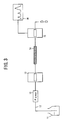
- the column thus obtained is used in a liquid chromatograph of FIG.3 for analyzing a specimen, which contained six alkylbenzene derivatives as the components.
- the liquid chromatograph includes a vessel 11 filled with a mobile phase, a pump 12, a sampler 13, a column 14 corresponding to the foregoing reversed liquid chromatograph column, a detector 15, a recorder 16 and a liquid feed tube 11 connecting the foregoing various parts of the liquid chromatograph.
- the pump 2 is connected to the vessel 11 and supplies the mobile phase in the vessel 11 to the various parts of the liquid chromatograph through the tube 17 with an exactly controlled rate.
- the sampler 13 injects the sample to the reversed phase liquid chromatograph column 14 in the state of a solution, wherein the sample thus injected is separated into individual components in the column 14 as a result of the action of the mobile phase fed by the pump 12 and the packing material in the column 14.
- Each of the components thus separated is detected by the detector 15, and the result of the detection is recorded by the recorder in the form of a chromatogram.
- the recorder By analyzing the chromatogram thus recorded, it is possible to evaluate the resolution of the polymer packing material used in the column 14 for separating the specimen into the components.
- FIGS.4A and 4B show respectively the chromatogram obtained by the present experiment and the chromatogram obtained by the comparative experiment.
- FIGS.4A and 4B it can be seen that sharp peaks are obtained in the present experiment shown in FIG.4A as compared with the comparative experiment shown in FIG.4B. This clearly indicates that the resolution of chromatography is higher in the packing material of the present experiment corresponding to the first embodiment as compared with the packing material of the comparative experiment.
- the polymer packing material was synthesized according to the oxidation-reduction reaction of the second embodiment.
- a number of polymer seed particles each having a diameter of about 1 ⁇ m are formed by a soap-free polymerization process and swelled by a swelling agent.
- the swelled particles are swelled further in a solution containing ethylene diacrylate, a diluent not reacting with ethylene diacrylate, and benzoil peroxide, to form a number of swelled particles 2 each having a diameter of about 5 ⁇ m.
- ethylene diacrylate acts as the monomer while benzoil peroxide acts as a polymerization initiator.
- the mixture thus obtained is mixed with dimethyl aniline, and a polymerization of the ethylene acrylate monomers in the swelled particles is conducted by an oxidation-reduction reaction under existence of ice.
- the diluent is removed from the polymerized particles to form a number of porous polymer particles having a uniform diameter as the polymer packing material.
- the polymer packing material thus obtained is filled in a reversed phase chromatograph column having an inner diameter of 4.6 mm and a length of 150 mm.
- the column thus obtained is used in the liquid chromatograph of FIG.3 for analyzing a specimen containing acetophenone, benzene, naphthalene, 1-phenylpentane, pyrene, and triphenylene as the components, while supplying a mixture of water and acetonitrile solvent (60% acetonitrile) as the mobile phase with a flow rate of 1.0 ml/min.
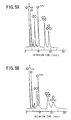
- FIGS.5A and 5B show respectively the chromatogram obtained by the present experiment and the chromatogram obtained by the comparative experiment.
- FIGS.5A and 5B it can be seen that, although there is little difference in the solutes of weak retention characterized by a small retention time, there appears a significant difference in the shape of the peak for the solutes of strong retention characterized by a long retention time.
- the shape of the peak is broad when the conventional packing material is used as indicated in FIG.5B, while a very sharp peak is obtained when the packing material of the second embodiment is used as indicated in FIG.5A.
- the result of FIG.5A indicates that the deterioration of resolution (the number of theoretical plates) is minimized.
- the polymer packing material obtained in the present experiment according to the second embodiment provides a substantial improvement in the resolution of liquid chromatography when used in the chromatograph column.
- a polymer packing material for liquid chromatography was synthesized according to the process of the third embodiment by conducting a heat treatment at a temperature of 100°C or more after the porous polymer particles are synthesized.
- a number of polymer seed particles each having a diameter of about 1 ⁇ m are formed by a soap-free polymerization process and swelled by a swelling agent.
- the swelled particles are swelled further in a solution containing ethylene diacrylate, a diluent not reacting with ethylene diacrylate, and benzoil peroxide, to form a number of swelled particles 2 each having a diameter of about 5 ⁇ m.
- ethylene diacrylate acts as the monomers while benzoil peroxide acts as a polymerization initiator.
- the mixture thus obtained is heated to a temperature of about 70°C to cause a polymerization of the ethylene acrylate monomers in the swelled particles.
- the diluent is removed from the polymerized particles to form a number of porous particles having a uniform diameter.
- porous polymer particles are held in a glass vessel and heated for 24 hours at 200°C, to form the desired polymer packing material. Further, the rest of the porous polymer particles are held in a glass vessel and heated also for 24 hours at 100°C.
- a reversed phase chromatograph column is formed by filling the polymer packing material thus obtained in a column having an inner diameter of 4.6 mm and a length of 150 mm, and a specimen was analyzed by the chromatograph of FIG.3 while using the reversed phase chromatograph column thus obtained for the column 14. Similarly as before, the specimen contained six alkylbenzene derivatives.
- FIGS.6A and 6B show the chromatograms obtained by the present experiment respectively for the case in which the heating after the polymerization was conducted at 200°C and for the case in which the heating was conducted at 100°C. Further, FIG.6C shows the chromatogram obtained by the comparative experiment.
- FIGS.6A and 6B it can be seen that sharp peaks are obtained in the present experiment as compared with the comparative experiment shown in FIG.6C. This clearly indicates that the resolution of chromatography is higher in the packing material of the present experiment corresponding to the first embodiment as compared with the packing material of the comparative experiment.
- the polymer particles obtained in the experiment 2 which uses the oxidation-reduction polymerization process, is subjected to a heat treatment process at 200°C after the polymerization process, similarly to the experiment 3.
- a reversed phase chromatograph column is formed by filling the polymer packing material thus obtained in a column having an inner diameter of 4.6 mm and a length of 150 mm, and a specimen was analyzed by the chromatograph of FIG.3 while using the reversed phase chromatograph column thus obtained for the column 14. Similarly as before, the specimen contained six alkylbenzene derivatives.
- FIGS.7A shows the chromatograms obtained by the present experiment while FIG.7B shows the chromatogram obtained by the comparative experiment.
- FIG.7A it can be seen that sharp peaks are obtained in the present experiment as compared with the comparative experiment shown in FIG.7B. This clearly indicates that the resolution of chromatography is higher in the packing material of the present experiment corresponding to the first embodiment as compared with the packing material of the comparative experiment.
Landscapes
- Chemical & Material Sciences (AREA)
- Organic Chemistry (AREA)
- Chemical Kinetics & Catalysis (AREA)
- Analytical Chemistry (AREA)
- Health & Medical Sciences (AREA)
- Medicinal Chemistry (AREA)
- Polymers & Plastics (AREA)
- Materials Engineering (AREA)
- Engineering & Computer Science (AREA)
- Physics & Mathematics (AREA)
- Thermal Sciences (AREA)
- Life Sciences & Earth Sciences (AREA)
- Biochemistry (AREA)
- General Health & Medical Sciences (AREA)
- General Physics & Mathematics (AREA)
- Immunology (AREA)
- Pathology (AREA)
- Solid-Sorbent Or Filter-Aiding Compositions (AREA)
- Polymerisation Methods In General (AREA)
Applications Claiming Priority (2)
| Application Number | Priority Date | Filing Date | Title |
|---|---|---|---|
| JP25555397A JP3628493B2 (ja) | 1997-09-19 | 1997-09-19 | 液体クロマトグラフィー用ポリマー充填剤の製造方法及びポリマー充填剤 |
| JP255553/97 | 1997-09-19 |
Publications (1)
| Publication Number | Publication Date |
|---|---|
| EP0903579A1 true EP0903579A1 (de) | 1999-03-24 |
Family
ID=17280330
Family Applications (1)
| Application Number | Title | Priority Date | Filing Date |
|---|---|---|---|
| EP98307604A Withdrawn EP0903579A1 (de) | 1997-09-19 | 1998-09-18 | Polymere Füllstoffe für Flüssigkeitschromatographie und Herstellungsmethode |
Country Status (5)
| Country | Link |
|---|---|
| US (1) | US5990182A (de) |
| EP (1) | EP0903579A1 (de) |
| JP (1) | JP3628493B2 (de) |
| KR (1) | KR19990029933A (de) |
| TW (1) | TW562923B (de) |
Cited By (2)
| Publication number | Priority date | Publication date | Assignee | Title |
|---|---|---|---|---|
| EP0982326A3 (de) * | 1998-08-28 | 2000-08-23 | Shiseido Company Limited | Polymer Packungsmaterial für Flussigkeitschromatographie und seine Herstellungsverfahren |
| CN103625142A (zh) * | 2013-11-22 | 2014-03-12 | 中国科学院化学研究所 | 应用于液体转印的染料敏化的多孔聚合物疏水薄膜 |
Families Citing this family (6)
| Publication number | Priority date | Publication date | Assignee | Title |
|---|---|---|---|---|
| US7226756B2 (en) * | 1993-05-12 | 2007-06-05 | The Penn State Research Foundation | Purified plant expansin proteins and DNA encoding same |
| AU2002256276A1 (en) * | 2001-04-19 | 2002-11-05 | Penn State Research Foundation | Novel expansin polynucleotides, related polypeptides and methods of use |
| KR20030072653A (ko) * | 2002-03-06 | 2003-09-19 | 이호재 | 미립화 폴리머를 이용한 크로마토그래피 칼럼의 제조방법 |
| US6912876B2 (en) * | 2003-11-21 | 2005-07-05 | Sara Lee Corporation | Shaped blank |
| TR201819830A2 (tr) | 2018-12-19 | 2020-07-21 | Tuerkiye Bilimsel Ve Teknolojik Arastirma Kurumu Tuebitak | Bor türevli̇ kromatografi̇k dolgu maddesi̇ni̇n geli̇şti̇ri̇lmesi̇ |
| JP7658133B2 (ja) * | 2021-03-24 | 2025-04-08 | セイコーエプソン株式会社 | 液体噴射ヘッドおよび液体噴射装置 |
Citations (2)
| Publication number | Priority date | Publication date | Assignee | Title |
|---|---|---|---|---|
| WO1993012167A1 (en) * | 1991-12-19 | 1993-06-24 | The Dow Chemical Company | Seeded porous copolymers and ion-exchange resins prepared therefrom |
| EP0575488A1 (de) * | 1991-03-13 | 1993-12-29 | Cornell Res Foundation Inc | Verfahren zur herstellung gleichförmiger makroporöser polymerperlen. |
Family Cites Families (1)
| Publication number | Priority date | Publication date | Assignee | Title |
|---|---|---|---|---|
| JPH05204609A (ja) * | 1992-01-13 | 1993-08-13 | Nec Corp | 乗算回路 |
-
1997
- 1997-09-19 JP JP25555397A patent/JP3628493B2/ja not_active Expired - Lifetime
-
1998
- 1998-09-15 US US09/153,677 patent/US5990182A/en not_active Expired - Fee Related
- 1998-09-17 TW TW087115522A patent/TW562923B/zh not_active IP Right Cessation
- 1998-09-18 KR KR1019980038677A patent/KR19990029933A/ko not_active Abandoned
- 1998-09-18 EP EP98307604A patent/EP0903579A1/de not_active Withdrawn
Patent Citations (2)
| Publication number | Priority date | Publication date | Assignee | Title |
|---|---|---|---|---|
| EP0575488A1 (de) * | 1991-03-13 | 1993-12-29 | Cornell Res Foundation Inc | Verfahren zur herstellung gleichförmiger makroporöser polymerperlen. |
| WO1993012167A1 (en) * | 1991-12-19 | 1993-06-24 | The Dow Chemical Company | Seeded porous copolymers and ion-exchange resins prepared therefrom |
Cited By (4)
| Publication number | Priority date | Publication date | Assignee | Title |
|---|---|---|---|---|
| EP0982326A3 (de) * | 1998-08-28 | 2000-08-23 | Shiseido Company Limited | Polymer Packungsmaterial für Flussigkeitschromatographie und seine Herstellungsverfahren |
| US6482867B1 (en) | 1998-08-28 | 2002-11-19 | Shiseido Co., Ltd. | Polymer packing material for liquid chromatography and a producing method thereof |
| CN103625142A (zh) * | 2013-11-22 | 2014-03-12 | 中国科学院化学研究所 | 应用于液体转印的染料敏化的多孔聚合物疏水薄膜 |
| CN103625142B (zh) * | 2013-11-22 | 2015-05-20 | 中国科学院化学研究所 | 应用于液体转印的染料敏化的多孔聚合物疏水薄膜 |
Also Published As
| Publication number | Publication date |
|---|---|
| JP3628493B2 (ja) | 2005-03-09 |
| US5990182A (en) | 1999-11-23 |
| TW562923B (en) | 2003-11-21 |
| KR19990029933A (ko) | 1999-04-26 |
| JPH1194813A (ja) | 1999-04-09 |
Similar Documents
| Publication | Publication Date | Title |
|---|---|---|
| Wulff et al. | Template imprinted polymers for HPLC separation of racemates | |
| CA2344051C (en) | Monolithic matrix for separating nucleic acids by reverse-phase ion-pair high performance liquid chromatography | |
| Hollis | Porous polymers used in GC and LC | |
| EP0982326B1 (de) | Polymer Packungsmaterial für Flussigkeitschromatographie und seine Herstellungsverfahren | |
| US5990182A (en) | Polymer packing material for liquid chromatography and a producing method thereof | |
| Zhu et al. | A new ionic liquid surface‐imprinted polymer for selective solid‐phase‐extraction and determination of sulfonamides in environmental samples | |
| EP2274091B1 (de) | Verbundwerkstoff | |
| EP2474827A1 (de) | Vorbearbeitungskartusche zur substanzentrennung und vorbearbeitungsverfahren dafür | |
| Ma et al. | Preparation and evaluation of a green solvent-based molecularly imprinted monolithic column for the recognition of proteins by high-performance liquid chromatography | |
| Diack et al. | Adsorption isotherm and overloaded elution profiles of phenyldodecane on porous carbon in liquid chromatography | |
| Takeuchi et al. | Miniaturized molecularly imprinted continuous polymer rods | |
| CN111001443A (zh) | 一种聚(胺-环氧氯丙烷)附聚接枝型阴离子色谱填料的制备方法 | |
| EP0458548B1 (de) | Kohlenstoffperlen, Verfahren zur Herstellung und Chromatographiesäule, die sie enthält | |
| JPH0285758A (ja) | イオンクロマトグラフィー用のイオン交換性複合組成物 | |
| JP2000088826A (ja) | 液体クロマトグラフィー用充填剤の製造方法 | |
| EP0104911B1 (de) | Säulenpackungsmaterial und dessen Herstellung | |
| JP3657448B2 (ja) | 液体クロマトグラフィー用ポリマー充填剤およびその製造方法 | |
| JP4700171B2 (ja) | 液体クロマトグラフィー用親水性ods充填剤の製造方法 | |
| Pirotta | Amberlite ER‐180‐A new styrene divinylbenzene adsorbent specifically designed for industrial chromatography and particularly for the extraction of cephalosporin C. | |
| Epton et al. | Synthesis and characterization of poly (acryloyl morpholine) xerogel networks suitable for the gel permeation chromatography of small molecules | |
| JP4203191B2 (ja) | 液体クロマトグラフィー用充填剤 | |
| US5167822A (en) | Butadiene acrylonitrile polymeric coating for chromatographic packing material | |
| US20240286110A1 (en) | Carbon microsphere chromatographic material | |
| US7553911B2 (en) | Coated polydivinylbenzene beads | |
| GB2031916A (en) | Crosslinked vinyl aromatic polymer granules for liquid chromatography |
Legal Events
| Date | Code | Title | Description |
|---|---|---|---|
| PUAI | Public reference made under article 153(3) epc to a published international application that has entered the european phase |
Free format text: ORIGINAL CODE: 0009012 |
|
| AK | Designated contracting states |
Kind code of ref document: A1 Designated state(s): DE FR GB IT |
|
| AX | Request for extension of the european patent |
Free format text: AL;LT;LV;MK;RO;SI |
|
| 17P | Request for examination filed |
Effective date: 19990423 |
|
| AKX | Designation fees paid |
Free format text: DE FR GB IT |
|
| STAA | Information on the status of an ep patent application or granted ep patent |
Free format text: STATUS: THE APPLICATION HAS BEEN WITHDRAWN |
|
| 18W | Application withdrawn |
Effective date: 20040430 |