EP0897941B1 - Cross-linked solid polyelectrolyte and use thereof - Google Patents
Cross-linked solid polyelectrolyte and use thereof Download PDFInfo
- Publication number
- EP0897941B1 EP0897941B1 EP97918369A EP97918369A EP0897941B1 EP 0897941 B1 EP0897941 B1 EP 0897941B1 EP 97918369 A EP97918369 A EP 97918369A EP 97918369 A EP97918369 A EP 97918369A EP 0897941 B1 EP0897941 B1 EP 0897941B1
- Authority
- EP
- European Patent Office
- Prior art keywords
- group
- epoxy
- ion
- copolymer
- monomer
- Prior art date
- Legal status (The legal status is an assumption and is not a legal conclusion. Google has not performed a legal analysis and makes no representation as to the accuracy of the status listed.)
- Expired - Lifetime
Links
- 239000007787 solid Substances 0.000 title abstract description 8
- 229920000867 polyelectrolyte Polymers 0.000 title abstract description 6
- 239000000178 monomer Substances 0.000 claims abstract description 60
- 239000004721 Polyphenylene oxide Substances 0.000 claims abstract description 38
- 229920000570 polyether Polymers 0.000 claims abstract description 37
- 125000000524 functional group Chemical group 0.000 claims abstract description 19
- 125000003700 epoxy group Chemical group 0.000 claims abstract description 12
- 229920001577 copolymer Polymers 0.000 claims description 64
- -1 glycidyl crotonate Chemical compound 0.000 claims description 59
- 239000007784 solid electrolyte Substances 0.000 claims description 54
- 229920000642 polymer Polymers 0.000 claims description 32
- 238000004132 cross linking Methods 0.000 claims description 25
- 239000003792 electrolyte Substances 0.000 claims description 25
- 239000000203 mixture Substances 0.000 claims description 23
- 150000001875 compounds Chemical class 0.000 claims description 21
- 229910052744 lithium Inorganic materials 0.000 claims description 19
- 125000002496 methyl group Chemical group [H]C([H])([H])* 0.000 claims description 19
- 125000004432 carbon atom Chemical group C* 0.000 claims description 18
- 230000009477 glass transition Effects 0.000 claims description 16
- 125000006353 oxyethylene group Chemical group 0.000 claims description 16
- 150000001768 cations Chemical class 0.000 claims description 15
- 230000004927 fusion Effects 0.000 claims description 15
- 239000004593 Epoxy Substances 0.000 claims description 14
- LYCAIKOWRPUZTN-UHFFFAOYSA-N Ethylene glycol Chemical compound OCCO LYCAIKOWRPUZTN-UHFFFAOYSA-N 0.000 claims description 14
- XUIMIQQOPSSXEZ-UHFFFAOYSA-N Silicon Chemical group [Si] XUIMIQQOPSSXEZ-UHFFFAOYSA-N 0.000 claims description 14
- 239000011243 crosslinked material Substances 0.000 claims description 14
- 229910052751 metal Inorganic materials 0.000 claims description 14
- 239000002184 metal Substances 0.000 claims description 14
- 125000005843 halogen group Chemical group 0.000 claims description 10
- 125000000217 alkyl group Chemical group 0.000 claims description 9
- WGCNASOHLSPBMP-UHFFFAOYSA-N hydroxyacetaldehyde Natural products OCC=O WGCNASOHLSPBMP-UHFFFAOYSA-N 0.000 claims description 8
- 150000002500 ions Chemical class 0.000 claims description 8
- 125000003545 alkoxy group Chemical group 0.000 claims description 6
- WHGNXNCOTZPEEK-UHFFFAOYSA-N dimethoxy-methyl-[3-(oxiran-2-ylmethoxy)propyl]silane Chemical compound CO[Si](C)(OC)CCCOCC1CO1 WHGNXNCOTZPEEK-UHFFFAOYSA-N 0.000 claims description 6
- BPSIOYPQMFLKFR-UHFFFAOYSA-N trimethoxy-[3-(oxiran-2-ylmethoxy)propyl]silane Chemical compound CO[Si](OC)(OC)CCCOCC1CO1 BPSIOYPQMFLKFR-UHFFFAOYSA-N 0.000 claims description 6
- VOZRXNHHFUQHIL-UHFFFAOYSA-N glycidyl methacrylate Chemical compound CC(=C)C(=O)OCC1CO1 VOZRXNHHFUQHIL-UHFFFAOYSA-N 0.000 claims description 5
- RPQRDASANLAFCM-UHFFFAOYSA-N oxiran-2-ylmethyl prop-2-enoate Chemical compound C=CC(=O)OCC1CO1 RPQRDASANLAFCM-UHFFFAOYSA-N 0.000 claims description 5
- DQZNLOXENNXVAD-UHFFFAOYSA-N trimethoxy-[2-(7-oxabicyclo[4.1.0]heptan-4-yl)ethyl]silane Chemical compound C1C(CC[Si](OC)(OC)OC)CCC2OC21 DQZNLOXENNXVAD-UHFFFAOYSA-N 0.000 claims description 5
- WKBOTKDWSSQWDR-UHFFFAOYSA-N Bromine atom Chemical group [Br] WKBOTKDWSSQWDR-UHFFFAOYSA-N 0.000 claims description 4
- 125000003118 aryl group Chemical group 0.000 claims description 4
- GYZLOYUZLJXAJU-UHFFFAOYSA-N diglycidyl ether Chemical compound C1OC1COCC1CO1 GYZLOYUZLJXAJU-UHFFFAOYSA-N 0.000 claims description 4
- 229920005604 random copolymer Polymers 0.000 claims description 4
- STMDPCBYJCIZOD-UHFFFAOYSA-N 2-(2,4-dinitroanilino)-4-methylpentanoic acid Chemical compound CC(C)CC(C(O)=O)NC1=CC=C([N+]([O-])=O)C=C1[N+]([O-])=O STMDPCBYJCIZOD-UHFFFAOYSA-N 0.000 claims description 3
- SZERAFCDZCHRQS-UHFFFAOYSA-N 2-ethenyl-3-methyloxirane Chemical compound CC1OC1C=C SZERAFCDZCHRQS-UHFFFAOYSA-N 0.000 claims description 3
- ZCYVEMRRCGMTRW-UHFFFAOYSA-N 7553-56-2 Chemical group [I] ZCYVEMRRCGMTRW-UHFFFAOYSA-N 0.000 claims description 3
- GXBYFVGCMPJVJX-UHFFFAOYSA-N Epoxybutene Chemical compound C=CC1CO1 GXBYFVGCMPJVJX-UHFFFAOYSA-N 0.000 claims description 3
- 125000003342 alkenyl group Chemical group 0.000 claims description 3
- 125000003710 aryl alkyl group Chemical group 0.000 claims description 3
- SXPLZNMUBFBFIA-UHFFFAOYSA-N butyl(trimethoxy)silane Chemical compound CCCC[Si](OC)(OC)OC SXPLZNMUBFBFIA-UHFFFAOYSA-N 0.000 claims description 3
- 125000000753 cycloalkyl group Chemical group 0.000 claims description 3
- 229910052740 iodine Inorganic materials 0.000 claims description 3
- JUVGLPRIQOJMIR-UHFFFAOYSA-N oxiran-2-ylmethyl 3-phenylprop-2-enoate Chemical compound C=1C=CC=CC=1C=CC(=O)OCC1CO1 JUVGLPRIQOJMIR-UHFFFAOYSA-N 0.000 claims description 3
- 125000001412 tetrahydropyranyl group Chemical group 0.000 claims description 3
- 229910052723 transition metal Inorganic materials 0.000 claims description 3
- 150000003624 transition metals Chemical class 0.000 claims description 3
- HILHCDFHSDUYNX-UHFFFAOYSA-N trimethoxy(pentyl)silane Chemical compound CCCCC[Si](OC)(OC)OC HILHCDFHSDUYNX-UHFFFAOYSA-N 0.000 claims description 3
- OWUVDWLTQIPNLN-GGWOSOGESA-N (4e,8e)-13-oxabicyclo[10.1.0]trideca-4,8-diene Chemical compound C1C\C=C\CC\C=C\CCC2OC21 OWUVDWLTQIPNLN-GGWOSOGESA-N 0.000 claims description 2
- YWFPXWMSGJXUFS-UPHRSURJSA-N (4z)-9-oxabicyclo[6.1.0]non-4-ene Chemical compound C1C\C=C/CCC2OC21 YWFPXWMSGJXUFS-UPHRSURJSA-N 0.000 claims description 2
- GIRRZESVVMQABO-UHFFFAOYSA-N 2-(cyclohexen-1-ylmethoxymethyl)oxirane Chemical compound C1OC1COCC1=CCCCC1 GIRRZESVVMQABO-UHFFFAOYSA-N 0.000 claims description 2
- JJRUAPNVLBABCN-UHFFFAOYSA-N 2-(ethenoxymethyl)oxirane Chemical compound C=COCC1CO1 JJRUAPNVLBABCN-UHFFFAOYSA-N 0.000 claims description 2
- LELKUNFWANHDPG-UHFFFAOYSA-N 2-(oxiran-2-ylmethoxymethyl)oxirane;prop-2-enoic acid Chemical compound OC(=O)C=C.C1OC1COCC1CO1 LELKUNFWANHDPG-UHFFFAOYSA-N 0.000 claims description 2
- AUNOCGWVFDDCAD-UHFFFAOYSA-N 2-[(4-ethenylcyclohexyl)oxymethyl]oxirane Chemical compound C1CC(C=C)CCC1OCC1OC1 AUNOCGWVFDDCAD-UHFFFAOYSA-N 0.000 claims description 2
- ZADXFVHUPXKZBJ-UHFFFAOYSA-N 2-[(4-ethenylphenyl)methoxymethyl]oxirane Chemical compound C1=CC(C=C)=CC=C1COCC1OC1 ZADXFVHUPXKZBJ-UHFFFAOYSA-N 0.000 claims description 2
- YNOXQPJKWDCAJW-UHFFFAOYSA-N 2-methylprop-2-enoic acid;2-(oxiran-2-ylmethoxymethyl)oxirane Chemical compound CC(=C)C(O)=O.C1OC1COCC1CO1 YNOXQPJKWDCAJW-UHFFFAOYSA-N 0.000 claims description 2
- PAVZJOKUCHKLOK-UHFFFAOYSA-N 4-ethenyl-7-oxabicyclo[4.1.0]hept-4-ene Chemical compound C1CC(C=C)=CC2OC21 PAVZJOKUCHKLOK-UHFFFAOYSA-N 0.000 claims description 2
- QGZKDVFQNNGYKY-UHFFFAOYSA-O Ammonium Chemical compound [NH4+] QGZKDVFQNNGYKY-UHFFFAOYSA-O 0.000 claims description 2
- 229910017048 AsF6 Inorganic materials 0.000 claims description 2
- CPELXLSAUQHCOX-UHFFFAOYSA-M Bromide Chemical compound [Br-] CPELXLSAUQHCOX-UHFFFAOYSA-M 0.000 claims description 2
- VEXZGXHMUGYJMC-UHFFFAOYSA-M Chloride anion Chemical compound [Cl-] VEXZGXHMUGYJMC-UHFFFAOYSA-M 0.000 claims description 2
- UFHFLCQGNIYNRP-UHFFFAOYSA-N Hydrogen Chemical compound [H][H] UFHFLCQGNIYNRP-UHFFFAOYSA-N 0.000 claims description 2
- NHNBFGGVMKEFGY-UHFFFAOYSA-N Nitrate Chemical compound [O-][N+]([O-])=O NHNBFGGVMKEFGY-UHFFFAOYSA-N 0.000 claims description 2
- DNIAPMSPPWPWGF-UHFFFAOYSA-N Propylene glycol Chemical compound CC(O)CO DNIAPMSPPWPWGF-UHFFFAOYSA-N 0.000 claims description 2
- ZMZDMBWJUHKJPS-UHFFFAOYSA-M Thiocyanate anion Chemical compound [S-]C#N ZMZDMBWJUHKJPS-UHFFFAOYSA-M 0.000 claims description 2
- 150000001450 anions Chemical class 0.000 claims description 2
- 229910052788 barium Inorganic materials 0.000 claims description 2
- 229910052792 caesium Inorganic materials 0.000 claims description 2
- 229910052791 calcium Inorganic materials 0.000 claims description 2
- 229910052799 carbon Inorganic materials 0.000 claims description 2
- 125000002915 carbonyl group Chemical group [*:2]C([*:1])=O 0.000 claims description 2
- 125000003178 carboxy group Chemical group [H]OC(*)=O 0.000 claims description 2
- 229910052802 copper Inorganic materials 0.000 claims description 2
- 125000004093 cyano group Chemical group *C#N 0.000 claims description 2
- 229940071161 dodecylbenzenesulfonate Drugs 0.000 claims description 2
- 239000001257 hydrogen Substances 0.000 claims description 2
- 229910052739 hydrogen Inorganic materials 0.000 claims description 2
- XMBWDFGMSWQBCA-UHFFFAOYSA-M iodide Chemical compound [I-] XMBWDFGMSWQBCA-UHFFFAOYSA-M 0.000 claims description 2
- 229910052742 iron Inorganic materials 0.000 claims description 2
- 229910052749 magnesium Inorganic materials 0.000 claims description 2
- 229910052748 manganese Inorganic materials 0.000 claims description 2
- 229910052759 nickel Inorganic materials 0.000 claims description 2
- 125000000449 nitro group Chemical group [O-][N+](*)=O 0.000 claims description 2
- 125000000018 nitroso group Chemical group N(=O)* 0.000 claims description 2
- 125000000962 organic group Chemical group 0.000 claims description 2
- AVNANMSIFNUHNY-MQQKCMAXSA-N oxiran-2-ylmethyl (2e,4e)-hexa-2,4-dienoate Chemical compound C\C=C\C=C\C(=O)OCC1CO1 AVNANMSIFNUHNY-MQQKCMAXSA-N 0.000 claims description 2
- NZSXYXVUIOHHSF-UHFFFAOYSA-N oxiran-2-ylmethyl hex-4-enoate Chemical compound CC=CCCC(=O)OCC1CO1 NZSXYXVUIOHHSF-UHFFFAOYSA-N 0.000 claims description 2
- VLTRZXGMWDSKGL-UHFFFAOYSA-M perchlorate Chemical compound [O-]Cl(=O)(=O)=O VLTRZXGMWDSKGL-UHFFFAOYSA-M 0.000 claims description 2
- 125000005010 perfluoroalkyl group Chemical group 0.000 claims description 2
- 125000000843 phenylene group Chemical group C1(=C(C=CC=C1)*)* 0.000 claims description 2
- 229910052700 potassium Inorganic materials 0.000 claims description 2
- 230000009257 reactivity Effects 0.000 claims description 2
- 229910052701 rubidium Inorganic materials 0.000 claims description 2
- 229910052709 silver Inorganic materials 0.000 claims description 2
- 229910052708 sodium Inorganic materials 0.000 claims description 2
- 229910052725 zinc Inorganic materials 0.000 claims description 2
- KOHBFAGTEWFCBI-UHFFFAOYSA-N 2-prop-1-enyloxirane Chemical compound CC=CC1CO1 KOHBFAGTEWFCBI-UHFFFAOYSA-N 0.000 claims 2
- 150000001721 carbon Chemical group 0.000 claims 1
- 238000009472 formulation Methods 0.000 claims 1
- 239000010408 film Substances 0.000 description 39
- WYURNTSHIVDZCO-UHFFFAOYSA-N Tetrahydrofuran Chemical compound C1CCOC1 WYURNTSHIVDZCO-UHFFFAOYSA-N 0.000 description 28
- IAYPIBMASNFSPL-UHFFFAOYSA-N Ethylene oxide Chemical compound C1CO1 IAYPIBMASNFSPL-UHFFFAOYSA-N 0.000 description 19
- 238000006116 polymerization reaction Methods 0.000 description 19
- 239000000243 solution Substances 0.000 description 19
- 239000003054 catalyst Substances 0.000 description 18
- 239000002904 solvent Substances 0.000 description 16
- 230000000052 comparative effect Effects 0.000 description 15
- 238000006243 chemical reaction Methods 0.000 description 14
- 229920006037 cross link polymer Polymers 0.000 description 13
- WHXSMMKQMYFTQS-UHFFFAOYSA-N Lithium Chemical compound [Li] WHXSMMKQMYFTQS-UHFFFAOYSA-N 0.000 description 12
- 239000003431 cross linking reagent Substances 0.000 description 12
- 239000007788 liquid Substances 0.000 description 12
- XLYOFNOQVPJJNP-UHFFFAOYSA-N water Substances O XLYOFNOQVPJJNP-UHFFFAOYSA-N 0.000 description 12
- 238000000034 method Methods 0.000 description 11
- QYZFTMMPKCOTAN-UHFFFAOYSA-N n-[2-(2-hydroxyethylamino)ethyl]-2-[[1-[2-(2-hydroxyethylamino)ethylamino]-2-methyl-1-oxopropan-2-yl]diazenyl]-2-methylpropanamide Chemical compound OCCNCCNC(=O)C(C)(C)N=NC(C)(C)C(=O)NCCNCCO QYZFTMMPKCOTAN-UHFFFAOYSA-N 0.000 description 10
- WEVYAHXRMPXWCK-UHFFFAOYSA-N Acetonitrile Chemical compound CC#N WEVYAHXRMPXWCK-UHFFFAOYSA-N 0.000 description 9
- UHOVQNZJYSORNB-UHFFFAOYSA-N Benzene Chemical compound C1=CC=CC=C1 UHOVQNZJYSORNB-UHFFFAOYSA-N 0.000 description 9
- OKKJLVBELUTLKV-UHFFFAOYSA-N Methanol Chemical compound OC OKKJLVBELUTLKV-UHFFFAOYSA-N 0.000 description 9
- MHCFAGZWMAWTNR-UHFFFAOYSA-M lithium perchlorate Chemical compound [Li+].[O-]Cl(=O)(=O)=O MHCFAGZWMAWTNR-UHFFFAOYSA-M 0.000 description 9
- 229910001486 lithium perchlorate Inorganic materials 0.000 description 9
- 238000002156 mixing Methods 0.000 description 9
- 229920000768 polyamine Polymers 0.000 description 9
- YLQBMQCUIZJEEH-UHFFFAOYSA-N tetrahydrofuran Natural products C=1C=COC=1 YLQBMQCUIZJEEH-UHFFFAOYSA-N 0.000 description 9
- CBTRJEXEEWVQHL-UHFFFAOYSA-N 2-[2-[2-(2-methoxyethoxy)ethoxy]ethoxymethyl]oxirane Chemical compound COCCOCCOCCOCC1CO1 CBTRJEXEEWVQHL-UHFFFAOYSA-N 0.000 description 8
- IJGRMHOSHXDMSA-UHFFFAOYSA-N Atomic nitrogen Chemical compound N#N IJGRMHOSHXDMSA-UHFFFAOYSA-N 0.000 description 8
- ATUOYWHBWRKTHZ-UHFFFAOYSA-N Propane Chemical compound CCC ATUOYWHBWRKTHZ-UHFFFAOYSA-N 0.000 description 8
- RTZKZFJDLAIYFH-UHFFFAOYSA-N Diethyl ether Chemical compound CCOCC RTZKZFJDLAIYFH-UHFFFAOYSA-N 0.000 description 6
- 229910019142 PO4 Inorganic materials 0.000 description 6
- 239000002253 acid Substances 0.000 description 6
- 150000008065 acid anhydrides Chemical class 0.000 description 6
- MTHSVFCYNBDYFN-UHFFFAOYSA-N diethylene glycol Chemical compound OCCOCCO MTHSVFCYNBDYFN-UHFFFAOYSA-N 0.000 description 6
- 239000011888 foil Substances 0.000 description 6
- 238000005259 measurement Methods 0.000 description 6
- VLKZOEOYAKHREP-UHFFFAOYSA-N n-Hexane Chemical compound CCCCCC VLKZOEOYAKHREP-UHFFFAOYSA-N 0.000 description 6
- 239000010452 phosphate Substances 0.000 description 6
- BASFCYQUMIYNBI-UHFFFAOYSA-N platinum Chemical compound [Pt] BASFCYQUMIYNBI-UHFFFAOYSA-N 0.000 description 6
- RPNUMPOLZDHAAY-UHFFFAOYSA-N Diethylenetriamine Chemical compound NCCNCCN RPNUMPOLZDHAAY-UHFFFAOYSA-N 0.000 description 5
- ZMXDDKWLCZADIW-UHFFFAOYSA-N N,N-Dimethylformamide Chemical compound CN(C)C=O ZMXDDKWLCZADIW-UHFFFAOYSA-N 0.000 description 5
- 239000012298 atmosphere Substances 0.000 description 5
- 229920003023 plastic Polymers 0.000 description 5
- 239000004033 plastic Substances 0.000 description 5
- OKTJSMMVPCPJKN-UHFFFAOYSA-N Carbon Chemical compound [C] OKTJSMMVPCPJKN-UHFFFAOYSA-N 0.000 description 4
- BLRPTPMANUNPDV-UHFFFAOYSA-N Silane Chemical compound [SiH4] BLRPTPMANUNPDV-UHFFFAOYSA-N 0.000 description 4
- 239000011521 glass Substances 0.000 description 4
- NAQMVNRVTILPCV-UHFFFAOYSA-N hexane-1,6-diamine Chemical compound NCCCCCCN NAQMVNRVTILPCV-UHFFFAOYSA-N 0.000 description 4
- 238000000465 moulding Methods 0.000 description 4
- 229910052757 nitrogen Inorganic materials 0.000 description 4
- 150000001451 organic peroxides Chemical class 0.000 description 4
- 229920001296 polysiloxane Polymers 0.000 description 4
- 238000002360 preparation method Methods 0.000 description 4
- 239000001294 propane Substances 0.000 description 4
- 239000000126 substance Substances 0.000 description 4
- 125000001424 substituent group Chemical group 0.000 description 4
- XMNIXWIUMCBBBL-UHFFFAOYSA-N 2-(2-phenylpropan-2-ylperoxy)propan-2-ylbenzene Chemical compound C=1C=CC=CC=1C(C)(C)OOC(C)(C)C1=CC=CC=C1 XMNIXWIUMCBBBL-UHFFFAOYSA-N 0.000 description 3
- ZWEHNKRNPOVVGH-UHFFFAOYSA-N 2-Butanone Chemical compound CCC(C)=O ZWEHNKRNPOVVGH-UHFFFAOYSA-N 0.000 description 3
- CSCPPACGZOOCGX-UHFFFAOYSA-N Acetone Chemical compound CC(C)=O CSCPPACGZOOCGX-UHFFFAOYSA-N 0.000 description 3
- PDQAZBWRQCGBEV-UHFFFAOYSA-N Ethylenethiourea Chemical compound S=C1NCCN1 PDQAZBWRQCGBEV-UHFFFAOYSA-N 0.000 description 3
- UKLDJPRMSDWDSL-UHFFFAOYSA-L [dibutyl(dodecanoyloxy)stannyl] dodecanoate Chemical compound CCCCCCCCCCCC(=O)O[Sn](CCCC)(CCCC)OC(=O)CCCCCCCCCCC UKLDJPRMSDWDSL-UHFFFAOYSA-L 0.000 description 3
- 239000012300 argon atmosphere Substances 0.000 description 3
- 239000003990 capacitor Substances 0.000 description 3
- 238000010908 decantation Methods 0.000 description 3
- ISAOCJYIOMOJEB-UHFFFAOYSA-N desyl alcohol Natural products C=1C=CC=CC=1C(O)C(=O)C1=CC=CC=C1 ISAOCJYIOMOJEB-UHFFFAOYSA-N 0.000 description 3
- 230000006866 deterioration Effects 0.000 description 3
- 239000012975 dibutyltin dilaurate Substances 0.000 description 3
- STVZJERGLQHEKB-UHFFFAOYSA-N ethylene glycol dimethacrylate Substances CC(=C)C(=O)OCCOC(=O)C(C)=C STVZJERGLQHEKB-UHFFFAOYSA-N 0.000 description 3
- 238000004817 gas chromatography Methods 0.000 description 3
- 125000004435 hydrogen atom Chemical group [H]* 0.000 description 3
- FPYJFEHAWHCUMM-UHFFFAOYSA-N maleic anhydride Chemical compound O=C1OC(=O)C=C1 FPYJFEHAWHCUMM-UHFFFAOYSA-N 0.000 description 3
- 239000000463 material Substances 0.000 description 3
- 150000002739 metals Chemical class 0.000 description 3
- 238000012544 monitoring process Methods 0.000 description 3
- QOHMWDJIBGVPIF-UHFFFAOYSA-N n',n'-diethylpropane-1,3-diamine Chemical compound CCN(CC)CCCN QOHMWDJIBGVPIF-UHFFFAOYSA-N 0.000 description 3
- 229920000620 organic polymer Polymers 0.000 description 3
- 229910052697 platinum Inorganic materials 0.000 description 3
- 238000000425 proton nuclear magnetic resonance spectrum Methods 0.000 description 3
- HBCQSNAFLVXVAY-UHFFFAOYSA-N pyrimidine-2-thiol Chemical class SC1=NC=CC=N1 HBCQSNAFLVXVAY-UHFFFAOYSA-N 0.000 description 3
- 229910052990 silicon hydride Inorganic materials 0.000 description 3
- 238000003756 stirring Methods 0.000 description 3
- WZCQRUWWHSTZEM-UHFFFAOYSA-N 1,3-phenylenediamine Chemical compound NC1=CC=CC(N)=C1 WZCQRUWWHSTZEM-UHFFFAOYSA-N 0.000 description 2
- JZFMNFJEQDUBPL-UHFFFAOYSA-N 1-sulfanyl-4,5-dihydroimidazole Chemical class SN1CCN=C1 JZFMNFJEQDUBPL-UHFFFAOYSA-N 0.000 description 2
- VILCJCGEZXAXTO-UHFFFAOYSA-N 2,2,2-tetramine Chemical compound NCCNCCNCCN VILCJCGEZXAXTO-UHFFFAOYSA-N 0.000 description 2
- RNFJDJUURJAICM-UHFFFAOYSA-N 2,2,4,4,6,6-hexaphenoxy-1,3,5-triaza-2$l^{5},4$l^{5},6$l^{5}-triphosphacyclohexa-1,3,5-triene Chemical compound N=1P(OC=2C=CC=CC=2)(OC=2C=CC=CC=2)=NP(OC=2C=CC=CC=2)(OC=2C=CC=CC=2)=NP=1(OC=1C=CC=CC=1)OC1=CC=CC=C1 RNFJDJUURJAICM-UHFFFAOYSA-N 0.000 description 2
- KWVGIHKZDCUPEU-UHFFFAOYSA-N 2,2-dimethoxy-2-phenylacetophenone Chemical compound C=1C=CC=CC=1C(OC)(OC)C(=O)C1=CC=CC=C1 KWVGIHKZDCUPEU-UHFFFAOYSA-N 0.000 description 2
- AHDSRXYHVZECER-UHFFFAOYSA-N 2,4,6-tris[(dimethylamino)methyl]phenol Chemical compound CN(C)CC1=CC(CN(C)C)=C(O)C(CN(C)C)=C1 AHDSRXYHVZECER-UHFFFAOYSA-N 0.000 description 2
- VOZKAJLKRJDJLL-UHFFFAOYSA-N 2,4-diaminotoluene Chemical compound CC1=CC=C(N)C=C1N VOZKAJLKRJDJLL-UHFFFAOYSA-N 0.000 description 2
- OZAIFHULBGXAKX-UHFFFAOYSA-N 2-(2-cyanopropan-2-yldiazenyl)-2-methylpropanenitrile Chemical compound N#CC(C)(C)N=NC(C)(C)C#N OZAIFHULBGXAKX-UHFFFAOYSA-N 0.000 description 2
- KUDUQBURMYMBIJ-UHFFFAOYSA-N 2-prop-2-enoyloxyethyl prop-2-enoate Chemical compound C=CC(=O)OCCOC(=O)C=C KUDUQBURMYMBIJ-UHFFFAOYSA-N 0.000 description 2
- 125000003903 2-propenyl group Chemical group [H]C([*])([H])C([H])=C([H])[H] 0.000 description 2
- VTYYLEPIZMXCLO-UHFFFAOYSA-L Calcium carbonate Chemical compound [Ca+2].[O-]C([O-])=O VTYYLEPIZMXCLO-UHFFFAOYSA-L 0.000 description 2
- ODINCKMPIJJUCX-UHFFFAOYSA-N Calcium oxide Chemical compound [Ca]=O ODINCKMPIJJUCX-UHFFFAOYSA-N 0.000 description 2
- BVKZGUZCCUSVTD-UHFFFAOYSA-L Carbonate Chemical compound [O-]C([O-])=O BVKZGUZCCUSVTD-UHFFFAOYSA-L 0.000 description 2
- IAZDPXIOMUYVGZ-UHFFFAOYSA-N Dimethylsulphoxide Chemical compound CS(C)=O IAZDPXIOMUYVGZ-UHFFFAOYSA-N 0.000 description 2
- CPLXHLVBOLITMK-UHFFFAOYSA-N Magnesium oxide Chemical compound [Mg]=O CPLXHLVBOLITMK-UHFFFAOYSA-N 0.000 description 2
- KDLHZDBZIXYQEI-UHFFFAOYSA-N Palladium Chemical compound [Pd] KDLHZDBZIXYQEI-UHFFFAOYSA-N 0.000 description 2
- ISWSIDIOOBJBQZ-UHFFFAOYSA-N Phenol Chemical compound OC1=CC=CC=C1 ISWSIDIOOBJBQZ-UHFFFAOYSA-N 0.000 description 2
- XYFCBTPGUUZFHI-UHFFFAOYSA-N Phosphine Chemical compound P XYFCBTPGUUZFHI-UHFFFAOYSA-N 0.000 description 2
- 229920003171 Poly (ethylene oxide) Polymers 0.000 description 2
- 235000000126 Styrax benzoin Nutrition 0.000 description 2
- 244000028419 Styrax benzoin Species 0.000 description 2
- LSNNMFCWUKXFEE-UHFFFAOYSA-N Sulfurous acid Chemical compound OS(O)=O LSNNMFCWUKXFEE-UHFFFAOYSA-N 0.000 description 2
- 235000008411 Sumatra benzointree Nutrition 0.000 description 2
- GKXVJHDEWHKBFH-UHFFFAOYSA-N [2-(aminomethyl)phenyl]methanamine Chemical compound NCC1=CC=CC=C1CN GKXVJHDEWHKBFH-UHFFFAOYSA-N 0.000 description 2
- 239000006230 acetylene black Substances 0.000 description 2
- 229910052782 aluminium Inorganic materials 0.000 description 2
- XAGFODPZIPBFFR-UHFFFAOYSA-N aluminium Chemical compound [Al] XAGFODPZIPBFFR-UHFFFAOYSA-N 0.000 description 2
- 238000004458 analytical method Methods 0.000 description 2
- ADCOVFLJGNWWNZ-UHFFFAOYSA-N antimony trioxide Chemical compound O=[Sb]O[Sb]=O ADCOVFLJGNWWNZ-UHFFFAOYSA-N 0.000 description 2
- 229960002130 benzoin Drugs 0.000 description 2
- 239000012965 benzophenone Substances 0.000 description 2
- 150000008366 benzophenones Chemical class 0.000 description 2
- WGQKYBSKWIADBV-UHFFFAOYSA-N benzylamine Chemical compound NCC1=CC=CC=C1 WGQKYBSKWIADBV-UHFFFAOYSA-N 0.000 description 2
- LWMFAFLIWMPZSX-UHFFFAOYSA-N bis[2-(4,5-dihydro-1h-imidazol-2-yl)propan-2-yl]diazene Chemical compound N=1CCNC=1C(C)(C)N=NC(C)(C)C1=NCCN1 LWMFAFLIWMPZSX-UHFFFAOYSA-N 0.000 description 2
- HQABUPZFAYXKJW-UHFFFAOYSA-N butan-1-amine Chemical compound CCCCN HQABUPZFAYXKJW-UHFFFAOYSA-N 0.000 description 2
- 238000001354 calcination Methods 0.000 description 2
- ZJRWDIJRKKXMNW-UHFFFAOYSA-N carbonic acid;cobalt Chemical compound [Co].OC(O)=O ZJRWDIJRKKXMNW-UHFFFAOYSA-N 0.000 description 2
- 150000007942 carboxylates Chemical class 0.000 description 2
- 238000007334 copolymerization reaction Methods 0.000 description 2
- PAFZNILMFXTMIY-UHFFFAOYSA-N cyclohexylamine Chemical compound NC1CCCCC1 PAFZNILMFXTMIY-UHFFFAOYSA-N 0.000 description 2
- JQVDAXLFBXTEQA-UHFFFAOYSA-N dibutylamine Chemical compound CCCCNCCCC JQVDAXLFBXTEQA-UHFFFAOYSA-N 0.000 description 2
- IUNMPGNGSSIWFP-UHFFFAOYSA-N dimethylaminopropylamine Chemical compound CN(C)CCCN IUNMPGNGSSIWFP-UHFFFAOYSA-N 0.000 description 2
- 230000000694 effects Effects 0.000 description 2
- GKIPXFAANLTWBM-UHFFFAOYSA-N epibromohydrin Chemical compound BrCC1CO1 GKIPXFAANLTWBM-UHFFFAOYSA-N 0.000 description 2
- 125000001495 ethyl group Chemical group [H]C([H])([H])C([H])([H])* 0.000 description 2
- 239000003063 flame retardant Substances 0.000 description 2
- 238000005227 gel permeation chromatography Methods 0.000 description 2
- UYTPUPDQBNUYGX-UHFFFAOYSA-N guanine Chemical compound O=C1NC(N)=NC2=C1N=CN2 UYTPUPDQBNUYGX-UHFFFAOYSA-N 0.000 description 2
- 235000019382 gum benzoic Nutrition 0.000 description 2
- 238000010438 heat treatment Methods 0.000 description 2
- 239000003999 initiator Substances 0.000 description 2
- GKQPCPXONLDCMU-CCEZHUSRSA-N lacidipine Chemical compound CCOC(=O)C1=C(C)NC(C)=C(C(=O)OCC)C1C1=CC=CC=C1\C=C\C(=O)OC(C)(C)C GKQPCPXONLDCMU-CCEZHUSRSA-N 0.000 description 2
- YJOMWQQKPKLUBO-UHFFFAOYSA-L lead(2+);phthalate Chemical compound [Pb+2].[O-]C(=O)C1=CC=CC=C1C([O-])=O YJOMWQQKPKLUBO-UHFFFAOYSA-L 0.000 description 2
- XGZVUEUWXADBQD-UHFFFAOYSA-L lithium carbonate Chemical compound [Li+].[Li+].[O-]C([O-])=O XGZVUEUWXADBQD-UHFFFAOYSA-L 0.000 description 2
- 229910052808 lithium carbonate Inorganic materials 0.000 description 2
- 229940018564 m-phenylenediamine Drugs 0.000 description 2
- VTHJTEIRLNZDEV-UHFFFAOYSA-L magnesium dihydroxide Chemical compound [OH-].[OH-].[Mg+2] VTHJTEIRLNZDEV-UHFFFAOYSA-L 0.000 description 2
- 239000000347 magnesium hydroxide Substances 0.000 description 2
- 229910001862 magnesium hydroxide Inorganic materials 0.000 description 2
- 238000004519 manufacturing process Methods 0.000 description 2
- 150000002736 metal compounds Chemical class 0.000 description 2
- 239000004570 mortar (masonry) Substances 0.000 description 2
- KYCGURZGBKFEQB-UHFFFAOYSA-N n',n'-dibutylpropane-1,3-diamine Chemical compound CCCCN(CCCC)CCCN KYCGURZGBKFEQB-UHFFFAOYSA-N 0.000 description 2
- ZETYUTMSJWMKNQ-UHFFFAOYSA-N n,n',n'-trimethylhexane-1,6-diamine Chemical compound CNCCCCCCN(C)C ZETYUTMSJWMKNQ-UHFFFAOYSA-N 0.000 description 2
- 239000012299 nitrogen atmosphere Substances 0.000 description 2
- 239000003960 organic solvent Substances 0.000 description 2
- 230000000737 periodic effect Effects 0.000 description 2
- 150000002978 peroxides Chemical class 0.000 description 2
- OJMIONKXNSYLSR-UHFFFAOYSA-N phosphorous acid Chemical compound OP(O)O OJMIONKXNSYLSR-UHFFFAOYSA-N 0.000 description 2
- 239000002685 polymerization catalyst Substances 0.000 description 2
- GNFWGDKKNWGGJY-UHFFFAOYSA-N propanimidamide Chemical compound CCC(N)=N GNFWGDKKNWGGJY-UHFFFAOYSA-N 0.000 description 2
- WQGWDDDVZFFDIG-UHFFFAOYSA-N pyrogallol Chemical compound OC1=CC=CC(O)=C1O WQGWDDDVZFFDIG-UHFFFAOYSA-N 0.000 description 2
- 150000003254 radicals Chemical class 0.000 description 2
- FAGUFWYHJQFNRV-UHFFFAOYSA-N tetraethylenepentamine Chemical compound NCCNCCNCCNCCN FAGUFWYHJQFNRV-UHFFFAOYSA-N 0.000 description 2
- UMGDCJDMYOKAJW-UHFFFAOYSA-N thiourea Chemical compound NC(N)=S UMGDCJDMYOKAJW-UHFFFAOYSA-N 0.000 description 2
- 150000003585 thioureas Chemical class 0.000 description 2
- HJIAMFHSAAEUKR-UHFFFAOYSA-N (2-hydroxyphenyl)-phenylmethanone Chemical compound OC1=CC=CC=C1C(=O)C1=CC=CC=C1 HJIAMFHSAAEUKR-UHFFFAOYSA-N 0.000 description 1
- KDGNCLDCOVTOCS-UHFFFAOYSA-N (2-methylpropan-2-yl)oxy propan-2-yl carbonate Chemical compound CC(C)OC(=O)OOC(C)(C)C KDGNCLDCOVTOCS-UHFFFAOYSA-N 0.000 description 1
- MUTGBJKUEZFXGO-OLQVQODUSA-N (3as,7ar)-3a,4,5,6,7,7a-hexahydro-2-benzofuran-1,3-dione Chemical compound C1CCC[C@@H]2C(=O)OC(=O)[C@@H]21 MUTGBJKUEZFXGO-OLQVQODUSA-N 0.000 description 1
- KMOUUZVZFBCRAM-OLQVQODUSA-N (3as,7ar)-3a,4,7,7a-tetrahydro-2-benzofuran-1,3-dione Chemical compound C1C=CC[C@@H]2C(=O)OC(=O)[C@@H]21 KMOUUZVZFBCRAM-OLQVQODUSA-N 0.000 description 1
- JKXUAKAQFISCCT-UHFFFAOYSA-M (4-benzoylphenyl)methyl-dimethyl-(2-prop-2-enoyloxyethyl)azanium;bromide Chemical compound [Br-].C1=CC(C[N+](C)(CCOC(=O)C=C)C)=CC=C1C(=O)C1=CC=CC=C1 JKXUAKAQFISCCT-UHFFFAOYSA-M 0.000 description 1
- UROHSXQUJQQUOO-UHFFFAOYSA-M (4-benzoylphenyl)methyl-trimethylazanium;chloride Chemical compound [Cl-].C1=CC(C[N+](C)(C)C)=CC=C1C(=O)C1=CC=CC=C1 UROHSXQUJQQUOO-UHFFFAOYSA-M 0.000 description 1
- POILWHVDKZOXJZ-ARJAWSKDSA-M (z)-4-oxopent-2-en-2-olate Chemical compound C\C([O-])=C\C(C)=O POILWHVDKZOXJZ-ARJAWSKDSA-M 0.000 description 1
- ZBBLRPRYYSJUCZ-GRHBHMESSA-L (z)-but-2-enedioate;dibutyltin(2+) Chemical compound [O-]C(=O)\C=C/C([O-])=O.CCCC[Sn+2]CCCC ZBBLRPRYYSJUCZ-GRHBHMESSA-L 0.000 description 1
- UDYXMTORTDACTG-UHFFFAOYSA-N 1,1,3-tributylthiourea Chemical compound CCCCNC(=S)N(CCCC)CCCC UDYXMTORTDACTG-UHFFFAOYSA-N 0.000 description 1
- HXMRAWVFMYZQMG-UHFFFAOYSA-N 1,1,3-triethylthiourea Chemical compound CCNC(=S)N(CC)CC HXMRAWVFMYZQMG-UHFFFAOYSA-N 0.000 description 1
- JAEZSIYNWDWMMN-UHFFFAOYSA-N 1,1,3-trimethylthiourea Chemical compound CNC(=S)N(C)C JAEZSIYNWDWMMN-UHFFFAOYSA-N 0.000 description 1
- NALFRYPTRXKZPN-UHFFFAOYSA-N 1,1-bis(tert-butylperoxy)-3,3,5-trimethylcyclohexane Chemical compound CC1CC(C)(C)CC(OOC(C)(C)C)(OOC(C)(C)C)C1 NALFRYPTRXKZPN-UHFFFAOYSA-N 0.000 description 1
- CGXVUIBINWTLNT-UHFFFAOYSA-N 1,2,3-tris(ethenoxy)propane Chemical compound C=COCC(OC=C)COC=C CGXVUIBINWTLNT-UHFFFAOYSA-N 0.000 description 1
- WVAFEFUPWRPQSY-UHFFFAOYSA-N 1,2,3-tris(ethenyl)benzene Chemical compound C=CC1=CC=CC(C=C)=C1C=C WVAFEFUPWRPQSY-UHFFFAOYSA-N 0.000 description 1
- XVVUYXCVXYNWTN-UHFFFAOYSA-N 1,2-bis(ethenyl)benzene;2,6-dimethylhepta-2,5-dienediamide Chemical compound C=CC1=CC=CC=C1C=C.NC(=O)C(C)=CCC=C(C)C(N)=O XVVUYXCVXYNWTN-UHFFFAOYSA-N 0.000 description 1
- MSAHTMIQULFMRG-UHFFFAOYSA-N 1,2-diphenyl-2-propan-2-yloxyethanone Chemical compound C=1C=CC=CC=1C(OC(C)C)C(=O)C1=CC=CC=C1 MSAHTMIQULFMRG-UHFFFAOYSA-N 0.000 description 1
- KOMNUTZXSVSERR-UHFFFAOYSA-N 1,3,5-tris(prop-2-enyl)-1,3,5-triazinane-2,4,6-trione Chemical compound C=CCN1C(=O)N(CC=C)C(=O)N(CC=C)C1=O KOMNUTZXSVSERR-UHFFFAOYSA-N 0.000 description 1
- FSAONUPVUVBQHL-UHFFFAOYSA-N 1,3-bis(4-azidophenyl)prop-2-en-1-one Chemical compound C1=CC(N=[N+]=[N-])=CC=C1C=CC(=O)C1=CC=C(N=[N+]=[N-])C=C1 FSAONUPVUVBQHL-UHFFFAOYSA-N 0.000 description 1
- RYHBNJHYFVUHQT-UHFFFAOYSA-N 1,4-Dioxane Chemical compound C1COCCO1 RYHBNJHYFVUHQT-UHFFFAOYSA-N 0.000 description 1
- XUNLTYLWCMUZFO-UHFFFAOYSA-N 1,4-dihydropyrazine-2,3-dithione Chemical compound S=C1NC=CNC1=S XUNLTYLWCMUZFO-UHFFFAOYSA-N 0.000 description 1
- YFBUDXNMBTUSOC-UHFFFAOYSA-N 1,4-dihydroquinoxaline-2,3-dithione Chemical compound C1=CC=C2NC(=S)C(=S)NC2=C1 YFBUDXNMBTUSOC-UHFFFAOYSA-N 0.000 description 1
- YQPDFPOALLAYGO-UHFFFAOYSA-N 1,5-bis(4-azidophenyl)penta-1,4-dien-3-one Chemical compound C1=CC(N=[N+]=[N-])=CC=C1C=CC(=O)C=CC1=CC=C(N=[N+]=[N-])C=C1 YQPDFPOALLAYGO-UHFFFAOYSA-N 0.000 description 1
- DKEGCUDAFWNSSO-UHFFFAOYSA-N 1,8-dibromooctane Chemical compound BrCCCCCCCCBr DKEGCUDAFWNSSO-UHFFFAOYSA-N 0.000 description 1
- UICXTANXZJJIBC-UHFFFAOYSA-N 1-(1-hydroperoxycyclohexyl)peroxycyclohexan-1-ol Chemical compound C1CCCCC1(O)OOC1(OO)CCCCC1 UICXTANXZJJIBC-UHFFFAOYSA-N 0.000 description 1
- OQZQDGSYKKFLTE-UHFFFAOYSA-N 1-(4-azidophenyl)-3-phenylprop-2-en-1-one Chemical compound C1=CC(N=[N+]=[N-])=CC=C1C(=O)C=CC1=CC=CC=C1 OQZQDGSYKKFLTE-UHFFFAOYSA-N 0.000 description 1
- HYRIDYFBEXCCIA-UHFFFAOYSA-N 1-(4-azidophenyl)ethanone Chemical compound CC(=O)C1=CC=C(N=[N+]=[N-])C=C1 HYRIDYFBEXCCIA-UHFFFAOYSA-N 0.000 description 1
- BMNGOGRNWBJJKB-UHFFFAOYSA-N 1-azidopyrene Chemical compound C1=C2C(N=[N+]=[N-])=CC=C(C=C3)C2=C2C3=CC=CC2=C1 BMNGOGRNWBJJKB-UHFFFAOYSA-N 0.000 description 1
- 239000012956 1-hydroxycyclohexylphenyl-ketone Substances 0.000 description 1
- JPOUDZAPLMMUES-UHFFFAOYSA-N 2,2-bis(tert-butylperoxy)octane Chemical compound CCCCCCC(C)(OOC(C)(C)C)OOC(C)(C)C JPOUDZAPLMMUES-UHFFFAOYSA-N 0.000 description 1
- PIZHFBODNLEQBL-UHFFFAOYSA-N 2,2-diethoxy-1-phenylethanone Chemical compound CCOC(OCC)C(=O)C1=CC=CC=C1 PIZHFBODNLEQBL-UHFFFAOYSA-N 0.000 description 1
- YTQQIHUQLOZOJI-UHFFFAOYSA-N 2,3-dihydro-1,2-thiazole Chemical compound C1NSC=C1 YTQQIHUQLOZOJI-UHFFFAOYSA-N 0.000 description 1
- XSQHUYDRSDBCHN-UHFFFAOYSA-N 2,3-dimethyl-2-propan-2-ylbutanenitrile Chemical compound CC(C)C(C)(C#N)C(C)C XSQHUYDRSDBCHN-UHFFFAOYSA-N 0.000 description 1
- UXCIJKOCUAQMKD-UHFFFAOYSA-N 2,4-dichlorothioxanthen-9-one Chemical compound C1=CC=C2C(=O)C3=CC(Cl)=CC(Cl)=C3SC2=C1 UXCIJKOCUAQMKD-UHFFFAOYSA-N 0.000 description 1
- BTJPUDCSZVCXFQ-UHFFFAOYSA-N 2,4-diethylthioxanthen-9-one Chemical compound C1=CC=C2C(=O)C3=CC(CC)=CC(CC)=C3SC2=C1 BTJPUDCSZVCXFQ-UHFFFAOYSA-N 0.000 description 1
- LZHUBCULTHIFNO-UHFFFAOYSA-N 2,4-dihydroxy-1,5-bis[4-(2-hydroxyethoxy)phenyl]-2,4-dimethylpentan-3-one Chemical compound C=1C=C(OCCO)C=CC=1CC(C)(O)C(=O)C(O)(C)CC1=CC=C(OCCO)C=C1 LZHUBCULTHIFNO-UHFFFAOYSA-N 0.000 description 1
- LCHAFMWSFCONOO-UHFFFAOYSA-N 2,4-dimethylthioxanthen-9-one Chemical compound C1=CC=C2C(=O)C3=CC(C)=CC(C)=C3SC2=C1 LCHAFMWSFCONOO-UHFFFAOYSA-N 0.000 description 1
- VVFNNEKHSFZNKA-UHFFFAOYSA-N 2,5-bis(tert-butylperoxy)-2,5-dimethylhex-3-ene Chemical compound CC(C)(C)OOC(C)(C)C=CC(C)(C)OOC(C)(C)C VVFNNEKHSFZNKA-UHFFFAOYSA-N 0.000 description 1
- DMWVYCCGCQPJEA-UHFFFAOYSA-N 2,5-bis(tert-butylperoxy)-2,5-dimethylhexane Chemical compound CC(C)(C)OOC(C)(C)CCC(C)(C)OOC(C)(C)C DMWVYCCGCQPJEA-UHFFFAOYSA-N 0.000 description 1
- JGBAASVQPMTVHO-UHFFFAOYSA-N 2,5-dihydroperoxy-2,5-dimethylhexane Chemical compound OOC(C)(C)CCC(C)(C)OO JGBAASVQPMTVHO-UHFFFAOYSA-N 0.000 description 1
- MLIWQXBKMZNZNF-UHFFFAOYSA-N 2,6-bis[(4-azidophenyl)methylidene]-4-methylcyclohexan-1-one Chemical compound O=C1C(=CC=2C=CC(=CC=2)N=[N+]=[N-])CC(C)CC1=CC1=CC=C(N=[N+]=[N-])C=C1 MLIWQXBKMZNZNF-UHFFFAOYSA-N 0.000 description 1
- UZNOMHUYXSAUPB-UHFFFAOYSA-N 2,6-bis[(4-azidophenyl)methylidene]cyclohexan-1-one Chemical compound C1=CC(N=[N+]=[N-])=CC=C1C=C(CCC1)C(=O)C1=CC1=CC=C(N=[N+]=[N-])C=C1 UZNOMHUYXSAUPB-UHFFFAOYSA-N 0.000 description 1
- AVTLBBWTUPQRAY-UHFFFAOYSA-N 2-(2-cyanobutan-2-yldiazenyl)-2-methylbutanenitrile Chemical compound CCC(C)(C#N)N=NC(C)(CC)C#N AVTLBBWTUPQRAY-UHFFFAOYSA-N 0.000 description 1
- JJBFVQSGPLGDNX-UHFFFAOYSA-N 2-(2-methylprop-2-enoyloxy)propyl 2-methylprop-2-enoate Chemical compound CC(=C)C(=O)OC(C)COC(=O)C(C)=C JJBFVQSGPLGDNX-UHFFFAOYSA-N 0.000 description 1
- JAHNSTQSQJOJLO-UHFFFAOYSA-N 2-(3-fluorophenyl)-1h-imidazole Chemical compound FC1=CC=CC(C=2NC=CN=2)=C1 JAHNSTQSQJOJLO-UHFFFAOYSA-N 0.000 description 1
- RGADKZXRWFOTFV-UHFFFAOYSA-N 2-(hydroxymethyl)-2-methylpropane-1,3-diol;prop-2-enoic acid Chemical compound OC(=O)C=C.OC(=O)C=C.OCC(C)(CO)CO RGADKZXRWFOTFV-UHFFFAOYSA-N 0.000 description 1
- HWUSOJCOEFAWCN-UHFFFAOYSA-N 2-(n-phenylanilino)-3,7-dihydropurin-6-one Chemical compound N=1C=2N=CNC=2C(=O)NC=1N(C=1C=CC=CC=1)C1=CC=CC=C1 HWUSOJCOEFAWCN-UHFFFAOYSA-N 0.000 description 1
- HZAXFHJVJLSVMW-UHFFFAOYSA-N 2-Aminoethan-1-ol Chemical compound NCCO HZAXFHJVJLSVMW-UHFFFAOYSA-N 0.000 description 1
- GOXQRTZXKQZDDN-UHFFFAOYSA-N 2-Ethylhexyl acrylate Chemical compound CCCCC(CC)COC(=O)C=C GOXQRTZXKQZDDN-UHFFFAOYSA-N 0.000 description 1
- OALMZWNBNXQUAL-UHFFFAOYSA-N 2-[(1-amino-2-methyl-1-oxopropan-2-yl)diazenyl]-2-methylpropanamide Chemical compound NC(=O)C(C)(C)N=NC(C)(C)C(N)=O OALMZWNBNXQUAL-UHFFFAOYSA-N 0.000 description 1
- VUDVPVOIALASLB-UHFFFAOYSA-N 2-[(2-cyano-1-hydroxypropan-2-yl)diazenyl]-3-hydroxy-2-methylpropanenitrile Chemical compound OCC(C)(C#N)N=NC(C)(CO)C#N VUDVPVOIALASLB-UHFFFAOYSA-N 0.000 description 1
- PFHOSZAOXCYAGJ-UHFFFAOYSA-N 2-[(2-cyano-4-methoxy-4-methylpentan-2-yl)diazenyl]-4-methoxy-2,4-dimethylpentanenitrile Chemical compound COC(C)(C)CC(C)(C#N)N=NC(C)(C#N)CC(C)(C)OC PFHOSZAOXCYAGJ-UHFFFAOYSA-N 0.000 description 1
- WYGWHHGCAGTUCH-UHFFFAOYSA-N 2-[(2-cyano-4-methylpentan-2-yl)diazenyl]-2,4-dimethylpentanenitrile Chemical compound CC(C)CC(C)(C#N)N=NC(C)(C#N)CC(C)C WYGWHHGCAGTUCH-UHFFFAOYSA-N 0.000 description 1
- AECMQTCXISKOGO-UHFFFAOYSA-N 2-[2-(dimethylamino)ethyl]phenol Chemical compound CN(C)CCC1=CC=CC=C1O AECMQTCXISKOGO-UHFFFAOYSA-N 0.000 description 1
- YFGKDYFYYPZZLE-UHFFFAOYSA-N 2-anilino-6-sulfanyl-1,3-dihydrotriazine-4-thione Chemical compound N1C(S)=CC(=S)NN1NC1=CC=CC=C1 YFGKDYFYYPZZLE-UHFFFAOYSA-N 0.000 description 1
- CKSAKVMRQYOFBC-UHFFFAOYSA-N 2-cyanopropan-2-yliminourea Chemical compound N#CC(C)(C)N=NC(N)=O CKSAKVMRQYOFBC-UHFFFAOYSA-N 0.000 description 1
- KMNCBSZOIQAUFX-UHFFFAOYSA-N 2-ethoxy-1,2-diphenylethanone Chemical compound C=1C=CC=CC=1C(OCC)C(=O)C1=CC=CC=C1 KMNCBSZOIQAUFX-UHFFFAOYSA-N 0.000 description 1
- CVUYSVSDCCHRNV-UHFFFAOYSA-N 2-ethyl-2-(hydroxymethyl)propane-1,3-diol;2-methylprop-2-enoic acid Chemical compound CC(=C)C(O)=O.CC(=C)C(O)=O.CCC(CO)(CO)CO CVUYSVSDCCHRNV-UHFFFAOYSA-N 0.000 description 1
- WFUGQJXVXHBTEM-UHFFFAOYSA-N 2-hydroperoxy-2-(2-hydroperoxybutan-2-ylperoxy)butane Chemical compound CCC(C)(OO)OOC(C)(CC)OO WFUGQJXVXHBTEM-UHFFFAOYSA-N 0.000 description 1
- QPXVRLXJHPTCPW-UHFFFAOYSA-N 2-hydroxy-2-methyl-1-(4-propan-2-ylphenyl)propan-1-one Chemical compound CC(C)C1=CC=C(C(=O)C(C)(C)O)C=C1 QPXVRLXJHPTCPW-UHFFFAOYSA-N 0.000 description 1
- XMLYCEVDHLAQEL-UHFFFAOYSA-N 2-hydroxy-2-methyl-1-phenylpropan-1-one Chemical compound CC(C)(O)C(=O)C1=CC=CC=C1 XMLYCEVDHLAQEL-UHFFFAOYSA-N 0.000 description 1
- OMIGHNLMNHATMP-UHFFFAOYSA-N 2-hydroxyethyl prop-2-enoate Chemical compound OCCOC(=O)C=C OMIGHNLMNHATMP-UHFFFAOYSA-N 0.000 description 1
- BWLBGMIXKSTLSX-UHFFFAOYSA-N 2-hydroxyisobutyric acid Chemical compound CC(C)(O)C(O)=O BWLBGMIXKSTLSX-UHFFFAOYSA-N 0.000 description 1
- BQZJOQXSCSZQPS-UHFFFAOYSA-N 2-methoxy-1,2-diphenylethanone Chemical compound C=1C=CC=CC=1C(OC)C(=O)C1=CC=CC=C1 BQZJOQXSCSZQPS-UHFFFAOYSA-N 0.000 description 1
- YDCANTZAVGJEFZ-UHFFFAOYSA-N 2-methyl-2-(oxiran-2-yl)oxirane Chemical compound C1OC1C1(C)CO1 YDCANTZAVGJEFZ-UHFFFAOYSA-N 0.000 description 1
- AGHDSXKIGIOMJN-UHFFFAOYSA-N 2-methyl-n'-phenylpropanimidamide Chemical compound CC(C)C(=N)NC1=CC=CC=C1 AGHDSXKIGIOMJN-UHFFFAOYSA-N 0.000 description 1
- QTWJRLJHJPIABL-UHFFFAOYSA-N 2-methylphenol;3-methylphenol;4-methylphenol Chemical compound CC1=CC=C(O)C=C1.CC1=CC=CC(O)=C1.CC1=CC=CC=C1O QTWJRLJHJPIABL-UHFFFAOYSA-N 0.000 description 1
- VFZKVQVQOMDJEG-UHFFFAOYSA-N 2-prop-2-enoyloxypropyl prop-2-enoate Chemical compound C=CC(=O)OC(C)COC(=O)C=C VFZKVQVQOMDJEG-UHFFFAOYSA-N 0.000 description 1
- KTALPKYXQZGAEG-UHFFFAOYSA-N 2-propan-2-ylthioxanthen-9-one Chemical compound C1=CC=C2C(=O)C3=CC(C(C)C)=CC=C3SC2=C1 KTALPKYXQZGAEG-UHFFFAOYSA-N 0.000 description 1
- BIISIZOQPWZPPS-UHFFFAOYSA-N 2-tert-butylperoxypropan-2-ylbenzene Chemical compound CC(C)(C)OOC(C)(C)C1=CC=CC=C1 BIISIZOQPWZPPS-UHFFFAOYSA-N 0.000 description 1
- VEORPZCZECFIRK-UHFFFAOYSA-N 3,3',5,5'-tetrabromobisphenol A Chemical compound C=1C(Br)=C(O)C(Br)=CC=1C(C)(C)C1=CC(Br)=C(O)C(Br)=C1 VEORPZCZECFIRK-UHFFFAOYSA-N 0.000 description 1
- ITNADJKYRCCJNX-UHFFFAOYSA-N 3-(2,3-diaminophenyl)sulfonylbenzene-1,2-diamine Chemical compound NC1=CC=CC(S(=O)(=O)C=2C(=C(N)C=CC=2)N)=C1N ITNADJKYRCCJNX-UHFFFAOYSA-N 0.000 description 1
- FRIBMENBGGCKPD-UHFFFAOYSA-N 3-(2,3-dimethoxyphenyl)prop-2-enal Chemical compound COC1=CC=CC(C=CC=O)=C1OC FRIBMENBGGCKPD-UHFFFAOYSA-N 0.000 description 1
- WVRNUXJQQFPNMN-VAWYXSNFSA-N 3-[(e)-dodec-1-enyl]oxolane-2,5-dione Chemical compound CCCCCCCCCC\C=C\C1CC(=O)OC1=O WVRNUXJQQFPNMN-VAWYXSNFSA-N 0.000 description 1
- XUSNPFGLKGCWGN-UHFFFAOYSA-N 3-[4-(3-aminopropyl)piperazin-1-yl]propan-1-amine Chemical compound NCCCN1CCN(CCCN)CC1 XUSNPFGLKGCWGN-UHFFFAOYSA-N 0.000 description 1
- IYMZEPRSPLASMS-UHFFFAOYSA-N 3-phenylpyrrole-2,5-dione Chemical compound O=C1NC(=O)C(C=2C=CC=CC=2)=C1 IYMZEPRSPLASMS-UHFFFAOYSA-N 0.000 description 1
- FQMIAEWUVYWVNB-UHFFFAOYSA-N 3-prop-2-enoyloxybutyl prop-2-enoate Chemical compound C=CC(=O)OC(C)CCOC(=O)C=C FQMIAEWUVYWVNB-UHFFFAOYSA-N 0.000 description 1
- VFXXTYGQYWRHJP-UHFFFAOYSA-N 4,4'-azobis(4-cyanopentanoic acid) Chemical compound OC(=O)CCC(C)(C#N)N=NC(C)(CCC(O)=O)C#N VFXXTYGQYWRHJP-UHFFFAOYSA-N 0.000 description 1
- RAFAYWADRVMWFA-UHFFFAOYSA-N 4,6-dimethyl-1h-pyrimidine-2-thione Chemical compound CC1=CC(C)=NC(S)=N1 RAFAYWADRVMWFA-UHFFFAOYSA-N 0.000 description 1
- ABBGIFCRZQRIAV-UHFFFAOYSA-N 4-(4-azidophenyl)but-3-en-2-one Chemical compound CC(=O)C=CC1=CC=C(N=[N+]=[N-])C=C1 ABBGIFCRZQRIAV-UHFFFAOYSA-N 0.000 description 1
- HLBLWEWZXPIGSM-UHFFFAOYSA-N 4-Aminophenyl ether Chemical compound C1=CC(N)=CC=C1OC1=CC=C(N)C=C1 HLBLWEWZXPIGSM-UHFFFAOYSA-N 0.000 description 1
- SDJOUGYEUFYPLL-UHFFFAOYSA-N 4-azidobenzaldehyde Chemical compound [N-]=[N+]=NC1=CC=C(C=O)C=C1 SDJOUGYEUFYPLL-UHFFFAOYSA-N 0.000 description 1
- DBCAQXHNJOFNGC-UHFFFAOYSA-N 4-bromo-1,1,1-trifluorobutane Chemical compound FC(F)(F)CCCBr DBCAQXHNJOFNGC-UHFFFAOYSA-N 0.000 description 1
- BZWAQKDURMULAT-UHFFFAOYSA-N 4-butyl-5-ethylimidazolidine-2-thione Chemical compound CCCCC1NC(=S)NC1CC BZWAQKDURMULAT-UHFFFAOYSA-N 0.000 description 1
- OPPHXULEHGYZRW-UHFFFAOYSA-N 4-methoxy-2,4-dimethyl-2-phenyldiazenylpentanenitrile Chemical compound COC(C)(C)CC(C)(C#N)N=NC1=CC=CC=C1 OPPHXULEHGYZRW-UHFFFAOYSA-N 0.000 description 1
- NGZJXCFNBVJLQN-UHFFFAOYSA-N 4-methylimidazolidine-2-thione Chemical compound CC1CNC(=S)N1 NGZJXCFNBVJLQN-UHFFFAOYSA-N 0.000 description 1
- JHWGFJBTMHEZME-UHFFFAOYSA-N 4-prop-2-enoyloxybutyl prop-2-enoate Chemical compound C=CC(=O)OCCCCOC(=O)C=C JHWGFJBTMHEZME-UHFFFAOYSA-N 0.000 description 1
- TZGHADJZPGPGBG-UHFFFAOYSA-N 5-butyl-1h-pyrimidine-2-thione Chemical compound CCCCC=1C=NC(=S)NC=1 TZGHADJZPGPGBG-UHFFFAOYSA-N 0.000 description 1
- ZFSPZXXKYPTSTJ-UHFFFAOYSA-N 5-methyl-2-propan-2-yl-4,5-dihydro-1h-imidazole Chemical compound CC(C)C1=NCC(C)N1 ZFSPZXXKYPTSTJ-UHFFFAOYSA-N 0.000 description 1
- ULKLGIFJWFIQFF-UHFFFAOYSA-N 5K8XI641G3 Chemical compound CCC1=NC=C(C)N1 ULKLGIFJWFIQFF-UHFFFAOYSA-N 0.000 description 1
- MWSKJDNQKGCKPA-UHFFFAOYSA-N 6-methyl-3a,4,5,7a-tetrahydro-2-benzofuran-1,3-dione Chemical compound C1CC(C)=CC2C(=O)OC(=O)C12 MWSKJDNQKGCKPA-UHFFFAOYSA-N 0.000 description 1
- 229920003026 Acene Polymers 0.000 description 1
- 239000004342 Benzoyl peroxide Substances 0.000 description 1
- OMPJBNCRMGITSC-UHFFFAOYSA-N Benzoylperoxide Chemical compound C=1C=CC=CC=1C(=O)OOC(=O)C1=CC=CC=C1 OMPJBNCRMGITSC-UHFFFAOYSA-N 0.000 description 1
- 239000004135 Bone phosphate Substances 0.000 description 1
- BTBUEUYNUDRHOZ-UHFFFAOYSA-N Borate Chemical compound [O-]B([O-])[O-] BTBUEUYNUDRHOZ-UHFFFAOYSA-N 0.000 description 1
- YYJXPUOMWDAMOZ-UHFFFAOYSA-N C(C1CO1)OCCCCCCCO[Si](OC)(OC)C Chemical compound C(C1CO1)OCCCCCCCO[Si](OC)(OC)C YYJXPUOMWDAMOZ-UHFFFAOYSA-N 0.000 description 1
- ZSFUUXODEPVBTM-UHFFFAOYSA-N C(C1CO1)OCCCCCO[Si](OC)(OC)C Chemical compound C(C1CO1)OCCCCCO[Si](OC)(OC)C ZSFUUXODEPVBTM-UHFFFAOYSA-N 0.000 description 1
- YCPDYLJKHHAUBS-UHFFFAOYSA-N CC(CCC1)CC1OC Chemical compound CC(CCC1)CC1OC YCPDYLJKHHAUBS-UHFFFAOYSA-N 0.000 description 1
- FBPFZTCFMRRESA-FSIIMWSLSA-N D-Glucitol Natural products OC[C@H](O)[C@H](O)[C@@H](O)[C@H](O)CO FBPFZTCFMRRESA-FSIIMWSLSA-N 0.000 description 1
- MQJKPEGWNLWLTK-UHFFFAOYSA-N Dapsone Chemical compound C1=CC(N)=CC=C1S(=O)(=O)C1=CC=C(N)C=C1 MQJKPEGWNLWLTK-UHFFFAOYSA-N 0.000 description 1
- 239000004641 Diallyl-phthalate Substances 0.000 description 1
- BRLQWZUYTZBJKN-UHFFFAOYSA-N Epichlorohydrin Chemical compound ClCC1CO1 BRLQWZUYTZBJKN-UHFFFAOYSA-N 0.000 description 1
- VGGSQFUCUMXWEO-UHFFFAOYSA-N Ethene Chemical compound C=C VGGSQFUCUMXWEO-UHFFFAOYSA-N 0.000 description 1
- JIGUQPWFLRLWPJ-UHFFFAOYSA-N Ethyl acrylate Chemical compound CCOC(=O)C=C JIGUQPWFLRLWPJ-UHFFFAOYSA-N 0.000 description 1
- 239000005977 Ethylene Substances 0.000 description 1
- MHAJPDPJQMAIIY-UHFFFAOYSA-N Hydrogen peroxide Chemical compound OO MHAJPDPJQMAIIY-UHFFFAOYSA-N 0.000 description 1
- 229910000003 Lead carbonate Inorganic materials 0.000 description 1
- PEEHTFAAVSWFBL-UHFFFAOYSA-N Maleimide Chemical compound O=C1NC(=O)C=C1 PEEHTFAAVSWFBL-UHFFFAOYSA-N 0.000 description 1
- NQSMEZJWJJVYOI-UHFFFAOYSA-N Methyl 2-benzoylbenzoate Chemical compound COC(=O)C1=CC=CC=C1C(=O)C1=CC=CC=C1 NQSMEZJWJJVYOI-UHFFFAOYSA-N 0.000 description 1
- NTIZESTWPVYFNL-UHFFFAOYSA-N Methyl isobutyl ketone Chemical compound CC(C)CC(C)=O NTIZESTWPVYFNL-UHFFFAOYSA-N 0.000 description 1
- UIHCLUNTQKBZGK-UHFFFAOYSA-N Methyl isobutyl ketone Natural products CCC(C)C(C)=O UIHCLUNTQKBZGK-UHFFFAOYSA-N 0.000 description 1
- VVQNEPGJFQJSBK-UHFFFAOYSA-N Methyl methacrylate Chemical compound COC(=O)C(C)=C VVQNEPGJFQJSBK-UHFFFAOYSA-N 0.000 description 1
- KFFQABQEJATQAT-UHFFFAOYSA-N N,N'-dibutylthiourea Chemical compound CCCCNC(=S)NCCCC KFFQABQEJATQAT-UHFFFAOYSA-N 0.000 description 1
- JLTDJTHDQAWBAV-UHFFFAOYSA-N N,N-dimethylaniline Chemical compound CN(C)C1=CC=CC=C1 JLTDJTHDQAWBAV-UHFFFAOYSA-N 0.000 description 1
- IGFHQQFPSIBGKE-UHFFFAOYSA-N Nonylphenol Natural products CCCCCCCCCC1=CC=C(O)C=C1 IGFHQQFPSIBGKE-UHFFFAOYSA-N 0.000 description 1
- WNDDODBAIXQYJZ-UHFFFAOYSA-N OC(=O)C1=C(N=[N+]=[N-])CC(=S(=O)=O)C=C1 Chemical compound OC(=O)C1=C(N=[N+]=[N-])CC(=S(=O)=O)C=C1 WNDDODBAIXQYJZ-UHFFFAOYSA-N 0.000 description 1
- PAIRLXWGRGDESR-UHFFFAOYSA-N OC(=O)C1=CC=CC(=S(=O)=O)C1N=[N+]=[N-] Chemical compound OC(=O)C1=CC=CC(=S(=O)=O)C1N=[N+]=[N-] PAIRLXWGRGDESR-UHFFFAOYSA-N 0.000 description 1
- BPQQTUXANYXVAA-UHFFFAOYSA-N Orthosilicate Chemical compound [O-][Si]([O-])([O-])[O-] BPQQTUXANYXVAA-UHFFFAOYSA-N 0.000 description 1
- 229910000978 Pb alloy Inorganic materials 0.000 description 1
- LGRFSURHDFAFJT-UHFFFAOYSA-N Phthalic anhydride Natural products C1=CC=C2C(=O)OC(=O)C2=C1 LGRFSURHDFAFJT-UHFFFAOYSA-N 0.000 description 1
- 239000002202 Polyethylene glycol Substances 0.000 description 1
- 229920000265 Polyparaphenylene Polymers 0.000 description 1
- 239000004734 Polyphenylene sulfide Substances 0.000 description 1
- 229920000388 Polyphosphate Polymers 0.000 description 1
- 239000004793 Polystyrene Substances 0.000 description 1
- QAOWNCQODCNURD-UHFFFAOYSA-L Sulfate Chemical compound [O-]S([O-])(=O)=O QAOWNCQODCNURD-UHFFFAOYSA-L 0.000 description 1
- ATJFFYVFTNAWJD-UHFFFAOYSA-N Tin Chemical compound [Sn] ATJFFYVFTNAWJD-UHFFFAOYSA-N 0.000 description 1
- GCTFWCDSFPMHHS-UHFFFAOYSA-M Tributyltin chloride Chemical compound CCCC[Sn](Cl)(CCCC)CCCC GCTFWCDSFPMHHS-UHFFFAOYSA-M 0.000 description 1
- GSEJCLTVZPLZKY-UHFFFAOYSA-N Triethanolamine Chemical compound OCCN(CCO)CCO GSEJCLTVZPLZKY-UHFFFAOYSA-N 0.000 description 1
- XSQUKJJJFZCRTK-UHFFFAOYSA-N Urea Natural products NC(N)=O XSQUKJJJFZCRTK-UHFFFAOYSA-N 0.000 description 1
- QYKIQEUNHZKYBP-UHFFFAOYSA-N Vinyl ether Chemical compound C=COC=C QYKIQEUNHZKYBP-UHFFFAOYSA-N 0.000 description 1
- 229910000004 White lead Inorganic materials 0.000 description 1
- XLOMVQKBTHCTTD-UHFFFAOYSA-N Zinc monoxide Chemical compound [Zn]=O XLOMVQKBTHCTTD-UHFFFAOYSA-N 0.000 description 1
- JUDXBRVLWDGRBC-UHFFFAOYSA-N [2-(hydroxymethyl)-3-(2-methylprop-2-enoyloxy)-2-(2-methylprop-2-enoyloxymethyl)propyl] 2-methylprop-2-enoate Chemical compound CC(=C)C(=O)OCC(CO)(COC(=O)C(C)=C)COC(=O)C(C)=C JUDXBRVLWDGRBC-UHFFFAOYSA-N 0.000 description 1
- LXEKPEMOWBOYRF-UHFFFAOYSA-N [2-[(1-azaniumyl-1-imino-2-methylpropan-2-yl)diazenyl]-2-methylpropanimidoyl]azanium;dichloride Chemical compound Cl.Cl.NC(=N)C(C)(C)N=NC(C)(C)C(N)=N LXEKPEMOWBOYRF-UHFFFAOYSA-N 0.000 description 1
- DBHQYYNDKZDVTN-UHFFFAOYSA-N [4-(4-methylphenyl)sulfanylphenyl]-phenylmethanone Chemical compound C1=CC(C)=CC=C1SC1=CC=C(C(=O)C=2C=CC=CC=2)C=C1 DBHQYYNDKZDVTN-UHFFFAOYSA-N 0.000 description 1
- ISKQADXMHQSTHK-UHFFFAOYSA-N [4-(aminomethyl)phenyl]methanamine Chemical compound NCC1=CC=C(CN)C=C1 ISKQADXMHQSTHK-UHFFFAOYSA-N 0.000 description 1
- KLARSDUHONHPRF-UHFFFAOYSA-N [Li].[Mn] Chemical compound [Li].[Mn] KLARSDUHONHPRF-UHFFFAOYSA-N 0.000 description 1
- XHCLAFWTIXFWPH-UHFFFAOYSA-N [O-2].[O-2].[O-2].[O-2].[O-2].[V+5].[V+5] Chemical compound [O-2].[O-2].[O-2].[O-2].[O-2].[V+5].[V+5] XHCLAFWTIXFWPH-UHFFFAOYSA-N 0.000 description 1
- NFCXVNJSAQUFJH-UHFFFAOYSA-N [Sn+4].[Sn+4].[Sn+4].[O-]P([O-])[O-].[O-]P([O-])[O-].[O-]P([O-])[O-].[O-]P([O-])[O-] Chemical compound [Sn+4].[Sn+4].[Sn+4].[O-]P([O-])[O-].[O-]P([O-])[O-].[O-]P([O-])[O-].[O-]P([O-])[O-] NFCXVNJSAQUFJH-UHFFFAOYSA-N 0.000 description 1
- XHPWRTXYJFNZAW-UHFFFAOYSA-N [[4-[2-(4-diazonioimino-2-sulfocyclohexa-2,5-dien-1-ylidene)ethylidene]-3-sulfocyclohexa-2,5-dien-1-ylidene]hydrazinylidene]azanide Chemical compound OS(=O)(=O)C1=CC(N=[N+]=[N-])=CC=C1C=CC1=CC=C(N=[N+]=[N-])C=C1S(O)(=O)=O XHPWRTXYJFNZAW-UHFFFAOYSA-N 0.000 description 1
- KYIKRXIYLAGAKQ-UHFFFAOYSA-N abcn Chemical compound C1CCCCC1(C#N)N=NC1(C#N)CCCCC1 KYIKRXIYLAGAKQ-UHFFFAOYSA-N 0.000 description 1
- WDJHALXBUFZDSR-UHFFFAOYSA-M acetoacetate Chemical compound CC(=O)CC([O-])=O WDJHALXBUFZDSR-UHFFFAOYSA-M 0.000 description 1
- RBYGDVHOECIAFC-UHFFFAOYSA-L acetonitrile;palladium(2+);dichloride Chemical compound [Cl-].[Cl-].[Pd+2].CC#N.CC#N RBYGDVHOECIAFC-UHFFFAOYSA-L 0.000 description 1
- 150000008062 acetophenones Chemical class 0.000 description 1
- 125000001931 aliphatic group Chemical group 0.000 description 1
- 229910052784 alkaline earth metal Inorganic materials 0.000 description 1
- AZDRQVAHHNSJOQ-UHFFFAOYSA-N alumane Chemical class [AlH3] AZDRQVAHHNSJOQ-UHFFFAOYSA-N 0.000 description 1
- WNROFYMDJYEPJX-UHFFFAOYSA-K aluminium hydroxide Chemical compound [OH-].[OH-].[OH-].[Al+3] WNROFYMDJYEPJX-UHFFFAOYSA-K 0.000 description 1
- 150000001412 amines Chemical class 0.000 description 1
- IMUDHTPIFIBORV-UHFFFAOYSA-N aminoethylpiperazine Chemical compound NCCN1CCNCC1 IMUDHTPIFIBORV-UHFFFAOYSA-N 0.000 description 1
- 150000008064 anhydrides Chemical class 0.000 description 1
- LJCFOYOSGPHIOO-UHFFFAOYSA-N antimony pentoxide Chemical compound O=[Sb](=O)O[Sb](=O)=O LJCFOYOSGPHIOO-UHFFFAOYSA-N 0.000 description 1
- 150000001540 azides Chemical class 0.000 description 1
- RQPZNWPYLFFXCP-UHFFFAOYSA-L barium dihydroxide Chemical compound [OH-].[OH-].[Ba+2] RQPZNWPYLFFXCP-UHFFFAOYSA-L 0.000 description 1
- 229910001863 barium hydroxide Inorganic materials 0.000 description 1
- AYJRCSIUFZENHW-DEQYMQKBSA-L barium(2+);oxomethanediolate Chemical compound [Ba+2].[O-][14C]([O-])=O AYJRCSIUFZENHW-DEQYMQKBSA-L 0.000 description 1
- 238000005452 bending Methods 0.000 description 1
- RWCCWEUUXYIKHB-UHFFFAOYSA-N benzophenone Chemical compound C=1C=CC=CC=1C(=O)C1=CC=CC=C1 RWCCWEUUXYIKHB-UHFFFAOYSA-N 0.000 description 1
- 235000019400 benzoyl peroxide Nutrition 0.000 description 1
- 229960003328 benzoyl peroxide Drugs 0.000 description 1
- WPKWPKDNOPEODE-UHFFFAOYSA-N bis(2,4,4-trimethylpentan-2-yl)diazene Chemical compound CC(C)(C)CC(C)(C)N=NC(C)(C)CC(C)(C)C WPKWPKDNOPEODE-UHFFFAOYSA-N 0.000 description 1
- ZPOLOEWJWXZUSP-AATRIKPKSA-N bis(prop-2-enyl) (e)-but-2-enedioate Chemical compound C=CCOC(=O)\C=C\C(=O)OCC=C ZPOLOEWJWXZUSP-AATRIKPKSA-N 0.000 description 1
- ZPOLOEWJWXZUSP-WAYWQWQTSA-N bis(prop-2-enyl) (z)-but-2-enedioate Chemical compound C=CCOC(=O)\C=C/C(=O)OCC=C ZPOLOEWJWXZUSP-WAYWQWQTSA-N 0.000 description 1
- QUDWYFHPNIMBFC-UHFFFAOYSA-N bis(prop-2-enyl) benzene-1,2-dicarboxylate Chemical compound C=CCOC(=O)C1=CC=CC=C1C(=O)OCC=C QUDWYFHPNIMBFC-UHFFFAOYSA-N 0.000 description 1
- MQDJYUACMFCOFT-UHFFFAOYSA-N bis[2-(1-hydroxycyclohexyl)phenyl]methanone Chemical compound C=1C=CC=C(C(=O)C=2C(=CC=CC=2)C2(O)CCCCC2)C=1C1(O)CCCCC1 MQDJYUACMFCOFT-UHFFFAOYSA-N 0.000 description 1
- GDTBXPJZTBHREO-UHFFFAOYSA-N bromine Substances BrBr GDTBXPJZTBHREO-UHFFFAOYSA-N 0.000 description 1
- 229910052794 bromium Inorganic materials 0.000 description 1
- YHWCPXVTRSHPNY-UHFFFAOYSA-N butan-1-olate;titanium(4+) Chemical compound [Ti+4].CCCC[O-].CCCC[O-].CCCC[O-].CCCC[O-] YHWCPXVTRSHPNY-UHFFFAOYSA-N 0.000 description 1
- WFYPICNXBKQZGB-UHFFFAOYSA-N butenyne Chemical group C=CC#C WFYPICNXBKQZGB-UHFFFAOYSA-N 0.000 description 1
- JHIWVOJDXOSYLW-UHFFFAOYSA-N butyl 2,2-difluorocyclopropane-1-carboxylate Chemical compound CCCCOC(=O)C1CC1(F)F JHIWVOJDXOSYLW-UHFFFAOYSA-N 0.000 description 1
- BXIQXYOPGBXIEM-UHFFFAOYSA-N butyl 4,4-bis(tert-butylperoxy)pentanoate Chemical compound CCCCOC(=O)CCC(C)(OOC(C)(C)C)OOC(C)(C)C BXIQXYOPGBXIEM-UHFFFAOYSA-N 0.000 description 1
- CQEYYJKEWSMYFG-UHFFFAOYSA-N butyl acrylate Chemical compound CCCCOC(=O)C=C CQEYYJKEWSMYFG-UHFFFAOYSA-N 0.000 description 1
- 125000000484 butyl group Chemical group [H]C([*])([H])C([H])([H])C([H])([H])C([H])([H])[H] 0.000 description 1
- 239000011575 calcium Substances 0.000 description 1
- 229910000019 calcium carbonate Inorganic materials 0.000 description 1
- 235000010216 calcium carbonate Nutrition 0.000 description 1
- AXCZMVOFGPJBDE-UHFFFAOYSA-L calcium dihydroxide Chemical compound [OH-].[OH-].[Ca+2] AXCZMVOFGPJBDE-UHFFFAOYSA-L 0.000 description 1
- 239000000920 calcium hydroxide Substances 0.000 description 1
- 235000011116 calcium hydroxide Nutrition 0.000 description 1
- 229910001861 calcium hydroxide Inorganic materials 0.000 description 1
- 229910001424 calcium ion Inorganic materials 0.000 description 1
- 239000000292 calcium oxide Substances 0.000 description 1
- 235000012255 calcium oxide Nutrition 0.000 description 1
- 239000000378 calcium silicate Substances 0.000 description 1
- 229910052918 calcium silicate Inorganic materials 0.000 description 1
- 235000012241 calcium silicate Nutrition 0.000 description 1
- CJZGTCYPCWQAJB-UHFFFAOYSA-L calcium stearate Chemical compound [Ca+2].CCCCCCCCCCCCCCCCCC([O-])=O.CCCCCCCCCCCCCCCCCC([O-])=O CJZGTCYPCWQAJB-UHFFFAOYSA-L 0.000 description 1
- 235000013539 calcium stearate Nutrition 0.000 description 1
- 239000008116 calcium stearate Substances 0.000 description 1
- OYACROKNLOSFPA-UHFFFAOYSA-N calcium;dioxido(oxo)silane Chemical compound [Ca+2].[O-][Si]([O-])=O OYACROKNLOSFPA-UHFFFAOYSA-N 0.000 description 1
- PYSZASIZWHHPHJ-UHFFFAOYSA-L calcium;phthalate Chemical compound [Ca+2].[O-]C(=O)C1=CC=CC=C1C([O-])=O PYSZASIZWHHPHJ-UHFFFAOYSA-L 0.000 description 1
- 229930003836 cresol Natural products 0.000 description 1
- 229940013361 cresol Drugs 0.000 description 1
- 238000002425 crystallisation Methods 0.000 description 1
- 230000008025 crystallization Effects 0.000 description 1
- 125000004122 cyclic group Chemical group 0.000 description 1
- 125000000113 cyclohexyl group Chemical group [H]C1([H])C([H])([H])C([H])([H])C([H])(*)C([H])([H])C1([H])[H] 0.000 description 1
- UOQACRNTVQWTFF-UHFFFAOYSA-N decane-1,10-dithiol Chemical compound SCCCCCCCCCCS UOQACRNTVQWTFF-UHFFFAOYSA-N 0.000 description 1
- 238000013461 design Methods 0.000 description 1
- 238000011161 development Methods 0.000 description 1
- LSXWFXONGKSEMY-UHFFFAOYSA-N di-tert-butyl peroxide Chemical compound CC(C)(C)OOC(C)(C)C LSXWFXONGKSEMY-UHFFFAOYSA-N 0.000 description 1
- 239000012933 diacyl peroxide Substances 0.000 description 1
- AYOHIQLKSOJJQH-UHFFFAOYSA-N dibutyltin Chemical compound CCCC[Sn]CCCC AYOHIQLKSOJJQH-UHFFFAOYSA-N 0.000 description 1
- ZBCBWPMODOFKDW-UHFFFAOYSA-N diethanolamine Chemical compound OCCNCCO ZBCBWPMODOFKDW-UHFFFAOYSA-N 0.000 description 1
- 150000004683 dihydrates Chemical class 0.000 description 1
- JJGXDDMGAQNTFF-UHFFFAOYSA-N dimethoxy-[2-(oxiran-2-ylmethoxy)ethyl]silane Chemical compound CO[SiH](CCOCC1CO1)OC JJGXDDMGAQNTFF-UHFFFAOYSA-N 0.000 description 1
- TZFOFXWOSAPGCS-UHFFFAOYSA-N dimethoxy-methyl-(7-oxabicyclo[4.1.0]heptan-4-ylmethyl)silane Chemical compound C1C(C[Si](C)(OC)OC)CCC2OC21 TZFOFXWOSAPGCS-UHFFFAOYSA-N 0.000 description 1
- SLQTWNAJXFHMHM-UHFFFAOYSA-N dimethoxy-methyl-[2-(7-oxabicyclo[4.1.0]heptan-4-yl)ethyl]silane Chemical compound C1C(CC[Si](C)(OC)OC)CCC2OC21 SLQTWNAJXFHMHM-UHFFFAOYSA-N 0.000 description 1
- PWPGWRIGYKWLEV-UHFFFAOYSA-N dimethoxy-methyl-[2-(oxiran-2-ylmethoxy)ethyl]silane Chemical compound CO[Si](C)(OC)CCOCC1CO1 PWPGWRIGYKWLEV-UHFFFAOYSA-N 0.000 description 1
- RWHQSBVLPQVZPR-UHFFFAOYSA-N dimethoxy-methyl-[3-(7-oxabicyclo[4.1.0]heptan-4-yl)propyl]silane Chemical compound C1C(CCC[Si](C)(OC)OC)CCC2OC21 RWHQSBVLPQVZPR-UHFFFAOYSA-N 0.000 description 1
- VEJGXMMRLUIHLA-UHFFFAOYSA-N dimethoxy-methyl-[4-(7-oxabicyclo[4.1.0]heptan-4-yl)butyl]silane Chemical compound C1C(CCCC[Si](C)(OC)OC)CCC2OC21 VEJGXMMRLUIHLA-UHFFFAOYSA-N 0.000 description 1
- YSRDUADNUDFRQJ-UHFFFAOYSA-N dimethoxy-methyl-[4-(oxiran-2-ylmethoxy)butyl]silane Chemical compound CO[Si](C)(OC)CCCCOCC1CO1 YSRDUADNUDFRQJ-UHFFFAOYSA-N 0.000 description 1
- MICKBAVUURIQET-UHFFFAOYSA-N dimethoxy-methyl-[6-(oxiran-2-ylmethoxy)hexyl]silane Chemical compound CO[Si](C)(OC)CCCCCCOCC1CO1 MICKBAVUURIQET-UHFFFAOYSA-N 0.000 description 1
- XXBDWLFCJWSEKW-UHFFFAOYSA-N dimethylbenzylamine Chemical compound CN(C)CC1=CC=CC=C1 XXBDWLFCJWSEKW-UHFFFAOYSA-N 0.000 description 1
- VVYDVQWJZWRVPE-UHFFFAOYSA-L dimethyltin(2+);diiodide Chemical compound C[Sn](C)(I)I VVYDVQWJZWRVPE-UHFFFAOYSA-L 0.000 description 1
- 238000004821 distillation Methods 0.000 description 1
- VFNGKCDDZUSWLR-UHFFFAOYSA-N disulfuric acid Chemical compound OS(=O)(=O)OS(O)(=O)=O VFNGKCDDZUSWLR-UHFFFAOYSA-N 0.000 description 1
- KGGOIDKBHYYNIC-UHFFFAOYSA-N ditert-butyl 4-[3,4-bis(tert-butylperoxycarbonyl)benzoyl]benzene-1,2-dicarboperoxoate Chemical compound C1=C(C(=O)OOC(C)(C)C)C(C(=O)OOC(C)(C)C)=CC=C1C(=O)C1=CC=C(C(=O)OOC(C)(C)C)C(C(=O)OOC(C)(C)C)=C1 KGGOIDKBHYYNIC-UHFFFAOYSA-N 0.000 description 1
- GKCPCPKXFGQXGS-UHFFFAOYSA-N ditert-butyldiazene Chemical compound CC(C)(C)N=NC(C)(C)C GKCPCPKXFGQXGS-UHFFFAOYSA-N 0.000 description 1
- GMSCBRSQMRDRCD-UHFFFAOYSA-N dodecyl 2-methylprop-2-enoate Chemical compound CCCCCCCCCCCCOC(=O)C(C)=C GMSCBRSQMRDRCD-UHFFFAOYSA-N 0.000 description 1
- JRBPAEWTRLWTQC-UHFFFAOYSA-N dodecylamine Chemical compound CCCCCCCCCCCCN JRBPAEWTRLWTQC-UHFFFAOYSA-N 0.000 description 1
- 239000008151 electrolyte solution Substances 0.000 description 1
- 229920005558 epichlorohydrin rubber Polymers 0.000 description 1
- IYNRVIKPUTZSOR-HWKANZROSA-N ethenyl (e)-but-2-enoate Chemical compound C\C=C\C(=O)OC=C IYNRVIKPUTZSOR-HWKANZROSA-N 0.000 description 1
- FFYWKOUKJFCBAM-UHFFFAOYSA-N ethenyl 2-methylprop-2-enoate Chemical compound CC(=C)C(=O)OC=C FFYWKOUKJFCBAM-UHFFFAOYSA-N 0.000 description 1
- BLCTWBJQROOONQ-UHFFFAOYSA-N ethenyl prop-2-enoate Chemical compound C=COC(=O)C=C BLCTWBJQROOONQ-UHFFFAOYSA-N 0.000 description 1
- 229940052303 ethers for general anesthesia Drugs 0.000 description 1
- 125000001301 ethoxy group Chemical group [H]C([H])([H])C([H])([H])O* 0.000 description 1
- ANSXAPJVJOKRDJ-UHFFFAOYSA-N furo[3,4-f][2]benzofuran-1,3,5,7-tetrone Chemical compound C1=C2C(=O)OC(=O)C2=CC2=C1C(=O)OC2=O ANSXAPJVJOKRDJ-UHFFFAOYSA-N 0.000 description 1
- 150000002334 glycols Chemical class 0.000 description 1
- 229910002804 graphite Inorganic materials 0.000 description 1
- 239000010439 graphite Substances 0.000 description 1
- LHGVFZTZFXWLCP-UHFFFAOYSA-N guaiacol Chemical compound COC1=CC=CC=C1O LHGVFZTZFXWLCP-UHFFFAOYSA-N 0.000 description 1
- 150000004820 halides Chemical class 0.000 description 1
- 229910052736 halogen Inorganic materials 0.000 description 1
- 150000002367 halogens Chemical class 0.000 description 1
- FLBJFXNAEMSXGL-UHFFFAOYSA-N het anhydride Chemical compound O=C1OC(=O)C2C1C1(Cl)C(Cl)=C(Cl)C2(Cl)C1(Cl)Cl FLBJFXNAEMSXGL-UHFFFAOYSA-N 0.000 description 1
- 125000004051 hexyl group Chemical group [H]C([H])([H])C([H])([H])C([H])([H])C([H])([H])C([H])([H])C([H])([H])* 0.000 description 1
- CZWLNMOIEMTDJY-UHFFFAOYSA-N hexyl(trimethoxy)silane Chemical compound CCCCCC[Si](OC)(OC)OC CZWLNMOIEMTDJY-UHFFFAOYSA-N 0.000 description 1
- QYRFJLLXPINATB-UHFFFAOYSA-N hydron;2,4,5,6-tetrafluorobenzene-1,3-diamine;dichloride Chemical compound Cl.Cl.NC1=C(F)C(N)=C(F)C(F)=C1F QYRFJLLXPINATB-UHFFFAOYSA-N 0.000 description 1
- 238000006459 hydrosilylation reaction Methods 0.000 description 1
- XLYOFNOQVPJJNP-UHFFFAOYSA-M hydroxide Chemical compound [OH-] XLYOFNOQVPJJNP-UHFFFAOYSA-M 0.000 description 1
- QQVIHTHCMHWDBS-UHFFFAOYSA-L isophthalate(2-) Chemical compound [O-]C(=O)C1=CC=CC(C([O-])=O)=C1 QQVIHTHCMHWDBS-UHFFFAOYSA-L 0.000 description 1
- 125000001449 isopropyl group Chemical group [H]C([H])([H])C([H])(*)C([H])([H])[H] 0.000 description 1
- JWZCKIBZGMIRSW-UHFFFAOYSA-N lead lithium Chemical compound [Li].[Pb] JWZCKIBZGMIRSW-UHFFFAOYSA-N 0.000 description 1
- HTUMBQDCCIXGCV-UHFFFAOYSA-N lead oxide Chemical compound [O-2].[Pb+2] HTUMBQDCCIXGCV-UHFFFAOYSA-N 0.000 description 1
- OCWMFVJKFWXKNZ-UHFFFAOYSA-L lead(2+);oxygen(2-);sulfate Chemical compound [O-2].[O-2].[O-2].[Pb+2].[Pb+2].[Pb+2].[Pb+2].[O-]S([O-])(=O)=O OCWMFVJKFWXKNZ-UHFFFAOYSA-L 0.000 description 1
- YEXPOXQUZXUXJW-UHFFFAOYSA-N lead(II) oxide Inorganic materials [Pb]=O YEXPOXQUZXUXJW-UHFFFAOYSA-N 0.000 description 1
- UMKARVFXJJITLN-UHFFFAOYSA-N lead;phosphorous acid Chemical compound [Pb].OP(O)O UMKARVFXJJITLN-UHFFFAOYSA-N 0.000 description 1
- 239000011777 magnesium Substances 0.000 description 1
- ZLNQQNXFFQJAID-UHFFFAOYSA-L magnesium carbonate Chemical compound [Mg+2].[O-]C([O-])=O ZLNQQNXFFQJAID-UHFFFAOYSA-L 0.000 description 1
- 239000001095 magnesium carbonate Substances 0.000 description 1
- 229910000021 magnesium carbonate Inorganic materials 0.000 description 1
- 229910001425 magnesium ion Inorganic materials 0.000 description 1
- 239000000395 magnesium oxide Substances 0.000 description 1
- 239000011572 manganese Substances 0.000 description 1
- 229910021645 metal ion Inorganic materials 0.000 description 1
- 229910044991 metal oxide Inorganic materials 0.000 description 1
- 150000004706 metal oxides Chemical class 0.000 description 1
- 125000000956 methoxy group Chemical group [H]C([H])([H])O* 0.000 description 1
- NCHMPORHGFKNSI-UHFFFAOYSA-N methoxy-dimethyl-propylsilane Chemical compound CCC[Si](C)(C)OC NCHMPORHGFKNSI-UHFFFAOYSA-N 0.000 description 1
- ZQMHJBXHRFJKOT-UHFFFAOYSA-N methyl 2-[(1-methoxy-2-methyl-1-oxopropan-2-yl)diazenyl]-2-methylpropanoate Chemical compound COC(=O)C(C)(C)N=NC(C)(C)C(=O)OC ZQMHJBXHRFJKOT-UHFFFAOYSA-N 0.000 description 1
- LVHBHZANLOWSRM-UHFFFAOYSA-N methylenebutanedioic acid Natural products OC(=O)CC(=C)C(O)=O LVHBHZANLOWSRM-UHFFFAOYSA-N 0.000 description 1
- VYKXQOYUCMREIS-UHFFFAOYSA-N methylhexahydrophthalic anhydride Chemical compound C1CCCC2C(=O)OC(=O)C21C VYKXQOYUCMREIS-UHFFFAOYSA-N 0.000 description 1
- 239000011259 mixed solution Substances 0.000 description 1
- ZIUHHBKFKCYYJD-UHFFFAOYSA-N n,n'-methylenebisacrylamide Chemical compound C=CC(=O)NCNC(=O)C=C ZIUHHBKFKCYYJD-UHFFFAOYSA-N 0.000 description 1
- VXRNYQMFDGOGSI-UHFFFAOYSA-N n-(1,3-dihydroxy-2-methylpropan-2-yl)-2-[[1-[(1,3-dihydroxy-2-methylpropan-2-yl)amino]-2-methyl-1-oxopropan-2-yl]diazenyl]-2-methylpropanamide Chemical compound OCC(C)(CO)NC(=O)C(C)(C)N=NC(C)(C)C(=O)NC(C)(CO)CO VXRNYQMFDGOGSI-UHFFFAOYSA-N 0.000 description 1
- RLRHPCKWSXWKBG-UHFFFAOYSA-N n-(2-azaniumylethyl)carbamate Chemical compound NCCNC(O)=O RLRHPCKWSXWKBG-UHFFFAOYSA-N 0.000 description 1
- WVFLGSMUPMVNTQ-UHFFFAOYSA-N n-(2-hydroxyethyl)-2-[[1-(2-hydroxyethylamino)-2-methyl-1-oxopropan-2-yl]diazenyl]-2-methylpropanamide Chemical compound OCCNC(=O)C(C)(C)N=NC(C)(C)C(=O)NCCO WVFLGSMUPMVNTQ-UHFFFAOYSA-N 0.000 description 1
- DZCCLNYLUGNUKQ-UHFFFAOYSA-N n-(4-nitrosophenyl)hydroxylamine Chemical compound ONC1=CC=C(N=O)C=C1 DZCCLNYLUGNUKQ-UHFFFAOYSA-N 0.000 description 1
- BUGISVZCMXHOHO-UHFFFAOYSA-N n-[1,3-dihydroxy-2-(hydroxymethyl)propan-2-yl]-2-[[1-[[1,3-dihydroxy-2-(hydroxymethyl)propan-2-yl]amino]-2-methyl-1-oxopropan-2-yl]diazenyl]-2-methylpropanamide Chemical compound OCC(CO)(CO)NC(=O)C(C)(C)N=NC(C)(C)C(=O)NC(CO)(CO)CO BUGISVZCMXHOHO-UHFFFAOYSA-N 0.000 description 1
- DRRZZMBHJXLZRS-UHFFFAOYSA-N n-[3-[dimethoxy(methyl)silyl]propyl]cyclohexanamine Chemical compound CO[Si](C)(OC)CCCNC1CCCCC1 DRRZZMBHJXLZRS-UHFFFAOYSA-N 0.000 description 1
- 239000007773 negative electrode material Substances 0.000 description 1
- SNQQPOLDUKLAAF-UHFFFAOYSA-N nonylphenol Chemical compound CCCCCCCCCC1=CC=CC=C1O SNQQPOLDUKLAAF-UHFFFAOYSA-N 0.000 description 1
- JFOJYGMDZRCSPA-UHFFFAOYSA-J octadecanoate;tin(4+) Chemical compound [Sn+4].CCCCCCCCCCCCCCCCCC([O-])=O.CCCCCCCCCCCCCCCCCC([O-])=O.CCCCCCCCCCCCCCCCCC([O-])=O.CCCCCCCCCCCCCCCCCC([O-])=O JFOJYGMDZRCSPA-UHFFFAOYSA-J 0.000 description 1
- IOQPZZOEVPZRBK-UHFFFAOYSA-N octan-1-amine Chemical compound CCCCCCCCN IOQPZZOEVPZRBK-UHFFFAOYSA-N 0.000 description 1
- WWZKQHOCKIZLMA-UHFFFAOYSA-N octanoic acid Chemical compound CCCCCCCC(O)=O WWZKQHOCKIZLMA-UHFFFAOYSA-N 0.000 description 1
- 229910052763 palladium Inorganic materials 0.000 description 1
- 239000012188 paraffin wax Substances 0.000 description 1
- 125000001147 pentyl group Chemical group C(CCCC)* 0.000 description 1
- PNJWIWWMYCMZRO-UHFFFAOYSA-N pent‐4‐en‐2‐one Natural products CC(=O)CC=C PNJWIWWMYCMZRO-UHFFFAOYSA-N 0.000 description 1
- 125000000864 peroxy group Chemical group O(O*)* 0.000 description 1
- 229960003742 phenol Drugs 0.000 description 1
- LYXOWKPVTCPORE-UHFFFAOYSA-N phenyl-(4-phenylphenyl)methanone Chemical compound C=1C=C(C=2C=CC=CC=2)C=CC=1C(=O)C1=CC=CC=C1 LYXOWKPVTCPORE-UHFFFAOYSA-N 0.000 description 1
- NBIIXXVUZAFLBC-UHFFFAOYSA-K phosphate Chemical compound [O-]P([O-])([O-])=O NBIIXXVUZAFLBC-UHFFFAOYSA-K 0.000 description 1
- 229910000073 phosphorus hydride Inorganic materials 0.000 description 1
- 239000002798 polar solvent Substances 0.000 description 1
- 229920000548 poly(silane) polymer Polymers 0.000 description 1
- 229920000767 polyaniline Polymers 0.000 description 1
- 229920000323 polyazulene Polymers 0.000 description 1
- 229920001223 polyethylene glycol Polymers 0.000 description 1
- 229920000414 polyfuran Polymers 0.000 description 1
- 229920006380 polyphenylene oxide Polymers 0.000 description 1
- 229920000069 polyphenylene sulfide Polymers 0.000 description 1
- 239000001205 polyphosphate Substances 0.000 description 1
- 235000011176 polyphosphates Nutrition 0.000 description 1
- 229920000128 polypyrrole Polymers 0.000 description 1
- 229920002223 polystyrene Polymers 0.000 description 1
- 239000007774 positive electrode material Substances 0.000 description 1
- 239000002243 precursor Substances 0.000 description 1
- FBCQUCJYYPMKRO-UHFFFAOYSA-N prop-2-enyl 2-methylprop-2-enoate Chemical compound CC(=C)C(=O)OCC=C FBCQUCJYYPMKRO-UHFFFAOYSA-N 0.000 description 1
- QTECDUFMBMSHKR-UHFFFAOYSA-N prop-2-enyl prop-2-enoate Chemical compound C=CCOC(=O)C=C QTECDUFMBMSHKR-UHFFFAOYSA-N 0.000 description 1
- HKJYVRJHDIPMQB-UHFFFAOYSA-N propan-1-olate;titanium(4+) Chemical compound CCCO[Ti](OCCC)(OCCC)OCCC HKJYVRJHDIPMQB-UHFFFAOYSA-N 0.000 description 1
- UFUASNAHBMBJIX-UHFFFAOYSA-N propan-1-one Chemical compound CC[C]=O UFUASNAHBMBJIX-UHFFFAOYSA-N 0.000 description 1
- 125000001436 propyl group Chemical group [H]C([*])([H])C([H])([H])C([H])([H])[H] 0.000 description 1
- 229940079877 pyrogallol Drugs 0.000 description 1
- 230000005855 radiation Effects 0.000 description 1
- GHMLBKRAJCXXBS-UHFFFAOYSA-N resorcinol Chemical compound OC1=CC=CC(O)=C1 GHMLBKRAJCXXBS-UHFFFAOYSA-N 0.000 description 1
- 229960001755 resorcinol Drugs 0.000 description 1
- QBERHIJABFXGRZ-UHFFFAOYSA-M rhodium;triphenylphosphane;chloride Chemical compound [Cl-].[Rh].C1=CC=CC=C1P(C=1C=CC=CC=1)C1=CC=CC=C1.C1=CC=CC=C1P(C=1C=CC=CC=1)C1=CC=CC=C1.C1=CC=CC=C1P(C=1C=CC=CC=1)C1=CC=CC=C1 QBERHIJABFXGRZ-UHFFFAOYSA-M 0.000 description 1
- 238000007151 ring opening polymerisation reaction Methods 0.000 description 1
- 150000003839 salts Chemical class 0.000 description 1
- 229910000077 silane Inorganic materials 0.000 description 1
- 229910052710 silicon Inorganic materials 0.000 description 1
- 239000010703 silicon Substances 0.000 description 1
- 239000011734 sodium Substances 0.000 description 1
- 159000000000 sodium salts Chemical class 0.000 description 1
- 239000000600 sorbitol Substances 0.000 description 1
- 229920001897 terpolymer Polymers 0.000 description 1
- CIHOLLKRGTVIJN-UHFFFAOYSA-N tert‐butyl hydroperoxide Chemical compound CC(C)(C)OO CIHOLLKRGTVIJN-UHFFFAOYSA-N 0.000 description 1
- 239000010409 thin film Substances 0.000 description 1
- 150000003606 tin compounds Chemical class 0.000 description 1
- XOLBLPGZBRYERU-UHFFFAOYSA-N tin dioxide Chemical compound O=[Sn]=O XOLBLPGZBRYERU-UHFFFAOYSA-N 0.000 description 1
- 229910001887 tin oxide Inorganic materials 0.000 description 1
- 150000003609 titanium compounds Chemical class 0.000 description 1
- STCOOQWBFONSKY-UHFFFAOYSA-N tributyl phosphate Chemical compound CCCCOP(=O)(OCCCC)OCCCC STCOOQWBFONSKY-UHFFFAOYSA-N 0.000 description 1
- XWKBMOUUGHARTI-UHFFFAOYSA-N tricalcium;diphosphite Chemical compound [Ca+2].[Ca+2].[Ca+2].[O-]P([O-])[O-].[O-]P([O-])[O-] XWKBMOUUGHARTI-UHFFFAOYSA-N 0.000 description 1
- VMFOHNMEJNFJAE-UHFFFAOYSA-N trimagnesium;diphosphite Chemical compound [Mg+2].[Mg+2].[Mg+2].[O-]P([O-])[O-].[O-]P([O-])[O-] VMFOHNMEJNFJAE-UHFFFAOYSA-N 0.000 description 1
- SRPWOOOHEPICQU-UHFFFAOYSA-N trimellitic anhydride Chemical compound OC(=O)C1=CC=C2C(=O)OC(=O)C2=C1 SRPWOOOHEPICQU-UHFFFAOYSA-N 0.000 description 1
- HGCVEHIYVPDFMS-UHFFFAOYSA-N trimethoxy(7-oxabicyclo[4.1.0]heptan-4-ylmethyl)silane Chemical compound C1C(C[Si](OC)(OC)OC)CCC2OC21 HGCVEHIYVPDFMS-UHFFFAOYSA-N 0.000 description 1
- LFBULLRGNLZJAF-UHFFFAOYSA-N trimethoxy(oxiran-2-ylmethoxymethyl)silane Chemical compound CO[Si](OC)(OC)COCC1CO1 LFBULLRGNLZJAF-UHFFFAOYSA-N 0.000 description 1
- HQYALQRYBUJWDH-UHFFFAOYSA-N trimethoxy(propyl)silane Chemical compound CCC[Si](OC)(OC)OC HQYALQRYBUJWDH-UHFFFAOYSA-N 0.000 description 1
- ZNXDCSVNCSSUNB-UHFFFAOYSA-N trimethoxy-[2-(oxiran-2-ylmethoxy)ethyl]silane Chemical compound CO[Si](OC)(OC)CCOCC1CO1 ZNXDCSVNCSSUNB-UHFFFAOYSA-N 0.000 description 1
- DBUFXGVMAMMWSD-UHFFFAOYSA-N trimethoxy-[3-(7-oxabicyclo[4.1.0]heptan-4-yl)propyl]silane Chemical compound C1C(CCC[Si](OC)(OC)OC)CCC2OC21 DBUFXGVMAMMWSD-UHFFFAOYSA-N 0.000 description 1
- ZOWVSEMGATXETK-UHFFFAOYSA-N trimethoxy-[4-(7-oxabicyclo[4.1.0]heptan-4-yl)butyl]silane Chemical compound C1C(CCCC[Si](OC)(OC)OC)CCC2OC21 ZOWVSEMGATXETK-UHFFFAOYSA-N 0.000 description 1
- BIKXLKXABVUSMH-UHFFFAOYSA-N trizinc;diborate Chemical compound [Zn+2].[Zn+2].[Zn+2].[O-]B([O-])[O-].[O-]B([O-])[O-] BIKXLKXABVUSMH-UHFFFAOYSA-N 0.000 description 1
- 229960000834 vinyl ether Drugs 0.000 description 1
- KAKZBPTYRLMSJV-UHFFFAOYSA-N vinyl-ethylene Natural products C=CC=C KAKZBPTYRLMSJV-UHFFFAOYSA-N 0.000 description 1
- 239000011701 zinc Substances 0.000 description 1
- 239000011787 zinc oxide Substances 0.000 description 1
- 235000014692 zinc oxide Nutrition 0.000 description 1
- XOOUIPVCVHRTMJ-UHFFFAOYSA-L zinc stearate Chemical compound [Zn+2].CCCCCCCCCCCCCCCCCC([O-])=O.CCCCCCCCCCCCCCCCCC([O-])=O XOOUIPVCVHRTMJ-UHFFFAOYSA-L 0.000 description 1
Classifications
-
- H—ELECTRICITY
- H01—ELECTRIC ELEMENTS
- H01M—PROCESSES OR MEANS, e.g. BATTERIES, FOR THE DIRECT CONVERSION OF CHEMICAL ENERGY INTO ELECTRICAL ENERGY
- H01M10/00—Secondary cells; Manufacture thereof
- H01M10/05—Accumulators with non-aqueous electrolyte
- H01M10/056—Accumulators with non-aqueous electrolyte characterised by the materials used as electrolytes, e.g. mixed inorganic/organic electrolytes
- H01M10/0564—Accumulators with non-aqueous electrolyte characterised by the materials used as electrolytes, e.g. mixed inorganic/organic electrolytes the electrolyte being constituted of organic materials only
- H01M10/0565—Polymeric materials, e.g. gel-type or solid-type
-
- C—CHEMISTRY; METALLURGY
- C08—ORGANIC MACROMOLECULAR COMPOUNDS; THEIR PREPARATION OR CHEMICAL WORKING-UP; COMPOSITIONS BASED THEREON
- C08G—MACROMOLECULAR COMPOUNDS OBTAINED OTHERWISE THAN BY REACTIONS ONLY INVOLVING UNSATURATED CARBON-TO-CARBON BONDS
- C08G65/00—Macromolecular compounds obtained by reactions forming an ether link in the main chain of the macromolecule
- C08G65/02—Macromolecular compounds obtained by reactions forming an ether link in the main chain of the macromolecule from cyclic ethers by opening of the heterocyclic ring
- C08G65/04—Macromolecular compounds obtained by reactions forming an ether link in the main chain of the macromolecule from cyclic ethers by opening of the heterocyclic ring from cyclic ethers only
- C08G65/06—Cyclic ethers having no atoms other than carbon and hydrogen outside the ring
- C08G65/14—Unsaturated oxiranes
-
- C—CHEMISTRY; METALLURGY
- C08—ORGANIC MACROMOLECULAR COMPOUNDS; THEIR PREPARATION OR CHEMICAL WORKING-UP; COMPOSITIONS BASED THEREON
- C08G—MACROMOLECULAR COMPOUNDS OBTAINED OTHERWISE THAN BY REACTIONS ONLY INVOLVING UNSATURATED CARBON-TO-CARBON BONDS
- C08G65/00—Macromolecular compounds obtained by reactions forming an ether link in the main chain of the macromolecule
- C08G65/02—Macromolecular compounds obtained by reactions forming an ether link in the main chain of the macromolecule from cyclic ethers by opening of the heterocyclic ring
- C08G65/04—Macromolecular compounds obtained by reactions forming an ether link in the main chain of the macromolecule from cyclic ethers by opening of the heterocyclic ring from cyclic ethers only
- C08G65/22—Cyclic ethers having at least one atom other than carbon and hydrogen outside the ring
-
- C—CHEMISTRY; METALLURGY
- C08—ORGANIC MACROMOLECULAR COMPOUNDS; THEIR PREPARATION OR CHEMICAL WORKING-UP; COMPOSITIONS BASED THEREON
- C08G—MACROMOLECULAR COMPOUNDS OBTAINED OTHERWISE THAN BY REACTIONS ONLY INVOLVING UNSATURATED CARBON-TO-CARBON BONDS
- C08G65/00—Macromolecular compounds obtained by reactions forming an ether link in the main chain of the macromolecule
- C08G65/02—Macromolecular compounds obtained by reactions forming an ether link in the main chain of the macromolecule from cyclic ethers by opening of the heterocyclic ring
- C08G65/04—Macromolecular compounds obtained by reactions forming an ether link in the main chain of the macromolecule from cyclic ethers by opening of the heterocyclic ring from cyclic ethers only
- C08G65/22—Cyclic ethers having at least one atom other than carbon and hydrogen outside the ring
- C08G65/24—Epihalohydrins
-
- C—CHEMISTRY; METALLURGY
- C08—ORGANIC MACROMOLECULAR COMPOUNDS; THEIR PREPARATION OR CHEMICAL WORKING-UP; COMPOSITIONS BASED THEREON
- C08G—MACROMOLECULAR COMPOUNDS OBTAINED OTHERWISE THAN BY REACTIONS ONLY INVOLVING UNSATURATED CARBON-TO-CARBON BONDS
- C08G65/00—Macromolecular compounds obtained by reactions forming an ether link in the main chain of the macromolecule
- C08G65/02—Macromolecular compounds obtained by reactions forming an ether link in the main chain of the macromolecule from cyclic ethers by opening of the heterocyclic ring
- C08G65/32—Polymers modified by chemical after-treatment
- C08G65/329—Polymers modified by chemical after-treatment with organic compounds
- C08G65/336—Polymers modified by chemical after-treatment with organic compounds containing silicon
-
- H—ELECTRICITY
- H01—ELECTRIC ELEMENTS
- H01M—PROCESSES OR MEANS, e.g. BATTERIES, FOR THE DIRECT CONVERSION OF CHEMICAL ENERGY INTO ELECTRICAL ENERGY
- H01M6/00—Primary cells; Manufacture thereof
- H01M6/14—Cells with non-aqueous electrolyte
- H01M6/18—Cells with non-aqueous electrolyte with solid electrolyte
- H01M6/181—Cells with non-aqueous electrolyte with solid electrolyte with polymeric electrolytes
-
- H—ELECTRICITY
- H01—ELECTRIC ELEMENTS
- H01M—PROCESSES OR MEANS, e.g. BATTERIES, FOR THE DIRECT CONVERSION OF CHEMICAL ENERGY INTO ELECTRICAL ENERGY
- H01M10/00—Secondary cells; Manufacture thereof
- H01M10/05—Accumulators with non-aqueous electrolyte
- H01M10/052—Li-accumulators
-
- Y—GENERAL TAGGING OF NEW TECHNOLOGICAL DEVELOPMENTS; GENERAL TAGGING OF CROSS-SECTIONAL TECHNOLOGIES SPANNING OVER SEVERAL SECTIONS OF THE IPC; TECHNICAL SUBJECTS COVERED BY FORMER USPC CROSS-REFERENCE ART COLLECTIONS [XRACs] AND DIGESTS
- Y02—TECHNOLOGIES OR APPLICATIONS FOR MITIGATION OR ADAPTATION AGAINST CLIMATE CHANGE
- Y02E—REDUCTION OF GREENHOUSE GAS [GHG] EMISSIONS, RELATED TO ENERGY GENERATION, TRANSMISSION OR DISTRIBUTION
- Y02E60/00—Enabling technologies; Technologies with a potential or indirect contribution to GHG emissions mitigation
- Y02E60/10—Energy storage using batteries
Definitions
- the present invention relates to a crosslinkable polyether copolymer, a crosslinked material of the copolymer, and a crosslinked solid polyelectrolyte. More particularly, the present invention relates to a solid polyelectrolyte which is suitable as a material for an electrochemical device such as a battery, a capacitor and a sensor.
- an electrolyte constituting an electrochemical device such as a battery, a capacitor and a sensor
- those in the form of a solution or a paste have hitherto been used in view of the ionic conductivity.
- the following problems are pointed out.
- a solid electrolyte such as an inorganic crystalline substance, inorganic glass, and an organic polymer substance is suggested.
- the organic polymer substance is generally superior in processability and moldability and the resulting solid electrolyte has good flexibility and bending processability and, furthermore, the design freedom of the device to be applied is high and, therefore, the development thereof is expected.
- the organic polymer substance is inferior in ionic conductivity to other materials at present.
- a polymer solid electrolyte prepared by crosslinking a polymer compound having average molecular weight of from 1,000 to 20,000 shows a comparatively good ionic conductivity within the practical temperature range, but those having more excellent mechanical characteristics and ionic conductivity are required.
- a polyether copolymer having an oligooxyethylene side chain described in Japanese patent Application No. 109616/1995 of the present applicant shows excellent ionic conductivity at room temperature (e.g. 30°C).
- room temperature e.g. 30°C
- temperature e.g. 60°C
- plastic deformation e.g., when using in a thin type battery, there is a fear of a short circuit between a positive electrode and a negative electrode.
- An object of the present invention is to provide a solid electrolyte, which is superior in ionic conductivity, and which causes no plastic deformation or has no fluidity even under high temperature.
- Another object of the present invention is to provide a polymer, which gives the above solid electrolyte.
- the present invention provides a polyether random copolymer having a number-average molecular weight of 100,000 to 2,000,000, a glass transition temperature measured by a differential scanning calorimeter (DSC) of not more than -60°C and a fusion heat of not more than 70 J/g, comprising:
- the present invention also provides a crosslinked material obtained by crosslinking the above copolymer.
- the present invention provides a solid polyelectrolyte comprising the above crosslinked material and an electrolyte salt compound.
- the present invention provides a battery comprising said solid polyelectrolyte.
- the repeating unit (C) may be derived from a monomer of the formula (III-1) or (III-2): wherein R 2 and R 3 represent a reactive functional group-containing group.
- the polymer of the present invention comprises (A) a repeating unit derived from a monomer of the formula (I): wherein R 1 is a group selected from an alkyl group having 1 to 12 carbon atoms, an alkenyl group having 2 to 8 carbon atoms, a cycloalkyl group having 3 to 8 carbon atoms, an aryl group having 6 to 14 carbon atoms, an aralkyl group having 7 to 12 carbon atoms and a tetrahydropyranyl group,
- the repeating unit (C) derived from a monomer of the formula (III-1) or (III-2) is represented by the formula (III'-1) or (III'-2): wherein R 2 and R 3 represent a reactive functional group-containing group.
- the reactive functional group in the repeating unit (C) is (a) a reactive silicon group, (b) an epoxy group, (c) an ethylenically unsaturated group, or (d) a halogen atom.
- the polymerization method of the polyether copolymer having a crosslinkable side chain of the present invention is conducted in the same manner as in Japanese Patent Kokai Publication Nos. 154736/1988 and 169823/1987 of the present applicant.
- the polymerization reaction can be conducted as follows. That is, the polyether copolymer can be obtained by reacting the respective monomers at the reaction temperature of 10 to 80°C under stirring, using a catalyst mainly composed of an organoaluminum, a catalyst mainly composed of an organozinc, an organotin-phosphate ester condensate catalyst and the like as a ring opening polymerization catalyst in the presence or absence of a solvent.
- the organotin-phosphate ester condensate catalyst is particularly preferable in view of the polymerization degree or properties of the resulting copolymer.
- the reaction functional group does not react and a copolymer having the reaction functional group is obtained.
- the content of the repeating unit (A) is from 1 to 98% by mol, preferably from 3 to 98% by mol, e.g. from 5 to 90% by mol; the content of the repeating unit (B) is from 95 to 1% by mol, preferably from 95 to 1% by mol, e.g. from 90 to 5% by mol; and the content of the repeating unit (C) is from 0.005 to 15% or to 10% by mol, preferably from 0.01 to 5% by mol, e.g. from 0.05 to 5% by mol.
- the content of the repeating unit (B) exceeds 95% by mol, an increase in glass transition temperature and crystallization of the oxyethylene chain arise, which results in drastic deterioration of the ionic conductivity of the solid electrolyte. It is generally known that the ionic conductivity is improved by the decrease of the crystallizability of polyethylene oxide. It has been found that, in case of the polyether copolymer of the present invention, the effect for improvement of the ionic conductivity is remarkably large.
- the molar ratio of the repeating unit (C) is smaller than 0.005% by mol, the copolymer can not be sufficiently crosslinked and, therefore, it is difficult to obtain a solid electrolyte at high temperature range (e.g. 60°C).
- the molar ratio of the repeating unit (C) is larger than 15% by mol, it becomes impossible to form a film.
- the glass transition temperature and fusion heat of the polyether copolymer are measured by a differential scanning calorimeter (DSC).
- DSC differential scanning calorimeter
- the glass transition temperature of the polyether copolymer is not more than -60°C, preferably not more than -63°C, e.g. not more than -65°C.
- the fusion heat of the polyether copolymer is not more than 70 J/g, e.g. not more than 60 J/g, particularly not more than 50 J/g.
- the polyether copolymer of the present invention is a random copolymer. In a random copolymer the effect for reduction of the crystallizability of polyethylene oxide is large.
- the polyether copolymer of the present invention is a polyether copolymer having an oligooxyethylene side chain and a side chain containing a crosslinkable reactive functional group.
- the polyether copolymer of the present invention is normally a terpolymer formed from three monomers, but it may be a copolymer formed from at least four monomers.
- the monomer having a reactive silicon group, which constitutes the repeating unit (C), is preferably represented by the formula (III-a-1): wherein R 2 is a reactive silicon group-containing group, or the formula (III-a-2): wherein R 3 is a reactive silicon-containing group.
- the reactive silicon group-containing monomer represented by the formula (III-a-1) is preferably a compound represented by the formula (III-a-1-1) or (III-a-1-2).
- the reactive silicon group-containing monomer represented by the formula (III-a-2) is preferably a compound represented by the formula (III-a-2-1).
- R 4 , R 5 and R 6 may be the same or different, but at least one of them represents an alkoxy group and the remainder represents an alkyl group; and m represents 1 to 6.
- Examples of the monomer represented by the formula (III-a-1-1) include 1-glycidoxymethyltrimethoxysilane, 1-glycidoxymethylmethyldimethoxysilane, 2-glycidoxyethyltrimethoxysilane, 2-glycidoxyethylmethyldimethoxysilane, 3-glycidoxypropylmethyldimethoxysilane, 3-glycidoxypropyltrimethoxysilane, 4-glycidoxybutylmethyldimethoxysilane, 4-glycidoxybutylmethyltrimethoxysilane, 6-glycidoxyhexylmethyldimethoxysilane and 6-glycidoxyhexylmethyltrimethoxysilane.
- Examples of the monomer represented by the formula (III-a-1-2) include 3-(1,2-epoxy)propyltrimethoxysilane, 3-(1,2-epoxy)propylmethyldimethoxysilane, 3-(1,2-epoxy)propyldimethylmethoxysilane, 4-(1,2-epoxy)butyltrimethoxysilane, 4-(1,2-epoxy)butylmethylditrimethoxysilane, 5-(1,2-epoxy)pentyltrimethoxysilane, 5-(1,2-epoxy)pentylmethyldimethoxysilane, 6-(1,2-epoxy)hexyltrimethoxysilane and 6-(1,2-epoxy)hexylmethyldimethoxysilane.
- Examples of the monomer represented by the formula (III-a-2-1) include 1-(3,4-epoxycyclohexyl)methyltrimethoxysilane, 1-(3,4-epoxycyclohexyl) methylmethyldimethoxysilane, 2-(3,4-epoxycyclohexyl)ethyltrimethoxysilane, 2-(3,4-epoxycyclohexyl)ethylmethyldimethoxysilane, 3-(3,4-epoxycyclohexyl) propyltrimethoxysilane, 3-(3,4-epoxycyclohexyl)propylmethyldimethoxysilane, 4-(3,4-epoxycyclohexyl)butyltrimethoxysilane and 4-(3,4-epoxycyclohexyl) butylmethyldimethoxysilane.
- 3-glycidoxypropyltrimethoxysilane 3-glycidoxypropylmethyldimethoxysilane, 4-(1,2-epoxy)butyltrimethoxysilane, 5-(1,2-epoxy)pentyltrimethoxysilane and 2-(3,4-epoxycyclohexyl)ethyltrimethoxysilane are particularly preferable.
- the monomer having two epoxy groups, which constitutes the repeating unit (C), is preferably represented by the formula (III-b): wherein R 7 is a divalent organic group.
- the group R 7 in the formula (III-b) is -CH 2 -O -(CHA 1 -CHA 2 -O) m -CH 2 -, -(CH 2 ) m -, or -CH 2 O -Ph -OCH 2 - wherein A 1 and A 2 represent hydrogen or a methyl group; Ph represents a phenylene group; and m represents a numeral of 0 to 12.
- the monomer having two epoxy groups is preferably a compound represented by the following formula (III-b-1), (III-b-2) or (III-b-3):
- a 1 and A 2 represent a hydrogen atom or a methyl group; and m represents a numeral of 0 to 12.
- Examples of the monomer represented by the formula (III-b-1) include 2,3-epoxypropyl-2',3'-epoxy-2'-methyl propyl ether, ethylene glycol-2,3-epoxypropyl-2',3'-epoxy-2'-methyl propyl ether, and diethylene glycol-2,3-epoxypropyl-2',3'-epoxy-2'-methyl propyl ether.
- Examples of the monomer represented by the formula (III-b-2) include 2-methyl-1,2,3,4-diepoxybutane, 2-methyl-1,2,4,5-diepoxypentane, and 2-methyl-1,2,5,6-diepoxyhexane.
- Examples of the monomer represented by the formula (III-b-3) include hydroquinone-2,3-epoxypropyl-2',3'-epoxy-2'-methyl propyl ether and catechol-2,3-epoxypropyl-2',3'-epoxy-2'-methyl propyl ether.
- 2,3-epoxypropyl-2',3'-epoxy-2'-methyl propyl ether and ethylene glycol-2,3-epoxypropyl-2',3'-epoxy-2'-methyl propyl ether are particularly preferable.
- the monomer having the ethylenically unsaturated group, which constitutes the repeating unit (C), is selected from 4-vinylcyclohexyl glycidyl ether, ⁇ -terpinyl glycidyl ether, cyclohexenylmethyl glycidyl ether, p-vinylbenzyl glycidyl ether, allylphenyl glycidyl ether, vinyl glycidyl ether, 3,4-epoxy-1-butene, 3,4-epoxy-1-pentene, 4,5-epoxy-2-pentane, 1,2-epoxy-5,9-cyclododecadiene, 3,4-epoxy-1-vinylcyclohexene, 1,2-epoxy-5-cyclooctene, glycidyl acrylate, glycidyl methacrylate, glycidyl sorbate, glycidyl cinnam
- Preferable examples thereof include glycidyl acrylate and glycidyl methacrylate.
- the monomer (C) having a halogen atom is preferably represented by the formula (III-d): wherein R 9 is a group having at least one halogen atom.
- Examples of the monomer having a halogen atom include: wherein X is a halogen atom, particularly a bromine atom (Br) or an iodine atom (I).
- the polymerization degree n of the oxyethylene unit of the side chain portion in the monomer (I), which constitutes the repeating unit (A), is from 1 to 12, e.g. 1 to 6.
- R 1 may be a methyl group, an ethyl group, a propyl group, a butyl group, a pentyl group, a hexyl group, an allyl group or a cyclohexyl group.
- the number-average molecular weight of the polyether copolymer is suitable within the range from from 100,000 to 2,000,000, so as to obtain excellent processability, moldability, mechanical strength and flexibility.
- the number-average molecular weight is smaller, it is necessary to increase the crosslink density so as to maintain the mechanical strength or to prevent from flowing at high temperature, which results in deterioration of ionic conductivity of the resulting electrolyte.
- it exceeds 2,000,000 the processability and moldability become insufficient.
- the crosslinking can be conducted by the reaction between the reactive silicon group and water.
- organometal compounds for example, tin compounds such as dibutyltin dilaurate, dibutyltin maleate, dibutyltin diacetate, tin octylate and dibutyltin acetylacetonate; titanium compounds such as tetrabutyl titanate and tetrapropyl titanate; aluminum compounds such as aluminum trisacetyl acetonate, aluminum trisethyl acetoacetate and diisopropoxyaluminum ethylacetoacetate; or amine compounds such as butylamine, octylamine, laurylamine, dibutylamine, monoethanolamine, diethanolamine, triethanolamine, diethylenetriamine, triety
- the reactive functional group is an epoxy group
- polyamines and acid anhydrides can be used.
- polyamines examples include aliphatic polyamines such as diethylenetriamine, dipropylenetriamine, triethylenetetramine, tetraethylenepentamine, dimethylaminopropylamine, diethylaminopropylamine, dibutylaminopropylamine, hexamethylenediamine, N-aminoethylpiperazine, bis-aminopropylpiperazine, trimethylhexamethylenediamine and dihydrazide isophthalate; and aromatic polyamines such as 4,4'-diamino diphenyl ether, diamino diphenyl sulfone, m-phenylenediamine, 2,4-toluylenediamine, m-toluylenediamine, o-toluylenediamine and xylylenediamine.
- the amount of the polyamine varies depending on the type of the polyamine, but is normally within the range from 0.1 to 10% by weight based
- Examples of the acid anhydrides includes maleic anhydride, dodecenylsuccinic anhydride, chlorendic anhydride, phthalic anhydride, pyromellitic anhydride, hexahydrophthalic anhydride, methylhexahydrophthalic anhydride, tetramethylenemaleic anhydride, tetrahydrophthalic anhydride, methyltetrahydrophthalic anhydride and trimellitic anhydride.
- the amount of the acid anhydrides varies depending on the type of the acid anhydride, but is normally within the range from 0.1 to 10% by weight based on the whole composition. In the crosslinking, an accelerator can be used.
- the accelerator include phenol, cresol, resorcin, pyrogallol, nonyl phenol and 2,4,6-tris(dimethylaminomethyl)phenol.
- the accelerator include benzyldimethylamine, 2,4,6-tris(dimethylaminomethyl)phenol, 2-(dimethylaminoethyl)phenol, dimethylaniline and 2-ethyl-4-methylimidazol.
- the amount of the accelerator varies depending on the type of the accelerator, but is normally within the range from 0.1 to 10% by weight based on the crosslinking agent.
- a radical initiator selected from an organic peroxide, an azo compound and the like, or active energy ray such as ultraviolet ray and electron ray is used. It is also possible to use a crosslinking agent having silicon hydride.
- organic peroxide there can be used those which are normally used in the crosslinking, such as ketone peroxide, peroxy ketal, hydroperoxide, dialkyl peroxide, diacyl peroxide and peroxy ester.
- ketone peroxide peroxy ketal
- hydroperoxide dialkyl peroxide
- diacyl peroxide and peroxy ester.
- Specific examples thereof include methyl ethyl ketone peroxide, cyclohexanone peroxide, 1,1-bis(t-butylperoxy)-3,3,5-trimethylcyclohexane, 2,2-bis(t-butylperoxy)octane, n-butyl-4,4-bis(t-butylperoxy)valerate, t-butyl hydroperoxide, cumene hydroperoxide, 2,5-dimethylhexane-2,5-dihydroperoxide, di-t-butyl peroxide, t-buty
- azo compound there can be used those which are normally used in the crosslinking, such as an azonitrile compound, an azoamide compound and an azoamidine compound, and specific examples thereof include 2,2'-azobisisobutyronitrile, 2,2'-azobis(2-methylbutyronitrile), 2,2'-azobis(4-methoxy-2,4-dimethylvaleronitrile), 2,2'-azobis(2,4-dimethylvaleronitrile), 1,1'-azobis(cyclohexane-1-carbonitrile), 2-(carbamoylazo)isobutyronitrile, 2-phenylazo-4-methoxy-2,4-dimethyl-valeronitrile, 2,2-azobis(2-methyl-N-phenylpropionamidine)dihydrochloride, 2,2'-azobis[N-(4-chlorophenyl)-2-methylpropionamidine]dihydrochloride, 2,2'-azobis[N-hydroxyphenyl
- glycidyl acrylate ether In the crosslinking due to radiation of activated energy ray such as ultraviolet ray, glycidyl acrylate ether, glycidyl methacrylate ether and glycidyl cinnamate ether are particularly preferable among the monomer component represented by the formula (III-c).
- acetophenones such as diethoxyacetophenone, 2-hydroxy-2-methyl-1-phenylpropan-1-one, benzyldimethylketal, 1-(4-isopropylphenyl)-2-hydroxy-2-methylpropan-1-one, 4-(2-hydroxyethoxy)phenyl-(2-hydroxy-2-propyl)ketone, 2,2-dimethoxy-1,2-diphenylethan-1-one, 1-hydroxycyclohexyl-phenylketone and 2-methyl-2-morpholino(4-thiomethylphenyl)propan-1-one; benzoin ethers such as benzoin, benzoin methyl ether, benzoin ethyl ether, benzoin isopropyl ether, and benzoin isobutyl ether; benzophenones such as benzophenone, methyl o-benzoyl benzoate, 4-phenylbenzophenone, hydroxybenzophenone, hydroxybenzophenone, hydroxybenzophen
- auxiliary crosslinking agent for crosslinking reaction by ultraviolet ray there can be optionally used ethylene glycol diacrylate, ethylene glycol dimethacrylate, oligoethylene glycol diacrylate, oligoethylene glycol dimethacrylate, propylene glycol diacrylate, propylene glycol dimethacrylate, oligopropylene glycol diacrylate, oligopropylene glycol dimethacrylate, 1,3-butylene glycol diacrylate, 1,4-butylene glycol diacrylate, 1,3-glycerol dimethacrylate, 1,1,1-trimethylolpropane dimethacrylate, 1,1,1-trimethylolethane diacrylate, pentaerythritoltrimethacrylate, 1,2,6-hexanetriacrylate, sorbitol pentamethacrylate, methylenebisacrylamide, methylenebismethacryl-amide divinyl benzene, vinyl methacrylate, vinyl crotonate,
- the compound having silicon hydride which is used for crosslinking the ethylenically unsaturated group
- a compound having at least two silicon hydrides are used.
- a polysiloxane compound or a polysilane compound is preferable.
- Examples of the polysiloxane compound include a linear polysiloxane compound represented by the formula (a-1) or (a-2), or a cyclic polysiloxane compound represented by the formula (a-3).
- R 11 , R 12 , R 13 , R 14 , R 15 , R 16 , R 17 , R 18 and R 19 respectively represent a hydrogen atom or an alkyl or alkoxy group having 1 to 12 carbon atoms; and n ⁇ 2, m ⁇ 0, 2 ⁇ n + m ⁇ 300.
- the alkyl group a lower alkyl group such as a methyl group and an ethyl group is preferable.
- As the alkoxy group a lower alkoxy group such as a methoxy group and ethoxy group is preferable.
- silane compound a linear silane compound represented by the formula (b-1) can be used.
- R 20 , R 21 , R 22 , R 23 and R 24 respectively represent a hydrogen atom or an alkyl or alkoxy group having 1 to 12 carbon atoms; and n ⁇ 2, m ⁇ 0, 2 ⁇ m + n ⁇ 100.
- Examples of the catalyst of the hydrosilylation reaction include transition metals such as palladium and platinum or a compound or complex thereof. Furthermore, peroxide, amine and phosphine can also be used. The most popular catalyst includes dichlorobis(acetonitrile)palladium(II), chlorotris(triphenylphosphine)rhodium(I) and chloroplatic acid.
- a crosslinking agent such as polyamienes, mercaptoimidazolines, mercaptopyrimidines, thioureas and polymercaptanes can be used.
- polyamines examples include hexamethylenediamine carbamate, triethylenetetramine, tetraethylenepentamine, ethylenediamine carbamate, diethylenetriamine, dipropylenetriamine, dimethylaminopropylamine, diethylaminopropylamine, dibutylaminopropylamine, hexamethylenediamine, trimethylhexamethylenediamine, diaminophenyl sulfone, m-phenylenediamine, 2,4-toluylenediamine, m-toluylenediamine, o-toluylenediamine, and xylylenediamine.
- Examples of the mercaptoimidazolines include 2-mercaptoimidazoline, 4-methyl-2-mercaptoimidazoline, and 5-ethyl-4-butyl-2-mercaptoimidazoline.
- Examples of the mercaptopyrimidines include 2-mercaptopyrimidine, 4,6-dimethyl-2-mercaptopyrimidine, and 5-butyl-2-mercaptopyrimidine.
- Examples of the thioureas include thiourea, ethylene thiourea, dibutyl thiourea, trimethyl thiourea, triethyl thiourea, and tributyl thiourea.
- polymercaptanes examples include 2-dibutylamino-4,6-dimethylcapto-s-triazine, 2-phenylamino-4,6-dimercaptotriazine, 2,5-dimercapto-1,3,4-thiazole, 1,10-decanedithiol, 2,3-dimercaptopyrazine, 2,3-dimercaptoquinoxaline, and 6-methylquinoxaline-2,3-dithiocarbonate.
- the amount of the crosslinking agent varies depending on the type of the crosslinking agent, but is normally within the range from 0.1 to 30% by weight based on the whole composition.
- a metal compound as an acid acceptor is effective to add to the composition of the present invention in view of the thermal stability of the halogen-containing polymer.
- the metal oxide as the acid acceptor include oxide, hydroxide, carbonate, carboxylate, silicate, borate, and phosphite of Group II metals of the Periodic Table; and oxide, basic carbonate, basic carboxylate, basic phosphite, basic sulfite, or tribasic sulfate of Group Via metals of the Periodic Table.
- magnesia magnesium hydroxide, barium hydroxide, magnesium carbonate, barium carbonate, quick lime, slaked lime, calcium carbonate, calcium silicate, calcium stearate, zinc stearate, calcium phthalate, magnesium phosphite, calcium phosphite, zinc white, tin oxide, litharge, read lead, white lead, dibasic lead phthalate, dibasic lead carbonate, tin stearate, basic lead phosphite, basic tin phosphite, basic lead sulfite, and tribasic lead sulfate.
- the amount of the metal compound as the above acid acceptor varies depending on the type thereof, but is normally within the range from 0.1 to 30% by weight based on the whole composition.
- the electrolyte salt compound used in the present invention is preferably soluble in a polyether copolymer of the present invention or a crosslinked material of said copolymer.
- the following salt compounds are preferably used.
- examples thereof include a compound composed of a cation selected from a metal cation, ammonium ion, amidinium ion and guanidium ion, and an anion selected from chlorine ion, bromine ion, iodine ion, perchlorate ion, thiocyanate ion, tetrafluoroborate ion, nitrate ion, AsF 6 - , PF 6 - , stearylsulfonate ion, octylsulfonate ion, dodecylbenzenesulfonate ion, naphthalenesufonate ion, dodecylnaphthalenesulfonate ion, 7,7,8,8-tetracyano-p-quinodimethane ion, X 1 SO 3 - , (X 1 SO 2 )(X 2 SO 2 )N - , (X 1
- X 1 , X 2 and X 3 independently represent a perfluoroalkyl or perfluoroaryl group having 1 to 6 carbon atoms and Y represents a nitro group, a nitroso group, a carbonyl group, a carboxyl group or a cyano group.
- X 1 , X 2 and X 3 may be the same or different.
- the metal cation a cation of a transition metal can be used.
- a cation of a metal selected from Mn, Fe, Co, Ni, Cu, Zn and Ag metals is used.
- a cation of a metal selected from Li, Na, K, Rb, Cs, Mg, Ca and Ba metals good results are also obtained.
- Two or more compounds described above may be used as the electrolyte salt compound.
- the amount of the electrolyte salt compound is so that a value of a molar ratio of the number of moles of the electrolyte salt compound to the total number of moles of oxyethylene units (the total number of moles of oxyethylene units included in a main chain and side chain of the polyether copolymer) is preferably within the range from 0.0001 to 5, more preferably from 0.001 to 0.5.
- this value exceeds 5, the processability and moldability, the mechanical strength and flexibility of the resulting solid electrolyte are deteriorated, and, furthermore, ionic conductivity is also deteriorated.
- a flame retardant When using the polyether copolymer of the present invention, its crosslinked material, and crosslinked polymer solid electrolyte obtained from them, a flame retardant can be used when the flame retardance is required. That is, an effective amount of those selected from halide such as a brominated epoxy compound, tetrabromobisphenol A and a chlorinated paraffin, antimony trioxide, antimony pentaoxide, aluminum hydroxide, magnesium hydroxide, phosphate, polyphosphate and zinc borate as a flame retardant are added.
- halide such as a brominated epoxy compound, tetrabromobisphenol A and a chlorinated paraffin, antimony trioxide, antimony pentaoxide, aluminum hydroxide, magnesium hydroxide, phosphate, polyphosphate and zinc borate
- the method for production of the polymer solid electrolyte of the present invention is not specifically limited, but the polymer solid electrolyte can be normally produced by (1) a method of crosslinking a copolymer after mechanically mixing a copolymer and an electrolyte salt compound, or after mixing by dissolving a copolymer and an electrolyte salt compound in a solvent, followed by removal of the solvent; or (2) a method of crosslinking a copolymer, followed by mechanical mixing of the crosslinked copolymer and an electrolyte salt compound, or dissolving and mixing the crosslinked copolymer and an electrolyte salt compound in a solvent, and then removing the solvent.
- various kneaders As means for mechanically mixing, various kneaders, open roll, extruder, etc. can be optionally used.
- various polar solvents such as tetrahydrofuran, acetone, acetonitrile, dimethylformamide, dimethyl sulfoxide, dioxane, methyl ethyl ketone and methyl isobutyl ketone may be used alone or in combination thereof.
- the concentration of the solution is not specifically limited, but it is preferably from 1 to 50% by weight.
- the amount of water used in the crosslinking reaction is not specifically limited because the crosslinking reaction easily occurs even in the presence of moisture in an atmosphere.
- the crosslinking can also be conducted by passing through a cold water or hot water bath for a short time, or exposing to a steam atmosphere.
- the crosslinking reaction is completed at the temperature of 10 to 200°C within 10 minutes to 20 hours.
- the crosslinking reaction when using a radical initiator, the crosslinking reaction is completed at the temperature of 10 to 200°C within 1 minutes to 20 hours. Furthermore, when using energy ray such as ultraviolet ray, a sensitizer is normally used. The crosslinking reaction is normally completed at the temperature of 10 to 150°C within 0.1 second to 1 hour. In case of the crosslinking agent having a silicon hydride, the crosslinking reaction is completed at the temperature of 10 to 180°C within 10 minutes to 10 hours.
- the copolymer of the present invention and the crosslinked material of the copolymer are a useful precursor for a polymer solid electrolyte.
- the polymer solid electrolyte is superior in mechanical strength and flexibility, and a large area thin-film shaped solid electrolyte can be easily obtained by utilizing the properties.
- a battery it is possible to make a battery by using the polymer solid electrolyte of the present invention.
- examples of a positive electrode material include lithium-manganese double oxide, lithium cobaltate, vanadium pentaoxide, polyacene, polypyrene, polyaniline, polyphenylene, polyphenylene sulfide, polyphenylene oxide, polypyrrole, polyfuran, and polyazulene.
- Examples of a negative electrode material include interlaminar compound prepared by occlusion of lithium between graphite or carbon layers, a lithium metal and a lithium-lead alloy.
- the crosslinked polymer solid electrolyte of the present invention can be used in a battery. By utilizing high ion conductivity, the crosslinked polymer solid electrolyte can also be used as a diaphragm of an ion electrode of the cation such as alkaline metal ion, Cu ion, Ca ion, and Mg ion.
- the polymer solid electrolyte of the present invention is particularly suitable as a material for electrochemical device such as a battery, a capacitor and a sensor.
- the composition (in terms of monomer) of the copolymer was analyzed by element analysis and 1 H NMR spectrum.
- the gel permeation chromatography measurement was conducted and the molecular weight was calculated in terms of standard polystyrene.
- the gel permeation chromatography measurement was conducted at 60°C by a measuring device RID-6A manufactured by Shimadzu Corp., using a column manufactured by Showa Denko such as Showdex KD-807, KD-806, KD-806M and KD-803, and a solvent DMF.
- the glass transition temperature and fusion heat were measured in a nitrogen atmosphere within the temperature range from -100 to 80°C at a heating rate of 10°C/min., using a differential scanning calorimeter DSC8230B manufactured by Rigaku Denki Co., Ltd.
- the measurement of the electrical conductivity ⁇ was conducted as follows. That is, a film vacuum-dried at 20°C under 1 mm Hg for 72 hours was sandwiched between platinum electrodes and the conductivity was calculated according to the complex impedance method, using an A.C. method (voltage: 0.5 V, frequency: 5 Hz to 1 MHz).
- the flexibility of the solid electrolyte film was evaluated by the presence or absence of breakage in case of folding the film at an angle of 180 degrees at 25°C.
- Tributyltin chloride (10 g) and tributyl phosphate (35 g) were charged in a three-necked flask equipped with a stirrer, a thermometer and a distillation device, and the mixture was heated at 250°C for 20 minutes while stirring under a nitrogen stream and the distillate was distilled off to obtain a solid condensate as a residue product.
- this condensate was used as a polymerization catalyst.
- the polymerization reaction was terminated by using methanol.
- the polymer was isolated by decantation, dried at 40°C under a normal pressure for 24 hours, and then dried at 45°C under reduced pressure for 10 hours to obtain 220 g of a polymer.
- the glass transition temperature of this copolymer was - 70°C, the number-average molecular weight was 400,000 and the fusion heat was 3 J/g. The results are shown in Table 1.
- the polyether copolymer (1 g) obtained in Example 1 and a catalyst dibutyltin dilaurate (5 mg) were dissolved in tetrahydrofuran (20 ml) and water (10 ⁇ l) was added, followed by stirring for 15 minutes. After the solvent was removed under a normal pressure, the mixture was dried at 60°C for 10 hours to obtain a crosslinked material.
- This crosslinked material was insoluble in an organic solvent, but it swelled in a solvent such as benzene and tetrahydrofuran.
- Example 7 The crosslinked material obtained in Example 7 (1 g) was impregnated with a tetrahydrofuran solution (5 ml) containing lithium perchlorate (100 mg) for 20 hours, heated and pressured at 160°C and 20 KgW/cm 2 for 10 minutes to obtain a film.
- This film had flexibility and its conductivity was 1.5 x 10 -4 S/cm at 20°C and 5.1 x 10 -4 S/cm at 60°C.
- the polyether copolymer (1 g) obtained in Examples 1 to 3 was dissolved in tetrahydrofuran (20 ml), and the resulting solution was mixed with a tetrahydrofuran solution of lithium perchlorate so that a molar ratio of the number of moles of the soluble electrolyte salt compound to the total number of moles of ethylene oxide units was 0.05. Water was added to this mixed liquid under the condition that the amount in mol of water was three times that of the reactive silicon group-containing component. This mixed liquid was casted on a mold made of polytetarfluoroethylene, dried, heated and pressured at 160°C and 20 KgW/cm 2 for 10 minutes to obtain a film. The results are shown in Table 2.
- the polyether copolymer (1 g) obtained in Examples 4 to 6 and a dibutyltin dilaurate catalyst (5 mg) were dissolved in terahydrofuran (20 ml), and the resulting solution was mixed with a terahydrofuran solution of lithium perchlorate so that a molar ratio of the number of moles of the soluble electrolyte salt compound to the total number of moles of ethylene oxide units was 0.05 and water was added to this mixed solution in the same amount as that of the reactive silicon group-containing component.
- This mixed liquid was casted on a mold made of polytetarfluoroethylene, dried and then allowed to stand at 100°C under an argon atmosphere for 3 hours to obtain a film.
- Table 2 The results are shown in Table 2.
- a copolymer having the structural units shown in Table 3 was synthesized in the same manner as in Example 1.
- Comparative Examples 1 and 3 a film was obtained in the same manner as in Example 9.
- Comparative Example 2 a film was obtained in the same manner as in Example 9, except for adding no water. The results were shown in Table 3.
- a lithium metal foil as the negative electrode and lithium cobaltate (LiCoO 2 ) as the positive electrode a secondary battery was prepared.
- the size of the crosslinked polymer solid electrolyte was 10 mm x 10 mm x 1 mm.
- the size of the lithium foil was 10 mm x 10 mm x 0.1 mm.
- Lithium cobaltate was prepared by mixing predetermined amounts of lithium carbonate and cobalt carbonate powder and then calcining the mixture at 900°C for 5 hours.
- the calcined mixture was ground, and then 12 parts by weight of acetylene black and 3 parts by weight of the crosslinked polymer solid electrolyte obtained in Example 9 were added to 85 parts by weight of the resulting lithium cobaltate, followed by mixing by a mortar and further press-molding under the pressure of 300 KgW/cm 2 to form a positive electrode having the size of 10 mm x 10 mm x 2 mm.
- Example 9 The crosslinked polymer solid electrolyte obtained in Example 9 was sandwiched between the lithium metal foil and the lithium cobaltate plate, and the charge/discharge characteristics of the resulting battery were examined with applying the pressure of 10 KgW/cm 2 so that the interfaces were brought into contact with each other.
- the discharge current at the initial terminal voltage of 3.2 V was 0.4 mA/cm 2 and the charging could be conducted at 0.3 mA/cm 2 . It is possible to easily reduce the thickness of the battery in this Example and, therefore, a light-weight and large-capacity battery can be obtained.
- Example 2 Example 3
- Example 4 Example 5
- the polymerization reaction was conducted at 20°C for 8 hours.
- the polymerization reaction was terminated by using methanol.
- the polymer was isolated by decantation, dried at 40°C under a normal pressure for 24 hours, and then dried at 45°C under reduced pressure for 10 hours to obtain 195 g of a polymer.
- the glass transition temperature of this polymer was -70°C, the number-average molecular weight was 320,000 and the fusion heat was 3 J/g.
- the results of the composition analysis (in terms of monomer) of this polymer by 1 H NMR spectrum are as shown in Example 16 of Table 4. Examples 17 to 21
- the polyether copolymer (1 g) obtained in Example 16 and diethylenetriamine (50 mg) were dissolved in tetrahydrofuran (20 ml), and then the reaction was conducted at 40°C for 2 hours. After the solvent was removed under reduced pressure, dried at 60°C for 6 hours to obtain a crosslinked material. This crosslinked material was insoluble in an organic solvent, but it swelled in a solvent such as benzene and tetrahydrofuran.
- the crosslinked material (1 g) obtained in Example 22 was impregnated with a tetrahydrofuran solution (5 ml) containing lithium perchlorate (100 mg) for 20 hours, heated and pressured at 160°C and 20 KgW/cm 2 for 10 minutes to obtain a film.
- This film had flexibility and its conductivity was 1.3 x 10 -4 S/cm at 20°C and 4.6 x 10 -4 S/cm at 60°C.
- the polyether copolymer (1 g) in Example 16 to 18 polymerized by using the organotin-phosphate ester condensate catalyst and maleic anhydride (150 mg) were dissolved in terahydrofuran (20 ml), and the resulting solution was mixed with a terahydrofuran solution of lithium perchlorate so that a molar ratio of the number of moles of the soluble electrolyte salt compound to the total number of moles of ethylene oxide units was 0.05.
- This mixed liquid was casted on a mold made of polytetarfluoroethylene, dried and then heated and pressured at 160°C and 20 KgW/cm 2 for one hour to obtain a film.
- Table 5 The results are shown in Table 5.
- the polyether copolymer (1 g) in Example 19 to 21 and diethylenetriamine (50 mg) were dissolved in terahydrofuran (20 ml), and the resulting solution was mixed with a terahydrofuran solution of lithium perchlorate so that a molar ratio of the number of moles of the soluble electrolyte salt compound to the total number of moles of ethylene oxide units was 0.05.
- This mixed liquid was casted on a mold made of polytetarfluoroethylene, dried and then allowed to stand at 100°C under an argon atmosphere for 10 hours to obtain a film.
- Table 2 The results are shown in Table 2.
- Example 16 Using the polyether copolymer shown in Table 6 obtained in the same manner as in Example 16, a film molding was conducted. In Comparative 4 and 6, a film was obtained in the same manner as in Example 24. In Comparative Example 5, a film molding was conducted as obtained in the same manner as in Example 9, except for adding no crosslinking agent.
- a lithium metal foil as the negative electrode and lithium cobaltate (LiCoO 2 ) as the positive electrode a secondary battery was prepared.
- the size of the crosslinked polymer solid electrolyte was 10 mm x 10 mm x 1 mm.
- the size of the lithium foil was 10 mm x 10 mm x 0.1 mm.
- Lithium cobaltate was prepared by mixing predetermined amounts of lithium carbonate and cobalt carbonate powder and then calcining the mixture at 900°C for 5 hours.
- the calcined mixture was ground, and then 12 parts by weight of acetylene black and 3 parts by weight of the crosslinked polymer solid electrolyte obtained in Example 24 were added to 85 parts by weight of the resulting lithium cobaltate, followed by mixing by a mortar and further press-molding under the pressure of 300 KgW/cm 2 to form a positive electrode having the size of 10 mm x 10 mm x 2 mm.
- Example 24 The crosslinked polymer solid electrolyte obtained in Example 24 was sandwiched between the lithium metal foil and the lithium cobaltate plate, and the charge/discharge characteristics of the resulting battery were examined with applying the pressure of 10 KgW/cm 2 so that the interfaces were brought into contact with each other.
- the discharge current at the initial terminal voltage of 3.2 V was 0.4 mA/cm 2 and the charging could be conducted at 0.3 mA/cm 2 . It is possible to easily reduce the thickness of the battery in this Example and, therefore, a light-weight and large-capacity battery can be obtained.
- Example 21 Composition of copolymer (% by mol) Flexibility of solid electrolyte film Not broken Not broken Not broken Not broken Not broken Not broken Not broken Not broken Not broken Conductivity of solid electrolyte film (S/cm) 20°C 2.8 x 10 -4 6.5 x 10 -4 1.2 x 10 -4 3.2 x 10 -4 1.9 x 10 -4 9.1 x 10 -5 60°C 8.9 x 10 -4 9.8 x 10 -4 5.0 x 10 -4 6.8 x 10 -4 6.8 x 10 -4 1.2 x 10 -4 Table 6 Comparative Example No.
- the polyether copolymer (1 g) in Table 7 and 8 polymerized by using the organotin-phosphate ester condensate catalyst and dicumyl peroxide (a crosslinking agent) (0.015 g) were dissolved in terahydrofuran (20 ml), and the resulting solution was mixed with a terahydrofuran solution of lithium perchlorate so that a molar ratio of the number of moles of the soluble electrolyte salt compound to the total number of moles of ethylene oxide units was 0.05.
- This mixed liquid was casted on a mold made of polytetarfluoroethylene, dried and then heated and pressured at 160°C and 20 KgW/cm 2 for 10 minutes to obtain a film.
- the polyether copolymer (1 g) shown in Table 7 and 2,2-dimethoxy-1,2-diphenylethan-1-one (a sensitizer) (0.02 g) were dissolved in terahydrofuran (20 ml), and the resulting solution was mixed with a terahydrofuran solution of lithium perchlorate so that a molar ratio of the number of moles of the soluble electrolyte salt compound to the total number of moles of ethylene oxide units was 0.05.
- This mixed liquid was casted on a mold made of polytetarfluoroethylene and dried, followed by ultraviolet ray irradiation (30 mW/cm 2 , 360 nm) under an argon atmosphere for 10 minutes to obtain a film.
- Example 31 to 33 and Comparative Example 7 to 12 are described in Table 7 and 8.
- Table 7 and 8 the glass transition point and fusion heat were measured in a nitrogen atmosphere within the temperature range from -100 to 80°C at a heating rate of 10°C/min., using a differential scanning calorimeter DSC8230B manufactured by Rigaku Denki Co., Ltd.
- the measurement of the conductivity ⁇ was conducted as follows. That is, a film vacuum-dried at 20°C under 1 mm Hg for 72 hours was sandwiched between platinum electrodes and the conductivity was calculated according to the complex impedance method, using an A.C. method (voltage: 0.5 V, frequency: 5 Hz to 1 MHz).
- the polymer was isolated by decantation, dried at 40°C under a normal pressure for 24 hours, and then dried at 45°C under reduced pressure for 10 hours to obtain 298 g of a polymer.
- the composition (in terms of monomer) of the polymer by 1 H NMR spectrum and measurement of the bromine content was determined.
- the copolymer (1 g) obtained in Example 34, ethylene thiourea (a crosslinking agent) (0.015 g) and dibasic lead phthalate (0.05 g) were dissolved in acetonitrile (20 ml), and the resulting solution was mixed with an acetonitrile solution of lithium perchlorate so that a molar ratio of (the number of moles of the soluble electrolyte salt compound) to (the total number of moles of ethylene oxide units) was 0.07.
- This mixed liquid was casted on a mold made of polytetarfluoroethylene, dried and then heated and pressured at 170°C and 60 KgW/cm 2 for 15 minutes to obtain a film.
- the polymer solid electrolyte of the present invention is superior in processability, moldability, mechanical strength, flexibility, heat resistance and the like and the ionic conductivity is remarkably improved. Accordingly, it can be applied to electronic apparatuses such as a large-capacity condenser and a display device (e.g. an electrochromic display), including solid batteries
Landscapes
- Chemical & Material Sciences (AREA)
- Chemical Kinetics & Catalysis (AREA)
- Health & Medical Sciences (AREA)
- Medicinal Chemistry (AREA)
- Polymers & Plastics (AREA)
- Organic Chemistry (AREA)
- General Chemical & Material Sciences (AREA)
- Engineering & Computer Science (AREA)
- Manufacturing & Machinery (AREA)
- Electrochemistry (AREA)
- Physics & Mathematics (AREA)
- Condensed Matter Physics & Semiconductors (AREA)
- Dispersion Chemistry (AREA)
- General Physics & Mathematics (AREA)
- Inorganic Chemistry (AREA)
- Secondary Cells (AREA)
- Compositions Of Macromolecular Compounds (AREA)
- Polyethers (AREA)
- Conductive Materials (AREA)
- Epoxy Resins (AREA)
- Silicon Polymers (AREA)
- Primary Cells (AREA)
- Macromonomer-Based Addition Polymer (AREA)
Abstract
Description
- The present invention relates to a crosslinkable polyether copolymer, a crosslinked material of the copolymer, and a crosslinked solid polyelectrolyte. More particularly, the present invention relates to a solid polyelectrolyte which is suitable as a material for an electrochemical device such as a battery, a capacitor and a sensor.
- As an electrolyte constituting an electrochemical device such as a battery, a capacitor and a sensor, those in the form of a solution or a paste have hitherto been used in view of the ionic conductivity. However, the following problems are pointed out. There is a fear of damage of an apparatus arising due to liquid leakage, and subminiaturization and thinning of the device are limited because a separator to be impregnated with an electrolyte solution is required. To the contrary, a solid electrolyte such as an inorganic crystalline substance, inorganic glass, and an organic polymer substance is suggested. The organic polymer substance is generally superior in processability and moldability and the resulting solid electrolyte has good flexibility and bending processability and, furthermore, the design freedom of the device to be applied is high and, therefore, the development thereof is expected. However, the organic polymer substance is inferior in ionic conductivity to other materials at present.
- For example, a trial of containing a specific alkaline metal salt in a mixture of an epichlorohydrin rubber and a low-molecular weight polyethylene glycol derivative and applying the resultant to a polymer solid electrolyte is suggested in Japanese Patent Kokai Publication No. 235957/1990 including the present applicant, but a practically sufficient conductivity value is not still obtained.
- Furthermore, a polymer solid electrolyte prepared by crosslinking a polymer compound having average molecular weight of from 1,000 to 20,000, described in Japanese Patent Kokai Publication Nos. 47833/1991 and 68064/1992, shows a comparatively good ionic conductivity within the practical temperature range, but those having more excellent mechanical characteristics and ionic conductivity are required.
- A polyether copolymer having an oligooxyethylene side chain described in Japanese patent Application No. 109616/1995 of the present applicant shows excellent ionic conductivity at room temperature (e.g. 30°C). However, because of having no crosslinked structure, when using temperature is high (e.g. 60°C), inconvenience arises by plastic deformation. For example, when using in a thin type battery, there is a fear of a short circuit between a positive electrode and a negative electrode.
- An object of the present invention is to provide a solid electrolyte, which is superior in ionic conductivity, and which causes no plastic deformation or has no fluidity even under high temperature.
- Another object of the present invention is to provide a polymer, which gives the above solid electrolyte.
- The present invention provides a polyether random copolymer having a number-average molecular weight of 100,000 to 2,000,000, a glass transition temperature measured by a differential scanning calorimeter (DSC) of not more than -60°C and a fusion heat of not more than 70 J/g, comprising:
- (A) 1 to 98% by mol of a repeating unit derived from a monomer represented by the formula (I):

- (B) 95 to 1% by mol of a repeating unit derived from a monomer represented by the formula (II):

- (C) 0.005 to 15% by mol of a repeating unit derived from a monomer having one epoxy group and at least one reactive functional group as defined in the annexed claims.
- The present invention also provides a crosslinked material obtained by crosslinking the above copolymer.
- Furthermore, the present invention provides a solid polyelectrolyte comprising the above crosslinked material and an electrolyte salt compound.
- Furthermore, the present invention provides a battery comprising said solid polyelectrolyte.
- The repeating unit (C) may be derived from a monomer of the formula (III-1) or (III-2):


- The polymer of the present invention comprises (A) a repeating unit derived from a monomer of the formula (I):

- (B) a repeating unit derived from a monomer of the formula (II):

- (C) a repeating unit derived from the monomer having one epoxy group and at least one reactive functional group.
- The repeating unit (C) derived from a monomer of the formula (III-1) or (III-2) is represented by the formula (III'-1) or (III'-2):


- The reactive functional group in the repeating unit (C) is (a) a reactive silicon group, (b) an epoxy group, (c) an ethylenically unsaturated group, or (d) a halogen atom.
- The polymerization method of the polyether copolymer having a crosslinkable side chain of the present invention is conducted in the same manner as in Japanese Patent Kokai Publication Nos. 154736/1988 and 169823/1987 of the present applicant.
- The polymerization reaction can be conducted as follows. That is, the polyether copolymer can be obtained by reacting the respective monomers at the reaction temperature of 10 to 80°C under stirring, using a catalyst mainly composed of an organoaluminum, a catalyst mainly composed of an organozinc, an organotin-phosphate ester condensate catalyst and the like as a ring opening polymerization catalyst in the presence or absence of a solvent. The organotin-phosphate ester condensate catalyst is particularly preferable in view of the polymerization degree or properties of the resulting copolymer. In the polymerization reaction, the reaction functional group does not react and a copolymer having the reaction functional group is obtained.
- In the polyether copolymer of the present invention, the content of the repeating unit (A) is from 1 to 98% by mol, preferably from 3 to 98% by mol, e.g. from 5 to 90% by mol; the content of the repeating unit (B) is from 95 to 1% by mol, preferably from 95 to 1% by mol, e.g. from 90 to 5% by mol; and the content of the repeating unit (C) is from 0.005 to 15% or to 10% by mol, preferably from 0.01 to 5% by mol, e.g. from 0.05 to 5% by mol. When the content of the repeating unit (B) exceeds 95% by mol, an increase in glass transition temperature and crystallization of the oxyethylene chain arise, which results in drastic deterioration of the ionic conductivity of the solid electrolyte. It is generally known that the ionic conductivity is improved by the decrease of the crystallizability of polyethylene oxide. It has been found that, in case of the polyether copolymer of the present invention, the effect for improvement of the ionic conductivity is remarkably large. On the other hand, when the molar ratio of the repeating unit (C) is smaller than 0.005% by mol, the copolymer can not be sufficiently crosslinked and, therefore, it is difficult to obtain a solid electrolyte at high temperature range (e.g. 60°C). When the molar ratio of the repeating unit (C) is larger than 15% by mol, it becomes impossible to form a film.
- The glass transition temperature and fusion heat of the polyether copolymer are measured by a differential scanning calorimeter (DSC). In the present invention, the glass transition temperature of the polyether copolymer is not more than -60°C, preferably not more than -63°C, e.g. not more than -65°C. The fusion heat of the polyether copolymer is not more than 70 J/g, e.g. not more than 60 J/g, particularly not more than 50 J/g. When the glass transition temperature and fusion heat exceed the above values, deterioration of the ionic conductivity arises.
- The polyether copolymer of the present invention is a random copolymer. In a random copolymer the effect for reduction of the crystallizability of polyethylene oxide is large. The polyether copolymer of the present invention is a polyether copolymer having an oligooxyethylene side chain and a side chain containing a crosslinkable reactive functional group. The polyether copolymer of the present invention is normally a terpolymer formed from three monomers, but it may be a copolymer formed from at least four monomers.
- The monomer having a reactive silicon group, which constitutes the repeating unit (C), is preferably represented by the formula (III-a-1):


- The reactive silicon group-containing monomer represented by the formula (III-a-1) is preferably a compound represented by the formula (III-a-1-1) or (III-a-1-2).


- The reactive silicon group-containing monomer represented by the formula (III-a-2) is preferably a compound represented by the formula (III-a-2-1).

- In the formulas (III-a-1-1), (III-a-1-2) and (III-a-2-1), R4, R5 and R6 may be the same or different, but at least one of them represents an alkoxy group and the remainder represents an alkyl group; and m represents 1 to 6.
- Examples of the monomer represented by the formula (III-a-1-1) include 1-glycidoxymethyltrimethoxysilane, 1-glycidoxymethylmethyldimethoxysilane, 2-glycidoxyethyltrimethoxysilane, 2-glycidoxyethylmethyldimethoxysilane, 3-glycidoxypropylmethyldimethoxysilane, 3-glycidoxypropyltrimethoxysilane, 4-glycidoxybutylmethyldimethoxysilane, 4-glycidoxybutylmethyltrimethoxysilane, 6-glycidoxyhexylmethyldimethoxysilane and 6-glycidoxyhexylmethyltrimethoxysilane.
- Examples of the monomer represented by the formula (III-a-1-2) include 3-(1,2-epoxy)propyltrimethoxysilane, 3-(1,2-epoxy)propylmethyldimethoxysilane, 3-(1,2-epoxy)propyldimethylmethoxysilane, 4-(1,2-epoxy)butyltrimethoxysilane, 4-(1,2-epoxy)butylmethylditrimethoxysilane, 5-(1,2-epoxy)pentyltrimethoxysilane, 5-(1,2-epoxy)pentylmethyldimethoxysilane, 6-(1,2-epoxy)hexyltrimethoxysilane and 6-(1,2-epoxy)hexylmethyldimethoxysilane.
- Examples of the monomer represented by the formula (III-a-2-1) include 1-(3,4-epoxycyclohexyl)methyltrimethoxysilane, 1-(3,4-epoxycyclohexyl) methylmethyldimethoxysilane, 2-(3,4-epoxycyclohexyl)ethyltrimethoxysilane, 2-(3,4-epoxycyclohexyl)ethylmethyldimethoxysilane, 3-(3,4-epoxycyclohexyl) propyltrimethoxysilane, 3-(3,4-epoxycyclohexyl)propylmethyldimethoxysilane, 4-(3,4-epoxycyclohexyl)butyltrimethoxysilane and 4-(3,4-epoxycyclohexyl) butylmethyldimethoxysilane.
- Among them, 3-glycidoxypropyltrimethoxysilane, 3-glycidoxypropylmethyldimethoxysilane, 4-(1,2-epoxy)butyltrimethoxysilane, 5-(1,2-epoxy)pentyltrimethoxysilane and 2-(3,4-epoxycyclohexyl)ethyltrimethoxysilane are particularly preferable.
- The monomer having two epoxy groups, which constitutes the repeating unit (C), is preferably represented by the formula (III-b):

- It is preferable that the group R7 in the formula (III-b) is
-CH2 -O -(CHA1 -CHA2 -O)m -CH2-,
-(CH2)m-, or
-CH2O -Ph -OCH2 -
wherein A1 and A2 represent hydrogen or a methyl group; Ph represents a phenylene group; and m represents a numeral of 0 to 12. - The monomer having two epoxy groups is preferably a compound represented by the following formula (III-b-1), (III-b-2) or (III-b-3):


- In the above formulas (III-b-1), (III-b-2) and (III-b-3), A1 and A2 represent a hydrogen atom or a methyl group; and m represents a numeral of 0 to 12.
- Examples of the monomer represented by the formula (III-b-1) include 2,3-epoxypropyl-2',3'-epoxy-2'-methyl propyl ether, ethylene glycol-2,3-epoxypropyl-2',3'-epoxy-2'-methyl propyl ether, and diethylene glycol-2,3-epoxypropyl-2',3'-epoxy-2'-methyl propyl ether. Examples of the monomer represented by the formula (III-b-2) include 2-methyl-1,2,3,4-diepoxybutane, 2-methyl-1,2,4,5-diepoxypentane, and 2-methyl-1,2,5,6-diepoxyhexane. Examples of the monomer represented by the formula (III-b-3) include hydroquinone-2,3-epoxypropyl-2',3'-epoxy-2'-methyl propyl ether and catechol-2,3-epoxypropyl-2',3'-epoxy-2'-methyl propyl ether.
- Among them, 2,3-epoxypropyl-2',3'-epoxy-2'-methyl propyl ether and ethylene glycol-2,3-epoxypropyl-2',3'-epoxy-2'-methyl propyl ether are particularly preferable.
- The monomer having the ethylenically unsaturated group, which constitutes the repeating unit (C), is selected from 4-vinylcyclohexyl glycidyl ether, α-terpinyl glycidyl ether, cyclohexenylmethyl glycidyl ether, p-vinylbenzyl glycidyl ether, allylphenyl glycidyl ether, vinyl glycidyl ether, 3,4-epoxy-1-butene, 3,4-epoxy-1-pentene, 4,5-epoxy-2-pentane, 1,2-epoxy-5,9-cyclododecadiene, 3,4-epoxy-1-vinylcyclohexene, 1,2-epoxy-5-cyclooctene, glycidyl acrylate, glycidyl methacrylate, glycidyl sorbate, glycidyl cinnamate, glycidyl crotonate, glycidyl-4-hexenoate, oligoethylene glycol glycidyl ether acrylate having 1 to 12 oxyethylene chains, oligoethylene glycol glycidyl ether methacrylate having 1 to 12 oxyethylene chains, oligoethylene glycol allyl glycidyl ether having 1 to 12 oxyethylene chains or

- Preferable examples thereof include glycidyl acrylate and glycidyl methacrylate.
- The monomer (C) having a halogen atom is preferably represented by the formula (III-d):

- Examples of the monomer having a halogen atom include:

- The polymerization degree n of the oxyethylene unit of the side chain portion in the monomer (I), which constitutes the repeating unit (A), is from 1 to 12, e.g. 1 to 6. When the polymerization degree n exceeds 12, the ionic conductivity of the resulting polymer solid electrolyte is deteriorated, unfavorably. In the monomer (I), R1 may be a methyl group, an ethyl group, a propyl group, a butyl group, a pentyl group, a hexyl group, an allyl group or a cyclohexyl group.
- As the molecular weight of the polyether copolymer, the number-average molecular weight is suitable within the range from from 100,000 to 2,000,000, so as to obtain excellent processability, moldability, mechanical strength and flexibility. When the number-average molecular weight is smaller, it is necessary to increase the crosslink density so as to maintain the mechanical strength or to prevent from flowing at high temperature, which results in deterioration of ionic conductivity of the resulting electrolyte. On the other hand, when it exceeds 2,000,000, the processability and moldability become insufficient.
- In the crosslinking method of the copolymer wherein the reactive functional group is a reactive silicon group, the crosslinking can be conducted by the reaction between the reactive silicon group and water. In order to enhance the reactivity, there may be used, as a catalyst, organometal compounds, for example, tin compounds such as dibutyltin dilaurate, dibutyltin maleate, dibutyltin diacetate, tin octylate and dibutyltin acetylacetonate; titanium compounds such as tetrabutyl titanate and tetrapropyl titanate; aluminum compounds such as aluminum trisacetyl acetonate, aluminum trisethyl acetoacetate and diisopropoxyaluminum ethylacetoacetate; or amine compounds such as butylamine, octylamine, laurylamine, dibutylamine, monoethanolamine, diethanolamine, triethanolamine, diethylenetriamine, trietylenetetraamine, cyclohexylamine, benzylamine, diethylaminopropylamine, guanine and diphenylguanine.
- In the crosslinking method of the copolymer, wherein the reactive functional group is an epoxy group, for example, polyamines and acid anhydrides can be used.
- Examples of the polyamines include aliphatic polyamines such as diethylenetriamine, dipropylenetriamine, triethylenetetramine, tetraethylenepentamine, dimethylaminopropylamine, diethylaminopropylamine, dibutylaminopropylamine, hexamethylenediamine, N-aminoethylpiperazine, bis-aminopropylpiperazine, trimethylhexamethylenediamine and dihydrazide isophthalate; and aromatic polyamines such as 4,4'-diamino diphenyl ether, diamino diphenyl sulfone, m-phenylenediamine, 2,4-toluylenediamine, m-toluylenediamine, o-toluylenediamine and xylylenediamine. The amount of the polyamine varies depending on the type of the polyamine, but is normally within the range from 0.1 to 10% by weight based on the whole composition.
- Examples of the acid anhydrides includes maleic anhydride, dodecenylsuccinic anhydride, chlorendic anhydride, phthalic anhydride, pyromellitic anhydride, hexahydrophthalic anhydride, methylhexahydrophthalic anhydride, tetramethylenemaleic anhydride, tetrahydrophthalic anhydride, methyltetrahydrophthalic anhydride and trimellitic anhydride. The amount of the acid anhydrides varies depending on the type of the acid anhydride, but is normally within the range from 0.1 to 10% by weight based on the whole composition. In the crosslinking, an accelerator can be used. In the crosslinking reaction of polyamines, the accelerator include phenol, cresol, resorcin, pyrogallol, nonyl phenol and 2,4,6-tris(dimethylaminomethyl)phenol. In the crosslinking reaction of the acid anhydride, the accelerator include benzyldimethylamine, 2,4,6-tris(dimethylaminomethyl)phenol, 2-(dimethylaminoethyl)phenol, dimethylaniline and 2-ethyl-4-methylimidazol. The amount of the accelerator varies depending on the type of the accelerator, but is normally within the range from 0.1 to 10% by weight based on the crosslinking agent.
- In the crosslinking method of the copolymer wherein the reactive functional group is ethylenically unsaturated group, a radical initiator selected from an organic peroxide, an azo compound and the like, or active energy ray such as ultraviolet ray and electron ray is used. It is also possible to use a crosslinking agent having silicon hydride.
- As the organic peroxide, there can be used those which are normally used in the crosslinking, such as ketone peroxide, peroxy ketal, hydroperoxide, dialkyl peroxide, diacyl peroxide and peroxy ester. Specific examples thereof include methyl ethyl ketone peroxide, cyclohexanone peroxide, 1,1-bis(t-butylperoxy)-3,3,5-trimethylcyclohexane, 2,2-bis(t-butylperoxy)octane, n-butyl-4,4-bis(t-butylperoxy)valerate, t-butyl hydroperoxide, cumene hydroperoxide, 2,5-dimethylhexane-2,5-dihydroperoxide, di-t-butyl peroxide, t-butylcumyl peroxide, dicumyl peroxide, α,α'-bis(t-butylperoxy-m-isopropyl)benzene, 2,5-dimethyl-2,5-di(t-butylperoxy)hexane, 2,5-dimethyl-2,5-di(t-butylperoxy) hexene, benzoylperoxide and t-butylperoxyisopropylcarbonate. The amount of the organic peroxide varies depending on the type of the organic peroxide, but it is normally within the range from 0.1 to 10 % by weight based on the whole composition.
- As the azo compound, there can be used those which are normally used in the crosslinking, such as an azonitrile compound, an azoamide compound and an azoamidine compound, and specific examples thereof include 2,2'-azobisisobutyronitrile, 2,2'-azobis(2-methylbutyronitrile), 2,2'-azobis(4-methoxy-2,4-dimethylvaleronitrile), 2,2'-azobis(2,4-dimethylvaleronitrile), 1,1'-azobis(cyclohexane-1-carbonitrile), 2-(carbamoylazo)isobutyronitrile, 2-phenylazo-4-methoxy-2,4-dimethyl-valeronitrile, 2,2-azobis(2-methyl-N-phenylpropionamidine)dihydrochloride, 2,2'-azobis[N-(4-chlorophenyl)-2-methylpropionamidine]dihydrochloride, 2,2'-azobis[N-hydroxyphenyl-2-methylpropionamidine]dihydrochloride, 2,2'-azobis[2-methyl-N-(phenylmethly)propionamidine]dihydrochloride, 2,2'-azobis[2-methyl-N-(2-propenyl)propionamidine]dihydrochloride, 2,2'-azobis(2-methylpropionamidine)dihydrochloride, 2,2'-azobis[N-(2-hydroxyethyl)-2-methylpropionamidine]dihydrochloride, 2,2'-azobis[2-(5-methyl-2-imidazolin-2-yl)propane]dihydrochloride, 2,2'-azobis[2-(2-imidazolin-2-yl)propane] dihyrochloride, 2,2'-azobis[2-(4,5,6,7-tetrahydro-1H-1,3-diazepin-2-yl)propane]dihydrochloride, 2,2'-azobis[2-(3,4,5,6-tetrahydropyrimidin-2-yl)propane]dihydrochloride, 2,2'-azobis[2-(5-hydroxy-3,4,5,6-tetrahydropyrimidin-2-yl)propane]dihydrochloride, 2,2'-azobis{2-[1-(2-hydroxyethyl)-2-imidazolin-2-yl]propane}dihydrochloride, 2,2'-azobis[2-(2-imidazolin-2-yl)propane], 2,2'-azobis{2-methyl-N-[1,1-bis(hydroxymethyl)-2-hydroxyethyl]propionamide}, 2,2'-azobis{2-methyl-N-[1,1-bis(hydroxymethyl) ethyl]propionamide}, 2,2'-azobis[2-methyl-N-(2-hydroxyethyl)propionamide], 2,2'-azobis(2-methylpropionamide)dihydrate, 2,2'-azobis(2,4,4-trimethylpentane), 2,2'-azobis(2-methylpropane), dimethyl 2,2'-azobisisobutyrate, 4,4'-azobis(4-cyanovaleric acid), and 2,2'-azobis[2-(hydroxymethyl) propionitrile]. The amount of the azo compound varies depending on the type of the azo compound, but is normally within the range from 0.1 to 10% by weight based on the whole composition.
- In the crosslinking due to radiation of activated energy ray such as ultraviolet ray, glycidyl acrylate ether, glycidyl methacrylate ether and glycidyl cinnamate ether are particularly preferable among the monomer component represented by the formula (III-c). Furthermore, as the auxiliary sensitizer, there can be optionally used acetophenones such as diethoxyacetophenone, 2-hydroxy-2-methyl-1-phenylpropan-1-one, benzyldimethylketal, 1-(4-isopropylphenyl)-2-hydroxy-2-methylpropan-1-one, 4-(2-hydroxyethoxy)phenyl-(2-hydroxy-2-propyl)ketone, 2,2-dimethoxy-1,2-diphenylethan-1-one, 1-hydroxycyclohexyl-phenylketone and 2-methyl-2-morpholino(4-thiomethylphenyl)propan-1-one; benzoin ethers such as benzoin, benzoin methyl ether, benzoin ethyl ether, benzoin isopropyl ether, and benzoin isobutyl ether; benzophenones such as benzophenone, methyl o-benzoyl benzoate, 4-phenylbenzophenone, hydroxybenzophenone, 4-benzoyl-4'-methyl-diphenyl sulfide, alkylated benzophenone, 3,3',4,4'-tetra(t-butylperoxycarbonyl)benzophenone, 4-benzoyl-N,N-dimethyl-N-[2-(1-oxo-2-propenyloxy)ethyl]benzenemethanaminium bromide and (4-benzoylbenzyl)trimethylammonium chloride; thioxanthones such as 2-isopropylthioxanthone, 2,4-dimethylthioxanthone, 2,4-diethylthioxanthone and 2,4-dichlorothioxanthone; azides such as azidopyrene, 3-sulfonylazidobenzoic acid, 4-sulfonylazidobenzoic acid, 2,6-bis(4'-azidobenzal)cyclohexanone-2,2'-disulfonic acid (sodium salt), p-azidobenzaldehyde, p-azidoacetophenone, p-azidobenzoinic acid, p-azidobenzalacetophenone, p-azidobenzalacetone, 4,4'-diazidochalcone, 1,3-bis(4'-azidobenzal)acetone, 2,6-bis(4'-azidobenzal)cyclohexanone, 2,6-bis(4-azidobenzal)4-methylcyclohexanone, 4,4'-diazidostilbene-2,2'-disulfonic acid, 1,3-bis(4'-azidobenzal)-2-propanone-2'-sulfonic acid, and 1,3-bis(4'-azidocinnacylidene)-2-propanone.
- As the auxiliary crosslinking agent for crosslinking reaction by ultraviolet ray, there can be optionally used ethylene glycol diacrylate, ethylene glycol dimethacrylate, oligoethylene glycol diacrylate, oligoethylene glycol dimethacrylate, propylene glycol diacrylate, propylene glycol dimethacrylate, oligopropylene glycol diacrylate, oligopropylene glycol dimethacrylate, 1,3-butylene glycol diacrylate, 1,4-butylene glycol diacrylate, 1,3-glycerol dimethacrylate, 1,1,1-trimethylolpropane dimethacrylate, 1,1,1-trimethylolethane diacrylate, pentaerythritoltrimethacrylate, 1,2,6-hexanetriacrylate, sorbitol pentamethacrylate, methylenebisacrylamide, methylenebismethacryl-amide divinyl benzene, vinyl methacrylate, vinyl crotonate, vinyl acrylate, vinyl acetylene, trivinyl benzene, triallyl cyanyl sulfide, divinyl ether, divinyl sulfo ether, diallyl phthalate, glycerol trivinyl ether, allyl methacrylate, allyl acrylate, diallyl maleate, diallyl fumarate, diallyl itaconate, methyl methacrylate, butyl acrylate, ethyl acrylate, 2-ethylhexyl acrylate, lauryl methacrylate, ethylene glycol acrylate, triallyl isocyanurate, maleimide, phenylmaleimide, p-quinonedioxime, maleic anhydride, and itaconic acid.
- As the compound having silicon hydride, which is used for crosslinking the ethylenically unsaturated group, a compound having at least two silicon hydrides are used. Particularly, a polysiloxane compound or a polysilane compound is preferable.
- Examples of the polysiloxane compound include a linear polysiloxane compound represented by the formula (a-1) or (a-2), or a cyclic polysiloxane compound represented by the formula (a-3).


- As the silane compound, a linear silane compound represented by the formula (b-1) can be used.

- In the formula (b-1), R20, R21, R22, R23 and R24 respectively represent a hydrogen atom or an alkyl or alkoxy group having 1 to 12 carbon atoms; and n ≧ 2, m ≧ 0, 2 ≦ m + n ≦ 100.
- Examples of the catalyst of the hydrosilylation reaction include transition metals such as palladium and platinum or a compound or complex thereof. Furthermore, peroxide, amine and phosphine can also be used. The most popular catalyst includes dichlorobis(acetonitrile)palladium(II), chlorotris(triphenylphosphine)rhodium(I) and chloroplatic acid.
- In the crosslinking method of the copolymer containing a halogen atom (e.g. a bromine atom or a iodine atom), for example, a crosslinking agent such as polyamienes, mercaptoimidazolines, mercaptopyrimidines, thioureas and polymercaptanes can be used. Examples of the polyamines include hexamethylenediamine carbamate, triethylenetetramine, tetraethylenepentamine, ethylenediamine carbamate, diethylenetriamine, dipropylenetriamine, dimethylaminopropylamine, diethylaminopropylamine, dibutylaminopropylamine, hexamethylenediamine, trimethylhexamethylenediamine, diaminophenyl sulfone, m-phenylenediamine, 2,4-toluylenediamine, m-toluylenediamine, o-toluylenediamine, and xylylenediamine. Examples of the mercaptoimidazolines include 2-mercaptoimidazoline, 4-methyl-2-mercaptoimidazoline, and 5-ethyl-4-butyl-2-mercaptoimidazoline. Examples of the mercaptopyrimidines include 2-mercaptopyrimidine, 4,6-dimethyl-2-mercaptopyrimidine, and 5-butyl-2-mercaptopyrimidine. Examples of the thioureas include thiourea, ethylene thiourea, dibutyl thiourea, trimethyl thiourea, triethyl thiourea, and tributyl thiourea. Examples of the polymercaptanes include 2-dibutylamino-4,6-dimethylcapto-s-triazine, 2-phenylamino-4,6-dimercaptotriazine, 2,5-dimercapto-1,3,4-thiazole, 1,10-decanedithiol, 2,3-dimercaptopyrazine, 2,3-dimercaptoquinoxaline, and 6-methylquinoxaline-2,3-dithiocarbonate. The amount of the crosslinking agent varies depending on the type of the crosslinking agent, but is normally within the range from 0.1 to 30% by weight based on the whole composition.
- Furthermore, it is effective to add a metal compound as an acid acceptor to the composition of the present invention in view of the thermal stability of the halogen-containing polymer. Examples of the metal oxide as the acid acceptor include oxide, hydroxide, carbonate, carboxylate, silicate, borate, and phosphite of Group II metals of the Periodic Table; and oxide, basic carbonate, basic carboxylate, basic phosphite, basic sulfite, or tribasic sulfate of Group Via metals of the Periodic Table. Specific examples thereof include magnesia, magnesium hydroxide, barium hydroxide, magnesium carbonate, barium carbonate, quick lime, slaked lime, calcium carbonate, calcium silicate, calcium stearate, zinc stearate, calcium phthalate, magnesium phosphite, calcium phosphite, zinc white, tin oxide, litharge, read lead, white lead, dibasic lead phthalate, dibasic lead carbonate, tin stearate, basic lead phosphite, basic tin phosphite, basic lead sulfite, and tribasic lead sulfate. The amount of the metal compound as the above acid acceptor varies depending on the type thereof, but is normally within the range from 0.1 to 30% by weight based on the whole composition.
- The electrolyte salt compound used in the present invention is preferably soluble in a polyether copolymer of the present invention or a crosslinked material of said copolymer. In the present invention, the following salt compounds are preferably used.
- That is, examples thereof include a compound composed of a cation selected from a metal cation, ammonium ion, amidinium ion and guanidium ion, and an anion selected from chlorine ion, bromine ion, iodine ion, perchlorate ion, thiocyanate ion, tetrafluoroborate ion, nitrate ion, AsF6 -, PF6 -, stearylsulfonate ion, octylsulfonate ion, dodecylbenzenesulfonate ion, naphthalenesufonate ion, dodecylnaphthalenesulfonate ion, 7,7,8,8-tetracyano-p-quinodimethane ion, X1SO3 -, (X1SO2)(X2SO2)N-, (X1SO2)(X2SO2)(X3SO2)C- and (X1SO2)(X2SO2)YC-, wherein X1, X2, X3 and Y respectively represent an electron attractive group. Preferably, X1, X2 and X3 independently represent a perfluoroalkyl or perfluoroaryl group having 1 to 6 carbon atoms and Y represents a nitro group, a nitroso group, a carbonyl group, a carboxyl group or a cyano group. X1, X2 and X3 may be the same or different. As the metal cation, a cation of a transition metal can be used. Preferably, a cation of a metal selected from Mn, Fe, Co, Ni, Cu, Zn and Ag metals is used. When using a cation of a metal selected from Li, Na, K, Rb, Cs, Mg, Ca and Ba metals, good results are also obtained. Two or more compounds described above may be used as the electrolyte salt compound.
- In the present invention, the amount of the electrolyte salt compound is so that a value of a molar ratio of the number of moles of the electrolyte salt compound to the total number of moles of oxyethylene units (the total number of moles of oxyethylene units included in a main chain and side chain of the polyether copolymer) is preferably within the range from 0.0001 to 5, more preferably from 0.001 to 0.5. When this value exceeds 5, the processability and moldability, the mechanical strength and flexibility of the resulting solid electrolyte are deteriorated, and, furthermore, ionic conductivity is also deteriorated.
- When using the polyether copolymer of the present invention, its crosslinked material, and crosslinked polymer solid electrolyte obtained from them, a flame retardant can be used when the flame retardance is required. That is, an effective amount of those selected from halide such as a brominated epoxy compound, tetrabromobisphenol A and a chlorinated paraffin, antimony trioxide, antimony pentaoxide, aluminum hydroxide, magnesium hydroxide, phosphate, polyphosphate and zinc borate as a flame retardant are added.
- The method for production of the polymer solid electrolyte of the present invention is not specifically limited, but the polymer solid electrolyte can be normally produced by (1) a method of crosslinking a copolymer after mechanically mixing a copolymer and an electrolyte salt compound, or after mixing by dissolving a copolymer and an electrolyte salt compound in a solvent, followed by removal of the solvent; or (2) a method of crosslinking a copolymer, followed by mechanical mixing of the crosslinked copolymer and an electrolyte salt compound, or dissolving and mixing the crosslinked copolymer and an electrolyte salt compound in a solvent, and then removing the solvent. As means for mechanically mixing, various kneaders, open roll, extruder, etc. can be optionally used. When producing using a solvent, various polar solvents such as tetrahydrofuran, acetone, acetonitrile, dimethylformamide, dimethyl sulfoxide, dioxane, methyl ethyl ketone and methyl isobutyl ketone may be used alone or in combination thereof. The concentration of the solution is not specifically limited, but it is preferably from 1 to 50% by weight.
- In case that the reactive functional group is a reactive silicon group, the amount of water used in the crosslinking reaction is not specifically limited because the crosslinking reaction easily occurs even in the presence of moisture in an atmosphere. The crosslinking can also be conducted by passing through a cold water or hot water bath for a short time, or exposing to a steam atmosphere.
- In case of the copolymer wherein the reactive functional group is an epoxy group-containing group, when using a polyamine or an acid anhydride, the crosslinking reaction is completed at the temperature of 10 to 200°C within 10 minutes to 20 hours.
- In case of the copolymer wherein the reactive functional group is an ethylenically unsaturated group, when using a radical initiator, the crosslinking reaction is completed at the temperature of 10 to 200°C within 1 minutes to 20 hours. Furthermore, when using energy ray such as ultraviolet ray, a sensitizer is normally used. The crosslinking reaction is normally completed at the temperature of 10 to 150°C within 0.1 second to 1 hour. In case of the crosslinking agent having a silicon hydride, the crosslinking reaction is completed at the temperature of 10 to 180°C within 10 minutes to 10 hours.
- The copolymer of the present invention and the crosslinked material of the copolymer are a useful precursor for a polymer solid electrolyte. The polymer solid electrolyte is superior in mechanical strength and flexibility, and a large area thin-film shaped solid electrolyte can be easily obtained by utilizing the properties. For example, it is possible to make a battery by using the polymer solid electrolyte of the present invention. In this case, examples of a positive electrode material include lithium-manganese double oxide, lithium cobaltate, vanadium pentaoxide, polyacene, polypyrene, polyaniline, polyphenylene, polyphenylene sulfide, polyphenylene oxide, polypyrrole, polyfuran, and polyazulene. Examples of a negative electrode material include interlaminar compound prepared by occlusion of lithium between graphite or carbon layers, a lithium metal and a lithium-lead alloy. The crosslinked polymer solid electrolyte of the present invention can be used in a battery. By utilizing high ion conductivity, the crosslinked polymer solid electrolyte can also be used as a diaphragm of an ion electrode of the cation such as alkaline metal ion, Cu ion, Ca ion, and Mg ion. The polymer solid electrolyte of the present invention is particularly suitable as a material for electrochemical device such as a battery, a capacitor and a sensor.
- The following Examples further illustrate the present invention.
- The composition (in terms of monomer) of the copolymer was analyzed by element analysis and 1H NMR spectrum. In case of the measurement of the molecular weight of the copolymer, the gel permeation chromatography measurement was conducted and the molecular weight was calculated in terms of standard polystyrene. The gel permeation chromatography measurement was conducted at 60°C by a measuring device RID-6A manufactured by Shimadzu Corp., using a column manufactured by Showa Denko such as Showdex KD-807, KD-806, KD-806M and KD-803, and a solvent DMF. The glass transition temperature and fusion heat were measured in a nitrogen atmosphere within the temperature range from -100 to 80°C at a heating rate of 10°C/min., using a differential scanning calorimeter DSC8230B manufactured by Rigaku Denki Co., Ltd. The measurement of the electrical conductivity σ was conducted as follows. That is, a film vacuum-dried at 20°C under 1 mm Hg for 72 hours was sandwiched between platinum electrodes and the conductivity was calculated according to the complex impedance method, using an A.C. method (voltage: 0.5 V, frequency: 5 Hz to 1 MHz). The flexibility of the solid electrolyte film was evaluated by the presence or absence of breakage in case of folding the film at an angle of 180 degrees at 25°C. Preparation Example (production of catalyst)
- Tributyltin chloride (10 g) and tributyl phosphate (35 g) were charged in a three-necked flask equipped with a stirrer, a thermometer and a distillation device, and the mixture was heated at 250°C for 20 minutes while stirring under a nitrogen stream and the distillate was distilled off to obtain a solid condensate as a residue product. In the following, this condensate was used as a polymerization catalyst.
- After the atmosphere in a four-necked glass flask (internal volume: 3 L) was replaced by nitrogen, the condensate (1 g) obtained in the above Preparation Example as the catalyst, 3-glycidoxypropylmethyldimethoxysilane (2.13 g) having a water content adjusted to not more than 10 ppm, triethylene glycol glycidyl methyl ether (224 g) and n-hexane (980 g) as the solvent were charged in the flask, and ethylene oxide (40 g) was gradually added with monitoring the polymerization degree of triethylene glycol glycidyl methyl ether by gas chromatography. The polymerization was conducted at 20°C for 10 hours. The polymerization reaction was terminated by using methanol. The polymer was isolated by decantation, dried at 40°C under a normal pressure for 24 hours, and then dried at 45°C under reduced pressure for 10 hours to obtain 220 g of a polymer. The glass transition temperature of this copolymer was - 70°C, the number-average molecular weight was 400,000 and the fusion heat was 3 J/g. The results are shown in Table 1.
- Using the monomers shown in Table 1, the same catalyst and operation as those of Example 1, the copolymerization was conducted. The results are shown in Table 1.
- The polyether copolymer (1 g) obtained in Example 1 and a catalyst dibutyltin dilaurate (5 mg) were dissolved in tetrahydrofuran (20 ml) and water (10 µl) was added, followed by stirring for 15 minutes. After the solvent was removed under a normal pressure, the mixture was dried at 60°C for 10 hours to obtain a crosslinked material. This crosslinked material was insoluble in an organic solvent, but it swelled in a solvent such as benzene and tetrahydrofuran.
- The crosslinked material obtained in Example 7 (1 g) was impregnated with a tetrahydrofuran solution (5 ml) containing lithium perchlorate (100 mg) for 20 hours, heated and pressured at 160°C and 20 KgW/cm2 for 10 minutes to obtain a film. This film had flexibility and its conductivity was 1.5 x 10⁻⁴ S/cm at 20°C and 5.1 x 10⁻⁴ S/cm at 60°C.
- The polyether copolymer (1 g) obtained in Examples 1 to 3 was dissolved in tetrahydrofuran (20 ml), and the resulting solution was mixed with a tetrahydrofuran solution of lithium perchlorate so that a molar ratio of the number of moles of the soluble electrolyte salt compound to the total number of moles of ethylene oxide units was 0.05. Water was added to this mixed liquid under the condition that the amount in mol of water was three times that of the reactive silicon group-containing component. This mixed liquid was casted on a mold made of polytetarfluoroethylene, dried, heated and pressured at 160°C and 20 KgW/cm2 for 10 minutes to obtain a film. The results are shown in Table 2.
- The polyether copolymer (1 g) obtained in Examples 4 to 6 and a dibutyltin dilaurate catalyst (5 mg) were dissolved in terahydrofuran (20 ml), and the resulting solution was mixed with a terahydrofuran solution of lithium perchlorate so that a molar ratio of the number of moles of the soluble electrolyte salt compound to the total number of moles of ethylene oxide units was 0.05 and water was added to this mixed solution in the same amount as that of the reactive silicon group-containing component. This mixed liquid was casted on a mold made of polytetarfluoroethylene, dried and then allowed to stand at 100°C under an argon atmosphere for 3 hours to obtain a film. The results are shown in Table 2.
- A copolymer having the structural units shown in Table 3 was synthesized in the same manner as in Example 1. In Comparative Examples 1 and 3, a film was obtained in the same manner as in Example 9. In Comparative Example 2, a film was obtained in the same manner as in Example 9, except for adding no water. The results were shown in Table 3.
- It is apparent from a comparison with Comparative Examples that the ionic conductivity and mechanical characteristics of the crosslinked polymer solid electrolyte obtained from the polyether copolymer of the present invention are excellent.
- Using the crosslinked polymer solid electrolyte obtained in Example 9 as the electrolyte, a lithium metal foil as the negative electrode and lithium cobaltate (LiCoO2) as the positive electrode, a secondary battery was prepared. The size of the crosslinked polymer solid electrolyte was 10 mm x 10 mm x 1 mm. The size of the lithium foil was 10 mm x 10 mm x 0.1 mm. Lithium cobaltate was prepared by mixing predetermined amounts of lithium carbonate and cobalt carbonate powder and then calcining the mixture at 900°C for 5 hours. The calcined mixture was ground, and then 12 parts by weight of acetylene black and 3 parts by weight of the crosslinked polymer solid electrolyte obtained in Example 9 were added to 85 parts by weight of the resulting lithium cobaltate, followed by mixing by a mortar and further press-molding under the pressure of 300 KgW/cm2 to form a positive electrode having the size of 10 mm x 10 mm x 2 mm.
- The crosslinked polymer solid electrolyte obtained in Example 9 was sandwiched between the lithium metal foil and the lithium cobaltate plate, and the charge/discharge characteristics of the resulting battery were examined with applying the pressure of 10 KgW/cm2 so that the interfaces were brought into contact with each other. The discharge current at the initial terminal voltage of 3.2 V was 0.4 mA/cm2 and the charging could be conducted at 0.3 mA/cm2. It is possible to easily reduce the thickness of the battery in this Example and, therefore, a light-weight and large-capacity battery can be obtained.
Table 1 Example No. 1 2 3 4 5 6 Charged monomer(% by mol) Monomer of the formula (1) 52.5 11.95 9 10.95 10.9 15.9 Ethylene oxide 47 88 89 89 89 83.8 3-Glycidoxypropylmethyldimethoxysilane 0.5 0.3 3-Glycidoxypropyltrimethoxysilane 0.05 0.05 0.1 2-(3,4-epoxycyclohexyl)ethyltrimethoxysilane ' 2 Oxyethylene unit of the side chain portion of the formula (1) Polymerization degree n 3 4 2 2 8.5 2 Substituent R' -CH3 -CH3 -CH2-CH-CH2 -(CH2)3-CH3 -CH3 
Composition of formed copolymer (% by mol) Monomer of the formula (1) 49.5 9.95 8 9.95 9.9 14.7 Ethylene oxide 50 90 90 90 90 85 3-Glycidoxypropylmethyldimethoxysilane 0.5 0.3 3-Glycidoxypropyltrimethoxysilane 0.05 0.05 0.1 2-(3,4-epoxycyclohexyl)ethyltrimethoxysilane 2 Number-average molecular weight of copolymer 400,000 580,000 330,000 400,000 170,000 390,000 Glass transition point of copolymer (°C) -70 -67 -67 -68 -63 -61 Fusion heat of copolymer (J/g) 3 42 38 14 10 7 Note: Monomer of the formula (1): 
Table 2 Example No. 9 10 11 12 13 14 Used copolymer Example 1 Example 2 Example 3 Example 4 Example 5 Example 6 Flexibility of solid electrolyte film Not broken Not broken Not broken Not broken Not broken Not broken Conductivity of solid electrolyte film (S/cm) 20°C 2.8x10⁻⁴ 4.5x10⁻⁴ 0.3x10⁻⁴ 0.2x10⁻⁴ 2.1x10⁻⁴ 0.1x10⁻⁴ 60°C 8.9x10⁻⁴ 9.2x10⁻⁴ 4.8x10⁻⁴ 2.8x10⁻⁴ 7.3x10⁻⁴ 1.8x10⁻⁴ Table 3 Comparative Example No. 1 2 3 Composition of formed copolymer (% by mol) Repeating unit of formula (1) 10 10 Ethylene oxide 99.5 90 70 3.Glycidoxypropyltrimethoxysilane 0.5 20 Oxyethylene unit of the side chain portion of the formula (1) Polymerization degree n 2 2 2 Substituent R' -CH3 -CH3 -CH3 Number-average molecular weight of copolymer 980,000 300,000 insoluble in solvent Glass transition point of copolymer (°C) -60 -68 impossible to measure Fusion heat of copolymer (J/g) 160 40 Flexibility of solid electrolyte film Not broken Not broken impossible to form film Conductivity of solid electrolyte film (S/cm) 20°C 1.5 x 10⁻⁶ 4.5 x 10⁻⁴ impossible to measure 60°C 8.0 x 10⁻⁶ difficult to measure because of plastic deformation impossible to measure - After the atmosphere in a four-necked glass flask (internal volume: 3 L) was replaced by nitrogen, the condensate (1 g) of Preparation Example as the catalyst, 2,3-epoxypropyl-2',3'-epoxy-2'-methyl propyl ether (10.47 g) having a water content adjusted to not more than 10 ppm, triethylene glycol glycidyl methyl ether (184 g) and n-hexane (900 g) as the solvent were charged in the flask, and ethylene oxide (40 g) was gradually added with monitoring the polymerization degree of triethylene glycol glycidyl methyl ether by gas chromatography. The polymerization reaction was conducted at 20°C for 8 hours. The polymerization reaction was terminated by using methanol. The polymer was isolated by decantation, dried at 40°C under a normal pressure for 24 hours, and then dried at 45°C under reduced pressure for 10 hours to obtain 195 g of a polymer. The glass transition temperature of this polymer was -70°C, the number-average molecular weight was 320,000 and the fusion heat was 3 J/g. The results of the composition analysis (in terms of monomer) of this polymer by 1H NMR spectrum are as shown in Example 16 of Table 4. Examples 17 to 21
- Using the monomer shown in Table 4, the same catalyst and operation as those of Example 16, the copolymerization was conducted. The results are shown in Table 4.
- The polyether copolymer (1 g) obtained in Example 16 and diethylenetriamine (50 mg) were dissolved in tetrahydrofuran (20 ml), and then the reaction was conducted at 40°C for 2 hours. After the solvent was removed under reduced pressure, dried at 60°C for 6 hours to obtain a crosslinked material. This crosslinked material was insoluble in an organic solvent, but it swelled in a solvent such as benzene and tetrahydrofuran.
- The crosslinked material (1 g) obtained in Example 22 was impregnated with a tetrahydrofuran solution (5 ml) containing lithium perchlorate (100 mg) for 20 hours, heated and pressured at 160°C and 20 KgW/cm2 for 10 minutes to obtain a film. This film had flexibility and its conductivity was 1.3 x 10⁻⁴ S/cm at 20°C and 4.6 x 10⁻⁴ S/cm at 60°C.
- The polyether copolymer (1 g) in Example 16 to 18 polymerized by using the organotin-phosphate ester condensate catalyst and maleic anhydride (150 mg) were dissolved in terahydrofuran (20 ml), and the resulting solution was mixed with a terahydrofuran solution of lithium perchlorate so that a molar ratio of the number of moles of the soluble electrolyte salt compound to the total number of moles of ethylene oxide units was 0.05. This mixed liquid was casted on a mold made of polytetarfluoroethylene, dried and then heated and pressured at 160°C and 20 KgW/cm2 for one hour to obtain a film. The results are shown in Table 5.
- The polyether copolymer (1 g) in Example 19 to 21 and diethylenetriamine (50 mg) were dissolved in terahydrofuran (20 ml), and the resulting solution was mixed with a terahydrofuran solution of lithium perchlorate so that a molar ratio of the number of moles of the soluble electrolyte salt compound to the total number of moles of ethylene oxide units was 0.05. This mixed liquid was casted on a mold made of polytetarfluoroethylene, dried and then allowed to stand at 100°C under an argon atmosphere for 10 hours to obtain a film. The results are shown in Table 2.
- Using the polyether copolymer shown in Table 6 obtained in the same manner as in Example 16, a film molding was conducted. In Comparative 4 and 6, a film was obtained in the same manner as in Example 24. In Comparative Example 5, a film molding was conducted as obtained in the same manner as in Example 9, except for adding no crosslinking agent.
- It is apparent from a comparison with Comparative Examples that the ionic conductivity and mechanical characteristics of the crosslinked polymer solid electrolyte obtained from the polyether copolymer of the present invention are excellent.
- Using the crosslinked polymer solid electrolyte obtained in Example 24 as the electrolyte, a lithium metal foil as the negative electrode and lithium cobaltate (LiCoO2) as the positive electrode, a secondary battery was prepared. The size of the crosslinked polymer solid electrolyte was 10 mm x 10 mm x 1 mm. The size of the lithium foil was 10 mm x 10 mm x 0.1 mm. Lithium cobaltate was prepared by mixing predetermined amounts of lithium carbonate and cobalt carbonate powder and then calcining the mixture at 900°C for 5 hours. The calcined mixture was ground, and then 12 parts by weight of acetylene black and 3 parts by weight of the crosslinked polymer solid electrolyte obtained in Example 24 were added to 85 parts by weight of the resulting lithium cobaltate, followed by mixing by a mortar and further press-molding under the pressure of 300 KgW/cm2 to form a positive electrode having the size of 10 mm x 10 mm x 2 mm.
- The crosslinked polymer solid electrolyte obtained in Example 24 was sandwiched between the lithium metal foil and the lithium cobaltate plate, and the charge/discharge characteristics of the resulting battery were examined with applying the pressure of 10 KgW/cm2 so that the interfaces were brought into contact with each other. The discharge current at the initial terminal voltage of 3.2 V was 0.4 mA/cm2 and the charging could be conducted at 0.3 mA/cm2. It is possible to easily reduce the thickness of the battery in this Example and, therefore, a light-weight and large-capacity battery can be obtained.
Table 4 Example No. 16 17 18 19 20 21 Charged monomer(% by mol) Monomer of the formula (1) 46 11 10 15 9 5 Ethylene oxide 50 85 86 77 89 88 2,3-epoxypropyl-2',3'-epoxy-2'-methyl propyl ether 4 2 Diethylene glycol 2,3-epoxypropyl-2',3'-epoxy-2'-methyl propyl ether 8 7 2-methyl-1,2,3,4-diepoxyethane 4 Catechol-2,3-epoxypropyl-2',3'-epoxy-2'-methyl propyl ether 4 Oxyethylene unit of the side chain portion of the formula (1) Polymerization degree n 3 4 3 2 8.5 2 Substituent R' -CH3 -CH3 -CH2-CH=CH2 -(CH2)3-CH3 -CH3 
Formed copolymer (% by mol) Monomer of the formula (1) 45 10 12 15 9 5 Ethylene oxide 52 86 85 78 89 89 2,3-epoxypropyl-2',3'-epoxy-2'-methyl propyl ether 4 2 Diethylene glycol 2,3-epoxypropyl-2',3'-epoxy-2'-methyl propyl ether 7 6 2-methyl-1,2,3,4-diepoxyethane 3 Catechol-2,3-epoxypropyl-2',3'-epoxy-2'-methyl propyl ether 4 Number-average molecular weight of copolymer 320,000 380,000 350,000 280,000 160,000 260,000 Glass transition point of copolymer (°C) -70 -67 -67 -68 -62 -60 Fusion heat of copolymer (J/g) 3 29 39 13 12 13 Note: Monomer of the formula (1): 
Table 5 Example No. 24 25 26 27 28 29 Used copolymer Example 16 Example 17 Example 18 Example 19 Example 20 Example 21 Composition of copolymer (% by mol) Flexibility of solid electrolyte film Not broken Not broken Not broken Not broken Not broken Not broken Conductivity of solid electrolyte film (S/cm) 20°C 2.8 x 10⁻⁴ 6.5 x 10⁻⁴ 1.2 x 10⁻⁴ 3.2 x 10⁻⁴ 1.9 x 10⁻⁴ 9.1 x 10⁻⁵ 60°C 8.9 x 10⁻⁴ 9.8 x 10⁻⁴ 5.0 x 10⁻⁴ 6.8 x 10⁻⁴ 6.8 x 10⁻⁴ 1.2 x 10⁻⁴ Table 6 Comparative Example No. 4 5 6 Composition of copolymer (% by mol) Repeating unit of formula (1) 10 10 Ethylene oxide 96 90 60 2,3-epoxypropyl-2',3'-epoxy-2'-methyl propyl ether 4 30 Oxyethylene unit of the side chain portion of the formula (1) Polymerization degree n 2 2 2 Substituent R' -CH3 -CH3 -CH3 Number-average molecular weight of copolymer 900,000 300,000 insoluble in solvent Glass transition point of copolymer (°C) . -60 -68 impossible to measure Fusion heat of copolymer (J/g) 162 40 Flexibility of solid electrolyte film Not broken Not broken impossible to form film Conductivity of solid electrolyte film (S/cm) 20°C 1.3 x 10⁻⁶ 4.5 x 10⁻⁴ impossible to measure 60'C 8.6 x 10⁻⁶ difficult to measure because of plastic deformation impossible to measure Note: Monomer of the formula (1): 
- The polyether copolymer (1 g) in Table 7 and 8 polymerized by using the organotin-phosphate ester condensate catalyst and dicumyl peroxide (a crosslinking agent) (0.015 g) were dissolved in terahydrofuran (20 ml), and the resulting solution was mixed with a terahydrofuran solution of lithium perchlorate so that a molar ratio of the number of moles of the soluble electrolyte salt compound to the total number of moles of ethylene oxide units was 0.05. This mixed liquid was casted on a mold made of polytetarfluoroethylene, dried and then heated and pressured at 160°C and 20 KgW/cm2 for 10 minutes to obtain a film.
- The polyether copolymer (1 g) shown in Table 7 and 2,2-dimethoxy-1,2-diphenylethan-1-one (a sensitizer) (0.02 g) were dissolved in terahydrofuran (20 ml), and the resulting solution was mixed with a terahydrofuran solution of lithium perchlorate so that a molar ratio of the number of moles of the soluble electrolyte salt compound to the total number of moles of ethylene oxide units was 0.05. This mixed liquid was casted on a mold made of polytetarfluoroethylene and dried, followed by ultraviolet ray irradiation (30 mW/cm2, 360 nm) under an argon atmosphere for 10 minutes to obtain a film.
- Using the polyether copolymer shown in Table 8 polymerized by using the organotin-phosphate ester condensate catalyst, without adding no crosslinking agent, a film was obtained in the same manner as in Examples 31 to 37.
- The monomer components shown in Table 8 and an aqueous 48% KOH solution were stirred at 120°C in an autoclave for 2 hours. Then, using the polymerized polyether copolymer (1 g) and dicumyl peroxide (a crosslinking agent) (0.03 g), a film was obtained in the same manner as in Examples 31 to 37.
- The results of Example 31 to 33 and Comparative Example 7 to 12 are described in Table 7 and 8. In Table 7 and 8, the glass transition point and fusion heat were measured in a nitrogen atmosphere within the temperature range from -100 to 80°C at a heating rate of 10°C/min., using a differential scanning calorimeter DSC8230B manufactured by Rigaku Denki Co., Ltd. The measurement of the conductivity σ was conducted as follows. That is, a film vacuum-dried at 20°C under 1 mm Hg for 72 hours was sandwiched between platinum electrodes and the conductivity was calculated according to the complex impedance method, using an A.C. method (voltage: 0.5 V, frequency: 5 Hz to 1 MHz). The flexibility of the solid electrolyte film was evaluated by the presence or absence of breakage in case of folding the film at an angle of 180 degrees.
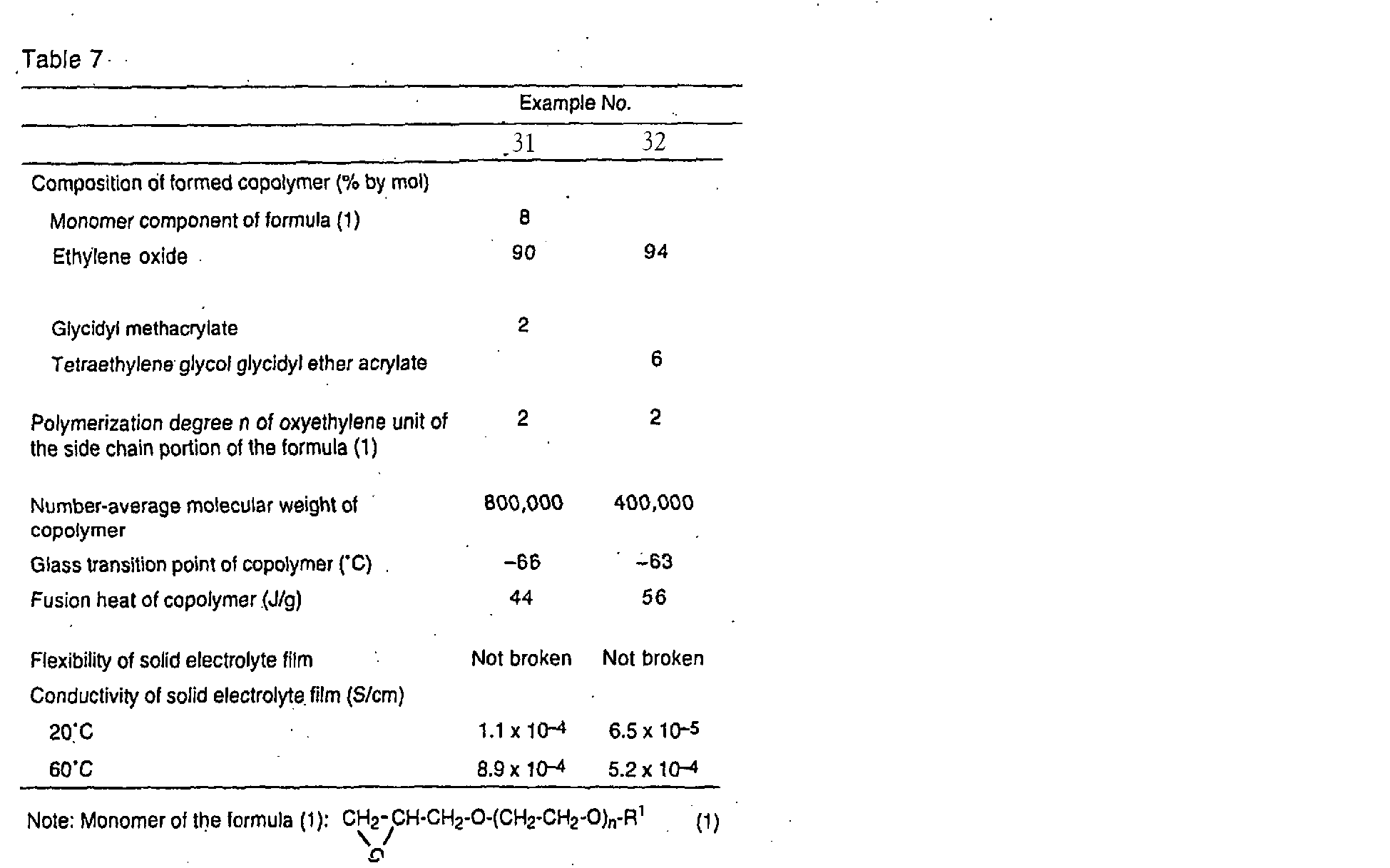

Table 8 Comparative Example No. 7 8 9 10 11 12 Composition of formed copolymer (% by mol) Repeating unit of formula (1) 100 10 7 Ethylene oxide 62 98 56 90 86 Allyl glycidyl ether 38 2 2 7 Epichlorohydrin 42 Polymerization degree n of oxyethylene unit of the side chain portion of the formula (1) 2 2 2 Number-average molecular weight of copolymer 150,000 950,000 200,000 100,000 300,000 5,000 Glass transition point of copolymer(°C) -71 -62 -48 -74 -68 -69 Fusion heat of copolymer (J/g) 0 153 0 0 40 25 Flexibility of solid electrolyte film Broken Not broken Not broken Liquid state Not broken Broken Conductivity of solid electrolyte film (S/cm) 20°C 4.9 x 10⁻⁶ 1.8 x 10⁻⁶ 3.8 x 10⁻⁶ Liquid state 4.5 x 10⁻⁴ 3.8 x 10⁻⁵ 60°C 3.0 x 10⁻⁵ 9.4 x 10⁻⁶ 2.4 x 10⁻⁵ Liquid state Difficult to measure because of plastic deformation 1.1 x 10⁻⁴ Note: Monomer of the formula (1): 
- After the atmosphere in a four-necked glass flask (internal volume: 3 L) was replaced by nitrogen, the condensate (1 g) of Preparation Example as the catalyst, epibromorohydrin

Charged monomer (% by mol) Ethylene oxide 70 Triethylene glycol glycidyl methyl ether 27 Epibromohydrin 4 Formed copolymer (% by mol) Ethylene oxide 72 Triethylene glycol glycidyl methyl ether 25 Epibromohydrin 3 Number-average molecular weight of copolymer: 370,000 Glass transition point of copolymer (°C): -69 Fusion heat of copolymer (J/g): 18 - The copolymer (1 g) obtained in Example 34, ethylene thiourea (a crosslinking agent) (0.015 g) and dibasic lead phthalate (0.05 g) were dissolved in acetonitrile (20 ml), and the resulting solution was mixed with an acetonitrile solution of lithium perchlorate so that a molar ratio of (the number of moles of the soluble electrolyte salt compound) to (the total number of moles of ethylene oxide units) was 0.07. This mixed liquid was casted on a mold made of polytetarfluoroethylene, dried and then heated and pressured at 170°C and 60 KgW/cm2 for 15 minutes to obtain a film.
- Flexibility of solid electrolyte film: Not broken
Conductivity of solid electrolyte film (S/cm):

- The polymer solid electrolyte of the present invention is superior in processability, moldability, mechanical strength, flexibility, heat resistance and the like and the ionic conductivity is remarkably improved. Accordingly, it can be applied to electronic apparatuses such as a large-capacity condenser and a display device (e.g. an electrochromic display), including solid batteries
Claims (21)
- A polyether random copolymer having a number-average molecular weight of 100,000 to 2,000,000, a glass transition temperature measured by a differential scanning calorimeter (DSC) of not more than -60°C and a fusion heat of not more than 70 J/g, comprising:(A) 1 to 98% by mol of a repeating unit derived from a monomer represented by the formula (I):
 (B) 95 to 1% by mol of a repeating unit derived from a monomer represented by the formula (II):
 (C) 0.005 to 15% by mol of a repeating unit derived from a monomer having one epoxy group and at least one reactive functional group, wherein the reactive functional group in the repeating unit (C) is (a) a reactive silicon group, (b) an epoxy group, (c) an ethylenically unsaturated group or (d) a halogen atom, and
 - The copolymer according to claim 1, wherein the repeating unit (C) is derived from a monomer of the formula (III-1) or (III-2):


- The copolymer according to claim 1, wherein the monomer having a reactive silicon group, which constitutes the repeating unit (C), is represented by the formula (III-a-1-1), (III-a-1-2) or (III-a-2-1):


- The copolymer according to claim 1, wherein the monomer having a reactive silicon group, which constitutes the repeating unit (C), is 3-glycidoxypropyltrimethoxysilane, 3-glycidoxypropylmethyldimethoxysilane, 4-(1,2-epoxy)butyltrimethoxysilane, 5-(1,2-epoxy)pentyltrimethoxysilane or 2-(3,4-epoxycyclohexyl)ethyltrimethoxysilane.
- The copolymer according to claim 1, wherein the monomer having two epoxy groups, which constitutes the repeating unit (C), is represented by the formula (III-b):

- The copolymer according to claim 5, wherein R7 in the formula (III-b) is
-CH2 -O-(CHA1-CHA2-O)m -CH2-,
-(CH2)m-, or
-CH2O-Ph-OCH2-
wherein A1 and A2 represent hydrogen or a methyl group; Ph represents a phenylene group; and m represents a numeral of 0 to 12. - The copolymer according to claim 1, wherein the monomer having two epoxy groups, which constitutes the repeating unit (C), is 2,3-epoxypropyl-2',3'-epoxy-2'-methyl propyl ether or ethylene glycol-2,3-epoxypropyl-2',3'-epoxy-2'-methyl propyl ether. wherein the monomer having an ethylenically unsaturated group, is 4-vinylcyclohexyl glycidyl ether, α-terpinyl glycidyl ether, cyclohexenylmethyl glycidyl ether, p-vinylbenzyl glycidyl ether, allylphenyl glycidyl ether, vinyl glycidyl ether, 3,4-epoxy-1-butene, 3,4-epoxy-1-pentene, 4,5-epoxy-2-pentene, 1,2-epoxy-5,9-cyclododecadiene, 3,4-epoxy-1-vinylcyclohexene, 1,2-epoxy-5-cyclooctene, glycidyl acrylate, glycidyl methacrylate, glycidyl sorbate, glycidyl cinnamate, glycidyl crotonate, glycidyl-4-hexenoate, oligoethylene glycol glycidyl ether acrylate having 1 to 12 oxyethylene chains, oligoethylene glycol glycidyl ether methacrylate having 1 to 12 oxyethylene chains, oligoethylene glycol allyl glycidyl ether having 1 to 12 oxyethylene chains or

- The copolymer according to claim 1, wherein the monomer having a halogen atom, which constitutes the repeating unit (C), is represented by the formula (III-d):

- The copolymer according to claim 1, wherein the monomer having a halogen atom is

- The copolymer according to claim 1, wherein the polyether copolymer comprises 3 to 98% by mol of the repeating unit (A), 95 to 1% by mol of the repeating unit (B) and 0.01 to 5% by mol of the repeating unit (C).
- The copolymer according to claim 1, wherein the monomer which constitute the repeating unit (C) is selected from 3,4 - epoxy -1-butene, 3,4-epoxy-1- pentene, 4,5- epoxy- 2- pentene, glycidyl acrylate and glycidyl methacrylate.
- A crosslinked material obtained by crosslinking the polyether copolymer of any of claims 1 to 11, utilizing the reactivity of a reactive functional group of the copolymer.
- A polymer solid electrolyte comprising the crosslinked material of claim 12 and an electrolyte salt compound.
- A polymer solid electrolyte according to claim 13, wherein the electrolyte salt compound is soluble in the polyether copolymer.
- The polymer solid electrolyte according to claim 13 or 14, wherein the electrolyte salt compound is a compound comprising a cation selected from a metal cation, an ammonium ion, an amidinium ion and a guanidium ion, and an anion selected from a chlorine ion, a bromine ion, a iodine ion, a perchlorate ion, a thiocyanate ion, a tetrafluoroborate ion, a nitrate ion, AsF6 -, PF6 -, a stearylsulfonate ion, an octylsulfonate ion, a dodecylbenzenesulfonate ion, a naphthalenesulfonate ion, a dodecylnaphthalenesulfonate ion, a 7,7,8,8-tetracyano-p-quinodimethane ion, X1SO3 -, (X1SO2)(X2SO2)N-, (X1SO2)(X2SO2)(X3SO2)C- and (X1SO2)(X2SO2)YC- (wherein X1, X2, X3 and Y respectively represent an electron attractive group).
- The polymer solid electrolyte according to claim 15, wherein X1, X2 and X3 independently represent a perfluoroalkyl or perfluoroaryl group having 1 to 6 carbon atoms and Y represents a nitro group, a nitroso group, a carbonyl group, a carboxyl group or a cyano group.
- The polymer solid electrolyte according to claim 15, wherein the metal cation is a cation of a metal selected from Li, Na, K, Rb, Cs, Mg, Ca and Ba.
- The polymer solid electrolyte according to claim 15, wherein the metal cation is a cation of a transition metal.
- The polymer solid electrolyte according to claim 15, wherein the metal cation is a cation of a metal selected from Mn, Fe, Co, Ni, Cu, Zn and Ag.
- The polymer solid electrolyte according to claim 13, wherein the formulation ratio of the electrolyte salt compound to the polyether copolymer is so that a value of a molar ratio of the number of moles of the electrolyte salt compound to the total number of moles of oxyethylene units is from 0.0001 to 5.
- A battery comprising the polymer solid electrolyte of claim 13 or 14.
Applications Claiming Priority (9)
| Application Number | Priority Date | Filing Date | Title |
|---|---|---|---|
| JP11349696 | 1996-05-08 | ||
| JP113496/96 | 1996-05-08 | ||
| JP17343596 | 1996-07-03 | ||
| JP173435/96 | 1996-07-03 | ||
| JP183186/96 | 1996-07-12 | ||
| JP18318696 | 1996-07-12 | ||
| JP24619996 | 1996-09-18 | ||
| JP246199/96 | 1996-09-18 | ||
| PCT/JP1997/001522 WO1997042251A1 (en) | 1996-05-08 | 1997-05-06 | Cross-linked solid polyelectrolyte and use thereof |
Publications (3)
| Publication Number | Publication Date |
|---|---|
| EP0897941A1 EP0897941A1 (en) | 1999-02-24 |
| EP0897941A4 EP0897941A4 (en) | 1999-07-21 |
| EP0897941B1 true EP0897941B1 (en) | 2006-12-06 |
Family
ID=27470087
Family Applications (1)
| Application Number | Title | Priority Date | Filing Date |
|---|---|---|---|
| EP97918369A Expired - Lifetime EP0897941B1 (en) | 1996-05-08 | 1997-05-06 | Cross-linked solid polyelectrolyte and use thereof |
Country Status (10)
| Country | Link |
|---|---|
| US (1) | US6239204B1 (en) |
| EP (1) | EP0897941B1 (en) |
| JP (1) | JP3215436B2 (en) |
| KR (1) | KR100570949B1 (en) |
| CN (1) | CN1136250C (en) |
| AU (1) | AU2651097A (en) |
| CA (1) | CA2253863C (en) |
| DE (1) | DE69737057D1 (en) |
| TW (1) | TW430686B (en) |
| WO (1) | WO1997042251A1 (en) |
Families Citing this family (45)
| Publication number | Priority date | Publication date | Assignee | Title |
|---|---|---|---|---|
| CN1096481C (en) * | 1996-08-20 | 2002-12-18 | 大曹株式会社 | Solid polyelectrolyte |
| JP3282565B2 (en) | 1996-11-22 | 2002-05-13 | ダイソー株式会社 | Crosslinked polymer solid electrolyte and its use |
| JP4955136B2 (en) * | 1998-06-25 | 2012-06-20 | ハイドロ−ケベック | Ion conductive material comprising a cross-linked polymer |
| JP3724252B2 (en) | 1999-04-19 | 2005-12-07 | ダイソー株式会社 | Crosslinked polymer solid electrolyte and use thereof |
| EP1195785A1 (en) * | 1999-06-04 | 2002-04-10 | Mitsui Chemicals, Inc. | Nonaqueous electrolytic solution, electrode, and capacitor containing the same |
| JP3710749B2 (en) * | 1999-06-16 | 2005-10-26 | 花王株式会社 | Surface modifier |
| KR100337889B1 (en) * | 2000-06-22 | 2002-05-24 | 김순택 | Lithium secondary battery |
| JPWO2002035636A1 (en) * | 2000-10-20 | 2004-03-04 | 大日本インキ化学工業株式会社 | Polymer solid electrolyte and battery using the electrolyte |
| JP2002279826A (en) * | 2001-03-19 | 2002-09-27 | Toyobo Co Ltd | Polymer electrolyte gel and manufacturing method of the same |
| US6956083B2 (en) * | 2001-05-31 | 2005-10-18 | The Regents Of The University Of California | Single ion conductor cross-linked polymeric networks |
| US7101643B2 (en) * | 2001-05-31 | 2006-09-05 | The Regents Of The University Of California | Polymeric electrolytes based on hydrosilyation reactions |
| DE10136447A1 (en) * | 2001-07-26 | 2003-02-06 | Bayer Ag | Graft copolymers for use in production of impact-resistant mouldings, obtained by polymerisation of a mixture of vinyl monomers and polyalkylene oxide rubber |
| US20040241551A1 (en) * | 2001-09-21 | 2004-12-02 | Seiji Nakamura | Element using polymer gel electrolyte |
| US6858351B2 (en) * | 2001-11-07 | 2005-02-22 | Daiso Co., Ltd. | Polyethylene oxide-based electrolyte containing silicon compound |
| DE60333958D1 (en) * | 2002-04-26 | 2010-10-07 | Zeon Corp | Polyether polymer and process for producing the same |
| KR100496852B1 (en) * | 2002-08-23 | 2005-06-23 | 대주전자재료 주식회사 | Ion-exchangeable membrane and direct methanol fuel cell employing same |
| US20050260528A1 (en) * | 2004-05-22 | 2005-11-24 | Hynix Semiconductor Inc. | Liquid composition for immersion lithography and lithography method using the same |
| KR101065374B1 (en) * | 2004-06-30 | 2011-09-16 | 삼성에스디아이 주식회사 | Polymer membrane for fuel cell and its manufacturing method |
| JP4811575B2 (en) * | 2005-02-28 | 2011-11-09 | 信越化学工業株式会社 | Curable resin composition for electrolyte membrane, method for producing electrolyte membrane, and method for producing electrolyte membrane / electrode assembly |
| WO2008102699A1 (en) * | 2007-02-21 | 2008-08-28 | Nippon Shokubai Co., Ltd. | Ethylene oxide copolymer, polymer composition and lithium secondary battery |
| US20090186177A1 (en) * | 2008-01-22 | 2009-07-23 | Eastman Chemical Company | Polyester melt phase products and process for making the same |
| JP2011006613A (en) * | 2009-06-26 | 2011-01-13 | Dainichiseika Color & Chem Mfg Co Ltd | Curable resin composition and hard coat film or sheet |
| JP5763899B2 (en) * | 2009-12-03 | 2015-08-12 | 株式会社日本触媒 | Intermediate-containing composition for water-soluble monomer and production method thereof, intermediate for water-soluble monomer, cationic group-containing monomer and production method thereof |
| CN102639519B (en) | 2009-12-03 | 2015-03-25 | 株式会社日本触媒 | Composition containing intermediate for water-soluble monomer and process for production thereof, composition containing water-soluble monomer, intermediate for water-soluble monomer, and water-soluble monomer and process for production thereof |
| JP5382536B2 (en) * | 2010-02-25 | 2014-01-08 | ダイソー株式会社 | Polymer solid electrolyte and use thereof |
| WO2012079250A1 (en) * | 2010-12-17 | 2012-06-21 | The Procter & Gamble Company | Cleaning compositions with amphoteric polycarboxylate polymers |
| JP5626531B2 (en) * | 2011-04-19 | 2014-11-19 | ダイソー株式会社 | Nonaqueous electrolyte secondary battery |
| TWI465503B (en) * | 2011-07-08 | 2014-12-21 | Eternal Materials Co Ltd | Electrolytic material formulation, electrolytic material composition formed therefrom and use thereof |
| WO2014050944A1 (en) * | 2012-09-28 | 2014-04-03 | 日本ゼオン株式会社 | Polyether copolymer, crosslinkable polyether copolymer composition, and electrolyte |
| US20160006075A1 (en) * | 2013-02-27 | 2016-01-07 | Daiso Co., Ltd. | Positive electrode and nonaqueous electrolyte secondary battery |
| CN103400989A (en) * | 2013-07-31 | 2013-11-20 | 东莞新能源科技有限公司 | Adhesive for negative electrode material of lithium ion battery and preparation method of electrode comprising same |
| CN103500835A (en) * | 2013-10-10 | 2014-01-08 | 东莞新能源科技有限公司 | Lithium-ion secondary battery and negative electrode sheet thereof |
| DE102015104439B4 (en) * | 2015-03-24 | 2019-02-21 | Bayerische Motoren Werke Aktiengesellschaft | Electrochromic element with improved electrolyte layer, process for its production, vehicle glazing and vehicle |
| US9920170B1 (en) * | 2017-01-19 | 2018-03-20 | International Business Machines Corporation | Bio-derived cross-linkers |
| US9920171B1 (en) * | 2017-01-27 | 2018-03-20 | International Business Machines Corporation | Crosslinkers from biorenewable resveratrol |
| US10160838B2 (en) | 2017-03-27 | 2018-12-25 | International Business Machines Corporation | Crosslinking materials from biorenewable aconitic acid |
| CN107863527B (en) * | 2017-10-09 | 2020-06-12 | 吉林聚能新型炭材料股份有限公司 | Composite negative electrode material and preparation method and application thereof |
| WO2019131476A1 (en) * | 2017-12-28 | 2019-07-04 | パナソニックIpマネジメント株式会社 | Electrolytic capacitor and method for manufacturing same |
| JP7478508B2 (en) * | 2018-11-26 | 2024-05-07 | 株式会社大阪ソーダ | Inorganic solid electrolyte secondary battery |
| CN110760292B (en) * | 2019-09-24 | 2021-02-09 | 江苏立一新材料科技有限公司 | Heat-resistant friction material and application thereof |
| CN111653822B (en) * | 2020-06-09 | 2022-02-11 | 北京化工大学 | Gel type ionic liquid electrolyte for lithium ion battery and preparation method and application thereof |
| US11824156B2 (en) | 2020-11-06 | 2023-11-21 | Nano And Advanced Materials Institute Limited | Secondary lithium-ion batteries comprising in situ thermal curable solid composite electrolyte |
| US12142729B2 (en) * | 2021-01-18 | 2024-11-12 | Honeycomb Battery Company | Quasi-solid and solid-state electrolyte for lithium-ion and lithium metal batteries and manufacturing method |
| CN115117438B (en) * | 2022-06-23 | 2025-08-19 | 中山大学 | Solid polymer electrolyte based on interlocking network and preparation method and application thereof |
| KR20260011498A (en) * | 2024-07-16 | 2026-01-23 | 코오롱인더스트리 주식회사 | Composition for solid polymer electrolyte, solid polymer electrolyte formed therefrom, and secondary battery comprising the same |
Family Cites Families (28)
| Publication number | Priority date | Publication date | Assignee | Title |
|---|---|---|---|---|
| US3297783A (en) * | 1962-11-16 | 1967-01-10 | Union Carbide Corp | Vinyl halide resin plasticized with a linear copolymer of a diepoxide with a 1, 2-alkylene oxide |
| FR2442512A1 (en) | 1978-11-22 | 1980-06-20 | Anvar | NEW ELASTOMERIC MATERIALS WITH ION CONDUCTION |
| US4578326A (en) | 1983-03-11 | 1986-03-25 | Societe Nationale Elf Aquitaine | Novel macromolecular material for use in realizing electrolytes and/or electrodes |
| US4758483A (en) | 1983-03-11 | 1988-07-19 | Societe Nationale Elf Aquitaine | Novel macromolecular material for use in realizing electrolytes and/or electrodes |
| FR2570224B1 (en) | 1984-09-11 | 1987-03-20 | Elf Aquitaine | SOLID POLYMER ELECTROLYTE CONSISTING OF A CROSSLINKED COPOLYMER |
| US4711950A (en) | 1985-11-05 | 1987-12-08 | Osaka Soda Co., Ltd. | Polyether polymer or copolymer, monomer therefor, and process for production thereof |
| JPH0826144B2 (en) | 1986-01-20 | 1996-03-13 | ダイソー株式会社 | Method for producing polyether copolymer having epoxy group in side chain |
| JPS62249361A (en) | 1986-04-21 | 1987-10-30 | Yuasa Battery Co Ltd | Organic solid electrolyte |
| EP0260847A1 (en) | 1986-09-19 | 1988-03-23 | Imperial Chemical Industries Plc | Solid electrolytes |
| FR2606218A1 (en) | 1986-10-30 | 1988-05-06 | Elf Aquitaine | NEW IONIC CONDUCTION MATERIAL |
| JPH0768336B2 (en) | 1986-12-18 | 1995-07-26 | ダイソー株式会社 | Process for producing polyether copolymer having oligooxyethylene side chain |
| GB8804860D0 (en) * | 1988-03-01 | 1988-03-30 | Ici Plc | Solid electrolyte devices |
| JP2757004B2 (en) | 1989-03-08 | 1998-05-25 | ダイソー株式会社 | Ion conductive solid electrolyte |
| JP2762145B2 (en) | 1989-04-13 | 1998-06-04 | 第一工業製薬株式会社 | Ion conductive polymer electrolyte |
| US5116541A (en) | 1989-04-13 | 1992-05-26 | Dai-Ichi Kogyo Seiyaku Co., Ltd. | Ion-conductive polymer electrolyte |
| JPH02295004A (en) | 1989-05-09 | 1990-12-05 | Hitachi Maxell Ltd | Lithium ion conductive polymer electrolyte |
| IT1236512B (en) | 1989-10-06 | 1993-03-11 | Eniricerche Spa | POLYEPOXIDE BASED SOLID POLYMER ELECTROLYTE. |
| JP2813831B2 (en) | 1989-10-26 | 1998-10-22 | 第一工業製薬株式会社 | Ion conductive polymer electrolyte |
| JP2813832B2 (en) | 1989-10-26 | 1998-10-22 | 第一工業製薬株式会社 | Ion conductive polymer electrolyte |
| JP2813834B2 (en) | 1990-05-31 | 1998-10-22 | 第一工業製薬株式会社 | Ion conductive polymer electrolyte |
| JP2923542B2 (en) | 1990-07-06 | 1999-07-26 | 第一工業製薬株式会社 | Ion conductive polymer electrolyte |
| US5268243A (en) | 1992-01-27 | 1993-12-07 | Dai-Ichi Kogyo Seiyaku Co., Ltd. | Galvanic cell |
| JP3258366B2 (en) | 1992-04-28 | 2002-02-18 | 株式会社ユアサコーポレーション | Electric double layer capacitor |
| EP0585072B1 (en) | 1992-08-27 | 1997-12-29 | Dai-Ichi Kogyo Seiyaku Co., Ltd. | Ion-conductive polymer electrolyte |
| US5755985A (en) | 1994-09-06 | 1998-05-26 | Hydro-Quebec | LPB electrolyte compositions based on mixtures of copolymers and interpenetrated networks |
| CA2175950C (en) | 1995-05-08 | 2008-12-02 | Shinzo Kohjiya | Polymer solid electrolyte |
| JP3022317B2 (en) | 1995-05-08 | 2000-03-21 | ダイソー株式会社 | Polymer solid electrolyte |
| DE69722890T2 (en) * | 1996-10-28 | 2004-05-13 | Daiso Co., Ltd. | Polyether copolymer and solid polymer electrolyte |
-
1997
- 1997-05-06 JP JP53974097A patent/JP3215436B2/en not_active Expired - Fee Related
- 1997-05-06 AU AU26510/97A patent/AU2651097A/en not_active Abandoned
- 1997-05-06 CN CNB971936641A patent/CN1136250C/en not_active Expired - Fee Related
- 1997-05-06 KR KR1019980707358A patent/KR100570949B1/en not_active Expired - Fee Related
- 1997-05-06 DE DE69737057T patent/DE69737057D1/en not_active Expired - Lifetime
- 1997-05-06 CA CA002253863A patent/CA2253863C/en not_active Expired - Fee Related
- 1997-05-06 US US09/147,159 patent/US6239204B1/en not_active Expired - Fee Related
- 1997-05-06 WO PCT/JP1997/001522 patent/WO1997042251A1/en not_active Ceased
- 1997-05-06 EP EP97918369A patent/EP0897941B1/en not_active Expired - Lifetime
- 1997-05-07 TW TW086106052A patent/TW430686B/en not_active IP Right Cessation
Also Published As
| Publication number | Publication date |
|---|---|
| CN1136250C (en) | 2004-01-28 |
| CA2253863A1 (en) | 1997-11-13 |
| TW430686B (en) | 2001-04-21 |
| KR19990087822A (en) | 1999-12-27 |
| DE69737057D1 (en) | 2007-01-18 |
| CA2253863C (en) | 2005-08-09 |
| US6239204B1 (en) | 2001-05-29 |
| JP3215436B2 (en) | 2001-10-09 |
| WO1997042251A1 (en) | 1997-11-13 |
| EP0897941A1 (en) | 1999-02-24 |
| KR100570949B1 (en) | 2006-08-30 |
| AU2651097A (en) | 1997-11-26 |
| CN1215416A (en) | 1999-04-28 |
| EP0897941A4 (en) | 1999-07-21 |
Similar Documents
| Publication | Publication Date | Title |
|---|---|---|
| EP0897941B1 (en) | Cross-linked solid polyelectrolyte and use thereof | |
| EP0856538B1 (en) | Solid polyelectrolyte | |
| EP0885913B1 (en) | Copolyether and solid polymer electrolyte | |
| EP0945476B1 (en) | Crosslinked solid polyether copolymer electrolyte | |
| EP0838487B1 (en) | Polyether copolymer and polymer solid electrolyte | |
| EP0994143B1 (en) | Solid polymer electrolyte and use thereof | |
| JPWO1997042251A1 (en) | Crosslinked polymer solid electrolyte and its uses | |
| US6858351B2 (en) | Polyethylene oxide-based electrolyte containing silicon compound | |
| JP4089221B2 (en) | Polymer solid electrolyte and battery | |
| JPWO1998025990A1 (en) | Polyether copolymers and polymer solid electrolytes | |
| JPWO1998007772A1 (en) | Polymer solid electrolyte | |
| US6201071B1 (en) | Polyether copolymer, solid polymer electrolyte and battery | |
| JP3282565B2 (en) | Crosslinked polymer solid electrolyte and its use | |
| JPH10176105A (en) | Solid polyelectrolyte | |
| JP4640172B2 (en) | Electrolyte composition and battery | |
| JP4269648B2 (en) | Electrolyte composition and battery | |
| JP4089246B2 (en) | Crosslinked polymer solid electrolyte and battery |
Legal Events
| Date | Code | Title | Description |
|---|---|---|---|
| PUAI | Public reference made under article 153(3) epc to a published international application that has entered the european phase |
Free format text: ORIGINAL CODE: 0009012 |
|
| 17P | Request for examination filed |
Effective date: 19981202 |
|
| AK | Designated contracting states |
Kind code of ref document: A1 Designated state(s): DE FR GB IT NL |
|
| A4 | Supplementary search report drawn up and despatched |
Effective date: 19990609 |
|
| AK | Designated contracting states |
Kind code of ref document: A4 Designated state(s): DE FR GB IT NL |
|
| RIC1 | Information provided on ipc code assigned before grant |
Free format text: 6C 08G 65/22 A, 6C 08G 65/08 B, 6C 08G 77/18 B, 6C 08G 59/20 B, 6C 08F 299/02 B, 6C 08L 71/02 B, 6C 08K 3/24 B, 6C 08K 5/42 B, 6H 01M 6/18 B, 6H 01M 10/40 B, 6C 08G 65/14 B, 6C 08G 65/24 B |
|
| 17Q | First examination report despatched |
Effective date: 20041125 |
|
| GRAP | Despatch of communication of intention to grant a patent |
Free format text: ORIGINAL CODE: EPIDOSNIGR1 |
|
| GRAS | Grant fee paid |
Free format text: ORIGINAL CODE: EPIDOSNIGR3 |
|
| GRAA | (expected) grant |
Free format text: ORIGINAL CODE: 0009210 |
|
| AK | Designated contracting states |
Kind code of ref document: B1 Designated state(s): DE FR GB IT NL |
|
| PG25 | Lapsed in a contracting state [announced via postgrant information from national office to epo] |
Ref country code: NL Free format text: LAPSE BECAUSE OF FAILURE TO SUBMIT A TRANSLATION OF THE DESCRIPTION OR TO PAY THE FEE WITHIN THE PRESCRIBED TIME-LIMIT Effective date: 20061206 Ref country code: IT Free format text: LAPSE BECAUSE OF FAILURE TO SUBMIT A TRANSLATION OF THE DESCRIPTION OR TO PAY THE FEE WITHIN THE PRE;WARNING: LAPSES OF ITALIAN PATENTS WITH EFFECTIVE DATE BEFORE 2007 MAY HAVE OCCURRED AT ANY TIME BEFORE 2007. THE CORRECT EFFECTIVE DATE MAY BE DIFFERENT FROM THE ONE RECORDED.SCRIBED TIME-LIMIT Effective date: 20061206 |
|
| REG | Reference to a national code |
Ref country code: GB Ref legal event code: FG4D |
|
| REF | Corresponds to: |
Ref document number: 69737057 Country of ref document: DE Date of ref document: 20070118 Kind code of ref document: P |
|
| PG25 | Lapsed in a contracting state [announced via postgrant information from national office to epo] |
Ref country code: DE Free format text: LAPSE BECAUSE OF FAILURE TO SUBMIT A TRANSLATION OF THE DESCRIPTION OR TO PAY THE FEE WITHIN THE PRESCRIBED TIME-LIMIT Effective date: 20070307 |
|
| NLV1 | Nl: lapsed or annulled due to failure to fulfill the requirements of art. 29p and 29m of the patents act | ||
| ET | Fr: translation filed | ||
| PLBE | No opposition filed within time limit |
Free format text: ORIGINAL CODE: 0009261 |
|
| STAA | Information on the status of an ep patent application or granted ep patent |
Free format text: STATUS: NO OPPOSITION FILED WITHIN TIME LIMIT |
|
| 26N | No opposition filed |
Effective date: 20070907 |
|
| GBPC | Gb: european patent ceased through non-payment of renewal fee |
Effective date: 20070506 |
|
| PG25 | Lapsed in a contracting state [announced via postgrant information from national office to epo] |
Ref country code: GB Free format text: LAPSE BECAUSE OF NON-PAYMENT OF DUE FEES Effective date: 20070506 |
|
| PGFP | Annual fee paid to national office [announced via postgrant information from national office to epo] |
Ref country code: FR Payment date: 20080523 Year of fee payment: 12 |
|
| REG | Reference to a national code |
Ref country code: FR Ref legal event code: ST Effective date: 20100129 |
|
| PG25 | Lapsed in a contracting state [announced via postgrant information from national office to epo] |
Ref country code: FR Free format text: LAPSE BECAUSE OF NON-PAYMENT OF DUE FEES Effective date: 20090602 |