EP0895532B1 - Absorbent fibrous granules - Google Patents
Absorbent fibrous granules Download PDFInfo
- Publication number
- EP0895532B1 EP0895532B1 EP97921371A EP97921371A EP0895532B1 EP 0895532 B1 EP0895532 B1 EP 0895532B1 EP 97921371 A EP97921371 A EP 97921371A EP 97921371 A EP97921371 A EP 97921371A EP 0895532 B1 EP0895532 B1 EP 0895532B1
- Authority
- EP
- European Patent Office
- Prior art keywords
- granules
- fibers
- oil
- percent
- less
- Prior art date
- Legal status (The legal status is an assumption and is not a legal conclusion. Google has not performed a legal analysis and makes no representation as to the accuracy of the status listed.)
- Expired - Lifetime
Links
- 239000008187 granular material Substances 0.000 title claims abstract description 180
- 239000002250 absorbent Substances 0.000 title claims abstract description 54
- 230000002745 absorbent Effects 0.000 title claims abstract description 53
- 239000000835 fiber Substances 0.000 claims abstract description 229
- 238000000034 method Methods 0.000 claims abstract description 23
- 238000002156 mixing Methods 0.000 claims description 13
- 239000007788 liquid Substances 0.000 claims description 11
- 239000004033 plastic Substances 0.000 claims description 9
- 229920003023 plastic Polymers 0.000 claims description 9
- 238000001035 drying Methods 0.000 claims description 6
- 229920001131 Pulp (paper) Polymers 0.000 claims description 4
- 229910010272 inorganic material Inorganic materials 0.000 claims description 4
- 239000011147 inorganic material Substances 0.000 claims description 4
- 239000008280 blood Substances 0.000 claims description 3
- 210000004369 blood Anatomy 0.000 claims description 3
- 239000012530 fluid Substances 0.000 abstract description 15
- 239000011368 organic material Substances 0.000 abstract 1
- 239000003921 oil Substances 0.000 description 106
- 239000000463 material Substances 0.000 description 84
- XLYOFNOQVPJJNP-UHFFFAOYSA-N water Substances O XLYOFNOQVPJJNP-UHFFFAOYSA-N 0.000 description 46
- 230000000694 effects Effects 0.000 description 39
- 239000010802 sludge Substances 0.000 description 38
- 239000000654 additive Substances 0.000 description 35
- 238000012360 testing method Methods 0.000 description 31
- 230000000996 additive effect Effects 0.000 description 26
- 230000000052 comparative effect Effects 0.000 description 24
- 239000002245 particle Substances 0.000 description 22
- 241000196324 Embryophyta Species 0.000 description 21
- 239000010705 motor oil Substances 0.000 description 20
- 239000002699 waste material Substances 0.000 description 20
- -1 e.g. Substances 0.000 description 19
- 239000000203 mixture Substances 0.000 description 19
- 239000004743 Polypropylene Substances 0.000 description 18
- 229920001155 polypropylene Polymers 0.000 description 18
- 238000000280 densification Methods 0.000 description 13
- 239000010893 paper waste Substances 0.000 description 13
- 239000002594 sorbent Substances 0.000 description 13
- 238000001179 sorption measurement Methods 0.000 description 12
- 238000005054 agglomeration Methods 0.000 description 10
- 230000002776 aggregation Effects 0.000 description 10
- 239000004816 latex Substances 0.000 description 10
- 229920000126 latex Polymers 0.000 description 10
- 239000000047 product Substances 0.000 description 10
- 238000004537 pulping Methods 0.000 description 9
- 239000007787 solid Substances 0.000 description 9
- 239000002956 ash Substances 0.000 description 8
- OSGAYBCDTDRGGQ-UHFFFAOYSA-L calcium sulfate Chemical compound [Ca+2].[O-]S([O-])(=O)=O OSGAYBCDTDRGGQ-UHFFFAOYSA-L 0.000 description 7
- 229920002678 cellulose Polymers 0.000 description 7
- 239000001913 cellulose Substances 0.000 description 7
- 238000005056 compaction Methods 0.000 description 7
- 229920005989 resin Polymers 0.000 description 7
- 239000011347 resin Substances 0.000 description 7
- 229920000742 Cotton Polymers 0.000 description 6
- 238000010521 absorption reaction Methods 0.000 description 6
- 239000002473 artificial blood Substances 0.000 description 6
- 239000004568 cement Substances 0.000 description 6
- 239000004927 clay Substances 0.000 description 6
- 239000011521 glass Substances 0.000 description 6
- 239000003415 peat Substances 0.000 description 6
- 238000005549 size reduction Methods 0.000 description 6
- 239000004094 surface-active agent Substances 0.000 description 6
- 241001465754 Metazoa Species 0.000 description 5
- 230000002209 hydrophobic effect Effects 0.000 description 5
- 239000002480 mineral oil Substances 0.000 description 5
- 235000010446 mineral oil Nutrition 0.000 description 5
- 239000000843 powder Substances 0.000 description 5
- 230000008569 process Effects 0.000 description 5
- 229920001410 Microfiber Polymers 0.000 description 4
- 230000009471 action Effects 0.000 description 4
- 238000005452 bending Methods 0.000 description 4
- 239000000919 ceramic Substances 0.000 description 4
- 230000001427 coherent effect Effects 0.000 description 4
- 238000010410 dusting Methods 0.000 description 4
- 239000010954 inorganic particle Substances 0.000 description 4
- 239000003658 microfiber Substances 0.000 description 4
- 239000004627 regenerated cellulose Substances 0.000 description 4
- 239000002002 slurry Substances 0.000 description 4
- RUPBZQFQVRMKDG-UHFFFAOYSA-M Didecyldimethylammonium chloride Chemical compound [Cl-].CCCCCCCCCC[N+](C)(C)CCCCCCCCCC RUPBZQFQVRMKDG-UHFFFAOYSA-M 0.000 description 3
- 241000282326 Felis catus Species 0.000 description 3
- 239000011230 binding agent Substances 0.000 description 3
- ZOMBKNNSYQHRCA-UHFFFAOYSA-J calcium sulfate hemihydrate Chemical compound O.[Ca+2].[Ca+2].[O-]S([O-])(=O)=O.[O-]S([O-])(=O)=O ZOMBKNNSYQHRCA-UHFFFAOYSA-J 0.000 description 3
- 238000009826 distribution Methods 0.000 description 3
- 238000011156 evaluation Methods 0.000 description 3
- 239000002657 fibrous material Substances 0.000 description 3
- 239000011507 gypsum plaster Substances 0.000 description 3
- 239000012784 inorganic fiber Substances 0.000 description 3
- 238000011068 loading method Methods 0.000 description 3
- 239000004005 microsphere Substances 0.000 description 3
- 229920001778 nylon Polymers 0.000 description 3
- 239000011146 organic particle Substances 0.000 description 3
- 239000008188 pellet Substances 0.000 description 3
- 229920000728 polyester Polymers 0.000 description 3
- 229920000098 polyolefin Polymers 0.000 description 3
- 238000002360 preparation method Methods 0.000 description 3
- 238000004513 sizing Methods 0.000 description 3
- 239000000126 substance Substances 0.000 description 3
- 235000008733 Citrus aurantifolia Nutrition 0.000 description 2
- 229920003347 Microthene® Polymers 0.000 description 2
- 241000282320 Panthera leo Species 0.000 description 2
- 229920000297 Rayon Polymers 0.000 description 2
- VYPSYNLAJGMNEJ-UHFFFAOYSA-N Silicium dioxide Chemical compound O=[Si]=O VYPSYNLAJGMNEJ-UHFFFAOYSA-N 0.000 description 2
- UIIMBOGNXHQVGW-UHFFFAOYSA-M Sodium bicarbonate Chemical compound [Na+].OC([O-])=O UIIMBOGNXHQVGW-UHFFFAOYSA-M 0.000 description 2
- LSNNMFCWUKXFEE-UHFFFAOYSA-N Sulfurous acid Chemical compound OS(O)=O LSNNMFCWUKXFEE-UHFFFAOYSA-N 0.000 description 2
- 235000011941 Tilia x europaea Nutrition 0.000 description 2
- GWEVSGVZZGPLCZ-UHFFFAOYSA-N Titan oxide Chemical compound O=[Ti]=O GWEVSGVZZGPLCZ-UHFFFAOYSA-N 0.000 description 2
- 240000008042 Zea mays Species 0.000 description 2
- 235000005824 Zea mays ssp. parviglumis Nutrition 0.000 description 2
- 235000002017 Zea mays subsp mays Nutrition 0.000 description 2
- 238000013019 agitation Methods 0.000 description 2
- 230000000844 anti-bacterial effect Effects 0.000 description 2
- 239000011324 bead Substances 0.000 description 2
- 239000003795 chemical substances by application Substances 0.000 description 2
- 230000001143 conditioned effect Effects 0.000 description 2
- 235000005822 corn Nutrition 0.000 description 2
- 239000008367 deionised water Substances 0.000 description 2
- 229910021641 deionized water Inorganic materials 0.000 description 2
- 239000003599 detergent Substances 0.000 description 2
- 230000007613 environmental effect Effects 0.000 description 2
- 238000005469 granulation Methods 0.000 description 2
- 230000003179 granulation Effects 0.000 description 2
- 229910052602 gypsum Inorganic materials 0.000 description 2
- 239000010440 gypsum Substances 0.000 description 2
- 230000006872 improvement Effects 0.000 description 2
- 239000011256 inorganic filler Substances 0.000 description 2
- 229910003475 inorganic filler Inorganic materials 0.000 description 2
- 229910052500 inorganic mineral Inorganic materials 0.000 description 2
- NLYAJNPCOHFWQQ-UHFFFAOYSA-N kaolin Chemical compound O.O.O=[Al]O[Si](=O)O[Si](=O)O[Al]=O NLYAJNPCOHFWQQ-UHFFFAOYSA-N 0.000 description 2
- 239000004571 lime Substances 0.000 description 2
- 238000002844 melting Methods 0.000 description 2
- 230000008018 melting Effects 0.000 description 2
- 210000001724 microfibril Anatomy 0.000 description 2
- 239000011707 mineral Substances 0.000 description 2
- 235000010755 mineral Nutrition 0.000 description 2
- 231100000252 nontoxic Toxicity 0.000 description 2
- 230000003000 nontoxic effect Effects 0.000 description 2
- 239000011236 particulate material Substances 0.000 description 2
- 238000005453 pelletization Methods 0.000 description 2
- 238000012545 processing Methods 0.000 description 2
- 239000002964 rayon Substances 0.000 description 2
- 239000007921 spray Substances 0.000 description 2
- KXGFMDJXCMQABM-UHFFFAOYSA-N 2-methoxy-6-methylphenol Chemical compound [CH]OC1=CC=CC([CH])=C1O KXGFMDJXCMQABM-UHFFFAOYSA-N 0.000 description 1
- 229920002972 Acrylic fiber Polymers 0.000 description 1
- 239000005995 Aluminium silicate Substances 0.000 description 1
- 239000005909 Kieselgur Substances 0.000 description 1
- 239000004677 Nylon Substances 0.000 description 1
- 240000007594 Oryza sativa Species 0.000 description 1
- 235000007164 Oryza sativa Nutrition 0.000 description 1
- 239000004952 Polyamide Substances 0.000 description 1
- 239000004698 Polyethylene Substances 0.000 description 1
- UFUQRRYHIHJMPB-DUCFOALUSA-L Sirius red 4B Chemical compound [Na+].[Na+].OS(=O)(=O)c1cc2cc(NC(=O)c3ccccc3)ccc2c([O-])c1\N=N\c1ccc(cc1)\N=N\c1ccc(cc1)S([O-])(=O)=O UFUQRRYHIHJMPB-DUCFOALUSA-L 0.000 description 1
- 229920002125 Sokalan® Polymers 0.000 description 1
- KKEYFWRCBNTPAC-UHFFFAOYSA-N Terephthalic acid Chemical compound OC(=O)C1=CC=C(C(O)=O)C=C1 KKEYFWRCBNTPAC-UHFFFAOYSA-N 0.000 description 1
- NIXOWILDQLNWCW-UHFFFAOYSA-N acrylic acid group Chemical group C(C=C)(=O)O NIXOWILDQLNWCW-UHFFFAOYSA-N 0.000 description 1
- 230000002411 adverse Effects 0.000 description 1
- 235000012211 aluminium silicate Nutrition 0.000 description 1
- 230000008901 benefit Effects 0.000 description 1
- 239000004566 building material Substances 0.000 description 1
- 239000006227 byproduct Substances 0.000 description 1
- 239000003610 charcoal Substances 0.000 description 1
- 239000010883 coal ash Substances 0.000 description 1
- 239000011248 coating agent Substances 0.000 description 1
- 238000000576 coating method Methods 0.000 description 1
- 239000002131 composite material Substances 0.000 description 1
- 239000004567 concrete Substances 0.000 description 1
- 230000003750 conditioning effect Effects 0.000 description 1
- 238000013270 controlled release Methods 0.000 description 1
- 238000007796 conventional method Methods 0.000 description 1
- 230000001419 dependent effect Effects 0.000 description 1
- 239000000428 dust Substances 0.000 description 1
- 238000005516 engineering process Methods 0.000 description 1
- 238000001125 extrusion Methods 0.000 description 1
- 239000003337 fertilizer Substances 0.000 description 1
- 239000000945 filler Substances 0.000 description 1
- 239000010419 fine particle Substances 0.000 description 1
- 239000003063 flame retardant Substances 0.000 description 1
- 230000003311 flocculating effect Effects 0.000 description 1
- 230000009969 flowable effect Effects 0.000 description 1
- 239000007789 gas Substances 0.000 description 1
- 239000003365 glass fiber Substances 0.000 description 1
- 229930195733 hydrocarbon Natural products 0.000 description 1
- 150000002430 hydrocarbons Chemical class 0.000 description 1
- 239000001257 hydrogen Substances 0.000 description 1
- 229910052739 hydrogen Inorganic materials 0.000 description 1
- 230000003116 impacting effect Effects 0.000 description 1
- 238000009413 insulation Methods 0.000 description 1
- 229940059904 light mineral oil Drugs 0.000 description 1
- 239000000314 lubricant Substances 0.000 description 1
- 238000004519 manufacturing process Methods 0.000 description 1
- 238000007431 microscopic evaluation Methods 0.000 description 1
- 239000003595 mist Substances 0.000 description 1
- 238000012986 modification Methods 0.000 description 1
- 230000004048 modification Effects 0.000 description 1
- 238000000465 moulding Methods 0.000 description 1
- WVJVHUWVQNLPCR-UHFFFAOYSA-N octadecanoyl octadecanoate Chemical compound CCCCCCCCCCCCCCCCCC(=O)OC(=O)CCCCCCCCCCCCCCCCC WVJVHUWVQNLPCR-UHFFFAOYSA-N 0.000 description 1
- 230000003287 optical effect Effects 0.000 description 1
- 230000003647 oxidation Effects 0.000 description 1
- 238000007254 oxidation reaction Methods 0.000 description 1
- 235000012771 pancakes Nutrition 0.000 description 1
- 238000010951 particle size reduction Methods 0.000 description 1
- 239000005011 phenolic resin Substances 0.000 description 1
- 229920001568 phenolic resin Polymers 0.000 description 1
- 230000000704 physical effect Effects 0.000 description 1
- 229920002647 polyamide Polymers 0.000 description 1
- 229920000573 polyethylene Polymers 0.000 description 1
- 229920000642 polymer Polymers 0.000 description 1
- 239000002243 precursor Substances 0.000 description 1
- 239000002994 raw material Substances 0.000 description 1
- 230000009467 reduction Effects 0.000 description 1
- 238000009877 rendering Methods 0.000 description 1
- 235000009566 rice Nutrition 0.000 description 1
- 238000005096 rolling process Methods 0.000 description 1
- 150000003839 salts Chemical class 0.000 description 1
- 239000004576 sand Substances 0.000 description 1
- 238000011012 sanitization Methods 0.000 description 1
- 229910000030 sodium bicarbonate Inorganic materials 0.000 description 1
- 235000017557 sodium bicarbonate Nutrition 0.000 description 1
- 239000002689 soil Substances 0.000 description 1
- 239000002195 soluble material Substances 0.000 description 1
- 239000010902 straw Substances 0.000 description 1
- 238000004381 surface treatment Methods 0.000 description 1
- 238000010408 sweeping Methods 0.000 description 1
- 229920005613 synthetic organic polymer Polymers 0.000 description 1
- KKEYFWRCBNTPAC-UHFFFAOYSA-L terephthalate(2-) Chemical compound [O-]C(=O)C1=CC=C(C([O-])=O)C=C1 KKEYFWRCBNTPAC-UHFFFAOYSA-L 0.000 description 1
- 229920001169 thermoplastic Polymers 0.000 description 1
- 239000004416 thermosoftening plastic Substances 0.000 description 1
- 239000004408 titanium dioxide Substances 0.000 description 1
- 210000002700 urine Anatomy 0.000 description 1
- 238000009736 wetting Methods 0.000 description 1
- 239000002023 wood Substances 0.000 description 1
Images
Classifications
-
- C—CHEMISTRY; METALLURGY
- C09—DYES; PAINTS; POLISHES; NATURAL RESINS; ADHESIVES; COMPOSITIONS NOT OTHERWISE PROVIDED FOR; APPLICATIONS OF MATERIALS NOT OTHERWISE PROVIDED FOR
- C09K—MATERIALS FOR MISCELLANEOUS APPLICATIONS, NOT PROVIDED FOR ELSEWHERE
- C09K3/00—Materials not provided for elsewhere
- C09K3/32—Materials not provided for elsewhere for absorbing liquids to remove pollution, e.g. oil, gasoline, fat
-
- B—PERFORMING OPERATIONS; TRANSPORTING
- B01—PHYSICAL OR CHEMICAL PROCESSES OR APPARATUS IN GENERAL
- B01J—CHEMICAL OR PHYSICAL PROCESSES, e.g. CATALYSIS OR COLLOID CHEMISTRY; THEIR RELEVANT APPARATUS
- B01J20/00—Solid sorbent compositions or filter aid compositions; Sorbents for chromatography; Processes for preparing, regenerating or reactivating thereof
- B01J20/28—Solid sorbent compositions or filter aid compositions; Sorbents for chromatography; Processes for preparing, regenerating or reactivating thereof characterised by their form or physical properties
- B01J20/28014—Solid sorbent compositions or filter aid compositions; Sorbents for chromatography; Processes for preparing, regenerating or reactivating thereof characterised by their form or physical properties characterised by their form
- B01J20/2803—Sorbents comprising a binder, e.g. for forming aggregated, agglomerated or granulated products
-
- C—CHEMISTRY; METALLURGY
- C02—TREATMENT OF WATER, WASTE WATER, SEWAGE, OR SLUDGE
- C02F—TREATMENT OF WATER, WASTE WATER, SEWAGE, OR SLUDGE
- C02F1/00—Treatment of water, waste water, or sewage
- C02F1/68—Treatment of water, waste water, or sewage by addition of specified substances, e.g. trace elements, for ameliorating potable water
- C02F1/681—Treatment of water, waste water, or sewage by addition of specified substances, e.g. trace elements, for ameliorating potable water by addition of solid materials for removing an oily layer on water
-
- B—PERFORMING OPERATIONS; TRANSPORTING
- B01—PHYSICAL OR CHEMICAL PROCESSES OR APPARATUS IN GENERAL
- B01J—CHEMICAL OR PHYSICAL PROCESSES, e.g. CATALYSIS OR COLLOID CHEMISTRY; THEIR RELEVANT APPARATUS
- B01J20/00—Solid sorbent compositions or filter aid compositions; Sorbents for chromatography; Processes for preparing, regenerating or reactivating thereof
- B01J20/28—Solid sorbent compositions or filter aid compositions; Sorbents for chromatography; Processes for preparing, regenerating or reactivating thereof characterised by their form or physical properties
- B01J20/28002—Solid sorbent compositions or filter aid compositions; Sorbents for chromatography; Processes for preparing, regenerating or reactivating thereof characterised by their form or physical properties characterised by their physical properties
- B01J20/28004—Sorbent size or size distribution, e.g. particle size
-
- B—PERFORMING OPERATIONS; TRANSPORTING
- B01—PHYSICAL OR CHEMICAL PROCESSES OR APPARATUS IN GENERAL
- B01J—CHEMICAL OR PHYSICAL PROCESSES, e.g. CATALYSIS OR COLLOID CHEMISTRY; THEIR RELEVANT APPARATUS
- B01J20/00—Solid sorbent compositions or filter aid compositions; Sorbents for chromatography; Processes for preparing, regenerating or reactivating thereof
- B01J20/28—Solid sorbent compositions or filter aid compositions; Sorbents for chromatography; Processes for preparing, regenerating or reactivating thereof characterised by their form or physical properties
- B01J20/28002—Solid sorbent compositions or filter aid compositions; Sorbents for chromatography; Processes for preparing, regenerating or reactivating thereof characterised by their form or physical properties characterised by their physical properties
- B01J20/28011—Other properties, e.g. density, crush strength
-
- B—PERFORMING OPERATIONS; TRANSPORTING
- B01—PHYSICAL OR CHEMICAL PROCESSES OR APPARATUS IN GENERAL
- B01J—CHEMICAL OR PHYSICAL PROCESSES, e.g. CATALYSIS OR COLLOID CHEMISTRY; THEIR RELEVANT APPARATUS
- B01J20/00—Solid sorbent compositions or filter aid compositions; Sorbents for chromatography; Processes for preparing, regenerating or reactivating thereof
- B01J20/28—Solid sorbent compositions or filter aid compositions; Sorbents for chromatography; Processes for preparing, regenerating or reactivating thereof characterised by their form or physical properties
- B01J20/28014—Solid sorbent compositions or filter aid compositions; Sorbents for chromatography; Processes for preparing, regenerating or reactivating thereof characterised by their form or physical properties characterised by their form
- B01J20/28023—Fibres or filaments
-
- B—PERFORMING OPERATIONS; TRANSPORTING
- B01—PHYSICAL OR CHEMICAL PROCESSES OR APPARATUS IN GENERAL
- B01J—CHEMICAL OR PHYSICAL PROCESSES, e.g. CATALYSIS OR COLLOID CHEMISTRY; THEIR RELEVANT APPARATUS
- B01J20/00—Solid sorbent compositions or filter aid compositions; Sorbents for chromatography; Processes for preparing, regenerating or reactivating thereof
- B01J20/28—Solid sorbent compositions or filter aid compositions; Sorbents for chromatography; Processes for preparing, regenerating or reactivating thereof characterised by their form or physical properties
- B01J20/28014—Solid sorbent compositions or filter aid compositions; Sorbents for chromatography; Processes for preparing, regenerating or reactivating thereof characterised by their form or physical properties characterised by their form
- B01J20/28028—Particles immobilised within fibres or filaments
-
- Y—GENERAL TAGGING OF NEW TECHNOLOGICAL DEVELOPMENTS; GENERAL TAGGING OF CROSS-SECTIONAL TECHNOLOGIES SPANNING OVER SEVERAL SECTIONS OF THE IPC; TECHNICAL SUBJECTS COVERED BY FORMER USPC CROSS-REFERENCE ART COLLECTIONS [XRACs] AND DIGESTS
- Y10—TECHNICAL SUBJECTS COVERED BY FORMER USPC
- Y10T—TECHNICAL SUBJECTS COVERED BY FORMER US CLASSIFICATION
- Y10T428/00—Stock material or miscellaneous articles
- Y10T428/29—Coated or structually defined flake, particle, cell, strand, strand portion, rod, filament, macroscopic fiber or mass thereof
- Y10T428/2913—Rod, strand, filament or fiber
- Y10T428/2929—Bicomponent, conjugate, composite or collateral fibers or filaments [i.e., coextruded sheath-core or side-by-side type]
-
- Y—GENERAL TAGGING OF NEW TECHNOLOGICAL DEVELOPMENTS; GENERAL TAGGING OF CROSS-SECTIONAL TECHNOLOGIES SPANNING OVER SEVERAL SECTIONS OF THE IPC; TECHNICAL SUBJECTS COVERED BY FORMER USPC CROSS-REFERENCE ART COLLECTIONS [XRACs] AND DIGESTS
- Y10—TECHNICAL SUBJECTS COVERED BY FORMER USPC
- Y10T—TECHNICAL SUBJECTS COVERED BY FORMER US CLASSIFICATION
- Y10T428/00—Stock material or miscellaneous articles
- Y10T428/29—Coated or structually defined flake, particle, cell, strand, strand portion, rod, filament, macroscopic fiber or mass thereof
- Y10T428/2913—Rod, strand, filament or fiber
- Y10T428/2929—Bicomponent, conjugate, composite or collateral fibers or filaments [i.e., coextruded sheath-core or side-by-side type]
- Y10T428/2931—Fibers or filaments nonconcentric [e.g., side-by-side or eccentric, etc.]
-
- Y—GENERAL TAGGING OF NEW TECHNOLOGICAL DEVELOPMENTS; GENERAL TAGGING OF CROSS-SECTIONAL TECHNOLOGIES SPANNING OVER SEVERAL SECTIONS OF THE IPC; TECHNICAL SUBJECTS COVERED BY FORMER USPC CROSS-REFERENCE ART COLLECTIONS [XRACs] AND DIGESTS
- Y10—TECHNICAL SUBJECTS COVERED BY FORMER USPC
- Y10T—TECHNICAL SUBJECTS COVERED BY FORMER US CLASSIFICATION
- Y10T428/00—Stock material or miscellaneous articles
- Y10T428/29—Coated or structually defined flake, particle, cell, strand, strand portion, rod, filament, macroscopic fiber or mass thereof
- Y10T428/2913—Rod, strand, filament or fiber
- Y10T428/298—Physical dimension
-
- Y—GENERAL TAGGING OF NEW TECHNOLOGICAL DEVELOPMENTS; GENERAL TAGGING OF CROSS-SECTIONAL TECHNOLOGIES SPANNING OVER SEVERAL SECTIONS OF THE IPC; TECHNICAL SUBJECTS COVERED BY FORMER USPC CROSS-REFERENCE ART COLLECTIONS [XRACs] AND DIGESTS
- Y10—TECHNICAL SUBJECTS COVERED BY FORMER USPC
- Y10T—TECHNICAL SUBJECTS COVERED BY FORMER US CLASSIFICATION
- Y10T428/00—Stock material or miscellaneous articles
- Y10T428/29—Coated or structually defined flake, particle, cell, strand, strand portion, rod, filament, macroscopic fiber or mass thereof
- Y10T428/2982—Particulate matter [e.g., sphere, flake, etc.]
Definitions
- the present invention relates to the field of fibrous granules or agglomerates used as absorbents.
- particulate-like or agglomerate absorbents have long been used for absorbing liquids particularly water and/or oils.
- the nature of the specific absorbents designed and used for particular end uses has changed significantly over time.
- absorbents in use today are quite different in regard to their composition, physical properties and/or chemistry.
- Typical large volume end uses for particulate-like absorbents include animal bedding, cat liter, oil absorbents, water absorbents or absorbents used to remove oil from water surfaces.
- animal bedding absorbents it has been described as important that the absorbent material be non-toxic, have antibacterial properties and have high absorption capacity for urine and the like.
- U.S. Patent No. 2,649,759 describes that for animal bedding typical common absorbents used are organic-type materials such as straw, peat moss, wood shavings as well as diatomaceous earth.
- This patent proposed use of a specific clay which is alleged as superior in view of its high absorbency, antibacterial properties, non-dusting properties and the fact that it is non-toxic.
- U.S. Patent No. 3,617,564 proposes an absorbent of low density corn cob granules which are formed of the cob with the center core removed. These granules are stated as having suitable properties, without any further treatment, for removing oil from fresh or salt water. Hydrophilic organic fibers have also been described as acceptable oil and/or water absorbents without a resin treatment.
- U.S. Patent Nos. 4,829,045 and 4,409,925 propose adding calcium sulfate and Plaster of Paris, respectively to augment the properties of organic hydrophilic fibers. In U.S. Patent No. 4,829,045 the natural fibers are peat fibers, which are pelletized.
- Resins are often used to modify the surface properties of organic fibers or particles to allegedly make the fibers or particulates better oil absorbents.
- U.S. Patent No. 2,692,861 describes an oil absorbent material for use as a floor sweeping composition. It describes conventional materials as sawdust, clays and sand. In order to improve the properties of these conventional materials the patent proposes coating the materials with resins which are "substantially free of paraffinic hydrocarbons".
- U.S. Patent No. 5,308,497 proposes using a phenolic resin for treating fibers to make oil absorbent sheet materials, e.g., sheets of woven or nonwoven treated fibers.
- U.S. Patent Nos. 4,519,918 and 4,537,877 use reject paper pulp fibers that are treated with specific resins to make them hydrophobic followed by dewatering, shredding and drying to form general purpose oil-absorbent materials.
- fibrous cellulosic organic fibers can function as oil and/or water absorbents
- fibrous waste sludge or white water waste solids as a raw material for forming a variety of absorbent products.
- This material represents an environmental and disposal problem for paper making companies and is a byproduct of primary pulping operations, recycle streams or waste paper pulping and the like.
- waste sludge or white water is a dilute stream of fibers unsuitable for paper making.
- the fibers may be too large or too small.
- Waste sludge can also include significant amounts of inorganic fillers (particularly if the sludge comes from a waste paper pulping operation).
- 3,376,497 describes a method of disposing of waste paper sludge by oxidation.
- U.S. Patent Nos. 5,478,441, 5,332,474 and 5,423,993 describe methods of recovering the small fibers for use in paper making.
- U.S. Patent No. 5,240,565 converts the waste sludge into energy and charcoal.
- U.S. Patent No. 5,346,549 forms waste sludge solids into a building material (e.g., concrete filler) by mixing it with coal ash.
- Waste paper sludge is described as a preferred feed material in U.S. Patent Nos. 4,670,156; 4,975,108; 4,753,917 and 3,770,575 which patents describe methods for making hydrophobic cellulosic fibers by rapidly drying waste paper sludge, pulp or some other fibrous materials.
- U.S. Patent No. 3,770,575 states that the fibers need to be treated with a sizing agent, e.g., stearic acid anhydride, if the treated fibers are to be used to absorb oil from the surface of water.
- a sizing agent e.g., stearic acid anhydride
- U.S. Patent Nos. 4,670,156 and 4,753,917 do not require the use of a sizing agent.
- U.S. Patent Nos. 4,374,794 and 4,356,060 also describe treating a waste paper sludge.
- the sludge is dewatered, extruded into pellets and dried at temperatures ranging from 100°C to 150°C to form an oil and water absorbent material.
- U.S. Patent No. 4,356,060 dries paper making waste sludge at a temperature of about 350°F after which it is sent to a hammermill where it is disintegrated into a soft, fluffy material which is used as an insulation product.
- the material preferably contains at least 30 percent clay.
- waste sludge fibers are dewatered, chopped into small pieces, mixed with sodium bicarbonate and then pelletized in a conventional pelletizer.
- a fluidized bed drier is used to dry the formed pellets.
- U.S. Patent No. 4,215,041 mixes pulverized dried waste sludge fibers with 30 to 34 percent lime or gypsum, and then adds water to form a slurry.
- the wet slurry is then granulated in a circular drum followed by sizing, dusting with a mineral powder and drying in a rotating drum.
- the resulted particles formed are allegedly hard granules suitable for use as a cat liter.
- U.S. Patent Nos. 4,931,139; 4,560,527 and 4,621,011 describe surface conditioning of agglomerates or granular particles formed with organic fibrous material, preferably waste paper sludge fibers. This surface treatment is exemplified as accomplished in a rotating drum, preferably with added water to cause any upstanding fibers to be folded back into the fibrous agglomerates, or otherwise formed granular particles.
- dry waste or recycle paper is first fiberized by a size reduction device, such as a hammermill then further treated.
- 4,931,139 is directed at a method of providing an oil absorbent material which addresses perceived problems with prior art processes which required pelletization and/or high amounts of inorganic fillers. These prior art fibrous particles were allegedly too dense, had dusting problems and/or were fuzzy.
- the absorbent material in this patent was formed by flocculating waste paper sludge fibers into a mat or sheet which was then shredded and conditioned in a water mist (the shredded particles were tumbled in the presence of water to fold in the fuzzy outer fiber ends). The resulting product was described as a low density material which had a good absorption capacity for oil.
- U.S. Patent Nos. 4,721,059 and 4,734,393 also describe an oil absorbent material formed with waste paper sludge fibers.
- the sludge fibers are dewatered and then shredded to a fine particle size, less than 10 mm, followed by standard pelletization and drying in a rotary drum drier.
- the resulting materials allegedly showed good absorbency for oil.
- the present invention provides cellulosic plant fiber granules comprised of 10 to 99 weight percent self associating, cellulosic, plant fibers and, in a first embodiment, from 1 to 90 weight percent, preferably 1 to 50 weight percent of particulate materials, having an aspect ratio of less than 3, which particulates are non-film forming or non-self associating, insoluble and inorganic or organic.
- the total percent of inorganic particulate materials in the granules should be less than 36 percent by weight of the granules, preferably less than 30 percent, most preferably less than 25 percent.
- the particulates have an average diameter of from 2 to 250 microns or micrometers, preferably 5 to 200 micrometers.
- non-self associating inorganic or organic fibers are mixed with the self associating cellulosic plant fibers.
- These fibers have an aspect ratio of greater than 3, preferably from 3 to 600 and an average diameter of from 0.1 to 100 micrometers, preferably 0.3 to 25 micrometers, most preferably greater than 1 micrometer.
- the ratio of the average narrowest width of the formed fiber granule to the average length of the fibers is greater than 1 preferably from 1.1 to 1200; most preferably from 1.2 to 50.
- the fiber length distribution is such that less than 10 percent, preferably less than 5 percent, of these added fibers are 50 percent longer than the maximum providing a LW ratio of 1.1, most preferably 5 percent or fewer of the fibers are more than 30 percent longer than the average fiber length providing an LW ratio of 1.1.
- the formed granules have a densified or compacted outer surface with substantially no cellulosic fibers protruding from most fiber granules, by more the 1 mm from the outer densified surface of the granules.
- a certain portion of the non-cellulosic fibers can protrude at lengths up to 1 mm, preferably less than 0.5 mm from the outer surface of the granules.
- the total amount of any protruding fibers can not adversely effect flowability of the granules as will be described below.
- the total amount of inorganic materials in the granules, in the form of fibers and/or particulates, should be less than 36 percent by weight of the granules, preferably less than 30 percent, to enable the absorbent granules to be incinerated after use and minimize the production of ash.
- the present invention is directed at providing incineratable, fibrous, absorbent granular materials formed from at least in part low cost cellulosic plant fibers which granules are particularly well suited for absorbing surface liquids such as aqueous fluids or oil from a floor-like surface.
- the invention absorbent granules leave little or no liquid surface residue, are easily swept up without dusting, are generally substantially non-tacky following absorption of oil, have a density such that they do not blow away and are susceptible to being recycled for their energy value providing a material with a relatively low ash content.
- the cellulosic plant fibers usable in forming the absorbent granular products of the invention can be any self associating cellulosic plant fiber which is suitable for agglomeration and compaction into a granular form.
- a preferred cellulose plant fiber source is waste paper or paper mill waste sludge or white water fibers.
- any conventional vegetative self associating cellulosic fibers, which can be agglomerated into a relatively dense flowable granule can be employed to form the invention absorbent fibrous granules.
- suitable cellulosic plant fibers are capable of self associating by microfibril entanglement between the cellulosic fibers and by hydrogen bonding.
- suitable cellulosic plant fibers are those which can be formed into a paper by self association without added resin binders. Wood pulp fibers are particularly preferred in terms of cost and availability.
- Paper mill waste sludge or white water is a primarily fibrous waste material resulting from the paper making process. This sludge, particularly if from a recycled paper feed stream, may also contain significant amounts of clay-like materials, generally film forming clays such as Kaolin clay or China clay. Generally, waste paper sludge must be land filled, burned or suitably treated to form a useful secondary product other than paper, even if some fibers are recovered and recycled into the primary pulp feed stream.
- the materials, such as recycled paper, forming the source of these fibers may be treated as described in U.S. Patent No. 4,560,527 where the material is first size reduced in a hammermill, or like device, to a particle size of from 1 to 10 mm.
- the non-film forming or non-self associating particles or fibers of the invention may be added and also subjected to size reduction. Size reduction of the added non-self associating fibers or particulates can also be done before being added to the self associating cellulosic fibers by conventional techniques if required.
- Suitable particulate-type materials used in the first embodiment of the invention are non-film forming, insoluble particles with an average diameter of from 2 to 250 micrometers, preferably 5 to 200 micrometers and an aspect ratio of less than 3. These particles would include plastic beads, titanium dioxide, glass, ceramic beads or the like.
- the particles generally are used in an amount ranging from preferably 1 to 50 percent by weight (all percents are weight percents unless otherwise indicated), most preferably from 1 to 30 percent.
- the total inorganic particle content of the granules should constitute no more than 36 percent of the formed granule, preferably less than 30 percent, most preferably less than 20 percent.
- film forming, self associating, binder clays or particles are present in the feed stream these can be tolerated in amounts up to 30 percent by weight of the granule.
- these film forming particulates are fine inorganic clays, lime, gypsum or the like.
- the added non-film forming materials should be selected so that the total inorganic content is no more than 36 percent of the granules and the cellulosic plant fiber constitutes at least 10 percent of the formed granules. Film forming particulates or bonding particulates are not desired if they can be avoided.
- non-self associating fibers preferably synthetic organic polymer fibers, however, inorganic fibers can also be used.
- the non-self associating fibers which have a length suitable for use in the invention granules, have a fiber length distribution and/or fiber bending resistance such that at most only a small portion of the fibers protrude out of the surface of the formed granules by more than 1.0 mm, preferably less than 0.5 mm after being treated in accordance with the invention process.
- Possible organic non-self associating fibers include staple-type organic fibers, melt-blown microfibers or organic non-self associating fibers such as animal hair, silk, unpulped cotton or the like.
- Preferred organic fibers are formed of thermoplastic synthetic polymeric materials such as polyolefins, polyesters, nylons, polyamides or the like.
- the nature of the fibers does not appear to be critical except that the fibers when in the granules should not form into a coherent mass or film with itself.
- Non-self associating fibers and/or particulates used in the granules can form a coherent mass by self association or other means such as fiber melting or continuous resin bonding.
- the fibers may be intermittently bonded to some extent by, e.g., particulate resins or the like.
- Lower cost polyolefin or polyester type fibers are preferred in terms of cost and disposability by incineration of the granules after use.
- the non-self associating fibers are present at an amount of from 1 to about 80 to 90 percent of the granules. With smaller diameter fibers, generally higher weight percents can be used. Preferably the non-self associating fibers constitute from 1 to 70 percent, most preferably from 1 to 40 percent, even more preferably 1 to 25 percent of the granule. Generally, as the weight percent of the added non-self associating fibers increase to their maximum, the Surface Residue Value increases beyond acceptable levels and/or the granules flowability or Flow Value becomes poor. The point at which this maximum is reached appears to be dependent on the non-self associating fiber diameter or fiber bending resistance.
- non-self associating fibers are preferred as providing the best performance at the lowest cost (generally higher non-self associating fiber loading levels that work effectively do not provide any significant performance advantage over lower non-self associating fiber loading levels that work effectively). If inorganic non-self associating fibers are used they should be used such that the total inorganic content of the granules is no more than 36 percent of the formed granules, preferably less than 30 percent of the formed granules.
- the density of the formed granules should be from about 0.15 to 0.5 grams per cubic centimeter, preferably 0.2 to 0.45 and most preferably 0.3 to 0.45. If the average density is less than 0.15 the granules are too light and easily displaced by air currents and difficult to sweep and/or keep in place. If the density is greater than 0.5 the granules generally have an excessive content of higher density inorganic materials which results in a high ash content rendering the granules unsuitable for incineration and making them less oil absorbent overall.
- the density of the granules can be adjusted by use of heavier particulates or fibers added to the cellulosic, self associating, plant fibers and/or by use of standard densification and surface compaction techniques.
- the majority of the granules preferably should have no fibers protruding more than 1.0 mm from the outer surface of the granules, providing granules which are somewhat smooth in appearance, but random in shape, and as a whole are free flowing.
- a few random cellulosic fibers or fiber bundles due to the random nature of the processing, may protrude by more than 1.0 mm from select granules. This random fiber protrusion is acceptable if the granules as a whole are still free flowing as defined herein.
- non-cellulosic fibers used e.g., larger diameter non-cellulosic fibers (fibers with diameters of greater than 10 microns, up to 50 microns or more)
- certain amounts of these fibers will tend to protrude from the surface of the granule even if the length of the fiber is less than the width of the granule.
- the granules are generally from 0.1 to 8 mm in average diameter, preferably 0.5 to 6 mm.
- the shape is preferably generally non-circular to minimize rolling. Suitable shapes include asymmetrical shapes such as pancake shapes or other shapes flattened on at least one face.
- the granules are absorbent and advantageously leave an oil Surface Residue Value (after 8 hours), as defined below, of less than 0.5 grams, preferably less than 0.2 grams and most preferably less than 0.1 grams with respect to a standard 20 weight motor oil.
- an oil Surface Residue Value (after 8 hours), as defined below, of less than 0.5 grams, preferably less than 0.2 grams and most preferably less than 0.1 grams with respect to a standard 20 weight motor oil.
- the absorbancy of the invention granules is defined relative to standard 20 weight motor oil, the absorbancy of the granules has also been shown relative to aqueous liquids providing Surface Residue Values of less than about 0.01 grams relative to water and less than about 0.5 grams relative to synthetic blood (as defined herein).
- oil absorbent fibrous granules in general, which may be oil absorbent in a liquid bath but lack the necessary capillary forces to remove substantially all oil, or other liquids from a floor or like hard surface.
- the granules also have a Flow Value (as tested in a plastic funnel unless otherwise indicated), as defined below, of less than 20 seconds, preferably less than 10 seconds and most preferably less than 5 seconds.
- the oil Sorbency Ratio, with respect to 20 weight motor oil is generally at least 1.4, preferably at least 1.6 and most preferably at least 1.8.
- the oil Sorbency Ratio is a measure of oil sorbency from a liquid bath and is not an indicator of the granules oil Surface Residue Value, however a granule used to absorb oil from a surface should have a minimum capacity to absorb oil from a liquid bath.
- the granules are formed by a process where self associating cellulosic plant fibers are reduced in size (e.g., to less than 10 mm, preferably less than 5 mm), intimately mixed with the non-film forming or non-self associating particulates and/or the non-self associating fibers, then agglomerated or granulated and finally densified and/or surface conditioned, to minimize cellulosic plant fiber protrusions and other fiber protrusions and provide a densified skin layer along the surface of the granules.
- steps can be carried out simultaneously or sequentially in the order listed by generally known methods.
- the size reduction of the fibers can be carried out by suitable equipment capable of reducing the size of fibers in a wet slurry having a solids content of from 2 to 50 weight percent, preferably from 5 to 40 weight percent.
- suitable equipment would include a blender, a Fitzpatrick mill, a pinmill or a suitably equipped hammermill.
- the non-self associating fibers can be added with the self associating cellulosic plant fibers to simultaneously reduce the size of the self associating cellulosic plant fibers and non-self associating fibers (if the non-cellulosic fibers are sufficiently weak or brittle to be disintegrate in the pinmill).
- the action of the paddles or pins in the pinmill can also to a certain extent perform the steps of intimate mixing, agglomeration, gross densification of the agglomerates and surface compaction of the agglomerates/granules by folding in of fibers to smooth the granule surface.
- pinmill may partially perform all the above steps but any one particular step may require further action which could be performed by further passes through the pinmill or by a conventional device for the property requiring further enhancement (e.g., generally surface compaction and densification but which could also include in addition further agglomeration or intimate mixing).
- further enhancement e.g., generally surface compaction and densification but which could also include in addition further agglomeration or intimate mixing.
- a separate agglomeration step can also be done with conventionally agglomerating devices including a rotating drum, a rotating disk or the like where the fibers and particulates are allowed to randomly associate and entangle forming the invention granules or agglomerate precursors of the invention granules.
- Agglomeration according to the invention does not include extrusion, molding or otherwise forming discrete uniformly densified pellets under pressure.
- the densification of the agglomerates into granules can be done as a part of the agglomeration in a pinmill or in conventional rotating disks or drums or like devices used for simultaneous agglomeration/densification.
- the densification generally occurs following the agglomeration. Namely densification generally occurs after the agglomerates reach a critical size. This critical size is determined by the nature of the materials being agglomerated, the slurry liquid content, additives and the agglomeration conditions (e.g., disk rotation speed and size). When the agglomerates reach this critical stable size all further action is generally agglomerates impacting each other causing densification and surface compaction.
- the densification of formed agglomerates can also be performed in a separate step by, e.g., a fluidized bed drier or a separate rotating horizontal drum or disk. If a rotating drum or disk is used, the densification of the cellulosic plant fiber granules can be aided by use of a water spray added at from 1 to 10 weight percent.
- the water may include surfactants or other materials to assist in wetting and subsequent folding in of the cellulosic and/or non-cellulosic fibers. Densification solely by use of a conventional rotating horizontal drum is less preferred as it tends to have little effect on the overall density of the agglomerates unless performed over extended periods of time.
- a rotating drum can be effective to smooth and compact the skin layer of a formed agglomerate or a previously densified agglomerate by folding in of protruding fibers.
- the granules due to this densification will have a variable density over their diameter with a higher density outer surface and a lower density central core. This density gradient can be quite dramatic with the outer surface having a density of at least 50 percent greater than that of a central core.
- the granules were prepared by first blending a low ash sludge from paper making with additive material (if any). All quantities are based on dry weights.
- the sludge was pulping sludge from International Paper Co. (Natchez, MS).
- the additive material(s) was treated with a 2 percent solution of SyntergentTM surfactant available from Henkel Chemical Corporation (Charlotte, NC) before combining with the sludge, the remaining examples were not treated.
- the mixture of sludge and additives was tumbled in a cement mixer, model RLX-3 made by Lion Hydraulics (Bloomington, MN), with a 40 cm diameter opening drum to dry blend the mixture.
- the sludge had an initial water content of 50 percent ⁇ 3 percent of the total by weight.
- the material mixture was tumbled for 5 ⁇ 1 minutes.
- the material mixture was then sprayed with water to increase the water content to 57 percent ⁇ 5 percent.
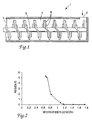
- the mixture was then passed through a rotating pinmill as shown in Fig. 1 at 800 RPM.
- the pinmill 1 has an inlet end 2 and an outlet end 3.
- the pinmill used had 71 pins arranged with a 40 degree offset between the two rows of pins.
- the two rows had an 80 degree helix angle.
- the diameter of the pinmill was about 8 inches (20 cm) with a 1.5 inch (3.8 cm) diameter shaft.
- the pins were cylindrical and about 3 inches (7.6 cm) long and 0.5 inches (1.3 cm) in diameter.
- the mixing portion of the pinmill was about 30 inches (76 cm).
- the mixture had additional water added to 68 ⁇ 6 percent of the total weight of the mixture and was then passed through the pin mill again.
- the material was then transferred to the cement mixer and tumbled for 10 ⁇ 5 minutes.
- the material was dried in a gas fired fluid bed drier with inlet air temperature below 350°F (177°C) to a water content of less than 3 percent moisture.
- the resultant granules were sieved to a mesh size of 8 x 40 (2.36 mm x 0.419 mm), unless otherwise indicated.
- Oil sorbency of the formed granules was tested according to ASTM F-726, part 9.1.2. The procedure used a 40 mesh wire basket of 7.62 x 10.16 x 2.54 cm. The basket was filled with the granular sorbent material.
- the test fluid and procedure for the mineral oil sorbency tests are as follows: the test fluid was KlearolTM white mineral oil, Light Mineral Oil NF, manufactured by Witco Corporation (Greenwich, CT). The sample was immersed for 2 minutes. The basket was removed from the oil and allowed to drain for 2 minutes and was reweighed.
- test fluid was 20W non-detergent motor oil available from Texaco Lubricants Corporation (Houston, TX).
- the sample was immersed in the test fluid for 5 minutes.
- the sample was removed from the fluid and drained for 30 seconds and reweighed.
- the oil sorbency is reported as a Sorbency Ratio which is the ratio of the weight of the oil containing sorbent divided by the initial sorbent weight.
- the apparent density of the granules was determined according to ASTM D2854. A 100 cc cylinder, described in this test, was used to do the testing but was filled only to 50 cc to preserve material.
- a test was devised to measure the tendency of dry granules to cling together.
- a 60 degree powder funnel was filled with test granules, using a finger or some other object to occlude the bottom opening to prevent the material from leaving the funnel.
- the funnels used were a PyrexTM powder funnel 6220-100 made by Corning Corporation (Corning, NY) (60 degrees, with a 100 mm top opening and a 12 mm stem opening with a stem length of 40 cm) and a plastic powder funnel model 4253-0100 (60 degrees, 100 mm top opening, stem opening 20 mm and stem length 35 mm) made by Nalgle Corporation (Rochester, NY). Excess material above the rim of the funnel was removed with a rule or some other object with a flat edge. The opening was cleared and the time to empty was noted. The Flow Values(plastic or glass) are reported in seconds.
- Table 2 shows a dramatic reduction in the Oil Surface Residue Value when the sorbent sludge cellulosic granules contain BMF fibers (compare C3 with E5 through E8).
- Comparative Example 4 formed with BMF fibers alone did not exhibit this behavior and the oil Surface Residue Value was even worse than C3 with no BMF fibers.
- C5 is Eagle Pitcher Floor Dry 85, a clay material from Eagle-Pitcher Minerals, Inc. (Reno, NV);
- C6 is Safety-Kleen Absorbant 8830, a ground corn cob material from Safety-Kleen Corporation (Elgin, IL);
- C7 is Peat Sorb, a peat material from the Peat Sorb Division of Peat "T” Inc.
- Oil Sorbency Ratio Motor Oil Surface Residue Value C9 0 0.35 1.71 1.91 0.257 9 1 0.39 1.37 1.63 0.015 10 2 0.31 1.62 1.92 0.018 11 3 0.34 1.54 1.85 0.018 12 4 0.35 1.37 1.74 0.009 13 5 0.30 1.55 2.07 0.017 14 10 0.28 1.75 2.22 0.011 15 25 0.28 1.98 2.36 0.005 16 75 0.20 2.6 3.29 0.009 17 90 0.18 3.07 3.92 0.006
- Polypropylene fibers 3 denier in size and 0.76 mm in length, were obtained from Cellusuede Fibers Inc. (Rockford, IL). Evaluations were performed as in Examples 9 through 17 and the results are given in Table 5. Effect of Polypropylene Fibers on Oil Sorption Example Percent Additive Density Sorbency Ratio Min.
- Oil Sorbency Ratio Motor Oil Surface Residue Value 18 1 0.35 1.59 1.83 0.013 19 2 0.36 1.39 1.89 0.004 20 4 0.32 1.74 2.18 0.007 21 6 0.33 1.84 2.21 0.009 22 10 0.36 1.41 3.81 0.010 23 16 0.28 2.09 2.46 0.017 24 25 0.25 2.42 2.92 0.003 25 40 0.23 2.79 3.28 0.014 C10 66 0.14 4.72 5.4 5.22 C11 86 0.15 4.49 4.84 4.35
- PET fibers polyester terephthalate (PET) fibers of varying lengths as an additive.
- the PET fibers were obtained from Cellusuede Fibers Inc. (Rockford, IL).
- the fibers 0.76 and 1.52 mm in length were 3 denier, while the fibers 3.17 mm in length were 1.5 denier.
- the additive fibers were incorporated in the granules at a 25 percent by dry weight level and tested as above. The evaluations were performed as in Examples 9 through 17 and the results are given in Table 10 below. Effect of PET Fiber Length on Oil Sorption Example Length Density Sorbency Ratio Min. Oil Sorbency Ratio Motor Oil Surface Residue Value 29 0.76 0.31 1.74 2.04 0.011 C16 1.52 0.30 1.72 2.18 2.21 C17 3.17 0.20 2.07 2.79 2.91
- the PET fibers acted similarly to the polypropylene fibers of Examples 24 and 26 through 28 at 25 percent by weight loading.
- Nylon fibers were 3 denier and 0.76 mm in length.
- ModacrylicTM (MA) fibers were high brightness acrylic fibers and were 3 denier and 0.76 mm in length.
- KanecaronTM (KA) fibers were high brightness fibers and were 3 denier and 0.76 mm in length. All were obtained from Cellusuede Fibers Inc. (Rockford, IL).
- Regenerated cellulose sponge material (RCS) was obtained from the 3M Home Care Products Division (St. Paul, MN) as OcelloTM brand sponges, product 7244-T. It was dried under ambient conditions and was ground in a hammermill to pass through a 1.58 mm opening.
- This RCS material was roughly fibrous with the majority of particles having a length to width ratio greater than three.
- Fluff Pulp (FP) was polyethylene 13099 Shortstuff ⁇ fibers (average length 0.25 mm) obtained from Minifibers, Inc. (Johnson City, TN).
- Polyolefinic Pulp TA-12 (POP) was obtained from Dupont Corporation (Wilmington, DE). All additive materials were incorporated into granules at a 25 percent by weight solids level and tested as above. The results are given in Table 12. Effect of Various Organic Fibers on Oil Sorption Example Additive Density Sorbency Ratio Min.
- Microthene FN 510-00 was obtained from Quantum Chemical Specialty Polymers (Cincinnati, OH). The average particle size was approximately 20 micrometers and the particle size distribution was such that 89 percent of the particles was within a size range of 5 to 40 micrometers.
- the small size organic particle additive is effective in this invention but the ability to leave only a minimal oil Surface Residue Value was reduced at the larger particle size.
- Ceramic microspheres designated as Z light W-1012 were obtained from 3M Company (St. Paul, MN). The volume average diameter was 57 micrometers. A second size designated Z light W-1600 was obtained from the same source and had a volume average diameter of 173 micrometers. Each was incorporated into granules at a 10 percent level. Performance results are given in Table 15. Effect of Inorganic Particles on Oil Sorption Example Size (micro-meters) Density Sorbency Ratio Min. Oil Sorbency Ratio Motor Oil Surface Residue Value 40 57 0.32 1.94 2.16 0.037 41 173 0.32 1.76 2.06 0.022
- This Comparative Example demonstrates the effect of using a sludge with a high ash (i.e., a film forming clay) content.
- a high ash mixed sludge was obtained from the Fort Howard Corporation (Green Bay, WI). The ash content was 47 percent.
- Granules were prepared from this sludge incorporating 50 percent BMF fibers that were pretreated with the SyntergentTM surfactant. Results are given in Table 16. Effect of High Ash Sludge Example Density Sorbency Ratio Min. Oil Sorbency Ratio Motor Oil Surface Residue Value C20 0.36 1.21 1.56 1.25
- Latex Addition Example Additive Surface Residue Value C21 10% Latex 0.968 42 10% BMF 0.019 5% Latex 43 10% BMF 0.011 10% Latex
- Example 51 The gentle action of the rotating glass drum did not significantly densify the granules however the surface was compacted and the granules of Example 51 provided excellent Surface Residue Values.
- Cotton fiber containing granules were prepared by tumbling 204 g raw Cotton fibers (Easy StreetTM, available from Veritec, Walpole, MA) that had been hammermilled dry to reduce the average fiber length to 0.31 mm, with 612 g of papermill sludge obtained from International Paper (Natchez, MS). The materials were then blended in a cement mixer, model RLX-3 made by Lion Hydraulics (Bloomington, MN) with a 40 cm diameter opening. The combined materials had a water content of 50.3 percent of the total weight. The materials were tumbled in the cement mixer for 5 ⁇ 1 minutes. The materials were then sprayed with water to increase the water content to approximately 60 weight percent.
- the material was then passed through a pinmill rotating at 800 rpm.
- the material had additional water added to a total of 70 weight percent of the sample.
- the material was passed through the pinmill again with added water.
- the material was then passed through the pinmill a third time without water addition.
- the material was then transferred to the cement mixer again and tumbled for 15 minutes.
- the material was dried in a convection tray drier at 120°C for three hours.
- the material was sieved to granules less than 2.4 mm in diameter and tested for its oil Surface Residue Value.
- the sample oil Surface Residue Value was 0.010 grams.
- the apparent density of the granules was 0.31 g/cc.
- the raw cotton cellulosic fibers were observed under a microscope and had no observable fibrils. Generally, cotton requires wet pulping in order for fibrils to form such that the cotton fibers become self associating.
- the aqueous Surface Residue Value testing was performed as follows. Five milliliters of deionized water containing 0.25% Syntergent surfactant was placed into a 15 cm diameter and 20 mm deep PyrexTM glass petri dish made by Corning Inc. Fifty milliliters of sorbent material was placed over the fluid and allowed to pick up the fluid. Duration of the test was 5 minutes. No agitation of the material was done after initial placement. After the time elapsed, the dish was inverted and tapped lightly to dislodge the sorbent. The material remaining in the dish was weighed and is reported as the aqueous Surface Residue Value. The Surface Residue Values are reported in grams.
- Example 54 the granules of Example 5, containing 5% BMF fibers, were tested using the above aqueous Surface Residue Value test.
- Example 55 the granules of Example 26, containing 25% polypropylene fibers 3 denier in size and 0.76 cm (0.030 in) long, were tested in this test.
- Example 56 the granules of Example 35, containing 25% regenerated cellulose sponge material, were tested.
- Example 57 the granules of Example 40, containing 10% ceramic microspheres, were tested.
- Example 58 the granules of Example 52, containing Weyerhaeuser pulping waste cellulose and 25% BMF fibers, were tested.
- Example C24 the granules of Example C3, containing no additive, were tested by the aqueous Surface Residue Value test.
- Example C25 the granules of Example C5, the Eagle Pitcher Floor Dry 85 material, were tested.
- Example C26 the granules of Example C6, the Safety-Kleen Absorbent 8830, were tested.
- Example C27 the granules of Example C8, the Biodac 16/30 material, were tested.
- Example C28 the granules of Example C23, the Absorbent GP material, were tested.
- Table 21 Sorption of Aqueous Fluid Example Surface Residue Value 54 0.007 55 0.002 56 0.002 57 0.006 58 0.005 C24 0.173 C25 0.172 C26 0.668 C27 1.2 C28 4.25
- An aqueous synthetic blood composition was prepared as follows. To 2.0 liters of deionized water was added 50.0 grams Acrysol G-110 (from Rohm & Haas Co., Philadephia, PA) and the mixture was shaken until uniformly mixed. Then 20.0 grams Direct Red 81 dye (from Aldrich Chemical Co., Milwaukee, WI) was added and the mixture was shaken until uniformly mixed. The surface tension was then adjusted to 40-48 dynes/cm by the addition of the surfactant Brij No. 30 as obtained from Aldrich Chemicals. The composition was used within 10 days of its preparation.
- the Surface Residue Value testing was performed as described above except that five millileters of artificial blood was substituted for the aqueous 0.25% Syntergent surfactant solution as the test fluid.
- Example 59 the granules of Example 5, containing 5% BMF fibers, were tested in the artificial blood Surface Residue Value test.
- Example 60 the granules of Example 26, containing 25% polypropylene fibers 3 denier in size and 0.76 cm (0.030 in) long, were tested in this test.
- Example 61 the granules of Example 35, containing 25% regenerated cellulose sponge material, were tested.
- Example 62 the granules of Example 40, containing 10% ceramic microspheres, were tested.
- Example 63 the granules of Example 52, containing Weyerhaeuser pulping waste cellulose and 25% BMF fibers, were tested.
- Example C29 the granules of Example C5, the Eagle Pitcher Floor Dry 85 material, were tested in the artificial blood Surface Residue Value test.
- Example C30 the granules of Example C6, the Saftey-Kleen Absorbent 9930, were tested.
- Example C31 the granules of Example C8, the Biodac 16/30 material, were tested.
- Example C32 the granules of Example C23, the Absorbent CG material, were tested. The results are given in Table 22. Sorption of Artificial Blood Example Surface Residue Value 59 0.009 60 0.51 61 0.43 62 0.018 63 0.007 C29 8.83 C30 3.5 C31 8.29 C32 3.41
Landscapes
- Chemical & Material Sciences (AREA)
- Organic Chemistry (AREA)
- Analytical Chemistry (AREA)
- Chemical Kinetics & Catalysis (AREA)
- Engineering & Computer Science (AREA)
- Health & Medical Sciences (AREA)
- Environmental & Geological Engineering (AREA)
- Public Health (AREA)
- Oil, Petroleum & Natural Gas (AREA)
- Materials Engineering (AREA)
- Medicinal Chemistry (AREA)
- Life Sciences & Earth Sciences (AREA)
- Hydrology & Water Resources (AREA)
- Water Supply & Treatment (AREA)
- Solid-Sorbent Or Filter-Aiding Compositions (AREA)
- Cultivation Of Plants (AREA)
- Paper (AREA)
Applications Claiming Priority (3)
| Application Number | Priority Date | Filing Date | Title |
|---|---|---|---|
| US638265 | 1996-04-26 | ||
| US08/638,265 US5763083A (en) | 1996-04-26 | 1996-04-26 | Oil absorbent fibrous granules |
| PCT/US1997/006913 WO1997041188A1 (en) | 1996-04-26 | 1997-04-25 | Absorbent fibrous granules |
Publications (2)
| Publication Number | Publication Date |
|---|---|
| EP0895532A1 EP0895532A1 (en) | 1999-02-10 |
| EP0895532B1 true EP0895532B1 (en) | 2002-07-10 |
Family
ID=24559317
Family Applications (1)
| Application Number | Title | Priority Date | Filing Date |
|---|---|---|---|
| EP97921371A Expired - Lifetime EP0895532B1 (en) | 1996-04-26 | 1997-04-25 | Absorbent fibrous granules |
Country Status (9)
| Country | Link |
|---|---|
| US (1) | US5763083A (enExample) |
| EP (1) | EP0895532B1 (enExample) |
| JP (1) | JP2000510509A (enExample) |
| KR (1) | KR100481573B1 (enExample) |
| AU (1) | AU2742797A (enExample) |
| BR (1) | BR9709170A (enExample) |
| DE (1) | DE69713880T2 (enExample) |
| ES (1) | ES2176735T3 (enExample) |
| WO (1) | WO1997041188A1 (enExample) |
Families Citing this family (32)
| Publication number | Priority date | Publication date | Assignee | Title |
|---|---|---|---|---|
| US6092302A (en) * | 1997-04-25 | 2000-07-25 | 3M Innovative Properties Company | Absorbent fibrous granules |
| US6689740B1 (en) | 1999-06-15 | 2004-02-10 | Givaudan Sa | Method for preparing fragrance products |
| US6983571B2 (en) * | 2000-09-29 | 2006-01-10 | Teel Plastics, Inc. | Composite roofing panel |
| GB2368261B (en) * | 2000-10-24 | 2002-10-02 | Anna Rachel Houghton | Cooking oil receptacle |
| US7038104B1 (en) | 2001-06-26 | 2006-05-02 | Eifling Boyd R | Cellulose absorbent |
| US7544635B2 (en) * | 2001-07-17 | 2009-06-09 | Zhi-Wei Liang | Process for changing hydrophilic/hydrophobic characteristics |
| GB2382582A (en) * | 2001-11-30 | 2003-06-04 | Master Works Ltd | Two-component composition comprising polymer resins and gypsum |
| US20030186052A1 (en) * | 2002-03-29 | 2003-10-02 | Cytech Fiber Processing Systems, Inc. | Fiber pellets and processes for forming fiber pellets |
| US20030227250A1 (en) * | 2002-05-08 | 2003-12-11 | Han Nee | Silver alloy thin film reflector and transparent electrical conductor |
| US20040081828A1 (en) * | 2002-10-25 | 2004-04-29 | Dezutter Ramon C. | Flowable and meterable densified fiber particle |
| US7905987B2 (en) * | 2006-08-17 | 2011-03-15 | Casella Waste Systems, Inc. | Paper sludge processing for animal bedding |
| US7735287B2 (en) * | 2006-10-04 | 2010-06-15 | Novik, Inc. | Roofing panels and roofing system employing the same |
| US9888712B2 (en) | 2007-06-08 | 2018-02-13 | Philip Morris Usa Inc. | Oral pouch products including a liner and tobacco beads |
| US20080308115A1 (en) * | 2007-06-08 | 2008-12-18 | Philip Morris Usa Inc. | Oral pouched products including tobacco beads |
| US8119173B2 (en) * | 2007-07-16 | 2012-02-21 | Philip Morris Usa Inc. | Method of flavor encapsulation through the use of a drum coater |
| US8020353B2 (en) * | 2008-10-15 | 2011-09-20 | Novik, Inc. | Polymer building products |
| FI121136B (fi) * | 2008-11-07 | 2010-07-30 | Tamfelt Filtration Oy | Kiekkosuodattimen sektori ja sektorikomponentti |
| US8377215B2 (en) | 2008-12-18 | 2013-02-19 | Philip Morris Usa Inc. | Moist botanical pouch processing |
| US20100197183A1 (en) * | 2009-01-30 | 2010-08-05 | Drapela David C | Industrial absorbent from cotton regin |
| US8209938B2 (en) | 2010-03-08 | 2012-07-03 | Novik, Inc. | Siding and roofing panel with interlock system |
| US10051884B2 (en) | 2010-03-26 | 2018-08-21 | Philip Morris Usa Inc. | Controlled release mentholated tobacco beads |
| CA135807S (en) | 2010-06-04 | 2011-01-27 | Novik Inc | Roof or siding shingle panel |
| KR101341150B1 (ko) * | 2011-12-22 | 2013-12-11 | 한국조폐공사 | 고반사 보호막을 갖는 자성입자 및 그 제조방법 |
| US11440510B2 (en) * | 2012-06-12 | 2022-09-13 | William Boroughf | Disposable oil change kit |
| US20130327659A1 (en) * | 2012-06-12 | 2013-12-12 | William Boroughf | Disposable oil change kit |
| US11602120B2 (en) | 2012-09-11 | 2023-03-14 | Pioneer Pet Products, Llc | Lightweight coated extruded granular absorbent |
| CA2838061C (en) | 2012-12-19 | 2016-03-29 | Novik Inc. | Corner assembly for siding and roofing coverings and method for covering a corner using same |
| US9388565B2 (en) | 2012-12-20 | 2016-07-12 | Novik Inc. | Siding and roofing panels and method for mounting same |
| CA2942267C (en) * | 2014-03-12 | 2022-09-27 | Pioneer Pet Products, Llc | Lightweight coated extruded granular absorbent |
| RU2638855C1 (ru) * | 2017-03-13 | 2017-12-18 | Михаил Николаевич Уразаев | Способ получения сорбента для очистки водной поверхности от нефти и нефтепродуктов |
| DE102018003329B4 (de) | 2018-04-24 | 2021-08-26 | Dräger Safety AG & Co. KGaA | Absorptionskorb und Absorptionskorbsystem |
| EP4214180A4 (en) | 2020-09-17 | 2024-10-30 | Green Boom Corp. | COMPOSITION ALLOWING POLYMERIZATION AND GRAFTING ONTO A POLYSACCHARIDE OR AGRICULTURAL FIBERS AND ITS MANUFACTURING PROCESS |
Family Cites Families (34)
| Publication number | Priority date | Publication date | Assignee | Title |
|---|---|---|---|---|
| US2692861A (en) * | 1950-05-03 | 1954-10-26 | Patent & Licensing Corp | Floor sweeping composition |
| US2649759A (en) * | 1950-10-05 | 1953-08-25 | S E Gibbs | Treated clay animal litter |
| US3617564A (en) * | 1970-06-01 | 1971-11-02 | Anderson Cob Mills Inc | Removing oil or oil substance from water and land areas using corncob components |
| US3876497A (en) * | 1971-11-23 | 1975-04-08 | Sterling Drug Inc | Paper mill waste sludge oxidation and product recovery |
| US3770575A (en) * | 1972-05-26 | 1973-11-06 | Westavco Corp | Method of making a hydrophobic fibrous product |
| JPS4984980A (enExample) * | 1972-10-27 | 1974-08-15 | ||
| US4102783A (en) * | 1975-12-08 | 1978-07-25 | Daicel Ltd. | Adsorbent process for oily materials |
| US4341180A (en) * | 1976-03-31 | 1982-07-27 | James River Corporation Of Virginia | Animal litter and process |
| US4356060A (en) * | 1979-09-12 | 1982-10-26 | Neckermann Edwin F | Insulating and filler material comprising cellulose fibers and clay, and method of making same from paper-making waste |
| SE418863B (sv) * | 1979-11-26 | 1981-06-29 | Bo Rolf Erland | Absorptionsmaterial och sett for dess framstellning respektive anvendande |
| NL169828C (nl) * | 1980-05-02 | 1982-09-01 | Kok Cornelis Jacobus M | Werkwijze voor de vervaardiging van een vloeistof- en schokabsorberend materiaal. |
| US4519918A (en) * | 1981-07-27 | 1985-05-28 | Papyrus Kopparfors Ab | Process for the absorption of organic liquids by use of a hydrophobic fibrous material |
| US4409925A (en) * | 1981-11-02 | 1983-10-18 | Thermaster Inc. | Absorbent material |
| SE8202932L (sv) * | 1982-05-10 | 1983-11-11 | Kopparfors Papyrus Ab | Absorptionsmedel for organiska vetskor, i synnerhet olja, vilket icke er dammexplosivt och har lag brandrisk |
| JPS58199041A (ja) * | 1982-05-14 | 1983-11-19 | Honshu Paper Co Ltd | 廃油吸収マツト |
| US4621011A (en) * | 1984-04-24 | 1986-11-04 | Kimberly-Clark Corporation | Agglomerated cellulosic particles |
| US4560527A (en) * | 1984-04-24 | 1985-12-24 | Kimberly-Clark Corporation | Method of making agglomerated cellulosic particles using a substantially horizontal rotating drum |
| US4721059A (en) * | 1985-03-21 | 1988-01-26 | H. Edward Lowe | Nonclay catbox filler |
| US4734393A (en) * | 1985-06-20 | 1988-03-29 | H. Edward Lowe | Non-clay oil and grease absorbent |
| US4975108A (en) * | 1985-08-26 | 1990-12-04 | Pruitt Norman W | Controlled release composition and method of manufacturing same |
| US4829045A (en) * | 1986-07-07 | 1989-05-09 | Nova-Huskey Research Corporation, Ltd. | Peat pellets |
| GB8627916D0 (en) * | 1986-11-21 | 1986-12-31 | Bonar Carelle Ltd | Absorbent products |
| US4931139A (en) * | 1987-01-02 | 1990-06-05 | Absorption Corp. | Degradable absorbent material and manufacturing process therefor |
| US5091245A (en) * | 1987-12-31 | 1992-02-25 | Phillips Christopher R | Degradable absorbent material |
| US5215041A (en) * | 1989-04-10 | 1993-06-01 | Organ-Faser Technology Company N.V. | Method for the manufacture of animal litter and animal litter |
| US5368918A (en) * | 1990-08-30 | 1994-11-29 | Nippon Shokubai Co., Ltd. | Absorbent material comprising absorbent polymeric particulate material coated with synthetic pulp |
| GB9023487D0 (en) * | 1990-10-29 | 1990-12-12 | Tryam Trading Inc | Oil sorbent |
| US5358607A (en) * | 1992-02-24 | 1994-10-25 | Ellis Douglas E | Porous low density shot-like degradable absorbent materials and manufacturing process therefor |
| GB9212867D0 (en) * | 1992-06-17 | 1992-07-29 | Wiggins Teape Group Ltd | Recovery and re-use of raw materials from paper mill waste sludge |
| US5308497A (en) * | 1992-08-31 | 1994-05-03 | United Technologies Automotive, Inc. | Method of absorbing petroleum-based products |
| US5346549A (en) * | 1992-10-23 | 1994-09-13 | Johnson William B | Environmentally stabilized products formed from ash and papermill waste |
| US5240565A (en) * | 1992-11-30 | 1993-08-31 | Williams Robert M | Apparatus for converting paper mill waste sludge into charcoal |
| US5332474A (en) * | 1993-01-19 | 1994-07-26 | Maxham John V | Conversion of pulp and paper mill waste solids to a papermaking filler product |
| US5423993A (en) * | 1993-08-06 | 1995-06-13 | John A. Boney | Fiber recovery system and process |
-
1996
- 1996-04-26 US US08/638,265 patent/US5763083A/en not_active Expired - Fee Related
-
1997
- 1997-04-25 KR KR10-1998-0708582A patent/KR100481573B1/ko not_active Expired - Fee Related
- 1997-04-25 WO PCT/US1997/006913 patent/WO1997041188A1/en not_active Ceased
- 1997-04-25 EP EP97921371A patent/EP0895532B1/en not_active Expired - Lifetime
- 1997-04-25 BR BR9709170A patent/BR9709170A/pt not_active Application Discontinuation
- 1997-04-25 AU AU27427/97A patent/AU2742797A/en not_active Abandoned
- 1997-04-25 JP JP09539037A patent/JP2000510509A/ja not_active Withdrawn
- 1997-04-25 ES ES97921371T patent/ES2176735T3/es not_active Expired - Lifetime
- 1997-04-25 DE DE69713880T patent/DE69713880T2/de not_active Expired - Fee Related
Also Published As
| Publication number | Publication date |
|---|---|
| DE69713880T2 (de) | 2002-11-14 |
| US5763083A (en) | 1998-06-09 |
| BR9709170A (pt) | 1999-08-03 |
| KR20000065038A (ko) | 2000-11-06 |
| EP0895532A1 (en) | 1999-02-10 |
| ES2176735T3 (es) | 2002-12-01 |
| AU2742797A (en) | 1997-11-19 |
| JP2000510509A (ja) | 2000-08-15 |
| WO1997041188A1 (en) | 1997-11-06 |
| DE69713880D1 (de) | 2002-08-14 |
| KR100481573B1 (ko) | 2005-07-08 |
Similar Documents
| Publication | Publication Date | Title |
|---|---|---|
| US6092302A (en) | Absorbent fibrous granules | |
| US5763083A (en) | Oil absorbent fibrous granules | |
| US4931139A (en) | Degradable absorbent material and manufacturing process therefor | |
| US4157696A (en) | Animal litter pellets | |
| US5664523A (en) | Materials for the treatment of pet excretions | |
| US6294118B1 (en) | Method for producing sorbents on the basis of a cellulose-containing material and clay minerals | |
| US5358607A (en) | Porous low density shot-like degradable absorbent materials and manufacturing process therefor | |
| US20080022940A1 (en) | Composite Absorbent Particles with Superabsorbent Material | |
| US20090217882A1 (en) | Dry Bed Agglomeration Process and Product Formed Thereby | |
| US7964529B2 (en) | Method of agglomeration | |
| US20080251027A1 (en) | Shaped Absorbent Particles | |
| CA2718196C (en) | Flocculant composition for dewatering solids laden slurries | |
| JPH0923776A (ja) | ペットの排泄物用処理材及びその製法 | |
| US20120118242A1 (en) | Absorbent material | |
| KR20140093257A (ko) | 경량 흡수제 셀룰로오스 펠릿들 | |
| CA2607753A1 (en) | Composite absorbent particles with superabsorbent material | |
| US5091245A (en) | Degradable absorbent material | |
| CA2252856C (en) | Absorbent fibrous granules | |
| CA2607676A1 (en) | Dry bed agglomeration process and product formed thereby | |
| MXPA98008785A (en) | Absorbent fibrous granules | |
| CA2607750A1 (en) | Method of agglomeration | |
| JP2002045067A (ja) | 汚液処理システム | |
| CA1313468C (en) | Degradable absorbent material and manufacturing process therefor | |
| EP1089616A1 (en) | Bedding for pets | |
| JPH0448407B2 (enExample) |
Legal Events
| Date | Code | Title | Description |
|---|---|---|---|
| PUAI | Public reference made under article 153(3) epc to a published international application that has entered the european phase |
Free format text: ORIGINAL CODE: 0009012 |
|
| 17P | Request for examination filed |
Effective date: 19981113 |
|
| AK | Designated contracting states |
Kind code of ref document: A1 Designated state(s): DE ES FR GB IT NL |
|
| 17Q | First examination report despatched |
Effective date: 19990923 |
|
| GRAG | Despatch of communication of intention to grant |
Free format text: ORIGINAL CODE: EPIDOS AGRA |
|
| GRAG | Despatch of communication of intention to grant |
Free format text: ORIGINAL CODE: EPIDOS AGRA |
|
| GRAG | Despatch of communication of intention to grant |
Free format text: ORIGINAL CODE: EPIDOS AGRA |
|
| GRAH | Despatch of communication of intention to grant a patent |
Free format text: ORIGINAL CODE: EPIDOS IGRA |
|
| GRAH | Despatch of communication of intention to grant a patent |
Free format text: ORIGINAL CODE: EPIDOS IGRA |
|
| GRAA | (expected) grant |
Free format text: ORIGINAL CODE: 0009210 |
|
| AK | Designated contracting states |
Kind code of ref document: B1 Designated state(s): DE ES FR GB IT NL |
|
| REG | Reference to a national code |
Ref country code: GB Ref legal event code: FG4D |
|
| REF | Corresponds to: |
Ref document number: 69713880 Country of ref document: DE Date of ref document: 20020814 |
|
| REG | Reference to a national code |
Ref country code: ES Ref legal event code: FG2A Ref document number: 2176735 Country of ref document: ES Kind code of ref document: T3 |
|
| ET | Fr: translation filed | ||
| PLBE | No opposition filed within time limit |
Free format text: ORIGINAL CODE: 0009261 |
|
| STAA | Information on the status of an ep patent application or granted ep patent |
Free format text: STATUS: NO OPPOSITION FILED WITHIN TIME LIMIT |
|
| 26N | No opposition filed |
Effective date: 20030411 |
|
| PGFP | Annual fee paid to national office [announced via postgrant information from national office to epo] |
Ref country code: FR Payment date: 20060417 Year of fee payment: 10 |
|
| PGFP | Annual fee paid to national office [announced via postgrant information from national office to epo] |
Ref country code: GB Payment date: 20060424 Year of fee payment: 10 |
|
| PGFP | Annual fee paid to national office [announced via postgrant information from national office to epo] |
Ref country code: ES Payment date: 20060426 Year of fee payment: 10 |
|
| PGFP | Annual fee paid to national office [announced via postgrant information from national office to epo] |
Ref country code: IT Payment date: 20060430 Year of fee payment: 10 |
|
| PGFP | Annual fee paid to national office [announced via postgrant information from national office to epo] |
Ref country code: NL Payment date: 20060517 Year of fee payment: 10 |
|
| PGFP | Annual fee paid to national office [announced via postgrant information from national office to epo] |
Ref country code: DE Payment date: 20060531 Year of fee payment: 10 |
|
| GBPC | Gb: european patent ceased through non-payment of renewal fee |
Effective date: 20070425 |
|
| NLV4 | Nl: lapsed or anulled due to non-payment of the annual fee |
Effective date: 20071101 |
|
| PG25 | Lapsed in a contracting state [announced via postgrant information from national office to epo] |
Ref country code: NL Free format text: LAPSE BECAUSE OF NON-PAYMENT OF DUE FEES Effective date: 20071101 Ref country code: DE Free format text: LAPSE BECAUSE OF NON-PAYMENT OF DUE FEES Effective date: 20071101 |
|
| PG25 | Lapsed in a contracting state [announced via postgrant information from national office to epo] |
Ref country code: GB Free format text: LAPSE BECAUSE OF NON-PAYMENT OF DUE FEES Effective date: 20070425 |
|
| REG | Reference to a national code |
Ref country code: ES Ref legal event code: FD2A Effective date: 20070426 |
|
| PG25 | Lapsed in a contracting state [announced via postgrant information from national office to epo] |
Ref country code: FR Free format text: LAPSE BECAUSE OF NON-PAYMENT OF DUE FEES Effective date: 20070430 |
|
| PG25 | Lapsed in a contracting state [announced via postgrant information from national office to epo] |
Ref country code: ES Free format text: LAPSE BECAUSE OF NON-PAYMENT OF DUE FEES Effective date: 20070426 |
|
| PG25 | Lapsed in a contracting state [announced via postgrant information from national office to epo] |
Ref country code: IT Free format text: LAPSE BECAUSE OF NON-PAYMENT OF DUE FEES Effective date: 20070425 |