EP0895397B9 - Annuleur d'écho acoustique - Google Patents
Annuleur d'écho acoustique Download PDFInfo
- Publication number
- EP0895397B9 EP0895397B9 EP98306066A EP98306066A EP0895397B9 EP 0895397 B9 EP0895397 B9 EP 0895397B9 EP 98306066 A EP98306066 A EP 98306066A EP 98306066 A EP98306066 A EP 98306066A EP 0895397 B9 EP0895397 B9 EP 0895397B9
- Authority
- EP
- European Patent Office
- Prior art keywords
- spectrum
- signal
- echo
- time
- estimating
- Prior art date
- Legal status (The legal status is an assumption and is not a legal conclusion. Google has not performed a legal analysis and makes no representation as to the accuracy of the status listed.)
- Expired - Lifetime
Links
- 238000001228 spectrum Methods 0.000 claims description 30
- 238000000034 method Methods 0.000 claims description 19
- 238000012546 transfer Methods 0.000 claims description 12
- 238000004891 communication Methods 0.000 claims description 5
- 230000001131 transforming effect Effects 0.000 claims 7
- 238000010586 diagram Methods 0.000 description 7
- 230000003111 delayed effect Effects 0.000 description 6
- 238000010606 normalization Methods 0.000 description 6
- 238000002592 echocardiography Methods 0.000 description 5
- 230000008859 change Effects 0.000 description 4
- 230000002596 correlated effect Effects 0.000 description 4
- 230000008569 process Effects 0.000 description 4
- 230000003044 adaptive effect Effects 0.000 description 2
- 230000001934 delay Effects 0.000 description 2
- 230000001629 suppression Effects 0.000 description 2
- 238000012549 training Methods 0.000 description 2
- 238000004364 calculation method Methods 0.000 description 1
- 230000001427 coherent effect Effects 0.000 description 1
- 238000012937 correction Methods 0.000 description 1
- 230000008878 coupling Effects 0.000 description 1
- 238000010168 coupling process Methods 0.000 description 1
- 238000005859 coupling reaction Methods 0.000 description 1
- 238000005516 engineering process Methods 0.000 description 1
- 230000007613 environmental effect Effects 0.000 description 1
- 230000009467 reduction Effects 0.000 description 1
- 238000005316 response function Methods 0.000 description 1
- 238000005070 sampling Methods 0.000 description 1
Images



Classifications
-
- H—ELECTRICITY
- H04—ELECTRIC COMMUNICATION TECHNIQUE
- H04M—TELEPHONIC COMMUNICATION
- H04M9/00—Arrangements for interconnection not involving centralised switching
- H04M9/08—Two-way loud-speaking telephone systems with means for conditioning the signal, e.g. for suppressing echoes for one or both directions of traffic
- H04M9/082—Two-way loud-speaking telephone systems with means for conditioning the signal, e.g. for suppressing echoes for one or both directions of traffic using echo cancellers
Definitions
- the present invention relates generally to the field of acoustic echo cancellation in telecommunications, and particularly to a pseudo spectrum-based acoustic echo canceller which adaptively cancels echoes arising in hands-free audio and video teleconferencing and related systems without requiring a state machine or training.
- a typical acoustic echo canceller currently available uses what-is-known-as an adaptive filter which employs a well-known algorithm such as the algorithm known as the Least-Mean-Square algorithm, or LMS.
- LMS Least-Mean-Square algorithm
- This algorithm continuously adapts to changes in the placement of both the speaker and microphone and to changes in loudspeaker volume.
- a state machine is needed to automatically determine each of the four states, i.e., receiving, transmitting, double-talk, and idle.
- these cancellers much be trained, that is, they must "leam" the loudspeaker-to-microphone acoustic response function for the room it is servicing.
- the acoustic compensation length is determined by the length of the filter that is determined by the host resource availability.
- Duttweiler in US Patent No, 4,562,312 discloses the estimation of delays in incoming and outgoing signals from a communication circuit. Obtaining the correlation between the signals and estimating the delay between the signals so as to employ an echo canceller to cancel echos developed in the delay.
- a microphone array is used together with a block adaptive algorithm to effectively suppress acoustic echo arising in hands free voice communication.
- the system is also capable of suppressing environmental noise.
- the present echo canceller utilizes the principle that the spectrum pattem of human speech does not change much in the short run.
- the present echo canceller takes 256 overlap 128 samples in 16 ms intervals, or sample blocks.
- the power spectrum taken at time 0 and at any time within the 16 ms interval are generally the same. This is true even though the waveform of the speech may change over time even in the short run.
- the echoes are simply a delayed form of a speech signal. Therefore, in following the principle described above, the spectrum of the speech signal and the spectrum of the echo taking are substantially the same.
- the inputs to the present echo canceller are x ( t ) and y ( t ), y ( t ) representing the incoming speech signal from a far-end speaker and x ( t ) representing the combination of speech signal from a near-end speaker and the echo.
- the well-known normalized cross-correlation estimation between x ( t ) and y ( t ) is performed to determine the level of correlation between x ( t ) and y ( t ) which is quantitatively represented by the correlation coefficient C , a value of 1 for C being perfect correlation.
- x ( t ) comprises of only the echo portion which is essentially a delayed form of y ( t ). In that case, there is almost a perfect correlation between x ( t ) and y ( t ) and the C value is near 1.
- the x ( t ) comprises only of the signal and the C value is near 0.
- the C value may be between 0 and 1, but typically near to 0 since the two speech signals will not be highly correlated. And of course, silence would result in a near 0 also, since respective noises will not be highly correlated. Certain decisions are based on whether the C value exceeds certain thresholds.
- the amount of delay is estimated by measuring the time shift required to produce the maximum C value. Once the delay is determined, the two channels of inputs are aligned by time-shifting x ( t ) to match y ( t ). The amplitude of the x ( t ) and y ( t ) is then normalized by first determining a certain gain factor, and then multiplying y ( t ) by the gain factor.
- the processed forms of the input x ( t ) and y ( t ) are next processed by applying the well-known Hanning window. They are then transformed into their respective frequency domain using the well-known fast Fourier transform (FFT) and then to Bark Scales, P x ( b ) and P y ( b ), using the Bark Frequency Warping technique.
- the transfer function H ( b ) is then estimated using the Bark Scales.
- the transfer function is used to normalize P y ( b ), which, in turn together with P x ( b ), is used to estimate the gain G ( b ) which will be used to suppress the echo.
- the Bark Scales are unwarped and the gain function is then used to suppress the echo from the input x ( t ).
- the well-known inverse FFT (IFFT) and overlap add are performed to yield an echo-free signal.
- FIG. 1 illustrates schematically the present echo canceller 1 placed in a telephone conference system operating in a room 10.
- the echo canceller 1 is serially connected to a telecommunications network through incoming line 15 and outgoing line 16.
- Room reverberative surfaces 18 define multiple echo paths which depend on room geometry. Two such echo paths, 20 and 21, are illustrated. Speech originating from a far-end speaker (speaker not shown) emanating from the room loudspeaker 1 travels along the echo paths 20 and 21, among others paths, and enters microphone 25 with various time delays. Speech 31 from the near-end speaker 30 also enters the microphone 25.
- Both the speech signal and the echo denoted as x ( t ), travel along the line 35 and into the echo canceller 1.
- the speech signal from the far-end speaker denoted as y ( t ), which is essentially the same as the echo without the delay, is also an input to the echo canceller 1 via line 15.
- a microphone array consisting of 3 microphones is used instead of a single microphone, and a well-known beam-forming technique is employed. This arrangement enhances the strength of the near-end speech signal while reducing the strength of the echo signal from the loudspeaker. This occurs because the array forms an acoustic beam at the signal direction and a null in the speaker direction. It has been found that this microphone array significantly enhances the performance of embodiments of the present invention.
- the present echo canceller utilizes the principle that the spectrum pattern of human speech does not change much in the short run.
- the present echo canceller takes 256 overlap 128 samples in 16 ms intervals, or sample blocks.
- the power spectrum of a speech signal taken at time 0, for instance, and at any time within the 16 ms interval are essentially the same. This is true even though the waveform of the speech may change over time even in the short run.
- the echo taking the paths 21 and 20, for instance are simply a delayed form of y ( t ). Therefore, in following the principle described above, the spectrum of the speech signal from the far-end speaker's speech signal y ( t ) and the spectrum of the echo taking the paths 21 and 20 are substantially the same.
- this principle is utilized in the present echo canceller to cancel the echo in a manner which is more effective than the currently-available systems.
- FIG. 2 illustrates a functional block diagram representing the circuitry for the echo canceller 1 referred to in FIG. 1.
- the circuitry would be implemented in a DSP chip or a microprocessor, though it can be implemented in other ways which are known to one skilled in the art.
- a brief description of the blocks will be given for FIG. 2.
- a more detailed flow diagram and description for the echo cancellation process employed by the circuit of FIG. 2 shall follow thereafter.
- the inputs to the circuit are x ( t ) and y ( t ), y ( t ) representing the incoming speech signal from the far-end speaker and x ( t ) representing the combination of speech signal from the near-end speaker and the echo.
- the well-known normalized cross-correlation estimation between x ( t ) and y ( t ) is performed in block 100 to determine the level of correlation between x ( t ) and y ( t ) which is quantitatively represented by the correlation coefficient C , a value of 1 for C being perfect correlation.
- x ( t ) comprises of only the echo portion which is essentially a delayed form of y ( t ). In that case, there is almost a perfect correlation between x ( t ) and y ( t ) and the C value is near 1.
- the x ( t ) comprises only of the signal and the C value is near 0.
- the C value may be between 0 and 1, but typically near to 0 since the two speech signals will not be highly correlated. And of course, silence would result in a near 0 also, since respective noises will not be highly correlated. Certain decisions are based on whether the C value exceeds certain thresholds.
- the amount of delay is estimated in block 120 by measuring the time shift required to produce the maximum C value. Once the delay is determined, the two channels of inputs are aligned in block 130 by time-shifting y ( t ) to match x ( t ). The amplitude of the x ( t ) and y ( t ) is then normalized in block 140 by first determining a certain gain factor, and then multiplying y ( t ) by the gain factor in block 145.
- the processed form of the input x ( t ) is next processed in blocks 150 through 165; the processed form of the input y ( t ) is next processed 151 through 166. Because both channels are processed in an identical manner which is well known and understood, only a brief description will be provided.
- the well-known Hanning window is applied to the processed inputs. They are then transformed into their respective frequency domain using the well-known fast Fourier transform (FFT), blocks 155 and 156, and then to Bark Scales, P x ( b ) and P y ( b ), using the Bark Frequency Warping technique in blocks 165 and 166.
- FFT fast Fourier transform
- P x ( b ) and P y ( b ) using the Bark Frequency Warping technique in blocks 165 and 166.
- the transfer function H ( b ) is estimated.
- the transfer function is then used in block 175 to normalize P y ( b ), which is then used to estimate the gain G ( b ) which will be used to suppress the echo.
- the Bark Scales are unwarped.
- the gain function is then used to suppress the echo from the input spectrum in block 185.
- the well-known inverse FFT (IFFT) is performed in block 190 and the overlap add in block 195 to yield an echo-free signal.
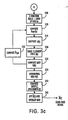
- M samples (in this case 256 overlap 128, though other values are possible) are taken from the inputs x ( t ) and y ( t ) in step 205 at 16 ms block intervals (8 KHz sampling rate).
- step 210 Sometimes a dc component exists with the inputs and so it is removed, step 210, using a common procedure well known to those skilled in the art.
- T denotes the transpose of a vector.
- step 230 the amount of delay between the two inputs, or D n , is estimated in step 230.
- the present canceller can still function, though not as optimally, even if steps 232, 234, 236, and 240 were eliminated, and step 245 were to be performed immediately after 230 using the same D n each time.
- step 250 an amplitude normalization is performed on the inputs using a gain normalization factor, Z which is initially set at 1, but which is continually updated in step 269 when the stated condition is met.
- ⁇ is near to 0, that indicates either a double-talk or only near-end speech or only silence.
- the coherence factor, ⁇ is used together with a non-linear energy function described in step 267 (see below) to further control the echo suppression.
- step 265 P x and P y are converted to Bark Scales P x ( b ) and P y ( b ) using the well-known Bark Frequency Warping technique.
- the gain normalization factor, Z is updated if the following conditions are met: ⁇ > ⁇ and E n >T n .
- step 275 it is determined whether ⁇ > ⁇ and E n > T n .
- ⁇ 0.65, though a different value may be optimal for ⁇ under different configuration, e.g., different microphone set-up. If the condition in step 275 is met, the transfer function H ( b ) is updated from its initial value of 1 in step 280. If the condition in step 275 is not met, then the step 285 is performed without updating the H ( b ).
- a buffer is provided to store M old values of P ⁇ y ( b ).
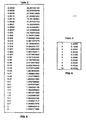
- the value of G s is found by referring to lookup Table 1 using the current value for ⁇ .
- steps 310, 315, 320, 325 and 330 are repeatedly performed for each sample block of input, each loop producing an updated value for the parameters involved.
- step 335 the G ( b ) is unwarped to produce G ( f ).
- step 345 the well-known inverse FFT (IFFT) and overlap add are performed on X ⁇ ( f ) and to produce an echo-free signal X ⁇ ( t ).
- IFFT inverse FFT
- the cross-correlation estimation technique employed here may be substituted with other techniques for determining the correction between two signals.
- the amplitude normalisation, the use of Hanning Window and Bark Scales while contributing to the effectiveness of the preferred embodiment of the present invention, may be eliminated under some circumstances without completely negating the function of the present invention.
- the Bark Scales are used in this case as way of reducing computation time and, therefore, may not unduly affect the performance of the present echo canceller.
- the Hanning Window was found to be optimal in this case, it may be replaced with other windows.
Landscapes
- Engineering & Computer Science (AREA)
- Signal Processing (AREA)
- Cable Transmission Systems, Equalization Of Radio And Reduction Of Echo (AREA)
Claims (14)
- Annuleur (1) d'écho acoustique pour un système de télécommunication apte à communiquer entre un haut parleur éloigné et un haut parleur proche, dit système ayant un microphone (25) et un haut parleur (23), le dit microphone recevant un signal de parole du haut parleur (30) proche, et un signal d'écho d'un signal de parole du haut parleur éloigné, émanant du dit haut parleur (23), le dit annuleur (1) d'écho comprenant :- des moyens aptes à réceptionner des échantillons de deux entrées provenant du système de télécommunication, x(t) et y(t), le dit y(t) étant le dit signal de parole provenant du dit haut parleur éloigné, le dit x(t) étant une combinaison du dit signal de parole du haut parleur proche et du dit signal d'écho de y(t) ;- des moyens (100) aptes à estimer une corrélation entre le x(t) et le y(t) ;- des moyens (120) aptes à estimer un retard entre le x (t) et le y(t) ;- des moyens (130) aptes à aligner x(t) et y(t) par décalage de temps de y (t) par le dit retard entre x(t) et y(t) ;Le dit annuleur d'écho étant caractérisé en ce qu'il comporte :- un moyen apte à transformer les signaux x(t) et décalés en temps y(t) en utilisant leur spectre dans un domaine de fréquence ;- des moyens (170) aptes à estimer une fonction de transfert en utilisant le spectre de x(t) et le spectre y(t) décalé dans le temps, et apte à normaliser le spectre de y(t) H décalé dans le temps, en utilisant la fonction de transfert ;- un moyen (175) apte à estimer une fonction de gain utilisant le spectre de x(t) et le spectre normalisé du y(t) décalé dans le temps ;- des moyens aptes à multiplier le spectre de x(t) par la dite fonction de gain ;- un moyen apte à transformer le spectre résultant en un signal en domaine de temps produisant un signal libre d'écho.
- Annuleur d'écho selon la revendication 1, caractérisé en ce qu'il comporte en outre des moyens aptes à appliquer une fenêtre de Hanning (150, 151).
- Annuleur d'écho selon l'une des revendications 1 ou 2, caractérisé en ce qu'il comporte en autre un moyen (165, 166) de distorsion d'échelle de Bark et des moyens (180) de redressement de distorsion d'échelle de Bark.
- Annuleur d'écho selon l'une des revendications précédentes, caractérisé en ce que 256 échantillons sont recueillis et recouvrant 128 échantillons dans des intervalles de blocs de 16ms.
- Annuleur d'écho selon l'une des revendications précédentes, caractérisé en ce qu'il comporte en outre un moyen (195) apte à l'addition de recouvrement.
- Procédé pour annuler un écho acoustique dans un système de télécommunication apte à la communication entre un haut parleur éloigné et un haut parleur proche (30), dit système comprenant un microphone (25) et un haut parleur (23), le dit microphone (25) recevant un signal de parole du dit haut parleur (30) proche et un signal d'écho du signal de parole du haut parleur proche, émanant du dit haut parleur (23), dit procédé comprenant les étapes de :a) recueillir (205) des échantillons de deux entrées provenant du système de télécommunication, x(t) et y(t), le dit y(t) étant le dit signal de parole du dit haut parleur éloigné, le dit x(t) étant une combinaison du dit signal de parole du haut parleur proche (30) et du dit signal d'écho du dit y(t) ;b) estimer (220) une corrélation entre le x(t) et y(t) ;c) estimer (230) un retard entre le x(t) et y(t) ;d) aligner (245) x(t) et y(t) par décalage de temps de y(t) du dit retard estimé dans l'étape c) ;Le dit procédé étant caractérisé en ce qu'il comporte les étapes suivantes :e) transformer (255) les signaux x(t) et y(t) décalés dans le temps en leurs spectres H dans un domaine de fréquence ;f) estimer une fonction de transfert en utilisant le spectre de y(t) et spectre de y(t) décalé dans le temps ;g) normaliser le spectre de y(t) décalé dans le temps en utilisant la fonction de transfert ;h) estimer (325) une fonction de gain H en utilisant le spectre de y(t) et le spectre normalisé de y(t) décalé dans le temps ;i) multiplier (340) le spectre de y(t) par la dite fonction de gain ;j) transformer (345) le dit spectre résultant de l'étape i) en un signal de domaine de temps produisant un signal libre d'écho.
- Procédé selon la revendication 6, caractérisé en ce qu'il comporte en outre l'étape d'appliquer (255) une fenêtre de Hanning après l'étape d).
- Procédé selon l'une des revendications 6 ou 7, caractérisé en ce qu'il comporte en outre l'étape de distorsion d'échelle de Bark (265) aux dits spectres après l'étape e) et de redressement de distorsion (355) après l'étape h).
- Procédé selon l'une des revendications 6 à 8, caractérisé en ce que 256 échantillons sont recueillis recouvrant 128 échantillons dans des intervalles de blocs de 16ms.
- Procédé selon l'une des revendications 6 à 9, caractérisé en ce qu'il comporte en outre l'étape de réaliser des ajouts de recouvrement (345).
- Annuleur d'écho acoustique selon l'une des revendications 1 à 5, caractérisé en ce que les moyens aptes à transformer les signaux en leurs spectres comportent en outre :- un moyen (140) apte à normaliser une amplitude de x(t) et de y(t) décalé dans le temps ;- un moyen (150) apte à appliquer une fenêtre de Hanning et transformer le dit signal normalisé x(t) et le signal normalisé y(t) décalé dans le temps en un domaine de fréquence où X(f)=xr (f)+jxi (f) et Y(f) = yr (f) + jyi (f) et où X(f) = FFT(x) et Y(f) = FFT(y);- un moyen (155,156) aptes à calculer un spectre de puissance Px et Py où Px = |xr (f)|+|xi (f)|+ε|xr (f)||xi (f)| et Py = |yr (f)|+|yi (f)| + ε|yr (f)||yi (f)|où ε est un facteur d'échelle qui contrôle la quantité d'écho et de bruit destinée à être supprimée ;- un moyen (165, 166) pour distorsion d'échelle de Bark Px et Py pour redresser la distorsion d'échelle de Bark Px (b) et Py (b);Or des moyens aptes à l'estimation de la fonction de transfert comportent en outre.- un moyen (170) apte à estimer une fonction de transfert H(b) normalisé Py (b) par la dite fonction de transfert ;Le moyen pour estimer la fonction de gain comporte en outre.- un moyen (175) apte à estimer une fonction de gain G (b), le dit G (b) étant calculé à partir de Px (b) et Py (b) ;- les moyens aptes à multiplier comportent en outre :- un moyen (180) apte à redresser la distorsion d'échelle de Bark du dit G (b) pour produire G (f) ;- un moyen apte à multiplier le dit signal X (f) par la dite fonction de gain G (f) pour produire X̃(f) ; etles moyens aptes à transformer en un signal à domaine de temps comportent en outre un moyen (190) apte à réaliser une transformation inverse et un ajout de recouvrement (195) pour convertir le dit signal X̃(f) pour produire un signal X̃ (t) libre d'écho.
- Annuleur d'écho acoustique selon la revendication 11, caractérisé en ce qu'il comporte en outre un moyen apte à mettre à jour le dit retard, le dit retard étant mis à jour sur la base d'une valeur de la dite corrélation entre x (t) et y (t).
- Annuleur d'écho selon l'une des revendications 11 ou 12, caractérisé en ce que le dit H(b) est calculé comme suit :

- Annuleur d'écho acoustique selon l'une des revendications 11 à 13, caractérisé en ce que G(b)= Rrpr (b)L̅b (b) où L̅ (b) est un facteur qui varie par rapport à Lb=Rrpr (b)Rpo (b);
Où
Où
γ est un facteur de lissage avec γ < 1;


Et
Où P̅y (b) est normalisé à l'échelle de Bark Py (b);
Où Gs est un facteur qui varie par rapport au facteur de cohérence Φ et
Applications Claiming Priority (2)
| Application Number | Priority Date | Filing Date | Title |
|---|---|---|---|
| SG9702744 | 1997-08-01 | ||
| SG1997002744A SG71035A1 (en) | 1997-08-01 | 1997-08-01 | Acoustic echo canceller |
Publications (4)
| Publication Number | Publication Date |
|---|---|
| EP0895397A2 EP0895397A2 (fr) | 1999-02-03 |
| EP0895397A3 EP0895397A3 (fr) | 1999-08-18 |
| EP0895397B1 EP0895397B1 (fr) | 2006-08-23 |
| EP0895397B9 true EP0895397B9 (fr) | 2007-01-17 |
Family
ID=20429709
Family Applications (1)
| Application Number | Title | Priority Date | Filing Date |
|---|---|---|---|
| EP98306066A Expired - Lifetime EP0895397B9 (fr) | 1997-08-01 | 1998-07-30 | Annuleur d'écho acoustique |
Country Status (4)
| Country | Link |
|---|---|
| US (1) | US6249581B1 (fr) |
| EP (1) | EP0895397B9 (fr) |
| DE (1) | DE69835644T2 (fr) |
| SG (1) | SG71035A1 (fr) |
Cited By (1)
| Publication number | Priority date | Publication date | Assignee | Title |
|---|---|---|---|---|
| CN109448748A (zh) * | 2018-12-17 | 2019-03-08 | 杭州嘉楠耘智信息科技有限公司 | 一种用于回声消除的滤波方法及装置、设备、介质 |
Families Citing this family (34)
| Publication number | Priority date | Publication date | Assignee | Title |
|---|---|---|---|---|
| DE19850272A1 (de) * | 1998-10-31 | 2000-05-04 | Alcatel Sa | Verfahren zur Verbesserung der Echounterdrückung in einem Telekommunikaionssystem |
| FR2802367B1 (fr) | 1999-12-14 | 2006-08-18 | France Telecom | Procede temps reel de traitement et de gestion pour l'annulation d'echo entre haut-parleur et microphone d'un terminal informatique |
| AU3039900A (en) | 1999-12-17 | 2001-06-25 | Nokia Corporation | A delay measurement system in a packet network |
| US6622030B1 (en) | 2000-06-29 | 2003-09-16 | Ericsson Inc. | Echo suppression using adaptive gain based on residual echo energy |
| US6766019B1 (en) * | 2000-07-21 | 2004-07-20 | Agere Systems Inc. | Method and apparatus for performing double-talk detection in acoustic echo cancellation |
| DE10043064B4 (de) * | 2000-09-01 | 2004-07-08 | Dietmar Dr. Ruwisch | Verfahren und Vorrichtung zur Elimination von Lautsprecherinterferenzen aus Mikrofonsignalen |
| DE60232316D1 (de) * | 2001-02-27 | 2009-06-25 | Smith & Nephew Inc | Vorrichtung zur totalen knierekonstruktion |
| US7547307B2 (en) * | 2001-02-27 | 2009-06-16 | Smith & Nephew, Inc. | Computer assisted knee arthroplasty instrumentation, systems, and processes |
| US6889066B2 (en) * | 2001-03-27 | 2005-05-03 | Qualcomm Incorporated | Network echo suppression in mobile stations |
| EP1413168A2 (fr) * | 2001-07-20 | 2004-04-28 | Koninklijke Philips Electronics N.V. | Systeme amplificateur de son equipe d'un dispositif de suppression d'echo et d'un dispositif de formation de faisceaux de haut-parleurs |
| EP1413167A2 (fr) * | 2001-07-20 | 2004-04-28 | Koninklijke Philips Electronics N.V. | Systeme de renforcement sonore suppresseur d'echo pour plusieurs microphones sous forme de postprocesseur |
| AU2003217389B2 (en) | 2002-02-11 | 2008-10-30 | Smith & Nephew, Inc. | Image-guided fracture reduction |
| US7409057B1 (en) | 2002-07-03 | 2008-08-05 | Marvell International Ltd. | Nonlinear echo compensator for class B transmitter line driver |
| US7272224B1 (en) * | 2003-03-03 | 2007-09-18 | Apple Inc. | Echo cancellation |
| US7363334B2 (en) * | 2003-08-28 | 2008-04-22 | Accoutic Processing Technology, Inc. | Digital signal-processing structure and methodology featuring engine-instantiated, wave-digital-filter componentry, and fabrication thereof |
| US20050065778A1 (en) * | 2003-09-24 | 2005-03-24 | Mastrianni Steven J. | Secure speech |
| US7862570B2 (en) | 2003-10-03 | 2011-01-04 | Smith & Nephew, Inc. | Surgical positioners |
| US7764985B2 (en) | 2003-10-20 | 2010-07-27 | Smith & Nephew, Inc. | Surgical navigation system component fault interfaces and related processes |
| AU2004291146B2 (en) | 2003-11-14 | 2011-08-25 | Smith & Nephew, Inc. | Adjustable surgical cutting systems |
| JP2007531596A (ja) | 2004-03-31 | 2007-11-08 | スミス アンド ネフュー インコーポレーテッド | 基準アレイ入力装置を提供する方法及び装置 |
| EP1737375B1 (fr) | 2004-04-21 | 2021-08-11 | Smith & Nephew, Inc | Systemes de navigation assistes par ordinateur pour arthroplastie de l'epaule |
| US7395790B2 (en) * | 2004-11-18 | 2008-07-08 | S&S Cycle, Inc. | Reed valve breather for evolution engine |
| WO2006091704A1 (fr) | 2005-02-22 | 2006-08-31 | Smith & Nephew, Inc. | Systeme de fraisage en ligne |
| WO2006111370A1 (fr) * | 2005-04-19 | 2006-10-26 | Epfl (Ecole Polytechnique Federale De Lausanne) | Procede et dispositif permettant de supprimer un echo dans un signal audio multicanal |
| US7647077B2 (en) | 2005-05-31 | 2010-01-12 | Bitwave Pte Ltd | Method for echo control of a wireless headset |
| US7856098B1 (en) * | 2005-09-15 | 2010-12-21 | Mindspeed Technologies, Inc. | Echo cancellation and control in discrete cosine transform domain |
| DE102008039329A1 (de) * | 2008-01-25 | 2009-07-30 | Fraunhofer-Gesellschaft zur Förderung der angewandten Forschung e.V. | Vorrichtung und Verfahren zur Berechnung von Steuerinformationen für ein Echounterdrückungsfilter und Vorrichtung und Verfahren zur Berechnung eines Verzögerungswerts |
| NO332437B1 (no) * | 2010-01-18 | 2012-09-17 | Cisco Systems Int Sarl | Apparat og fremgangsmate for a supprimere et akustisk ekko |
| EP2710787A1 (fr) * | 2011-05-17 | 2014-03-26 | Google, Inc. | Post-traitement non-linéaire pour annulation d'écho acoustique |
| US9065895B2 (en) * | 2012-02-22 | 2015-06-23 | Broadcom Corporation | Non-linear echo cancellation |
| WO2014066367A1 (fr) * | 2012-10-23 | 2014-05-01 | Interactive Intelligence, Inc. | Système et procédé de suppression de l'écho acoustique |
| US9083782B2 (en) * | 2013-05-08 | 2015-07-14 | Blackberry Limited | Dual beamform audio echo reduction |
| CN103414453B (zh) * | 2013-08-19 | 2016-02-24 | 北京无线电计量测试研究所 | 一种频率源短稳参数数字化检测方法及装置 |
| CN111917926B (zh) * | 2019-05-09 | 2021-08-06 | 上海触乐信息科技有限公司 | 一种通信终端中的回声消除方法、装置及终端设备 |
Family Cites Families (12)
| Publication number | Priority date | Publication date | Assignee | Title |
|---|---|---|---|---|
| US3699271A (en) * | 1970-11-16 | 1972-10-17 | Bell Telephone Labor Inc | Speech processor using multiband controlled center clipping |
| US3784747A (en) * | 1971-12-03 | 1974-01-08 | Bell Telephone Labor Inc | Speech suppression by predictive filtering |
| DE3118473C2 (de) * | 1981-05-09 | 1987-02-05 | Felten & Guilleaume Fernmeldeanlagen GmbH, 8500 Nürnberg | Verfahren zur Aufbereitung elektrischer Signale mit einer digitalen Filteranordnung |
| US4644108A (en) * | 1982-10-27 | 1987-02-17 | International Business Machines Corporation | Adaptive sub-band echo suppressor |
| US4562312A (en) * | 1983-02-17 | 1985-12-31 | At&T Bell Laboratories | Subsampling delay estimator for an echo canceler |
| US4951269A (en) * | 1986-10-30 | 1990-08-21 | Fujitsu Limited | Echo canceller with short processing delay and decreased multiplication number |
| NL8701633A (nl) * | 1987-07-10 | 1989-02-01 | Philips Nv | Digitale echocompensator. |
| US5588089A (en) * | 1990-10-23 | 1996-12-24 | Koninklijke Ptt Nederland N.V. | Bark amplitude component coder for a sampled analog signal and decoder for the coded signal |
| US5450522A (en) * | 1991-08-19 | 1995-09-12 | U S West Advanced Technologies, Inc. | Auditory model for parametrization of speech |
| DE4316297C1 (de) * | 1993-05-14 | 1994-04-07 | Fraunhofer Ges Forschung | Frequenzanalyseverfahren |
| JP3447060B2 (ja) * | 1994-04-12 | 2003-09-16 | コーニンクレッカ フィリップス エレクトロニクス エヌ ヴィ | エコー消去を改善した信号増幅システム |
| US5659619A (en) * | 1994-05-11 | 1997-08-19 | Aureal Semiconductor, Inc. | Three-dimensional virtual audio display employing reduced complexity imaging filters |
-
1997
- 1997-08-01 SG SG1997002744A patent/SG71035A1/en unknown
-
1998
- 1998-07-29 US US09/124,804 patent/US6249581B1/en not_active Expired - Lifetime
- 1998-07-30 DE DE69835644T patent/DE69835644T2/de not_active Expired - Fee Related
- 1998-07-30 EP EP98306066A patent/EP0895397B9/fr not_active Expired - Lifetime
Cited By (2)
| Publication number | Priority date | Publication date | Assignee | Title |
|---|---|---|---|---|
| CN109448748A (zh) * | 2018-12-17 | 2019-03-08 | 杭州嘉楠耘智信息科技有限公司 | 一种用于回声消除的滤波方法及装置、设备、介质 |
| CN109448748B (zh) * | 2018-12-17 | 2021-08-03 | 嘉楠明芯(北京)科技有限公司 | 一种用于回声消除的滤波方法及装置、设备、介质 |
Also Published As
| Publication number | Publication date |
|---|---|
| EP0895397A2 (fr) | 1999-02-03 |
| DE69835644D1 (de) | 2006-10-05 |
| EP0895397B1 (fr) | 2006-08-23 |
| DE69835644T2 (de) | 2007-08-23 |
| SG71035A1 (en) | 2000-03-21 |
| EP0895397A3 (fr) | 1999-08-18 |
| US6249581B1 (en) | 2001-06-19 |
Similar Documents
| Publication | Publication Date | Title |
|---|---|---|
| EP0895397B1 (fr) | Annuleur d'écho acoustique | |
| US7742592B2 (en) | Method and device for removing echo in an audio signal | |
| US8594320B2 (en) | Hybrid echo and noise suppression method and device in a multi-channel audio signal | |
| CN110838300B (zh) | 回声消除的处理方法及处理系统 | |
| EP0843934B1 (fr) | Montage utilise pour supprimer une composante parasite dans un signal d'entree | |
| US7062040B2 (en) | Suppression of echo signals and the like | |
| JP2936101B2 (ja) | デジタルエコーキャンセラ | |
| US7684559B2 (en) | Acoustic echo suppressor for hands-free speech communication | |
| EP1855457B1 (fr) | Annulation d'écho à canaux multiples à l'aide d'une étape de décorrélation | |
| JP2538176B2 (ja) | エコ―制御装置 | |
| US9426279B2 (en) | Systems and methods for echo cancellation and echo suppression | |
| JP4975073B2 (ja) | デジタル適応フィルタと同フィルタを用いたアコスティックエコーキャンセラ | |
| EP0932142B1 (fr) | Système intégré d'amélioration de parole dans un véhicule et système de téléphone cellulaire mobile à mains-libre | |
| EP0769867A2 (fr) | Annuleur d'écho acoustique par bandes partielles | |
| JP2009065699A (ja) | 音響エコーの相殺および抑制を実行する利得制御方法 | |
| US20030185402A1 (en) | Adaptive distortion manager for use with an acoustic echo canceler and a method of operation thereof | |
| JP3420705B2 (ja) | エコー抑圧方法及び装置並びにエコー抑圧プログラムが記憶されたコンピュータに読取り可能な記憶媒体 | |
| CN106533500A (zh) | 一种优化回声消除器收敛特性的方法 | |
| JP3507020B2 (ja) | 反響抑圧方法、反響抑圧装置及び反響抑圧プログラム記憶媒体 | |
| US6834108B1 (en) | Method for improving acoustic noise attenuation in hand-free devices | |
| US20080267420A1 (en) | Methods and systems for reducing acoustic echoes in multichannel audio-communication systems | |
| JP3756839B2 (ja) | 反響低減方法、反響低減装置、反響低減プログラム | |
| Mohammed | A new adaptive beamformer for optimal acoustic echo and noise cancellation with less computational load | |
| US6694020B1 (en) | Frequency domain stereophonic acoustic echo canceller utilizing non-linear transformations | |
| US8369511B2 (en) | Robust method of echo suppressor |
Legal Events
| Date | Code | Title | Description |
|---|---|---|---|
| PUAI | Public reference made under article 153(3) epc to a published international application that has entered the european phase |
Free format text: ORIGINAL CODE: 0009012 |
|
| AK | Designated contracting states |
Kind code of ref document: A2 Designated state(s): DE ES FR GB IT |
|
| AX | Request for extension of the european patent |
Free format text: AL;LT;LV;MK;RO;SI |
|
| PUAL | Search report despatched |
Free format text: ORIGINAL CODE: 0009013 |
|
| AK | Designated contracting states |
Kind code of ref document: A3 Designated state(s): AT BE CH CY DE DK ES FI FR GB GR IE IT LI LU MC NL PT SE |
|
| AX | Request for extension of the european patent |
Free format text: AL;LT;LV;MK;RO;SI |
|
| 17P | Request for examination filed |
Effective date: 20000115 |
|
| AKX | Designation fees paid |
Free format text: DE ES FR GB IT |
|
| 17Q | First examination report despatched |
Effective date: 20040129 |
|
| GRAP | Despatch of communication of intention to grant a patent |
Free format text: ORIGINAL CODE: EPIDOSNIGR1 |
|
| GRAS | Grant fee paid |
Free format text: ORIGINAL CODE: EPIDOSNIGR3 |
|
| GRAA | (expected) grant |
Free format text: ORIGINAL CODE: 0009210 |
|
| AK | Designated contracting states |
Kind code of ref document: B1 Designated state(s): DE ES FR GB IT |
|
| PG25 | Lapsed in a contracting state [announced via postgrant information from national office to epo] |
Ref country code: IT Free format text: LAPSE BECAUSE OF FAILURE TO SUBMIT A TRANSLATION OF THE DESCRIPTION OR TO PAY THE FEE WITHIN THE PRESCRIBED TIME-LIMIT;WARNING: LAPSES OF ITALIAN PATENTS WITH EFFECTIVE DATE BEFORE 2007 MAY HAVE OCCURRED AT ANY TIME BEFORE 2007. THE CORRECT EFFECTIVE DATE MAY BE DIFFERENT FROM THE ONE RECORDED. Effective date: 20060823 |
|
| REG | Reference to a national code |
Ref country code: GB Ref legal event code: FG4D |
|
| REF | Corresponds to: |
Ref document number: 69835644 Country of ref document: DE Date of ref document: 20061005 Kind code of ref document: P |
|
| PG25 | Lapsed in a contracting state [announced via postgrant information from national office to epo] |
Ref country code: ES Free format text: LAPSE BECAUSE OF FAILURE TO SUBMIT A TRANSLATION OF THE DESCRIPTION OR TO PAY THE FEE WITHIN THE PRESCRIBED TIME-LIMIT Effective date: 20061204 |
|
| ET | Fr: translation filed | ||
| REG | Reference to a national code |
Ref country code: FR Ref legal event code: CA |
|
| PLBE | No opposition filed within time limit |
Free format text: ORIGINAL CODE: 0009261 |
|
| STAA | Information on the status of an ep patent application or granted ep patent |
Free format text: STATUS: NO OPPOSITION FILED WITHIN TIME LIMIT |
|
| 26N | No opposition filed |
Effective date: 20070524 |
|
| PGFP | Annual fee paid to national office [announced via postgrant information from national office to epo] |
Ref country code: DE Payment date: 20080731 Year of fee payment: 11 |
|
| PGFP | Annual fee paid to national office [announced via postgrant information from national office to epo] |
Ref country code: FR Payment date: 20080630 Year of fee payment: 11 |
|
| PGFP | Annual fee paid to national office [announced via postgrant information from national office to epo] |
Ref country code: GB Payment date: 20080704 Year of fee payment: 11 |
|
| GBPC | Gb: european patent ceased through non-payment of renewal fee |
Effective date: 20090730 |
|
| REG | Reference to a national code |
Ref country code: FR Ref legal event code: ST Effective date: 20100331 |
|
| PG25 | Lapsed in a contracting state [announced via postgrant information from national office to epo] |
Ref country code: FR Free format text: LAPSE BECAUSE OF NON-PAYMENT OF DUE FEES Effective date: 20090731 |
|
| PG25 | Lapsed in a contracting state [announced via postgrant information from national office to epo] |
Ref country code: GB Free format text: LAPSE BECAUSE OF NON-PAYMENT OF DUE FEES Effective date: 20090730 |
|
| PG25 | Lapsed in a contracting state [announced via postgrant information from national office to epo] |
Ref country code: DE Free format text: LAPSE BECAUSE OF NON-PAYMENT OF DUE FEES Effective date: 20100202 |