EP0888810A1 - Composite reverse osmosis membrane and method of reverse osmotic treatment of water using the same - Google Patents
Composite reverse osmosis membrane and method of reverse osmotic treatment of water using the same Download PDFInfo
- Publication number
- EP0888810A1 EP0888810A1 EP97907348A EP97907348A EP0888810A1 EP 0888810 A1 EP0888810 A1 EP 0888810A1 EP 97907348 A EP97907348 A EP 97907348A EP 97907348 A EP97907348 A EP 97907348A EP 0888810 A1 EP0888810 A1 EP 0888810A1
- Authority
- EP
- European Patent Office
- Prior art keywords
- reverse osmosis
- composite membrane
- osmosis composite
- water
- membrane
- Prior art date
- Legal status (The legal status is an assumption and is not a legal conclusion. Google has not performed a legal analysis and makes no representation as to the accuracy of the status listed.)
- Granted
Links
Images


Classifications
-
- B—PERFORMING OPERATIONS; TRANSPORTING
- B01—PHYSICAL OR CHEMICAL PROCESSES OR APPARATUS IN GENERAL
- B01D—SEPARATION
- B01D67/00—Processes specially adapted for manufacturing semi-permeable membranes for separation processes or apparatus
- B01D67/0081—After-treatment of organic or inorganic membranes
- B01D67/0088—Physical treatment with compounds, e.g. swelling, coating or impregnation
-
- B—PERFORMING OPERATIONS; TRANSPORTING
- B01—PHYSICAL OR CHEMICAL PROCESSES OR APPARATUS IN GENERAL
- B01D—SEPARATION
- B01D69/00—Semi-permeable membranes for separation processes or apparatus characterised by their form, structure or properties; Manufacturing processes specially adapted therefor
- B01D69/12—Composite membranes; Ultra-thin membranes
- B01D69/125—In situ manufacturing by polymerisation, polycondensation, cross-linking or chemical reaction
- B01D69/1251—In situ manufacturing by polymerisation, polycondensation, cross-linking or chemical reaction by interfacial polymerisation
-
- C—CHEMISTRY; METALLURGY
- C02—TREATMENT OF WATER, WASTE WATER, SEWAGE, OR SLUDGE
- C02F—TREATMENT OF WATER, WASTE WATER, SEWAGE, OR SLUDGE
- C02F1/00—Treatment of water, waste water, or sewage
- C02F1/44—Treatment of water, waste water, or sewage by dialysis, osmosis or reverse osmosis
- C02F1/441—Treatment of water, waste water, or sewage by dialysis, osmosis or reverse osmosis by reverse osmosis
-
- Y—GENERAL TAGGING OF NEW TECHNOLOGICAL DEVELOPMENTS; GENERAL TAGGING OF CROSS-SECTIONAL TECHNOLOGIES SPANNING OVER SEVERAL SECTIONS OF THE IPC; TECHNICAL SUBJECTS COVERED BY FORMER USPC CROSS-REFERENCE ART COLLECTIONS [XRACs] AND DIGESTS
- Y02—TECHNOLOGIES OR APPLICATIONS FOR MITIGATION OR ADAPTATION AGAINST CLIMATE CHANGE
- Y02A—TECHNOLOGIES FOR ADAPTATION TO CLIMATE CHANGE
- Y02A20/00—Water conservation; Efficient water supply; Efficient water use
- Y02A20/124—Water desalination
- Y02A20/131—Reverse-osmosis
Definitions
- the present invention relates to improvements in the performance of a reverse osmosis composite membrane such as performance stability and fouling tolerance for selectively separating the components of a liquid mixture. More particularly, the present invention relates to a reverse osmosis composite membrane having a high salt rejection, a high chlorine tolerance, and a high fouling tolerance, which comprises a polymer thin film on the reverse osmosis composite membrane, and to a reverse osmosis treatment method for water using the same.
- Such a reverse osmosis composite membrane is suitable for manufacturing ultrapure water, desalinating brackish water, and the like, and it also can contribute to the removal and recovery of the contaminating sources or effective substances from a soil or the like, the cause of pollution in a dyeing waste water system, an electrochemical deposition paint waste water system, or a domestic waste water system to implement a waste water recycling system.
- it can operate stably for a long period with respect to the quality of water containing various membrane-fouling substances, such as surfactants and transition metal components including iron, which cause a decrease in flux.
- reverse osmosis membranes examples include Loeb type membranes described in U.S. Patent Nos. 3133132 and 3133137 as asymmetric membranes made of cellulose acetate.
- reverse osmosis composite membranes in which an active thin film substantially having a selective separation property is formed on a microporous support film, are known as reverse osmosis membranes having a different structure from the asymmetric reverse osmosis membranes.
- various methods for after treatment of the reverse osmosis membrane are disclosed.
- methods using various polymers as a protective layer are disclosed (for example, Publication of Japanese Patent Application (Tokkai Sho) No. 51-13388, Publication of Japanese Patent Application (Tokkai Sho) No. 53-16372, Publication of Japanese Patent Application (Tokkai Sho) No. 62-197105, and Publication of Japanese Patent Application (Tokko Hei) No. 7-90152).
- One fouling mechanism includes the charge condition of the membrane.
- the surface of a cross-linked polyamide reverse osmosis membrane obtained by interfacial polymerization of polyfunctional aromatic amine and polyfunctional alicyclic acid halide has a negative charge due to the residual carboxylic acid.
- the membrane surface having negative charge adsorbs, for example, cationic fouling substances, decreasing the flux. Therefore, a membrane has been required that is neutral in charge and has a high water permeability and a high salt rejection.
- the present invention provides a reverse osmosis composite membrane comprising a sponge layer and a separation layer formed on a surface of the sponge layer, wherein the surface zeta ( ⁇ ) potential of the skin layer is controlled within ⁇ 10mV at pH 6.
- the surface zeta ( ⁇ ) potential of such a membrane can be measured by using an electrophoretic light scattering device or the like.
- the surface zeta potential is within ⁇ 10mV preferably in the range of pH 6 to 8, in which pH range the reverse osmosis composite membrane is used, and more preferably, in the range of pH 5 to 11.
- a surface of the reverse osmosis composite membrane in which an absolute value of the surface zeta ( ⁇ ) potential is greater than ⁇ 10mV in the range of pH 5 to 11 is coated with at least one substance selected from the group consisting of an electrically neutral organic substance and an electrically neutral polymer. Electroneutrality is preferred for controlling the electrical adsorption of membrane-fouling substances having a charge group present in water by the membrane.
- the at least one substance selected from the group consisting of an electrically neutral organic substance and an electrically neutral polymer is an organic substance or a polymer that has a nonionic hydrophilic group (for example, a ⁇ OH group). Because, in addition to the electroneutrality, adsorption due to a hydrophobic interaction on the membrane is controlled when the membrane-fouling substances have a hydrophobic group.
- the organic substance or the polymer that has a nonionic hydrophilic group is polyvinyl alcohol that is water-insoluble at 25°C and is water-soluble at 80°C.
- polyvinyl alcohol controls the adsorption of the membrane-fouling substances.
- polyvinyl alcohol that is water-insoluble at a temperature of more than 80°C has a small number of alcohol groups, so that such polyvinyl alcohol does not tend to control the adsorption of the membrane-fouling substances.
- the polyvinyl alcohol has a saponification degree of 95% or more, because a sufficient number of alcohol groups can be obtained.
- the thickness of the organic substance or the polymer that has a nonionic hydrophilic group is in the range of 0.001 to 1 ⁇ m. If the thickness is more than 1 ⁇ m, the water permeability obtained after the coating decreases significantly. If the thickness is less than 0.001 ⁇ m, a uniform coating will be difficult.
- the reverse osmosis composite membrane in which an absolute value of the surface zeta ( ⁇ ) potential before treatment is greater than ⁇ 10mV in the range of pH 5 to 11 has a flux of 0.6 [m 3 /m 2 /day] or more in a reverse osmosis test conducted by feeding a 500 ppm NaCl solution at a pressure of 7.5 kg/cm 2 and a temperature of 25°C to ensure a sufficient flux after the coating.
- the reverse osmosis composite membrane has a flux of 0.6 [m 3 /m 2 /day] or more in a reverse osmosis test conducted by feeding a 1,500 ppm NaCl solution at a pressure of 15 kg/cm 2 and a temperature of 25°C to ensure a sufficient flux at a practical level.
- the reverse osmosis composite membrane is formed of aromatic polyamide.
- the aromatic polyamide refers to polyamide in which at least one component selected from the group consisting of an acid component and an amine component is aromatic.
- the preferred aromatic polyamide is a completely aromatic polyamide comprising an aromatic acid component and an aromatic amine component.
- Such aromatic polyamide can maintain a high water permeability and a high salt rejection.
- the present invention provides a reverse osmosis treatment method for water comprising using any of the reverse osmosis composite membranes of the present invention.
- the reverse osmosis treatment method it is preferable that water containing a surfactant is fed to the reverse osmosis composite membrane as raw water.
- the membrane adsorbs a surfactant, so that a stable performance cannot be obtained.
- the adsorption of the surfactant by the membrane is controlled. Therefore, a stable reverse osmosis treatment can be conducted for water containing a surfactant without decreasing the separation performance.
- the content of the surfactant is in the range of 0.01 ppm to 20 wt.%.
- the content of the surfactant can be in any range. If the content is in the range of 0.01 ppm to 20 wt.%, a sufficient surface potential property of the present invention can be provided.
- the reverse osmosis treatment method it is preferable that water containing a transition metal component is fed to the reverse osmosis composite membrane as raw water.
- the membrane adsorbs a transition metal component, so that a stable performance cannot be obtained.
- the reverse osmosis composite membrane of the present invention the adsorption of the transition metal component by the membrane is controlled. Therefore, a stable reverse osmosis treatment can be conducted for water containing a transition metal component without decreasing the separation performance.
- the transition metal component is iron, because the reverse osmosis composite membrane of the present invention can control the adsorption of the iron component sufficiently.
- the content of the transition metal component is in the range of 0.01 ppm to 20 wt.%.
- the content of the transition metal component can be in any range. If the content of the transition metal component is in the range of 0.01 ppm to 20 wt.%, a sufficient surface potential property of the present invention can be provided.
- the method for controlling the surface ⁇ potential of the present invention is not particularly limited.
- the surface of the reverse osmosis composite membrane is preferably treated with at least one substance selected from the group consisting of an electrically neutral organic substance and an electrically neutral polymer, and more preferably, at least one substance selected from the group consisting of an organic substance and a polymer that has a nonionic hydrophilic group.
- Such at least one substance selected from the group consisting of an electrically neutral organic substance and an electrically neutral polymer is an organic substance or a polymer that has a cationic group and an anionic group, which is prepared as a copolymer or a blend.
- a suitable nonionic hydrophilic group are expressed by the following Formulae 1 to 4: HO ⁇ ⁇ CONH 2 ⁇ ⁇ CH 2 CH 2 OR ⁇ (wherein R represents an alkyl group having 1 to 4 carbon atoms.)
- This organic substance or polymer that has a nonionic hydrophilic group is selected from the group consisting of vinyl polymers, condensation polymerized compounds, and addition polymerized compounds each having a nonionic hydrophilic group, such as polyvinyl alcohol, a saponified polyethylene-vinyl acetate copolymer, polyvinyl pyrrolidone, hydroxypropyl cellulose, and polyethylene glycol.
- a more preferable polymer having a nonionic hydrophilic group is water-insoluble at 25 °C and is hot-water-soluble, for example, polyvinyl alcohol.
- the saponification degree of polyvinyl alcohol is 95% or more, and more preferably in the range of 99 to 100%.
- the polyvinyl alcohol is water-insoluble at 25°C due to hydrogen bonding between molecular chains but is water-soluble at 80°C. Satisfying these conditions is preferable because of the following reasons. Since many ⁇ OH groups are in contact with treated water on the surface of the membrane, the hydrophilicity increases. Thus, the tolerance to fouling substances increases and the decrease of the flux involved in the treatment is controlled. Therefore, the membrane can provide a very good performance.
- the reverse osmosis composite membrane is not particularly limited.
- the examples of the reverse osmosis composite membranes are polyamide, polyurea and the like, manufactured by an interfacial polymerization method. These membranes can be readily obtained by conventionally known methods. For example, at least one surface of a porous polysulfone support film is coated with an aqueous solution of a monomer or a polymer that has a reactive amino group such as metaphenylenediamine, piperazine, or polyethyleneimine, and the coated surface is contacted with a solution in which a polyfunctional acid chloride such as trimesic acid chloride or isophthalic acid chloride, a polyfunctional isocyanate such as tolylenediisocyanate, or a mixture thereof is dissolved in a solvent such as hexane, to perform interfacial polymerization on the porous polysulfone support film to form a thin film having desalination properties.
- a polyfunctional acid chloride such as trime
- a reverse osmosis composite membrane can be made.
- the absolute value of the surface ⁇ potential is greater than 10 mV in the range of pH 5 to 11 due to the effect of the residual functional groups.
- the thus obtained reverse osmosis composite membrane is coated with a solution of the organic substance or the polymer and dried to obtain a final reverse osmosis composite membrane in which surface charge is controlled.
- This organic substance or polymer that has a nonionic hydrophilic group is dissolved in a solvent that is not likely to damage the active thin film layer of the reverse osmosis composite membrane, such as water, lower alcohol, hydrocarbon halide, aliphatic hydrocarbon, acetone, acetonitrile, or a mixture thereof.
- aliphatic alcohols such as methanol, ethanol, propanol, and butanol
- aliphatic alcohol halide such as ethylene chlorohydrin
- methoxymethanol methoxyethanol
- a mixed solvent of at least one of these lower alocohols and water are preferable.
- the ratio of the lower alcohol to water is not particularly limited.
- the ratio of water is preferably 0 to 90%.
- a surfactant is preferably added to improve the wettability for the membrane.
- the concentration of the organic substance or the polymer prepared by using the solvent is preferably in the range of 0.01 to 20 wt.%, and more preferably, 0.05 to 5 wt.%.
- the coating method is not particularly limited. A dipping method, a transfer method, a spraying method, or the like is preferably used.
- the drying means and the drying temperature after the coating are not particularly limited. The drying temperature is preferably in the range of 20 to 200°C, and more preferably, 50 to 150°C.
- the thickness of the thus obtained thin film on the reverse osmosis composite membrane is preferably in the range of 0.001 to 1 ⁇ m, and more preferably, 0.005 to 0.5 ⁇ m to control the decrease of the flux caused by the coating.
- the method for controlling the thickness is not particularly limited. The thickness can be controlled by the concentration of the solution, or the like.
- the surface charge can be controlled by mixing the organic substance or the polymer with an aqueous solution of the monomer or the polymer that has a reactive amino group or a solution of acid chloride or isocyanate dissolved in a solvent such as hexane, and manufacturing a reverse osmosis composite membrane according to the above procedure.
- the lower alcohol is preferably added to at least one of the solutions, to which the polymer is added, to provide the solubility of the polymer.
- the performance of the reverse osmosis composite membrane is not particularly limited.
- the flux is preferably 0.6 [m 3 /m 2 /day] or more in a reverse osmosis test conducted by feeding a 500 ppm NaCl solution at a pressure of 7.5 kg/cm 2 and a temperature of 25°C to maintain a high water permeability of the reverse osmosis composite membrane after the treatment with the organic substance or the polymer.
- the water permeability of the reverse osmosis composite membrane obtained after the treatment with the organic substance or the polymer is not particularly limited.
- the flux is preferably 0.6 [m 3 /m 2 /day] or more in a reverse osmosis test conducted by feeding a 1,500 ppm NaCl solution at a pressure of 15 kg/cm 2 and a temperature of 25°C.
- the flux of the reverse osmosis composite membrane having a water-insoluble polymer having a nonionic hydrophilic group as a surface layer or in the separation layer is preferably 0.1 [m 3 /m 2 /day] or more, and more preferably, 0.6 [m 3 /m 2 /day] or more in view of practical operation when evaluated by feeding a 1,500 ppm NaCl solution at a pressure of 15 kg/cm 2 and a temperature of 25°C.
- Figs. 1-2 are schematic cross-sectional views of the embodiments of the present invention.
- a separation layer 2 is present on a porous layer 1.
- a thin film 3 of polyvinyl alcohol is present as the surface layer of the separation layer 2.
- Fig. 2 shows a layer (portion) in which a polyvinyl alcohol component 4 and a separation layer 5 are present in a phase separation condition on the porous layer 1.
- the polyvinyl alcohol component need not be in the shape of a thin film.
- the conditions of Figs. 1 and 2 may be combined.
- PVA polyvinyl alcohol
- the reverse osmosis composite membrane was coated with this solution and dried at 130°C for 5 minutes. As a result, a PVA coating film having an average thickness of about 0.1 ⁇ m was obtained.
- the performance of the reverse osmosis composite membrane having the PVA coating film was evaluated by using an aqueous solution containing 1,500 ppm of sodium chloride at a pressure of 15 kgf/cm 2 and is shown in Table 1.
- the reverse osmosis composite membrane was cut to a size of about 30 ⁇ 60 mm, and set in a cell for a flat sheet sample attached to the measurement device.
- the standard particle for electrophoresis was a polystyrene particle (520 nm) whose surface was coated with hydroxypropyl cellulose.
- a 10 mM NaCl solution in which the polystyrene particles were dispersed was used.
- this solution was adjusted to the pH for the measurement by using an aqueous solution of HCl or NaOH.
- Fig. 3 shows the result of the pH dependency of the surface zeta ( ⁇ ) potential.
- the membrane was set in a flat membrane cell, and the flux of pure water (evaluated at a pressure of 15 kgf/cm 2 ) was evaluated before and after an aqueous solution containing 1,000 ppm of a cationic surfactant was pressure circulated at a pressure of 15 kgf/cm 2 for 17 hours.
- the results are shown in Table 2.
- Example 2 The same measurements as in Example 1 were made by using a reverse osmosis composite membrane before surface coating with polyvinyl alcohol. The results are shown in Table 2. Sample Surface zeta ⁇ potential at pH 6 [mV] Flux-1 [m 3 /m 2 /day] Flux-2 [m 3 /m 2 /day] Retention [%] Example 1 0 1.2 1.0 83 Comparative Example 1 ⁇ 25 2.0 0.9 45
- Fig. 3 shows the result of the pH dependency of the surface zeta ( ⁇ ) potential of the reverse osmosis composite membranes in Example 1 according to the present invention and Comparative Example 1.
- the isoelectric point of the surface of the separation layer was changed to a neutral range by forming the PVA thin layer having a saponification degree of 99%, and therefore the fouling tolerance was improved.
- the reverse osmosis composite membrane had a high salt rejection and a high water permeability and permitted practical desalination at a relatively low pressure.
- polyvinyl alcohol (PVA) having a saponification degree of 99% was dissolved in a 1:1 solution containing isopropyl alcohol (IPA) and water at a concentration of 0.25 wt.%.
- the reverse osmosis composite membrane was coated with this PVA solution by dipping and dried at 130°C for 5 minutes to form a thin layer having an average thickness of about 0.1 ⁇ m.
- the membrane was evaluated by feeding a 1,500 ppm NaCl solution at a pressure of 15 kg/cm 2 and a temperature of 25°C.
- the results of Example 2 and Comparative Example 2 are shown in Table 3. The PVA layer on the surface of the membrane of Example 2 was present after the test without being dissolved in water.
- Polyvinyl alcohol (water-soluble PVA) having a saponification degree of 89% was evaluated in the same manner as in Example 1. As a result, the PVA on the surface was not present because it was dissolved in water.
- PVA polyvinyl alcohol
- IPA isopropyl alcohol
- a decrease in flux due to adsorption was measured by using a cationic surfactant.
- the membrane was set in a flat membrane cell, and an aqueous solution containing 500 ppm of catiogen PAN (manufactured by DAI-ICHI KOGYO SEIYAKU Co., Ltd.) was used as water containing a cationic surfactant.
- the aqueous solution was pressure circulated at a pressure of 15kgf/cm 2 for 1 hour, and the flux was measured. The flux was compared with that measured before adding the cationic surfactant. The results are shown in Table 4.
- Example 3 The membrane before the PVA layer was formed as described in Example 3, that is, a membrane without PVA coating, was measured. The results are shown in Table 4. Sample Isoelectric point Initial Flux [m 3 /m 2 /day] Flux (1hr) after a cationic surfactant is added [m 3 /m 2 /day] Retention [%] Example 3 pH 6.4 1.43 0.84 58.9 Comparative Example 4 pH 3.4 1.89 0.61 32.2
- the isoelectric point of the surface of the separation layer was changed to a neutral range by forming the PVA thin layer, and therefore the fouling tolerance was improved.
- the reverse osmosis composite membrane had a high salt rejection and a high water permeability and permitted practical desalination at a relatively low pressure.
- the reverse osmosis composite membrane was coated with this solution and dried at 130°C for 5 minutes.
- the performance of the membrane was evaluated by using an aqueous solution containing 1,500 ppm of sodium chloride at a pressure of 15 kgf/cm 2 and is shown in Table 5.
- the membrane was set in a flat membrane cell, and water obtained by filtering general domestic waste water containing 1 ppm of a surfactant with a water MF filter was pressure circulated at a pressure of 15 kgf/cm 2 for 14 days. The results are shown in Table 6.
- a reverse osmosis composite membrane having the same reverse osmosis membrane performance as the membrane whose surface was treated with polyvinyl alcohol was used.
- An aqueous solution in which 3.0 wt.% of triethylamine and 6.0 wt.% of camphor sulfonic acid were added to an aqueous solution containing 2.0 wt.% of m-phenylenediamine and 0.15 wt.% of sodium lauryl sulfate was contacted with a microporous polysulfone support film for several seconds, and the excess solution was removed to form a layer of the solution on the support film.
- Example 4 The same resistance test as in Example 4 was made on the reverse osmosis composite membrane. The results are shown in Table 6. Sample Surface ⁇ potential at pH6 [mV] Flux-1 [m 3 /m 2 /day] Flux-2 [m 3 /m 2 /day] Retention [%] Example 4 0 1.2 1.1 92 Comparative Example 5 ⁇ 17 1.2 0.6 50
- a reverse osmosis composite membrane was formed in the same manner as in Example 4, and the surface of the membrane was coated with polyvinyl alcohol.
- the value of the surface zeta ( ⁇ ) potential is shown in Table 7.
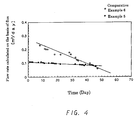
- the tolerance to water containing an iron component was evaluated by setting a 4-inch element manufactured by using this membrane, and performing an operation at a constant flow rate of 1.4 (l/min) by using industrial water containing 0.90 mg/l of an iron component. The results are shown in Fig. 4.
- Example 5 For comparison, a reverse osmosis composite membrane before surface treatment with polyvinyl alcohol was measured in the same manner as in Example 5. The results are shown in Table 7 and Fig. 5. Sample surface zeta ( ⁇ ) potential at pH6 [mV] Example 5 0 Comparative Example 6 ⁇ 25
- Example 5 After the evaluation, the elements of Example 5 and Comparative Example 6 were disassembled. No iron component attached to the surface of the membrane of the element of Example 5 was seen, while the iron component was attached to the surface of the membrane of the element of Comparative Example 6.
- Example 5 could ensure a sufficient flux in an operation at a low pressure and operate stably for a long time.
- the reverse osmosis composite membrane of the present invention had a high salt rejection, a high water permeability, and a high fouling tolerance, and permitted practical desalination at a relatively low pressure. Furthermore, the performance of the reverse osmosis composite membrane did not deteriorate significantly even by conducting a reverse osmosis treatment with raw water containing a surfactant or a transition metal component.
Landscapes
- Chemical & Material Sciences (AREA)
- Chemical Kinetics & Catalysis (AREA)
- Engineering & Computer Science (AREA)
- Inorganic Chemistry (AREA)
- Manufacturing & Machinery (AREA)
- Life Sciences & Earth Sciences (AREA)
- Hydrology & Water Resources (AREA)
- Environmental & Geological Engineering (AREA)
- Water Supply & Treatment (AREA)
- Organic Chemistry (AREA)
- Separation Using Semi-Permeable Membranes (AREA)
Abstract
Description

| Sample | NaCl (at 25°C) rejection [%] | Flux (at 25°C) [m3m2/day] | Ratio of flux after treatment to flux before treatment |
| Example 1 | 99.70 | 1.2 | 0.7 |
| Before polyvinyl alcohol treatment | 99.48 | 1.7 | ― |
| Evaluation with an aqueous solution containing 500 ppm sodium chloride at a pressure of 7.5 kgf/cm2 | 99.56 | 0.8 |
| Sample | Surface zeta ζ potential at pH 6 [mV] | Flux-1 [m3/m2/day] | Flux-2 [m3/m2/day] | Retention [%] |
| Example 1 | 0 | 1.2 | 1.0 | 83 |
| Comparative Example 1 | ― 25 | 2.0 | 0.9 | 45 |
| Initial performance | Permeation of industrial water in Ibaraki City | After washing with oxalic acid | |||||
| Sample | NaCl 1500ppm Rej. (%) | Flux m3/m2/d | Ultrapure water Flux 1 m3/m2/d | Flux after 28 hr m3/m2/d | Retention Flux / | Ultrapure water Flux m3/m2/d | Washing recovery ratio Flux / |
| Example 2 | 99.70 | 1.02 | 1.01 | 0.78 | 77.2% | 0.91 | 89.5% |
| Comparative Example 2 | 99.48 | 2.01 | 1.82 | 0.98 | 53.8% | 1.23 | 67.8% |
| Sample | Isoelectric point | Initial Flux [m3/m2/day] | Flux (1hr) after a cationic surfactant is added [m3/m2/day] | Retention [%] |
| Example 3 | pH 6.4 | 1.43 | 0.84 | 58.9 |
| Comparative Example 4 | pH 3.4 | 1.89 | 0.61 | 32.2 |
| Sample | NaCl (at 25°C) rejection [%] | Flux (at 25°C) [m3m2/day] | Ratio of flux after treatment to flux before treatment |
| Example 1 | 99.70 | 1.2 | 0.7 |
| Before polyvinyl alcohol treatment | 99.48 | 1.7 | ― |
| Evaluation with an aqueous solution containing 500 ppm sodium chloride at a pressure of 7.5 kgf/cm2 | 99.56 | 0.8 |
| Sample | Surface ζ potential at pH6 [mV] | Flux-1 [m3/m2/day] | Flux-2 [m3/m2/day] | Retention [%] |
| Example 4 | 0 | 1.2 | 1.1 | 92 |
| Comparative Example 5 | ― 17 | 1.2 | 0.6 | 50 |
| Sample | surface zeta (ζ) potential at pH6 [mV] |
| Example 5 | 0 |
| Comparative Example 6 | ― 25 |
Claims (17)
- A reverse osmosis composite membrane comprising:a sponge layer; anda separation layer formed on a surface of the sponge layer,
wherein a surface zeta (ζ) potential of the skin layer is controlled within ± 10mV at pH 6. - The reverse osmosis composite membrane according to claim 1, wherein the pH is in the range of 6 to 8.
- The reverse osmosis composite membrane according to claim 1, wherein the pH is in the range of 5 to 11.
- The reverse osmosis composite membrane according to claim 1, wherein a surface of a reverse osmosis composite membrane in which an absolute value of the surface zeta (ζ) potential is greater than ± 10mV in the range of pH 5 to 11 is coated with at least one substance selected from the group consisting of an electrically neutral organic substance and an electrically neutral polymer.
- The reverse osmosis composite membrane according to claim 4, wherein the at least one substance selected from the group consisting of an electrically neutral organic substance and an electrically neutral polymer is an organic substance or a polymer that has a nonionic hydrophilic group.
- The reverse osmosis composite membrane according to claim 5, wherein the organic substance or the polymer that has a nonionic hydrophilic group is polyvinyl alcohol that is water-insoluble at 25°C and is water-soluble at 80°C.
- The reverse osmosis composite membrane according to claim 6, wherein the polyvinyl alcohol has a saponification degree of 95% or more.
- The reverse osmosis composite membrane according to claim 5, wherein a thickness of the organic substance or the polymer that has a nonionic hydrophilic group is in the range of 0.001 to 1 µ m.
- The reverse osmosis composite membrane according to claim 4, wherein the reverse osmosis composite membrane in which an absolute value of the surface zeta (ζ) potential before treatment is greater than ± 10mV in the range of pH 5 to 11 has a flux of 0.6 [m3/m2/day] or more in a reverse osmosis test conducted by feeding a 500 ppm NaCl solution at a pressure of 7.5 kg/cm2 and a temperature of 25°C.
- The reverse osmosis composite membrane according to claim 1, having a flux of 0.6 [m3/m2/day] or more in a reverse osmosis test conducted by feeding a 1,500 ppm NaCl solution at a pressure of 15 kg/cm2 and a temperature of 25°C.
- The reverse osmosis composite membrane according to claim 1, which is formed of aromatic polyamide.
- A reverse osmosis treatment method for water, comprising using the reverse osmosis composite membrane according to claim 1.
- The reverse osmosis treatment method according to claim 12, wherein water containing a surfactant is fed to the reverse osmosis composite membrane as raw water.
- The reverse osmosis treatment method according to claim 13, wherein a content of the surfactant is in the range of 0.01 ppm to 20 wt.%.
- The reverse osmosis treatment method according to claim 12, wherein water containing a transition metal component is fed to the reverse osmosis composite membrane as raw water.
- The reverse osmosis treatment method according to claim 15, wherein the transition metal component is iron.
- The reverse osmosis treatment method according to claim 15, wherein a content of the transition metal component is in the range of 0.01 ppm to 20 wt.%.
Applications Claiming Priority (7)
| Application Number | Priority Date | Filing Date | Title |
|---|---|---|---|
| JP61477/96 | 1996-03-18 | ||
| JP6147796 | 1996-03-18 | ||
| JP102657/96 | 1996-04-24 | ||
| JP10265796 | 1996-04-24 | ||
| JP112542/96 | 1996-05-07 | ||
| JP11254296 | 1996-05-07 | ||
| PCT/JP1997/000856 WO1997034686A1 (en) | 1996-03-18 | 1997-03-17 | Composite reverse osmosis membrane and method of reverse osmotic treatment of water using the same |
Publications (3)
| Publication Number | Publication Date |
|---|---|
| EP0888810A1 true EP0888810A1 (en) | 1999-01-07 |
| EP0888810A4 EP0888810A4 (en) | 2001-08-22 |
| EP0888810B1 EP0888810B1 (en) | 2006-06-21 |
Family
ID=27297517
Family Applications (1)
| Application Number | Title | Priority Date | Filing Date |
|---|---|---|---|
| EP97907348A Expired - Lifetime EP0888810B1 (en) | 1996-03-18 | 1997-03-17 | Composite reverse osmosis membrane and method of reverse osmotic treatment of water using the same |
Country Status (6)
| Country | Link |
|---|---|
| US (1) | US6177011B1 (en) |
| EP (1) | EP0888810B1 (en) |
| JP (1) | JP3379963B2 (en) |
| CN (1) | CN1213985A (en) |
| DE (1) | DE69736172T2 (en) |
| WO (1) | WO1997034686A1 (en) |
Cited By (7)
| Publication number | Priority date | Publication date | Assignee | Title |
|---|---|---|---|---|
| WO2001051170A1 (en) * | 2000-01-14 | 2001-07-19 | Mykrolis Corporation | System and method for liquid filtration based on a neutral filter material |
| NL1020950C2 (en) * | 2002-06-24 | 2003-12-30 | Saehan Ind Inc | Composite polyamide reverse osmosis membrane for desalination of seawater, comprises polyamide layer and hydrophilic coating of polyfunctional epoxy compound, formed sequentially on microporous support |
| US6723245B1 (en) | 2002-01-04 | 2004-04-20 | Nalco Company | Method of using water soluble cationic polymers in membrane biological reactors |
| EP1779914A1 (en) * | 2000-01-14 | 2007-05-02 | Entegris, Inc. | System for liquid filtration based on a neutral filter material |
| US8017014B2 (en) | 2005-06-01 | 2011-09-13 | Nalco Company | Method for improving flux in a membrane bioreactor |
| US8889008B2 (en) | 2008-05-02 | 2014-11-18 | Nalco Company | Method of conditioning a mixed liquor containing nonionic polysaccharides and/or nonionic organic molecules |
| EP4659851A4 (en) * | 2023-02-03 | 2026-07-29 | Toray Industries | SEMIPERMEABLE COMPOSITE MEMBRANE, SEMIPERMEABLE COMPOSITE MEMBRANE MODULE AND FLUID SEPARATION DEVICE |
Families Citing this family (98)
| Publication number | Priority date | Publication date | Assignee | Title |
|---|---|---|---|---|
| US6413425B1 (en) * | 1997-04-10 | 2002-07-02 | Nitto Denko Corporation | Reverse osmosis composite membrane and reverse osmosis treatment method for water using the same |
| KR100869203B1 (en) * | 2001-04-18 | 2008-11-18 | 아사히 카세이 쿠라레 메디칼 가부시키가이샤 | Asymmetric Porous Membrane and Manufacturing Method Thereof |
| US6833073B2 (en) * | 2001-10-09 | 2004-12-21 | Pti Advanced Filtration, Inc. | Composite nanofiltration and reverse osmosis membranes and method for producing the same |
| US6913694B2 (en) | 2001-11-06 | 2005-07-05 | Saehan Industries Incorporation | Selective membrane having a high fouling resistance |
| US6773590B2 (en) * | 2002-01-29 | 2004-08-10 | Alexander Shkolnik | Filtering membranes on the basis of welded polymer structures and method for manufacture thereof |
| US7144511B2 (en) * | 2002-05-02 | 2006-12-05 | City Of Long Beach | Two stage nanofiltration seawater desalination system |
| KR100474169B1 (en) * | 2002-05-20 | 2005-03-08 | 주식회사 새 한 | Producing method of the selective membrame having a high fouling resistance |
| US20050059480A1 (en) * | 2003-09-11 | 2005-03-17 | Konami Gaming, Inc. | System and method for awarding incentive awards to a player of a gaming device |
| US7490725B2 (en) * | 2003-10-09 | 2009-02-17 | Membrane Technology & Research | Reverse osmosis membrane and process |
| GB2428065B (en) | 2004-05-28 | 2008-12-31 | Bp Exploration Operating | Desalination method |
| CN101010334B (en) * | 2004-08-30 | 2013-02-06 | 东丽株式会社 | Fractionation apparatus |
| US20060135253A1 (en) * | 2004-09-10 | 2006-06-22 | Jeffrey George | Gaming system and method for providing entry to a contest |
| JP4656502B2 (en) * | 2004-10-01 | 2011-03-23 | 日東電工株式会社 | Composite semipermeable membrane and method for producing the same |
| JP4656503B2 (en) * | 2004-10-01 | 2011-03-23 | 日東電工株式会社 | Composite semipermeable membrane and method for producing the same |
| JP2006102594A (en) * | 2004-10-01 | 2006-04-20 | Nitto Denko Corp | Manufacturing method of composite semipermeable membrane |
| JP4656511B2 (en) * | 2004-10-04 | 2011-03-23 | 日東電工株式会社 | Method for producing composite reverse osmosis membrane |
| US7537697B2 (en) * | 2006-02-01 | 2009-05-26 | Woongjin Chemical Co., Ltd. | Selective membrane having a high fouling resistance |
| US7913857B2 (en) * | 2006-02-01 | 2011-03-29 | Woongjin Chemical Co., Ltd. | Selective membrane having a high fouling resistance |
| US8727854B2 (en) | 2006-02-23 | 2014-05-20 | Konami Gaming, Inc | System and method for operating a matching game in conjunction with a transaction on a gaming machine |
| JP4936438B2 (en) | 2006-10-10 | 2012-05-23 | 日東電工株式会社 | Method for producing dry composite semipermeable membrane |
| JP2008093544A (en) * | 2006-10-10 | 2008-04-24 | Nitto Denko Corp | Composite semipermeable membrane and method for producing the same |
| US7967677B2 (en) | 2006-11-08 | 2011-06-28 | Igt | Gaming system and method for providing virtual drawings |
| CN100460048C (en) * | 2006-12-01 | 2009-02-11 | 北京工业大学 | Preparation method of anti-pollution modified PVA composite membrane |
| JP2008246419A (en) * | 2007-03-30 | 2008-10-16 | Nitto Denko Corp | Manufacturing method of composite semipermeable membrane |
| JP2009006279A (en) * | 2007-06-28 | 2009-01-15 | Nitto Denko Corp | Composite semipermeable membrane and method for producing the same |
| JP5701475B2 (en) * | 2007-07-12 | 2015-04-15 | 日東電工株式会社 | Composite semipermeable membrane |
| CN101185849B (en) * | 2007-09-11 | 2011-01-05 | 浙江工商大学 | Preparation method of polyamide/polyvinyl alcohol/polyamide composite membrane whose separation layer is multi-layer alternate compounding |
| JP5568835B2 (en) * | 2007-10-01 | 2014-08-13 | 栗田工業株式会社 | Reverse osmosis membrane, reverse osmosis membrane device, and method of hydrophilizing reverse osmosis membrane |
| DE102007060525A1 (en) * | 2007-12-13 | 2009-06-18 | Aksys Gmbh | Silencer air duct and method of making a silencer air duct |
| US8177978B2 (en) | 2008-04-15 | 2012-05-15 | Nanoh20, Inc. | Reverse osmosis membranes |
| KR20100003799A (en) | 2008-07-02 | 2010-01-12 | 웅진케미칼 주식회사 | Selective membrane having a high fouling resistance and preparation method thereof |
| AU2009268532B2 (en) * | 2008-07-10 | 2013-01-10 | Board Of Regents, The University Of Texas System | Water purification membranes with improved fouling resistance |
| US20100133172A1 (en) * | 2008-12-01 | 2010-06-03 | Qun Song | Fouling resistant coating for membrane surfaces |
| JP5220698B2 (en) * | 2009-07-06 | 2013-06-26 | 富士フイルム株式会社 | Crystalline polymer microporous membrane, method for producing the same, and filter for filtration |
| CN102791365B (en) * | 2010-03-10 | 2014-12-24 | 陶氏环球技术有限责任公司 | Polyamide membrane with a coating comprising polyalkylene oxide and acetophenone compounds |
| WO2011136865A1 (en) | 2010-04-26 | 2011-11-03 | Dow Global Technologies Llc | Polyamide membrane with a coating comprising polyalkylene oxide and triazine compounds |
| WO2011149571A1 (en) | 2010-05-24 | 2011-12-01 | Dow Global Technologies Llc | Polyamide membrane with coating comprising polyalkylene oxide and biguanide compounds |
| US8646616B2 (en) | 2010-05-24 | 2014-02-11 | Dow Global Technologies Llc | Composite membrane with coating comprising polyalkylene oxide and imidazol compounds |
| US8757396B2 (en) | 2010-05-24 | 2014-06-24 | Dow Global Technologies Llc | Composite membrane with coating comprising polyalkylene oxide and oxy-substituted phenyl compounds |
| US8857629B2 (en) | 2010-07-15 | 2014-10-14 | International Business Machines Corporation | Composite membrane with multi-layered active layer |
| US9216385B2 (en) | 2010-10-04 | 2015-12-22 | Saudi Arabian Oil Company | Application of rejection enhancing agents (REAs) that do not have cloud point limitations on desalination membranes |
| EP2633901A4 (en) * | 2010-10-26 | 2014-09-17 | Toray Industries | Separation membrane, separation membrane element and separation membrane production method |
| KR101240956B1 (en) | 2011-02-18 | 2013-03-11 | 웅진케미칼 주식회사 | Reverse osmosis composite having high fouling resistance and manufacturing method thereof |
| US9022227B2 (en) | 2011-03-21 | 2015-05-05 | International Business Machines Corporation | Composite membranes and methods of preparation thereof |
| CN102210986B (en) * | 2011-06-10 | 2013-08-14 | 南京帝膜净水材料开发有限公司 | Method for preparing nanofiltration composite membrane |
| CN102836641A (en) * | 2011-06-22 | 2012-12-26 | 通用电气公司 | Membrane and its preparation method |
| US20130056413A1 (en) * | 2011-09-01 | 2013-03-07 | General Electric Company | Membrane treatment of cooling tower blow down water |
| CN103842062B (en) | 2011-09-29 | 2016-04-27 | 东丽株式会社 | Composite semipermeable membrane |
| SG10201912504UA (en) * | 2011-10-27 | 2020-02-27 | Univ Nanyang Tech | A method of forming forward osmosis membranes and the forward osmosis membranes thus formed |
| JP6057317B2 (en) * | 2012-04-05 | 2017-01-11 | セイコーエプソン株式会社 | Separation device |
| US9561474B2 (en) | 2012-06-07 | 2017-02-07 | International Business Machines Corporation | Composite membrane with multi-layered active layer |
| US10239021B2 (en) * | 2012-06-14 | 2019-03-26 | Teledyne Scientific & Imaging, Llc | Fouling resistant coating for filtration membranes and methods of producing and using same |
| JP5660255B2 (en) * | 2012-06-15 | 2015-01-28 | 株式会社明電舎 | Solid-liquid separation method |
| CN102974221B (en) * | 2012-12-04 | 2015-05-20 | 贵阳时代沃顿科技有限公司 | Method for controlling surface potential of reverse osmosis membrane |
| WO2014107523A2 (en) * | 2013-01-02 | 2014-07-10 | The Regents Of The University Of California | Chlorine-tolerant polyamide derivatives for preparing biofouling-resistant reverse osmosis membranes and membranes made therefrom |
| CN112870995A (en) * | 2013-02-28 | 2021-06-01 | 东丽株式会社 | Composite semipermeable membrane |
| WO2014158660A1 (en) | 2013-03-14 | 2014-10-02 | Dow Global Technologies Llc | Composite polyamide membrane including dissolvable polymer coating |
| CN104248914B (en) * | 2013-06-28 | 2016-06-29 | 中国石油化工股份有限公司 | A kind of reverse osmosis membrane and preparation method thereof |
| CN105517695B (en) * | 2013-08-01 | 2017-11-28 | 株式会社Lg化学 | Polyamide-based water treatment separation membrane having excellent durability and manufacturing method thereof |
| CN105611994B (en) | 2013-09-30 | 2019-06-21 | 东丽株式会社 | Composite semipermeable membrane and method of making the same |
| WO2015116508A1 (en) | 2014-01-31 | 2015-08-06 | Dow Global Technologies Llc | Composite polyamide membrane including cellulose-based quaternary ammonium coating |
| WO2015139073A1 (en) * | 2014-03-17 | 2015-09-24 | Osmoflo Pty Ltd | Membranes with sacrificial coatings |
| US9795928B2 (en) | 2014-06-24 | 2017-10-24 | Nano And Advanced Materials Institute Limited | Stepwise interfacial polymerization technique with different reagent solution designs to prepare hollow fiber nanofiltration membrane composites |
| DE102014224473A1 (en) | 2014-11-29 | 2016-06-02 | Leibniz-Institut Für Polymerforschung Dresden E.V. | Reverse osmosis or nanofiltration membranes and processes for their preparation |
| US9861940B2 (en) | 2015-08-31 | 2018-01-09 | Lg Baboh2O, Inc. | Additives for salt rejection enhancement of a membrane |
| JP6747926B2 (en) | 2015-09-30 | 2020-08-26 | 日東電工株式会社 | Method for manufacturing spiral type separation membrane element |
| JP6485540B2 (en) | 2015-10-27 | 2019-03-20 | 東レ株式会社 | Composite semipermeable membrane and method for producing the same |
| US10781122B2 (en) | 2015-12-15 | 2020-09-22 | Kemco Systems Co. Llc | Membrane filtration apparatus and process for reuse of industrial wastewater |
| CN105396462B (en) * | 2015-12-25 | 2018-03-02 | 成都美富特膜科技有限公司 | A kind of composite modified reagent and preparation method thereof |
| CN105396463A (en) * | 2015-12-25 | 2016-03-16 | 成都美富特膜科技有限公司 | Method for controlling electric potential of surface of reverse osmosis membrane |
| CN105617872A (en) * | 2015-12-25 | 2016-06-01 | 成都美富特膜科技有限公司 | Application of compound modified reagent to reverse osmosis membrane |
| US9737859B2 (en) | 2016-01-11 | 2017-08-22 | Lg Nanoh2O, Inc. | Process for improved water flux through a TFC membrane |
| KR102626085B1 (en) | 2016-02-29 | 2024-01-18 | 도레이 카부시키가이샤 | Laminated semipermeable membrane |
| US10155203B2 (en) | 2016-03-03 | 2018-12-18 | Lg Nanoh2O, Inc. | Methods of enhancing water flux of a TFC membrane using oxidizing and reducing agents |
| CN105749768A (en) * | 2016-04-15 | 2016-07-13 | 湖南沁森环保高科技有限公司 | Composite reverse osmosis membrane with high salt removing rate and controllable flux and method for preparing composite reverse osmosis membrane |
| CN109414016B (en) | 2016-06-30 | 2021-05-25 | 香港科技大学 | Colloidal coating for surface antibacterial and anti-biofouling |
| KR102337641B1 (en) | 2016-12-26 | 2021-12-10 | 도레이 카부시키가이샤 | Composite semipermeable membrane and manufacturing method thereof |
| CN106823867A (en) * | 2017-03-06 | 2017-06-13 | 北京理工大学 | Using the method for polyalcohols/ester blend hydrophilic modification hydrophobic type polymeric membrane for separation |
| WO2018198679A1 (en) | 2017-04-28 | 2018-11-01 | 東レ株式会社 | Semipermeable composite membrane and method for producing same |
| US10946338B2 (en) | 2017-10-10 | 2021-03-16 | Qatar Foundation | Composite reverse osmosis membrane, a water filtration system and a method of manufacturing same |
| CN108079806B (en) | 2018-02-07 | 2020-09-08 | 浙江大学 | Polyamide semipermeable membrane, preparation method and application thereof |
| JP7151703B2 (en) | 2018-02-28 | 2022-10-12 | 東レ株式会社 | Composite semipermeable membrane and composite semipermeable membrane element |
| EP3760303B1 (en) | 2018-02-28 | 2024-02-21 | Toray Industries, Inc. | Composite semipermeable membrane and composite semipermeable membrane element |
| CN109046025B (en) * | 2018-08-24 | 2020-11-20 | 清华大学 | Nanofiltration membrane for selective separation of trace organic matter and calcium and magnesium ions and preparation method thereof |
| JP6526894B1 (en) * | 2018-09-20 | 2019-06-05 | 日東電工株式会社 | Separation membrane |
| US12121867B2 (en) | 2018-12-26 | 2024-10-22 | Toray Industries, Inc. | Composite semipermeable membrane |
| US11278847B2 (en) | 2019-07-30 | 2022-03-22 | NL Chemical Technology, Inc | Reverse osmosis membrane with hydrogel coating |
| US12311321B2 (en) * | 2019-12-12 | 2025-05-27 | Aquaporin A/S | Anti-fouling and semi-permeable membrane |
| CN111282453B (en) * | 2020-02-20 | 2021-05-11 | 汕头市奥斯博环保材料制造有限公司 | A kind of preparation method of high-performance seawater desalination membrane and obtained seawater desalination membrane |
| JP7581642B2 (en) | 2020-03-30 | 2024-11-13 | 東洋紡株式会社 | Polyphenylene-based semipermeable membrane and method for producing same |
| US11684895B2 (en) | 2020-09-03 | 2023-06-27 | NL Chemical Technology, Inc. | Bilayer polyamide desalination membrane |
| CN112657353B (en) * | 2021-03-16 | 2021-06-04 | 湖南澳维新材料技术有限公司 | A kind of preparation method of electrically neutral polyamide composite reverse osmosis membrane material |
| CN114284518A (en) * | 2021-12-31 | 2022-04-05 | 复旦大学 | Application of PMSA Composite Membranes Based on Interfacial Superassembly in Salt Gradient Energy Conversion |
| JP2023143687A (en) | 2022-03-24 | 2023-10-06 | 日東電工株式会社 | Composite semipermeable membrane and spiral membrane element |
| JPWO2024162434A1 (en) * | 2023-02-03 | 2024-08-08 | ||
| JP2025012317A (en) * | 2023-07-13 | 2025-01-24 | オルガノ株式会社 | Water treatment device and water treatment method |
| CN117482763A (en) * | 2023-11-29 | 2024-02-02 | 天津工业大学 | A polyamide composite membrane with a nearly electrically neutral surface and its preparation method and application |
| JP7827224B1 (en) * | 2024-08-02 | 2026-03-10 | 東レ株式会社 | Composite semipermeable membrane, composite semipermeable membrane element, and fluid separation device |
Family Cites Families (34)
| Publication number | Priority date | Publication date | Assignee | Title |
|---|---|---|---|---|
| US3133137A (en) | 1960-11-29 | 1964-05-12 | Univ California | High flow porous membranes for separating water from saline solutions |
| NL271831A (en) | 1960-11-29 | |||
| US3620895A (en) | 1969-01-03 | 1971-11-16 | Polaroid Corp | Corrugated micropermeable membrane |
| JPS5223346B2 (en) | 1972-08-30 | 1977-06-23 | ||
| JPS5113388A (en) | 1974-07-24 | 1976-02-02 | Kurita Water Ind Ltd | Hantomakuno seinokaizenhoho |
| JPS5918087B2 (en) | 1976-07-30 | 1984-04-25 | 荏原インフイルコ株式会社 | Membrane treatment method |
| JPS54107882A (en) | 1978-02-13 | 1979-08-24 | Toray Ind Inc | Semipermeable membrane |
| US4277344A (en) | 1979-02-22 | 1981-07-07 | Filmtec Corporation | Interfacially synthesized reverse osmosis membrane |
| IL63638A0 (en) * | 1980-09-16 | 1981-11-30 | Aligena Ag | Semipermeable composite membranes,their manufacture and their use |
| US4702840A (en) | 1982-02-05 | 1987-10-27 | Pall Corporation | Charge modified polyamide membrane |
| CH656887A5 (en) * | 1982-02-05 | 1986-07-31 | Pall Corp | MICROPOROUS POLYAMIDE MEMBRANE, USE THEREOF AND PROCESS FOR PREPARING THE SAME. |
| US4431545A (en) * | 1982-05-07 | 1984-02-14 | Pall Corporation | Microporous filter system and process |
| US5156740A (en) * | 1982-06-01 | 1992-10-20 | Gft Ingenieurburo Fur Industrieanlagenbau | Multi-layer membrane and the use thereof for the separation of liquid mixtures according to the pervaporation process |
| IL70415A (en) * | 1982-12-27 | 1987-07-31 | Aligena Ag | Semipermeable encapsulated membranes,their manufacture and their use |
| US4529646A (en) | 1984-07-30 | 1985-07-16 | E. I. Du Pont De Nemours And Company | Production of composite membranes |
| US4520044A (en) | 1984-07-30 | 1985-05-28 | E. I. Du Pont De Nemours And Company | Production of composite membranes |
| JPS61287492A (en) * | 1985-06-11 | 1986-12-17 | Toray Ind Inc | Method and apparatus for producing ultrapure water |
| JPS62121603A (en) | 1985-08-05 | 1987-06-02 | Toray Ind Inc | Composite semipermeable membrane and preparation thereof |
| JPH0790152B2 (en) | 1986-02-26 | 1995-10-04 | 東レ株式会社 | Composite reverse osmosis membrane |
| DK169616B1 (en) * | 1986-08-27 | 1994-12-27 | Dow Danmark | Permeable, porous, polymer-treated plastic membrane with hydrophilic character, processes for their preparation and use thereof |
| JPS63218208A (en) | 1987-03-05 | 1988-09-12 | Toray Ind Inc | Composite semipermeable membrane and its production |
| US4909943A (en) * | 1987-07-20 | 1990-03-20 | The Dow Chemical Company | Rejection enhancing coatings for reverse osmosis membranes |
| JPH0290990A (en) * | 1988-09-26 | 1990-03-30 | Mitsubishi Rayon Co Ltd | How to filter low conductivity water |
| US4872984A (en) | 1988-09-28 | 1989-10-10 | Hydranautics Corporation | Interfacially synthesized reverse osmosis membrane containing an amine salt and processes for preparing the same |
| US4948507A (en) | 1988-09-28 | 1990-08-14 | Hydranautics Corporation | Interfacially synthesized reverse osmosis membrane containing an amine salt and processes for preparing the same |
| DE4004153C1 (en) * | 1990-02-10 | 1991-08-08 | Metallgesellschaft Ag, 6000 Frankfurt, De | Multilayered membrane with high sepn. performance - comprises carrier layer of polyamide, polyvinylidene-di:fluoride polyester or glass fibres porous supply and PVA sepn. layer |
| US5259950A (en) * | 1990-03-27 | 1993-11-09 | Toray Industries, Inc. | Composite membrane |
| US5128041A (en) * | 1991-05-15 | 1992-07-07 | Pall Corporation | Microporous membrane, method of manufacture, and method of use |
| JP3212129B2 (en) | 1992-03-11 | 2001-09-25 | ダイセル化学工業株式会社 | New composite separation membrane and wastewater treatment method using the same |
| US5234598A (en) * | 1992-05-13 | 1993-08-10 | Allied-Signal Inc. | Thin-film composite membrane |
| JPH06170186A (en) * | 1992-12-05 | 1994-06-21 | Nitto Denko Corp | Liquid separation membrane evaluation method |
| JP3325666B2 (en) | 1993-09-21 | 2002-09-17 | 呉羽化学工業株式会社 | Matte vinylidene fluoride resin film |
| US5989426A (en) * | 1995-07-05 | 1999-11-23 | Nitto Denko Corp. | Osmosis membrane |
| US6171497B1 (en) * | 1996-01-24 | 2001-01-09 | Nitto Denko Corporation | Highly permeable composite reverse osmosis membrane |
-
1997
- 1997-03-17 CN CN97193174A patent/CN1213985A/en active Pending
- 1997-03-17 DE DE69736172T patent/DE69736172T2/en not_active Expired - Lifetime
- 1997-03-17 EP EP97907348A patent/EP0888810B1/en not_active Expired - Lifetime
- 1997-03-17 JP JP53335297A patent/JP3379963B2/en not_active Expired - Lifetime
- 1997-03-17 WO PCT/JP1997/000856 patent/WO1997034686A1/en not_active Ceased
- 1997-03-17 US US09/077,768 patent/US6177011B1/en not_active Expired - Lifetime
Cited By (13)
| Publication number | Priority date | Publication date | Assignee | Title |
|---|---|---|---|---|
| EP1779914A1 (en) * | 2000-01-14 | 2007-05-02 | Entegris, Inc. | System for liquid filtration based on a neutral filter material |
| US7462283B2 (en) | 2000-01-14 | 2008-12-09 | Entegris, Inc. | System and method for liquid filtration based on a neutral filter material |
| KR100808772B1 (en) * | 2000-01-14 | 2008-02-29 | 엔테그리스, 아이엔씨. | Systems and methods for liquid filtration based on neutral filter materials |
| WO2001051170A1 (en) * | 2000-01-14 | 2001-07-19 | Mykrolis Corporation | System and method for liquid filtration based on a neutral filter material |
| US6723245B1 (en) | 2002-01-04 | 2004-04-20 | Nalco Company | Method of using water soluble cationic polymers in membrane biological reactors |
| US6926832B2 (en) | 2002-01-04 | 2005-08-09 | Nalco Company | Method of using water soluble polymers in a membrane biological reactor |
| FR2843045A1 (en) * | 2002-06-24 | 2004-02-06 | Saehan Ind Inc | Composite polyamide reverse osmosis membrane for desalination of seawater, comprises polyamide layer and hydrophilic coating of polyfunctional epoxy compound, formed sequentially on microporous support |
| GB2390042B (en) * | 2002-06-24 | 2006-11-15 | Saehan Ind Inc | Selective membrane having a high fouling resistance |
| GB2390042A (en) * | 2002-06-24 | 2003-12-31 | Saehan Ind Inc | Membrane comprising cross-linked polyfunctional epoxy compound |
| NL1020950C2 (en) * | 2002-06-24 | 2003-12-30 | Saehan Ind Inc | Composite polyamide reverse osmosis membrane for desalination of seawater, comprises polyamide layer and hydrophilic coating of polyfunctional epoxy compound, formed sequentially on microporous support |
| US8017014B2 (en) | 2005-06-01 | 2011-09-13 | Nalco Company | Method for improving flux in a membrane bioreactor |
| US8889008B2 (en) | 2008-05-02 | 2014-11-18 | Nalco Company | Method of conditioning a mixed liquor containing nonionic polysaccharides and/or nonionic organic molecules |
| EP4659851A4 (en) * | 2023-02-03 | 2026-07-29 | Toray Industries | SEMIPERMEABLE COMPOSITE MEMBRANE, SEMIPERMEABLE COMPOSITE MEMBRANE MODULE AND FLUID SEPARATION DEVICE |
Also Published As
| Publication number | Publication date |
|---|---|
| CN1213985A (en) | 1999-04-14 |
| WO1997034686A1 (en) | 1997-09-25 |
| DE69736172T2 (en) | 2007-04-26 |
| EP0888810A4 (en) | 2001-08-22 |
| JP3379963B2 (en) | 2003-02-24 |
| US6177011B1 (en) | 2001-01-23 |
| EP0888810B1 (en) | 2006-06-21 |
| DE69736172D1 (en) | 2006-08-03 |
Similar Documents
| Publication | Publication Date | Title |
|---|---|---|
| US6177011B1 (en) | Composite reverse osmosis membrane having a separation layer with polyvinyl alcohol coating and method of reverse osmotic treatment of water using the same | |
| US6413425B1 (en) | Reverse osmosis composite membrane and reverse osmosis treatment method for water using the same | |
| JPWO1997034686A1 (en) | Reverse osmosis composite membrane and reverse osmosis treatment method for water using the same | |
| US5658460A (en) | Use of inorganic ammonium cation salts to maintain the flux and salt rejection characteristics of reverse osmosis and nanofiltration membranes during drying | |
| EP1958685B1 (en) | Selective membrane having a high fouling resistance | |
| EP2835175B1 (en) | Polyamide-based water treatment separation membrane having excellent oxidation resistance and chlorine resistance and manufacturing method therefor | |
| US6833073B2 (en) | Composite nanofiltration and reverse osmosis membranes and method for producing the same | |
| KR101733264B1 (en) | Polyamide water-treatment membranes having properties of high salt rejection and high flux and manufacturing method thereof | |
| US4661254A (en) | Chlorine-resistant semipermeable membranes | |
| CN106457165B (en) | Composite semipermeable membrane | |
| CN113289498A (en) | Positively charged nanofiltration membrane and preparation method thereof | |
| CN113939358A (en) | Zwitterion Charged Copolymer Membrane | |
| JP4284767B2 (en) | Composite semipermeable membrane, water production method using the same, and fluid separation element | |
| US20160151748A1 (en) | Reverse osmosis or nanofiltration membranes and method for production thereof | |
| JPH1066845A (en) | Reverse osmosis composite membrane | |
| KR20130108073A (en) | Semi-permeable composite membrane | |
| JP2001286741A (en) | Reverse osmosis composite membrane and method for producing the same | |
| EP3354333B1 (en) | Water treatment membrane and method for manufacturing same | |
| JPH10337454A (en) | Reverse osmosis composite membrane and reverse osmosis treatment method of water using the same | |
| KR100583136B1 (en) | Silane-polyamide composite membrane and manufacturing method thereof | |
| KR100692394B1 (en) | Method for preparing reverse osmosis membrane with boron removal function | |
| JP3646362B2 (en) | Semipermeable membrane and method for producing the same | |
| US20230241559A1 (en) | Reverse osmosis membrane and method of producing the same | |
| CN105792916A (en) | Alkali stabilized semipermeable membrane and method thereof | |
| JPH1128466A (en) | Reverse osmosis treatment method of water by reverse osmosis composite membrane |
Legal Events
| Date | Code | Title | Description |
|---|---|---|---|
| PUAI | Public reference made under article 153(3) epc to a published international application that has entered the european phase |
Free format text: ORIGINAL CODE: 0009012 |
|
| 17P | Request for examination filed |
Effective date: 19980828 |
|
| AK | Designated contracting states |
Kind code of ref document: A1 Designated state(s): DE FR GB IT |
|
| A4 | Supplementary search report drawn up and despatched |
Effective date: 20010709 |
|
| AK | Designated contracting states |
Kind code of ref document: A4 Designated state(s): DE FR GB IT |
|
| RIC1 | Information provided on ipc code assigned before grant |
Free format text: 7B 01D 69/02 A, 7B 01D 69/12 B, 7B 01D 71/56 B, 7B 01D 61/02 B, 7B 01D 67/00 B, 7C 02F 1/44 B |
|
| 17Q | First examination report despatched |
Effective date: 20020930 |
|
| GRAP | Despatch of communication of intention to grant a patent |
Free format text: ORIGINAL CODE: EPIDOSNIGR1 |
|
| GRAS | Grant fee paid |
Free format text: ORIGINAL CODE: EPIDOSNIGR3 |
|
| RAP1 | Party data changed (applicant data changed or rights of an application transferred) |
Owner name: NITTO DENKO CORPORATION |
|
| RIN1 | Information on inventor provided before grant (corrected) |
Inventor name: IKEDA, KENICHI Inventor name: HACHISUKA, HISAO, ROOM NO. 501, RANBURASU SAGA |
|
| GRAA | (expected) grant |
Free format text: ORIGINAL CODE: 0009210 |
|
| AK | Designated contracting states |
Kind code of ref document: B1 Designated state(s): DE FR GB IT |
|
| PG25 | Lapsed in a contracting state [announced via postgrant information from national office to epo] |
Ref country code: IT Free format text: LAPSE BECAUSE OF FAILURE TO SUBMIT A TRANSLATION OF THE DESCRIPTION OR TO PAY THE FEE WITHIN THE PRESCRIBED TIME-LIMIT;WARNING: LAPSES OF ITALIAN PATENTS WITH EFFECTIVE DATE BEFORE 2007 MAY HAVE OCCURRED AT ANY TIME BEFORE 2007. THE CORRECT EFFECTIVE DATE MAY BE DIFFERENT FROM THE ONE RECORDED. Effective date: 20060621 |
|
| REG | Reference to a national code |
Ref country code: GB Ref legal event code: FG4D |
|
| REF | Corresponds to: |
Ref document number: 69736172 Country of ref document: DE Date of ref document: 20060803 Kind code of ref document: P |
|
| ET | Fr: translation filed | ||
| PLBE | No opposition filed within time limit |
Free format text: ORIGINAL CODE: 0009261 |
|
| STAA | Information on the status of an ep patent application or granted ep patent |
Free format text: STATUS: NO OPPOSITION FILED WITHIN TIME LIMIT |
|
| 26N | No opposition filed |
Effective date: 20070322 |
|
| PGFP | Annual fee paid to national office [announced via postgrant information from national office to epo] |
Ref country code: FR Payment date: 20100324 Year of fee payment: 14 |
|
| PGFP | Annual fee paid to national office [announced via postgrant information from national office to epo] |
Ref country code: GB Payment date: 20100317 Year of fee payment: 14 |
|
| PGFP | Annual fee paid to national office [announced via postgrant information from national office to epo] |
Ref country code: DE Payment date: 20100422 Year of fee payment: 14 |
|
| GBPC | Gb: european patent ceased through non-payment of renewal fee |
Effective date: 20110317 |
|
| REG | Reference to a national code |
Ref country code: FR Ref legal event code: ST Effective date: 20111130 |
|
| PG25 | Lapsed in a contracting state [announced via postgrant information from national office to epo] |
Ref country code: DE Free format text: LAPSE BECAUSE OF NON-PAYMENT OF DUE FEES Effective date: 20111001 Ref country code: FR Free format text: LAPSE BECAUSE OF NON-PAYMENT OF DUE FEES Effective date: 20110331 |
|
| REG | Reference to a national code |
Ref country code: DE Ref legal event code: R119 Ref document number: 69736172 Country of ref document: DE Effective date: 20111001 |
|
| PG25 | Lapsed in a contracting state [announced via postgrant information from national office to epo] |
Ref country code: GB Free format text: LAPSE BECAUSE OF NON-PAYMENT OF DUE FEES Effective date: 20110317 |
|
| PGFP | Annual fee paid to national office [announced via postgrant information from national office to epo] |
Ref country code: IT Payment date: 20150219 Year of fee payment: 19 |
|
| PG25 | Lapsed in a contracting state [announced via postgrant information from national office to epo] |
Ref country code: IT Free format text: LAPSE BECAUSE OF NON-PAYMENT OF DUE FEES Effective date: 20160317 |