EP0873365B1 - Neue aromatische amin-cellulosederivate und verfahren zu deren herstellung - Google Patents
Neue aromatische amin-cellulosederivate und verfahren zu deren herstellung Download PDFInfo
- Publication number
- EP0873365B1 EP0873365B1 EP97908113A EP97908113A EP0873365B1 EP 0873365 B1 EP0873365 B1 EP 0873365B1 EP 97908113 A EP97908113 A EP 97908113A EP 97908113 A EP97908113 A EP 97908113A EP 0873365 B1 EP0873365 B1 EP 0873365B1
- Authority
- EP
- European Patent Office
- Prior art keywords
- cellulose
- substituent
- substitution
- rate
- residue
- Prior art date
- Legal status (The legal status is an assumption and is not a legal conclusion. Google has not performed a legal analysis and makes no representation as to the accuracy of the status listed.)
- Expired - Lifetime
Links
- 0 CC/*=C1/C(COC)([*+]*)CCCC1C Chemical compound CC/*=C1/C(COC)([*+]*)CCCC1C 0.000 description 1
Classifications
-
- C—CHEMISTRY; METALLURGY
- C08—ORGANIC MACROMOLECULAR COMPOUNDS; THEIR PREPARATION OR CHEMICAL WORKING-UP; COMPOSITIONS BASED THEREON
- C08B—POLYSACCHARIDES; DERIVATIVES THEREOF
- C08B15/00—Preparation of other cellulose derivatives or modified cellulose, e.g. complexes
- C08B15/05—Derivatives containing elements other than carbon, hydrogen, oxygen, halogens or sulfur
- C08B15/06—Derivatives containing elements other than carbon, hydrogen, oxygen, halogens or sulfur containing nitrogen, e.g. carbamates
Definitions
- the invention relates to a method for manufacturing of aromatic amine cellulose derivatives according to the claims 1 to 10 and new aromatic amine cellulose derivatives according to claims 11 to 13.
- cellulose derivative p-aminophenyl cellulose of the general formula IIIa and its preparation is described in the patent specification CS 221024.
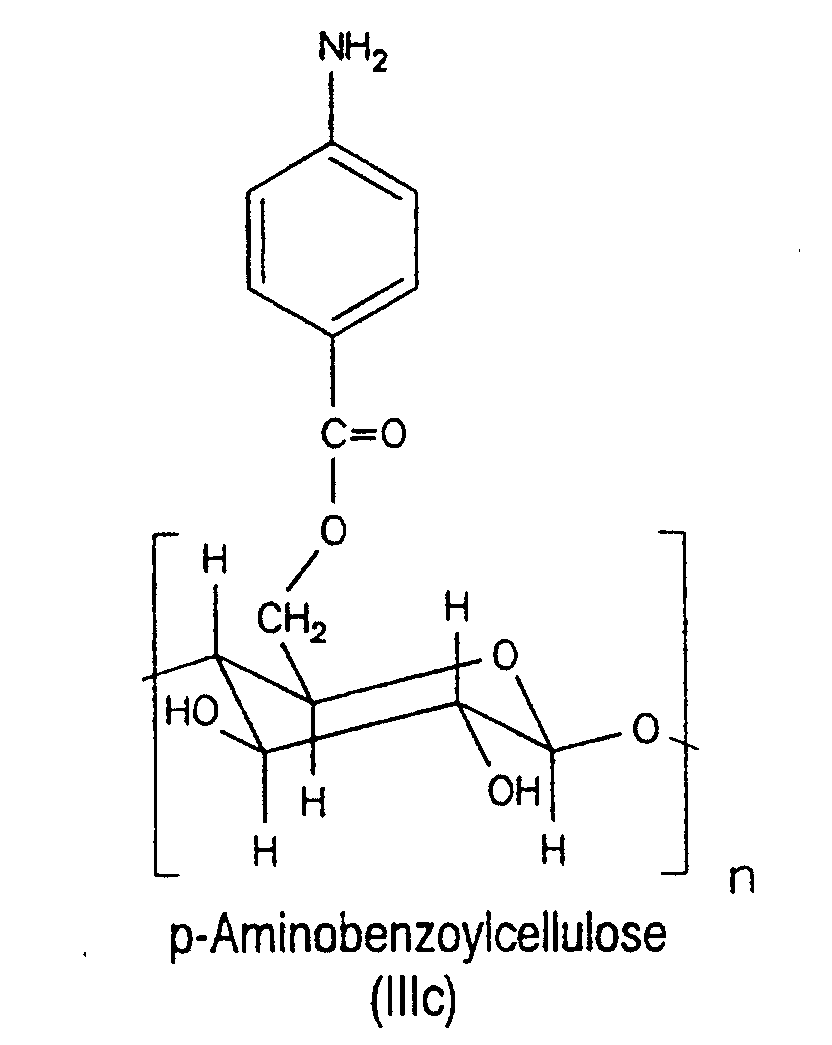
- the compound p-aminobenzyl cellulose of the general formula IIIb and its preparation is, for example, from the publication by Braun, D and Meuret, B. (1989), Paper 43 , 688-694, and the compound p-aminobenzoyl cellulose of the general formula IIIc and its Synthesis known from the patent JP 01249801.
- cellulose derivatives are particularly suitable for use as a carrier matrix for bio-compounds, such as enzymes or antibodies:
- p-aminobenzyl cellulose derivative this application is described, for example, by Ohba, R., Shibata, T. and Ueda, S. (1979) in J. Ferment. Technol. 57 , 146-150 and for p-aminobenzoyl cellulose, for example from Dumitriu, S. and Popa, MI (1985) in Cellul. Chem. Technol. 19 , 609-613.
- the syntheses of the derivatives mentioned are very complex.
- the synthesis products prove to be inconsistent since they are obtained from the corresponding p-nitro derivative via a reduction reaction step.
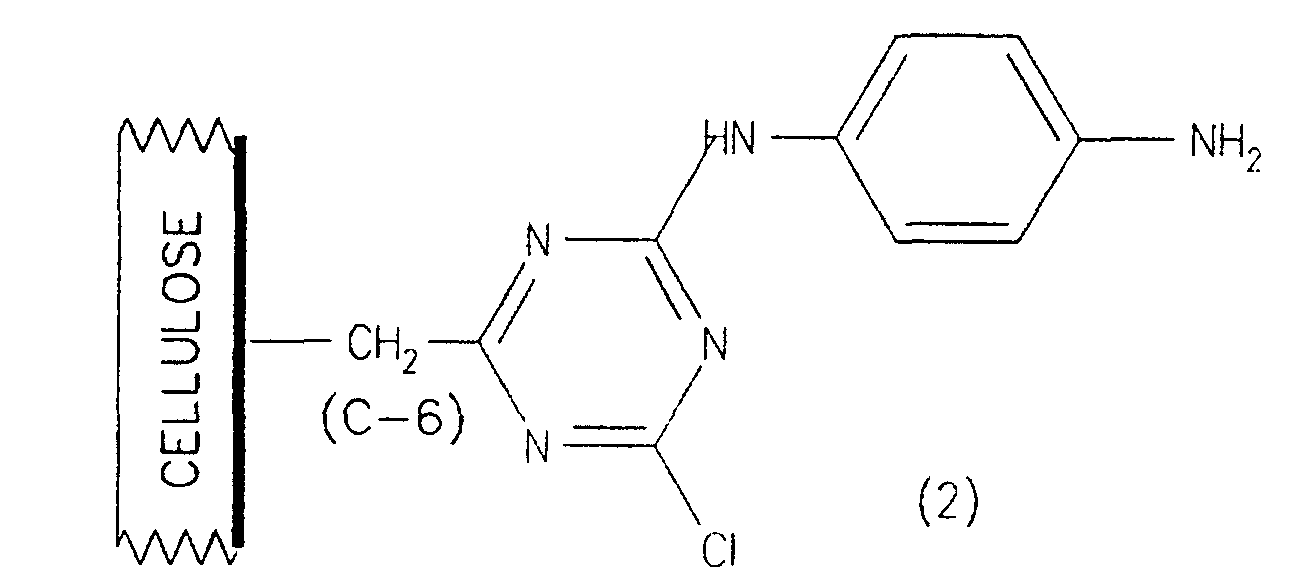
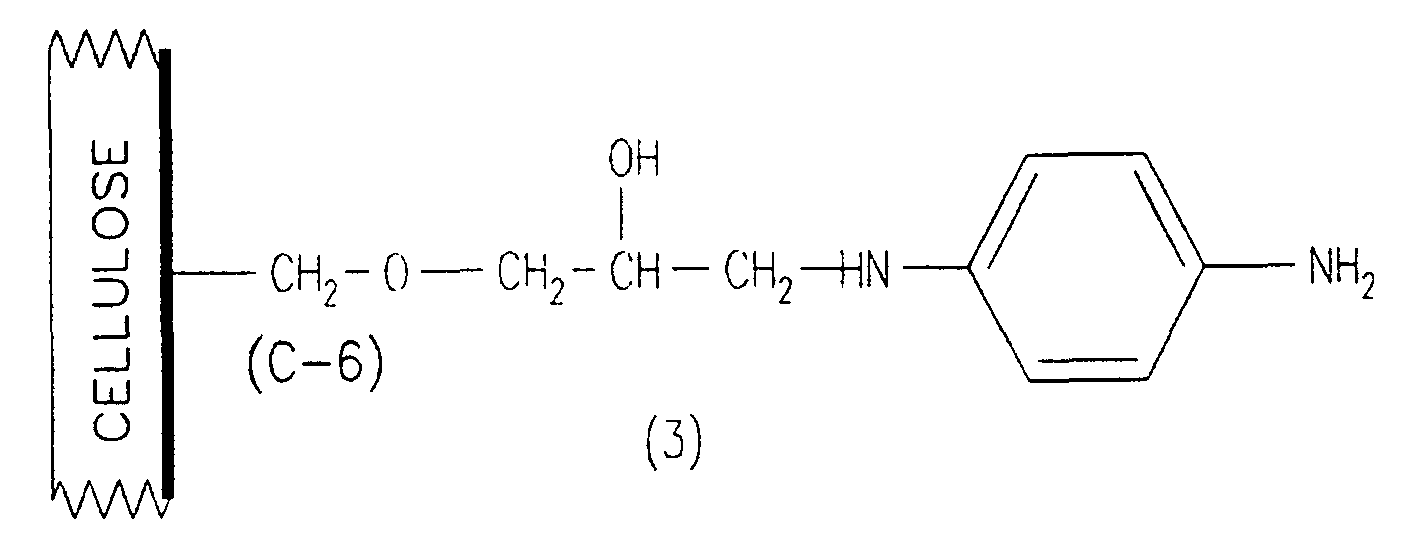
- p-phenylenediamine cellulose derivatives of the following structures are known from the literature: (See e.g. Simionescu, C. and Dumitriu, S. (1983), Polym. Sci. Technol. (Plenum) 23 , (Polym. Med.), 115-137) (See Hebeish, A. and Waly, A. (1978), J. Appl. Polym. Sci. 22 , 2713-2716) (See patent specification CS 223256) (See Beddows, CG (1980). Biotechnol. Bioeng. 22 , 311-321)
- a crucial disadvantage is that the complex synthetic routes require a reduction reaction step of corresponding p-nitro intermediates, which often leads to inconsistent reaction products. Furthermore, the cellulose derivatives described have the disadvantageous properties of being mostly insoluble and, compared to the free p-phenylenediamine, they are less reactive, for example not redox-active.
- DE-PS 473 097 amine cellulose derivatives are known, coupled to the dyes by ionic bonding can be, which leads to a color.
- the amine cellulose derivatives are made by moving from organic substituted inorganic acids Cellulose esters with acid chlorides or acid anhydrides implemented in the presence of tertiary aliphatic anides or displaced or esterified and with primary, secondary or tertiary aliphatic, aromatic or araliphatic amines.
- DD 296 934 A5 discloses a method of manufacture of cellulose matrices for hydrophobic chromatography. Hydrophobic groups are introduced through the implementation of tosylated cellulose with nucleophiles Compounds, especially arylamines.
- US 2,241,542 shows a process for the production of cellulose derivatives to which dye molecules bind can.
- the functional ones used for the coupling Groups are aliphatic di- or tri-amines.
- the object of the invention is a simple method for the production of aromatic amine cellulose derivatives to provide. It is also the task of Invention to provide corresponding cellulose derivatives which have redox reactivity, e.g. an oxidative Coupling activity.
- corresponding cellulose derivatives can be prepared in only one synthesis step by the reaction according to the invention.
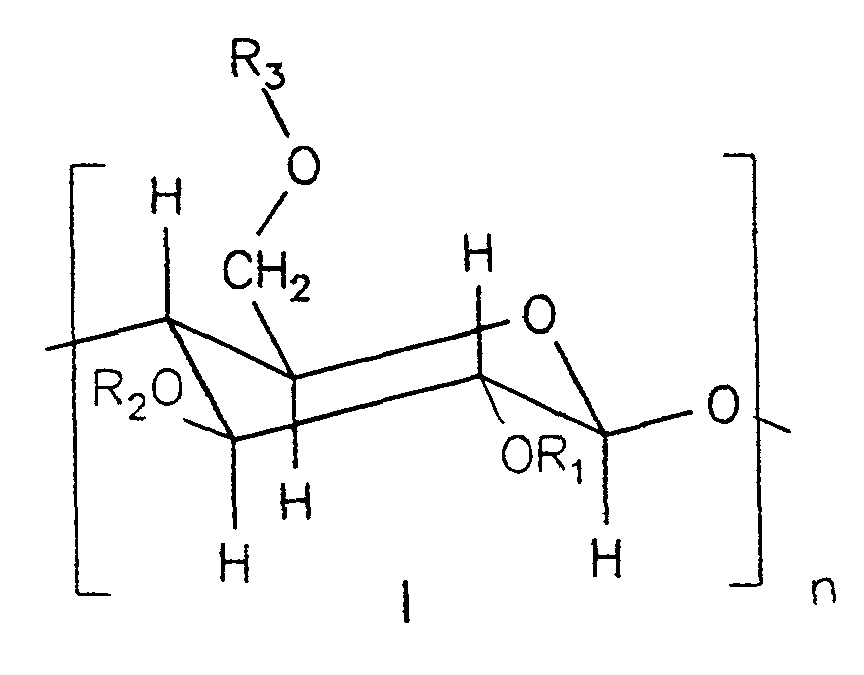
- the radical R 3 located on the C-6 of the backbone can be exclusively a tosyl or tresyl radical, or else both radicals can be represented in the R 3 position within a macromolecule.
- Such tosyl or Tresyl cellulose derivatives are used in which the substituent in the R 1 and / or R 2 position of the backbone is an alkyl, preferably CH 3 , or an acyl, preferably acetyl, or a (further) tosyl or tresyl radical.
- the substituent in the R 1 and / or R 2 position can exclusively be a substituent of the type mentioned, or it is also possible for different substituents of the type mentioned in the R 1 and / or R 2 position within a macromolecule be represented.
- the synthesis according to the invention takes place in a known manner suitable solvents, such as dimethylformamide or dimethylacetamide, preferably in dimethyl sulfoxide (DMSO).
- suitable solvents such as dimethylformamide or dimethylacetamide, preferably in dimethyl sulfoxide (DMSO).
- the reaction can be carried out in the presence of an organic Base are carried out, being as base preferably pyridine or triethylamine. Using of triethylamine are preferably 0.15 parts by weight this base for the synthesis according to the invention used, with a triethylamine layer the reaction mixture covers.
- reaction temperature and the duration depends on the choice of others Reaction conditions: For example, the reaction carried out without base addition, is suitable for the implementation in particular a temperature of 100 ° C and a period of 5 hours; the Conversely, reaction with triethylamine is sufficient for one Temperature of 100 ° C a reaction time of 3 hours. Overall, attempts at optimization have shown that a optimal implementation at a temperature of 80 ° C to 120 ° C over a period of 1 to 10 hours.
- the aromatic amine radical in the R 3 position is preferably an aromatic diamine radical, in particular a phenylene or 1,4-phenylenediamine radical of the formula:
- the aromatic amine radical in the R 3 position can also be the radical of one of the compounds with the structural formulas shown above.
- the substituent in the R 1 and / or R 2 position is an alkyl, preferably CH 3 , or acyl, preferably acetyl, or a tosyl radical or a tresyl radical.
- the substituent can only be a single one of the type mentioned, or different substituents of the type mentioned can also be represented in the R 1 and / or R 2 position within a macromolecule.
- the derivatives according to the invention are soluble, redox-active, surprisingly have chromogenic properties and are ideal for use as a carrier matrix.
- the reaction mixture is at a temperature of 100 ° C and for a Period of 3 hours, sometimes strongly stirred and in the stirring breaks left.
- Triethylamine which is the mixture before autoxidation protects.
- the clear solution a brownish color.
- After cooling of the mixture becomes the white-colored reaction product precipitated in ethanol, centrifuged and about 5 times with Washed ethanol.
- the solid is in freshly precipitated State soluble in THF, DMSO or DMAC.
- DMAC solutions of the p-phenylenediamine cellulose derivative used.
- a mixture of 100 mg of tosyl cellulose (DS 2.3) and 150 mg of p-phenylenediamine is dissolved in 1 ml of DMSO and the solution is heated to 100 ° C. with stirring. In the course of a reaction time of 8 hours, the mixture is colored dark brown. After the reaction mixture has cooled, a weakly colored reaction product is precipitated from ethanol. The solid is centrifuged off, washed with ethanol about 5 times and then dissolved in DMAC.
- a mixture of 200 ml of 2,3-di-methyl-6-tosyl cellulose and 300 mg of p-phenylenediamine is dissolved in DMAC and the Solution with 1 ml of triethylamine.
- the reaction mixture for a total of 3 hours at a temperature of initially 80 ° C and finally for Let stand at 100 ° C for about 30 minutes. After that the brown colored reaction mixture to room temperature cooled and a weakly colored solid in ethanol failed. The solid is centrifuged off, approx. Washed 5 times with ethanol and then dissolved in DMAC.
- a mixture of 300 mg tosyl cellulose (DS 2.0) and 300 mg of p-phenylenediamine is dissolved in 2 ml of DMSO and 500 ⁇ l of pyridine were added to the solution.
- the reaction mixture is at 80 ° C for a period of 3 hours heated and then for 30 minutes at approx. 120 ° C ditched. After the reaction mixture has cooled down Room temperature becomes a brown-colored reaction product precipitated in ethanol, centrifuged and the brownish solid washed about 5 times with ethanol. The solid is then dissolved in DMAC.
Landscapes
- Chemical & Material Sciences (AREA)
- Life Sciences & Earth Sciences (AREA)
- Engineering & Computer Science (AREA)
- Biochemistry (AREA)
- Materials Engineering (AREA)
- Health & Medical Sciences (AREA)
- Chemical Kinetics & Catalysis (AREA)
- Medicinal Chemistry (AREA)
- Polymers & Plastics (AREA)
- Organic Chemistry (AREA)
- Polysaccharides And Polysaccharide Derivatives (AREA)
Description






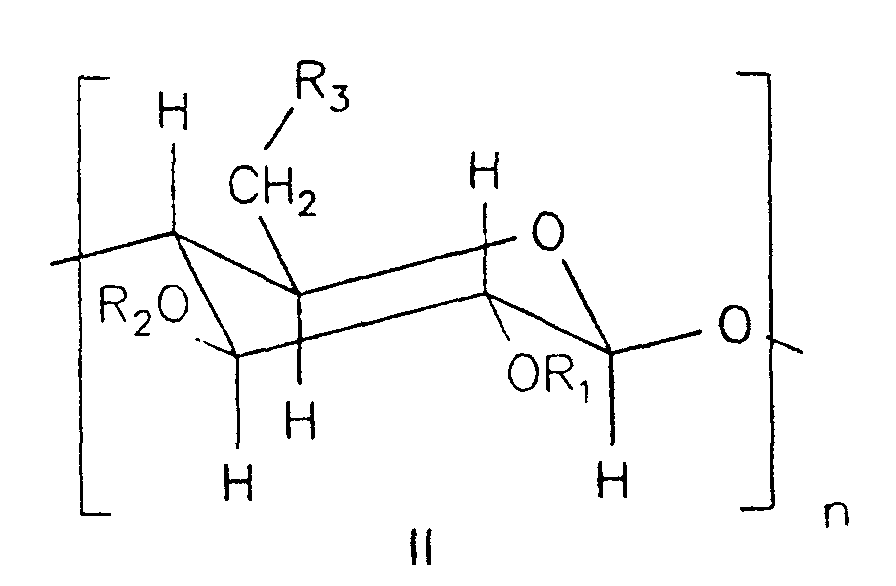

Der Festsoff wird abzentrifugiert, mit Äthanol ca. 5mal gewaschen und anschließend in DMAC gelöst.
Claims (13)
- Verfahren zur Herstellung von aromatischen Di-oder Triamin-Cellulosederivaten, bei dem ein aromatisches Di- oder Triamin mit Tosyl- oder Tresylcellulose der allgemeinen Formel I in der R1, R2 = Hbedeutet,oder R1 = H, R2 = Substituent mit einem Substitutionsgrad ≤ 1oder R1 = Substituent mit einem Substitutionsgrad ≤ 1, R2 = Hoder R1, R2 = Substituent mit einem Substitutionsgrad ≤ 2und R3 ein Tosyl- oder Tresylrest mit einem Substitutionsgrad ≤ 1
umgesetzt wird. - Verfahren nach Anspruch 1,
dadurch gekennzeichnet,
daß als Diamin ein Phenylendiamin eingesetzt wird. - Verfahren nach Anspruch 2,
dadurch gekennzeichnet,
daß als Phenylendiamin 1,4-Phenylendiamin eingesetzt wird. - Verfahren nach einem der vorhergehenden Ansprüche,
dadurch gekennzeichnet,
daß der Substituent R1 und/oder R2 ein Alkyl, vorzugsweise CH3, oder ein Acyl, vorzugsweise Acetyl, oder ein Tosylrest oder ein Tresylrest ist. - Verfahren nach einem der vorhergehenden Ansprüche,
dadurch gekennzeichnet,
daß für die Umsetzung Dimethylformamid oder Dimethylacetamid, vorzugsweise Dimethylsulfoxid, als Lösungsmittel eingesetzt wird. - Verfahren nach einem der vorhergehenden Ansprüche,
dadurch gekennzeichnet,
daß die Umsetzung in Gegenwart einer organischen Base durchgeführt wird. - Verfahren nach Anspruch 6,
dadurch gekennzeichnet,
daß als Base Pyridin oder Triethylamin eingesetzt wird. - Verfahren nach Anspruch 7,
dadurch gekennzeichnet,
daß 0,15 Gew.-Anteile Triethylamin eingesetzt werden. - Verfahren nach einem der vorhergehenden Ansprüche,
dadurch gekennzeichnet,
daß die Reaktion bei einer Temperatur von 80°C bis 120°C über eine Zeitdauer von 1 bis 10 Stunden durchgeführt wird. - Aromatische Di- oder Triamin-Cellulosederivate der allgemeinen Formel IIin der R1, R2 = H
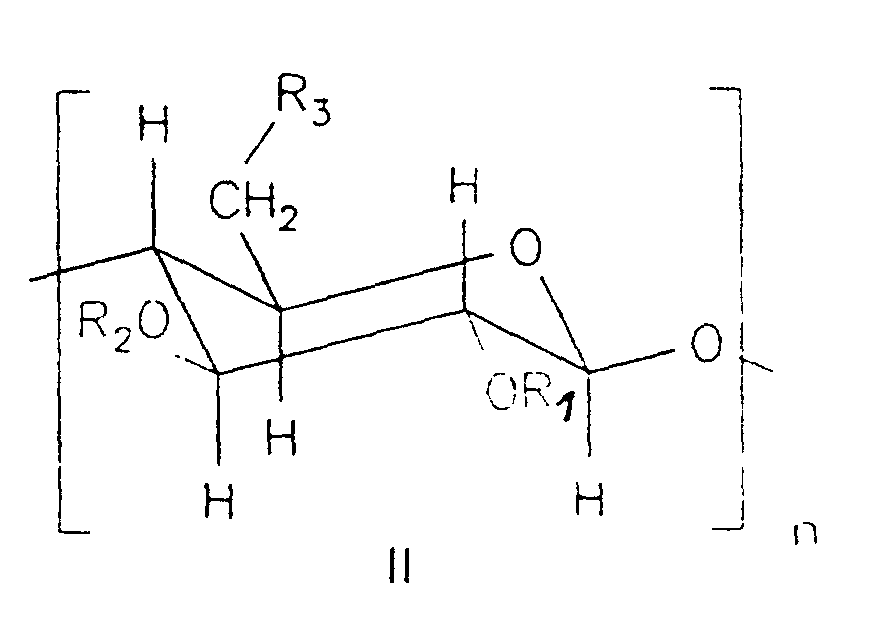 bedeutet.oder R1 = H, R2 = Substituent mit einem Substitutionsgrad ≤ 1oder R1 = Substituent mit einem Substitutionsgrad ≤ 1, R2 = Hoder R1, R2 = Substituent mit einem Substitutionsgrad ≤ 2und R3 ein aromatischer Aminrest mit einem Substitutionsgrad ≤ 1
 - Aromatische Di-oder Triamin-Cellulosederivate nach Anspruch 10,
dadurch gekennzeichnet,
daß R3 ein Phenylendiaminrest bedeutet. - Aromatische Di- oder Triamin-Cellulosederivate nach Anspruch 11,
dadurch gekennzeichnet,
daß R3 ein 1,4-Phenylendiaminrest der Formelbedeutet.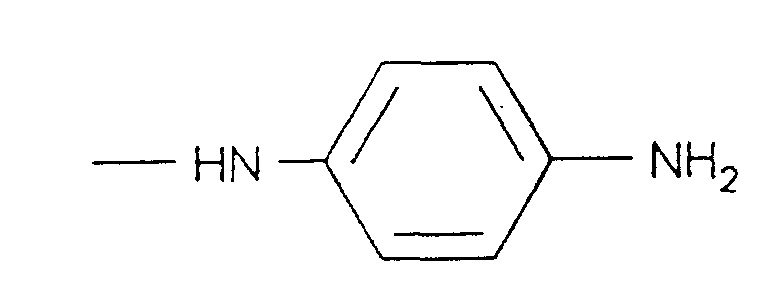
- Aromatische Di- oder Triamin-Cellulosederivate nach einem der Ansprüche 10 bis 12,
dadurch gekennzeichnet,
daß der Substituent R1 und/oder R2 ein Alkyl, vorzugsweise CH3, oder Acyl, vorzugsweise Acetyl, oder ein Tosylrest oder ein Tresylrest ist.
Applications Claiming Priority (3)
| Application Number | Priority Date | Filing Date | Title |
|---|---|---|---|
| DE1996100929 DE19600929C2 (de) | 1996-01-12 | 1996-01-12 | Aromatische Di- oder Triamin-Cellulosederivate und Verfahren zu deren Herstellung |
| DE19600929 | 1996-01-12 | ||
| PCT/DE1997/000070 WO1997025353A1 (de) | 1996-01-12 | 1997-01-09 | Neue aromatische amin-cellulosederivate und verfahren zu deren herstellung |
Publications (2)
| Publication Number | Publication Date |
|---|---|
| EP0873365A1 EP0873365A1 (de) | 1998-10-28 |
| EP0873365B1 true EP0873365B1 (de) | 2001-06-13 |
Family
ID=7782608
Family Applications (1)
| Application Number | Title | Priority Date | Filing Date |
|---|---|---|---|
| EP97908113A Expired - Lifetime EP0873365B1 (de) | 1996-01-12 | 1997-01-09 | Neue aromatische amin-cellulosederivate und verfahren zu deren herstellung |
Country Status (3)
| Country | Link |
|---|---|
| EP (1) | EP0873365B1 (de) |
| DE (2) | DE19600929C2 (de) |
| WO (1) | WO1997025353A1 (de) |
Cited By (1)
| Publication number | Priority date | Publication date | Assignee | Title |
|---|---|---|---|---|
| RU2362783C1 (ru) * | 2008-04-03 | 2009-07-27 | Государственное образовательное учреждение высшего профессионального образования "Кубанский государственный университет" (КубГУ) | Способ получения анионообменных материалов на основе целлюлозы (варианты) и применение полученного материала для концентрирования анионных форм элементов из растворов |
Families Citing this family (1)
| Publication number | Priority date | Publication date | Assignee | Title |
|---|---|---|---|---|
| DE102005008434A1 (de) * | 2005-02-24 | 2006-09-07 | Forschungszentrum Jülich GmbH | Verfahren zur Modifizierung eines Substrats |
Citations (1)
| Publication number | Priority date | Publication date | Assignee | Title |
|---|---|---|---|---|
| US2241542A (en) * | 1939-01-26 | 1941-05-13 | Dreyfus Henry | Manufacture of nitrogen derivatives of cellulose |
Family Cites Families (2)
| Publication number | Priority date | Publication date | Assignee | Title |
|---|---|---|---|---|
| DE473097C (de) * | 1926-10-31 | 1929-03-12 | I G Farbenindustrie Akt Ges | Verfahren zur Darstellung loeslicher Aminocellulosederivate |
| DD296934A5 (de) * | 1989-04-25 | 1991-12-19 | Forschungszentrum Fuer Tierproduktion Dummerstorf-Rostock,De | Verfahren zur herstellung von cellulosematrizen |
-
1996
- 1996-01-12 DE DE1996100929 patent/DE19600929C2/de not_active Expired - Fee Related
-
1997
- 1997-01-09 EP EP97908113A patent/EP0873365B1/de not_active Expired - Lifetime
- 1997-01-09 WO PCT/DE1997/000070 patent/WO1997025353A1/de not_active Ceased
- 1997-01-09 DE DE59703787T patent/DE59703787D1/de not_active Expired - Fee Related
Patent Citations (1)
| Publication number | Priority date | Publication date | Assignee | Title |
|---|---|---|---|---|
| US2241542A (en) * | 1939-01-26 | 1941-05-13 | Dreyfus Henry | Manufacture of nitrogen derivatives of cellulose |
Cited By (1)
| Publication number | Priority date | Publication date | Assignee | Title |
|---|---|---|---|---|
| RU2362783C1 (ru) * | 2008-04-03 | 2009-07-27 | Государственное образовательное учреждение высшего профессионального образования "Кубанский государственный университет" (КубГУ) | Способ получения анионообменных материалов на основе целлюлозы (варианты) и применение полученного материала для концентрирования анионных форм элементов из растворов |
Also Published As
| Publication number | Publication date |
|---|---|
| DE59703787D1 (de) | 2001-07-19 |
| WO1997025353A1 (de) | 1997-07-17 |
| EP0873365A1 (de) | 1998-10-28 |
| DE19600929A1 (de) | 1997-07-17 |
| DE19600929C2 (de) | 1998-08-20 |
Similar Documents
| Publication | Publication Date | Title |
|---|---|---|
| EP0618231B1 (de) | Immunologisch aktive Konjugate und ein Verfahren zu ihrer Herstellung | |
| DE69621649T2 (de) | Verfahren zur herstellung von cefdinir | |
| DE3886543T2 (de) | Oligonukleotidfunktionierungsmittel und -verfahren. | |
| EP0371262A1 (de) | Neue Digoxigenin-Derivate und ihre Verwendung | |
| EP1040168A1 (de) | Neue farbstoff-polysaccharid-konjugate und deren verwendung als diagnostikum | |
| EP0147369B1 (de) | Ionisch modifiziertes Cellulosematerial, dessen Herstellung und Verwendung | |
| DE69130107T2 (de) | Partricinderivate | |
| DE3924705C2 (de) | ||
| DE19600929C2 (de) | Aromatische Di- oder Triamin-Cellulosederivate und Verfahren zu deren Herstellung | |
| DE69508962T2 (de) | Diclavulanat-salze mit diaminoether und verfahren zu deren herstellung | |
| DE69806800T2 (de) | Kristall eines depsipeptid-derivates und verfahren zu seiner herstellung | |
| DE3012669A1 (de) | Verfahren zur herstellung von derivaten von 7-aminodesacetoxycephalosporansaeure | |
| DE69014196T2 (de) | 3,6-diamino-2,5-pyrazindicarbonitril und ihre herstellung. | |
| DE2825289A1 (de) | 1-n-(omega-aminoalkansulfonyl)-derivate von aminoglycosidischen antibiotika und verfahren zur herstellung derselben | |
| DE1795731A1 (de) | Verfahren zur herstellung neuer antibiotisch wirksamer verbindungen | |
| DE102017124041B4 (de) | Kopplung an Imidfarbstoffe und Verfahren zu deren Herstellung | |
| DE2705601C3 (de) | enthaltende Arzneimittel | |
| DE2559540C3 (de) | 1 -Hydroxy-3,6-disulf o-8-acetamino-2-(3'-phosphonophenylazo)-naphthalin und dessen Salze | |
| DE2525962A1 (de) | Neue heterocyclische verbindungen, ihre herstellung und verwendung | |
| CH531004A (de) | Verfahren zur Herstellung neuer Derivate der 7-Aminocephalosporansäure mit antibiotischer Wirkung | |
| DE4303359C2 (de) | Reaktive Carbazolfarbstoffe und Verfahren zu deren Herstellung | |
| DD211553A1 (de) | Verfahren zur herstellung von 4-azido-zimtsaeuresuccinimidylester | |
| DD284878A5 (de) | Verfahren zur herstellung eines pseudoprimycin-komplexs seiner saeureadditionssalze | |
| DE19930557B4 (de) | Verfahren zur Herstellung von Hydraten von Ciprofloxacin und von Ciprofloxacin-Anhydrat enthaltenden pharmazeutischen Zusammensetzungen | |
| DE2142422C3 (de) | Derivate des Digoxigenins, Verfahren zu ihrer Herstellung und deren Verwendung zur radioimmunologischen Bestimmung von Digoxin |
Legal Events
| Date | Code | Title | Description |
|---|---|---|---|
| PUAI | Public reference made under article 153(3) epc to a published international application that has entered the european phase |
Free format text: ORIGINAL CODE: 0009012 |
|
| 17P | Request for examination filed |
Effective date: 19980715 |
|
| AK | Designated contracting states |
Kind code of ref document: A1 Designated state(s): DE FR GB |
|
| 17Q | First examination report despatched |
Effective date: 19990830 |
|
| GRAG | Despatch of communication of intention to grant |
Free format text: ORIGINAL CODE: EPIDOS AGRA |
|
| GRAG | Despatch of communication of intention to grant |
Free format text: ORIGINAL CODE: EPIDOS AGRA |
|
| GRAH | Despatch of communication of intention to grant a patent |
Free format text: ORIGINAL CODE: EPIDOS IGRA |
|
| GRAH | Despatch of communication of intention to grant a patent |
Free format text: ORIGINAL CODE: EPIDOS IGRA |
|
| GRAA | (expected) grant |
Free format text: ORIGINAL CODE: 0009210 |
|
| AK | Designated contracting states |
Kind code of ref document: B1 Designated state(s): DE FR GB |
|
| REF | Corresponds to: |
Ref document number: 59703787 Country of ref document: DE Date of ref document: 20010719 |
|
| GBT | Gb: translation of ep patent filed (gb section 77(6)(a)/1977) |
Effective date: 20010821 |
|
| ET | Fr: translation filed | ||
| REG | Reference to a national code |
Ref country code: GB Ref legal event code: IF02 |
|
| PGFP | Annual fee paid to national office [announced via postgrant information from national office to epo] |
Ref country code: DE Payment date: 20020109 Year of fee payment: 6 |
|
| PGFP | Annual fee paid to national office [announced via postgrant information from national office to epo] |
Ref country code: GB Payment date: 20020116 Year of fee payment: 6 |
|
| PGFP | Annual fee paid to national office [announced via postgrant information from national office to epo] |
Ref country code: FR Payment date: 20020124 Year of fee payment: 6 |
|
| PLBE | No opposition filed within time limit |
Free format text: ORIGINAL CODE: 0009261 |
|
| STAA | Information on the status of an ep patent application or granted ep patent |
Free format text: STATUS: NO OPPOSITION FILED WITHIN TIME LIMIT |
|
| 26N | No opposition filed | ||
| PG25 | Lapsed in a contracting state [announced via postgrant information from national office to epo] |
Ref country code: GB Free format text: LAPSE BECAUSE OF NON-PAYMENT OF DUE FEES Effective date: 20030109 |
|
| PG25 | Lapsed in a contracting state [announced via postgrant information from national office to epo] |
Ref country code: DE Free format text: LAPSE BECAUSE OF NON-PAYMENT OF DUE FEES Effective date: 20030801 |
|
| GBPC | Gb: european patent ceased through non-payment of renewal fee |
Effective date: 20030109 |
|
| PG25 | Lapsed in a contracting state [announced via postgrant information from national office to epo] |
Ref country code: FR Free format text: LAPSE BECAUSE OF NON-PAYMENT OF DUE FEES Effective date: 20030930 |
|
| REG | Reference to a national code |
Ref country code: FR Ref legal event code: ST |