EP0857710B1 - Methode zur Bestimmung von Salz Stöchiometrie - Google Patents
Methode zur Bestimmung von Salz Stöchiometrie Download PDFInfo
- Publication number
- EP0857710B1 EP0857710B1 EP98300669A EP98300669A EP0857710B1 EP 0857710 B1 EP0857710 B1 EP 0857710B1 EP 98300669 A EP98300669 A EP 98300669A EP 98300669 A EP98300669 A EP 98300669A EP 0857710 B1 EP0857710 B1 EP 0857710B1
- Authority
- EP
- European Patent Office
- Prior art keywords
- stoichiometry
- determining
- error
- bisphenol
- conductivity
- Prior art date
- Legal status (The legal status is an assumption and is not a legal conclusion. Google has not performed a legal analysis and makes no representation as to the accuracy of the status listed.)
- Expired - Lifetime
Links
Images

Classifications
-
- C—CHEMISTRY; METALLURGY
- C07—ORGANIC CHEMISTRY
- C07C—ACYCLIC OR CARBOCYCLIC COMPOUNDS
- C07C37/00—Preparation of compounds having hydroxy or O-metal groups bound to a carbon atom of a six-membered aromatic ring
- C07C37/64—Preparation of O-metal compounds with O-metal group bound to a carbon atom belonging to a six-membered aromatic ring
- C07C37/66—Preparation of O-metal compounds with O-metal group bound to a carbon atom belonging to a six-membered aromatic ring by conversion of hydroxy groups to O-metal groups
-
- Y—GENERAL TAGGING OF NEW TECHNOLOGICAL DEVELOPMENTS; GENERAL TAGGING OF CROSS-SECTIONAL TECHNOLOGIES SPANNING OVER SEVERAL SECTIONS OF THE IPC; TECHNICAL SUBJECTS COVERED BY FORMER USPC CROSS-REFERENCE ART COLLECTIONS [XRACs] AND DIGESTS
- Y10—TECHNICAL SUBJECTS COVERED BY FORMER USPC
- Y10T—TECHNICAL SUBJECTS COVERED BY FORMER US CLASSIFICATION
- Y10T436/00—Chemistry: analytical and immunological testing
- Y10T436/20—Oxygen containing
- Y10T436/203332—Hydroxyl containing
Definitions
- the invention is directed to a method for a determination of stoichiometry.
- the invention is directed to a method of BPA (bisphenol A, isopropylidenediphenol) disodium salt production and stoichiometry determination that allows a real time measurement of stoichiometry, with minimal sampling, extraction, and chromatography steps.
- BPA bisphenol A, isopropylidenediphenol
- the stoichiometry or ratio of bisphenol A (BPA) to a caustic sodium hydroxide is a key feature in preparing dry BPA disodium salt.
- Dry BPA disodium salt is used for a displacement reaction in which bisimide (BI) is manufactured.
- Bisimide is an intermediate product in the manufacture of many various resins, such as but not limited to ULTEM® resin (registered Trademark General Electric Co.). Therefore, the determination of stoichiometry is important in the manufacture of resins.
- BPA disodium salt is a batch process with a molar ratio of ingredient at about a 1:2 ratio in an aqueous solution.
- An aqueous salt solution is then analyzed, by methods known in the art, to determine an amount of free BPA (protonated bisphenol A), which is related to the initial BPA:caustic ratio, or stoichiometry.
- BPA protonated bisphenol A
- at least one corrective "add" of material is made to the contents of the reactor, and analysis is repeated, as needed.
- the steps are repeated until an acceptable salt with a stoichiometry within a desired predetermined range is obtained.
- This repeating is, of course, time and labor intensive, all of which are ineffective and undesirable.
- the repeated steps add possible error producing factors into the process.
- the error producing factors include, but are not limited to, adding improper amounts or inexact levels of materials, and allowing extra and foreign materials to exit and enter the reaction vessel.
- any existing error will be compounded by the additional errors. It has been observed that a large error amount causes process problems, which result in significant and undesirable losses.
- the determination of a stoichiometry requires determining and measuring parameters for various characteristics of the material.
- Various methods for determining and measuring parameter values have been proposed. For example, it has been proposed to use sound velocity probes, in conjunction with toroidal AC conductivity probes, to track a continuous acid-base equilibrium process, to determine stoichiometry parameter values.
- caustic (NaOH) depletion and salt (NaCl) formation can be tracked by a single measurement, for example by a sound velocity. This single measurement is possible because in an ideal batch process a stoichiometry of caustic (NaOH) to salt (NaCl) is known. However, in this batch process, the caustic (NaOH) must be continuously replenished.
- a conductivity probe produces an output signal, which is corrected for temperature.
- commercially available temperature probes used in the process include a protective polymer coating, under which the temperature probe is buried. Accordingly, a probe used for such measurements has a relatively slow response time, and the conductivity data must be logged in a raw uncorrected form.
- K is a constant and a and b are measured variables, such as for example, velocities, conductivities, and temperatures.
- the arbitrary generalized approximation function for stoichiometry error SE in Equation (1) produced a rough calculated generalized approximated stoichiometry error SE from measured variables.
- the determined stoichiometry error SE is only within a range of about ⁇ 1.0% of a standard stoichiometry error SE.
- an error of about ⁇ 1.0% is not acceptable because of error producing factors.
- the invention is related to a method for a salt production and an accurate and reliable stoichiometry process, and a similarly an accurate and reliable measurement and determination of variables to -determine stoichiometry error SE are needed to produce salts, that overcomes the above noted, and other, deficiencies.
- the invention provides for determining a stoichiometry error SE of a sample comprises determining temperature of the sample; determining an on-stoichiometry conductivity of the sample; determining an on-stoichiometry sound velocity of the sample; and determining a nominal operating temperature point.
- the stoichiometry error SE for a sample is determined by: wherein, A is a proportionality constant relating stoichiometry error to conductivity; c ⁇ is a temperature correction coefficient for sound velocity; c ⁇ is a temperature correction coefficient for conductivity; d is a sound velocity correction coefficient for conductivity; T 0 is a nominal operating temperature point; ⁇ T 0 is an on-stoichiometry conductivity at T 0 ; and ⁇ T 0 is an on-stoichiometry sound velocity at T 0 .
- a method for making bisphenol salt as the result of the reaction between bisphenol and an alkali metal hydroxide comprises:
- a method for making bisphenol salt as the result of the reaction between bisphenol, such as but not limited to bisphenol A, and an alkali metal hydroxide, such as but not limited to, sodium hydroxide and method to control the stoichiometry of bisphenol A and sodium hydroxide in the manufacture of BPA disodium salt has been described by Dellacoletta and Verbicky in U.S. Patent No. 4,410,735, issued October 18, 1983, assigned to the instant Assignee, the contents of which are fully incorporated by reference in this application. This method relies on a high pressure liquid chromatography (HPLC) analysis.
- HPLC high pressure liquid chromatography
- the (HPLC) method to control the stoichiometry of bisphenol A and sodium hydroxide in the manufacture of BPA disodium salt is used in the manufacture of resins, such as ULTEM® resin, with considerable success.
- BPA bisphenol A, isopropylidenediphenol
- a plant sample of BPA disodium salt in an aqueous salt solution is provided in a reactor.
- the plant sample is adjusted to about 10% solids with water, using a meter, such as a sound velocity meter, to measure percentage of solids.
- a sample of the aqueous solution for example about 25 ml, is then extracted out, shaken with toluene for about 1 minute in a capped jar, container or reactor.
- the phases are allowed to separate, for example for about 2 minutes, and a toluene phase is diluted with about 2 ml of acetonitrile.
- the sample is then analyzed by an appropriate method, such as but not limited to, a high pressure liquid chromatography (HPLC) to determine an amount of free BPA extracted into the toluene.
- HPLC high pressure liquid chromatography
- the amount of extracted free BPA is related to an initial BPA:caustic ratio or stoichiometry in the plant sample of BPA disodium salt. While the Dellacoletta and Verbicky process provides for an efficient process and stoichiometry determination, it has been determined that there are several factors, that when controlled, can lead to an even more desirable process and stoichiometry determination.
- an efficient and desirable controlled stoichiometry error is about ⁇ 0.2 mol % BPA, or about 11 pounds of BPA per batch process.
- This controlled stoichiometry error is about ⁇ 0.2 mol % BPA, or about 11 pounds of BPA per batch process results in a highly efficient salt and a desirably low stoichiometry error.
- the salt can be then used for the manufacture of other products, such as resins. Accordingly, controlling process parameters to obtain a stoichiometry error, about ⁇ 0.2 mol % BPA, is desirable.
- the extraction temperature during a HPLC process provides a sample, that when analyzed, is important in the determination of an accurate, precise stoichiometry measurement.
- a lab prepared stoichiometry salt purified BPA and about 0.1N standard caustic it was determined that about a ⁇ 1.0°C difference in extraction temperature resulted in about a ⁇ 0.1 mol % BPA stoichiometry error of the aqueous salt, as determined during a HPLC process.
- Samples when extracted from the plant, are hot. After these hot samples are diluted to about 10% solids, analysis occurs, either relatively quickly after dilution, or is delayed for several minutes. If a delay occurs during a HPLC process, the samples are cooled naturally, since laboratory ambient temperature during a HPLC process is not normally controlled. Since temperature is a characteristic that impacts other material characteristics, a poor extraction temperature control results in unsatisfactory parameter determination. This, of course, leads to a poor stoichiometry result.
- BPA from different sources do not possess desirable characteristics for use with a stoichiometry test, even when an extraction temperature, hold time, and percent solids of the diluted plant sample are closely controlled during a HPLC process.
- the stoichiometry error is compensated for during a HPLC process, by making stoichiometry standards in accordance with the source of BPA, and modifying the HPLC analytical process accordingly in light of the source of BPA.
- the description herein refers to disodium salt, however the invention includes other alkali metals in the salt. These alkali metals include for example, sodium, potassium, and lithium. Further, the description of the invention includes other bisphenols, in addition to BPA.
- the bisphenols, which can be converted to alkali metal salts, in accordance with the invention comprise, for example, 2,2-bis(2-hydroxyphenyl)propane; 2,4'-dihydroxydiphenylmethane; bis (2-hydroxyphenyl)methane; 2,2-bis(4(4-hydroxyphenyl)propane, hereinafter identified as "bisphenol-A” or "BPA";(4-hydroxyphenyl)-2(3'-hydroxyphenyl)propane; 1, 1-bis (4-hydroxyphenyl)ethane; 1,1-bis(4-hydroxyphenyl)propane; 2,2-bis(4-hydroxyphenyl) pentane; 3,3-bis(4-hydroxyphenyl)pentane; 4,4
- a sensor system and method to control salt stoichiometry uses a modified HPLC process, as discussed above.
- the sensor system and method to control salt stoichiometry determines salt stoichiometry and salt stoichiometry error SE as set forth below.
- FIG. 1 shows hardware used in the sensor system, in accordance with the invention.
- the hardware comprises known features, and similar features could be used for disclosed features.
- a dual sensor input system 10 as illustrated in Fig. 1, comprises a reactor or container 12, such as a conduit, into which at least two sensors are placed.
- a conductivity sensor 14 is placed at an upstream location in the reactor 12.
- the conductivity sensor 14 may be any known conductivity sensor, for example a toroidal conductivity sensor.
- a sound velocity sensor 16 is located downstream from the conductivity sensor 14 in the reactor 12.
- the sound velocity sensor 16 may be coupled with a temperature sensor (not illustrated). Alternatively, the temperature sensor may be formed integral with the sound velocity sensor 16.
- the sensors 14 and 16 are used in the determination of variables, which are used to determine a stoichiometry.
- the dual sensor system 10 further comprises an input lead 18, which connects the conductivity sensor 14 to a conductivity transmitter 20.
- An output lead 22 extends from the conductivity transmitter to a processor 24, for example a sonic analyzer.
- An output lead 23 from the sound velocity sensor 16 also extends to the processor 24.
- the processor 24 can be any appropriate electronic device that can process signals by the HPLC process discussed above, in accordance with the invention.
- At least two outputs 26 and 28 extend from the processor 24 and are connected to a display or similar monitor (not illustrated).
- the monitor permits an operator access to the data obtained from the sensors.
- a first output 26 of the at least two outputs may be a temperature output
- a second output 28 of the at least two outputs may be a concentration output.
- the outputs may be grouped together as a single output wire that is capable carry a plurality of signals.
- the stoichiometry determination process involves simultaneous acquisition of parameters of the sample in the reactor 12. These parameters include, but are not limited to, sound velocity, conductivity, and temperature data. These parameters are for use in the HPLC process, described above.
- the process controls the determination of variables, for the process as discussed above, and involves processing of acquired data to determine, i.e., calculate, a stoichiometry error SE.
- the stoichiometry error SE in accordance with the invention, uses a linear temperature correction for sound velocity and linear temperature, and sound velocity corrections for conductivity.
- the process utilizing the sensor system 10 to obtain data will now be described.
- the process that is being monitored is a batch process.
- the process controls ambient temperature, ambient atmosphere contact, percent solids, by using differrnt sources of BPA standards and biasing HPLC analysis process described above to account for organic impurities, to obtain a controlled HPLC process and result. Therefore, the process results in less "adds" so an overall possibility of an error is significantly reduced.
- the process uses the sensor system 10 to obtain controlled data.
- the probes 14 and 16 are placed in the reactor 12 and immersed in samples at about 90°C. Sound velocity, temperature, and conductivity data parameters are then measured, in accordance with the control HPLC method, as discussed above.
- the measured data parameters, determined using the controlled HPLC analytical method described above, are then investigated to determine a possible relationship with respect to a standard independently determined stoichiometry error SE.
- a mathematical formula was determined to relate determined stoichiometry error SE, for example of disodium salt, to measured parameter values of conductivity ⁇ , sound velocity ⁇ , and temperature T .
- the stoichiometry error SE was determined as in Equation (2): where, A is a proportionality constant relating stoichiometry error to conductivity; c ⁇ is a temperature correction coefficient for sound velocity; c ⁇ is a temperature correction coefficient for conductivity; d is a sound velocity correction coefficient for conductivity; T 0 is a nominal operating temperature point; ⁇ T 0 is an on-stoichiometry conductivity at T 0 ; and ⁇ T 0 is an on-stoichiometry sound velocity at T 0 .
- Equation (2) it is assumed that the measured conductivity can be corrected for sound velocity and temperature. This correction yields a quantity, which exhibits a linear relationship with stoichiometry error SE. Thus, assuming that a linear relationship holds for a small range around "zero" stoichiometry error, Equation (2) is dependent on obtaining a plant stoichiometry within a few percent of about zero. This obtaining a plant stoichiometry within a few percent of about zero is achieved, for example, by accurately weighing out initial ingredients.
- a standard independently determined stoichiometry error se is determined, for example, as an independent test stoichiometry error se from a standard laboratory method using ultra pure materials and controlled conditions, as is known in the art. These ultra pure materials and controlled conditions are not suitable for use in a plant environment.
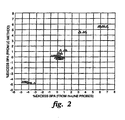
- the measured data was plotted, as in Fig. 2.
- the measured stoichiometry error from the controlled HPLC method is plotted on the Y-axis
- the predicted stoichiometry error as in Equation (2) is plotted along the X-axis.
- the dual sensor system 10 determines process parameters.
- the data obtained by probes 14 and 16 is logged by a processor 24 on a data acquisition system.
- Data logged by the data acquisition system is used to measure temperature coefficients, c ⁇ ,c ⁇ .
- the temperature coefficients, c ⁇ ,c ⁇ are predetermined and constant for all stoichiometry determinations.
- Equation (2) the constant nature of the temperature coefficients, c ⁇ , c ⁇ reduces the number of variable parameters in Equation (2) from six to four. This, of course, is efficient and desirable since the reduction variables lessens any error associated with the determination as set forth in Equation(2).
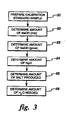
- An independent (test) stoichiometry error SE for example to be used in the above determination, is determined in the following manner. To facilitate understanding of the determination, the Equations used in the determination are provided, and then parameters are applied to the Equations. Further, Fig. 3 is a flow chart of the application of the Equations to result in an independent (test) stoichiometry error se.
- This reaction produces about 0.025 moles or about 6.807 grams of BPA salt, using only recrystallized BPA, about 1N NaOH with DI H 2 O.
- 1N NaOH is one molecular weight, in grams, of NaOH about 40.0 per liter of H 2 O. Therefore, about 1.0 grams of NaOH per about 25 mls of H 2 O result, where the density of 1N NaOH is approximately 1.040.
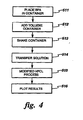
- step S11 about 10 milligrams of recrystallized BPA were placed in a container.
- step S12 about 100 mls of toluene were added to the container. Next, the container and contents were shaken until the BPA is dissolved in step S13.
- step S14 some of this solution, for example about 2 mls, is transferred into a high pressure liquid chromatography (HPLC) vial.
- HPLC high pressure liquid chromatography
- the modified HPLC process is then used, in step S15, to determine a stoichiometry.
- step S16 the resultant stoichiometry error SE is plotted in step S16, with the stoichiometry error as determined from measured parameters.
- the instant invention can also be applied to determine stoichiometry error parameters for use in determining a stoichiometry error.
- This determination of parametners comprises analyzing at least two, and preferably more than two samples liquid, to determine a stoichiometry error and applying the determined stoichiometry error to determine a proportionality constant for determining stoichiometry error parameters for use in Equation (2).
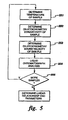
- step S51 the temperature of a sample is determined.
- step S52 an on-stoichiometry conductivity of the sample at a nominal operating temperature is determined.
- step S53 an on-stoichiometry sound velocity of the sample at a nominal operating temperature is determined.
- a stoichiometry error by a liquid chromatographic analyzation is determined, in accordance with the invention. Steps S51-S54 are repeated for each sample available.
- the determination of a proportionality constant for determining stoichiometry error parameters requires only two different samples to be measured and analyzed. However, it has been determined even more preferable results are obtained if the number of samples measured and analyzed is greater than two.
- the process determines if there are any more samples to be analyzed, at step S55. If there are more samples to be analyzed, the process repeats steps S51-S54, as necessary. When there are no remaining samples to be measured and analyzed, the process moves to step S56, to determine a linear relation between stoichiometry error and temperature, conductivity and sound velocity according to Equation (2): by a least squares analysis.
- the least squares analysis relies upon the determined values in steps S51-55 to provide stoichiometry paramenters.
- These parameters include at least one of: A , which is a proportionality constant relating stoichiometry error to conductivity; c ⁇ , which is a temperature correction coefficient for sound velocity; c ⁇ , which is a temperature correction coefficient for conductivity; d , which is a sound velocity correction coefficient for conductivity; ⁇ T 0 , which is an on-stoichiometry conductivity at T 0 ; and ⁇ T 0 which is an on-stoichiometry sound velocity at T 0 .
- the process is conducted by measuring all paramenters A , c ⁇ , c ⁇ , ⁇ T 0 , ⁇ T 0 , and d and determining a linear relation, as above. Further, one or more of the parameters may be measured and the remainder of the parameters can be determined as above.
- the determining a stoichiometry error by a liquid chromatography analysis in step S54 comprises making bisphenol salt as the result of the reaction between bisphenol and an alkali metal hydroxide.
- the method further comprises preparing an aqueous bisphenol salt solution from substantially equivalent amounts of bisphenol and alkali metal hydroxide; contacting at least a portion of the aqueous solution bisphenol salt solution with an immiscible organic solvent to produce a two phase mixture; obtaining a value of the organic phase of the two phase mixture; determining alkali metal hydroxide variance from stoichiometry; adding at least one of additional alkali metal hydroxide and additional bisphenol to the aqueous bisphenoxide salt solution to obtain a bisphenoxide salt mixture having a substantial stoichiometry relation between alkali metal hydroxide and bisphenol; and separating water from the resulting aqueous bisphenoxide salt mixture to produce the anhydrous alkali metal bisphenoxide salt within a ⁇ 0.2
Landscapes
- Chemical & Material Sciences (AREA)
- Organic Chemistry (AREA)
- Organic Low-Molecular-Weight Compounds And Preparation Thereof (AREA)
- Investigating Or Analyzing Materials By The Use Of Electric Means (AREA)
Claims (8)
- Verfahren zum Herstellen von Bisphenolsalz als dem Resultat der Umsetzung zwischen Bisphenol und einem Alkalimetallhydroxid, wobei das Verfahren umfasst:wobei die Bestimungsphase umfasst:Herstellen einer wässerigen Bisphenolsalz-Lösung aus stöchiometrischen Mengen von Bisphenol (BP) (1 Teil) und Alkalimetallhydroxid (2 Teile),Bestimmen der Alkalimetallhydroxid-Abweichung von der Stöchiometrie,In-Berührung-bringen einer Probe der wässerigen Bisphenolsalz-Lösung mit einem unmischbaren organischen Lösungsmittel zur Herstellung einer Zweiphasen-Mischung,Trennenlassen der Phasen in eine organische Phase und eine wässerige BP -Salzphase,Analysieren der organischen Phase und Bestimmen der Menge freien BP darin undIn-Beziehung-setzen der Menge freien BP 's in der organischen Phase zur tatsächlichen Stöchiometrie der wässerigen BP -Salzlösung,Kontrollieren der Extraktions-Temperatur, sodass diese innerhalb ± 1,0°C liegt,Kontrollieren des Kontaktes mit der Umgebungs-Temperatur, um die Absorption von CO2 zu vermeiden, undKontrollieren des Feststoffgehaltes der Probe, sodass dieser etwa 10±0,4% Feststoffe beträgt,Hinzugeben mindestens eines zusätzlichen Alkalimetallhydroxids und zusätzlichen Bisphenols zu der wässerigen Bisphenoxidsalz-Lösung,Abtrennen von Wasser aus der wässerigen Bisphenoxidsalz-Lösung zur Herstellung eines wasserfreien Alkalimetallbisphenoxidsalzes innerhalb einer stöchiometrischen Beziehung von ± 0,2 Mol-% zwischen Bisphenol und Alkalimetallhydroxid.
- Verfahren nach Anspruch 1, worin das Bisphenol Bisphenol-A ist.
- Verfahren nach Anspruch 1, worin das unmischbare organische Lösungsmittel Toluol ist.
- Verfahren nach Anspruch 1, worin das Alkalimetallhydroxid Natriumhydroxid ist.
- Verfahren nach Anspruch 1, weiter umfassend das Kontrollieren des Kontaktes mit der Umgebungs-Atmosphäre.
- Verfahren nach Anspruch 1, weiter umfassend die Bestimmung des Stöchiometriefehlers SE einer Probe, wobei das Verfahren umfasst:wobei der Stöchiometriefehler SE für eine Probe bestimmt ist durch:Bestimmen der Temperatur der Probe,Bestimmen der Leitfähigkeit der Probe undBestimmen der Schallgeschwindigkeit für die Probe,
o eine Stöchiometrie-Leitfähigkeit bei To ist und ν To eine Stöchiometrie-Schallgeschwindigkeit bei To ist. - Verfahren nach Anspruch 1, weiter umfassend das Bestimmen der Stöchiometriefehler-Parameter zwischen Proben, wobei das Verfahren die Stufen umfasst:(1) Bestimmen der Temperatur einer ersten Probe,(2) Bestimmen der Stöchiometrie-Leitfähigkeit einer Probe bei einer nominellen Betriebs-Temperatur,(3) Bestimmen der Stöchiometrie-Schallgeschwindigkeit bei einer nominellen Betriebs-Temperatur,(4) Bestimmen eines Stöchioetriefehlers durch eine chromatographische Flüssigkeits-Analyse,(5) Wiederholen der Stufen (1) bis (4) für mindestens eine zweite Probe,(6) Bestimmen einer linearen Beziehung zwischen Stöchiometriefehler und Temperatur, Leitfähigkeit und Schallgeschwindigkeit gemäß:A einer Proportionalitäts-Konstanten, die Stöchiometriefehler mit Leitfähigkeit in Beziehung setzt, c σ einem Temperaturkorrektur-Koeffizienten für die Leitfähigkeit, c ν einem Temperaturkorrektur-Koeffizienten für die Schallgeschwindigkeit, d einem Schallgeschwindigkeits-Korrekturkoeffizienten für die Leitfähigkeit, σ T
o , welches eine Stöchiometrie-Leitfähigkeit bei To ist und ν To , welches eine Stöchiometrie-Schallgeschwindigkeit bei To ist. - Verfahren nach Anspruch 7, worin die Bestimmung eines Stöchiometriefehlers umfasst:Herstellen einer Lösung aus im Wesentlichen äquivalenten Mengen von Bestandteilen,In-Berührung-bringen mindestens eines Teiles der Lösung mit einem organischen Lösungsmittel zur Herstellung einer Zweiphasen-Mischung,Erhalten eines Wertes der organischen Phase der Zweiphasen-Mischung,Bestimmen der Abweichung von der Stöchiometrie,Hinzugeben mindestens eines der Bestandteile zu der Lösung, um eine Mischung zu erhalten, die im Wesentlichen eine stöchiometrische Beziehung zwischen den Bestandteilen aufweist, undAbtrennen von Wasser aus der resultierenden Mischung zur Herstellung einer Stöchiometrie-Beziehung von 0,2 Mol-% zwischen den Bestandteilen.
Applications Claiming Priority (2)
| Application Number | Priority Date | Filing Date | Title |
|---|---|---|---|
| US08/795,839 US5851837A (en) | 1997-02-06 | 1997-02-06 | Method for determination of salt stoichiometry |
| US795839 | 1997-02-06 |
Publications (2)
| Publication Number | Publication Date |
|---|---|
| EP0857710A1 EP0857710A1 (de) | 1998-08-12 |
| EP0857710B1 true EP0857710B1 (de) | 2003-06-04 |
Family
ID=25166581
Family Applications (1)
| Application Number | Title | Priority Date | Filing Date |
|---|---|---|---|
| EP98300669A Expired - Lifetime EP0857710B1 (de) | 1997-02-06 | 1998-01-30 | Methode zur Bestimmung von Salz Stöchiometrie |
Country Status (6)
| Country | Link |
|---|---|
| US (1) | US5851837A (de) |
| EP (1) | EP0857710B1 (de) |
| JP (1) | JPH10291950A (de) |
| DE (1) | DE69815167T2 (de) |
| ES (1) | ES2201407T3 (de) |
| SG (1) | SG74610A1 (de) |
Cited By (1)
| Publication number | Priority date | Publication date | Assignee | Title |
|---|---|---|---|---|
| DE102004023734B3 (de) * | 2004-05-11 | 2006-05-18 | Betriebsforschungsinstitut VDEh - Institut für angewandte Forschung GmbH | Verfahren und Vorrichtung zur Konzentrationsbestimmung mindestens eines Metallsalzes und mindestens einer Säure einer mindestens ein Metallsalz enthaltenden Beizsäure |
Families Citing this family (18)
| Publication number | Priority date | Publication date | Assignee | Title |
|---|---|---|---|---|
| DE19607681B4 (de) * | 1996-02-29 | 2009-07-09 | Fogra Forschungsgesellschaft Druck E.V. | Verfahren und Vorrichtung zur kontinuierlichen Messung und Regelung der Zusammensetzung einer Feuchtmittellösung für den Offsetdruck |
| ATE402410T1 (de) * | 1996-03-19 | 2008-08-15 | Daikin Ind Ltd | Verfahren zur erfassung von komponentenkonzentrationen einer dreikomponentenmischung und prozess zur kontinuierlichen herstellung von fluorwasserstoff unter nutzung des verfahrens |
| MXPA03006429A (es) * | 2001-01-19 | 2004-05-05 | Honeywell Int Inc | Metodo para regular la concentracion de agua en una corriente de proceso. |
| US7115785B2 (en) * | 2003-08-25 | 2006-10-03 | General Electric Company | Method for making salts hydroxy-substituted hydrocarbons |
| WO2006017787A2 (en) * | 2004-08-06 | 2006-02-16 | Grain Processing Corporation | Tablet coating composition |
| US7902407B2 (en) | 2005-03-30 | 2011-03-08 | Sabic Innovative Plastics Ip B.V. | Method for preparation of salts of hydroxy-substituted aromatic compounds |
| US9006348B2 (en) * | 2005-09-16 | 2015-04-14 | Sabic Global Technologies B.V. | Poly aryl ether ketone polymer blends |
| US20070066737A1 (en) * | 2005-09-16 | 2007-03-22 | Gallucci Robert R | Flame retardant polymer blends |
| WO2007035402A2 (en) | 2005-09-16 | 2007-03-29 | General Electric Company | Improved poly aryl ether ketone polymer blends |
| US20080274360A1 (en) * | 2007-05-04 | 2008-11-06 | General Electric Company | Polyaryl ether ketone - polycarbonate copolymer blends |
| US8080671B2 (en) | 2008-05-23 | 2011-12-20 | Sabic Innovative Plastics Ip B.V. | Production of low color polyetherimides |
| US8912272B2 (en) | 2008-12-19 | 2014-12-16 | Sabic Innovative Plastics Ip B.V. | Moisture resistant polyimide compositions |
| CN102338766A (zh) * | 2011-08-02 | 2012-02-01 | 湘潭大学 | 一种用于双酚a检测的电化学传感器 |
| WO2015160933A1 (en) | 2014-04-15 | 2015-10-22 | Sabic Global Technologies B.V. | Methods of manufacture of polyetherimides |
| CN106164029B (zh) | 2014-04-15 | 2018-06-29 | 沙特基础工业全球技术有限公司 | 制造羟基取代的芳香族化合物的盐和聚醚酰亚胺的方法 |
| US10526449B2 (en) | 2015-02-27 | 2020-01-07 | Sabic Global Technologies B.V. | Process to make low color polyetherimide by halo-displacement and low color polyetherimide |
| US10584210B2 (en) | 2015-02-27 | 2020-03-10 | Sabic Global Technologies B.V. | Polyetherimide with improved color, and methods of manufacture thereof |
| DE102018206360A1 (de) * | 2018-04-25 | 2019-10-31 | Conti Temic Microelectronic Gmbh | Sensorvorrichtung zum Bestimmen der elektrischen Leitfähigkeit eines Fluids und der Schallgeschwindigkeit im Fluid |
Family Cites Families (8)
| Publication number | Priority date | Publication date | Assignee | Title |
|---|---|---|---|---|
| US3960968A (en) * | 1973-07-13 | 1976-06-01 | Bayer Aktiengesellschaft | Method for the continuous production of aqueous dialkali salt solutions of aromatic dihydroxy compounds |
| US4202993A (en) * | 1979-05-09 | 1980-05-13 | General Electric Company | Method for making substantially anhydrous alkali metal bisphenol salts |
| US4410735A (en) * | 1981-11-30 | 1983-10-18 | General Electric Company | Method for making bisphenoxide salts |
| EP0117459B1 (de) * | 1983-02-28 | 1989-09-06 | General Electric Company | Verfahren zur Herstellung von wasserfreien Salzen von aromatischen Dihydroxyverbindungen |
| US4546207A (en) * | 1983-02-28 | 1985-10-08 | General Electric Company | Process for preparing anhydrous salts of dihydroxyaromatic compounds |
| US4492806A (en) * | 1983-11-28 | 1985-01-08 | General Electric Company | Process for preparing alkali metal salts of hydroxyaromatic compounds |
| JPS6327448A (ja) * | 1986-07-17 | 1988-02-05 | Daicel Chem Ind Ltd | 高純度ビスフエノ−ルアルカリ金属二塩の製造方法 |
| JPH0710784B2 (ja) * | 1988-08-23 | 1995-02-08 | セントラル硝子株式会社 | 2,2―ビス(4―ヒドロキシフェニル)ヘキサフルオロプロパンの精製法 |
-
1997
- 1997-02-06 US US08/795,839 patent/US5851837A/en not_active Expired - Lifetime
-
1998
- 1998-01-30 ES ES98300669T patent/ES2201407T3/es not_active Expired - Lifetime
- 1998-01-30 DE DE69815167T patent/DE69815167T2/de not_active Expired - Lifetime
- 1998-01-30 EP EP98300669A patent/EP0857710B1/de not_active Expired - Lifetime
- 1998-02-02 SG SG1998000227A patent/SG74610A1/en unknown
- 1998-02-04 JP JP10022446A patent/JPH10291950A/ja active Pending
Cited By (1)
| Publication number | Priority date | Publication date | Assignee | Title |
|---|---|---|---|---|
| DE102004023734B3 (de) * | 2004-05-11 | 2006-05-18 | Betriebsforschungsinstitut VDEh - Institut für angewandte Forschung GmbH | Verfahren und Vorrichtung zur Konzentrationsbestimmung mindestens eines Metallsalzes und mindestens einer Säure einer mindestens ein Metallsalz enthaltenden Beizsäure |
Also Published As
| Publication number | Publication date |
|---|---|
| ES2201407T3 (es) | 2004-03-16 |
| US5851837A (en) | 1998-12-22 |
| JPH10291950A (ja) | 1998-11-04 |
| EP0857710A1 (de) | 1998-08-12 |
| SG74610A1 (en) | 2000-08-22 |
| DE69815167D1 (de) | 2003-07-10 |
| DE69815167T2 (de) | 2004-04-08 |
Similar Documents
| Publication | Publication Date | Title |
|---|---|---|
| EP0857710B1 (de) | Methode zur Bestimmung von Salz Stöchiometrie | |
| Christensen et al. | Entropy titration. A calorimetric method for the determination of ΔG, ΔH, and ΔS from a single thermometric titration1a, B | |
| US7829339B2 (en) | Method for casein determination in milk | |
| Paulsen et al. | Determination of sulfur as arsenic monosulfide ion by isotope dilution thermal ionization mass spectrometry | |
| KR101936848B1 (ko) | 유도체를 이용한 식품 중 에틸렌 옥사이드 분석방법 | |
| Zawadiak et al. | Concurrent iodimetric determination of cumene hydroperoxide and dicumenyl peroxide used for reaction control in dicumenyl peroxide synthesis | |
| Fossey et al. | Determination of acidity constants by solvent extraction/flow injection analysis using a dual-membrane phase separator | |
| Muthu et al. | Vapor-liquid equilibrium for the binary systems propionitrile-ethylbenzene and acetonitrile-ethyl acetate,-ethyl alcohol, and-toluene | |
| Mahrous et al. | Spectrophotometric determination of certain cephalosporins with ninhydrin | |
| US4810776A (en) | Process for producing epoxy resin having a low-EHC-content from chlorine-substituted crude epoxy resin of high EHC-content and apparatus for automatically controlling such process | |
| US20030213911A1 (en) | Method of measuring the concentration of hydroperoxides of alkylaromatic hydrocarbons | |
| Yano et al. | Measurement of the concentrations of glucose and citric acid in the aqueous solution of a blood anticoagulant using near infrared spectroscopy | |
| Taylor et al. | Simple and rapid procedure for the determination of lead in whole blood by use of a slotted tube and discrete nebulisation flame atomic-absorption spectrometry | |
| CN117169319A (zh) | 氧同位素测定方法 | |
| CN113008720B (zh) | 4-溴二苯醚纯度定值方法 | |
| López-Anreus | Simultaneous vapour phase Fourier transform infrared spectrometric determination of butyl acetate, toluene and methyl ethyl ketone in paint solvents | |
| Voss et al. | A fast and simple procedure for routine determinations of plasma cholinesterase activities | |
| JP2000074809A (ja) | 化学物質の残存率の予測方法 | |
| CN108627578A (zh) | 辛伐他汀和辛伐他汀羟基酸浓度的定量分析方法 | |
| Trancoso et al. | Validation and quality assurance applied to goat milk chemical composition: Minerals and trace elements measurements | |
| Nisbet et al. | Calibration drift in the automated determination of calcium and magnesium by atomic absorption | |
| JPH0580029A (ja) | 連続流れ方式水分分析方法及び装置 | |
| Gutierrez et al. | Stopped-flow determination of creatinine in human serum and food samples | |
| Berner et al. | Solid phase extraction for the determination of ibuprofen by means of HPLC and UV detection in the lower ng range in plasma and urine | |
| Toullec et al. | An accurate spectrophotometric method for determination of small amounts of water in acidic methanol |
Legal Events
| Date | Code | Title | Description |
|---|---|---|---|
| PUAI | Public reference made under article 153(3) epc to a published international application that has entered the european phase |
Free format text: ORIGINAL CODE: 0009012 |
|
| AK | Designated contracting states |
Kind code of ref document: A1 Designated state(s): DE ES FR GB IT NL |
|
| AX | Request for extension of the european patent |
Free format text: AL;LT;LV;MK;RO;SI |
|
| 17P | Request for examination filed |
Effective date: 19990212 |
|
| AKX | Designation fees paid |
Free format text: DE ES FR GB IT NL |
|
| RBV | Designated contracting states (corrected) |
Designated state(s): DE ES FR GB IT NL |
|
| 17Q | First examination report despatched |
Effective date: 19991015 |
|
| GRAH | Despatch of communication of intention to grant a patent |
Free format text: ORIGINAL CODE: EPIDOS IGRA |
|
| GRAH | Despatch of communication of intention to grant a patent |
Free format text: ORIGINAL CODE: EPIDOS IGRA |
|
| GRAA | (expected) grant |
Free format text: ORIGINAL CODE: 0009210 |
|
| AK | Designated contracting states |
Designated state(s): DE ES FR GB IT NL |
|
| REG | Reference to a national code |
Ref country code: GB Ref legal event code: FG4D |
|
| REF | Corresponds to: |
Ref document number: 69815167 Country of ref document: DE Date of ref document: 20030710 Kind code of ref document: P |
|
| REG | Reference to a national code |
Ref country code: ES Ref legal event code: FG2A Ref document number: 2201407 Country of ref document: ES Kind code of ref document: T3 |
|
| ET | Fr: translation filed | ||
| PLBE | No opposition filed within time limit |
Free format text: ORIGINAL CODE: 0009261 |
|
| STAA | Information on the status of an ep patent application or granted ep patent |
Free format text: STATUS: NO OPPOSITION FILED WITHIN TIME LIMIT |
|
| 26N | No opposition filed |
Effective date: 20040305 |
|
| REG | Reference to a national code |
Ref country code: GB Ref legal event code: 732E |
|
| PGFP | Annual fee paid to national office [announced via postgrant information from national office to epo] |
Ref country code: IT Payment date: 20080129 Year of fee payment: 11 |
|
| REG | Reference to a national code |
Ref country code: FR Ref legal event code: TP |
|
| NLS | Nl: assignments of ep-patents |
Owner name: SABIC INNOVATIVE PLASTICS IP B.V. Effective date: 20081023 |
|
| PGFP | Annual fee paid to national office [announced via postgrant information from national office to epo] |
Ref country code: ES Payment date: 20090218 Year of fee payment: 12 |
|
| PGFP | Annual fee paid to national office [announced via postgrant information from national office to epo] |
Ref country code: NL Payment date: 20090104 Year of fee payment: 12 |
|
| PGFP | Annual fee paid to national office [announced via postgrant information from national office to epo] |
Ref country code: GB Payment date: 20090128 Year of fee payment: 12 |
|
| REG | Reference to a national code |
Ref country code: NL Ref legal event code: V1 Effective date: 20100801 |
|
| GBPC | Gb: european patent ceased through non-payment of renewal fee |
Effective date: 20100130 |
|
| PG25 | Lapsed in a contracting state [announced via postgrant information from national office to epo] |
Ref country code: NL Free format text: LAPSE BECAUSE OF NON-PAYMENT OF DUE FEES Effective date: 20100801 |
|
| PG25 | Lapsed in a contracting state [announced via postgrant information from national office to epo] |
Ref country code: GB Free format text: LAPSE BECAUSE OF NON-PAYMENT OF DUE FEES Effective date: 20100130 |
|
| REG | Reference to a national code |
Ref country code: ES Ref legal event code: FD2A Effective date: 20110328 |
|
| PG25 | Lapsed in a contracting state [announced via postgrant information from national office to epo] |
Ref country code: IT Free format text: LAPSE BECAUSE OF NON-PAYMENT OF DUE FEES Effective date: 20090130 |
|
| PG25 | Lapsed in a contracting state [announced via postgrant information from national office to epo] |
Ref country code: ES Free format text: LAPSE BECAUSE OF NON-PAYMENT OF DUE FEES Effective date: 20110314 |
|
| PG25 | Lapsed in a contracting state [announced via postgrant information from national office to epo] |
Ref country code: ES Free format text: LAPSE BECAUSE OF NON-PAYMENT OF DUE FEES Effective date: 20100131 |
|
| PGFP | Annual fee paid to national office [announced via postgrant information from national office to epo] |
Ref country code: DE Payment date: 20140122 Year of fee payment: 17 |
|
| PGFP | Annual fee paid to national office [announced via postgrant information from national office to epo] |
Ref country code: FR Payment date: 20140108 Year of fee payment: 17 |
|
| REG | Reference to a national code |
Ref country code: DE Ref legal event code: R119 Ref document number: 69815167 Country of ref document: DE |
|
| PG25 | Lapsed in a contracting state [announced via postgrant information from national office to epo] |
Ref country code: DE Free format text: LAPSE BECAUSE OF NON-PAYMENT OF DUE FEES Effective date: 20150801 |
|
| REG | Reference to a national code |
Ref country code: FR Ref legal event code: ST Effective date: 20150930 |
|
| PG25 | Lapsed in a contracting state [announced via postgrant information from national office to epo] |
Ref country code: FR Free format text: LAPSE BECAUSE OF NON-PAYMENT OF DUE FEES Effective date: 20150202 |