EP0857691B1 - Rieselfähige Erdalkalicarbonate - Google Patents
Rieselfähige Erdalkalicarbonate Download PDFInfo
- Publication number
- EP0857691B1 EP0857691B1 EP98101510A EP98101510A EP0857691B1 EP 0857691 B1 EP0857691 B1 EP 0857691B1 EP 98101510 A EP98101510 A EP 98101510A EP 98101510 A EP98101510 A EP 98101510A EP 0857691 B1 EP0857691 B1 EP 0857691B1
- Authority
- EP
- European Patent Office
- Prior art keywords
- process according
- carbonate
- weight
- pourable
- preparation
- Prior art date
- Legal status (The legal status is an assumption and is not a legal conclusion. Google has not performed a legal analysis and makes no representation as to the accuracy of the status listed.)
- Expired - Lifetime
Links
- 150000004649 carbonic acid derivatives Chemical class 0.000 title description 3
- AYJRCSIUFZENHW-UHFFFAOYSA-L barium carbonate Chemical compound [Ba+2].[O-]C([O-])=O AYJRCSIUFZENHW-UHFFFAOYSA-L 0.000 claims abstract description 27
- 239000004094 surface-active agent Substances 0.000 claims abstract description 20
- 238000000034 method Methods 0.000 claims abstract description 17
- 229910000018 strontium carbonate Inorganic materials 0.000 claims abstract description 13
- BVKZGUZCCUSVTD-UHFFFAOYSA-L Carbonate Chemical compound [O-]C([O-])=O BVKZGUZCCUSVTD-UHFFFAOYSA-L 0.000 claims abstract description 12
- BDAGIHXWWSANSR-NJFSPNSNSA-N hydroxyformaldehyde Chemical compound O[14CH]=O BDAGIHXWWSANSR-NJFSPNSNSA-N 0.000 claims abstract description 12
- 238000002360 preparation method Methods 0.000 claims description 14
- 150000001875 compounds Chemical class 0.000 claims description 13
- QAOWNCQODCNURD-UHFFFAOYSA-L Sulfate Chemical compound [O-]S([O-])(=O)=O QAOWNCQODCNURD-UHFFFAOYSA-L 0.000 claims description 7
- 159000000000 sodium salts Chemical class 0.000 claims description 7
- 150000002191 fatty alcohols Chemical class 0.000 claims description 6
- 239000002202 Polyethylene glycol Substances 0.000 claims description 5
- 229920001223 polyethylene glycol Polymers 0.000 claims description 5
- -1 alkyl benzenesulphonate Chemical compound 0.000 claims description 4
- 125000000129 anionic group Chemical group 0.000 claims description 4
- MTHSVFCYNBDYFN-UHFFFAOYSA-N diethylene glycol Chemical compound OCCOCCO MTHSVFCYNBDYFN-UHFFFAOYSA-N 0.000 claims description 4
- XLYOFNOQVPJJNP-UHFFFAOYSA-N water Substances O XLYOFNOQVPJJNP-UHFFFAOYSA-N 0.000 claims description 4
- 239000000654 additive Substances 0.000 claims description 3
- 230000000996 additive effect Effects 0.000 claims description 3
- 239000004927 clay Substances 0.000 claims description 3
- 238000006253 efflorescence Methods 0.000 claims description 3
- 206010037844 rash Diseases 0.000 claims description 3
- 238000001035 drying Methods 0.000 claims description 2
- 238000000265 homogenisation Methods 0.000 claims description 2
- 229910021653 sulphate ion Inorganic materials 0.000 claims 4
- PMZURENOXWZQFD-UHFFFAOYSA-L Sodium Sulfate Chemical compound [Na+].[Na+].[O-]S([O-])(=O)=O PMZURENOXWZQFD-UHFFFAOYSA-L 0.000 claims 2
- JXLHNMVSKXFWAO-UHFFFAOYSA-N azane;7-fluoro-2,1,3-benzoxadiazole-4-sulfonic acid Chemical class N.OS(=O)(=O)C1=CC=C(F)C2=NON=C12 JXLHNMVSKXFWAO-UHFFFAOYSA-N 0.000 claims 2
- 239000000126 substance Substances 0.000 claims 2
- MRUAUOIMASANKQ-UHFFFAOYSA-N cocamidopropyl betaine Chemical compound CCCCCCCCCCCC(=O)NCCC[N+](C)(C)CC([O-])=O MRUAUOIMASANKQ-UHFFFAOYSA-N 0.000 claims 1
- 229940073507 cocamidopropyl betaine Drugs 0.000 claims 1
- 235000011837 pasties Nutrition 0.000 claims 1
- LEDMRZGFZIAGGB-UHFFFAOYSA-L strontium carbonate Chemical compound [Sr+2].[O-]C([O-])=O LEDMRZGFZIAGGB-UHFFFAOYSA-L 0.000 claims 1
- 239000003945 anionic surfactant Substances 0.000 abstract description 2
- 238000005469 granulation Methods 0.000 abstract 1
- 230000003179 granulation Effects 0.000 abstract 1
- QAOWNCQODCNURD-UHFFFAOYSA-N Sulfuric acid Chemical class OS(O)(=O)=O QAOWNCQODCNURD-UHFFFAOYSA-N 0.000 description 9
- 238000004519 manufacturing process Methods 0.000 description 8
- 239000000047 product Substances 0.000 description 7
- 125000004432 carbon atom Chemical group C* 0.000 description 5
- 239000011521 glass Substances 0.000 description 4
- KWIUHFFTVRNATP-UHFFFAOYSA-N glycine betaine Chemical compound C[N+](C)(C)CC([O-])=O KWIUHFFTVRNATP-UHFFFAOYSA-N 0.000 description 4
- 239000011734 sodium Substances 0.000 description 4
- ZLMJMSJWJFRBEC-UHFFFAOYSA-N Potassium Chemical compound [K] ZLMJMSJWJFRBEC-UHFFFAOYSA-N 0.000 description 3
- 125000000217 alkyl group Chemical group 0.000 description 3
- 239000000203 mixture Substances 0.000 description 3
- 229910052700 potassium Inorganic materials 0.000 description 3
- 239000011591 potassium Substances 0.000 description 3
- 239000000843 powder Substances 0.000 description 3
- 150000003839 salts Chemical class 0.000 description 3
- 229910052708 sodium Inorganic materials 0.000 description 3
- 125000001273 sulfonato group Chemical class [O-]S(*)(=O)=O 0.000 description 3
- 239000004711 α-olefin Substances 0.000 description 3
- CURLTUGMZLYLDI-UHFFFAOYSA-N Carbon dioxide Chemical compound O=C=O CURLTUGMZLYLDI-UHFFFAOYSA-N 0.000 description 2
- 235000013162 Cocos nucifera Nutrition 0.000 description 2
- 244000060011 Cocos nucifera Species 0.000 description 2
- RTZKZFJDLAIYFH-UHFFFAOYSA-N Diethyl ether Chemical compound CCOCC RTZKZFJDLAIYFH-UHFFFAOYSA-N 0.000 description 2
- DGAQECJNVWCQMB-PUAWFVPOSA-M Ilexoside XXIX Chemical compound C[C@@H]1CC[C@@]2(CC[C@@]3(C(=CC[C@H]4[C@]3(CC[C@@H]5[C@@]4(CC[C@@H](C5(C)C)OS(=O)(=O)[O-])C)C)[C@@H]2[C@]1(C)O)C)C(=O)O[C@H]6[C@@H]([C@H]([C@@H]([C@H](O6)CO)O)O)O.[Na+] DGAQECJNVWCQMB-PUAWFVPOSA-M 0.000 description 2
- 150000001335 aliphatic alkanes Chemical group 0.000 description 2
- 150000003863 ammonium salts Chemical class 0.000 description 2
- 239000002585 base Substances 0.000 description 2
- 229960003237 betaine Drugs 0.000 description 2
- 239000011449 brick Substances 0.000 description 2
- 125000002091 cationic group Chemical group 0.000 description 2
- 235000014113 dietary fatty acids Nutrition 0.000 description 2
- 229930195729 fatty acid Natural products 0.000 description 2
- 239000000194 fatty acid Substances 0.000 description 2
- 150000004665 fatty acids Chemical class 0.000 description 2
- 150000003467 sulfuric acid derivatives Chemical class 0.000 description 2
- TURPNXCLLLFJAP-UHFFFAOYSA-N 2-[2-(2-hydroxyethoxy)ethoxy]ethyl hydrogen sulfate Chemical compound OCCOCCOCCOS(O)(=O)=O TURPNXCLLLFJAP-UHFFFAOYSA-N 0.000 description 1
- QGZKDVFQNNGYKY-UHFFFAOYSA-O Ammonium Chemical compound [NH4+] QGZKDVFQNNGYKY-UHFFFAOYSA-O 0.000 description 1
- 229920001353 Dextrin Polymers 0.000 description 1
- 239000004375 Dextrin Substances 0.000 description 1
- 229920002472 Starch Polymers 0.000 description 1
- 230000002378 acidificating effect Effects 0.000 description 1
- 239000003513 alkali Substances 0.000 description 1
- 229910001854 alkali hydroxide Inorganic materials 0.000 description 1
- 150000008044 alkali metal hydroxides Chemical class 0.000 description 1
- 150000001336 alkenes Chemical group 0.000 description 1
- 125000002877 alkyl aryl group Chemical group 0.000 description 1
- 150000001408 amides Chemical class 0.000 description 1
- 239000002280 amphoteric surfactant Substances 0.000 description 1
- 239000011230 binding agent Substances 0.000 description 1
- 229910002092 carbon dioxide Inorganic materials 0.000 description 1
- 239000001569 carbon dioxide Substances 0.000 description 1
- 150000003841 chloride salts Chemical class 0.000 description 1
- 239000007859 condensation product Substances 0.000 description 1
- 235000019425 dextrin Nutrition 0.000 description 1
- JRBPAEWTRLWTQC-UHFFFAOYSA-N dodecylamine Chemical compound CCCCCCCCCCCCN JRBPAEWTRLWTQC-UHFFFAOYSA-N 0.000 description 1
- 229910001651 emery Inorganic materials 0.000 description 1
- 150000002170 ethers Chemical class 0.000 description 1
- 239000004744 fabric Substances 0.000 description 1
- 238000010304 firing Methods 0.000 description 1
- 238000012812 general test Methods 0.000 description 1
- 150000004028 organic sulfates Chemical class 0.000 description 1
- 239000012188 paraffin wax Substances 0.000 description 1
- 239000002245 particle Substances 0.000 description 1
- 229920001521 polyalkylene glycol ether Polymers 0.000 description 1
- 235000019353 potassium silicate Nutrition 0.000 description 1
- 230000002265 prevention Effects 0.000 description 1
- 150000003333 secondary alcohols Chemical class 0.000 description 1
- 238000007873 sieving Methods 0.000 description 1
- 235000012239 silicon dioxide Nutrition 0.000 description 1
- NTHWMYGWWRZVTN-UHFFFAOYSA-N sodium silicate Chemical compound [Na+].[Na+].[O-][Si]([O-])=O NTHWMYGWWRZVTN-UHFFFAOYSA-N 0.000 description 1
- 238000003892 spreading Methods 0.000 description 1
- 235000019698 starch Nutrition 0.000 description 1
- 239000008107 starch Substances 0.000 description 1
- BDHFUVZGWQCTTF-UHFFFAOYSA-M sulfonate Chemical compound [O-]S(=O)=O BDHFUVZGWQCTTF-UHFFFAOYSA-M 0.000 description 1
- 239000000725 suspension Substances 0.000 description 1
- 150000003568 thioethers Chemical class 0.000 description 1
- 238000005303 weighing Methods 0.000 description 1
Classifications
-
- C—CHEMISTRY; METALLURGY
- C01—INORGANIC CHEMISTRY
- C01F—COMPOUNDS OF THE METALS BERYLLIUM, MAGNESIUM, ALUMINIUM, CALCIUM, STRONTIUM, BARIUM, RADIUM, THORIUM, OR OF THE RARE-EARTH METALS
- C01F11/00—Compounds of calcium, strontium, or barium
- C01F11/18—Carbonates
- C01F11/186—Strontium or barium carbonate
-
- C—CHEMISTRY; METALLURGY
- C04—CEMENTS; CONCRETE; ARTIFICIAL STONE; CERAMICS; REFRACTORIES
- C04B—LIME, MAGNESIA; SLAG; CEMENTS; COMPOSITIONS THEREOF, e.g. MORTARS, CONCRETE OR LIKE BUILDING MATERIALS; ARTIFICIAL STONE; CERAMICS; REFRACTORIES; TREATMENT OF NATURAL STONE
- C04B33/00—Clay-wares
- C04B33/02—Preparing or treating the raw materials individually or as batches
- C04B33/13—Compounding ingredients
-
- C—CHEMISTRY; METALLURGY
- C01—INORGANIC CHEMISTRY
- C01P—INDEXING SCHEME RELATING TO STRUCTURAL AND PHYSICAL ASPECTS OF SOLID INORGANIC COMPOUNDS
- C01P2004/00—Particle morphology
- C01P2004/60—Particles characterised by their size
- C01P2004/61—Micrometer sized, i.e. from 1-100 micrometer
-
- C—CHEMISTRY; METALLURGY
- C01—INORGANIC CHEMISTRY
- C01P—INDEXING SCHEME RELATING TO STRUCTURAL AND PHYSICAL ASPECTS OF SOLID INORGANIC COMPOUNDS
- C01P2004/00—Particle morphology
- C01P2004/60—Particles characterised by their size
- C01P2004/62—Submicrometer sized, i.e. from 0.1-1 micrometer
-
- C—CHEMISTRY; METALLURGY
- C01—INORGANIC CHEMISTRY
- C01P—INDEXING SCHEME RELATING TO STRUCTURAL AND PHYSICAL ASPECTS OF SOLID INORGANIC COMPOUNDS
- C01P2006/00—Physical properties of inorganic compounds
- C01P2006/20—Powder free flowing behaviour
-
- C—CHEMISTRY; METALLURGY
- C04—CEMENTS; CONCRETE; ARTIFICIAL STONE; CERAMICS; REFRACTORIES
- C04B—LIME, MAGNESIA; SLAG; CEMENTS; COMPOSITIONS THEREOF, e.g. MORTARS, CONCRETE OR LIKE BUILDING MATERIALS; ARTIFICIAL STONE; CERAMICS; REFRACTORIES; TREATMENT OF NATURAL STONE
- C04B2111/00—Mortars, concrete or artificial stone or mixtures to prepare them, characterised by specific function, property or use
- C04B2111/20—Resistance against chemical, physical or biological attack
- C04B2111/21—Efflorescence resistance
Definitions
- the invention relates to a method of manufacture of a free flowing barium carbonate and strontium carbonate using surfactant compounds.
- Barium carbonate is used in the brick industry for prevention of efflorescence used as well, for example - like strontium carbonate - in glass production.
- the two carbonates are produced in such a way that from water-soluble salts, for example the sulfides or chlorides, using carbon dioxide or alkali carbonate Desired barium carbonate or strontium carbonate precipitated becomes.
- the products obtained are characterized by a not particularly good flowability. When using however, good flowability is desirable.
- the present invention is to provide a method with which free-flowing barium carbonate or strontium carbonate can be produced with a small grain. This object is achieved by what is stated in the claims Procedure solved.
- the inventive method for the production of free-flowing Alkaline earth carbonate from the group consisting of Barium carbonate and strontium carbonate provide that one produced aqueous preparation that at least 50 wt .-% of Contains carbonates in a grain size of 0.1 to 1 ⁇ m, which additionally one or more organic surfactants Contains compounds, based on the dry matter a total amount of 0.01 to 1% by weight, preferably 0.01 up to 0.5% by weight of surface-active compound in the preparation contained essentially evenly distributed is, and one dries and crushes the preparation in order with essentially dry, free-flowing alkaline earth carbonate a grain size of up to 10 to get.
- the preparation has the consistency of a dough. It is preferred to use the The inventive method free-flowing barium carbonate forth.
- the surfactant compound is preferably in of such an amount that they are based on the Dry matter in an amount of 0.01 to 0.5 wt .-% in of the preparation (or in the dried product) is.
- the known anionic, cationic or amphoteric organic surfactant compounds and mixtures the same can be used.
- Anionic are particularly preferred surfactant compounds.
- Good as well alkylnaphthalenesulfonates and alkanesulfonates are suitable and paraffin sulfonates, here in particular the sodium salts.
- Alkanesulfonates usually have 12 to 18 carbon atoms in the alkane chain; mostly it is (due to production) mixtures of homologous alkanes.
- Well usable are also ⁇ -olefin sulfonates with 12 to 18 carbon atoms in the olefin chain.
- Surfactant compounds of the sulfate type are also very suitable, these are salts of the acidic sulfuric acid esters of the general formula ROSO 3 M, in which M is usually the sodium, potassium or ammonium cation.
- the group R is, for example, primary, linear alkyl groups with 8 and more, for example up to 20, carbon atoms.
- R can also stand for the addition products of sulfuric acid to ⁇ -olefins; In purely formal terms, the products correspond to the condensation products of secondary alcohols and sulfuric acid. Sulfates from the production of linear ⁇ -olefins with 8 to 18 carbon atoms and sulfuric acid are particularly suitable.
- ether sulfate type surface-active compounds of the ether sulfate type are also very suitable.
- This is the short name for salts, especially sodium salts, of sulfuric acid semiesters of the alkyl or alkylaryl oligoglycol ethers of the general formula RO (CH 2 CH 2 O) n SO 3 Na. They are usually mixtures of homologues of compounds with n 0, 1, 2 ...; the number n in the formula indicates the average degree of oxethylation.
- Alkyl ether sulfates which have an average degree of oxyethylation of 2 to 4 and are derived from C12-C14 fatty alcohols (fatty alcohol polyalkylene glycol ether sulfates) are particularly suitable.
- Cationic surface-active compounds can also be used such as laurylamine polyethylene glycol ether, and amphoteric surfactant compounds, especially betaines.
- Acid amide betaines such as, for example, are very suitable Coconut fatty acid amidopropyl betaine.
- binder such as alkali hydroxide, water glass, Dextrin, silicic acid ester or starch is not necessary.
- a dough-like, Preparation containing surfactants with a water content of 25 to 60% by weight For example, you can use them to make them a corresponding suspension of the alkaline earth carbonate in water with the desired amount of surfactant Move connection and knead for homogenization.
- Drying is preferably carried out at one temperature from 100 to 240 ° C.
- the surface-active compound is preferred in one contained in the preparation in such an amount that they related to the dry matter in an amount of 0.01 to 0.5 wt .-% is contained in the preparation.
- Another object of the present invention is free-flowing alkaline earth carbonate with a grain size of up to 10 ⁇ m, selected from the group consisting of barium carbonate or strontium carbonate, which is characterized by a content - based on the dry matter - of 0.01 to 1% by weight, preferably 0.01 to 0.5% by weight of a surfactant Compound, preferably an anionic surfactant compound, especially an organic one Derivatives of a sulfate or sulfonate.
- a surfactant Compound preferably an anionic surfactant compound, especially an organic one Derivatives of a sulfate or sulfonate.
- Free-flowing barium carbonate is particularly preferred or strontium carbonate, which is characterized by a content of 0.01 to 0.5% by weight of C12-C14 fatty alcohol polyethylene glycol ether sulfate sodium salt, n-C10-C13-alkylbenzenesulfonate sodium salt, sec-C13-C17 alkanesulfonate sodium salt or coconut fatty acid amidopropyl betaine.
- the process according to the invention allows the production of a barium carbonate or strontium carbonate which is extremely free-flowing despite the small particle size.
- the alkaline earth carbonate according to the invention in particular of BaCO 3 , is excellently suitable as a clay additive for preventing efflorescence during firing, for example of clay bricks, the SrCO 3 and BaCO 3 are also suitable for glass production.
Landscapes
- Chemical & Material Sciences (AREA)
- Organic Chemistry (AREA)
- Ceramic Engineering (AREA)
- Engineering & Computer Science (AREA)
- Inorganic Chemistry (AREA)
- Dispersion Chemistry (AREA)
- Life Sciences & Earth Sciences (AREA)
- Geology (AREA)
- Materials Engineering (AREA)
- Structural Engineering (AREA)
- Detergent Compositions (AREA)
- Compounds Of Alkaline-Earth Elements, Aluminum Or Rare-Earth Metals (AREA)
- Emulsifying, Dispersing, Foam-Producing Or Wetting Agents (AREA)
- Organic Low-Molecular-Weight Compounds And Preparation Thereof (AREA)
Description
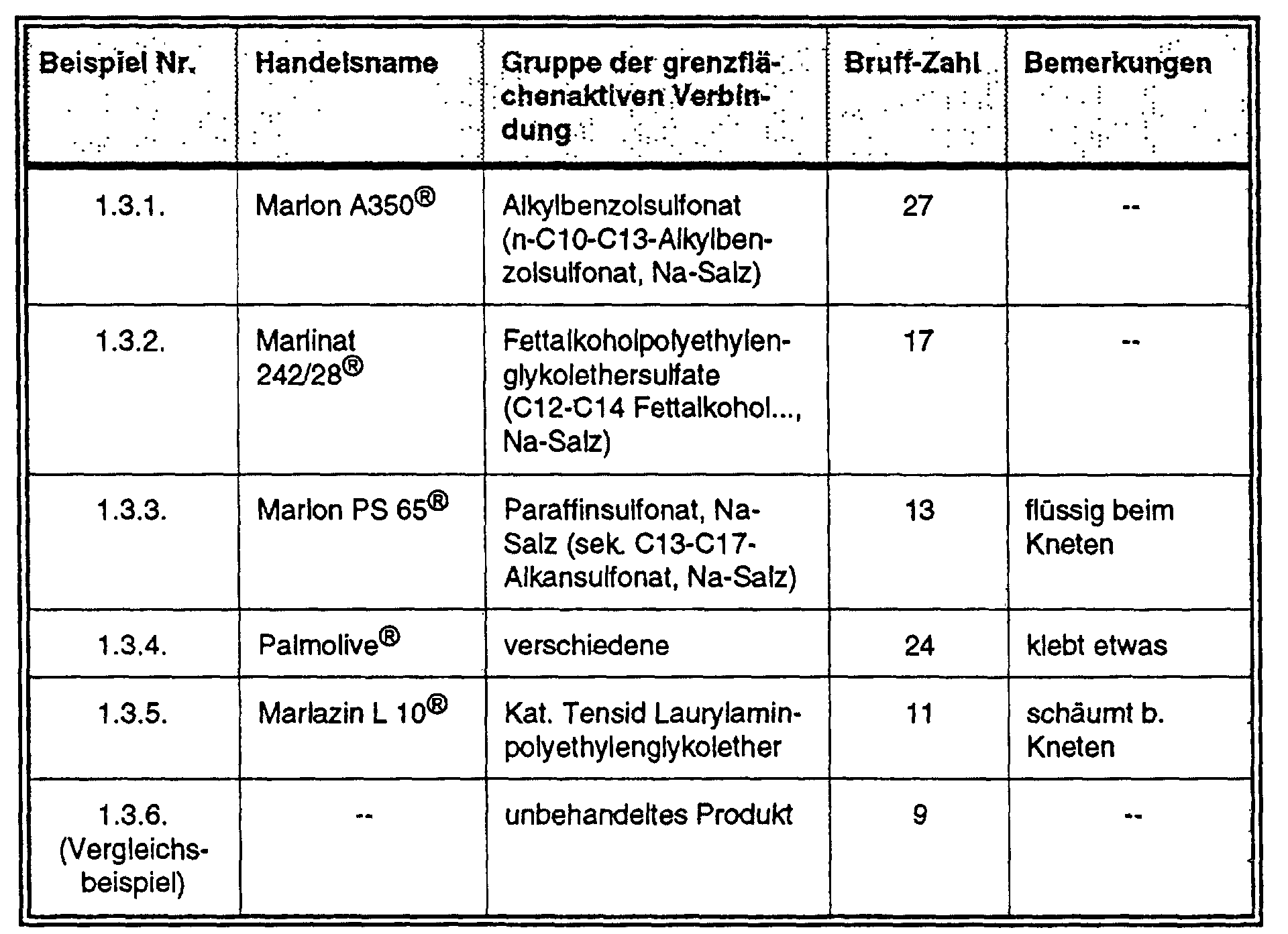
- Geräte:
- Waage 0,1 1 g genau
Glasrohr (Länge 60 cm, Innendurchmesser 3 cm)
Stativ (mit Halterung)
Bodenplatte (belegt mit Schmirgelleinen Nr. 100 und mit zwei senkrecht zueinander stehenden cm-Einteilungen ausgehend vom Mittelpunkt) - Durchführung:
- 200 g des zu bestimmenden Pulvers, z. B. BaCO3- oder SrCO3-Pulver, werden in ein 60 cm langes Rohr gefüllt. Das Rohr wird an beiden Enden mit flachen Stopfen verschlossen und 20-mal "über Kopf" geschüttelt, um die Probe zu fluidisieren. Das Glasrohr wird nun so in die Halterung des Stativs gesetzt, daß das untere Ende des Rohres 12 cm vom Mittelpunkt der Bodenplatte entfernt ist. Die beiden Stopfen werden nun gleichzeitig entfernt. Das Ausbreitmaß des auf der Platte ausgeflossenen Pulvers wird auf zwei zueinander senkrechten Durchmessern (ablesen auf der cmSkala und mitteln) bestimmt. In der Mitte des Ausbreitkegels wird mit Hilfe einer Nadel oder dergleichen dessen Höhe bestimmt.
Claims (12)
- Verfahren zur Herstellung von rieselfähigem Erdalkalicarbonat aus der Gruppe bestehend aus BaCO3 und SrCO3, wobei man eine wäßrige Zubereitung erzeugt, die mindestens 50 Gew.-% des Carbonats in einer Körnung von 0,1 bis 1 µm enthält, die zusätzlich eine oder mehrere organische grenzflächenaktive Verbindungen enthält, wobei bezogen auf die Trockensubstanz eine Gesamtmenge von 0,01 bis 1,0 Gew.-% an grenzflächenaktiver Verbindung in der Zubereitung im wesentlichen gleichmäßig verteilt enthalten ist, und man die Zubereitung trocknet und zerkleinert, um im wesentlichen trockenes, rieselfähiges Erdalkalicarbonat einer Körnung von bis zu 10 µm zu erhalten.
- Verfahren nach Anspruch 1, dadurch gekennzeichnet, daß man rieselfähiges BaCO3 herstellt.
- Verfahren nach Anspruch 1 oder 2, dadurch gekennzeichnet, daß man eine anionische grenzflächenaktive Verbindung, vorzugsweise ein organisches Sulfat- oder Sulfonat-Derivat einsetzt.
- Verfahren nach Anspruch 3, dadurch gekennzeichnet, daß man ein Fettalkoholpolyethylenglycolethersulfat oder ein Alkylbenzolsulfonat, insbesondere in Form der Natrium-Salze, einsetzt.
- Verfahren nach Anspruch 4, dadurch gekennzeichnet, daß man ein Fettalkoholpolyethylenglycolethersulfat mit einem C12-C14-Fettalkohol oder ein Alkylbenzolsulfonat mit einer C10-C13-Alkylkette einsetzt.
- Verfahren nach Anspruch 5, dadurch gekennzeichnet, daß man ein n-C10-C13-Alkylbenzolsulfonat in Form des Natrium-Salzes einsetzt.
- Verfahren nach Anspruch 1, dadurch gekennzeichnet, daß man eine teigartige, eine grenzflächenaktive Verbindung enthaltende Zubereitung mit einem Wassergehalt von 25 bis 60 Gew.-% einsetzt und zur Homogenisierung knetet.
- Verfahren nach Anspruch 1, dadurch gekennzeichnet, daß man die Trocknung bei einer Temperatur von 100 bis 240 °C durchführt.
- Verfahren nach einem der vorhergehenden Ansprüche, dadurch gekennzeichnet, daß man die grenzflächenaktive Verbindung in einer solchen Menge einsetzt, daß sie bezogen auf die Trokkensubstanz in einer Menge von 0,01 bis 0,5 Gew.-% in der Zubereitung enthalten ist.
- Im wesentlichen trockenes, rieselfähiges Erdalkalicarbonat ausgewählt aus der Gruppe bestehend aus Bariumcarbonat und Strontiumcarbonat, gekennzeichnet durch einen Gehalt von 0,01 bis 1 Gew.-%, vorzugsweise 0,01 bis 0,5 Gew.-% einer grenzflächenaktiven Verbindung, vorzugsweise einer anionischen grenzflächenaktiven Verbindung, insbesondere eines organischen Derivates eines Sulfates oder Sulfonates, und einer Körnung von bis zu 10 µm, erhältlich nach dem Verfahren gemäß einem der Ansprüche 1 bis 9.
- Rieselfähiges Bariumcarbonat bzw. Strontiumcarbonat nach Anspruch 10, gekennzeichnet durch einen Gehalt von 0,01 bis 1 Gew.-%, vorzugsweise 0,01 bis 0,5 Gew.-% an C12-C14-Fettalkoholpolyethylenglycolethersulfat-Natriumsalz, n-C10-C13-Alkylbenzolsulfonat-Natriumsalz, sek-C13-C17-Alkansulfonat-Natriumsalz oder Kokosfettsäureamidopropylbetain.
- Verwendung des rieselfähigen Erdalkalicarbonats gemäß Anspruch 10 oder 11 als Ausblühungen verhindernder Tonzusatz.
Applications Claiming Priority (2)
| Application Number | Priority Date | Filing Date | Title |
|---|---|---|---|
| DE19704458 | 1997-02-06 | ||
| DE19704458A DE19704458A1 (de) | 1997-02-06 | 1997-02-06 | Rieselfähiges Erdalkalicarbonat |
Publications (2)
| Publication Number | Publication Date |
|---|---|
| EP0857691A1 EP0857691A1 (de) | 1998-08-12 |
| EP0857691B1 true EP0857691B1 (de) | 2001-10-10 |
Family
ID=7819459
Family Applications (1)
| Application Number | Title | Priority Date | Filing Date |
|---|---|---|---|
| EP98101510A Expired - Lifetime EP0857691B1 (de) | 1997-02-06 | 1998-01-29 | Rieselfähige Erdalkalicarbonate |
Country Status (3)
| Country | Link |
|---|---|
| EP (1) | EP0857691B1 (de) |
| AT (1) | ATE206690T1 (de) |
| DE (2) | DE19704458A1 (de) |
Family Cites Families (6)
| Publication number | Priority date | Publication date | Assignee | Title |
|---|---|---|---|---|
| BE624322A (de) * | 1961-11-02 | |||
| US3615811A (en) * | 1968-02-29 | 1971-10-26 | Chemical Products Corp | Carbonate compositions and process |
| US3738938A (en) * | 1968-02-29 | 1973-06-12 | Chem Prod Corp | Carbonate composition and process |
| GB1306707A (en) * | 1969-05-21 | 1973-02-14 | Continental Oil Co | Process for preparing barium-containing dispersion |
| US4888161A (en) * | 1987-01-28 | 1989-12-19 | Chemical Products Corporation | Method of forming dense, unsintered, granular alkaline earth metal carbonates |
| US4888308A (en) * | 1987-02-10 | 1989-12-19 | Chemical Products Corporation | Glass manufacture using dense, unsintered, granular alkaline earth metal carbonates |
-
1997
- 1997-02-06 DE DE19704458A patent/DE19704458A1/de not_active Withdrawn
-
1998
- 1998-01-29 DE DE59801671T patent/DE59801671D1/de not_active Expired - Fee Related
- 1998-01-29 EP EP98101510A patent/EP0857691B1/de not_active Expired - Lifetime
- 1998-01-29 AT AT98101510T patent/ATE206690T1/de not_active IP Right Cessation
Also Published As
| Publication number | Publication date |
|---|---|
| DE19704458A1 (de) | 1998-08-13 |
| EP0857691A1 (de) | 1998-08-12 |
| ATE206690T1 (de) | 2001-10-15 |
| DE59801671D1 (de) | 2001-11-15 |
Similar Documents
| Publication | Publication Date | Title |
|---|---|---|
| DE2426277C3 (de) | Schaumhaltige Aufschlämmung zur Herstellung von porösem anorganischen Bau- bzw. Konstruktionsmaterial | |
| DE69519733T2 (de) | Verfahren zum zerkleinern von hydroxypropylmethylcellulose | |
| DE69122292T2 (de) | Suspendiermittel für wasserlösliches Polymer | |
| DE2913721C2 (de) | Verflüssigungsmittel für kalzinierten Gips sowie Verwendung des Mittels | |
| DE2322707C3 (de) | Mörtel aus anorganischen Bindemitteln | |
| DE2549192A1 (de) | Kermische, feuerfeste, gebrannte cordieritmassen, verfahren zu ihrer herstellung und ihre verwendung | |
| DE2445813A1 (de) | Redispergierbares kunststoffpulver und verfahren zu seiner herstellung | |
| DE4324959C1 (de) | Verwendung von basischen Aluminiumsulfaten als alkaliarme Abbindebeschleuniger für Zement | |
| DE3506162C2 (de) | ||
| DE2851840A1 (de) | Zusatzstoffe fuer massen auf basis von gebranntem gips, gips oder anhydrit und deren verwendung | |
| DE68910366T2 (de) | Schaummittel. | |
| DE2830895A1 (de) | Aluminiumoxidsubstrate und verfahren zu ihrer herstellung | |
| DE68907788T2 (de) | Betonzusammensetzung mit einem Verflüssigungszusatz. | |
| DE2745270C3 (de) | Zusatz zu hydraulischen Zementmischungen | |
| DE2319707A1 (de) | Zementmoertelzusammensetzungen | |
| EP0857691A1 (de) | Rieselfähige Erdalkalicarbonaten | |
| DE4308906A1 (de) | Hydraulische Mischung und deren Verwendung zum Herstellen von Betonpfeilern | |
| DE69307961T2 (de) | Verwendung von Mitteln zum Beschleunigen die Härtungsgeschwindigkeit von Zement, Mörtel und Beton, unter beibehaltung ihrer Bearbeitbarkeit. | |
| DE3031447A1 (de) | Verfahren zur verhinderung eines konsistenzverlustes in frischem beton | |
| EP0001992A1 (de) | Verschäumbare Magnesiazementmischung, ihre Verwendung und Verfahren zur Herstellung poröser Formkörper | |
| DE2921245C2 (de) | Verfahren zur Herstellung einer Mörteltrockenmasse auf der Basis von Magnesiumhydroxid und -chlorid | |
| DE1793510B2 (de) | Detergentienpräparat | |
| DE60019533T2 (de) | Verfahren zur herstellung einkerniger waschmittelteilchen | |
| DE3329064A1 (de) | Sprengstoffmasse | |
| DE10232180B4 (de) | Verfahren zur Herstellung von Porenbeton |
Legal Events
| Date | Code | Title | Description |
|---|---|---|---|
| PUAI | Public reference made under article 153(3) epc to a published international application that has entered the european phase |
Free format text: ORIGINAL CODE: 0009012 |
|
| AK | Designated contracting states |
Kind code of ref document: A1 Designated state(s): AT BE CH DE DK ES FR GB GR IT LI NL PT SE |
|
| 17P | Request for examination filed |
Effective date: 19990212 |
|
| AKX | Designation fees paid |
Free format text: AT BE CH DE DK ES FR GB GR IT LI NL PT SE |
|
| RBV | Designated contracting states (corrected) |
Designated state(s): AT BE CH DE DK ES FR GB GR IT LI NL PT SE |
|
| 17Q | First examination report despatched |
Effective date: 20000125 |
|
| GRAG | Despatch of communication of intention to grant |
Free format text: ORIGINAL CODE: EPIDOS AGRA |
|
| GRAG | Despatch of communication of intention to grant |
Free format text: ORIGINAL CODE: EPIDOS AGRA |
|
| GRAH | Despatch of communication of intention to grant a patent |
Free format text: ORIGINAL CODE: EPIDOS IGRA |
|
| GRAH | Despatch of communication of intention to grant a patent |
Free format text: ORIGINAL CODE: EPIDOS IGRA |
|
| GRAH | Despatch of communication of intention to grant a patent |
Free format text: ORIGINAL CODE: EPIDOS IGRA |
|
| GRAA | (expected) grant |
Free format text: ORIGINAL CODE: 0009210 |
|
| AK | Designated contracting states |
Kind code of ref document: B1 Designated state(s): AT BE CH DE DK ES FR GB GR IT LI NL PT SE |
|
| PG25 | Lapsed in a contracting state [announced via postgrant information from national office to epo] |
Ref country code: NL Free format text: LAPSE BECAUSE OF FAILURE TO SUBMIT A TRANSLATION OF THE DESCRIPTION OR TO PAY THE FEE WITHIN THE PRESCRIBED TIME-LIMIT Effective date: 20011010 Ref country code: IT Free format text: LAPSE BECAUSE OF FAILURE TO SUBMIT A TRANSLATION OF THE DESCRIPTION OR TO PAY THE FEE WITHIN THE PRESCRIBED TIME-LIMIT;WARNING: LAPSES OF ITALIAN PATENTS WITH EFFECTIVE DATE BEFORE 2007 MAY HAVE OCCURRED AT ANY TIME BEFORE 2007. THE CORRECT EFFECTIVE DATE MAY BE DIFFERENT FROM THE ONE RECORDED. Effective date: 20011010 Ref country code: GB Free format text: LAPSE BECAUSE OF FAILURE TO SUBMIT A TRANSLATION OF THE DESCRIPTION OR TO PAY THE FEE WITHIN THE PRESCRIBED TIME-LIMIT Effective date: 20011010 Ref country code: FR Free format text: LAPSE BECAUSE OF FAILURE TO SUBMIT A TRANSLATION OF THE DESCRIPTION OR TO PAY THE FEE WITHIN THE PRESCRIBED TIME-LIMIT Effective date: 20011010 |
|
| REF | Corresponds to: |
Ref document number: 206690 Country of ref document: AT Date of ref document: 20011015 Kind code of ref document: T |
|
| REG | Reference to a national code |
Ref country code: CH Ref legal event code: EP |
|
| REF | Corresponds to: |
Ref document number: 59801671 Country of ref document: DE Date of ref document: 20011115 |
|
| PG25 | Lapsed in a contracting state [announced via postgrant information from national office to epo] |
Ref country code: SE Free format text: LAPSE BECAUSE OF FAILURE TO SUBMIT A TRANSLATION OF THE DESCRIPTION OR TO PAY THE FEE WITHIN THE PRESCRIBED TIME-LIMIT Effective date: 20020110 Ref country code: PT Free format text: LAPSE BECAUSE OF FAILURE TO SUBMIT A TRANSLATION OF THE DESCRIPTION OR TO PAY THE FEE WITHIN THE PRESCRIBED TIME-LIMIT Effective date: 20020110 Ref country code: DK Free format text: LAPSE BECAUSE OF FAILURE TO SUBMIT A TRANSLATION OF THE DESCRIPTION OR TO PAY THE FEE WITHIN THE PRESCRIBED TIME-LIMIT Effective date: 20020110 |
|
| PG25 | Lapsed in a contracting state [announced via postgrant information from national office to epo] |
Ref country code: GR Free format text: LAPSE BECAUSE OF FAILURE TO SUBMIT A TRANSLATION OF THE DESCRIPTION OR TO PAY THE FEE WITHIN THE PRESCRIBED TIME-LIMIT Effective date: 20020111 |
|
| PG25 | Lapsed in a contracting state [announced via postgrant information from national office to epo] |
Ref country code: AT Free format text: LAPSE BECAUSE OF NON-PAYMENT OF DUE FEES Effective date: 20020129 |
|
| PG25 | Lapsed in a contracting state [announced via postgrant information from national office to epo] |
Ref country code: LI Free format text: LAPSE BECAUSE OF NON-PAYMENT OF DUE FEES Effective date: 20020131 Ref country code: CH Free format text: LAPSE BECAUSE OF NON-PAYMENT OF DUE FEES Effective date: 20020131 Ref country code: BE Free format text: LAPSE BECAUSE OF NON-PAYMENT OF DUE FEES Effective date: 20020131 |
|
| NLV1 | Nl: lapsed or annulled due to failure to fulfill the requirements of art. 29p and 29m of the patents act | ||
| GBV | Gb: ep patent (uk) treated as always having been void in accordance with gb section 77(7)/1977 [no translation filed] |
Effective date: 20011010 |
|
| PG25 | Lapsed in a contracting state [announced via postgrant information from national office to epo] |
Ref country code: ES Free format text: LAPSE BECAUSE OF FAILURE TO SUBMIT A TRANSLATION OF THE DESCRIPTION OR TO PAY THE FEE WITHIN THE PRESCRIBED TIME-LIMIT Effective date: 20020430 |
|
| BERE | Be: lapsed |
Owner name: SOLVAY BARIUM STRONTIUM G.M.B.H. Effective date: 20020131 |
|
| EN | Fr: translation not filed | ||
| PLBE | No opposition filed within time limit |
Free format text: ORIGINAL CODE: 0009261 |
|
| STAA | Information on the status of an ep patent application or granted ep patent |
Free format text: STATUS: NO OPPOSITION FILED WITHIN TIME LIMIT |
|
| REG | Reference to a national code |
Ref country code: CH Ref legal event code: PL |
|
| 26N | No opposition filed | ||
| PGFP | Annual fee paid to national office [announced via postgrant information from national office to epo] |
Ref country code: DE Payment date: 20060126 Year of fee payment: 9 |
|
| PG25 | Lapsed in a contracting state [announced via postgrant information from national office to epo] |
Ref country code: DE Free format text: LAPSE BECAUSE OF NON-PAYMENT OF DUE FEES Effective date: 20070801 |