EP0856807A2 - Terminal für IC-Karte mit mehreren Protokollen und Kontrollverfahren dafür - Google Patents
Terminal für IC-Karte mit mehreren Protokollen und Kontrollverfahren dafür Download PDFInfo
- Publication number
- EP0856807A2 EP0856807A2 EP98101356A EP98101356A EP0856807A2 EP 0856807 A2 EP0856807 A2 EP 0856807A2 EP 98101356 A EP98101356 A EP 98101356A EP 98101356 A EP98101356 A EP 98101356A EP 0856807 A2 EP0856807 A2 EP 0856807A2
- Authority
- EP
- European Patent Office
- Prior art keywords
- communication protocol
- data
- determining
- clock signal
- medium
- Prior art date
- Legal status (The legal status is an assumption and is not a legal conclusion. Google has not performed a legal analysis and makes no representation as to the accuracy of the status listed.)
- Ceased
Links
Images


Classifications
-
- G—PHYSICS
- G06—COMPUTING OR CALCULATING; COUNTING
- G06K—GRAPHICAL DATA READING; PRESENTATION OF DATA; RECORD CARRIERS; HANDLING RECORD CARRIERS
- G06K7/00—Methods or arrangements for sensing record carriers, e.g. for reading patterns
- G06K7/10—Methods or arrangements for sensing record carriers, e.g. for reading patterns by electromagnetic radiation, e.g. optical sensing; by corpuscular radiation
- G06K7/10009—Methods or arrangements for sensing record carriers, e.g. for reading patterns by electromagnetic radiation, e.g. optical sensing; by corpuscular radiation sensing by radiation using wavelengths larger than 0.1 mm, e.g. radio-waves or microwaves
- G06K7/10297—Methods or arrangements for sensing record carriers, e.g. for reading patterns by electromagnetic radiation, e.g. optical sensing; by corpuscular radiation sensing by radiation using wavelengths larger than 0.1 mm, e.g. radio-waves or microwaves arrangements for handling protocols designed for non-contact record carriers such as RFIDs NFCs, e.g. ISO/IEC 14443 and 18092
-
- G—PHYSICS
- G06—COMPUTING OR CALCULATING; COUNTING
- G06K—GRAPHICAL DATA READING; PRESENTATION OF DATA; RECORD CARRIERS; HANDLING RECORD CARRIERS
- G06K7/00—Methods or arrangements for sensing record carriers, e.g. for reading patterns
- G06K7/0008—General problems related to the reading of electronic memory record carriers, independent of its reading method, e.g. power transfer
Definitions
- the present invention relates to a terminal unit for an IC card which is capable of reading various trading data and data about an amount of money from the IC card serving as a credit card or electronic money and a control method therefor.
- IC cards are used to serve as portable storage mediums each comprising a nonvolatile memory and an IC chip for controlling the nonvolatile memory.
- a portable terminal unit for an IC card (including a desktop type terminal unit as well as the portable type terminal unit) which permits a user to always carry the terminal unit.
- the foregoing terminal unit is formed into a card-like shape similarly to the IC card and comprising a keyboard, a liquid crystal display section and battery.
- various trading data or data about an amount of money is read from the IC card in response to the operation of the keyboard.
- the terminal unit displays read data on the liquid crystal display section thereof.
- IC cards include IC cards of a type comprising a CPU and having a structure adapted to an asynchronous protocol so that data is transmitted in response to supply of a clock and a command from outside. Moreover, the IC cards include IC cards of a type having no CPU and arranged in such a manner as to serially transmit data in synchronization with supply of a clock signal from outside.
- a process for reading data from the IC card adapted to the asynchronous protocol and that from the IC card adapted to the synchronous protocol are different from each other. Therefore, there arises a problem in that plural types of terminal units for IC cards must be prepared to be adaptable to the above-mentioned types of the protocols.
- An object of the present invention is to provide a terminal unit for IC cards which is capable of processing data of both of an asynchronous communication protocol type IC card and a synchronous communication protocol type IC card and which exhibits satisfactory flexibility and a method of controlling the terminal unit for IC cards.
- a data processing apparatus receiving portable mediums, the apparatus communicates with the portable mediums in a synchronous communication protocol and an asynchronous communication protocol, comprising: first supply means (15, 16, S104) for holding one of the portable mediums and supplying a first clock signal to the held medium for the purpose of establishing communication with the portable medium in the synchronous communication protocol; means (11, S105, S106, S117, S107, S108, S113, S109) for determining whether the held medium uses the synchronous communication protocol or the asynchronous communication protocol in accordance with data transmitted from the held medium in response to the first clock signal; means (11, S110, S111) for continuing a subsequent communication with the held medium in the synchronous communication protocol when the determining means has determined that the portable medium uses the synchronous communication protocol; and second supply means (11, S114, S115, S116, S118) for supplying a second clock signal to the held medium for the purpose of establishing communication with the portable medium in the asynchronous communication protocol when the
- the present invention having the above-mentioned structure is able to eliminate a necessity of preparing an exclusive terminal unit for the synchronous communication protocol and that for the asynchronous protocol. That is, only when the IC medium is inserted into the terminal unit, a clock signal is supplied on the assumption that the protocol is the synchronous protocol regardless of the protocol. Then, a signal is read from the IC medium in response to the supplied clock signal. Then, the protocol of the inserted IC card is determined in accordance with the read signal so that a proper communication protocol is automatically selected. As a result, one terminal unit is able to process portable mediums of both protocol types.
- a method of controlling the portable mediums permits only one terminal unit to automatically determine the protocol to realize the required process because of the same reason.
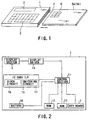
- reference numeral 1 represents a body of a terminal unit for an IC card, the body 1 being formed into a card-like shape having a liquid crystal display section 2 and a keyboard 3 on the upper surface thereof.
- the liquid crystal display section 2 is a section on which various data is displayed
- the keyboard 3 serves as a means for inputting a password and other data.
- a card insertion opening 4 is formed in the side surface of the body 1 to permit insertion of the IC card 5a (5b).
- the IC card 5a (5b) serves as a credit card, a point cumulative medium or a prepaid card and having a contact section 6 formed at a predetermined position on either of the surfaces thereof.
- the contact section 6 establishes the electrical connection between the body 1 and the IC card 5a (5b) and comprises a plurality of terminals including a power supply terminal, a reset terminal, a clock terminal and an input/output (I/O) terminal.
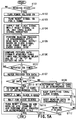
- FIG. 2 shows a control circuit in the body 1, the control circuit having a control section 11 for controlling the overall body of the apparatus.
- a keyboard 3 a ROM (Read Only Memory) 12, a RAM (Random Access Memory) 13, a display driver 14, an IC-card interface (I/F) 15 and a battery 18 are connected to the control section 11.
- ROM Read Only Memory
- RAM Random Access Memory
- I/F IC-card interface
- the control section 11 includes a CPU and a power supply circuit.
- the power supply circuit receives the voltage (for example, 3 V) of the battery 18, and then converts the voltage into operation voltage for the control section 11 and that for the IC card.
- the operation voltage (for example, 5 V) for the IC card is supplied to the IC-card interface 15.
- the ROM 12 has control program stored thereon.
- the RAM 13 serves as a work memory.
- the display driver 14 operates the liquid crystal display section 2.
- the IC-card interface 15 establishes the connection with the IC card 5a (5b) and makes an access to the same.
- the IC-card interface 15 has a clock circuit 16 and a switching circuit 17.
- the clock circuit 16 transmits a clock signal having a predetermined frequency.
- the switching circuit 17 selectively switches the frequency of the clock signal generated by the clock section 16 into either of a frequency of 3.5 MHz for operating (for reading data from) the IC card adapted to the asynchronous protocol or a frequency of 10 KHz for operating (for reading data from) the IC card adapted to the synchronous protocol.
- the frequency of 10 KHz is generated by the operation of the control section 11 for controlling the frequency of 3.5 MHz.
- the IC card 5a is an IC card (hereinafter called an "asynchronous protocol type IC card") having a CPU and adapted to the asynchronous protocol for transmitting data in response to supply of a clock signal and a command from outside. As shown in FIG. 3, the IC card 5a is formed by a contact section 6 and an IC chip 21.
- the IC chip 21 comprises a CPU 22, a ROM 23 having a control program stored thereon, a RAM 24 serving as a work memory and an EEPROM 25 which is a nonvolatile memory on which data is stored.
- an IC card 5b is prepared.
- the IC card 5b is an IC card (hereinafter called a "synchronous protocol type IC card") having no CPU and adapted to the synchronous protocol for serially transmitting data one by one in synchronization with a clock signal supplied from outside.
- the IC card 5b comprises a contact section 6 and a IC chip 31, as shown in FIG. 4.
- the IC chip 31 comprises a control circuit 32, a program memory 33 and an EEPROM 34 which is a nonvolatile memory on which data is stored.
- the control section 11 of the body 1 of a system comprising the terminal unit for the IC card and the IC cards of the foregoing type has the following functional means.
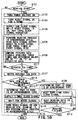
- step S101 when either of the IC card 5a or the IC card 5b is inserted into the card insertion opening 4 and start of reading data is instructed by using the keyboard 3 (YES in step S101), power source voltage VCC is supplied to the inserted IC card (step S102).
- a reset signal RST which is turned on (the level of which is raised to a high level) for a predetermined period of time, is supplied to the inserted IC card (step S103). Then, one clock signal CLK is supplied during the period in which the reset signal RST is turned on. Then, clock signals CLK each having a frequency of 10 KHz are supplied (step S104).
- step S105 When the reset signal RST and clock signal CLK have been supplied, a process for reading data from the synchronous protocol type IC card 5b is performed. A data signal is read from the inserted IC card at each rising edge of the clock signal CLK so that read data for each bit is fetched three times (or odd-number times) (step S105).
- data in the synchronous protocol type IC card 5b for each bit is serially read at the rising edge of the clock signal CLK having the frequency of 10 KHz, as shown in the time chart shown in FIG. 7. That is, data a is read in synchronization with the first rising edge of the clock signal CLK. Data b is read in synchronization with the second rising edge of the clock signal CLK. Data c is read in synchronization with the third rising edge of the clock signal CLK. As described above, data is sequentially read. Timing when data is fetched for each bit is indicated by an arrow. Thus, fetching is performed three times for each of data a, b, c, d, ⁇ .
- Three data items for each of the fetched bits are compared with one another.
- the contents of read data are determined for each bit on the basis of the contents of majority data. That is, much one of "1" or "0" of the three data items is determined as effective data (step S106).
- data is fetched three times for each bit to determine data.
- improper reading because of noise or the like can be prevented.
- the number of fetching times is not limited to three times and appropriate odd number of times, for example, five times or seven times, may be employed if the majority and minority can be generated.
- step S108 The above-mentioned process is repeated to make references until a predetermined number of, for example, 10 bits is obtained from determined effective data (steps S107 and S117) to determine whether or not the content is the common "1" (step S108).
- the inserted IC card is the synchronous protocol type IC card 5b having no CPU, serial data output for each bit is sequentially performed. Therefore, data of 10 bits is in the form in which "1" and "0" are arbitrarily mixed with one another. When the foregoing state is realized, the card has no data.
- FIG. 5B shows another example for determining whether the IC card is a synchronous protocol type card or an asynchronous protocol type card. Since the other steps shown in FIG. 5B are the same as those shown in FIG. 5A, the same steps are omitted from description.
- step S118 if the signal obtained from the IC card is determined that the signal has been regulated as a signal which is first transmitted from a synchronous protocol type IC card, a determination can be made that the inserted IC card is the synchronous protocol type IC card without a necessity of performing the determination shown in FIG. 5A (step S118).
- the inserted IC card is the asynchronous protocol type IC card 5a having a CPU
- the IC card transmits data in response to only a command supplied from outside. Therefore, ten data items are formed in such a manner that "1" successively appears in place of the original form.
- step S109 a determination is made that the IC card inserted into the card insertion opening 4 is the synchronous protocol type IC card 5b (step S109).
- step S110 supply of clock signals CLK each having the frequency of 10 KHz is continued (step S110).
- step S111 and S112 a process of reading data from the synchronous protocol type IC card 5b is continued until completion of the reading process is instructed by using the keyboard 3 (steps S111 and S112).
- step S108 If the contents of ten data items are common "1" (YES in step S108), a determination is made that the IC card inserted into the card insertion opening 4 is the asynchronous protocol type IC card 5a (step S113).
- the clock signal CLK which must be supplied is switched from 10 KHz for the synchronous protocol type IC card to 3.5 MHz for the asynchronous protocol type IC card (step S114). Then, a waiting process is performed for a period of type which corresponds to 40,000 clocks determined on the basis of the clock signal CLK having the frequency of 3.5 MHz (step S115). Then reset signal RST which is always turned on (the level of which is high level) is supplied. At this time, ATR is received from the IC card. The ATR is determined, and then a usual process (the reading process or the like) for the asynchronous protocol type IC card is performed (step S116). The waiting process which is performed for the period of type corresponding to 40,000 clocks is regulated by ISO.
- the process for reading data from the asynchronous protocol type IC card 5a causes an output of data to be made in response to only supply of a cowand by using the keyboard 3.
- the output data is displayed on the liquid crystal display section 2.
- the IC card inserted into the card insertion opening 4 is the asynchronous protocol type IC card 5a or the synchronous protocol type IC card 5b is automatically determined. Moreover, a reading process adaptable to a result of determination is automatically performed. As a result, data can be read from both of the asynchronous protocol type IC card 5a and the synchronous protocol type IC card 5b. Thus, a satisfactory flexibility can be realized.
- the synchronous type reading process which is started in response to supply of the reset signal RST and the clock signal CLK, is initially performed.
- the IC card is determined.
- the asynchronous type reading process in which the waiting process for the period of time corresponding to 40,000 clocks regulated by ISO is performed to correspond to a result of determination of the IC card. Therefore, time required to determine the IC card, that is, time required to obtain read data can satisfactorily be shortened. It leads to a fact that the convenience for a user can be improved.
- the present invention may be applied to a desktop type terminal unit.
- the terminal unit for IC cards according to the present invention is arranged in such a manner that a determination is made whether the inserted IC card is the asynchronous protocol type IC card or the synchronous protocol type IC card. Moreover, the reading process is performed to be adaptable to a result of determination. As a result, the terminal unit for IC cards exhibiting satisfactory flexibility can be provided which is capable of processing data of both of the asynchronous protocol type IC card and the synchronous protocol type IC card.
- the method of controlling the terminal unit for IC cards according to the present invention is arranged in such a manner that a determination is made whether the inserted IC card is the asynchronous protocol type IC card or the synchronous protocol type IC card. Moreover, the reading process is performed to be adaptable to a result of determination. As a result, the method of controlling the terminal unit for IC cards exhibiting satisfactory flexibility can be provided which is capable of processing data of both of the asynchronous protocol type IC card and the synchronous protocol type IC card.
Landscapes
- Engineering & Computer Science (AREA)
- Physics & Mathematics (AREA)
- Toxicology (AREA)
- Computer Vision & Pattern Recognition (AREA)
- General Physics & Mathematics (AREA)
- Theoretical Computer Science (AREA)
- Health & Medical Sciences (AREA)
- Artificial Intelligence (AREA)
- Computer Networks & Wireless Communication (AREA)
- Computer Security & Cryptography (AREA)
- Electromagnetism (AREA)
- General Health & Medical Sciences (AREA)
- Credit Cards Or The Like (AREA)
- Communication Control (AREA)
Applications Claiming Priority (2)
| Application Number | Priority Date | Filing Date | Title |
|---|---|---|---|
| JP9016948A JPH10214314A (ja) | 1997-01-30 | 1997-01-30 | Icカード用携帯端末装置およびその制御方法 |
| JP16948/97 | 1997-01-30 |
Publications (2)
| Publication Number | Publication Date |
|---|---|
| EP0856807A2 true EP0856807A2 (de) | 1998-08-05 |
| EP0856807A3 EP0856807A3 (de) | 1998-12-30 |
Family
ID=11930363
Family Applications (1)
| Application Number | Title | Priority Date | Filing Date |
|---|---|---|---|
| EP98101356A Ceased EP0856807A3 (de) | 1997-01-30 | 1998-01-27 | Terminal für IC-Karte mit mehreren Protokollen und Kontrollverfahren dafür |
Country Status (4)
| Country | Link |
|---|---|
| US (1) | US6125452A (de) |
| EP (1) | EP0856807A3 (de) |
| JP (1) | JPH10214314A (de) |
| TW (1) | TW451157B (de) |
Cited By (2)
| Publication number | Priority date | Publication date | Assignee | Title |
|---|---|---|---|---|
| WO2000077717A1 (en) * | 1999-06-10 | 2000-12-21 | Cubic Corporation | Multiple protocol smart card communication device |
| GB2363950A (en) * | 1999-12-23 | 2002-01-09 | Htec Ltd | Communication protocol selection scheme which reduces risk of data corruption on a data storage device |
Families Citing this family (14)
| Publication number | Priority date | Publication date | Assignee | Title |
|---|---|---|---|---|
| IL127569A0 (en) | 1998-09-16 | 1999-10-28 | Comsense Technologies Ltd | Interactive toys |
| US6607136B1 (en) | 1998-09-16 | 2003-08-19 | Beepcard Inc. | Physical presence digital authentication system |
| WO2000019353A1 (de) * | 1998-09-30 | 2000-04-06 | Koninklijke Philips Electronics N.V. | Datenträger |
| CA2345745A1 (en) | 1998-10-02 | 2000-04-13 | Comsense Technologies, Ltd. | Card for interaction with a computer |
| US7280970B2 (en) | 1999-10-04 | 2007-10-09 | Beepcard Ltd. | Sonic/ultrasonic authentication device |
| US8019609B2 (en) | 1999-10-04 | 2011-09-13 | Dialware Inc. | Sonic/ultrasonic authentication method |
| FR2803674B1 (fr) * | 2000-01-12 | 2002-04-19 | Schlumberger Systems & Service | Puce electronique pour objet portatif |
| JP3817518B2 (ja) * | 2000-09-12 | 2006-09-06 | キヤノン株式会社 | カード利用サービスへのアクセスのためのシステム |
| US9219708B2 (en) | 2001-03-22 | 2015-12-22 | DialwareInc. | Method and system for remotely authenticating identification devices |
| AUPR559201A0 (en) * | 2001-06-08 | 2001-07-12 | Canon Kabushiki Kaisha | Card reading device for service access |
| FR2830700A1 (fr) * | 2001-10-09 | 2003-04-11 | Koninkl Philips Electronics Nv | Dispositif de generation d'un signal d'horloge |
| US20030088796A1 (en) * | 2001-11-06 | 2003-05-08 | Soubhi Abdulkarim | Communication adapter |
| JP2004147251A (ja) * | 2002-10-28 | 2004-05-20 | Matsushita Electric Ind Co Ltd | データ転送装置およびインタフェース制御半導体集積回路、ならびにプロトコル処理回路制御方法 |
| DE102004049671B4 (de) * | 2004-10-12 | 2007-08-02 | Mühlbauer Ag | Elektronisches Modul für die Herstellung, Programmierung und das Testen von Chipkarten und zugehöriges Verfahren |
Family Cites Families (5)
| Publication number | Priority date | Publication date | Assignee | Title |
|---|---|---|---|---|
| JPS61154221A (ja) * | 1984-12-26 | 1986-07-12 | Toshiba Corp | 多数決回路 |
| JPH0682405B2 (ja) * | 1986-01-14 | 1994-10-19 | カシオ計算機株式会社 | テストプログラム起動方式 |
| FR2661762B1 (fr) * | 1990-05-03 | 1992-07-31 | Storck Jean | Procede et dispositif de transaction entre un premier et au moins un deuxieme supports de donnees et support a cette fin. |
| US5682027A (en) * | 1992-10-26 | 1997-10-28 | Intellect Australia Pty Ltd. | System and method for performing transactions and a portable intelligent device therefore |
| CA2168434A1 (en) * | 1993-07-30 | 1995-09-02 | Quentin Rees Oliver | Device and method for programmable functions |
-
1997
- 1997-01-30 JP JP9016948A patent/JPH10214314A/ja active Pending
-
1998
- 1998-01-08 TW TW087100191A patent/TW451157B/zh not_active IP Right Cessation
- 1998-01-27 EP EP98101356A patent/EP0856807A3/de not_active Ceased
- 1998-01-30 US US09/016,405 patent/US6125452A/en not_active Expired - Fee Related
Cited By (4)
| Publication number | Priority date | Publication date | Assignee | Title |
|---|---|---|---|---|
| WO2000077717A1 (en) * | 1999-06-10 | 2000-12-21 | Cubic Corporation | Multiple protocol smart card communication device |
| US6577229B1 (en) | 1999-06-10 | 2003-06-10 | Cubic Corporation | Multiple protocol smart card communication device |
| US7227449B2 (en) | 1999-06-10 | 2007-06-05 | Cubic Corporation | Multiple protocol smart card communication device |
| GB2363950A (en) * | 1999-12-23 | 2002-01-09 | Htec Ltd | Communication protocol selection scheme which reduces risk of data corruption on a data storage device |
Also Published As
| Publication number | Publication date |
|---|---|
| US6125452A (en) | 2000-09-26 |
| JPH10214314A (ja) | 1998-08-11 |
| TW451157B (en) | 2001-08-21 |
| EP0856807A3 (de) | 1998-12-30 |
Similar Documents
| Publication | Publication Date | Title |
|---|---|---|
| US6125452A (en) | Terminal unit for IC card using plural protocols and control method therefor | |
| US5070233A (en) | Ic card reader/writer and ic card transactions processing apparatus capable of producing various frequency clock pulses | |
| US6557754B2 (en) | Apparatus and method of providing a dual mode card and reader | |
| EP0727759B1 (de) | IC Kartenleser/ -schreiber | |
| US5126548A (en) | Ic card with additional terminals and method of controlling the ic card | |
| EP1862911B1 (de) | Schnittstellenvorrichtung | |
| US5712472A (en) | Card read/write method | |
| JP3162406B2 (ja) | データの処理と記憶のための装置 | |
| EP0780813A2 (de) | Chipkarte, Chipkartenlese-/-schreibvorrichtung, Host für eine Chipkartenlese-/-schreibvorrichtung, Chipkartensystem und Verfahren zum Gewähren des Gebrauches von mehreren Verkäufern in einem Chipkartensystem | |
| KR100995534B1 (ko) | 스마트 카드 리더를 구비하는 기기를 테스트하기 위한 방법 및 테스트 어댑터 | |
| JPH1051372A (ja) | 携帯電話機 | |
| US8060664B2 (en) | Integrated circuit having a plurality of interfaces and integrated circuit card having the same | |
| JP2004348235A (ja) | 携帯可能電子装置および携帯端末装置 | |
| US20050223148A1 (en) | Electronic apparatus that communicates with host through serial communication interface | |
| EP0220703A2 (de) | Chipkartensystem | |
| US5712881A (en) | Data transmission apparatus selectively using two clock signals | |
| US20060163364A1 (en) | Ic chip, card and mobile terminal connected to the same | |
| JP4655323B2 (ja) | 情報表示装置及び情報表示方法 | |
| US20080093452A1 (en) | Method For Communicating By A Detector Of The Presence Of Chip Cards In A Reader Chip Cards And A Reading Device Communicating By The Presence Detector | |
| KR100465440B1 (ko) | 포터블데이터매체와통신을수행하기위한장치 | |
| JPH0935013A (ja) | Icカード読み取り装置及びicカード書き込み装置 | |
| JPS61150089A (ja) | Icカ−ド | |
| KR100239170B1 (ko) | 자체적 사용자 인터페이스 가능한 스마트 카드장치 제어방법 | |
| JPH04162188A (ja) | 携帯可能記憶媒体読取書込装置 | |
| JP2009077097A (ja) | 電子装置の通信方法 |
Legal Events
| Date | Code | Title | Description |
|---|---|---|---|
| PUAI | Public reference made under article 153(3) epc to a published international application that has entered the european phase |
Free format text: ORIGINAL CODE: 0009012 |
|
| 17P | Request for examination filed |
Effective date: 19980127 |
|
| AK | Designated contracting states |
Kind code of ref document: A2 Designated state(s): DE FR GB NL |
|
| AX | Request for extension of the european patent |
Free format text: AL;LT;LV;MK;RO;SI |
|
| PUAL | Search report despatched |
Free format text: ORIGINAL CODE: 0009013 |
|
| AK | Designated contracting states |
Kind code of ref document: A3 Designated state(s): AT BE CH DE DK ES FI FR GB GR IE IT LI LU MC NL PT SE |
|
| AX | Request for extension of the european patent |
Free format text: AL;LT;LV;MK;RO;SI |
|
| AKX | Designation fees paid |
Free format text: DE FR GB NL |
|
| 17Q | First examination report despatched |
Effective date: 20010202 |
|
| STAA | Information on the status of an ep patent application or granted ep patent |
Free format text: STATUS: THE APPLICATION HAS BEEN REFUSED |
|
| 18R | Application refused |
Effective date: 20011227 |