EP0856533A1 - Hydroxylgruppenhaltige Copolymerisate und Verfahren zu ihrer Herstellung - Google Patents
Hydroxylgruppenhaltige Copolymerisate und Verfahren zu ihrer Herstellung Download PDFInfo
- Publication number
- EP0856533A1 EP0856533A1 EP98101350A EP98101350A EP0856533A1 EP 0856533 A1 EP0856533 A1 EP 0856533A1 EP 98101350 A EP98101350 A EP 98101350A EP 98101350 A EP98101350 A EP 98101350A EP 0856533 A1 EP0856533 A1 EP 0856533A1
- Authority
- EP
- European Patent Office
- Prior art keywords
- weight
- acid
- saturated
- monocarboxylic acids
- esters
- Prior art date
- Legal status (The legal status is an assumption and is not a legal conclusion. Google has not performed a legal analysis and makes no representation as to the accuracy of the status listed.)
- Granted
Links
- 125000002887 hydroxy group Chemical group [H]O* 0.000 title claims abstract description 18
- 238000000034 method Methods 0.000 title claims abstract description 11
- 230000008569 process Effects 0.000 title claims abstract description 6
- 238000002360 preparation method Methods 0.000 title claims description 9
- 229920000642 polymer Polymers 0.000 title description 4
- 239000000178 monomer Substances 0.000 claims abstract description 44
- 229920001577 copolymer Polymers 0.000 claims abstract description 41
- 150000002763 monocarboxylic acids Chemical class 0.000 claims abstract description 41
- -1 hydroxyalkyl ester Chemical class 0.000 claims abstract description 28
- 239000011248 coating agent Substances 0.000 claims abstract description 23
- 229920006395 saturated elastomer Polymers 0.000 claims abstract description 22
- 229920001567 vinyl ester resin Polymers 0.000 claims abstract description 19
- NIXOWILDQLNWCW-UHFFFAOYSA-N Acrylic acid Chemical class OC(=O)C=C NIXOWILDQLNWCW-UHFFFAOYSA-N 0.000 claims abstract description 13
- 239000002253 acid Substances 0.000 claims abstract description 13
- 239000000049 pigment Substances 0.000 claims abstract description 13
- 150000002596 lactones Chemical class 0.000 claims abstract description 12
- 239000000654 additive Substances 0.000 claims abstract description 11
- 239000007795 chemical reaction product Substances 0.000 claims abstract description 9
- 239000000945 filler Substances 0.000 claims abstract description 9
- 239000004971 Cross linker Substances 0.000 claims abstract description 8
- 239000003960 organic solvent Substances 0.000 claims abstract description 8
- 239000003973 paint Substances 0.000 claims abstract description 8
- 239000005056 polyisocyanate Substances 0.000 claims description 24
- 229920001228 polyisocyanate Polymers 0.000 claims description 24
- 125000000391 vinyl group Chemical group [H]C([*])=C([H])[H] 0.000 claims description 20
- 239000000203 mixture Substances 0.000 claims description 18
- 125000004432 carbon atom Chemical group C* 0.000 claims description 15
- 125000002768 hydroxyalkyl group Chemical group 0.000 claims description 13
- SMZOUWXMTYCWNB-UHFFFAOYSA-N 2-(2-methoxy-5-methylphenyl)ethanamine Chemical compound COC1=CC=C(C)C=C1CCN SMZOUWXMTYCWNB-UHFFFAOYSA-N 0.000 claims description 10
- CERQOIWHTDAKMF-UHFFFAOYSA-N Methacrylic acid Chemical compound CC(=C)C(O)=O CERQOIWHTDAKMF-UHFFFAOYSA-N 0.000 claims description 9
- 125000003055 glycidyl group Chemical group C(C1CO1)* 0.000 claims description 9
- 229920005989 resin Polymers 0.000 claims description 9
- 239000011347 resin Substances 0.000 claims description 9
- 229920002554 vinyl polymer Polymers 0.000 claims description 8
- 238000006116 polymerization reaction Methods 0.000 claims description 7
- 229920003180 amino resin Polymers 0.000 claims description 6
- 150000002148 esters Chemical class 0.000 claims description 6
- LDHQCZJRKDOVOX-UHFFFAOYSA-N trans-crotonic acid Natural products CC=CC(O)=O LDHQCZJRKDOVOX-UHFFFAOYSA-N 0.000 claims description 6
- PAPBSGBWRJIAAV-UHFFFAOYSA-N ε-Caprolactone Chemical compound O=C1CCCCCO1 PAPBSGBWRJIAAV-UHFFFAOYSA-N 0.000 claims description 6
- 238000010528 free radical solution polymerization reaction Methods 0.000 claims description 5
- YEJRWHAVMIAJKC-UHFFFAOYSA-N 4-Butyrolactone Chemical compound O=C1CCCO1 YEJRWHAVMIAJKC-UHFFFAOYSA-N 0.000 claims description 4
- JYVXNLLUYHCIIH-UHFFFAOYSA-N 4-hydroxy-4-methyl-2-oxanone Chemical compound CC1(O)CCOC(=O)C1 JYVXNLLUYHCIIH-UHFFFAOYSA-N 0.000 claims description 4
- OZJPLYNZGCXSJM-UHFFFAOYSA-N 5-valerolactone Chemical compound O=C1CCCCO1 OZJPLYNZGCXSJM-UHFFFAOYSA-N 0.000 claims description 4
- LDHQCZJRKDOVOX-NSCUHMNNSA-N crotonic acid Chemical compound C\C=C\C(O)=O LDHQCZJRKDOVOX-NSCUHMNNSA-N 0.000 claims description 3
- LDHQCZJRKDOVOX-IHWYPQMZSA-N isocrotonic acid Chemical compound C\C=C/C(O)=O LDHQCZJRKDOVOX-IHWYPQMZSA-N 0.000 claims description 3
- 239000000047 product Substances 0.000 claims description 3
- 230000009477 glass transition Effects 0.000 claims description 2
- 239000003431 cross linking reagent Substances 0.000 claims 1
- 230000000379 polymerizing effect Effects 0.000 claims 1
- 239000011230 binding agent Substances 0.000 abstract description 11
- 238000004519 manufacturing process Methods 0.000 abstract description 11
- 238000000576 coating method Methods 0.000 abstract description 8
- 229930195733 hydrocarbon Natural products 0.000 abstract description 2
- 150000002430 hydrocarbons Chemical class 0.000 abstract description 2
- 239000000463 material Substances 0.000 abstract description 2
- 239000004215 Carbon black (E152) Substances 0.000 abstract 1
- 239000000243 solution Substances 0.000 description 22
- DKPFZGUDAPQIHT-UHFFFAOYSA-N Butyl acetate Natural products CCCCOC(C)=O DKPFZGUDAPQIHT-UHFFFAOYSA-N 0.000 description 21
- 238000009835 boiling Methods 0.000 description 15
- 150000004945 aromatic hydrocarbons Chemical class 0.000 description 14
- PPBRXRYQALVLMV-UHFFFAOYSA-N Styrene Chemical compound C=CC1=CC=CC=C1 PPBRXRYQALVLMV-UHFFFAOYSA-N 0.000 description 10
- 229920006243 acrylic copolymer Polymers 0.000 description 9
- 239000002904 solvent Substances 0.000 description 9
- NIXOWILDQLNWCW-UHFFFAOYSA-M Acrylate Chemical compound [O-]C(=O)C=C NIXOWILDQLNWCW-UHFFFAOYSA-M 0.000 description 8
- 125000001931 aliphatic group Chemical group 0.000 description 8
- 150000001875 compounds Chemical class 0.000 description 8
- IQPQWNKOIGAROB-UHFFFAOYSA-N isocyanate group Chemical group [N-]=C=O IQPQWNKOIGAROB-UHFFFAOYSA-N 0.000 description 7
- 239000004611 light stabiliser Substances 0.000 description 7
- 238000006243 chemical reaction Methods 0.000 description 6
- 239000003795 chemical substances by application Substances 0.000 description 6
- TVFJAZCVMOXQRK-UHFFFAOYSA-N ethenyl 7,7-dimethyloctanoate Chemical compound CC(C)(C)CCCCCC(=O)OC=C TVFJAZCVMOXQRK-UHFFFAOYSA-N 0.000 description 6
- 239000007787 solid Substances 0.000 description 6
- UKLDJPRMSDWDSL-UHFFFAOYSA-L [dibutyl(dodecanoyloxy)stannyl] dodecanoate Chemical compound CCCCCCCCCCCC(=O)O[Sn](CCCC)(CCCC)OC(=O)CCCCCCCCCCC UKLDJPRMSDWDSL-UHFFFAOYSA-L 0.000 description 5
- 239000012975 dibutyltin dilaurate Substances 0.000 description 5
- 238000001035 drying Methods 0.000 description 5
- 239000003999 initiator Substances 0.000 description 5
- XMNIXWIUMCBBBL-UHFFFAOYSA-N 2-(2-phenylpropan-2-ylperoxy)propan-2-ylbenzene Chemical compound C=1C=CC=CC=1C(C)(C)OOC(C)(C)C1=CC=CC=C1 XMNIXWIUMCBBBL-UHFFFAOYSA-N 0.000 description 4
- NQBXSWAWVZHKBZ-UHFFFAOYSA-N 2-butoxyethyl acetate Chemical compound CCCCOCCOC(C)=O NQBXSWAWVZHKBZ-UHFFFAOYSA-N 0.000 description 4
- CTQNGGLPUBDAKN-UHFFFAOYSA-N O-Xylene Chemical compound CC1=CC=CC=C1C CTQNGGLPUBDAKN-UHFFFAOYSA-N 0.000 description 4
- GWEVSGVZZGPLCZ-UHFFFAOYSA-N Titan oxide Chemical compound O=[Ti]=O GWEVSGVZZGPLCZ-UHFFFAOYSA-N 0.000 description 4
- 125000003118 aryl group Chemical group 0.000 description 4
- 150000001735 carboxylic acids Chemical class 0.000 description 4
- 239000008199 coating composition Substances 0.000 description 4
- LSXWFXONGKSEMY-UHFFFAOYSA-N di-tert-butyl peroxide Chemical compound CC(C)(C)OOC(C)(C)C LSXWFXONGKSEMY-UHFFFAOYSA-N 0.000 description 4
- 125000005442 diisocyanate group Chemical group 0.000 description 4
- 238000010790 dilution Methods 0.000 description 4
- 239000012895 dilution Substances 0.000 description 4
- 150000002762 monocarboxylic acid derivatives Chemical class 0.000 description 4
- 239000008096 xylene Substances 0.000 description 4
- 150000003738 xylenes Chemical class 0.000 description 4
- ZWEHNKRNPOVVGH-UHFFFAOYSA-N 2-Butanone Chemical compound CCC(C)=O ZWEHNKRNPOVVGH-UHFFFAOYSA-N 0.000 description 3
- CCTFMNIEFHGTDU-UHFFFAOYSA-N 3-methoxypropyl acetate Chemical compound COCCCOC(C)=O CCTFMNIEFHGTDU-UHFFFAOYSA-N 0.000 description 3
- WOBHKFSMXKNTIM-UHFFFAOYSA-N Hydroxyethyl methacrylate Chemical compound CC(=C)C(=O)OCCO WOBHKFSMXKNTIM-UHFFFAOYSA-N 0.000 description 3
- VVQNEPGJFQJSBK-UHFFFAOYSA-N Methyl methacrylate Chemical compound COC(=O)C(C)=C VVQNEPGJFQJSBK-UHFFFAOYSA-N 0.000 description 3
- ZMANZCXQSJIPKH-UHFFFAOYSA-N Triethylamine Chemical group CCN(CC)CC ZMANZCXQSJIPKH-UHFFFAOYSA-N 0.000 description 3
- QRUDEWIWKLJBPS-UHFFFAOYSA-N benzotriazole Chemical compound C1=CC=C2N[N][N]C2=C1 QRUDEWIWKLJBPS-UHFFFAOYSA-N 0.000 description 3
- 125000003178 carboxy group Chemical group [H]OC(*)=O 0.000 description 3
- 230000000052 comparative effect Effects 0.000 description 3
- 238000004132 cross linking Methods 0.000 description 3
- 239000012948 isocyanate Substances 0.000 description 3
- 150000002513 isocyanates Chemical class 0.000 description 3
- QQWAKSKPSOFJFF-UHFFFAOYSA-N oxiran-2-ylmethyl 2,2-dimethyloctanoate Chemical compound CCCCCCC(C)(C)C(=O)OCC1CO1 QQWAKSKPSOFJFF-UHFFFAOYSA-N 0.000 description 3
- 238000010422 painting Methods 0.000 description 3
- 239000004848 polyfunctional curative Substances 0.000 description 3
- 229920001296 polysiloxane Polymers 0.000 description 3
- 239000007921 spray Substances 0.000 description 3
- 238000003756 stirring Methods 0.000 description 3
- 125000001302 tertiary amino group Chemical group 0.000 description 3
- MYRTYDVEIRVNKP-UHFFFAOYSA-N 1,2-Divinylbenzene Chemical compound C=CC1=CC=CC=C1C=C MYRTYDVEIRVNKP-UHFFFAOYSA-N 0.000 description 2
- UAJRSHJHFRVGMG-UHFFFAOYSA-N 1-ethenyl-4-methoxybenzene Chemical compound COC1=CC=C(C=C)C=C1 UAJRSHJHFRVGMG-UHFFFAOYSA-N 0.000 description 2
- OZAIFHULBGXAKX-UHFFFAOYSA-N 2-(2-cyanopropan-2-yldiazenyl)-2-methylpropanenitrile Chemical compound N#CC(C)(C)N=NC(C)(C)C#N OZAIFHULBGXAKX-UHFFFAOYSA-N 0.000 description 2
- VHSHLMUCYSAUQU-UHFFFAOYSA-N 2-hydroxypropyl methacrylate Chemical compound CC(O)COC(=O)C(C)=C VHSHLMUCYSAUQU-UHFFFAOYSA-N 0.000 description 2
- XTHFKEDIFFGKHM-UHFFFAOYSA-N Dimethoxyethane Chemical compound COCCOC XTHFKEDIFFGKHM-UHFFFAOYSA-N 0.000 description 2
- PEDCQBHIVMGVHV-UHFFFAOYSA-N Glycerine Chemical compound OCC(O)CO PEDCQBHIVMGVHV-UHFFFAOYSA-N 0.000 description 2
- 239000005057 Hexamethylene diisocyanate Substances 0.000 description 2
- UFHFLCQGNIYNRP-UHFFFAOYSA-N Hydrogen Chemical compound [H][H] UFHFLCQGNIYNRP-UHFFFAOYSA-N 0.000 description 2
- OFOBLEOULBTSOW-UHFFFAOYSA-N Malonic acid Chemical compound OC(=O)CC(O)=O OFOBLEOULBTSOW-UHFFFAOYSA-N 0.000 description 2
- 229920000877 Melamine resin Polymers 0.000 description 2
- BAPJBEWLBFYGME-UHFFFAOYSA-N Methyl acrylate Chemical compound COC(=O)C=C BAPJBEWLBFYGME-UHFFFAOYSA-N 0.000 description 2
- VYPSYNLAJGMNEJ-UHFFFAOYSA-N Silicium dioxide Chemical compound O=[Si]=O VYPSYNLAJGMNEJ-UHFFFAOYSA-N 0.000 description 2
- 150000001298 alcohols Chemical class 0.000 description 2
- 150000001299 aldehydes Chemical class 0.000 description 2
- XYLMUPLGERFSHI-UHFFFAOYSA-N alpha-Methylstyrene Chemical compound CC(=C)C1=CC=CC=C1 XYLMUPLGERFSHI-UHFFFAOYSA-N 0.000 description 2
- TZCXTZWJZNENPQ-UHFFFAOYSA-L barium sulfate Chemical compound [Ba+2].[O-]S([O-])(=O)=O TZCXTZWJZNENPQ-UHFFFAOYSA-L 0.000 description 2
- 229920006026 co-polymeric resin Polymers 0.000 description 2
- 238000007334 copolymerization reaction Methods 0.000 description 2
- RWGFKTVRMDUZSP-UHFFFAOYSA-N cumene Chemical compound CC(C)C1=CC=CC=C1 RWGFKTVRMDUZSP-UHFFFAOYSA-N 0.000 description 2
- JHIVVAPYMSGYDF-UHFFFAOYSA-N cyclohexanone Chemical compound O=C1CCCCC1 JHIVVAPYMSGYDF-UHFFFAOYSA-N 0.000 description 2
- 125000000524 functional group Chemical group 0.000 description 2
- RRAMGCGOFNQTLD-UHFFFAOYSA-N hexamethylene diisocyanate Chemical compound O=C=NCCCCCCN=C=O RRAMGCGOFNQTLD-UHFFFAOYSA-N 0.000 description 2
- 239000001257 hydrogen Substances 0.000 description 2
- 229910052739 hydrogen Inorganic materials 0.000 description 2
- HJOVHMDZYOCNQW-UHFFFAOYSA-N isophorone Chemical compound CC1=CC(=O)CC(C)(C)C1 HJOVHMDZYOCNQW-UHFFFAOYSA-N 0.000 description 2
- NIMLQBUJDJZYEJ-UHFFFAOYSA-N isophorone diisocyanate Chemical compound CC1(C)CC(N=C=O)CC(C)(CN=C=O)C1 NIMLQBUJDJZYEJ-UHFFFAOYSA-N 0.000 description 2
- 150000002734 metacrylic acid derivatives Chemical class 0.000 description 2
- 150000002978 peroxides Chemical class 0.000 description 2
- 235000012239 silicon dioxide Nutrition 0.000 description 2
- 125000001424 substituent group Chemical group 0.000 description 2
- 239000004408 titanium dioxide Substances 0.000 description 2
- CLHPBURJMZXHFZ-UHFFFAOYSA-N (1,2,2-trimethylcyclohexyl) prop-2-enoate Chemical compound CC1(C)CCCCC1(C)OC(=O)C=C CLHPBURJMZXHFZ-UHFFFAOYSA-N 0.000 description 1
- OZHZKEPGBZBJNF-UHFFFAOYSA-N (1-butylcyclohexyl) prop-2-enoate Chemical compound CCCCC1(OC(=O)C=C)CCCCC1 OZHZKEPGBZBJNF-UHFFFAOYSA-N 0.000 description 1
- PSGCQDPCAWOCSH-UHFFFAOYSA-N (4,7,7-trimethyl-3-bicyclo[2.2.1]heptanyl) prop-2-enoate Chemical compound C1CC2(C)C(OC(=O)C=C)CC1C2(C)C PSGCQDPCAWOCSH-UHFFFAOYSA-N 0.000 description 1
- LEEANUDEDHYDTG-UHFFFAOYSA-N 1,2-dimethoxypropane Chemical compound COCC(C)OC LEEANUDEDHYDTG-UHFFFAOYSA-N 0.000 description 1
- VZXTWGWHSMCWGA-UHFFFAOYSA-N 1,3,5-triazine-2,4-diamine Chemical compound NC1=NC=NC(N)=N1 VZXTWGWHSMCWGA-UHFFFAOYSA-N 0.000 description 1
- PAUHLEIGHAUFAK-UHFFFAOYSA-N 1-isocyanato-1-[(1-isocyanatocyclohexyl)methyl]cyclohexane Chemical compound C1CCCCC1(N=C=O)CC1(N=C=O)CCCCC1 PAUHLEIGHAUFAK-UHFFFAOYSA-N 0.000 description 1
- GNDLGOZYDSQVAK-UHFFFAOYSA-N 2,7-diisocyanato-2,7-dimethyloctane Chemical compound O=C=NC(C)(C)CCCCC(C)(C)N=C=O GNDLGOZYDSQVAK-UHFFFAOYSA-N 0.000 description 1
- OAYXUHPQHDHDDZ-UHFFFAOYSA-N 2-(2-butoxyethoxy)ethanol Chemical compound CCCCOCCOCCO OAYXUHPQHDHDDZ-UHFFFAOYSA-N 0.000 description 1
- GOXQRTZXKQZDDN-UHFFFAOYSA-N 2-Ethylhexyl acrylate Chemical compound CCCCC(CC)COC(=O)C=C GOXQRTZXKQZDDN-UHFFFAOYSA-N 0.000 description 1
- SBYMUDUGTIKLCR-UHFFFAOYSA-N 2-chloroethenylbenzene Chemical class ClC=CC1=CC=CC=C1 SBYMUDUGTIKLCR-UHFFFAOYSA-N 0.000 description 1
- DBWWINQJTZYDFK-UHFFFAOYSA-N 2-ethenyl-1,4-dimethylbenzene Chemical compound CC1=CC=C(C)C(C=C)=C1 DBWWINQJTZYDFK-UHFFFAOYSA-N 0.000 description 1
- SVONRAPFKPVNKG-UHFFFAOYSA-N 2-ethoxyethyl acetate Chemical compound CCOCCOC(C)=O SVONRAPFKPVNKG-UHFFFAOYSA-N 0.000 description 1
- CFVWNXQPGQOHRJ-UHFFFAOYSA-N 2-methylpropyl prop-2-enoate Chemical compound CC(C)COC(=O)C=C CFVWNXQPGQOHRJ-UHFFFAOYSA-N 0.000 description 1
- FRIBMENBGGCKPD-UHFFFAOYSA-N 3-(2,3-dimethoxyphenyl)prop-2-enal Chemical compound COC1=CC=CC(C=CC=O)=C1OC FRIBMENBGGCKPD-UHFFFAOYSA-N 0.000 description 1
- VXKUOGVOWWPRNM-UHFFFAOYSA-N 3-ethoxypropyl acetate Chemical compound CCOCCCOC(C)=O VXKUOGVOWWPRNM-UHFFFAOYSA-N 0.000 description 1
- QMYGFTJCQFEDST-UHFFFAOYSA-N 3-methoxybutyl acetate Chemical compound COC(C)CCOC(C)=O QMYGFTJCQFEDST-UHFFFAOYSA-N 0.000 description 1
- JHWGFJBTMHEZME-UHFFFAOYSA-N 4-prop-2-enoyloxybutyl prop-2-enoate Chemical compound C=CC(=O)OCCCCOC(=O)C=C JHWGFJBTMHEZME-UHFFFAOYSA-N 0.000 description 1
- JTHZUSWLNCPZLX-UHFFFAOYSA-N 6-fluoro-3-methyl-2h-indazole Chemical compound FC1=CC=C2C(C)=NNC2=C1 JTHZUSWLNCPZLX-UHFFFAOYSA-N 0.000 description 1
- GZVHEAJQGPRDLQ-UHFFFAOYSA-N 6-phenyl-1,3,5-triazine-2,4-diamine Chemical compound NC1=NC(N)=NC(C=2C=CC=CC=2)=N1 GZVHEAJQGPRDLQ-UHFFFAOYSA-N 0.000 description 1
- FIHBHSQYSYVZQE-UHFFFAOYSA-N 6-prop-2-enoyloxyhexyl prop-2-enoate Chemical compound C=CC(=O)OCCCCCCOC(=O)C=C FIHBHSQYSYVZQE-UHFFFAOYSA-N 0.000 description 1
- QTBSBXVTEAMEQO-UHFFFAOYSA-M Acetate Chemical compound CC([O-])=O QTBSBXVTEAMEQO-UHFFFAOYSA-M 0.000 description 1
- OMPJBNCRMGITSC-UHFFFAOYSA-N Benzoylperoxide Chemical compound C=1C=CC=CC=1C(=O)OOC(=O)C1=CC=CC=C1 OMPJBNCRMGITSC-UHFFFAOYSA-N 0.000 description 1
- RWSOTUBLDIXVET-UHFFFAOYSA-N Dihydrogen sulfide Chemical class S RWSOTUBLDIXVET-UHFFFAOYSA-N 0.000 description 1
- BRLQWZUYTZBJKN-UHFFFAOYSA-N Epichlorohydrin Chemical compound ClCC1CO1 BRLQWZUYTZBJKN-UHFFFAOYSA-N 0.000 description 1
- 239000004593 Epoxy Substances 0.000 description 1
- JIGUQPWFLRLWPJ-UHFFFAOYSA-N Ethyl acrylate Chemical compound CCOC(=O)C=C JIGUQPWFLRLWPJ-UHFFFAOYSA-N 0.000 description 1
- JOYRKODLDBILNP-UHFFFAOYSA-N Ethyl urethane Chemical compound CCOC(N)=O JOYRKODLDBILNP-UHFFFAOYSA-N 0.000 description 1
- 239000005058 Isophorone diisocyanate Substances 0.000 description 1
- 101500021084 Locusta migratoria 5 kDa peptide Proteins 0.000 description 1
- NTIZESTWPVYFNL-UHFFFAOYSA-N Methyl isobutyl ketone Chemical compound CC(C)CC(C)=O NTIZESTWPVYFNL-UHFFFAOYSA-N 0.000 description 1
- UIHCLUNTQKBZGK-UHFFFAOYSA-N Methyl isobutyl ketone Natural products CCC(C)C(C)=O UIHCLUNTQKBZGK-UHFFFAOYSA-N 0.000 description 1
- NRCMAYZCPIVABH-UHFFFAOYSA-N Quinacridone Chemical compound N1C2=CC=CC=C2C(=O)C2=C1C=C1C(=O)C3=CC=CC=C3NC1=C2 NRCMAYZCPIVABH-UHFFFAOYSA-N 0.000 description 1
- ZJCCRDAZUWHFQH-UHFFFAOYSA-N Trimethylolpropane Chemical compound CCC(CO)(CO)CO ZJCCRDAZUWHFQH-UHFFFAOYSA-N 0.000 description 1
- XTXRWKRVRITETP-UHFFFAOYSA-N Vinyl acetate Chemical compound CC(=O)OC=C XTXRWKRVRITETP-UHFFFAOYSA-N 0.000 description 1
- ULQMPOIOSDXIGC-UHFFFAOYSA-N [2,2-dimethyl-3-(2-methylprop-2-enoyloxy)propyl] 2-methylprop-2-enoate Chemical compound CC(=C)C(=O)OCC(C)(C)COC(=O)C(C)=C ULQMPOIOSDXIGC-UHFFFAOYSA-N 0.000 description 1
- UKMBKKFLJMFCSA-UHFFFAOYSA-N [3-hydroxy-2-(2-methylprop-2-enoyloxy)propyl] 2-methylprop-2-enoate Chemical compound CC(=C)C(=O)OCC(CO)OC(=O)C(C)=C UKMBKKFLJMFCSA-UHFFFAOYSA-N 0.000 description 1
- YKTSYUJCYHOUJP-UHFFFAOYSA-N [O--].[Al+3].[Al+3].[O-][Si]([O-])([O-])[O-] Chemical compound [O--].[Al+3].[Al+3].[O-][Si]([O-])([O-])[O-] YKTSYUJCYHOUJP-UHFFFAOYSA-N 0.000 description 1
- KYIKRXIYLAGAKQ-UHFFFAOYSA-N abcn Chemical compound C1CCCCC1(C#N)N=NC1(C#N)CCCCC1 KYIKRXIYLAGAKQ-UHFFFAOYSA-N 0.000 description 1
- WDJHALXBUFZDSR-UHFFFAOYSA-N acetoacetic acid Chemical class CC(=O)CC(O)=O WDJHALXBUFZDSR-UHFFFAOYSA-N 0.000 description 1
- 150000007513 acids Chemical class 0.000 description 1
- 230000000996 additive effect Effects 0.000 description 1
- 238000007605 air drying Methods 0.000 description 1
- 125000003158 alcohol group Chemical group 0.000 description 1
- 125000002723 alicyclic group Chemical group 0.000 description 1
- 150000001338 aliphatic hydrocarbons Chemical class 0.000 description 1
- HSFWRNGVRCDJHI-UHFFFAOYSA-N alpha-acetylene Natural products C#C HSFWRNGVRCDJHI-UHFFFAOYSA-N 0.000 description 1
- 125000003277 amino group Chemical group 0.000 description 1
- 229940072049 amyl acetate Drugs 0.000 description 1
- PGMYKACGEOXYJE-UHFFFAOYSA-N anhydrous amyl acetate Natural products CCCCCOC(C)=O PGMYKACGEOXYJE-UHFFFAOYSA-N 0.000 description 1
- 239000002518 antifoaming agent Substances 0.000 description 1
- IWLBIFVMPLUHLK-UHFFFAOYSA-N azane;formaldehyde Chemical compound N.O=C IWLBIFVMPLUHLK-UHFFFAOYSA-N 0.000 description 1
- 150000001565 benzotriazoles Chemical class 0.000 description 1
- 235000019400 benzoyl peroxide Nutrition 0.000 description 1
- OHJMTUPIZMNBFR-UHFFFAOYSA-N biuret Chemical compound NC(=O)NC(N)=O OHJMTUPIZMNBFR-UHFFFAOYSA-N 0.000 description 1
- 238000012662 bulk polymerization Methods 0.000 description 1
- CQEYYJKEWSMYFG-UHFFFAOYSA-N butyl acrylate Chemical compound CCCCOC(=O)C=C CQEYYJKEWSMYFG-UHFFFAOYSA-N 0.000 description 1
- 239000006229 carbon black Substances 0.000 description 1
- 238000009833 condensation Methods 0.000 description 1
- 230000005494 condensation Effects 0.000 description 1
- 239000007859 condensation product Substances 0.000 description 1
- 238000005260 corrosion Methods 0.000 description 1
- KBLWLMPSVYBVDK-UHFFFAOYSA-N cyclohexyl prop-2-enoate Chemical compound C=CC(=O)OC1CCCCC1 KBLWLMPSVYBVDK-UHFFFAOYSA-N 0.000 description 1
- 239000012933 diacyl peroxide Substances 0.000 description 1
- QGBSISYHAICWAH-UHFFFAOYSA-N dicyandiamide Chemical compound NC(N)=NC#N QGBSISYHAICWAH-UHFFFAOYSA-N 0.000 description 1
- MTHSVFCYNBDYFN-UHFFFAOYSA-N diethylene glycol Chemical class OCCOCCO MTHSVFCYNBDYFN-UHFFFAOYSA-N 0.000 description 1
- 238000004821 distillation Methods 0.000 description 1
- 230000009189 diving Effects 0.000 description 1
- 238000005886 esterification reaction Methods 0.000 description 1
- UIWXSTHGICQLQT-UHFFFAOYSA-N ethenyl propanoate Chemical compound CCC(=O)OC=C UIWXSTHGICQLQT-UHFFFAOYSA-N 0.000 description 1
- 125000001033 ether group Chemical group 0.000 description 1
- LYCAIKOWRPUZTN-UHFFFAOYSA-N ethylene glycol Natural products OCCO LYCAIKOWRPUZTN-UHFFFAOYSA-N 0.000 description 1
- 125000002534 ethynyl group Chemical group [H]C#C* 0.000 description 1
- 239000007789 gas Substances 0.000 description 1
- 235000011187 glycerol Nutrition 0.000 description 1
- 238000000227 grinding Methods 0.000 description 1
- MNWFXJYAOYHMED-UHFFFAOYSA-M heptanoate Chemical compound CCCCCCC([O-])=O MNWFXJYAOYHMED-UHFFFAOYSA-M 0.000 description 1
- FUZZWVXGSFPDMH-UHFFFAOYSA-N hexanoic acid Chemical compound CCCCCC(O)=O FUZZWVXGSFPDMH-UHFFFAOYSA-N 0.000 description 1
- 229920001519 homopolymer Polymers 0.000 description 1
- 150000002432 hydroperoxides Chemical class 0.000 description 1
- WGCNASOHLSPBMP-UHFFFAOYSA-N hydroxyacetaldehyde Natural products OCC=O WGCNASOHLSPBMP-UHFFFAOYSA-N 0.000 description 1
- 150000003949 imides Chemical class 0.000 description 1
- 239000001034 iron oxide pigment Substances 0.000 description 1
- GJRQTCIYDGXPES-UHFFFAOYSA-N iso-butyl acetate Natural products CC(C)COC(C)=O GJRQTCIYDGXPES-UHFFFAOYSA-N 0.000 description 1
- FGKJLKRYENPLQH-UHFFFAOYSA-M isocaproate Chemical compound CC(C)CCC([O-])=O FGKJLKRYENPLQH-UHFFFAOYSA-M 0.000 description 1
- ZFSLODLOARCGLH-UHFFFAOYSA-N isocyanuric acid Chemical group OC1=NC(O)=NC(O)=N1 ZFSLODLOARCGLH-UHFFFAOYSA-N 0.000 description 1
- OQAGVSWESNCJJT-UHFFFAOYSA-N isovaleric acid methyl ester Natural products COC(=O)CC(C)C OQAGVSWESNCJJT-UHFFFAOYSA-N 0.000 description 1
- 150000002576 ketones Chemical class 0.000 description 1
- 239000004922 lacquer Substances 0.000 description 1
- 150000003951 lactams Chemical class 0.000 description 1
- PBOSTUDLECTMNL-UHFFFAOYSA-N lauryl acrylate Chemical compound CCCCCCCCCCCCOC(=O)C=C PBOSTUDLECTMNL-UHFFFAOYSA-N 0.000 description 1
- 239000007788 liquid Substances 0.000 description 1
- HCWCAKKEBCNQJP-UHFFFAOYSA-N magnesium orthosilicate Chemical compound [Mg+2].[Mg+2].[O-][Si]([O-])([O-])[O-] HCWCAKKEBCNQJP-UHFFFAOYSA-N 0.000 description 1
- 239000000391 magnesium silicate Substances 0.000 description 1
- 229910052919 magnesium silicate Inorganic materials 0.000 description 1
- 235000019792 magnesium silicate Nutrition 0.000 description 1
- JDSHMPZPIAZGSV-UHFFFAOYSA-N melamine Chemical compound NC1=NC(N)=NC(N)=N1 JDSHMPZPIAZGSV-UHFFFAOYSA-N 0.000 description 1
- 229910052751 metal Inorganic materials 0.000 description 1
- 239000002184 metal Substances 0.000 description 1
- 125000005395 methacrylic acid group Chemical group 0.000 description 1
- 230000004048 modification Effects 0.000 description 1
- 238000012986 modification Methods 0.000 description 1
- SYSQUGFVNFXIIT-UHFFFAOYSA-N n-[4-(1,3-benzoxazol-2-yl)phenyl]-4-nitrobenzenesulfonamide Chemical class C1=CC([N+](=O)[O-])=CC=C1S(=O)(=O)NC1=CC=C(C=2OC3=CC=CC=C3N=2)C=C1 SYSQUGFVNFXIIT-UHFFFAOYSA-N 0.000 description 1
- 150000002923 oximes Chemical class 0.000 description 1
- FIWHJQPAGLNURC-UHFFFAOYSA-N oxiran-2-ylmethyl 7,7-dimethyloctanoate Chemical compound CC(C)(C)CCCCCC(=O)OCC1CO1 FIWHJQPAGLNURC-UHFFFAOYSA-N 0.000 description 1
- RPQRDASANLAFCM-UHFFFAOYSA-N oxiran-2-ylmethyl prop-2-enoate Chemical class C=CC(=O)OCC1CO1 RPQRDASANLAFCM-UHFFFAOYSA-N 0.000 description 1
- PNJWIWWMYCMZRO-UHFFFAOYSA-N pent‐4‐en‐2‐one Natural products CC(=O)CC=C PNJWIWWMYCMZRO-UHFFFAOYSA-N 0.000 description 1
- 150000002976 peresters Chemical class 0.000 description 1
- IEQIEDJGQAUEQZ-UHFFFAOYSA-N phthalocyanine Chemical compound N1C(N=C2C3=CC=CC=C3C(N=C3C4=CC=CC=C4C(=N4)N3)=N2)=C(C=CC=C2)C2=C1N=C1C2=CC=CC=C2C4=N1 IEQIEDJGQAUEQZ-UHFFFAOYSA-N 0.000 description 1
- 229920000058 polyacrylate Polymers 0.000 description 1
- 239000003505 polymerization initiator Substances 0.000 description 1
- 229920005862 polyol Polymers 0.000 description 1
- 150000003077 polyols Chemical class 0.000 description 1
- 239000004814 polyurethane Substances 0.000 description 1
- 229920002635 polyurethane Polymers 0.000 description 1
- 238000012545 processing Methods 0.000 description 1
- HJWLCRVIBGQPNF-UHFFFAOYSA-N prop-2-enylbenzene Chemical class C=CCC1=CC=CC=C1 HJWLCRVIBGQPNF-UHFFFAOYSA-N 0.000 description 1
- LYBIZMNPXTXVMV-UHFFFAOYSA-N propan-2-yl prop-2-enoate Chemical compound CC(C)OC(=O)C=C LYBIZMNPXTXVMV-UHFFFAOYSA-N 0.000 description 1
- RQGPLDBZHMVWCH-UHFFFAOYSA-N pyrrolo[3,2-b]pyrrole Chemical compound C1=NC2=CC=NC2=C1 RQGPLDBZHMVWCH-UHFFFAOYSA-N 0.000 description 1
- 230000009257 reactivity Effects 0.000 description 1
- 238000007142 ring opening reaction Methods 0.000 description 1
- 150000003839 salts Chemical class 0.000 description 1
- RMAQACBXLXPBSY-UHFFFAOYSA-N silicic acid Chemical compound O[Si](O)(O)O RMAQACBXLXPBSY-UHFFFAOYSA-N 0.000 description 1
- 239000000377 silicon dioxide Substances 0.000 description 1
- 229920002545 silicone oil Polymers 0.000 description 1
- WSFQLUVWDKCYSW-UHFFFAOYSA-M sodium;2-hydroxy-3-morpholin-4-ylpropane-1-sulfonate Chemical compound [Na+].[O-]S(=O)(=O)CC(O)CN1CCOCC1 WSFQLUVWDKCYSW-UHFFFAOYSA-M 0.000 description 1
- 238000010557 suspension polymerization reaction Methods 0.000 description 1
- 239000000454 talc Substances 0.000 description 1
- 229910052623 talc Inorganic materials 0.000 description 1
- OPQYOFWUFGEMRZ-UHFFFAOYSA-N tert-butyl 2,2-dimethylpropaneperoxoate Chemical compound CC(C)(C)OOC(=O)C(C)(C)C OPQYOFWUFGEMRZ-UHFFFAOYSA-N 0.000 description 1
- GJBRNHKUVLOCEB-UHFFFAOYSA-N tert-butyl benzenecarboperoxoate Chemical compound CC(C)(C)OOC(=O)C1=CC=CC=C1 GJBRNHKUVLOCEB-UHFFFAOYSA-N 0.000 description 1
- ISXSCDLOGDJUNJ-UHFFFAOYSA-N tert-butyl prop-2-enoate Chemical compound CC(C)(C)OC(=O)C=C ISXSCDLOGDJUNJ-UHFFFAOYSA-N 0.000 description 1
- 238000012360 testing method Methods 0.000 description 1
- 239000002562 thickening agent Substances 0.000 description 1
- CWERGRDVMFNCDR-UHFFFAOYSA-N thioglycolic acid Chemical class OC(=O)CS CWERGRDVMFNCDR-UHFFFAOYSA-N 0.000 description 1
- 238000012546 transfer Methods 0.000 description 1
- 238000005829 trimerization reaction Methods 0.000 description 1
- 230000007306 turnover Effects 0.000 description 1
- AVWRKZWQTYIKIY-UHFFFAOYSA-N urea-1-carboxylic acid Chemical compound NC(=O)NC(O)=O AVWRKZWQTYIKIY-UHFFFAOYSA-N 0.000 description 1
- 150000003672 ureas Chemical class 0.000 description 1
- XLYOFNOQVPJJNP-UHFFFAOYSA-N water Substances O XLYOFNOQVPJJNP-UHFFFAOYSA-N 0.000 description 1
- 239000000080 wetting agent Substances 0.000 description 1
- LRXTYHSAJDENHV-UHFFFAOYSA-H zinc phosphate Chemical compound [Zn+2].[Zn+2].[Zn+2].[O-]P([O-])([O-])=O.[O-]P([O-])([O-])=O LRXTYHSAJDENHV-UHFFFAOYSA-H 0.000 description 1
- 229910000165 zinc phosphate Inorganic materials 0.000 description 1
Classifications
-
- C—CHEMISTRY; METALLURGY
- C08—ORGANIC MACROMOLECULAR COMPOUNDS; THEIR PREPARATION OR CHEMICAL WORKING-UP; COMPOSITIONS BASED THEREON
- C08G—MACROMOLECULAR COMPOUNDS OBTAINED OTHERWISE THAN BY REACTIONS ONLY INVOLVING UNSATURATED CARBON-TO-CARBON BONDS
- C08G18/00—Polymeric products of isocyanates or isothiocyanates
- C08G18/06—Polymeric products of isocyanates or isothiocyanates with compounds having active hydrogen
- C08G18/28—Polymeric products of isocyanates or isothiocyanates with compounds having active hydrogen characterised by the compounds used containing active hydrogen
- C08G18/40—High-molecular-weight compounds
- C08G18/62—Polymers of compounds having carbon-to-carbon double bonds
- C08G18/6216—Polymers of alpha-beta ethylenically unsaturated carboxylic acids or of derivatives thereof
- C08G18/625—Polymers of alpha-beta ethylenically unsaturated carboxylic acids; hydrolyzed polymers of esters of these acids
- C08G18/6258—Polymers of alpha-beta ethylenically unsaturated carboxylic acids; hydrolyzed polymers of esters of these acids the acid groups being esterified with polyhydroxy compounds or epoxy compounds during or after polymerization
-
- C—CHEMISTRY; METALLURGY
- C08—ORGANIC MACROMOLECULAR COMPOUNDS; THEIR PREPARATION OR CHEMICAL WORKING-UP; COMPOSITIONS BASED THEREON
- C08F—MACROMOLECULAR COMPOUNDS OBTAINED BY REACTIONS ONLY INVOLVING CARBON-TO-CARBON UNSATURATED BONDS
- C08F220/00—Copolymers of compounds having one or more unsaturated aliphatic radicals, each having only one carbon-to-carbon double bond, and only one being terminated by only one carboxyl radical or a salt, anhydride ester, amide, imide or nitrile thereof
- C08F220/02—Monocarboxylic acids having less than ten carbon atoms; Derivatives thereof
- C08F220/10—Esters
- C08F220/26—Esters containing oxygen in addition to the carboxy oxygen
- C08F220/32—Esters containing oxygen in addition to the carboxy oxygen containing epoxy radicals
- C08F220/325—Esters containing oxygen in addition to the carboxy oxygen containing epoxy radicals containing glycidyl radical, e.g. glycidyl (meth)acrylate
-
- C—CHEMISTRY; METALLURGY
- C09—DYES; PAINTS; POLISHES; NATURAL RESINS; ADHESIVES; COMPOSITIONS NOT OTHERWISE PROVIDED FOR; APPLICATIONS OF MATERIALS NOT OTHERWISE PROVIDED FOR
- C09D—COATING COMPOSITIONS, e.g. PAINTS, VARNISHES OR LACQUERS; FILLING PASTES; CHEMICAL PAINT OR INK REMOVERS; INKS; CORRECTING FLUIDS; WOODSTAINS; PASTES OR SOLIDS FOR COLOURING OR PRINTING; USE OF MATERIALS THEREFOR
- C09D175/00—Coating compositions based on polyureas or polyurethanes; Coating compositions based on derivatives of such polymers
- C09D175/04—Polyurethanes
-
- C—CHEMISTRY; METALLURGY
- C08—ORGANIC MACROMOLECULAR COMPOUNDS; THEIR PREPARATION OR CHEMICAL WORKING-UP; COMPOSITIONS BASED THEREON
- C08F—MACROMOLECULAR COMPOUNDS OBTAINED BY REACTIONS ONLY INVOLVING CARBON-TO-CARBON UNSATURATED BONDS
- C08F220/00—Copolymers of compounds having one or more unsaturated aliphatic radicals, each having only one carbon-to-carbon double bond, and only one being terminated by only one carboxyl radical or a salt, anhydride ester, amide, imide or nitrile thereof
- C08F220/02—Monocarboxylic acids having less than ten carbon atoms; Derivatives thereof
- C08F220/10—Esters
- C08F220/20—Esters of polyhydric alcohols or phenols, e.g. 2-hydroxyethyl (meth)acrylate or glycerol mono-(meth)acrylate
Definitions
- the invention relates to copolymers containing hydroxyl groups which are suitable as a binding agent for solvent-based coating agents. You will find in particular Use in the production of transparent and / or pigmented Topcoat coatings in vehicle and vehicle parts painting.
- Hydroxyl group-containing copolymer resins with polyisocyanates or Melamine resins that can be crosslinked are used as paint binders in vehicle painting known.
- Monomer type and amount of monomers can have the properties of these Modified coating agents modified and depending on Application requirements can be adapted to different requirement profiles.
- DE-A-37 31 652 coating agents based on Described polyacrylate resins with hydroxyl, carboxyl and tertiary amino groups, the copolymers being prepared from hydroxy-functional olefinic unsaturated monomers, olefinically unsaturated carboxylic acids and others polymerizable monomers and the reaction product is further reacted with Compounds containing isocyanate groups and tertiary amino groups.
- the Hydroxy-functional olefinically unsaturated monomers can partially exist from caprolactone-modified hydroxyalkyl esters of unsaturated carboxylic acids and / or from reaction products of unsaturated carboxylic acids such as acrylic acid Glycidyl esters of alpha, alpha-dialkylalkane monocarboxylic acids.
- DE-A-28 51 616 describes copolymer solutions which are obtained by combining unsaturated monocarboxylic acids with monoglycidyl compounds, e.g. Acrylic acid with glycidyl esters of alpha, alpha-dialkylalkane monocarboxylic acids, in an organic solvent in the presence of monomeric vinyl compounds are and then polymerized with the vinyl compounds.
- unsaturated monocarboxylic acids e.g. Acrylic acid with glycidyl esters of alpha, alpha-dialkylalkane monocarboxylic acids
- a disadvantage of the copolymer resins described above is that from them Formulated isocyanate crosslinking coating agents under the conditions of Car refinishing inadequate drying properties and poor Exhibit hardness.
- copolymers containing hydroxyl groups are disclosed in EP-A-349 818 described that by solution polymerization of 5-25 wt .-% vinyl ester of Monocarboxylic acids, 10-50% by weight vinyl aromatic hydrocarbons and 10-40 % By weight of hydroxy-functional unsaturated monomers are produced, the Monomers can be metered in in a special way.
- the so produced Copolymers have a high residual monomer content of vinyl esters Monocarboxylic acids, which leads to highly cloudy polymer solutions. From the Clearcoats made from copolymers also show at room temperature inadequate drying properties.
- the object of the invention is therefore based on hydroxy-functional copolymers of vinyl esters of monocarboxylic acids to provide a very low Have residual monomer content of vinyl esters of saturated monocarboxylic acids and haze-free polymer solutions result.
- hydroxy functional Coating agents formulated coating agents are said to produce highly brilliant films and especially short under the conditions of vehicle refinishing Have drying times and very good hardness.
- (meth) acrylic here and below stands for acrylic and / or Methacrylic.
- the preparation of the copolymers according to the invention from components A), B), C) and optionally D) can be carried out by polymerization using customary methods, for B.
- the Bulk, solution, or bead polymerization can be carried out.
- the various polymerization processes are well known to those skilled in the art.
- the solution polymerization process is used to manufacture the copolymers according to the invention are preferred.
- the solvent is in the Submitted reaction vessel, heated to boiling temperature and the monomer / initiator mixture metered continuously in a certain time.
- the polymerization is preferred at temperatures between 100 ° C and 180 ° C, preferably at 130 ° C to 160 ° C carried out.
- the polymerization reaction can be carried out with known ones Polymerization initiators are started.
- Examples of preferred initiators for the polymerization are: Dialkyl peroxides such as di-tert-butyl peroxide, dicumyl peroxide; Diacyl peroxides, such as Dibenzoyl peroxide, dialauroyl peroxide, peresters, such as tert-butyl perbenzoate, tert-butyl perpivalate, Hydroperoxides, such as cumene hydroperoxide, azo compounds, such as Azo-bis-cyclohexane carbonitrile, azo-bis-isobutyronitrile.
- Dialkyl peroxides such as di-tert-butyl peroxide, dicumyl peroxide
- Diacyl peroxides such as Dibenzoyl peroxide, dialauroyl peroxide
- peresters such as tert-butyl perbenzoate, tert-butyl perpivalate
- Hydroperoxides such as cumene hydroperoxide
- glycol ethers such as ethylene glycol dimethyl ether
- Propylene glycol dimethyl ether Propylene glycol dimethyl ether
- Glycol ether esters such as ethyl glycol acetate, Butyl glycol acetate, 3-methoxy-n-butyl acetate, butyl diglycol acetate, Methoxypropyl acetate, esters such as butyl acetate, isobutyl acetate, amyl acetate
- Ketones like Methyl ethyl ketone, methyl isobutyl ketone, cyclohexanone, isophorone, aromatic Hydrocarbons (e.g. with a boiling range of 136-180 ° C), aliphatic Hydrocarbons.
- chain transfer agents e.g. Mercaptans, thioglycolic acid esters, cumene, dimeric alpha-methylstyrene are used.
- the copolymers obtained from the monomer components A), B), C) and optionally D) have an OH number of 110-170, preferably 120-160 mg KOH / g, an acid number of 5-35, preferably 10-30 mg KOH / g, a number average molecular weight Mn of 1500-8000, preferably of 2000-6000 and a glass transition temperature T g of 30-70 ° C, preferably 40-60 ° C.
- the copolymers have a residual monomer content of vinyl esters of unsaturated monocarboxylic acids (component A) of at most 1% by weight, preferably of less than 0.9% by weight (determined by the MCS method - Multi Column Switching Gas Chromatographic System), based in each case on the total amount of component A.
- component A vinyl esters of saturated monocarboxylic acids, preferably vinyl esters of saturated monocarboxylic acids with 5-15 carbon atoms in the molecule, singly or in a mixture, are used in the alpha position.
- Vinyl esters of saturated alpha-alkylalkane monocarboxylic acids and / or of saturated alpha, alpha-dialkylalkane monocarboxylic acids with 5-13 carbon atoms in the molecule are preferred.
- the glycidyl esters of alpha, alpha-dialkyl monocarboxylic acids with 9-11 C atoms in the molecule are particularly preferred.
- the alkyl radicals can also have a different number of carbon atoms.
- the vinyl esters are obtained, for example, by reacting the above-mentioned saturated monocarboxylic acids with acetylene. They are commercially available, e.g. B. as Veova 9, Veova 10.
- Component A) is used in an amount of 5-20% by weight, preferably 8-14% by weight, based on the entire copolymer used.
- Vinylaromatic hydrocarbons are preferred as monomer component B) used with 8-9 carbon atoms per molecule.
- suitable ones Compounds are styrene, alpha-methylstyrene, chlorostyrenes, vinyltoluenes, 2,5-dimethylstyrene, p-methoxystyrene. Styrene is preferably used.
- the component B) is obtained in an amount of 10-30% by weight, preferably 12-20% by weight on the entire copolymer.
- the monomer component C) is a hydroxy-functional unsaturated Monomers.
- Component C) is preferred in an amount of 41-55% by weight of 43-50% by weight, based on the total copolymer, used.
- the Hydroxy-functional component C) contains components C1) to C3).
- hydroxyalkyl esters become alpha, beta-unsaturated Monocarboxylic acids with primary or secondary hydroxyl groups used.
- the hydroxyalkyl esters of acrylic acid, methacrylic acid, Act crotonic acid and / or isocrotonic acid.
- the hydroxyalkyl esters are preferred the (meth) acrylic acid.
- the hydroxyalkyl radicals can, for example, 1-10 C atoms, preferably contain 2-6 carbon atoms.
- Suitable hydroxyalkyl esters are alpha, beta-unsaturated monocarboxylic acids with primary hydroxyl groups Hydroxyethyl (meth) acrylate, hydroxypropyl (meth) acrylate, hydroxybutyl (meth) acrylate, Hydroxyamyl (meth) acrylate, hydroxyhexyl (meth) acrylate.
- suitable ones Hydroxyalkyl esters with secondary hydroxyl groups are 2-hydroxypropyl (meth) acrylate, 2-hydroxybutyl (meth) acrylate, 3-hydroxybutyl (meth) acrylate.
- Component C1) is used in an amount of 40-70% by weight, preferably 50-60 % By weight, based on the total amount of component C) used.
- lactones are used as component C2).
- Suitable lactones are e.g. those that contain 3-15 carbon atoms in the ring, the rings also can have different substituents.
- Preferred lactones are gamma-butyrolactone, delta-valerolactone, epsilon-caprolactone, beta-hydroxy-beta-methyl-delta-valerolactone, Lambda laurolactone or mixtures thereof. Particularly preferred is epsilon-caprolactone.
- the hydroxyl groups are modified by means of the lactones used a part of the above-described hydroxyalkyl esters alpha, beta-unsaturated Moncarboxylic acids (component C1) through a ring opening of the lactone ongoing esterification reaction. Finally, they are created again during the implementation Hydroxyl groups in the form of the corresponding lactone Hydroxyalkyl ester groups. It is preferably the Reaction products to those from one mole of a hydroxyalkyl ester alpha, beta-unsaturated monocarboxylic acid and 1-5 mol, preferably an average of 2 Mol. Of a lactone.
- the modification of the hydroxyl groups of the hydroxyalkyl esters with the lactone can be done before, during or after performing the Copolymerization reaction take place.
- Component C2) is used in an amount of 1-10% by weight, preferably 1-6% by weight, based on the total amount of component C) used.
- the reaction products are alpha, beta-unsaturated Monocarboxylic acids with glycidyl esters of saturated alpha-alkylalkane monocarboxylic acids or saturated alpha, alpha-dialkylalkane monocarboxylic acids.
- Prefers these are the reaction products of (meth) acrylic acid with Glycidyl esters of saturated alpha, alpha-dialkylalkane monocarboxylic acids with 7-13 C atoms in the molecule, particularly preferably with 9-11 C atoms in the molecule.
- the Glycidyl esters are e.g. by reacting the corresponding carboxylic acids with Epichlorohydrin prepared in a known manner. They are commercially available, e.g. B. as Cardura E10.
- the reaction product C3) can be carried out before the copolymerization reaction or in Presence of the other unsaturated polymerizable monomers produced will.
- Component C3) is used in an amount of 30-55% by weight, preferably 35-50 % By weight, based on the total amount of component C), is used.
- the Monomer component D) are used.
- Unsaturated monomers with carboxyl groups are, for example, alpha, beta - unsaturated monocarboxylic acids, such as acrylic acid, methacrylic acid, crotonic acid, Isocrotonic acid. Acrylic and methacrylic acid are preferred.
- Suitable unsaturated monomers are without further functional groups for example esters of unsaturated monocarboxylic acids with aliphatic monovalent branched or unbranched and cyclic alcohols with 1-20 carbon atoms. These are preferably esters of acrylic acid or methacrylic acid.
- esters with aliphatic alcohols are methyl acrylate, ethyl acrylate, isopropyl acrylate, tert-butyl acrylate, n-butyl acrylate, isobutyl acrylate, 2-ethylhexyl acrylate, lauryl acrylate, Stearyl acrylate and the corresponding methacrylates.
- esters with cyclic Alcohols are cyclohexyl acrylate, trimethylcyclohexyl acrylate, 4-tert. Butylcyclohexyl acrylate, isobornyl acrylate and the corresponding methacrylates.
- vinyl esters different from A e.g. Vinyl acetate or vinyl propionate, be used.
- Ethylenically polyunsaturated monomers can also be used. These are Monomers with at least 2 free-radically polymerizable double bonds. Examples include divinylbenzene, 1,4-butanediol diacrylate, 1,6-hexanediol diacrylate, Neopentyl glycol dimethacrylate, glycerol dimethacrylate.
- Component D) is preferably in an amount of 20-35% by weight, based on the entire copolymer used.
- the coating agents included one or more crosslinkers.
- crosslinker component b polyisocyanates, blocked polyisocyanates and / or aminoplast resins are used.
- the polyisocyanates are, for example, any organic ones Polyisocyanates with aliphatic, cycloaliphatic, araliphatic and / or aromatic bound free isocyanate groups.
- the polyisocyanates are at room temperature liquid or liquefied by adding organic solvents.
- the polyisocyanates generally have a viscosity of 1 to 6,000 mPas at 23 ° C, preferably above 5 and below 3,000 mPas.
- Such polyisocyanates are generally known and are described, for example, in DE-A 38 29 587 or DE-A 42 26 243.
- the polyisocyanates are preferably polyisocyanates or Polyisocyanate mixtures with only aliphatic and / or cycloaliphatic bound isocyanate groups with an average NCO functionality of 1.5 to 5, preferably 2 to 4.
- lacquer polyisocyanates are particularly well suited Base of hexamethylene diisocyanate, 1-isocyanato-3,3,5-trimethyl-5-isocyanatomethylcyclohexane (IPDI) and / or bis (isocyanatocyclohexyl) methane and the per se known biuret, allophanate, urethane and / or isocyanurate groups Derivatives of these diisocyanates, preferably following their preparation by distillation, from excess starting diisocyanate to a residual content have been exempted from less than 0.5% by weight.
- IPDI 1-isocyanato-3,3,5-trimethyl-5-isocyanatomethylcyclohexane
- isocyanurate groups Derivatives of these diisocyanates, preferably following their preparation by distillation, from excess starting diisocyanate to a residual content have been exempted from less than 0.5% by weight.
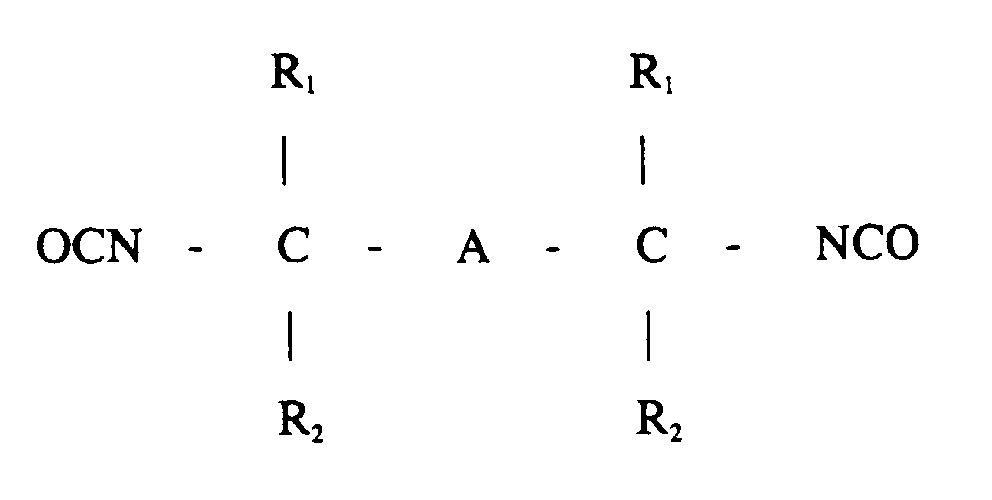
- the substituents R 1 and R 2 are either linear or branched, the same or different.
- the basic structure A can consist of a simple bond, an aromatic or alicyclic ring or an aliphatic linear or branched C chain with 1 to 12 C atoms. Examples include 1,1,6,6-tetramethylhexamethylene diisocyanate, 1,5-dibutyl pentamethyl diisocyanate, p- or m-tetramethylxylylene diisocyanate.
- the diisocyanates can also be used in the usual way to form higher-functionality compounds be implemented, for example by trimerization or by implementation with Water or polyols, e.g. Trimethylolpropane or glycerin.
- polyisocyanates can also be used in the form of isocyanate-modified resins will.
- the polyisocyanates can also be in blocked or partially blocked form be used.
- blocked or partially blocked isocyanates are any di- and / or polyisocyanates in which the isocyanate groups or a part of the isocyanate groups have been reacted with compounds that are active Contain hydrogen.
- Corresponding di- and / or polyisocyanates can also be used prepolymers containing isocyanate groups can be used. It is for example aliphatic, cycloaliphatic, aromatic, optionally also steric hindered polyisocyanates, as already described above.
- Prefers become trivalent aromatic and / or aliphatic blocked or partial blocked isocyanates with a number average molecular weight of e.g. 500 - 1,500.
- Low molecular acid compounds containing hydrogen to block NCO groups are known. Examples are aliphatic or cycloaliphatic Alcohols, dialkylamino alcohols, oximes, lactams, imides, hydroxyl alkyl esters, Malonic or acetoacetic acid esters.
- Aminoplast resins are also suitable as crosslinkers.
- Aminoplast resins are described for example in Ullmann “Encyclopedia of Industrial Chemistry", 5. Edition, Vol. A2, chapter “Aminoresins”, pages 115-141 (1985) and Houben-Weyl, "Methods of Organic Chemistry", volume 14/2, pages 319 - 399 (1962).
- the Resins are manufactured according to the state of the art and used by many companies Sales products offered.
- Examples of such aminoplast resins are amine-formaldehyde condensation resins, by the reaction of aldehydes with melamine, Guanamine, benzoguanamine or dicyandiamide are formed. The alcohol groups of the Aldehyde condensation products are then partially or completely with alcohols etherified.
- the coating compositions according to the invention contain organic solvents.
- the Solvents can come from the manufacture of the binders or separately be added. These are, for example, solvents such as they have already been mentioned above for the preparation of the solution polymers.
- Pigments and / or fillers can be used in the coating compositions according to the invention be included.
- pigments all common pigments are organic or suitable of inorganic nature.
- inorganic or organic Color pigments and fillers are titanium dioxide, micronized titanium dioxide, Iron oxide pigments, zinc phosphate (anti-corrosion pigment), azo pigments, Phthalocyanine pigments, quinacridone or pyrrolopyrrole pigments, carbon black, Silicon dioxide, barium sulfate, talc, aluminum silicate, Magnesium silicate.
- Coatings can contain additives that are customary in paint.
- the additives are the usual additives that can be used in the paint sector.
- examples for such additives there are light stabilizers, e.g. based on benzotriazoles and HALS compounds, leveling agents based on (meth) acrylic homopolymers or silicone oils, rheology-influencing agents, such as highly disperse Silicic acid or polymeric urea compounds, thickeners, such as crosslinked Polycarboxylic acid or polyurethane, anti-foaming agent, wetting agent, Curing accelerator for the crosslinking reaction of the OH-functional binders, for example organic metal salts such as dibutyltin dilaurate, zinc naphthenate and Compounds containing tertiary amino groups such as triethylamine for the Crosslinking reaction with polyisocyanates.
- the additives are used in the usual way Amounts familiar to those skilled in the art are used.
- the individual components are used to manufacture pigmented coating agents mixed together and homogenized or ground in the usual manner. For example, one can proceed in such a way that a part of the copolymers containing hydroxyl groups with the pigments and / or fillers as well as common additives and solvents and mixed in grinding units is rubbed. Then the ground material with the remaining copolymer solution completed.
- the binders according to the invention can be used one-component or two-component coating agents can be formulated. If polyisocyanates with free isocyanate groups are used as crosslinkers it is a two-component system, i.e. the hydroxyl group Binder component, possibly with pigments, fillers and customary paint additives, is mixed with the polyisocyanate component shortly before application. Then can be adjusted to spray viscosity with organic solvents if necessary.
- the coating agents produced in this way are particularly suitable for Manufacture of pigmented or transparent top layers of an air drying or forced-drying, e.g. Multi-layer coating that dries up to 80 ° C. she However, even at higher temperatures e.g. 80-140 ° C can be hardened. They are suitable for vehicle and industrial painting, especially for the Refinishing of vehicles and vehicle parts.
- the coating agents are made by known methods, e.g. Splashing, diving, Rolls or squeegees, applied.
- the Coating agents for example, according to the wet-on-wet method on conventional ones or aqueous basecoats are applied, whereupon both layers together e.g. 10-60 min at e.g. 40-80 ° C can be hardened.
- the coating agents can be applied to conventional 1K or 2K filler layers be applied.
- the coating agents according to the invention can also be used as Filler layer, e.g. on usual primers, e.g. 2K epoxy primers applied and dried at room temperature.
- the invention therefore also relates to a method for producing Multilayer coatings or the use of the binders according to the invention in Coating agents for the production of multilayer coatings, in particular the pigmented top and transparent clear coats of multi-layer coatings be created by the binders or coating agents according to the invention.
- the Coating agents formulated from the binders according to the invention have high Reactivity and short drying times. It will be veil-free and brilliant Coatings achieved with very good hardness.
- a xylene isomer mixture 100 g of an aromatic hydrocarbon with a boiling range of 155-178 ° C, 80 g of n-butyl acetate, 72 are placed in a 2-liter three-necked flask equipped with a stirrer, thermometer, cooler and two dropping funnels g of glycidyl neodecanoate with a glycidyl equivalent weight of 249 and 62 g of vinyl neodecanoate are introduced and heated to 149 ° C. with stirring.
- a monomer mixture of 31 g of acrylic acid, 80 g of styrene, 135 g of 2-hydroxyethyl methacrylate, 149 g of methyl methacrylate and 11 g of epsilon-caprolactone is simultaneously added dropwise with an initiator solution of 10 g of an aromatic hydrocarbon with a boiling range of 155- 178 ° C, 5 g of di-tert-butyl peroxide and 5 g of dicumyl peroxide.
- the temperature drops to 144 ° C.
- the dropping funnels are rinsed with 30 g of an aromatic hydrocarbon with a boiling range of 155-178 ° C.
- the batch is then polymerized for 4 hours. The conversion is then about 99%.
- a (meth) acrylic copolymer solution is obtained obtained with a solids content of 55.4% (solids at 1 h 150 ° C), one Acid number of 17.8 mg KOH / g, an OH number of 135 mg KOH / g, a viscosity of 1800 mPa.s / 25 ° C and a residual monomer content of the vinyl neodecanoate of 0.65% (based on the total use of the vinyl monomer).
- the batch is then polymerized for 4 hours.
- the turnover is then about 99%.
- a (meth) acrylic copolymer solution is obtained obtained with a solids of 54.6% (solids at 1 h 150 ° C), one Acid number of 16.5 mg KOH / g, an OH number of 132 mg KOH / g, a viscosity of 1580 mPa.s / 25 ° C and a residual monomer content of the vinyl neodecanoate of 0.8% (based on the total use of the vinyl monomer).
- 140 g of xylene isomer mixture 100 g of an aromatic hydrocarbon with a boiling range of 155-178 ° C, 72 g of glycidyl neodecanoate with a glycidyl equivalent weight of.
- 72 g of glycidyl neodecanoate with a glycidyl equivalent weight of. are in a 2 liter three-necked flask equipped with a stirrer, thermometer, cooler and two dropping funnels 249 and 62 g of vinyl neodecanoate are introduced and heated to 150 ° C. with stirring.
- a monomer mixture of 31 g of acrylic acid, 100 g of styrene, 118 g of 2-hydroxyethyl methacrylate, 14 g of 2-hydroxypropyl methacrylate, 136 g of methyl methacrylate and 3 g of epsilon-caprolactone was simultaneously added dropwise with an initiator solution of 10 g of an aromatic hydrocarbon within 5 hours with a boiling range of 155-178 ° C, 7 g di-tert-butyl peroxide and 7 g dicumyl peroxide. After the end of the feed, the temperature drops to 146 ° C. The dropping funnels are rinsed with 30 g of an aromatic hydrocarbon with a boiling range of 155-178 ° C. The batch is then polymerized for 4 hours. The conversion is then about 99%.
- a (meth) acrylic copolymer solution is obtained with a solids content of 54.3% (solids content for 1 h 150 ° C), an acid number of 16.1 mg KOH / g, an OH number of 132 mg KOH / g, a viscosity of 2990 mPa.s / 25 ° C and a residual monomer content of Vinyl neodecanoate of 0.82% (based on the total use of the vinyl monomer).
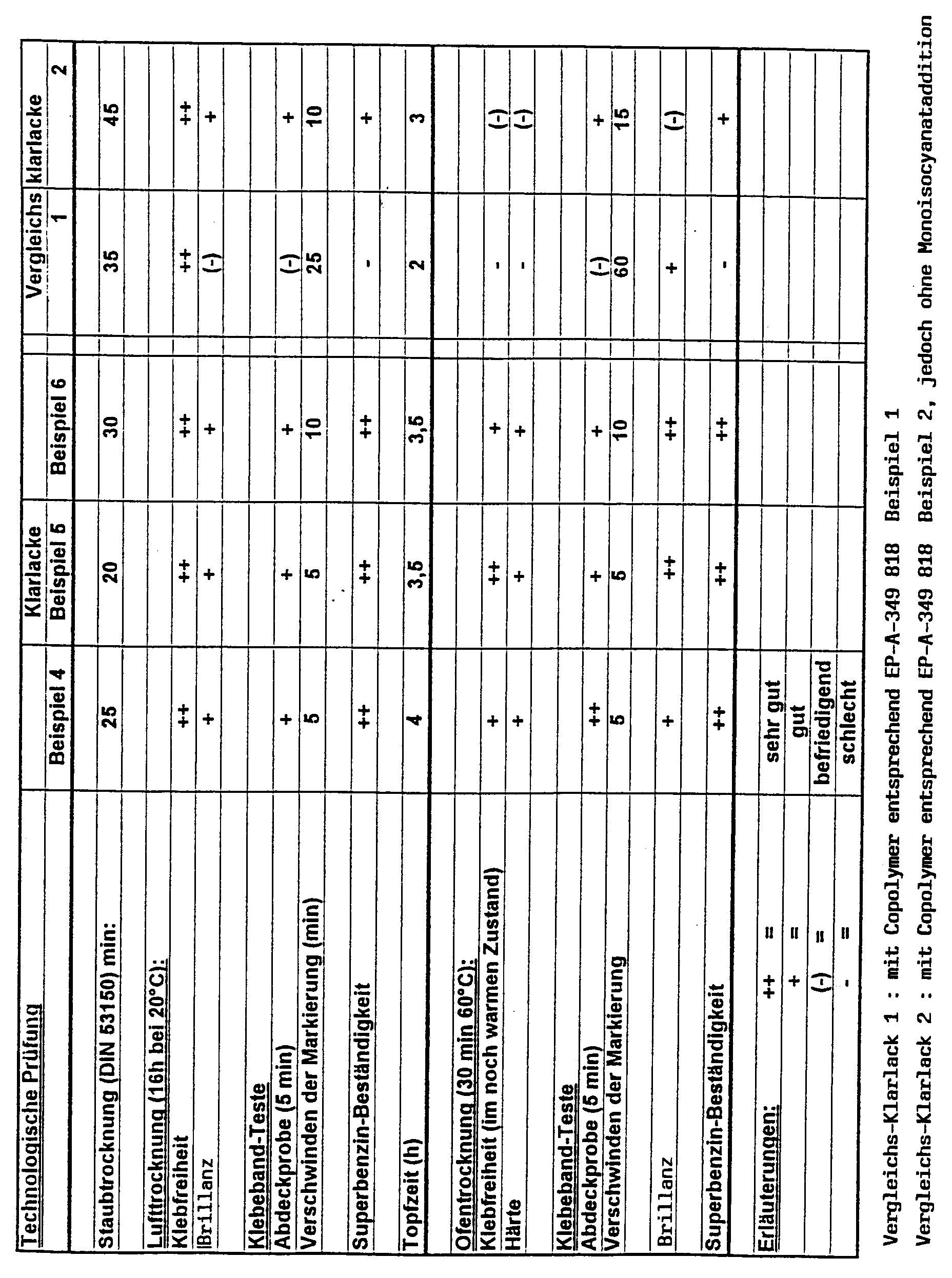
- Example 2 Analogous to Example 4-6, 2 comparative clearcoats were produced, the copolymers according to the invention by comparison copolymers from EP 349 818, Example 1 and Example 2 have been replaced.
- a hardener solution is prepared from 39.10 g of an aliphatic polyisocyanate based on cyclotrimerized hexamethylene diisocyanate, 4.10 g Ethoxypropyl acetate, 10.94 g n-butyl acetate, 29.20 g aromatic Hydrocarbon with a boiling range of 155-178 ° C, 12.50 g xylene mixture of isomers, 4.00 g methoxypropyl acetate and 0.16 g of a 10% Dibutyltin dilaurate solution in n-butyl acetate.
- the clear coats thus obtained are applied by spray application in a dry film thickness of 40-60 ⁇ m in a wet-on-wet process to a solvent-based basecoat film and cured at 60 ° C. for 5 minutes 30 minutes.
- the results of the paint tests are shown in the following table.
Landscapes
- Chemical & Material Sciences (AREA)
- Organic Chemistry (AREA)
- Health & Medical Sciences (AREA)
- Chemical Kinetics & Catalysis (AREA)
- Medicinal Chemistry (AREA)
- Polymers & Plastics (AREA)
- Life Sciences & Earth Sciences (AREA)
- Engineering & Computer Science (AREA)
- Materials Engineering (AREA)
- Wood Science & Technology (AREA)
- Paints Or Removers (AREA)
- Addition Polymer Or Copolymer, Post-Treatments, Or Chemical Modifications (AREA)
- Saccharide Compounds (AREA)
Abstract
Description
wobei die Komponente C)
Als Monomerkomponente A) werden Vinylester gesättigter Monocarbonsäuren, bevorzugt Vinylester von in alpha-Stellung verzweigten gesättigten Monocarbonsäuren mit 5-15 C-Atomen im Molekül, einzeln oder im Gemisch eingesetzt. Bevorzugt sind dabei Vinylester von gesättigten alpha-Alkylalkanmonocarbonsäuren und/oder von gesättigten alpha,alpha-Dialkylalkanmonocarbonsäuren mit 5-13 C-Atomen im Molekül. Besonders bevorzugt sind die Glycidylester von alpha,alpha-Dialkylmonocarbonsäuren mit 9-11 C-Atomen im Molekül. Die Alkylreste können hierbei auch eine unterschiedliche Anzahl an C-Atomen besitzen. Die Vinylester werden z.B. durch Umsetzung der vorstehend genannten gesättigten Monocarbonsäuren mit Acetylen erhalten. Sie sind kommerziell erhältlich, z. B. als Veova 9, Veova 10.
Danach wird der Ansatz 4 Stunden lang nachpolymerisiert. Der Umsatz beträgt dann ca. 99%.
Danach wird der Ansatz 4 Stunden lang nachpolymerisiert. Der Umsatz beträgt dann ca. 99%.
Claims (14)
- Hydroxylgruppenhaltige Copolymerisate auf der Basis von Vinylestern von Monocarbonsäuren, dadurch gekennzeichnet, daß sie eine OH-Zahl von 110 - 170 mg KOH/g, eine Säurezahl von 5 - 35 mg KOH/g und ein zahlenmittleres Molekulargewicht Mn von 1500 - 8000 g/mol besitzen und durch Polymerisation vonA) 5 - 20 Gew.-% eines oder mehrerer Vinylester gesättigter Monocarbonsäuren,B) 10 - 30 Gew.- % eines oder mehrerer vinylaromatischer Kohlenwasserstoffe,C) 41 - 55 Gew.-% hydroxyfunktioneller polymerisierbarer ungesättigter Monomere undD) 0 - 40 Gew.-% weiterer polymerisierbarer ungesättigter Monomere erhältlich sind, wobei die Komponente C)C1) 40 - 70 Gew.-% eines oder mehrerer Hydroxyalkylester α,β-ungesättigter Monocarbonsäuren,C2) 1 - 10 Gew.-% eines oder mehrerer Lactone undC3) 30 - 55 Gew.-% eines oder mehrerer Umsatzprodukte einer α,β-ungesättigten Monocarbonsäure mit einem Glycidylester einer gesättigten α,α-Dialkylalkanmonocarbonsäure oder einer gesättigten α-Alkylalkanmonocarbonsäure enthält, und die Summe der Komponenten A) bis D) und die Summe der Komponenten C1) bis C3) sich jeweils zu 100 Gew.-% ergänzen.
- Copolymerisate nach Anspruch 1, dadurch gekennzeichnet, daß sie durch das Lösungspolymerisationsverfahren erhältlich sind.
- Copolymerisate nach Anspruch 1 oder 2, dadurch gekennzeichnet, daß sie eine OH-Zahl von 120 - 160 mg KOH/g, eine Säurezahl von 10 - 30 mg KOH/g und ein zahlenmittleres Molekulargewicht von 2000 - 6000 g/mol aufweisen.
- Copolymerisate nach einem der Ansprüche 1 bis 3, dadurch gekennzeichnet, daß sie eine Glasübergangstemperatur zwischen 30 und 70 °C aufweisen.
- Copolymerisate nach einem der Ansprüche 1 bis 4, dadurch gekennzeichnet, daß sie einen Restmonomerenanteil an Vinylestern ungesättigter Monocarbonsäuren von maximal 1 Gew.-% aufweisen.
- Copolymerisate nach einem der Ansprüche 1 bis 5, dadurch gekennzeichnet, daß als Monomerenkomponente A) Vinylester von in α-Stellung verzweigten gesättigten Monocarbonsäuren mit 5 - 15 C-Atomen pro Molekül, einzeln oder im Gemisch enthalten sind.
- Copolymerisate nach einem der Ansprüche 1 bis 6, dadurch gekennzeichnet, daß als Monomerenkomponente B) vinylaromatische Kohlenwasserstoffe mit 8 - 9 C-Atomen pro Molekül enthalten sind.
- Copolymerisate nach einem der Ansprüche 1 bis 7, dadurch gekennzeichnet, daß als Komponente C1) Hydroxyalkylester der Acrylsäure, Methacrylsäure, Crotonsäure und/oder Isocrotonsäure enthalten sind.
- Copolymerisate nach einem der Ansprüche 1 bis 8, dadurch gekennzeichnet, daß als Komponente C2) γ-Butyrolacton, δ-Valerolacton, ε-Caprolacton, β-Hydroxy-β-methyl-δ-valerolacton, λ-Laurinlacton oder deren Gemische enthalten sind.
- Copolymerisate nach einem der Ansprüche 1 bis 9, dadurch gekennzeichnet, daß als Komponente C3) Umsetzungsprodukte der (Meth)acrylsäure mit Glycidylestern gesättigter α-α-Dialkylalkanmonocarbonsäuren mit 7 bis 13 C-Atomen enthalten sind.
- Copolymerisate nach einem der Ansprüche 1 bis 10, dadurch gekennzeichnet, daß als Komponente D) Acrylsäure, Methacrylsäure und/oder deren Ester enthalten sind.
- Verfahren zur Herstellung hydroxylgruppenhaltiger Copolymerisate auf der Basis von Vinylestern von Monocarbonsäuren, dadurch gekennzeichnet, daß die hydroxylgruppenhaltigen Copolymerisate durch Polymerisation der Komponenten A) 5 - 20 Gew.-% eines oder mehrerer Vinylester gesättigter Monocarbonsäuren, B) 10 - 30 Gew.-% eines oder mehrerer vinylaromatischer Kohlenwasserstoffe, C) 41 - 55 Gew.-% hydroxyfunktioneller polymerisierbarer ungesättigter Monomere und D) 0 - 40 Gew.-% weiterer polymerisierbarer ungesättigter Monomere erhältlich sind, wobei sich die Komponente C) aus C1) 40 - 70 Gew.-% eines oder mehrerer Hydroxyalkylester α,β-ungesättigter Monocarbonsäuren, C2) 1 - 10 Gew.-% eines oder mehrerer Lactone und C3) 30 - 55 Gew.-% eines oder mehrerer Umsatzprodukte einer α,β-ungesättigten Monocarbonsäure mit einem Glycidylester einer gesättigten α,α-Dialkylalkanmonocarbonsäure oder einer gesättigten α-Alkylalkanmonocarbonsäure zusammensetzt, und die Summe der Komponenten A) bis D) und die Summe der Komponenten C1) bis C3) sich jeweils zu 100 Gew.-% ergänzen.
- Überzugsmittel, dadurch gekennzeichnet, daß es (a) als Bindemittel ein oder mehrere Copolymerisate nach einem oder mehreren der Ansprüche 1 bis 11, (b) einen oder mehrere Vernetzer, (c) organische Lösemittel und ggf. (d) Pigmente, Füllstoffe und/oder lackübliche Additive enthält.
- Überzugsmittel nach Anspruch 13, dadurch gekennzeichnet, daß als Vernetzer Polyisocyanate, blockierte Polyisocyanate und/oder Aminoplastharze eingesetzt werden.
Applications Claiming Priority (2)
| Application Number | Priority Date | Filing Date | Title |
|---|---|---|---|
| DE19704020A DE19704020A1 (de) | 1997-02-04 | 1997-02-04 | Hydroxylgruppenhaltige Copolymerisate und Verfahren zu ihrer Herstellung |
| DE19704020 | 1997-02-04 |
Publications (2)
| Publication Number | Publication Date |
|---|---|
| EP0856533A1 true EP0856533A1 (de) | 1998-08-05 |
| EP0856533B1 EP0856533B1 (de) | 2003-07-30 |
Family
ID=7819182
Family Applications (1)
| Application Number | Title | Priority Date | Filing Date |
|---|---|---|---|
| EP98101350A Expired - Lifetime EP0856533B1 (de) | 1997-02-04 | 1998-01-27 | Überzugsmittel enthaltend hydroxylgruppenhaltige Copolymerisate |
Country Status (11)
| Country | Link |
|---|---|
| US (1) | US6162886A (de) |
| EP (1) | EP0856533B1 (de) |
| JP (1) | JPH10231332A (de) |
| AT (1) | ATE246211T1 (de) |
| AU (1) | AU5288998A (de) |
| CA (1) | CA2228976A1 (de) |
| DE (2) | DE19704020A1 (de) |
| DK (1) | DK0856533T3 (de) |
| ES (1) | ES2201344T3 (de) |
| PT (1) | PT856533E (de) |
| ZA (1) | ZA98918B (de) |
Cited By (7)
| Publication number | Priority date | Publication date | Assignee | Title |
|---|---|---|---|---|
| WO2001002500A1 (de) * | 1999-06-30 | 2001-01-11 | Basf Coatings Ag | Beschichtungsstoff und seine verwendung zur herstellung von füllerschichten und steinschlagschutzgrundierungen |
| US6364918B1 (en) | 1999-06-17 | 2002-04-02 | Clariant Gmbh | Hydroxyl-containing copolymers, and their use for the preparation of fuel oils having improved lubricity |
| US6391071B1 (en) | 1999-06-17 | 2002-05-21 | Clariant Gmbh | Use of hydroxyl-containing copolymers for the preparation of fuel oils having improved lubricity |
| WO2002046252A1 (en) * | 2000-12-08 | 2002-06-13 | Resolution Research Nederland B.V. | Irradiation curable, high solid coating compositions and their preparation |
| EP1541647A1 (de) * | 2003-12-10 | 2005-06-15 | E. I. du Pont de Nemours and Company | Wässrige Zweikomponenten-Beschichtungsmittel |
| EP2548901A1 (de) * | 2011-07-19 | 2013-01-23 | Cytec Surface Specialties, S.A. | Verfahren zur Herstellung von strahlungshärtbaren Zusammensetzungen |
| CN103709312A (zh) * | 2013-12-16 | 2014-04-09 | 上海涂料有限公司技术中心 | 一种可复涂聚氨酯涂料用羟基丙烯酸树脂的制备方法 |
Families Citing this family (17)
| Publication number | Priority date | Publication date | Assignee | Title |
|---|---|---|---|---|
| GB9707036D0 (en) * | 1997-04-07 | 1997-05-28 | Zeneca Resins Bv | Aqueous crosslinkable coating compositions |
| DE19930066A1 (de) | 1999-06-30 | 2001-01-11 | Basf Coatings Ag | Farb- und/oder effektgebende Mehrschichtlackierung, Verfahren zu ihrer Herstellung und ihre Verwendung |
| DE19930665A1 (de) | 1999-07-02 | 2001-01-11 | Basf Coatings Ag | Basislack und seine Verwendung zur Herstellung von farb- und/oder effektgebenden Basislackierungen und Mehrschichtlackierung |
| DE19930664A1 (de) | 1999-07-02 | 2001-01-11 | Basf Coatings Ag | Klarlack und seine Verwendung zur Herstellung von Klarlackierungen und farb- und/oder effektgebenden Mehrschichtlackierungen |
| DE19959923A1 (de) | 1999-12-11 | 2001-06-28 | Basf Coatings Ag | Wäßrige Primärdispersionen und Beschichtungsstoffe, Verfahren zu ihrer Herstellung und ihre Verwendung |
| DE19959927A1 (de) | 1999-12-11 | 2002-02-07 | Basf Coatings Ag | Wäßrige Primärdispersionen und Beschichtungsstoffe, Verfahren zu ihrer Herstellung und ihre Verwendung |
| DE19961040A1 (de) * | 1999-12-16 | 2001-06-21 | Basf Ag | Thermoplastische Formmassen mit verbessertem Verarbeitungsverhalten auf Basis von Polyarylenethersulfonen und Polyamiden |
| DE10005819A1 (de) | 2000-02-10 | 2001-08-23 | Basf Coatings Ag | Wäßrige Primärdispersionen, Verfahren zu ihrer Herstellung und ihre Verwendung |
| DE10018078A1 (de) * | 2000-04-12 | 2001-11-08 | Basf Coatings Ag | Formmassen und Verfahren zur Herstellung von Formkörpern |
| DE10018601A1 (de) * | 2000-04-14 | 2001-10-25 | Basf Coatings Ag | Wäßrige Primärdispersionen und Beschichtungsstoffe, Verfahren zu ihrer Herstellung und ihre Verwendung |
| DE10126650B4 (de) * | 2001-06-01 | 2005-08-18 | Basf Coatings Ag | Funktionale organische Pulver, Verfahren zu ihrer Herstellung und ihre Verwendung |
| DE10126651A1 (de) * | 2001-06-01 | 2002-12-12 | Basf Coatings Ag | Pulverlacksuspensionen (Pulverslurries) und Pulverlacke, Verfahren zu ihrer Herstellung und ihre Verwendung |
| US20040214942A1 (en) * | 2003-03-03 | 2004-10-28 | Jos Huybrechts | Two-component coating compositions |
| CA2491308A1 (en) * | 2004-12-29 | 2006-06-30 | The Sherwin-Williams Company | Method of applying automotive primer-surfacer using a squeegee |
| JP5408888B2 (ja) * | 2008-03-13 | 2014-02-05 | 日本ペイント株式会社 | 水分散型樹脂、二液型熱硬化性樹脂組成物及びこれらの製造方法 |
| WO2017125341A1 (en) * | 2016-01-22 | 2017-07-27 | Basf Coatings Gmbh | Branched hydroxy-functional (meth)acrylate copolymers having anti-sag properties |
| TWI701309B (zh) * | 2018-12-07 | 2020-08-11 | 長興材料工業股份有限公司 | 可交聯共聚物及其應用 |
Citations (4)
| Publication number | Priority date | Publication date | Assignee | Title |
|---|---|---|---|---|
| US4082816A (en) * | 1972-09-18 | 1978-04-04 | Cook Paint And Varnish Company | Caprolactone polymers from unsaturated monomers |
| EP0580054A2 (de) * | 1992-07-23 | 1994-01-26 | Bayer Ag | Verfahren zur Herstellung von Polyhydroxylverbindungen und ihre Verwendung in Lacken |
| EP0653468A2 (de) * | 1993-11-12 | 1995-05-17 | Herberts Gesellschaft mit beschränkter Haftung | Überzugsmittel für transparente Decklackschichten und deren Verwendung bei Verfahren zur Herstellung von Mehrschichtüberzügen |
| EP0680977A1 (de) * | 1994-05-02 | 1995-11-08 | Hoechst Aktiengesellschaft | Hydroxy- und Carboxylgruppen enthaltende Copolymerisate, ihre Herstellung und ihre Verwendung in festkörperreichen Beschichtungsmitteln |
Family Cites Families (10)
| Publication number | Priority date | Publication date | Assignee | Title |
|---|---|---|---|---|
| US3694415A (en) * | 1970-07-15 | 1972-09-26 | Kiyoshi Honda | Coating resinous composition |
| DE2822436A1 (de) * | 1978-05-23 | 1979-12-06 | Consortium Elektrochem Ind | Hydroxylgruppen enthaltende vinylester- und vinylhalogenid-copolymere |
| DE2851616A1 (de) * | 1978-11-29 | 1980-06-12 | Synthopol Chemie Dr Koch | Zwischenproduktloesung eines additionsproduktes einer alpha , beta - ungesaettigten monocarbonsaeure mit einer monoglycidylverbindung, verfahren zu ihrer herstellung sowie ihre verwendung |
| US4525499A (en) * | 1983-05-26 | 1985-06-25 | Dai Nippon Toryo Co., Ltd. | Non-aqueous dispersion type resin composition |
| DE3731652A1 (de) * | 1987-09-19 | 1989-04-06 | Basf Lacke & Farben | Ueberzugsmittel auf der basis eines acrylatcopolymerisats mit hydroxyl-, carboxyl- und tertiaeren aminogruppen, verfahren zur herstellung des ueberzugsmittels sowie seine verwendung |
| DE3823005A1 (de) * | 1988-07-07 | 1990-01-11 | Basf Lacke & Farben | Hydroxylgruppenhaltie copolymerisate auf der basis von vinylester-,vinylaromat- und hydroxylalkylester-monomeren, verfahren zur ihrer herstellung sowie ihre verwendung in beschichtungsmitteln |
| DE3829587A1 (de) * | 1988-09-01 | 1990-03-15 | Bayer Ag | Beschichtungsmittel, ein verfahren zu ihrer herstellung und die verwendung von ausgewaehlten zweikomponenten-polyurethansystemen als bindemittel fuer derartige beschichtungsmittel |
| DE3918669A1 (de) * | 1989-06-08 | 1990-12-20 | Basf Lacke & Farben | Carboxylgruppen und ggf. tertiaere aminogruppen enthaltende copolymere, verfahren zu ihrer herstellung und ihre verwendung in beschichtungsmassen |
| DE4226243A1 (de) * | 1992-08-08 | 1994-02-10 | Herberts Gmbh | Wasserverdünnbares Überzugsmittel auf Polyol- und Polyisocyanatbasis, Verfahren zu dessen Herstellung und seine Verwendung |
| DE4405042A1 (de) * | 1994-02-17 | 1995-08-24 | Herberts Gmbh | Verfahren zur Herstellung von blockierten Isocyanaten, die erhaltenen blockierten Isocyanate und deren Verwendung |
-
1997
- 1997-02-04 DE DE19704020A patent/DE19704020A1/de not_active Withdrawn
-
1998
- 1998-01-27 DE DE59809111T patent/DE59809111D1/de not_active Expired - Fee Related
- 1998-01-27 ES ES98101350T patent/ES2201344T3/es not_active Expired - Lifetime
- 1998-01-27 DK DK98101350T patent/DK0856533T3/da active
- 1998-01-27 AT AT98101350T patent/ATE246211T1/de not_active IP Right Cessation
- 1998-01-27 EP EP98101350A patent/EP0856533B1/de not_active Expired - Lifetime
- 1998-01-27 PT PT98101350T patent/PT856533E/pt unknown
- 1998-01-29 US US09/015,852 patent/US6162886A/en not_active Expired - Fee Related
- 1998-02-02 AU AU52889/98A patent/AU5288998A/en not_active Abandoned
- 1998-02-03 CA CA002228976A patent/CA2228976A1/en not_active Abandoned
- 1998-02-03 JP JP10021627A patent/JPH10231332A/ja active Pending
- 1998-02-04 ZA ZA98918A patent/ZA98918B/xx unknown
Patent Citations (4)
| Publication number | Priority date | Publication date | Assignee | Title |
|---|---|---|---|---|
| US4082816A (en) * | 1972-09-18 | 1978-04-04 | Cook Paint And Varnish Company | Caprolactone polymers from unsaturated monomers |
| EP0580054A2 (de) * | 1992-07-23 | 1994-01-26 | Bayer Ag | Verfahren zur Herstellung von Polyhydroxylverbindungen und ihre Verwendung in Lacken |
| EP0653468A2 (de) * | 1993-11-12 | 1995-05-17 | Herberts Gesellschaft mit beschränkter Haftung | Überzugsmittel für transparente Decklackschichten und deren Verwendung bei Verfahren zur Herstellung von Mehrschichtüberzügen |
| EP0680977A1 (de) * | 1994-05-02 | 1995-11-08 | Hoechst Aktiengesellschaft | Hydroxy- und Carboxylgruppen enthaltende Copolymerisate, ihre Herstellung und ihre Verwendung in festkörperreichen Beschichtungsmitteln |
Cited By (13)
| Publication number | Priority date | Publication date | Assignee | Title |
|---|---|---|---|---|
| US6364918B1 (en) | 1999-06-17 | 2002-04-02 | Clariant Gmbh | Hydroxyl-containing copolymers, and their use for the preparation of fuel oils having improved lubricity |
| US6391071B1 (en) | 1999-06-17 | 2002-05-21 | Clariant Gmbh | Use of hydroxyl-containing copolymers for the preparation of fuel oils having improved lubricity |
| WO2001002500A1 (de) * | 1999-06-30 | 2001-01-11 | Basf Coatings Ag | Beschichtungsstoff und seine verwendung zur herstellung von füllerschichten und steinschlagschutzgrundierungen |
| US6727316B1 (en) | 1999-06-30 | 2004-04-27 | Basf Coatings Ag | Coating material and its use for producing filler coats and stone impact protection primers |
| AU775344B2 (en) * | 1999-06-30 | 2004-07-29 | Basf Coatings Aktiengesellschaft | Coating material and its use for producing filler coats and stone impact protection primers |
| WO2002046252A1 (en) * | 2000-12-08 | 2002-06-13 | Resolution Research Nederland B.V. | Irradiation curable, high solid coating compositions and their preparation |
| EP1541647A1 (de) * | 2003-12-10 | 2005-06-15 | E. I. du Pont de Nemours and Company | Wässrige Zweikomponenten-Beschichtungsmittel |
| US7091278B2 (en) | 2003-12-10 | 2006-08-15 | E. I. Dupont De Nemours And Company | Aqueous two-component coating compositions |
| EP2548901A1 (de) * | 2011-07-19 | 2013-01-23 | Cytec Surface Specialties, S.A. | Verfahren zur Herstellung von strahlungshärtbaren Zusammensetzungen |
| WO2013010813A1 (en) | 2011-07-19 | 2013-01-24 | Cytec Surface Specialties, S.A. | Process for the preparation of radiation curable compositions |
| US9708515B2 (en) | 2011-07-19 | 2017-07-18 | Henkel Ag & Co. Kgaa | Process for the preparation of radiation curable compositions |
| CN103709312A (zh) * | 2013-12-16 | 2014-04-09 | 上海涂料有限公司技术中心 | 一种可复涂聚氨酯涂料用羟基丙烯酸树脂的制备方法 |
| CN103709312B (zh) * | 2013-12-16 | 2016-05-11 | 上海涂料有限公司技术中心 | 一种可复涂聚氨酯涂料用羟基丙烯酸树脂的制备方法 |
Also Published As
| Publication number | Publication date |
|---|---|
| ZA98918B (en) | 1998-08-06 |
| CA2228976A1 (en) | 1998-08-04 |
| AU5288998A (en) | 1998-08-06 |
| ATE246211T1 (de) | 2003-08-15 |
| JPH10231332A (ja) | 1998-09-02 |
| US6162886A (en) | 2000-12-19 |
| PT856533E (pt) | 2003-12-31 |
| DE59809111D1 (de) | 2003-09-04 |
| EP0856533B1 (de) | 2003-07-30 |
| DE19704020A1 (de) | 1998-08-06 |
| ES2201344T3 (es) | 2004-03-16 |
| DK0856533T3 (da) | 2003-08-18 |
Similar Documents
| Publication | Publication Date | Title |
|---|---|---|
| EP0856533B1 (de) | Überzugsmittel enthaltend hydroxylgruppenhaltige Copolymerisate | |
| DE19529124C1 (de) | Überzugsmittel und deren Verwendung in Verfahren zur Herstellung von Mehrschichtüberzügen | |
| EP0707608B1 (de) | Wässriges zweikomponenten-polyurethan-beschichtungsmittel, verfahren zu seiner herstellung und seine verwendung in verfahren zur herstellung einer mehrschichtlackierung | |
| EP0638591B1 (de) | Hydroxylgruppen enthaltende Copolymerisate, ihre Herstellung und ihre Verwendung in festkörperreichen Beschichtungsmitteln | |
| DE4310414A1 (de) | Verfahren zur Herstellung einer zweischichtigen Decklackierung auf einer Substratoberfläche | |
| DE60104506T2 (de) | Hydroxyfunktionelle (Meth)acrylat-Copolymere sowie Überzugsmischungen | |
| DE3924618A1 (de) | Ueberzugsmittel auf der basis von carboxylgruppenhaltigen polymeren und epoxidgruppenhaltigen vernetzern, verfahren zur herstellung des ueberzugsmittels sowie seine verwendung | |
| DE4242518C2 (de) | Wäßrige Polymerdispersionen für Klarlacke | |
| EP0749462A1 (de) | Beschichtungsmittel auf basis eines vernetzbaren hydroxylgruppenhaltigen poly(meth)acrylatharzes | |
| EP0630923B2 (de) | Überzugsmittel und deren Verwendung, insbesondere bei der Herstellung transparenter und pigmentierter Deckschichten | |
| EP0819710B1 (de) | Neue festkörperreiche 2K-PUR-Bindemittelkombinationen | |
| EP0688840A2 (de) | Überzugsmittel und deren Verwendung bei Verfahren zur Herstellung von Mehrschichtüberzügen | |
| DE4407409A1 (de) | Beschichtungsmittel auf Basis eines hydroxylgruppenhaltigen Polyacrylatharzes und seine Verwendung in Verfahren zur Herstellung einer Mehrschichtlackierung | |
| EP0308756A1 (de) | Überzugsmittel auf der Basis eines Acrylatcopolymerisats mit Hydroxyl-, Carboxyl- und tertiären Aminogruppen, Verfahren zur Herstellung des Überzugsmittels sowie seine Verwendung | |
| DE4415319A1 (de) | Hydroxy- und Carboxylgruppen enthaltende Copolymerisate, ihre Herstellung und ihre Verwendung in festkörperreichen Beschichtungsmitteln | |
| DE602004001354T2 (de) | Zweikomponenten-Beschichtungszusammensetzungen | |
| EP0320719B1 (de) | Bindemittel, Verfahren zu dessen Herstellung und dessen Verwendung in klaren oder pigmentierten Überzugsmitteln | |
| EP0752436B1 (de) | Überzugsmittel, dessen Verwendung und Verfahren zur Mehrschichtlackierung | |
| EP0588314B1 (de) | Überzugsmittel, Verfahren zu dessen Herstellung und dessen Verwendung zur Herstellung transparenter Deckschichten auf Mehrschichtüberzügen | |
| DE60119262T2 (de) | Beschichtungsmittelzusammensetzungen auf Basis Hydroxy-funktioneller (Meth)Acrylcopolymerisate | |
| EP0656924B1 (de) | Verfahren zur mehrschichtlackierung von substraten | |
| EP0714915A2 (de) | Niedermolekulare funktionelle Copolymerisate, Verfahren zu ihrer Herstellung und ihre Verwendung | |
| DE4445355A1 (de) | Bindemittel, diese enthaltende wäßrige und lösemittelhaltige Überzugsmittel, Verfahren zu deren Herstellung und zur Herstellung von Mehrschichtlackierungen | |
| EP0289997A2 (de) | Überzugsmittel und dessen Verwendung bei Verfahren zur Herstellung von Mehrschichtüberzügen | |
| DE4338703C1 (de) | Überzugsmittel für transparente Decklackschichten und deren Verwendung bei Verfahren zur Herstellung von Mehrschichtüberzügen |
Legal Events
| Date | Code | Title | Description |
|---|---|---|---|
| PUAI | Public reference made under article 153(3) epc to a published international application that has entered the european phase |
Free format text: ORIGINAL CODE: 0009012 |
|
| AK | Designated contracting states |
Kind code of ref document: A1 Designated state(s): AT BE CH DE DK ES FR GB GR IE IT LI NL PT SE |
|
| AX | Request for extension of the european patent |
Free format text: AL;LT;LV;MK;RO;SI |
|
| 17P | Request for examination filed |
Effective date: 19990111 |
|
| AKX | Designation fees paid |
Free format text: AT BE CH DE DK ES FR GB GR IE IT LI NL PT SE |
|
| RBV | Designated contracting states (corrected) |
Designated state(s): AT BE CH DE DK ES FR GB GR IE IT LI NL PT SE |
|
| 17Q | First examination report despatched |
Effective date: 19990429 |
|
| RAP1 | Party data changed (applicant data changed or rights of an application transferred) |
Owner name: E.I. DU PONT DE NEMOURS AND COMPANY |
|
| RTI1 | Title (correction) |
Free format text: COATINGS BASED ON POLYMERS CONTAINING HYDROXYL GROUPS |
|
| GRAH | Despatch of communication of intention to grant a patent |
Free format text: ORIGINAL CODE: EPIDOS IGRA |
|
| GRAH | Despatch of communication of intention to grant a patent |
Free format text: ORIGINAL CODE: EPIDOS IGRA |
|
| GRAA | (expected) grant |
Free format text: ORIGINAL CODE: 0009210 |
|
| AK | Designated contracting states |
Designated state(s): AT BE CH DE DK ES FR GB GR IE IT LI NL PT SE |
|
| PG25 | Lapsed in a contracting state [announced via postgrant information from national office to epo] |
Ref country code: IE Free format text: LAPSE BECAUSE OF FAILURE TO SUBMIT A TRANSLATION OF THE DESCRIPTION OR TO PAY THE FEE WITHIN THE PRESCRIBED TIME-LIMIT Effective date: 20030730 |
|
| REG | Reference to a national code |
Ref country code: GB Ref legal event code: FG4D Free format text: NOT ENGLISH |
|
| REG | Reference to a national code |
Ref country code: CH Ref legal event code: EP |
|
| REG | Reference to a national code |
Ref country code: DK Ref legal event code: T3 |
|
| REG | Reference to a national code |
Ref country code: CH Ref legal event code: NV Representative=s name: HEPP WENGER & RYFFEL AG |
|
| REG | Reference to a national code |
Ref country code: IE Ref legal event code: FG4D Free format text: GERMAN |
|
| REF | Corresponds to: |
Ref document number: 59809111 Country of ref document: DE Date of ref document: 20030904 Kind code of ref document: P |
|
| GBT | Gb: translation of ep patent filed (gb section 77(6)(a)/1977) | ||
| PG25 | Lapsed in a contracting state [announced via postgrant information from national office to epo] |
Ref country code: GR Free format text: LAPSE BECAUSE OF FAILURE TO SUBMIT A TRANSLATION OF THE DESCRIPTION OR TO PAY THE FEE WITHIN THE PRESCRIBED TIME-LIMIT Effective date: 20031030 |
|
| REG | Reference to a national code |
Ref country code: SE Ref legal event code: TRGR |
|
| PGFP | Annual fee paid to national office [announced via postgrant information from national office to epo] |
Ref country code: PT Payment date: 20031230 Year of fee payment: 7 |
|
| PGFP | Annual fee paid to national office [announced via postgrant information from national office to epo] |
Ref country code: DK Payment date: 20040109 Year of fee payment: 7 |
|
| PGFP | Annual fee paid to national office [announced via postgrant information from national office to epo] |
Ref country code: SE Payment date: 20040122 Year of fee payment: 7 |
|
| PGFP | Annual fee paid to national office [announced via postgrant information from national office to epo] |
Ref country code: ES Payment date: 20040226 Year of fee payment: 7 |
|
| REG | Reference to a national code |
Ref country code: ES Ref legal event code: FG2A Ref document number: 2201344 Country of ref document: ES Kind code of ref document: T3 |
|
| REG | Reference to a national code |
Ref country code: IE Ref legal event code: FD4D |
|
| ET | Fr: translation filed | ||
| PLBE | No opposition filed within time limit |
Free format text: ORIGINAL CODE: 0009261 |
|
| STAA | Information on the status of an ep patent application or granted ep patent |
Free format text: STATUS: NO OPPOSITION FILED WITHIN TIME LIMIT |
|
| 26N | No opposition filed |
Effective date: 20040504 |
|
| PGFP | Annual fee paid to national office [announced via postgrant information from national office to epo] |
Ref country code: BE Payment date: 20041201 Year of fee payment: 8 |
|
| PGFP | Annual fee paid to national office [announced via postgrant information from national office to epo] |
Ref country code: GB Payment date: 20041223 Year of fee payment: 8 |
|
| PGFP | Annual fee paid to national office [announced via postgrant information from national office to epo] |
Ref country code: NL Payment date: 20050117 Year of fee payment: 8 Ref country code: CH Payment date: 20050117 Year of fee payment: 8 Ref country code: AT Payment date: 20050117 Year of fee payment: 8 |
|
| PGFP | Annual fee paid to national office [announced via postgrant information from national office to epo] |
Ref country code: FR Payment date: 20050118 Year of fee payment: 8 |
|
| PG25 | Lapsed in a contracting state [announced via postgrant information from national office to epo] |
Ref country code: SE Free format text: LAPSE BECAUSE OF NON-PAYMENT OF DUE FEES Effective date: 20050128 Ref country code: ES Free format text: LAPSE BECAUSE OF NON-PAYMENT OF DUE FEES Effective date: 20050128 |
|
| PG25 | Lapsed in a contracting state [announced via postgrant information from national office to epo] |
Ref country code: DK Free format text: LAPSE BECAUSE OF NON-PAYMENT OF DUE FEES Effective date: 20050131 |
|
| PGFP | Annual fee paid to national office [announced via postgrant information from national office to epo] |
Ref country code: DE Payment date: 20050322 Year of fee payment: 8 |
|
| PG25 | Lapsed in a contracting state [announced via postgrant information from national office to epo] |
Ref country code: PT Free format text: LAPSE BECAUSE OF NON-PAYMENT OF DUE FEES Effective date: 20050727 |
|
| EUG | Se: european patent has lapsed | ||
| REG | Reference to a national code |
Ref country code: DK Ref legal event code: EBP |
|
| REG | Reference to a national code |
Ref country code: PT Ref legal event code: MM4A Effective date: 20050727 |
|
| PG25 | Lapsed in a contracting state [announced via postgrant information from national office to epo] |
Ref country code: GB Free format text: LAPSE BECAUSE OF NON-PAYMENT OF DUE FEES Effective date: 20060127 Ref country code: AT Free format text: LAPSE BECAUSE OF NON-PAYMENT OF DUE FEES Effective date: 20060127 |
|
| PG25 | Lapsed in a contracting state [announced via postgrant information from national office to epo] |
Ref country code: LI Free format text: LAPSE BECAUSE OF NON-PAYMENT OF DUE FEES Effective date: 20060131 Ref country code: FR Free format text: LAPSE BECAUSE OF NON-PAYMENT OF DUE FEES Effective date: 20060131 Ref country code: CH Free format text: LAPSE BECAUSE OF NON-PAYMENT OF DUE FEES Effective date: 20060131 Ref country code: BE Free format text: LAPSE BECAUSE OF NON-PAYMENT OF DUE FEES Effective date: 20060131 |
|
| PGFP | Annual fee paid to national office [announced via postgrant information from national office to epo] |
Ref country code: IT Payment date: 20060131 Year of fee payment: 9 |
|
| REG | Reference to a national code |
Ref country code: ES Ref legal event code: FD2A Effective date: 20050128 |
|
| PG25 | Lapsed in a contracting state [announced via postgrant information from national office to epo] |
Ref country code: NL Free format text: LAPSE BECAUSE OF NON-PAYMENT OF DUE FEES Effective date: 20060801 Ref country code: DE Free format text: LAPSE BECAUSE OF NON-PAYMENT OF DUE FEES Effective date: 20060801 |
|
| REG | Reference to a national code |
Ref country code: CH Ref legal event code: PL |
|
| GBPC | Gb: european patent ceased through non-payment of renewal fee |
Effective date: 20060127 |
|
| NLV4 | Nl: lapsed or anulled due to non-payment of the annual fee |
Effective date: 20060801 |
|
| REG | Reference to a national code |
Ref country code: FR Ref legal event code: ST Effective date: 20060929 |
|
| BERE | Be: lapsed |
Owner name: E.I. *DU PONT DE NEMOURS AND CY Effective date: 20060131 |
|
| PG25 | Lapsed in a contracting state [announced via postgrant information from national office to epo] |
Ref country code: IT Free format text: LAPSE BECAUSE OF NON-PAYMENT OF DUE FEES Effective date: 20070127 |