EP0851039B1 - Fil en acier inoxydable et procédé de fabrication - Google Patents
Fil en acier inoxydable et procédé de fabrication Download PDFInfo
- Publication number
- EP0851039B1 EP0851039B1 EP97402907A EP97402907A EP0851039B1 EP 0851039 B1 EP0851039 B1 EP 0851039B1 EP 97402907 A EP97402907 A EP 97402907A EP 97402907 A EP97402907 A EP 97402907A EP 0851039 B1 EP0851039 B1 EP 0851039B1
- Authority
- EP
- European Patent Office
- Prior art keywords
- wire
- diameter
- equal
- wire according
- mpa
- Prior art date
- Legal status (The legal status is an assumption and is not a legal conclusion. Google has not performed a legal analysis and makes no representation as to the accuracy of the status listed.)
- Expired - Lifetime
Links
Classifications
-
- C—CHEMISTRY; METALLURGY
- C22—METALLURGY; FERROUS OR NON-FERROUS ALLOYS; TREATMENT OF ALLOYS OR NON-FERROUS METALS
- C22C—ALLOYS
- C22C38/00—Ferrous alloys, e.g. steel alloys
- C22C38/18—Ferrous alloys, e.g. steel alloys containing chromium
- C22C38/40—Ferrous alloys, e.g. steel alloys containing chromium with nickel
- C22C38/42—Ferrous alloys, e.g. steel alloys containing chromium with nickel with copper
-
- C—CHEMISTRY; METALLURGY
- C21—METALLURGY OF IRON
- C21D—MODIFYING THE PHYSICAL STRUCTURE OF FERROUS METALS; GENERAL DEVICES FOR HEAT TREATMENT OF FERROUS OR NON-FERROUS METALS OR ALLOYS; MAKING METAL MALLEABLE, e.g. BY DECARBURISATION OR TEMPERING
- C21D6/00—Heat treatment of ferrous alloys
- C21D6/004—Heat treatment of ferrous alloys containing Cr and Ni
-
- C—CHEMISTRY; METALLURGY
- C21—METALLURGY OF IRON
- C21D—MODIFYING THE PHYSICAL STRUCTURE OF FERROUS METALS; GENERAL DEVICES FOR HEAT TREATMENT OF FERROUS OR NON-FERROUS METALS OR ALLOYS; MAKING METAL MALLEABLE, e.g. BY DECARBURISATION OR TEMPERING
- C21D8/00—Modifying the physical properties of ferrous metals or ferrous alloys by deformation combined with, or followed by, heat treatment
- C21D8/06—Modifying the physical properties of ferrous metals or ferrous alloys by deformation combined with, or followed by, heat treatment during manufacturing of rods or wires
-
- Y—GENERAL TAGGING OF NEW TECHNOLOGICAL DEVELOPMENTS; GENERAL TAGGING OF CROSS-SECTIONAL TECHNOLOGIES SPANNING OVER SEVERAL SECTIONS OF THE IPC; TECHNICAL SUBJECTS COVERED BY FORMER USPC CROSS-REFERENCE ART COLLECTIONS [XRACs] AND DIGESTS
- Y10—TECHNICAL SUBJECTS COVERED BY FORMER USPC
- Y10S—TECHNICAL SUBJECTS COVERED BY FORMER USPC CROSS-REFERENCE ART COLLECTIONS [XRACs] AND DIGESTS
- Y10S148/00—Metal treatment
- Y10S148/902—Metal treatment having portions of differing metallurgical properties or characteristics
- Y10S148/908—Spring
-
- Y—GENERAL TAGGING OF NEW TECHNOLOGICAL DEVELOPMENTS; GENERAL TAGGING OF CROSS-SECTIONAL TECHNOLOGIES SPANNING OVER SEVERAL SECTIONS OF THE IPC; TECHNICAL SUBJECTS COVERED BY FORMER USPC CROSS-REFERENCE ART COLLECTIONS [XRACs] AND DIGESTS
- Y10—TECHNICAL SUBJECTS COVERED BY FORMER USPC
- Y10T—TECHNICAL SUBJECTS COVERED BY FORMER US CLASSIFICATION
- Y10T428/00—Stock material or miscellaneous articles
- Y10T428/12—All metal or with adjacent metals
- Y10T428/12431—Foil or filament smaller than 6 mils
Definitions
- the present invention relates to a stainless steel wire of small diameter having high mechanical characteristics, usable in particular for the manufacture of springs or elastomer reinforcement wires.
- fine drawn wires having very mechanical characteristics high, made of unstable austenitic stainless steel type 1.4310 (according to standards EN 10088 and Pr EN 10270.3) including chemical analysis comprises, by weight, from 16 to 19% of chromium, from 6 to 9.5% of nickel, at most 0.8 % molybdenum, at most 0.11% nitrogen and 0.05 to 0.15% carbon.
- the mechanical characteristics obtained for the drawn wire result from both the work hardening and the formation of martensite ⁇ 'generated by work hardening resulting from wire drawing.
- These wires can be used for the manufacture of springs which are obtained by shaping the wire then thermal relaxation treatment and hardening. This technique has at least one drawback which results from very significant consolidation during the wire drawing. Because of the importance of this consolidation, when the diameter of the wire is small, it cannot be obtained in several cycles alternating drawing and heat treatment of hyperemperance. This complicates manufacturing and increases its cost.
- fine drawn wires having characteristics very high mechanical properties, usable in particular for the manufacture of springs, made of austenitic stainless steel with secondary hardening by NiAl precipitation, type 1.4568 (according to EN 10088 and Pr EN 10270) the chemical analysis of which comprises, by weight, from 16 to 18% of chromium, from 6.5 to 7.8% nickel and 0.7-1.5% aluminum.
- This technique has the advantage of making it possible to manufacture the springs from a wire with mechanical characteristics significantly lower than desired mechanical characteristics for the spring, which facilitates the carrying out the shaping operation. Indeed, the characteristics final mechanical can be obtained by heat treatment of aging which causes precipitation hardening.
- this technique has the disadvantage of using steel grades containing easily oxidizable or nitriding elements which generate the formation of harmful inclusions for the fatigue strength of the springs, on the other hand these grades of steel lead, as in the previous case, to a very significant consolidation during wire drawing, which also requires way, a succession of cycles alternating drawing and treatment of hyper quenching.
- Document DE-A-2 338 282 describes a steel for the manufacture of very long wire, the composition of which overlaps that claimed.
- the object of the present invention is to remedy these drawbacks by offering a precipitation hardenable austenitic stainless steel wire, having, in the strain-hardened state before aging, a tensile strength greater than 2200 MPa for a diameter between 0.4 and 0.5 mm, greater than 2225 MPa for a diameter between 0.3 and 0.4 mm, greater than 2250 MPa for a diameter between 0.2 and 0.3 mm, greater than 2275 mm for a diameter less than 0.2 mm, and which is easy to draw or cold roll.
- This wire can be of round, oval or polygonal cross section, for example of triangular, square, rectangular or hexagonal section.
- its dimension is defined by its diameter
- its section is not round, its dimension is defined by the diameter of a wire whose section would have the same surface. In all cases, we will talk about the diameter of the wire.
- the subject of the invention is a stainless steel wire, of diameter less than 2 mm and of tensile strength greater than 2100 MPa, consisting of a steel whose chemical composition comprises, by weight: 0% ⁇ C ⁇ 0.03% 0% ⁇ Mn ⁇ 2% 0% ⁇ If ⁇ 0.5% 8% ⁇ Ni ⁇ 9% 17% ⁇ Cr ⁇ 18% 0% ⁇ Mo ⁇ 0.4% 3% ⁇ Cu ⁇ 3.5% 0% ⁇ N ⁇ 0.03% S ⁇ 0.01% P ⁇ 0.04% the remainder being iron and impurities resulting from processing.
- This wire can be used in particular to make a spring, make a cable or can constitute the core of an elastomer reinforcement wire.
- the invention also relates to a method for manufacturing the yarn according to the invention.
- the process consists of sourcing a wire rod of diameter greater than or equal to 5 mm made of an austenitic steel whose composition chemical complies with what is indicated above, to submit it to a hyperhardening treatment to give it an entirely austenitic structure, pickling and shaping it by cold plastic deformation, generally without intermediate heat treatment, or, for the smallest diameters, with an intermediate hyperemperation followed by a reduction in section greater than 300.
- the purpose of cold plastic deformation is to in particular, to reduce the section and, possibly, to give the section of the wire the desired shape (round, square, triangle, etc.).
- This plastic deformation can be made by wire drawing, rolling or any other manufacturing process of a wire by cold plastic deformation.
- the invention relates to an austenitic stainless steel, the chemical composition of which comprises, by weight: 0% ⁇ C ⁇ 0.03% 0% ⁇ Mn ⁇ 2% 0% ⁇ If ⁇ 0.5% 8% ⁇ Ni ⁇ 9% 17% ⁇ Cr ⁇ 18% 0% ⁇ Mo ⁇ 0.4% 3% ⁇ Cu ⁇ 3.5% 0% ⁇ N ⁇ 0.03% S ⁇ 0.01% P ⁇ 0.04% the remainder being iron and impurities resulting from processing.
- this steel exhibits the advantage of achieving high mechanical characteristics by drawing and structural hardening without the need for intermediate annealing, even for diameter reductions greater than 20 times.
- a wire is produced by hot rolling machine with a diameter greater than or equal to 5 mm which is subjected to a treatment hyperhardening consisting of heating to a temperature between 800 ° C and 1250 ° C followed by air cooling, or faster, in order to impart an entirely austenitic structure, then it is pickled.
- a treatment hyperhardening consisting of heating to a temperature between 800 ° C and 1250 ° C followed by air cooling, or faster, in order to impart an entirely austenitic structure, then it is pickled.
- the hyper-soaked and pickled wire rod thus obtained is then drawn until a diameter of less than 2 mm, in one or more stages of several passes each, without the need for any intermediate heat treatment, at month as long as the ratio of the initial section to the final section remains below 485.
- To manufacture the smallest diameters, especially the smaller diameters at 0.25 mm it may be necessary to make an intermediate overflow intended to restore the deformation capacity of the metal.
- the final work hardening i.e. carried out after the intermediate overheating, must correspond to a section reduction greater than 300 (final section / initial section ⁇ 1/300).
- This aging treatment consists of heating for a time between 5 min and 3 hours, at a temperature between 400 and 475 ° C It generates a hardening resulting from the precipitation of Cu ⁇ (c.f.c.) in a centered cubic structure ( ⁇ 'martensite induced by wire drawing deformation). This hardening is, all other things being equal, the higher the Martensite content is higher.
- the aging treatment can be performed either directly after drawing or after carrying out operations additional on the wire, for example after having shaped it to manufacture a spiral spring.
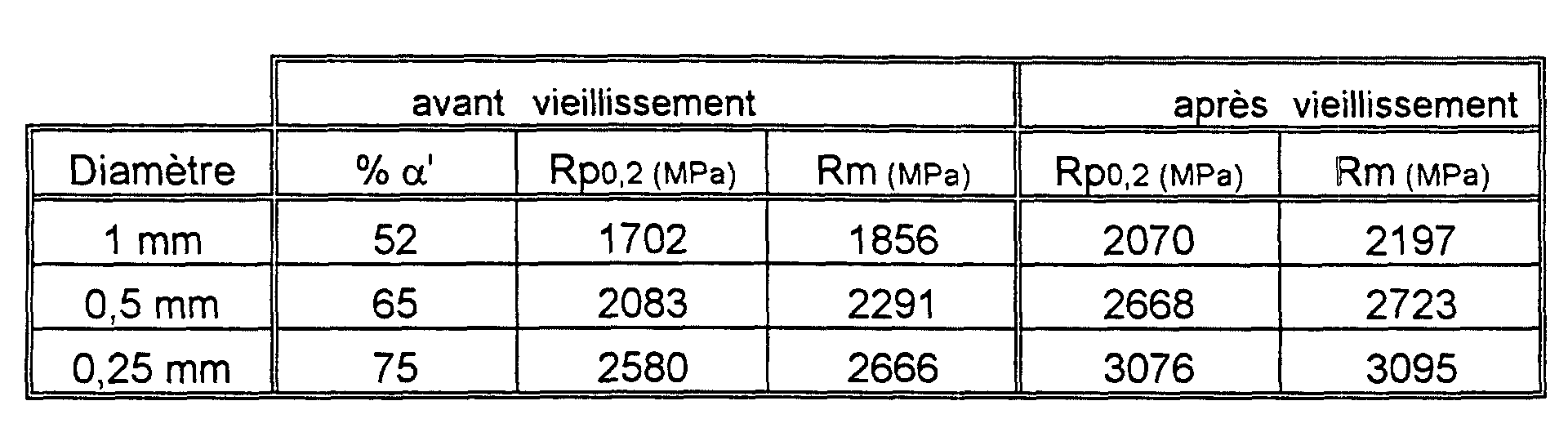
- drawn wire of 1 mm, 0.5 mm and 0.25 mm diameter was produced in accordance with the invention, starting with a machine wire 5.5 mm in diameter made up of a austenitic stainless steel, the chemical composition of which was as follows (in% by weight): VS Mn Yes Or Cr Mo Cu NOT S P 0.011 1.83 0.4 8.08 17.24 0.36 3.24 0.027 0.004 0.025
- the wire rod was hyper-soaked by reheating to 1080 ° C and water cooling then pickled.
- wires thus obtained were used to manufacture springs such as indicated above which have the advantage of having characteristics at least equal to those of springs manufactured in standard grade 1.4310, with a equal or even improved relaxation, while being simpler and less costly to to manufacture.
- the yarns according to the invention can also be used to make elastomeric reinforcing threads, for example example for making reinforcements of tires.
- These reinforcing threads comprise a core consisting of a drawn wire according to the invention coated, by example, by nickel plating and brass plating (this coating is intended to ensure good bond with rubber).
Landscapes
- Chemical & Material Sciences (AREA)
- Engineering & Computer Science (AREA)
- Metallurgy (AREA)
- Organic Chemistry (AREA)
- Materials Engineering (AREA)
- Mechanical Engineering (AREA)
- Crystallography & Structural Chemistry (AREA)
- Physics & Mathematics (AREA)
- Thermal Sciences (AREA)
- Manufacturing & Machinery (AREA)
- Heat Treatment Of Steel (AREA)
- Metal Extraction Processes (AREA)
- Heat Treatment Of Strip Materials And Filament Materials (AREA)
- Wire Processing (AREA)
- Treatment Of Steel In Its Molten State (AREA)
- Cell Electrode Carriers And Collectors (AREA)
- Yarns And Mechanical Finishing Of Yarns Or Ropes (AREA)
- Ropes Or Cables (AREA)
Description
- moins de 0,03 % de carbone car, au delà, la martensite présente en grande proportion dans le fil tréfilé devient sensible à la rupture différée et les ressorts peuvent, alors, se fissurer sous l'effet des contraintes résiduelles de formage ; en général la teneur en carbone est supérieure à 0,005 % car il est extrêmement difficile de descendre en dessous lors des opérations d'affinage ;
- de 0 %à 2 %, et de préférence plus de 0,2 %, de manganèse pour fixer le soufre et éviter la formation de sulfures de chrome à bas point de fusion ; au delà de 2 % l'acier devient très difficile à décarburer sans réoxyder le manganèse, ce qui augmente de façon très importante les coûts de fabrication ;
- de 0 % à 0,5 % de silicium dont la présence (en général plus de 0,1 %) résulte de l'élaboration de l'acier, durcit fortement la martensite présente dans les fils écrouis ; afin d'éviter un durcissement excessif avant l'opération de mise en forme, on limite sa teneur à 0,5 % ;
- de 8 % à 9 % de nickel, pour garantir une structure austénitique pendant le laminage à chaud et après le traitement d'hypertrempe ;
- de 17 % à 18 % de chrome pour obtenir une résistance à la corrosion suffisante sans engendrer trop de difficultés de décapage après le laminage à chaud ;
- de 0 % à 0,4 % de molybdène pour améliorer la tenue à la corrosion sans détériorer les autres propriétés ;
- de 3 % à 3,5 % de cuivre pour permettre le durcissement par précipitation au cours du traitement de vieillissement après tréfilage ; la teneur est limitée à 3,5 % car, au delà, le cuivre engendre des difficultés de laminage à chaud ;
- de 0 % à 0,03 % d'azote qui résulte de l'élaboration ; sa teneur est généralement supérieure à 0,005 %, mais doit rester inférieure à 0,03 % pour éviter des risques de fissuration en différé ;
- moins de 0,01 % de soufre qui est une impureté dont la teneur doit être limitée car, en trop grande quantité, elle rend cassants les fils tréfilés ;
- moins de 0,04 % de phosphore qui est une impureté pouvant créer des défauts lors du laminage à chaud ;
| résistance à la traction minimale imposée par les normes | ||||||||||
| Φ mm | 1,5/1,75 | 1,25/1,5 | 1/1,25 | 0,8/1 | 0,65/0,8 | 0,5/0,65 | 0,4/0,5 | 0,3/0,4 | 0,2/0,3 | < 0,2 |
| R MPa | 1950 | 2000 | 2050 | 2100 | 2125 | 2150 | 2200 | 2225 | 2250 | 2275 |
| C | Mn | Si | Ni | Cr | Mo | Cu | N | S | P |
| 0,011 | 1,83 | 0,4 | 8,08 | 17,24 | 0,36 | 3,24 | 0,027 | 0,004 | 0,025 |
- fil de 1 mm de diamètre : en une descente de 5,5 mm à 1 mm, en 12 passes ;
- fil de 0,5 mm de diamètre :à partir du fil écroui de 1 mm, en une descente de 8 passes de 1 mm à 0,5 mm ;
- fil de 0,25 mm de diamètre : à partir du fil écroui de 1 mm, en une descente de 5 passes de 1 mm à 0,7 mm suivie d'une descente de 8 passes de 0,7 mm à 0,25 mm; sans traitement thermique intermédiaire.
Claims (13)
- Fil en acier inoxydable de diamètre inférieur à 2 mm et de résistance à la traction supérieure à 2100 MPa, caractérisé en ce qu'il est constitué d'un acier dont la composition chimique comprend, en poids :
- Fil selon la revendication 1 caractérisé en ce que son diamètre est inférieur ou égal à 0,5 mm et sa résistance à la traction supérieure ou égale à 2200 MPa.
- Fil selon la revendication 1 ou 2, caractérisé en ce que son diamètre est inférieur ou égal à 0,3 mm et sa résistance à la traction supérieure ou égale à 2250 MPa.
- Fil selon la revendication 1, 2 ou 3, caractérisé en ce que son diamètre est inférieur ou égal à 0,2 mm et sa résistance à la traction supérieure ou égale à 2275 MPa.
- Ressort caractérisé en ce qu'il est constitué d'un fil selon l'une quelconque des revendications 1 à 4.
- Fil de renforcement d'élastomère comportant au moins une âme en acier inoxydable, caractérisé en ce que l'âme est constituée d'un fil selon l'une quelconque des revendications 1 à 4.
- Procédé pour la fabrication d'un fil selon la revendication 1 caractérisé en ce que :on s'approvisionne en un fil machine de diamètre supérieur ou égal à 5 mm en un acier dont la composition chimique comprend, en poids :on effectue sur le fil machine une hypertrempe afin d'obtenir une structure entièrement austénitique,et on effectue une mise en forme par déformation plastique à froid pour obtenir un diamètre inférieur à 2 mm.
- Procédé selon la revendication 7 caractérisé en ce que la mise en forme par déformation plastique à froid est effectuée sans traitement thermique intermédiaire.
- Procédé selon la revendication 7 caractérisé en ce que la mise en forme par déformation plastique à froid est effectuée avec une hypertrempe intermédiaire et en ce que la réduction de section effectuée après l'hypertrempe intermédiaire est supérieure à 300.
- Procédé selon la revendication 8 ou la revendication 9 caractérisé en ce que, en outre, on effectue un traitement thermique de vieillissement constitué d'un maintien pendant une durée comprise entre 5 mn et 3 heures à une température comprise entre 400 °C et 475 °C.
- Acier pour la fabrication d'un fil selon la revendication 1 caractérisé en ce que sa composition chimique comprend, en poids :
- Fil selon l'une quelconque des revendications 1 à 4 caractérisé en ce que sa section est ronde.
- Procédé selon l'une quelconque des revendications 7 à 9 caractérisé en ce que la mise en forme par déformation plastique à froid est un tréfilage en plusieurs passes.
Applications Claiming Priority (2)
| Application Number | Priority Date | Filing Date | Title |
|---|---|---|---|
| FR9616250A FR2757878B1 (fr) | 1996-12-31 | 1996-12-31 | Fil trefile en acier inoxydable et procede de fabrication |
| FR9616250 | 1996-12-31 |
Publications (2)
| Publication Number | Publication Date |
|---|---|
| EP0851039A1 EP0851039A1 (fr) | 1998-07-01 |
| EP0851039B1 true EP0851039B1 (fr) | 2001-08-16 |
Family
ID=9499329
Family Applications (1)
| Application Number | Title | Priority Date | Filing Date |
|---|---|---|---|
| EP97402907A Expired - Lifetime EP0851039B1 (fr) | 1996-12-31 | 1997-12-03 | Fil en acier inoxydable et procédé de fabrication |
Country Status (17)
| Country | Link |
|---|---|
| US (1) | US6106639A (fr) |
| EP (1) | EP0851039B1 (fr) |
| JP (1) | JPH10204592A (fr) |
| KR (1) | KR100487265B1 (fr) |
| CN (1) | CN1076404C (fr) |
| AT (1) | ATE204343T1 (fr) |
| AU (1) | AU717911B2 (fr) |
| BR (1) | BR9705615A (fr) |
| CA (1) | CA2223656C (fr) |
| DE (1) | DE69706131T2 (fr) |
| DK (1) | DK0851039T3 (fr) |
| ES (1) | ES2162218T3 (fr) |
| FR (1) | FR2757878B1 (fr) |
| ID (1) | ID19297A (fr) |
| PT (1) | PT851039E (fr) |
| TW (1) | TW448233B (fr) |
| ZA (1) | ZA9711350B (fr) |
Cited By (1)
| Publication number | Priority date | Publication date | Assignee | Title |
|---|---|---|---|---|
| US7166174B2 (en) | 2001-07-20 | 2007-01-23 | Nv Bekaert Sa | Bundle drawn stainless steel fibers |
Families Citing this family (12)
| Publication number | Priority date | Publication date | Assignee | Title |
|---|---|---|---|---|
| ES2195528T3 (es) * | 1998-07-30 | 2003-12-01 | Aster | Hilo de material compuesto que comprende un alma de acero al carbono y una capa externa de acero inoxidable. |
| FR2781814B1 (fr) * | 1998-07-30 | 2000-09-22 | Aster | Fil composite comprenant une ame en acier au carbone et une couche externe en acier inoxydable |
| US20010045411A1 (en) * | 2000-01-20 | 2001-11-29 | Bailey Edwin C. | High tensile strength stainless steel screen and method of making thereof |
| KR100382994B1 (ko) * | 2000-11-21 | 2003-05-09 | 유성권 | 스테인레스 스틸 와이어 메쉬 |
| KR100666727B1 (ko) * | 2005-04-19 | 2007-01-09 | 포스코신기술연구조합 | 스프링용 304h 오스테나이트계 스테인레스강 |
| CN100497710C (zh) * | 2007-11-21 | 2009-06-10 | 江阴康瑞不锈钢制品有限公司 | 高强度耐腐蚀抗菌型胸罩用不锈钢丝及其制造方法 |
| SE535101C2 (sv) * | 2010-01-11 | 2012-04-17 | Sandvik Intellectual Property | Musiksträng |
| JP2013047367A (ja) * | 2011-08-29 | 2013-03-07 | Nippon Koshuha Steel Co Ltd | 高強度ステンレス鋼極細線の製造方法 |
| UA111115C2 (uk) | 2012-04-02 | 2016-03-25 | Ейкей Стіл Пропертіс, Інк. | Рентабельна феритна нержавіюча сталь |
| FR3013737B1 (fr) * | 2013-11-22 | 2016-01-01 | Michelin & Cie | Fil d'acier a haute trefilabilite comprenant un taux de carbone en masse compris entre 0,05 % inclus et 0,4 % exclu |
| CN108239724A (zh) * | 2018-03-29 | 2018-07-03 | 冯满 | 一种合金钢 |
| CN114015952A (zh) * | 2021-11-05 | 2022-02-08 | 连云港力升金属科技有限公司 | 一种高韧性、耐腐蚀的不锈钢丝及其制备方法 |
Family Cites Families (9)
| Publication number | Priority date | Publication date | Assignee | Title |
|---|---|---|---|---|
| US3282684A (en) * | 1963-07-31 | 1966-11-01 | Armco Steel Corp | Stainless steel and articles |
| US4022586A (en) * | 1969-12-29 | 1977-05-10 | Armco Steel Corporation | Austenitic chromium-nickel-copper stainless steel and articles |
| FR2194195A5 (fr) * | 1972-07-28 | 1974-02-22 | Creusot Loire | |
| JPS5528366A (en) * | 1978-08-21 | 1980-02-28 | Nippon Steel Corp | Nonmagnetic stainless steel for rivet and screw |
| US4222773A (en) * | 1979-05-29 | 1980-09-16 | Fagersta Ab | Corrosion resistant austenitic stainless steel containing 0.1 to 0.3 percent manganese |
| JPS5677364A (en) * | 1979-11-29 | 1981-06-25 | Kawasaki Steel Corp | Spring stainless steel with superior manufacturability, forming workability and fatigue characteristic after aging |
| JPS5935412B2 (ja) * | 1980-03-19 | 1984-08-28 | 日新製鋼株式会社 | 析出硬化型ばね用ステンレス鋼素材の製法 |
| FR2690169B1 (fr) * | 1992-04-17 | 1994-09-23 | Ugine Savoie Sa | Acier inoxydable austénitique à haute usinabilité et à déformation à froid améliorée. |
| US5411613A (en) * | 1993-10-05 | 1995-05-02 | United States Surgical Corporation | Method of making heat treated stainless steel needles |
-
1996
- 1996-12-31 FR FR9616250A patent/FR2757878B1/fr not_active Expired - Fee Related
-
1997
- 1997-12-03 DK DK97402907T patent/DK0851039T3/da active
- 1997-12-03 ES ES97402907T patent/ES2162218T3/es not_active Expired - Lifetime
- 1997-12-03 PT PT97402907T patent/PT851039E/pt unknown
- 1997-12-03 AT AT97402907T patent/ATE204343T1/de active
- 1997-12-03 EP EP97402907A patent/EP0851039B1/fr not_active Expired - Lifetime
- 1997-12-03 DE DE69706131T patent/DE69706131T2/de not_active Expired - Lifetime
- 1997-12-04 CA CA002223656A patent/CA2223656C/fr not_active Expired - Fee Related
- 1997-12-08 TW TW086118434A patent/TW448233B/zh active
- 1997-12-08 AU AU46921/97A patent/AU717911B2/en not_active Ceased
- 1997-12-17 ZA ZA9711350A patent/ZA9711350B/xx unknown
- 1997-12-18 US US08/993,658 patent/US6106639A/en not_active Expired - Lifetime
- 1997-12-24 ID IDP973972A patent/ID19297A/id unknown
- 1997-12-26 JP JP9368352A patent/JPH10204592A/ja not_active Withdrawn
- 1997-12-30 KR KR1019970078938A patent/KR100487265B1/ko not_active Expired - Lifetime
- 1997-12-30 BR BR9705615A patent/BR9705615A/pt not_active IP Right Cessation
- 1997-12-30 CN CN97108588A patent/CN1076404C/zh not_active Expired - Fee Related
Cited By (1)
| Publication number | Priority date | Publication date | Assignee | Title |
|---|---|---|---|---|
| US7166174B2 (en) | 2001-07-20 | 2007-01-23 | Nv Bekaert Sa | Bundle drawn stainless steel fibers |
Also Published As
| Publication number | Publication date |
|---|---|
| ATE204343T1 (de) | 2001-09-15 |
| KR100487265B1 (ko) | 2005-06-16 |
| CA2223656C (fr) | 2004-10-26 |
| ZA9711350B (en) | 1998-06-23 |
| FR2757878A1 (fr) | 1998-07-03 |
| CN1192482A (zh) | 1998-09-09 |
| AU717911B2 (en) | 2000-04-06 |
| JPH10204592A (ja) | 1998-08-04 |
| AU4692197A (en) | 1998-07-02 |
| ID19297A (id) | 1998-07-02 |
| BR9705615A (pt) | 1999-03-09 |
| DK0851039T3 (da) | 2001-11-12 |
| CA2223656A1 (fr) | 1998-06-30 |
| EP0851039A1 (fr) | 1998-07-01 |
| ES2162218T3 (es) | 2001-12-16 |
| DE69706131T2 (de) | 2002-03-21 |
| FR2757878B1 (fr) | 1999-02-05 |
| CN1076404C (zh) | 2001-12-19 |
| US6106639A (en) | 2000-08-22 |
| PT851039E (pt) | 2002-01-30 |
| DE69706131D1 (de) | 2001-09-20 |
| KR19980064827A (ko) | 1998-10-07 |
| TW448233B (en) | 2001-08-01 |
Similar Documents
| Publication | Publication Date | Title |
|---|---|---|
| EP0859064B1 (fr) | Acier inoxydable pour l'élaboration de fil tréfilé notamment de fil de renfort de pneumatique et procédé de realisation dudit fil | |
| EP0976541B1 (fr) | Fil composite comprenant une ame en acier au carbone et une couche externe en acier inoxydable | |
| CA2223656C (fr) | Fil en acier inoxydable et procede de fabrication | |
| EP0925380B1 (fr) | Procede de fabrication de fils en acier auto-trempant, fils de forme et application a une conduite flexible | |
| EP2576849B1 (fr) | Procédé de fabrication d'un fil de forme en acier à hautes caractéristiques mécaniques résistant à la fragilisation par l'hydrogène | |
| FR2765243A1 (fr) | Acier inoxydable austenoferritique a tres bas nickel et presentant un fort allongement en traction | |
| FR2522692A1 (fr) | Fil d'acier utilisable dans le noyau d'acier toronne d'un conducteur d'aluminium renforce d'acier et son procede de fabrication | |
| EP0953651B1 (fr) | Acier inoxydable pour l'élaboration de fil tréfilé en acier inoxydable, notamment de fil de renfort de pneumatique et fil obtenu par le procédé | |
| JP4068556B2 (ja) | 集束伸線によるステンレス鋼繊維 | |
| EP0571521B1 (fr) | Fil metallique comportant un substrat en acier ayant une structure de type martensite revenue ecrouie, et un revetement | |
| WO2018117124A1 (fr) | Fil d'acier plaqué, procédé de fabrication de fil d'acier plaqué, câble d'acier et corps composite à base de caoutchouc | |
| FR2543461A1 (fr) | Procede pour fabriquer des tubes d'acier sans soudure | |
| EP0506768B1 (fr) | Fil d'acier ayant une structure de type bainite inferieure ecrouie; procede pour produire ce fil | |
| CA1107179A (fr) | Procede d'obtention d'un element allonge en acier dur | |
| EP0474530B1 (fr) | Procédé d'élaboration de produits à très haute charge à la rupture à partir d'un acier austénitique instable, et produits en résultant | |
| JP5472548B1 (ja) | 線材及びそれを用いた鋼線、並びに鋼片 | |
| WO2004104234A1 (fr) | Fil metallique en alliage fe-ni ayant une grande resistance mecanique et un faible coefficient de dilatation thermique, pour cables haute tension, et procede de fabrication | |
| EP0092629B1 (fr) | Procédé de fabrication de barres et de tubes en aciers à hautes caractéristiques mécaniques | |
| US3992201A (en) | Filaments for fluorescent lamps | |
| US3877495A (en) | Method of manufacturing improved filaments for fluorescent lamps | |
| FR2781814A1 (fr) | Fil composite comprenant une ame en acier au carbone et une couche externe en acier inoxydable | |
| MXPA98000147A (en) | Stainless steel wire and manufacturing procedure | |
| FR2694574A1 (fr) | Acier pour mandrins de laminoirs à tubes et mandrins de laminoirs à tubes réalisés à partir de cet acier. | |
| JP2016188416A (ja) | ゴムとの接着性に優れた極細めっき鋼線およびそれを用いたゴム複合体ならびにその製造方法 | |
| BE823113A (fr) | Procede de fabrication de produits de grande longueur a partir d'un demi-produit en acier au carbone lamine a chaud et produits ainsi obtenus |
Legal Events
| Date | Code | Title | Description |
|---|---|---|---|
| PUAI | Public reference made under article 153(3) epc to a published international application that has entered the european phase |
Free format text: ORIGINAL CODE: 0009012 |
|
| AK | Designated contracting states |
Kind code of ref document: A1 Designated state(s): AT BE CH DE DK ES FI FR GB GR IE IT LI LU NL PT SE |
|
| 17P | Request for examination filed |
Effective date: 19990104 |
|
| AKX | Designation fees paid |
Free format text: AT BE CH DE DK ES FI FR GB GR IE IT LI LU NL PT SE |
|
| RBV | Designated contracting states (corrected) |
Designated state(s): AT BE CH DE DK ES FI FR GB GR IE IT LI LU NL PT SE |
|
| GRAG | Despatch of communication of intention to grant |
Free format text: ORIGINAL CODE: EPIDOS AGRA |
|
| 17Q | First examination report despatched |
Effective date: 20001213 |
|
| GRAG | Despatch of communication of intention to grant |
Free format text: ORIGINAL CODE: EPIDOS AGRA |
|
| GRAH | Despatch of communication of intention to grant a patent |
Free format text: ORIGINAL CODE: EPIDOS IGRA |
|
| RAP1 | Party data changed (applicant data changed or rights of an application transferred) |
Owner name: UGINE-SAVOIE IMPHY Owner name: IMPHY UGINE PRECISION Owner name: SPRINT METAL - SOCIETE DE PRODUCTION INTERNATIONAL |
|
| GRAH | Despatch of communication of intention to grant a patent |
Free format text: ORIGINAL CODE: EPIDOS IGRA |
|
| RAP1 | Party data changed (applicant data changed or rights of an application transferred) |
Owner name: UGINE-SAVOIE IMPHY Owner name: SPRINT METAL - SOCIETE DE PRODUCTION INTERNATIONAL |
|
| GRAA | (expected) grant |
Free format text: ORIGINAL CODE: 0009210 |
|
| AK | Designated contracting states |
Kind code of ref document: B1 Designated state(s): AT BE CH DE DK ES FI FR GB GR IE IT LI LU NL PT SE |
|
| REF | Corresponds to: |
Ref document number: 204343 Country of ref document: AT Date of ref document: 20010915 Kind code of ref document: T |
|
| REG | Reference to a national code |
Ref country code: CH Ref legal event code: EP |
|
| REF | Corresponds to: |
Ref document number: 69706131 Country of ref document: DE Date of ref document: 20010920 |
|
| REG | Reference to a national code |
Ref country code: IE Ref legal event code: FG4D Free format text: FRENCH |
|
| REG | Reference to a national code |
Ref country code: DK Ref legal event code: T3 |
|
| GBT | Gb: translation of ep patent filed (gb section 77(6)(a)/1977) |
Effective date: 20011116 |
|
| REG | Reference to a national code |
Ref country code: ES Ref legal event code: FG2A Ref document number: 2162218 Country of ref document: ES Kind code of ref document: T3 |
|
| REG | Reference to a national code |
Ref country code: GB Ref legal event code: IF02 |
|
| REG | Reference to a national code |
Ref country code: PT Ref legal event code: SC4A Free format text: AVAILABILITY OF NATIONAL TRANSLATION Effective date: 20011017 |
|
| PLBE | No opposition filed within time limit |
Free format text: ORIGINAL CODE: 0009261 |
|
| STAA | Information on the status of an ep patent application or granted ep patent |
Free format text: STATUS: NO OPPOSITION FILED WITHIN TIME LIMIT |
|
| REG | Reference to a national code |
Ref country code: GR Ref legal event code: EP Ref document number: 20010402044 Country of ref document: GR |
|
| 26N | No opposition filed | ||
| NLT1 | Nl: modifications of names registered in virtue of documents presented to the patent office pursuant to art. 16 a, paragraph 1 |
Owner name: UGITECH Owner name: SPRINT METAL - SOCIETE DE PRODUCTION INTERNATIONAL |
|
| REG | Reference to a national code |
Ref country code: CH Ref legal event code: PUEA Owner name: UGITECH Free format text: SPRINT METAL - SOCIETE DE PRODUCTION INTERNATIONALE DE TREFILES#IMMEUBLE "LA PACIFIC" - 11/13 COURS VALMY, LA DEFENSE 7#92800 PUTEAUX (FR) $ UGITECH#AVENUE PAUL GIROD#73400 UGINE (FR) -TRANSFER TO- UGITECH#AVENUE PAUL GIROD#73400 UGINE (FR) Ref country code: CH Ref legal event code: PFA Owner name: SPRINT METAL - SOCIETE DE PRODUCTION INTERNATIONA Free format text: SPRINT METAL - SOCIETE DE PRODUCTION INTERNATIONALE DE TREFILES#IMMEUBLE "LA PACIFIC" - 11/13 COURS VALMY, LA DEFENSE 7#92800 PUTEAUX (FR) $ UGINE-SAVOIE IMPHY#IMMEUBLE PACIFIC, LA DEFENSE 7, 11-13 COURS VALMY#92800 PUTEAUX (FR) -TRANSFER TO- SPRINT METAL - SOCIETE DE PRODUCTION INTERNATIONALE DE TREFILES#IMMEUBLE "LA PACIFIC" - 11/13 COURS VALMY, LA DEFENSE 7#92800 PUTEAUX (FR) $ UGITECH#AVENUE PAUL GIROD#73400 UGINE (FR) |
|
| REG | Reference to a national code |
Ref country code: FR Ref legal event code: TP Ref country code: FR Ref legal event code: CD |
|
| NLS | Nl: assignments of ep-patents |
Owner name: UGITECH Effective date: 20070207 |
|
| REG | Reference to a national code |
Ref country code: PT Ref legal event code: TE4A Owner name: UGITECH, SOCIEDADE ANONIMA FRANCESA, FR Effective date: 20070409 Ref country code: PT Ref legal event code: PD4A Owner name: UGITECH, SOCIEDADE ANONIMA FRANCESA, FR Effective date: 20070409 Ref country code: PT Ref legal event code: PC4A Owner name: UGITECH, SOCIEDADE ANONIMA FRANCESA, FR Effective date: 20070409 |
|
| REG | Reference to a national code |
Ref country code: GB Ref legal event code: 732E |
|
| BECA | Be: change of holder's address |
Owner name: *UGITECHAVENUE PAUL GIROD, F-73400 UGINE Effective date: 20070109 |
|
| BECH | Be: change of holder |
Owner name: *UGITECH Effective date: 20070109 |
|
| PGFP | Annual fee paid to national office [announced via postgrant information from national office to epo] |
Ref country code: LU Payment date: 20091130 Year of fee payment: 13 Ref country code: IE Payment date: 20091130 Year of fee payment: 13 Ref country code: DK Payment date: 20091123 Year of fee payment: 13 |
|
| PGFP | Annual fee paid to national office [announced via postgrant information from national office to epo] |
Ref country code: GR Payment date: 20091119 Year of fee payment: 13 Ref country code: DE Payment date: 20091214 Year of fee payment: 13 |
|
| PGFP | Annual fee paid to national office [announced via postgrant information from national office to epo] |
Ref country code: AT Payment date: 20101117 Year of fee payment: 14 |
|
| REG | Reference to a national code |
Ref country code: DK Ref legal event code: EBP |
|
| REG | Reference to a national code |
Ref country code: IE Ref legal event code: MM4A |
|
| PG25 | Lapsed in a contracting state [announced via postgrant information from national office to epo] |
Ref country code: IE Free format text: LAPSE BECAUSE OF NON-PAYMENT OF DUE FEES Effective date: 20101203 |
|
| REG | Reference to a national code |
Ref country code: DE Ref legal event code: R119 Ref document number: 69706131 Country of ref document: DE Effective date: 20110701 |
|
| PG25 | Lapsed in a contracting state [announced via postgrant information from national office to epo] |
Ref country code: DE Free format text: LAPSE BECAUSE OF NON-PAYMENT OF DUE FEES Effective date: 20110701 Ref country code: GR Free format text: LAPSE BECAUSE OF NON-PAYMENT OF DUE FEES Effective date: 20110704 |
|
| PG25 | Lapsed in a contracting state [announced via postgrant information from national office to epo] |
Ref country code: LU Free format text: LAPSE BECAUSE OF NON-PAYMENT OF DUE FEES Effective date: 20101203 |
|
| REG | Reference to a national code |
Ref country code: AT Ref legal event code: MM01 Ref document number: 204343 Country of ref document: AT Kind code of ref document: T Effective date: 20121203 |
|
| PG25 | Lapsed in a contracting state [announced via postgrant information from national office to epo] |
Ref country code: AT Free format text: LAPSE BECAUSE OF NON-PAYMENT OF DUE FEES Effective date: 20121203 |
|
| REG | Reference to a national code |
Ref country code: FR Ref legal event code: PLFP Year of fee payment: 19 |
|
| PGFP | Annual fee paid to national office [announced via postgrant information from national office to epo] |
Ref country code: IT Payment date: 20151215 Year of fee payment: 19 Ref country code: CH Payment date: 20151207 Year of fee payment: 19 Ref country code: GB Payment date: 20151218 Year of fee payment: 19 Ref country code: FI Payment date: 20151120 Year of fee payment: 19 |
|
| PGFP | Annual fee paid to national office [announced via postgrant information from national office to epo] |
Ref country code: ES Payment date: 20151218 Year of fee payment: 19 Ref country code: BE Payment date: 20151214 Year of fee payment: 19 Ref country code: PT Payment date: 20151118 Year of fee payment: 19 Ref country code: SE Payment date: 20151215 Year of fee payment: 19 Ref country code: FR Payment date: 20151208 Year of fee payment: 19 Ref country code: NL Payment date: 20151116 Year of fee payment: 19 |
|
| PG25 | Lapsed in a contracting state [announced via postgrant information from national office to epo] |
Ref country code: BE Free format text: LAPSE BECAUSE OF NON-PAYMENT OF DUE FEES Effective date: 20161231 |
|
| PG25 | Lapsed in a contracting state [announced via postgrant information from national office to epo] |
Ref country code: FI Free format text: LAPSE BECAUSE OF NON-PAYMENT OF DUE FEES Effective date: 20161203 |
|
| REG | Reference to a national code |
Ref country code: CH Ref legal event code: PL |
|
| REG | Reference to a national code |
Ref country code: SE Ref legal event code: EUG |
|
| REG | Reference to a national code |
Ref country code: NL Ref legal event code: MM Effective date: 20170101 |
|
| GBPC | Gb: european patent ceased through non-payment of renewal fee |
Effective date: 20161203 |
|
| PG25 | Lapsed in a contracting state [announced via postgrant information from national office to epo] |
Ref country code: PT Free format text: LAPSE BECAUSE OF NON-PAYMENT OF DUE FEES Effective date: 20170605 Ref country code: SE Free format text: LAPSE BECAUSE OF NON-PAYMENT OF DUE FEES Effective date: 20161204 |
|
| PG25 | Lapsed in a contracting state [announced via postgrant information from national office to epo] |
Ref country code: NL Free format text: LAPSE BECAUSE OF NON-PAYMENT OF DUE FEES Effective date: 20170101 |
|
| REG | Reference to a national code |
Ref country code: FR Ref legal event code: ST Effective date: 20170831 |
|
| PG25 | Lapsed in a contracting state [announced via postgrant information from national office to epo] |
Ref country code: FR Free format text: LAPSE BECAUSE OF NON-PAYMENT OF DUE FEES Effective date: 20170102 Ref country code: CH Free format text: LAPSE BECAUSE OF NON-PAYMENT OF DUE FEES Effective date: 20161231 Ref country code: IT Free format text: LAPSE BECAUSE OF NON-PAYMENT OF DUE FEES Effective date: 20161203 Ref country code: LI Free format text: LAPSE BECAUSE OF NON-PAYMENT OF DUE FEES Effective date: 20161231 |
|
| PG25 | Lapsed in a contracting state [announced via postgrant information from national office to epo] |
Ref country code: GB Free format text: LAPSE BECAUSE OF NON-PAYMENT OF DUE FEES Effective date: 20161203 |
|
| REG | Reference to a national code |
Ref country code: BE Ref legal event code: MM Effective date: 20161231 |
|
| PG25 | Lapsed in a contracting state [announced via postgrant information from national office to epo] |
Ref country code: PT Free format text: LAPSE BECAUSE OF EXPIRATION OF PROTECTION Effective date: 20171213 |
|
| REG | Reference to a national code |
Ref country code: ES Ref legal event code: FD2A Effective date: 20180507 |
|
| PG25 | Lapsed in a contracting state [announced via postgrant information from national office to epo] |
Ref country code: ES Free format text: LAPSE BECAUSE OF FAILURE TO SUBMIT A TRANSLATION OF THE DESCRIPTION OR TO PAY THE FEE WITHIN THE PRESCRIBED TIME-LIMIT Effective date: 20010816 |
|
| PG25 | Lapsed in a contracting state [announced via postgrant information from national office to epo] |
Ref country code: PT Free format text: LAPSE BECAUSE OF EXPIRATION OF PROTECTION Effective date: 20151203 Ref country code: ES Free format text: LAPSE BECAUSE OF FAILURE TO SUBMIT A TRANSLATION OF THE DESCRIPTION OR TO PAY THE FEE WITHIN THE PRESCRIBED TIME-LIMIT Effective date: 20161204 |
|
| RIC2 | Information provided on ipc code assigned after grant |
Ipc: C21D 9/52 20060101ALI19980312BHEP Ipc: C22C 38/42 20060101AFI19980312BHEP Ipc: C21D 6/00 20060101ALI19980312BHEP |