EP0848857B1 - Verfahren zum herstellen von bleiakkumulatoren - Google Patents
Verfahren zum herstellen von bleiakkumulatoren Download PDFInfo
- Publication number
- EP0848857B1 EP0848857B1 EP97920733A EP97920733A EP0848857B1 EP 0848857 B1 EP0848857 B1 EP 0848857B1 EP 97920733 A EP97920733 A EP 97920733A EP 97920733 A EP97920733 A EP 97920733A EP 0848857 B1 EP0848857 B1 EP 0848857B1
- Authority
- EP
- European Patent Office
- Prior art keywords
- lead
- unit
- separating material
- electrodes
- active compound
- Prior art date
- Legal status (The legal status is an assumption and is not a legal conclusion. Google has not performed a legal analysis and makes no representation as to the accuracy of the status listed.)
- Expired - Lifetime
Links
- 238000000034 method Methods 0.000 title claims abstract description 39
- 238000003860 storage Methods 0.000 title claims abstract description 10
- 239000000463 material Substances 0.000 claims abstract description 42
- 235000011837 pasties Nutrition 0.000 claims abstract description 11
- 238000004519 manufacturing process Methods 0.000 claims description 30
- 239000002253 acid Substances 0.000 claims description 10
- 238000005266 casting Methods 0.000 claims description 9
- 238000000576 coating method Methods 0.000 claims description 9
- 239000011248 coating agent Substances 0.000 claims description 8
- QAOWNCQODCNURD-UHFFFAOYSA-N Sulfuric acid Chemical compound OS(O)(=O)=O QAOWNCQODCNURD-UHFFFAOYSA-N 0.000 claims description 5
- 238000005470 impregnation Methods 0.000 claims description 4
- 238000003780 insertion Methods 0.000 claims description 3
- 230000037431 insertion Effects 0.000 claims description 3
- 238000003825 pressing Methods 0.000 claims description 3
- 238000000429 assembly Methods 0.000 claims description 2
- 230000000712 assembly Effects 0.000 claims description 2
- 150000001875 compounds Chemical class 0.000 claims 8
- 230000003750 conditioning effect Effects 0.000 claims 2
- 235000011149 sulphuric acid Nutrition 0.000 claims 1
- 239000001117 sulphuric acid Substances 0.000 claims 1
- 238000009736 wetting Methods 0.000 claims 1
- 230000008569 process Effects 0.000 description 16
- 238000002360 preparation method Methods 0.000 description 9
- 230000005070 ripening Effects 0.000 description 8
- 230000035800 maturation Effects 0.000 description 6
- 239000004698 Polyethylene Substances 0.000 description 5
- VYPSYNLAJGMNEJ-UHFFFAOYSA-N Silicium dioxide Chemical compound O=[Si]=O VYPSYNLAJGMNEJ-UHFFFAOYSA-N 0.000 description 4
- YADSGOSSYOOKMP-UHFFFAOYSA-N dioxolead Chemical compound O=[Pb]=O YADSGOSSYOOKMP-UHFFFAOYSA-N 0.000 description 4
- 238000000926 separation method Methods 0.000 description 4
- 238000010924 continuous production Methods 0.000 description 3
- 238000001035 drying Methods 0.000 description 3
- 229910000464 lead oxide Inorganic materials 0.000 description 3
- 238000011068 loading method Methods 0.000 description 3
- YEXPOXQUZXUXJW-UHFFFAOYSA-N oxolead Chemical compound [Pb]=O YEXPOXQUZXUXJW-UHFFFAOYSA-N 0.000 description 3
- 238000002791 soaking Methods 0.000 description 3
- 238000010521 absorption reaction Methods 0.000 description 2
- 230000015572 biosynthetic process Effects 0.000 description 2
- 230000035622 drinking Effects 0.000 description 2
- 238000010438 heat treatment Methods 0.000 description 2
- 239000007788 liquid Substances 0.000 description 2
- 230000005012 migration Effects 0.000 description 2
- 238000013508 migration Methods 0.000 description 2
- 239000002994 raw material Substances 0.000 description 2
- 239000000377 silicon dioxide Substances 0.000 description 2
- XLYOFNOQVPJJNP-UHFFFAOYSA-N water Substances O XLYOFNOQVPJJNP-UHFFFAOYSA-N 0.000 description 2
- 238000010306 acid treatment Methods 0.000 description 1
- 238000001994 activation Methods 0.000 description 1
- 239000011149 active material Substances 0.000 description 1
- 238000010923 batch production Methods 0.000 description 1
- 239000002131 composite material Substances 0.000 description 1
- 238000000151 deposition Methods 0.000 description 1
- 230000007613 environmental effect Effects 0.000 description 1
- 238000011049 filling Methods 0.000 description 1
- 238000007730 finishing process Methods 0.000 description 1
- 239000011888 foil Substances 0.000 description 1
- 238000002372 labelling Methods 0.000 description 1
- 238000003754 machining Methods 0.000 description 1
- 238000010327 methods by industry Methods 0.000 description 1
- 238000005192 partition Methods 0.000 description 1
- -1 polyethylene Polymers 0.000 description 1
- 229920000573 polyethylene Polymers 0.000 description 1
- 238000004080 punching Methods 0.000 description 1
- 238000004064 recycling Methods 0.000 description 1
- 239000000126 substance Substances 0.000 description 1
Images
Classifications
-
- H—ELECTRICITY
- H01—ELECTRIC ELEMENTS
- H01M—PROCESSES OR MEANS, e.g. BATTERIES, FOR THE DIRECT CONVERSION OF CHEMICAL ENERGY INTO ELECTRICAL ENERGY
- H01M4/00—Electrodes
- H01M4/02—Electrodes composed of, or comprising, active material
- H01M4/14—Electrodes for lead-acid accumulators
- H01M4/16—Processes of manufacture
- H01M4/20—Processes of manufacture of pasted electrodes
-
- H—ELECTRICITY
- H01—ELECTRIC ELEMENTS
- H01M—PROCESSES OR MEANS, e.g. BATTERIES, FOR THE DIRECT CONVERSION OF CHEMICAL ENERGY INTO ELECTRICAL ENERGY
- H01M10/00—Secondary cells; Manufacture thereof
- H01M10/06—Lead-acid accumulators
- H01M10/12—Construction or manufacture
-
- H—ELECTRICITY
- H01—ELECTRIC ELEMENTS
- H01M—PROCESSES OR MEANS, e.g. BATTERIES, FOR THE DIRECT CONVERSION OF CHEMICAL ENERGY INTO ELECTRICAL ENERGY
- H01M50/00—Constructional details or processes of manufacture of the non-active parts of electrochemical cells other than fuel cells, e.g. hybrid cells
- H01M50/40—Separators; Membranes; Diaphragms; Spacing elements inside cells
- H01M50/46—Separators, membranes or diaphragms characterised by their combination with electrodes
-
- Y—GENERAL TAGGING OF NEW TECHNOLOGICAL DEVELOPMENTS; GENERAL TAGGING OF CROSS-SECTIONAL TECHNOLOGIES SPANNING OVER SEVERAL SECTIONS OF THE IPC; TECHNICAL SUBJECTS COVERED BY FORMER USPC CROSS-REFERENCE ART COLLECTIONS [XRACs] AND DIGESTS
- Y02—TECHNOLOGIES OR APPLICATIONS FOR MITIGATION OR ADAPTATION AGAINST CLIMATE CHANGE
- Y02E—REDUCTION OF GREENHOUSE GAS [GHG] EMISSIONS, RELATED TO ENERGY GENERATION, TRANSMISSION OR DISTRIBUTION
- Y02E60/00—Enabling technologies; Technologies with a potential or indirect contribution to GHG emissions mitigation
- Y02E60/10—Energy storage using batteries
-
- Y—GENERAL TAGGING OF NEW TECHNOLOGICAL DEVELOPMENTS; GENERAL TAGGING OF CROSS-SECTIONAL TECHNOLOGIES SPANNING OVER SEVERAL SECTIONS OF THE IPC; TECHNICAL SUBJECTS COVERED BY FORMER USPC CROSS-REFERENCE ART COLLECTIONS [XRACs] AND DIGESTS
- Y02—TECHNOLOGIES OR APPLICATIONS FOR MITIGATION OR ADAPTATION AGAINST CLIMATE CHANGE
- Y02P—CLIMATE CHANGE MITIGATION TECHNOLOGIES IN THE PRODUCTION OR PROCESSING OF GOODS
- Y02P70/00—Climate change mitigation technologies in the production process for final industrial or consumer products
- Y02P70/50—Manufacturing or production processes characterised by the final manufactured product
-
- Y—GENERAL TAGGING OF NEW TECHNOLOGICAL DEVELOPMENTS; GENERAL TAGGING OF CROSS-SECTIONAL TECHNOLOGIES SPANNING OVER SEVERAL SECTIONS OF THE IPC; TECHNICAL SUBJECTS COVERED BY FORMER USPC CROSS-REFERENCE ART COLLECTIONS [XRACs] AND DIGESTS
- Y10—TECHNICAL SUBJECTS COVERED BY FORMER USPC
- Y10T—TECHNICAL SUBJECTS COVERED BY FORMER US CLASSIFICATION
- Y10T29/00—Metal working
- Y10T29/10—Battery-grid making
-
- Y—GENERAL TAGGING OF NEW TECHNOLOGICAL DEVELOPMENTS; GENERAL TAGGING OF CROSS-SECTIONAL TECHNOLOGIES SPANNING OVER SEVERAL SECTIONS OF THE IPC; TECHNICAL SUBJECTS COVERED BY FORMER USPC CROSS-REFERENCE ART COLLECTIONS [XRACs] AND DIGESTS
- Y10—TECHNICAL SUBJECTS COVERED BY FORMER USPC
- Y10T—TECHNICAL SUBJECTS COVERED BY FORMER US CLASSIFICATION
- Y10T29/00—Metal working
- Y10T29/49—Method of mechanical manufacture
- Y10T29/49002—Electrical device making
- Y10T29/49108—Electric battery cell making
Definitions
- the invention relates to a method for producing lead accumulators.
- the active mass is a pulpy, pasty mass that under Release of moisture must ripen. This happens through slow Water release over several hours. On average, a ripening process take up to 24 hours.
- WO 90/06000 A discloses a continuous process for producing Lead-acid batteries, in which those with an active mass and a separating material provided lead electrodes electrically connected to cell blocks and in one Accumulator housings are placed where they mature the lead electrodes be stored. After the ripening process, the accumulator with acid filled and made ready for operation by charging with electrical current.
- the present invention is based on the object of specifying a method for producing lead accumulators which enables online operation and extensive automation in the production of lead accumulators with good electrical properties without wasting time. Furthermore, the invention provides a device for carrying out the method and a battery of a new generation is identified.
- a method for producing lead-acid batteries with the features of claim 1 is specified for the technical solution of the problem.
- the on-line process which destroys time-consuming ripening or drying process at the end of the mechanical or assembly-side manufacturing process.
- a correspondingly stored accumulator with matured active mass is connected to the storage is filled, loaded, checked, labeled and the like. It is activation processes that are related to the actual manufacturing process of a Batteries have nothing more to do, but make them ready for use.
- the invention relates basically on the production of a pasty positive or negative active Dimensions. After the grid electrodes with the positive or negative active Mass are provided, then immediately one of the two Lead electrodes, positive or negative, provided with separating material on both sides, so that the positive and negative electrodes filled with paste in a known manner alternately stacked into plate blocks.
- the active mass for example, originally lead oxide, is initially used as a pasty mass applied without being electrochemically active. Only during the electrochemical processes within an accumulator arise from the paste the active mass, for example lead dioxide.
- the manufacturing method can be fully automated by the solution according to the invention and in online operation based on the manufacture of lattice-shaped Lead electrodes up to the stacking of an electrical one equipped with cell blocks connected and provided with poles accumulator.
- the separating materials are, for example, a polyethylene film (PE film) with silica deposits.
- the lead electrodes are made according to a advantageous proposal of the invention cast in a continuous process, so that there are so-called electrode coils, i.e. coils in tape form present electrodes, which were produced by means of a casting roller. To this Coils or on the cast belt can be directly in a likewise continuous Process the pasty, active mass are applied. Then the lead electrodes provided with active mass, singly and individually in from the Partition formed pockets inserted.
- the Separation can also be done directly by the production of electrodes, or by separating a coil.
- the bags are made with Silica-provided PE film fed from a roll and the respective Pocket formed with direct insertion of the electrode. In doing so, a Film strips deflected, folded over with the electrode inserted and attached to two Side edges closed by pressing force.
- the moisture content on the whole group consisting of lead electrode, active mass applied to it and separating material is voted.
- the ideal maturity moisture content of those with active Weighted lead electrodes are 6 to 8%.
- the active mass is pasty mushy and releases moisture during ripening.
- the chemical in itself indifferent, porous separating material will absorb the moisture and additionally Extract further moisture from the plate, so that an ideal course of the ripening process cannot be guaranteed. For this reason, the total moisture content also the moisture absorption capacity of the release material consider.
- the invention proposed that the lead electrode provided with active mass and Separating material existing assembly is soaked with liquid.
- the release material can absorb moisture, so that it becomes a later the active mass does not dry out further.
- the soaking is done by immersing it in a liquid. Basically can Water should be used for this as it is only necessary Moisture content goes.
- the pocketed and provided with active mass Soak lead electrode in acid preferably in sulfuric acid.
- the acid treatment works if the separating material shrinks later towards later drying out. In this respect, the above could Temperature treatment can be dispensed with or by soaking in acid get supported.
- Assemblies consisting of lead electrode, active mass and separating material, stacked, electrically connected, inserted into a housing, electrically connected and finally the completed battery for maturing the active mass stored.
- the stacking can be done fully automatically and can also be timed on one The time before the watering must be shifted, i.e. directly to the formation of the pockets made of separating material.
- the invention provides a method for producing lead acid batteries specified what a maximum level of automation and manufacturing in on-line operation allows. By relocating the one that interrupts online operations Ripening process at the end of the manufacturing and assembly process production capacities can be increased significantly. Through the special measure, the moisture content on the entire assembly made of lead electrode, Matching active mass and separating material will be an optimal one Tires of the active mass also in the stacked and with separating material guaranteed installed in a battery case.
- the invention also provides a device for producing lead acid batteries according to the inventive method with the features of Claim 12 specified.
- the casting unit and the coating unit are advantageously continuous working systems so that the electrodes are interconnected cast in band form and in this band form either with or without interim coil formation can also be coated with active material.
- a separation unit separates the electrode and in the unit for applying the Release materials are fed, folded and the lead electrode inserted. With an edge pressing device, at least two open side edges PE film cover closed.
- the device has a unit for adjusting the moisture content in the form of a drinking bowl through which the pocketed lead electrodes isolated or already passed through in a stack. It happens in essential that the release material is soaked. This process can possibly also before the bags are made.
- the device according to the invention of the method according to the invention comprises contiguous units for performing an automated on-line manufacturing process, where as an essential unit a drinking unit or another unit for setting the required moisture content is involved.
- a lead accumulator produced by the method according to the invention is a new generation lead accumulator, which with a in Bags and in the stacked state ripened active mass is provided.
- Such an accumulator has excellent technological properties and is nevertheless economical and economical in a continuous online process inexpensive to manufacture.
- the essence of the invention lies in the shifting of the time-consuming Maturation process at the end of mechanical manufacturing and Assembly process.
- a special feature of the invention lies in Setting a total moisture content for the assembly consisting of Lead electrodes, active mass and release material. It matters less with which means and at what time the individual units with appropriate moisture. For example, the entire Manufacturing process take place in a sufficiently humid environment so that for example, the separating material from the environment is moist. The separating material can also be pretreated, the heat treatment to avoid shrinkage is another special feature. But the release material can also be pre-soaked or pre-soaked in acid before becoming a Lead electrode receiving pocket is processed.
- the manufacturing process involves the preparation of some raw materials or some finished parts.
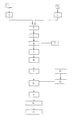
- the raw materials include lead, which on the one hand is processed in the casting process to grid-shaped electrodes, which but also on the other hand for the production of the active mass, for example Manufacture of lead oxide is used. Then in the electrochemical process from the lead oxide lead dioxide. Furthermore, a release material must be in a suitable place be fed and finally a housing.
- lead is melted in a lead melted and processed in a grid casting process 2 to grid electrodes.
- This can be a continuous lead casting process, from which in Lead electrodes connected to one another in the form of a band. This can be wound on coils or sent directly to further processing.
- lead is used to produce the active mass prepared and trained in mass preparation 4, the active mass. Even though only one lead preparation and one active in the exemplary embodiment shown Mass is talked about, it goes without saying that both positive and parallel negative pasty masses are made, from which the respective later active masses arise.
- a film feed 7 ensures the feed of the separating material, for example PE film with silica deposits.
- the release material can be through Pretreated heat treatment.
- pocket 8 the isolated and provided with active mass lead electrodes in through the foil formed pockets inserted.
- the bags are then impregnated 9 moisturize and stacked at step 10. The batch process can also take place before the impregnation.
- the stack forming a cell block which of course follows the one in itself known manufacturing regulations to form a cell block merged is electrically becomes a unit in a method step 11 connected.
- Housing is housing preparation via a housing feed 12 13 fed.
- minor preparatory measures carried out for example punching connection holes, deburring, if necessary, etc. That with the sufficient number of cell blocks equipped housing is fed to a further process step, in which the individual cell blocks are electrically connected and the accumulator with be provided with a positive and a negative pole.
- the plates are ripened by storage.
- Storage can take place under specified environmental conditions take place, for example at certain temperatures, moisture levels and etc. ..
- the accumulator After ripening, the accumulator is brought to completion. For this include, for example, filling, loading, labeling, the Transport preparation and the like.
Landscapes
- Engineering & Computer Science (AREA)
- Manufacturing & Machinery (AREA)
- Chemical & Material Sciences (AREA)
- Chemical Kinetics & Catalysis (AREA)
- Electrochemistry (AREA)
- General Chemical & Material Sciences (AREA)
- Battery Electrode And Active Subsutance (AREA)
- Supply Devices, Intensifiers, Converters, And Telemotors (AREA)
- Secondary Cells (AREA)
- Forging (AREA)
- Superconductors And Manufacturing Methods Therefor (AREA)
- Electrical Discharge Machining, Electrochemical Machining, And Combined Machining (AREA)
Applications Claiming Priority (3)
| Application Number | Priority Date | Filing Date | Title |
|---|---|---|---|
| DE19627616 | 1996-07-09 | ||
| DE19627616A DE19627616A1 (de) | 1996-07-09 | 1996-07-09 | Verfahren zum Herstellen von Bleiakkumulatoren |
| PCT/EP1997/002018 WO1998001915A1 (de) | 1996-07-09 | 1997-04-22 | Verfahren zum herstellen von bleiakkumulatoren |
Publications (2)
| Publication Number | Publication Date |
|---|---|
| EP0848857A1 EP0848857A1 (de) | 1998-06-24 |
| EP0848857B1 true EP0848857B1 (de) | 2002-04-03 |
Family
ID=7799332
Family Applications (1)
| Application Number | Title | Priority Date | Filing Date |
|---|---|---|---|
| EP97920733A Expired - Lifetime EP0848857B1 (de) | 1996-07-09 | 1997-04-22 | Verfahren zum herstellen von bleiakkumulatoren |
Country Status (12)
| Country | Link |
|---|---|
| US (1) | US6114066A (cs) |
| EP (1) | EP0848857B1 (cs) |
| JP (1) | JPH11513178A (cs) |
| KR (1) | KR19990044475A (cs) |
| AT (1) | ATE215742T1 (cs) |
| CZ (1) | CZ297308B6 (cs) |
| DE (2) | DE19627616A1 (cs) |
| ES (1) | ES2170949T3 (cs) |
| PL (1) | PL325420A1 (cs) |
| PT (1) | PT848857E (cs) |
| TR (1) | TR199800425T1 (cs) |
| WO (1) | WO1998001915A1 (cs) |
Families Citing this family (5)
| Publication number | Priority date | Publication date | Assignee | Title |
|---|---|---|---|---|
| DE10302382B4 (de) * | 2003-01-22 | 2005-03-31 | Franz Xaver Mittermaier | Vorrichtungen zum Herstellen von Elektroden für Bleiakkumulatoren |
| US8533973B2 (en) * | 2008-12-02 | 2013-09-17 | Mac Engineering And Equipment Company, Inc. | Contact flash dryer and method of contact flash drying |
| JP5571442B2 (ja) * | 2010-04-22 | 2014-08-13 | 古河電池株式会社 | 鉛蓄電池用格子体鋳造装置の異常判定方法 |
| CN102403539B (zh) * | 2010-09-15 | 2014-02-26 | 郭隆 | 水平电池生产系统 |
| KR101687281B1 (ko) * | 2015-04-28 | 2016-12-16 | (주)무진서비스 | 축전지의 조립 장치 |
Family Cites Families (11)
| Publication number | Priority date | Publication date | Assignee | Title |
|---|---|---|---|---|
| US1659654A (en) * | 1921-02-21 | 1928-02-21 | Hazelett Storage Battery Compa | Method of making storage-battery plates |
| US4351106A (en) * | 1980-08-20 | 1982-09-28 | Brady Allan O | Battery cell assembly system and method |
| GB2082092B (en) * | 1980-08-21 | 1985-01-30 | Chloride Group Ltd | Method of making battery plates |
| EP0105466A1 (en) * | 1982-09-30 | 1984-04-18 | PORRO & PORRO S.r.l. | Connection device for furniture structural elements |
| GB2129193B (en) * | 1982-10-29 | 1985-11-13 | Chloride Group Plc | Manufacturing recombination electric storage cells |
| DE3309069C1 (de) * | 1983-03-14 | 1984-06-20 | MTU Motoren- und Turbinen-Union München GmbH, 8000 München | Elektrode,insbesondere fuer WIG-Schweissverfahren |
| US4606982A (en) * | 1985-05-09 | 1986-08-19 | Gates Energy Products, Inc. | Sealed lead-acid cell and method |
| JPS6454667A (en) * | 1987-08-24 | 1989-03-02 | Japan Storage Battery Co Ltd | Manufacture of lead storage battery |
| JPH01217867A (ja) * | 1988-02-24 | 1989-08-31 | Japan Storage Battery Co Ltd | 鉛蓄電池の製造方法 |
| WO1990006000A1 (en) * | 1988-11-14 | 1990-05-31 | Mixon, Inc. | Battery manufacturing process |
| DE4011531A1 (de) * | 1990-04-10 | 1991-10-17 | Reten Electronic Gmbh & Co | Zylindrischer bleiakkumulator |
-
1996
- 1996-07-09 DE DE19627616A patent/DE19627616A1/de not_active Withdrawn
-
1997
- 1997-04-22 EP EP97920733A patent/EP0848857B1/de not_active Expired - Lifetime
- 1997-04-22 TR TR1998/00425T patent/TR199800425T1/xx unknown
- 1997-04-22 JP JP10504690A patent/JPH11513178A/ja active Pending
- 1997-04-22 KR KR1019980701723A patent/KR19990044475A/ko not_active Withdrawn
- 1997-04-22 DE DE59706848T patent/DE59706848D1/de not_active Expired - Fee Related
- 1997-04-22 PT PT97920733T patent/PT848857E/pt unknown
- 1997-04-22 WO PCT/EP1997/002018 patent/WO1998001915A1/de not_active Ceased
- 1997-04-22 PL PL97325420A patent/PL325420A1/xx unknown
- 1997-04-22 AT AT97920733T patent/ATE215742T1/de not_active IP Right Cessation
- 1997-04-22 ES ES97920733T patent/ES2170949T3/es not_active Expired - Lifetime
- 1997-04-22 CZ CZ0046998A patent/CZ297308B6/cs not_active IP Right Cessation
- 1997-04-22 US US09/029,961 patent/US6114066A/en not_active Expired - Lifetime
Also Published As
| Publication number | Publication date |
|---|---|
| DE59706848D1 (de) | 2002-05-08 |
| PL325420A1 (en) | 1998-07-20 |
| ATE215742T1 (de) | 2002-04-15 |
| PT848857E (pt) | 2002-09-30 |
| ES2170949T3 (es) | 2002-08-16 |
| JPH11513178A (ja) | 1999-11-09 |
| WO1998001915A1 (de) | 1998-01-15 |
| TR199800425T1 (xx) | 1998-11-23 |
| KR19990044475A (ko) | 1999-06-25 |
| CZ46998A3 (cs) | 1998-07-15 |
| US6114066A (en) | 2000-09-05 |
| CZ297308B6 (cs) | 2006-11-15 |
| EP0848857A1 (de) | 1998-06-24 |
| DE19627616A1 (de) | 1998-01-15 |
Similar Documents
| Publication | Publication Date | Title |
|---|---|---|
| DE2610863C3 (de) | Elektrochemische Batterie | |
| DE102018111005B4 (de) | Verfahren zur künstlichen SEI-Transplantation | |
| EP0848857B1 (de) | Verfahren zum herstellen von bleiakkumulatoren | |
| EP3475713B1 (de) | Verfahren zur bestimmung des alters eines elektrochemischen energiespeichers | |
| DE305694T1 (de) | Verfahren und vorrichtung zur herstellung und einfuehrung von batterieexplosion verringerndem material. | |
| DE102019003574A1 (de) | ''Verfahren zur Herstellung einer Lithium-lonen-Batteriezelle'' | |
| DE3248401C2 (cs) | ||
| EP2504877A1 (de) | Vorrichtung für elektrolyt-austausch bei energiespeichern | |
| DE2525444A1 (de) | Verfahren zum herstellen alkalischer zellen | |
| EP0491150B1 (de) | Verfahren zur Herstellung eines Bleiakkumulators mit einem als Gel festgelegten Schwefelsäureelektrolyten | |
| DE2737837C3 (de) | Bauart und Verfahren zur Herstellung eines mehrzelligen Bleiakkumulators | |
| DE69011114T2 (de) | Verfahren zur elektrochemischen behandlung eines stapels von batterieplatten. | |
| DE102018214216A1 (de) | Herstellungsverfahren für eine Batterieelektrode und Batteriezelle sowie Batterieelektrode und Batteriezelle daraus, Vorrichtung zur Herstellung von Batteriezellen, Fahrzeug, sowie Verwendung von ionischen Flüssigkeiten | |
| DE102022126123A1 (de) | Direktrecycling von batterien | |
| EP0850493B1 (de) | Verfahren zur herstellung von bleielektroden | |
| DE19757481C2 (de) | Verfahren zur Herstellung eines Betriebselektrolyten für Bleiakkumulatoren in Form eines thixotropen Gels | |
| EP1575117B1 (de) | Wartungsfreier Akkumulator und Verfahren zu dessen Herstellung | |
| DE3246799C2 (cs) | ||
| US2544517A (en) | Method of making batteries | |
| EP2385570A1 (de) | Verfahren zur Herstellung von Platten für Bleiakkumulatoren | |
| DE1596309C3 (de) | Verfahren zur Behandlung von Akkumulatorenplatten nach der Formation mit Wässerung der Elektroden durchkathodische Polung | |
| EP0160846B1 (de) | Verfahren zur Herstellung eines geladenen und trocken lagerfähigen Nickel-Cadmium-Akkumulators in offener Bauweise | |
| DE2457349C2 (de) | Verwendung einer antimon- und kadmiumhaltigen Bleilegierung für die Gitter von wartungsfreien Blei-Säure-Akkumulatoren | |
| DE352992C (de) | Trockenelement | |
| DE4015496C1 (en) | Lead sulphate free paste of lead and lead oxide - contains up to 60 vol. per cent solids, used to impregnate support of accumulator frame |
Legal Events
| Date | Code | Title | Description |
|---|---|---|---|
| PUAI | Public reference made under article 153(3) epc to a published international application that has entered the european phase |
Free format text: ORIGINAL CODE: 0009012 |
|
| 17P | Request for examination filed |
Effective date: 19980124 |
|
| AK | Designated contracting states |
Kind code of ref document: A1 Designated state(s): AT DE ES FR GB IT PT |
|
| 17Q | First examination report despatched |
Effective date: 19990126 |
|
| GRAG | Despatch of communication of intention to grant |
Free format text: ORIGINAL CODE: EPIDOS AGRA |
|
| GRAG | Despatch of communication of intention to grant |
Free format text: ORIGINAL CODE: EPIDOS AGRA |
|
| GRAH | Despatch of communication of intention to grant a patent |
Free format text: ORIGINAL CODE: EPIDOS IGRA |
|
| GRAH | Despatch of communication of intention to grant a patent |
Free format text: ORIGINAL CODE: EPIDOS IGRA |
|
| REG | Reference to a national code |
Ref country code: GB Ref legal event code: IF02 |
|
| GRAA | (expected) grant |
Free format text: ORIGINAL CODE: 0009210 |
|
| AK | Designated contracting states |
Kind code of ref document: B1 Designated state(s): AT DE ES FR GB IT PT |
|
| REF | Corresponds to: |
Ref document number: 215742 Country of ref document: AT Date of ref document: 20020415 Kind code of ref document: T |
|
| GBT | Gb: translation of ep patent filed (gb section 77(6)(a)/1977) |
Effective date: 20020403 |
|
| REF | Corresponds to: |
Ref document number: 59706848 Country of ref document: DE Date of ref document: 20020508 |
|
| ET | Fr: translation filed | ||
| REG | Reference to a national code |
Ref country code: ES Ref legal event code: FG2A Ref document number: 2170949 Country of ref document: ES Kind code of ref document: T3 |
|
| REG | Reference to a national code |
Ref country code: PT Ref legal event code: SC4A Free format text: AVAILABILITY OF NATIONAL TRANSLATION Effective date: 20020702 |
|
| PLBE | No opposition filed within time limit |
Free format text: ORIGINAL CODE: 0009261 |
|
| STAA | Information on the status of an ep patent application or granted ep patent |
Free format text: STATUS: NO OPPOSITION FILED WITHIN TIME LIMIT |
|
| PGFP | Annual fee paid to national office [announced via postgrant information from national office to epo] |
Ref country code: PT Payment date: 20030320 Year of fee payment: 7 |
|
| 26N | No opposition filed |
Effective date: 20030106 |
|
| PGFP | Annual fee paid to national office [announced via postgrant information from national office to epo] |
Ref country code: GB Payment date: 20030326 Year of fee payment: 7 |
|
| PGFP | Annual fee paid to national office [announced via postgrant information from national office to epo] |
Ref country code: AT Payment date: 20030403 Year of fee payment: 7 |
|
| PGFP | Annual fee paid to national office [announced via postgrant information from national office to epo] |
Ref country code: FR Payment date: 20030408 Year of fee payment: 7 |
|
| PGFP | Annual fee paid to national office [announced via postgrant information from national office to epo] |
Ref country code: ES Payment date: 20030422 Year of fee payment: 7 |
|
| PG25 | Lapsed in a contracting state [announced via postgrant information from national office to epo] |
Ref country code: GB Free format text: LAPSE BECAUSE OF NON-PAYMENT OF DUE FEES Effective date: 20040422 Ref country code: AT Free format text: LAPSE BECAUSE OF NON-PAYMENT OF DUE FEES Effective date: 20040422 |
|
| PG25 | Lapsed in a contracting state [announced via postgrant information from national office to epo] |
Ref country code: ES Free format text: LAPSE BECAUSE OF NON-PAYMENT OF DUE FEES Effective date: 20040423 |
|
| PGFP | Annual fee paid to national office [announced via postgrant information from national office to epo] |
Ref country code: DE Payment date: 20040615 Year of fee payment: 8 |
|
| PG25 | Lapsed in a contracting state [announced via postgrant information from national office to epo] |
Ref country code: PT Free format text: LAPSE BECAUSE OF NON-PAYMENT OF DUE FEES Effective date: 20041022 |
|
| GBPC | Gb: european patent ceased through non-payment of renewal fee |
Effective date: 20040422 |
|
| PG25 | Lapsed in a contracting state [announced via postgrant information from national office to epo] |
Ref country code: FR Free format text: LAPSE BECAUSE OF NON-PAYMENT OF DUE FEES Effective date: 20041231 |
|
| REG | Reference to a national code |
Ref country code: PT Ref legal event code: MM4A Free format text: LAPSE DUE TO NON-PAYMENT OF FEES Effective date: 20041022 |
|
| REG | Reference to a national code |
Ref country code: FR Ref legal event code: ST |
|
| PG25 | Lapsed in a contracting state [announced via postgrant information from national office to epo] |
Ref country code: IT Free format text: LAPSE BECAUSE OF NON-PAYMENT OF DUE FEES Effective date: 20050422 |
|
| REG | Reference to a national code |
Ref country code: ES Ref legal event code: FD2A Effective date: 20040423 |
|
| PG25 | Lapsed in a contracting state [announced via postgrant information from national office to epo] |
Ref country code: DE Free format text: LAPSE BECAUSE OF NON-PAYMENT OF DUE FEES Effective date: 20051101 |