EP0847728A2 - Vorrichtung für transmyokardiale Revaskularisation - Google Patents
Vorrichtung für transmyokardiale Revaskularisation Download PDFInfo
- Publication number
- EP0847728A2 EP0847728A2 EP97120623A EP97120623A EP0847728A2 EP 0847728 A2 EP0847728 A2 EP 0847728A2 EP 97120623 A EP97120623 A EP 97120623A EP 97120623 A EP97120623 A EP 97120623A EP 0847728 A2 EP0847728 A2 EP 0847728A2
- Authority
- EP
- European Patent Office
- Prior art keywords
- channel
- creating
- flap
- incision
- heart tissue
- Prior art date
- Legal status (The legal status is an assumption and is not a legal conclusion. Google has not performed a legal analysis and makes no representation as to the accuracy of the status listed.)
- Withdrawn
Links
- 230000000250 revascularization Effects 0.000 title claims abstract description 7
- 210000005003 heart tissue Anatomy 0.000 claims abstract description 30
- 210000004165 myocardium Anatomy 0.000 claims abstract description 26
- 210000001519 tissue Anatomy 0.000 claims abstract description 19
- 230000002107 myocardial effect Effects 0.000 claims abstract description 13
- 230000000740 bleeding effect Effects 0.000 claims abstract description 11
- 238000000608 laser ablation Methods 0.000 claims description 20
- 239000013307 optical fiber Substances 0.000 claims description 7
- 238000003780 insertion Methods 0.000 claims description 4
- 230000037431 insertion Effects 0.000 claims description 4
- 230000035515 penetration Effects 0.000 claims description 3
- 238000000034 method Methods 0.000 abstract description 26
- 239000000835 fiber Substances 0.000 description 10
- 238000000605 extraction Methods 0.000 description 8
- 230000023555 blood coagulation Effects 0.000 description 7
- 238000003825 pressing Methods 0.000 description 4
- 230000015572 biosynthetic process Effects 0.000 description 3
- 238000012986 modification Methods 0.000 description 3
- 230000004048 modification Effects 0.000 description 3
- 210000001174 endocardium Anatomy 0.000 description 2
- 208000014674 injury Diseases 0.000 description 2
- 238000001356 surgical procedure Methods 0.000 description 2
- 208000012260 Accidental injury Diseases 0.000 description 1
- 206010016654 Fibrosis Diseases 0.000 description 1
- 208000007536 Thrombosis Diseases 0.000 description 1
- 208000027418 Wounds and injury Diseases 0.000 description 1
- 238000002679 ablation Methods 0.000 description 1
- 238000002399 angioplasty Methods 0.000 description 1
- QVGXLLKOCUKJST-UHFFFAOYSA-N atomic oxygen Chemical compound [O] QVGXLLKOCUKJST-UHFFFAOYSA-N 0.000 description 1
- 230000005540 biological transmission Effects 0.000 description 1
- 239000008280 blood Substances 0.000 description 1
- 210000004369 blood Anatomy 0.000 description 1
- 230000017531 blood circulation Effects 0.000 description 1
- 230000035602 clotting Effects 0.000 description 1
- 210000004351 coronary vessel Anatomy 0.000 description 1
- 230000006378 damage Effects 0.000 description 1
- 230000000881 depressing effect Effects 0.000 description 1
- 230000000994 depressogenic effect Effects 0.000 description 1
- 230000004761 fibrosis Effects 0.000 description 1
- 230000007774 longterm Effects 0.000 description 1
- 239000007769 metal material Substances 0.000 description 1
- 208000031225 myocardial ischemia Diseases 0.000 description 1
- 229910052760 oxygen Inorganic materials 0.000 description 1
- 239000001301 oxygen Substances 0.000 description 1
- 230000002035 prolonged effect Effects 0.000 description 1
- 230000037390 scarring Effects 0.000 description 1
- HGCGQDMQKGRJNO-UHFFFAOYSA-N xenon monochloride Chemical compound [Xe]Cl HGCGQDMQKGRJNO-UHFFFAOYSA-N 0.000 description 1
Images







Classifications
-
- A—HUMAN NECESSITIES
- A61—MEDICAL OR VETERINARY SCIENCE; HYGIENE
- A61B—DIAGNOSIS; SURGERY; IDENTIFICATION
- A61B18/00—Surgical instruments, devices or methods for transferring non-mechanical forms of energy to or from the body
- A61B18/18—Surgical instruments, devices or methods for transferring non-mechanical forms of energy to or from the body by applying electromagnetic radiation, e.g. microwaves
- A61B18/20—Surgical instruments, devices or methods for transferring non-mechanical forms of energy to or from the body by applying electromagnetic radiation, e.g. microwaves using laser
- A61B18/22—Surgical instruments, devices or methods for transferring non-mechanical forms of energy to or from the body by applying electromagnetic radiation, e.g. microwaves using laser the beam being directed along or through a flexible conduit, e.g. an optical fibre; Couplings or hand-pieces therefor
- A61B18/24—Surgical instruments, devices or methods for transferring non-mechanical forms of energy to or from the body by applying electromagnetic radiation, e.g. microwaves using laser the beam being directed along or through a flexible conduit, e.g. an optical fibre; Couplings or hand-pieces therefor with a catheter
-
- A—HUMAN NECESSITIES
- A61—MEDICAL OR VETERINARY SCIENCE; HYGIENE
- A61B—DIAGNOSIS; SURGERY; IDENTIFICATION
- A61B17/00—Surgical instruments, devices or methods
- A61B17/32—Surgical cutting instruments
- A61B17/3205—Excision instruments
- A61B17/32053—Punch like cutting instruments, e.g. using a cylindrical or oval knife
-
- A—HUMAN NECESSITIES
- A61—MEDICAL OR VETERINARY SCIENCE; HYGIENE
- A61B—DIAGNOSIS; SURGERY; IDENTIFICATION
- A61B17/00—Surgical instruments, devices or methods
- A61B17/00234—Surgical instruments, devices or methods for minimally invasive surgery
- A61B2017/00238—Type of minimally invasive operation
- A61B2017/00243—Type of minimally invasive operation cardiac
- A61B2017/00247—Making holes in the wall of the heart, e.g. laser Myocardial revascularization
-
- A—HUMAN NECESSITIES
- A61—MEDICAL OR VETERINARY SCIENCE; HYGIENE
- A61B—DIAGNOSIS; SURGERY; IDENTIFICATION
- A61B18/00—Surgical instruments, devices or methods for transferring non-mechanical forms of energy to or from the body
- A61B2018/00315—Surgical instruments, devices or methods for transferring non-mechanical forms of energy to or from the body for treatment of particular body parts
- A61B2018/00345—Vascular system
- A61B2018/00351—Heart
- A61B2018/00392—Transmyocardial revascularisation
Definitions
- the present disclosure relates to an improved method for transmyocardial revascularization (TMR) and apparatus for implementing the same.
- TMR transmyocardial revascularization
- the claims are directed to the apparatus.
- TMR is a known procedure for producing channels of small diameters within the myocardium, which channels extend into the ventricle. Such channels are believed to facilitate delivery of blood directly from the ventricle to oxygen starved areas of the heart. TMR is typically used on patients with ischemic heart disease who are not candidates for coronary artery bypass or percutaneous transluminal angioplasty.
- each channel is of sufficiently small diameter such that the end portions of the channels at the epicardium can be closed by blood clotting.
- the channels are preferably created by employing either a mechanical coring apparatus or an advancing lasing device. With either technique, an important objective is to produce channels that remain patent in the long term and which do not close up due to fibrosis and/or scarring.
- the technique for stopping the bleeding from each channel at the epicardium after channel formation entails applying pressure to the opening of the just-formed channel. Pressure is typically applied by the finger of the surgeon or assistant during open heart surgery, or with a laparoscopic instrument when the procedure is performed laparoscopically. In either case, since pressure is applied to each channel opening for at least several seconds, and it is impractical to begin forming another channel until the bleeding is stopped from the previous channel, the overall TMR procedure wherein typically dozens of channels are formed is undesirably prolonged by the time expended on applying pressure to each channel.
- the present disclosure is directed to a method for performing transmyocardial revascularization (TMR) that alleviates the aforementioned problems in prior art methods.
- the method comprises the steps of creating an incision in an outer portion of heart tissue of a patient and creating a channel in the patient's myocardium through the incision by advancing a channel creating device into the myocardium beyond the depth of the incision to remove myocardial tissue without removing all outer portion heart tissue coinciding with the channel.
- the remaining outer portion tissue acts as a cap to reduce bleeding from the channel subsequent to removal of the channel creating device.
- the cap may be in the form of an annular flap of myocardial/epicardial tissue.
- the channel creating device used to create the channel with the method can be either a mechanical coring device or an advancing lasing device.
- an apparatus comprises a mechanical coring device having a tubular coring member for creating a channel within a patient's myocardium, and a flap creating member integrated with the mechanical coring device for creating a flap of heart tissue at an outer portion of the channel to reduce bleeding therefrom.
- an apparatus for performing TMR comprises a lasing device having a laser ablation member for creating a channel within a patient's myocardium by ablating myocardial tissue and correspondingly advancing into the myocardium, and a flap creating member integrated with the lasing device for creating a flap of heart tissue at an outer portion of the channel to likewise reduce bleeding.
- the adjoining interface between the cap or flap of heart tissue thus formed, and the proximal myocardial tissue defines a very narrow opening.
- blood clotting can occur rapidly at the interface.
- the present disclosure may allow the time-consuming pressure-applying step to be eliminated altogether from the procedure.
- FIG. 1 a cross-sectional view of a transmyocardial channel 18 which is formed by methods and apparatus in accordance with the present disclosure is shown.
- Channel 18 is generally cylindrical and extends from epicardium 15 through myocardium 12 and endocardium 21 into ventricle 11.
- the channel is "capped” by means of a flap 14 of heart tissue comprising epicardial tissue 15 sandwiched with myocardial tissue 12. Flap 14 is sealed to the rest of myocardium 12 and epicardium 15 at adjoining interface 16 by blood clotting.
- flap 14 has a shape resembling a tapered disk that is less than 360 degrees in annular extent.
- flap 14 in other shapes, such as a circular "plug” unitary with the myocardium along a full 360 degree perimeter with a centralized incision.
- flap 14 it is understood that it may be possible to form flap 14 in other shapes, such as a circular "plug" unitary with the myocardium along a full 360 degree perimeter with a centralized incision.
- the following description will describe the "flap” embodiment; however, it is understood that the disclosure is not so limited.
- transmyocardial channels that are formed with an advancing mechanical coring or laser ablation member, are formed without a flap or cap at the outer portion of the channel (i.e., in the vicinity of the epicardium).
- the channels are sealed or capped by means of blood clotting extending across the entire diameter of the channel opening at the epicardium. Since the surface area of each such blood clot is excessively large, it is necessary to apply pressure to the opening to speed up clot formation.
- blood clotting is only necessary at the adjoining interface (i.e., incision) 16 to re-attach flap 14 to the rest of myocardium 12/epicardium 15.
- the surface area of blood clotting is substantially reduced and bleeding stops much faster for a given diameter channel as compared to the prior art. Indeed, it may be possible to totally eliminate the pressure-applying step, whereby dozens of channels can be created in rapid succession. In addition, it may be feasible, if desired, to form wider diameter channels than is practically realizable in the prior art.
- Device 10 is a modified design of a mechanical coring device described in detail in EP 97 107 784.7 and commonly assigned, copending U.S. patent application Serial No. 08/650,485, filed on May 13, 1996 entitled CORING DEVICE AND METHOD, to Pacala et al.
- Pacala et al. describes a mechanical coring device for coring body tissue to define reproducible patent channels by utilizing a coring member that is rotatable and linearly advanceable at coordinated, predetermined rates.
- device 10 differs from the coring device of Pacala et al. by utilizing a coring/flap creating assembly 20, described in further detail below, rather than just a coring member to core channels.
- housing 13 includes an elongated body portion 11 defining the longitudinal axis of device 10 and a stationary handle 19 projecting from elongated body portion 11.
- a movable trigger 17 is pivotally connected to housing 13 adjacent stationary handle 19 forming a pistol type grip.
- An opening 27 allows passage of power supply cable 23 into the housing to power the linear advancement and rotation of the coring number of assembly 20 when trigger 17 is depressed.
- Surface 29 is brought into contact with the epicardium during the channel-forming procedure.
- FIG. 4 an embodiment of coring/flap creating assembly 20 is illustrated in a perspective view.
- Assembly 20 comprises an outer flap creating member 32 and a coring member 22 inside member 32, where both members are preferably shaped as tubular cylinders.
- Coring member 22 cores tissue with a serrated annular edge 44 and moves translationally with respect to member 32 in direction d1 during the coring operation.
- Flap creating member 32 has a cutting portion 35 which is of a beveled shape defining a peak 39 and trough 34.
- members 22 and 32 are preferably retracted back into housing 13 so that the sharp cutting edges do not protrude, thereby preventing accidental injury.
- FIGS. 5A and 5B A preferred configuration for the cutting portion of flap creating member 32 is shown more clearly in the cross-sectional and rear views of FIGS. 5A and 5B, respectively.
- a first beveled portion 36 extends from 34 to peak or tip 39 and can have an angle a1 in the range of 15-35_.
- Second beveled portions 41 which are seen more clearly in FIG. 5B. Beveled portions 41 are generallysymetrical about peak 39 and intersect to form peak 39.
- the thickness t of the perimeter wall of member 32 is selected in correspondence with diameter D.
- t may be in the range of 0.05mm to 0.3mm.
- Diameter D is slightly larger than the outer diameter of the coring member 22.
- Thickness t should be sufficiently large to enable heart tissue to be pushed aside as the cutting end 35 penetrates. Sufficient heart tissue needs to be pushed aside to prevent all of the heart tissue that is coincident with the channel from being cored away as coring member 22 advances to bore the channel, whereby the desired flap will be formed.
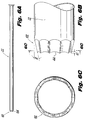
- coring member 22 is an elongated tubular member having a central throughbore and a coring end 102 in the form of serrated annular edge 44.
- Coring end 102 is formed from a plurality of spaced serrations formed at an angle ⁇ with respect to the longitudinal axis of coring member 22.
- the serrations are preferably flat cuts as shown in FIG. 6C but can also be contoured such as, for example, being concave or convex.
- Each serration has a tool depth t1 which preferably ranges from about .05mm to about .20mm.
- the number of serrations preferably ranges from about 4 to about 20.
- FIG. 7A illustrates assembly of coring member 22 within flap creating member 32;
- FIG. 7B shows an end view of the assembly 20.
- Exemplary values of tool depth t and core diameter in relation to the number of serrations are recited in Pacala et al. cited above. That patent application also discloses exemplary rotational speeds and advancement rates for the core member and details of how to integrate the coring member with the coring device to effectuate the same.
- the coring device can be modified by one skilled in the art to incorporate the flap creating member 32 disclosed herein.
- the modification amounts to adding the additional tubular member 32 surrounding the coring member to realize coring/flap creating assembly 20 (FIG. 1 herein) with adequate support therefor within housing 11, and preferably, with means for retracting the cutting portion 35 as discussed above to prevent injury.
- the modification enables automatic extraction of the cutting portion 35 to a predetermined distance either by initial depression of trigger 17 or by depression of an additional triggering button on the housing.
- the inclusion of an automatic extraction mechanism will enable the operator to place the device on the surface of the epicardium, depress the automatic extraction trigger to cause flap creating member 32 to incise and penetrate the epicardium, and then core the channel by depressing trigger 17.
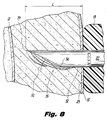
- a TMR procedure in accordance with the present disclosure is initiated by inserting cutting portion 35 of flap creating member 32 a predetermined distance L into a patient's myocardium 12, whether by automatic extraction or manual insertion of cutting portion 35. If manual insertion is employed, surface 29 of the housing of device 10 can operate as a stop to prevent excessive penetration. With an automatic extraction embodiment, surface 29 is first placed against the epicardium and then cutting edge 35 is extracted by the distance L. In any case, as cutting portion 35 is inserted, an annular incision is created which separates both the epicardium and myocardium. As cutting portion 35 penetrates, heart tissue that is separated by the incision is pushed aside by the walls of the cutting portion, as indicated by arrows 52, and compresses against the adjoining tissue.
- coring member 22 is rotated and advanced through flap creating member 32 in order to core out the channel.
- the coring member is simultaneously advanced and rotated at predetermined coordinated rates in order to form a channel having a substantially uniform diameter.
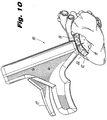
- Myocardial and endocardial tissue that is cored is drawn backwards through the hollow center of coring member 22. After member 22 reaches the ventricle, as shown in FIG. 10, coring member 22 is withdrawn by releasing trigger 17.
- Flap creating member 32 is then withdrawn, whereby the myocardial/endocardial tissue that was pushed aside recoils to its original position, resulting in the channel 18 with flap 14 as shown in FIGS. 1 and 2. The operator can then immediately begin producing another channel without applying pressure to the previously formed channel.
- FIG. 11 there is shown a handle portion of a laser ablation device 100 which is disclosed in EP 97 107 783.9 and commonly assigned copending U.S. patent application Serial No. 08/648,638, filed on May 13, 1996, entitled LASING DEVICE.
- Lasing device 100 includes a housing 120, a tapered portion 114 and a collar-like end portion 116 through which an optical fiber 118 can be advanced or retracted.
- Optical fiber 118 is connected on the opposite side of housing 120 to a laser energy generator (not shown) such as a xenon-chloride excimer laser energy source.
- a fiber optic bundle of a plurality of closely packed optical fibers could be utilized rather than the single fiber 118.
- Housing 120 includes an advancing mechanism (not shown) operative to advance fiber 118 from collar 116 into heart tissue during a TMR procedure while laser energy is outputted therefrom.
- laser energy between about 10 mj/mm 2 and 60 mj/mm 2 may be outputted to produce transmyocardial channels while the fiber is advanced into the heart tissue at a coordinated rate.
- advancing the fiber at a coordinated rate in relation to the magnitude of laser power, precise channels can be formed via ablation without mechanical tearing. Details of the advancement mechanism and of other features of laser ablation devices 100 are found in the above-noted patent application.
- laser ablation device 100 is modified as shown in FIG. 12A by adding a flap creating member 132 surrounding optical fiber 118.
- Flap creating member 132 is preferably similar or identical to flap creating member 32 of FIGS 4-5B and also performs an analogous function as member 32 --creating a flap of heart tissue to reduce bleeding from TMR channels created by optical fiber 118.
- flap creating member 132 is preferably of metallic material and shaped as a tubular cylinder with a beveled cutting portion.
- FIG. 12B illustrates the beveled portion of member 132 having an apex 139 and trough 134.
- the diameter of optic fiber 118 is slightly less than the inner diameter of member 132 so that fiber 118 can move translationally with minimal friction through the throughbore of member 132.
- Flap creating member 132 can preferably be automatically extracted from and retracted into housing 120 via the opening of end portion 116. It will be appreciated that one skilled in the art can incorporate an automatic retraction and extraction mechanism within housing 120, which mechanism would be trigger-actuated via one or more triggers on housing 120. Alternatively, a simpler design without an automatic retraction/extraction feature could be implemented by fabricating flap creating member 132 as an integral, stationary extension of end portion 116.
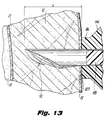
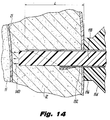
- Member 132 is first inserted a predetermined distance L from the outer surface of epicardium 15 into myocardium 12, where L is reliably attained by means of the annular surface 127 contacting epicardium 15 to prevent excessive penetration. Insertion of member 132 is accomplished either manually or by automatic extraction following placement of surface 127 in contact with epicardium 15. As member 132 is inserted, an annular beveled incision is made in the outer heart tissue consisting of epicardium 15 and myocardium 12, and the heart tissue separated by the incision is pushed aside in direction 52.
- the operator initiates laser energy transmission 140 from optical fiber 118 and coordinated advancement of fiber 118 into myocardium 12 to ablate myocardial and endocardial tissue and produce the desired channel. Advancement of fiber 118 may occur either continuously as laser energy is outputted, or in discrete steps. Once fiber 118 reaches ventricle 11, it is withdrawn from the myocardium, followed by withdrawal of member 132, resulting in the channel 18 and annular flap 14 as shown in FIGS. 1 and 2. As is the case with the mechanical coring embodiment discussed above, the annular interface 16 is sufficiently narrow to enable rapid blood clotting thereat, thereby obviating or substantially reducing the time needed to apply pressure to the epicardium to seal the channel.
Landscapes
- Health & Medical Sciences (AREA)
- Surgery (AREA)
- Physics & Mathematics (AREA)
- Life Sciences & Earth Sciences (AREA)
- Heart & Thoracic Surgery (AREA)
- Medical Informatics (AREA)
- Nuclear Medicine, Radiotherapy & Molecular Imaging (AREA)
- Electromagnetism (AREA)
- Engineering & Computer Science (AREA)
- Biomedical Technology (AREA)
- Optics & Photonics (AREA)
- Otolaryngology (AREA)
- Molecular Biology (AREA)
- Animal Behavior & Ethology (AREA)
- General Health & Medical Sciences (AREA)
- Public Health (AREA)
- Veterinary Medicine (AREA)
- Laser Surgery Devices (AREA)
- Surgical Instruments (AREA)
- Prostheses (AREA)
Applications Claiming Priority (2)
| Application Number | Priority Date | Filing Date | Title |
|---|---|---|---|
| US764417 | 1996-12-12 | ||
| US08/764,417 US5947989A (en) | 1996-12-12 | 1996-12-12 | Method and apparatus for transmyocardial revascularization |
Publications (2)
| Publication Number | Publication Date |
|---|---|
| EP0847728A2 true EP0847728A2 (de) | 1998-06-17 |
| EP0847728A3 EP0847728A3 (de) | 1999-06-23 |
Family
ID=25070675
Family Applications (1)
| Application Number | Title | Priority Date | Filing Date |
|---|---|---|---|
| EP97120623A Withdrawn EP0847728A3 (de) | 1996-12-12 | 1997-11-25 | Vorrichtung für transmyokardiale Revaskularisation |
Country Status (3)
| Country | Link |
|---|---|
| US (1) | US5947989A (de) |
| EP (1) | EP0847728A3 (de) |
| CA (1) | CA2221959A1 (de) |
Cited By (2)
| Publication number | Priority date | Publication date | Assignee | Title |
|---|---|---|---|---|
| WO2007070279A1 (en) * | 2005-12-09 | 2007-06-21 | Huot Instruments, Llc | Dermal incisor |
| ES2279733A1 (es) * | 2006-11-27 | 2007-08-16 | Rudolf Morgenstern Lopez | Dispositivo para eliminacion de tejido en operaciones endoscopicas. |
Families Citing this family (24)
| Publication number | Priority date | Publication date | Assignee | Title |
|---|---|---|---|---|
| US5968059A (en) * | 1997-03-06 | 1999-10-19 | Scimed Life Systems, Inc. | Transmyocardial revascularization catheter and method |
| US6200311B1 (en) * | 1998-01-20 | 2001-03-13 | Eclipse Surgical Technologies, Inc. | Minimally invasive TMR device |
| USD439334S1 (en) | 1998-10-26 | 2001-03-20 | Stryker Corporation | Handpiece for a surgical tool |
| US6893421B1 (en) * | 2000-08-08 | 2005-05-17 | Scimed Life Systems, Inc. | Catheter shaft assembly |
| US6595958B1 (en) * | 2000-08-08 | 2003-07-22 | Scimed Life Systems, Inc. | Tortuous path injection device and method |
| US6613017B1 (en) | 2000-08-08 | 2003-09-02 | Scimed Life Systems, Inc. | Controlled depth injection device and method |
| DE10219046B4 (de) * | 2002-04-23 | 2005-02-17 | EPSa Elektronik und Präzisionsbau Saalfeld GmbH Niederl. Jena | Vorrichtung zur Erzeugung von Druckgasimpulsen für Augeninnendruckuntersuchungen |
| US8668698B2 (en) | 2002-05-31 | 2014-03-11 | Vidacare Corporation | Assembly for coupling powered driver with intraosseous device |
| US11298202B2 (en) | 2002-05-31 | 2022-04-12 | Teleflex Life Sciences Limited | Biopsy devices and related methods |
| US11337728B2 (en) | 2002-05-31 | 2022-05-24 | Teleflex Life Sciences Limited | Powered drivers, intraosseous devices and methods to access bone marrow |
| US8641715B2 (en) | 2002-05-31 | 2014-02-04 | Vidacare Corporation | Manual intraosseous device |
| US10973545B2 (en) | 2002-05-31 | 2021-04-13 | Teleflex Life Sciences Limited | Powered drivers, intraosseous devices and methods to access bone marrow |
| IL165224A0 (en) * | 2002-05-31 | 2005-12-18 | Vidacare Corp | Apparatus and method to access bone marrow |
| US9504477B2 (en) | 2003-05-30 | 2016-11-29 | Vidacare LLC | Powered driver |
| US8672941B2 (en) * | 2005-02-02 | 2014-03-18 | Kensey Nash Bvf Technology Llc | Coring device for preserving living tissue |
| EP3659520B1 (de) | 2006-09-12 | 2023-11-08 | Teleflex Life Sciences Limited | Knochenmark-absaugvorrichtungen |
| EP2073728B1 (de) | 2006-09-12 | 2018-11-07 | Teleflex Medical Devices S.à.r.l. | Biopsie-vorrichtung |
| US8944069B2 (en) | 2006-09-12 | 2015-02-03 | Vidacare Corporation | Assemblies for coupling intraosseous (IO) devices to powered drivers |
| EP2462881B1 (de) * | 2006-10-04 | 2016-08-24 | Boston Scientific Limited | Interventionskatheter |
| DE102007049796A1 (de) * | 2007-05-18 | 2009-04-23 | Wisap Gesellschaft für wissenschaftlichen Apparatebau mbH | Vorrichtung zum Ausschneiden und Entfernen von Gewebezylindern aus einem Gewebe und deren Verwendung |
| DE102007023207A1 (de) * | 2007-05-18 | 2008-11-20 | Wisap Gesellschaft für wissenschaftlichen Apparatebau mbH | Vorrichtung zum Ausschneiden und Entfernen von Gewebezylindern aus einem Gewebe und deren Verwendung |
| US7866223B2 (en) * | 2007-06-04 | 2011-01-11 | Swift & Company | Method of obtaining samples of meat to assay for microbial contamination |
| JP6669842B1 (ja) * | 2018-12-04 | 2020-03-18 | 合同会社山鹿Cl | 刃付き吸引管 |
| JP7295562B2 (ja) * | 2018-12-04 | 2023-06-21 | 合同会社山鹿Cl | 刃付き吸引管 |
Family Cites Families (88)
| Publication number | Priority date | Publication date | Assignee | Title |
|---|---|---|---|---|
| US3087486A (en) * | 1959-03-05 | 1963-04-30 | Cenco Instr Corp | Cardiac electrode means |
| US3821510A (en) * | 1973-02-22 | 1974-06-28 | H Muncheryan | Hand held laser instrumentation device |
| US4469098A (en) * | 1978-12-18 | 1984-09-04 | Davi Samantha K | Apparatus for and method of utilizing energy to excise pathological tissue |
| US4266548A (en) * | 1978-12-18 | 1981-05-12 | Davi S K | Apparatus for and method of utilizing energy to excise pathological tissue |
| US4269174A (en) * | 1979-08-06 | 1981-05-26 | Medical Dynamics, Inc. | Transcutaneous vasectomy apparatus and method |
| US4311138A (en) * | 1980-03-10 | 1982-01-19 | Sugarman Edward D | Illuminated hypodermic needle |
| US4336809A (en) * | 1980-03-17 | 1982-06-29 | Burleigh Instruments, Inc. | Human and animal tissue photoradiation system and method |
| US4461305A (en) * | 1981-09-04 | 1984-07-24 | Cibley Leonard J | Automated biopsy device |
| US4564011A (en) * | 1982-03-22 | 1986-01-14 | Leon Goldman | Laser optic device and method |
| DE3233914C2 (de) * | 1982-09-13 | 1986-02-13 | Oerlikon-Boehringer GmbH, 7320 Göppingen | Drehmaschinenspindel mit fliehkraftausgleichendem Spannfutter |
| DE3341117C2 (de) * | 1983-11-12 | 1986-02-06 | Josef 7512 Rheinstetten Lindenberg | Biopsiekanüle |
| JPS60126171A (ja) * | 1983-12-09 | 1985-07-05 | インタ−ナショナル ビジネス マシ−ンズ コ−ポレ−ション | レ−ザ・カテ−テル装置 |
| US4830460A (en) * | 1987-05-19 | 1989-05-16 | Advanced Interventional Systems, Inc. | Guidance system and method for delivery system for high-energy pulsed ultraviolet laser light |
| US5188632A (en) * | 1984-12-07 | 1993-02-23 | Advanced Interventional Systems, Inc. | Guidance and delivery system for high-energy pulsed laser light |
| EP0189329A3 (de) * | 1985-01-25 | 1987-06-03 | Robert E. Fischell | Durchbohrendes Kathetersystem für gefässinterne Arterioplastik |
| US4913142A (en) * | 1985-03-22 | 1990-04-03 | Massachusetts Institute Of Technology | Catheter for laser angiosurgery |
| US4658817A (en) * | 1985-04-01 | 1987-04-21 | Children's Hospital Medical Center | Method and apparatus for transmyocardial revascularization using a laser |
| US5196004A (en) * | 1985-07-31 | 1993-03-23 | C. R. Bard, Inc. | Infrared laser catheter system |
| US4785815A (en) * | 1985-10-23 | 1988-11-22 | Cordis Corporation | Apparatus for locating and ablating cardiac conduction pathways |
| AU588458B2 (en) * | 1986-10-06 | 1989-09-14 | Gv Medical Inc. | Adjustable control apparatus for optical fibres |
| US4860743A (en) * | 1986-10-27 | 1989-08-29 | University Of Florida | Laser method and apparatus for the recanalization of vessels and the treatment of other cardiac conditions |
| DE3718139C1 (de) * | 1987-05-29 | 1988-12-08 | Strahlen Umweltforsch Gmbh | Herzkatheter |
| US5048538A (en) * | 1989-11-27 | 1991-09-17 | Vance Products Incorporated | Biopsy instrument |
| US4852567A (en) * | 1988-01-21 | 1989-08-01 | C. R. Bard, Inc. | Laser tipped catheter |
| US5037421A (en) * | 1989-10-06 | 1991-08-06 | Coherent, Inc., Medical Group | Mid-infrared laser arthroscopic procedure |
| US5147354B1 (en) * | 1988-08-19 | 1997-10-14 | Coherent Inc | Mid-infrared laser endoscope |
| US4928695A (en) * | 1989-02-17 | 1990-05-29 | Leon Goldman | Laser diagnostic and treatment device |
| DE3911796A1 (de) * | 1989-04-11 | 1990-10-18 | Messerschmitt Boelkow Blohm | Myokardsonde |
| US4985028A (en) * | 1989-08-30 | 1991-01-15 | Angeion Corporation | Catheter |
| US4997431A (en) * | 1989-08-30 | 1991-03-05 | Angeion Corporation | Catheter |
| US5104393A (en) * | 1989-08-30 | 1992-04-14 | Angelase, Inc. | Catheter |
| US4940061A (en) * | 1989-11-27 | 1990-07-10 | Ingress Technologies, Inc. | Biopsy instrument |
| US5257989A (en) * | 1990-02-07 | 1993-11-02 | Coherent, Inc. | Contact laser delivery probe |
| IL97130A (en) * | 1990-02-07 | 1995-07-31 | Coherent Inc | Transmission system while in contact with laser |
| US5109830A (en) * | 1990-04-10 | 1992-05-05 | Candela Laser Corporation | Apparatus for navigation of body cavities |
| US5111832A (en) * | 1990-07-24 | 1992-05-12 | Sanjeev Saksena | Processes for the control of tachyarrhythmias by in vivo laser ablation of human heart tissue |
| US5312396A (en) * | 1990-09-06 | 1994-05-17 | Massachusetts Institute Of Technology | Pulsed laser system for the surgical removal of tissue |
| US5125926A (en) * | 1990-09-24 | 1992-06-30 | Laser Engineering, Inc. | Heart-synchronized pulsed laser system |
| US5700259A (en) * | 1990-09-24 | 1997-12-23 | Plc Medical Systems, Inc. | Thoracoscopic transmyocardial revascularization handpiece assembly |
| US5304171A (en) * | 1990-10-18 | 1994-04-19 | Gregory Kenton W | Catheter devices and methods for delivering |
| EP0481684A3 (en) * | 1990-10-19 | 1993-03-03 | Angelase, Inc. | Location and ablation of an active site of ventricular tachycardia |
| US5093877A (en) * | 1990-10-30 | 1992-03-03 | Advanced Cardiovascular Systems | Optical fiber lasing apparatus lens |
| US5389096A (en) * | 1990-12-18 | 1995-02-14 | Advanced Cardiovascular Systems | System and method for percutaneous myocardial revascularization |
| WO1992008410A1 (en) * | 1990-11-14 | 1992-05-29 | Kedem, Hadar | Hard tissue biopsy instrument |
| US5380316A (en) * | 1990-12-18 | 1995-01-10 | Advanced Cardiovascular Systems, Inc. | Method for intra-operative myocardial device revascularization |
| NZ242509A (en) * | 1991-05-01 | 1996-03-26 | Univ Columbia | Myocardial revascularisation using laser |
| US5324300A (en) * | 1991-10-25 | 1994-06-28 | Elias Elias G | Device for the controlled excision of tissue from a living body |
| US5437660A (en) * | 1991-12-30 | 1995-08-01 | Trimedyne, Inc. | Tissue ablation and a lateral-lasing fiber optic device therefor |
| US5683366A (en) * | 1992-01-07 | 1997-11-04 | Arthrocare Corporation | System and method for electrosurgical tissue canalization |
| US5222501A (en) * | 1992-01-31 | 1993-06-29 | Duke University | Methods for the diagnosis and ablation treatment of ventricular tachycardia |
| WO1993015672A1 (en) * | 1992-02-05 | 1993-08-19 | Angelase, Inc. | Multi-fiber laser catheter |
| WO1993015676A1 (en) * | 1992-02-05 | 1993-08-19 | Angelase, Inc. | Laser catheter with movable integral fixation wire |
| US5281212A (en) * | 1992-02-18 | 1994-01-25 | Angeion Corporation | Laser catheter with monitor and dissolvable tip |
| US5314466A (en) * | 1992-04-13 | 1994-05-24 | Ep Technologies, Inc. | Articulated unidirectional microwave antenna systems for cardiac ablation |
| WO1993020768A1 (en) * | 1992-04-13 | 1993-10-28 | Ep Technologies, Inc. | Steerable microwave antenna systems for cardiac ablation |
| US5274728A (en) * | 1992-07-06 | 1993-12-28 | Infrared Fiber Systems, Inc. | Heavy metal-oxide glass optical fibers for use in laser medical surgery |
| WO1994002075A1 (en) * | 1992-07-15 | 1994-02-03 | University Of Miami | Surgical cutting heads |
| WO1994002077A2 (en) * | 1992-07-15 | 1994-02-03 | Angelase, Inc. | Ablation catheter system |
| US5251641A (en) * | 1992-07-29 | 1993-10-12 | Hgg Laser Fare, Inc. | Biopsy needle |
| CA2102084A1 (en) * | 1992-11-09 | 1994-05-10 | Howard C. Topel | Surgical cutting instrument for coring tissue affixed thereto |
| WO1994010922A1 (en) * | 1992-11-13 | 1994-05-26 | Ep Technologies, Inc. | Cardial ablation systems using temperature monitoring |
| US5346489A (en) * | 1992-11-18 | 1994-09-13 | Luxar Corporation | Medical laser delivery system |
| WO1994014383A1 (en) * | 1992-12-22 | 1994-07-07 | Laser Engineering, Inc. | Handpiece for transmyocardial vascularization heart-synchronized pulsed laser system |
| US5405348A (en) * | 1993-02-12 | 1995-04-11 | Anspach, Jr.; William E. | Surgical cutting instrument |
| US5423330A (en) * | 1993-03-10 | 1995-06-13 | The University Of Miami | Capsule suction punch instrument and method of use |
| DE4403134A1 (de) * | 1993-05-14 | 1995-08-03 | Laser Medizin Zentrum Ggmbh Be | Kombinationsvorrichtung zur thermischen Verödung biologischen Gewebes |
| WO1995005212A2 (en) * | 1993-08-11 | 1995-02-23 | Electro-Catheter Corporation | Improved ablation electrode |
| US5651785A (en) * | 1993-09-20 | 1997-07-29 | Abela Laser Systems, Inc. | Optical fiber catheter and method |
| EP0669107A1 (de) * | 1994-02-23 | 1995-08-30 | SMITH & NEPHEW DYONICS INC | Chirurgisches Instrument mit beigefügtem Laser |
| US5511556A (en) * | 1994-04-11 | 1996-04-30 | Desantis; Stephen A. | Needle core biopsy instrument |
| JP3546074B2 (ja) * | 1994-05-16 | 2004-07-21 | 株式会社八光 | 生検針 |
| US5549601A (en) * | 1994-10-11 | 1996-08-27 | Devices For Vascular Intervention, Inc. | Delivery of intracorporeal probes |
| US5591159A (en) * | 1994-11-09 | 1997-01-07 | Taheri; Syde A. | Transcavitary myocardial perfusion apparatus |
| US5615690A (en) * | 1995-02-15 | 1997-04-01 | Symbiosis Corporation | Tissue core biopsy cannula |
| EP0737486A3 (de) * | 1995-04-14 | 1997-02-26 | Daig Corp | Einführungshilfe für medizinische Verfahren im rechten Ventrikel im Zusammenhang mit der Ausstrombahn dieses Ventrikels |
| EP0738518A3 (de) * | 1995-04-17 | 1997-03-12 | Daig Corp | Einführungshilfe für medizinische Verfahren im rechten Ventrikel im Zusammenhang mit der Trikuspidal-Klappe |
| WO1996035469A1 (en) * | 1995-05-10 | 1996-11-14 | Cardiogenesis Corporation | System for treating or diagnosing heart tissue |
| US5620439A (en) * | 1995-06-06 | 1997-04-15 | George S. Abela | Catheter and technique for endovascular myocardial revascularization |
| US5728091A (en) * | 1995-06-07 | 1998-03-17 | Cardiogenesis Corporation | Optical fiber for myocardial channel formation |
| US6132451A (en) * | 1995-06-07 | 2000-10-17 | Eclipse Surgical Technologies, Inc. | Optical fiber for myocardial channel formation |
| ATE231363T1 (de) * | 1995-06-07 | 2003-02-15 | Eclipse Surgical Tech | Mit eindringtiefebegrenzer versehene chirurgische vorrichtung zum erzeugen von kanälen |
| US5824005A (en) * | 1995-08-22 | 1998-10-20 | Board Of Regents, The University Of Texas System | Maneuverable electrophysiology catheter for percutaneous or intraoperative ablation of cardiac arrhythmias |
| EP0888150B1 (de) * | 1996-01-08 | 2004-03-24 | Biosense Inc. | Gerät zur myokardialen gefässneubildung |
| US5713894A (en) * | 1996-02-27 | 1998-02-03 | Murphy-Chutorian; Douglas | Combined mechanical/optical system for transmyocardial revascularization |
| US5738680A (en) * | 1996-04-05 | 1998-04-14 | Eclipse Surgical Technologies, Inc. | Laser device with piercing tip for transmyocardial revascularization procedures |
| US5782823A (en) * | 1996-04-05 | 1998-07-21 | Eclipse Surgical Technologies, Inc. | Laser device for transmyocardial revascularization procedures including means for enabling a formation of a pilot hole in the epicardium |
| US5703985A (en) * | 1996-04-29 | 1997-12-30 | Eclipse Surgical Technologies, Inc. | Optical fiber device and method for laser surgery procedures |
| US5672170A (en) * | 1996-06-20 | 1997-09-30 | Cynosure, Inc. | Laser transmyocardial revascularization arrangement |
-
1996
- 1996-12-12 US US08/764,417 patent/US5947989A/en not_active Expired - Lifetime
-
1997
- 1997-11-24 CA CA002221959A patent/CA2221959A1/en not_active Abandoned
- 1997-11-25 EP EP97120623A patent/EP0847728A3/de not_active Withdrawn
Cited By (4)
| Publication number | Priority date | Publication date | Assignee | Title |
|---|---|---|---|---|
| WO2007070279A1 (en) * | 2005-12-09 | 2007-06-21 | Huot Instruments, Llc | Dermal incisor |
| US7744544B2 (en) | 2005-12-09 | 2010-06-29 | Huot Instruments, Llc | Dermal incisor |
| ES2279733A1 (es) * | 2006-11-27 | 2007-08-16 | Rudolf Morgenstern Lopez | Dispositivo para eliminacion de tejido en operaciones endoscopicas. |
| ES2279733B1 (es) * | 2006-11-27 | 2008-08-16 | Rudolf Morgenstern Lopez | Dispositivo para eliminacion de tejido en operaciones endoscopicas. |
Also Published As
| Publication number | Publication date |
|---|---|
| US5947989A (en) | 1999-09-07 |
| CA2221959A1 (en) | 1998-06-12 |
| EP0847728A3 (de) | 1999-06-23 |
Similar Documents
| Publication | Publication Date | Title |
|---|---|---|
| US5947989A (en) | Method and apparatus for transmyocardial revascularization | |
| US5713894A (en) | Combined mechanical/optical system for transmyocardial revascularization | |
| US5871495A (en) | Method and apparatus for mechanical transmyocardial revascularization of the heart | |
| US5911729A (en) | Electrocautery coring using solid needle | |
| US5703985A (en) | Optical fiber device and method for laser surgery procedures | |
| US5738680A (en) | Laser device with piercing tip for transmyocardial revascularization procedures | |
| US5782823A (en) | Laser device for transmyocardial revascularization procedures including means for enabling a formation of a pilot hole in the epicardium | |
| US6011889A (en) | Piercing point optical fiber device for laser surgery procedures | |
| US4658817A (en) | Method and apparatus for transmyocardial revascularization using a laser | |
| EP1017451A1 (de) | Geräte und verfahren zur durchführungtransmyokardialer revaskularisierung | |
| AU8506398A (en) | Apparatus and method for transmyocardial revascularization by laser ablation | |
| CA2346653A1 (en) | Laser handpiece for performing transmyocardial revascularization | |
| KR102676747B1 (ko) | 모발 추출에 이용되는 펀칭니들 및 핸드피스 | |
| CA2298007A1 (en) | Laser fibre optic bundle |
Legal Events
| Date | Code | Title | Description |
|---|---|---|---|
| PUAI | Public reference made under article 153(3) epc to a published international application that has entered the european phase |
Free format text: ORIGINAL CODE: 0009012 |
|
| AK | Designated contracting states |
Kind code of ref document: A2 Designated state(s): AT BE CH DE DK ES FI FR GB GR IE IT LI LU MC NL PT SE |
|
| AX | Request for extension of the european patent |
Free format text: AL;LT;LV;MK;RO;SI |
|
| PUAL | Search report despatched |
Free format text: ORIGINAL CODE: 0009013 |
|
| AK | Designated contracting states |
Kind code of ref document: A3 Designated state(s): AT BE CH DE DK ES FI FR GB GR IE IT LI LU MC NL PT SE |
|
| AX | Request for extension of the european patent |
Free format text: AL;LT;LV;MK;RO;SI |
|
| 17P | Request for examination filed |
Effective date: 19991223 |
|
| AKX | Designation fees paid |
Free format text: DE ES FR GB IT |
|
| RBV | Designated contracting states (corrected) |
Designated state(s): AT BE CH DE DK ES FI FR GB GR IE IT LI LU MC NL PT SE |
|
| 17Q | First examination report despatched |
Effective date: 20010719 |
|
| STAA | Information on the status of an ep patent application or granted ep patent |
Free format text: STATUS: THE APPLICATION IS DEEMED TO BE WITHDRAWN |
|
| 18D | Application deemed to be withdrawn |
Effective date: 20020403 |