EP0845822A1 - Hydrogen absorbing alloy electrode, method of fabricating hydrogen absorbing alloy electrode, and alkali battery - Google Patents
Hydrogen absorbing alloy electrode, method of fabricating hydrogen absorbing alloy electrode, and alkali battery Download PDFInfo
- Publication number
- EP0845822A1 EP0845822A1 EP97120569A EP97120569A EP0845822A1 EP 0845822 A1 EP0845822 A1 EP 0845822A1 EP 97120569 A EP97120569 A EP 97120569A EP 97120569 A EP97120569 A EP 97120569A EP 0845822 A1 EP0845822 A1 EP 0845822A1
- Authority
- EP
- European Patent Office
- Prior art keywords
- hydrogen absorbing
- absorbing alloy
- electrode
- quinone
- hydrogen
- Prior art date
- Legal status (The legal status is an assumption and is not a legal conclusion. Google has not performed a legal analysis and makes no representation as to the accuracy of the status listed.)
- Granted
Links
- 229910045601 alloy Inorganic materials 0.000 title claims abstract description 187
- 239000000956 alloy Substances 0.000 title claims abstract description 187
- 239000001257 hydrogen Substances 0.000 title claims abstract description 187
- 229910052739 hydrogen Inorganic materials 0.000 title claims abstract description 187
- UFHFLCQGNIYNRP-UHFFFAOYSA-N Hydrogen Chemical compound [H][H] UFHFLCQGNIYNRP-UHFFFAOYSA-N 0.000 title claims abstract description 186
- 239000003513 alkali Substances 0.000 title claims abstract description 46
- 238000004519 manufacturing process Methods 0.000 title claims description 7
- AZQWKYJCGOJGHM-UHFFFAOYSA-N para-benzoquinone Natural products O=C1C=CC(=O)C=C1 AZQWKYJCGOJGHM-UHFFFAOYSA-N 0.000 claims abstract description 98
- -1 quinone compound Chemical class 0.000 claims abstract description 39
- XLYOFNOQVPJJNP-UHFFFAOYSA-N water Substances O XLYOFNOQVPJJNP-UHFFFAOYSA-N 0.000 claims abstract description 30
- 239000002253 acid Substances 0.000 claims abstract description 21
- 238000000034 method Methods 0.000 claims description 10
- 239000013078 crystal Substances 0.000 claims description 9
- 230000000052 comparative effect Effects 0.000 description 47
- 239000000843 powder Substances 0.000 description 26
- PXHVJJICTQNCMI-UHFFFAOYSA-N nickel Substances [Ni] PXHVJJICTQNCMI-UHFFFAOYSA-N 0.000 description 25
- 229910052759 nickel Inorganic materials 0.000 description 13
- VEXZGXHMUGYJMC-UHFFFAOYSA-N Hydrochloric acid Chemical compound Cl VEXZGXHMUGYJMC-UHFFFAOYSA-N 0.000 description 10
- 239000000203 mixture Substances 0.000 description 9
- 238000010306 acid treatment Methods 0.000 description 8
- 238000002844 melting Methods 0.000 description 6
- 230000008018 melting Effects 0.000 description 6
- 230000000694 effects Effects 0.000 description 5
- 239000011248 coating agent Substances 0.000 description 4
- 238000000576 coating method Methods 0.000 description 4
- 239000003792 electrolyte Substances 0.000 description 4
- 229910052761 rare earth metal Inorganic materials 0.000 description 4
- 229910001122 Mischmetal Inorganic materials 0.000 description 3
- QVGXLLKOCUKJST-UHFFFAOYSA-N atomic oxygen Chemical compound [O] QVGXLLKOCUKJST-UHFFFAOYSA-N 0.000 description 3
- 230000003247 decreasing effect Effects 0.000 description 3
- 238000009689 gas atomisation Methods 0.000 description 3
- 229910052748 manganese Inorganic materials 0.000 description 3
- 239000001301 oxygen Substances 0.000 description 3
- 229910052760 oxygen Inorganic materials 0.000 description 3
- FRASJONUBLZVQX-UHFFFAOYSA-N 1,4-naphthoquinone Chemical compound C1=CC=C2C(=O)C=CC(=O)C2=C1 FRASJONUBLZVQX-UHFFFAOYSA-N 0.000 description 2
- KWYUFKZDYYNOTN-UHFFFAOYSA-M Potassium hydroxide Chemical compound [OH-].[K+] KWYUFKZDYYNOTN-UHFFFAOYSA-M 0.000 description 2
- 239000011230 binding agent Substances 0.000 description 2
- 238000007599 discharging Methods 0.000 description 2
- 229910052751 metal Inorganic materials 0.000 description 2
- 238000012986 modification Methods 0.000 description 2
- 230000004048 modification Effects 0.000 description 2
- WOAHJDHKFWSLKE-UHFFFAOYSA-N 1,2-benzoquinone Chemical compound O=C1C=CC=CC1=O WOAHJDHKFWSLKE-UHFFFAOYSA-N 0.000 description 1
- KETQAJRQOHHATG-UHFFFAOYSA-N 1,2-naphthoquinone Chemical compound C1=CC=C2C(=O)C(=O)C=CC2=C1 KETQAJRQOHHATG-UHFFFAOYSA-N 0.000 description 1
- 229940105324 1,2-naphthoquinone Drugs 0.000 description 1
- IJGRMHOSHXDMSA-UHFFFAOYSA-N Atomic nitrogen Chemical compound N#N IJGRMHOSHXDMSA-UHFFFAOYSA-N 0.000 description 1
- 229910002335 LaNi5 Inorganic materials 0.000 description 1
- 229920003171 Poly (ethylene oxide) Polymers 0.000 description 1
- PYKYMHQGRFAEBM-UHFFFAOYSA-N anthraquinone Natural products CCC(=O)c1c(O)c2C(=O)C3C(C=CC=C3O)C(=O)c2cc1CC(=O)OC PYKYMHQGRFAEBM-UHFFFAOYSA-N 0.000 description 1
- 150000004056 anthraquinones Chemical class 0.000 description 1
- 239000012300 argon atmosphere Substances 0.000 description 1
- 229910052804 chromium Inorganic materials 0.000 description 1
- 239000003245 coal Substances 0.000 description 1
- 150000001875 compounds Chemical class 0.000 description 1
- 229910001873 dinitrogen Inorganic materials 0.000 description 1
- 230000004927 fusion Effects 0.000 description 1
- 239000007789 gas Substances 0.000 description 1
- 230000000977 initiatory effect Effects 0.000 description 1
- 229910052742 iron Inorganic materials 0.000 description 1
- 239000002184 metal Substances 0.000 description 1
- 238000000465 moulding Methods 0.000 description 1
- 239000004745 nonwoven fabric Substances 0.000 description 1
- 230000003647 oxidation Effects 0.000 description 1
- 238000007254 oxidation reaction Methods 0.000 description 1
- 238000012856 packing Methods 0.000 description 1
- 239000002245 particle Substances 0.000 description 1
- 230000000149 penetrating effect Effects 0.000 description 1
- 238000007747 plating Methods 0.000 description 1
- 229920001343 polytetrafluoroethylene Polymers 0.000 description 1
- 239000004810 polytetrafluoroethylene Substances 0.000 description 1
- 238000004321 preservation Methods 0.000 description 1
- 238000004080 punching Methods 0.000 description 1
- 239000000758 substrate Substances 0.000 description 1
- 229910052723 transition metal Inorganic materials 0.000 description 1
- 150000003624 transition metals Chemical class 0.000 description 1
- 229910052720 vanadium Inorganic materials 0.000 description 1
- 229910052726 zirconium Inorganic materials 0.000 description 1
Images

Classifications
-
- H—ELECTRICITY
- H01—ELECTRIC ELEMENTS
- H01M—PROCESSES OR MEANS, e.g. BATTERIES, FOR THE DIRECT CONVERSION OF CHEMICAL ENERGY INTO ELECTRICAL ENERGY
- H01M4/00—Electrodes
- H01M4/02—Electrodes composed of, or comprising, active material
- H01M4/36—Selection of substances as active materials, active masses, active liquids
- H01M4/38—Selection of substances as active materials, active masses, active liquids of elements or alloys
- H01M4/383—Hydrogen absorbing alloys
-
- Y—GENERAL TAGGING OF NEW TECHNOLOGICAL DEVELOPMENTS; GENERAL TAGGING OF CROSS-SECTIONAL TECHNOLOGIES SPANNING OVER SEVERAL SECTIONS OF THE IPC; TECHNICAL SUBJECTS COVERED BY FORMER USPC CROSS-REFERENCE ART COLLECTIONS [XRACs] AND DIGESTS
- Y02—TECHNOLOGIES OR APPLICATIONS FOR MITIGATION OR ADAPTATION AGAINST CLIMATE CHANGE
- Y02E—REDUCTION OF GREENHOUSE GAS [GHG] EMISSIONS, RELATED TO ENERGY GENERATION, TRANSMISSION OR DISTRIBUTION
- Y02E60/00—Enabling technologies; Technologies with a potential or indirect contribution to GHG emissions mitigation
- Y02E60/10—Energy storage using batteries
-
- Y—GENERAL TAGGING OF NEW TECHNOLOGICAL DEVELOPMENTS; GENERAL TAGGING OF CROSS-SECTIONAL TECHNOLOGIES SPANNING OVER SEVERAL SECTIONS OF THE IPC; TECHNICAL SUBJECTS COVERED BY FORMER USPC CROSS-REFERENCE ART COLLECTIONS [XRACs] AND DIGESTS
- Y02—TECHNOLOGIES OR APPLICATIONS FOR MITIGATION OR ADAPTATION AGAINST CLIMATE CHANGE
- Y02P—CLIMATE CHANGE MITIGATION TECHNOLOGIES IN THE PRODUCTION OR PROCESSING OF GOODS
- Y02P70/00—Climate change mitigation technologies in the production process for final industrial or consumer products
- Y02P70/50—Manufacturing or production processes characterised by the final manufactured product
-
- Y—GENERAL TAGGING OF NEW TECHNOLOGICAL DEVELOPMENTS; GENERAL TAGGING OF CROSS-SECTIONAL TECHNOLOGIES SPANNING OVER SEVERAL SECTIONS OF THE IPC; TECHNICAL SUBJECTS COVERED BY FORMER USPC CROSS-REFERENCE ART COLLECTIONS [XRACs] AND DIGESTS
- Y10—TECHNICAL SUBJECTS COVERED BY FORMER USPC
- Y10S—TECHNICAL SUBJECTS COVERED BY FORMER USPC CROSS-REFERENCE ART COLLECTIONS [XRACs] AND DIGESTS
- Y10S420/00—Alloys or metallic compositions
- Y10S420/90—Hydrogen storage
Definitions
- the present invention relates to a hydrogen absorbing alloy electrode used as a negative electrode of an alkali secondary battery such as a nickel-hydrogen secondary battery, a method of fabricating the hydrogen absorbing alloy electrode, and an alkali secondary battery using the hydrogen absorbing alloy electrode, and is characterized in that a hydrogen absorbing alloy used for the hydrogen absorbing alloy electrode is modified, to improve the initial activity thereof in a case where the hydrogen absorbing alloy electrode is used as the negative electrode to increase charging characteristics in the early stages, and prevent the internal pressure of the alkali secondary battery from being increased to improve the initial discharge capacity of the alkali secondary battery.
- a nickel-hydrogen secondary battery has been conventionally known as one example of an alkali secondary battery.
- a hydrogen absorbing alloy electrode using a hydrogen absorbing alloy has been generally used as its negative electrode.
- Examples of the hydrogen absorbing alloy used for the negative electrode include a hydrogen absorbing alloy having a CaCu 5 -type crystal structure using Misch metal (Mm) which is a mixture of rare earth elements and a Laves hydrogen absorbing alloy.
- Misch metal Misch metal
- each of the hydrogen absorbing alloys however, a coating of an oxide or the like is generally formed on its surface by natural oxidation, for example.
- a hydrogen absorbing alloy electrode is fabricated using such a hydrogen absorbing alloy, and the hydrogen absorbing alloy electrode is used as the negative electrode of the nickel-hydrogen secondary battery, the activity in the early stages of the hydrogen absorbing alloy is low, and hydrogen gas is not sufficiently absorbed in the hydrogen absorbing alloy. As a result, some problems arise. For example, the capacity in the early stages of the nickel-hydrogen secondary battery is decreased, and the internal pressure of the battery is increased by the hydrogen gas.
- the hydrogen absorbing alloy When the hydrogen absorbing alloy is immersed in the acid solution, to remove the coating of the oxide on the surface of the hydrogen absorbing alloy, some active portions appear on the surface of the hydrogen absorbing alloy. However, some problems remain. For example, the active portions thus appearing on the surface are oxidized again, whereby the activity in the early stages of the hydrogen absorbing alloy is not sufficiently improved, and the hydrogen gas is not sufficiently absorbed in the hydrogen absorbing alloy. Therefore, the capacity of the battery is still low, and the internal pressure of the battery is increased.
- An object of the present invention is to improve, in a hydrogen absorbing alloy electrode used as a negative electrode of an alkali secondary battery such as a nickel-hydrogen secondary battery, the activity in the early stages of the hydrogen absorbing alloy electrode which is used as the negative electrode.
- Another object of the present invention is to obtain a hydrogen absorbing alloy electrode whose activity in the early stages is improved so that charging and discharging characteristics are increased.
- Still another object of the present invention is to improve the initial discharge capacity of an alkali secondary battery using a hydrogen absorbing alloy electrode as its negative electrode and prevent the internal pressure of the battery from being increased.
- a hydrogen absorbing alloy electrode In a hydrogen absorbing alloy electrode according to the present invention, a hydrogen absorbing alloy treated upon being immersed in an acid solution containing at least a quinone compound, a hydrogen absorbing alloy immersed in water to which at least a quinone compound is added, or a hydrogen absorbing alloy treated upon being immersed in an acid solution containing at least a quinone compound and then immersed in water to which at least a quinone compound is added is used.
- a hydrogen absorbing alloy used for a hydrogen absorbing alloy electrode is treated upon being immersed in an acid solution containing at least a quinone compound, is immersed in water to which at least a quinone compound is added, or is treated upon being immersed in an acid solution containing at least a quinone compound and is then immersed in water to which at least a quinone compound is added.
- a hydrogen absorbing alloy treated upon being immersed in an acid solution containing at least a quinone compound, a hydrogen absorbing alloy immersed in water to which at least a quinone compound is added, or a hydrogen absorbing alloy treated upon being immersed in an acid solution containing at least a quinone compound and then immersed in water to which at least a quinone compound is added is used as a hydrogen absorbing alloy in a hydrogen absorbing alloy electrode used as its negative electrode.
- the hydrogen absorbing alloy electrode using the hydrogen absorbing alloy thus treated is used as the negative electrode of the alkali secondary battery such as the nickel-hydrogen secondary battery, hydrogen gas is sufficiently absorbed in the hydrogen absorbing alloy in the hydrogen absorbing alloy electrode from the early stages, so that charging characteristics are improved. Therefore, the internal pressure of the battery is prevented from being increased, and the discharge capacity of the battery is improved.
- the hydrogen absorbing alloy when the hydrogen absorbing alloy is immersed in the water to which at least the quinone compound is added, dissolved oxygen in the water is removed by the quinone compound, and an oxide on the surface of the hydrogen absorbing alloy is reduced, so that active portions appear on the surface of the hydrogen absorbing alloy, as in the above-mentioned case.
- the hydrogen absorbing alloy electrode using the hydrogen absorbing alloy is used as the negative electrode of the alkali secondary battery such as the nickel-hydrogen secondary battery, therefore, the hydrogen gas is sufficiently absorbed in the hydrogen absorbing alloy in the hydrogen absorbing alloy electrode from the early stages, so that charging characteristics are improved. Therefore, the internal pressure of the battery is prevented from being increased, and the discharge capacity of the battery is improved.
- the hydrogen absorbing alloy When the hydrogen absorbing alloy is treated in the acid solution to which at least the quinone compound is added, and the hydrogen absorbing alloy is then immersed in the water to which the quinone compound is added, the hydrogen absorbing alloy can be preserved for a long time period in a preferable state without reducing the characteristics of the hydrogen absorbing alloy treated in the acid solution to which the quinone compound is added.
- quinone compound added to the acid solution and the water various types of known quinone and their derivatives can be used. Examples include quinone, o-benzoquinone, p-benzoquinone, anthraquinone, 1,2-naphthoquinone, and 1,4-naphthoquinone.
- an alloy having a CaCu 5 -type crystal structure and a C14-type and/or C15-type Laves alloy can be used as the hydrogen absorbing alloy in the present invention.
- the alloy having a CaCu 5 -type crystal structure is preferably used.
- Examples of the alloy having a CaCu 5 -type crystal structure include an alloy represented by MmNi 2 CoAlMn obtained by replacing La in LaNi 5 with Mm (Misch metal) which is a mixture of rare earth elements.
- the alloy is indicated as a general formula by MmNi x M1 y M2 Z (In the formula, Mm is a mixture of rare earth elements, M1 is at least one type of element selected from Co, Al and Mn, M2 is a transition metal other than M1, x is a positive integer, and 4.7 ⁇ x + y + z ⁇ 5.4).
- Laves alloy examples include TiNi 2 and Ti 0.5 Zr 0.5 Ni 2 .
- the alloy is indicated by a general formula AB 2 (in the formula, A is at least one type of element selected from Ti and Zr, and B is at least one type of element selected from Ni, Co, V, Mn, Fe and Cr).
- a hydrogen absorbing alloy electrode, a method of fabricating the hydrogen absorbing alloy electrode, and an alkali secondary battery according to embodiments of the present invention will be specifically described, and comparative examples will be taken, to make it clear that in an alkali secondary battery using a hydrogen absorbing alloy electrode as its negative electrode, the activity thereof is increased from the early stages so that the initial discharge capacity and the internal pressure characteristics thereof are improved.
- the hydrogen absorbing alloy electrode, the method of fabricating the hydrogen absorbing alloy electrode, and the alkali secondary battery in the present invention are not particularly limited to those in the foregoing embodiments, and can be embodied upon being suitably changed in the range in which the gist thereof is not changed.
- metal elements Ni, Co, Al and Mn having purity of 99.9 % were mixed with Misch metal (Mm) which is a mixture of rare earth elements in the molar ratio of 1.0 : 3.1 : 1.0 : 0:3 : 0:6.
- Mm Misch metal
- a mixture obtained was melted in high frequency melting furnace in an argon atmosphere, and was then naturally cooled, to produce an ingot of a hydrogen absorbing alloy indicated by a composition formula of MmNi 3.1 CoAl 0.3 Mn 0.6 .
- the ingot of the hydrogen absorbing alloy was mechanically ground in air, to obtain hydrogen absorbing alloy powder having an average particle diameter of 80 ⁇ m.
- the hydrogen absorbing alloy powder was immersed in a 0.5 N hydrochloric acid solution to which 50 ppm of quinone was added for two hours under room temperature, to treat the surface of the hydrogen absorbing alloy, after which the hydrogen absorbing alloy was filtered. Thereafter, the hydrogen absorbing alloy was rinsed and dried, to obtain a hydrogen absorbing alloy used for a hydrogen absorbing alloy electrode.
- the mixture was dissolved by a melting furnace, to obtain hydrogen absorbing alloy powder, as in the above-mentioned embodiment 1.
- the hydrogen absorbing alloy powder was used as it was.
- the hydrogen absorbing alloy powder was immersed in a 0.5 N hydrochloric acid solution to which no quinone was added for two hours under room temperature, to obtain a hydrogen absorbing alloy used for a hydrogen absorbing alloy electrode.
- hydrogen absorbing alloy powder having the same composition as that in the embodiment 1 was produced by a gas atomizing method, and was then immersed for two hours in a 0.5 N hydrochloric acid solution to which 50 ppm of quinone was added, as in the above-mentioned embodiment 1, to obtain a hydrogen absorbing alloy used for a hydrogen absorbing alloy electrode.
- the gas atomizing method was used as in the above-mentioned embodiment 2, to produce hydrogen absorbing alloy powder.
- the hydrogen absorbing alloy powder thus produced was used as it was.
- the hydrogen absorbing alloy powder was immersed in a 0.5 N hydrochloric acid solution to which no quinone was added for two hours, to obtain a hydrogen absorbing alloy used for a hydrogen absorbing alloy electrode, as in the above-mentioned comparative example 2.
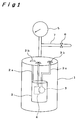
- the produced hydrogen absorbing alloy electrode in each of the embodiments 1 and 2 and the comparative examples 1 to 4 was used as a test electrode (a negative electrode), while a cylindrical sintered nickel electrode having a sufficiently larger electrochemical capacity than that of the test electrode was used as a counter electrode (a positive electrode), and a plate-shaped sintered nickel electrode was used as a reference electrode, to assemble a test cell as shown in Fig. 1.
- a cylindrical sintered nickel electrode 2 to be the above-mentioned counter electrode was held by a positive electrode lead 2a connected to the upper surface of a sealed container 1, and a test electrode 3 was held by a negative electrode lead 3a connected to the upper surface of the sealed container 1, as shown in Fig. 1.
- the test electrode 3 was vertically positioned in the center of the cylindrical sintered nickel electrode 2, and a plate-shaped sintered nickel electrode 4 to be the above-mentioned reference electrode was also positioned in the cylindrical sintered nickel electrode 2.
- terminal portions of the positive electrode lead 2a and the negative electrode lead 3a were exposed to the exterior after penetrating the upper surface of the sealed container 1, and were respectively connected to a positive electrode terminal 2b and a negative electrode terminal 3b.
- 30 % by weight of a potassium hydroxide solution was poured as an alkali electrolyte into the sealed container 1, the cylindrical sintered nickel electrode 2, the test electrode 3 and the plate-shaped sintered nickel electrode 4 were immersed in the alkali electrolyte, and a space of the sealed container 1 in an upper part of the alkali electrolyte was filled with nitrogen gas so that the internal pressure of the test cell would be 5 kgf/cm 2 .
- a pressure relief valve 7 comprising a pressure indicator 5 and a relief valve 6 was mounted on the center on the upper surface of the sealed container 1.
- Each of the test cells using the hydrogen absorbing alloy electrodes in the embodiments 1 and 2 and the comparative examples 1 to 4 was charged for eight hours at a current of 50 mA/g under ordinary temperature and was stopped for one hour, and was then discharged up to a final discharge voltage of 0.9 V at a current of 50 mA/g and was stopped for one hour.
- the foregoing was taken as one cycle, to achieve charging and discharging, and measure the initial discharge capacity of the test cell.
- the results were shown in the following Table 1.
- An alkali secondary battery of AA size in a cylindrical shape (having a capacity of 100 mAh) as shown in Fig. 2 was fabricated using each of the hydrogen absorbing alloy electrodes thus fabricated as its negative electrode, while using a sintered nickel electrode conventionally used as its positive electrode, and using a nonwoven fabric having alkali resistance as a separator.
- a separator 13 was interposed between the positive electrode 11 and the negative electrode 12, and they were spirally wound and contained in a battery can 14, after which 30 % by weight of a potassium hydroxide solution was pored as an alkali electrolyte into the battery can 14, and the battery can 14 was sealed, to connect the positive electrode 11 to a positive electrode cover 16 through a positive electrode lead 15 as well as to connect the negative electrode 12 to the battery can 14 through a negative electrode lead 17 so that the battery can 14 and the positive electrode cover 16 would be electrically separated from each other by an insulating packing 18.
- a coil spring 20 was provided between the positive electrode cover 16 and a positive electrode external terminal 19. When the internal pressure of the battery was abnormally increased, the coil spring 20 was compressed so that gas inside the battery would be emitted into air.
- each of the alkali secondary batteries fabricated as described above was charged at 1000 mA (1C) under ordinary temperature while measuring the internal pressure of the battery, and a charging time elapsed until the internal pressure of the alkali second battery reaches 10 kgf/cm2 was measured.
- the charging time was shown as the pressure characteristics in the early stages of the alkali secondary battery in the following Table 2.
- the hydrogen absorbing alloy powder which was treated as shown in the embodiments 1 and 2 and the comparative examples 1 and 3 was used, and was preserved in water for two weeks.
- the hydrogen absorbing alloy powder which was treated as shown in the embodiment 1 was used.
- the hydrogen absorbing alloy powder was preserved in water to which no quinone was added.
- the hydrogen absorbing alloy powder was preserved in water to which 20 ppm of quinone was added.
- the hydrogen absorbing alloy powder treated as shown in the embodiment 2 was used.
- the hydrogen absorbing alloy powder was preserved in water to which no quinone was added.
- the hydrogen absorbing alloy powder was preserved in water to which 20 ppm of quinone was added.
- the hydrogen absorbing alloy powder treated as shown in the comparative example 1 and the hydrogen absorbing alloy powder treated as shown in the comparative example 2 were respectively used in the embodiment 7 and the embodiment 8, and were preserved in water to which 20 ppm of quinone was added.
- the hydrogen absorbing alloy powder treated as shown in the comparative example 2 and the hydrogen absorbing alloy powder treated as shown in the comparative example 2 were respectively used in the comparative example 5 and the comparative example 6, and were preserved in water to which no quinone was added.
- the hydrogen absorbing alloy powder preserved in the water to which no quinone was added and the hydrogen absorbing alloy power preserved in the water to which quinone was added were used as described above were used, to produce test cells and alkali secondary batteries in the same manner as those in the embodiments 1 and 2 and the comparative examples 1 to 4.
- the initial discharge capacity of each of the test cells and the alkali secondary batteries was measured as in the above-mentioned case, and the internal pressure characteristics of each of the alkali secondary batteries was measured as in the above-mentioned case. The results thereof were together shown in the following Table 3.
Landscapes
- Chemical & Material Sciences (AREA)
- Chemical Kinetics & Catalysis (AREA)
- Electrochemistry (AREA)
- General Chemical & Material Sciences (AREA)
- Battery Electrode And Active Subsutance (AREA)
Abstract
Description
| fabricating conditions of hydrogen absorbing electrode | initial discharge capacity | ||||
| alloy producing method | presence of acid treatment | presence of quinone | test cell (mAh/g) | alkali secondary battery (mAh) | |
| | melting furnace | yes | yes | 276 | 830 |
| comparative example 1 | melting furnace | no | no | 222 | 620 |
| comparative example 2 | melting furnace | yes | no | 246 | 675 |
| | atomizing | yes | yes | 277 | 840 |
| comparative example 3 | atomizing | no | no | 170 | 580 |
| comparative example 4 | atomizing | yes | no | 221 | 620 |
| | comparative example 1 | comparative example 2 | | comparative example 3 | comparative example 4 | |
| internal pressure characteristics | 135 min. | 100 min. | 115 min. | 135 min. | 100 min. | 115 min. |
| electrode fabricating conditions | initial discharge capacity | internal pressure characteristics (min.) | |||
| type of hydrogen absorbing alloy | presence of quinone at the time of preservation in water | test cell (mAh/g) | alkali secondary battery (mAh) | ||
| | | no | 270 | 810 | 135 |
| | | yes | 280 | 840 | 140 |
| | | no | 268 | 805 | 135 |
| | | yes | 282 | 830 | 140 |
| | comparative example 1 | yes | 230 | 635 | 105 |
| embodiment 8 | comparative example 2 | yes | 175 | 580 | 105 |
| comparative example 5 | comparative example 1 | no | 220 | 610 | 100 |
| comparative example 6 | comparative example 2 | no | 165 | 565 | 100 |
Claims (20)
- A hydrogen absorbing alloy electrode including a hydrogen absorbing alloy, whereina hydrogen absorbing alloy treated upon being immersed in an acid solution to which at least a quinone compound is added is used.
- The hydrogen absorbing alloy electrode according to claim 1, whereina hydrogen absorbing alloy obtained by further immersing said hydrogen absorbing alloy in water to which at least a quinone compound is added is used.
- The hydrogen absorbing alloy electrode according to claim 1, whereinsaid quinone compound is quinone.
- The hydrogen absorbing alloy electrode according to claim 1, whereinsaid hydrogen absorbing alloy is a hydrogen absorbing alloy having a CaCu5-type crystal structure.
- A hydrogen absorbing alloy electrode including a hydrogen absorbing alloy, whereina hydrogen absorbing alloy immersed in water to which at least a quinone compound is added is used.
- The hydrogen absorbing alloy electrode according to claim 5, whereinsaid quinone compound is quinone.
- The hydrogen absorbing alloy electrode according to claim 5, whereinsaid hydrogen absorbing alloy is a hydrogen absorbing alloy having a CaCu5-type crystal structure.
- A method of fabricating a hydrogen absorbing alloy electrode including a hydrogen absorbing alloy, whereinsaid hydrogen absorbing alloy is treated upon being immersed in an acid solution to which at least a quinone compound is added.
- The method according to claim 8, whereinsaid hydrogen absorbing alloy is further immersed in water to which at least a quinone compound is added.
- The method according to claim 8, whereinsaid quinone compound is quinone.
- The method according to claim 8, whereinsaid hydrogen absorbing alloy is a hydrogen absorbing alloy having a CaCu5-type crystal structure.
- A method of fabricating a hydrogen absorbing alloy electrode including a hydrogen absorbing alloy, whereinsaid hydrogen absorbing alloy is immersed in water to which at least a quinone compound is added.
- The method according to claim 12, whereinsaid quinone compound is quinone.
- The method according to claim 12, whereinsaid hydrogen absorbing alloy is a hydrogen absorbing alloy having a CaCu5-type crystal structure.
- An alkali secondary battery using a hydrogen absorbing alloy electrode including a hydrogen absorbing alloy as its negative electrode, whereina hydrogen absorbing alloy treated upon being immersed in an acid solution to which at least a quinone compound is added is used for the hydrogen absorbing alloy electrode.
- The alkali secondary battery according to claim 15, whereina hydrogen absorbing alloy obtained by further immersing said hydrogen absorbing alloy in water to which at least a quinone compound is added is used for the hydrogen absorbing alloy electrode.
- The alkali secondary battery according to claim 15, whereinsaid quinone compound is quinone.
- The alkali secondary battery according to claim 17, whereinsaid hydrogen absorbing alloy is a hydrogen absorbing alloy having a CaCu5-type crystal structure.
- An alkali secondary battery using a hydrogen absorbing alloy electrode including a hydrogen absorbing alloy as its negative electrode, whereina hydrogen absorbing alloy immersed in water to which at least a quinone compound is added is used for the hydrogen absorbing alloy electrode.
- The alkali secondary battery according to claim 17, whereinsaid quinone compound is quinone.
Applications Claiming Priority (3)
| Application Number | Priority Date | Filing Date | Title |
|---|---|---|---|
| JP316823/96 | 1996-11-28 | ||
| JP31682396 | 1996-11-28 | ||
| JP31682396A JP3433033B2 (en) | 1996-11-28 | 1996-11-28 | Hydrogen storage alloy electrode and method of manufacturing hydrogen storage alloy electrode |
Publications (2)
| Publication Number | Publication Date |
|---|---|
| EP0845822A1 true EP0845822A1 (en) | 1998-06-03 |
| EP0845822B1 EP0845822B1 (en) | 2002-08-14 |
Family
ID=18081322
Family Applications (1)
| Application Number | Title | Priority Date | Filing Date |
|---|---|---|---|
| EP97120569A Expired - Lifetime EP0845822B1 (en) | 1996-11-28 | 1997-11-24 | Hydrogen absorbing alloy electrode, method of fabricating hydrogen absorbing alloy electrode, and alkali battery |
Country Status (5)
| Country | Link |
|---|---|
| US (1) | US6068948A (en) |
| EP (1) | EP0845822B1 (en) |
| JP (1) | JP3433033B2 (en) |
| CN (1) | CN1106049C (en) |
| DE (1) | DE69714689T2 (en) |
Families Citing this family (8)
| Publication number | Priority date | Publication date | Assignee | Title |
|---|---|---|---|---|
| KR100344143B1 (en) * | 1996-09-06 | 2002-07-24 | 가부시키가이샤 산도쿠 | Rare earth metal-nickel-base hydrogen absorbing alloy, process for preparing the same, and negative electrode for nickel-hydrogen rechargeable battery |
| WO1998033613A1 (en) * | 1997-01-31 | 1998-08-06 | Sanyo Electric Co., Ltd. | Hydrogen storage alloy powder ane method of manufacturing the same |
| JP2988479B1 (en) * | 1998-09-11 | 1999-12-13 | 松下電器産業株式会社 | Alkaline storage battery, hydrogen storage alloy electrode and method for producing the same |
| US6492057B1 (en) * | 1999-04-14 | 2002-12-10 | Ovonic Battery Company, Inc. | Electrochemical cell having reduced cell pressure |
| US8053106B1 (en) * | 2005-12-01 | 2011-11-08 | Quallion Llc | Battery with improved insulator |
| CN100459271C (en) * | 2005-12-06 | 2009-02-04 | 比亚迪股份有限公司 | Method for making alkali secondary cell |
| CA2925478C (en) * | 2013-09-26 | 2022-08-30 | President And Fellows Of Harvard College | Quinone and hydroquinone based rechargable battery |
| EP3653296B1 (en) * | 2017-07-12 | 2023-12-13 | Japan Science and Technology Agency | Intermetallic compound, hydrogen storage/release material, catalyst and method for producing ammonia |
Citations (3)
| Publication number | Priority date | Publication date | Assignee | Title |
|---|---|---|---|---|
| JPH05190175A (en) * | 1992-01-17 | 1993-07-30 | Matsushita Electric Ind Co Ltd | Surface treatment method of hydrogen storage alloy for alkaline secondary battery |
| JPH05195008A (en) * | 1992-01-14 | 1993-08-03 | Matsushita Electric Ind Co Ltd | Surface treatment method of hydrogen storage alloy for alkaline secondary battery and alkaline secondary battery provided with hydrogen storage alloy subjected to the surface treatment method as an electrode |
| JPH05225975A (en) * | 1992-02-13 | 1993-09-03 | Furukawa Battery Co Ltd:The | Hydrogen storage alloy electrode |
Family Cites Families (4)
| Publication number | Priority date | Publication date | Assignee | Title |
|---|---|---|---|---|
| JPH0799691B2 (en) * | 1990-11-10 | 1995-10-25 | 工業技術院長 | Method for manufacturing hydrogen storage electrode |
| JPH0773878A (en) * | 1993-08-31 | 1995-03-17 | Sanyo Electric Co Ltd | Manufacture of metal hydride electrode |
| JP3454600B2 (en) * | 1995-04-05 | 2003-10-06 | 三洋電機株式会社 | Method for producing hydrogen storage alloy for alkaline storage battery |
| US5858571A (en) * | 1996-08-30 | 1999-01-12 | Shin-Etsu Chemical Co., Ltd. | Method of producing hydrogen absorbing alloy powder, and electrode using hydrogen absorbing alloy powder produced by said method |
-
1996
- 1996-11-28 JP JP31682396A patent/JP3433033B2/en not_active Expired - Fee Related
-
1997
- 1997-11-24 US US08/976,659 patent/US6068948A/en not_active Expired - Fee Related
- 1997-11-24 EP EP97120569A patent/EP0845822B1/en not_active Expired - Lifetime
- 1997-11-24 DE DE69714689T patent/DE69714689T2/en not_active Expired - Fee Related
- 1997-11-28 CN CN97122630A patent/CN1106049C/en not_active Expired - Fee Related
Patent Citations (3)
| Publication number | Priority date | Publication date | Assignee | Title |
|---|---|---|---|---|
| JPH05195008A (en) * | 1992-01-14 | 1993-08-03 | Matsushita Electric Ind Co Ltd | Surface treatment method of hydrogen storage alloy for alkaline secondary battery and alkaline secondary battery provided with hydrogen storage alloy subjected to the surface treatment method as an electrode |
| JPH05190175A (en) * | 1992-01-17 | 1993-07-30 | Matsushita Electric Ind Co Ltd | Surface treatment method of hydrogen storage alloy for alkaline secondary battery |
| JPH05225975A (en) * | 1992-02-13 | 1993-09-03 | Furukawa Battery Co Ltd:The | Hydrogen storage alloy electrode |
Non-Patent Citations (3)
| Title |
|---|
| CHEMICAL ABSTRACTS, vol. 119, no. 26, 27 December 1993, Columbus, Ohio, US; abstract no. 275123, KAMIHARASHI, SEIJI ET AL: "Surface treatment of hydrogen-absorbing alloy anodes for secondary alkaline batteries" XP002057730 * |
| DATABASE WPI Section Ch Week 9335, Derwent World Patents Index; Class E19, AN 93-278502, XP002057731 * |
| PATENT ABSTRACTS OF JAPAN vol. 017, no. 668 (E - 1473) 9 December 1993 (1993-12-09) * |
Also Published As
| Publication number | Publication date |
|---|---|
| EP0845822B1 (en) | 2002-08-14 |
| US6068948A (en) | 2000-05-30 |
| JP3433033B2 (en) | 2003-08-04 |
| CN1184339A (en) | 1998-06-10 |
| JPH10162818A (en) | 1998-06-19 |
| DE69714689D1 (en) | 2002-09-19 |
| CN1106049C (en) | 2003-04-16 |
| DE69714689T2 (en) | 2003-04-10 |
Similar Documents
| Publication | Publication Date | Title |
|---|---|---|
| KR920010422B1 (en) | Hydrogen Absorption Storage Electrode and Manufacturing Method Thereof | |
| EP0383991B2 (en) | Alkaline storage battery using hydrogen absorbing alloy | |
| US6673490B2 (en) | Nickel-hydrogen storage battery and method of producing the same | |
| EP0845822B1 (en) | Hydrogen absorbing alloy electrode, method of fabricating hydrogen absorbing alloy electrode, and alkali battery | |
| KR100412625B1 (en) | Nickel-hydrogen storage battery | |
| EP1075032B1 (en) | Hydrogen absorbing alloy and nickel-metal hydride rechargeable battery | |
| EP0845823B1 (en) | Hydrogen absorbing alloy electrode, method of fabricating hydrogen absorbing alloy electrode, and alkali secondary battery | |
| US20050100789A1 (en) | Nickel metal hydride storage battery | |
| US6197448B1 (en) | Hydrogen storage alloy | |
| US6221528B1 (en) | Hydrogen-absorbing alloy electrode for alkaline secondary battery and method of manufacturing thereof | |
| JP3402992B2 (en) | Nickel-hydrogen battery pack | |
| US6395424B1 (en) | Hydrogen absorbing alloy for alkali storage battery, hydrogen absorbing alloy electrode for alkali storage battery, and alkali storage battery | |
| JPH1167264A (en) | Manufacture of nickel-hydrogen storage battery | |
| JP3377591B2 (en) | Manufacturing method of metal oxide / hydrogen secondary battery | |
| EP1096584A1 (en) | Hydrogen absorbing alloy for alkaline storage battery and method for production thereof, and hydrogen absorbing alloy electrode for alkaline storage battery and method for production thereof | |
| JP3746086B2 (en) | Method for manufacturing nickel-metal hydride battery | |
| JP2989300B2 (en) | Metal-hydrogen alkaline storage battery | |
| JPH05144432A (en) | Electrode with hydrogen storage alloy | |
| JPH05114403A (en) | Hydrogen storage alloy electrode and manufacture thereof | |
| KR19990012199A (en) | Hydrogen storage alloy of nickel hydrogen battery | |
| EP0566055A1 (en) | A hydrogen storage alloy electrode | |
| JPH04329266A (en) | Alkaline storage battery | |
| JPH10162819A (en) | Hydrogen storage alloy electrode and manufacture thereof | |
| JPH07320739A (en) | Hydrogen storage alloy electrode | |
| JPH10162813A (en) | Hydrogen storage alloy electrode and manufacture thereof |
Legal Events
| Date | Code | Title | Description |
|---|---|---|---|
| PUAI | Public reference made under article 153(3) epc to a published international application that has entered the european phase |
Free format text: ORIGINAL CODE: 0009012 |
|
| AK | Designated contracting states |
Kind code of ref document: A1 Designated state(s): DE FR GB |
|
| AX | Request for extension of the european patent |
Free format text: AL;LT;LV;MK;RO;SI |
|
| 17P | Request for examination filed |
Effective date: 19980630 |
|
| AKX | Designation fees paid |
Free format text: DE FR GB |
|
| RBV | Designated contracting states (corrected) |
Designated state(s): DE FR GB |
|
| 17Q | First examination report despatched |
Effective date: 19991208 |
|
| GRAG | Despatch of communication of intention to grant |
Free format text: ORIGINAL CODE: EPIDOS AGRA |
|
| GRAG | Despatch of communication of intention to grant |
Free format text: ORIGINAL CODE: EPIDOS AGRA |
|
| GRAG | Despatch of communication of intention to grant |
Free format text: ORIGINAL CODE: EPIDOS AGRA |
|
| GRAH | Despatch of communication of intention to grant a patent |
Free format text: ORIGINAL CODE: EPIDOS IGRA |
|
| GRAH | Despatch of communication of intention to grant a patent |
Free format text: ORIGINAL CODE: EPIDOS IGRA |
|
| GRAA | (expected) grant |
Free format text: ORIGINAL CODE: 0009210 |
|
| AK | Designated contracting states |
Kind code of ref document: B1 Designated state(s): DE FR GB |
|
| REG | Reference to a national code |
Ref country code: GB Ref legal event code: FG4D |
|
| REF | Corresponds to: |
Ref document number: 69714689 Country of ref document: DE Date of ref document: 20020919 |
|
| ET | Fr: translation filed | ||
| PLBE | No opposition filed within time limit |
Free format text: ORIGINAL CODE: 0009261 |
|
| STAA | Information on the status of an ep patent application or granted ep patent |
Free format text: STATUS: NO OPPOSITION FILED WITHIN TIME LIMIT |
|
| 26N | No opposition filed |
Effective date: 20030515 |
|
| PGFP | Annual fee paid to national office [announced via postgrant information from national office to epo] |
Ref country code: FR Payment date: 20061108 Year of fee payment: 10 |
|
| PGFP | Annual fee paid to national office [announced via postgrant information from national office to epo] |
Ref country code: DE Payment date: 20061116 Year of fee payment: 10 |
|
| PGFP | Annual fee paid to national office [announced via postgrant information from national office to epo] |
Ref country code: GB Payment date: 20061122 Year of fee payment: 10 |
|
| GBPC | Gb: european patent ceased through non-payment of renewal fee |
Effective date: 20071124 |
|
| PG25 | Lapsed in a contracting state [announced via postgrant information from national office to epo] |
Ref country code: DE Free format text: LAPSE BECAUSE OF NON-PAYMENT OF DUE FEES Effective date: 20080603 |
|
| REG | Reference to a national code |
Ref country code: FR Ref legal event code: ST Effective date: 20080930 |
|
| PG25 | Lapsed in a contracting state [announced via postgrant information from national office to epo] |
Ref country code: GB Free format text: LAPSE BECAUSE OF NON-PAYMENT OF DUE FEES Effective date: 20071124 |
|
| PG25 | Lapsed in a contracting state [announced via postgrant information from national office to epo] |
Ref country code: FR Free format text: LAPSE BECAUSE OF NON-PAYMENT OF DUE FEES Effective date: 20071130 |