EP0842496B1 - Verfahren und apparat zum maximierung der visuellen qualität eines in elektrischer form präsentierten bildes - Google Patents
Verfahren und apparat zum maximierung der visuellen qualität eines in elektrischer form präsentierten bildes Download PDFInfo
- Publication number
- EP0842496B1 EP0842496B1 EP96917514A EP96917514A EP0842496B1 EP 0842496 B1 EP0842496 B1 EP 0842496B1 EP 96917514 A EP96917514 A EP 96917514A EP 96917514 A EP96917514 A EP 96917514A EP 0842496 B1 EP0842496 B1 EP 0842496B1
- Authority
- EP
- European Patent Office
- Prior art keywords
- image
- colour
- colour reproduction
- procedure
- determined
- Prior art date
- Legal status (The legal status is an assumption and is not a legal conclusion. Google has not performed a legal analysis and makes no representation as to the accuracy of the status listed.)
- Expired - Lifetime
Links
Images
Classifications
-
- H—ELECTRICITY
- H04—ELECTRIC COMMUNICATION TECHNIQUE
- H04N—PICTORIAL COMMUNICATION, e.g. TELEVISION
- H04N1/00—Scanning, transmission or reproduction of documents or the like, e.g. facsimile transmission; Details thereof
- H04N1/46—Colour picture communication systems
- H04N1/56—Processing of colour picture signals
- H04N1/60—Colour correction or control
- H04N1/6077—Colour balance, e.g. colour cast correction
- H04N1/608—Colour balance, e.g. colour cast correction within the L, C1, C2 colour signals
-
- H—ELECTRICITY
- H04—ELECTRIC COMMUNICATION TECHNIQUE
- H04N—PICTORIAL COMMUNICATION, e.g. TELEVISION
- H04N9/00—Details of colour television systems
- H04N9/64—Circuits for processing colour signals
- H04N9/643—Hue control means, e.g. flesh tone control
-
- H—ELECTRICITY
- H04—ELECTRIC COMMUNICATION TECHNIQUE
- H04N—PICTORIAL COMMUNICATION, e.g. TELEVISION
- H04N9/00—Details of colour television systems
- H04N9/64—Circuits for processing colour signals
- H04N9/73—Colour balance circuits, e.g. white balance circuits or colour temperature control
Definitions
- the present invention relates to a procedure for automatically maximizing the visual quality of an image in electric format as defined in claim 1.
- the present invention relates to an apparatus for optimizing the visual quality of an image in electric format as defined in claim 8.
- the object of the present invention is to eliminate the problems and drawbacks described above.
- a specific object of the present invention is to produce a new type of procedure for image processing which can be easily implemented and automated for use in the processing of large amounts of images.
- a further object of the present invention is to produce an apparatus which can be used for the processing of an image being transmitted in an information network, a printing system or the like to optimize the visual quality of the image without significantly retarding its transmission.
- An additional object of the present invention is to present a procedure which can be used for improving the visual quality of an image without special image processing skill.
- an image in electric format preferably a colour image
- the image may be a packed one, obtained by packing methods known in themselves, e.g. methods employing the GIF or TIFF standard.
- the image is converted into a chromaticity coordinate format, preferably an Ls ⁇ coordinate format, where L stands for luminance, s for colour saturation, and ⁇ for hue angle.
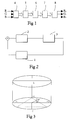
- Ls ⁇ values are determined for the RGB values in Fig. 1 according to the following equations.
- R, G and B values for the new parameters can be adjusted by means of the constants k 1 , k 2 and k 3 , and the proportion of neutral and saturated colours by means of the constant a.
- the image can also be converted into a format employing a different coordinate system.
- the greyness balance of the image is determined and compared with a standard observer's greyness balance preference. Based on this comparison, the greyness balance of the image is adjusted to make it correspond to the standard observer's preference.
- the highest and lowest luminance values of the grey shades are determined, a probability model is used to determine whether the shades should be neutral grey and the whole image is shifted in the colour space so that the highest and the lowest values correspond to neutral grey.
- the purpose of this operation is to adjust the greyness balance of the image so that white will be perceived as white and black will be perceived as black to a maximum degree of "correctness".
- the optimized image is converted from the chromaticity coordinate format back into its original format.
- the colour reproduction of the image is optimized to make it correspond to a standard observer's preference.
- a visual processor has been taught a preference selected on the basis of a large number of images of various themes presented to a number of test persons.
- the visual processor adjusts the visual quality of each image to a maximum level.
- the teaching of the visual processor can be performed by a control parameter optimizing method or a neural network method.
- the procedure of the invention has several advantages as compared with prior art.
- the most important and most significant advantage is undoubtedly the fact that the procedure corrects the visual quality of the image automatically and independently of the source, in other words, the technical origin as well as the "correct" colour reproduction are unknown.
- the procedure can be implemented independently of hardware, which means that the display device or printer eventually used to reproduce the image need not be known.
- the procedure can also be provided with profiles of different output device groups or individual devices, and the procedure can be incorporated in individual output devices.
- a further advantage of the present invention as compared with prior art is that the procedure can be easily standardized for use as a method of improving image quality in information networks.
- the procedure can be applied for different types of display devices, including the cathode ray tube, liquid crystal display and electroluminescent display.
- the procedure can be applied for different types of display control systems, including standardized computer screens and computer screens developed for special uses, as well as television screens employing the normal and HDTV standards.
- the procedure can be applied for different types of colour printer, including electrography, ink jet, thermal printers, electronic colour printing machines and other printing machines connectable to a computer.
- the colour reproduction of an image is determined and compared with a predetermined colour reproduction preference of a standard observer and, based on this comparison, the colour reproduction of the image is accentuated to make it correspond to the standard observer's preference.
- the colour reproduction of the image is accentuated by adjusting the global colour reproduction of the image to make it correspond to the standard observer's preference.
- Global colour reproduction means the colour reproduction in the entire image, in other words, at this stage of the procedure the colours in the entire image are crispened or accentuated.
- the colour reproduction of the image is accentuated by locating local colour areas on the basis of occurrence probabilities and adjusting the colour reproduction in the image areas encountered to make it correspond to the standard observer's preference.
- detected continuous areas of sufficient size are compared with predefined values.
- a given standard colour can be defined beforehand e.g. for the human skin, the sky, water and any objects, such as a Coca Cola can. From the shape, size, position and size of chromaticity statistic of a colour area encountered, it is possible to infer whether it is a predefined colour type. If such as colour type is encountered, the local colour area in the image is adjusted to make it correspond to the predefined colour.
- the image is classified according to certain classification rules.
- the image can be subjected to a certain type of thematic classification, to determine e.g. whether the image represents a portrait or a landscape.
- the image can be subjected to a certain type of quality classification to determine the quality of the image.
- Quality classes have preferably been defined beforehand. The quality classification is used to prevent "over-optimization" of an image, i.e. to ensure that an image whose quality has already been visually optimized by the method of the invention will not be processed again.
- the standard observer's preference mentioned in this application is determined by presenting a number of images to a large number of people and using their observations to determine optimal values for the greyness balance, global colour reproduction and local colour reproduction of the images. Let it be stated that the standard observer's preference can be continuously "improved" by increasing the number of people to whom the images are presented. On the other hand, it is also possible to use a standard observer's preference produced by a highly skilled image processing specialist. This can be achieved e.g. by teaching that preference to the apparatus implementing the procedure.
- the apparatus of the present invention for optimizing the visual quality of an image in electric format comprises a visual processor which stores predefined standard observer's preference values for greyness balance and colour reproduction and which receives an image, analyzes and classifies it and makes decisions as to how the image is to be adjusted, and a signal processor electrically connected to the visual processor to adjust the image as controlled by the visual processor.
- the visual processor preferably comprises conversion means for converting the image into an Ls ⁇ coordinate format. Further, the conversion means preferably consist of electric components in the processor circuit.
- the signal processor may be any kind of microprocessor, programmable circuit or application-specific integrated circuit (ASIC) suited for use in signal processing.
- the procedure of the invention works as follows.
- An image e.g. in an RGB format is received in block 4 and converted into an Ls ⁇ format. This conversion is described later on by referring to Fig. 3.
- an adjustment of the greyness balance is effected in block 5.
- highest and lowest values for parameter L are determined and compared with predefined values. If necessary, based on the comparison, the whole Ls ⁇ colour space of the image is shifted so that the highest and lowest values fall on the desired point in the colour space.
- the apparatus shown in Fig. 2 also comprises a printer or a display 3 used to print or display the corrected image.
- the colour space represented by Fig. 3 is of a cylindrical shape.
- R, G and B values for the new parameters can be adjusted by means of the constants k 1 , k 2 and k 3 , and the proportion of neutral and saturated colours by means of the constant a.
Landscapes
- Engineering & Computer Science (AREA)
- Multimedia (AREA)
- Signal Processing (AREA)
- Facsimile Image Signal Circuits (AREA)
- Color Image Communication Systems (AREA)
- Image Processing (AREA)
- Controls And Circuits For Display Device (AREA)
- Processing Of Color Television Signals (AREA)
Claims (9)
- Verfahren zum automatischen Maximieren der visuellen Qualität eines Bildes in elektrischem Format, bei welchem:dadurch gekennzeichnet, daß die folgenden Operationen automatisch durchgeführt werden:das Bild in das Farbwertkoordinatenformat verarbeitet wird; unddie Bildparameter, wie etwa ein wahrscheinlicher Grauwertabgleich, die allgemeine Farbwiedergabe und die lokale Farbwiedergabe des Bildes, für das Bild durch ein statistisches Verfahren aus dem Videosignal bestimmt werden;die Parameter des Bildes werden mit bestimmten Parametern verglichen, die auf einen Normbetrachter bezogen sind, und basierend auf diesem Vergleich werden der wahrscheinliche Grauwertabgleich, die allgemeine Farbwiedergabe und/oder die lokale Farbwiedergabe des Bildes hervorgehoben, um es so der bevorzugten Einstellung des Normbetrachters entsprechen zu lassen, wobei die bevorzugte Einstellung des Normbetrachters bestimmt wird, indem eine Anzahl von Bildern einer großen Anzahl von Menschen präsentiert wird und deren Beobachtungen verwendet werden, um optimale Werte für den Grauwertabgleich, die allgemeine Farbwiedergabe und/oder die lokale Farbwiedergabe des Bildes zu bestimmen.
- Verfahren nach Anspruch 1,
dadurch gekennzeichnet, daß in einem LSα-Koordinatenformat, in dem L für Luminanz, s für Farbsättigung und α für den Farbtonwinkel steht, diese Werte aus den RGB-Werten des Bildes mit Hilfe der Gleichungen: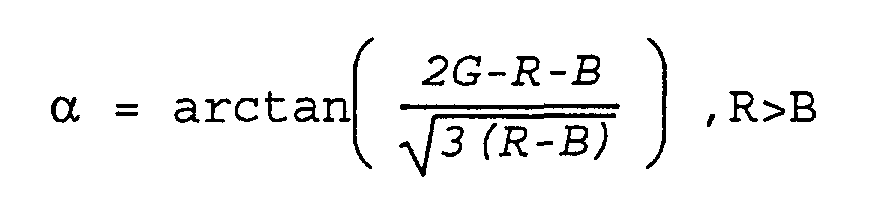 (wenn R = B:α = 3/2π; wenn α>0:α = π+2π) bestimmt werden.
- Verfahren nach Anspruch 1 oder 2,
dadurch gekennzeichnet, daß die Farbwiedergabe des Bildes durch Einstellen der allgemeinen Farbwiedergabe des Bildes in der Weise, daß sie der bevorzugten Einstellung des Normbetrachters entspricht, hervorgehoben wird. - Verfahren nach einem der vorstehenden Ansprüche 1 - 3,
dadurch gekennzeichnet, daß die Farbwiedergabe des Bildes dadurch hervorgehoben wird, daß lokale Farbbereiche auf der Basis von Vorkommenswahrscheinlichkeiten gefunden werden und die Farbwiedergabe in den in dem Bild angetroffenen Bereichen so eingestellt wird, daß sie der bevorzugten Einstellung des Normbetrachters entspricht. - Verfahren nach einem der vorstehenden Ansprüche 1 - 4,
dadurch gekennzeichnet, daß ein Histogramm erzeugt wird, das den Farbraum des Bildes darstellt, der höchste und der niedrigste Wert der Graustufen bestimmt wird, die Werte mit Wahrscheinlichkeitswerten verglichen werden und auf der Basis dieses Vergleichs das Bild im Farbraum so verschoben wird, daß der höchste und der niedrigste Wert neutralem Grau entsprechen. - Verfahren nach einem der vorstehenden Ansprüche 1 - 5,
dadurch gekennzeichnet, daß das Thema des Bildes bestimmt wird und das Bild gemäß seinem Thema in ein vorher festgelegtes Thema aus einer Anzahl von Themen eingeteilt wird, wobei Thema den thematischen Gegenstand des Bildes bezeichnet, wie etwa ein Porträt oder eine Landschaft. - Verfahren nach einem der vorstehenden Ansprüche 1 - 6,
dadurch gekennzeichnet, daß das Qualitätsniveau des Bildes bestimmt wird und das Bild gemäß seinem Qualitätsniveau in ein vorher festgelegtes Qualitätsniveau aus einer Anzahl von vorher festgelegten Qualitätsniveaus eingeteilt wird. - Vorrichtung zum Optimieren der visuellen Qualität eines Bildes in einem elektrischen Format, wobei die Vorrichtung einen visuellen Prozessor (1) enthält, in dem eine vorbestimmte Funktion der bevorzugten Einstellungen eines Normbetrachters zum Korrigieren der statistisch bestimmten Bildparameter, wie z.B. Grauwertabgleich und Farbwiedergabe des Bildes, verarbeitet in einem Farbwertkoordinatenformat, gespeichert ist und der das Bild empfängt, analysiert und klassifiziert und die Entscheidungen trifft, wie das Bild einzustellen ist, sowie einen Signalprozessor (2), der mit dem visuellen Prozessor elektrisch verbunden ist, um die Einstellung des Bildes unter Steuerung des visuellen Prozessors zu ermöglichen, wobei die bevorzugte Einstellung eines Normbetrachters bestimmt wird, indem eine Anzahl von Bildern einer großen Anzahl von Menschen präsentiert wird und deren Beobachtungen verwendet werden, um optimale Werte für den Grauwertabgleich, die allgemeine Farbwiedergabe und/oder die lokale Farbwiedergabe des Bildes zu bestimmen.
- Vorrichtung nach Anspruch 8,
dadurch gekennzeichnet, daß der visuelle Prozessor eine Umwandlungseinrichtung zum Umwandeln des Bildes in ein Lsα-Koordinatensystem enthält.
Applications Claiming Priority (3)
| Application Number | Priority Date | Filing Date | Title |
|---|---|---|---|
| FI953061 | 1995-06-20 | ||
| FI953061A FI107412B (fi) | 1995-06-20 | 1995-06-20 | Menetelmä ja laite sähköisessä muodossa olevan kuvan visuaalisen laadun maksimoimiseksi |
| PCT/FI1996/000339 WO1997001151A1 (en) | 1995-06-20 | 1996-06-07 | Method and apparatus for maximizing the visual quality of image presented in electric form |
Publications (2)
| Publication Number | Publication Date |
|---|---|
| EP0842496A1 EP0842496A1 (de) | 1998-05-20 |
| EP0842496B1 true EP0842496B1 (de) | 2002-07-24 |
Family
ID=8543645
Family Applications (1)
| Application Number | Title | Priority Date | Filing Date |
|---|---|---|---|
| EP96917514A Expired - Lifetime EP0842496B1 (de) | 1995-06-20 | 1996-06-07 | Verfahren und apparat zum maximierung der visuellen qualität eines in elektrischer form präsentierten bildes |
Country Status (6)
| Country | Link |
|---|---|
| US (1) | US6268940B1 (de) |
| EP (1) | EP0842496B1 (de) |
| JP (1) | JPH11514166A (de) |
| DE (1) | DE69622567T2 (de) |
| FI (1) | FI107412B (de) |
| WO (1) | WO1997001151A1 (de) |
Families Citing this family (9)
| Publication number | Priority date | Publication date | Assignee | Title |
|---|---|---|---|---|
| EP1248455A1 (de) | 2001-04-05 | 2002-10-09 | Imip Llc | Automatische Inhaltsuntersuchung für Farbkorrekturvorrichtung |
| US7003174B2 (en) | 2001-07-02 | 2006-02-21 | Corel Corporation | Removal of block encoding artifacts |
| US7009733B2 (en) | 2001-07-02 | 2006-03-07 | Coral Corporation | Manual correction of an image color |
| US6826310B2 (en) | 2001-07-06 | 2004-11-30 | Jasc Software, Inc. | Automatic contrast enhancement |
| US6868179B2 (en) | 2001-07-06 | 2005-03-15 | Jasc Software, Inc. | Automatic saturation adjustment |
| EP1545135B1 (de) * | 2002-09-26 | 2013-04-03 | Seiko Epson Corporation | Einstellung des ausgangsbildes von bilddaten |
| JP5173120B2 (ja) * | 2005-05-23 | 2013-03-27 | オリンパスメディカルシステムズ株式会社 | 内視鏡装置 |
| US7876970B2 (en) | 2006-01-13 | 2011-01-25 | Qualcomm Incorporated | Method and apparatus for white balancing digital images |
| US7889245B2 (en) * | 2007-01-12 | 2011-02-15 | Seiko Epson Corporation | Automatic white balancing of a digital image |
Family Cites Families (13)
| Publication number | Priority date | Publication date | Assignee | Title |
|---|---|---|---|---|
| US5838455A (en) * | 1919-05-11 | 1998-11-17 | Minolta Co., Ltd. | Image processor with image data compression capability |
| JPS5689729A (en) | 1979-12-21 | 1981-07-21 | Fuji Photo Film Co Ltd | Picture information input device |
| JPS6120042A (ja) * | 1984-07-06 | 1986-01-28 | Dainippon Screen Mfg Co Ltd | 画像走査記録方法及び装置 |
| US5282030A (en) * | 1990-11-19 | 1994-01-25 | Olympus Optical Co., Ltd. | Endoscopic image processor and endoscopic image processing method |
| JPH06121161A (ja) * | 1991-05-14 | 1994-04-28 | Fuji Xerox Co Ltd | カラー画像処理装置の文字処理方式 |
| JP3082289B2 (ja) * | 1991-05-14 | 2000-08-28 | 富士ゼロックス株式会社 | 画像処理装置 |
| JP3317446B2 (ja) * | 1991-05-14 | 2002-08-26 | 富士ゼロックス株式会社 | 画像処理装置 |
| US5448502A (en) * | 1991-06-20 | 1995-09-05 | Matsushita Electric Industrial Co., Ltd. | Devices for judging image on the basis of gray world assumption, discriminating color chart, deducing light source and regulating color |
| JP2741996B2 (ja) * | 1992-10-30 | 1998-04-22 | 大日本スクリーン製造株式会社 | 正規化曲線の作成方法 |
| IL106406A (en) * | 1993-07-20 | 1997-03-18 | Scitex Corp Ltd And Advanced V | Automatic inspection of printing plates or cylinders |
| JP2959385B2 (ja) * | 1993-08-23 | 1999-10-06 | ブラザー工業株式会社 | カラー出力用データの色値データ変換装置 |
| US5357352A (en) | 1993-10-04 | 1994-10-18 | Xerox Corporation | Image-dependent color shifting of strongly color shifted images |
| JPH07322080A (ja) * | 1994-05-26 | 1995-12-08 | Fuji Xerox Co Ltd | カラー画像読取装置 |
-
1995
- 1995-06-20 FI FI953061A patent/FI107412B/fi not_active IP Right Cessation
-
1996
- 1996-06-07 US US08/973,894 patent/US6268940B1/en not_active Expired - Lifetime
- 1996-06-07 EP EP96917514A patent/EP0842496B1/de not_active Expired - Lifetime
- 1996-06-07 DE DE69622567T patent/DE69622567T2/de not_active Expired - Lifetime
- 1996-06-07 WO PCT/FI1996/000339 patent/WO1997001151A1/en not_active Ceased
- 1996-06-07 JP JP9503603A patent/JPH11514166A/ja active Pending
Also Published As
| Publication number | Publication date |
|---|---|
| US6268940B1 (en) | 2001-07-31 |
| DE69622567T2 (de) | 2003-04-03 |
| FI953061L (fi) | 1996-12-21 |
| JPH11514166A (ja) | 1999-11-30 |
| EP0842496A1 (de) | 1998-05-20 |
| FI107412B (fi) | 2001-07-31 |
| FI953061A0 (fi) | 1995-06-20 |
| DE69622567D1 (de) | 2002-08-29 |
| WO1997001151A1 (en) | 1997-01-09 |
Similar Documents
| Publication | Publication Date | Title |
|---|---|---|
| US5070413A (en) | Color digital halftoning with vector error diffusion | |
| US6591008B1 (en) | Method and apparatus for displaying pictorial images to individuals who have impaired color and/or spatial vision | |
| US6204940B1 (en) | Digital processing of scanned negative films | |
| JP3640989B2 (ja) | 露光変更方法及び画像処理システム | |
| US6181445B1 (en) | Device-independent and medium-independent color matching between an input device and an output device | |
| US6628830B1 (en) | Image processing method and apparatus and storage medium | |
| EP0720351B1 (de) | Verfahren zur Erzeugung von Farbprobeabzügen | |
| US6192152B1 (en) | Image processing apparatus | |
| US7142711B2 (en) | Image processing method and image apparatus, and image forming apparatus, program, and storage medium | |
| US20110317222A1 (en) | Methods and apparatus for dynamically soft proofing halftone images | |
| US20040257378A1 (en) | Method for converting color to monochrome to maintain differentiability | |
| EP0842496B1 (de) | Verfahren und apparat zum maximierung der visuellen qualität eines in elektrischer form präsentierten bildes | |
| US8041112B2 (en) | Image processing apparatus, image forming apparatus, image reading apparatus, image processing method, image processing program, computer-readable storage medium for storing the image processing program with segmentation and density correction optimization | |
| US5854883A (en) | Color proofing method providing accurate visual simulation of screens | |
| JP3950551B2 (ja) | 画像処理方法、装置および記録媒体 | |
| EP1011263A2 (de) | Farbkorrekturverfahren mit Multipegelhalbtonrasterung | |
| JP3360476B2 (ja) | 画像処理方法及び装置 | |
| US6424740B1 (en) | Method and means for producing high quality digital reflection prints from transparency images | |
| JP2004297617A (ja) | 画像処理装置、画像形成装置、画像処理方法、画像処理プログラム、及び画像処理プログラムを記録したコンピュータ読み取り可能な記録媒体 | |
| KR100460980B1 (ko) | 인쇄화질 개선장치 및 그 방법 | |
| Samadzadegan et al. | Spatio-spectral gamut mapping and separation | |
| Stanek et al. | Scanning parameter selection for inkjet print analysis | |
| KR20040011095A (ko) | 디지털 화질 개선 방법 |
Legal Events
| Date | Code | Title | Description |
|---|---|---|---|
| PUAI | Public reference made under article 153(3) epc to a published international application that has entered the european phase |
Free format text: ORIGINAL CODE: 0009012 |
|
| 17P | Request for examination filed |
Effective date: 19971210 |
|
| AK | Designated contracting states |
Kind code of ref document: A1 Designated state(s): BE DE ES FR GB IT SE |
|
| 17Q | First examination report despatched |
Effective date: 20001214 |
|
| GRAG | Despatch of communication of intention to grant |
Free format text: ORIGINAL CODE: EPIDOS AGRA |
|
| GRAG | Despatch of communication of intention to grant |
Free format text: ORIGINAL CODE: EPIDOS AGRA |
|
| GRAH | Despatch of communication of intention to grant a patent |
Free format text: ORIGINAL CODE: EPIDOS IGRA |
|
| GRAH | Despatch of communication of intention to grant a patent |
Free format text: ORIGINAL CODE: EPIDOS IGRA |
|
| GRAA | (expected) grant |
Free format text: ORIGINAL CODE: 0009210 |
|
| AK | Designated contracting states |
Kind code of ref document: B1 Designated state(s): BE DE ES FR GB IT SE |
|
| PG25 | Lapsed in a contracting state [announced via postgrant information from national office to epo] |
Ref country code: IT Free format text: LAPSE BECAUSE OF FAILURE TO SUBMIT A TRANSLATION OF THE DESCRIPTION OR TO PAY THE FEE WITHIN THE PRESCRIBED TIME-LIMIT;WARNING: LAPSES OF ITALIAN PATENTS WITH EFFECTIVE DATE BEFORE 2007 MAY HAVE OCCURRED AT ANY TIME BEFORE 2007. THE CORRECT EFFECTIVE DATE MAY BE DIFFERENT FROM THE ONE RECORDED. Effective date: 20020724 Ref country code: BE Free format text: LAPSE BECAUSE OF FAILURE TO SUBMIT A TRANSLATION OF THE DESCRIPTION OR TO PAY THE FEE WITHIN THE PRESCRIBED TIME-LIMIT Effective date: 20020724 |
|
| REG | Reference to a national code |
Ref country code: GB Ref legal event code: FG4D |
|
| REF | Corresponds to: |
Ref document number: 69622567 Country of ref document: DE Date of ref document: 20020829 |
|
| PG25 | Lapsed in a contracting state [announced via postgrant information from national office to epo] |
Ref country code: SE Free format text: LAPSE BECAUSE OF FAILURE TO SUBMIT A TRANSLATION OF THE DESCRIPTION OR TO PAY THE FEE WITHIN THE PRESCRIBED TIME-LIMIT Effective date: 20021024 |
|
| PG25 | Lapsed in a contracting state [announced via postgrant information from national office to epo] |
Ref country code: ES Free format text: LAPSE BECAUSE OF FAILURE TO SUBMIT A TRANSLATION OF THE DESCRIPTION OR TO PAY THE FEE WITHIN THE PRESCRIBED TIME-LIMIT Effective date: 20030130 |
|
| ET | Fr: translation filed | ||
| PLBE | No opposition filed within time limit |
Free format text: ORIGINAL CODE: 0009261 |
|
| STAA | Information on the status of an ep patent application or granted ep patent |
Free format text: STATUS: NO OPPOSITION FILED WITHIN TIME LIMIT |
|
| 26N | No opposition filed |
Effective date: 20030425 |
|
| REG | Reference to a national code |
Ref country code: GB Ref legal event code: 732E |
|
| REG | Reference to a national code |
Ref country code: FR Ref legal event code: TP |
|
| REG | Reference to a national code |
Ref country code: FR Ref legal event code: PLFP Year of fee payment: 20 |
|
| PGFP | Annual fee paid to national office [announced via postgrant information from national office to epo] |
Ref country code: GB Payment date: 20150615 Year of fee payment: 20 Ref country code: DE Payment date: 20150624 Year of fee payment: 20 |
|
| PGFP | Annual fee paid to national office [announced via postgrant information from national office to epo] |
Ref country code: FR Payment date: 20150630 Year of fee payment: 20 |
|
| REG | Reference to a national code |
Ref country code: DE Ref legal event code: R071 Ref document number: 69622567 Country of ref document: DE |
|
| REG | Reference to a national code |
Ref country code: GB Ref legal event code: PE20 Expiry date: 20160606 |
|
| PG25 | Lapsed in a contracting state [announced via postgrant information from national office to epo] |
Ref country code: GB Free format text: LAPSE BECAUSE OF EXPIRATION OF PROTECTION Effective date: 20160606 |