EP0837955B1 - Gleitschicht auf kupferbasis - Google Patents
Gleitschicht auf kupferbasis Download PDFInfo
- Publication number
- EP0837955B1 EP0837955B1 EP96920626A EP96920626A EP0837955B1 EP 0837955 B1 EP0837955 B1 EP 0837955B1 EP 96920626 A EP96920626 A EP 96920626A EP 96920626 A EP96920626 A EP 96920626A EP 0837955 B1 EP0837955 B1 EP 0837955B1
- Authority
- EP
- European Patent Office
- Prior art keywords
- area
- particle
- subtotal
- lead
- sectional
- Prior art date
- Legal status (The legal status is an assumption and is not a legal conclusion. Google has not performed a legal analysis and makes no representation as to the accuracy of the status listed.)
- Expired - Lifetime
Links
- RYGMFSIKBFXOCR-UHFFFAOYSA-N Copper Chemical compound [Cu] RYGMFSIKBFXOCR-UHFFFAOYSA-N 0.000 title claims description 13
- 229910052802 copper Inorganic materials 0.000 title claims description 13
- 239000010949 copper Substances 0.000 title claims description 13
- 239000002245 particle Substances 0.000 claims description 42
- 239000011159 matrix material Substances 0.000 claims description 5
- 229910000881 Cu alloy Inorganic materials 0.000 claims description 3
- 239000011133 lead Substances 0.000 description 42
- 239000012791 sliding layer Substances 0.000 description 22
- 238000009826 distribution Methods 0.000 description 13
- PXHVJJICTQNCMI-UHFFFAOYSA-N Nickel Chemical compound [Ni] PXHVJJICTQNCMI-UHFFFAOYSA-N 0.000 description 6
- 238000005266 casting Methods 0.000 description 6
- 239000000463 material Substances 0.000 description 6
- 238000005520 cutting process Methods 0.000 description 5
- 239000013589 supplement Substances 0.000 description 5
- 239000012876 carrier material Substances 0.000 description 4
- 229910000906 Bronze Inorganic materials 0.000 description 3
- ATJFFYVFTNAWJD-UHFFFAOYSA-N Tin Chemical compound [Sn] ATJFFYVFTNAWJD-UHFFFAOYSA-N 0.000 description 3
- 239000010974 bronze Substances 0.000 description 3
- KUNSUQLRTQLHQQ-UHFFFAOYSA-N copper tin Chemical compound [Cu].[Sn] KUNSUQLRTQLHQQ-UHFFFAOYSA-N 0.000 description 3
- 230000008018 melting Effects 0.000 description 3
- 238000002844 melting Methods 0.000 description 3
- 229910052759 nickel Inorganic materials 0.000 description 3
- 238000004544 sputter deposition Methods 0.000 description 3
- 238000003860 storage Methods 0.000 description 3
- 230000001427 coherent effect Effects 0.000 description 2
- 230000000694 effects Effects 0.000 description 2
- 230000029142 excretion Effects 0.000 description 2
- 230000002349 favourable effect Effects 0.000 description 2
- 238000000227 grinding Methods 0.000 description 2
- 238000004519 manufacturing process Methods 0.000 description 2
- 239000000155 melt Substances 0.000 description 2
- 238000005245 sintering Methods 0.000 description 2
- 238000007711 solidification Methods 0.000 description 2
- 230000008023 solidification Effects 0.000 description 2
- 229910000831 Steel Inorganic materials 0.000 description 1
- 239000000654 additive Substances 0.000 description 1
- 230000000996 additive effect Effects 0.000 description 1
- 239000012300 argon atmosphere Substances 0.000 description 1
- 230000001174 ascending effect Effects 0.000 description 1
- 230000009286 beneficial effect Effects 0.000 description 1
- 229910052797 bismuth Inorganic materials 0.000 description 1
- JCXGWMGPZLAOME-UHFFFAOYSA-N bismuth atom Chemical compound [Bi] JCXGWMGPZLAOME-UHFFFAOYSA-N 0.000 description 1
- 239000000919 ceramic Substances 0.000 description 1
- 230000015271 coagulation Effects 0.000 description 1
- 238000005345 coagulation Methods 0.000 description 1
- 239000000567 combustion gas Substances 0.000 description 1
- 230000000295 complement effect Effects 0.000 description 1
- 238000010276 construction Methods 0.000 description 1
- 238000005260 corrosion Methods 0.000 description 1
- 230000007797 corrosion Effects 0.000 description 1
- 238000005516 engineering process Methods 0.000 description 1
- 238000010438 heat treatment Methods 0.000 description 1
- 239000010410 layer Substances 0.000 description 1
- WABPQHHGFIMREM-UHFFFAOYSA-N lead(0) Chemical compound [Pb] WABPQHHGFIMREM-UHFFFAOYSA-N 0.000 description 1
- 239000010687 lubricating oil Substances 0.000 description 1
- 238000000034 method Methods 0.000 description 1
- 239000000843 powder Substances 0.000 description 1
- 150000003839 salts Chemical class 0.000 description 1
- 239000010959 steel Substances 0.000 description 1
- 239000000758 substrate Substances 0.000 description 1
- 239000004094 surface-active agent Substances 0.000 description 1
Images
Classifications
-
- C—CHEMISTRY; METALLURGY
- C23—COATING METALLIC MATERIAL; COATING MATERIAL WITH METALLIC MATERIAL; CHEMICAL SURFACE TREATMENT; DIFFUSION TREATMENT OF METALLIC MATERIAL; COATING BY VACUUM EVAPORATION, BY SPUTTERING, BY ION IMPLANTATION OR BY CHEMICAL VAPOUR DEPOSITION, IN GENERAL; INHIBITING CORROSION OF METALLIC MATERIAL OR INCRUSTATION IN GENERAL
- C23C—COATING METALLIC MATERIAL; COATING MATERIAL WITH METALLIC MATERIAL; SURFACE TREATMENT OF METALLIC MATERIAL BY DIFFUSION INTO THE SURFACE, BY CHEMICAL CONVERSION OR SUBSTITUTION; COATING BY VACUUM EVAPORATION, BY SPUTTERING, BY ION IMPLANTATION OR BY CHEMICAL VAPOUR DEPOSITION, IN GENERAL
- C23C30/00—Coating with metallic material characterised only by the composition of the metallic material, i.e. not characterised by the coating process
-
- F—MECHANICAL ENGINEERING; LIGHTING; HEATING; WEAPONS; BLASTING
- F16—ENGINEERING ELEMENTS AND UNITS; GENERAL MEASURES FOR PRODUCING AND MAINTAINING EFFECTIVE FUNCTIONING OF MACHINES OR INSTALLATIONS; THERMAL INSULATION IN GENERAL
- F16C—SHAFTS; FLEXIBLE SHAFTS; ELEMENTS OR CRANKSHAFT MECHANISMS; ROTARY BODIES OTHER THAN GEARING ELEMENTS; BEARINGS
- F16C33/00—Parts of bearings; Special methods for making bearings or parts thereof
- F16C33/02—Parts of sliding-contact bearings
- F16C33/04—Brasses; Bushes; Linings
- F16C33/06—Sliding surface mainly made of metal
- F16C33/12—Structural composition; Use of special materials or surface treatments, e.g. for rust-proofing
- F16C33/121—Use of special materials
-
- F—MECHANICAL ENGINEERING; LIGHTING; HEATING; WEAPONS; BLASTING
- F16—ENGINEERING ELEMENTS AND UNITS; GENERAL MEASURES FOR PRODUCING AND MAINTAINING EFFECTIVE FUNCTIONING OF MACHINES OR INSTALLATIONS; THERMAL INSULATION IN GENERAL
- F16C—SHAFTS; FLEXIBLE SHAFTS; ELEMENTS OR CRANKSHAFT MECHANISMS; ROTARY BODIES OTHER THAN GEARING ELEMENTS; BEARINGS
- F16C33/00—Parts of bearings; Special methods for making bearings or parts thereof
- F16C33/02—Parts of sliding-contact bearings
- F16C33/04—Brasses; Bushes; Linings
- F16C33/24—Brasses; Bushes; Linings with different areas of the sliding surface consisting of different materials
-
- F—MECHANICAL ENGINEERING; LIGHTING; HEATING; WEAPONS; BLASTING
- F16—ENGINEERING ELEMENTS AND UNITS; GENERAL MEASURES FOR PRODUCING AND MAINTAINING EFFECTIVE FUNCTIONING OF MACHINES OR INSTALLATIONS; THERMAL INSULATION IN GENERAL
- F16C—SHAFTS; FLEXIBLE SHAFTS; ELEMENTS OR CRANKSHAFT MECHANISMS; ROTARY BODIES OTHER THAN GEARING ELEMENTS; BEARINGS
- F16C2204/00—Metallic materials; Alloys
- F16C2204/10—Alloys based on copper
-
- Y—GENERAL TAGGING OF NEW TECHNOLOGICAL DEVELOPMENTS; GENERAL TAGGING OF CROSS-SECTIONAL TECHNOLOGIES SPANNING OVER SEVERAL SECTIONS OF THE IPC; TECHNICAL SUBJECTS COVERED BY FORMER USPC CROSS-REFERENCE ART COLLECTIONS [XRACs] AND DIGESTS
- Y10—TECHNICAL SUBJECTS COVERED BY FORMER USPC
- Y10S—TECHNICAL SUBJECTS COVERED BY FORMER USPC CROSS-REFERENCE ART COLLECTIONS [XRACs] AND DIGESTS
- Y10S384/00—Bearings
- Y10S384/90—Cooling or heating
- Y10S384/91—Powders
-
- Y—GENERAL TAGGING OF NEW TECHNOLOGICAL DEVELOPMENTS; GENERAL TAGGING OF CROSS-SECTIONAL TECHNOLOGIES SPANNING OVER SEVERAL SECTIONS OF THE IPC; TECHNICAL SUBJECTS COVERED BY FORMER USPC CROSS-REFERENCE ART COLLECTIONS [XRACs] AND DIGESTS
- Y10—TECHNICAL SUBJECTS COVERED BY FORMER USPC
- Y10S—TECHNICAL SUBJECTS COVERED BY FORMER USPC CROSS-REFERENCE ART COLLECTIONS [XRACs] AND DIGESTS
- Y10S384/00—Bearings
- Y10S384/90—Cooling or heating
- Y10S384/912—Metallic
-
- Y—GENERAL TAGGING OF NEW TECHNOLOGICAL DEVELOPMENTS; GENERAL TAGGING OF CROSS-SECTIONAL TECHNOLOGIES SPANNING OVER SEVERAL SECTIONS OF THE IPC; TECHNICAL SUBJECTS COVERED BY FORMER USPC CROSS-REFERENCE ART COLLECTIONS [XRACs] AND DIGESTS
- Y10—TECHNICAL SUBJECTS COVERED BY FORMER USPC
- Y10T—TECHNICAL SUBJECTS COVERED BY FORMER US CLASSIFICATION
- Y10T428/00—Stock material or miscellaneous articles
- Y10T428/12—All metal or with adjacent metals
- Y10T428/12014—All metal or with adjacent metals having metal particles
- Y10T428/12028—Composite; i.e., plural, adjacent, spatially distinct metal components [e.g., layers, etc.]
- Y10T428/12063—Nonparticulate metal component
-
- Y—GENERAL TAGGING OF NEW TECHNOLOGICAL DEVELOPMENTS; GENERAL TAGGING OF CROSS-SECTIONAL TECHNOLOGIES SPANNING OVER SEVERAL SECTIONS OF THE IPC; TECHNICAL SUBJECTS COVERED BY FORMER USPC CROSS-REFERENCE ART COLLECTIONS [XRACs] AND DIGESTS
- Y10—TECHNICAL SUBJECTS COVERED BY FORMER USPC
- Y10T—TECHNICAL SUBJECTS COVERED BY FORMER US CLASSIFICATION
- Y10T428/00—Stock material or miscellaneous articles
- Y10T428/12—All metal or with adjacent metals
- Y10T428/12493—Composite; i.e., plural, adjacent, spatially distinct metal components [e.g., layers, joint, etc.]
- Y10T428/12771—Transition metal-base component
- Y10T428/12861—Group VIII or IB metal-base component
- Y10T428/12903—Cu-base component
-
- Y—GENERAL TAGGING OF NEW TECHNOLOGICAL DEVELOPMENTS; GENERAL TAGGING OF CROSS-SECTIONAL TECHNOLOGIES SPANNING OVER SEVERAL SECTIONS OF THE IPC; TECHNICAL SUBJECTS COVERED BY FORMER USPC CROSS-REFERENCE ART COLLECTIONS [XRACs] AND DIGESTS
- Y10—TECHNICAL SUBJECTS COVERED BY FORMER USPC
- Y10T—TECHNICAL SUBJECTS COVERED BY FORMER US CLASSIFICATION
- Y10T428/00—Stock material or miscellaneous articles
- Y10T428/12—All metal or with adjacent metals
- Y10T428/12493—Composite; i.e., plural, adjacent, spatially distinct metal components [e.g., layers, joint, etc.]
- Y10T428/12771—Transition metal-base component
- Y10T428/12861—Group VIII or IB metal-base component
- Y10T428/12903—Cu-base component
- Y10T428/12917—Next to Fe-base component
- Y10T428/12924—Fe-base has 0.01-1.7% carbon [i.e., steel]
Definitions
- the invention relates to a sliding layer based on copper, consisting of a copper or copper alloy matrix with softer metallic inclusions of at least 10% by weight, the particles with respect to a layer parallel Form the observation surface of separate cut surfaces.
- Cast or sintered sliding layers from lead-containing bronzes which are usually a tin content between 1 and 5% by weight and a lead content of 10 to 30% by weight show one for the respective manufacturing process characteristic heterogeneous structure depending on the tin and lead content a broad statistical spread of the lead particles average particle diameter.
- lead-containing bronzes which are usually a tin content between 1 and 5% by weight and a lead content of 10 to 30% by weight show one for the respective manufacturing process characteristic heterogeneous structure depending on the tin and lead content a broad statistical spread of the lead particles average particle diameter.
- the lead collects in the interdendritic spaces of the solidifying bronze, with the lead particle size increases at a lower solidification rate, resulting in a corresponding wide Gaussian distribution of the size of the lead excretions leads.
- a similar statistical distribution arises for sintered lead bronzes lead particle sizes, but for a different cause. Due to the Coagulation and growth processes that do not run smoothly during sintering result from the very fine distribution of lead originally
- the invention is therefore based on the object of a sliding layer based on copper to improve the type described above so that the higher levels correspondingly good tribological properties to softer deposits advantageous strength values can be connected.
- the invention solves the problem in that one with the smallest Cutting area beginning, after increasing area size Summation of the particle cut areas is the cut area of that particle that the Subtotal of the cut areas up to its area size to 50% of the Total added, at most ten times the cut area of the die Subtotal to 5% of the final total of additional particles, at least corresponds to a fifth of the largest single cut surface.
- the invention is based on the knowledge that it has tribological properties a copper-based sliding layer with e.g. B. with softer lead storage not only on the amount of lead stored, but also depends on their size distribution, especially in the sliding surface or a slice-parallel observation surface. Are the cut surfaces between the lead particles and the observation area in a limited Size range, so surprisingly good unexpected tribological Properties for the sliding layer can be achieved.
- the causes have not yet been fully clarified, it is assumed that Comparison to the conventional broad statistical size distribution of the Lead phase much more uniform structure of the deposits neither the Strength of the sliding layer due to larger coherent lead phases locally still affected a significant proportion of lead storage which, due to the small particle size, hardly makes a contribution to the can give tribological properties.
- the Particle cut areas totaled by increasing area size by the for determine the desired effect of a considerable range of cut surface sizes to be able to.
- the smallest cut areas resulting in the observation area of the particles may add up to the total area of all cut surfaces make up at most 5% if the largest of these for the tribological effect negligible smallest cut areas at least a tenth of the Cut area corresponds to that particle that is the subtotal of the cut areas up to its area size to 50% of the total.
- the Section of this supplement the subtotal to 50% of the total Particles in turn must not be smaller than one fifth of the largest single cut area of all particles, so the desired size distribution with respect to the total area is observed.
- a steel carrier shell in an electrolytic bath which is salted from copper, lead and nickel, an addition of a conductive salt which increases the electrical conductivity, and a suitable additive system composed of surfactants and brighteners were used in one for a sliding layer 60% copper, 30% lead and 10% nickel suitable ratio, coated, and that at an average current of 4 A / dm 2 .
- the sliding layer formed had a hardness of 370 UMHV 5p and was still unsuitable as a sliding material.
- Another possibility of producing a sliding layer according to the invention is to physically apply a sliding layer made of 60% copper, 30% lead and 10% nickel to a cast carrier material made of a lead bronze in a vacuum by cathode sputtering.
- a sliding layer made of 60% copper, 30% lead and 10% nickel is produced in a vacuum by cathode sputtering.
- the cathode sputtering can be carried out, for example, at a temperature of approximately 80 ° C. and an argon atmosphere in a vacuum of 2.10 -3 mbar, the temperature of the cast carrier material being kept constant and below the melting temperature of the lead material.
- the sliding layer according to the invention can also be produced by casting become.
- the melt for example, made of copper with 25% lead and 3% tin can in this case in a suitable casting device on a carrier material be infused that the solidification of the matrix and subsequently of lead excretion takes place very quickly, so that it is even and fine microstructure comes.
- the temperature of the melt, the preheating temperature of the substrate, the casting speed and the casting thickness are set accordingly become.
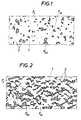
- the softer lead particles 2 embedded in the base material 1 form cut surfaces in the layer-parallel grinding surface shown, which can be measured and added up in size in ascending order.
- the cut surface that supplements the subtotal of the cut surfaces to 5% of the final total is designated F 5 and has a size of 0.11 ⁇ m 2 in the selected exemplary embodiment, which shows a lead content of 20%.
- the sectional area F 50 is 0.63 ⁇ m 2
- the sectional area F 100 is 2.19 ⁇ m 2 .
- the exemplary embodiment according to FIG. 2 shows the typical conditions for a sliding layer physically applied in a vacuum by sputtering.
- Lead particles 2 are again stored in the base material 1, which make up a weight fraction of 28%.
- the cut areas F 5 , F 50 and F 100 are entered again, resulting in an amount of 0.10 ⁇ m 2 , 0.51 ⁇ m 2 and 1.73 ⁇ m 2 for these areas.
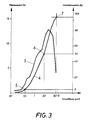
- the cut surfaces of the lead deposits 2, visible in the ground surface, of a sliding layer, which is characteristic of the invention, are sorted in size on the abscissa and their share in the total area of all measured cut surfaces is plotted on the ordinate, so that the resulting curve 3 illustrates the size distribution of the cut surfaces of the lead particles 2 in the grinding surface.
- curve 3 was created on the basis of moving averages.
- Curve 4 shows the course of the subtotal of the individual cut surfaces in the case of a summation of the lead particle cut surfaces starting with the smallest cut surface and taking place after increasing surface area.
Landscapes
- Engineering & Computer Science (AREA)
- General Engineering & Computer Science (AREA)
- Mechanical Engineering (AREA)
- Chemical & Material Sciences (AREA)
- Chemical Kinetics & Catalysis (AREA)
- Materials Engineering (AREA)
- Metallurgy (AREA)
- Organic Chemistry (AREA)
- Sliding-Contact Bearings (AREA)
- Powder Metallurgy (AREA)
Applications Claiming Priority (3)
| Application Number | Priority Date | Filing Date | Title |
|---|---|---|---|
| AT1183/95 | 1995-07-12 | ||
| AT0118395A AT402436B (de) | 1995-07-12 | 1995-07-12 | Gleitschicht auf kupferbasis |
| PCT/AT1996/000118 WO1997003228A1 (de) | 1995-07-12 | 1996-07-04 | Gleitschicht auf kupferbasis |
Publications (2)
| Publication Number | Publication Date |
|---|---|
| EP0837955A1 EP0837955A1 (de) | 1998-04-29 |
| EP0837955B1 true EP0837955B1 (de) | 1999-03-24 |
Family
ID=3508407
Family Applications (1)
| Application Number | Title | Priority Date | Filing Date |
|---|---|---|---|
| EP96920626A Expired - Lifetime EP0837955B1 (de) | 1995-07-12 | 1996-07-04 | Gleitschicht auf kupferbasis |
Country Status (7)
| Country | Link |
|---|---|
| US (1) | US6022629A (enExample) |
| EP (1) | EP0837955B1 (enExample) |
| AT (1) | AT402436B (enExample) |
| AU (1) | AU6181696A (enExample) |
| DE (1) | DE59601509D1 (enExample) |
| IN (1) | IN188945B (enExample) |
| WO (1) | WO1997003228A1 (enExample) |
Families Citing this family (4)
| Publication number | Priority date | Publication date | Assignee | Title |
|---|---|---|---|---|
| AT408352B (de) * | 1999-03-26 | 2001-11-26 | Miba Gleitlager Ag | Galvanisch abgeschiedene legierungsschicht, insbesondere eine laufschicht eines gleitlagers |
| JP2001241445A (ja) * | 2000-02-28 | 2001-09-07 | Daido Metal Co Ltd | 銅系摺動材料、その製造方法およびすべり軸受 |
| AT413034B (de) * | 2003-10-08 | 2005-10-15 | Miba Gleitlager Gmbh | Legierung, insbesondere für eine gleitschicht |
| US11231067B2 (en) * | 2018-05-10 | 2022-01-25 | Nissan Motor Co., Ltd. | Bearing member |
Family Cites Families (11)
| Publication number | Priority date | Publication date | Assignee | Title |
|---|---|---|---|---|
| AU576797B2 (en) * | 1983-11-28 | 1988-09-08 | Federal Mogul Corporation | Composite bearing material made by powder metalurgy |
| JPH01503150A (ja) * | 1986-05-28 | 1989-10-26 | フェデラル‐モーギュル・コーポレーション | 複合軸受材料の製法およびその方法で製造される軸受材料 |
| CH671239A5 (enExample) * | 1986-07-15 | 1989-08-15 | Balzers Hochvakuum | |
| JP2512477B2 (ja) * | 1987-06-17 | 1996-07-03 | 大豊工業株式会社 | 銅系摺動材料 |
| AT389356B (de) * | 1987-07-24 | 1989-11-27 | Miba Gleitlager Ag | Hochbelastbares gleitlager |
| US4927707A (en) * | 1987-09-08 | 1990-05-22 | Honda Giken Kogyo Kabashiki Kaisha | Combination of slide members |
| EP0411882B1 (en) * | 1989-07-31 | 1995-03-22 | Toyota Jidosha Kabushiki Kaisha | Dispersion strengthened copper-base alloy for overlay |
| US5242717A (en) * | 1990-12-27 | 1993-09-07 | Daido Metal Company Ltd. | Method of producing a composite sliding member |
| JPH0771744B2 (ja) * | 1990-12-27 | 1995-08-02 | 大同メタル工業株式会社 | 複合摺動材料とその製造方法 |
| JPH08941B2 (ja) * | 1992-03-31 | 1996-01-10 | 大同メタル工業株式会社 | 耐摩耗性摺動合金、摺動部材およびその製造方法 |
| JP2525538B2 (ja) * | 1992-12-25 | 1996-08-21 | 大同メタル工業株式会社 | 高強度裏金を有する銅合金すべり軸受及びその製造方法 |
-
1995
- 1995-07-12 AT AT0118395A patent/AT402436B/de not_active IP Right Cessation
-
1996
- 1996-07-04 WO PCT/AT1996/000118 patent/WO1997003228A1/de not_active Ceased
- 1996-07-04 US US08/981,974 patent/US6022629A/en not_active Expired - Fee Related
- 1996-07-04 DE DE59601509T patent/DE59601509D1/de not_active Expired - Lifetime
- 1996-07-04 EP EP96920626A patent/EP0837955B1/de not_active Expired - Lifetime
- 1996-07-04 AU AU61816/96A patent/AU6181696A/en not_active Abandoned
- 1996-07-08 IN IN1245CA1996 patent/IN188945B/en unknown
Also Published As
| Publication number | Publication date |
|---|---|
| ATA118395A (de) | 1996-09-15 |
| US6022629A (en) | 2000-02-08 |
| DE59601509D1 (de) | 1999-04-29 |
| IN188945B (enExample) | 2002-11-30 |
| WO1997003228A1 (de) | 1997-01-30 |
| AU6181696A (en) | 1997-02-10 |
| AT402436B (de) | 1997-05-26 |
| EP0837955A1 (de) | 1998-04-29 |
Similar Documents
| Publication | Publication Date | Title |
|---|---|---|
| DE602006000573T2 (de) | Gleitelement | |
| DE19852481A1 (de) | Schichtverbundwerkstoff für Gleitelemente und Verfahren zu seiner Herstellung | |
| DE102004030017C5 (de) | Gleitelement | |
| DE69205758T2 (de) | Hochleistungsdrahtelektrode für Funkerosionsbearbeitung und Verfahren zur Herstellung derselben. | |
| DE3346553C2 (de) | Verbundmaterial für ein Gleitelement | |
| EP1439238B1 (de) | Korrosionsbeständige Messinglegierung für Trinkwasserformteile | |
| DE4243880C2 (de) | Verbundlager aus einer Kupfer-Blei-Legierung | |
| DE102004015827B4 (de) | Gleitteil | |
| DE4443375C2 (de) | Mehrschichtlager mit einer Kupfer-Blei-Legierung als Lagerschicht | |
| EP0837955B1 (de) | Gleitschicht auf kupferbasis | |
| DE3601439C1 (de) | Schichtverbundwerkstoff,insbesondere fuer Gleit- und Reibelemente,sowie Verfahren zu seiner Herstellung | |
| DE3519452C2 (de) | Schichtwerkstoff für Gleitlagerelemente mit Antifriktionsschicht aus einem Lagerwerkstoff auf Aluminiumbasis | |
| EP0660964B1 (de) | Werkstoff für elektrische kontakte auf der basis von silber-zinnoxid oder silber-zinkoxid und verfahren zu seiner herstellung | |
| DE2654476B2 (de) | Verfahren zur Herstellung einer Schottky-Sperrschicht | |
| EP3797181B1 (de) | Kupferband zur herstellung von elektrischen kontakten und verfahren zur herstellung eines kupferbandes und steckverbinder | |
| DE69301322T2 (de) | Verfahren zur Herstellung eines Rohres mit schädlingsabweisender Beschichtung | |
| DE3518799C2 (de) | Mehrschichten-Gleitlager | |
| DE69631520T2 (de) | Gleitlager mit überlagerungsschichten | |
| AT524071B1 (de) | Verfahren zur Herstellung eines mehrschichtigen Gleitlagerelementes | |
| EP3825119A1 (de) | Mehrschichtgleitlagerelement | |
| EP2928685B1 (de) | Gleitlagerverbundwerkstoff | |
| DE3203037C2 (de) | Kontaktelement und Verfahren zu dessen Herstellung | |
| DE2540999B2 (de) | Elektrischer Steckkontakt mit einer Kontaktschicht aus einer Silber-Palladium-Legierung | |
| DE102006045531B3 (de) | Verfahren zum Herstellen einer Schicht auf einem Träger | |
| WO2007060078A1 (de) | Verfahren zum herstellen einer kontaktgeeigneten schicht auf einem metallelement |
Legal Events
| Date | Code | Title | Description |
|---|---|---|---|
| PUAI | Public reference made under article 153(3) epc to a published international application that has entered the european phase |
Free format text: ORIGINAL CODE: 0009012 |
|
| 17P | Request for examination filed |
Effective date: 19980113 |
|
| AK | Designated contracting states |
Kind code of ref document: A1 Designated state(s): DE FR GB IT |
|
| GRAG | Despatch of communication of intention to grant |
Free format text: ORIGINAL CODE: EPIDOS AGRA |
|
| 17Q | First examination report despatched |
Effective date: 19980602 |
|
| GRAG | Despatch of communication of intention to grant |
Free format text: ORIGINAL CODE: EPIDOS AGRA |
|
| GRAH | Despatch of communication of intention to grant a patent |
Free format text: ORIGINAL CODE: EPIDOS IGRA |
|
| GRAH | Despatch of communication of intention to grant a patent |
Free format text: ORIGINAL CODE: EPIDOS IGRA |
|
| GRAA | (expected) grant |
Free format text: ORIGINAL CODE: 0009210 |
|
| AK | Designated contracting states |
Kind code of ref document: B1 Designated state(s): DE FR GB IT |
|
| ITF | It: translation for a ep patent filed | ||
| REF | Corresponds to: |
Ref document number: 59601509 Country of ref document: DE Date of ref document: 19990429 |
|
| GBT | Gb: translation of ep patent filed (gb section 77(6)(a)/1977) |
Effective date: 19990420 |
|
| ET | Fr: translation filed | ||
| PLBE | No opposition filed within time limit |
Free format text: ORIGINAL CODE: 0009261 |
|
| STAA | Information on the status of an ep patent application or granted ep patent |
Free format text: STATUS: NO OPPOSITION FILED WITHIN TIME LIMIT |
|
| 26N | No opposition filed | ||
| REG | Reference to a national code |
Ref country code: GB Ref legal event code: IF02 |
|
| PGFP | Annual fee paid to national office [announced via postgrant information from national office to epo] |
Ref country code: FR Payment date: 20080723 Year of fee payment: 13 |
|
| REG | Reference to a national code |
Ref country code: FR Ref legal event code: ST Effective date: 20090630 |
|
| PG25 | Lapsed in a contracting state [announced via postgrant information from national office to epo] |
Ref country code: FR Free format text: LAPSE BECAUSE OF NON-PAYMENT OF DUE FEES Effective date: 20080731 |
|
| PGFP | Annual fee paid to national office [announced via postgrant information from national office to epo] |
Ref country code: DE Payment date: 20150804 Year of fee payment: 20 Ref country code: GB Payment date: 20150730 Year of fee payment: 20 |
|
| PGFP | Annual fee paid to national office [announced via postgrant information from national office to epo] |
Ref country code: IT Payment date: 20150721 Year of fee payment: 20 |
|
| REG | Reference to a national code |
Ref country code: DE Ref legal event code: R071 Ref document number: 59601509 Country of ref document: DE |
|
| REG | Reference to a national code |
Ref country code: GB Ref legal event code: PE20 Expiry date: 20160703 |
|
| PG25 | Lapsed in a contracting state [announced via postgrant information from national office to epo] |
Ref country code: GB Free format text: LAPSE BECAUSE OF EXPIRATION OF PROTECTION Effective date: 20160703 |