EP0833503A2 - Szenenänderungsdetektor für digitales Video - Google Patents
Szenenänderungsdetektor für digitales Video Download PDFInfo
- Publication number
- EP0833503A2 EP0833503A2 EP97116200A EP97116200A EP0833503A2 EP 0833503 A2 EP0833503 A2 EP 0833503A2 EP 97116200 A EP97116200 A EP 97116200A EP 97116200 A EP97116200 A EP 97116200A EP 0833503 A2 EP0833503 A2 EP 0833503A2
- Authority
- EP
- European Patent Office
- Prior art keywords
- block
- picture
- motion
- current
- determining
- Prior art date
- Legal status (The legal status is an assumption and is not a legal conclusion. Google has not performed a legal analysis and makes no representation as to the accuracy of the status listed.)
- Ceased
Links
Images

Classifications
-
- H—ELECTRICITY
- H04—ELECTRIC COMMUNICATION TECHNIQUE
- H04N—PICTORIAL COMMUNICATION, e.g. TELEVISION
- H04N5/00—Details of television systems
- H04N5/14—Picture signal circuitry for video frequency region
- H04N5/147—Scene change detection
-
- G—PHYSICS
- G06—COMPUTING OR CALCULATING; COUNTING
- G06T—IMAGE DATA PROCESSING OR GENERATION, IN GENERAL
- G06T7/00—Image analysis
- G06T7/20—Analysis of motion
- G06T7/254—Analysis of motion involving subtraction of images
-
- H—ELECTRICITY
- H04—ELECTRIC COMMUNICATION TECHNIQUE
- H04N—PICTORIAL COMMUNICATION, e.g. TELEVISION
- H04N19/00—Methods or arrangements for coding, decoding, compressing or decompressing digital video signals
- H04N19/10—Methods or arrangements for coding, decoding, compressing or decompressing digital video signals using adaptive coding
- H04N19/134—Methods or arrangements for coding, decoding, compressing or decompressing digital video signals using adaptive coding characterised by the element, parameter or criterion affecting or controlling the adaptive coding
- H04N19/142—Detection of scene cut or scene change
-
- H—ELECTRICITY
- H04—ELECTRIC COMMUNICATION TECHNIQUE
- H04N—PICTORIAL COMMUNICATION, e.g. TELEVISION
- H04N19/00—Methods or arrangements for coding, decoding, compressing or decompressing digital video signals
- H04N19/10—Methods or arrangements for coding, decoding, compressing or decompressing digital video signals using adaptive coding
- H04N19/169—Methods or arrangements for coding, decoding, compressing or decompressing digital video signals using adaptive coding characterised by the coding unit, i.e. the structural portion or semantic portion of the video signal being the object or the subject of the adaptive coding
- H04N19/179—Methods or arrangements for coding, decoding, compressing or decompressing digital video signals using adaptive coding characterised by the coding unit, i.e. the structural portion or semantic portion of the video signal being the object or the subject of the adaptive coding the unit being a scene or a shot
-
- H—ELECTRICITY
- H04—ELECTRIC COMMUNICATION TECHNIQUE
- H04N—PICTORIAL COMMUNICATION, e.g. TELEVISION
- H04N19/00—Methods or arrangements for coding, decoding, compressing or decompressing digital video signals
- H04N19/85—Methods or arrangements for coding, decoding, compressing or decompressing digital video signals using pre-processing or post-processing specially adapted for video compression
- H04N19/87—Methods or arrangements for coding, decoding, compressing or decompressing digital video signals using pre-processing or post-processing specially adapted for video compression involving scene cut or scene change detection in combination with video compression
-
- H—ELECTRICITY
- H04—ELECTRIC COMMUNICATION TECHNIQUE
- H04N—PICTORIAL COMMUNICATION, e.g. TELEVISION
- H04N5/00—Details of television systems
- H04N5/14—Picture signal circuitry for video frequency region
- H04N5/144—Movement detection
- H04N5/145—Movement estimation
Definitions
- the present invention relates to an apparatus and method for detecting scene changes in a sequence of digital video frames (e.g., pictures).
- a sequence of digital video frames e.g., pictures
- changes in luminance in different blocks of a video frame relative to corresponding blocks in a previous frame are used to provide a reliable indication of a scene change.
- digital video transmission formats have become increasingly popular for providing television and other audio, video, and/or data services to consumers' homes. Such programming can be transmitted to a consumer's home via a direct broadcast satellite link, or via a cable television network.
- digital video can provide a higher image quality than traditional analog television broadcasts.
- spatial compression techniques take advantage of correlations between neighboring pixels or blocks of pixels in a frame
- temporal techniques take advantage of correlations between pixels or blocks of pixels in successive video frames.
- motion compensation techniques can provide even greater temporal compression.
- a scene change can be defined generally as any significant change in the composition of the frame.
- a scene change may occur when the camera angle is changed, or when there is a switch between a close-up view and a panoramic view.
- a scene change is indicated by a noticeable change in the luminance level between successive video frames. For example, a scene change may occur when a bright light is switched on in a dark room.
- the encoding of the video sequence may be modified accordingly. For example, motion compensation may be temporarily suspended when a scene change is detected since there is a reduced probability of temporal correlation between the first frame of the new scene and the last frame of the previous scene.
- a specific type of picture e.g., I, P, or B picture
- I, P and B pictures are defined by the MPEG-2 standard as discussed in greater detail below.
- Various existing scene detection systems attempt to provide reliable scene change detection. For example, one system uses the sum of the absolute value of the difference of corresponding pixel values between the current frame and the previous frame, and compares this sum with a predetermined constant threshold to determine whether there is a scene change.
- this system may fail to give reliable results if a fast motion occurs in successive frames.
- such a system is not consistently reliable when different levels of motion are present (e.g., moderately fast, fast, very fast).
- Another system determines the absolute value of the difference between corresponding pixel values between the current frame and the previous frame. Then, the absolute value of the difference of the corresponding pixel values between the current frame and the next frame is determined. Finally, the sum of the difference of the above two differences is obtained and compared with a predetermined constant threshold to determine whether there is a scene change.
- this system may not provide reliable results when the scene transitions from no motion to fast motion.
- a scene detection system for digital video which can reliably detect scene changes when different levels of motion are present, and when there is a transition from no motion to fast motion.
- the system should be compatible with existing digital video encoding standards including the Motion Picture Expert's Group (MPEG) standard, details of which can be found in document ISO/IEC JTC1/SC29/WG11 N0702, entitled “Information Technology - Generic Coding of Moving Pictures and Associated Audio, Recommendation H.262," March 25, 1994, incorporated herein by reference.
- MPEG Motion Picture Expert's Group
- the MPEG system includes three types of video pictures; specifically, the intra-coded picture (I-picture), predictive-coded picture (P-picture), and bi-directionally predictive-coded picture (B-picture). Furthermore, either frame or field structure video sequences are accommodated.
- I-picture completely describes a single video picture without reference to any other picture.
- motion vectors can be included with an I-picture.
- An error in an I-picture has the potential for greater impact on the displayed video since both P-pictures and B-pictures in the base layer are predicted from I-pictures.
- P pictures are predicted based on previous I or P pictures. The reference is from an earlier I or P picture to a future P-picture and is known as forward prediction.
- B-pictures are predicted from the closest earlier I or P picture and the closest later I or P picture.
- An advantageous scene detection system would also provide automatic control of the rate control and adaptive quantization processes of video compression encoders which use various standards, including MPEG-1, MPEG-2, ISO/IEC H.261 (videoconferencing), and ISO/IEC H.263.
- the system should also be compatible with various color television broadcast standards such as the National Television Standards Committee (NTSC) standard, used in North America, and the Phase Alternating Line (PAL) standard, used in Europe, and should further be compatible with both frame and field mode video.
- NTSC National Television Standards Committee
- PAL Phase Alternating Line
- a method and apparatus are presented for detecting a scene change between a prior picture and a current picture in a sequence of video pictures.
- an average luminance value is determined for a block pair of the prior and current video pictures.
- the blocks of the block pair are located, respectively, in the same relative position in the prior and current pictures.
- an incremental visual sensation value is determined using a difference between the average luminance values. If the incremental visual sensation value exceeds a block contrast threshold level, a scene change is indicated.
- the block contrast threshold level may be approximately fifteen to twenty-five times a Weber fraction constant defined herein.
- a minimum of the average luminance values of the current and prior picture blocks is determined, where, if the minimum exceeds a dark scene threshold, the incremental visual sensation value is determined using the ratio of (a) the absolute value of the difference between the average luminance values, and (b) the minimum of the average luminance values of the current and prior picture blocks. Otherwise, the incremental visual sensation value is determined using the ratio of (a) the absolute value of the difference, and (b) the dark scene threshold.
- the dark scene threshold may be approximately 10% of a maximum gray level.
- the difference between the average luminance values may be determined for a plurality of block pairs of the prior and current video pictures.
- every block pair in the pictures are used to provide an overall picture scene change determination.
- the incremental visual sensation value is determined for each of the block pairs using the differences, where, if the incremental visual sensation value exceeds the block contrast threshold level for a threshold proportion of block pairs in the current and prior video pictures, a scene change is indicated.
- This threshold proportion may be approximately 80% to 90%.
- the method may be adaptively optimized by determining a relative amount of motion between the blocks of the block pair, and adjusting a size of the blocks based on the relative amount of motion.
- the size of the blocks is increased as the relative amount of motion increases.
- the relative amount of motion can be found by determining a sum of the absolute value of a horizontal motion vector and the absolute value of a vertical motion vector, where the horizontal and vertical motion vectors are indicative of horizontal and vertical motion, respectively, of a video image of the current picture block relative to a video image of the prior picture block.
- a determination is then made to see if the sum exceeds a motion threshold.
- the motion threshold may be adjusted according to a picture type of the current picture (e.g., whether the current picture is an I, P or B picture).
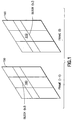
- FIGURE 1 illustrates a comparison between blocks of two consecutive video frames in accordance with the present invention.
- FIGURE 2 is a block diagram of a scene change detector in accordance with the present invention.
- a method and apparatus are presented for detecting scene changes in a sequence of digital video frames.
- the brightness level of a scene is determined by the average luminance of the pixels which comprise the scene, and the dynamic range of the luminance values of the pixels. Moreover, the visual sensation of brightness to the human eye is generally considered to be a function of the natural logarithm of image luminance. At a frame and/or field of a scene change, the visual sensation of brightness is changed significantly from the previous frame or previous corresponding field.
- ⁇ C is defined as the differential value of the average brightness of a region (e.g., block) which has the same relative position in the two frames and/or fields.
- the following ratio known as the Weber fraction can be defined:
- the Weber fraction remains approximately constant at high background luminance levels, e.g., greater than 0.5 mL (milliLumens).
- the value of the constant C ⁇ has been found to be 0.02, which means that, on an scale of 0 to 1, at least fifty different luminance levels are required for the contrast between levels to be perceptible by a human.
- FIGURE 1 illustrates a comparison between blocks of two consecutive video frames in accordance with the present invention.
- a current frame, Frame (i), shown at 100 includes a block 110.
- a previous frame, Frame (i-1), shown at 150 includes a block 160 which is located in the same relative position in the frame 150 as block 110 is located in frame 100.
- the frames 100 and 150 may each comprise thirty slices, with each slice having forty-four macroblocks.
- an entire NTSC frame comprises 1,320 macroblocks.
- a macroblock typically comprises a 16 x 16 block of pixels which, in the MPEG-2 standard, for example, is comprised of four 8 x 8 pixel blocks.
- the present invention is compatible with the PAL format, which includes 1,584 macroblocks in 36 slices, with 44 macroblocks per slice, and 16 x 16 pixels per macroblock.
- each frame is partitioned into a set of k x 1 disjoint blocks, with each block having m x n pixels.
- the size of the block can be programmed to adaptively change based on the current motion information. In particular, the faster the motion is, the larger the block size m x n should be.
- vector[x][y][z] satisfies the following inequality:
- Vector[x][y][0] and vector[x][y][1] are the horizontal and vertical motion vectors, respectively, of a current frame block (e.g., block (x,y)) relative to a prior frame block.
- motion vectors vector[x][y][z] are obtained from the closest available picture with the same picture type. For example, if the current picture type is a P-picture, then motion vectors vector[x][y][z] are motion vectors of the previous predicted P-picture. This is true since the scene change detection for each picture occurs before the motion estimation of the picture.
- the block size is adjusted accordingly.
- An initial (default) block size of 16 x 16 may be used.
- the block size should not be increased such that the block crosses over the right and/or bottom boundary of a macroblock. Generally, the block size should be larger when the motion is faster. Moreover, the largest allowed block size may be limited in some applications to 32 x 48 pixels.
- the average luminance of each block in a frame is determined.
- c1 and c2 are dummy counting indexes.
- the range of 80-90% was determined based on extensive testing, but the actual optimal figure may vary with the particular scene.
- the mathematical expression x ⁇ denotes rounding of the non-integer x to the next lowest integer.
- FIGURE 2 is a block diagram of a scene change detector in accordance with the present invention.
- the detector shown generally at 200, includes input terminals 205 and 210.
- pixel data from the current frame, X i,k,l , Is received and provided to a block average function 215 to produce the average luminance value for each block in the ith frame, B i,k,l .
- pixel data from the previous frame, X i-1,k,l is received and provided to a block average function 220 to produce the average luminance value for each block in the (i-1)th frame, B i-1,k,l .
- ⁇ C i,k,l is then provided to a threshold function 235 which determines whether block (k,l) is indicative of a scene change (e.g., whether ⁇ C i,k,l >T 1 . If so, an index[k][l] may be set accordingly.
- Accumulator 240 accumulates the scene change result for each block, and sums the result over the entire frame or a portion thereof.
- threshold function 250 receives the summed result from accumulator 240, and uses the threshold T 2 to determine whether a scene change for the overall frame is indicated.
- the scene change detection system of the present invention was tested extensively using different video sequences.
- the "Football”, “Mobile Calendar”, “Flower Garden”, and “Table Tennis” video sequences described in Test Model Editing Committee, "Test Model 5", ISO/IEC JTC1/SC29/WG11 MPEG93/457, April 1993 were analyzed, along with the "Destruct”, “Street Organ”, “Silent”, and "Fun Fair” video sequences, described in the Ad hoc group on MPEG-4 video VM editing, "MPEG-4 Video Verification Model Version 3.0", ISO/IEC JTC1/SC29/WG11 N1277, Tampere, Finland, July 1996.
- Sample test results of the scene detection system of the present invention are shown in Table 1, below.
- the particular video sequence is identified in the first column.
- the sequence of frames involved is indicated in the second column. For example, [0:50] indicates that frames 0 through 50 were analyzed for a scene change.
- the third column indicates whether a scene change was detected, and if so, in which frames. For example, a scene change in a third frame means that a scene change between the second and third frames was detected.
- the fourth column if applicable, provides additional information on the nature of the video sequence.
- coding efficiency was examined using the MPEG-2 WG-11 programs. Coding efficiency is measured by determining the number of bits generated by the coding method to achieve a given image quality. Specifically, for a constant quality level, fewer coding bits are indicative of higher coding efficiency. It was determined that, if a frame with a scene change detected in accordance with the present invention is coded as a P-picture type, then more than 46% of the macroblocks are coded as I-pictures. Thus, the scene detection system of the present invention was found to operate as expected since it successfully located frames which are difficult to efficiently code using predictive coding.
- such frames can be coded as I-pictures since the rate control engine of the encoder allocates more bits for I-pictures, thereby also improving image quality.
- a process for selecting a macroblock coding type for each macroblock of a P-picture or B-picture will determine whether the macroblock should be coded as an intra-coded block (I-coded) or non-intra-coded block (P- or B-coded) based on which coding type provides better quality or uses fewer data bits.
- I-coded intra-coded block
- P- or B-coded non-intra-coded block
- a small proportion of macroblocks in a picture will be I-coded (e.g., less than five per cent). This is desirable as I-coded blocks consume a relatively large number of data bits since there is no temporal compression.
- the proportion of I-coded macroblocks in a picture is greater than, e.g., thirty or forty per cent, then the picture quality will be poor. In this case, prediction coding is inefficient for the picture, as would be expected at a scene change. Thus, when a scene change occurs, it is generally desirable that the first frame of the new scene should not be coded as a P-picture.
- the various threshold levels set forth herein may be adjusted according to the particular scene or video sequence which is analyzed. That is, some types of video sequences, such as action movies, may be characterized by more frequent and pronounced scene change activity. Moreover, specific lighting conditions may be associated with a particular video sequence, e.g., such as a horror film, where lighting levels may be relatively low throughout the sequence. In this case, the scene change detection thresholds can be adjusted accordingly.
- a portion of a video picture may be analyzed using different thresholds. For instance, in a video sequence of a landscape scene with a relatively dark earth at the bottom part of the picture and a relatively bright sky at the top part of the picture, a more sensitive scene change threshold may be used for the bottom part of the picture.
- a more sensitive scene change threshold may be used for the bottom part of the picture.
- different sized blocks may be used in different regions of a picture. For instance, when motion is more prevalent toward the middle of a picture than toward the edges, larger block sizes may be used in the middle of the picture.
Landscapes
- Engineering & Computer Science (AREA)
- Multimedia (AREA)
- Signal Processing (AREA)
- Computer Vision & Pattern Recognition (AREA)
- Physics & Mathematics (AREA)
- General Physics & Mathematics (AREA)
- Theoretical Computer Science (AREA)
- Compression Or Coding Systems Of Tv Signals (AREA)
- Image Analysis (AREA)
- Studio Circuits (AREA)
- Television Signal Processing For Recording (AREA)
Applications Claiming Priority (2)
| Application Number | Priority Date | Filing Date | Title |
|---|---|---|---|
| US722468 | 1996-09-27 | ||
| US08/722,468 US5751378A (en) | 1996-09-27 | 1996-09-27 | Scene change detector for digital video |
Publications (2)
| Publication Number | Publication Date |
|---|---|
| EP0833503A2 true EP0833503A2 (de) | 1998-04-01 |
| EP0833503A3 EP0833503A3 (de) | 1999-07-14 |
Family
ID=24901966
Family Applications (1)
| Application Number | Title | Priority Date | Filing Date |
|---|---|---|---|
| EP97116200A Ceased EP0833503A3 (de) | 1996-09-27 | 1997-09-18 | Szenenänderungsdetektor für digitales Video |
Country Status (8)
| Country | Link |
|---|---|
| US (1) | US5751378A (de) |
| EP (1) | EP0833503A3 (de) |
| JP (1) | JPH10178613A (de) |
| KR (1) | KR19980025070A (de) |
| CN (1) | CN1099801C (de) |
| CA (1) | CA2216077C (de) |
| NO (1) | NO974432L (de) |
| TW (1) | TW361035B (de) |
Cited By (7)
| Publication number | Priority date | Publication date | Assignee | Title |
|---|---|---|---|---|
| US6711279B1 (en) | 2000-11-17 | 2004-03-23 | Honeywell International Inc. | Object detection |
| WO2004073814A1 (en) * | 2003-02-21 | 2004-09-02 | Sony Computer Entertainment Europe Ltd | Control of data processing |
| WO2004073815A1 (en) * | 2003-02-21 | 2004-09-02 | Sony Computer Entertainment Europe Ltd | Control of data processing |
| WO2004066609A3 (en) * | 2003-01-23 | 2004-09-23 | Intergraph Hardware Tech Co | Video content parser with scene change detector |
| US7310110B2 (en) | 2001-09-07 | 2007-12-18 | Intergraph Software Technologies Company | Method, device and computer program product for demultiplexing of video images |
| WO2011028666A1 (en) | 2009-09-02 | 2011-03-10 | Sony Computer Entertainment Inc. | Scene change detection |
| EP3249603A1 (de) * | 2016-05-25 | 2017-11-29 | IMINT Image Intelligence AB | Bewegungsdetektion in einem video |
Families Citing this family (137)
| Publication number | Priority date | Publication date | Assignee | Title |
|---|---|---|---|---|
| US6122322A (en) * | 1996-11-19 | 2000-09-19 | Telefonaktiebolaget Lm Ericsson | Subliminal message protection |
| FR2757296B1 (fr) * | 1996-12-13 | 2001-10-12 | Sgs Thomson Microelectronics | Procede et dispositif d'estimation de mouvement de portions d'images pour circuit de compression d'images mobiles |
| US6115420A (en) * | 1997-03-14 | 2000-09-05 | Microsoft Corporation | Digital video signal encoder and encoding method |
| US6496228B1 (en) * | 1997-06-02 | 2002-12-17 | Koninklijke Philips Electronics N.V. | Significant scene detection and frame filtering for a visual indexing system using dynamic thresholds |
| US6167155A (en) * | 1997-07-28 | 2000-12-26 | Physical Optics Corporation | Method of isomorphic singular manifold projection and still/video imagery compression |
| US5990980A (en) * | 1997-12-23 | 1999-11-23 | Sarnoff Corporation | Detection of transitions in video sequences |
| US6937651B1 (en) * | 1998-06-29 | 2005-08-30 | Texas Instruments Incorporated | Method and apparatus for compressing image information |
| US6034733A (en) * | 1998-07-29 | 2000-03-07 | S3 Incorporated | Timing and control for deinterlacing and enhancement of non-deterministically arriving interlaced video data |
| US6731684B1 (en) | 1998-09-29 | 2004-05-04 | General Instrument Corporation | Method and apparatus for detecting scene changes and adjusting picture coding type in a high definition television encoder |
| US6606411B1 (en) | 1998-09-30 | 2003-08-12 | Eastman Kodak Company | Method for automatically classifying images into events |
| US6351556B1 (en) | 1998-11-20 | 2002-02-26 | Eastman Kodak Company | Method for automatically comparing content of images for classification into events |
| GB9928022D0 (en) * | 1999-11-26 | 2000-01-26 | British Telecomm | Video coding and decording |
| US6766098B1 (en) | 1999-12-30 | 2004-07-20 | Koninklijke Philip Electronics N.V. | Method and apparatus for detecting fast motion scenes |
| US7334191B1 (en) | 2000-05-09 | 2008-02-19 | International Business Machines Corporation | Segmentation and detection of representative frames in video sequences |
| US6760536B1 (en) | 2000-05-16 | 2004-07-06 | International Business Machines Corporation | Fast video playback with automatic content based variable speed |
| US8028249B2 (en) * | 2001-05-23 | 2011-09-27 | Eastman Kodak Company | Method and system for browsing large digital multimedia object collections |
| US6996782B2 (en) * | 2001-05-23 | 2006-02-07 | Eastman Kodak Company | Using digital objects organized according to a histogram timeline |
| US6870956B2 (en) * | 2001-06-14 | 2005-03-22 | Microsoft Corporation | Method and apparatus for shot detection |
| US6804301B2 (en) | 2001-08-15 | 2004-10-12 | General Instrument Corporation | First pass encoding of I and P-frame complexity for compressed digital video |
| US6996183B2 (en) * | 2001-09-26 | 2006-02-07 | Thomson Licensing | Scene cut detection in a video bitstream |
| KR100846770B1 (ko) * | 2002-03-05 | 2008-07-16 | 삼성전자주식회사 | 동영상 부호화 방법 및 이에 적합한 장치 |
| US7233696B2 (en) * | 2002-07-12 | 2007-06-19 | Hill Richard K | Apparatus and method for characterizing digital images using a two axis image sorting technique |
| US7127120B2 (en) * | 2002-11-01 | 2006-10-24 | Microsoft Corporation | Systems and methods for automatically editing a video |
| US20040088723A1 (en) * | 2002-11-01 | 2004-05-06 | Yu-Fei Ma | Systems and methods for generating a video summary |
| US7274741B2 (en) * | 2002-11-01 | 2007-09-25 | Microsoft Corporation | Systems and methods for generating a comprehensive user attention model |
| US7116716B2 (en) * | 2002-11-01 | 2006-10-03 | Microsoft Corporation | Systems and methods for generating a motion attention model |
| US9108107B2 (en) | 2002-12-10 | 2015-08-18 | Sony Computer Entertainment America Llc | Hosting and broadcasting virtual events using streaming interactive video |
| US9314691B2 (en) | 2002-12-10 | 2016-04-19 | Sony Computer Entertainment America Llc | System and method for compressing video frames or portions thereof based on feedback information from a client device |
| US10201760B2 (en) | 2002-12-10 | 2019-02-12 | Sony Interactive Entertainment America Llc | System and method for compressing video based on detected intraframe motion |
| US9077991B2 (en) | 2002-12-10 | 2015-07-07 | Sony Computer Entertainment America Llc | System and method for utilizing forward error correction with video compression |
| US9446305B2 (en) | 2002-12-10 | 2016-09-20 | Sony Interactive Entertainment America Llc | System and method for improving the graphics performance of hosted applications |
| US8549574B2 (en) | 2002-12-10 | 2013-10-01 | Ol2, Inc. | Method of combining linear content and interactive content compressed together as streaming interactive video |
| US8949922B2 (en) * | 2002-12-10 | 2015-02-03 | Ol2, Inc. | System for collaborative conferencing using streaming interactive video |
| US9061207B2 (en) | 2002-12-10 | 2015-06-23 | Sony Computer Entertainment America Llc | Temporary decoder apparatus and method |
| US9192859B2 (en) | 2002-12-10 | 2015-11-24 | Sony Computer Entertainment America Llc | System and method for compressing video based on latency measurements and other feedback |
| US8711923B2 (en) | 2002-12-10 | 2014-04-29 | Ol2, Inc. | System and method for selecting a video encoding format based on feedback data |
| US9138644B2 (en) | 2002-12-10 | 2015-09-22 | Sony Computer Entertainment America Llc | System and method for accelerated machine switching |
| US8964830B2 (en) | 2002-12-10 | 2015-02-24 | Ol2, Inc. | System and method for multi-stream video compression using multiple encoding formats |
| US8526490B2 (en) | 2002-12-10 | 2013-09-03 | Ol2, Inc. | System and method for video compression using feedback including data related to the successful receipt of video content |
| US20090118019A1 (en) | 2002-12-10 | 2009-05-07 | Onlive, Inc. | System for streaming databases serving real-time applications used through streaming interactive video |
| US8366552B2 (en) | 2002-12-10 | 2013-02-05 | Ol2, Inc. | System and method for multi-stream video compression |
| US7164798B2 (en) * | 2003-02-18 | 2007-01-16 | Microsoft Corporation | Learning-based automatic commercial content detection |
| US7260261B2 (en) | 2003-02-20 | 2007-08-21 | Microsoft Corporation | Systems and methods for enhanced image adaptation |
| US7298895B2 (en) * | 2003-04-15 | 2007-11-20 | Eastman Kodak Company | Method for automatically classifying images into events |
| US6865297B2 (en) * | 2003-04-15 | 2005-03-08 | Eastman Kodak Company | Method for automatically classifying images into events in a multimedia authoring application |
| US7400761B2 (en) * | 2003-09-30 | 2008-07-15 | Microsoft Corporation | Contrast-based image attention analysis framework |
| US7471827B2 (en) * | 2003-10-16 | 2008-12-30 | Microsoft Corporation | Automatic browsing path generation to present image areas with high attention value as a function of space and time |
| JP4407249B2 (ja) * | 2003-11-18 | 2010-02-03 | ソニー株式会社 | データ処理装置およびその方法と符号化装置、その方法及びプログラム |
| US20050123886A1 (en) * | 2003-11-26 | 2005-06-09 | Xian-Sheng Hua | Systems and methods for personalized karaoke |
| US9053754B2 (en) * | 2004-07-28 | 2015-06-09 | Microsoft Technology Licensing, Llc | Thumbnail generation and presentation for recorded TV programs |
| US7986372B2 (en) * | 2004-08-02 | 2011-07-26 | Microsoft Corporation | Systems and methods for smart media content thumbnail extraction |
| FI117845B (fi) * | 2004-08-12 | 2007-03-15 | Gurulogic Microsystems Oy | Videokuvan prosessointi |
| KR100694060B1 (ko) * | 2004-10-12 | 2007-03-12 | 삼성전자주식회사 | 오디오 비디오 동기화 장치 및 그 방법 |
| CN100391232C (zh) * | 2005-01-07 | 2008-05-28 | 智辉研发股份有限公司 | 数字影像闪光场景检测与消除方法 |
| US7548936B2 (en) | 2005-01-12 | 2009-06-16 | Microsoft Corporation | Systems and methods to present web image search results for effective image browsing |
| US7532256B2 (en) * | 2005-01-25 | 2009-05-12 | Teresis Media Management | Methods and apparatus for detecting scenes in a video medium |
| JP4432933B2 (ja) * | 2005-07-08 | 2010-03-17 | セイコーエプソン株式会社 | 画像表示装置および画像表示方法 |
| JP4687526B2 (ja) * | 2005-07-27 | 2011-05-25 | セイコーエプソン株式会社 | 動画像表示装置および動画像表示方法 |
| US20070112811A1 (en) * | 2005-10-20 | 2007-05-17 | Microsoft Corporation | Architecture for scalable video coding applications |
| US8180826B2 (en) * | 2005-10-31 | 2012-05-15 | Microsoft Corporation | Media sharing and authoring on the web |
| US7599918B2 (en) | 2005-12-29 | 2009-10-06 | Microsoft Corporation | Dynamic search with implicit user intention mining |
| US8078618B2 (en) | 2006-01-30 | 2011-12-13 | Eastman Kodak Company | Automatic multimode system for organizing and retrieving content data files |
| JP2007241479A (ja) * | 2006-03-06 | 2007-09-20 | Toshiba Corp | 変動領域検出装置及びその方法 |
| JP4714647B2 (ja) * | 2006-07-31 | 2011-06-29 | 日本放送協会 | カット点検出装置及びカット点検出プログラム |
| EP2129136A4 (de) * | 2007-01-31 | 2016-04-13 | Nec Corp | Bildqualitäts-evaluierungsverfahren, bildqualitäts-evaluierungsvorrichtung und bildqualitäts-evaluierungsprogramm |
| ZA200905257B (en) | 2007-02-08 | 2010-10-27 | Behavioral Recognition Sys Inc | Behavioral recognition system |
| US8411935B2 (en) | 2007-07-11 | 2013-04-02 | Behavioral Recognition Systems, Inc. | Semantic representation module of a machine-learning engine in a video analysis system |
| US8300924B2 (en) * | 2007-09-27 | 2012-10-30 | Behavioral Recognition Systems, Inc. | Tracker component for behavioral recognition system |
| US8200011B2 (en) * | 2007-09-27 | 2012-06-12 | Behavioral Recognition Systems, Inc. | Context processor for video analysis system |
| US8175333B2 (en) * | 2007-09-27 | 2012-05-08 | Behavioral Recognition Systems, Inc. | Estimator identifier component for behavioral recognition system |
| US9168457B2 (en) | 2010-09-14 | 2015-10-27 | Sony Computer Entertainment America Llc | System and method for retaining system state |
| US20090268097A1 (en) * | 2008-04-28 | 2009-10-29 | Siou-Shen Lin | Scene change detection method and related apparatus according to summation results of block matching costs associated with at least two frames |
| KR100949917B1 (ko) * | 2008-05-28 | 2010-03-30 | 한국산업기술대학교산학협력단 | 적응적 인트라 예측을 통한 고속 부호화 방법 및 시스템 |
| US20090304293A1 (en) * | 2008-06-08 | 2009-12-10 | Te-Hao Chang | Motion estimation method and related apparatus for efficiently selecting motion vector |
| US9633275B2 (en) | 2008-09-11 | 2017-04-25 | Wesley Kenneth Cobb | Pixel-level based micro-feature extraction |
| US8275046B2 (en) * | 2008-09-19 | 2012-09-25 | Texas Instruments Incorporated | Fast macroblock structure decision using SAD discrepancy and its prediction mode |
| US9373055B2 (en) * | 2008-12-16 | 2016-06-21 | Behavioral Recognition Systems, Inc. | Hierarchical sudden illumination change detection using radiance consistency within a spatial neighborhood |
| US8285046B2 (en) * | 2009-02-18 | 2012-10-09 | Behavioral Recognition Systems, Inc. | Adaptive update of background pixel thresholds using sudden illumination change detection |
| US8416296B2 (en) * | 2009-04-14 | 2013-04-09 | Behavioral Recognition Systems, Inc. | Mapper component for multiple art networks in a video analysis system |
| US8340352B2 (en) * | 2009-08-18 | 2012-12-25 | Behavioral Recognition Systems, Inc. | Inter-trajectory anomaly detection using adaptive voting experts in a video surveillance system |
| US9805271B2 (en) * | 2009-08-18 | 2017-10-31 | Omni Ai, Inc. | Scene preset identification using quadtree decomposition analysis |
| US8379085B2 (en) * | 2009-08-18 | 2013-02-19 | Behavioral Recognition Systems, Inc. | Intra-trajectory anomaly detection using adaptive voting experts in a video surveillance system |
| US8280153B2 (en) * | 2009-08-18 | 2012-10-02 | Behavioral Recognition Systems | Visualizing and updating learned trajectories in video surveillance systems |
| US8493409B2 (en) * | 2009-08-18 | 2013-07-23 | Behavioral Recognition Systems, Inc. | Visualizing and updating sequences and segments in a video surveillance system |
| US8358834B2 (en) | 2009-08-18 | 2013-01-22 | Behavioral Recognition Systems | Background model for complex and dynamic scenes |
| US8625884B2 (en) * | 2009-08-18 | 2014-01-07 | Behavioral Recognition Systems, Inc. | Visualizing and updating learned event maps in surveillance systems |
| US8295591B2 (en) * | 2009-08-18 | 2012-10-23 | Behavioral Recognition Systems, Inc. | Adaptive voting experts for incremental segmentation of sequences with prediction in a video surveillance system |
| US20110043689A1 (en) * | 2009-08-18 | 2011-02-24 | Wesley Kenneth Cobb | Field-of-view change detection |
| US8797405B2 (en) * | 2009-08-31 | 2014-08-05 | Behavioral Recognition Systems, Inc. | Visualizing and updating classifications in a video surveillance system |
| US8285060B2 (en) * | 2009-08-31 | 2012-10-09 | Behavioral Recognition Systems, Inc. | Detecting anomalous trajectories in a video surveillance system |
| US8270733B2 (en) * | 2009-08-31 | 2012-09-18 | Behavioral Recognition Systems, Inc. | Identifying anomalous object types during classification |
| US8167430B2 (en) * | 2009-08-31 | 2012-05-01 | Behavioral Recognition Systems, Inc. | Unsupervised learning of temporal anomalies for a video surveillance system |
| US8270732B2 (en) * | 2009-08-31 | 2012-09-18 | Behavioral Recognition Systems, Inc. | Clustering nodes in a self-organizing map using an adaptive resonance theory network |
| US8786702B2 (en) | 2009-08-31 | 2014-07-22 | Behavioral Recognition Systems, Inc. | Visualizing and updating long-term memory percepts in a video surveillance system |
| US8218819B2 (en) * | 2009-09-01 | 2012-07-10 | Behavioral Recognition Systems, Inc. | Foreground object detection in a video surveillance system |
| US8218818B2 (en) * | 2009-09-01 | 2012-07-10 | Behavioral Recognition Systems, Inc. | Foreground object tracking |
| US8170283B2 (en) * | 2009-09-17 | 2012-05-01 | Behavioral Recognition Systems Inc. | Video surveillance system configured to analyze complex behaviors using alternating layers of clustering and sequencing |
| US8180105B2 (en) * | 2009-09-17 | 2012-05-15 | Behavioral Recognition Systems, Inc. | Classifier anomalies for observed behaviors in a video surveillance system |
| JP5625543B2 (ja) * | 2010-06-28 | 2014-11-19 | ソニー株式会社 | 符号化装置、電子機器、撮像装置、および撮像システム |
| CN102223544B (zh) * | 2011-06-02 | 2013-02-06 | 福州瑞芯微电子有限公司 | 一种h264视频码流检测到错误后处理错误的方法 |
| US8744186B1 (en) * | 2011-09-30 | 2014-06-03 | Tribune Broadcasting Company, Llc | Systems and methods for identifying a scene-change/non-scene-change transition between frames |
| CN104303218A (zh) | 2012-03-15 | 2015-01-21 | 行为识别系统公司 | 行为识别系统中的警报指令和聚焦警报指令 |
| TW201345262A (zh) * | 2012-04-20 | 2013-11-01 | Novatek Microelectronics Corp | 影像處理電路及影像處理方法 |
| CN103379303A (zh) * | 2012-04-25 | 2013-10-30 | 联咏科技股份有限公司 | 影像处理电路及影像处理方法 |
| US9723271B2 (en) | 2012-06-29 | 2017-08-01 | Omni Ai, Inc. | Anomalous stationary object detection and reporting |
| WO2014004901A1 (en) | 2012-06-29 | 2014-01-03 | Behavioral Recognition Systems, Inc. | Unsupervised learning of feature anomalies for a video surveillance system |
| US9911043B2 (en) | 2012-06-29 | 2018-03-06 | Omni Ai, Inc. | Anomalous object interaction detection and reporting |
| US9111353B2 (en) | 2012-06-29 | 2015-08-18 | Behavioral Recognition Systems, Inc. | Adaptive illuminance filter in a video analysis system |
| US9317908B2 (en) | 2012-06-29 | 2016-04-19 | Behavioral Recognition System, Inc. | Automatic gain control filter in a video analysis system |
| US9113143B2 (en) | 2012-06-29 | 2015-08-18 | Behavioral Recognition Systems, Inc. | Detecting and responding to an out-of-focus camera in a video analytics system |
| US8995823B2 (en) | 2012-07-17 | 2015-03-31 | HighlightCam, Inc. | Method and system for content relevance score determination |
| EP2885766A4 (de) | 2012-08-20 | 2017-04-26 | Behavioral Recognition Systems, Inc. | Verfahren und system zur erkennung von öl an der meeresoberfläche |
| US9306989B1 (en) | 2012-10-16 | 2016-04-05 | Google Inc. | Linking social media and broadcast media |
| WO2014075022A1 (en) | 2012-11-12 | 2014-05-15 | Behavioral Recognition Systems, Inc. | Image stabilization techniques for video surveillance systems |
| CN102946505B (zh) * | 2012-11-22 | 2015-02-18 | 四川虹微技术有限公司 | 一种基于图像分块统计的自适应运动检测方法 |
| CN102968769B (zh) * | 2012-11-27 | 2015-07-22 | 宁波盈芯信息科技有限公司 | 一种图像一致性增强装置 |
| US20140176802A1 (en) * | 2012-12-21 | 2014-06-26 | Nvidia Corporation | Detection and measurement of video scene transitions |
| US9639521B2 (en) | 2013-08-09 | 2017-05-02 | Omni Ai, Inc. | Cognitive neuro-linguistic behavior recognition system for multi-sensor data fusion |
| US9179184B1 (en) | 2014-06-20 | 2015-11-03 | Google Inc. | Methods, systems, and media for detecting a presentation of media content on a display device |
| KR101480750B1 (ko) * | 2014-06-26 | 2015-01-12 | (주)유디피 | 모션 검출 장치 및 방법 |
| US9619513B2 (en) | 2014-07-29 | 2017-04-11 | International Business Machines Corporation | Changed answer notification in a question and answer system |
| US9866734B2 (en) | 2014-08-26 | 2018-01-09 | Dolby Laboratories Licensing Corporation | Scene-change detection using video stream pairs |
| US9460522B2 (en) | 2014-10-29 | 2016-10-04 | Behavioral Recognition Systems, Inc. | Incremental update for background model thresholds |
| US9349054B1 (en) | 2014-10-29 | 2016-05-24 | Behavioral Recognition Systems, Inc. | Foreground detector for video analytics system |
| US9471844B2 (en) | 2014-10-29 | 2016-10-18 | Behavioral Recognition Systems, Inc. | Dynamic absorption window for foreground background detector |
| US10409909B2 (en) | 2014-12-12 | 2019-09-10 | Omni Ai, Inc. | Lexical analyzer for a neuro-linguistic behavior recognition system |
| US10409910B2 (en) | 2014-12-12 | 2019-09-10 | Omni Ai, Inc. | Perceptual associative memory for a neuro-linguistic behavior recognition system |
| US10521672B2 (en) * | 2014-12-31 | 2019-12-31 | Opentv, Inc. | Identifying and categorizing contextual data for media |
| CN104702964B (zh) * | 2015-03-30 | 2018-05-15 | 北京布卡互动科技有限公司 | 一种图像处理方法及装置 |
| US10169326B2 (en) | 2015-05-22 | 2019-01-01 | International Business Machines Corporation | Cognitive reminder notification mechanisms for answers to questions |
| US9912736B2 (en) | 2015-05-22 | 2018-03-06 | International Business Machines Corporation | Cognitive reminder notification based on personal user profile and activity information |
| US10152534B2 (en) | 2015-07-02 | 2018-12-11 | International Business Machines Corporation | Monitoring a corpus for changes to previously provided answers to questions |
| US10769185B2 (en) | 2015-10-16 | 2020-09-08 | International Business Machines Corporation | Answer change notifications based on changes to user profile information |
| CN109640166A (zh) * | 2018-08-13 | 2019-04-16 | 张利军 | 基于动感程度的片尾曲选择方法 |
| US10831989B2 (en) | 2018-12-04 | 2020-11-10 | International Business Machines Corporation | Distributing updated communications to viewers of prior versions of the communications |
| CN109599068B (zh) * | 2019-01-31 | 2021-03-02 | 京东方科技集团股份有限公司 | 一种vr设备及其控制方法 |
| CN113873096B (zh) * | 2020-06-30 | 2024-07-30 | 晶晨半导体(上海)股份有限公司 | 场景检测方法、芯片、电子设备以及存储介质 |
Family Cites Families (15)
| Publication number | Priority date | Publication date | Assignee | Title |
|---|---|---|---|---|
| US4823184A (en) * | 1984-04-09 | 1989-04-18 | Corporate Communications Consultants, Inc. | Color correction system and method with scene-change detection |
| JPH05252437A (ja) * | 1991-07-24 | 1993-09-28 | C S K Sogo Kenkyusho:Kk | 画像処理方法および装置 |
| JPH0548995A (ja) * | 1991-08-15 | 1993-02-26 | Sony Corp | デイジタル磁気記録装置 |
| JPH0549031A (ja) * | 1991-08-15 | 1993-02-26 | Pioneer Electron Corp | 画像監視装置 |
| US5245436A (en) * | 1992-02-14 | 1993-09-14 | Intel Corporation | Method and apparatus for detecting fades in digital video sequences |
| JPH05236458A (ja) * | 1992-02-20 | 1993-09-10 | Toshiba Corp | 動画像処理装置 |
| JP2611607B2 (ja) * | 1992-06-29 | 1997-05-21 | 日本ビクター株式会社 | シーンチェンジ検出装置 |
| JPH06237414A (ja) * | 1993-02-10 | 1994-08-23 | Matsushita Electric Ind Co Ltd | 動画像のカットチェンジ検出装置 |
| JP2518503B2 (ja) * | 1993-03-08 | 1996-07-24 | 日本電気株式会社 | 画面切り替え検出方法 |
| JP2971724B2 (ja) * | 1994-02-22 | 1999-11-08 | ケイディディ株式会社 | 動画像のカット点検出装置 |
| US5589884A (en) * | 1993-10-01 | 1996-12-31 | Toko Kabushiki Kaisha | Adaptive quantization controlled by scene change detection |
| JP3344601B2 (ja) * | 1993-12-29 | 2002-11-11 | ソニー株式会社 | 画像データ再生方法及びその装置、静止画検出装置及びその方法、シーンチエンジ検出装置及びその方法並びにフレームシンクロナイザ |
| US5617149A (en) * | 1994-11-22 | 1997-04-01 | Electronics And Telecommunications Research Institute | Apparatus and method for detecting scene changes using the difference of mad between image frames |
| KR0178230B1 (ko) * | 1995-08-08 | 1999-05-01 | 배순훈 | 특징점에 의한 움직임 추정을 이용한 영상 처리 장치 |
| JPH09261648A (ja) * | 1996-03-21 | 1997-10-03 | Fujitsu Ltd | シーンチェンジ検出装置 |
-
1996
- 1996-09-27 US US08/722,468 patent/US5751378A/en not_active Expired - Lifetime
-
1997
- 1997-09-18 EP EP97116200A patent/EP0833503A3/de not_active Ceased
- 1997-09-19 CA CA002216077A patent/CA2216077C/en not_active Expired - Fee Related
- 1997-09-22 JP JP9273283A patent/JPH10178613A/ja active Pending
- 1997-09-25 TW TW086113988A patent/TW361035B/zh active
- 1997-09-25 NO NO974432A patent/NO974432L/no not_active Application Discontinuation
- 1997-09-26 CN CN97118915A patent/CN1099801C/zh not_active Expired - Fee Related
- 1997-09-27 KR KR1019970049350A patent/KR19980025070A/ko not_active Abandoned
Cited By (12)
| Publication number | Priority date | Publication date | Assignee | Title |
|---|---|---|---|---|
| US6711279B1 (en) | 2000-11-17 | 2004-03-23 | Honeywell International Inc. | Object detection |
| WO2002041272A3 (en) * | 2000-11-17 | 2004-03-25 | Honeywell Int Inc | Object detection |
| US7184585B2 (en) | 2000-11-17 | 2007-02-27 | Honeywell International Inc. | Object detection |
| US7310110B2 (en) | 2001-09-07 | 2007-12-18 | Intergraph Software Technologies Company | Method, device and computer program product for demultiplexing of video images |
| US8233044B2 (en) | 2001-09-07 | 2012-07-31 | Intergraph Software Technologies | Method, device and computer program product for demultiplexing of video images |
| WO2004066609A3 (en) * | 2003-01-23 | 2004-09-23 | Intergraph Hardware Tech Co | Video content parser with scene change detector |
| WO2004073814A1 (en) * | 2003-02-21 | 2004-09-02 | Sony Computer Entertainment Europe Ltd | Control of data processing |
| WO2004073815A1 (en) * | 2003-02-21 | 2004-09-02 | Sony Computer Entertainment Europe Ltd | Control of data processing |
| US8035613B2 (en) | 2003-02-21 | 2011-10-11 | Sony Computer Entertainment Europe Ltd. | Control of data processing |
| WO2011028666A1 (en) | 2009-09-02 | 2011-03-10 | Sony Computer Entertainment Inc. | Scene change detection |
| EP2473949A4 (de) * | 2009-09-02 | 2017-03-22 | Sony Interactive Entertainment Inc. | Erkennung von szenenänderungen |
| EP3249603A1 (de) * | 2016-05-25 | 2017-11-29 | IMINT Image Intelligence AB | Bewegungsdetektion in einem video |
Also Published As
| Publication number | Publication date |
|---|---|
| JPH10178613A (ja) | 1998-06-30 |
| CN1180276A (zh) | 1998-04-29 |
| NO974432L (no) | 1998-03-30 |
| KR19980025070A (ko) | 1998-07-06 |
| HK1010299A1 (en) | 1999-06-17 |
| CA2216077A1 (en) | 1998-03-27 |
| NO974432D0 (no) | 1997-09-25 |
| MX9707360A (es) | 1998-06-30 |
| EP0833503A3 (de) | 1999-07-14 |
| CA2216077C (en) | 2005-10-25 |
| TW361035B (en) | 1999-06-11 |
| CN1099801C (zh) | 2003-01-22 |
| US5751378A (en) | 1998-05-12 |
Similar Documents
| Publication | Publication Date | Title |
|---|---|---|
| US5751378A (en) | Scene change detector for digital video | |
| US6721359B1 (en) | Method and apparatus for motion compensated video coding | |
| US5654759A (en) | Methods and apparatus for reducing blockiness in decoded video | |
| EP0896466B1 (de) | Vorrichtung zum Feststellen von Überblendungen in digitalen Videosequenzen | |
| US6037986A (en) | Video preprocessing method and apparatus with selective filtering based on motion detection | |
| US7620261B2 (en) | Edge adaptive filtering system for reducing artifacts and method | |
| US6959044B1 (en) | Dynamic GOP system and method for digital video encoding | |
| US5812197A (en) | System using data correlation for predictive encoding of video image data subject to luminance gradients and motion | |
| US6351493B1 (en) | Coding an intra-frame upon detecting a scene change in a video sequence | |
| EP2302932A1 (de) | Skalierbarkeitstechniken basierend auf Inhaltsinformationen | |
| US8098729B2 (en) | Implementing B-picture scene changes | |
| JP4197958B2 (ja) | ビデオ信号中の字幕の検出 | |
| KR20040018506A (ko) | 비디오 데이터 스트림에서 카툰을 검출하기 위한 방법 및시스템 | |
| US20040196907A1 (en) | Device and method for controlling image encoding, encoding system, transmission system and broadcast system | |
| US6069976A (en) | Apparatus and method for adaptively coding an image signal | |
| US8179961B2 (en) | Method and apparatus for adapting a default encoding of a digital video signal during a scene change period | |
| EP1198139A1 (de) | Verfahren und Vorrichtung zur Codierung von Videofeldern | |
| US6020933A (en) | Method and apparatus for encoding a motion vector | |
| HK1010441A (en) | Scene change detector for digital video | |
| US20070047643A1 (en) | Video data compression | |
| MXPA97007360A (en) | Scene change detector for digi video | |
| HK1010299B (en) | Scene change detector for digital video | |
| Pronina et al. | Improving MPEG performance using frame partitioning | |
| WO1999059342A1 (en) | Method and system for mpeg-2 encoding with frame partitioning | |
| MXPA98006297A (en) | Static distance detector for digi video |
Legal Events
| Date | Code | Title | Description |
|---|---|---|---|
| PUAI | Public reference made under article 153(3) epc to a published international application that has entered the european phase |
Free format text: ORIGINAL CODE: 0009012 |
|
| AK | Designated contracting states |
Kind code of ref document: A2 Designated state(s): AT BE CH DE DK ES FI FR GB GR IE IT LI LU MC NL PT SE |
|
| RAP1 | Party data changed (applicant data changed or rights of an application transferred) |
Owner name: GENERAL INSTRUMENT CORPORATION |
|
| RAP1 | Party data changed (applicant data changed or rights of an application transferred) |
Owner name: GENERAL INSTRUMENT CORPORATION |
|
| PUAL | Search report despatched |
Free format text: ORIGINAL CODE: 0009013 |
|
| AK | Designated contracting states |
Kind code of ref document: A3 Designated state(s): AT BE CH DE DK ES FI FR GB GR IE IT LI LU MC NL PT SE |
|
| RIC1 | Information provided on ipc code assigned before grant |
Free format text: 6H 04N 5/14 A, 6G 06T 7/20 B |
|
| 17P | Request for examination filed |
Effective date: 20000113 |
|
| AKX | Designation fees paid |
Free format text: AT BE CH DE DK ES FI FR GB GR IE IT LI LU MC NL PT SE |
|
| 17Q | First examination report despatched |
Effective date: 20040407 |
|
| STAA | Information on the status of an ep patent application or granted ep patent |
Free format text: STATUS: THE APPLICATION HAS BEEN REFUSED |
|
| 18R | Application refused |
Effective date: 20050606 |
|
| REG | Reference to a national code |
Ref country code: HK Ref legal event code: WD Ref document number: 1010441 Country of ref document: HK |
|
| P01 | Opt-out of the competence of the unified patent court (upc) registered |
Effective date: 20230520 |