EP0832561B1 - A material, method and apparatus for inhibiting microbial growth in an aqueous medium - Google Patents
A material, method and apparatus for inhibiting microbial growth in an aqueous medium Download PDFInfo
- Publication number
- EP0832561B1 EP0832561B1 EP97202345A EP97202345A EP0832561B1 EP 0832561 B1 EP0832561 B1 EP 0832561B1 EP 97202345 A EP97202345 A EP 97202345A EP 97202345 A EP97202345 A EP 97202345A EP 0832561 B1 EP0832561 B1 EP 0832561B1
- Authority
- EP
- European Patent Office
- Prior art keywords
- biocide
- material according
- aqueous medium
- support
- sol
- Prior art date
- Legal status (The legal status is an assumption and is not a legal conclusion. Google has not performed a legal analysis and makes no representation as to the accuracy of the status listed.)
- Expired - Lifetime
Links
Images

Classifications
-
- C—CHEMISTRY; METALLURGY
- C02—TREATMENT OF WATER, WASTE WATER, SEWAGE, OR SLUDGE
- C02F—TREATMENT OF WATER, WASTE WATER, SEWAGE, OR SLUDGE
- C02F1/00—Treatment of water, waste water, or sewage
- C02F1/50—Treatment of water, waste water, or sewage by addition or application of a germicide or by oligodynamic treatment
-
- A—HUMAN NECESSITIES
- A01—AGRICULTURE; FORESTRY; ANIMAL HUSBANDRY; HUNTING; TRAPPING; FISHING
- A01N—PRESERVATION OF BODIES OF HUMANS OR ANIMALS OR PLANTS OR PARTS THEREOF; BIOCIDES, e.g. AS DISINFECTANTS, AS PESTICIDES OR AS HERBICIDES; PEST REPELLANTS OR ATTRACTANTS; PLANT GROWTH REGULATORS
- A01N25/00—Biocides, pest repellants or attractants, or plant growth regulators, characterised by their forms, or by their non-active ingredients or by their methods of application, e.g. seed treatment or sequential application; Substances for reducing the noxious effect of the active ingredients to organisms other than pests
- A01N25/08—Biocides, pest repellants or attractants, or plant growth regulators, characterised by their forms, or by their non-active ingredients or by their methods of application, e.g. seed treatment or sequential application; Substances for reducing the noxious effect of the active ingredients to organisms other than pests containing solids as carriers or diluents
-
- A—HUMAN NECESSITIES
- A01—AGRICULTURE; FORESTRY; ANIMAL HUSBANDRY; HUNTING; TRAPPING; FISHING
- A01N—PRESERVATION OF BODIES OF HUMANS OR ANIMALS OR PLANTS OR PARTS THEREOF; BIOCIDES, e.g. AS DISINFECTANTS, AS PESTICIDES OR AS HERBICIDES; PEST REPELLANTS OR ATTRACTANTS; PLANT GROWTH REGULATORS
- A01N25/00—Biocides, pest repellants or attractants, or plant growth regulators, characterised by their forms, or by their non-active ingredients or by their methods of application, e.g. seed treatment or sequential application; Substances for reducing the noxious effect of the active ingredients to organisms other than pests
- A01N25/26—Biocides, pest repellants or attractants, or plant growth regulators, characterised by their forms, or by their non-active ingredients or by their methods of application, e.g. seed treatment or sequential application; Substances for reducing the noxious effect of the active ingredients to organisms other than pests in coated particulate form
-
- A—HUMAN NECESSITIES
- A01—AGRICULTURE; FORESTRY; ANIMAL HUSBANDRY; HUNTING; TRAPPING; FISHING
- A01N—PRESERVATION OF BODIES OF HUMANS OR ANIMALS OR PLANTS OR PARTS THEREOF; BIOCIDES, e.g. AS DISINFECTANTS, AS PESTICIDES OR AS HERBICIDES; PEST REPELLANTS OR ATTRACTANTS; PLANT GROWTH REGULATORS
- A01N43/00—Biocides, pest repellants or attractants, or plant growth regulators containing heterocyclic compounds
- A01N43/72—Biocides, pest repellants or attractants, or plant growth regulators containing heterocyclic compounds having rings with nitrogen atoms and oxygen or sulfur atoms as ring hetero atoms
- A01N43/80—Biocides, pest repellants or attractants, or plant growth regulators containing heterocyclic compounds having rings with nitrogen atoms and oxygen or sulfur atoms as ring hetero atoms five-membered rings with one nitrogen atom and either one oxygen atom or one sulfur atom in positions 1,2
Definitions
- the invention relates to a material, method and apparatus for inhibiting microbial growth in an aqueous medium.
- Microbial growth occurs in many systems in which aqueous media such as water, aqueous solutions and aqueous dispersions are employed.
- aqueous media such as water, aqueous solutions and aqueous dispersions are employed.
- biofouling can occur in many areas of photoprocessing systems and, in particular, where low flow rate washes and water recycling is used.
- the problem may be overcome by adding biocides to the wash water tanks when bacterial biofilm formation becomes evident visually.
- biocides may not work and even at quite high concentrations are not particularly effective because the bacteria have attached to surfaces to form colonies which have built up in layers.
- any biocide in solution can only reach the outer biofilm layer and not the inner layers of the biofilm which are protected.
- widespread use of such biocides is not desirable because they are relatively expensive and toxic chemicals which require specialised disposal to protect the environment.
- US-A-4 552 591 describes a biocidal composition for inhibiting microbial growth in oil field waters which comprises a biocide and a solid, particulate adsorbent therefor.
- the biocides are conventional water soluble compounds traditionally used in the treatment of oil field waters e.g. 2-methyl-4-isothiazolin-3-one which are adhered to a known adsorbent e.g. diatomaceous earth.
- the compositions avoid the personal and environmental contamination which can result from spillage of the biocide used previously in liquid form. After addition to oil field waters, such compositions release the biocide through leaching.
- WO 95/32862 discloses a silicone coating system containing a 3-isothiazolone biocide.
- a problem associated with the prior art methods and materials for inhibiting bacterial growth in aqueous media using biocides is that biocide is released in the media.
- the invention provides a biocidal material comprising a biocide and an inorganic carrier characterised in that the inorganic carrier is a porous SiO 2 /TiO 2 sol-gel matrix in which the biocide is immobilised.
- the invention also provides a method for inhibiting bacterial growth in an aqueous medium comprising contacting the aqueous medium with a biocidal material in accordance with the invention.
- the invention also provides apparatus for inhibiting bacterial growth in an aqueous medium comprising a container having fluid inlet means and fluid outlet means said inlet and outlet means communicating with an inner chamber such that, when the apparatus is in use, fluid entering the inner chamber through the inlet means flows through the chamber and leaves the container through the outlet means characterised in that the inner chamber holds a biocidal material in accordance with the invention.
- the invention removes the need for conventional dosing of biocides in solution, either directly or by gradual release, which has many drawbacks.
- the biocide is only used on demand when the bacteria are present.
- the invention is able to utilise inexpensive, readily available inorganic supports.
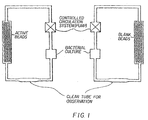
- Figure 1 is a schematic representation of apparatus used in evaluating the materials of the invention.
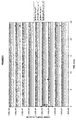
- Figure 2 is a graphical representation of results achieved using the invention in accordance with Example 1 described hereafter.
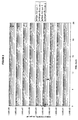
- Figure 3 is a graphical representation of results achieved using the invention in accordance with Example 2 described hereafter.
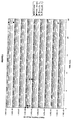
- Figure 4 is a graphical representation of results achieved using the invention in accordance with Example 3 described hereafter.
- Figure 5 is a graphical representation of results achieved using the invention in accordance with Example 4 described hereafter.
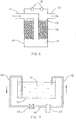
- Figure 6 is a schematic representation of apparatus for use in performing the method of the invention.
- Figure 7 is a schematic representation of the use of the apparatus shown in Figure 4.
- a SiO 2 /TiO 2 sol-gel matrix is used in the invention.
- An amorphous matrix of the glassy material may be prepared by the room temperature polymerisation of suitable monomers, usually metal alkoxides.
- suitable monomers usually metal alkoxides.
- the polymerisation of metal alkoxide mixtures results in a transparent porous solid (xerogel) with surface areas of up to hundreds of square metres per gram and having small pores e.g. from 0.5 to 500nm.
- the low temperature glass synthesis allows doping of the inorganic glass with organic molecules e.g a chemically sensitive dye.
- the sol-gel glass has a cage-like porous molecular structure in which a single doping molecule can be isolated in an individual cage, even at high concentrations of additive. Molecules trapped in sol-gel glasses can interact with diffusible solutes or components in an adjacent liquid or gas phase in the pore space.
- the mole ratio of Si:Ti in the sol-gel glass is from 90:10 to 50:50, more preferably from 80:20 to 60:40.
- biocide examples include those described in " Microbiocides for the Protection of Materials", W. Paulus, published by Chapman Hall, 1993. They are agents capable of killing or inhibiting the multiplication of microorganisms such as bacteria, yeasts, fungi, algae and lichens. Examples include heterocyclic N,S compounds, compounds with activated halogen groups and quaternary ammonium salts.
- Preferred biocides include those currently employed in the treatment of photoprocessing systems e.g. isothiazolinones.
- isothiazolinone biocides are those having the structure wherein
- Preferred biocides include those having the following stuctures: wherein R 3 is an alkyl group having from 4 to 20 carbon atoms or an aryl group having from 6 to 20 carbon atoms; wherein R 5 and R 6 are selected from hydrogen and halogen, and R 4 is an alkyl group having from 5 to 20 carbon atoms; and, wherein each of R 7 , R 8 and R 9 is hydrogen or an alkyl group providing a total of from 2 to 20 carbon atoms; R 10 is substituted or unsubstituted alkyl or aryl e.g. phenoxyethyl; and, Y is any suitable counter anion e.g. halide.
- isothiazolinone biocides include ProxelTM (manufactured by Zeneca) : PromexalTM (manufactured by Zeneca): KathonTM (manufactured by Rohm and Haas):
- BronopolTM manufactured by Boots
- DomiphenTM bromide manufactured by Ciba-Geigy
- VantocilTM manufactured by Zeneca
- Densil STM manufactured by Zeneca
- Biocides which are hydrophobically modified ProxelTM and KathonTM have been prepared having the following structures:
- Log P is a well known term used in literature on biocides. As used herein, it provides a measure of the hydrophobicity of the biocide.
- a known amount of biocide was placed in a glass vessel containing either 10ml of water or 10ml of octanol depending on the solubility of the biocide. An equal volume of the other solvent was added and the glass vessel sealed. The vessel was shaken vigorously for a few minutes and then every few hours for more than 48 hours. Each mixture was placed in a sealed separating funnel and left for a further 24 hours. The water phase of each mixture was removed and the UV/visible spectra run against water with appropriate dilutions to bring absorbance between 0 and 1.5 for the commercial biocides and the octanol fractions were examined for the hydrophobically modified biocides.
- the log P value of the biocides which are used in the invention is preferably at least 1.5, more preferably at least 2.0.
- the amount of biocide used is from 5 to 35 mole percent, more preferably from 20 to 30 mole percent based on the metal alkoxide or other precursor used to construct the inorganic polymer network.
- the inorganic polymer network is coated on a support.
- Preferred support materials are those to which the inorganic polymer readily adheres.
- Inorganic support materials are advantageous. Many provide the additional benefits of low cost and physical robustness. Suitable materials include pumice, clay, sand, gravel, chalk, zeolites and glass. Such materials give the further advantage of easy disposal and are potentially more stable over wide pH ranges than organic polymer-based systems.
- Polymers suitable for use as support materials include any inert, water insoluble polymers having appropriate surface properties.
- such polymer supports have a non-crystalline surface.
- the polymer supports have a hydrophilic surface comprising groups such as -OH and -COOH.
- suitable types of polymer from which suitable supports can be derived include ethenic polymers including polyolefins, polystyrene, polyvinyl chloride, polyvinyl acetate and acrylic polymers; and polymers formed by condensation reactions including polyesters, polyamides, polyurethanes, polyethers, epoxy resins, amino resins and phenol-aldehyde resins.
- the support may take a variety of forms e.g. particulate, sheet or fibre. It may be porous or nonporous.
- the thickness of the inorganic polymer network coating on the support may be from 10nm to 10 ⁇ m, preferably from 50nm to 5 ⁇ m.
- a solution of the biocide is made in an organic solvent e.g. tetrahydrofuran or alcohol.
- the biocide solution is mixed with an alkoxide sol-gel forming pre-cursor.
- the pre-cursor containing the biocide may be coated on a support if required by any conventional coating means e.g. dipping, spinning and spraying.
- the pre-cursor containing the biocide is left for some hours e.g. from 4 to 6 hours, before removing the solvent, preferably under reduced pressure. Drying is preferably carried out in a vacuum oven at a temperature from 60 to 100°C.
- the aqueous medium is brought into contact with the biocidal material.
- a container e.g. a column containing the material in particulate form
- passing the aqueous medium through a filter of the material passing the aqueous medium over the material in the form of a surface coating.
- the invention is of particular use in photoprocessing systems.
- Such systems comprise stages for developing, fixing, bleaching and washing an exposed photographic material.
- Each stage requires apparatus for applying the appropriate aqueous processing solution to the photographic material.
- the apparatus may comprise means for supplying, removing and, possibly, recirculating such solutions.
- the method of the invention may be used to inhibit microbial growth in the wash water or other solutions used in a photoprocessor.
- FIG. 6 is a schematic representation of apparatus for use in performing the method of the invention.
- the apparatus comprises a container 10 having fluid inlet means 11 and fluid outlet means 12 said inlet and outlet means 11, 12 communicating with an inner chamber 13 of the container.
- fluid entering the inner chamber through the inlet means 11 flows through the chamber 13 and leaves the container through the outlet means 12.
- the inner chamber 13 holds a biocidal material in accordance with the invention in the form of particles 14.
- a filter 15 to retain the particles is positioned at the top of the inner chamber to prevent loss of the particles from the device.
- the top of the container 10 is provided with plugs 16 for venting any gas which accumulates in the device.
- Fluid entering the device flows down a central tube and subsequently flows up through the particles.
- the arrows indicate the direction of the flow of fluid through the device.
- FIG. 7 is a schematic representation of the use of the apparatus shown in Figure 6.
- a tank 20 containing water 21 is shown e.g. the wash water tank of a photoprocessor.
- Tubing 22 has an open end in the water 21 at the bottom of tank 20, the other end being connected to the inlet of a pump 23 outside the tank 20.
- Tubing 24 connects the outlet of the pump 23 to the inlet of a device 25 of the type shown in Figure 6.
- One end of tubing 26 is connected to the outlet of device 25 and the other end opens into the top of tank 20.
- water is pumped from the bottom of tank 20 through device 25 and back into tank 20 in a recirculation loop.
- the arrows indicate the direction of the flow of water around the loop.
- the invention is further illustrated by way of example as follows.
- Control (blank sol-gel) and active (immobilised biocide in sol-gel) coated pumice stones were tested in a nutrient broth containing ⁇ 10 4 bacteria/ml ( Pseudomonas aeruginosa ).
- the control particles and active particles were each put separately into a 10cm glass column with screw-tight plastic adaptors and polypropylene nozzles.
- a nylon mesh filter was put at the bottom and top of each column in between two rubber washers.
- the columns, all silicone rubber tubing, flasks and nutrient broth necessary to complete the flow circuit were sterilised by autoclaving at 120°C for >20minutes. Each column was placed in circuit with 50ml of nutrient broth as shown in Figure 1.
- a shaking water bath held at 30°C was used to keep the 250ml wide-neck round-bottomed flasks containing the culture at this constant temperature.
- a small inoculum of pre-prepared bacterial culture was added to each flask to give a known number of bacteria/ml in the flask.
- a small aliquot of the bacterial culture was removed from each flask for further counting/analysis and the pumps started to give a volume flowrate of 13.5ml/min. The flow direction was upwards through the stones.
- Example 3 An identical method to Example 1 was used except that porous clay beads (OBI, 8-16mm) were used in place of the pumice stones. Microbiological evaluation was carried out in a similar fashion to Example 1, and the data is given in Figure 3. This demonstrates that bacteriostatic activity is obtained for the Compound 2 immobilised in sol-gel coated on clay beads.
- Example 2 An identical method to Example 1 was used except that Compound 3 was used in place of Compound 2. Microbiological evaluation was carried out in a similar fashion to Example 1, using untreated pumice stones (no sol-gel coating) and those having a sol-gel coating only (no biocide); the data are given in Figure 4.
- Example 2 An identical method to Example 1 was used except that Compound 3 was used in place of Compound 2.
- the resultant active and control pumice stones were dried for 1 hour at 90°C and tested as described previously.
- the microbiological results in Figure 5 show that the drying treatment has removed any contribution from the blank sol-gel coating.
- Compound 3 immobilised in sol-gel coated on pumice stones is strongly bactericidal.
Landscapes
- Life Sciences & Earth Sciences (AREA)
- Health & Medical Sciences (AREA)
- General Health & Medical Sciences (AREA)
- Engineering & Computer Science (AREA)
- Wood Science & Technology (AREA)
- Plant Pathology (AREA)
- Dentistry (AREA)
- Pest Control & Pesticides (AREA)
- Agronomy & Crop Science (AREA)
- Zoology (AREA)
- Environmental Sciences (AREA)
- Toxicology (AREA)
- Hydrology & Water Resources (AREA)
- Environmental & Geological Engineering (AREA)
- Water Supply & Treatment (AREA)
- Chemical & Material Sciences (AREA)
- Organic Chemistry (AREA)
- Agricultural Chemicals And Associated Chemicals (AREA)
- Photographic Developing Apparatuses (AREA)
Applications Claiming Priority (2)
| Application Number | Priority Date | Filing Date | Title |
|---|---|---|---|
| GB9615944 | 1996-07-30 | ||
| GBGB9615944.7A GB9615944D0 (en) | 1996-07-30 | 1996-07-30 | A material,method and apparatus for inhibiting microbial growth in an aqueous medium |
Publications (3)
| Publication Number | Publication Date |
|---|---|
| EP0832561A2 EP0832561A2 (en) | 1998-04-01 |
| EP0832561A3 EP0832561A3 (en) | 1999-02-17 |
| EP0832561B1 true EP0832561B1 (en) | 2003-03-19 |
Family
ID=10797710
Family Applications (1)
| Application Number | Title | Priority Date | Filing Date |
|---|---|---|---|
| EP97202345A Expired - Lifetime EP0832561B1 (en) | 1996-07-30 | 1997-07-25 | A material, method and apparatus for inhibiting microbial growth in an aqueous medium |
Country Status (8)
| Country | Link |
|---|---|
| US (1) | US5855899A (enExample) |
| EP (1) | EP0832561B1 (enExample) |
| JP (1) | JPH1087405A (enExample) |
| AU (1) | AU736967B2 (enExample) |
| CA (1) | CA2207168A1 (enExample) |
| DE (1) | DE69719892T2 (enExample) |
| DK (1) | DK0832561T3 (enExample) |
| GB (1) | GB9615944D0 (enExample) |
Families Citing this family (10)
| Publication number | Priority date | Publication date | Assignee | Title |
|---|---|---|---|---|
| AU7865598A (en) * | 1997-08-14 | 1999-02-25 | Rohm And Haas Company | Solid biocidal compositions |
| US6090399A (en) * | 1997-12-11 | 2000-07-18 | Rohm And Haas Company | Controlled release composition incorporating metal oxide glass comprising biologically active compound |
| US6610282B1 (en) * | 1998-05-05 | 2003-08-26 | Rohm And Haas Company | Polymeric controlled release compositions |
| GB9818778D0 (en) | 1998-08-28 | 1998-10-21 | Crosfield Joseph & Sons | Particulate carrier for biocide formulations |
| FR2801767B1 (fr) * | 1999-12-01 | 2002-09-13 | Eastman Kodak Co | Materiau biocide ayant une activite amelioree |
| FR2822087B1 (fr) * | 2001-03-14 | 2004-01-16 | Eastman Kodak Co | Materiau composite ameliore pour le traitement d'effluents photographiques |
| US6806299B2 (en) * | 2001-05-18 | 2004-10-19 | The Regents Of The University Of California | Preparation of hydrophobic organic aeorgels |
| US7211607B2 (en) * | 2002-04-24 | 2007-05-01 | The Regents Of The University Of California | Method for producing high surface area chromia materials for catalysis |
| US20050211635A1 (en) * | 2004-03-24 | 2005-09-29 | Yeh Eshan B | Anti-microbial media and methods for making and utilizing the same |
| ATE530228T1 (de) * | 2009-04-23 | 2011-11-15 | Rohm & Haas | Verringerung der gehalte an antimikrobiellen verbindungen bei der produktabgabe |
Family Cites Families (12)
| Publication number | Priority date | Publication date | Assignee | Title |
|---|---|---|---|---|
| US2038694A (en) * | 1930-10-15 | 1936-04-28 | Davision Chemical Corp | Medicament |
| US2595290A (en) * | 1946-07-25 | 1952-05-06 | Quinn Products Inc | Water purification |
| GB1590574A (en) * | 1976-08-06 | 1981-06-03 | Atomic Energy Authority Uk | Biologically active gels |
| US4552591A (en) * | 1984-05-15 | 1985-11-12 | Petrolite Corporation | Oil field biocide composition |
| EP0190504B1 (en) * | 1984-12-28 | 1993-04-21 | Johnson Matthey Public Limited Company | Antimicrobial compositions |
| FR2580281B1 (fr) * | 1985-04-11 | 1987-09-18 | Synthelabo | Derives du nitrofuranne, leur preparation et leur application en therapeutique |
| JPS6323960A (ja) * | 1986-07-16 | 1988-02-01 | Zenji Hagiwara | 非晶質アルミノ珪酸塩粒子を含有する高分子体及びその製造方法 |
| US5651978A (en) * | 1993-05-18 | 1997-07-29 | Matsushita Electric Industrial Co., Ltd. | Silver thiosulfate silica gel antibacterial compositions |
| FR2710628B1 (fr) * | 1993-09-27 | 1995-12-01 | Kodak Pathe | Préparation de solutions d'oxyde mixte à base d'étain et de silicium. |
| KR970000745B1 (ko) * | 1993-11-19 | 1997-01-18 | 주식회사 엘지화학 | 항균성 화장료용 안료와 그 제조방법 및 이를 함유하는 화장료 조성물 |
| GB9504630D0 (en) * | 1995-03-08 | 1995-04-26 | Kodak Ltd | A material and method for inhibiting bacterial growth in an aqueous medium |
| FR2732189B1 (fr) * | 1995-03-27 | 1997-05-09 | Kodak Pathe | Gels organiques-inorganiques pour delivrer des quantites controlees de composes actifs dans des solutions aqueuses |
-
1996
- 1996-07-30 GB GBGB9615944.7A patent/GB9615944D0/en active Pending
-
1997
- 1997-06-06 CA CA002207168A patent/CA2207168A1/en not_active Abandoned
- 1997-06-26 US US08/882,792 patent/US5855899A/en not_active Expired - Fee Related
- 1997-07-25 DK DK97202345T patent/DK0832561T3/da active
- 1997-07-25 EP EP97202345A patent/EP0832561B1/en not_active Expired - Lifetime
- 1997-07-25 DE DE69719892T patent/DE69719892T2/de not_active Expired - Fee Related
- 1997-07-29 JP JP9203453A patent/JPH1087405A/ja active Pending
- 1997-07-29 AU AU31586/97A patent/AU736967B2/en not_active Ceased
Also Published As
| Publication number | Publication date |
|---|---|
| DE69719892D1 (de) | 2003-04-24 |
| AU3158697A (en) | 1998-02-05 |
| JPH1087405A (ja) | 1998-04-07 |
| US5855899A (en) | 1999-01-05 |
| DE69719892T2 (de) | 2003-12-04 |
| GB9615944D0 (en) | 1996-09-11 |
| EP0832561A2 (en) | 1998-04-01 |
| CA2207168A1 (en) | 1998-01-30 |
| EP0832561A3 (en) | 1999-02-17 |
| AU736967B2 (en) | 2001-08-09 |
| DK0832561T3 (da) | 2003-05-12 |
Similar Documents
| Publication | Publication Date | Title |
|---|---|---|
| US20160128333A1 (en) | Antimicrobial quaternary ammonium organosilane coatings | |
| US9764264B2 (en) | Ballast water treatment systems | |
| US6780332B2 (en) | Antimicrobial filtration | |
| EP0832561A2 (en) | A material, method and apparatus for inhibiting microbial growth in an aqueous medium | |
| CA1308018C (en) | Cleaning method for water containing vessels and systems | |
| US9364572B2 (en) | Static fluid disinfecting systems and related methods | |
| CN102046537A (zh) | 杀微生物剂的受控释放 | |
| US5866016A (en) | Methods and compositions for controlling biofouling using combinations of an ionene polymer and a salt of dodecylamine | |
| CA2169884C (en) | A material and method for inhibiting bacterial growth in an aqueous medium | |
| WO2000030443A1 (en) | Biocide material and method of preparation of said material | |
| EP0827939B1 (en) | Method for Inhibiting Microbial Growth in an Aqueous Medium | |
| US20170073253A1 (en) | Water Bladder System and Related Methods | |
| US20010014345A1 (en) | Material, method and apparatus for inhibiting bacterial growth in an aqueous medium | |
| EP0894432A2 (en) | A method of inhibiting microbial growth in an aqueous medium | |
| US5866633A (en) | Material and method for inhibiting bacterial growth in an aqueous medium | |
| AU720577B2 (en) | Methods and compositions for controlling biofouling using combinations of an ionene polymer and a salt of dodecylamine | |
| Price et al. | Analytical method for the release of isothiazolones from microtubules in artificial seawater | |
| CA2243493C (en) | A method of inhibiting microbial growth in an aqueous medium | |
| EP2978460A1 (en) | Static fluid disinfecting systems and related methods | |
| EP0934000A1 (en) | Chemical system generating reactive oxygen species continuously and methods of using same |
Legal Events
| Date | Code | Title | Description |
|---|---|---|---|
| PUAI | Public reference made under article 153(3) epc to a published international application that has entered the european phase |
Free format text: ORIGINAL CODE: 0009012 |
|
| AK | Designated contracting states |
Kind code of ref document: A2 Designated state(s): DE DK FR GB NL SE |
|
| AX | Request for extension of the european patent |
Free format text: AL;LT;LV;RO;SI |
|
| PUAL | Search report despatched |
Free format text: ORIGINAL CODE: 0009013 |
|
| AK | Designated contracting states |
Kind code of ref document: A3 Designated state(s): AT BE CH DE DK ES FI FR GB GR IE IT LI LU MC NL PT SE |
|
| AX | Request for extension of the european patent |
Free format text: AL;LT;LV;RO;SI |
|
| 17P | Request for examination filed |
Effective date: 19990722 |
|
| AKX | Designation fees paid |
Free format text: DE DK FR GB NL SE |
|
| 17Q | First examination report despatched |
Effective date: 20010511 |
|
| GRAH | Despatch of communication of intention to grant a patent |
Free format text: ORIGINAL CODE: EPIDOS IGRA |
|
| GRAH | Despatch of communication of intention to grant a patent |
Free format text: ORIGINAL CODE: EPIDOS IGRA |
|
| GRAA | (expected) grant |
Free format text: ORIGINAL CODE: 0009210 |
|
| AK | Designated contracting states |
Designated state(s): DE DK FR GB NL SE |
|
| REG | Reference to a national code |
Ref country code: GB Ref legal event code: FG4D |
|
| REF | Corresponds to: |
Ref document number: 69719892 Country of ref document: DE Date of ref document: 20030424 Kind code of ref document: P |
|
| REG | Reference to a national code |
Ref country code: DK Ref legal event code: T3 |
|
| REG | Reference to a national code |
Ref country code: SE Ref legal event code: TRGR |
|
| ET | Fr: translation filed | ||
| PLBE | No opposition filed within time limit |
Free format text: ORIGINAL CODE: 0009261 |
|
| STAA | Information on the status of an ep patent application or granted ep patent |
Free format text: STATUS: NO OPPOSITION FILED WITHIN TIME LIMIT |
|
| 26N | No opposition filed |
Effective date: 20031222 |
|
| PGFP | Annual fee paid to national office [announced via postgrant information from national office to epo] |
Ref country code: NL Payment date: 20040716 Year of fee payment: 8 |
|
| PGFP | Annual fee paid to national office [announced via postgrant information from national office to epo] |
Ref country code: FR Payment date: 20040720 Year of fee payment: 8 |
|
| PGFP | Annual fee paid to national office [announced via postgrant information from national office to epo] |
Ref country code: SE Payment date: 20040721 Year of fee payment: 8 Ref country code: GB Payment date: 20040721 Year of fee payment: 8 |
|
| PGFP | Annual fee paid to national office [announced via postgrant information from national office to epo] |
Ref country code: DK Payment date: 20040722 Year of fee payment: 8 |
|
| PGFP | Annual fee paid to national office [announced via postgrant information from national office to epo] |
Ref country code: DE Payment date: 20040831 Year of fee payment: 8 |
|
| REG | Reference to a national code |
Ref country code: GB Ref legal event code: 732E |
|
| NLS | Nl: assignments of ep-patents |
Owner name: MONTANA STATE UNIVERSITY |
|
| REG | Reference to a national code |
Ref country code: FR Ref legal event code: TP |
|
| PG25 | Lapsed in a contracting state [announced via postgrant information from national office to epo] |
Ref country code: GB Free format text: LAPSE BECAUSE OF NON-PAYMENT OF DUE FEES Effective date: 20050725 |
|
| PG25 | Lapsed in a contracting state [announced via postgrant information from national office to epo] |
Ref country code: SE Free format text: LAPSE BECAUSE OF NON-PAYMENT OF DUE FEES Effective date: 20050726 |
|
| PG25 | Lapsed in a contracting state [announced via postgrant information from national office to epo] |
Ref country code: DK Free format text: LAPSE BECAUSE OF NON-PAYMENT OF DUE FEES Effective date: 20050801 |
|
| PG25 | Lapsed in a contracting state [announced via postgrant information from national office to epo] |
Ref country code: NL Free format text: LAPSE BECAUSE OF NON-PAYMENT OF DUE FEES Effective date: 20060201 Ref country code: DE Free format text: LAPSE BECAUSE OF NON-PAYMENT OF DUE FEES Effective date: 20060201 |
|
| EUG | Se: european patent has lapsed | ||
| GBPC | Gb: european patent ceased through non-payment of renewal fee |
Effective date: 20050725 |
|
| PG25 | Lapsed in a contracting state [announced via postgrant information from national office to epo] |
Ref country code: FR Free format text: LAPSE BECAUSE OF NON-PAYMENT OF DUE FEES Effective date: 20060331 |
|
| NLV4 | Nl: lapsed or anulled due to non-payment of the annual fee |
Effective date: 20060201 |
|
| REG | Reference to a national code |
Ref country code: DK Ref legal event code: EBP |
|
| REG | Reference to a national code |
Ref country code: FR Ref legal event code: ST Effective date: 20060331 |