EP0830867B1 - Appareil pour le traitement du sang par circulation extracorporelle et procédé de fabrication - Google Patents
Appareil pour le traitement du sang par circulation extracorporelle et procédé de fabrication Download PDFInfo
- Publication number
- EP0830867B1 EP0830867B1 EP97420168A EP97420168A EP0830867B1 EP 0830867 B1 EP0830867 B1 EP 0830867B1 EP 97420168 A EP97420168 A EP 97420168A EP 97420168 A EP97420168 A EP 97420168A EP 0830867 B1 EP0830867 B1 EP 0830867B1
- Authority
- EP
- European Patent Office
- Prior art keywords
- substance
- blood
- membrane
- compartment
- equipment
- Prior art date
- Legal status (The legal status is an assumption and is not a legal conclusion. Google has not performed a legal analysis and makes no representation as to the accuracy of the status listed.)
- Expired - Lifetime
Links
- 239000008280 blood Substances 0.000 title claims abstract description 110
- 210000004369 blood Anatomy 0.000 title claims abstract description 110
- 230000004087 circulation Effects 0.000 title claims abstract description 21
- 238000000034 method Methods 0.000 title claims description 24
- 238000004519 manufacturing process Methods 0.000 title description 14
- 230000008569 process Effects 0.000 title description 10
- 239000000126 substance Substances 0.000 claims abstract description 78
- 239000007864 aqueous solution Substances 0.000 claims abstract description 24
- 238000009832 plasma treatment Methods 0.000 claims abstract 4
- 239000012528 membrane Substances 0.000 claims description 119
- 229920002873 Polyethylenimine Polymers 0.000 claims description 86
- 238000011282 treatment Methods 0.000 claims description 27
- 239000012510 hollow fiber Substances 0.000 claims description 19
- 230000001954 sterilising effect Effects 0.000 claims description 13
- 238000004659 sterilization and disinfection Methods 0.000 claims description 12
- 239000007788 liquid Substances 0.000 claims description 11
- 239000002052 molecular layer Substances 0.000 claims description 9
- 239000011159 matrix material Substances 0.000 claims description 6
- IAYPIBMASNFSPL-UHFFFAOYSA-N Ethylene oxide Chemical compound C1CO1 IAYPIBMASNFSPL-UHFFFAOYSA-N 0.000 claims description 5
- 229920001577 copolymer Polymers 0.000 claims description 5
- 125000002091 cationic group Chemical group 0.000 claims description 3
- 230000017531 blood circulation Effects 0.000 claims 3
- 230000015572 biosynthetic process Effects 0.000 claims 2
- 239000000835 fiber Substances 0.000 description 32
- ZMXDDKWLCZADIW-UHFFFAOYSA-N N,N-Dimethylformamide Chemical compound CN(C)C=O ZMXDDKWLCZADIW-UHFFFAOYSA-N 0.000 description 27
- 238000012360 testing method Methods 0.000 description 27
- 230000004913 activation Effects 0.000 description 25
- 239000000243 solution Substances 0.000 description 25
- XLYOFNOQVPJJNP-UHFFFAOYSA-N water Chemical compound O XLYOFNOQVPJJNP-UHFFFAOYSA-N 0.000 description 23
- FAPWRFPIFSIZLT-UHFFFAOYSA-M Sodium chloride Chemical compound [Na+].[Cl-] FAPWRFPIFSIZLT-UHFFFAOYSA-M 0.000 description 22
- PEDCQBHIVMGVHV-UHFFFAOYSA-N Glycerine Chemical compound OCC(O)CO PEDCQBHIVMGVHV-UHFFFAOYSA-N 0.000 description 18
- 238000001179 sorption measurement Methods 0.000 description 11
- 238000000108 ultra-filtration Methods 0.000 description 11
- 238000000502 dialysis Methods 0.000 description 9
- 238000000338 in vitro Methods 0.000 description 9
- 230000037452 priming Effects 0.000 description 9
- 239000011780 sodium chloride Substances 0.000 description 9
- BFSVOASYOCHEOV-UHFFFAOYSA-N 2-diethylaminoethanol Chemical compound CCN(CC)CCO BFSVOASYOCHEOV-UHFFFAOYSA-N 0.000 description 8
- 229920002307 Dextran Polymers 0.000 description 8
- 239000013543 active substance Substances 0.000 description 8
- 230000000694 effects Effects 0.000 description 8
- 102000001399 Kallikrein Human genes 0.000 description 7
- 108060005987 Kallikrein Proteins 0.000 description 7
- 238000005259 measurement Methods 0.000 description 7
- 229920002239 polyacrylonitrile Polymers 0.000 description 7
- 229920000642 polymer Polymers 0.000 description 7
- 102000018832 Cytochromes Human genes 0.000 description 6
- 108010052832 Cytochromes Proteins 0.000 description 6
- 239000000203 mixture Substances 0.000 description 6
- 230000004048 modification Effects 0.000 description 6
- 238000012986 modification Methods 0.000 description 6
- 238000012546 transfer Methods 0.000 description 6
- XBDQKXXYIPTUBI-UHFFFAOYSA-M Propionate Chemical compound CCC([O-])=O XBDQKXXYIPTUBI-UHFFFAOYSA-M 0.000 description 5
- 239000000463 material Substances 0.000 description 5
- 230000007935 neutral effect Effects 0.000 description 5
- SZHIIIPPJJXYRY-UHFFFAOYSA-M sodium;2-methylprop-2-ene-1-sulfonate Chemical compound [Na+].CC(=C)CS([O-])(=O)=O SZHIIIPPJJXYRY-UHFFFAOYSA-M 0.000 description 5
- IJGRMHOSHXDMSA-UHFFFAOYSA-N Atomic nitrogen Chemical compound N#N IJGRMHOSHXDMSA-UHFFFAOYSA-N 0.000 description 4
- 229920002134 Carboxymethyl cellulose Polymers 0.000 description 4
- 102000008946 Fibrinogen Human genes 0.000 description 4
- 108010049003 Fibrinogen Proteins 0.000 description 4
- 239000001768 carboxy methyl cellulose Substances 0.000 description 4
- 235000010948 carboxy methyl cellulose Nutrition 0.000 description 4
- 239000008112 carboxymethyl-cellulose Substances 0.000 description 4
- 229940012952 fibrinogen Drugs 0.000 description 4
- 239000003292 glue Substances 0.000 description 4
- 239000002504 physiological saline solution Substances 0.000 description 4
- 102000004169 proteins and genes Human genes 0.000 description 4
- 108090000623 proteins and genes Proteins 0.000 description 4
- NLHHRLWOUZZQLW-UHFFFAOYSA-N Acrylonitrile Chemical compound C=CC#N NLHHRLWOUZZQLW-UHFFFAOYSA-N 0.000 description 3
- HTTJABKRGRZYRN-UHFFFAOYSA-N Heparin Chemical compound OC1C(NC(=O)C)C(O)OC(COS(O)(=O)=O)C1OC1C(OS(O)(=O)=O)C(O)C(OC2C(C(OS(O)(=O)=O)C(OC3C(C(O)C(O)C(O3)C(O)=O)OS(O)(=O)=O)C(CO)O2)NS(O)(=O)=O)C(C(O)=O)O1 HTTJABKRGRZYRN-UHFFFAOYSA-N 0.000 description 3
- 230000008901 benefit Effects 0.000 description 3
- 238000006243 chemical reaction Methods 0.000 description 3
- 238000010586 diagram Methods 0.000 description 3
- 229960002897 heparin Drugs 0.000 description 3
- 229920000669 heparin Polymers 0.000 description 3
- 229920002521 macromolecule Polymers 0.000 description 3
- 239000002356 single layer Substances 0.000 description 3
- KRKNYBCHXYNGOX-UHFFFAOYSA-K Citrate Chemical compound [O-]C(=O)CC(O)(CC([O-])=O)C([O-])=O KRKNYBCHXYNGOX-UHFFFAOYSA-K 0.000 description 2
- 229920002491 Diethylaminoethyl-dextran Polymers 0.000 description 2
- 108090000113 Plasma Kallikrein Proteins 0.000 description 2
- 208000001647 Renal Insufficiency Diseases 0.000 description 2
- 230000009471 action Effects 0.000 description 2
- 239000012080 ambient air Substances 0.000 description 2
- 208000003455 anaphylaxis Diseases 0.000 description 2
- 238000003556 assay Methods 0.000 description 2
- 210000004204 blood vessel Anatomy 0.000 description 2
- 230000000295 complement effect Effects 0.000 description 2
- 238000010790 dilution Methods 0.000 description 2
- 239000012895 dilution Substances 0.000 description 2
- 239000003792 electrolyte Substances 0.000 description 2
- 238000002615 hemofiltration Methods 0.000 description 2
- 239000007924 injection Substances 0.000 description 2
- 238000002347 injection Methods 0.000 description 2
- 201000006370 kidney failure Diseases 0.000 description 2
- 229910052757 nitrogen Inorganic materials 0.000 description 2
- 239000011148 porous material Substances 0.000 description 2
- 239000000843 powder Substances 0.000 description 2
- 238000002360 preparation method Methods 0.000 description 2
- 239000002904 solvent Substances 0.000 description 2
- 230000006641 stabilisation Effects 0.000 description 2
- 238000011105 stabilization Methods 0.000 description 2
- 239000008174 sterile solution Substances 0.000 description 2
- 230000001225 therapeutic effect Effects 0.000 description 2
- 231100000331 toxic Toxicity 0.000 description 2
- 230000002588 toxic effect Effects 0.000 description 2
- 238000012795 verification Methods 0.000 description 2
- WXHLLJAMBQLULT-UHFFFAOYSA-N 2-[[6-[4-(2-hydroxyethyl)piperazin-1-yl]-2-methylpyrimidin-4-yl]amino]-n-(2-methyl-6-sulfanylphenyl)-1,3-thiazole-5-carboxamide;hydrate Chemical compound O.C=1C(N2CCN(CCO)CC2)=NC(C)=NC=1NC(S1)=NC=C1C(=O)NC1=C(C)C=CC=C1S WXHLLJAMBQLULT-UHFFFAOYSA-N 0.000 description 1
- 239000005541 ACE inhibitor Substances 0.000 description 1
- 206010067484 Adverse reaction Diseases 0.000 description 1
- 102000004506 Blood Proteins Human genes 0.000 description 1
- 108010017384 Blood Proteins Proteins 0.000 description 1
- PTHCMJGKKRQCBF-UHFFFAOYSA-N Cellulose, microcrystalline Chemical compound OC1C(O)C(OC)OC(CO)C1OC1C(O)C(O)C(OC)C(CO)O1 PTHCMJGKKRQCBF-UHFFFAOYSA-N 0.000 description 1
- VGGSQFUCUMXWEO-UHFFFAOYSA-N Ethene Chemical compound C=C VGGSQFUCUMXWEO-UHFFFAOYSA-N 0.000 description 1
- 108010080865 Factor XII Proteins 0.000 description 1
- 102000000429 Factor XII Human genes 0.000 description 1
- 206010057371 Hypoaesthesia oral Diseases 0.000 description 1
- DGAQECJNVWCQMB-PUAWFVPOSA-M Ilexoside XXIX Chemical compound C[C@@H]1CC[C@@]2(CC[C@@]3(C(=CC[C@H]4[C@]3(CC[C@@H]5[C@@]4(CC[C@@H](C5(C)C)OS(=O)(=O)[O-])C)C)[C@@H]2[C@]1(C)O)C)C(=O)O[C@H]6[C@@H]([C@H]([C@@H]([C@H](O6)CO)O)O)O.[Na+] DGAQECJNVWCQMB-PUAWFVPOSA-M 0.000 description 1
- 206010028813 Nausea Diseases 0.000 description 1
- 206010030113 Oedema Diseases 0.000 description 1
- 102000003827 Plasma Kallikrein Human genes 0.000 description 1
- 229910021607 Silver chloride Inorganic materials 0.000 description 1
- 241000897276 Termes Species 0.000 description 1
- XTXRWKRVRITETP-UHFFFAOYSA-N Vinyl acetate Chemical compound CC(=O)OC=C XTXRWKRVRITETP-UHFFFAOYSA-N 0.000 description 1
- 239000004480 active ingredient Substances 0.000 description 1
- 230000006838 adverse reaction Effects 0.000 description 1
- 230000002052 anaphylactic effect Effects 0.000 description 1
- 229940044094 angiotensin-converting-enzyme inhibitor Drugs 0.000 description 1
- 239000003146 anticoagulant agent Substances 0.000 description 1
- 229940127219 anticoagulant drug Drugs 0.000 description 1
- 239000002220 antihypertensive agent Substances 0.000 description 1
- 229940127088 antihypertensive drug Drugs 0.000 description 1
- 238000002617 apheresis Methods 0.000 description 1
- 238000000149 argon plasma sintering Methods 0.000 description 1
- 238000012550 audit Methods 0.000 description 1
- JXLHNMVSKXFWAO-UHFFFAOYSA-N azane;7-fluoro-2,1,3-benzoxadiazole-4-sulfonic acid Chemical compound N.OS(=O)(=O)C1=CC=C(F)C2=NON=C12 JXLHNMVSKXFWAO-UHFFFAOYSA-N 0.000 description 1
- 230000004888 barrier function Effects 0.000 description 1
- 235000015278 beef Nutrition 0.000 description 1
- 238000004166 bioassay Methods 0.000 description 1
- 230000000035 biogenic effect Effects 0.000 description 1
- 239000013060 biological fluid Substances 0.000 description 1
- 239000012620 biological material Substances 0.000 description 1
- 230000036770 blood supply Effects 0.000 description 1
- 239000000872 buffer Substances 0.000 description 1
- 229920002301 cellulose acetate Polymers 0.000 description 1
- 230000015271 coagulation Effects 0.000 description 1
- 238000005345 coagulation Methods 0.000 description 1
- 230000001186 cumulative effect Effects 0.000 description 1
- 238000007872 degassing Methods 0.000 description 1
- 230000007850 degeneration Effects 0.000 description 1
- 239000008367 deionised water Substances 0.000 description 1
- 229910021641 deionized water Inorganic materials 0.000 description 1
- 230000008021 deposition Effects 0.000 description 1
- 238000003795 desorption Methods 0.000 description 1
- 238000001514 detection method Methods 0.000 description 1
- 239000000385 dialysis solution Substances 0.000 description 1
- 238000004090 dissolution Methods 0.000 description 1
- 239000008151 electrolyte solution Substances 0.000 description 1
- 238000011156 evaluation Methods 0.000 description 1
- 238000001914 filtration Methods 0.000 description 1
- 239000012530 fluid Substances 0.000 description 1
- 238000001631 haemodialysis Methods 0.000 description 1
- 238000005534 hematocrit Methods 0.000 description 1
- 230000000322 hemodialysis Effects 0.000 description 1
- 230000002209 hydrophobic effect Effects 0.000 description 1
- 208000034783 hypoesthesia Diseases 0.000 description 1
- 230000006872 improvement Effects 0.000 description 1
- 239000011229 interlayer Substances 0.000 description 1
- 230000002427 irreversible effect Effects 0.000 description 1
- 210000003734 kidney Anatomy 0.000 description 1
- 239000010410 layer Substances 0.000 description 1
- 231100001231 less toxic Toxicity 0.000 description 1
- 238000005374 membrane filtration Methods 0.000 description 1
- 230000002503 metabolic effect Effects 0.000 description 1
- 125000005394 methallyl group Chemical group 0.000 description 1
- 238000000465 moulding Methods 0.000 description 1
- 230000008693 nausea Effects 0.000 description 1
- 238000006386 neutralization reaction Methods 0.000 description 1
- 230000001453 nonthrombogenic effect Effects 0.000 description 1
- 231100000252 nontoxic Toxicity 0.000 description 1
- 230000003000 nontoxic effect Effects 0.000 description 1
- 238000006213 oxygenation reaction Methods 0.000 description 1
- 239000008363 phosphate buffer Substances 0.000 description 1
- 238000002616 plasmapheresis Methods 0.000 description 1
- 229920003023 plastic Polymers 0.000 description 1
- 239000004033 plastic Substances 0.000 description 1
- 229920003229 poly(methyl methacrylate) Polymers 0.000 description 1
- 229920002492 poly(sulfone) Polymers 0.000 description 1
- 239000004926 polymethyl methacrylate Substances 0.000 description 1
- 231100000683 possible toxicity Toxicity 0.000 description 1
- 239000002244 precipitate Substances 0.000 description 1
- 239000000047 product Substances 0.000 description 1
- 230000000135 prohibitive effect Effects 0.000 description 1
- 238000010926 purge Methods 0.000 description 1
- 238000000746 purification Methods 0.000 description 1
- 230000002285 radioactive effect Effects 0.000 description 1
- 238000005070 sampling Methods 0.000 description 1
- 230000035807 sensation Effects 0.000 description 1
- 230000035945 sensitivity Effects 0.000 description 1
- 210000002966 serum Anatomy 0.000 description 1
- HKZLPVFGJNLROG-UHFFFAOYSA-M silver monochloride Chemical compound [Cl-].[Ag+] HKZLPVFGJNLROG-UHFFFAOYSA-M 0.000 description 1
- 229910052708 sodium Inorganic materials 0.000 description 1
- 239000011734 sodium Substances 0.000 description 1
- 238000006467 substitution reaction Methods 0.000 description 1
- 239000000758 substrate Substances 0.000 description 1
- 208000024891 symptom Diseases 0.000 description 1
- 231100000419 toxicity Toxicity 0.000 description 1
- 230000001988 toxicity Effects 0.000 description 1
- 231100000820 toxicity test Toxicity 0.000 description 1
- 238000011277 treatment modality Methods 0.000 description 1
- 230000002792 vascular Effects 0.000 description 1
- 238000005406 washing Methods 0.000 description 1
- 239000002699 waste material Substances 0.000 description 1
- 239000004520 water soluble gel Substances 0.000 description 1
Images





Classifications
-
- A—HUMAN NECESSITIES
- A61—MEDICAL OR VETERINARY SCIENCE; HYGIENE
- A61M—DEVICES FOR INTRODUCING MEDIA INTO, OR ONTO, THE BODY; DEVICES FOR TRANSDUCING BODY MEDIA OR FOR TAKING MEDIA FROM THE BODY; DEVICES FOR PRODUCING OR ENDING SLEEP OR STUPOR
- A61M1/00—Suction or pumping devices for medical purposes; Devices for carrying-off, for treatment of, or for carrying-over, body-liquids; Drainage systems
- A61M1/14—Dialysis systems; Artificial kidneys; Blood oxygenators ; Reciprocating systems for treatment of body fluids, e.g. single needle systems for hemofiltration or pheresis
- A61M1/16—Dialysis systems; Artificial kidneys; Blood oxygenators ; Reciprocating systems for treatment of body fluids, e.g. single needle systems for hemofiltration or pheresis with membranes
-
- A—HUMAN NECESSITIES
- A61—MEDICAL OR VETERINARY SCIENCE; HYGIENE
- A61L—METHODS OR APPARATUS FOR STERILISING MATERIALS OR OBJECTS IN GENERAL; DISINFECTION, STERILISATION OR DEODORISATION OF AIR; CHEMICAL ASPECTS OF BANDAGES, DRESSINGS, ABSORBENT PADS OR SURGICAL ARTICLES; MATERIALS FOR BANDAGES, DRESSINGS, ABSORBENT PADS OR SURGICAL ARTICLES
- A61L33/00—Antithrombogenic treatment of surgical articles, e.g. sutures, catheters, prostheses, or of articles for the manipulation or conditioning of blood; Materials for such treatment
- A61L33/06—Use of macromolecular materials
- A61L33/068—Use of macromolecular materials obtained otherwise than by reactions only involving carbon-to-carbon unsaturated bonds
-
- A—HUMAN NECESSITIES
- A61—MEDICAL OR VETERINARY SCIENCE; HYGIENE
- A61M—DEVICES FOR INTRODUCING MEDIA INTO, OR ONTO, THE BODY; DEVICES FOR TRANSDUCING BODY MEDIA OR FOR TAKING MEDIA FROM THE BODY; DEVICES FOR PRODUCING OR ENDING SLEEP OR STUPOR
- A61M1/00—Suction or pumping devices for medical purposes; Devices for carrying-off, for treatment of, or for carrying-over, body-liquids; Drainage systems
- A61M1/36—Other treatment of blood in a by-pass of the natural circulatory system, e.g. temperature adaptation, irradiation ; Extra-corporeal blood circuits
- A61M1/3672—Means preventing coagulation
-
- A—HUMAN NECESSITIES
- A61—MEDICAL OR VETERINARY SCIENCE; HYGIENE
- A61M—DEVICES FOR INTRODUCING MEDIA INTO, OR ONTO, THE BODY; DEVICES FOR TRANSDUCING BODY MEDIA OR FOR TAKING MEDIA FROM THE BODY; DEVICES FOR PRODUCING OR ENDING SLEEP OR STUPOR
- A61M1/00—Suction or pumping devices for medical purposes; Devices for carrying-off, for treatment of, or for carrying-over, body-liquids; Drainage systems
- A61M1/36—Other treatment of blood in a by-pass of the natural circulatory system, e.g. temperature adaptation, irradiation ; Extra-corporeal blood circuits
- A61M1/3672—Means preventing coagulation
- A61M1/3673—Anticoagulant coating, e.g. Heparin coating
-
- B—PERFORMING OPERATIONS; TRANSPORTING
- B01—PHYSICAL OR CHEMICAL PROCESSES OR APPARATUS IN GENERAL
- B01D—SEPARATION
- B01D61/00—Processes of separation using semi-permeable membranes, e.g. dialysis, osmosis or ultrafiltration; Apparatus, accessories or auxiliary operations specially adapted therefor
- B01D61/24—Dialysis ; Membrane extraction
- B01D61/28—Apparatus therefor
-
- B—PERFORMING OPERATIONS; TRANSPORTING
- B01—PHYSICAL OR CHEMICAL PROCESSES OR APPARATUS IN GENERAL
- B01D—SEPARATION
- B01D63/00—Apparatus in general for separation processes using semi-permeable membranes
- B01D63/02—Hollow fibre modules
- B01D63/021—Manufacturing thereof
- B01D63/0233—Manufacturing thereof forming the bundle
-
- B—PERFORMING OPERATIONS; TRANSPORTING
- B01—PHYSICAL OR CHEMICAL PROCESSES OR APPARATUS IN GENERAL
- B01D—SEPARATION
- B01D65/00—Accessories or auxiliary operations, in general, for separation processes or apparatus using semi-permeable membranes
- B01D65/02—Membrane cleaning or sterilisation ; Membrane regeneration
- B01D65/022—Membrane sterilisation
-
- B—PERFORMING OPERATIONS; TRANSPORTING
- B01—PHYSICAL OR CHEMICAL PROCESSES OR APPARATUS IN GENERAL
- B01D—SEPARATION
- B01D67/00—Processes specially adapted for manufacturing semi-permeable membranes for separation processes or apparatus
- B01D67/0081—After-treatment of organic or inorganic membranes
- B01D67/0088—Physical treatment with compounds, e.g. swelling, coating or impregnation
-
- B—PERFORMING OPERATIONS; TRANSPORTING
- B01—PHYSICAL OR CHEMICAL PROCESSES OR APPARATUS IN GENERAL
- B01D—SEPARATION
- B01D67/00—Processes specially adapted for manufacturing semi-permeable membranes for separation processes or apparatus
- B01D67/0081—After-treatment of organic or inorganic membranes
- B01D67/0093—Chemical modification
-
- B—PERFORMING OPERATIONS; TRANSPORTING
- B01—PHYSICAL OR CHEMICAL PROCESSES OR APPARATUS IN GENERAL
- B01D—SEPARATION
- B01D71/00—Semi-permeable membranes for separation processes or apparatus characterised by the material; Manufacturing processes specially adapted therefor
- B01D71/06—Organic material
- B01D71/40—Polymers of unsaturated acids or derivatives thereof, e.g. salts, amides, imides, nitriles, anhydrides, esters
- B01D71/42—Polymers of nitriles, e.g. polyacrylonitrile
- B01D71/421—Polyacrylonitrile
-
- B—PERFORMING OPERATIONS; TRANSPORTING
- B01—PHYSICAL OR CHEMICAL PROCESSES OR APPARATUS IN GENERAL
- B01D—SEPARATION
- B01D2313/00—Details relating to membrane modules or apparatus
- B01D2313/13—Specific connectors
- B01D2313/131—Quick connectors or quick-fit
-
- B—PERFORMING OPERATIONS; TRANSPORTING
- B01—PHYSICAL OR CHEMICAL PROCESSES OR APPARATUS IN GENERAL
- B01D—SEPARATION
- B01D2321/00—Details relating to membrane cleaning, regeneration, sterilization or to the prevention of fouling
- B01D2321/34—Details relating to membrane cleaning, regeneration, sterilization or to the prevention of fouling by radiation
-
- B—PERFORMING OPERATIONS; TRANSPORTING
- B01—PHYSICAL OR CHEMICAL PROCESSES OR APPARATUS IN GENERAL
- B01D—SEPARATION
- B01D2321/00—Details relating to membrane cleaning, regeneration, sterilization or to the prevention of fouling
- B01D2321/34—Details relating to membrane cleaning, regeneration, sterilization or to the prevention of fouling by radiation
- B01D2321/346—Details relating to membrane cleaning, regeneration, sterilization or to the prevention of fouling by radiation by gamma radiation
Definitions
- the present invention relates to a method of manufacturing an apparatus for the treatment of extracorporeal circulation blood and a apparatus obtained from this process.
- Apparatus for the treatment of blood by circulation extracorporeal are used in various medical applications or paramedics such as: treatment of renal insufficiency by dialysis or haemofiltration, plasmapheresis and apheresis therapeutic and non-therapeutic, oxygenation of the blood, immuno-purification, etc.
- All these devices have in common to have a compartment blood with two accesses, in which, during the treatment in question, the patient's blood is circulated.
- a pipe blood sample is connected between a blood vessel of the patient and an access, used as input, of the blood compartment;
- a blood supply line is connected between the other access blood compartment, used as an outlet, and a blood vessel the patient; and the patient's blood is put into circulation in this circuit extracorporeal buckled on the patient, by means of a pump arranged generally on the sampling line.
- the blood compartment of these devices is usually defined by a part of the walls of a housing of the device and by a wall of an active element of the apparatus, by means of which the treatment blood is made.
- the blood compartment is delimited by the interior of the fibers a bundle of hollow fibers constituting a semi-permeable membrane, by the outer surface of the glue discs used to fix the fiber bundle at both ends of a housing tubular of the apparatus, and by two endpieces attached to each end housing.
- All materials used in the manufacture of these devices are chosen to be as biocompatible as possible so that reactions (including coagulation) that occur when the blood comes in contact with a foreign material do not occur or at relatively benign levels.
- US 5,162,102 discloses a medical device having a portion of contact with the blood formed of a hydrophobic material in which an active agent surface, safe for the human body, is deposited on all or part of the portion in contact with the blood; for example the active agent on the surface can be deposited only on the inner surface of the blood inlet or the blood outlet of the instrument, so that by introducing rinsing liquid into the instrument, the active agent at the surface is distributed over the entire part of the instrument in contact with the blood
- the object of the invention is to propose a method of manufacturing a apparatus that satisfies these conditions.
- the purpose of the invention is to propose a manufacturing process of a device satisfying the conditions above and whose active ingredient, before treatment, has negative charges on the surface.
- the blood comes in contact with a negatively charged surface, it is the seat of a biological phenomenon, called activation of the contact phase which is manifested by the generation of active substances, kallikrein and factor Xlla, from inactive substances, prekallikrein and factor XII.
- the activation of the contact phase is benign in itself, but when it occurs simultaneously with certain disruptive factors (taking of antihypertensive drugs of IEC type by the patient, dilution of blood entering the apparatus filled with saline solution, concomitant lowering of pH), it appears to be responsible for undesirable, so-called anaphylactoids that manifest themselves minutes after the start of treatment with various symptoms, among which the sensation of generalized heat, the numbness of fingers, lips or tongue, panting, nausea, edema Laryngeal. It is recalled that anaphylactoid reactions are not exclusively related to the use of medical devices Blood compartment has a negatively charged internal surface.
- the ability to dissolve in a aqueous solution which is a characteristic of the substance, must be understand according to the objective to be achieved, which is that at the end of the process, at least one molecular layer of the substance is bound at the inner surface to be treated of the blood compartment.
- this ability includes both the ability physical to dissolve in an aqueous solution and a rate of dissolution, which depends on several parameters: volume of solution aqueous solution, temperature of the aqueous solution, aqueous solution in the blood compartment.
- the substance has to be chosen, among other criteria, so that the objective of the invention reached by circulating in the blood compartment, by for example, two liters of physiological saline, at room temperature (20 ° C to 24 ° C), at a flow rate of 200 ml / min (conventional conditions of priming of a dialyzer in a dialysis center).
- the process has two major advantages: on the one hand, the surface modified by the substance is obtained only after sterilization of the apparatus so that this modified, biocompatible surface does not risk of being damaged by high energy sterilization, as irradiation sterilization ⁇ ; on the other hand, when aqueous solution used is the priming solution of the exchanger, the implementation of the device by the user is exactly identical to that of any device of the same type.
- the blood compartment has two symmetrical accesses
- the quantity determined of substance is deposited at the level of each access so that, what whatever the direction of the subsequent circulation of the aqueous solution in the blood compartment, a molecular layer of the substance is formed on the inner surface to be treated.
- This process has the advantage of being very easy to implement. industrially.
- the invention also relates to an apparatus for the treatment blood or plasma according to claim 8.
- the surface to be treated presents negative charges and the substance is cationic so a molecular layer of the substance masks the negative charges of the surface.
- the apparatus is a hemodialyzer / hemofilter provided with a membrane made from a copolymer of acrylonitrile and sodium methallyl sulfonate (membrane known under the trade name AN69).
- PEI polyethylenimine
- the amount of PEI (molecular weight, 25 k ⁇ ) deposited at one or each blood access is preferably between about 5 and about 10 mg per m 2 of membrane intended to be in contact with the blood.
- This device does not activate the contact phase and has the same performance than an unmodified hemodialyzer / hemofilter.
- a hemodialyzer / hemofilter conventionally comprises two compartments separated by a semi-permeable membrane.
- a first compartment is intended to be connected by means of a pipeline and a return line to the vascular circuit of the patient, while the second compartment has an input possibly connected to a source of dialysis fluid (treatment with hemodialysis and haemodiafiltration) and an connected to an evacuation of spent liquid (used dialysate and / or ultrafiltrate).
- the membrane is chosen to allow transfers diffusive and / or convective metabolic waste, starting from blood compartment to the compartment for used liquid.
- the membrane can be manufactured in the form of a flat membrane or a bundle of hollow fibers.
- a flat membrane dialyzer comprises an accordion-folded flat membrane strip, a plate interlayer being introduced in all the folds opening of the same side.
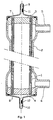
- a fiber dialyzer hollow comprises a bundle of hollow fibers 1, which is arranged in a tubular housing 2 where it is subject to both ends by a glue disc 3, 4.
- the purpose of the glue discs 3, 4 is to delimit the tubular housing 2 a sealed compartment to which two tubings 5, 6, perpendicular to the axis of the housing 2, give access. Every end of the housing 2 is fixed a nozzle 7, 8 comprising a axial access tubing 9, 10.
- the two tubings 9, 10 are symmetrical.
- the blood compartment of this device consists of the interior space delimited between each glue disc 3, 4 and the end piece 8, 9 closing the corresponding end of the tubular housing 2, and from the inside of the hollow fibers.
- this device to improve the biocompatibility of this device by modifying an internal surface of the compartment blood, it is deposited in each tip 8, 9, after the device has been assembled as shown in FIG. 1, a determined quantity of a substance soluble in an aqueous solution and capable of modifying the relevant area as desired.
- the amount of substance is chosen so that, after circulation of a determined quantity of aqueous solution in the blood compartment, at least one layer of the substance covers the surface of which the biocompatibility is to be improved.
- the amount of substance is deposited in the form of a drop 11, 12 by means of a device conventional injection. The drop is formed either of a gel of the substance of a matrix material in which the substance is incorporated.
- the tubing 5, 6, 9, 10 are equipped with plugs and the device can be sterilized, for example by means of ethylene oxide or by irradiation ⁇ .
- any apparatus for the treatment of blood or extracorporeal circulation plasma includes a phase Preliminary Seizure, during which the blood compartment is rinsed and filled with a sterile aqueous solution.
- this phase of preparation of the apparatus for dissolving the treatment substance and bring it into contact with the surface to be treated the user, before beginning of the dialysis session itself, connects one of the access tubings 9 (10) of the blood circuit to a solution bag sterile, connects the other access tubing 10 (9) to a pocket of empty collection, and causes the circulation of the sterile solution in the blood compartment, where appropriate by means of the blood pump of the dialysis machine.
- the sterile solution dissolves the substance and the door in contact with the surface to be treated where it binds, for example by ionic or covalent bond.
- a fitting is made having a complementary female part of these tubes 9, 10 as well as a complementary male part of the connection element female equipping the end of the pipes used to connect a patient to a blood treatment device.
- This connection is obtained by molding or extruding a plastic material suitable for contact with the blood.
- a drop of the substance intended to improve the biocompatibility of a blood treatment is then placed in a package likely to be a sterile barrier then, the whole is sterilized by irradiation ⁇ .
- the fitting is mounted on a device conventional blood treatment before the preliminary priming phase of the apparatus described above.
- the PEI with a molecular mass of between 10 and 2000 k ⁇ which is in the form of a water-soluble gel, is a completely is suitable for the modification of the membrane known under the trade name AN69, whose surface has negative charges.
- the potential toxicity threshold of the irradiated PEI corresponds to the injection of a quantity of PEI necessary to raise the concentration of an internal liquid (plasma) to 0.4 mg / ml. (By way of comparison, if the amount of PEI sufficient to treat a conventional dialyzer, 10 mg, was injected into the blood of an adult, the concentration of PEI plasma would be of the order of 0.002 mg / ml ).
- Another substance suitable for membrane modification known under the trade name AN69 is diethylaminoethyl dextran (DEAE dextran) with an average molecular weight of 500 k Dalton.
- DAE dextran diethylaminoethyl dextran
- a neutral matrix material As for example, a carboxymethyl cellulose gel can be used for this purpose.
- a polymer solution is prepared, containing 35% by weight of a copolymer of acrylonitrile and sodium methallyl sulfonate, 52% by weight of dimethylformamide (DMF) and 13% by weight of glycerol.
- the polymer solution is heated to 130 ° C and extruded into a die having two nozzles concentric, nitrogen being injected into the internal nozzle for form the light of the hollow fiber.
- the thermoreversible gel fiber exiting the die is the seat of a thermal phase inversion.
- the fiber is then received in a water bath in which the solvent (DMF) in the fiber is replaced by water.
- the fiber is then dipped in hot water at 95 ° C where it is stretched about four times. follows a stabilization phase in hot water at 95 ° C.
- the fiber is glycerinated with a water / glycerol mixture.
- the manufacture of a plane membrane from AN69 comprises the following steps: a polymer solution is prepared, containing 21% by weight of a copolymer of acrylonitrile and sodium methallyl sulphonate, and 79% by weight of dimethylformamide (DMF). After filtration and degassing, this polymer solution is extruded by means of a die-shaped slit on a rotating cylinder heated to 80 ° C. Part of the DMF is evaporated. The film obtained is stretched about three and a half times in hot water at 95 ° C. Follows a phase of stabilization in water hot at 95 ° C. Finally the membrane is glycerinated in a mixture water / glycerol.
- DMF dimethylformamide
- a dialyser comprising about 8500 hollow fibers AN69 was assembled. Each fiber has the following dimensions: internal diameter: 240 ⁇ m; wall thickness: 50 ⁇ m; length: 0.225 m. The surface of the membrane intended to come into contact with the blood is approximately 1.44 m 2 . A drop of 10 mg of PEI (LUPASOL WF, BASF, molecular weight: 25 k ⁇ ) was deposited in each access tubing to the blood compartment, after which the access tubings to the two compartments of the dialyzer were closed with special plugs and the dialyzer was sterilized with ethylene oxide.
- PEI LPASOL WF, BASF, molecular weight: 25 k ⁇
- this dialyser was subjected to the following test: a biological fluid was prepared to stimulate the production of kallikreins on contact of a negatively charged membrane on the surface.
- the liquid Biological material used for the test consisted of human plasma poor in platelets, diluted to 5% in physiological saline addition of citrate (it is noted that the conditions of the test used are away from the conditions of use of a device for circulation extracorporeal blood: the dilution rate is very high, the fluid chosen is plasma and not blood, the plasma is supplemented with citrate, so acidified, while in dialysis, the anticoagulant used is heparin.
- test conditions are chosen on purpose because they stimulate and amplify the activation of the contact phase).
- One liter and half of this liquid were circulated in closed circuit in the blood compartment of the dialyzer at a flow rate of 100 ml / min for six hours.
- Plasma kallikrein were measured in samples of liquid taken at intervals of time by means of a conventional chromogenic test, from the substrate S 2302 of the BIOGENIC company. The result of the assays shows unequivocally that the dialyzer manufactured according to the invention does not cause elevation of kallikrein levels in a diluted plasma.
- the process according to the invention makes industrializable improving the biocompatibility of a dialyzer whose membrane is in AN69.
- An AN69 flat membrane dialyzer was assembled.
- the membrane has a thickness of about 20 microns.
- the surface of the membrane intended to come into contact with the blood is approximately 1.50 m 2 .
- a drop of 10 mg of PEI (LUPASOL WF, 25 k ⁇ ) was deposited in each blood compartment access tubing, after which the access tubings to the two compartments of the dialyzer were sealed and the dialyzer was sterilized by irradiation ⁇ (36 KGy).
- Two liters of sterile physiological saline at room temperature (about 22 ° C) were circulated in the blood compartment of this dialyzer.
- the saline solution dissolved the drop of PEI gel and the PEI molecules circulated in the dialyser bound to the sodium methallyl sulfonate groups present on the membrane surface.
- the dialyzer is then subjected to the in vitro test described in Example 1, intended to measure whether the membrane AN69 coated with a PEI monolayer activates the contact phase. As in the case of hollow fiber dialyser, the test result is negative.
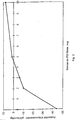
- the graph of FIG. 2 shows the result of in vitro tests carried out on a plane membrane dialyser of the type of example 2, intended to determine the effect of the quantity of PEI (LUPASOL WF, 25 k ⁇ ) used by dialyzer on the surface electric charge of an AN69 membrane.
- the surface electric charge is evaluated by means of the flow potential measurement, as defined below: it is assumed that a solution of electrolyte flowing in the compartment of a dialyser generates a difference in potential ⁇ E proportional to the pressure drop ⁇ P created by the electrolyte solution between the inlet and the outlet of the dialyzer.
- a solution of sodium chloride (10 -2 M) was circulated in the blood compartment, and ⁇ E and ⁇ P were measured at level of access to the blood compartment, using Ag / AgCl electrodes and pressure sensors.
- the ⁇ E / ⁇ P ratio is called the flow potential of the electrolyte in the dialyzer and this ratio is characteristic of the charge on the surface of the membrane.
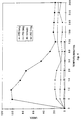
- the graph of Figure 4 shows the result of in vitro tests carried out on a plane membrane dialyser of the type of Example 2, intended to determine the effect of the amount of PEI (LUPASOL WF, 25 k ⁇ ) used by dialyzer on the activation of the contact phase:
- the activation of the contact phase is evaluated through the generation of kallikreins according to the test described in Example 1.
- 10 mg of PEI molecular weight, 25 k Dalton
- the graph of Figure 4 shows the result of in vitro tests carried out on a plane membrane dialyser of the type of Example 2, intended to determine the effect of the amount of PEI (LUPASOL P, 750 k ⁇ ) used by dialyzer on the activation of the contact phase.
- the activation of the contact phase is evaluated through the generation of kallikreins according to the test described in Example 1. On this diagram, we see that 7 mg of PEI (molecular weight, 750 k Dalton) are sufficient to completely suppress activation of the contact phase.
- PEI (LUPASOL P, 750 k ⁇ ) was labeled with a molecule possessing a radioactive isotope (N-succimidyl [2-3 3 H] propionate), using the following procedure: PEI with N-succimidyl [2-3 3 H] propionate for PEI 3H (marked PEI) which was then precipitated with sulfosalicylic acid to separate the labeled PEI excess N-succimidyl [2-3 3 H] propionate; then the precipitate was subjected to successive washings with water to remove excess N-succimidyl [2-3 3 H] propionate and obtain labeled PEI having a specific activity of 1.52 mCi / g (this which corresponds to an average substitution rate of 11.7 mmol of 3H propionate per ⁇ mol of PEI.
- a dialyser comprising approximately 8500 hollow fibers AN69 has been manufactured in accordance with the process described in paragraph 1 of Example 1, with the difference that it is a drop of 10 mg of Marked PEI that has been deposited in each access tubing blood compartment of the dialyzer and not the standard PEI (LUPASOL WF, from BASF, molecular weight: 25 k ⁇ ).
- An experimental membrane M was manufactured in the form of a hollow fiber according to the following steps.
- a polymer solution has prepared, containing 28% by weight of an acrylonitrile copolymer and vinyl acetate, 51% by weight of dimethylformamide (DMF) and 21% by weight of glycerol.
- the polymer solution was heated to 120 ° C and extruded in a die having two nozzles concentric, nitrogen being injected into the internal nozzle for form the light of the hollow fiber.
- the thermoreversible gel fiber exiting the die was the site of a thermal phase inversion.
- the fiber has was then received in a water bath in which the solvent (DMF) in the fiber has been replaced by water.
- the fiber was then dipped in hot water at 40 ° C where it was stretched about two times.
- the resulting fiber was then stabilized in hot water at 60 ° C.
- the fiber has been glycerinated in a water / glycerol mixture.
- a dialyzer comprising about 10,000 hollow fibers M was assembled. Each fiber has the following dimensions: internal diameter: 190 ⁇ m; wall thickness: 50 ⁇ m; length: 0.225 m. The surface of the membrane intended to come into contact with the blood is approximately 1.34 m 2 .
- a drop of 12 mg of PEI (LUPASOL WF, molecular weight: 25 k ⁇ ) was deposited in each blood compartment access tubing.
- Two liters of sterile saline (0.9 g / l sodium chloride solution) at room temperature (22 ° C) were circulated at a rate of 200 ml / min into the blood compartment of this dialyzer.
- the saline solution dissolved the drop of PEI gel and the PEI molecules circulated in the dialyser bound, by ionic bond, to the surface of the membrane.
- Example 2 The dialyzer was then subjected to the in vitro test described in Example 1, intended to measure whether the membrane M coated with a PEI monolayer activates the contact phase. As in the case of hollow fiber dialyser, the test result is negative.
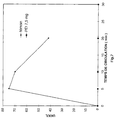
- Figure 6 represents the level of activation caused by this dialyzer and the level activation caused by a dialyzer of the same manufacture but whose membrane was not coated with PEI.
- a water-soluble, non-toxic gel was prepared chemically neutral to the AN69 membrane by dissolving at room temperature (25 ° C) of carboxymethylcellulose (C 5678 from SIGMA) in deionized water at a rate of 12.5% by weight of carboxymethyl cellulose and 87.5% by weight of water.
- carboxymethylcellulose C 5678 from SIGMA
- D 1162 SIGMA diethylaminoethyl dextran
- a dialyser comprising about 8500 hollow fibers AN69 was assembled. Each fiber has the following dimensions: internal diameter: 240 ⁇ m; wall thickness: 50 ⁇ m; length: 0.225 m. The surface of the membrane intended to come into contact with the blood is approximately 1.44 m 2 .
- a drop of 100 mg of the neutral gel / active substance mixture ie 50 mg of DEAE dextran
- Two liters of sterile saline solution (0.9 g / l sodium chloride solution) at room temperature (25 ° C.) were circulated at a flow rate of 200 ml / min into the blood compartment of this dialyzer from access where the drop of neutral gel / active substance mixture has been deposited.
- the saline solution dissolved the drop of gel and the DEAE dextran molecules circulated in the dialyser were ionically bound to the sodium methallyl sulfonate groups present on the membrane surface.
- the dialyzer treated with PEI was subjected to the series of conventional measures designed to determine the characteristics: toxicity, hemocompatibility, transfer capacity diffusive and convective, etc.
- the characteristics of the treated dialyzer are at least as good as those of a dialyzer of the same type untreated.
- dialysers have passed the biological assessment tests medical devices defined in the international standard ISO 10993-1.
- Hemocompatibility of a dialysis membrane is related to its adsorption properties of proteins on the surface of the membrane in contact with the blood.
- the kinetics of adsorption of 125 I-labeled fibrinogen was measured in vitro on reduced model dialysers having a membrane composed of AN 69 fibers under hydrodynamic conditions comparable to those of a dialysis session.
- the reduced model dialysers used for the tests included 170 fibers in AN 69 (internal diameter: 210 ⁇ m, wall thickness: 42 ⁇ m, length: 0.18 m), the surface of which was intended to come into contact with blood. treated with PEI in accordance with the invention (approximately 30 mg / m 2 , respectively 300 mg / m 2 , for the mini-dialyzers in the compartment from which the drop of PEI deposited was 0.7 mg or 7 mg respectively) ).
- Heparinized human blood containing fibrinogen was prepared radiolabeled at a concentration of 2.5 ⁇ g / ml and circulated liquid, in an open circuit, at a flow rate of 2.5 ml / min, in a mini control dialyser (AN 69 without PEI) and in a mini dialyzer according to the invention.
- the adsorption rate of fibrinogen, determined at means of measuring the radioactivity of the mini-dialyser, is represented in FIG. 8b. We can see that this speed is much the same for a mini control dialyzer and for mini dialysers on the membrane of which PEI has been fixed.
- Ultrafiltration slope measurement and flow measurement maximum ultrafiltration were performed as follows: circulates standardized, heparinized beef blood (protein level 60 g / l and 32% hematocrit) in the blood compartment of the dialyzer at a fixed rate of 300 ml / min. Ultrafiltration is caused blood through the membrane by means of a pump connected to the second compartment of the dialyzer. By gradually increasing the ultrafiltration rate, the transmembrane pressure is increased (PTM), which is measured continuously using two pressure respectively connected to the two compartments of the dialyzer, and the ultrafiltration slope is deduced in ml / h.mmHg. From a threshold value, the ultrafiltration flow remains stable even if the TMP continues to increase. The ultrafiltration flow rate is then measured maximum in ml / min.
- PTM transmembrane pressure
Landscapes
- Health & Medical Sciences (AREA)
- Chemical & Material Sciences (AREA)
- Engineering & Computer Science (AREA)
- Heart & Thoracic Surgery (AREA)
- Chemical Kinetics & Catalysis (AREA)
- Vascular Medicine (AREA)
- Veterinary Medicine (AREA)
- General Health & Medical Sciences (AREA)
- Hematology (AREA)
- Public Health (AREA)
- Life Sciences & Earth Sciences (AREA)
- Animal Behavior & Ethology (AREA)
- Urology & Nephrology (AREA)
- Manufacturing & Machinery (AREA)
- Anesthesiology (AREA)
- Biomedical Technology (AREA)
- Inorganic Chemistry (AREA)
- Cardiology (AREA)
- Epidemiology (AREA)
- Surgery (AREA)
- Water Supply & Treatment (AREA)
- Emergency Medicine (AREA)
- Materials Engineering (AREA)
- External Artificial Organs (AREA)
Description
| Dialyseur N° | Pente d'ultrafiltration (ml/h.mmHg) | Débit d'ultrafiltration maximal ml/min |
| 1 | 39 | 100 |
| 2 | 43 | 104 |
| 3 | 43 | 107 |
| 4 | 45 | 104 |
Claims (20)
- Procédé de fabrication d'un appareil pour le traitement du sang ou du plasma par circulation extracorporelle ayant un compartiment pour la circulation du sang muni de deux accès et d'une surface interne à traiter avec une substance, comprenant l'étape de :caractérisé en ce que :déposer dans le compartiment sang, au niveau d'au moins l'un des accès (9 ;10), une quantité déterminée (11,12) de la substance, la substance étant apte à se dissoudre dans une solution aqueuse et apte à se lier durablement à la surface interne à traiter du compartiment sang pour en accroítre la biocompatibilité, la quantité de substance étant choisie pour que la circulation d'un volume déterminé de solution aqueuse dans le compartiment sang, à partir de l'accès où la substance a été déposée, ait pour résultat la formation par liaison durable d'au moins une couche moléculaire de la substance sur la surface interne à traiter du compartiment sang,après que le dépôt de la substance a été effectué, et avant la circulation de la solution aqueuse, le procédé comprend l'étape de stériliser l'appareil, la quantité déterminée (11,12) de substance étant déposée sous une forme telle que la substance puisse subir sans altération une irradiation propre à stériliser l'appareil.
- Procédé selon la revendication 1, pour un appareil dont le compartiment sang a deux accès symétriques (9, 10), caractérisé en ce que la quantité déterminée de substance est déposée au niveau de chaque accès de façon que, quel que soit le sens de circulation ultérieure de la solution aqueuse dans le compartiment sang, une couche moléculaire de la substance soit formée sur la surface interne à traiter.
- Procédé selon une des revendications 1 à 2, caractérisé en ce que la quantité déterminée (11,12) de substance est déposée sous la forme d'une goutte d'un gel de cette substance.
- Procédé selon une des revendications 1 ou 2, caractérisé en ce que la quantité déterminée (11,12) de substance est déposée sous la forme d'une goutte d'un matériau matrice soluble dans une solution aqueuse, dans lequel la substance est incorporée.
- Procédé selon la revendication 1, caractérisé en ce que l'appareil est stérilisé au moyen d'oxyde d'éthylène.
- Procédé selon la revendication 1, caractérisé en ce que l'appareil est stérilisé par irradiation γ.
- Procédé selon la revendication 1, caractérisé en ce que la quantité déterminée (11,12) de substance est déposée après que l'appareil a été assemblé.
- Appareil pour le traitement du sang ou du plasma par circulation extracorporelle comprenant :un compartiment pour la circulation du sang muni de deux accès (9 ; 10);une quantité déterminée (11 ; 12) d'une substance soluble dans une solution aqueuse et déposée au niveau d'au moins l'un des accès (9 ; 10) dans le compartiment sang ;le compartiment ayant au moins une surface interne destinée à être revêtue d'au moins une couche moléculaire de ladite substance ;l'appareil pour le traitement, avant la circulation de la solution aqueuse, muni de la substance déposée est un appareil stérilisé.la substance déposée est apte à se lier à la surface interne à traiter du compartiment sang pour en accroítre la biocompatibilité ;la quantité de substance est choisie pour que la circulation d'un volume déterminé de solution aqueuse dans le compartiment sang à partir de l'accès où la substance a été déposée ait pour résultat la formation par liaison durable de ladite couche moléculaire de la substance sur la surface interne à traiter du compartiment sang, caractérisé en ce que :la forme de la quantité déterminée de la substance déposée est telle que la substance puisse subir sans altération une irradiation propre à la stérilisation de l'appareil; et
- Appareil selon la revendication 8, ayant deux accès symétriques, caractérisé en ce que la quantité déterminée (11,12) de substance est déposée au niveau de chaque accès de façon que, quel que soit le sens de la circulation ultérieure de la solution aqueuse dans le compartiment sang, une couche moléculaire de la substance soit formée sur la surface interne à traiter.
- Appareil selon une des revendications 8 et 9, caractérisé en ce que la quantité déterminée (11,12) de substance se présente sous la forme d'une goutte d'un gel de cette substance.
- Appareil selon une des revendications 8 et 9, caractérisé en ce que la quantité déterminée (11,12) de substance se présente sous la forme d'une goutte d'un matériau matrice dans lequel la substance est incorporée.
- Appareil selon une des revendications 8 à 11, caractérisé en ce que la surface à traiter présente des charges négatives et en ce que la substance est cationique de sorte qu'une couche moléculaire de la substance masque les charges négatives de la surface.
- Appareil selon une des revendications 8 à 12, constitué par un hémodialyseur/hémofiltre comprenant deux compartiments séparés par une membrane semi perméable, un premier compartiment étant destiné à la circulation de sang et un second compartiment étant destiné à la circulation de liquide. usé, caractérisé en ce que la surface à traiter est la surface de la membrane semi perméable située du côté du compartiment sang.
- Appareil selon la revendication 13, caractérisé en ce que la membrane est fabriquée à partir d'un copolymère d'acrylonitrile et en ce que la substance est de la polyéthylèneimine.
- Appareil selon la revendication 14, caractérisé en ce que la polyéthylèneimine a une masse moléculaire comprise entre environ 10 et environ 2000 k u.
- Appareil selon la revendication 15, caractérisé en ce que la polyéthylèneimine a une masse moléculaire de 25 k u.
- Appareil selon la revendication 15, caractérisé en ce que la polyéthylèneimine a une masse moléculaire de 750 k u.
- Appareil selon la revendication 15, caractérisé en ce que la quantité de polyéthylèneimine de masse moléculaire de 25 k u déposée au niveau d'un ou de chaque accès sang est comprise entre environ 5 mg et environ 10 mg par m2 de membrane active.
- Appareil selon une des revendications 13 à 18, caractérisé en ce que la membrane est une membrane plane.
- Appareil selon une des revendications 13 à 18, caractérisé en ce que la membrane est constituée par un faisceau de fibres creuses.
Priority Applications (1)
| Application Number | Priority Date | Filing Date | Title |
|---|---|---|---|
| EP05021798A EP1616586A3 (fr) | 1996-09-19 | 1997-09-18 | Appareil pour le traitement extracorporel du sang et procédé pour sa fabrication |
Applications Claiming Priority (4)
| Application Number | Priority Date | Filing Date | Title |
|---|---|---|---|
| FR9611631 | 1996-09-19 | ||
| FR9611631A FR2758989A1 (fr) | 1996-09-19 | 1996-09-19 | Appareil pour le traitement du sang par circulation extracorporelle et procede de fabrication |
| FR9613997A FR2758990B1 (fr) | 1996-09-19 | 1996-11-08 | Appareil pour le traitement du sang par circulation extracorporelle et procede de fabrication |
| FR9613997 | 1996-11-08 |
Related Child Applications (1)
| Application Number | Title | Priority Date | Filing Date |
|---|---|---|---|
| EP05021798A Division EP1616586A3 (fr) | 1996-09-19 | 1997-09-18 | Appareil pour le traitement extracorporel du sang et procédé pour sa fabrication |
Publications (3)
| Publication Number | Publication Date |
|---|---|
| EP0830867A1 EP0830867A1 (fr) | 1998-03-25 |
| EP0830867B1 true EP0830867B1 (fr) | 2005-12-14 |
| EP0830867B9 EP0830867B9 (fr) | 2006-06-28 |
Family
ID=26232995
Family Applications (2)
| Application Number | Title | Priority Date | Filing Date |
|---|---|---|---|
| EP05021798A Withdrawn EP1616586A3 (fr) | 1996-09-19 | 1997-09-18 | Appareil pour le traitement extracorporel du sang et procédé pour sa fabrication |
| EP97420168A Expired - Lifetime EP0830867B9 (fr) | 1996-09-19 | 1997-09-18 | Appareil pour le traitement du sang par circulation extracorporelle et procédé de fabrication |
Family Applications Before (1)
| Application Number | Title | Priority Date | Filing Date |
|---|---|---|---|
| EP05021798A Withdrawn EP1616586A3 (fr) | 1996-09-19 | 1997-09-18 | Appareil pour le traitement extracorporel du sang et procédé pour sa fabrication |
Country Status (8)
| Country | Link |
|---|---|
| US (2) | US6010475A (fr) |
| EP (2) | EP1616586A3 (fr) |
| JP (1) | JP3896197B2 (fr) |
| AT (1) | ATE312633T1 (fr) |
| CA (2) | CA2214481C (fr) |
| DE (1) | DE69734862T2 (fr) |
| ES (1) | ES2256873T3 (fr) |
| FR (1) | FR2758990B1 (fr) |
Families Citing this family (16)
| Publication number | Priority date | Publication date | Assignee | Title |
|---|---|---|---|---|
| FR2804328B1 (fr) * | 2000-01-27 | 2002-03-15 | Hospal Ind | Membrane semi-permeable non thrombogene et procede de fabrication |
| JP4783971B2 (ja) * | 2000-09-29 | 2011-09-28 | 東レ株式会社 | 酸化低密度リポ蛋白吸着用吸着材 |
| ATE382670T1 (de) * | 2001-10-04 | 2008-01-15 | Toray Industries | Hydrophiles material und verfahren zu seiner herstellung |
| KR101342985B1 (ko) * | 2004-08-30 | 2013-12-18 | 브라코 다이어그노스틱스 아이엔씨. | 조제, 특히 방사성 동위 원소 발생기에서 이용되기 위한 향상된 콘테이너 |
| FR2878451B1 (fr) * | 2004-11-29 | 2009-11-06 | Otv Sa | Procede electrocinetique de determination de l'etat de charge electrostatique d'une membrane poreuse en cours de filtration, et son utilisation |
| FR2902670B1 (fr) | 2006-06-22 | 2009-04-24 | Gambro Lundia Ab | Utilisation d'une suspension pour traiter un support a usage medical, support a usage medical, echangeur et dispositif d'adsorption comprenant le support |
| US20080190849A1 (en) * | 2007-02-14 | 2008-08-14 | Dxv Water Technologies, Llc | Depth exposed membrane for water extraction |
| WO2011097403A1 (fr) | 2010-02-04 | 2011-08-11 | Dxv Water Technologies, Llc | Systèmes et procédés de traitement de l'eau |
| FR2982029B1 (fr) * | 2011-10-31 | 2013-11-29 | Cad Instr | Appareil pour la mesure du potentiel du courant d'ecoulement tangentiel et/ou transversal dans une fibre creuse |
| JP6058337B2 (ja) * | 2012-09-28 | 2017-01-11 | 泉工医科工業株式会社 | 圧力センサ付きコネクタ |
| CN103736161A (zh) * | 2014-01-15 | 2014-04-23 | 倪吉喆 | 一种丁肝病毒特异性血浆吸附柱及其使用方法 |
| CN103721307A (zh) * | 2014-01-15 | 2014-04-16 | 倪自谦 | 一种丙肝病毒特异性血浆吸附柱及其使用方法 |
| WO2015110277A1 (fr) * | 2014-01-21 | 2015-07-30 | Nephro-Solutions Ag | Appareil de dialyse muni d'un dialyseur |
| US10513446B2 (en) | 2014-10-10 | 2019-12-24 | EcoDesal, LLC | Depth exposed membrane for water extraction |
| EP3296010B1 (fr) * | 2016-09-14 | 2023-04-26 | Gambro Lundia AB | Membrane à base d'acrylonitrile présentant une faible thrombogénicité |
| CN109689188A (zh) * | 2016-11-29 | 2019-04-26 | 甘布罗伦迪亚股份公司 | 用于吸附细菌的膜 |
Family Cites Families (21)
| Publication number | Priority date | Publication date | Assignee | Title |
|---|---|---|---|---|
| US2449731A (en) * | 1946-03-29 | 1948-09-21 | Robert F Therrien | Growth poisoning sewer joint |
| DE3879218T2 (de) * | 1987-09-21 | 1993-07-22 | Terumo Corp | Medizinisches instrument und verfahren zur herstellung. |
| US5098960A (en) * | 1987-09-23 | 1992-03-24 | Board Of Reagents, The University Of Texas System | Methods and compositions for providing articles having improved biocompatibility characteristics |
| US5098977A (en) * | 1987-09-23 | 1992-03-24 | Board Of Regents, The University Of Texas System | Methods and compositions for providing articles having improved biocompatability characteristics |
| FR2624375B1 (fr) * | 1987-12-11 | 1997-03-28 | Hospal Ind | Procede et dispositif de rincage et d'amorcage d'un echangeur |
| AU629203B2 (en) * | 1988-03-23 | 1992-10-01 | E.I. Du Pont De Nemours And Company | Low coefficient of friction surface |
| EP0397130B1 (fr) * | 1989-05-11 | 1995-04-19 | Kanegafuchi Kagaku Kogyo Kabushiki Kaisha | Dispositif médical ayant une surface hautement biocompatible et sa méthode de fabrication |
| SE467309B (sv) * | 1990-10-22 | 1992-06-29 | Berol Nobel Ab | Hydrofiliserad fast yta, foerfarande foer dess framstaellning samt medel daerfoer |
| SE467308B (sv) * | 1990-10-22 | 1992-06-29 | Berol Nobel Ab | Fast yta belagd med ett hydrofilt ytterskikt med kovalent bundna biopolymerer, saett att framstaella en saadan yta och ett konjugat daerfoer |
| US5190534A (en) * | 1990-12-07 | 1993-03-02 | Delmed, Inc. | Prefilled sterilant fluid releasable coupling connector apparatus for catheter applications |
| US5229172A (en) * | 1993-01-19 | 1993-07-20 | Medtronic, Inc. | Modification of polymeric surface by graft polymerization |
| US5308641A (en) * | 1993-01-19 | 1994-05-03 | Medtronic, Inc. | Biocompatibility of solid surfaces |
| ATE202942T1 (de) * | 1994-04-15 | 2001-07-15 | Cobe Cardiovascular Inc | Blutverträglicher beschichteter artikel |
| CA2165443A1 (fr) * | 1994-05-17 | 1995-11-25 | Seiichiro Iguchi | Procede pour inhiber la coagulation du sang lors de l'etablissement d'une circulation sanguine extracorporelle et dispositif de liberation d'un medicament antithrombotique utilisedans ce procede |
| US5558900A (en) * | 1994-09-22 | 1996-09-24 | Fan; You-Ling | One-step thromboresistant, lubricious coating |
| US5532311A (en) * | 1995-02-01 | 1996-07-02 | Minnesota Mining And Manufacturing Company | Process for modifying surfaces |
| GB9521253D0 (en) * | 1995-10-17 | 1995-12-20 | Luthra Ajay K | Biocompatible lubricious hydrophilic materials for medical devices |
| US5811151A (en) * | 1996-05-31 | 1998-09-22 | Medtronic, Inc. | Method of modifying the surface of a medical device |
| US5863501A (en) * | 1996-08-30 | 1999-01-26 | Minntech Corporation | Oxygenator priming method |
| US5997517A (en) * | 1997-01-27 | 1999-12-07 | Sts Biopolymers, Inc. | Bonding layers for medical device surface coatings |
| US5984370A (en) * | 1997-08-05 | 1999-11-16 | Lewis; John K. | Corrosion barrier with antibacterial protection for pipe connections |
-
1996
- 1996-11-08 FR FR9613997A patent/FR2758990B1/fr not_active Expired - Fee Related
-
1997
- 1997-09-18 CA CA002214481A patent/CA2214481C/fr not_active Expired - Fee Related
- 1997-09-18 CA CA002637712A patent/CA2637712C/fr not_active Expired - Fee Related
- 1997-09-18 AT AT97420168T patent/ATE312633T1/de not_active IP Right Cessation
- 1997-09-18 ES ES97420168T patent/ES2256873T3/es not_active Expired - Lifetime
- 1997-09-18 EP EP05021798A patent/EP1616586A3/fr not_active Withdrawn
- 1997-09-18 US US08/933,032 patent/US6010475A/en not_active Expired - Lifetime
- 1997-09-18 DE DE69734862T patent/DE69734862T2/de not_active Expired - Lifetime
- 1997-09-18 EP EP97420168A patent/EP0830867B9/fr not_active Expired - Lifetime
- 1997-09-19 JP JP25563697A patent/JP3896197B2/ja not_active Expired - Fee Related
-
1999
- 1999-07-30 US US09/364,052 patent/US6454998B1/en not_active Expired - Fee Related
Also Published As
| Publication number | Publication date |
|---|---|
| EP1616586A3 (fr) | 2010-10-13 |
| FR2758990B1 (fr) | 1999-05-28 |
| EP1616586A2 (fr) | 2006-01-18 |
| CA2637712C (fr) | 2009-09-22 |
| CA2637712A1 (fr) | 1998-03-19 |
| US6010475A (en) | 2000-01-04 |
| ATE312633T1 (de) | 2005-12-15 |
| ES2256873T3 (es) | 2006-07-16 |
| JPH1099431A (ja) | 1998-04-21 |
| DE69734862T2 (de) | 2006-09-14 |
| DE69734862D1 (de) | 2006-01-19 |
| CA2214481A1 (fr) | 1998-03-19 |
| JP3896197B2 (ja) | 2007-03-22 |
| CA2214481C (fr) | 2008-11-04 |
| US6454998B1 (en) | 2002-09-24 |
| FR2758990A1 (fr) | 1998-08-07 |
| EP0830867B9 (fr) | 2006-06-28 |
| EP0830867A1 (fr) | 1998-03-25 |
Similar Documents
| Publication | Publication Date | Title |
|---|---|---|
| EP0830867B9 (fr) | Appareil pour le traitement du sang par circulation extracorporelle et procédé de fabrication | |
| EP0801953B1 (fr) | Appareil médical pour le traitement extracorporel du sang ou du plasma et procédés de fabrication de cet appareil | |
| EP0925826B1 (fr) | Utilisation d'un polymère neutre ou cationique pour prévenir l'activation de la phase contact du sang ou du plasma en contact avec une membrane semi-perméable | |
| CA2368999C (fr) | Membrane semi-permeable non thrombogene et procede de fabrication | |
| JP4453248B2 (ja) | 中空糸膜および中空糸膜モジュールの製造方法 | |
| EP0320419B1 (fr) | Procédé et dispositif de rinçage et d'amorçage d'un échangeur | |
| CN1842363B (zh) | 膜的表面处理和相关产品 | |
| US8118176B2 (en) | Membrane unit element, semipermeable membrane, filtration device, and processes for manufacturing the same | |
| JP2003175320A (ja) | 中空糸状膜の製造方法 | |
| EP1339481B1 (fr) | Utilisation d'une solution aqueuse de glycérol pour préserver les performances de membranes semi-perméhables humides destinées au traitement du sang ou du plasma | |
| JP3281363B1 (ja) | 血液浄化膜 | |
| FR2758989A1 (fr) | Appareil pour le traitement du sang par circulation extracorporelle et procede de fabrication | |
| JP2003175321A (ja) | 中空糸状膜の製造方法 | |
| JP2003033632A (ja) | 血液浄化膜の製造方法 | |
| JP4678063B2 (ja) | 中空糸膜モジュール | |
| JP2002143299A (ja) | 中空糸膜型血液処理装置及びその製造方法 | |
| JP2003175322A (ja) | 中空糸状膜の製造方法 | |
| FR2747590A1 (fr) | Appareil medical pour le traitement extracorporel du sang ou du plasma et procedes de fabrication de cet appareil | |
| JP2003245529A (ja) | 中空糸膜の製造方法 | |
| EP4721779A1 (fr) | Membrane poreuse à fibres creuses et module de purification du sang |
Legal Events
| Date | Code | Title | Description |
|---|---|---|---|
| PUAI | Public reference made under article 153(3) epc to a published international application that has entered the european phase |
Free format text: ORIGINAL CODE: 0009012 |
|
| AK | Designated contracting states |
Kind code of ref document: A1 Designated state(s): AT BE CH DE ES FR GB GR IE IT LI NL PT SE |
|
| 17P | Request for examination filed |
Effective date: 19980407 |
|
| AKX | Designation fees paid |
Free format text: AT BE CH DE ES FR GB GR IE IT LI NL PT SE |
|
| RBV | Designated contracting states (corrected) |
Designated state(s): AT BE CH DE ES FR GB GR IE IT LI NL PT SE |
|
| 17Q | First examination report despatched |
Effective date: 20020118 |
|
| GRAP | Despatch of communication of intention to grant a patent |
Free format text: ORIGINAL CODE: EPIDOSNIGR1 |
|
| RAP1 | Party data changed (applicant data changed or rights of an application transferred) |
Owner name: GAMBRO INDUSTRIES SAS |
|
| GRAS | Grant fee paid |
Free format text: ORIGINAL CODE: EPIDOSNIGR3 |
|
| GRAA | (expected) grant |
Free format text: ORIGINAL CODE: 0009210 |
|
| AK | Designated contracting states |
Kind code of ref document: B1 Designated state(s): AT BE CH DE ES FR GB GR IE IT LI NL PT SE |
|
| PG25 | Lapsed in a contracting state [announced via postgrant information from national office to epo] |
Ref country code: NL Free format text: LAPSE BECAUSE OF FAILURE TO SUBMIT A TRANSLATION OF THE DESCRIPTION OR TO PAY THE FEE WITHIN THE PRESCRIBED TIME-LIMIT Effective date: 20051214 Ref country code: IE Free format text: LAPSE BECAUSE OF FAILURE TO SUBMIT A TRANSLATION OF THE DESCRIPTION OR TO PAY THE FEE WITHIN THE PRESCRIBED TIME-LIMIT Effective date: 20051214 Ref country code: AT Free format text: LAPSE BECAUSE OF FAILURE TO SUBMIT A TRANSLATION OF THE DESCRIPTION OR TO PAY THE FEE WITHIN THE PRESCRIBED TIME-LIMIT Effective date: 20051214 |
|
| REG | Reference to a national code |
Ref country code: GB Ref legal event code: FG4D Free format text: NOT ENGLISH |
|
| REG | Reference to a national code |
Ref country code: CH Ref legal event code: EP |
|
| REG | Reference to a national code |
Ref country code: IE Ref legal event code: FG4D Free format text: LANGUAGE OF EP DOCUMENT: FRENCH |
|
| REF | Corresponds to: |
Ref document number: 69734862 Country of ref document: DE Date of ref document: 20060119 Kind code of ref document: P |
|
| PG25 | Lapsed in a contracting state [announced via postgrant information from national office to epo] |
Ref country code: SE Free format text: LAPSE BECAUSE OF FAILURE TO SUBMIT A TRANSLATION OF THE DESCRIPTION OR TO PAY THE FEE WITHIN THE PRESCRIBED TIME-LIMIT Effective date: 20060314 Ref country code: GR Free format text: LAPSE BECAUSE OF FAILURE TO SUBMIT A TRANSLATION OF THE DESCRIPTION OR TO PAY THE FEE WITHIN THE PRESCRIBED TIME-LIMIT Effective date: 20060314 |
|
| GBT | Gb: translation of ep patent filed (gb section 77(6)(a)/1977) |
Effective date: 20060327 |
|
| PG25 | Lapsed in a contracting state [announced via postgrant information from national office to epo] |
Ref country code: PT Free format text: LAPSE BECAUSE OF FAILURE TO SUBMIT A TRANSLATION OF THE DESCRIPTION OR TO PAY THE FEE WITHIN THE PRESCRIBED TIME-LIMIT Effective date: 20060515 |
|
| NLV1 | Nl: lapsed or annulled due to failure to fulfill the requirements of art. 29p and 29m of the patents act | ||
| REG | Reference to a national code |
Ref country code: ES Ref legal event code: FG2A Ref document number: 2256873 Country of ref document: ES Kind code of ref document: T3 |
|
| REG | Reference to a national code |
Ref country code: IE Ref legal event code: FD4D |
|
| PG25 | Lapsed in a contracting state [announced via postgrant information from national office to epo] |
Ref country code: LI Free format text: LAPSE BECAUSE OF NON-PAYMENT OF DUE FEES Effective date: 20060930 Ref country code: CH Free format text: LAPSE BECAUSE OF NON-PAYMENT OF DUE FEES Effective date: 20060930 Ref country code: BE Free format text: LAPSE BECAUSE OF NON-PAYMENT OF DUE FEES Effective date: 20060930 |
|
| PLBE | No opposition filed within time limit |
Free format text: ORIGINAL CODE: 0009261 |
|
| STAA | Information on the status of an ep patent application or granted ep patent |
Free format text: STATUS: NO OPPOSITION FILED WITHIN TIME LIMIT |
|
| 26N | No opposition filed |
Effective date: 20060915 |
|
| REG | Reference to a national code |
Ref country code: FR Ref legal event code: GC |
|
| REG | Reference to a national code |
Ref country code: CH Ref legal event code: PL |
|
| REG | Reference to a national code |
Ref country code: GB Ref legal event code: 732E |
|
| BERE | Be: lapsed |
Owner name: GAMBRO INDUSTRIES SAS Effective date: 20060930 |
|
| PGFP | Annual fee paid to national office [announced via postgrant information from national office to epo] |
Ref country code: DE Payment date: 20100930 Year of fee payment: 14 |
|
| REG | Reference to a national code |
Ref country code: DE Ref legal event code: R081 Ref document number: 69734862 Country of ref document: DE Owner name: GAMBRO INDUSTRIES, FR Free format text: FORMER OWNER: GAMBRO INDUSTRIES S.A.S., MEYZIEU, FR Effective date: 20110513 |
|
| REG | Reference to a national code |
Ref country code: ES Ref legal event code: PC2A Owner name: GAMBRO INDUSTRIES Effective date: 20110811 |
|
| REG | Reference to a national code |
Ref country code: FR Ref legal event code: RM Effective date: 20111011 |
|
| PGFP | Annual fee paid to national office [announced via postgrant information from national office to epo] |
Ref country code: FR Payment date: 20110901 Year of fee payment: 15 Ref country code: ES Payment date: 20110915 Year of fee payment: 15 Ref country code: GB Payment date: 20110826 Year of fee payment: 15 |
|
| PGFP | Annual fee paid to national office [announced via postgrant information from national office to epo] |
Ref country code: IT Payment date: 20110922 Year of fee payment: 15 |
|
| REG | Reference to a national code |
Ref country code: FR Ref legal event code: RG Effective date: 20120215 |
|
| GBPC | Gb: european patent ceased through non-payment of renewal fee |
Effective date: 20120918 |
|
| REG | Reference to a national code |
Ref country code: FR Ref legal event code: ST Effective date: 20130531 |
|
| PG25 | Lapsed in a contracting state [announced via postgrant information from national office to epo] |
Ref country code: GB Free format text: LAPSE BECAUSE OF NON-PAYMENT OF DUE FEES Effective date: 20120918 Ref country code: DE Free format text: LAPSE BECAUSE OF NON-PAYMENT OF DUE FEES Effective date: 20130403 |
|
| PG25 | Lapsed in a contracting state [announced via postgrant information from national office to epo] |
Ref country code: FR Free format text: LAPSE BECAUSE OF NON-PAYMENT OF DUE FEES Effective date: 20121001 Ref country code: IT Free format text: LAPSE BECAUSE OF NON-PAYMENT OF DUE FEES Effective date: 20120918 |
|
| REG | Reference to a national code |
Ref country code: DE Ref legal event code: R119 Ref document number: 69734862 Country of ref document: DE Effective date: 20130403 |
|
| REG | Reference to a national code |
Ref country code: ES Ref legal event code: FD2A Effective date: 20131022 |
|
| PG25 | Lapsed in a contracting state [announced via postgrant information from national office to epo] |
Ref country code: ES Free format text: LAPSE BECAUSE OF NON-PAYMENT OF DUE FEES Effective date: 20120919 |