EP0816798B1 - Method and interferometric apparatus for measuring changes in displacement of an object in a rotating reference frame - Google Patents
Method and interferometric apparatus for measuring changes in displacement of an object in a rotating reference frame Download PDFInfo
- Publication number
- EP0816798B1 EP0816798B1 EP97111166A EP97111166A EP0816798B1 EP 0816798 B1 EP0816798 B1 EP 0816798B1 EP 97111166 A EP97111166 A EP 97111166A EP 97111166 A EP97111166 A EP 97111166A EP 0816798 B1 EP0816798 B1 EP 0816798B1
- Authority
- EP
- European Patent Office
- Prior art keywords
- beams
- quarter wave
- reference frame
- wave plate
- respect
- Prior art date
- Legal status (The legal status is an assumption and is not a legal conclusion. Google has not performed a legal analysis and makes no representation as to the accuracy of the status listed.)
- Expired - Lifetime
Links
- 238000000034 method Methods 0.000 title claims description 23
- 238000006073 displacement reaction Methods 0.000 title claims description 22
- 238000005259 measurement Methods 0.000 claims description 67
- 230000010287 polarization Effects 0.000 claims description 63
- 230000003287 optical effect Effects 0.000 claims description 16
- 230000008878 coupling Effects 0.000 claims 6
- 238000010168 coupling process Methods 0.000 claims 6
- 238000005859 coupling reaction Methods 0.000 claims 6
- 230000005670 electromagnetic radiation Effects 0.000 claims 4
- 238000009987 spinning Methods 0.000 claims 4
- 230000005540 biological transmission Effects 0.000 claims 2
- 238000010276 construction Methods 0.000 description 2
- 238000003462 Bender reaction Methods 0.000 description 1
- 230000002411 adverse Effects 0.000 description 1
- 238000010586 diagram Methods 0.000 description 1
- 230000000694 effects Effects 0.000 description 1
- 238000005516 engineering process Methods 0.000 description 1
- 238000012986 modification Methods 0.000 description 1
- 230000004048 modification Effects 0.000 description 1
Images




Classifications
-
- B—PERFORMING OPERATIONS; TRANSPORTING
- B23—MACHINE TOOLS; METAL-WORKING NOT OTHERWISE PROVIDED FOR
- B23Q—DETAILS, COMPONENTS, OR ACCESSORIES FOR MACHINE TOOLS, e.g. ARRANGEMENTS FOR COPYING OR CONTROLLING; MACHINE TOOLS IN GENERAL CHARACTERISED BY THE CONSTRUCTION OF PARTICULAR DETAILS OR COMPONENTS; COMBINATIONS OR ASSOCIATIONS OF METAL-WORKING MACHINES, NOT DIRECTED TO A PARTICULAR RESULT
- B23Q17/00—Arrangements for observing, indicating or measuring on machine tools
- B23Q17/22—Arrangements for observing, indicating or measuring on machine tools for indicating or measuring existing or desired position of tool or work
-
- G—PHYSICS
- G01—MEASURING; TESTING
- G01B—MEASURING LENGTH, THICKNESS OR SIMILAR LINEAR DIMENSIONS; MEASURING ANGLES; MEASURING AREAS; MEASURING IRREGULARITIES OF SURFACES OR CONTOURS
- G01B9/00—Measuring instruments characterised by the use of optical techniques
- G01B9/02—Interferometers
- G01B9/02001—Interferometers characterised by controlling or generating intrinsic radiation properties
- G01B9/02011—Interferometers characterised by controlling or generating intrinsic radiation properties using temporal polarization variation
-
- B—PERFORMING OPERATIONS; TRANSPORTING
- B23—MACHINE TOOLS; METAL-WORKING NOT OTHERWISE PROVIDED FOR
- B23Q—DETAILS, COMPONENTS, OR ACCESSORIES FOR MACHINE TOOLS, e.g. ARRANGEMENTS FOR COPYING OR CONTROLLING; MACHINE TOOLS IN GENERAL CHARACTERISED BY THE CONSTRUCTION OF PARTICULAR DETAILS OR COMPONENTS; COMBINATIONS OR ASSOCIATIONS OF METAL-WORKING MACHINES, NOT DIRECTED TO A PARTICULAR RESULT
- B23Q17/00—Arrangements for observing, indicating or measuring on machine tools
-
- G—PHYSICS
- G01—MEASURING; TESTING
- G01B—MEASURING LENGTH, THICKNESS OR SIMILAR LINEAR DIMENSIONS; MEASURING ANGLES; MEASURING AREAS; MEASURING IRREGULARITIES OF SURFACES OR CONTOURS
- G01B9/00—Measuring instruments characterised by the use of optical techniques
- G01B9/02—Interferometers
- G01B9/02001—Interferometers characterised by controlling or generating intrinsic radiation properties
- G01B9/02002—Interferometers characterised by controlling or generating intrinsic radiation properties using two or more frequencies
-
- G—PHYSICS
- G01—MEASURING; TESTING
- G01B—MEASURING LENGTH, THICKNESS OR SIMILAR LINEAR DIMENSIONS; MEASURING ANGLES; MEASURING AREAS; MEASURING IRREGULARITIES OF SURFACES OR CONTOURS
- G01B9/00—Measuring instruments characterised by the use of optical techniques
- G01B9/02—Interferometers
- G01B9/02001—Interferometers characterised by controlling or generating intrinsic radiation properties
- G01B9/02007—Two or more frequencies or sources used for interferometric measurement
-
- G—PHYSICS
- G01—MEASURING; TESTING
- G01B—MEASURING LENGTH, THICKNESS OR SIMILAR LINEAR DIMENSIONS; MEASURING ANGLES; MEASURING AREAS; MEASURING IRREGULARITIES OF SURFACES OR CONTOURS
- G01B9/00—Measuring instruments characterised by the use of optical techniques
- G01B9/02—Interferometers
- G01B9/02049—Interferometers characterised by particular mechanical design details
-
- G—PHYSICS
- G01—MEASURING; TESTING
- G01B—MEASURING LENGTH, THICKNESS OR SIMILAR LINEAR DIMENSIONS; MEASURING ANGLES; MEASURING AREAS; MEASURING IRREGULARITIES OF SURFACES OR CONTOURS
- G01B2290/00—Aspects of interferometers not specifically covered by any group under G01B9/02
- G01B2290/70—Using polarization in the interferometer
Definitions
- This invention relates to a method and apparatus for using an interferometer to make measurements of changes in the location of an object. More particularly, this invention is for making such measurements while that object is in a rotating reference frame.
- the accuracies of making such indirect measurements are limited by such problems as Abbe offset, thermal expansion, hysteresis, and backlash in the mechanical linkages.
- the point of measurement of radial position is not at or close to the rotating tool. Instead, the radial position is inferred from the amount of movement of a measurement scale which is mounted on a portion of a draw bar mechanically linked and located outside of the rotating spindle at a significant distance from the cutting tool.
- AC type interferometers capable of measuring changes in linear or angular position are well known in the prior art.
- a typical example is described in U.S. Patent No. 3,458,259, to Bagley, et al , and assigned to Hewlett-Packard Company (HP), the same assignee as the present patent application.
- HP also sells commercial products such as the HP 5517A laser transducer system which embodies an interferometer for making various types of displacement measurements.
- the HP system generates an electrical signals containing information representing the displacement measurements.
- the electrical signals are available for application to subsequent circuitry and devices for purposes such as displaying the measurements or controlling movement of the object. It would be desirable to use that interferometric metrology system for making a direct measurement of the radial position of the tool as it is rotating.
- the interferometric optics are relatively small and could be mounted to rotate with the spindle and used for directly measuring the radial position of the tool.
- the conventional AC type interferometer metrology system will not function properly if only the interferometric optics were mounted to rotate with the spindle. It is conceptually possible to mount the laser light source, interferometric optics, and the receiver for responding the optical signals so that they all rotate with the spindle. But, for many reasons, that arrangement is not practical for most of the CNC machines. For example, there are space limitations, problems of getting power to the electrical components of the metrology system , and complications of obtaining electrical signals out of the rotating reference frame.
- a new and improved AC type interferometric metrology apparatus is used to measure the position of a tool held by a rotating spindle located in a rotating reference frame.
- the rotating reference frame spins about an axis of rotation of the spindle and that axis is normal to a radial axis where the tool is positioned.
- a conventional two frequency laser light source mounted in a fixed frame of reference transmits twin beams each having a frequency which is different from one another by a prescribed amount. The beams from the source are converted from beams that have linear and orthogonal polarization states with respect to one another into input beams having right and left circular polarization states.
- an interferometer mounted in the rotating reference frame and converted into beams which have linear and orthogonal polarization states that rotate with the rotating reference frame.
- an interferometer mounted in the rotating reference frame, includes a reference path reflector, a measurement path reflector, and a polarizing beam splitter with its polarization axis aligned at forty-five (45) degrees to the fast axis of the quarter wave plate. This arrangement ensures that the polarizing beam splitter divides the two beams so that one beam having one frequency is transmitted along a reference path, parallel to the axis of rotation, to the reference path reflector.
- the beam splitter reflects the other beam with the other frequency along a path parallel to the radial axis, to the measurement path reflector, which is connected to the tool.
- the beams returning respectively from the reference and measurement path reflectors are transmitted back through the polarizing beam splitter and the quarter wave plate. Having right and left circular polarizations, the two emerging beams from the quarter wave plate are then sent to a second quarter wave plate mounted in the fixed frame and thereafter converted into beams having linear and orthogonal polarization states with respect to one another.
- a receiver mounted in the fixed frame of reference responds to the retuming beams after they pass through the second quarter wave plate for generating an intermediate measure signal.
- the intermediate measure signal includes an unwanted component because the quarter wave plate in the rotating frame of reference introduces in the light beams passing back and forth through it a frequency shift proportional to the angular rotation of the reference frame.
- a signal processor is coupled to receive the intermediate measure signal, a reference signal from the light source, and a special signal representing a measurement of the angular rotation of the rotating quarter wave plate.
- the signal processor operates to remove the unwanted component and produces a signal representing the measure of the change in radial position of the measurement reflector.
- the special signal is produced by a rotary encoder disposed for measuring the amount of angular rotation of the rotating reference frame.
- the rotary encoder is replaced with an optical arrangement. Briefly described, this alternate embodiment requires the use of a second pair of input beams having linear and orthogonal polarization states with respect to one another and polarization axes that rotate with the rotating reference frame.
- a specially modified interferometer is arranged so that the second pair of input beams are both sent through the interferometer and bypass the polarizing beam splitter. After being transmitted to and reflected by the reference path reflector, the second pair of beams are passed back through the interferometer (bypassing the beam splitter) and through the quarter wave plate mounted in the rotating reference frame.
- a second receiver mixes the second pair of returning beams and generates a second receiver signal.
- the second receiver signal is combined with the intermediate measure signal to produce directly the signal representing the measurement of the change in position of the measurement reflector.
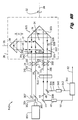
- Fig.1 depicts a preferred embodiment of an interferometric apparatus 10 made in accordance with the teachings of the present invention.
- a laser head 12 is mounted in a fixed reference frame and generates twin coincident light beams 14 & 16 having stabilized frequencies f1 and f2, respectively.
- the two beams are produced so that one beam having frequency f1 is linearly and orthogonally polarized with respect to the other beam having frequency f2.
- the beam 14 is assumed to have frequency f1 in a plane of polarization which is normal to the plane of Fig. 1 and is depicted as dots 17.
- the beam 16 is assumed to have frequency f2 in an orthogonal plane of polarization which is in the plane of the Fig. 1 and is depicted as vertical lines 19.
- the twin light beams 14 & 16 are transmitted to a stationary quarter wave plate 18 which is mounted in the fixed reference frame and which converts the twin beams into beams 20 & 22 having right and left hand circular polarizations (depicted as circular arrows 21 & 23) with respect to one another.
- the twin beams 20 & 22 are then sent to a quarter wave plate 24 mounted in a rotating reference frame 26.
- the quarter wave plate 24 converts those twin beams to a pair of beams 25 & 27 which have linear and orthogonal polarization states with respect to one another.
- the rotating frame 26 revolves about a rotation axis 28.
- the axes of linear polarization of the beams 25 & 27 also rotate with the rotating reference frame 26.
- the rotating reference frame is assumed to rotate with a rotational frequency of W revolutions/second, as indicated by a curved arrow 32, with respect to the stationary measurement frame where is mounted the light source 12. Since the beams 20 & 22 are produced with opposite circular polarizations, the resulting beams 25 & 27 emerging from the quarter wave plate 24 have their frequencies upshifted and downshifted respectively by an amount equal to W. It is also assumed for purposes of explanation that the beam 20 has frequency f1 and becomes the beam 25 having an upshifted frequency equal to f1+W. This arrangement also results in the beam 22 having frequency f2 which becomes the beam 27 having a downshifted frequency equal to f2-W.
- a polarizing beam splitter 34 is mounted in and rotates with the rotating reference frame 26.
- the beam splitter 34 is disposed for receiving the twin beams 20 & 22 transmitted from the quarter wave plate 24.
- the fast axis of the quarter wave plate 24 is aligned to be 45 degrees to a polarization axis of the polarizing beam splitter 34.
- This arrangement permits the linear and orthogonal beams 25 & 27 to stay aligned to the polarizing beam splitter 34 as it rotates.
- the beam splitter 34 diverts the beam 25 with frequency f1 +W upwards along a measurement path which is parallel to a radial axis 35, to a measurement reflector 36, which is preferably a conventional cube corner reflector.
- the measurement reflector 36 is movable back and forth along the radial axis 35, it is mounted in the rotating frame of reference 26 and thus rotates with respect to the fixed reference frame.
- the reflector 36 is assumed to have moved a distance D between the location where the reflector is depicted with solid lines and the location where the reflector is shown with dotted lines.
- the means for movably mounting the reflector 36 is not shown.
- the beam 25 after traveling out and back from the measurement reflector 36 returns to the beam splitter 34 as beam 40 with a Doppler shift of ⁇ f.
- the Doppler shift is positive or negative depending upon which frequency f1 or f2 is in the measurement path and the direction of movement of the measurement reflector 36.
- the beam splitter 34 is arranged to pass beam 27 having frequency f2-W along a reference path having a fixed length to a reference reflector 38, which is also preferably a cube corner reflector.
- the reference path is parallel to the rotation axis 28 and the reflector 38 being mounted in the rotating reference frame 26 rotates about the rotation axis 28.
- the beam 27 after being reflected by the reflector 38 is returned to the beam splitter 34 as a beam 42.
- the beam 42 is not Doppler shifted.
- the beam 40 is reflected by and the beam 42 is transmitted through the beam splitter 34 and both are then sent through the quarter wave plate 24 and become beams 43 & 47. Those beams are then passed through the stationary quarter wave plate 18 and emerge as returning beams 44 & 46, each of which is again frequency shifted up or down by a value equal to W.
- f_meas are the split frequency, f1-f2, the Doppler shift, ⁇ f, arising from the movement of the measurement reflector 36, and the frequency shift, 4W, arising from the quarter wave plate 24 as it rotates in unison with the rotating reference frame 26.
- the measurement signal 50 and the reference signal 52 are transmitted to a compensator 54 which includes one portion 51 that operates by determining a frequency difference and integrating the result to produce an intermediate signal 56.
- ⁇ f Fv/ ⁇ , where F is the interferometer fold factor, v is the velocity of the measurement reflector 36, and ⁇ is the wavelength of the laser light beam. Integrating f_diff gives ⁇ , which is the intermediate signal 56 and is the phase in fringes.
- a correction of 4 fringes/revolution of the rotating reference frame 26 is required to be subtracted.
- a conventional encoder 58 is coupled to the rotating reference frame 26 for detecting its angular rotation and generating an encoder signal 60.
- a second portion 53 of the compensator 54 receives the intermediate signal 56 and the encoder signal 60 and responds to produce a displacement signal 62 representing the measurement of the change in position, D, of the reflector 36 along the radial axis 35.
- the present invention is adaptable for use in a CNC machine application where a spindle containing a radially movable cutting tool is rotating about the axis 28.
- the measurement of the displacement of the measurement reflector 36 is a direct measurement of the movement of the tool along a radial axis normal to the axis of rotation of the spindle.
- the quarter wave plate 24 is preferably affixed to the polarizing beam splitter 34 of an interferometer 70.
- FIG. 2 A partial view of an alternate embodiment is depicted in Fig. 2 in which a quarter wave plate 200 and interferometer 202 is used in place of the quarter wave plate 24 and interferometer 70 of Fig. 1. In this alternate embodiment, the quarter wave plate 200 is separated from the interferometer 202. The remaining elements of Fig. 2 (not shown) are the same as those in Fig. 1.
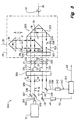
- Fig. 3 Depicted in Fig. 3 is another preferred embodiment of the present invention.
- the laser head 12 mounted in a fixed reference frame generates twin beams 302 & 304 having the frequencies f1 and f2, respectively, and linear and orthogonal polarizations.
- a non-polarizing beam splitter 305 divides the beams 302 & 304 into the beams 14 & 16 and another pair of beams 306 & 308 which emerge from a beam bender 307.
- the beams 14 & 16 have linear and orthogonal polarization states with respect to one another.
- the beams 306 & 308 also have linear and orthogonal polarization states with respect to one another as depicted by the dot 17 and the line 19.
- a stationary quarter wave plate 309 converts the beams 14 & 16 to the beams 20 & 22 having right and left circular polarizations with respect to one another.
- the beams 306 & 308 are also converted by the stationary quarter wave plate 309 into a pair of beams 310 & 312 having right and left circular polarization states with respect to one another.
- a quarter wave plate 315 mounted in the rotating reference frame 26 converts the beams 20 & 22 to the beams 25 & 27 having linear and orthogonal polarization states to one another.
- the beams 310 & 312 are also converted by the quarter wave plate 315 into a pair of beams 314 & 316 having linear and orthogonal polarization states to one another.
- An interferometer 320 mounted in the rotating reference frame includes the polarizing beam splitter 34 which is formed as a central core portion of a cube 322 and a reference reflector 323.
- the reflector 323 is preferably a cube corner reflector.
- the beam splitter 34, the measurement reflector 36, and all other elements having the same reference numerals as in Fig. 1 are all arranged and operated in the same manner as described for those same elements. Accordingly, the beams 44 & 46 are generated in the same manner as the embodiment of Fig. 1 and are sent to the receiver 48 after being redirected by the beam bender 49.
- the receiver 48 generates the measurement signal 50.
- the cube 322 includes an outer annular portion 324 which surrounds the polarizing beam splitter 34.
- the annular portion 324 transmits the beams 314 & 316 to the reference reflector 323 which reflects those two beams back into the annular portion 324 as a pair of beams 326 & 328.
- the beams 326 & 328 After being applied to the quarter wave plate 315, the beams 326 & 328 emerge as a pair of beams 330 & 332 having right and left circular polarization states to one another.
- the stationary quarter wave plate 309 thereafter converts the beams 330 & 332 to a pair of beams 334 & 336 having linear and orthogonal polarization states to one another.
- a beam bender 338 redirects the beams 334 & 336 to a reference receiver 340 which is mounted in the fixed reference frame and which operates to generate a reference signal 342.
- a compensator 344 operating in response to the applied measurement signal 50 and the reference signal 342 generates the displacement signal 62 representing the change in position of the reflector 36 along the radial axis 35. Accordingly, this embodiment as depicted in Fig. 3 eliminates the need for the encoder 58 as well as the signal 52 from the laser head 12 as shown in Fig. 1.
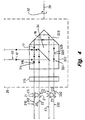
- Fig. 4 depicts a partial view of another embodiment of the present invention wherein the quarter wave plate 315 is separated from the cube 322.
- the other elements are the same as those in Fig. 3.
- Fig. 5 shows another alternate embodiment of an apparatus 500 made in accordance with the teachings of the present invention.
- the laser head 12 mounted in the fixed reference frame produces the twin beams 14 & 16 which are transmitted through an isolator 502.
- the purpose of the isolator 502 will be explained in a later portion of this description.
- the twin beams are passed through a non-polarizing beam splitter 504, the quarter wave plate 18 mounted in the fixed reference frame, and then to the quarter wave plate 24 mounted in the rotating reference frame 26.
- the twin beams 20 & 22 emerging from the quarter wave plate 18 have right and left circular polarizations with respect to one another.
- the twin beams 25 & 27 After emerging from the quarter wave plate 24, the twin beams 25 & 27 have linear and orthogonal polarization states but which now rotate with the rotating reference frame 26.
- the interferometer 70 operates the same as described in Fig. 1 so that the measurement reflector 36 returns the beam 40 and the reference reflector 38 returns the beam 42.
- the beams 40 & 42 after passing through the quarter wave plate 24 and the stationary quarter wave plate 18, are reflected by the non-polarizing beam splitter 504 and emerge as the beams 44 & 46 which are sent to the receiver 48.
- the purpose of the isolator 502 is to block or significantly attenuate any of the returning beams from being transmitted back into and adversely affecting the operation of the laser head 12.
- the technology for designing and making suitable optical isolators is known.
- Optical attenuators are all well known devices and many are suitable for use in the present invention . It should be pointed out that a disadvantage of using an attenuator is the resulting lower efficiencies due to lower beam
- Fig. 5 The other elements of Fig. 5 which have the same reference numerals as depicted in Fig. 1 operate in the same manner so that the apparatus 500 thereby produces the displacement signal 62.
- the apparatus 500 is very similar to the apparatus 10 (of Fig. 1), except that the beams entering and returning from the rotating reference frame 26 are coaxial in path instead of traveling along parallel paths.
- This embodiment is not preferred as that shown in Fig. 1 because the signal intensity of the beams is lower than used in apparatus 10.
- the interferometer 70 used in the apparatus 500 can be smaller than that for the apparatus 10, since the beams are coaxial. This embodiment is useful for those applications where space is very limited.
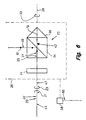
- FIG. 5 depicts a partial view of another embodiment wherein the quarter wave plate 24 is separated from the interferometer 70.
- the other elements (not shown) are the same as those in Fig. 5.
- FIG. 7 Another alternate embodiment of the present invention is shown wherein an apparatus 700 uses an optical arrangement similar to that of Fig. 3 in order to eliminate the need for an encoder and the reference signal from the laser head 12.
- the elements having the same numerals as those in Figs. 3 & 5 operate in like manner so that the apparatus 700 thereby generates the displacement signal 62.
- the present invention requires the beams which enter and return from the rotating reference frame must be along paths that are parallel or coaxial to the rotation axis 28.
- the associated interferometer can be located in any suitable orientation, as long as the beams are directed to enter the interferometer properly.
- the measurement and reference path reflectors are oriented on paths which are normal to the axis of rotation 28 and parallel (or coaxial) to the rotation axis, respectively. In the embodiments shown in Figs.
- the associated interferometer can be oriented differently so that the measurement and reference reflectors are not along paths respectively normal and parallel (or coaxial) to the rotation axis. Orienting the interferometer differently is useful for making other measurements in the rotating reference frame such as flatness or changes in angular position instead of just measuring radial displacement perpendicular to the rotation axis.
- the present invention can be used in so called differential interferometers where the reference reflector is movable, and the interferometric measurement is a differential measurement made between the locations of the reference and the measurement reflectors.
- the laser head used in the above described embodiments preferably generate twin beams which are linear and orthogonal to one another.
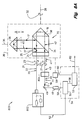
- a laser head 802 generates the twin beams 20 & 22 having right and left circular polarizations with respect to one another.
- the beams 20 & 22 are transmitted into the rotating reference frame 26 along a path parallel to the rotation axis 28.
- a quarter wave plate 804 the other elements are the same as those in Fig. 1 or Fig. 2.
- the quarter wave plate 804 is not the same as the quarter wave plate 24 of Fig. 1 because the quarter wave plate 804 is only needed to generate the beams 44 & 46.
- Fig. 8B an apparatus 840 is shown wherein the laser head 802 is used for generating the beams 20, 22, 310, & 312, with each respective pair having right and left circular polarizations states with respect to one another.
- the other elements are the same as those in Figs. 3 or 4.
- the quarter wave plate 844 is only needed to generate the beams 44, 46, 334, & 336 and is thus not the same as the quarter wave plate 309 of Fig. 3.
- the stationary quarter wave plates of Figs. 3, 4, 7, & 8B which are each preferably monolithic in construction, can be divided into two portions, on portion for generating the beams 310, 312, 20, & 22 and another portion for producing the beams 44, 46, 334, & 336.
- the two portions need not be stacked on top of one another so long as they are in position for receiving the corresponding beams. It is also possible for having individual portions sized for receiving individual beams or various sub-combinations of beams.
- the quarter wave plates mounted in the rotation reference frame 26 of Figs. 3, 4, 7, & 8B which are each preferably of monolithic construction, can be divided into an annular portion for producing the beams 314, 316, 330, & 332 and a central core portion for generating the beams 25, 27, 43, & 47.
- the two portions can be concentric to one another but the central portion does not have to be nested within the annular portion.
- the receivers 48 & 340 of Figs. 1-4, 7, 8A, & 8B can be located online to receive the beams 44 & 46 and 334 & 336, respectively.
- the beam benders 49 & 338 can be eliminated if the size of the receivers are small enough so as not to interfere with the beams from the laser head or the parallel beam paths for the input and returning beams are separated with enough distance so that the receivers do not interfere with the input beams from laser head.
- flat mirrors can be used for the reflectors.
- the preferred devices are cube corner reflectors.
- the isolator 502 of Figs. 5-7 is not always needed. Although its operation is not as efficient, the laser head can operate as a source of the twin beams without the use of an isolator even though some laser light is returned to it.
- twin beams from the laser head are preferably beams having optical light frequencies.
- other non-optical frequencies can be used since the operation of the AC type of interferometer is not restricted to the optical frequencies of light.
Landscapes
- Physics & Mathematics (AREA)
- General Physics & Mathematics (AREA)
- Engineering & Computer Science (AREA)
- Mechanical Engineering (AREA)
- Instruments For Measurement Of Length By Optical Means (AREA)
- Length Measuring Devices By Optical Means (AREA)
Applications Claiming Priority (2)
| Application Number | Priority Date | Filing Date | Title |
|---|---|---|---|
| US08/676,872 US5677768A (en) | 1996-07-03 | 1996-07-03 | Method and interferometric apparatus for measuring changes in displacement of an object in a rotating reference frame |
| US676872 | 1996-07-03 |
Publications (3)
| Publication Number | Publication Date |
|---|---|
| EP0816798A2 EP0816798A2 (en) | 1998-01-07 |
| EP0816798A3 EP0816798A3 (en) | 2000-01-12 |
| EP0816798B1 true EP0816798B1 (en) | 2002-06-12 |
Family
ID=24716391
Family Applications (1)
| Application Number | Title | Priority Date | Filing Date |
|---|---|---|---|
| EP97111166A Expired - Lifetime EP0816798B1 (en) | 1996-07-03 | 1997-07-03 | Method and interferometric apparatus for measuring changes in displacement of an object in a rotating reference frame |
Country Status (6)
| Country | Link |
|---|---|
| US (1) | US5677768A (enExample) |
| EP (1) | EP0816798B1 (enExample) |
| JP (1) | JP3841516B2 (enExample) |
| KR (1) | KR100434007B1 (enExample) |
| DE (1) | DE69713211T2 (enExample) |
| TW (1) | TW316289B (enExample) |
Families Citing this family (15)
| Publication number | Priority date | Publication date | Assignee | Title |
|---|---|---|---|---|
| US6157458A (en) * | 1998-04-30 | 2000-12-05 | Agilent Technologies | Achromatic quarter wave plate for an air turbulence compensating inteferometer |
| US6399940B1 (en) | 1999-05-10 | 2002-06-04 | Fanuc America Corporation | Optical rotary position encoder |
| JP2003211346A (ja) * | 2002-01-15 | 2003-07-29 | Mori Seiki Co Ltd | 工作機械の精度解析装置 |
| US6847455B1 (en) | 2002-01-25 | 2005-01-25 | The United States Of America As Represented By The Department Of Energy | Heterodyne interferometer with angstrom-level periodic nonlinearity |
| US6897962B2 (en) * | 2002-04-18 | 2005-05-24 | Agilent Technologies, Inc. | Interferometer using beam re-tracing to eliminate beam walk-off |
| KR100468155B1 (ko) * | 2002-06-27 | 2005-01-26 | 한국과학기술원 | 이종모드 헬륨-네온 레이저와 슈퍼 헤테로다인위상측정법을 이용한 헤테로다인 레이저 간섭계 |
| US7251039B1 (en) * | 2005-04-29 | 2007-07-31 | Agilent Technologies, Inc. | Low non-linear error displacement measuring interferometer |
| US7330272B2 (en) * | 2005-04-29 | 2008-02-12 | Agilent Technologies, Inc. | Discrete quarter wave plates for displacement measuring interferometers |
| US20090135430A1 (en) * | 2007-11-26 | 2009-05-28 | Miao Zhu | Systems and Methods for Reducing Nonlinearity in an Interferometer |
| CN102147505B (zh) * | 2010-02-08 | 2015-06-03 | 菲尼萨公司 | 增强型多体式光学设备 |
| US20120064759A1 (en) * | 2010-09-09 | 2012-03-15 | Spatial Digital Systems | Retractable mobile power device module |
| TWI452262B (zh) * | 2011-05-17 | 2014-09-11 | Univ Nat Yunlin Sci & Tech | 同時量測位移及傾角之干涉儀系統 |
| CN107966103B (zh) * | 2017-10-13 | 2019-11-19 | 深圳大学 | 基于局域自旋特性的超灵敏位移传感方法及装置 |
| WO2019071545A1 (zh) * | 2017-10-13 | 2019-04-18 | 深圳大学 | 基于局域自旋特性的超灵敏位移传感方法及装置 |
| TWI641805B (zh) * | 2018-04-02 | 2018-11-21 | 國立雲林科技大學 | Laser interference calibrator |
Family Cites Families (8)
| Publication number | Priority date | Publication date | Assignee | Title |
|---|---|---|---|---|
| DE2904836A1 (de) * | 1979-02-08 | 1980-08-14 | Max Planck Gesellschaft | Interferometrische einrichtung zur messung der wellenlaenge optischer strahlung |
| US4802765A (en) * | 1986-06-12 | 1989-02-07 | Zygo Corporation | Differential plane mirror having beamsplitter/beam folder assembly |
| DE3708295C1 (en) * | 1987-03-14 | 1988-08-25 | Daimler Benz Ag | Laser interferometer arrangement for measuring the axial play of two parts mounted so as to be capable of mutual rotation |
| JP2572111B2 (ja) * | 1988-07-11 | 1997-01-16 | 株式会社東京精密 | レーザ干渉測定装置 |
| US5064289A (en) * | 1989-02-23 | 1991-11-12 | Hewlett-Packard Company | Linear-and-angular measuring plane mirror interferometer |
| JP2757072B2 (ja) * | 1989-12-11 | 1998-05-25 | コニカ株式会社 | レーザー干渉測長計 |
| EP0634636B1 (de) * | 1993-07-07 | 1999-10-06 | Deutsches Zentrum für Luft- und Raumfahrt e.V. | Interferometer nach Michelson |
| US5583638A (en) * | 1993-07-21 | 1996-12-10 | Hewlett-Packard Company | Angular michelson interferometer and optical wavemeter based on a rotating periscope |
-
1996
- 1996-07-03 US US08/676,872 patent/US5677768A/en not_active Expired - Fee Related
-
1997
- 1997-01-13 TW TW086100274A patent/TW316289B/zh active
- 1997-06-11 JP JP15376597A patent/JP3841516B2/ja not_active Expired - Fee Related
- 1997-07-02 KR KR1019970030726A patent/KR100434007B1/ko not_active Expired - Fee Related
- 1997-07-03 DE DE69713211T patent/DE69713211T2/de not_active Expired - Fee Related
- 1997-07-03 EP EP97111166A patent/EP0816798B1/en not_active Expired - Lifetime
Also Published As
| Publication number | Publication date |
|---|---|
| TW316289B (en) | 1997-09-21 |
| DE69713211D1 (de) | 2002-07-18 |
| DE69713211T2 (de) | 2003-01-16 |
| EP0816798A2 (en) | 1998-01-07 |
| KR980008447A (ko) | 1998-04-30 |
| KR100434007B1 (ko) | 2004-08-02 |
| US5677768A (en) | 1997-10-14 |
| JPH1082609A (ja) | 1998-03-31 |
| JP3841516B2 (ja) | 2006-11-01 |
| EP0816798A3 (en) | 2000-01-12 |
Similar Documents
| Publication | Publication Date | Title |
|---|---|---|
| EP0816798B1 (en) | Method and interferometric apparatus for measuring changes in displacement of an object in a rotating reference frame | |
| US4859066A (en) | Linear and angular displacement measuring interferometer | |
| US4881816A (en) | Linear and angular displacement measuring interferometer | |
| US4883357A (en) | Dual high stability interferometer | |
| US4881815A (en) | Linear and angular displacement measuring interferometer | |
| EP0250306B1 (en) | Angle measuring interferometer | |
| US4868385A (en) | Rotating state detection apparatus using a plurality of light beams | |
| EP0658813B1 (en) | Radiation-source unit for generating a beam having two directions of polarisation and two frequencies | |
| JP4316691B2 (ja) | 偏位を測定するための装置 | |
| EP0227554B1 (en) | Differential plane mirror interferometer | |
| US5172186A (en) | Laser interferometry length measuring an apparatus employing a beam slitter | |
| US20220042792A1 (en) | Five-degree-of-freedom heterodyne grating interferometry system | |
| US6943894B2 (en) | Laser distance measuring system and laser distance measuring method | |
| US4717250A (en) | Angle measuring interferometer | |
| US4958929A (en) | Optical fiber sensor | |
| US7355719B2 (en) | Interferometer for measuring perpendicular translations | |
| EP0036251A2 (en) | Polarising optical system | |
| US5767971A (en) | Apparatus for measuring refractive index of medium using light, displacement measuring system using the same apparatus, and direction-of-polarization rotating unit | |
| US4807997A (en) | Angular displacement measuring interferometer | |
| JPH1082609A5 (enExample) | ||
| US5028137A (en) | Angular displacement measuring interferometer | |
| JPH07120213A (ja) | 追尾式レーザ干渉計 | |
| US5155550A (en) | Accurate correlator of rotational and translational motions and control method and apparatus | |
| US5067813A (en) | Optical apparatus for measuring displacement of an object | |
| JPH10103918A (ja) | レーザ測長器 |
Legal Events
| Date | Code | Title | Description |
|---|---|---|---|
| PUAI | Public reference made under article 153(3) epc to a published international application that has entered the european phase |
Free format text: ORIGINAL CODE: 0009012 |
|
| AK | Designated contracting states |
Kind code of ref document: A2 Designated state(s): DE FR GB IT |
|
| PUAL | Search report despatched |
Free format text: ORIGINAL CODE: 0009013 |
|
| AK | Designated contracting states |
Kind code of ref document: A3 Designated state(s): AT BE CH DE DK ES FI FR GB GR IE IT LI LU MC NL PT SE |
|
| 17P | Request for examination filed |
Effective date: 20000613 |
|
| AKX | Designation fees paid |
Free format text: DE FR GB IT |
|
| RAP1 | Party data changed (applicant data changed or rights of an application transferred) |
Owner name: HEWLETT-PACKARD COMPANY, A DELAWARE CORPORATION |
|
| RAP1 | Party data changed (applicant data changed or rights of an application transferred) |
Owner name: AGILENT TECHNOLOGIES, INC. |
|
| 17Q | First examination report despatched |
Effective date: 20010227 |
|
| RAP1 | Party data changed (applicant data changed or rights of an application transferred) |
Owner name: AGILENT TECHNOLOGIES INC. |
|
| RAP1 | Party data changed (applicant data changed or rights of an application transferred) |
Owner name: AGILENT TECHNOLOGIES INC. A DELAWARE CORPORATION |
|
| RAP1 | Party data changed (applicant data changed or rights of an application transferred) |
Owner name: AGILENT TECHNOLOGIES, INC. (A DELAWARE CORPORATION |
|
| GRAG | Despatch of communication of intention to grant |
Free format text: ORIGINAL CODE: EPIDOS AGRA |
|
| GRAG | Despatch of communication of intention to grant |
Free format text: ORIGINAL CODE: EPIDOS AGRA |
|
| GRAH | Despatch of communication of intention to grant a patent |
Free format text: ORIGINAL CODE: EPIDOS IGRA |
|
| GRAH | Despatch of communication of intention to grant a patent |
Free format text: ORIGINAL CODE: EPIDOS IGRA |
|
| GRAA | (expected) grant |
Free format text: ORIGINAL CODE: 0009210 |
|
| AK | Designated contracting states |
Kind code of ref document: B1 Designated state(s): DE FR GB IT |
|
| REG | Reference to a national code |
Ref country code: GB Ref legal event code: FG4D |
|
| REF | Corresponds to: |
Ref document number: 69713211 Country of ref document: DE Date of ref document: 20020718 |
|
| ET | Fr: translation filed | ||
| PLBE | No opposition filed within time limit |
Free format text: ORIGINAL CODE: 0009261 |
|
| STAA | Information on the status of an ep patent application or granted ep patent |
Free format text: STATUS: NO OPPOSITION FILED WITHIN TIME LIMIT |
|
| 26N | No opposition filed |
Effective date: 20030313 |
|
| PGFP | Annual fee paid to national office [announced via postgrant information from national office to epo] |
Ref country code: FR Payment date: 20060717 Year of fee payment: 10 |
|
| PGFP | Annual fee paid to national office [announced via postgrant information from national office to epo] |
Ref country code: GB Payment date: 20060726 Year of fee payment: 10 |
|
| PGFP | Annual fee paid to national office [announced via postgrant information from national office to epo] |
Ref country code: IT Payment date: 20060731 Year of fee payment: 10 |
|
| PGFP | Annual fee paid to national office [announced via postgrant information from national office to epo] |
Ref country code: DE Payment date: 20060831 Year of fee payment: 10 |
|
| GBPC | Gb: european patent ceased through non-payment of renewal fee |
Effective date: 20070703 |
|
| PG25 | Lapsed in a contracting state [announced via postgrant information from national office to epo] |
Ref country code: DE Free format text: LAPSE BECAUSE OF NON-PAYMENT OF DUE FEES Effective date: 20080201 |
|
| PG25 | Lapsed in a contracting state [announced via postgrant information from national office to epo] |
Ref country code: GB Free format text: LAPSE BECAUSE OF NON-PAYMENT OF DUE FEES Effective date: 20070703 |
|
| REG | Reference to a national code |
Ref country code: FR Ref legal event code: ST Effective date: 20080331 |
|
| PG25 | Lapsed in a contracting state [announced via postgrant information from national office to epo] |
Ref country code: FR Free format text: LAPSE BECAUSE OF NON-PAYMENT OF DUE FEES Effective date: 20070731 |
|
| PG25 | Lapsed in a contracting state [announced via postgrant information from national office to epo] |
Ref country code: IT Free format text: LAPSE BECAUSE OF NON-PAYMENT OF DUE FEES Effective date: 20070703 |