EP0809683B1 - Thermische zersetzung von naphthensäuren - Google Patents
Thermische zersetzung von naphthensäuren Download PDFInfo
- Publication number
- EP0809683B1 EP0809683B1 EP96907036A EP96907036A EP0809683B1 EP 0809683 B1 EP0809683 B1 EP 0809683B1 EP 96907036 A EP96907036 A EP 96907036A EP 96907036 A EP96907036 A EP 96907036A EP 0809683 B1 EP0809683 B1 EP 0809683B1
- Authority
- EP
- European Patent Office
- Prior art keywords
- feed
- tan
- naphthenic acids
- crudes
- treatment
- Prior art date
- Legal status (The legal status is an assumption and is not a legal conclusion. Google has not performed a legal analysis and makes no representation as to the accuracy of the status listed.)
- Expired - Lifetime
Links
Images
Classifications
-
- C—CHEMISTRY; METALLURGY
- C10—PETROLEUM, GAS OR COKE INDUSTRIES; TECHNICAL GASES CONTAINING CARBON MONOXIDE; FUELS; LUBRICANTS; PEAT
- C10G—CRACKING HYDROCARBON OILS; PRODUCTION OF LIQUID HYDROCARBON MIXTURES, e.g. BY DESTRUCTIVE HYDROGENATION, OLIGOMERISATION, POLYMERISATION; RECOVERY OF HYDROCARBON OILS FROM OIL-SHALE, OIL-SAND, OR GASES; REFINING MIXTURES MAINLY CONSISTING OF HYDROCARBONS; REFORMING OF NAPHTHA; MINERAL WAXES
- C10G31/00—Refining of hydrocarbon oils, in the absence of hydrogen, by methods not otherwise provided for
- C10G31/06—Refining of hydrocarbon oils, in the absence of hydrogen, by methods not otherwise provided for by heating, cooling, or pressure treatment
-
- Y—GENERAL TAGGING OF NEW TECHNOLOGICAL DEVELOPMENTS; GENERAL TAGGING OF CROSS-SECTIONAL TECHNOLOGIES SPANNING OVER SEVERAL SECTIONS OF THE IPC; TECHNICAL SUBJECTS COVERED BY FORMER USPC CROSS-REFERENCE ART COLLECTIONS [XRACs] AND DIGESTS
- Y02—TECHNOLOGIES OR APPLICATIONS FOR MITIGATION OR ADAPTATION AGAINST CLIMATE CHANGE
- Y02P—CLIMATE CHANGE MITIGATION TECHNOLOGIES IN THE PRODUCTION OR PROCESSING OF GOODS
- Y02P30/00—Technologies relating to oil refining and petrochemical industry
- Y02P30/20—Technologies relating to oil refining and petrochemical industry using bio-feedstock
Definitions
- This invention relates to a thermal, non-catalytic treatment for decomposing naphthenic acids present in crude oils or crude oil fractions.
- US-A-1,953,353 discloses decomposing naphthenic acids present in topped crudes or distillates, at atmospheric pressure and at a temperature from 315° to 400°C (600°F to 750°F). CO 2 is the only gaseous naphthenic acid decomposition product recognised and referred to.
- US-A-5,250,175 refers generally to the thermal treatment of waste streams from e.g. oil and gas industry and refinery production, and chemical manufacturing industry. It particularly refers to a staged thermal treatment of streams arising in oil field drilling. At each stage gaseous volatiles are carried away by a carrier gas such as nitrogen, carbon dioxide or steam.
- the carrier gas has as a major function the provision of an atmosphere preventing the combustion/oxidation of the gaseous volatiles.
- a process for reducing the total total acid number (TAN) of a naphthenic acids-containing petroleum feed comprising the steps of: (a) thermally treating the feed, in the absence of any agent for removing naphthenic acids, in a treatment zone at a temperature of at least 205°C (400°F) for a period of time sufficient to substantially reduce the TAN and (b) continuously removing gaseous phase naphthenic acids decomposition-components, comprising water vapour, CO and CO 2 , from the treatment zone during the thermal treating step by introducing a water vapor-free, inert sweep gas.
- TAN total total acid number
- petroleum acids may be substantially reduced, or at the least, reduced to the level where the feeds may thereafter be treated in plain carbon steel vessels.
- thermal treatment in addition to its normal meaning also means the absence of any catalyst for promoting the conversion of naphthenic acids, the absence of any material added to react or complex with naphthenic acids, and the absence of absorbents for naphthenic acids, i.e., the absence of any material used for the purpose of removing naphthenic acids.
- the thermal treatment amounts to heating the feed to a temperature of at least 205°C (400°F), preferably at least 315°C (600°F) for a period of time sufficient to reduce substantially TAN of the feed while constantly sweeping away inhibitors indigenous or formed during the decomposition.
- Inhibitors are primarily water vapor, magnified by the presence of CO 2 and/or CO.
- the thermal treatment process is, of course, a time-temperature dependent relationship once the threshold temperature level is attained. Thus, higher temperatures are also useful with a corresponding decrease in residence time at those higher temperatures.
- premature cracking of the bulk hydrocarbons is to be avoided or minimized, e.g., based on the feed, less than about 0.5 wt% gaseous hydrocarbon products, and preferably, based on the feed, less than 0.2 wt% of gaseous hydrocarbon products is produced.
- the gases that are produced are primarily water vapor, CO 2 and CO by virtue of the decomposition of the naphthenic acids.
- Other gases that may be produced by the very low level of cracking include light hydrocarbon gases, e.g., C 1 -C 4 alkyls or iso-alkyls, and hydrogen in small amounts.
- the process of this invention preferably reduces TAN to levels of less than about 1.5 mg KOH/gm oil, more preferably less than about 1 mg KOH/gm oil, still more preferably to less than about 0.5 mg KOH/gm oil, as measured by ASTM D-664.
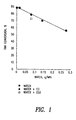
- Figure 1 shows TAN reduction versus water for Example 4.
- Feeds that may be effectively treated by this thermal treatment process include feeds containing naphthenic acids such as whole crudes or crude fractions. Crude fractions that may be treated are topped crudes (since few naphthenic acids are present in 205°C- (400°F -)naphtha), atmospheric residua, and vacuum gas oils, e.g., 343 to 566°C (650-1050°F). Preferred feeds include whole and topped crudes and vacuum gas oils, particularly whole and topped crudes.
- the feed may be treated at super-atmospheric, atmospheric or sub-atmospheric pressure, e.g., 0.101 to 101.3 bar (0.1 to 100 atmospheres), preferably less than about 15.20 bar (15 atmospheres), more preferably 1.013 to 10.13 bar (1-10 atmospheres), and preferably in an inert atmosphere, e.g., nitrogen or other non-oxidizing gases.
- an inert atmosphere e.g., nitrogen or other non-oxidizing gases.
- Any light ends or light cracked hydrocarbon products can be recovered by condensation, and, if desirable, recombined with the treated feed.
- This sweep gas may be natural gas or other light hydrocarbon gases as may be generally available at refineries or production facilities. Purge rates of sweep gas would be in the range of 0.18 to 356.0 std m 3 /m 3 (1-2000 standard cubic feet per barrel of feed (SCF/Bbl).
- the gaseous products would be removed from the reaction zone such that CO + CO 2 partial pressure is below 3.45 kPa (0.5 psia) and the H 2 O, partial pressure is below about 1.38 kPa (0.2 psia).
- temperatures are preferably in the range of 315 to 482°C (600-900°F), more preferably 371 to 427°C (700-800°F).
- Treatment (residence time at temperature) times may vary widely and are inversely related to temperature, e.g., 30 seconds to about 10 hours, preferably 1-90 minutes, more preferably 30-90 minutes.
- Treatment times will generally result in lower TAN values, while taking care not to exceed the cracking levels previously mentioned.
- soaking drums may be employed to carry out the process either on a batch or continuous basis.
- Engineers skilled in the art will readily envisage tubular reactors to effect the process.
- Naphthenic acid content was monitored by TAN initially and after each day. The results are shown in Table 1 below.
- Test Day TAN (mg KOH/gm oil) 0 (initial TAN) 3.02 1 2.22 2.22 2 1.80, 1.77 3 1.17 1.25
- thermally treated naphthenic acid decomposition was conducted in open and closed reactors.
- produced gas could slowly escape while in the closed reactor, product gases were retained.
- TAN reduction and gas make were determined and results are shown in Table 2.
- the closed reactor consisted of tubing bombs (25 g oil in 65 cc reactor volume), or mini bombs (5 g oil in 12 cc reactor volume).
- thermally treated naphthenic acid decomposition was conducted in an autoclave to demonstrate the beneficial effect of sweeping gaseous products from the reaction zone.
- experiment Test 1 produced gases were continuously swept away with helium at a rate of 227.0 std m 3 /m 3 (1275 SCF/Bbl) while in experiment Test 2, product gases were retained such that the maximum pressure rose to 791 kPa (100 psig).
- TAN was determined and results are shown in Table 3.
Landscapes
- Chemical & Material Sciences (AREA)
- Oil, Petroleum & Natural Gas (AREA)
- Engineering & Computer Science (AREA)
- Chemical Kinetics & Catalysis (AREA)
- General Chemical & Material Sciences (AREA)
- Organic Chemistry (AREA)
- Production Of Liquid Hydrocarbon Mixture For Refining Petroleum (AREA)
- Fats And Perfumes (AREA)
- Physical Or Chemical Processes And Apparatus (AREA)
- Organic Low-Molecular-Weight Compounds And Preparation Thereof (AREA)
Claims (10)
- Verfahren zur Verminderung der Gesamtsäurezahl (TAN) von Naphthensäuren enthaltendem Erdöleinsatzmaterial, das ein vollständiges Rohöl oder eine Rohölfraktion ist, bei dem in Stufen (a) das Einsatzmaterial in Abwesenheit von jeglichem Mittel zur Entfernung von Naphthensäuren in einer Behandlungszone bei einer Temperatur von mindestens 205°C (400°F) für einen ausreichenden Zeitraum wärmebehandelt wird, um die TAN wesentlich zu vermindern, und (b) während der Wärmebehandlungsstufe in der Gasphase vorliegende Zersetzungskomponenten von Naphthensäuren, die Wasserdampf, CO und CO2 umfassen, kontinuierlich aus der Behandlungszone entfernt werden, indem ein wasserdampffreies inertes Spülgas eingebracht wird.
- Verfahren nach Anspruch 1, bei dem die gasförmigen Reaktionsprodukte entfernt werden, so dass der Partialdruck von CO+CO2 weniger als 3,45 kPa (0,5 psia) beträgt und der Partialdruck von Wasser weniger als 1,38 kPa (0,2 psia) beträgt.
- Verfahren nach einem der vorhergehenden Ansprüche, bei dem das Spülgas Erdgas ist.
- Verfahren nach einem der vorhergehenden Ansprüche, bei dem das Spülgas mit einer Rate von 0,18 bis 356,0 Std m3/m3 des Erdöleinsatzmaterials (1 bis 2000 Std ft3 pro Barrel Einsatzmaterial) verwendet wird.
- Verfahren nach einem der vorhergehenden Ansprüche, bei dem die Behandlungstemperatur mindestens 315°C (600°F) beträgt.
- Verfahren nach Anspruch 5, bei dem die Behandlungstemperatur im Bereich von 315 bis 482°C (600 bis 900°F) liegt.
- Verfahren nach Anspruch 5 oder Anspruch 6, bei dem die Wärmebehandlungsdauer 1 bis 90 Minuten beträgt.
- Verfahren nach einem der vorhergehenden Ansprüche, bei dem die Wärmebehandlung bei einem Druck im Bereich von 1,01 bis 10,13 bar (1 bis 10 atm) durchgeführt wird.
- Verfahren nach einem der vorhergehenden Ansprüche, bei dem das Einsatzmaterial ausgewählt ist aus vollständigen Rohölen, entwässerten Rohölen, getoppten Rohölen, atmosphärischen Rückständen und 343 bis 566°C (650 bis 1050°F) Vakuumgasöl.
- Verfahren nach einem der vorhergehenden Ansprüche, bei dem das Einsatzmaterial eine Anfangs-TAN über 2 mg KOH/g Einsatzmaterial hat, gemessen nach ASTM Verfahren D-664.
Applications Claiming Priority (5)
| Application Number | Priority Date | Filing Date | Title |
|---|---|---|---|
| US39072995A | 1995-02-17 | 1995-02-17 | |
| US390729 | 1995-02-17 | ||
| US57104995A | 1995-12-12 | 1995-12-12 | |
| US571049 | 1995-12-12 | ||
| PCT/US1996/001817 WO1996025471A1 (en) | 1995-02-17 | 1996-02-09 | Thermal decomposition of naphthenic acids |
Publications (3)
| Publication Number | Publication Date |
|---|---|
| EP0809683A1 EP0809683A1 (de) | 1997-12-03 |
| EP0809683A4 EP0809683A4 (de) | 1998-12-23 |
| EP0809683B1 true EP0809683B1 (de) | 2001-11-14 |
Family
ID=27013257
Family Applications (1)
| Application Number | Title | Priority Date | Filing Date |
|---|---|---|---|
| EP96907036A Expired - Lifetime EP0809683B1 (de) | 1995-02-17 | 1996-02-09 | Thermische zersetzung von naphthensäuren |
Country Status (8)
| Country | Link |
|---|---|
| EP (1) | EP0809683B1 (de) |
| JP (1) | JP3827723B2 (de) |
| CN (1) | CN1125868C (de) |
| CA (1) | CA2212775C (de) |
| DE (1) | DE69616985T2 (de) |
| DK (1) | DK0809683T3 (de) |
| NO (1) | NO317557B1 (de) |
| WO (1) | WO1996025471A1 (de) |
Families Citing this family (8)
| Publication number | Priority date | Publication date | Assignee | Title |
|---|---|---|---|---|
| AU713522B2 (en) * | 1995-10-20 | 1999-12-02 | Exxon Research And Engineering Company | Viscosity reduction by heat soak-induced naphthenic acid decomposition in hydrocarbon oils |
| CN1272869A (zh) * | 1997-08-29 | 2000-11-08 | 埃克森研究工程公司 | 降低原油总酸值的方法 |
| US6086751A (en) * | 1997-08-29 | 2000-07-11 | Exxon Research And Engineering Co | Thermal process for reducing total acid number of crude oil |
| RU2184762C2 (ru) * | 1997-08-29 | 2002-07-10 | Экссон Рисерч энд Энджиниринг Компани | Способ снижения общего кислотного числа нефтяного сырья |
| US5928502A (en) * | 1997-08-29 | 1999-07-27 | Exxon Research And Engineering Co. | Process for reducing total acid number of crude oil |
| US5891325A (en) * | 1998-08-11 | 1999-04-06 | Exxon Research And Engineering Co. | Process for reducing total acid number of crude oil |
| CN1814704A (zh) * | 2005-01-31 | 2006-08-09 | 中国石油化工股份有限公司 | 一种深度脱除含酸原油中石油酸的方法 |
| JP5506139B2 (ja) * | 2007-01-18 | 2014-05-28 | Jx日鉱日石エネルギー株式会社 | 化学装置に対する腐食を低減する方法 |
Citations (2)
| Publication number | Priority date | Publication date | Assignee | Title |
|---|---|---|---|---|
| US2186425A (en) * | 1937-01-04 | 1940-01-09 | Shell Dev | Process for removing naphthenic acids from hydrocarbon oils |
| US2227811A (en) * | 1938-05-23 | 1941-01-07 | Shell Dev | Process for removing naphthenic acids from hydrocarbon oils |
Family Cites Families (2)
| Publication number | Priority date | Publication date | Assignee | Title |
|---|---|---|---|---|
| US1953353A (en) * | 1930-08-19 | 1934-04-03 | Associated Oil Company | Process of treating hydrocarbon oils |
| US5250175A (en) * | 1989-11-29 | 1993-10-05 | Seaview Thermal Systems | Process for recovery and treatment of hazardous and non-hazardous components from a waste stream |
-
1996
- 1996-02-09 CN CN96191970A patent/CN1125868C/zh not_active Expired - Fee Related
- 1996-02-09 DE DE69616985T patent/DE69616985T2/de not_active Expired - Fee Related
- 1996-02-09 DK DK96907036T patent/DK0809683T3/da active
- 1996-02-09 EP EP96907036A patent/EP0809683B1/de not_active Expired - Lifetime
- 1996-02-09 WO PCT/US1996/001817 patent/WO1996025471A1/en not_active Ceased
- 1996-02-09 JP JP52503996A patent/JP3827723B2/ja not_active Expired - Lifetime
- 1996-02-09 CA CA002212775A patent/CA2212775C/en not_active Expired - Fee Related
-
1997
- 1997-08-11 NO NO19973684A patent/NO317557B1/no not_active IP Right Cessation
Patent Citations (2)
| Publication number | Priority date | Publication date | Assignee | Title |
|---|---|---|---|---|
| US2186425A (en) * | 1937-01-04 | 1940-01-09 | Shell Dev | Process for removing naphthenic acids from hydrocarbon oils |
| US2227811A (en) * | 1938-05-23 | 1941-01-07 | Shell Dev | Process for removing naphthenic acids from hydrocarbon oils |
Also Published As
| Publication number | Publication date |
|---|---|
| EP0809683A1 (de) | 1997-12-03 |
| CN1125868C (zh) | 2003-10-29 |
| NO973684D0 (no) | 1997-08-11 |
| CN1175972A (zh) | 1998-03-11 |
| EP0809683A4 (de) | 1998-12-23 |
| DE69616985D1 (de) | 2001-12-20 |
| CA2212775A1 (en) | 1997-11-02 |
| WO1996025471A1 (en) | 1996-08-22 |
| DE69616985T2 (de) | 2002-05-29 |
| CA2212775C (en) | 2007-04-17 |
| JPH11500164A (ja) | 1999-01-06 |
| NO973684L (no) | 1997-08-11 |
| JP3827723B2 (ja) | 2006-09-27 |
| NO317557B1 (no) | 2004-11-15 |
| DK0809683T3 (da) | 2002-03-04 |
Similar Documents
| Publication | Publication Date | Title |
|---|---|---|
| US5820750A (en) | Thermal decomposition of naphthenic acids | |
| EP1062298B1 (de) | Thermisches verfahren zur reduzierung der gesamtanzahl von säuren in rohöl | |
| EP0733693A2 (de) | Verfahren zur Versorgung eines Rohres mit Koksanlagerung- und Kohlenmonoxidhemmenden Eigenschaften bei dem thermische Kracken von Kohlenwasserstoffen | |
| US5891325A (en) | Process for reducing total acid number of crude oil | |
| EP0948581B1 (de) | Viskositätsreduktion durch thermisch verursachte zersetzung von naphthensäure in mineralölen | |
| US6387840B1 (en) | Oil soluble coking additive | |
| CA2212775C (en) | Thermal decomposition of naphthenic acids | |
| GB2234530A (en) | Heat treatment of high temperature steels | |
| EP1119597B1 (de) | Veresterung von sauren rohölen | |
| KR900004491B1 (ko) | 탄화수소 처리공정중의 코우크스 형성 및 용착의 억제방법 및 억제용 조성물 | |
| AU708575B2 (en) | Thermal decomposition of naphthenic acids | |
| US4421638A (en) | Demetallization of heavy oils | |
| US3250697A (en) | Sweetening process using ammonia as catalyst | |
| RU2152975C1 (ru) | Термическое разложение нафтеновых кислот | |
| EP0141988B1 (de) | Passivation von Metallverunreinigungen an Krackkatalysatoren | |
| MXPA96003335A (en) | Thermal decomposition of acids nafteni | |
| US4414104A (en) | Process for removal of metals from hydrocarbon oils | |
| JPH0560514B2 (de) | ||
| MXPA98002426A (en) | Reduction of viscosity by decomposition of nafety acid, induced by heat infiltration, in hydrocarbon oils | |
| JP2003535151A6 (ja) | 石油酸のアンモニアによる処理方法 | |
| EP0414483A1 (de) | Molecul-Umstrukturierungskatalysator |
Legal Events
| Date | Code | Title | Description |
|---|---|---|---|
| PUAI | Public reference made under article 153(3) epc to a published international application that has entered the european phase |
Free format text: ORIGINAL CODE: 0009012 |
|
| 17P | Request for examination filed |
Effective date: 19970903 |
|
| AK | Designated contracting states |
Kind code of ref document: A1 Designated state(s): BE DE DK FR GB IT NL |
|
| A4 | Supplementary search report drawn up and despatched |
Effective date: 19981105 |
|
| AK | Designated contracting states |
Kind code of ref document: A4 Designated state(s): BE DE DK FR GB IT NL |
|
| 17Q | First examination report despatched |
Effective date: 19991214 |
|
| GRAG | Despatch of communication of intention to grant |
Free format text: ORIGINAL CODE: EPIDOS AGRA |
|
| RAP1 | Party data changed (applicant data changed or rights of an application transferred) |
Owner name: EXXONMOBIL RESEARCH AND ENGINEERING COMPANY |
|
| GRAG | Despatch of communication of intention to grant |
Free format text: ORIGINAL CODE: EPIDOS AGRA |
|
| GRAH | Despatch of communication of intention to grant a patent |
Free format text: ORIGINAL CODE: EPIDOS IGRA |
|
| GRAH | Despatch of communication of intention to grant a patent |
Free format text: ORIGINAL CODE: EPIDOS IGRA |
|
| GRAA | (expected) grant |
Free format text: ORIGINAL CODE: 0009210 |
|
| AK | Designated contracting states |
Kind code of ref document: B1 Designated state(s): BE DE DK FR GB IT NL |
|
| REF | Corresponds to: |
Ref document number: 69616985 Country of ref document: DE Date of ref document: 20011220 |
|
| REG | Reference to a national code |
Ref country code: GB Ref legal event code: IF02 |
|
| REG | Reference to a national code |
Ref country code: DK Ref legal event code: T3 |
|
| PLBE | No opposition filed within time limit |
Free format text: ORIGINAL CODE: 0009261 |
|
| STAA | Information on the status of an ep patent application or granted ep patent |
Free format text: STATUS: NO OPPOSITION FILED WITHIN TIME LIMIT |
|
| 26N | No opposition filed | ||
| PGFP | Annual fee paid to national office [announced via postgrant information from national office to epo] |
Ref country code: DK Payment date: 20090108 Year of fee payment: 14 |
|
| PGFP | Annual fee paid to national office [announced via postgrant information from national office to epo] |
Ref country code: NL Payment date: 20090210 Year of fee payment: 14 Ref country code: DE Payment date: 20090227 Year of fee payment: 14 |
|
| PGFP | Annual fee paid to national office [announced via postgrant information from national office to epo] |
Ref country code: GB Payment date: 20090106 Year of fee payment: 14 |
|
| PGFP | Annual fee paid to national office [announced via postgrant information from national office to epo] |
Ref country code: BE Payment date: 20090318 Year of fee payment: 14 |
|
| PGFP | Annual fee paid to national office [announced via postgrant information from national office to epo] |
Ref country code: IT Payment date: 20090212 Year of fee payment: 14 |
|
| PGFP | Annual fee paid to national office [announced via postgrant information from national office to epo] |
Ref country code: FR Payment date: 20090206 Year of fee payment: 14 |
|
| BERE | Be: lapsed |
Owner name: *EXXONMOBIL RESEARCH AND ENGINEERING CY Effective date: 20100228 |
|
| REG | Reference to a national code |
Ref country code: NL Ref legal event code: V1 Effective date: 20100901 |
|
| REG | Reference to a national code |
Ref country code: DK Ref legal event code: EBP |
|
| GBPC | Gb: european patent ceased through non-payment of renewal fee |
Effective date: 20100209 |
|
| REG | Reference to a national code |
Ref country code: FR Ref legal event code: ST Effective date: 20101029 |
|
| PG25 | Lapsed in a contracting state [announced via postgrant information from national office to epo] |
Ref country code: NL Free format text: LAPSE BECAUSE OF NON-PAYMENT OF DUE FEES Effective date: 20100901 Ref country code: FR Free format text: LAPSE BECAUSE OF NON-PAYMENT OF DUE FEES Effective date: 20100301 Ref country code: DK Free format text: LAPSE BECAUSE OF NON-PAYMENT OF DUE FEES Effective date: 20100228 |
|
| PG25 | Lapsed in a contracting state [announced via postgrant information from national office to epo] |
Ref country code: DE Free format text: LAPSE BECAUSE OF NON-PAYMENT OF DUE FEES Effective date: 20100901 Ref country code: BE Free format text: LAPSE BECAUSE OF NON-PAYMENT OF DUE FEES Effective date: 20100228 |
|
| PG25 | Lapsed in a contracting state [announced via postgrant information from national office to epo] |
Ref country code: IT Free format text: LAPSE BECAUSE OF NON-PAYMENT OF DUE FEES Effective date: 20100209 Ref country code: GB Free format text: LAPSE BECAUSE OF NON-PAYMENT OF DUE FEES Effective date: 20100209 |