EP0808918B1 - Plasma processing apparatus and processing method - Google Patents
Plasma processing apparatus and processing method Download PDFInfo
- Publication number
- EP0808918B1 EP0808918B1 EP97303434A EP97303434A EP0808918B1 EP 0808918 B1 EP0808918 B1 EP 0808918B1 EP 97303434 A EP97303434 A EP 97303434A EP 97303434 A EP97303434 A EP 97303434A EP 0808918 B1 EP0808918 B1 EP 0808918B1
- Authority
- EP
- European Patent Office
- Prior art keywords
- reaction vessel
- cathode electrodes
- plasma processing
- film
- matching circuit
- Prior art date
- Legal status (The legal status is an assumption and is not a legal conclusion. Google has not performed a legal analysis and makes no representation as to the accuracy of the status listed.)
- Expired - Lifetime
Links
Images






Classifications
-
- H—ELECTRICITY
- H01—ELECTRIC ELEMENTS
- H01J—ELECTRIC DISCHARGE TUBES OR DISCHARGE LAMPS
- H01J37/00—Discharge tubes with provision for introducing objects or material to be exposed to the discharge, e.g. for the purpose of examination or processing thereof
- H01J37/32—Gas-filled discharge tubes
- H01J37/32009—Arrangements for generation of plasma specially adapted for examination or treatment of objects, e.g. plasma sources
- H01J37/32082—Radio frequency generated discharge
- H01J37/32091—Radio frequency generated discharge the radio frequency energy being capacitively coupled to the plasma
-
- C—CHEMISTRY; METALLURGY
- C23—COATING METALLIC MATERIAL; COATING MATERIAL WITH METALLIC MATERIAL; CHEMICAL SURFACE TREATMENT; DIFFUSION TREATMENT OF METALLIC MATERIAL; COATING BY VACUUM EVAPORATION, BY SPUTTERING, BY ION IMPLANTATION OR BY CHEMICAL VAPOUR DEPOSITION, IN GENERAL; INHIBITING CORROSION OF METALLIC MATERIAL OR INCRUSTATION IN GENERAL
- C23C—COATING METALLIC MATERIAL; COATING MATERIAL WITH METALLIC MATERIAL; SURFACE TREATMENT OF METALLIC MATERIAL BY DIFFUSION INTO THE SURFACE, BY CHEMICAL CONVERSION OR SUBSTITUTION; COATING BY VACUUM EVAPORATION, BY SPUTTERING, BY ION IMPLANTATION OR BY CHEMICAL VAPOUR DEPOSITION, IN GENERAL
- C23C14/00—Coating by vacuum evaporation, by sputtering or by ion implantation of the coating forming material
- C23C14/22—Coating by vacuum evaporation, by sputtering or by ion implantation of the coating forming material characterised by the process of coating
- C23C14/34—Sputtering
-
- C—CHEMISTRY; METALLURGY
- C23—COATING METALLIC MATERIAL; COATING MATERIAL WITH METALLIC MATERIAL; CHEMICAL SURFACE TREATMENT; DIFFUSION TREATMENT OF METALLIC MATERIAL; COATING BY VACUUM EVAPORATION, BY SPUTTERING, BY ION IMPLANTATION OR BY CHEMICAL VAPOUR DEPOSITION, IN GENERAL; INHIBITING CORROSION OF METALLIC MATERIAL OR INCRUSTATION IN GENERAL
- C23C—COATING METALLIC MATERIAL; COATING MATERIAL WITH METALLIC MATERIAL; SURFACE TREATMENT OF METALLIC MATERIAL BY DIFFUSION INTO THE SURFACE, BY CHEMICAL CONVERSION OR SUBSTITUTION; COATING BY VACUUM EVAPORATION, BY SPUTTERING, BY ION IMPLANTATION OR BY CHEMICAL VAPOUR DEPOSITION, IN GENERAL
- C23C16/00—Chemical coating by decomposition of gaseous compounds, without leaving reaction products of surface material in the coating, i.e. chemical vapour deposition [CVD] processes
- C23C16/44—Chemical coating by decomposition of gaseous compounds, without leaving reaction products of surface material in the coating, i.e. chemical vapour deposition [CVD] processes characterised by the method of coating
- C23C16/50—Chemical coating by decomposition of gaseous compounds, without leaving reaction products of surface material in the coating, i.e. chemical vapour deposition [CVD] processes characterised by the method of coating using electric discharges
- C23C16/505—Chemical coating by decomposition of gaseous compounds, without leaving reaction products of surface material in the coating, i.e. chemical vapour deposition [CVD] processes characterised by the method of coating using electric discharges using radio frequency discharges
- C23C16/507—Chemical coating by decomposition of gaseous compounds, without leaving reaction products of surface material in the coating, i.e. chemical vapour deposition [CVD] processes characterised by the method of coating using electric discharges using radio frequency discharges using external electrodes, e.g. in tunnel type reactors
-
- H—ELECTRICITY
- H01—ELECTRIC ELEMENTS
- H01J—ELECTRIC DISCHARGE TUBES OR DISCHARGE LAMPS
- H01J37/00—Discharge tubes with provision for introducing objects or material to be exposed to the discharge, e.g. for the purpose of examination or processing thereof
- H01J37/32—Gas-filled discharge tubes
- H01J37/32431—Constructional details of the reactor
- H01J37/32532—Electrodes
-
- H—ELECTRICITY
- H01—ELECTRIC ELEMENTS
- H01J—ELECTRIC DISCHARGE TUBES OR DISCHARGE LAMPS
- H01J37/00—Discharge tubes with provision for introducing objects or material to be exposed to the discharge, e.g. for the purpose of examination or processing thereof
- H01J37/32—Gas-filled discharge tubes
- H01J37/32431—Constructional details of the reactor
- H01J37/32623—Mechanical discharge control means
- H01J37/32651—Shields, e.g. dark space shields, Faraday shields
-
- H—ELECTRICITY
- H10—SEMICONDUCTOR DEVICES; ELECTRIC SOLID-STATE DEVICES NOT OTHERWISE PROVIDED FOR
- H10F—INORGANIC SEMICONDUCTOR DEVICES SENSITIVE TO INFRARED RADIATION, LIGHT, ELECTROMAGNETIC RADIATION OF SHORTER WAVELENGTH OR CORPUSCULAR RADIATION
- H10F71/00—Manufacture or treatment of devices covered by this subclass
- H10F71/10—Manufacture or treatment of devices covered by this subclass the devices comprising amorphous semiconductor material
- H10F71/103—Manufacture or treatment of devices covered by this subclass the devices comprising amorphous semiconductor material including only Group IV materials
-
- Y—GENERAL TAGGING OF NEW TECHNOLOGICAL DEVELOPMENTS; GENERAL TAGGING OF CROSS-SECTIONAL TECHNOLOGIES SPANNING OVER SEVERAL SECTIONS OF THE IPC; TECHNICAL SUBJECTS COVERED BY FORMER USPC CROSS-REFERENCE ART COLLECTIONS [XRACs] AND DIGESTS
- Y02—TECHNOLOGIES OR APPLICATIONS FOR MITIGATION OR ADAPTATION AGAINST CLIMATE CHANGE
- Y02E—REDUCTION OF GREENHOUSE GAS [GHG] EMISSIONS, RELATED TO ENERGY GENERATION, TRANSMISSION OR DISTRIBUTION
- Y02E10/00—Energy generation through renewable energy sources
- Y02E10/50—Photovoltaic [PV] energy
-
- Y—GENERAL TAGGING OF NEW TECHNOLOGICAL DEVELOPMENTS; GENERAL TAGGING OF CROSS-SECTIONAL TECHNOLOGIES SPANNING OVER SEVERAL SECTIONS OF THE IPC; TECHNICAL SUBJECTS COVERED BY FORMER USPC CROSS-REFERENCE ART COLLECTIONS [XRACs] AND DIGESTS
- Y02—TECHNOLOGIES OR APPLICATIONS FOR MITIGATION OR ADAPTATION AGAINST CLIMATE CHANGE
- Y02P—CLIMATE CHANGE MITIGATION TECHNOLOGIES IN THE PRODUCTION OR PROCESSING OF GOODS
- Y02P70/00—Climate change mitigation technologies in the production process for final industrial or consumer products
- Y02P70/50—Manufacturing or production processes characterised by the final manufactured product
Definitions
- the present invention relates to a plasma processing apparatus and a processing method and, more particularly, to a plasma processing apparatus and a processing method such as: a plasma CVD apparatus and a film forming method for a crystalline or non-monocrystalline functional deposition film effective for an electrophotographic photosensitive device serving as a semiconductor device, an image input line sensor, an image-pickup device, or a photomotive device; a sputtering apparatus and a film forming method which can preferably form a semiconductor device, an insulating film serving as an optical element, or a metal wire; or an etching apparatus and method for a semiconductor device.
- a plasma CVD apparatus and a film forming method for a crystalline or non-monocrystalline functional deposition film effective for an electrophotographic photosensitive device serving as a semiconductor device, an image input line sensor, an image-pickup device, or a photomotive device a sputtering apparatus and a film forming method which can preferably form a semiconductor device, an insulating film serving as
- a plasma process in forming a semiconductor or the like various methods are used depending on applications. Examples include an apparatus and a method using the characteristics of a plasma, such as film formation for an oxide film, a nitride film, and an amorphous-silicon-based semiconductor film using a plasma CVD method film formation for a metal wiring film or the like using a sputtering method or a micropatterning technique or the like using etching.
- a demand for improvement of film quality and processing performance becomes strong, and various devices are examined.
- a plasma process using a high-frequency power has stable discharging and can be applied to an insulating material of an oxide film or a nitride film, the plasma process is widely applied.
- the oscillation frequency of a discharging high-frequency wave power source used in a plasma process such as plasma CVD is generally 13.56 MHz.
- a plasma CVD apparatus generally used in deposition film formation is shown in Fig. 13.
- Fig. 13 shows a film formation apparatus for a cylindrical amorphous-silicon film (to be referred to as an a-Si film hereinafter) for a cylindrical electrophotographic photosensitive material.
- a film forming method for an a-Si film will be described below with reference to Fig. 13.
- the film formation apparatus shown in Fig. 13 is constituted such that, in a reaction vessel 101 which can be reduced in pressure, a cylindrical cathode electrode 102 electrically insulated from the reaction vessel 101 and a cylindrical film-formed substrate 103 serving as a counter electrode are arranged by an insulating material 113.
- the film-formed substrate 103 is heated to a predetermined temperature by a heater 105 arranged in the film-formed substrate 103, and is held on a substrate holder 104 having a rotating mechanism driven by a motor 112.
- a high-frequency wave power source 106 is connected to the cathode electrode 102 through a matching circuit 107.
- An evacuating means 108 for evacuating the reaction vessel 101 and a gas supply means 109 for supplying a gas into the reaction vessel 101 are attached to the film formation apparatus.
- the reaction vessel 101 is evacuated by the evacuating means 108 to a high degree of vacuum, and the gas supply means 109 feeds a source gas such as a silane gas, disilane gas, a methane gas, or an ethane gas or a doping gas such as a diborane gas to keep the pressure in the reaction vessel 101 in the range of several 1 Pa (10 mTorr) to several 10 -1 Pa (mTorr).
- the high-frequency wave power source 106 supplies a high-frequency wave power of 13.56 MHz to the cathode electrode 102 to generate a plasma between the cathode electrode 102 and the film-formed substrate 103, thereby decomposing the source gas.
- an a-Si film is deposited on the film-formed substrate 103 heated to about 200°C to 350°C by the heater 105.
- a deposition rate for obtaining an a-Si film which satisfies the performance of an electrophotographic photosensitive material by the film forming method described above is the maximum of about 6 ⁇ m/hour. When the deposition rate is higher than 6 ⁇ m/hour, the characteristic feature of the photosensitive material cannot be obtained.
- the a-Si film is generally used as an electrophotographic photosensitive material, the a-Si film requires a thickness of at least 20 pm to 30 pm to obtain charging performance, and a long period of time is required to manufacture an electrophotographic photosensitive material.
- the present inventors used the conventional plasma CVD method and apparatus described above and a high-frequency wave power having a frequency higher than a conventional discharge frequency of 13.56 MHz to increase the deposition rate of high-quality film.
- Such a film thickness nonuniformity poses a serious problem not only when an electrophotographic photosensitive material is formed but also when a crystalline or non-monocrystalline functional deposition film for an image input line sensor, an image-pickup device, a photomotive device, or the like is formed.
- a plasma process such as dry etching or sputtering, when the discharge frequency is increased, similarly, nonuniform processing occurs. For this reason, a high-frequency wave power having a frequency higher than 13.56 MHz cannot be used practically without problems.
- the plasma processing apparatus of the present invention is of the type, such as disclosed in European Patent Application EP-A-0517047, comprising:
- the present invention is intended to provide a method and apparatus capable of uniformly performing a plasma process such as CVD, sputtering, etching, or ashing to substrates having a relatively large area at a process rate which cannot be achieved in the conventional plasma process.
- a plasma process such as CVD, sputtering, etching, or ashing
- a deposition film forming method using plasma CVD which can form deposition films having an extremely uniform thickness, at a high speed, which can be used to form semiconductor devices.
- the aforesaid plasma processing apparatus is characterised in that:
- capacitors are arranged in the high-frequency wave transmission paths between the matching circuit and the cathode electrodes.
- an earth shield is arranged covering the reaction vessel arranged outside the cathode electrodes except for the high-frequency wave transmission paths between the matching circuit and the cathode electrodes. The above apparatus is especially preferable when the high-frequency wave power is 30 MHz to 600 MHz or less.
- a plasma processing method for applying a plasma process to substrates to be processed by using the above plasma processing apparatus belongs to the present invention.
- the steps of this method are recited in claim 7 of the claims appended hereto.
- the present inventors have examined the above problems of the conventional method and apparatus.
- plasma distribution was sensitive with respect to the shape of the cathode electrode in comparison with the plasma distribution of the conventional apparatus, and the size of the discharge apparatus was 1/10 or less the wavelength of the high-frequency wave. For this reason, influence of a stationary wave began to occur. As a result, it was found that nonuniform processing occurred.
- the high-frequency wave power output of a high-frequency wave power source 7 is applied to a cylindrical cathode electrode 102 through a matching circuit 107 to form a high-frequency wave electric field between the cathode electrode 102 and a substrate to be processed 103 opposing the cathode electrode 102 to generate a plasma, thereby applying a plasma process to the substrate to be processed 103.
- the substrate of electrophotographic photosensitive material serving as the substrate to be processed has a diameter of about 100 mm. For this reason, the diameter d of the cathode is about 200 mm to 300 mm.
- the transmission distance of the high-frequency wave to the opposite side of the cathode electrode along the peripheral surface is 1.57 d.
- the distance is about 390 mm.
- the frequency of the high-frequency wave is changed from 13.56 MHz (conventional frequency) to 100 MHz, the wavelength ⁇ is about 22 m to 3 m in the air. More specifically, at 100 MHz, a high-frequency wave applied from one point on the periphery of the cathode electrode transmits through the cathode electrode peripheral surface to reach the opposite side.
- an electric field distribution begins to occur on the cathode electrode periphery due to influence of a stationary wave.
- the high-frequency wave electric field also influences the cathode electrode surface, a nonuniform electric field on the inner periphery of the cathode electrode occurs, and a nonuniform discharge. occurs in the circumference direction.
- the length of the substrate of electrophotographic photosensitive material serving as the substrates to be processed is generally about 350 mm, so that the cathode electrode length is about 350 mm to 400 mm. For this reason, as in the peripheral direction described above, nonuniform discharge occurs also in an axial direction.
- the plasma density nonuniformity is defined as a value obtained by dividing the difference between the maximum value and minimum value of the plasma density.
- the plasma density nonuniformity was ⁇ 10% or higher at almost 30 MHz, and it was apparent that nonuniformity of the high-frequency wave voltage on the cathode electrode at the discharge frequency became conspicuous.
- the width of energy of ions incident on the substrate to be processed was measured, the width was about 30 eV at 13.56 MHz, about 15 eV at 30 MHz, and about 10 eV at 100 MHz or higher.
- a small energy width is important because controllability can be improved, and the frequency of 30 MHz or higher is preferably used. Therefore, it is very important that the plasma density is free from nonuniformity in this frequency range.
- the high-frequency wave is transmitted from the rear surface of the cathode electrode to the surface of the cathode electrode to reach the front surface of the cathode electrode, so that the high-frequency wave power is supplied to the plasma.
- it is effective that the high-frequency wave distribution transmitted to the rear or front surface of the cathode is adjusted.
- the reaction vessel must not be constituted by the cathode electrode, or a cathode electrode must not be arranged in the reaction vessel. It is best that the cathode electrode is arranged outside the reaction vessel. In order to supply high-frequency wave power from the cathode electrode outside the reaction vessel to a plasma in the reaction vessel, a portion between the cathode electrode and the plasma must consist of a dielectric material.
- any dielectric material having small loss of a high-frequency wave may be used, e.g., alumina ceramic, quartz glass, pyrexTM glass, teflonTM, or the like can be used.
- the reaction vessel must have a thickness which can withstand the atmospheric pressure because the reaction vessel is reduced in pressure. Depending on the shape or size, the thickness must be generally set to at least 5 mm or more, preferably, 10 mm or more.
- the reactance component 1/j ⁇ C of a complex impedance generated by an electrostatic capacitor C of the dielectric material becomes 10 ⁇ to 50 ⁇ which is almost equal to that of the impedance of the plasma, and it is difficult to efficiently supply the high-frequency wave to the plasma.
- the discharge frequency is increased to 30 MHz to 600 MHz, a complex impedance generated by the dielectric material decreases in inverse proportion to the frequency. For this reason, even if the dielectric material having the above thickness is arranged between the cathode electrode and the plasma, the high-frequency wave can be efficiently supplied to the plasma.
- an arrangement in which the cathode electrode is arranged outside the reaction vessel is effective because a high-frequency wave can be efficiently supplied at a discharge frequency of 30 MHz or higher.
- the shape and material of the cathode electrode can be considerably changed, the complex impedance at an arbitrary point on the cathode electrode can be changed, and the above problem can be solved.
- the optimum shape and the optimum constituent material of the cathode electrode change depending on the shape of a substrate to be processed, plasma processing conditions, and the discharge frequency, when the cathode electrode is outside the reaction vessel, only the cathode electrode may be exchanged, and the reaction vessel is not temporarily opened in the air. For this reason, the above method can easily cope with changes in various processing conditions. For the same reason, as described above, the optimum cathode electrode can be determined by trial-and-error more easily than in the conventional method.
- the above means can be easily executed because the cathode electrode is arranged outside the reaction vessel. However, when the cathode electrode is arranged outside the reaction vessel as described above, this arrangement can also be easily applied to a parallel-plate-type plasma processing apparatus.
- the cathode electrode is arranged outside the reaction vessel, and a dielectric material serving as a buffer is arranged between the cathode electrode and the plasma, a high-frequency stationary wave on the cathode electrode causing high-frequency wave voltage nonuniformity at a frequency of 30 MHz to 600 MHz higher than a conventional frequency is prevented from reflecting nonuniformity of the plasma strength.
- the high-frequency wave power is separately applied to a plurality of cathode electrodes. This method is optimum in a case wherein the surface area of each cathode is decreased to prevent a stationary wave from easily occurring, and a plasma having a large area is formed.
- the high-frequency wave power While a high-frequency wave power is transmitted from a high-frequency wave power source to the cathode electrodes through the matching circuit, the high-frequency wave power may be transmitted to the interior of the reaction vessel through the atmospheric air and part of the dielectric material. For this reason, the plasma density becomes nonuniform. As a result, the deposition disadvantageously has a film thickness nonuniformity. Therefore, when an earth shield is arranged covering the reaction vessel having a plurality of cathode electrodes arranged outside except for high-frequency wave transmission paths extending from the matching circuit to the cathode electrodes, the high-frequency wave power can be prevented from being transmitted to the interior of the reaction vessel through the atmospheric air. As a result, advantageously, the uniformity of the film thickness can be improved.
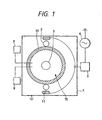
- Fig. 1 is a view showing the arrangement of a side cross-section of a plasma processing apparatus
- Fig. 2 is a view showing the longitudinal cross-section of this apparatus.
- This plasma processing apparatus comprises, as shown in Figs. 1 and 2, a cylindrical dielectric member 10 constituting the side portion of a reaction vessel 15 which can be reduced in pressure, and an earth shield 1, for preventing high-frequency wave leakage, which forms the upper and bottom portions of the reaction vessel 15 and surrounds the side portion of the reaction vessel 15.
- an earth shield 1 for preventing high-frequency wave leakage, which forms the upper and bottom portions of the reaction vessel 15 and surrounds the side portion of the reaction vessel 15.
- two cathode electrodes 2 are arranged to be electrically insulated from the earth shield 1 by an insulating material 13. More specifically, the cathode electrodes 2 are arranged outside the reaction vessel 15.
- a cylindrical substrate 3 serving as a counter electrode of the cathode electrodes 2 is arranged inside the reaction vessel 15 whose side portion is constituted by the dielectric member 10.
- the substrate 3 is heated from its inside to a predetermined temperature by a heater 5 arranged in the reaction vessel 15, and is held by a substrate holder 4 having a rotating mechanism driven by a motor (not shown).
- the substrate 3 and the substrate holder 4 for holding the substrate 3 is grounded, and the substrate 3 is used as the counter electrode of the cathode electrodes 2.
- An evacuation means 8 for evacuating the reaction vessel 15 which is partially constituted by the dielectric member 10 and a gas supply means 9 for supplying a gas into the reaction vessel 15 are attached to the plasma processing apparatus.
- a matching circuit 7 arranged outside the earth shield 1 is connected to the cathode electrodes 2 through capacitors 11, and a high-frequency wave power source 6 is connected to the matching circuit 7.
- the capacitances of the capacitors 11 connected between the matching circuit 7 and the cathode electrodes 2 are changed to values which cancel L components of the transmission paths extending from the matching circuit 7 to the cathode electrodes 2.
- the gas supply means 9 feeds a film-forming source gas such as a silane gas, disilane gas, a methane gas, or an ethane gas and a doping gas such as a diborane gas to keep the pressure in the reaction vessel 15 in the range of several Pa (10 mTorr) to several tenths Pa (mTorr).
- a film-forming source gas such as a silane gas, disilane gas, a methane gas, or an ethane gas and a doping gas such as a diborane gas
- the high-frequency wave power source 6 supplies a high-frequency wave power of 30 MHz to 600 MHz or less to the cathode electrodes 2 through the matching circuit 7 and each capacitor 11 to generate a plasma between the cathode electrodes 2 and the substrate 3 arranged inside the dielectric member 10, thereby decomposing the source gas.
- an a-Si film is uniformly deposited on the substrate 3 heated to about 200°C to 350°C by the heater 5.
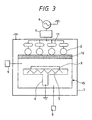
- Fig. 3 is a view showing a longitudinal cross-section of a plasma processing apparatus according to a modification of the apparatus of Figs. 1 and 2.
- the parallel-plate-type plasma processing apparatus shown in Fig. 3 comprises a reaction vessel 15 which has an upper portion constituted by a dielectric member 10 and can be reduced in pressure.
- the reaction vessel 15 is surrounded by the earth shield 1.
- a plurality of cathode electrodes 2 are arranged on the outside surface (surface on the atmospheric-air side) of the dielectric member 10. More specifically, the cathode electrodes 2 are arranged outside the reaction vessel 15.
- a plate-like film-formed substrate 3 serving as a counter electrode of the cathode electrodes 2 is arranged inside the reaction vessel 15 whose upper portion is constituted by the dielectric member 10.
- the substrate 3 is heated from its inside to a predetermined temperature by a heater 5 arranged in the reaction vessel 15, and is held by a substrate holder 4 having a rotating mechanism driven by a motor 12.
- the substrate 3 and the substrate holder 4 for holding the substrate 3 are earthed.
- An evacuation means 8 for evacuating the reaction vessel 15,which is partially constituted by the dielectric member 10 and a gas supply means 9 for supplying a gas into the reaction vessel 15, are attached to the plasma processing apparatus.
- a matching circuit 7 arranged outside the earth shield 1 is connected to the cathode electrodes 2 through capacitors 11, and a high-frequency wave power source 6 is connected to the matching circuit 7.
- the capacitances of the capacitors 11 connected between the matching circuit 7 and the cathode electrodes 2 are changed to values which cancel L components of the transmission paths extending from the matching circuit 7 to the cathode electrodes 2.
- Fig. 4 is a view showing the arrangement of a side cross-section of another plasma processing apparatus
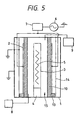
- Fig. 5 is a view showing the longitudinal cross-section of this apparatus.
- the same reference numerals as used in Figs. 1 and 2 denote the same parts in Figs. 4 and 5.
- This plasma processing apparatus comprises, as shown in Figs. 4 and 5, a cylindrical dielectric member 10 constituting the side portion of a reaction vessel 15 which can be reduced in pressure, and a first earth shield 1, for preventing high-frequency wave leakage, which forms the upper and bottom portions of the reaction vessel 15 and surrounds the side portion of the reaction vessel 15.
- a cylindrical dielectric member 10 constituting the side portion of a reaction vessel 15 which can be reduced in pressure
- a first earth shield 1 for preventing high-frequency wave leakage, which forms the upper and bottom portions of the reaction vessel 15 and surrounds the side portion of the reaction vessel 15.
- cathode electrodes 2 are arranged to be electrically insulated from the first earth shield 1 by an insulating material 13. More specifically, the cathode electrodes 2 are arranged outside the reaction vessel 15.
- a cylindrical substrate 3 serving as a counter electrode of the cathode electrodes 2 is arranged.
- the substrate 3 is heated from its inside to a predetermined temperature by a heater 5 arranged in the reaction vessel 15, and is held by a substrate holder 4 having a rotating mechanism driven by a motor 12.
- the substrate holder 4 for holding the substrate 3 is earthed . and the substrate 3 is used as the counter electrode of the cathode electrodes 2.
- An evacuation means 8 for evacuating the reaction vessel 15 which is partially constituted by the dielectric member 10 and a gas supply means 9 for supplying a gas into the reaction vessel 15 are attached to the plasma processing apparatus.
- a matching circuit 7 arranged outside the first earth shield 1 is connected to the cathode electrodes 2, and a high-frequency wave power source 6 is connected to the matching circuit 7.
- a second earth shield 14 is arranged covering the reaction vessel 15 having the plurality of cathode electrodes 2 arranged outside except for high-frequency wave transmission paths extending from the matching circuit 7 to the cathode electrodes 2
- a plurality of openings (not shown) for connecting the high-frequency wave transmission paths from the outside of the second earth shield 14 to the cathode electrodes 2 are formed in the second earth shield 14.
- the reaction vessel having a plurality of cathode electrodes arranged outside is covered with the earth shields outside the high-frequency wave transmission paths extending from the matching circuit to the cathode electrodes, so that the high-frequency wave power can be prevented from being transmitted to the interior of the reaction vessel through the atmospheric air.
- the substrates and the reaction vessel arranged on a concentric circle very uniform deposition films can be formed at a high speed.
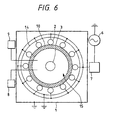
- the number of cathode electrodes need not be limited to two, and, as shown in Fig. 6, a greater plurality of cathode electrodes are preferably arranged to prevent a high-frequency stationary wave from easily occurring and to make the plasma distribution more uniform.
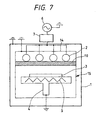
- Fig. 7 is a view showing a longitudinal cross-section of a plasma processing apparatus according to a modification of the apparatus of Fig. 4.
- a parallel-plate-type plasma processing apparatus as shown in Fig. 7 comprises a reaction vessel 15 whose upper portion is constituted by a dielectric member 10 and which can be reduced in pressure.
- the reaction vessel 15 is surrounded by an earth shield 1.
- a plurality of cathode electrodes 2 are arranged on the outside surface (surface on the atmospheric-air side) of the dielectric member 10. More specifically, the cathode electrodes 2 are arranged outside the reaction vessel 15.
- a plate-like substrate 3 serving as a counter electrode of the cathode electrodes 2 is arranged.
- the substrate 3 is heated from its inside to a predetermined temperature by a heater 5 arranged in the reaction vessel 15, and is held by a substrate holder 4 having a rotating mechanism driven by a motor 12.
- the substrate 3 and the substrate holder 4 for holding the substrate 3 is earthed and the substrate 3 is used as the counter electrode of the cathode electrodes 2.
- An evacuation means (not shown) for evacuating the reaction vessel 15 which is partially constituted by the dielectric member 10 and a gas supply means (not shown) for supplying a gas into the reaction vessel 15 are attached to the plasma processing apparatus.
- a matching circuit 7 arranged outside the first earth shield 1 is connected to the cathode electrodes 2, and a high-frequency wave power source 6 is connected to the matching circuit 7.
- a second earth shield 14 is arranged covering the reaction vessel 15 having the plurality of cathode electrodes 2 arranged outside except for high-frequency wave transmission paths extending from the matching circuit 7 to the cathode electrodes 2.
- a plurality of openings (not shown) for connecting the high-frequency wave transmission paths from the outside of the second earth shield 14 to the cathode electrodes 2 are formed in the second earth shield 14.
- Fig. 8 is a view showing the arrangement of a side cross-section of another plasma processing apparatus
- Fig. 9 is another view showing the longitudinal cross-section of this apparatus.
- the same reference numerals as used in Figs. 1 to 7 denote the same parts in Figs. 8 and 9.
- This plasma processing apparatus comprises, as shown in Figs. 8 and 9, a cylindrical dielectric member 10 constituting the side portion of a reaction vessel 15 which can be reduced in pressure, and a first earth shield 1, for preventing high-frequency wave leakage, which forms the upper and bottom portions of the reaction vessel 15 and surrounds the side portion of the reaction vessel 15.
- a cylindrical dielectric member 10 constituting the side portion of a reaction vessel 15 which can be reduced in pressure
- a first earth shield 1 for preventing high-frequency wave leakage, which forms the upper and bottom portions of the reaction vessel 15 and surrounds the side portion of the reaction vessel 15.
- cathode electrodes 2 are arranged to be electrically insulated from the first earth shield 1 by an insulating material 13. More specifically, the cathode electrodes 2 are arranged outside the reaction vessel 15.
- a cylindrical substrate 3 serving as a counter electrode of the cathode electrodes 2 is arranged.
- the substrate 3 is heated from its inside to a predetermined temperature by a heater 5 arranged in the reaction vessel 15, and is held by a substrate holder 4 having a rotating mechanism driven by a motor (not shown).
- the substrate holder 4 for holding the substrate 3 is earthed, and the substrate 3 is used as the counter electrode of the cathode electrodes 2.
- a matching circuit 7 arranged outside the first earth shield 1 is connected to the cathode electrodes 2 through capacitors 11, and a high-frequency wave power source 6 is connected to the matching circuit 7.
- An evacuation means 8 for evacuating the reaction vessel 15 which is partially constituted by the dielectric member 10 and a gas supply means 9 for supplying a gas into the reaction vessel 15 are attached to the plasma processing apparatus.
- a second earth shield 14 is arranged covering the reaction vessel 15 having the plurality of cathode electrodes 2 arranged outside except for high-frequency wave transmission paths extending from the matching circuit 7 to the cathode electrodes 2.
- a plurality of openings (not shown) for connecting the high-frequency wave transmission paths from the outside of the second earth shield 14 to the cathode electrodes 2 are formed in the second earth shield 14.
- the reaction vessel having a plurality of cathode electrodes arranged outside is covered with the earth shields outside the high-frequency wave transmission paths extending from the matching circuit to the cathode electrodes, so that the high-frequency wave power can be prevented from being transmitted to the interior of the reaction vessel through the atmospheric air.
- the substrates to be processed are each cylindrical, and the substrates to be processed and the reaction vessel are arranged on a concentric circle, very uniform deposition films can be formed on the plurality of substrates to be processed at a high speed.
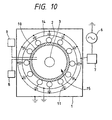
- the number of cathode electrodes need not be limited to two, and, as shown in Fig. 10, a greater plurality of cathode electrodes are preferably arranged to prevent a high-frequency stationary wave from easily occurring and to make the plasma distribution more uniform.
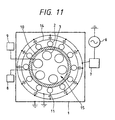
- the apparatus shown in Fig. 10 is modified so that a plurality of substrates 3 are arranged on a concentric circle as shown in Fig. 11. A nonuniform film is rarely formed.
- Fig. 12 is a . view showing a longitudinal cross-section of yet another plasma processing apparatus.
- a parallel-plate-type plasma processing apparatus as shown in Fig. 12 comprises a reaction vessel 15 whose upper portion is constituted by a dielectric member 10 and which can be reduced in pressure.
- the reaction vessel 15 is surrounded by an earth shield 1.
- a plurality of cathode electrodes 2 are arranged on the outside surface (surface on the atmospheric-air side) of the dielectric member 10. More specifically, the cathode electrodes 2 are arranged outside the reaction vessel 15.
- a plate-like film-formed substrate 3 serving as a counter electrode of the cathode electrodes 2 is arranged inside the reaction vessel 15 whose upper portion is constituted by the dielectric member 10.
- the substrate 3 is heated from its inside to a predetermined temperature by a heater 5 arranged in the reaction vessel 15, and is held by a substrate holder 4 having a rotating mechanism driven by a motor (not shown).
- the substrate holder 4 for holding the film-formed substrate 3 is earthed and the film-formed substrate 3 is used as the counter electrode of the cathode electrodes 2.
- An evacuation means (not shown) for evacuating the reaction vessel 15 which is partially constituted by the dielectric member 10 and a gas supply means (not shown) for supplying a gas into the reaction vessel 15 are attached to the plasma processing apparatus.
- a matching circuit 7 arranged outside the first earth shield 1 is connected to the cathode electrodes 2 through capacitors 11, and a high-frequency wave power source 6 is connected to the matching circuit 7.
- the capacitances of the capacitors 11 connected between the matching circuit 7 and the cathode electrodes 2 are changed to values which cancel L components of the transmission paths extending from the matching circuit 7 to the cathode electrodes 2.
- a second earth shield 14 is arranged covering the reaction vessel 15 having the plurality of cathode electrodes 2 arranged thereoutside except for high-frequency wave transmission paths extending from the matching circuit 7 to the cathode electrodes 2.
- a plurality of openings (not shown) for connecting the high-frequency wave transmission paths from the outside of the second earth shield 14 to the cathode electrodes 2 are formed in the second earth shield 14.
- a cathode electrode As a cathode electrode, a right cylindrical Al cathode electrode having an inner diameter of 250 mm and a length of 300 mm was used. The cathode electrode was arranged outside an alumina-ceramic dielectric tube which partially constituted a reaction vessel and had a thickness of 10 mm.
- Film thickness nonuniformity was obtained when film formation was performed by using the externally arranged cathode electrodes.
- a comparison experiment for a film thickness nonuniformity obtained in a case wherein simply cylindrical Al cathode electrodes having an inner diameter of 250 mm and a length of 300 mm was arranged in a reaction vessel was performed.
- the film thickness nonuniformities were about ⁇ 15% in use of the externally arranged cathode electrodes and about ⁇ 30% in use of the cylindrical cathode.
- An effect of improving a film thickness distribution obtained by using the externally arranged cathode electrodes could be confirmed.
- the respective films were considerably influenced by plasma distribution.
- the a-Si film could be sufficient in practical use, e.g., in an electrophotographic photosensitive device, an image input line sensor, or the like.
- the high-frequency wave power source 6 having a frequency of 105 MHz was used, and a discharge experiment was performed under the conditions shown in Table 1 of Example 1.
- the reactance L between the matching circuit and the load was set to 404.5 nH, and a high-power capacitor was arranged as shown in Fig. 1.
- the obtained results are shown in Table 2.
- a rectangular substrate was used. Capacitors were interposed between the matching circuit and cathode electrodes, and the cathode electrodes were arranged outside an alumina-ceramic dielectric rectangular member which partially constituted a reaction vessel and had a thickness of 20 mm. For comparison, the film thickness nonuniformity obtained when the cathode electrodes were arranged inside the reaction vessel to perform film formation under the conditions shown in Table 3 was measured. When the cathode electrodes were arranged outside the reaction vessel, and the capacitors were interposed, the film thickness nonuniformity was about ⁇ 18%; when the cathode electrodes were arranged inside the reaction vessel, the film thickness nonuniformity was about ⁇ 35%.
- the respective films were considerably influenced by plasma distribution.
- the a-Si film could be sufficient in practical use, e.g., in an electrophotographic photosensitive device, an image input line sensor, or the like.
- the film thickness nonuniformity obtained when a film forming apparatus having the second earth shield was measured. As a result, the film thickness nonuniformity was about ⁇ 11%. When the second earth shield was not used, the film thickness nonuniformity was about ⁇ 15%. It was confirmed that an effect of improving the film thickness distribution was obtained by using the second earth shield.
- the respective films were considerably influenced by plasma distribution.
- the a-Si film could be sufficient in practical use, e.g., in an electrophotographic photosensitive device, an image input line sensor, or the like.
- the second earth shield covering a reaction vessel having the plurality of cathode electrodes arranged outside except for high-frequency wave transmission paths extending from the matching circuit to the cathode electrodes, a complex impedance at a high frequency can be increased.
- the arrangement is designed such that only a portion of the high-frequency path free from the earth shield can be controlled, a problem of film thickness nonuniformity caused by a high discharge frequency can be solved.
- the film thickness nonuniformity was measured by using an apparatus in which the second earth shield was arranged. As a result, the film thickness nonuniformity was about ⁇ 13% in comparison with about ⁇ 18% obtained by using a simple plate, and preferable film thickness uniformity was exhibited.
- the respective films were considerably influenced by plasma distribution.
- the a-Si film could be sufficient in practical use, e.g., in an electrophotographic photosensitive device, an image input line sensor, or the like.
- cathode electrodes right cylindrical Al cathode electrodes each having an inner diameter of 250 mm and a length of 300 mm were used.
- the cathode electrodes were arranged outside an alumina-ceramic dielectric tube which partially constituted a reaction vessel and had a thickness of 10 mm.
- a second earth shield was arranged covering the reaction vessel having the plurality of cathode electrodes arranged outside except for high-frequency wave transmission paths extending from the matching circuit to the cathode electrodes.
- the cathode length was not limited to the value in this example.
- the film thickness nonuniformity was obtained when film formation was performed by using the externally arranged cathode electrode.
- comparison experiments were performed to measure film thickness nonuniformities: in a case wherein right cylindrical Al cathode electrodes each having a length of 300 mm were arranged in a reaction vessel a case wherein externally arranged cathodes shown in Fig. 1 were used, and capacitors were interposed between the matching circuit and the cathodes; and a case wherein a second earth shield covering the reaction vessel having the plurality of cathode electrodes arranged outside except for high-frequency wave transmission paths extending from the matching circuit to the cathode electrodes.
- the film thickness nonuniformity was about ⁇ 15% when cylindrical cathode electrodes were arranged in the reaction vessel; ⁇ 13% when the capacitors were interposed; ⁇ 11% when the second earth shield was interposed; and ⁇ 9% when the apparatus using the capacitors and the second earth shield was used. The effect of improving the film thickness distribution was confirmed.
- the respective films were considerably influenced by plasma distribution.
- the a-Si film could be sufficient in practical use, e.g., in an electrophotographic photosensitive device, an image input line sensor, or the like.
- the capacitors are arranged between the cathode electrodes and the matching circuit
- the second earth shield is arranged covering the reaction vessel having the plurality of cathode electrodes arranged outside except for high-frequency wave transmission paths extending from the matching circuit to the cathode electrodes, and a high-frequency wave is supplied to the plasma through the dielectric member partially constituting the reaction chamber which can be reduced in pressure.
- matching can be established, and loss caused by transmission of the high-frequency wave power through the atmospheric air before the high-frequency wave power reaches the cathode electrodes is maximally prevented, so that the plasma is stable.
- the problem of film thickness nonuniformity can be solved.
- the entire film nonuniformity was about 12%, and the film quality could be sufficient in practical use, e.g., in an electrophotographic photosensitive device, an image input line sensor, or the like. Therefore, an apparatus having high productivity can be provided.
- a parallel-plate-type plasma CVD apparatus having a second earth shield covering a reaction vessel having a plurality of cathode electrodes arranged outside except for high-frequency wave transmission paths extending from a matching circuit to the cathode electrodes and capacitors interposed between a matching circuit and the cathode electrodes, an a-Si film was formed on the film-formed substrate at a discharge frequency of 100 MHz under the film-formation conditions shown in Table 3, and the film thickness nonuniformity was measured.
- the film thickness nonuniformity was about ⁇ 10%, in comparison with about ⁇ 18% obtained by using a simple plate, and better film thickness uniformity was exhibited.
- the respective films were considerably influenced by plasma distribution.
- the a-Si film could be sufficient in practical use, e.g., in an electrophotographic photosensitive device, an image input line sensor, or the like.
- An a-Si film formed in this example had film quality higher than that of an a-Si film formed by a conventional apparatus and nonuniformity less than that of the a-Si film formed by the conventional apparatus.
- the a-Si film formed in this example could be sufficient in practical use, e.g., in an electrophotographic photosensitive device, an image input line sensor, or the like.
- a high-frequency wave power having 30 MHz or higher and 600 MHz or lower is supplied to the cathode electrodes through a matching circuit to generate a plasma between the cathode electrodes and the counter electrode, and a plasma process is performed to a substrate to be processed arranged on the counter electrode, the plurality of cathode electrodes are arranged outside the reaction vessel, and the reaction vessel between the cathode electrodes and the counter electrode is partially constituted by a dielectric member, so that homogeneous high-frequency wave discharge having a large area can be easily achieved, and a plasma process for a large substrate can be uniformly performed at a high speed.
- the dielectric material buffers the non-uniformity of the high-frequency wave voltage on the cathode electrodes to make the plasma distribution uniform. For this reason, a uniform plasma can be supplied to a substrate to be processed.
- the cathode electrodes are arranged outside the reaction vessel, the degree of freedom of the design of the cathode electrodes increases, and the optimum shape and optimum constituent material of the cathode electrode can be easily determined.
- high-frequency wave power is separately supplied to a plurality of cathode electrodes, a high-frequency stationary wave can be prevented from easily occurring by decreasing the surface area per cathode, and the arrangement is optimum to form a large-area plasma.
- the transmission paths between the matching circuit and the cathode electrodes are different from each other in length, and inductances L of the transmission paths are different from each other. For this reason, matching may not be established at a high frequency.
- capacitors are arranged in the high-frequency wave transmission paths between the matching circuit and the cathode electrodes, the L components can be cancelled and the matching can be reliably established.
- the apparatus has an earth shield covering a reaction vessel having the cathode electrodes arranged outside except for high-frequency wave transmission paths extending from the matching circuit to the cathode electrodes, the high-frequency wave power is prevented from being transmitted to the interior of the reaction vessel through the matching circuit and the atmospheric air in the middle of the high-frequency wave transmission paths. For this reason, the plasma distribution can be prevented from being nonuniform.
Landscapes
- Chemical & Material Sciences (AREA)
- Engineering & Computer Science (AREA)
- Physics & Mathematics (AREA)
- Plasma & Fusion (AREA)
- Analytical Chemistry (AREA)
- Metallurgy (AREA)
- Materials Engineering (AREA)
- Mechanical Engineering (AREA)
- Chemical Kinetics & Catalysis (AREA)
- Organic Chemistry (AREA)
- General Chemical & Material Sciences (AREA)
- Power Engineering (AREA)
- Plasma Technology (AREA)
- Chemical Vapour Deposition (AREA)
- Drying Of Semiconductors (AREA)
- ing And Chemical Polishing (AREA)
- Physical Deposition Of Substances That Are Components Of Semiconductor Devices (AREA)
Description
- The present invention relates to a plasma processing apparatus and a processing method and, more particularly, to a plasma processing apparatus and a processing method such as: a plasma CVD apparatus and a film forming method for a crystalline or non-monocrystalline functional deposition film effective for an electrophotographic photosensitive device serving as a semiconductor device, an image input line sensor, an image-pickup device, or a photomotive device; a sputtering apparatus and a film forming method which can preferably form a semiconductor device, an insulating film serving as an optical element, or a metal wire; or an etching apparatus and method for a semiconductor device.
- As a plasma process in forming a semiconductor or the like, various methods are used depending on applications. Examples include an apparatus and a method using the characteristics of a plasma, such as film formation for an oxide film, a nitride film, and an amorphous-silicon-based semiconductor film using a plasma CVD method film formation for a metal wiring film or the like using a sputtering method or a micropatterning technique or the like using etching. In addition, in recent years, a demand for improvement of film quality and processing performance becomes strong, and various devices are examined. In particular, since a plasma process using a high-frequency power has stable discharging and can be applied to an insulating material of an oxide film or a nitride film, the plasma process is widely applied.
- Conventionally, the oscillation frequency of a discharging high-frequency wave power source used in a plasma process such as plasma CVD is generally 13.56 MHz. A plasma CVD apparatus generally used in deposition film formation is shown in Fig. 13. Fig. 13 shows a film formation apparatus for a cylindrical amorphous-silicon film (to be referred to as an a-Si film hereinafter) for a cylindrical electrophotographic photosensitive material. A film forming method for an a-Si film will be described below with reference to Fig. 13.
- The film formation apparatus shown in Fig. 13 is constituted such that, in a
reaction vessel 101 which can be reduced in pressure, acylindrical cathode electrode 102 electrically insulated from thereaction vessel 101 and a cylindrical film-formedsubstrate 103 serving as a counter electrode are arranged by aninsulating material 113. The film-formedsubstrate 103 is heated to a predetermined temperature by aheater 105 arranged in the film-formedsubstrate 103, and is held on asubstrate holder 104 having a rotating mechanism driven by amotor 112. A high-frequencywave power source 106 is connected to thecathode electrode 102 through amatching circuit 107. An evacuating means 108 for evacuating thereaction vessel 101 and a gas supply means 109 for supplying a gas into thereaction vessel 101 are attached to the film formation apparatus. - In order to form an a-Si film by the above apparatus, the
reaction vessel 101 is evacuated by the evacuatingmeans 108 to a high degree of vacuum, and the gas supply means 109 feeds a source gas such as a silane gas, disilane gas, a methane gas, or an ethane gas or a doping gas such as a diborane gas to keep the pressure in thereaction vessel 101 in the range of several 1 Pa (10 mTorr) to several 10-1 Pa (mTorr). The high-frequencywave power source 106 supplies a high-frequency wave power of 13.56 MHz to thecathode electrode 102 to generate a plasma between thecathode electrode 102 and the film-formedsubstrate 103, thereby decomposing the source gas. At this time, an a-Si film is deposited on the film-formedsubstrate 103 heated to about 200°C to 350°C by theheater 105. - A deposition rate for obtaining an a-Si film which satisfies the performance of an electrophotographic photosensitive material by the film forming method described above is the maximum of about 6 µm/hour. When the deposition rate is higher than 6 µm/hour, the characteristic feature of the photosensitive material cannot be obtained. When the a-Si film is generally used as an electrophotographic photosensitive material, the a-Si film requires a thickness of at least 20 pm to 30 pm to obtain charging performance, and a long period of time is required to manufacture an electrophotographic photosensitive material.
- In recent years, the report (Plasma Chemistry and Plasma Processing,
Vol 7, No. 3, (1987) p.267 - p.273) of a plasma CVD method using a parallel-plate-type plasma CVD apparatus and a high-frequency wave power source of 13.56 MHz or higher has been made. This report shows the probability that the deposition rate can be increased without degrading the performance of the deposition film by making the discharge frequency higher than the conventional frequency of 13.56 MHz. An attempt to increase the discharge frequency has been widely examined in sputtering or the like. - The present inventors used the conventional plasma CVD method and apparatus described above and a high-frequency wave power having a frequency higher than a conventional discharge frequency of 13.56 MHz to increase the deposition rate of high-quality film.
- As a result, when the frequency was increased, a high-quality film could be manufactured at a deposition rate higher than the conventional deposition rate. However, when a discharge frequency of 13.56 MHz was used, the following problem is newly posed. More specifically, when the discharge frequency is increased, the plasma is eccentrically located and the deposition rate is then nonuniform. As a result, in forming on a substrate an electrophotographic photosensitive material having a relatively large area, a significant film thickness nonuniformity (for example, a film thickness nonuniformity of ±20% or more in the electrophotographic photosensitive material) results.
- Such a film thickness nonuniformity poses a serious problem not only when an electrophotographic photosensitive material is formed but also when a crystalline or non-monocrystalline functional deposition film for an image input line sensor, an image-pickup device, a photomotive device, or the like is formed. In another plasma process such as dry etching or sputtering, when the discharge frequency is increased, similarly, nonuniform processing occurs. For this reason, a high-frequency wave power having a frequency higher than 13.56 MHz cannot be used practically without problems.
- The plasma processing apparatus of the present invention is of the type, such as disclosed in European Patent Application EP-A-0517047, comprising:
- a reaction vessel the internal pressure of which can be reduced, at least a part of said reaction vessel being formed of a dielectric material;
- a substrate holder for arranging a substrate to be processed thereon, said substrate holder being arranged in said reaction vessel;
- means for feeding a processing gas to said reaction vessel; and
- a plurality of cathode electrodes, connected to a matching circuit, for feeding a high-frequency wave power to the inside of said reaction vessel via said matching circuit from a high frequency wave power source, said plurality of cathode electrodes being arranged on the outside of said reaction vessel.
-
- The present invention is intended to provide a method and apparatus capable of uniformly performing a plasma process such as CVD, sputtering, etching, or ashing to substrates having a relatively large area at a process rate which cannot be achieved in the conventional plasma process.
- In particular, amongst preferred applications, there is provided a deposition film forming method using plasma CVD which can form deposition films having an extremely uniform thickness, at a high speed, which can be used to form semiconductor devices.
- According to the present invention, the aforesaid plasma processing apparatus is characterised in that:
- said substrate holder is one of a plurality and the plurality of substrate holders are spaced about the circumference of a circle having a first diameter, and that said plurality of cathode electrodes are spaced about the circumference of a concentric circle having a second diameter greater than the first diameter.
-
- Preferably, capacitors are arranged in the high-frequency wave transmission paths between the matching circuit and the cathode electrodes. Alternatively, or additionally, it is preferred that an earth shield is arranged covering the reaction vessel arranged outside the cathode electrodes except for the high-frequency wave transmission paths between the matching circuit and the cathode electrodes. The above apparatus is especially preferable when the high-frequency wave power is 30 MHz to 600 MHz or less.
- In addition, a plasma processing method for applying a plasma process to substrates to be processed by using the above plasma processing apparatus belongs to the present invention. The steps of this method are recited in
claim 7 of the claims appended hereto. - In the accompanying drawings:
- Fig. 1 is a view showing the arrangement of a side cross-section of a plasma processing apparatus, in which a capacitor is arranged between a matching circuit and cathode electrodes;
- Fig. 2 is a view showing the arrangement of a longitudinal cross-section of the plasma processing apparatus of Fig. 1, in which a capacitor is arranged between the matching circuit and each cathode electrode;
- Fig. 3 is a view showing a longitudinal cross-section of a plasma processing apparatus according to a modification of the apparatus shown in Fig. 1;
- Fig. 4 is a view showing the arrangement of a side cross-section of an alternative plasma processing apparatus, having an earth shield covering the reaction vessel to remove a high-frequency wave power source line extending from the matching circuit to each cathode electrode;
- Fig. 5 is a view showing the arrangement of a longitudinal cross-section of the alternative plasma processing apparatus shown in Fig. 4, having an earth shield covering the reaction vessel to remove a high-frequency wave power source line extending from the matching circuit to each cathode electrode;
- Fig. 6 is a view showing a state in which the cathode electrodes shown in Fig. 4 are arranged on a concentric circle;
- Fig. 7 is a view showing a longitudinal cross-section of another plasma processing apparatus according to a modification of the apparatus of Fig. 4;
- Fig. 8 is a view showing the arrangement of a side cross-section of another plasma processing apparatus, having a capacitor arranged between the matching circuit and each cathode electrode and having an earth shield covering the reaction vessel to remove a high-frequency wave power source line extending from the matching circuit to each cathode electrode;
- Fig. 9 is a view showing the arrangement of a longitudinal cross-section of the plasma processing apparatus of Fig. 8 having a capacitor arranged between the matching circuit and each cathode electrode and having an earth shield covering the reaction vessel to remove a high-frequency wave power source line extending from the matching circuit to each cathode electrode;
- Fig. 10 is a view showing a state wherein a large number of cathode electrodes shown in Fig. 8 are arranged on a concentric circle;
- Fig. 11 is a view showing a state wherein a plurality of substrates to be processed, are arranged on a concentric circle in the apparatus shown in Fig. 10 modified in accordance with the present invention;
- Fig. 12 is a view showing a longitudinal cross-section of a plasma processing apparatus according to a modification of the apparatus shown in Fig. 8; and
- Fig. 13 is a view showing a cross-section of a conventional plasma processing apparatus.
-
- The present inventors have examined the above problems of the conventional method and apparatus. At a discharge frequency higher than a conventional discharge frequency, plasma distribution was sensitive with respect to the shape of the cathode electrode in comparison with the plasma distribution of the conventional apparatus, and the size of the discharge apparatus was 1/10 or less the wavelength of the high-frequency wave. For this reason, influence of a stationary wave began to occur. As a result, it was found that nonuniform processing occurred.
- An experiment performed to solve the above problem and achieve uniformity of a plasma and uniformity of a plasma process based on the plasma, and knowledge obtained by the experiment will be described below.
- By using the apparatus shown in Fig. 13, the high-frequency wave power output of a high-frequency
wave power source 7 is applied to acylindrical cathode electrode 102 through amatching circuit 107 to form a high-frequency wave electric field between thecathode electrode 102 and a substrate to be processed 103 opposing thecathode electrode 102 to generate a plasma, thereby applying a plasma process to the substrate to be processed 103. In this case, the substrate of electrophotographic photosensitive material serving as the substrate to be processed has a diameter of about 100 mm. For this reason, the diameter d of the cathode is about 200 mm to 300 mm. When a high-frequency wave is applied from one point of the periphery of the cathode electrode, the transmission distance of the high-frequency wave to the opposite side of the cathode electrode along the peripheral surface is 1.57 d. For example, when d = 250 mm, the distance is about 390 mm. When the frequency of the high-frequency wave is changed from 13.56 MHz (conventional frequency) to 100 MHz, the wavelength λ is about 22 m to 3 m in the air. More specifically, at 100 MHz, a high-frequency wave applied from one point on the periphery of the cathode electrode transmits through the cathode electrode peripheral surface to reach the opposite side. When the transmission distance along the peripheral surface is λ/10 or more, an electric field distribution begins to occur on the cathode electrode periphery due to influence of a stationary wave. The high-frequency wave electric field also influences the cathode electrode surface, a nonuniform electric field on the inner periphery of the cathode electrode occurs, and a nonuniform discharge. occurs in the circumference direction. - Similarly, the length of the substrate of electrophotographic photosensitive material serving as the substrates to be processed is generally about 350 mm, so that the cathode electrode length is about 350 mm to 400 mm. For this reason, as in the peripheral direction described above, nonuniform discharge occurs also in an axial direction.
- As described above, it was found that, although no problem occurred at 13.56 MHz or at a discharge frequency near 13.56 MHz, nonuniform discharge became conspicuous when the discharge frequency was made higher.
- In order to measure the frequency at which these problems are influenced and made conspicuous, discharging was performed at 13.5 MHz to 600 MHz by using the plasma CVD apparatus shown in Fig. 13 to measure plasma density nonuniformity. The plasma density nonuniformity is defined as a value obtained by dividing the difference between the maximum value and minimum value of the plasma density. As a result, the plasma density nonuniformity was ±10% or higher at almost 30 MHz, and it was apparent that nonuniformity of the high-frequency wave voltage on the cathode electrode at the discharge frequency became conspicuous.
- When the discharge frequency exceeded 600 MHz, a high-frequency wave matching circuit could not be easily designed, and transmission loss became large. It was understood that a frequency higher than 600 MHz could not be practical.
- When the width of energy of ions incident on the substrate to be processed was measured, the width was about 30 eV at 13.56 MHz, about 15 eV at 30 MHz, and about 10 eV at 100 MHz or higher. In the process using incident ion energy for the substrate to be processed, a small energy width is important because controllability can be improved, and the frequency of 30 MHz or higher is preferably used. Therefore, it is very important that the plasma density is free from nonuniformity in this frequency range.
- As a means for solving nonuniformity caused by nonuniform high-frequency wave voltage on the cathode electrode at 30 MHz to 600 MHz, the present inventors obtained the following knowledge.
- In order to prevent a high-frequency stationary wave causing high-frequency wave voltage nonuniformity on the cathode electrode from reflecting nonuniformity of plasma strength, the following are required:
- a) to prevent a stationary wave from being generated on the cathode electrode surface; and
- b) to arrange a buffer function between a stationary wave on the cathode electrode surface and a plasma.
-
- In the apparatus in Fig. 13, in order to supply a high-frequency wave power to the plasma, the high-frequency wave power supplied from a high-frequency wave power source via an impedance that is adjusted to match the impedance of the plasma, and the high-frequency wave power is applied to the rear surface of the cathode electrode. In addition, the high-frequency wave is transmitted from the rear surface of the cathode electrode to the surface of the cathode electrode to reach the front surface of the cathode electrode, so that the high-frequency wave power is supplied to the plasma. Here, in order to prevent the high-frequency wave power from being nonuniform on the cathode electrode surface, it is effective that the high-frequency wave distribution transmitted to the rear or front surface of the cathode is adjusted.
- In order to adjust the high-frequency wave distribution on the cathode electrode in the above-mentioned manner at a frequency 30 MHz to 600 MHz higher than a conventional frequency, it is important that the complex impedance of the cathode electrode can be adjusted in shape, material, and the like. For this purpose, the reaction vessel must not be constituted by the cathode electrode, or a cathode electrode must not be arranged in the reaction vessel. It is best that the cathode electrode is arranged outside the reaction vessel. In order to supply high-frequency wave power from the cathode electrode outside the reaction vessel to a plasma in the reaction vessel, a portion between the cathode electrode and the plasma must consist of a dielectric material. In this case, any dielectric material having small loss of a high-frequency wave may be used, e.g., alumina ceramic, quartz glass, pyrex™ glass, teflon™, or the like can be used. When such a dielectric material is used as a part of the reaction vessel which can be reduced in pressure, the reaction vessel must have a thickness which can withstand the atmospheric pressure because the reaction vessel is reduced in pressure. Depending on the shape or size, the thickness must be generally set to at least 5 mm or more, preferably, 10 mm or more. When the conventional frequency of 13.56 MHz is used, and a dielectric material having the above thickness is arranged between the cathode electrode and the plasma, the
reactance component 1/jωC of a complex impedance generated by an electrostatic capacitor C of the dielectric material becomes 10 Ω to 50 Ω which is almost equal to that of the impedance of the plasma, and it is difficult to efficiently supply the high-frequency wave to the plasma. However, when the discharge frequency is increased to 30 MHz to 600 MHz, a complex impedance generated by the dielectric material decreases in inverse proportion to the frequency. For this reason, even if the dielectric material having the above thickness is arranged between the cathode electrode and the plasma, the high-frequency wave can be efficiently supplied to the plasma. As described above, in order to obtain large-area uniform discharge which is problematic at a discharge frequency of 30 MHz or higher, an arrangement in which the cathode electrode is arranged outside the reaction vessel is effective because a high-frequency wave can be efficiently supplied at a discharge frequency of 30 MHz or higher. In this manner, the shape and material of the cathode electrode can be considerably changed, the complex impedance at an arbitrary point on the cathode electrode can be changed, and the above problem can be solved. Although the optimum shape and the optimum constituent material of the cathode electrode change depending on the shape of a substrate to be processed, plasma processing conditions, and the discharge frequency, when the cathode electrode is outside the reaction vessel, only the cathode electrode may be exchanged, and the reaction vessel is not temporarily opened in the air. For this reason, the above method can easily cope with changes in various processing conditions. For the same reason, as described above, the optimum cathode electrode can be determined by trial-and-error more easily than in the conventional method. - Even if a potential distribution is left on the cathode electrode to some extent in the above method, since a dielectric material is arranged between the cathode electrode and the plasma, the uniformity of the plasma is better than that of the potential distribution on the cathode electrode due to the buffer function of the dielectric material.
- The above means can be easily executed because the cathode electrode is arranged outside the reaction vessel. However, when the cathode electrode is arranged outside the reaction vessel as described above, this arrangement can also be easily applied to a parallel-plate-type plasma processing apparatus.
- As described above, since the cathode electrode is arranged outside the reaction vessel, and a dielectric material serving as a buffer is arranged between the cathode electrode and the plasma, a high-frequency stationary wave on the cathode electrode causing high-frequency wave voltage nonuniformity at a frequency of 30 MHz to 600 MHz higher than a conventional frequency is prevented from reflecting nonuniformity of the plasma strength. In addition, in order to eliminate the influence of the stationary wave, it is effective that the high-frequency wave power is separately applied to a plurality of cathode electrodes. This method is optimum in a case wherein the surface area of each cathode is decreased to prevent a stationary wave from easily occurring, and a plasma having a large area is formed. However, in an apparatus in which a high-frequency wave power is supplied from the same power source to a plurality of cathode electrodes through a matching circuit, the distance between the matching circuit and each cathode electrode increases, and L components, i.e. inductances, of the transmission paths between the matching circuit and the cathode electrodes are different from each other. For this reason, in particular, since the frequency is high, matching cannot be established. Therefore, when capacitors are interposed between the matching circuit and the cathode electrodes to change the capacitances of the respective capacitors, L components are canceled, and matching can be established between the plurality of cathode electrodes.
- While a high-frequency wave power is transmitted from a high-frequency wave power source to the cathode electrodes through the matching circuit, the high-frequency wave power may be transmitted to the interior of the reaction vessel through the atmospheric air and part of the dielectric material. For this reason, the plasma density becomes nonuniform. As a result, the deposition disadvantageously has a film thickness nonuniformity. Therefore, when an earth shield is arranged covering the reaction vessel having a plurality of cathode electrodes arranged outside except for high-frequency wave transmission paths extending from the matching circuit to the cathode electrodes, the high-frequency wave power can be prevented from being transmitted to the interior of the reaction vessel through the atmospheric air. As a result, advantageously, the uniformity of the film thickness can be improved.
- A preferred embodiment of the present invention will be described below following discussion first of a number of background examples. Reference is made to the accompanying drawings.
- Fig. 1 is a view showing the arrangement of a side cross-section of a plasma processing apparatus, and Fig. 2 is a view showing the longitudinal cross-section of this apparatus.
- This plasma processing apparatus comprises, as shown in Figs. 1 and 2, a
cylindrical dielectric member 10 constituting the side portion of areaction vessel 15 which can be reduced in pressure, and anearth shield 1, for preventing high-frequency wave leakage, which forms the upper and bottom portions of thereaction vessel 15 and surrounds the side portion of thereaction vessel 15. On the outer peripheral surface (surface on the atmospheric-air side) of thedielectric member 10, twocathode electrodes 2 are arranged to be electrically insulated from theearth shield 1 by an insulatingmaterial 13. More specifically, thecathode electrodes 2 are arranged outside thereaction vessel 15. Inside thereaction vessel 15 whose side portion is constituted by thedielectric member 10, acylindrical substrate 3 serving as a counter electrode of thecathode electrodes 2 is arranged. Thesubstrate 3 is heated from its inside to a predetermined temperature by aheater 5 arranged in thereaction vessel 15, and is held by a substrate holder 4 having a rotating mechanism driven by a motor (not shown). Thesubstrate 3 and the substrate holder 4 for holding thesubstrate 3 is grounded, and thesubstrate 3 is used as the counter electrode of thecathode electrodes 2. An evacuation means 8 for evacuating thereaction vessel 15 which is partially constituted by thedielectric member 10 and a gas supply means 9 for supplying a gas into thereaction vessel 15 are attached to the plasma processing apparatus. - A
matching circuit 7 arranged outside theearth shield 1 is connected to thecathode electrodes 2 throughcapacitors 11, and a high-frequencywave power source 6 is connected to thematching circuit 7. The capacitances of thecapacitors 11 connected between the matchingcircuit 7 and thecathode electrodes 2 are changed to values which cancel L components of the transmission paths extending from thematching circuit 7 to thecathode electrodes 2. - In order to form an a-Si film for, e.g., a cylindrical electrophotographic photosensitive material by using the above apparatus, after the
reaction vessel 15 is evacuated by the evacuation means 8 to a high degree of vacuum, the gas supply means 9 feeds a film-forming source gas such as a silane gas, disilane gas, a methane gas, or an ethane gas and a doping gas such as a diborane gas to keep the pressure in thereaction vessel 15 in the range of several Pa (10 mTorr) to several tenths Pa (mTorr). The high-frequencywave power source 6 supplies a high-frequency wave power of 30 MHz to 600 MHz or less to thecathode electrodes 2 through thematching circuit 7 and eachcapacitor 11 to generate a plasma between thecathode electrodes 2 and thesubstrate 3 arranged inside thedielectric member 10, thereby decomposing the source gas. At this time, an a-Si film is uniformly deposited on thesubstrate 3 heated to about 200°C to 350°C by theheater 5. - Accordingly, matching between paths on which the high-frequency wave power is supplied from the same power source to the plurality of cathode electrodes through the matching circuit can be established. For this reason, when a plurality of substrates are to be processed and those are each cylindrical, and the substrates to be processed and the reaction vessel are arranged on a concentric circle, very uniform deposition films can be formed on the plurality of substrates at, a high speed.
- Fig. 3 is a view showing a longitudinal cross-section of a plasma processing apparatus according to a modification of the apparatus of Figs. 1 and 2.
- The parallel-plate-type plasma processing apparatus shown in Fig. 3 comprises a
reaction vessel 15 which has an upper portion constituted by adielectric member 10 and can be reduced in pressure. Thereaction vessel 15 is surrounded by theearth shield 1. A plurality ofcathode electrodes 2 are arranged on the outside surface (surface on the atmospheric-air side) of thedielectric member 10. More specifically, thecathode electrodes 2 are arranged outside thereaction vessel 15. Inside thereaction vessel 15 whose upper portion is constituted by thedielectric member 10, a plate-like film-formedsubstrate 3 serving as a counter electrode of thecathode electrodes 2 is arranged. Thesubstrate 3 is heated from its inside to a predetermined temperature by aheater 5 arranged in thereaction vessel 15, and is held by a substrate holder 4 having a rotating mechanism driven by a motor 12. Thesubstrate 3 and the substrate holder 4 for holding thesubstrate 3 are earthed. An evacuation means 8 for evacuating thereaction vessel 15,which is partially constituted by thedielectric member 10 and a gas supply means 9 for supplying a gas into thereaction vessel 15, are attached to the plasma processing apparatus. - A
matching circuit 7 arranged outside theearth shield 1 is connected to thecathode electrodes 2 throughcapacitors 11, and a high-frequencywave power source 6 is connected to thematching circuit 7. The capacitances of thecapacitors 11 connected between the matchingcircuit 7 and thecathode electrodes 2 are changed to values which cancel L components of the transmission paths extending from thematching circuit 7 to thecathode electrodes 2. - In such a parallel-plate-type plasma processing apparatus, the same effect as in the above cylindrical coaxial-type plasma processing apparatus and method can be obtained.
- These apparatus can be applied to not only CVD but also sputtering, etching, ashing, or the like.
- Fig. 4 is a view showing the arrangement of a side cross-section of another plasma processing apparatus, and Fig. 5 is a view showing the longitudinal cross-section of this apparatus. The same reference numerals as used in Figs. 1 and 2 denote the same parts in Figs. 4 and 5.
- This plasma processing apparatus comprises, as shown in Figs. 4 and 5, a
cylindrical dielectric member 10 constituting the side portion of areaction vessel 15 which can be reduced in pressure, and afirst earth shield 1, for preventing high-frequency wave leakage, which forms the upper and bottom portions of thereaction vessel 15 and surrounds the side portion of thereaction vessel 15. On the outer peripheral surface (surface on the atmospheric-air side) of thedielectric member 10,cathode electrodes 2 are arranged to be electrically insulated from thefirst earth shield 1 by an insulatingmaterial 13. More specifically, thecathode electrodes 2 are arranged outside thereaction vessel 15. Inside thereaction vessel 15 whose side portion is constituted by thedielectric member 10, acylindrical substrate 3 serving as a counter electrode of thecathode electrodes 2 is arranged. Thesubstrate 3 is heated from its inside to a predetermined temperature by aheater 5 arranged in thereaction vessel 15, and is held by a substrate holder 4 having a rotating mechanism driven by a motor 12. The substrate holder 4 for holding thesubstrate 3 is earthed . and thesubstrate 3 is used as the counter electrode of thecathode electrodes 2. An evacuation means 8 for evacuating thereaction vessel 15 which is partially constituted by thedielectric member 10 and a gas supply means 9 for supplying a gas into thereaction vessel 15 are attached to the plasma processing apparatus. - A
matching circuit 7 arranged outside thefirst earth shield 1 is connected to thecathode electrodes 2, and a high-frequencywave power source 6 is connected to thematching circuit 7. Asecond earth shield 14 is arranged covering thereaction vessel 15 having the plurality ofcathode electrodes 2 arranged outside except for high-frequency wave transmission paths extending from thematching circuit 7 to the cathode electrodes 2 A plurality of openings (not shown) for connecting the high-frequency wave transmission paths from the outside of thesecond earth shield 14 to thecathode electrodes 2 are formed in thesecond earth shield 14. - Accordingly, the reaction vessel having a plurality of cathode electrodes arranged outside is covered with the earth shields outside the high-frequency wave transmission paths extending from the matching circuit to the cathode electrodes, so that the high-frequency wave power can be prevented from being transmitted to the interior of the reaction vessel through the atmospheric air. For this reason, when a plurality of cylindrical substrates are processed with the substrates and the reaction vessel arranged on a concentric circle, very uniform deposition films can be formed at a high speed.
- The number of cathode electrodes need not be limited to two, and, as shown in Fig. 6, a greater plurality of cathode electrodes are preferably arranged to prevent a high-frequency stationary wave from easily occurring and to make the plasma distribution more uniform.
- Fig. 7 is a view showing a longitudinal cross-section of a plasma processing apparatus according to a modification of the apparatus of Fig. 4.
- The same reference numerals as used in Figs. 1 and 2 denote the same parts in Fig. 7. A parallel-plate-type plasma processing apparatus as shown in Fig. 7 comprises a
reaction vessel 15 whose upper portion is constituted by adielectric member 10 and which can be reduced in pressure. Thereaction vessel 15 is surrounded by anearth shield 1. A plurality ofcathode electrodes 2 are arranged on the outside surface (surface on the atmospheric-air side) of thedielectric member 10. More specifically, thecathode electrodes 2 are arranged outside thereaction vessel 15. Inside thereaction vessel 15 whose upper portion is constituted by thedielectric member 10, a plate-like substrate 3 serving as a counter electrode of thecathode electrodes 2 is arranged. Thesubstrate 3 is heated from its inside to a predetermined temperature by aheater 5 arranged in thereaction vessel 15, and is held by a substrate holder 4 having a rotating mechanism driven by a motor 12. Thesubstrate 3 and the substrate holder 4 for holding thesubstrate 3 is earthed and thesubstrate 3 is used as the counter electrode of thecathode electrodes 2. An evacuation means (not shown) for evacuating thereaction vessel 15 which is partially constituted by thedielectric member 10 and a gas supply means (not shown) for supplying a gas into thereaction vessel 15 are attached to the plasma processing apparatus. - A
matching circuit 7 arranged outside thefirst earth shield 1 is connected to thecathode electrodes 2, and a high-frequencywave power source 6 is connected to thematching circuit 7. Asecond earth shield 14 is arranged covering thereaction vessel 15 having the plurality ofcathode electrodes 2 arranged outside except for high-frequency wave transmission paths extending from thematching circuit 7 to thecathode electrodes 2. A plurality of openings (not shown) for connecting the high-frequency wave transmission paths from the outside of thesecond earth shield 14 to thecathode electrodes 2 are formed in thesecond earth shield 14. - In such a parallel-plate-type plasma processing apparatus, the same effect as in the above cylindrical coaxial-type plasma processing apparatus and method can be obtained.
- Fig. 8 is a view showing the arrangement of a side cross-section of another plasma processing apparatus , and Fig. 9 is another view showing the longitudinal cross-section of this apparatus. The same reference numerals as used in Figs. 1 to 7 denote the same parts in Figs. 8 and 9.
- This plasma processing apparatus comprises, as shown in Figs. 8 and 9, a
cylindrical dielectric member 10 constituting the side portion of areaction vessel 15 which can be reduced in pressure, and afirst earth shield 1, for preventing high-frequency wave leakage, which forms the upper and bottom portions of thereaction vessel 15 and surrounds the side portion of thereaction vessel 15. On the outer peripheral surface (surface on the atmospheric-air side) of thedielectric member 10,cathode electrodes 2 are arranged to be electrically insulated from thefirst earth shield 1 by an insulatingmaterial 13. More specifically, thecathode electrodes 2 are arranged outside thereaction vessel 15. Inside thereaction vessel 15 whose side portion is constituted by thedielectric member 10, acylindrical substrate 3 serving as a counter electrode of thecathode electrodes 2 is arranged. Thesubstrate 3 is heated from its inside to a predetermined temperature by aheater 5 arranged in thereaction vessel 15, and is held by a substrate holder 4 having a rotating mechanism driven by a motor (not shown). The substrate holder 4 for holding thesubstrate 3 is earthed, and thesubstrate 3 is used as the counter electrode of thecathode electrodes 2. Amatching circuit 7 arranged outside thefirst earth shield 1 is connected to thecathode electrodes 2 throughcapacitors 11, and a high-frequencywave power source 6 is connected to thematching circuit 7. An evacuation means 8 for evacuating thereaction vessel 15 which is partially constituted by thedielectric member 10 and a gas supply means 9 for supplying a gas into thereaction vessel 15 are attached to the plasma processing apparatus. - The capacitances of the
capacitors 11 connected between the matchingcircuit 7 and thecathode electrodes 2 are changed to values which cancel L components of the transmission paths extending from thematching circuit 7 to thecathode electrodes 2. Asecond earth shield 14 is arranged covering thereaction vessel 15 having the plurality ofcathode electrodes 2 arranged outside except for high-frequency wave transmission paths extending from thematching circuit 7 to thecathode electrodes 2. A plurality of openings (not shown) for connecting the high-frequency wave transmission paths from the outside of thesecond earth shield 14 to thecathode electrodes 2 are formed in thesecond earth shield 14. - Accordingly, matching between paths on which the high-frequency wave power is supplied from the same power source to the plurality of cathode electrodes through the matching circuit can be established, and the reaction vessel having a plurality of cathode electrodes arranged outside is covered with the earth shields outside the high-frequency wave transmission paths extending from the matching circuit to the cathode electrodes, so that the high-frequency wave power can be prevented from being transmitted to the interior of the reaction vessel through the atmospheric air. For this reason, when the substrates to be processed are each cylindrical, and the substrates to be processed and the reaction vessel are arranged on a concentric circle, very uniform deposition films can be formed on the plurality of substrates to be processed at a high speed.
- The number of cathode electrodes need not be limited to two, and, as shown in Fig. 10, a greater plurality of cathode electrodes are preferably arranged to prevent a high-frequency stationary wave from easily occurring and to make the plasma distribution more uniform.
- In the preferred embodiment of the present invention, the apparatus shown in Fig. 10 is modified so that a plurality of
substrates 3 are arranged on a concentric circle as shown in Fig. 11. A nonuniform film is rarely formed. - Fig. 12 is a . view showing a longitudinal cross-section of yet another plasma processing apparatus.
- The same reference numerals as used in Figs. 1 to 7 denote the same parts in Fig. 12. A parallel-plate-type plasma processing apparatus as shown in Fig. 12 comprises a
reaction vessel 15 whose upper portion is constituted by adielectric member 10 and which can be reduced in pressure. Thereaction vessel 15 is surrounded by anearth shield 1. A plurality ofcathode electrodes 2 are arranged on the outside surface (surface on the atmospheric-air side) of thedielectric member 10. More specifically, thecathode electrodes 2 are arranged outside thereaction vessel 15. Inside thereaction vessel 15 whose upper portion is constituted by thedielectric member 10, a plate-like film-formedsubstrate 3 serving as a counter electrode of thecathode electrodes 2 is arranged. Thesubstrate 3 is heated from its inside to a predetermined temperature by aheater 5 arranged in thereaction vessel 15, and is held by a substrate holder 4 having a rotating mechanism driven by a motor (not shown). The substrate holder 4 for holding the film-formedsubstrate 3 is earthed and the film-formedsubstrate 3 is used as the counter electrode of thecathode electrodes 2. An evacuation means (not shown) for evacuating thereaction vessel 15 which is partially constituted by thedielectric member 10 and a gas supply means (not shown) for supplying a gas into thereaction vessel 15 are attached to the plasma processing apparatus. - A
matching circuit 7 arranged outside thefirst earth shield 1 is connected to thecathode electrodes 2 throughcapacitors 11, and a high-frequencywave power source 6 is connected to thematching circuit 7. The capacitances of thecapacitors 11 connected between the matchingcircuit 7 and thecathode electrodes 2 are changed to values which cancel L components of the transmission paths extending from thematching circuit 7 to thecathode electrodes 2. - A
second earth shield 14 is arranged covering thereaction vessel 15 having the plurality ofcathode electrodes 2 arranged thereoutside except for high-frequency wave transmission paths extending from thematching circuit 7 to thecathode electrodes 2. A plurality of openings (not shown) for connecting the high-frequency wave transmission paths from the outside of thesecond earth shield 14 to thecathode electrodes 2 are formed in thesecond earth shield 14. - In such a parallel-plate-type plasma processing apparatus, the same effect as in the above cylindrical coaxial-type plasma processing apparatus and method can be obtained.
- The above background examples and preferred embodiment will be further described below with reference to detailed examples and comparative examples.
- In this example, by using the cylindrical coaxial-type plasma CVD apparatus shown in Figs. 1 and 2, an a-Si film was formed on a substrate at a discharge frequency of 100 MHz under the film-formation conditions shown in Table 1.
Source gas SiH4 Carrier Gas H2 Gas flow rate SiH4 350 sccm H2 350 sccm Pressure 4.0 Pa (0.03 torr) Substrate temperature 250°C High-frequency wave power 0.5 W/cm2 - As a cathode electrode, a right cylindrical Al cathode electrode having an inner diameter of 250 mm and a length of 300 mm was used. The cathode electrode was arranged outside an alumina-ceramic dielectric tube which partially constituted a reaction vessel and had a thickness of 10 mm.
- Film thickness nonuniformity was obtained when film formation was performed by using the externally arranged cathode electrodes. For comparison, a comparison experiment for a film thickness nonuniformity obtained in a case wherein simply cylindrical Al cathode electrodes having an inner diameter of 250 mm and a length of 300 mm was arranged in a reaction vessel was performed. As a result, the film thickness nonuniformities were about ±15% in use of the externally arranged cathode electrodes and about ±30% in use of the cylindrical cathode. An effect of improving a film thickness distribution obtained by using the externally arranged cathode electrodes could be confirmed.
- The respective films were considerably influenced by plasma distribution. When the film quality of an a-Si film was partially measured in the same film thickness state, the a-Si film could be sufficient in practical use, e.g., in an electrophotographic photosensitive device, an image input line sensor, or the like.
- When the cathode electrodes are arranged outside the reaction vessel as described above, a high-frequency wave power is supplied to a plasma through a dielectric member partially constituting the reaction vessel which can be reduced in pressure, the potential distribution of a high-frequency wave on the cathode electrode. As a result, a problem of film thickness nonuniformity caused by a high discharge frequency can be solved.
- In this example, in the plasma processing apparatus shown in Figs. 1 and 2, the high-frequency
wave power source 6 having a frequency of 105 MHz was used, and a discharge experiment was performed under the conditions shown in Table 1 of Example 1. In this example, the reactance L between the matching circuit and the load was set to 404.5 nH, and a high-power capacitor was arranged as shown in Fig. 1. The obtained results are shown in Table 2.Capacitance of Capacitor Incident Wave Reflection Wave Synthesis L between Matching Circuit and Cathode Electrode Discharge State 1pF 500 W 300 W 129 Ω discharge may occur 5pF 500 W 80 W 36.4 Ω almost stable 7pF 500 W 5 W 14.1 Ω stable 10pF 500 W 200 W 115.2 Ω slightly stable - In this manner, when capacitors are interposed between the matching circuit and the cathode electrodes, and the capacitances of the capacitors are changed, an L component is canceled. A problem that matching cannot be established can be solved.
- In this example, by using the parallel-plate-type plasma CVD apparatus shown in Fig. 3, an a-Si film was formed on the film-formed substrate at a discharge frequency of 100 MHz under the film-formation conditions shown in Table 3.
Source gas SiH4 Carrier Gas H2 Gas flow rate SiH4 450 sccm H2 450 sccm Pressure 4.0 Pa (0.03 torr) Substrate temperature 250°C High-frequency wave power 0.5 W/cm2 - In this example, a rectangular substrate was used. Capacitors were interposed between the matching circuit and cathode electrodes, and the cathode electrodes were arranged outside an alumina-ceramic dielectric rectangular member which partially constituted a reaction vessel and had a thickness of 20 mm. For comparison, the film thickness nonuniformity obtained when the cathode electrodes were arranged inside the reaction vessel to perform film formation under the conditions shown in Table 3 was measured. When the cathode electrodes were arranged outside the reaction vessel, and the capacitors were interposed, the film thickness nonuniformity was about ±18%; when the cathode electrodes were arranged inside the reaction vessel, the film thickness nonuniformity was about ±35%.
- The respective films were considerably influenced by plasma distribution. When the film quality of an a-Si film was partially measured in the same film thickness state, the a-Si film could be sufficient in practical use, e.g., in an electrophotographic photosensitive device, an image input line sensor, or the like.
- In this example, by using a cylindrical coaxial-type plasma CVD apparatus in which a second earth shield was arranged covering a reaction vessel having the plurality of
cathode electrodes 2 arranged outside except for high-frequency wave transmission paths extending from a matching circuit to the cathode electrodes as shown in Figs. 4 and 5, an a-Si film was formed on the film-formed substrate at a discharge frequency of 100 MHz under the film-formation conditions shown in Table 1. For comparison, by using an apparatus in which the second earth shield was not used, an a-Si film was formed on a substrate under the film-formation conditions shown in Table 1. - The film thickness nonuniformity obtained when a film forming apparatus having the second earth shield was measured. As a result, the film thickness nonuniformity was about ±11%. When the second earth shield was not used, the film thickness nonuniformity was about ±15%. It was confirmed that an effect of improving the film thickness distribution was obtained by using the second earth shield.
- The respective films were considerably influenced by plasma distribution. When the film quality of the a-Si film was partially measured in the same film thickness state, the a-Si film could be sufficient in practical use, e.g., in an electrophotographic photosensitive device, an image input line sensor, or the like.
- As described above, by arranging the second earth shield covering a reaction vessel having the plurality of cathode electrodes arranged outside except for high-frequency wave transmission paths extending from the matching circuit to the cathode electrodes, a complex impedance at a high frequency can be increased. When the arrangement is designed such that only a portion of the high-frequency path free from the earth shield can be controlled, a problem of film thickness nonuniformity caused by a high discharge frequency can be solved.
- In this example, by using the plasma CVD apparatus in which cathode electrodes were arranged on a concentric circle shown in Fig. 6, an a-Si film was formed on the film-formed substrate at a discharge frequency of 100 MHz under the film-formation conditions shown in Table 1.
- As a result, when the cathodes were arranged on the concentric circle, an apparatus which had the second earth shield and cathode electrodes arranged on a concentric circle could obtain a high film formation rate of 4 nm/s.
- In this example, as shown in Fig. 7, by using a parallel-plate-type plasma CVD apparatus in which a second earth shield covering a reaction vessel having the plurality of cathode electrodes arranged outside except for high-frequency wave transmission paths extending from a matching circuit to the cathode electrodes, an a-Si film was formed on the film-formed substrate at a discharge frequency of 100 MHz under the film-formation conditions shown in Table 3.
- The film thickness nonuniformity was measured by using an apparatus in which the second earth shield was arranged. As a result, the film thickness nonuniformity was about ±13% in comparison with about ±18% obtained by using a simple plate, and preferable film thickness uniformity was exhibited.
- The respective films were considerably influenced by plasma distribution. When the film quality of the a-Si film was partially measured in the same film thickness state, the a-Si film could be sufficient in practical use, e.g., in an electrophotographic photosensitive device, an image input line sensor, or the like.
- In this example 7, by using the cylindrical coaxial-type plasma CVD apparatus shown in Figs. 8 and 9, an a-Si film was formed on a substrate at a discharge frequency of 100 MHz under the film-formation conditions shown in Table 1.
- As cathode electrodes, right cylindrical Al cathode electrodes each having an inner diameter of 250 mm and a length of 300 mm were used. The cathode electrodes were arranged outside an alumina-ceramic dielectric tube which partially constituted a reaction vessel and had a thickness of 10 mm. A second earth shield was arranged covering the reaction vessel having the plurality of cathode electrodes arranged outside except for high-frequency wave transmission paths extending from the matching circuit to the cathode electrodes. When film-formation conditions changed, the cathode length had to be changed depending on the conditions. The cathode length was not limited to the value in this example.
- The film thickness nonuniformity was obtained when film formation was performed by using the externally arranged cathode electrode. For comparison, comparison experiments were performed to measure film thickness nonuniformities: in a case wherein right cylindrical Al cathode electrodes each having a length of 300 mm were arranged in a reaction vessel a case wherein externally arranged cathodes shown in Fig. 1 were used, and capacitors were interposed between the matching circuit and the cathodes; and a case wherein a second earth shield covering the reaction vessel having the plurality of cathode electrodes arranged outside except for high-frequency wave transmission paths extending from the matching circuit to the cathode electrodes. As a result, the film thickness nonuniformity was about ±15% when cylindrical cathode electrodes were arranged in the reaction vessel; ±13% when the capacitors were interposed; ±11% when the second earth shield was interposed; and ±9% when the apparatus using the capacitors and the second earth shield was used. The effect of improving the film thickness distribution was confirmed.
- The respective films were considerably influenced by plasma distribution. When the film quality of the a-Si film was partially measured in the same film thickness state, the a-Si film could be sufficient in practical use, e.g., in an electrophotographic photosensitive device, an image input line sensor, or the like.
- As described above, the capacitors are arranged between the cathode electrodes and the matching circuit, the second earth shield is arranged covering the reaction vessel having the plurality of cathode electrodes arranged outside except for high-frequency wave transmission paths extending from the matching circuit to the cathode electrodes, and a high-frequency wave is supplied to the plasma through the dielectric member partially constituting the reaction chamber which can be reduced in pressure. For this reason, matching can be established, and loss caused by transmission of the high-frequency wave power through the atmospheric air before the high-frequency wave power reaches the cathode electrodes is maximally prevented, so that the plasma is stable. As a result, the problem of film thickness nonuniformity can be solved.
- In this example, as shown in Fig. 10, by using a plasma CVD apparatus having a plurality of cathode electrodes arranged on a concentric circle, an a-Si film was formed on the film-formed substrate at a discharge frequency of 100 MHz under the film-formation conditions shown in Table 1.
- As a result, when the cathodes were arranged on the concentric circle, an apparatus which had the second earth shield cathode electrodes arranged on a concentric circle, and capacitors arranged to the respective cathode electrodes could obtain a high film formation rate of 5 nm/s.
- In this example, as shown in Fig. 11, by using a plasma CVD apparatus having a plurality of cathode electrodes arranged in a circle and a plurality of substrate arranged on a concentric circle, an a-Si film was formed on the film-formed substrate at a discharge frequency of 100 MHz under the film-formation conditions shown in Table 1.
- As a result, even with the plurality of film-formed substrates were arranged on the concentric circle, the entire film nonuniformity was about 12%, and the film quality could be sufficient in practical use, e.g., in an electrophotographic photosensitive device, an image input line sensor, or the like. Therefore, an apparatus having high productivity can be provided.
- In this example, as shown in Fig. 12, by using a parallel-plate-type plasma CVD apparatus having a second earth shield covering a reaction vessel having a plurality of cathode electrodes arranged outside except for high-frequency wave transmission paths extending from a matching circuit to the cathode electrodes and capacitors interposed between a matching circuit and the cathode electrodes, an a-Si film was formed on the film-formed substrate at a discharge frequency of 100 MHz under the film-formation conditions shown in Table 3, and the film thickness nonuniformity was measured.
- As a result, the film thickness nonuniformity was about ±10%, in comparison with about ±18% obtained by using a simple plate, and better film thickness uniformity was exhibited.
- The respective films were considerably influenced by plasma distribution. When the film quality of the a-Si film was partially measured in the same film thickness state, the a-Si film could be sufficient in practical use, e.g., in an electrophotographic photosensitive device, an image input line sensor, or the like.
- In this example, by using the same apparatus as in Example 7, under the same conditions as in Example 7, a glass substrate was arranged on an Al cylindrical substrate surface in an axial direction, an a-Si film was formed. A Cr comb-shaped electrode having a cap of 250 µm for evaluating film quality (electric characteristics) was deposited on the glass substrate subjected to film formation. The electric characteristics of this a-Si film were evaluated by measuring a photosensitivity (photoconductivity σp/dark-conductivity ad). The obtained results are shown in Table 4. Here, the photoconductivity σp is evaluated by a conductivity in irradiation of an He-Ne laser (wavelength: 632.8 nm) having a strength of 1 mW/cm2. For comparison of this experiment, an a-Si film was formed on a #7059 glass substrate by a conventional apparatus (Fig. 13) under the same conditions. In this experiment, the value of photoconductivity was evaluated under the following references.
- ○ : photoconductivity is 104 or more, and preferable film characteristics can be obtained.
- Δ : photoconductivity photoconductivity is 103 or more, and film characteristics is free from a problem in practice.
- × : photoconductivity is 103 or less, and film
characteristics is slightly preferable in
practice.
upper ←←← axial direction →→→ portion Conventional Apparatus Δ ○ ○ Δ × × Δ Δ ○ Δ Apparatus of the Present Invention ○ Δ ○ ○ Δ Δ ○ ○ ○ ○ -
- An a-Si film formed in this example had film quality higher than that of an a-Si film formed by a conventional apparatus and nonuniformity less than that of the a-Si film formed by the conventional apparatus. The a-Si film formed in this example could be sufficient in practical use, e.g., in an electrophotographic photosensitive device, an image input line sensor, or the like.
- As described above, in an apparatus in which a counter electrode opposing cathode electrodes is arranged in a reaction vessel which can be reduced in pressure, a high-frequency wave power having 30 MHz or higher and 600 MHz or lower is supplied to the cathode electrodes through a matching circuit to generate a plasma between the cathode electrodes and the counter electrode, and a plasma process is performed to a substrate to be processed arranged on the counter electrode, the plurality of cathode electrodes are arranged outside the reaction vessel, and the reaction vessel between the cathode electrodes and the counter electrode is partially constituted by a dielectric member, so that homogeneous high-frequency wave discharge having a large area can be easily achieved, and a plasma process for a large substrate can be uniformly performed at a high speed. In particular, when a high-frequency wave is supplied from the cathode electrodes to a plasma through the dielectric material, the dielectric material buffers the non-uniformity of the high-frequency wave voltage on the cathode electrodes to make the plasma distribution uniform. For this reason, a uniform plasma can be supplied to a substrate to be processed. In addition, since the cathode electrodes are arranged outside the reaction vessel, the degree of freedom of the design of the cathode electrodes increases, and the optimum shape and optimum constituent material of the cathode electrode can be easily determined. Further, since high-frequency wave power is separately supplied to a plurality of cathode electrodes, a high-frequency stationary wave can be prevented from easily occurring by decreasing the surface area per cathode, and the arrangement is optimum to form a large-area plasma.
- In the apparatus in which a high-frequency wave power is supplied from the same power source to a plurality of cathode electrodes through a matching circuit, the transmission paths between the matching circuit and the cathode electrodes are different from each other in length, and inductances L of the transmission paths are different from each other. For this reason, matching may not be established at a high frequency. However, when capacitors are arranged in the high-frequency wave transmission paths between the matching circuit and the cathode electrodes, the L components can be cancelled and the matching can be reliably established.
- When the apparatus has an earth shield covering a reaction vessel having the cathode electrodes arranged outside except for high-frequency wave transmission paths extending from the matching circuit to the cathode electrodes, the high-frequency wave power is prevented from being transmitted to the interior of the reaction vessel through the matching circuit and the atmospheric air in the middle of the high-frequency wave transmission paths. For this reason, the plasma distribution can be prevented from being nonuniform.
Claims (14)
- A plasma processing apparatus comprising:characterised in that said substrate holder (4) is one of a plurality and the plurality of substrate holders (4) are spaced about the circumference of a circle having a first diameter, and that said plurality of cathode electrodes (2) are spaced about the circumference of a concentric circle having a second diameter greater than the first diameter.a reaction vessel (15) the internal pressure of which can be reduced, at least a part (10) of said reaction vessel being formed of a dielectric material;a substrate holder (4) for arranging a substrate (3) to be processed thereon, said substrate holder being arranged in said reaction vessel;means (9) for feeding a processing gas to said reaction vessel; anda plurality of cathode electrodes (2), connected to a matching circuit (7), for feeding a high-frequency wave power to the inside of said reaction vessel via said matching circuit from a high frequency wave power source (6), said plurality of cathode electrodes being arranged on the outside of said reaction vessel;
- A plasma processing apparatus according to claim 1, wherein each of said plurality of cathode electrodes (2) is connected to said matching circuit (7) via a respective capacitor (11).
- A plasma processing apparatus according to either of claims 1 or 2, wherein said dielectric material (10) is selected from any one of alumina ceramic, glass or polytetrafluoroethene.
- A plasma processing apparatus according to any preceding claim, including the high-frequency wave power source (6), wherein said high-frequency wave power has a frequency of 30 MHz to 600 MHz.
- A plasma processing apparatus according to any preceding claim, comprising a first earth shield (14) enclosing said reaction vessel and said plurality of cathode electrodes.
- A plasma processing apparatus according to claim 5, comprising a second earth shield (1) covering a path for connecting said plurality of cathode electrodes (2) and said matching circuit (7) to each other and covering said first earth shield (14).
- A plasma processing method characterised by comprising the steps of:arranging substrates (3) to be processed on a plurality of substrate holders (4) spaced about the circumference of a concentric circle having a first diameter in a reaction vessel (15) the internal pressure of which can be reduced at least a part (10) of said reaction vessel being formed of a dielectric material;feeding a processing gas to said reaction vessel;feeding a high-frequency wave to the inside of said reaction vessel via a matching circuit (7) connected to a plurality of cathode electrodes (2) which are arranged on the outside of said reaction vessel and spaced about the circumference of a circle having a second diameter larger than the first diameter to thereby generate a plasma in said reaction vessel; andsubjecting said plurality of substrates to plasma processing.
- A plasma processing method according to claim 7, wherein each one of said plurality of cathode electrodes (2) is connected to said matching circuit (7) via a respective capacitor (11).
- A plasma processing method according to either of claims 7 or 8, wherein said dielectric material (10) is selected from any one of alumina ceramic, glass or polytetrafluoroethene.
- A plasma processing method according to any of claims 7 to 9 wherein said high-frequency wave power has a frequency of 30 MHz to 600 MHz.
- A plasma processing method according to any of claims 7 to 10 performed with a first earth shield (14) enclosing said reaction vessel and said plurality of cathode electrodes.
- A plasma processing method according to claim 11 performed with a second earth shield (1) covering a path fore connecting said plurality of cathode electrodes (2) and said matching circuit (7) to each other and covering said first earth shield (14).
- A plasma processing method according to any of claims 7 to 12, wherein said plasma process is any one of: chemical vapour deposition; sputtering; etching; or ashing.
- A method of producing electrophotographic photosensitive devices or of producing image input line sensors, which includes producing α-Si film on a plurality of substrates by the method of any of claims 7 to 13 and then using the deposited α-Si film in the production of the devices or sensors.
Applications Claiming Priority (3)
| Application Number | Priority Date | Filing Date | Title |
|---|---|---|---|
| JP125770/96 | 1996-05-21 | ||
| JP12577096 | 1996-05-21 | ||
| JP12577096A JP3437376B2 (en) | 1996-05-21 | 1996-05-21 | Plasma processing apparatus and processing method |
Publications (3)
| Publication Number | Publication Date |
|---|---|
| EP0808918A2 EP0808918A2 (en) | 1997-11-26 |
| EP0808918A3 EP0808918A3 (en) | 1998-10-28 |
| EP0808918B1 true EP0808918B1 (en) | 2002-10-02 |
Family
ID=14918408
Family Applications (1)
| Application Number | Title | Priority Date | Filing Date |
|---|---|---|---|
| EP97303434A Expired - Lifetime EP0808918B1 (en) | 1996-05-21 | 1997-05-20 | Plasma processing apparatus and processing method |
Country Status (5)
| Country | Link |
|---|---|
| US (2) | US6145469A (en) |
| EP (1) | EP0808918B1 (en) |
| JP (1) | JP3437376B2 (en) |
| KR (1) | KR100276599B1 (en) |
| DE (1) | DE69715962T2 (en) |
Families Citing this family (19)
| Publication number | Priority date | Publication date | Assignee | Title |
|---|---|---|---|---|
| JP3437376B2 (en) * | 1996-05-21 | 2003-08-18 | キヤノン株式会社 | Plasma processing apparatus and processing method |
| JP2921499B2 (en) * | 1996-07-30 | 1999-07-19 | 日本電気株式会社 | Plasma processing equipment |
| AU2001224729A1 (en) * | 2000-01-10 | 2001-07-24 | Tokyo Electron Limited | Segmented electrode assembly and method for plasma processing |
| JP2001323379A (en) | 2000-05-15 | 2001-11-22 | Canon Inc | Apparatus and method for forming deposited film |
| JP2002030447A (en) | 2000-07-11 | 2002-01-31 | Canon Inc | Plasma processing method and plasma processing apparatus |
| KR100829327B1 (en) * | 2002-04-05 | 2008-05-13 | 가부시키가이샤 히다치 고쿠사이 덴키 | Substrate Processing Unit and Reaction Vessel |
| WO2004079813A1 (en) * | 2003-03-04 | 2004-09-16 | Hitachi Kokusai Electric Inc. | Substrate processor and method of manufacturing device |
| JP4298401B2 (en) * | 2003-06-27 | 2009-07-22 | キヤノン株式会社 | Deposited film forming apparatus and deposited film forming method |
| DE102004009735A1 (en) * | 2004-02-25 | 2005-09-15 | Endress + Hauser Gmbh + Co. Kg | Process sensor unit, for explosion hazard areas, has adjustable position display using projection screen attached to electronics housing |
| US20070048456A1 (en) * | 2004-09-14 | 2007-03-01 | Keshner Marvin S | Plasma enhanced chemical vapor deposition apparatus and method |
| JP4951501B2 (en) * | 2005-03-01 | 2012-06-13 | 株式会社日立国際電気 | Substrate processing apparatus and semiconductor device manufacturing method |
| JPWO2007111348A1 (en) * | 2006-03-28 | 2009-08-13 | 株式会社日立国際電気 | Substrate processing equipment |
| US20080139003A1 (en) * | 2006-10-26 | 2008-06-12 | Shahid Pirzada | Barrier coating deposition for thin film devices using plasma enhanced chemical vapor deposition process |
| JP5568212B2 (en) * | 2007-09-19 | 2014-08-06 | 株式会社日立国際電気 | Substrate processing apparatus, coating method therefor, substrate processing method, and semiconductor device manufacturing method |
| TWI477646B (en) * | 2010-08-09 | 2015-03-21 | Hon Hai Prec Ind Co Ltd | Chemical vapor deposition device |
| JP5730521B2 (en) * | 2010-09-08 | 2015-06-10 | 株式会社日立ハイテクノロジーズ | Heat treatment equipment |
| US9932252B2 (en) | 2013-05-01 | 2018-04-03 | Nch Corporation | System and method for treating water systems with high voltage discharge and ozone |
| US9868653B2 (en) | 2013-05-01 | 2018-01-16 | Nch Corporation | System and method for treating water systems with high voltage discharge and ozone |
| US11390950B2 (en) | 2017-01-10 | 2022-07-19 | Asm Ip Holding B.V. | Reactor system and method to reduce residue buildup during a film deposition process |
Family Cites Families (14)
| Publication number | Priority date | Publication date | Assignee | Title |
|---|---|---|---|---|
| US4158717A (en) * | 1977-02-14 | 1979-06-19 | Varian Associates, Inc. | Silicon nitride film and method of deposition |
| DE2954552C2 (en) * | 1978-03-03 | 1989-02-09 | Canon K.K., Tokio/Tokyo, Jp | |
| CA1269950A (en) * | 1984-06-22 | 1990-06-05 | Yoshihisa Tawada | Glow-discharge decomposition apparatus |
| JPH04362091A (en) * | 1991-06-05 | 1992-12-15 | Mitsubishi Heavy Ind Ltd | Plasma chemical vapor deposition apparatus |
| US5383984A (en) * | 1992-06-17 | 1995-01-24 | Tokyo Electron Limited | Plasma processing apparatus etching tunnel-type |
| US5277751A (en) * | 1992-06-18 | 1994-01-11 | Ogle John S | Method and apparatus for producing low pressure planar plasma using a coil with its axis parallel to the surface of a coupling window |
| TW249313B (en) * | 1993-03-06 | 1995-06-11 | Tokyo Electron Co | |
| WO2004083486A1 (en) * | 1993-03-23 | 2004-09-30 | Atsushi Yamagami | Method and apparatus for plasma cdv by use of ultrashort wave |
| US5531834A (en) * | 1993-07-13 | 1996-07-02 | Tokyo Electron Kabushiki Kaisha | Plasma film forming method and apparatus and plasma processing apparatus |
| US5571366A (en) * | 1993-10-20 | 1996-11-05 | Tokyo Electron Limited | Plasma processing apparatus |
| US5653811A (en) * | 1995-07-19 | 1997-08-05 | Chan; Chung | System for the plasma treatment of large area substrates |
| US6065425A (en) | 1996-03-25 | 2000-05-23 | Canon Kabushiki Kaisha | Plasma process apparatus and plasma process method |
| JP3437376B2 (en) * | 1996-05-21 | 2003-08-18 | キヤノン株式会社 | Plasma processing apparatus and processing method |
| US5970907A (en) | 1997-01-27 | 1999-10-26 | Canon Kabushiki Kaisha | Plasma processing apparatus |
-
1996
- 1996-05-21 JP JP12577096A patent/JP3437376B2/en not_active Expired - Fee Related
-
1997
- 1997-05-09 US US08/853,449 patent/US6145469A/en not_active Expired - Lifetime
- 1997-05-20 EP EP97303434A patent/EP0808918B1/en not_active Expired - Lifetime
- 1997-05-20 DE DE69715962T patent/DE69715962T2/en not_active Expired - Lifetime
- 1997-05-21 KR KR1019970019765A patent/KR100276599B1/en not_active Expired - Fee Related
-
2000
- 2000-09-18 US US09/664,339 patent/US6558507B1/en not_active Expired - Fee Related
Also Published As
| Publication number | Publication date |
|---|---|
| US6145469A (en) | 2000-11-14 |
| DE69715962T2 (en) | 2003-06-18 |
| US6558507B1 (en) | 2003-05-06 |
| EP0808918A3 (en) | 1998-10-28 |
| EP0808918A2 (en) | 1997-11-26 |
| JPH09310181A (en) | 1997-12-02 |
| KR970077336A (en) | 1997-12-12 |
| JP3437376B2 (en) | 2003-08-18 |
| DE69715962D1 (en) | 2002-11-07 |
| KR100276599B1 (en) | 2000-12-15 |
Similar Documents
| Publication | Publication Date | Title |
|---|---|---|
| US6145469A (en) | Plasma processing apparatus and processing method | |
| JP3236111B2 (en) | Plasma processing apparatus and processing method | |
| HK1046774B (en) | Plasma reactor for treating substrates having large surfaces | |
| JP3501668B2 (en) | Plasma CVD method and plasma CVD apparatus | |
| EP2113937A1 (en) | Vacuum processing apparatus and film forming method using vacuum processing apparatus | |
| US5970907A (en) | Plasma processing apparatus | |
| US5846612A (en) | Process for forming high-quality deposited film utilizing plasma CVD | |
| US5558719A (en) | Plasma processing apparatus | |
| US5718769A (en) | Plasma processing apparatus | |
| EP0678895B1 (en) | Plasma processing apparatus | |
| US20020056415A1 (en) | Apparatus and method for production of solar cells | |
| JPH06295866A (en) | Plasma reactor | |
| JPH05343338A (en) | Plasma CVD equipment | |
| GB2286200A (en) | Plasma treatment of substrates having non planar surfaces; contoured electrodes | |
| JP3793034B2 (en) | Plasma CVD equipment | |
| JP4355490B2 (en) | Deposited film forming equipment | |
| JP2001335944A (en) | Plasma processing apparatus and plasma processing method | |
| JP2002030449A (en) | Crystalline silicon film, method of forming crystalline silicon film, and apparatus for forming crystalline silicon film | |
| JPH08339963A (en) | Plasma processing apparatus and processing method | |
| JP2626203B2 (en) | Manufacturing method of electrophotographic photoreceptor | |
| US6486045B2 (en) | Apparatus and method for forming deposited film | |
| JP2776087B2 (en) | Electrophotographic photoreceptor manufacturing equipment | |
| JPH01279757A (en) | Plasma treatment apparatus | |
| JPH05291149A (en) | Plasma CVD equipment | |
| JPH05160028A (en) | Surface processor |
Legal Events
| Date | Code | Title | Description |
|---|---|---|---|
| PUAI | Public reference made under article 153(3) epc to a published international application that has entered the european phase |
Free format text: ORIGINAL CODE: 0009012 |
|
| AK | Designated contracting states |
Kind code of ref document: A2 Designated state(s): DE FR GB IT NL |
|
| PUAL | Search report despatched |
Free format text: ORIGINAL CODE: 0009013 |
|
| AK | Designated contracting states |
Kind code of ref document: A3 Designated state(s): DE FR GB IT NL |
|
| 17P | Request for examination filed |
Effective date: 19990310 |
|
| 17Q | First examination report despatched |
Effective date: 20000426 |
|
| GRAG | Despatch of communication of intention to grant |
Free format text: ORIGINAL CODE: EPIDOS AGRA |
|
| GRAG | Despatch of communication of intention to grant |
Free format text: ORIGINAL CODE: EPIDOS AGRA |
|
| GRAH | Despatch of communication of intention to grant a patent |
Free format text: ORIGINAL CODE: EPIDOS IGRA |
|
| GRAH | Despatch of communication of intention to grant a patent |
Free format text: ORIGINAL CODE: EPIDOS IGRA |
|
| GRAA | (expected) grant |
Free format text: ORIGINAL CODE: 0009210 |
|
| AK | Designated contracting states |
Kind code of ref document: B1 Designated state(s): DE FR GB IT NL |
|
| PG25 | Lapsed in a contracting state [announced via postgrant information from national office to epo] |
Ref country code: NL Free format text: LAPSE BECAUSE OF FAILURE TO SUBMIT A TRANSLATION OF THE DESCRIPTION OR TO PAY THE FEE WITHIN THE PRESCRIBED TIME-LIMIT Effective date: 20021002 Ref country code: IT Free format text: LAPSE BECAUSE OF FAILURE TO SUBMIT A TRANSLATION OF THE DESCRIPTION OR TO PAY THE FEE WITHIN THE PRE;WARNING: LAPSES OF ITALIAN PATENTS WITH EFFECTIVE DATE BEFORE 2007 MAY HAVE OCCURRED AT ANY TIME BEFORE 2007. THE CORRECT EFFECTIVE DATE MAY BE DIFFERENT FROM THE ONE RECORDED.SCRIBED TIME-LIMIT Effective date: 20021002 Ref country code: FR Free format text: LAPSE BECAUSE OF FAILURE TO SUBMIT A TRANSLATION OF THE DESCRIPTION OR TO PAY THE FEE WITHIN THE PRESCRIBED TIME-LIMIT Effective date: 20021002 |
|
| REG | Reference to a national code |
Ref country code: GB Ref legal event code: FG4D |
|
| REF | Corresponds to: |
Ref document number: 69715962 Country of ref document: DE Date of ref document: 20021107 |
|
| NLV1 | Nl: lapsed or annulled due to failure to fulfill the requirements of art. 29p and 29m of the patents act | ||
| PG25 | Lapsed in a contracting state [announced via postgrant information from national office to epo] |
Ref country code: GB Free format text: LAPSE BECAUSE OF NON-PAYMENT OF DUE FEES Effective date: 20030520 |
|
| EN | Fr: translation not filed | ||
| PLBE | No opposition filed within time limit |
Free format text: ORIGINAL CODE: 0009261 |
|
| STAA | Information on the status of an ep patent application or granted ep patent |
Free format text: STATUS: NO OPPOSITION FILED WITHIN TIME LIMIT |
|
| 26N | No opposition filed |
Effective date: 20030703 |
|
| GBPC | Gb: european patent ceased through non-payment of renewal fee |
Effective date: 20030520 |
|
| PGFP | Annual fee paid to national office [announced via postgrant information from national office to epo] |
Ref country code: DE Payment date: 20140531 Year of fee payment: 18 |
|
| REG | Reference to a national code |
Ref country code: DE Ref legal event code: R119 Ref document number: 69715962 Country of ref document: DE |
|
| PG25 | Lapsed in a contracting state [announced via postgrant information from national office to epo] |
Ref country code: DE Free format text: LAPSE BECAUSE OF NON-PAYMENT OF DUE FEES Effective date: 20151201 |