EP0808839B1 - Epoxysuccinamid-derivate oder deren salze und medikamente die diese enthalten - Google Patents
Epoxysuccinamid-derivate oder deren salze und medikamente die diese enthalten Download PDFInfo
- Publication number
- EP0808839B1 EP0808839B1 EP96941212A EP96941212A EP0808839B1 EP 0808839 B1 EP0808839 B1 EP 0808839B1 EP 96941212 A EP96941212 A EP 96941212A EP 96941212 A EP96941212 A EP 96941212A EP 0808839 B1 EP0808839 B1 EP 0808839B1
- Authority
- EP
- European Patent Office
- Prior art keywords
- group
- carbon atoms
- mmol
- preparation example
- lysine
- Prior art date
- Legal status (The legal status is an assumption and is not a legal conclusion. Google has not performed a legal analysis and makes no representation as to the accuracy of the status listed.)
- Expired - Lifetime
Links
- 0 *N(*)C(C1OC1C(O)=O)=O Chemical compound *N(*)C(C1OC1C(O)=O)=O 0.000 description 1
Classifications
-
- C—CHEMISTRY; METALLURGY
- C07—ORGANIC CHEMISTRY
- C07D—HETEROCYCLIC COMPOUNDS
- C07D303/00—Compounds containing three-membered rings having one oxygen atom as the only ring hetero atom
- C07D303/02—Compounds containing oxirane rings
- C07D303/48—Compounds containing oxirane rings with hetero atoms or with carbon atoms having three bonds to hetero atoms with at the most one bond to halogen, directly attached to ring carbon atoms, e.g. ester or nitrile radicals
-
- A—HUMAN NECESSITIES
- A61—MEDICAL OR VETERINARY SCIENCE; HYGIENE
- A61K—PREPARATIONS FOR MEDICAL, DENTAL OR TOILETRY PURPOSES
- A61K31/00—Medicinal preparations containing organic active ingredients
- A61K31/33—Heterocyclic compounds
- A61K31/335—Heterocyclic compounds having oxygen as the only ring hetero atom, e.g. fungichromin
-
- A—HUMAN NECESSITIES
- A61—MEDICAL OR VETERINARY SCIENCE; HYGIENE
- A61P—SPECIFIC THERAPEUTIC ACTIVITY OF CHEMICAL COMPOUNDS OR MEDICINAL PREPARATIONS
- A61P19/00—Drugs for skeletal disorders
- A61P19/08—Drugs for skeletal disorders for bone diseases, e.g. rachitism, Paget's disease
-
- A—HUMAN NECESSITIES
- A61—MEDICAL OR VETERINARY SCIENCE; HYGIENE
- A61P—SPECIFIC THERAPEUTIC ACTIVITY OF CHEMICAL COMPOUNDS OR MEDICINAL PREPARATIONS
- A61P19/00—Drugs for skeletal disorders
- A61P19/08—Drugs for skeletal disorders for bone diseases, e.g. rachitism, Paget's disease
- A61P19/10—Drugs for skeletal disorders for bone diseases, e.g. rachitism, Paget's disease for osteoporosis
-
- Y—GENERAL TAGGING OF NEW TECHNOLOGICAL DEVELOPMENTS; GENERAL TAGGING OF CROSS-SECTIONAL TECHNOLOGIES SPANNING OVER SEVERAL SECTIONS OF THE IPC; TECHNICAL SUBJECTS COVERED BY FORMER USPC CROSS-REFERENCE ART COLLECTIONS [XRACs] AND DIGESTS
- Y02—TECHNOLOGIES OR APPLICATIONS FOR MITIGATION OR ADAPTATION AGAINST CLIMATE CHANGE
- Y02P—CLIMATE CHANGE MITIGATION TECHNOLOGIES IN THE PRODUCTION OR PROCESSING OF GOODS
- Y02P20/00—Technologies relating to chemical industry
- Y02P20/50—Improvements relating to the production of bulk chemicals
- Y02P20/55—Design of synthesis routes, e.g. reducing the use of auxiliary or protecting groups
Definitions
- the present invention relates to novel epoxysuccinamide derivatives or salts thereof, which exhibit inhibitory activity against cathepsin, medicines and medicinal compositions comprising such a derivative or salt, the use of such a derivative or salt for the manufacture of a medicine, and the medicines and medical compositions for the use in a method for treating osteopathy and osteoporosis.
- a cysteine protease inhibitor as a substance, which inhibits decreases of calcium salts and collagen fibers at the same time, in treatment for absorptive osteopathy (Japanese Patent Application Laid-Open Nos. 284127/1988 and 21861/1990).
- a cysteine protease inhibitor As to compounds which inhibit cathepsin B and cathepsin L, epoxysuccinic acid derivatives are reported in, for example, European Patent Publication No. 655447A1. However, these compounds inhibit cathepsin L and cathepsin B at substantially the same inhibition coefficients, and does not selectively inhibit cathepsin L which is said to involve bone resorption.
- the present invention provides an epoxysuccinamide derivative represented by the general formula (1) wherein R 1 and R 2 are the same or different from each other and independently represent a hydrogen atom or a cyclic aromatic hydrocarbon group having 6-14 carbon atoms (which may have 1-3 substituents selected from an alkyl group having 1-6 carbon atoms, an alkoxy group having 1-6 carbon atoms, a halogen atom, a nitro group or trifluoromethyl group), or an aralkyl group having 7-20 carbon atoms, or R 1 and R 2 may form a nitrogen-containing heterocyclic ring, which is a 5-, 6- or 7-membered monocyclic or 8-, 9-, 10-, 11- or 12-membered bicyclic heterocyclic group which has a nitrogen atom and may further have an oxygen or sulfur atom, together with the adjacent nitrogen atom, R 3 is a hydrogen atom or an acyl group which generally protects an amino group or is easily deacylated in vivo, R 4 is a hydrogen
- the present invention also provides a medicine comprising the above-described epoxysuccinamide derivative (1) or a salt thereof as an active ingredient.
- the present invention further provides a medicinal composition
- a medicinal composition comprising the above-described epoxysuccinamide derivative (1) or a salt thereof and a pharmaceutically acceptable carrier.
- the present invention still further provides use of the above-described epoxysuccinamide derivative (1) or a salt thereof for the manufacture of a medicine.
- the present invention yet still further provides a medicine or medical composition comprising the above-described epoxysuccinamide derivative (1) or a salt thereof for the use in a method for treating osteopathy and osteoporosis.
- the epoxysuccinamide derivative (1) or a salt thereof has an inhibitory activity against cathepsin L and family enzymes thereof, cathepsin B and cathepsin H. More preferably, the inhibitory effect of the invention compound on cathepsin L and family enzymes thereof is extremely stronger than on other cathepsin groups.
- the invention compound is useful as a pharmaceutical agent for diseases caused by cathepsins, such as muscular dystrophy, muscular atrophy, myocardial infarction, apoplectic stroke, Alzheimer disease, disturbance of consciousness and dyskinesis upon head injury, multiple sclerosis, peripheral nerve neuropathy, cataract, inflammation, allergy, fulminant hepatitis, osteoporosis, (malignant) hypercalcemia, Paget disease, breast cancer, prostatic cancer, and prostatic hypertrophy, or an agent for inhibiting cancerous proliferation and preventing metastasis and a platelet aggregation inhibitor, and especially as an agent for preventing and treating osteopathy such as osteoporosis, malignant hypercalcemia or Paget disease, particularly as an agent for preventing and treating osteoporosis because the invention compound specifically inhibits cathepsin L and family enzymes thereof to inhibit bone resorption.
- diseases caused by cathepsins such as muscular dystrophy, muscular atrophy, myocardial infarction, apoplectic stroke, Alzheimer
- Fig. 1 illustrates an in vivo effect of a compound according to Example 2 on rat hepatic cathepsin.
- Fig. 2 illustrates an in vivo effect of a compound according to Example 14 on rat hepatic cathepsin.
- the aromatic hydrocarbon groups of the aromatic hydrocarbon groups which are represented by R 1 , R 2 and R 5 and may be substituted are cyclic aromatic hydrocarbon groups having 6-14 carbon atoms and include, for example, phenyl, naphthyl, dihydronaphthyl, tetrahydronaphthyl, anthryl, pentalenyl, indanyl, indenyl, phenanthryl, azulenyl, acenaphthynyl, acenaphthenyl, indacenyl, biphenylenyl and fluorenyl.
- aromatic hydrocarbon groups may have 1-3 substituents selected from an alkyl group (methyl, ethyl, propyl, isopropyl, butyl, pentyl, hexyl or the like) having 1-6 carbon atoms, an alkoxy group (methoxy, ethoxy, propyloxy, isopropyloxy, butoxy, pentyloxy, hexyloxy or the like) having 1-6 carbon atoms, a halogen atom (fluorine, chlorine, bromine or the like), a nitro group or a trifluoromethyl group.
- an alkyl group methyl, ethyl, propyl, isopropyl, butyl, pentyl, hexyl or the like
- an alkoxy group methoxy, ethoxy, propyloxy, isopropyloxy, butoxy, pentyloxy, hexyloxy or the like
- a halogen atom fluorine,
- the aralkyl groups represented by R 1 , R 2 , R 4 and R 5 are aralkyl groups having 7-20 carbon atoms and include, for example, benzyl, phenylethyl, phenylpropyl, phenylbutyl, naphthylmethyl, naphthylethyl, anthrylmethyl, 1,2-dihydronaphthyl methyl, 1,2,3,4-tetrahydronaphthyl methyl, 1,2-dihydroanthrylmethyl, 1,2,3,4-tetrahydroanthrylmethyl, 9,10-dihydroanthrylmethyl, diphenylmethyl, diphenylethyl and trityl groups.
- R 1 and R 2 may form a nitrogen-containing heterocyclic ring together with the adjacent nitrogen atom.
- the nitrogen-containing heterocyclic ring is a 5-, 6- or 7-membered monocyclic or 8-, 9-, 10-, 11- or 12-membered bicyclic heterocyclic group which has a nitrogen atom and may further have an oxygen or sulfur atom.
- Specific examples thereof include pyrrolidinyl, pyrrolinyl, pyrrolyl, piperazinyl, indolinyl, indolyl, morpholino and piperidino groups. Of these, particularly preferred is the case where R 1 and R 2 form an indolinyl group together with the adjacent nitrogen atom.
- the acyl group represented by R 3 is an acyl group, from the synthetic point of view, which generally protects an amino group, or an acyl group which is easily deacylated in vivo .
- Specific examples thereof include alkanoyl groups (formyl, acetyl, trifluoroacetyl, propionyl, butyryl, isobutyryl, isovaleryl, pivaloyl and heptanoyl groups, etc.) which may be substituted by 1-3 halogen atoms and have 1-7 carbon atoms; benzoyl groups (benzoyl, 4-chlorobenzoyl, 4-nitrobenzoyl, 4-bromobenzoyl and 4-methoxybenzoyl groups, etc.) which may have 1-3 substituents selected from an alkyl group (methyl, ethyl, propyl, isopropyl, butyl, pentyl, hexyl or the like) having 1-6 carbon atoms, an al
- a hydrogen atom, an alkanoyl group having 1-7 carbon atoms, a benzoyl group, an alkoxycarbonyl group having 2-7 carbon atoms or a benzyloxycarbonyl group is more preferred as R 3 , with a hydrogen atom being particularly preferred.
- the amino acid residue which is formed by R 5 together with the nitrogen atom adjacent to the carbonyl is such that the amino group of the amino acid residue corresponds to the nitrogen atom adjacent to the carbonyl.
- Such an amino acid is a naturally occurring or synthetic compound having at least an amino group and a carboxyl group, which may be protected, in its molecule, and includes amino acids having 2-20 carbon atoms.
- the naturally occurring amino acids include constituent amino acids for proteins in organisms, for example, alanine, isoleucine, norleucine, glycine, serine, threonine, valine, leucine, arginine, hydroxylysine, lysine, asparagin, aspartic acid, glutamine, glutamic acid, cystine, cysteine, methionine, phenylalanine, triptophan, histidine, hydroxyproline, proline and tyrosine.
- alanine isoleucine, norleucine, glycine, serine, threonine, valine, leucine, arginine, hydroxylysine, lysine, asparagin, aspartic acid, glutamine, glutamic acid, cystine, cysteine, methionine, phenylalanine, triptophan, histidine, hydroxyproline, proline and tyrosine.
- amino acids such as sarcosine, creatine, homocysteine, cysteine sulfonic acid, norleucine, isoserine, homoserine, oxylysine, norvaline, dehydrovaline, ornithine, arginosuccinic acid, dopa, 3-monoiodotyrosine, 3,5-diiodotyrosine, thyroxine, ⁇ , ⁇ -diaminobutyric acid, 2,3-diaminosuccinic acid, ⁇ -aminoadipic acid, ⁇ , ⁇ -diaminopropionic acid, sacchropine, ⁇ -alanine, ⁇ -aminobutyric acid, ⁇ -aminobutyric acid, ⁇ -aminocaproic acid, acediasulfone, agaristine
- amino acids such as sarcosine, creatine, homocysteine, cysteine sulfonic acid,
- the carboxyl group of the amino acid residue may be protected by an amino group which may have 1 or 2 substituents such as alkyl groups (methyl, ethyl, propyl, isopropyl, butyl, isobutyl, pentyl, hexyl, etc.) having 1-6 carbon atoms, alkenyl groups (ethenyl, propenyl, butenyl, pentenyl, hexenyl, etc.) having 2-6 carbon atoms, alkynyl groups (ethynyl, propynyl, butynyl, pentynyl, hexynyl, etc.) having 2-6 carbon atoms, cycloalkyl groups (cyclopropyl, cyclobutyl, cyclopentyl, cyclohexyl, etc.) having 3-6 carbon atoms, cycloalkenyl groups (cyclobutenyl, cyclopentenyl, cyclohe
- Preferred substituents of the amino group which protects the carboxyl group of the amino acid residue are one or two of the alkyl groups having 1-6 carbon atoms, the cycloalkyl group having 3-6 carbon atoms, the aromatic hydrocarbon groups which may be substituted, and the aralkyl groups having 7-20 carbon atoms. Methyl, ethyl, propyl, isopropyl, cyclohexyl, phenyl and phenylethyl groups are particularly preferred.
- Particularly preferred amino acid residues include a phenylalanine residue and phenylalanine residues the carboxyl groups of which have been protected by the above-described amino group which may have the substituents.
- the compound (6) used in the step 3 is synthesized in the following manner. wherein R 1 , R 2 and R 6 have the same meanings as defined above, and R 8 is a protecting group for the amino group and may be separated without affecting R 6 . Examples thereof include benzyloxycarbonyl, fluorenylmethyloxycarbonyl and t-butoxycarbonyl groups.
- R 8 is a benzyloxycarbonyl group
- the object can be achieved by catalytic hydrogenation.
- a catalyst used in the catalytic hydrogenation include palladium on carbon, palladium on alumina, palladium black, platinum on carbon, platinum oxide, platinum on alumina and platinum black.
- the amount of the catalyst used is desirably within a range of from 10% to 200% of the weight of the substrate.
- a solvent used include methanol, ethanol, water, acetic acid, tetrahydrofuran, dioxane, diethyl ether, diisopropyl ether, ethyl acetate, dichloromethane and chloroform. These solvents may be used either singly or in any combination thereof.
- any of those mentioned in the step 3 may be used.
- the solvent so far as it does not affect the reaction.
- Examples thereof include dichloromethane, chloroform, ethyl acetate, tetrahydrofuran, dioxane, diethyl ether, isopropyl ether, benzene, toluene, N,N-dimethylformamide and dimethyl sulfoxide.
- the basic compound is desirably an organic amine. Examples thereof include triethylamine, pyridine, N,N-dimethylaminopyridine, diisopropylethylamine and 1,8-diazabicyclo[5,4,0]-7-undecene.
- reaction mixture was diluted with ethyl acetate, washed with water, dilute hydrochloric acid, a saturated aqueous solution of sodium hydrogencarbonate, water and saturated brine in that order, and dried over anhydrous magnesium sulfate.
- the desiccant was separated by filtration, and the filtrate was then concentrated under reduced pressure to obtain 1.898 g of the title compound. m.p.: 101-106°C.
- the invention compounds each have excellent inhibitory effect on cathepsin L, B and H, and their effects are particularly strong on cathepsin L.
Landscapes
- Health & Medical Sciences (AREA)
- Chemical & Material Sciences (AREA)
- Organic Chemistry (AREA)
- Physical Education & Sports Medicine (AREA)
- Medicinal Chemistry (AREA)
- Veterinary Medicine (AREA)
- Rheumatology (AREA)
- Public Health (AREA)
- General Health & Medical Sciences (AREA)
- Animal Behavior & Ethology (AREA)
- Orthopedic Medicine & Surgery (AREA)
- Life Sciences & Earth Sciences (AREA)
- Pharmacology & Pharmacy (AREA)
- Nuclear Medicine, Radiotherapy & Molecular Imaging (AREA)
- General Chemical & Material Sciences (AREA)
- Chemical Kinetics & Catalysis (AREA)
- Bioinformatics & Cheminformatics (AREA)
- Engineering & Computer Science (AREA)
- Epidemiology (AREA)
- Pharmaceuticals Containing Other Organic And Inorganic Compounds (AREA)
- Epoxy Compounds (AREA)
- Acyclic And Carbocyclic Compounds In Medicinal Compositions (AREA)
Claims (15)
- Epoxysuccinamidderivat der allgemeinen Formel (1) oder ein Salz desselben,wobei R1 und R2 gleich oder voneinander verschieden sind und unabhängig voneinander für ein Wasserstoffatom, eine cyclische aromatische Kohlenwasserstoffgruppe mit 6-14 Kohlenstoffatomen (welche 1 bis 3 Substituenten haben kann ausgewählt aus einer Alkylgruppe mit 1-6 Kohlenstoffatomen, einer Alkoxygruppe mit 1-6 Kohlenstoffatomen, einem Halogenatom, einer Nitrogruppe und einer Trifluormethylgruppe) oder für eine Aralkylgruppe mit 7-20 Kohlenstoffatomen stehen, oder R1 und R2 zusammen mit dem benachbarten Stickstoffatom einen stickstoffhaltigen heterocyclischen Ring bilden können, der eine 5-, 6- oder 7-gliedrige monocyclische oder eine 8-, 9-, 10-, 11- oder 12-gliedrige bicyclische heterocyclische Gruppe mit einem Stickstoffatom ist und weiterhin ein Sauerstoff- oder Schwefelatom aufweisen kann, R3 ein Wasserstoffatom oder eine Acylgruppe ist, die eine übliche Schutzgruppe für eine Aminogruppe ist oder in vivo leicht deacyliert werden kann, R4 ein Wasserstoffatom oder eine Aralkylgruppe mit 7-20 Kohlenstoffatomen ist, und R5 eine cyclische aromatische Kohlenwasserstoffgruppe mit 6-14 Kohlenstoffatomen ist (welche 1 bis 3 Substituenten haben kann ausgewählt aus einer Alkylgruppe mit 1-6 Kohlenstoffatomen, einer Alkoxygruppe mit 1-6 Kohlenstoffatomen, einem Halogenatom, einer Nitrogruppe und einer Trifluormethylgruppe) oder eine Aralkylgruppe mit 7-20 Kohlenstoffatomen, oder R5 zusammen mit dem benachbarten Stickstoffatom einen wahlweise geschützten Aminosäurerest mit 2-20 Kohlenstoffatomen bilden kann.
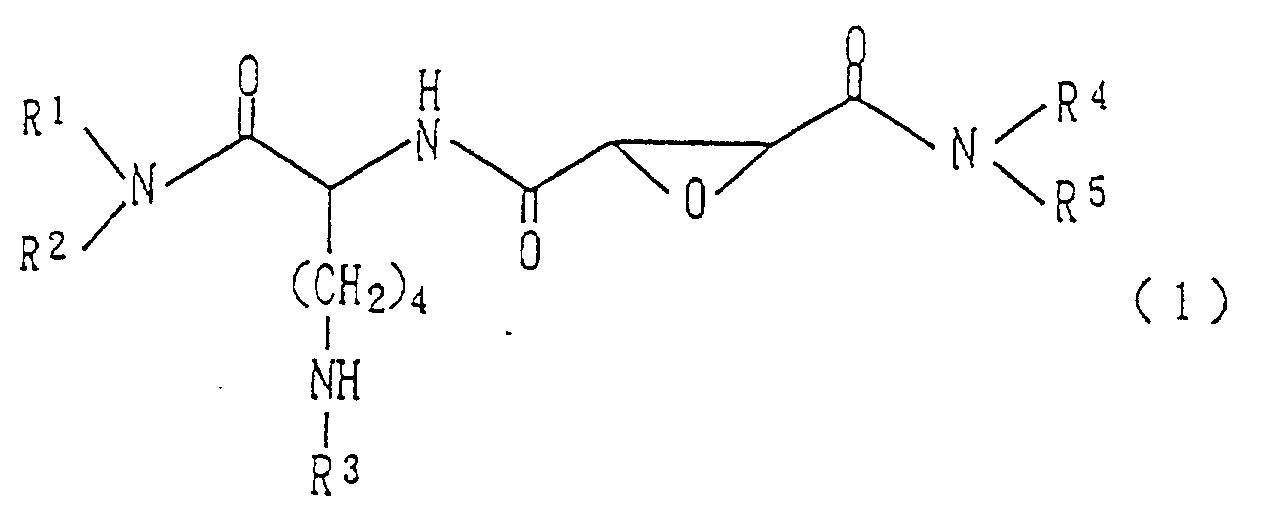
- Das Epoxysuccinamidderivat oder dessen Salz gemäß Anspruch 1, wobei R1 und R2 gleich oder voneinander verschieden sind und unabhängig voneinander für ein Wasserstoffatom, eine cyclische aromatische Kohlenwasserstoffgruppe mit 6-14 Kohlenstoffatomen (welche 1 bis 3 Substituenten haben kann ausgewählt aus einer Alkylgruppe mit 1-6 Kohlenstoffatomen, einer Alkoxygruppe mit 1-6 Kohlenstoffatomen, einem Halogenatom, einer Nitrogruppe und einer Trifluormethylgruppe) oder für eine Aralkylgruppe mit 7-20 Kohlenstoffatomen stehen, oder R1 und R2 zusammen mit dem benachbarten Stickstoffatom für eine Pyrrolidinylgruppe, Pyrrolinylgruppe, Pyrrolylgruppe, Piperazinylgruppe, Indolinylgruppe, Indolylgruppe, Morpholino- oder Piperidinogruppe stehen,
R3 ein Wasserstoffatom, eine Alkanoylgruppe, die mit 1-3 Halogenatomen substituiert sein und aus 1-7 Kohlenstoffatomen bestehen kann, eine Benzoylgruppe (die 1-3 Substituenten haben kann ausgewählt aus einer Alkylgruppe mit 1-6 Kohlenstoffatomen, einer Alkoxygruppe mit 1-6 Kohlenstoffatomen, einem Halogenatom, einer Nitrogruppe, einer Aminogruppe und einer Acylaminogruppe), eine Alkoxycarbonylgruppe aus 2-7 Kohlenstoffatomen oder eine Benzyloxycarbonylgruppe ist (die 1-3 Substituenten haben kann ausgewählt aus einer Alkylgruppe mit 1-6 Kohlenstoffatomen, einer Alkoxygruppe mit 1-6 Kohlenstoffatomen, einem Halogenatom, einer Nitrogruppe, einer Aminogruppe oder einer Acylaminogruppe),
R4 ein Wasserstoffatom und eine Aralkylgruppe mit 7-20 Kohlenstoffatomen ist, und
R5 eine cyclische aromatische Kohlenwasserstoffgruppe mit 6-14 Kohlenstoffatomen (welche 1 bis 3 Substituenten haben kann ausgewählt aus einer Alkylgruppe mit 1-6 Kohlenstoffatomen, einer Alkoxygruppe mit 1-6 Kohlenstoffatomen, einem Halogenatom, einer Nitrogruppe und einer Trifluormethylgruppe) oder eine Aralkylgruppe mit 7-20 Kohlenstoffatomen ist, oder R5 zusammen mit dem benachbarten Stickstoffatom einen Aminosäurerest mit 2-20 Kohlenstoffatomen bilden kann, dessen Carboxylgruppe geschützt sein kann. - Das Epoxysuccinamidderivat oder dessen Salz gemäß Anspruch 1, wobei R1 und R2 gleich oder voneinander verschieden sind und unabhängig voneinander für ein Wasserstoffatom, eine cyclische aromatische Kohlenwasserstoffgruppe mit 6-14 Kohlenstoffatomen (welche 1 bis 3 Substituenten haben kann ausgewählt aus einer Alkylgruppe mit 1-6 Kohlenstoffatomen, einer Alkoxygruppe mit 1-6 Kohlenstoffatomen, einem Halogenatom, einer Nitrogruppe und einer Trifluormethylgruppe) oder für eine Aralkylgruppe mit 7-20 Kohlenstoffatomen stehen, oder R1 und R2 zusammen mit dem benachbarten Stickstoffatom für eine Pyrrolidinylgruppe, Pyrrolinylgruppe, Pyrrolylgruppe, Piperazinylgruppe, Indolinylgruppe, Indolylgruppe, Morpholino- oder Piperidinogruppe stehen, R3 ein Wasserstoffatom, eine Alkanoylgruppe, die mit 1-3 Halogenatomen substituiert sein und aus 1-7 Kohlenstoffatomen bestehen kann, eine Benzoylgruppe (die 1-3 Substituenten haben kann ausgewählt aus einer Alkylgruppe mit 1-6 Kohlenstoffatomen, einer Alkoxygruppe mit 1-6 Kohlenstoffatomen, einem Halogenatom, einer Nitrogruppe, einer Aminogruppe und einer Acylaminogruppe), eine Alkoxycarbonylgruppe mit 2-7 Kohlenstoffatomen oder eine Benzyloxycarbonylgruppe ist (die 1-3 Substituenten haben kann ausgewählt aus einer Alkylgruppe mit 1-6 Kohlenstoffatomen, einer Alkoxygruppe mit 1-6 Kohlenstoffatomen, einem Halogenatom, einer Nitrogruppe, einer Aminogruppe und einer Acylaminogruppe),
R4 ein Wasserstoffatom oder eine Aralkylgruppe mit 7-20 Kohlenstoffatomen ist, und
R5 eine cyclische aromatische Kohlenwasserstoffgruppe (welche 1 bis 3 Substituenten haben kann ausgewählt aus einer Alkylgruppe mit 1-6 Kohlenstoffatomen, einer Alkoxygruppe mit 1-6 Kohlenstoffatomen, einem Halogenatom, einer Nitrogruppe und einer Trifluormethylgruppe) oder eine Aralkylgruppe mit 7-20 Kohlenstoffatomen ist, oder R5 zusammen mit dem benachbarten Stickstoffatom einen Aminosäurerest mit 2-20 Kohlenstoffatomen bildet, dessen Carboxylgruppe mit einer Aminogruppe, einer C1-6-Alkylaminogruppe, einer Di-C1-6-Alkylaminogruppe, einer C2-6-Alkenylaminogruppe, einer C2-6-Alkinylaminogruppe, einer C3-6-Cycloalkylaminogruppe, einer C3-6-Cycloalkenylaminogruppe, einer C1-6-Hydroxyalkylaminogruppe, einer Aminogruppe, die mit einer aromatischen Kohlenwasserstoffgruppe aus 6-14 Kohlenstoffatomen substituiert ist, oder mit einer Aralkylaminogruppe mit 7-20 Kohlenstoffatomen geschützt sein kann. - Das Epoxysuccinamidderivat oder dessen Salz gemäß Anspruch 1, wobei R1 und R2 gleich der voneinander verschieden sind und unabhängig voneinander für ein Wasserstoffatom, eine cyclische aromatische Kohlenwasserstoffgruppe mit 6-14 Kohlenstoffatomen (welche 1 bis 3 Substituenten haben kann ausgewählt aus einer Alkylgruppe mit 1-6 Kohlenstoffatomen, einer Alkoxygruppe mit 1-6 Kohlenstoffatomen, einem Halogenatom, einer Nitrogruppe und einer Trifluormethylgruppe) oder für eine Aralkylgruppe mit 7-20 Kohlenstoffatomen stehen, oder R1 und R2 zusammen mit dem benachbarten Stickstoffatom für eine Indolinylgruppe stehen,
R3 ein Wasserstoffatom, eine Alkanoylgruppe mit 1-7 Kohlenstoffatomen, eine Benzoylgruppe, eine Alkoxycarbonylgruppe mit 2-7 Kohlenstoffatomen oder eine Benzyloxycarbonylgruppe ist,
R4 ein Wasserstoffatom oder eine Aralkylgruppe mit 7-20 Kohlenstoffatomen ist, und
R5 eine cyclische aromatische Kohlenwasserstoffgruppe mit 6-14 Kohlenstoffatomen oder eine Aralkylgruppe mit 7-20 Kohlenstoffatomen ist, oder R5 zusammen mit-dem benachbarten Stickstoffatom einen Aminosäurerest mit 2-20 Kohlenstoffatomen bildet, dessen Carboxylgruppe mit einer Aminogruppe, einer C1-6-Alkylaminogruppe, einer Di-C1-6-Alkylaminogruppe, einer C3-6-Cycloalkylaminogruppe, einer Aminogruppe, die mit einer aromatischen Kohlenwasserstoffgruppe mit 6-14 Kohlenstoffatomen substituiert ist, oder mit einer Aralkylaminogruppe geschützt sein kann. - Das Epoxysuccinamidderivat oder dessen Salz gemäß einem der Ansprüche 1 bis 4, wobei R1 ein Wasserstoffatom und R2 eine Phenyl- oder Naphthylgruppe ist (welche 1 bis 3 Substituenten haben kann ausgewählt aus einer Alkylgruppe mit 1-6 Kohlenstoffatomen, einer Alkoxygruppe mit 1-6 Kohlenstoffatomen, einem Halogenatom, einer Nitrogruppe und einer Trifluormethylgruppe).
- Das Epoxysuccinamidderivat oder dessen Salz gemäß einem der Ansprüche 1 bis 5, wobei R4 ein Wasserstoffatom ist und wobei R5 eine Phenyl-, Naphthyl- oder Indanylgruppe oder eine Aralkylgruppe mit 7-20 Kohlenstoffatomen ist oder zusammen mit dem benachbarten Stickstoffatom für einen Phenylalaninrest steht, dessen Carboxylgruppe mit einer Aminogruppe, einer C1-6-Alkylaminogruppe, einer Di-C1-6-Alkylaminogruppe, einer C3-6-Cycloalkylaminogruppe, oder mit einer C7-20-Aralkylaminogruppe geschützt sein kann.
- Medikament umfassend das Epoxysuccinamidderivat oder dessen Salz gemäß einem der Ansprüche 1 bis 6 als aktiven Bestandteil.
- Das Medikament gemäß Anspruch 7, das als Mittel zur Vorbeugung gegen oder zur Behandlung von Osteopathie nützlich ist.
- Das Medikament gemäß Anspruch 7, das als Mittel zur Vorbeugung gegen oder zur Behandlung von Osteoporose nützlich ist.
- Medizinische Zusammensetzung umfassend das Epoxysuccinamidderivat oder dessen Salz gemäß einem der Ansprüche 1 bis 6 und einen pharmazeutisch einsetzbaren Trägerstoff.
- Verwendung des Epoxysuccinamidderivats oder dessen Salz gemäß einem der Ansprüche 1 bis 6 zur Herstellung eines Medikaments zur Vorbeugung gegen oder zur Behandlung von Osteopathie.
- Die Verwendung gemäß Anspruch 11, wobei das Medikament zur Vorbeugung gegen oder zur Behandlung von Osteoporose ist.
- Das Medikament gemäß einem der Ansprüche 7 bis 9 oder die medizinische Zusammensetzung gemäß Anspruch 10 zur Verwendung in einem Verfahren zur Behandlung von Osteopathie.
- Das Medikament gemäß einem der Ansprüche 7 bis 9 oder die medizinische Zusammensetzung gemäß Anspruch 10 zur Verwendung in einem Verfahren zur Behandlung von Osteoporose.
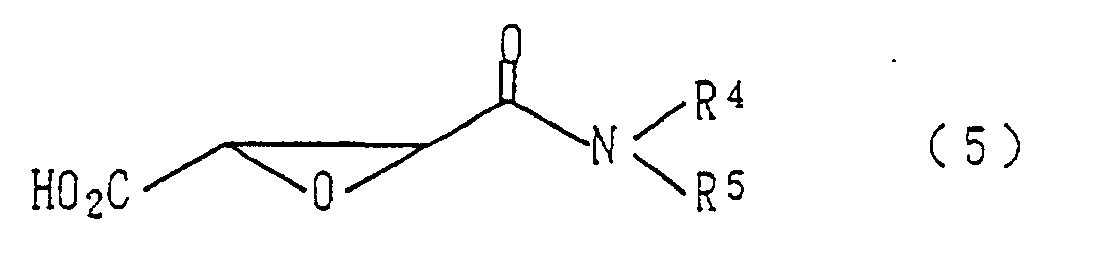
- Verfahren zur Herstellung eines Epoxysuccinamidderivats der allgemeinen, in Anspruch 1 definierten Formel (1), wobei das Verfahren die Reaktion einer Carbonsäure der allgemeinen Formel (5)wobei R4 und R5 dieselbe Bedeutung haben wie oben definiert, mit einem Amin der allgemeinen Formel (6)
 wobei R1 und R2 dieselbe Bedeutung haben wie oben definiert und R6 eine Acylgruppe ist, in Gegenwart eines Kondensationsmittels, wahlweise das Entfernen der Schutzgruppe (R6) der Aminogruppe und wahlweise die Reaktion der Aminogruppe mit einem Acylierungsmittel umfasst.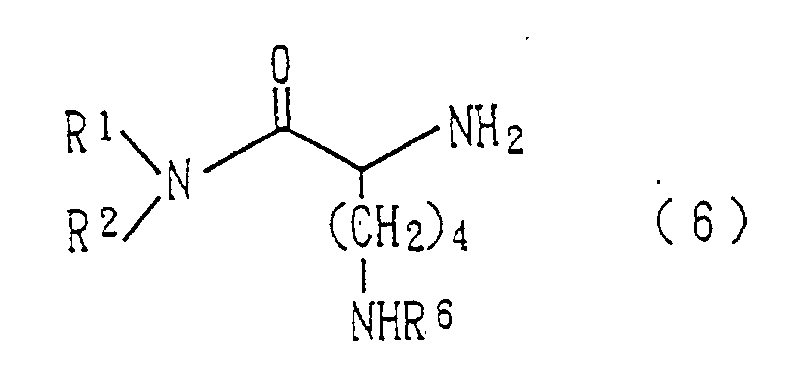
Applications Claiming Priority (4)
| Application Number | Priority Date | Filing Date | Title |
|---|---|---|---|
| JP32297195 | 1995-12-12 | ||
| JP32297195 | 1995-12-12 | ||
| JP322971/95 | 1995-12-12 | ||
| PCT/JP1996/003603 WO1997021694A1 (en) | 1995-12-12 | 1996-12-10 | Epoxysuccinamide derivatives or salts thereof, and drugs containing the same |
Publications (3)
| Publication Number | Publication Date |
|---|---|
| EP0808839A1 EP0808839A1 (de) | 1997-11-26 |
| EP0808839A4 EP0808839A4 (de) | 1998-12-02 |
| EP0808839B1 true EP0808839B1 (de) | 2001-05-23 |
Family
ID=18149701
Family Applications (1)
| Application Number | Title | Priority Date | Filing Date |
|---|---|---|---|
| EP96941212A Expired - Lifetime EP0808839B1 (de) | 1995-12-12 | 1996-12-10 | Epoxysuccinamid-derivate oder deren salze und medikamente die diese enthalten |
Country Status (9)
| Country | Link |
|---|---|
| US (1) | US5883121A (de) |
| EP (1) | EP0808839B1 (de) |
| JP (1) | JP3338452B2 (de) |
| KR (1) | KR100226461B1 (de) |
| AT (1) | ATE201404T1 (de) |
| AU (1) | AU697565B2 (de) |
| CA (1) | CA2211128C (de) |
| DE (1) | DE69612962T2 (de) |
| WO (1) | WO1997021694A1 (de) |
Families Citing this family (14)
| Publication number | Priority date | Publication date | Assignee | Title |
|---|---|---|---|---|
| JP3410476B2 (ja) * | 1997-04-18 | 2003-05-26 | 大鵬薬品工業株式会社 | 新規なエポキシコハク酸アミド誘導体又はその塩 |
| TR200101869T2 (tr) * | 1998-12-23 | 2002-01-21 | Smithkline Beecham Corporation | Proteaz İnhibitörleri. |
| EP1384713B1 (de) * | 1998-12-23 | 2008-10-15 | SmithKline Beecham Corporation | 4-Amino-azepan-3-on-Derivate als Protease-Inhibitors |
| US6605589B1 (en) * | 2000-03-31 | 2003-08-12 | Parker Hughes Institute | Cathepsin inhibitors in cancer treatment |
| US6620844B2 (en) * | 2001-02-14 | 2003-09-16 | Newmillennium Pharmaceutical, Inc. | Method for reducing blood insulin levels by reducing in vivo cathepsin L activity |
| US20040009891A1 (en) * | 2001-02-14 | 2004-01-15 | Newmillennium Pharmaceutical, Inc. | Method and composition for treating obesity by targeting cathepsin |
| WO2004084830A2 (en) * | 2003-03-21 | 2004-10-07 | Buck Institute | Method for treating alzheimer’s dementia |
| US9144594B2 (en) * | 2005-11-08 | 2015-09-29 | University Of Miami | Cathepsin L mediated diseases and associated methods and products |
| WO2007056435A2 (en) * | 2005-11-08 | 2007-05-18 | The General Hospital Corporation | Dynamin mediated diseases and associated methods and products |
| CN101808634A (zh) * | 2006-06-13 | 2010-08-18 | 利兰·斯坦福青年大学托管委员会 | 半胱氨酸蛋白酶的环氧化物抑制剂 |
| KR20100023948A (ko) | 2007-06-08 | 2010-03-04 | 닛뽕 케미파 가부시키가이샤 | 뇌동맥류의 치료 또는 예방약 |
| WO2009054454A1 (ja) | 2007-10-24 | 2009-04-30 | National University Corporation Tokyo Medical And Dental University | カテプシン阻害剤を有効成分として含有するToll様受容体のシグナル伝達の調整剤 |
| CN104981249B (zh) | 2012-12-18 | 2018-06-19 | 英国卫生部 | 抗微生物化合物、它们的合成及其应用 |
| CN107151236B (zh) * | 2016-03-03 | 2021-04-30 | 中国人民解放军军事医学科学院毒物药物研究所 | 一种2,3-环氧丁二酰衍生物及其制备方法和用途 |
Family Cites Families (2)
| Publication number | Priority date | Publication date | Assignee | Title |
|---|---|---|---|---|
| US5556853A (en) * | 1993-10-29 | 1996-09-17 | Takeda Chemical Industries, Ltd. | Epoxysuccinic acid derivatives |
| US5438267A (en) * | 1994-01-26 | 1995-08-01 | Baker Hughes Incorporated | Single-switching method of eliminating the effect of electromagnetic coupling between a pair of receivers |
-
1996
- 1996-12-10 JP JP52192797A patent/JP3338452B2/ja not_active Expired - Fee Related
- 1996-12-10 EP EP96941212A patent/EP0808839B1/de not_active Expired - Lifetime
- 1996-12-10 US US08/894,050 patent/US5883121A/en not_active Expired - Fee Related
- 1996-12-10 AU AU10414/97A patent/AU697565B2/en not_active Ceased
- 1996-12-10 DE DE69612962T patent/DE69612962T2/de not_active Expired - Fee Related
- 1996-12-10 KR KR1019970705137A patent/KR100226461B1/ko not_active Expired - Fee Related
- 1996-12-10 AT AT96941212T patent/ATE201404T1/de not_active IP Right Cessation
- 1996-12-10 WO PCT/JP1996/003603 patent/WO1997021694A1/ja not_active Ceased
- 1996-12-10 CA CA002211128A patent/CA2211128C/en not_active Expired - Fee Related
Also Published As
| Publication number | Publication date |
|---|---|
| EP0808839A1 (de) | 1997-11-26 |
| ATE201404T1 (de) | 2001-06-15 |
| KR19980701741A (ko) | 1998-06-25 |
| KR100226461B1 (ko) | 1999-10-15 |
| AU1041497A (en) | 1997-07-03 |
| CA2211128A1 (en) | 1997-06-19 |
| WO1997021694A1 (en) | 1997-06-19 |
| JP3338452B2 (ja) | 2002-10-28 |
| DE69612962D1 (de) | 2001-06-28 |
| CA2211128C (en) | 2001-02-06 |
| DE69612962T2 (de) | 2001-11-15 |
| EP0808839A4 (de) | 1998-12-02 |
| US5883121A (en) | 1999-03-16 |
| AU697565B2 (en) | 1998-10-08 |
Similar Documents
| Publication | Publication Date | Title |
|---|---|---|
| CA2211128C (en) | Epoxysuccinamide derivatives or salts thereof, and drugs containing the same | |
| FI69834C (fi) | Foerfarande foer framstaellning av terapeutiskt anvaendbara etr- eller tioetermerkaptoacylproliner | |
| Buehlmayer et al. | Synthesis and biological activity of some transition-state inhibitors of human renin | |
| TAMAI et al. | Efficient synthetic method for ethyl (+)-(2S, 3S)-3-[(S)-3-methyl-1-(3-methylbutylcarbamoyl) butylcarbamoyl]-2-oxiranecarboxylate (EST), a new inhibitor of cysteine proteinases | |
| KR0138498B1 (ko) | 신규 이속사졸 유도체 및 그의 염 | |
| KR19990071683A (ko) | 시스테인 및 세린 프로테아제의 d-아미노산 유도된 억제제 | |
| CZ68293A3 (en) | Indoline derivatives with amidic group, process of their preparation and pharmaceutical preparations in which they are comprised | |
| JPWO1997021694A1 (ja) | エポキシコハク酸アミド誘導体又はその塩及びこれを含有する医薬 | |
| EP1513531B1 (de) | Basische nichtpeptid-bradykinin-antagonisten und pharmazeutische zusammensetzungen daraus | |
| EP0190891A2 (de) | Aminosäurederivate | |
| CN101160297B (zh) | 作为细胞凋亡蛋白抑制剂(iap)调节剂的2-氨基羰基取代的哌嗪或二氮杂-环状化合物 | |
| EP0921122B1 (de) | Epoxysuccinamid-derivate oder ihre salze | |
| CN102131802A (zh) | 用作凝血酶抑制剂的新型杂环甲酰胺 | |
| JPWO1998047887A1 (ja) | 新規なエポキシコハク酸アミド誘導体又はその塩 | |
| CN111606970A (zh) | 一种1,5-二氮杂双环[5,3,0]十烷酮氨基酸衍生物及其制备方法和应用 | |
| Takahashi et al. | Novel matrix metalloproteinase inhibitors: Generation of lead compounds by the in silico fragment-based approach | |
| EP0594656A1 (de) | 4-amino-3-hydroxycarbonsäure-derivate | |
| HU206194B (en) | Process for producing cyclomethylene-1,2-dicarboxylic acid derivatives and pharmaceutical compositions comprising same | |
| FR2483916A1 (fr) | Nouveaux n-cycloalkylaminoacides utiles notamment inhibiteurs de l'enzyme de conversion de l'angiotensine i | |
| EP0333000B1 (de) | Peptide mit inhibitorischer Wirkung auf enzymatische Systeme, Verfahren zu deren Herstellung und diese enthaltende pharmazeutische Zusammensetzungen | |
| KR101096427B1 (ko) | 신규한 4-아릴-4-옥소부탄산 아미드 유도체 또는 이의 약학적으로 허용가능한 염, 이의 제조방법 및 이를 유효성분으로 함유하는 약학적 조성물 | |
| Capraro et al. | Synthesis of Potent and Orally Active HIV‐Protease Inhibitors | |
| KR100551944B1 (ko) | 신규에폭시숙신아미드유도체또는그의염 | |
| JPH0559908B2 (de) | ||
| KR20010077201A (ko) | 4-하이드록실아미노-3-사이클로부텐-1,2-다이온 유도체 및이들의 제조 방법 |
Legal Events
| Date | Code | Title | Description |
|---|---|---|---|
| PUAI | Public reference made under article 153(3) epc to a published international application that has entered the european phase |
Free format text: ORIGINAL CODE: 0009012 |
|
| 17P | Request for examination filed |
Effective date: 19970806 |
|
| AK | Designated contracting states |
Kind code of ref document: A1 Designated state(s): AT BE CH DE DK ES FI FR GB GR IE IT LI LU MC NL PT SE |
|
| A4 | Supplementary search report drawn up and despatched | ||
| AK | Designated contracting states |
Kind code of ref document: A4 Designated state(s): AT BE CH DE DK ES FI FR GB GR IE IT LI LU MC NL PT SE |
|
| 17Q | First examination report despatched |
Effective date: 19990514 |
|
| GRAG | Despatch of communication of intention to grant |
Free format text: ORIGINAL CODE: EPIDOS AGRA |
|
| GRAG | Despatch of communication of intention to grant |
Free format text: ORIGINAL CODE: EPIDOS AGRA |
|
| GRAH | Despatch of communication of intention to grant a patent |
Free format text: ORIGINAL CODE: EPIDOS IGRA |
|
| GRAH | Despatch of communication of intention to grant a patent |
Free format text: ORIGINAL CODE: EPIDOS IGRA |
|
| GRAA | (expected) grant |
Free format text: ORIGINAL CODE: 0009210 |
|
| ITF | It: translation for a ep patent filed | ||
| AK | Designated contracting states |
Kind code of ref document: B1 Designated state(s): AT BE CH DE DK ES FI FR GB GR IE IT LI LU MC NL PT SE |
|
| PG25 | Lapsed in a contracting state [announced via postgrant information from national office to epo] |
Ref country code: NL Free format text: LAPSE BECAUSE OF FAILURE TO SUBMIT A TRANSLATION OF THE DESCRIPTION OR TO PAY THE FEE WITHIN THE PRESCRIBED TIME-LIMIT Effective date: 20010523 Ref country code: FI Free format text: LAPSE BECAUSE OF FAILURE TO SUBMIT A TRANSLATION OF THE DESCRIPTION OR TO PAY THE FEE WITHIN THE PRESCRIBED TIME-LIMIT Effective date: 20010523 Ref country code: BE Free format text: LAPSE BECAUSE OF FAILURE TO SUBMIT A TRANSLATION OF THE DESCRIPTION OR TO PAY THE FEE WITHIN THE PRESCRIBED TIME-LIMIT Effective date: 20010523 Ref country code: AT Free format text: LAPSE BECAUSE OF FAILURE TO SUBMIT A TRANSLATION OF THE DESCRIPTION OR TO PAY THE FEE WITHIN THE PRESCRIBED TIME-LIMIT Effective date: 20010523 |
|
| REF | Corresponds to: |
Ref document number: 201404 Country of ref document: AT Date of ref document: 20010615 Kind code of ref document: T |
|
| REG | Reference to a national code |
Ref country code: CH Ref legal event code: EP |
|
| REF | Corresponds to: |
Ref document number: 69612962 Country of ref document: DE Date of ref document: 20010628 |
|
| ET | Fr: translation filed | ||
| REG | Reference to a national code |
Ref country code: IE Ref legal event code: FG4D |
|
| PG25 | Lapsed in a contracting state [announced via postgrant information from national office to epo] |
Ref country code: SE Free format text: LAPSE BECAUSE OF FAILURE TO SUBMIT A TRANSLATION OF THE DESCRIPTION OR TO PAY THE FEE WITHIN THE PRESCRIBED TIME-LIMIT Effective date: 20010823 Ref country code: PT Free format text: LAPSE BECAUSE OF FAILURE TO SUBMIT A TRANSLATION OF THE DESCRIPTION OR TO PAY THE FEE WITHIN THE PRESCRIBED TIME-LIMIT Effective date: 20010823 Ref country code: DK Free format text: LAPSE BECAUSE OF FAILURE TO SUBMIT A TRANSLATION OF THE DESCRIPTION OR TO PAY THE FEE WITHIN THE PRESCRIBED TIME-LIMIT Effective date: 20010823 |
|
| PG25 | Lapsed in a contracting state [announced via postgrant information from national office to epo] |
Ref country code: GR Free format text: LAPSE BECAUSE OF FAILURE TO SUBMIT A TRANSLATION OF THE DESCRIPTION OR TO PAY THE FEE WITHIN THE PRESCRIBED TIME-LIMIT Effective date: 20010824 |
|
| REG | Reference to a national code |
Ref country code: CH Ref legal event code: NV Representative=s name: BOVARD AG PATENTANWAELTE |
|
| NLV1 | Nl: lapsed or annulled due to failure to fulfill the requirements of art. 29p and 29m of the patents act | ||
| PG25 | Lapsed in a contracting state [announced via postgrant information from national office to epo] |
Ref country code: ES Free format text: LAPSE BECAUSE OF FAILURE TO SUBMIT A TRANSLATION OF THE DESCRIPTION OR TO PAY THE FEE WITHIN THE PRESCRIBED TIME-LIMIT Effective date: 20011130 |
|
| PG25 | Lapsed in a contracting state [announced via postgrant information from national office to epo] |
Ref country code: MC Free format text: LAPSE BECAUSE OF NON-PAYMENT OF DUE FEES Effective date: 20011210 Ref country code: LU Free format text: LAPSE BECAUSE OF NON-PAYMENT OF DUE FEES Effective date: 20011210 Ref country code: IE Free format text: LAPSE BECAUSE OF FAILURE TO SUBMIT A TRANSLATION OF THE DESCRIPTION OR TO PAY THE FEE WITHIN THE PRESCRIBED TIME-LIMIT Effective date: 20011210 |
|
| REG | Reference to a national code |
Ref country code: GB Ref legal event code: IF02 |
|
| PLBE | No opposition filed within time limit |
Free format text: ORIGINAL CODE: 0009261 |
|
| STAA | Information on the status of an ep patent application or granted ep patent |
Free format text: STATUS: NO OPPOSITION FILED WITHIN TIME LIMIT |
|
| 26N | No opposition filed | ||
| REG | Reference to a national code |
Ref country code: IE Ref legal event code: MM4A |
|
| PGFP | Annual fee paid to national office [announced via postgrant information from national office to epo] |
Ref country code: DE Payment date: 20061213 Year of fee payment: 11 |
|
| PGFP | Annual fee paid to national office [announced via postgrant information from national office to epo] |
Ref country code: FR Payment date: 20061215 Year of fee payment: 11 |
|
| PGFP | Annual fee paid to national office [announced via postgrant information from national office to epo] |
Ref country code: GB Payment date: 20061218 Year of fee payment: 11 |
|
| PGFP | Annual fee paid to national office [announced via postgrant information from national office to epo] |
Ref country code: CH Payment date: 20061227 Year of fee payment: 11 |
|
| PGFP | Annual fee paid to national office [announced via postgrant information from national office to epo] |
Ref country code: IT Payment date: 20061231 Year of fee payment: 11 |
|
| REG | Reference to a national code |
Ref country code: CH Ref legal event code: PL |
|
| GBPC | Gb: european patent ceased through non-payment of renewal fee |
Effective date: 20071210 |
|
| PG25 | Lapsed in a contracting state [announced via postgrant information from national office to epo] |
Ref country code: LI Free format text: LAPSE BECAUSE OF NON-PAYMENT OF DUE FEES Effective date: 20071231 Ref country code: DE Free format text: LAPSE BECAUSE OF NON-PAYMENT OF DUE FEES Effective date: 20080701 Ref country code: CH Free format text: LAPSE BECAUSE OF NON-PAYMENT OF DUE FEES Effective date: 20071231 |
|
| REG | Reference to a national code |
Ref country code: FR Ref legal event code: ST Effective date: 20081020 |
|
| PG25 | Lapsed in a contracting state [announced via postgrant information from national office to epo] |
Ref country code: GB Free format text: LAPSE BECAUSE OF NON-PAYMENT OF DUE FEES Effective date: 20071210 |
|
| PG25 | Lapsed in a contracting state [announced via postgrant information from national office to epo] |
Ref country code: FR Free format text: LAPSE BECAUSE OF NON-PAYMENT OF DUE FEES Effective date: 20071231 |
|
| PG25 | Lapsed in a contracting state [announced via postgrant information from national office to epo] |
Ref country code: IT Free format text: LAPSE BECAUSE OF NON-PAYMENT OF DUE FEES Effective date: 20071210 |