EP0807915B1 - Traffic monitoring method and device - Google Patents
Traffic monitoring method and device Download PDFInfo
- Publication number
- EP0807915B1 EP0807915B1 EP97107655A EP97107655A EP0807915B1 EP 0807915 B1 EP0807915 B1 EP 0807915B1 EP 97107655 A EP97107655 A EP 97107655A EP 97107655 A EP97107655 A EP 97107655A EP 0807915 B1 EP0807915 B1 EP 0807915B1
- Authority
- EP
- European Patent Office
- Prior art keywords
- traffic
- identification
- control centre
- speech recognition
- traffic participant
- Prior art date
- Legal status (The legal status is an assumption and is not a legal conclusion. Google has not performed a legal analysis and makes no representation as to the accuracy of the status listed.)
- Expired - Lifetime
Links
Images
Classifications
-
- G—PHYSICS
- G08—SIGNALLING
- G08G—TRAFFIC CONTROL SYSTEMS
- G08G5/00—Traffic control systems for aircraft
- G08G5/20—Arrangements for acquiring, generating, sharing or displaying traffic information
- G08G5/26—Transmission of traffic-related information between aircraft and ground stations
-
- G—PHYSICS
- G01—MEASURING; TESTING
- G01S—RADIO DIRECTION-FINDING; RADIO NAVIGATION; DETERMINING DISTANCE OR VELOCITY BY USE OF RADIO WAVES; LOCATING OR PRESENCE-DETECTING BY USE OF THE REFLECTION OR RERADIATION OF RADIO WAVES; ANALOGOUS ARRANGEMENTS USING OTHER WAVES
- G01S13/00—Systems using the reflection or reradiation of radio waves, e.g. radar systems; Analogous systems using reflection or reradiation of waves whose nature or wavelength is irrelevant or unspecified
- G01S13/88—Radar or analogous systems specially adapted for specific applications
- G01S13/91—Radar or analogous systems specially adapted for specific applications for traffic control
-
- G—PHYSICS
- G08—SIGNALLING
- G08G—TRAFFIC CONTROL SYSTEMS
- G08G5/00—Traffic control systems for aircraft
- G08G5/50—Navigation or guidance aids
- G08G5/51—Navigation or guidance aids for control when on the ground, e.g. taxiing or rolling
-
- G—PHYSICS
- G08—SIGNALLING
- G08G—TRAFFIC CONTROL SYSTEMS
- G08G5/00—Traffic control systems for aircraft
- G08G5/70—Arrangements for monitoring traffic-related situations or conditions
- G08G5/72—Arrangements for monitoring traffic-related situations or conditions for monitoring traffic
- G08G5/727—Arrangements for monitoring traffic-related situations or conditions for monitoring traffic from a ground station
-
- G—PHYSICS
- G01—MEASURING; TESTING
- G01S—RADIO DIRECTION-FINDING; RADIO NAVIGATION; DETERMINING DISTANCE OR VELOCITY BY USE OF RADIO WAVES; LOCATING OR PRESENCE-DETECTING BY USE OF THE REFLECTION OR RERADIATION OF RADIO WAVES; ANALOGOUS ARRANGEMENTS USING OTHER WAVES
- G01S13/00—Systems using the reflection or reradiation of radio waves, e.g. radar systems; Analogous systems using reflection or reradiation of waves whose nature or wavelength is irrelevant or unspecified
- G01S13/86—Combinations of radar systems with non-radar systems, e.g. sonar, direction finder
-
- G—PHYSICS
- G01—MEASURING; TESTING
- G01S—RADIO DIRECTION-FINDING; RADIO NAVIGATION; DETERMINING DISTANCE OR VELOCITY BY USE OF RADIO WAVES; LOCATING OR PRESENCE-DETECTING BY USE OF THE REFLECTION OR RERADIATION OF RADIO WAVES; ANALOGOUS ARRANGEMENTS USING OTHER WAVES
- G01S13/00—Systems using the reflection or reradiation of radio waves, e.g. radar systems; Analogous systems using reflection or reradiation of waves whose nature or wavelength is irrelevant or unspecified
- G01S13/88—Radar or analogous systems specially adapted for specific applications
- G01S13/91—Radar or analogous systems specially adapted for specific applications for traffic control
- G01S13/913—Radar or analogous systems specially adapted for specific applications for traffic control for landing purposes
-
- G—PHYSICS
- G01—MEASURING; TESTING
- G01S—RADIO DIRECTION-FINDING; RADIO NAVIGATION; DETERMINING DISTANCE OR VELOCITY BY USE OF RADIO WAVES; LOCATING OR PRESENCE-DETECTING BY USE OF THE REFLECTION OR RERADIATION OF RADIO WAVES; ANALOGOUS ARRANGEMENTS USING OTHER WAVES
- G01S3/00—Direction-finders for determining the direction from which infrasonic, sonic, ultrasonic or electromagnetic waves, or particle emission, not having a directional significance, are being received
- G01S3/02—Direction-finders for determining the direction from which infrasonic, sonic, ultrasonic or electromagnetic waves, or particle emission, not having a directional significance, are being received using radio waves
Definitions
- the invention relates to an arrangement for traffic monitoring, in particular at airports, at the facilities for determining the positions of road users are provided, a communication device for communication between road users and a control center, a speech recognition device for speech recognition of a radio message the road user and optionally the control center are provided on the control center side is, a data processing system is provided, a connection between Data processing system and the device or devices for position determination and the speech recognition device is provided, and the Data processing system Means for data fusion of their input data for tracking the clear location and identification of road users and Forwarding the assignment results to an output unit.
- she also relates to a method for traffic monitoring, in particular on Airports at which a position determination of a road user by bearing and provided with further information, communication between road users and a control center recorded and fed a voice recognition on the part of the head office becomes, an identifier given with the message from the road user identified in the speech recognition by the head office and the position-determined Is assigned to road users, the assigned identification of the position-determined road user is continuously maintained, with the source of the Identification lies with the road user, and there is a clear assignment between position and identification.
- Aircraft both takeoff, landing, on the tarmac moving or not moving at a certain time; also various types of motor vehicles for passenger transport or but also for handling maintenance or other transports.
- Different sensor systems are known for situation detection (EP 0 613 111 A1). These include, for example, non-cooperative sensors, such as induction loops in the runway or taxiway, light barriers or a primary radar, such as the so-called airport surface detection equipment (ASDE). Such sensors can also be used without a localization element Road users work. The ASDE can even face obstacles on the runway or recognize the taxiways. Certain road users have also via cooperative sensors, e.g. based on the secondary radar or querying the location obtained in the aircraft from the satellite navigation via Automatic Dependent Surveillance (ADS). These allow at the same time the identification of the participant, but set the facilities mentioned ahead that are still in the development phase.
- ADS Automatic Dependent Surveillance
- EP 0 613 111 A1 discloses an airport monitoring system and a method to carry out airport surveillance using the system at the sensors along the runway are provided. Detect these sensors Position and speed of the moving vehicles or aircraft on the taxiways and taxiways.
- a speech recognition unit provided the vocabulary of the controller located on the ground recognizes. As is well known, the controller repeats on the ground or in the tower first reporting a pilot whose words regarding aircraft identification, Flight number and airline. The speech recognition unit analyzes what the controller or pilot in the tower repeats. With the help of data fusion software then the data from the sensors that determine the position of the Aircraft and other road users identified at the airport have and merged the speech recognition unit.
- the speech recognition unit can be used for the purposes of application according to EP 0 613 111 A1 be limited to the relatively simple embodiment, in which only the Pre-programmable language of a known person, namely that of the controller or pilots on the ground must be recognized.
- JP 6-342 061 is a further system for locating and identifying Objects known at airports, using sensors and voice recognition be used.
- the technical effort is very large, however, since two Direction finders are required to clearly identify the object with the signal source to locate.
- the use of two direction finding devices meets with financial and also Technical problems, since airfields usually only have a direction finder.
- the invention has for its object an arrangement and a Propose traffic monitoring procedures that are more universal are, if possible, get along with existing systems, as low as possible Retrofitting requirements on the airports and, if possible, at all do not require retrofit requirements for road users, nevertheless allow the location and identification of road users.
- This, task is in a generic arrangement Traffic monitoring, especially at airports, solved by taking the facilities for determining the positions of road users a single direction finder or direction finder antenna to determine the direction of the Communication transmission is, and that in addition still another Location device is provided.
- the task is also carried out in a generic method for traffic monitoring, resolved especially at airports by the bearing only with a single direction finder or direction finder antenna, and that if there is a discrepancy in the assignment from the head office a manual correction is made or an oral one to the road user or automatic request for renewed oral or automatic Passing its identifier is triggered by the headquarters.
- the road users practically no additional equipment or devices at all required.
- the system comes with that at airports, for example already existing device for determining position from and only sets the communication system available to road users, that is, radio devices for voice communication with the central or ground station, ahead. Airplanes naturally have such radio equipment and the other vehicles in the airport area must, too always have radio equipment to receive instructions (man think, for example, of buses to be directed, fire engines, transport vehicles, Maintenance vehicles).
- the method according to the invention initially works as already at airports known with a position determination of a road user bearing in the conventional sense and additional information such as the measurement from a primary radar or a known runway or taxiway. This Location data are fed to the data processing system.
- the bearing of the road user through the central office sets a radio link between the road user and the headquarters ahead, which is now starts with an identifier as standard, for example the aircraft registration number or another, identifying the road user speech reproduction.
- Speech recognition devices are in the Able to read this mark from such communication or at least recognize it as an identifier.
- the trigger The factor for identifying the road user is himself on the basis of the identifier that is passed in front of the message. This message serves as the source of the identification.
- the of the direction determined from which the message arrives is used to determine the position used by the road user.
- This road user identification identified in the speech recognition is. now merged in the data processing system with the data from the position determination.
- This process allows the identification to be clearly assigned a location date of a road user and only occurs once if it is clarified which identified road user object is now a agreed bearing can be assigned.
- the results of the data fusion can therefore correspond to an output unit be made available, for example screens in the tower or also recording devices.
- the direction finder at the airfield and others is not cooperative location systems, such as the above-mentioned ASDE, combined with the radio equipment available in aircraft for the Speech connection with the head office.
- the invention uses computers for directional and Position determination and recognition of the spoken word Identification of the road user and for clear object tracking.
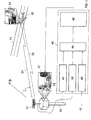
- Figure 1 shows a schematic overview of the overall situation.
- the facilities at an airport shown here purely schematically include, for example, a taxiway 11, a control center in the form of a tower 12, in which a pilot 13 is located, a direction finder antenna 14 and the location 15 from a primary radar.
- radio message 31 begins usually with the identifier of the road user 20. For example whose identifier D-ADAM, message 31 would begin with "Braurischweig Tower, this is Delta-Alpha-Delta-Alpha-Mike ".
- the pilot 13 in the tower 12 usually gives a repetition of these in its radio messages 32 Identifier or a unique abbreviation of the same to the road user 20 indicate that this is meant.
- the direction finder antenna 14 increases with each message from the road user 20 him a direction determination, which here by the angle "PSI" in relation to the north direction is indicated. This bearing is done by determining the direction the incoming radio message from the road user, ie the incoming communication transmission, the source of the Identification. In connection with the location 15 of the primary radar or others Information about the location or the train used can be shared by several road users the one to be identified can then be clearly identified. All this data is now shown schematically (shown in the lower half of the picture) fed to a data processing system 40. In this data processing system 40 is shown schematically as a result of a block diagram, which is procedural happens:
- data is received from the tower 12 or directly from the direction finder antenna 14 via the determination of the direction of the road user 20 in a field 41 processed
- a speech recognition device 42 Preparation of the recorded communication between the pilot 13 and the pilot 21 instead, for example, from a primary radar or from Other sources 15 supplied additional data on the aircraft position and in the field 43 processed.
- the speech recognition device 42 is designed such that it evaluates the word information spoken by the road user. In contrast to the prior art, this results in a direct evaluation of what comes from the road user without going through the Repetition of this information in a manner suitable for the speech recognition device Shape. An error by interrogation by the pilot does not occur here on.
- incoming information can be compared by comparing what the pilot hears and what it gets displayed or by comparing the data stored in the computer Identification of an expected road user and the result of the Speech recognition. There will be a discrepancy in the latter case reported to the pilot.
- the correction is either automatic, if it is minor or from the pilot by correctly entering the identifier and their processing in speech recognition or finally through whose request to the road user to resubmit the ID.
- the fields 41 and 43 then give data on the angle determined by them PSI or the coordinates x, y, z of the road user to field 44 the block diagram in which a data fusion takes place with the determined Results of the speech recognition device 42, here for example the determination, that the road user 20 is "D-ADAM".
- the Data fusion in field 44 forms the position and direction of movement of the road user on the one hand, and its identification on the other hand a unity in the Computer and thus ensures that both information belong together an object.
- This date is passed on to field 45.
- field 45 is a situation tracking is provided, d. H. that the constantly updated new data from fields 41 and 43 are processed further and further; the Speech recognition device 42 can, but does not have to be necessary for the further Update. If it is used, it will access the Voice information that comes from the road user.
- the situation tracking 45 is a corresponding output to a Output unit, for example a screen 17 forwarded to the pilot 13.
- a particularly good assignment is of course possible because it is the direction finder antenna 14 is an antenna that points to the input direction of the radio message 31 reacts. Then a time identification option is also special simply possible.
- the voice communication 31/32 between pilot 21 and pilot 13 is in Switched between airplane (traffic control 20) and tower 12.
- the pilot answers after or before calling the tower 12 (e.g. "Braunschweig Tower") each with the aircraft registration number or one different identifier, for example if it is another road user, is.
- the pilot 13 repeats the mark or the identifier in his answer.
- the essentially standardized identification code offers an excellent one Basis for the automatic detection of the identifier through analysis of the digitized Speech signal using word recognition programs. Such Programs are expediently able, despite the interference in radio communication the desired information from the spoken words of the pilot filter out. In cases of doubt, a further evaluation can be made of what information the pilot repeats and / or delivers himself.
- the complement direction finder 14 by digitizing the measured direction with simultaneous computer-controlled analysis of pilot 21 and pilot spoken words to capture the identifier of the road user 20 is of particular advantage.
- the computer or the data processing system 40 are used for data fusion 44 in addition to these two pieces of information - direction and identifier - as mentioned also additional information, such as measurement signals from other part sensors or the Knowledge of the predetermined movement sequence, e.g. Runway or taxiway processed. This is used for location, but usually not for identification the road user.
- the data fusion means that the incoming information is processed for the safe location and identification of each individual participant.
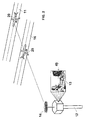
- Figure 2 indicates a situation in which there may be an ambiguous identification.
- Two road users 20, 25 are from the direction of direction finder antenna 14 in the same direction, and there may be doubts about the identity of the two road users 20, 25 during situation tracking 45. But this also recognizes the data processing system 40. It sets a label for hazard identification and reports it to the controller 13, for example, via the screen 17, who can prompt the road users 20 and 25 to simply give a new subscriber identification by voice. However, this request can preferably also be made from the computer in a different form using synthetic speech or radio technology.
Landscapes
- Engineering & Computer Science (AREA)
- Physics & Mathematics (AREA)
- General Physics & Mathematics (AREA)
- Aviation & Aerospace Engineering (AREA)
- Radar, Positioning & Navigation (AREA)
- Remote Sensing (AREA)
- Electromagnetism (AREA)
- Computer Networks & Wireless Communication (AREA)
- Traffic Control Systems (AREA)
Description
Die Erfindung betrifft eine Anordnung zur Verkehrsüberwachung, insbesondere auf Flughäfen, bei der Einrichtungen zur Bestimmung von Positionen von Verkehrsteilnehmem vorgesehen sind, eine Kommunikationseinrichtung zur Kommunikation zwischen Verkehrsteilnehmem und einer Zentrale vorgesehen ist, eine Spracherkennungseinrichtung zur Spracherkennung einer Funkmeldung der Verkehrsteilnehmer und optional der Zentrale auf Seiten der Zentrale vorgesehen ist, eine Datenverarbeitungsanlage vorgesehen ist, eine Verbindung zwischen Datenverarbeitungsanlage und der oder den Einrichtungen zur Positionsbestimmung und der Spracherkennungseinrichtung vorgesehen ist, und die Datenverarbeitungsanlage Mittel zur Datenfusion ihrer Eingangsdaten zur Verfolgung der eindeutigen Ortung und Identifizierung der Verkehrsteilnehmer und Weitergabe der Zuordnungsergebnisse an eine Ausgabeeinheit aufweist. Sie betrifft außerdem ein Verfahren zur Verkehrsüberwachung, insbesondere auf Flughäfen, bei dem eine Positionsbestimmung eines Verkehrsteilnehmers durch Peilung und mitfels weiterer Informationen erfolgt, eine Kommunikation zwischen Verkehrsteilnehmer und einer Zentrale aufgezeichnet und einer Spracherkennung auf Seiten der Zentrale zugeführt wird, eine mit der Meldung des Verkehrsteilnehmers durchgegebene Kennung in der Spracherkennung seitens der Zentrale identifiziert und dem positionsbestimmten Verkehrsteilnehmer zugeordnet wird, die zugeordnete Identifizierung des positionsbestimmten Verkehrsteilnehmers kontinuierlich beibehalten wird, wobei die Quelle der Identifizierung bei dem Verkehrsteilnehmer liegt, und eine eindeutige Zuordnung zwischen Position und Identifizierung erfolgt.The invention relates to an arrangement for traffic monitoring, in particular at airports, at the facilities for determining the positions of road users are provided, a communication device for communication between road users and a control center, a speech recognition device for speech recognition of a radio message the road user and optionally the control center are provided on the control center side is, a data processing system is provided, a connection between Data processing system and the device or devices for position determination and the speech recognition device is provided, and the Data processing system Means for data fusion of their input data for tracking the clear location and identification of road users and Forwarding the assignment results to an output unit. she also relates to a method for traffic monitoring, in particular on Airports at which a position determination of a road user by bearing and provided with further information, communication between road users and a control center recorded and fed a voice recognition on the part of the head office becomes, an identifier given with the message from the road user identified in the speech recognition by the head office and the position-determined Is assigned to road users, the assigned identification of the position-determined road user is continuously maintained, with the source of the Identification lies with the road user, and there is a clear assignment between position and identification.
Die kontinuierliche Zunahme des Luftverkehrs und die ständig komplexer werdenden Situationen auf und in der Umgebung von Flughäfen aufgrund der Zunahme der Verkehrsteilnehmer führt dazu, dass für eine effiziente Abwicklung des Verkehrs im Flughafennahbereich und auf dem Rollfeld möglichst automatisierte und vor allem wetterunabhängige Situationserfassungen erfolgen sollten.The steady increase in air traffic and the ever more complex Situations in and around airports due to the increase The road user leads to efficient processing automated traffic in the vicinity of the airport and on the tarmac and above all, weather-independent situation recordings should be made.
Auf den Flughäfen befinden sich unterschiedliche Verkehrsteilnehmer: einerseits Flugzeuge, und zwar sowohl startende, landende, sich auf dem Rollfeld bewegende oder auch zu einem bestimmten Zeitpunkt sich nicht bewegende; femer auch Kraftfahrzeuge verschiedenster Art für Personenbeförderung oder aber auch zur Abwicklung von Wartung oder sonstigen Transporten.There are different road users at the airports: on the one hand Aircraft, both takeoff, landing, on the tarmac moving or not moving at a certain time; also various types of motor vehicles for passenger transport or but also for handling maintenance or other transports.
Diese sehr unterschiedlichen Verkehrsteilnehmer erschweren natürlich eine sichere Ortung und Identifizierung, da viele von Ihnen für eine solche Ortung keine Ausrüstung besitzen und aus Kosten- und auch Komplikationsgründen gar nicht alle Verkehrsteilnehmer entsprechend ausgerüstet werden können.Of course, these very different road users make safe driving difficult Location and identification as many of you for such location do not own any equipment, and for cost and complication reasons not all road users can be equipped accordingly.
Bekannt sind für die Situationserfassung unterschiedliche Sensorsysteme (EP 0 613 111 A1). Hierzu gehören beispielsweise nichtkooperative Sensoren, wie Induktionsschleifen in der Start- oder Rollbahn, Lichtschranken oder auch ein Primärradar, wie das sogenannte Airport Surface Detection Equipment (ASDE). Solche Sensoren können auch ohne ein eigenes Ortungselement im Verkehrsteilnehmer arbeiten. Das ASDE kann sogar Hindernisse auf der Startbahn oder den Rollwegen erkennen. Bestimmte Verkehrsteilnehmer verfügen auch über kooperative Sensoren, z.B. auf der Grundlage des Sekundärradars oder des Abfragens der im Flugzeug gewonnenen Ortung aus der Satellitennavigation per Automatic Dependent Surveillance (ADS). Diese erlauben gleichzeitig die Identifizierung des Teilnehmers, setzen aber die genannten Einrichtungen voraus, die noch in der Entwicklungsphase sind.Different sensor systems are known for situation detection (EP 0 613 111 A1). These include, for example, non-cooperative sensors, such as induction loops in the runway or taxiway, light barriers or a primary radar, such as the so-called airport surface detection equipment (ASDE). Such sensors can also be used without a localization element Road users work. The ASDE can even face obstacles on the runway or recognize the taxiways. Certain road users have also via cooperative sensors, e.g. based on the secondary radar or querying the location obtained in the aircraft from the satellite navigation via Automatic Dependent Surveillance (ADS). These allow at the same time the identification of the participant, but set the facilities mentioned ahead that are still in the development phase.
Die EP 0 613 111 A1 offenbart ein Flughafenüberwachungssystem und ein Verfahren zur Durchführung der Flughafenüberwachung mittels des Systems, bei dem Sensoren entlang der Rollbahn vorgesehen sind. Diese Sensoren erfassen Position und Geschwindigkeit der sich bewegenden Fahrzeuge oder Flugzeuge auf den Rollbahnen und Taxiways. Darüber hinaus ist eine Spracherkennungseinheit vorgesehen, die das Vokabular des am Boden befindlichen Controllers erkennt. Bekanntlich wiederholt der Controller am Boden bzw. im Tower nach erstmaligem Melden eines Piloten dessen Worte betreffend Flugzeugkennung, Flugnummer und Fluglinie. Die Spracherkennungseinheit analysiert das, was der Controller oder Lotse im Tower wiederholt. Mit Hilfe einer Datenfusionssoftware werden dann die Daten der Sensoren, die die Position der Flugzeuge und anderen Verkehrsteilnehmem auf dem Flughafen identifiziert haben und der Spracherkennungseinheit zusammengeführt. Die Spracherkennungseinheit kann für die Zwecke der Anwendung gemäß der EP 0 613 111 A1 auf die relativ einfache Ausführungsform beschränkt sein, in der lediglich die voreinprogrammierbare Sprache einer bekannten Person, nämlich die des Controllers oder Lotsen am Boden erkannt werden muss.EP 0 613 111 A1 discloses an airport monitoring system and a method to carry out airport surveillance using the system at the sensors along the runway are provided. Detect these sensors Position and speed of the moving vehicles or aircraft on the taxiways and taxiways. In addition, there is a speech recognition unit provided the vocabulary of the controller located on the ground recognizes. As is well known, the controller repeats on the ground or in the tower first reporting a pilot whose words regarding aircraft identification, Flight number and airline. The speech recognition unit analyzes what the controller or pilot in the tower repeats. With the help of data fusion software then the data from the sensors that determine the position of the Aircraft and other road users identified at the airport have and merged the speech recognition unit. The speech recognition unit can be used for the purposes of application according to EP 0 613 111 A1 be limited to the relatively simple embodiment, in which only the Pre-programmable language of a known person, namely that of the controller or pilots on the ground must be recognized.
Aus der JP 6-342 061 ist ein weiteres System zur Ortung und Identifizierung von Objekten auf Flughäfen bekannt, bei dem Sensoren und eine Spracherkennung eingesetzt werden. Der technische Aufwand ist allerdings sehr groß, da zwei Peileinrichtungen erforderlich sind, um das Objekt mit der Signalquelle eindeutig zu orten. Der Einsatz von zwei Peileinrichtungen stößt auf finanzielle und auch technische Probleme, da Flugplätze im Regelfall nur eine Peileinrichtung besitzen.JP 6-342 061 is a further system for locating and identifying Objects known at airports, using sensors and voice recognition be used. The technical effort is very large, however, since two Direction finders are required to clearly identify the object with the signal source to locate. The use of two direction finding devices meets with financial and also Technical problems, since airfields usually only have a direction finder.
Der Erfindung liegt die Aufgabe zugrunde, eine Anordnung und ein Verfahren zur Verkehrsüberwachung vorzuschlagen, die universeller einsetzbar sind, möglichst mit schon bestehenden Anlagen auskommen, möglichst geringe Nachrüstungsanforderungen auf den Flugplätzen und möglichst überhaupt keine Nachrüstungsanforderungen bei den Verkehrsteilnehmern verlangen, gleichwohl aber eine Ortung und Identifizierung der Verkehrsteilnehmer erlauben.The invention has for its object an arrangement and a Propose traffic monitoring procedures that are more universal are, if possible, get along with existing systems, as low as possible Retrofitting requirements on the airports and, if possible, at all do not require retrofit requirements for road users, nevertheless allow the location and identification of road users.
Diese, Aufgabe wird bei einer gattungsgemäßen Anordnung zur Verkehrsüberwachung, insbesondere auf Flughäfen dadurch gelöst, dass unter den Einrichtungen zur Bestimmung von Positionen von Verkehrsteilnehmem eine einzelne Peileinrichtung oder Peilerantenne zur Richtungsfeststellung der Kommunikationsübertragung ist, und dass zusätzlich noch eine weitere Ortungseinrichtung vorgesehen ist. This, task is in a generic arrangement Traffic monitoring, especially at airports, solved by taking the facilities for determining the positions of road users a single direction finder or direction finder antenna to determine the direction of the Communication transmission is, and that in addition still another Location device is provided.
Die Aufgabe wird außerdem bei einem gattungsgemäßen Verfahren zur Verkehrsüberwachung, insbesondere auf Flughäfen dadurch gelöst, dass die Peilung nur mit einer einzigen Peileinrichtung oder Peilerantenne durchgeführt wird, und dass bei einer erkannten Unstimmigkeit bei der Zuordnung von der Zentrale eine manuelle Korrektur erfolgt oder an den Verkehrsteilnehmer eine mündliche oder automatische Aufforderung zur erneuten mündlichen oder automatischen Durchgabe seiner Kennung von der Zentrale ausgelöst wird.The task is also carried out in a generic method for traffic monitoring, resolved especially at airports by the bearing only with a single direction finder or direction finder antenna, and that if there is a discrepancy in the assignment from the head office a manual correction is made or an oral one to the road user or automatic request for renewed oral or automatic Passing its identifier is triggered by the headquarters.
Bei einem solchen Verfahren und einer solchen Anordnung werden bei den Verkehrsteilnehmem praktisch überhaupt keine zusätzlichen Anlagen oder Geräte verlangt. Das System kommt nämlich mit der beispielsweise auf den Flughäfen schon in der Regel vorhandenen Einrichtung zur Positionsbestimmung aus und setzt zusätzlich nur das bei den Verkehrsteilnehmem vorhandene Kommunikationssystem, also Funkgeräte für die Sprechverbindung mit der Zentrale oder Bodenstation, voraus. Über solche Funkgeräte verfügen Flugzeuge ganz selbstverständlich und auch die übrigen Fahrzeuge im Flugplatzbereich müssen, schon zur Entgegennahme von Anweisungen, stets über Funkgeräte verfügen (man denke beispielsweise an zu dirigierende Busse, Feuerwehrfahrzeuge, Transportwagen, Wartungsfahrzeuge).With such a method and such an arrangement, the road users practically no additional equipment or devices at all required. The system comes with that at airports, for example already existing device for determining position from and only sets the communication system available to road users, that is, radio devices for voice communication with the central or ground station, ahead. Airplanes naturally have such radio equipment and the other vehicles in the airport area must, too always have radio equipment to receive instructions (man think, for example, of buses to be directed, fire engines, transport vehicles, Maintenance vehicles).
Zu diesen ohnehin vorhandenen Elementen wird jetzt zusätzlich nur in der Zentrale, also beispielsweise dem Tower auf dem Flughafen, eine Spracherkennungseinrichtung benötigt, sowie ein Rechner bzw. eine Datenverarbeitungsanlage, die zur Datenfusion in der Lage ist.In addition to these already existing elements, only the head office, for example the tower at the airport, a speech recognition device required, as well as a computer or a data processing system, capable of data fusion.
Das erfindungsgemäße Verfahren arbeitet zunächst, wie schon auf Flughäfen bekannt, mit einer Positionsbestimmung eines Verkehrsteilnehmers aufgrund einer Peilung im herkömmlichen Sinne und Zusatzinformation, wie der Messung aus einem Primärradar oder einer bekannten Landebahn oder Rollweg. Diese Ortungsdaten werden der Datenverarbeitungsanlage zugeführt. The method according to the invention initially works as already at airports known with a position determination of a road user bearing in the conventional sense and additional information such as the measurement from a primary radar or a known runway or taxiway. This Location data are fed to the data processing system.
Die Peilung des Verkehrsteilnehmers durch die Zentrale setzt eine Funkverbindung zwischen dem Verkehrsteilnehmer und der Zentrale voraus, die auch jetzt schon standardmäßig mit einer Kennung beginnt, beispielsweise dem Flugzeugkennzeichen oder auch einer anderen, den Verkehrsteilnehmer identifizierenden sprachlichen Wiedergabe. Spracherkennungseinrichtungen sind in der Lage, aus einer solchen Kommunikation dieses Kennzeichen herauszulesen oder zumindest es als Identifizierungskennzeichen zu erkennen. Der auslösende Faktor für die Identifizierung des Verkehrsteilnehmers ist dieser selbst aufgrund seiner durchgegebenen Kennung, die er seiner Meldung voranstellt. Diese Meldung dient als Quelle der Identifizierung. Aus ihrem Inhalt liest die Spracherkennung die für die Identifizierung relevanten Daten heraus. Die von der Zentrale ermittelte Richtung, aus der die Meldung eintrifft, wird zur Positionsbestimmung des Verkehrsteilnehmers genutzt.The bearing of the road user through the central office sets a radio link between the road user and the headquarters ahead, which is now starts with an identifier as standard, for example the aircraft registration number or another, identifying the road user speech reproduction. Speech recognition devices are in the Able to read this mark from such communication or at least recognize it as an identifier. The trigger The factor for identifying the road user is himself on the basis of the identifier that is passed in front of the message. This message serves as the source of the identification. The reads from its content Speech recognition the data relevant for identification. The of the direction determined from which the message arrives is used to determine the position used by the road user.
Diese in der Spracherkennung identifizierte Verkehrsteilnehmerkennung wird. nun in der Datenverarbeitungsanlage fusioniert mit den Daten aus der Positionsbestimmung.This road user identification identified in the speech recognition is. now merged in the data processing system with the data from the position determination.
Dieser Vorgang gestattet eine eindeutige Zuordnung der ldentifizierung zu einem Ortungsdatum eines Verkehrsteilnehmers und erfolgt nur einmal, wenn klargestellt ist, welches identifizierte Verkehrsteilnehmerobjekt nun einer be-, stimmten Peilung zugeordnet werden kann.This process allows the identification to be clearly assigned a location date of a road user and only occurs once if it is clarified which identified road user object is now a agreed bearing can be assigned.
Bewegt sich dieser Verkehrsteilnehmer nun auf dem Flughafen, so läuft seine Identifizierung mit ihm. Dem Rechner ist bekannt, dass sich Verkehrsteilnehmer nicht in Sprüngen bewegen und dass sie von den entsprechend vorgezeichneten Wegen üblicherweise nicht abkommen. If this road user is now moving at the airport, his is running Identification with him. The computer knows that there are road users do not move in jumps and that they are of the appropriate usually do not deviate from the prescribed routes.
Die Ergebnisse der Datenfusion können also entsprechend einer Ausgabeeinheit zur Verfügung gestellt werden, beispielsweise Bildschirmen im Tower oder auch Aufzeichnungsgeräten.The results of the data fusion can therefore correspond to an output unit be made available, for example screens in the tower or also recording devices.
Für den Fall, dass es mit der eindeutigen Identifizierung während der Weiterverfolgung Probleme gibt, beispielsweise weil sich die Wege zweier Verkehrsteilnehmer sehr eng benachbart kreuzen, ist es bevorzugt, dass dieser Umstand von dem Verfahren erkannt wird. Im Rechner wird ein Label zur Gefahrenidentifizierung gesetzt. Dadurch tritt der Fluglotse oder aber der Rechner selbst in Aktion. Der oder die Verkehrsteilnehmer werden zur erneuten Abgabe einer Teilnehmerkennung in dem Sprachkommunikationsweg aufgefordert. Eine solche Aufforderung kann entweder ergehen, indem das Überwachungspersonal in der Zentrale eine solche Aufforderung erlässt, oder aber auch vom Rechner aus per synthetischer Sprache oder funktechnisch in anderer Form. Wiederum geht dann die Quelle der Identifizierung vom Verkehrsteilnehmer aus.In the event that there is unique identification during the follow-up Problems arise, for example because the paths of two road users are different cross very closely, it is preferred that this fact is recognized by the method. In the computer there is a label for hazard identification set. As a result, the air traffic controller or the computer itself enters Action. The road user (s) will be able to submit another Requested subscriber identifier in the voice communication path. Such The request can be made either by the surveillance personnel in the control center issues such a request, or else from the computer by synthetic language or by radio technology in another form. Again goes then the source of the identification from the road user.
Mit der Erfindung ist es möglich, ein kooperatives Sensorsystem auf Flugplätzen, in Flughafenbereichen oder auch in anderem Zusammenhang aufzubauen. Hierzu wird der an Flugplätzen vorhandene Peiler und sonstige nicht kooperative Ortungssysteme, wie beispielsweise das oben genannte ASDE, kombiniert mit den in Flugzeugen vorhandenen Funkgeräten für die Sprechverbindung mit der Zentrale. Die Erfindung nutzt Rechner zur Richtungsund Positionsbestimmung und zur Erkennung des gesprochenen Wortes zur Identifizierung des Verkehrsteilnehmers und zur eindeutigen Objektverfolgung.With the invention it is possible to use a cooperative sensor system on airfields, to build up in airport areas or in another context. For this purpose, the direction finder at the airfield and others is not cooperative location systems, such as the above-mentioned ASDE, combined with the radio equipment available in aircraft for the Speech connection with the head office. The invention uses computers for directional and Position determination and recognition of the spoken word Identification of the road user and for clear object tracking.
Mit der Erfindung können auch andere Verkehrsüberwachungen stattfinden, bei denen ähnliche Grundbedingungen herrschen, beispielsweise in Schifffahrtshäfen oder auch in größeren Industriegeländen. With the invention, other traffic monitors can also take place at which have similar basic conditions, for example in shipping ports or also in larger industrial areas.
Die Erfindung wird im Folgenden anhand der Zeichnung näher erläutert. Es zeigen:
- Figur 1
- schematisch den Ablauf des erfindungsgemäßen Verfahrens; und
- Figur 2
- einen speziellen kritischen Zustand.
- Figure 1
- schematically the sequence of the method according to the invention; and
- Figure 2
- a special critical condition.
Figur 1 zeigt eine schematische Übersicht über die Gesamtsituation. Zu den
hier rein schematisch dargestellten Einrichtungen auf einem Flughafen gehört
beispielsweise eine Rollbahn 11, eine Zentrale in Form eines Towers 12, in welchem
sich ein Lotse 13 befindet, ferner eine Peiler-Antenne 14 und die Ortung
15 aus einem Primärradar. Figure 1 shows a schematic overview of the overall situation. The facilities at an airport shown here purely schematically include, for example, a
Auf der Rollbahn 11 ist schematisch ein Verkehrsteilnehmer 20, hier ein Flugzeug,
mit einem Piloten 21 dargestellt. Der Pilot 21 des Verkehrsteilnehmers 20
gibt nun eine Meldung an den Tower 12 bzw. den dort sitzenden Lotsen 13.
Diese Meldung ist hier als Funkspruch 31 markiert. Der Funkspruch 31 beginnt
üblicherweise mit der Kennung des Verkehrsteilnehmers 20. Sei beispielsweise
dessen Kennung D-ADAM, so würde die Meldung 31 beginnen mit "Braurischweig
Tower, hier ist Delta-Alpha-Delta-Alpha-Mike". Der Lotse 13 im Tower
12 gibt bei seinen Funksprüchen 32 üblicherweise eine Wiederholung dieser
Kennung oder einer eindeutigen Abkürzung derselben, um dem Verkehrsteilnehmer
20 anzuzeigen, dass dieser gemeint ist.On the
Die Peiler-Antenne 14 nimmt bei jeder Meldung des Verkehrsteilnehmers 20 zu
ihm eine Richtungsbestimmung vor, die hier durch den Winkel "PSI" im Verhältnis
zur Nordrichtung angedeutet ist. Diese Peilung erfolgt durch eine Richtungsbestimmung
des eintreffenden Funkspruches vom Verkehrsteilnehmer,
also der eingehenden Kommunikationsübertragung, der Quelle der
Identifizierung. In Verbindung mit der Ortung 15 des Primärradars oder anderer
Informationen über den Ort oder die benutzte Bahn kann für mehrere Verkehrsteilnehmer
der zu identifizierende dann eindeutig erkannt werden.
Alle diese Daten werden nun schematisch (in der unteren Bildhälfte dargestellt)
einer Datenverarbeitungsanlage 40 zugeführt. In dieser Datenverarbeitungsanlage
40 ist infolge eines Blockdiagramms schematisch wiedergegeben, was verfahrensmäßig
geschieht:The
Vom Tower 12 bzw. direkt von der Peiler-Antenne 14 werden einerseits Daten
über die Richtungsbestimmung des Verkehrsteilnehmers 20 in einem Feld 41
verarbeitet, andererseits findet in einer Spracherkennungseinrichtung 42 eine
Aufbereitung der aufgezeichneten Kommunikation des Lotsen 13 mit dem Piloten
21 statt, zum dritten werden beispielsweise von einem Primärradar oder von
anderen Quellen weitere Daten 15 zur Flugzeugposition zugeführt und im Feld
43 aufbereitet. Die Spracherkennungseinrichtung 42 ist so ausgelegt, dass sie
die von dem Verkehrsteilnehmer gesprochenen Wortinformationen auswertet.
Dadurch geschieht, im Unterschied zum Stand der Technik, eine direkte Auswertung
dessen, was vom Verkehrsteilnehmer kommt, ohne Umweg über die
Wiederholung dieser Informationen in für die Spracherkennungseinrichtung geeigneter
Form. Ein Fehler durch Verhören durch den Lotsen tritt hier also nicht
auf. Eine Überprüfung auf Richtigkeit der bei der Spracherkennungseinrichtung
eingehenden Information kann aber durch Vergleich dessen, was der Lotse hört
und was er angezeigt bekommt oder durch Vergleich der im Rechner gespeicherten
Kennung eines erwarteten Verkehrsteilnehmers und dem Ergebnis der
Spracherkennung erfolgen. Eine Unstimmigkeit wird im letztgenannten Falle
dem Lotsen zur Anzeige gebracht. Die Korrektur erfolgt entweder automatisch,
wenn sie geringfügig ist oder vom Lotsen aus durch korrekte Eingabe der Kennung
und deren Verarbeitung in der Spracherkennung oder schließlich durch
dessen Aufforderung an den Verkehrsteilnehmer zur erneuten Durchgabe der
Kennung.On the one hand, data is received from the
Die Felder 41 und 43 geben dann Daten über den von ihnen ermittelten Winkel
PSI bzw. die Koordinaten x, y, z des Verkehrsteilnehmers weiter an das Feld 44
des Blockschaltbildes, in dem eine Datenfusion stattfindet mit den ermittelten
Ergebnissen der Spracherkennungseinrichtung 42, hier beispielsweise der Feststellung,
daß es sich bei dem Verkehrsteilnehmer 20 um "D-ADAM" handelt. Die
Datenfusion im Feld 44 bildet aus Position und Bewegungsrichtung des Verkehrsteilnehmers
einerseits, und seiner Identifikation andererseits eine Einheit im
Rechner und sichert so die Zusammengehörigkeit beider Informationen zu
einem Objekt. Dieses Datum wird an das Feld 45 weitergegeben. Im Feld 45 ist
eine Situationsverfolgung vorgesehen, d. h. dass die ständig aktualisierten
neuen Daten aus den Feldern 41 und 43 immer weiter verarbeitet werden; die
Spracherkennungseinrichtung 42 kann, muss aber nicht notwendig zur weiteren
Aktualisierung herangezogen werden. Wird sie herangezogen, greift sie auf die
Sprachinformation zurück, die vom Verkehrsteilnehmer ausgeht. Als Ausgabeergebnis
der Situationsverfolgung 45 wird eine entsprechende Ausgabe an eine
Ausgabeeinheit, beispielsweise einen Bildschirm 17 vor dem Lotsen 13, weitergegeben.The
Eine besonders gute Zuordnung ist natürlich möglich, weil es sich bei der Peiler-Antenne
14 um eine Antenne handelt, die auf die Eingangsrichtung der Funkmeldung
31 reagiert. Dann ist auch eine zeitliche Identifikationsmöglichkeit besonders
einfach möglich.A particularly good assignment is of course possible because it is the
Solche Peiler mit feststehender Antenne sind an den meisten Flugplätzen schon installiert.Such direction finders with a fixed antenna are already available at most airfields Installed.
Die Sprachkommunikation 31/32 zwischen Pilot 21 und Lotsen 13 wird im
Wechsel zwischen Flugzeug (VerkehrsteiInehmer 20) und Tower 12 umgeschaltet.
Der Pilot meldet sich nach oder vor dem Anrufen des Towers 12
(z.B. "Braunschweig-Tower") jeweils mit dem Flugzeugkennzeichen oder einer
anderen Kennung, wenn es sich beispielsweise um einen anderen Verkehrsteilnehmer,
handelt. Der Lotse 13 wiederholt das Kennzeichen oder die Kennung
bei seiner Antwort.The
Der im wesentlichen genormte Erkennungscode bietet eine ausgezeichnete
Grundlage für die automatische Erfassung der Kennung durch Analyse des digitalisierten
Sprachsignals mit Hilfe von Programmen zur Worterkennung. Solche
Programme sind zweckmäßig in der Lage, trotz der Störungen im Funksprechverkehr
aus den gesprochenen Worten des Piloten die gewünschte Information
herauszufiltem. In Zweifelsfällen kann eine weitere Auswertung dessen erfolgen,
was der Lotse an Informationen wiederholt und/oder selbst abgibt. Die Ergänzung
des Peilers 14 durch eine Digitalisierung für die gemessene Richtung
mit gleichzeitiger rechnergesteuerter Analyse der vom Piloten 21 und vom Lotsen
gesprochenen Worte zur Erfassung der Kennung des Verkehrsteilnehmers
20 ist von besonderem Vorteil.The essentially standardized identification code offers an excellent one
Basis for the automatic detection of the identifier through analysis of the digitized
Speech signal using word recognition programs. Such
Programs are expediently able, despite the interference in radio communication
the desired information from the spoken words of the pilot
filter out. In cases of doubt, a further evaluation can be made of
what information the pilot repeats and / or delivers himself. The
In dem Rechner bzw. der Datenverarbeitungsanlage 40 werden zur Datenfusion
44 neben diesen beiden Informationen - Richtung und Kennung - wie erwähnt
auch zusätzliche Informationen, wie Messsignale anderer Teilsensoren oder die
Kenntnis des vorbestimmten Bewegungsablaufs, z.B. Landebahn oder Rollweg
verarbeitet. Dieses dient zur Ortung, im Regelfalle aber nicht zur Identifizierung
der Verkehrsteilnehmer.In the computer or the
Durch die Datenfusion wird eine Verarbeitung der eingehenden Informationen zur sicheren Ortung und Identifizierung jedes einzelnen Teilnehmers möglich.The data fusion means that the incoming information is processed for the safe location and identification of each individual participant.
Sinnvoll ist es, wenn neben den erwähnten Sensordaten auch ein Zugriff auf die
Daten für die Flugplatztopographie, für Flug- und Rollpläne der Verkehrsteilnehmer
20 und so weiter vorgesehen ist. Dieses ist in der Figur 1 zur Vereinfachung
weggelassen.It makes sense if, in addition to the sensor data mentioned, access to the
Data for the aerodrome topography, for flight and taxi plans of
Figur 2 deutet eine Situation an, bei der es möglicherweise zu einer nicht eindeutigen
Identifikation kommt. Zwei Verkehrsteilnehmer 20, 25 befinden sich
aus Richtung der Peilerantenne 14 in derselben Richtung, und es kann während
der Situationsverfolgung 45 zu Zweifeln über die Identität der beiden Verkehrsteilnehmer
20, 25 kommen. Aber auch dieses erkennt die Datenverarbeitungsanlage
40. Sie setzt ein Label zur Gefahrenidentifizierung und meldet es beispielsweise
über den Bildschirm 17 dem Lotsen 13, der die Verkehrsteilnehmer
20 und 25 auffordern kann, einfach eine erneute Teilnehmerkennung sprachlich
abzugeben. Diese Aufforderung kann bevorzugt aber auch vom Rechner aus
per synthetischer Sprache oder Funktechnik in anderer Form erfolgen. Figure 2 indicates a situation in which there may be an ambiguous identification. Two
Auch die Kenntnis der Unterschiede der Rollbahnen 11 und 16 kann für die Datenverarbeitungsanlage
40 schon zur eindeutigen Zuordnung der empfangenen
Information ausreichen. Knowledge of the differences between the
- 1111
- Rollbahnrunway
- 1212
- TowerTower
- 1313
- Lotsepilot
- 1414
- Peiler-AntenneDF antenna
- 1515
- Ortunglocating
- 1616
- Rollbahnrunway
- 1717
- Bildschirmscreen
- 2020
- Verkehrsteilnehmerroad users
- 2121
- Pilotpilot
- 2525
- Verkehrsteilnehmerroad users
- 3131
- Funkspruch/PilotRadio message / Pilot
- 3232
- Funkspruch/LotseRadio message / traffic controller
- 4040
- DatenverarbeitungsanlageData processing system
- 4141
- Feld (Daten über Richtungsbestimmung)Field (data about direction determination)
- 4242
- SpracherkennungseinrichtungSpeech recognition device
- 4343
- Feld (Daten Primärradar etc.)Field (data primary radar etc.)
- 4444
- Feld (Datenfusion)Field (data fusion)
- 4545
- Feld (Situationsverfolgung)Field (situation tracking)
Claims (3)
- Arrangement for monitoring traffic, in particular at airports, in which units (14, 15) for determining the positions of traffic participants (20, 25) are provided,
a communications unit for communication (31, 32) between traffic participants and a control centre (12) is provided,
a speech recognition unit (42) for recognition of a radio message of the traffic participants (20, 25) and optionally of the control centre (12) is provided on the part of the control centre,
a data processing unit (40) is provided,
a connection is provided between the data processing unit and the unit or units (14, 15) for determining position and the speech recognition unit (42),
and the data processing unit has means for fusing its input data to track the clearly defined bearing and identification of the traffic participants (20, 25) and relay the coordination results to an output unit (17),
characterised in that
amongst the units (14, 15, 16) for determining the positions of traffic participants (20, 25) is a single direction finder or direction finder antenna (14) for establishing the direction of the communication transmission, and
in that a further locating device (15) is additionally provided. - Arrangement according to Claim 1,
characterised in that
the further locating device is a primary radar system (15) which serves to determine the direction of incoming radio messages (31) to locate traffic participants (20, 25). - Method of traffic monitoring, in particular at airports, in whichcharacterised in thata position of a traffic participant is determined by taking a bearing and by means of further information,a communication between the traffic participant and a control centre is recorded and passed to a speech recognition unit on the part of the control centre,an identification code transmitted with the message of the traffic participant is identified in the speech recognition unit on the part of the control office and is assigned to the traffic participant whose position has been determined,the assigned identification of the traffic participant whose position has been determined is continuously retained, in which case the source of identification lies with the traffic participant, anda clearly defined coordination between position and identification is achieved,
the bearing is taken only with a single direction finder or direction finder antenna, and
in that in the case of a recognised discrepancy in coordination a manual correction is made by the control centre, or a verbal or automatic request to the traffic participant for a repeat verbal or automatic communication of the identification code of said traffic participant is initiated by the control centre.
Applications Claiming Priority (2)
| Application Number | Priority Date | Filing Date | Title |
|---|---|---|---|
| DE19619015 | 1996-05-10 | ||
| DE19619015A DE19619015B4 (en) | 1996-05-10 | 1996-05-10 | Method and arrangement for traffic monitoring |
Publications (2)
| Publication Number | Publication Date |
|---|---|
| EP0807915A1 EP0807915A1 (en) | 1997-11-19 |
| EP0807915B1 true EP0807915B1 (en) | 2002-06-26 |
Family
ID=7794031
Family Applications (1)
| Application Number | Title | Priority Date | Filing Date |
|---|---|---|---|
| EP97107655A Expired - Lifetime EP0807915B1 (en) | 1996-05-10 | 1997-05-09 | Traffic monitoring method and device |
Country Status (3)
| Country | Link |
|---|---|
| US (1) | US6044322A (en) |
| EP (1) | EP0807915B1 (en) |
| DE (1) | DE19619015B4 (en) |
Families Citing this family (39)
| Publication number | Priority date | Publication date | Assignee | Title |
|---|---|---|---|---|
| US5434565A (en) * | 1994-03-22 | 1995-07-18 | Potomac Aviation Technology Corporation | Automatic weather monitoring and adaptive transmitting system |
| US6161097A (en) * | 1997-08-11 | 2000-12-12 | The United Sates Of America As Represented By The Administrator Of The National Aeronautics And Space Administration | Automated traffic management system and method |
| IL125289A (en) * | 1998-07-09 | 2004-03-28 | Ehud Ezroni | Aircraft communication system |
| US7889133B2 (en) | 1999-03-05 | 2011-02-15 | Itt Manufacturing Enterprises, Inc. | Multilateration enhancements for noise and operations management |
| US7667647B2 (en) * | 1999-03-05 | 2010-02-23 | Era Systems Corporation | Extension of aircraft tracking and positive identification from movement areas into non-movement areas |
| US7570214B2 (en) | 1999-03-05 | 2009-08-04 | Era Systems, Inc. | Method and apparatus for ADS-B validation, active and passive multilateration, and elliptical surviellance |
| US7739167B2 (en) | 1999-03-05 | 2010-06-15 | Era Systems Corporation | Automated management of airport revenues |
| US7777675B2 (en) * | 1999-03-05 | 2010-08-17 | Era Systems Corporation | Deployable passive broadband aircraft tracking |
| US8203486B1 (en) | 1999-03-05 | 2012-06-19 | Omnipol A.S. | Transmitter independent techniques to extend the performance of passive coherent location |
| US7908077B2 (en) * | 2003-06-10 | 2011-03-15 | Itt Manufacturing Enterprises, Inc. | Land use compatibility planning software |
| US8446321B2 (en) | 1999-03-05 | 2013-05-21 | Omnipol A.S. | Deployable intelligence and tracking system for homeland security and search and rescue |
| US20100079342A1 (en) * | 1999-03-05 | 2010-04-01 | Smith Alexander E | Multilateration enhancements for noise and operations management |
| US7782256B2 (en) * | 1999-03-05 | 2010-08-24 | Era Systems Corporation | Enhanced passive coherent location techniques to track and identify UAVs, UCAVs, MAVs, and other objects |
| US7612716B2 (en) | 1999-03-05 | 2009-11-03 | Era Systems Corporation | Correlation of flight track data with other data sources |
| RU2158963C1 (en) * | 1999-12-21 | 2000-11-10 | Закрытое акционерное общество "ИСТ ЛАЙН-ХЭНДЛИНГ" | Method of operational tracking and control of ground airport transport facilities |
| RU2160930C1 (en) * | 1999-12-21 | 2000-12-20 | Закрытое акционерное общество "ИСТ ЛАЙН-ХЭНДЛИНГ" | System for operational tracking and control of airfield transport |
| US6606035B2 (en) * | 2000-11-17 | 2003-08-12 | Safe Landing Systems Inc. | System and method for airport runway monitoring |
| US7069513B2 (en) | 2001-01-24 | 2006-06-27 | Bevocal, Inc. | System, method and computer program product for a transcription graphical user interface |
| US7444284B1 (en) | 2001-01-24 | 2008-10-28 | Bevocal, Inc. | System, method and computer program product for large-scale street name speech recognition |
| US7383187B2 (en) * | 2001-01-24 | 2008-06-03 | Bevocal, Inc. | System, method and computer program product for a distributed speech recognition tuning platform |
| US20020143553A1 (en) * | 2001-01-24 | 2002-10-03 | Michael Migdol | System, method and computer program product for a voice-enabled universal flight information finder |
| US6789065B2 (en) | 2001-01-24 | 2004-09-07 | Bevocal, Inc | System, method and computer program product for point-to-point voice-enabled driving directions |
| US20020133336A1 (en) * | 2001-01-24 | 2002-09-19 | Mikael Berner | System, method and computer program product for supporting the delivery of localized content |
| US6486825B1 (en) | 2001-05-02 | 2002-11-26 | Omaha Airport Authority | Runway incursion detection and warning system |
| US6681158B2 (en) * | 2001-09-21 | 2004-01-20 | Garmin At, Inc. | Uninterruptable ADS-B system for aircraft tracking |
| AU2003283391A1 (en) * | 2002-11-13 | 2004-06-03 | Bernd Schonebeck | Voice processing system, method for allocating acoustic and/or written character strings to words or lexical entries |
| US7965227B2 (en) * | 2006-05-08 | 2011-06-21 | Era Systems, Inc. | Aircraft tracking using low cost tagging as a discriminator |
| US8234121B1 (en) * | 2007-08-10 | 2012-07-31 | Rockwell Collins, Inc. | Voice recognition system for an avionics system using unique words to encode specific frequencies |
| FR2954564B1 (en) * | 2009-12-23 | 2012-07-13 | Thales Sa | SYSTEM AND METHOD FOR AIDING THE IDENTIFICATION AND CONTROL OF AIRCRAFT PRESENT IN AN AIRCRAFT SECTOR TO BE MONITORED. |
| CN101916489A (en) * | 2010-06-24 | 2010-12-15 | 北京华安天诚科技有限公司 | Airfield runway intrusion warning server, system and method |
| DE102011107934B4 (en) * | 2011-07-19 | 2018-08-23 | Deutsches Zentrum für Luft- und Raumfahrt e.V. | assistance system |
| FR2991805B1 (en) * | 2012-06-11 | 2016-12-09 | Airbus | DEVICE FOR AIDING COMMUNICATION IN THE AERONAUTICAL FIELD. |
| FR3010809B1 (en) * | 2013-09-18 | 2017-05-19 | Airbus Operations Sas | METHOD AND DEVICE FOR AUTOMATIC MANAGEMENT ON BOARD AN AIRCRAFT AUDIO MESSAGE AIRCRAFT. |
| US8793139B1 (en) | 2013-11-06 | 2014-07-29 | Nexgen Flight LLC. | Voice activated cockpit management system for flight procedures and control of aircraft systems and flight management systems of single and multi-engine aircraft |
| US9135911B2 (en) | 2014-02-07 | 2015-09-15 | NexGen Flight LLC | Automated generation of phonemic lexicon for voice activated cockpit management systems |
| AT516219B1 (en) * | 2014-09-09 | 2017-06-15 | Frequentis Ag | Method for identifying and checking voice radio messages |
| DE102018127010A1 (en) | 2018-10-29 | 2020-04-30 | Uwe Rodenwald | Method, computer program and device for automated computer-based communication processing |
| EP3664065A1 (en) * | 2018-12-07 | 2020-06-10 | FRAUNHOFER-GESELLSCHAFT zur Förderung der angewandten Forschung e.V. | Device, method and computer program for handling speech radio signals |
| CN110888134B (en) * | 2019-11-04 | 2023-07-18 | 电子科技大学 | A non-cooperative and cooperative integrated airport surface surveillance system |
Family Cites Families (7)
| Publication number | Priority date | Publication date | Assignee | Title |
|---|---|---|---|---|
| NL7800163A (en) * | 1978-01-06 | 1979-07-10 | Hollandse Signaalapparaten Bv | ASDE RADAR DEVICE. |
| US4806936A (en) * | 1986-06-20 | 1989-02-21 | Hughes Aircraft Company | Method of determining the position of multiple targets using bearing-only sensors |
| JP2600098B2 (en) * | 1992-12-04 | 1997-04-16 | 運輸省船舶技術研究所長 | Aircraft identification method at airport and aircraft automatic identification device |
| CA2114755A1 (en) * | 1993-02-26 | 1994-08-27 | Peter L. Hoover | Airport surveillance system |
| US5714948A (en) * | 1993-05-14 | 1998-02-03 | Worldwide Notifications Systems, Inc. | Satellite based aircraft traffic control system |
| US5374932A (en) * | 1993-08-02 | 1994-12-20 | Massachusetts Institute Of Technology | Airport surface surveillance system |
| US5400031A (en) * | 1994-03-07 | 1995-03-21 | Norden Systems, Inc. | Airport surface vehicle identification system and method |
-
1996
- 1996-05-10 DE DE19619015A patent/DE19619015B4/en not_active Expired - Fee Related
-
1997
- 1997-05-08 US US08/852,895 patent/US6044322A/en not_active Expired - Fee Related
- 1997-05-09 EP EP97107655A patent/EP0807915B1/en not_active Expired - Lifetime
Also Published As
| Publication number | Publication date |
|---|---|
| US6044322A (en) | 2000-03-28 |
| DE19619015B4 (en) | 2006-11-02 |
| DE19619015A1 (en) | 1997-11-13 |
| EP0807915A1 (en) | 1997-11-19 |
Similar Documents
| Publication | Publication Date | Title |
|---|---|---|
| EP0807915B1 (en) | Traffic monitoring method and device | |
| EP0883873B1 (en) | Airport guidance system, in particular airport surface movement guidance and control system | |
| DE602004004146T2 (en) | LATERAL ROUTE RETRACTING METHOD AND SYSTEM USING A FLIGHT CONTROL COMPUTER | |
| DE19752559B4 (en) | Procedure for guiding aircraft on taxiways | |
| EP0892962B1 (en) | Aircraft flight correction process | |
| DE60121200T2 (en) | METHOD FOR GUIDING A PLANE IN A FORMATION | |
| US20020109625A1 (en) | Automatic method of tracking and organizing vehicle movement on the ground and of identifying foreign bodies on runways in an airport zone | |
| WO2008061793A1 (en) | Method and device for the control of air traffic management at an airport | |
| DE102015004605B4 (en) | Method of operating a control system of a mobile unit and mobile unit | |
| EP1946285B1 (en) | Method, arrangement and monitoring device for navigation of aircraft and ground vehicles using satellite-assisted positioning | |
| EP1109032B1 (en) | Method and system for warning against collisions between aircraft | |
| DE4304562A1 (en) | Device for improving the runway, taxiway and apron control of aircraft | |
| DE202016009158U1 (en) | Device arrangement and its use for improving the detection quality of ground situation display and traffic guidance or traffic management systems | |
| EP0514826A1 (en) | Traffic conditions detection method and arrangement | |
| DE602004000883T2 (en) | Method and device for on-board pilot support in the absence of air traffic control | |
| DE3822120A1 (en) | Pilotage system for the guidance of vehicles, especially airplanes | |
| WO2014135500A1 (en) | Method and device arrangement for individual automated traffic control of road users at an airport | |
| DE10115793A1 (en) | Automatic monitoring system for paths of ships or aircraft uses control computers and communication units that automatically communicate with corresponding devices on other craft to avoid collisions | |
| Battiste et al. | Advanced taxi map display design for low-visibility operations | |
| DE3943318C2 (en) | Method and device for automatically performing roll movements of aircraft on the ground | |
| Battiste et al. | An operation evaluation of ADS-B and CDTI during airport surface and final approach operations | |
| Prinzo | Automatic Dependent Surveillance-Broadcast/Cockpit Display of Traffic Information: Innovations in Aircraft Navigation on the Airport Surface | |
| DE102024108207A1 (en) | Procedure for assisting a landing of an aircraft | |
| DE3546116A1 (en) | Method for displaying required and actual data on the flight conditions before and during landing, for a pilot | |
| COLLISION | AIRCRAFT ACCIDENT REPORT |
Legal Events
| Date | Code | Title | Description |
|---|---|---|---|
| PUAI | Public reference made under article 153(3) epc to a published international application that has entered the european phase |
Free format text: ORIGINAL CODE: 0009012 |
|
| AK | Designated contracting states |
Kind code of ref document: A1 Designated state(s): FR GB NL |
|
| RAP1 | Party data changed (applicant data changed or rights of an application transferred) |
Owner name: DEUTSCHES ZENTRUM FUER LUFT- UND RAUMFAHRT E.V. |
|
| RAP3 | Party data changed (applicant data changed or rights of an application transferred) |
Owner name: DEUTSCHES ZENTRUM FUER LUFT- UND RAUMFAHRT E.V. |
|
| 17P | Request for examination filed |
Effective date: 19980514 |
|
| 17Q | First examination report despatched |
Effective date: 20001121 |
|
| GRAG | Despatch of communication of intention to grant |
Free format text: ORIGINAL CODE: EPIDOS AGRA |
|
| RIN1 | Information on inventor provided before grant (corrected) |
Inventor name: STIELER, BERNHARD, PROF. DR. ING. |
|
| GRAG | Despatch of communication of intention to grant |
Free format text: ORIGINAL CODE: EPIDOS AGRA |
|
| GRAH | Despatch of communication of intention to grant a patent |
Free format text: ORIGINAL CODE: EPIDOS IGRA |
|
| GRAH | Despatch of communication of intention to grant a patent |
Free format text: ORIGINAL CODE: EPIDOS IGRA |
|
| GRAA | (expected) grant |
Free format text: ORIGINAL CODE: 0009210 |
|
| AK | Designated contracting states |
Kind code of ref document: B1 Designated state(s): FR GB NL |
|
| REG | Reference to a national code |
Ref country code: GB Ref legal event code: FG4D Free format text: NOT ENGLISH |
|
| GBT | Gb: translation of ep patent filed (gb section 77(6)(a)/1977) |
Effective date: 20020721 |
|
| ET | Fr: translation filed | ||
| PLBE | No opposition filed within time limit |
Free format text: ORIGINAL CODE: 0009261 |
|
| STAA | Information on the status of an ep patent application or granted ep patent |
Free format text: STATUS: NO OPPOSITION FILED WITHIN TIME LIMIT |
|
| 26N | No opposition filed |
Effective date: 20030327 |
|
| PGFP | Annual fee paid to national office [announced via postgrant information from national office to epo] |
Ref country code: NL Payment date: 20080523 Year of fee payment: 12 |
|
| PGFP | Annual fee paid to national office [announced via postgrant information from national office to epo] |
Ref country code: GB Payment date: 20080522 Year of fee payment: 12 |
|
| GBPC | Gb: european patent ceased through non-payment of renewal fee |
Effective date: 20090509 |
|
| NLV4 | Nl: lapsed or anulled due to non-payment of the annual fee |
Effective date: 20091201 |
|
| PG25 | Lapsed in a contracting state [announced via postgrant information from national office to epo] |
Ref country code: NL Free format text: LAPSE BECAUSE OF NON-PAYMENT OF DUE FEES Effective date: 20091201 |
|
| REG | Reference to a national code |
Ref country code: FR Ref legal event code: ST Effective date: 20100129 |
|
| PG25 | Lapsed in a contracting state [announced via postgrant information from national office to epo] |
Ref country code: FR Free format text: LAPSE BECAUSE OF NON-PAYMENT OF DUE FEES Effective date: 20090602 |
|
| PGFP | Annual fee paid to national office [announced via postgrant information from national office to epo] |
Ref country code: FR Payment date: 20080519 Year of fee payment: 12 |
|
| PG25 | Lapsed in a contracting state [announced via postgrant information from national office to epo] |
Ref country code: GB Free format text: LAPSE BECAUSE OF NON-PAYMENT OF DUE FEES Effective date: 20090509 |