EP0807640B1 - Polymerisation in Anwesenheit eines stabilen freien Radikals und eines freien radikalischen Initiators - Google Patents
Polymerisation in Anwesenheit eines stabilen freien Radikals und eines freien radikalischen Initiators Download PDFInfo
- Publication number
- EP0807640B1 EP0807640B1 EP97106251A EP97106251A EP0807640B1 EP 0807640 B1 EP0807640 B1 EP 0807640B1 EP 97106251 A EP97106251 A EP 97106251A EP 97106251 A EP97106251 A EP 97106251A EP 0807640 B1 EP0807640 B1 EP 0807640B1
- Authority
- EP
- European Patent Office
- Prior art keywords
- process according
- polymer
- monomer
- copolymer
- polymerization
- Prior art date
- Legal status (The legal status is an assumption and is not a legal conclusion. Google has not performed a legal analysis and makes no representation as to the accuracy of the status listed.)
- Expired - Lifetime
Links
- 150000003254 radicals Chemical class 0.000 title claims abstract description 49
- 239000003999 initiator Substances 0.000 title claims abstract description 31
- 238000006116 polymerization reaction Methods 0.000 title claims description 37
- 239000000178 monomer Substances 0.000 claims abstract description 58
- 238000000034 method Methods 0.000 claims abstract description 39
- 229920001577 copolymer Polymers 0.000 claims abstract description 31
- 125000000217 alkyl group Chemical group 0.000 claims abstract description 16
- 125000003118 aryl group Chemical group 0.000 claims abstract description 5
- 125000002877 alkyl aryl group Chemical group 0.000 claims abstract description 3
- 229920000642 polymer Polymers 0.000 claims description 52
- 238000006243 chemical reaction Methods 0.000 claims description 24
- 238000007334 copolymerization reaction Methods 0.000 claims description 22
- -1 aralkyl radical Chemical class 0.000 claims description 17
- 125000004432 carbon atom Chemical group C* 0.000 claims description 12
- NIXOWILDQLNWCW-UHFFFAOYSA-N acrylic acid group Chemical group C(C=C)(=O)O NIXOWILDQLNWCW-UHFFFAOYSA-N 0.000 claims description 9
- 150000001993 dienes Chemical group 0.000 claims description 7
- XMNIXWIUMCBBBL-UHFFFAOYSA-N 2-(2-phenylpropan-2-ylperoxy)propan-2-ylbenzene Chemical group C=1C=CC=CC=1C(C)(C)OOC(C)(C)C1=CC=CC=C1 XMNIXWIUMCBBBL-UHFFFAOYSA-N 0.000 claims description 6
- HIDBROSJWZYGSZ-UHFFFAOYSA-N 1-phenylpyrrole-2,5-dione Chemical compound O=C1C=CC(=O)N1C1=CC=CC=C1 HIDBROSJWZYGSZ-UHFFFAOYSA-N 0.000 claims description 5
- NLHHRLWOUZZQLW-UHFFFAOYSA-N Acrylonitrile Chemical compound C=CC#N NLHHRLWOUZZQLW-UHFFFAOYSA-N 0.000 claims description 5
- CERQOIWHTDAKMF-UHFFFAOYSA-N Methacrylic acid Chemical compound CC(=C)C(O)=O CERQOIWHTDAKMF-UHFFFAOYSA-N 0.000 claims description 5
- GYCMBHHDWRMZGG-UHFFFAOYSA-N Methylacrylonitrile Chemical compound CC(=C)C#N GYCMBHHDWRMZGG-UHFFFAOYSA-N 0.000 claims description 5
- 239000004793 Polystyrene Substances 0.000 claims description 5
- 125000005907 alkyl ester group Chemical group 0.000 claims description 5
- 229920002223 polystyrene Polymers 0.000 claims description 5
- 239000005062 Polybutadiene Substances 0.000 claims description 4
- 125000005395 methacrylic acid group Chemical group 0.000 claims description 4
- 229920002857 polybutadiene Polymers 0.000 claims description 4
- BQCIDUSAKPWEOX-UHFFFAOYSA-N 1,1-Difluoroethene Chemical compound FC(F)=C BQCIDUSAKPWEOX-UHFFFAOYSA-N 0.000 claims description 3
- 239000002253 acid Substances 0.000 claims description 3
- 239000008346 aqueous phase Substances 0.000 claims description 3
- 238000004519 manufacturing process Methods 0.000 claims description 3
- 239000012074 organic phase Substances 0.000 claims description 3
- WKBOTKDWSSQWDR-UHFFFAOYSA-N Bromine atom Chemical compound [Br] WKBOTKDWSSQWDR-UHFFFAOYSA-N 0.000 claims description 2
- ZAMOUSCENKQFHK-UHFFFAOYSA-N Chlorine atom Chemical compound [Cl] ZAMOUSCENKQFHK-UHFFFAOYSA-N 0.000 claims description 2
- ABLZXFCXXLZCGV-UHFFFAOYSA-N Phosphorous acid Chemical group OP(O)=O ABLZXFCXXLZCGV-UHFFFAOYSA-N 0.000 claims description 2
- 239000004698 Polyethylene Substances 0.000 claims description 2
- CIUQDSCDWFSTQR-UHFFFAOYSA-N [C]1=CC=CC=C1 Chemical compound [C]1=CC=CC=C1 CIUQDSCDWFSTQR-UHFFFAOYSA-N 0.000 claims description 2
- 125000003545 alkoxy group Chemical group 0.000 claims description 2
- GDTBXPJZTBHREO-UHFFFAOYSA-N bromine Substances BrBr GDTBXPJZTBHREO-UHFFFAOYSA-N 0.000 claims description 2
- 229910052794 bromium Inorganic materials 0.000 claims description 2
- 229910052801 chlorine Inorganic materials 0.000 claims description 2
- 239000000460 chlorine Substances 0.000 claims description 2
- 125000004185 ester group Chemical group 0.000 claims description 2
- 125000005843 halogen group Chemical group 0.000 claims description 2
- 125000004435 hydrogen atom Chemical group [H]* 0.000 claims description 2
- 125000002887 hydroxy group Chemical group [H]O* 0.000 claims description 2
- PNDPGZBMCMUPRI-UHFFFAOYSA-N iodine Chemical compound II PNDPGZBMCMUPRI-UHFFFAOYSA-N 0.000 claims description 2
- 239000003960 organic solvent Substances 0.000 claims description 2
- 229920003229 poly(methyl methacrylate) Polymers 0.000 claims description 2
- 229920000573 polyethylene Polymers 0.000 claims description 2
- 239000004926 polymethyl methacrylate Substances 0.000 claims description 2
- 229920000098 polyolefin Polymers 0.000 claims description 2
- 238000010526 radical polymerization reaction Methods 0.000 claims description 2
- 229920006395 saturated elastomer Polymers 0.000 claims description 2
- 238000004383 yellowing Methods 0.000 claims 6
- SMZOUWXMTYCWNB-UHFFFAOYSA-N 2-(2-methoxy-5-methylphenyl)ethanamine Chemical compound COC1=CC=C(C)C=C1CCN SMZOUWXMTYCWNB-UHFFFAOYSA-N 0.000 claims 4
- BZHJMEDXRYGGRV-UHFFFAOYSA-N Vinyl chloride Chemical compound ClC=C BZHJMEDXRYGGRV-UHFFFAOYSA-N 0.000 claims 2
- 230000001747 exhibiting effect Effects 0.000 claims 2
- VVQNEPGJFQJSBK-UHFFFAOYSA-N Methyl methacrylate Chemical group COC(=O)C(C)=C VVQNEPGJFQJSBK-UHFFFAOYSA-N 0.000 claims 1
- 229910006069 SO3H Inorganic materials 0.000 claims 1
- 125000003178 carboxy group Chemical group [H]OC(*)=O 0.000 claims 1
- 125000004122 cyclic group Chemical group 0.000 claims 1
- 125000003710 aryl alkyl group Chemical group 0.000 abstract 1
- PPBRXRYQALVLMV-UHFFFAOYSA-N Styrene Chemical group C=CC1=CC=CC=C1 PPBRXRYQALVLMV-UHFFFAOYSA-N 0.000 description 12
- WYURNTSHIVDZCO-UHFFFAOYSA-N Tetrahydrofuran Chemical compound C1CCOC1 WYURNTSHIVDZCO-UHFFFAOYSA-N 0.000 description 10
- 229920002554 vinyl polymer Polymers 0.000 description 10
- 239000003505 polymerization initiator Substances 0.000 description 7
- 230000015572 biosynthetic process Effects 0.000 description 5
- 238000005227 gel permeation chromatography Methods 0.000 description 5
- YLQBMQCUIZJEEH-UHFFFAOYSA-N tetrahydrofuran Natural products C=1C=COC=1 YLQBMQCUIZJEEH-UHFFFAOYSA-N 0.000 description 5
- IJGRMHOSHXDMSA-UHFFFAOYSA-N Atomic nitrogen Chemical compound N#N IJGRMHOSHXDMSA-UHFFFAOYSA-N 0.000 description 4
- OMPJBNCRMGITSC-UHFFFAOYSA-N Benzoylperoxide Chemical compound C=1C=CC=CC=1C(=O)OOC(=O)C1=CC=CC=C1 OMPJBNCRMGITSC-UHFFFAOYSA-N 0.000 description 4
- 230000000052 comparative effect Effects 0.000 description 4
- GDOPTJXRTPNYNR-UHFFFAOYSA-N methyl-cyclopentane Natural products CC1CCCC1 GDOPTJXRTPNYNR-UHFFFAOYSA-N 0.000 description 4
- 238000002360 preparation method Methods 0.000 description 4
- 125000001436 propyl group Chemical group [H]C([*])([H])C([H])([H])C([H])([H])[H] 0.000 description 4
- 239000004342 Benzoyl peroxide Substances 0.000 description 3
- OKKJLVBELUTLKV-UHFFFAOYSA-N Methanol Chemical compound OC OKKJLVBELUTLKV-UHFFFAOYSA-N 0.000 description 3
- 235000019400 benzoyl peroxide Nutrition 0.000 description 3
- 238000007086 side reaction Methods 0.000 description 3
- 0 **(*C(*)(*)*1*)C(*)(*)N1O Chemical compound **(*C(*)(*)*1*)C(*)(*)N1O 0.000 description 2
- SDJHPPZKZZWAKF-UHFFFAOYSA-N 2,3-dimethylbuta-1,3-diene Chemical compound CC(=C)C(C)=C SDJHPPZKZZWAKF-UHFFFAOYSA-N 0.000 description 2
- KAKZBPTYRLMSJV-UHFFFAOYSA-N Butadiene Chemical compound C=CC=C KAKZBPTYRLMSJV-UHFFFAOYSA-N 0.000 description 2
- RRHGJUQNOFWUDK-UHFFFAOYSA-N Isoprene Chemical compound CC(=C)C=C RRHGJUQNOFWUDK-UHFFFAOYSA-N 0.000 description 2
- RPDUDBYMNGAHEM-UHFFFAOYSA-N PROXYL Chemical group CC1(C)CCC(C)(C)N1[O] RPDUDBYMNGAHEM-UHFFFAOYSA-N 0.000 description 2
- QYTDEUPAUMOIOP-UHFFFAOYSA-N TEMPO Chemical group CC1(C)CCCC(C)(C)N1[O] QYTDEUPAUMOIOP-UHFFFAOYSA-N 0.000 description 2
- 241001080024 Telles Species 0.000 description 2
- 239000000203 mixture Substances 0.000 description 2
- 238000012544 monitoring process Methods 0.000 description 2
- 229910052757 nitrogen Inorganic materials 0.000 description 2
- 238000004172 nitrogen cycle Methods 0.000 description 2
- 230000000379 polymerizing effect Effects 0.000 description 2
- 238000003756 stirring Methods 0.000 description 2
- 125000003011 styrenyl group Chemical group [H]\C(*)=C(/[H])C1=C([H])C([H])=C([H])C([H])=C1[H] 0.000 description 2
- JAMNSIXSLVPNLC-UHFFFAOYSA-N (4-ethenylphenyl) acetate Chemical compound CC(=O)OC1=CC=C(C=C)C=C1 JAMNSIXSLVPNLC-UHFFFAOYSA-N 0.000 description 1
- PMJHHCWVYXUKFD-SNAWJCMRSA-N (E)-1,3-pentadiene Chemical group C\C=C\C=C PMJHHCWVYXUKFD-SNAWJCMRSA-N 0.000 description 1
- OEVVKKAVYQFQNV-UHFFFAOYSA-N 1-ethenyl-2,4-dimethylbenzene Chemical group CC1=CC=C(C=C)C(C)=C1 OEVVKKAVYQFQNV-UHFFFAOYSA-N 0.000 description 1
- UVHXEHGUEKARKZ-UHFFFAOYSA-N 1-ethenylanthracene Chemical compound C1=CC=C2C=C3C(C=C)=CC=CC3=CC2=C1 UVHXEHGUEKARKZ-UHFFFAOYSA-N 0.000 description 1
- OMNYXCUDBQKCMU-UHFFFAOYSA-N 2,4-dichloro-1-ethenylbenzene Chemical compound ClC1=CC=C(C=C)C(Cl)=C1 OMNYXCUDBQKCMU-UHFFFAOYSA-N 0.000 description 1
- KRDXTHSSNCTAGY-UHFFFAOYSA-N 2-cyclohexylpyrrolidine Chemical compound C1CCNC1C1CCCCC1 KRDXTHSSNCTAGY-UHFFFAOYSA-N 0.000 description 1
- IWTYTFSSTWXZFU-UHFFFAOYSA-N 3-chloroprop-1-enylbenzene Chemical compound ClCC=CC1=CC=CC=C1 IWTYTFSSTWXZFU-UHFFFAOYSA-N 0.000 description 1
- 239000004743 Polypropylene Substances 0.000 description 1
- 150000001336 alkenes Chemical class 0.000 description 1
- 125000005262 alkoxyamine group Chemical group 0.000 description 1
- XYLMUPLGERFSHI-UHFFFAOYSA-N alpha-Methylstyrene Chemical compound CC(=C)C1=CC=CC=C1 XYLMUPLGERFSHI-UHFFFAOYSA-N 0.000 description 1
- 238000004458 analytical method Methods 0.000 description 1
- 238000010539 anionic addition polymerization reaction Methods 0.000 description 1
- 125000000751 azo group Chemical group [*]N=N[*] 0.000 description 1
- 229920001400 block copolymer Polymers 0.000 description 1
- 239000011203 carbon fibre reinforced carbon Substances 0.000 description 1
- YACLQRRMGMJLJV-UHFFFAOYSA-N chloroprene Chemical compound ClC(=C)C=C YACLQRRMGMJLJV-UHFFFAOYSA-N 0.000 description 1
- 150000001875 compounds Chemical class 0.000 description 1
- 125000000753 cycloalkyl group Chemical group 0.000 description 1
- 230000006378 damage Effects 0.000 description 1
- 238000000354 decomposition reaction Methods 0.000 description 1
- 230000000593 degrading effect Effects 0.000 description 1
- LSXWFXONGKSEMY-UHFFFAOYSA-N di-tert-butyl peroxide Chemical compound CC(C)(C)OOC(C)(C)C LSXWFXONGKSEMY-UHFFFAOYSA-N 0.000 description 1
- 229920001971 elastomer Polymers 0.000 description 1
- 239000011521 glass Substances 0.000 description 1
- 229910052736 halogen Inorganic materials 0.000 description 1
- 150000002367 halogens Chemical class 0.000 description 1
- 150000002432 hydroperoxides Chemical class 0.000 description 1
- 239000012535 impurity Substances 0.000 description 1
- 239000003112 inhibitor Substances 0.000 description 1
- 230000010354 integration Effects 0.000 description 1
- 238000005259 measurement Methods 0.000 description 1
- CERQOIWHTDAKMF-UHFFFAOYSA-M methacrylate group Chemical group C(C(=C)C)(=O)[O-] CERQOIWHTDAKMF-UHFFFAOYSA-M 0.000 description 1
- JRZJOMJEPLMPRA-UHFFFAOYSA-N olefin Natural products CCCCCCCC=C JRZJOMJEPLMPRA-UHFFFAOYSA-N 0.000 description 1
- 150000002978 peroxides Chemical class 0.000 description 1
- PMJHHCWVYXUKFD-UHFFFAOYSA-N piperylene Natural products CC=CC=C PMJHHCWVYXUKFD-UHFFFAOYSA-N 0.000 description 1
- 229920001155 polypropylene Polymers 0.000 description 1
- 238000003825 pressing Methods 0.000 description 1
- 238000010926 purge Methods 0.000 description 1
- 239000012429 reaction media Substances 0.000 description 1
- 230000036632 reaction speed Effects 0.000 description 1
- 230000035484 reaction time Effects 0.000 description 1
- 239000005060 rubber Substances 0.000 description 1
- 230000035939 shock Effects 0.000 description 1
- BWHOZHOGCMHOBV-BQYQJAHWSA-N trans-benzylideneacetone Chemical compound CC(=O)\C=C\C1=CC=CC=C1 BWHOZHOGCMHOBV-BQYQJAHWSA-N 0.000 description 1
- 125000000391 vinyl group Chemical group [H]C([*])=C([H])[H] 0.000 description 1
Classifications
-
- C—CHEMISTRY; METALLURGY
- C08—ORGANIC MACROMOLECULAR COMPOUNDS; THEIR PREPARATION OR CHEMICAL WORKING-UP; COMPOSITIONS BASED THEREON
- C08F—MACROMOLECULAR COMPOUNDS OBTAINED BY REACTIONS ONLY INVOLVING CARBON-TO-CARBON UNSATURATED BONDS
- C08F4/00—Polymerisation catalysts
- C08F4/28—Oxygen or compounds releasing free oxygen
- C08F4/32—Organic compounds
- C08F4/38—Mixtures of peroxy-compounds
-
- C—CHEMISTRY; METALLURGY
- C08—ORGANIC MACROMOLECULAR COMPOUNDS; THEIR PREPARATION OR CHEMICAL WORKING-UP; COMPOSITIONS BASED THEREON
- C08F—MACROMOLECULAR COMPOUNDS OBTAINED BY REACTIONS ONLY INVOLVING CARBON-TO-CARBON UNSATURATED BONDS
- C08F12/00—Homopolymers and copolymers of compounds having one or more unsaturated aliphatic radicals, each having only one carbon-to-carbon double bond, and at least one being terminated by an aromatic carbocyclic ring
- C08F12/02—Monomers containing only one unsaturated aliphatic radical
- C08F12/04—Monomers containing only one unsaturated aliphatic radical containing one ring
- C08F12/06—Hydrocarbons
Definitions
- the invention relates to a method for polymerizing at least one monomer polymerizable or copolymerizable by radical route in presence of a stable free radical and of a polymerization initiator.
- the presence of a stable free radical in a polymerization helps control the growth of polymer chains and generally lead to a polymer with low polymolecularity, or even close to unity as is possible in anionic polymerization.
- the presence of the stable free radical has the disadvantage of considerably slow down the reaction speed and make it difficult or even impossible, obtaining polymers with a high average molecular mass by weight, for example greater than 50,000.
- We can try to remedy this disadvantage by adding to the polymerization an initiator of polymerization.
- the initiators so far used in circles comprising a polymerizable monomer and a stable free radical were to the origin of side reactions resulting in partial destruction of the stable free radical and of the initiator itself and, by the formation impurities significantly degrading the appearance of the final polymer. Because of these side reactions, the initiator was ineffective, lengthening the reaction times and making it difficult to obtain polymers of high molecular weight.
- the final polymer was colored and often opaque.
- WO 94/11412 describes a polymerization process in the presence of a stable free radical and benzoyl peroxide as as a polymerization initiator.
- the polymers thus obtained have a number average molecular weight less than 60,000 and a mass weight average molecular weight less than 70,000, and additionally exhibit a high index of yellow.
- US Patent 4,581,429 describes a polymerization process conferring a control on the formation of polymer chains in growth. This process requires the preparation of an alkoxyamine and leads to oligomers with molecular weights less than 10,000. This process has low degrees of conversion of monomer to polymer.
- the invention relates to a process for the manufacture of a polymer or copolymer having a yellowness index measured according to standard ASTM D1925 of less than 20, comprising a step of polymerization or copolymerization in organic phase, in the absence of aqueous phase, by radical of at least one monomer in the presence of a stable free radical and of an initiator of formula R 1 - O - O - R 2 in which R 1 and R 2 , which may be identical or different, represent an alkyl, aryl, alkylaryl or aralkyl radical comprising, for example, from 1 to 20 carbon atoms.
- At least one radical from R 1 and R 2 comprises an aromatic ring.
- the initiator has a half-life of one hour at a temperature between 80 ° C and 150 ° C and more preferably between 100 ° C and 130 ° C.
- Dicumyl peroxide is a particularly suitable initiator.
- the initiator can be introduced into the polymerization medium or copolymerization at a rate of 50 to 50,000 ppm by weight based on the mass of polymerizable or copolymerizable monomer.
- a stable free radical should not be confused with radicals free whose life is ephemeral (a few milliseconds) as free radicals from the usual polymerization initiators such as peroxides, hydroperoxides and azo initiators. Radicals free polymerization initiators tend to accelerate polymerization. On the contrary, stable free radicals generally tend to slow down the polymerization.
- a free radical is stable at meaning of the present invention if it is not a polymerization initiator and if, under the conditions of use of the present invention, the duration average life of the radical is at least five minutes. During this average lifetime, the molecules of the stable free radical alternate in permanently the radical state and the group state linked by a bond covalent to a polymer chain. Of course, it is preferable that the stable free radical exhibits good stability throughout the its use in the context of the present invention.
- a stable free radical can be isolated as a radical at temperature room.
- R1, R2, R3, R4, R'1 and R'2 which may be identical or different represent a halogen atom such as chlorine, bromine or iodine, a saturated linear, branched or cyclic hydrocarbon group or unsaturated such as an alkyl or phenyl radical, or an ester group - COOR or an alkoxyl group - OR, or a phosphonate group - PO (OR) 2 , or a polymer chain which can for example be a polymethyl methacrylate chain , polybutadiene, polyolefin such as polyethylene or polypropylene, but preferably being a polystyrene chain, and in which R5, R6, R7, R8, R9 and R10, which may be identical or different, may be chosen from the same family of groups than that which has just been envisaged for R1, R2, R3, R4, R'1 and R'2, and moreover may represent a hydrogen atom, a hydroxyl group -OH, an acid group such as
- the stable free radical can be 2,2,5,5-tetramethyl-1-pyrrolidinyloxy marketed under the brand PROXYL or the 2,2,6,6-tetramethyl-1-piperidinyloxy, generally marketed under the name TEMPO.
- the stable free radical can be introduced into the medium of polymerization or copolymerization at a rate of 0.005% to 5% by weight of the sum of the mass of polymerizable monomer and free radical stable.
- the molar ratio of the stable free radical over the initiator is between 1.5 and 2.5 and more preferably close to 2.
- any monomer having a carbon-carbon double bond capable of polymerizing or free radical copolymerization can be used.
- At least one monomer present in the polymerization medium or copolymerization can be a vinyl aromatic monomer or a olefin or a diene or an acrylic or methacrylic monomer.
- the monomer can also be vinylidene difluoride or chloride vinyl.
- vinyl aromatic monomer is meant styrene, styrene substituted on the vinyl group by an alkyl group such as alphamethylstyrene or ortho-vinyltoluene, para-vinyltoluene, ortho-ethylstyrene, 2,4-dimethylstyrene, styrene substituted on the ring with halogen such as 2,4-dichlorostyrene as well as vinylanthracene, chloromethylstyrene, para-acetoxystyrene.
- alkyl group such as alphamethylstyrene or ortho-vinyltoluene, para-vinyltoluene, ortho-ethylstyrene, 2,4-dimethylstyrene, styrene substituted on the ring with halogen such as 2,4-dichlorostyrene as well as vinylanthracene, chloromethylstyren
- diene in particular a conjugated diene comprising from 4 to 8 carbon atoms such as 1,3-butadiene, isoprene, 2,3-dimethyl1,3-butadiene, piperylene, chloroprene.
- the method according to the invention is more particularly effective in the case of vinyl aromatic monomers and dienes.
- the polymerization or copolymerization is carried out under the usual conditions known from the person skilled in the art taking into account the monomer (s) considered, the as soon as this polymerization or copolymerization occurs through a radical mechanism.
- the medium comprises a vinyl aromatic monomer and that excellent control of the growth of the polymer is desired or copolymer so that the latter is polymolecularity particularly narrow, it is better to conduct the polymerization or copolymerization at a temperature at which no polymerization or copolymerization is observed in the absence of the initiator.
- a temperature at which no polymerization or copolymerization is observed in the absence of the initiator we are in this situation when the temperature is less than about 120 ° C. Appreciable speeds of polymerization or copolymerization are nevertheless obtained by the process of the invention when the temperature is between 90 ° C and 120 ° C.
- the medium comprises a monomer vinyl aromatic
- the process according to the invention can be carried out between 50 and 200 ° C and preferably between 100 and 130 ° C.
- the polymerization or copolymerization medium can be intended for lead to a shock vinyl aromatic polymer, in which case it includes generally at least one vinyl aromatic monomer and one rubber, the latter generally being a conjugated polydiene such as one or more polybutadienes.
- the invention also relates to the preparation of copolymers.
- this monomer can be copolymerized with, for example, at least a monomer chosen from acrylonitrile, methacrylonitrile, acid acrylic, methacrylic acid, an alkyl ester whose group alkyl contains from 1 to 4 carbon atoms, an N-alkylmaleimide whose alkyl group contains from 1 to 4 carbon atoms, N-phenylmaleimide.
- the process according to the invention allows the preparation of copolymers to blocks. Indeed, the polymerization of a first monomer in the presence of a stable free radical leads to a block of living polymer. So he is possible to attach to this first block a block of another polymer in placing the first block of living polymer in a medium of polymerization of a second monomer. It is thus possible to carry out block copolymers, for example, copolymers comprising one or more several blocks of polystyrene and one or more blocks of polybutadiene. The production of such copolymers by the radical route requires good control of the polymerization of each of the blocks.
- termination reactions must therefore be the least frequent possible. There are fewer termination reactions when during the polymerization, number average molecular weight is better linearly proportional to the percentage of conversion. The existence of termination reactions results in a decrease in speed increase in number-average molecular weight as a function of the conversion percentage.
- the method according to the invention relates to organic phase polymerizations or copolymerizations, in the absence of aqueous phase, as is the case in bulk or bulk processes solution in an organic solvent.
- the invention relates both to the preparation of oligomers, weight average molecular weight polymers or copolymers less than 10,000, than that of polymers or copolymers by mass weight average molecular weight greater than 10,000, such as high polymers weight average molecular weight generally ranging from 100,000 to 400,000.
- the invention relates to both polymerization processes or copolymerization including the rate of conversion of monomer into polymer or copolymer is less than 50% than those with a conversion rate of polymer or copolymer monomer is greater than 50%.
- the conversion rate from monomer to polymer or copolymer can exceed 60%, and generally ranges from 65% to 80%.
- the process according to the invention leads to a polymer or copolymer (which includes oligomers) with generally lower polymolecularity at 1.9 and the yellowness index measured according to ASTM D 1925 less than 20, even 10 and even 5.
- the polymolecularity of the final polymer or copolymer is generally less than 1.5.
- the concentration (I) as a function of time (t) is determined by the equation: in which Kd represents the decomposition rate constant of the initiator at the temperature considered.
- the reactor is then brought to 125 ° C. with stirring until setting by mass of the reaction medium.
- the time at which the mixture reaches the temperature of 125 ° C is defined as the start time of test.
- the polymer is then cooled to room temperature, then dissolved in 10 times its weight of tetrahydrofuran (THF).
- THF tetrahydrofuran
- the polymer is then precipitated by pouring the solution dropwise into THF obtained in 10 times its volume of methanol.
- the polystyrene collected is analyzed by gel permeation chromatography (GPC). Tables 1 to 7 collect the results.
- the polymer obtained after 5 hours and 30 min of polymerization is then degassed in an oven under a residual pressure vacuum of 25 mbar for 20 minutes at 200 ° C: it is then shaped into a plate of 3 mm thick in a press for 10 minutes including 5 minutes preheating from room temperature to 170 ° C, then 5 pressing minutes at 170 ° C under 200 bars.
Landscapes
- Chemical & Material Sciences (AREA)
- Polymers & Plastics (AREA)
- Health & Medical Sciences (AREA)
- Chemical Kinetics & Catalysis (AREA)
- Medicinal Chemistry (AREA)
- Organic Chemistry (AREA)
- Materials Engineering (AREA)
- Engineering & Computer Science (AREA)
- Addition Polymer Or Copolymer, Post-Treatments, Or Chemical Modifications (AREA)
- Polymerisation Methods In General (AREA)
- Dental Preparations (AREA)
- Polymerization Catalysts (AREA)
- Organic Low-Molecular-Weight Compounds And Preparation Thereof (AREA)
Claims (31)
- Verfahren zur Herstellung eines Polymers oder Copolymers mit einem Gelbwert (Vergilbungsindex), gemessen nach der Norm ASTM D 1925, unterhalb von 20, umfassend einen Schritt der Polymerisation oder Copolymerisation in organischer Phase in Abwesenheit einer wäßrigen Phase auf radikalischem Weg mindestens eines Monomers in Gegenwart eines stabilen freien Radikals und eines Starters der Formel
- Verfahren nach Anspruch 1, dadurch gekennzeichnet, daß mindestens ein Rest von R1 und R2 einen aromatischen Kern umfaßt.
- Verfahren nach Anspruch 2, dadurch gekennzeichnet, daß der Starter Dicumylperoxid ist.
- Verfahren nach einem der vorhergehenden Ansprüche, dadurch gekennzeichnet, daß der Starter eine Halblebenszeit von einer Stunde bei einer Temperatur zwischen 80 C° und 150 C° aufweist.
- Verfahren nach einem der Ansprüche 1 bis 3, dadurch gekennzeichnet, daß der Starter in Mengen von 50 bis 50.000 ppm, gewichtsbezogen auf Basis der Masse des Monomers, zu dem Polymerisations- oder Copolymerisationsmilieu hinzugegeben wird und daß das stabile freie Radikal in Mengen von 0,005 bis 5 Gew.-% der Summe der Masse des Monomers und des stabilen freien Radikals hinzugegeben wird.
- Verfahren nach einem der vorhergehenden Ansprüche, dadurch gekennzeichnet, daß das stabile freie Radikal eine Gruppe =N-O• umfaßt.
- Verfahren nach einem der vorhergehenden Ansprüche, dadurch gekennzeichnet, daß das stabile freie Radikal ausgewählt ist aus den folgenden Formeln:
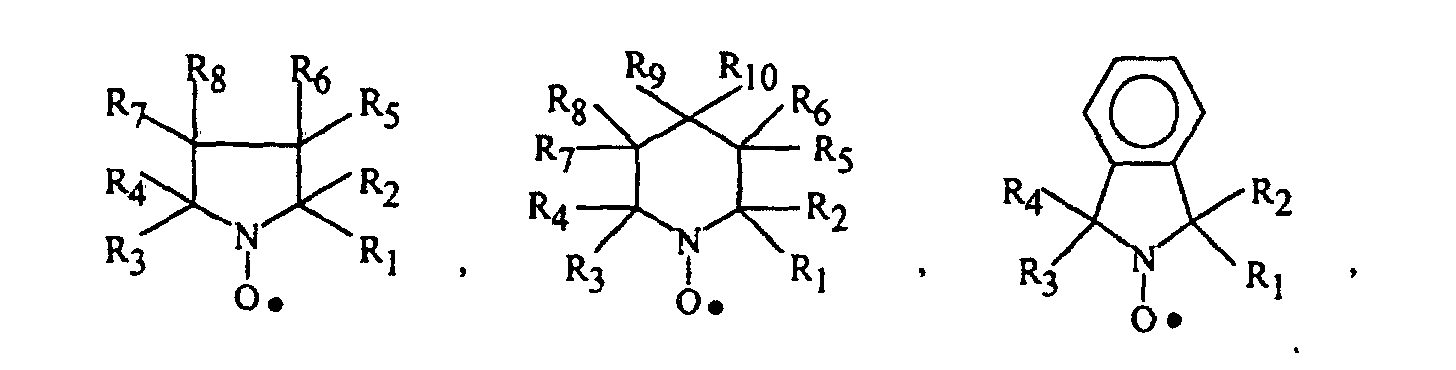
 wobei R1, R2, R3, R4, R'1 und R'2, identisch oder verschieden, ein Halogenatom wie Chlor, Brom oder Iod, eine gesättigte oder ungesättigte, lineare, verzweigte oder ringförmige Kohlenwasserstoffgruppe wie einen Alkyl- oder Phenylrest oder eine Estergruppe -COOR oder eine Alkoxylgruppe -OR oder eine Phosphonatgruppe -PO(OR)2 oder eine Polymerkette, die beispielsweise eine Polymethylmethacrylatkette, eine Polybutadienkette oder eine Polyolefinkette wie eine Polyethylen- oder eine Polypropylenkette sein kann, aber vorzugsweise eine Polystyrolkette ist, darstellen und wobei R5, R6, R7, R8, R9 und R10, identisch oder verschieden, ausgewählt sein können aus derselben Familie von Gruppen, wie sie in bezug auf R1, R2, R3, R4, R'1 und R'2 genannt worden sind, und außerdem ein Wasserstoffatom, eine Hydroxylgruppe -OH oder eine Säuregruppe wie - COOH oder -PO(OH)2 oder -SO3H darstellen können,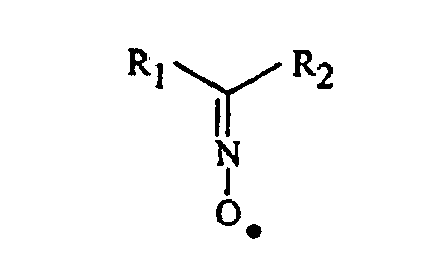
oder das stabile freie Radikalausgewählt ist aus der folgenden Liste:N-Tertiobutyl-1-phenyl-2-methylpropylnitroxid,N-Tertiobutyl-1-(2-naphthyl)-2-methylpropylnitroxid,N-Tertiobutyl-1-diethylphösphono-2,2-dimethylpropylnitroxid,N-Tertiobutyl-1-dibenzylphosphono-2,2-dimethylpropylnitroxid,N-Phenyl-1-diethylphosphono-2,2-dimethylpropylnitroxid,N-Phenyl-1-diethylphosphono-1-methylethylnitroxid,N-(1-Phenyl-2-methylpropyl)-1-diethylphosphono-1-methylethylnitroxid. - Verfahren nach einem der vorhergehenden Ansprüche, dadurch gekennzeichnet, daß das Molverhältnis von stabilem freiem Radikal zu Starter zwischen 1,5 und 2,6 liegt.
- Verfahren nach einem der vorhergehenden Ansprüche, dadurch gekennzeichnet, daß die Polymerisations- oder Copolymerisationstemperatur von 100 °C bis 130 °C reicht.
- Verfahren nach einem der vorhergehenden Ansprüche, dadurch gekennzeichnet, daß der Umsetzungsgrad des Monomers zu Polymer größer als 50 % ist.
- Verfahren nach dem vorhergehenden Anspruch, dadurch gekennzeichnet, daß der Umsetzungsgrad größer als 60 % ist.
- Verfahren nach einem der vorhergehenden Ansprüche, dadurch gekennzeichnet, daß es zu einem Polymer oder Copolymer mit einer gewichtsmittleren Molekularmasse von mehr als 10.000 führt.
- Verfahren nach dem vorhergehenden Anspruch, dadurch gekennzeichnet, daß es zu einem Polymer oder Copolymer mit einer gewichtsmittleren Molekularmasse von 100.000 bis 400.000 führt.
- Verfahren nach einem der vorhergehenden Ansprüche, dadurch gekennzeichnet, daß das Molverhältnis der Menge von stabilem freiem Radikal zu der Menge des Monomers größer als 1,2.
- Verfahren nach einem der vorhergehenden Ansprüche, dadurch gekennzeichnet, daß es zu einem Polymer oder Copolymer mit einer Polymolekularität von weniger als 1,9 führt.
- Verfahren nach einem der vorhergehenden Ansprüche, dadurch gekennzeichnet, daß es zu einem Polymer oder Copolymer mit einem Gelbwert (Vergilbungsindex) von weniger als 10 führt.
- Verfahren nach einem der vorhergehenden Ansprüche, dadurch gekennzeichnet, daß es zu einem Polymer oder Copolymer mit einem Gelbwert (Vergilbungsindex) von weniger als 5 führt.
- Verfahren nach einem der vorhergehenden Ansprüche, dadurch gekennzeichnet, daß es zu einem Polymer oder Copolymer mit einer Polymolekularität von weniger als 1,5 führt.
- Verfahren nach einem der vorhergehenden Ansprüche, dadurch gekennzeichnet, daß es in Masse oder in Lösung in einem organischen Lösemittel durchgeführt wird.
- Verfahren nach einem der vorhergehenden Ansprüche, dadurch gekennzeichnet, daß mindestens ein Monomer vinylaromatisch oder acrylisch oder methacrylisch ist oder ein Dien ist.
- Verfahren nach einem der vorhergehenden Ansprüche, dadurch gekennzeichnet, daß jedes vorhandene Monomer ausgewählt ist aus der folgenden Liste: vinylaromatisches Monomer, Dienmonomer, Acryl- oder Methacrylmonomer, Vinylidendifluorid, Vinylchlorid, und wenn ein vinylaromatisches Monomer vorhanden ist, gegebenenfalls Acrylnitril, Methacrylnitril, Acrylsäure, Methacrylsäure, einem Alkylester, dessen Alkylgruppe 1 bis 4 Kohlenstoffatome enthält, einem N-Alkylmaleinimid, dessen Alkylgruppe 1 bis 4 Kohlenstoffatome enthält, und N-Phenylmaleinimid.
- Verfahren nach dem vorhergehenden Anspruch, dadurch gekennzeichnet, daß ein vinylaromatisches Monomer vorhanden ist und daß jedes vorhandene Monomer ausgewählt ist aus der folgenden Liste: vinylaromatisches Monomer, Acrylnitril, Methacrylnitril, Acrylsäure, Methacrylsäure, einem Alkylester mit einer Akylgruppe mit 1 bis 4 Kohlenstoffatomen, einem N-Alkylmaleinimid mit einer Alkylgruppe mit 1 bis 4 Kohlenstoffatomen und N-Phenylmaleinimid.
- Verfahren nach dem vorhergehenden Anspruch, dadurch gekennzeichnet, daß jedes vorhandene Monomer vinylaromatisch ist.
- Polymer oder Copolymer, erhalten durch radikalische Polymerisation mindestens eines Monomers, und mit einer gewichtsmittleren Molekularmasse von mehr als 50.000, einer Polymolekularität von weniger als 1,9 und einem Gelbwert (Vergilbungsindex), gemessen nach der Norm ASTM D 1925, von weniger als 20.
- Polymer oder Copolymer nach dem vorhergehenden Anspruch, dadurch gekennzeichnet, daß der Gelbwert (Vergilbungsindex) kleiner als 10 ist.
- Polymer oder Copolymer nach dem vorhergehenden Anspruch, dadurch gekennzeichnet, daß der Gelbwert (Vergilbungsindex) kleiner als 5 ist.
- Polymer oder Copolymer nach einem der Ansprüche 24 bis 26, dadurch gekennzeichnet, daß seine Polymolekularität kleiner als 1,5 ist.
- Polymer oder Copolymer nach einem der Ansprüche 24 bis 27, dadurch gekennzeichnet, daß es eine gewichtsmittlere Molekularmasse von 100.00 bis 400.000 aufweist.
- Polymer oder Copolymer nach einem der Ansprüche 24 bis 28, dadurch gekennzeichnet, daß jedes bei seiner Polymerisation oder Copolymerisation vorhandene Monomer ausgewählt ist aus der folgenden Liste: vinylaromatisches Monomer, Dien, Acryl- oder Methacrylmonomer, Vinylidendifluorid, Vinylchlorid, und wenn ein vinylaromatisches Monomer vorhanden ist, gegebenenfalls Acrylnitril, Methacrylnitril, Acrylsäure, Methacrylsäure, einem Alkylester mit einer Alkylgruppe mit 1 bis 4 Kohlenstoffatomen, einem N-Alkylmaleinimid mit einer Alkylgruppe mit 1 bis 4 Kohlenstoffatomen und N-Phenylmaleinimid.
- Polymer oder Copolymer nach dem vorhergehenden Anspruch, dadurch gekennzeichnet, daß jedes bei seiner Polymerisation oder Copolymerisation vorhandene Monomer ausgewählt ist aus der folgenden Liste: vinylaromatisches Monomer, Acrylnitril, Methacrylnitril, Acrylsäure, Methacrylsäure, einem Alkylester mit einer Alkylgruppe mit 1 bis 4 Kohlenstoffatomen, einem N-Alkylmaleinimid mit einer Alkylgruppe mit 1 bis 4 Kohlenstoffatomen und N-Phenylmaleinimid, wobei zwingend ein vinylaromatisches Monomer vorhanden ist.
- Polymer oder Copolymer nach dem vorhergehenden Anspruch, dadurch gekennzeichnet, daß jedes bei seiner Polymerisation oder Copolymerisation vorhandene Monomer vinylaromatisch ist.
Applications Claiming Priority (2)
| Application Number | Priority Date | Filing Date | Title |
|---|---|---|---|
| FR9605909A FR2748484B1 (fr) | 1996-05-13 | 1996-05-13 | Polymerisation en presence d'un radical libre stable et d'un initiateur de radicaux libres |
| FR9605909 | 1996-05-13 |
Publications (3)
| Publication Number | Publication Date |
|---|---|
| EP0807640A1 EP0807640A1 (de) | 1997-11-19 |
| EP0807640B1 true EP0807640B1 (de) | 2002-07-03 |
| EP0807640B2 EP0807640B2 (de) | 2009-02-18 |
Family
ID=9492064
Family Applications (1)
| Application Number | Title | Priority Date | Filing Date |
|---|---|---|---|
| EP97106251A Expired - Lifetime EP0807640B2 (de) | 1996-05-13 | 1997-04-16 | Polymerisation in Anwesenheit eines stabilen freien Radikals und eines freien radikalischen Initiators |
Country Status (14)
| Country | Link |
|---|---|
| US (1) | US6346589B1 (de) |
| EP (1) | EP0807640B2 (de) |
| JP (1) | JPH1045817A (de) |
| KR (1) | KR100481267B1 (de) |
| CN (2) | CN1137143C (de) |
| AT (1) | ATE220075T1 (de) |
| CA (1) | CA2204780C (de) |
| DE (1) | DE69713681T2 (de) |
| ES (1) | ES2179976T3 (de) |
| FR (1) | FR2748484B1 (de) |
| NO (1) | NO324339B1 (de) |
| PL (1) | PL319929A1 (de) |
| SG (1) | SG78270A1 (de) |
| TW (1) | TW454018B (de) |
Families Citing this family (6)
| Publication number | Priority date | Publication date | Assignee | Title |
|---|---|---|---|---|
| KR970064016U (ko) | 1996-05-31 | 1997-12-11 | 브이시알의 전면 패널 | |
| FR2797878B1 (fr) * | 1999-08-05 | 2003-10-17 | Atofina | Procede de polymerisation ou copolymerisation radicalaire controlee de l'ethylene sous haute pression en presence d'un amorceur-controleur |
| US6734269B1 (en) | 1998-10-06 | 2004-05-11 | Atofina | Method for controlled free radical polymerization or copolymerization of ethylene under high pressure in the presence of an initiator-controller |
| US6653409B2 (en) | 2001-02-26 | 2003-11-25 | The Yokohama Rubber Co., Ltd. | Radical-modified polymer and polymer composition containing the same |
| CA2633263A1 (en) * | 2005-12-16 | 2007-07-12 | Arkema Inc. | Low surface energy block co-polymer preparation methods and applications |
| US10368053B2 (en) * | 2012-11-14 | 2019-07-30 | Qualcomm Incorporated | Structured light active depth sensing systems combining multiple images to compensate for differences in reflectivity and/or absorption |
Family Cites Families (21)
| Publication number | Priority date | Publication date | Assignee | Title |
|---|---|---|---|---|
| US3914339A (en) † | 1970-06-24 | 1975-10-21 | Sumitomo Chemical Co | Process for producing rubber-modified plastics |
| US4006283A (en) * | 1974-12-23 | 1977-02-01 | General Electric Company | Preparation of di-tertiary butyl peroxide crosslink polyolefin materials |
| DE3486145T2 (de) | 1983-07-11 | 1993-09-23 | Commw Scient Ind Res Org | Verfahren zur polymerisation und nach diesem verfahren hergestellte polymere. |
| DE3942592A1 (de) * | 1989-12-22 | 1991-06-27 | Basf Lacke & Farben | Loesliche vernetzbare copolymerisate auf der basis von vinylester-, vinyaromat- und acrylatmonomeren, verfahren zu ihrer herstellung sowie ihre verwendung in beschichtungsmitteln |
| IT1241155B (it) * | 1990-05-18 | 1993-12-29 | Vedril | Procedimento per la produzione di polimeri acrilici in massa continua |
| JPH04146908A (ja) † | 1990-10-09 | 1992-05-20 | Monsant Kasei Kk | スチレン―アクリロニトリル共重合体の製造法 |
| US5344902A (en) * | 1991-06-18 | 1994-09-06 | Occidental Research Corporation | Polymerization with initiator and quaternary ammonium salt |
| US5322912A (en) * | 1992-11-16 | 1994-06-21 | Xerox Corporation | Polymerization processes and toner compositions therefrom |
| US5852140A (en) | 1993-03-25 | 1998-12-22 | Xerox Corporation | Semisuspension polymerization processes |
| DE4340887A1 (de) † | 1993-12-01 | 1995-06-08 | Roehm Gmbh | Polymethacrylat-Formmasse mit hoher Wärmeformbeständigkeit und hoher Stabilität gegen thermischen Abbau |
| WO1995026987A1 (en) * | 1994-04-04 | 1995-10-12 | Xerox Corporation | Aqueous polymerization processes |
| US5412047A (en) * | 1994-05-13 | 1995-05-02 | Xerox Corporation | Homoacrylate polymerization processes with oxonitroxides |
| JPH083208A (ja) † | 1994-06-20 | 1996-01-09 | Nippon Steel Chem Co Ltd | 分子量調節剤 |
| DE4424300A1 (de) † | 1994-07-09 | 1996-01-11 | Roehm Gmbh | Kontinuierliches Verfahren zur Herstellung einer thermoplastischen Kunststoff-Formmasse |
| US6084044A (en) | 1994-12-14 | 2000-07-04 | The Dow Chemical Company | Catalyzed process for producing high molecular weight monovinylidene aromatic polymers |
| JPH10510858A (ja) | 1994-12-14 | 1998-10-20 | ザ ダウ ケミカル カンパニー | ビニル酸触媒のフリーラジカル重合による高分子量ポリスチレンの製造 |
| US5449724A (en) * | 1994-12-14 | 1995-09-12 | Xerox Corporation | Stable free radical polymerization process and thermoplastic materials produced therefrom |
| US5530079A (en) * | 1995-01-03 | 1996-06-25 | Xerox Corporation | Polymerization processes |
| FR2730240A1 (fr) | 1995-02-07 | 1996-08-09 | Atochem Elf Sa | Stabilisation d'un polymere par un radical libre stable |
| JPH08269107A (ja) | 1995-03-30 | 1996-10-15 | Xerox Corp | フリーラジカル重合方法 |
| US5773510A (en) | 1995-03-30 | 1998-06-30 | Xerox Corporation | Processes for the preparation of branched polymers |
-
1996
- 1996-05-13 FR FR9605909A patent/FR2748484B1/fr not_active Expired - Fee Related
-
1997
- 1997-04-16 ES ES97106251T patent/ES2179976T3/es not_active Expired - Lifetime
- 1997-04-16 DE DE69713681T patent/DE69713681T2/de not_active Expired - Lifetime
- 1997-04-16 EP EP97106251A patent/EP0807640B2/de not_active Expired - Lifetime
- 1997-04-16 AT AT97106251T patent/ATE220075T1/de not_active IP Right Cessation
- 1997-04-21 NO NO19971833A patent/NO324339B1/no unknown
- 1997-05-07 CA CA002204780A patent/CA2204780C/fr not_active Expired - Fee Related
- 1997-05-08 SG SG1997001426A patent/SG78270A1/en unknown
- 1997-05-09 US US08/853,240 patent/US6346589B1/en not_active Expired - Fee Related
- 1997-05-12 PL PL97319929A patent/PL319929A1/xx unknown
- 1997-05-13 CN CNB971135940A patent/CN1137143C/zh not_active Expired - Fee Related
- 1997-05-13 JP JP9137616A patent/JPH1045817A/ja active Pending
- 1997-05-13 KR KR1019970018573A patent/KR100481267B1/ko not_active Expired - Fee Related
- 1997-05-13 CN CNA031458521A patent/CN1478798A/zh active Pending
- 1997-05-22 TW TW086106888A patent/TW454018B/zh not_active IP Right Cessation
Non-Patent Citations (1)
| Title |
|---|
| Swern D., Organic Peroxides; Swern D., Ed.; Wiley, New-York, Vol. II, 1971, pages 870-871. * |
Also Published As
| Publication number | Publication date |
|---|---|
| FR2748484B1 (fr) | 1998-07-24 |
| DE69713681T2 (de) | 2003-02-27 |
| KR970074800A (ko) | 1997-12-10 |
| NO971833L (no) | 1997-11-14 |
| NO324339B1 (no) | 2007-09-24 |
| TW454018B (en) | 2001-09-11 |
| KR100481267B1 (ko) | 2005-09-16 |
| CA2204780A1 (fr) | 1997-11-13 |
| FR2748484A1 (fr) | 1997-11-14 |
| PL319929A1 (en) | 1997-11-24 |
| JPH1045817A (ja) | 1998-02-17 |
| EP0807640B2 (de) | 2009-02-18 |
| US6346589B1 (en) | 2002-02-12 |
| DE69713681D1 (de) | 2002-08-08 |
| NO971833D0 (no) | 1997-04-21 |
| ES2179976T3 (es) | 2003-02-01 |
| CN1169437A (zh) | 1998-01-07 |
| CN1478798A (zh) | 2004-03-03 |
| EP0807640A1 (de) | 1997-11-19 |
| SG78270A1 (en) | 2001-02-20 |
| ATE220075T1 (de) | 2002-07-15 |
| CA2204780C (fr) | 2007-11-13 |
| CN1137143C (zh) | 2004-02-04 |
Similar Documents
| Publication | Publication Date | Title |
|---|---|---|
| EP0726280B1 (de) | Verfahren zur Herstellung einer Zusammensetzung, enthaltend ein vinylaromatisches Polymer und einen Kautschuk, durch Polymerisation in Gegenwart eines stabilen freien Radikals | |
| EP0760824B1 (de) | Polymerisation in gegenwart von einem beta-substituiertem nitroxyd-radikal | |
| EP0903354B1 (de) | Herstellung von schlagfesten vinylaromatischen Polymer aus einem Kautschuk mit einer Gruppe zur Erzeugung eines freien, stabilen Radikal | |
| EP0991683B1 (de) | Verfahren zur herstellung von blockcopolymeren durch kontrollierte radikalische polymerisation | |
| EP0927727B1 (de) | Verfahren zur kontrollierten Radikalpolymerisation mit Verwendung geringer Mengen eines stabilen Freien Radikalen | |
| EP0992514B1 (de) | Radikalische Polymerisation in Gegenwart von mehreren stabilen, freien Radikalen | |
| EP0807640B2 (de) | Polymerisation in Anwesenheit eines stabilen freien Radikals und eines freien radikalischen Initiators | |
| EP0844256B1 (de) | Polymerisation in anwesenheit eines stabilen freien Radikal und ein Iniferter | |
| EP0906937A1 (de) | Durch frei Radikale polymerisation gepfropft Polymer in Gegenwart von Stabilen Freien Radikalen, dessen Herstellung und Anwendungen | |
| US6815500B1 (en) | Shock vinylaromatic polymer by polymerization of a vinylaromatic monomer in the presence of free radical and a polymerization initiator | |
| FR2791060A1 (fr) | Procede de preparation d'un caoutchouc porteur de radical libre stable et utilisation dudit caoutchouc porteur pour la preparation d'un polymere vinylaromatique choc | |
| FR2768738A1 (fr) | Polymere vinylaromatique choc obtenu a partir d'un caoutchouc porteur d'un groupement generateur d'un radical libre stable | |
| EP0718329A1 (de) | Verfahren zur Herstellung einer Zusammensetzung aus einem Vinylaromatischen Polymerisat, einem Kautschuk, einem mineralischen Füllstoff und einem Haftvermittler und die Zusammensetzung selbst | |
| CA2185164C (fr) | Polymerisation en presence d'un radical nitroxyde .beta.-substitue |
Legal Events
| Date | Code | Title | Description |
|---|---|---|---|
| PUAI | Public reference made under article 153(3) epc to a published international application that has entered the european phase |
Free format text: ORIGINAL CODE: 0009012 |
|
| 17P | Request for examination filed |
Effective date: 19970416 |
|
| AK | Designated contracting states |
Kind code of ref document: A1 Designated state(s): AT BE DE ES FI FR GB IT NL SE |
|
| 17Q | First examination report despatched |
Effective date: 19990113 |
|
| RAP1 | Party data changed (applicant data changed or rights of an application transferred) |
Owner name: ATOFINA |
|
| GRAG | Despatch of communication of intention to grant |
Free format text: ORIGINAL CODE: EPIDOS AGRA |
|
| GRAG | Despatch of communication of intention to grant |
Free format text: ORIGINAL CODE: EPIDOS AGRA |
|
| GRAH | Despatch of communication of intention to grant a patent |
Free format text: ORIGINAL CODE: EPIDOS IGRA |
|
| GRAH | Despatch of communication of intention to grant a patent |
Free format text: ORIGINAL CODE: EPIDOS IGRA |
|
| GRAA | (expected) grant |
Free format text: ORIGINAL CODE: 0009210 |
|
| AK | Designated contracting states |
Kind code of ref document: B1 Designated state(s): AT BE DE ES FI FR GB IT NL SE |
|
| PG25 | Lapsed in a contracting state [announced via postgrant information from national office to epo] |
Ref country code: NL Free format text: LAPSE BECAUSE OF FAILURE TO SUBMIT A TRANSLATION OF THE DESCRIPTION OR TO PAY THE FEE WITHIN THE PRESCRIBED TIME-LIMIT Effective date: 20020703 |
|
| REF | Corresponds to: |
Ref document number: 220075 Country of ref document: AT Date of ref document: 20020715 Kind code of ref document: T |
|
| REF | Corresponds to: |
Ref document number: 69713681 Country of ref document: DE Date of ref document: 20020808 |
|
| GBT | Gb: translation of ep patent filed (gb section 77(6)(a)/1977) |
Effective date: 20021002 |
|
| NLV1 | Nl: lapsed or annulled due to failure to fulfill the requirements of art. 29p and 29m of the patents act | ||
| REG | Reference to a national code |
Ref country code: ES Ref legal event code: FG2A Ref document number: 2179976 Country of ref document: ES Kind code of ref document: T3 |
|
| PLBQ | Unpublished change to opponent data |
Free format text: ORIGINAL CODE: EPIDOS OPPO |
|
| PLBI | Opposition filed |
Free format text: ORIGINAL CODE: 0009260 |
|
| PLBQ | Unpublished change to opponent data |
Free format text: ORIGINAL CODE: EPIDOS OPPO |
|
| PLBI | Opposition filed |
Free format text: ORIGINAL CODE: 0009260 |
|
| PLBF | Reply of patent proprietor to notice(s) of opposition |
Free format text: ORIGINAL CODE: EPIDOS OBSO |
|
| 26 | Opposition filed |
Opponent name: ROEHM GMBH & CO. KG Effective date: 20030401 |
|
| 26 | Opposition filed |
Opponent name: THE DOW CHEMICAL COMPANY Effective date: 20030403 Opponent name: ROEHM GMBH & CO. KG Effective date: 20030401 |
|
| PLAX | Notice of opposition and request to file observation + time limit sent |
Free format text: ORIGINAL CODE: EPIDOSNOBS2 |
|
| PLBB | Reply of patent proprietor to notice(s) of opposition received |
Free format text: ORIGINAL CODE: EPIDOSNOBS3 |
|
| RAP2 | Party data changed (patent owner data changed or rights of a patent transferred) |
Owner name: ARKEMA |
|
| PLAQ | Examination of admissibility of opposition: information related to despatch of communication + time limit deleted |
Free format text: ORIGINAL CODE: EPIDOSDOPE2 |
|
| PLAR | Examination of admissibility of opposition: information related to receipt of reply deleted |
Free format text: ORIGINAL CODE: EPIDOSDOPE4 |
|
| PLBQ | Unpublished change to opponent data |
Free format text: ORIGINAL CODE: EPIDOS OPPO |
|
| PLAB | Opposition data, opponent's data or that of the opponent's representative modified |
Free format text: ORIGINAL CODE: 0009299OPPO |
|
| R26 | Opposition filed (corrected) |
Opponent name: THE DOW CHEMICAL COMPANY Effective date: 20030403 Opponent name: ROEHM GMBH & CO. KG Effective date: 20030401 |
|
| RAP2 | Party data changed (patent owner data changed or rights of a patent transferred) |
Owner name: ARKEMA FRANCE |
|
| RAP2 | Party data changed (patent owner data changed or rights of a patent transferred) |
Owner name: ARKEMA FRANCE |
|
| PLAB | Opposition data, opponent's data or that of the opponent's representative modified |
Free format text: ORIGINAL CODE: 0009299OPPO |
|
| R26 | Opposition filed (corrected) |
Opponent name: THE DOW CHEMICAL COMPANY Effective date: 20030403 Opponent name: EVONIK ROEHM GMBH Effective date: 20030401 |
|
| PGFP | Annual fee paid to national office [announced via postgrant information from national office to epo] |
Ref country code: FR Payment date: 20080312 Year of fee payment: 12 Ref country code: ES Payment date: 20080520 Year of fee payment: 12 Ref country code: DE Payment date: 20080424 Year of fee payment: 12 |
|
| PGFP | Annual fee paid to national office [announced via postgrant information from national office to epo] |
Ref country code: AT Payment date: 20080410 Year of fee payment: 12 |
|
| PGFP | Annual fee paid to national office [announced via postgrant information from national office to epo] |
Ref country code: FI Payment date: 20080411 Year of fee payment: 12 Ref country code: BE Payment date: 20080616 Year of fee payment: 12 Ref country code: IT Payment date: 20080428 Year of fee payment: 12 |
|
| RIC2 | Information provided on ipc code assigned after grant |
Ipc: C08F 20/12 20060101ALI20080923BHEP Ipc: C08F 36/02 20060101ALI20080923BHEP Ipc: C08F 12/02 20060101ALI20080923BHEP Ipc: C08F 4/34 20060101ALI20080923BHEP Ipc: C08F 2/00 20060101AFI20080923BHEP |
|
| PGFP | Annual fee paid to national office [announced via postgrant information from national office to epo] |
Ref country code: SE Payment date: 20080408 Year of fee payment: 12 |
|
| PGFP | Annual fee paid to national office [announced via postgrant information from national office to epo] |
Ref country code: GB Payment date: 20080416 Year of fee payment: 12 |
|
| PUAH | Patent maintained in amended form |
Free format text: ORIGINAL CODE: 0009272 |
|
| STAA | Information on the status of an ep patent application or granted ep patent |
Free format text: STATUS: PATENT MAINTAINED AS AMENDED |
|
| 27A | Patent maintained in amended form |
Effective date: 20090218 |
|
| AK | Designated contracting states |
Kind code of ref document: B2 Designated state(s): AT BE DE ES FI FR GB IT NL SE |
|
| PG25 | Lapsed in a contracting state [announced via postgrant information from national office to epo] |
Ref country code: ES Free format text: LAPSE BECAUSE OF FAILURE TO SUBMIT A TRANSLATION OF THE DESCRIPTION OR TO PAY THE FEE WITHIN THE PRESCRIBED TIME-LIMIT Effective date: 20090529 |
|
| PG25 | Lapsed in a contracting state [announced via postgrant information from national office to epo] |
Ref country code: AT Free format text: LAPSE BECAUSE OF FAILURE TO SUBMIT A TRANSLATION OF THE DESCRIPTION OR TO PAY THE FEE WITHIN THE PRESCRIBED TIME-LIMIT Effective date: 20020703 |
|
| BERE | Be: lapsed |
Owner name: *ATOFINA Effective date: 20090430 |
|
| GBPC | Gb: european patent ceased through non-payment of renewal fee |
Effective date: 20090416 |
|
| PG25 | Lapsed in a contracting state [announced via postgrant information from national office to epo] |
Ref country code: DE Free format text: LAPSE BECAUSE OF FAILURE TO SUBMIT A TRANSLATION OF THE DESCRIPTION OR TO PAY THE FEE WITHIN THE PRESCRIBED TIME-LIMIT Effective date: 20090519 |
|
| PG25 | Lapsed in a contracting state [announced via postgrant information from national office to epo] |
Ref country code: GB Free format text: LAPSE BECAUSE OF NON-PAYMENT OF DUE FEES Effective date: 20090416 |
|
| PG25 | Lapsed in a contracting state [announced via postgrant information from national office to epo] |
Ref country code: BE Free format text: LAPSE BECAUSE OF NON-PAYMENT OF DUE FEES Effective date: 20090430 |
|
| PG25 | Lapsed in a contracting state [announced via postgrant information from national office to epo] |
Ref country code: FI Free format text: LAPSE BECAUSE OF NON-PAYMENT OF DUE FEES Effective date: 20020703 |
|
| PG25 | Lapsed in a contracting state [announced via postgrant information from national office to epo] |
Ref country code: IT Free format text: LAPSE BECAUSE OF NON-PAYMENT OF DUE FEES Effective date: 20090416 |
|
| REG | Reference to a national code |
Ref country code: FR Ref legal event code: ST Effective date: 20110923 |
|
| PG25 | Lapsed in a contracting state [announced via postgrant information from national office to epo] |
Ref country code: FR Free format text: LAPSE BECAUSE OF NON-PAYMENT OF DUE FEES Effective date: 20090430 |
|
| PG25 | Lapsed in a contracting state [announced via postgrant information from national office to epo] |
Ref country code: FI Free format text: LAPSE BECAUSE OF FAILURE TO SUBMIT A TRANSLATION OF THE DESCRIPTION OR TO PAY THE FEE WITHIN THE PRESCRIBED TIME-LIMIT Effective date: 20090218 Ref country code: SE Free format text: LAPSE BECAUSE OF NON-PAYMENT OF DUE FEES Effective date: 20090714 |