EP0807640B1 - Polymerization in the presence of a stable free radical and free radical initiator - Google Patents
Polymerization in the presence of a stable free radical and free radical initiator Download PDFInfo
- Publication number
- EP0807640B1 EP0807640B1 EP97106251A EP97106251A EP0807640B1 EP 0807640 B1 EP0807640 B1 EP 0807640B1 EP 97106251 A EP97106251 A EP 97106251A EP 97106251 A EP97106251 A EP 97106251A EP 0807640 B1 EP0807640 B1 EP 0807640B1
- Authority
- EP
- European Patent Office
- Prior art keywords
- process according
- polymer
- monomer
- copolymer
- polymerization
- Prior art date
- Legal status (The legal status is an assumption and is not a legal conclusion. Google has not performed a legal analysis and makes no representation as to the accuracy of the status listed.)
- Expired - Lifetime
Links
- 150000003254 radicals Chemical class 0.000 title claims abstract description 49
- 239000003999 initiator Substances 0.000 title claims abstract description 31
- 238000006116 polymerization reaction Methods 0.000 title claims description 37
- 239000000178 monomer Substances 0.000 claims abstract description 58
- 238000000034 method Methods 0.000 claims abstract description 39
- 229920001577 copolymer Polymers 0.000 claims abstract description 31
- 125000000217 alkyl group Chemical group 0.000 claims abstract description 16
- 125000003118 aryl group Chemical group 0.000 claims abstract description 5
- 125000002877 alkyl aryl group Chemical group 0.000 claims abstract description 3
- 229920000642 polymer Polymers 0.000 claims description 52
- 238000006243 chemical reaction Methods 0.000 claims description 24
- 238000007334 copolymerization reaction Methods 0.000 claims description 22
- -1 aralkyl radical Chemical class 0.000 claims description 17
- 125000004432 carbon atom Chemical group C* 0.000 claims description 12
- NIXOWILDQLNWCW-UHFFFAOYSA-N acrylic acid group Chemical group C(C=C)(=O)O NIXOWILDQLNWCW-UHFFFAOYSA-N 0.000 claims description 9
- 150000001993 dienes Chemical group 0.000 claims description 7
- XMNIXWIUMCBBBL-UHFFFAOYSA-N 2-(2-phenylpropan-2-ylperoxy)propan-2-ylbenzene Chemical group C=1C=CC=CC=1C(C)(C)OOC(C)(C)C1=CC=CC=C1 XMNIXWIUMCBBBL-UHFFFAOYSA-N 0.000 claims description 6
- HIDBROSJWZYGSZ-UHFFFAOYSA-N 1-phenylpyrrole-2,5-dione Chemical compound O=C1C=CC(=O)N1C1=CC=CC=C1 HIDBROSJWZYGSZ-UHFFFAOYSA-N 0.000 claims description 5
- NLHHRLWOUZZQLW-UHFFFAOYSA-N Acrylonitrile Chemical compound C=CC#N NLHHRLWOUZZQLW-UHFFFAOYSA-N 0.000 claims description 5
- CERQOIWHTDAKMF-UHFFFAOYSA-N Methacrylic acid Chemical compound CC(=C)C(O)=O CERQOIWHTDAKMF-UHFFFAOYSA-N 0.000 claims description 5
- GYCMBHHDWRMZGG-UHFFFAOYSA-N Methylacrylonitrile Chemical compound CC(=C)C#N GYCMBHHDWRMZGG-UHFFFAOYSA-N 0.000 claims description 5
- 239000004793 Polystyrene Substances 0.000 claims description 5
- 125000005907 alkyl ester group Chemical group 0.000 claims description 5
- 229920002223 polystyrene Polymers 0.000 claims description 5
- 239000005062 Polybutadiene Substances 0.000 claims description 4
- 125000005395 methacrylic acid group Chemical group 0.000 claims description 4
- 229920002857 polybutadiene Polymers 0.000 claims description 4
- BQCIDUSAKPWEOX-UHFFFAOYSA-N 1,1-Difluoroethene Chemical compound FC(F)=C BQCIDUSAKPWEOX-UHFFFAOYSA-N 0.000 claims description 3
- 239000002253 acid Substances 0.000 claims description 3
- 239000008346 aqueous phase Substances 0.000 claims description 3
- 238000004519 manufacturing process Methods 0.000 claims description 3
- 239000012074 organic phase Substances 0.000 claims description 3
- WKBOTKDWSSQWDR-UHFFFAOYSA-N Bromine atom Chemical compound [Br] WKBOTKDWSSQWDR-UHFFFAOYSA-N 0.000 claims description 2
- ZAMOUSCENKQFHK-UHFFFAOYSA-N Chlorine atom Chemical compound [Cl] ZAMOUSCENKQFHK-UHFFFAOYSA-N 0.000 claims description 2
- ABLZXFCXXLZCGV-UHFFFAOYSA-N Phosphorous acid Chemical group OP(O)=O ABLZXFCXXLZCGV-UHFFFAOYSA-N 0.000 claims description 2
- 239000004698 Polyethylene Substances 0.000 claims description 2
- CIUQDSCDWFSTQR-UHFFFAOYSA-N [C]1=CC=CC=C1 Chemical compound [C]1=CC=CC=C1 CIUQDSCDWFSTQR-UHFFFAOYSA-N 0.000 claims description 2
- 125000003545 alkoxy group Chemical group 0.000 claims description 2
- GDTBXPJZTBHREO-UHFFFAOYSA-N bromine Substances BrBr GDTBXPJZTBHREO-UHFFFAOYSA-N 0.000 claims description 2
- 229910052794 bromium Inorganic materials 0.000 claims description 2
- 229910052801 chlorine Inorganic materials 0.000 claims description 2
- 239000000460 chlorine Substances 0.000 claims description 2
- 125000004185 ester group Chemical group 0.000 claims description 2
- 125000005843 halogen group Chemical group 0.000 claims description 2
- 125000004435 hydrogen atom Chemical group [H]* 0.000 claims description 2
- 125000002887 hydroxy group Chemical group [H]O* 0.000 claims description 2
- PNDPGZBMCMUPRI-UHFFFAOYSA-N iodine Chemical compound II PNDPGZBMCMUPRI-UHFFFAOYSA-N 0.000 claims description 2
- 239000003960 organic solvent Substances 0.000 claims description 2
- 229920003229 poly(methyl methacrylate) Polymers 0.000 claims description 2
- 229920000573 polyethylene Polymers 0.000 claims description 2
- 239000004926 polymethyl methacrylate Substances 0.000 claims description 2
- 229920000098 polyolefin Polymers 0.000 claims description 2
- 238000010526 radical polymerization reaction Methods 0.000 claims description 2
- 229920006395 saturated elastomer Polymers 0.000 claims description 2
- 238000004383 yellowing Methods 0.000 claims 6
- SMZOUWXMTYCWNB-UHFFFAOYSA-N 2-(2-methoxy-5-methylphenyl)ethanamine Chemical compound COC1=CC=C(C)C=C1CCN SMZOUWXMTYCWNB-UHFFFAOYSA-N 0.000 claims 4
- BZHJMEDXRYGGRV-UHFFFAOYSA-N Vinyl chloride Chemical compound ClC=C BZHJMEDXRYGGRV-UHFFFAOYSA-N 0.000 claims 2
- 230000001747 exhibiting effect Effects 0.000 claims 2
- VVQNEPGJFQJSBK-UHFFFAOYSA-N Methyl methacrylate Chemical group COC(=O)C(C)=C VVQNEPGJFQJSBK-UHFFFAOYSA-N 0.000 claims 1
- 229910006069 SO3H Inorganic materials 0.000 claims 1
- 125000003178 carboxy group Chemical group [H]OC(*)=O 0.000 claims 1
- 125000004122 cyclic group Chemical group 0.000 claims 1
- 125000003710 aryl alkyl group Chemical group 0.000 abstract 1
- PPBRXRYQALVLMV-UHFFFAOYSA-N Styrene Chemical group C=CC1=CC=CC=C1 PPBRXRYQALVLMV-UHFFFAOYSA-N 0.000 description 12
- WYURNTSHIVDZCO-UHFFFAOYSA-N Tetrahydrofuran Chemical compound C1CCOC1 WYURNTSHIVDZCO-UHFFFAOYSA-N 0.000 description 10
- 229920002554 vinyl polymer Polymers 0.000 description 10
- 239000003505 polymerization initiator Substances 0.000 description 7
- 230000015572 biosynthetic process Effects 0.000 description 5
- 238000005227 gel permeation chromatography Methods 0.000 description 5
- YLQBMQCUIZJEEH-UHFFFAOYSA-N tetrahydrofuran Natural products C=1C=COC=1 YLQBMQCUIZJEEH-UHFFFAOYSA-N 0.000 description 5
- IJGRMHOSHXDMSA-UHFFFAOYSA-N Atomic nitrogen Chemical compound N#N IJGRMHOSHXDMSA-UHFFFAOYSA-N 0.000 description 4
- OMPJBNCRMGITSC-UHFFFAOYSA-N Benzoylperoxide Chemical compound C=1C=CC=CC=1C(=O)OOC(=O)C1=CC=CC=C1 OMPJBNCRMGITSC-UHFFFAOYSA-N 0.000 description 4
- 230000000052 comparative effect Effects 0.000 description 4
- GDOPTJXRTPNYNR-UHFFFAOYSA-N methyl-cyclopentane Natural products CC1CCCC1 GDOPTJXRTPNYNR-UHFFFAOYSA-N 0.000 description 4
- 238000002360 preparation method Methods 0.000 description 4
- 125000001436 propyl group Chemical group [H]C([*])([H])C([H])([H])C([H])([H])[H] 0.000 description 4
- 239000004342 Benzoyl peroxide Substances 0.000 description 3
- OKKJLVBELUTLKV-UHFFFAOYSA-N Methanol Chemical compound OC OKKJLVBELUTLKV-UHFFFAOYSA-N 0.000 description 3
- 235000019400 benzoyl peroxide Nutrition 0.000 description 3
- 238000007086 side reaction Methods 0.000 description 3
- 0 **(*C(*)(*)*1*)C(*)(*)N1O Chemical compound **(*C(*)(*)*1*)C(*)(*)N1O 0.000 description 2
- SDJHPPZKZZWAKF-UHFFFAOYSA-N 2,3-dimethylbuta-1,3-diene Chemical compound CC(=C)C(C)=C SDJHPPZKZZWAKF-UHFFFAOYSA-N 0.000 description 2
- KAKZBPTYRLMSJV-UHFFFAOYSA-N Butadiene Chemical compound C=CC=C KAKZBPTYRLMSJV-UHFFFAOYSA-N 0.000 description 2
- RRHGJUQNOFWUDK-UHFFFAOYSA-N Isoprene Chemical compound CC(=C)C=C RRHGJUQNOFWUDK-UHFFFAOYSA-N 0.000 description 2
- RPDUDBYMNGAHEM-UHFFFAOYSA-N PROXYL Chemical group CC1(C)CCC(C)(C)N1[O] RPDUDBYMNGAHEM-UHFFFAOYSA-N 0.000 description 2
- QYTDEUPAUMOIOP-UHFFFAOYSA-N TEMPO Chemical group CC1(C)CCCC(C)(C)N1[O] QYTDEUPAUMOIOP-UHFFFAOYSA-N 0.000 description 2
- 241001080024 Telles Species 0.000 description 2
- 239000000203 mixture Substances 0.000 description 2
- 238000012544 monitoring process Methods 0.000 description 2
- 229910052757 nitrogen Inorganic materials 0.000 description 2
- 238000004172 nitrogen cycle Methods 0.000 description 2
- 230000000379 polymerizing effect Effects 0.000 description 2
- 238000003756 stirring Methods 0.000 description 2
- 125000003011 styrenyl group Chemical group [H]\C(*)=C(/[H])C1=C([H])C([H])=C([H])C([H])=C1[H] 0.000 description 2
- JAMNSIXSLVPNLC-UHFFFAOYSA-N (4-ethenylphenyl) acetate Chemical compound CC(=O)OC1=CC=C(C=C)C=C1 JAMNSIXSLVPNLC-UHFFFAOYSA-N 0.000 description 1
- PMJHHCWVYXUKFD-SNAWJCMRSA-N (E)-1,3-pentadiene Chemical group C\C=C\C=C PMJHHCWVYXUKFD-SNAWJCMRSA-N 0.000 description 1
- OEVVKKAVYQFQNV-UHFFFAOYSA-N 1-ethenyl-2,4-dimethylbenzene Chemical group CC1=CC=C(C=C)C(C)=C1 OEVVKKAVYQFQNV-UHFFFAOYSA-N 0.000 description 1
- UVHXEHGUEKARKZ-UHFFFAOYSA-N 1-ethenylanthracene Chemical compound C1=CC=C2C=C3C(C=C)=CC=CC3=CC2=C1 UVHXEHGUEKARKZ-UHFFFAOYSA-N 0.000 description 1
- OMNYXCUDBQKCMU-UHFFFAOYSA-N 2,4-dichloro-1-ethenylbenzene Chemical compound ClC1=CC=C(C=C)C(Cl)=C1 OMNYXCUDBQKCMU-UHFFFAOYSA-N 0.000 description 1
- KRDXTHSSNCTAGY-UHFFFAOYSA-N 2-cyclohexylpyrrolidine Chemical compound C1CCNC1C1CCCCC1 KRDXTHSSNCTAGY-UHFFFAOYSA-N 0.000 description 1
- IWTYTFSSTWXZFU-UHFFFAOYSA-N 3-chloroprop-1-enylbenzene Chemical compound ClCC=CC1=CC=CC=C1 IWTYTFSSTWXZFU-UHFFFAOYSA-N 0.000 description 1
- 239000004743 Polypropylene Substances 0.000 description 1
- 150000001336 alkenes Chemical class 0.000 description 1
- 125000005262 alkoxyamine group Chemical group 0.000 description 1
- XYLMUPLGERFSHI-UHFFFAOYSA-N alpha-Methylstyrene Chemical compound CC(=C)C1=CC=CC=C1 XYLMUPLGERFSHI-UHFFFAOYSA-N 0.000 description 1
- 238000004458 analytical method Methods 0.000 description 1
- 238000010539 anionic addition polymerization reaction Methods 0.000 description 1
- 125000000751 azo group Chemical group [*]N=N[*] 0.000 description 1
- 229920001400 block copolymer Polymers 0.000 description 1
- 239000011203 carbon fibre reinforced carbon Substances 0.000 description 1
- YACLQRRMGMJLJV-UHFFFAOYSA-N chloroprene Chemical compound ClC(=C)C=C YACLQRRMGMJLJV-UHFFFAOYSA-N 0.000 description 1
- 150000001875 compounds Chemical class 0.000 description 1
- 125000000753 cycloalkyl group Chemical group 0.000 description 1
- 230000006378 damage Effects 0.000 description 1
- 238000000354 decomposition reaction Methods 0.000 description 1
- 230000000593 degrading effect Effects 0.000 description 1
- LSXWFXONGKSEMY-UHFFFAOYSA-N di-tert-butyl peroxide Chemical compound CC(C)(C)OOC(C)(C)C LSXWFXONGKSEMY-UHFFFAOYSA-N 0.000 description 1
- 229920001971 elastomer Polymers 0.000 description 1
- 239000011521 glass Substances 0.000 description 1
- 229910052736 halogen Inorganic materials 0.000 description 1
- 150000002367 halogens Chemical class 0.000 description 1
- 150000002432 hydroperoxides Chemical class 0.000 description 1
- 239000012535 impurity Substances 0.000 description 1
- 239000003112 inhibitor Substances 0.000 description 1
- 230000010354 integration Effects 0.000 description 1
- 238000005259 measurement Methods 0.000 description 1
- CERQOIWHTDAKMF-UHFFFAOYSA-M methacrylate group Chemical group C(C(=C)C)(=O)[O-] CERQOIWHTDAKMF-UHFFFAOYSA-M 0.000 description 1
- JRZJOMJEPLMPRA-UHFFFAOYSA-N olefin Natural products CCCCCCCC=C JRZJOMJEPLMPRA-UHFFFAOYSA-N 0.000 description 1
- 150000002978 peroxides Chemical class 0.000 description 1
- PMJHHCWVYXUKFD-UHFFFAOYSA-N piperylene Natural products CC=CC=C PMJHHCWVYXUKFD-UHFFFAOYSA-N 0.000 description 1
- 229920001155 polypropylene Polymers 0.000 description 1
- 238000003825 pressing Methods 0.000 description 1
- 238000010926 purge Methods 0.000 description 1
- 239000012429 reaction media Substances 0.000 description 1
- 230000036632 reaction speed Effects 0.000 description 1
- 230000035484 reaction time Effects 0.000 description 1
- 239000005060 rubber Substances 0.000 description 1
- 230000035939 shock Effects 0.000 description 1
- BWHOZHOGCMHOBV-BQYQJAHWSA-N trans-benzylideneacetone Chemical compound CC(=O)\C=C\C1=CC=CC=C1 BWHOZHOGCMHOBV-BQYQJAHWSA-N 0.000 description 1
- 125000000391 vinyl group Chemical group [H]C([*])=C([H])[H] 0.000 description 1
Classifications
-
- C—CHEMISTRY; METALLURGY
- C08—ORGANIC MACROMOLECULAR COMPOUNDS; THEIR PREPARATION OR CHEMICAL WORKING-UP; COMPOSITIONS BASED THEREON
- C08F—MACROMOLECULAR COMPOUNDS OBTAINED BY REACTIONS ONLY INVOLVING CARBON-TO-CARBON UNSATURATED BONDS
- C08F4/00—Polymerisation catalysts
- C08F4/28—Oxygen or compounds releasing free oxygen
- C08F4/32—Organic compounds
- C08F4/38—Mixtures of peroxy-compounds
-
- C—CHEMISTRY; METALLURGY
- C08—ORGANIC MACROMOLECULAR COMPOUNDS; THEIR PREPARATION OR CHEMICAL WORKING-UP; COMPOSITIONS BASED THEREON
- C08F—MACROMOLECULAR COMPOUNDS OBTAINED BY REACTIONS ONLY INVOLVING CARBON-TO-CARBON UNSATURATED BONDS
- C08F12/00—Homopolymers and copolymers of compounds having one or more unsaturated aliphatic radicals, each having only one carbon-to-carbon double bond, and at least one being terminated by an aromatic carbocyclic ring
- C08F12/02—Monomers containing only one unsaturated aliphatic radical
- C08F12/04—Monomers containing only one unsaturated aliphatic radical containing one ring
- C08F12/06—Hydrocarbons
Definitions
- the invention relates to a method for polymerizing at least one monomer polymerizable or copolymerizable by radical route in presence of a stable free radical and of a polymerization initiator.
- the presence of a stable free radical in a polymerization helps control the growth of polymer chains and generally lead to a polymer with low polymolecularity, or even close to unity as is possible in anionic polymerization.
- the presence of the stable free radical has the disadvantage of considerably slow down the reaction speed and make it difficult or even impossible, obtaining polymers with a high average molecular mass by weight, for example greater than 50,000.
- We can try to remedy this disadvantage by adding to the polymerization an initiator of polymerization.
- the initiators so far used in circles comprising a polymerizable monomer and a stable free radical were to the origin of side reactions resulting in partial destruction of the stable free radical and of the initiator itself and, by the formation impurities significantly degrading the appearance of the final polymer. Because of these side reactions, the initiator was ineffective, lengthening the reaction times and making it difficult to obtain polymers of high molecular weight.
- the final polymer was colored and often opaque.
- WO 94/11412 describes a polymerization process in the presence of a stable free radical and benzoyl peroxide as as a polymerization initiator.
- the polymers thus obtained have a number average molecular weight less than 60,000 and a mass weight average molecular weight less than 70,000, and additionally exhibit a high index of yellow.
- US Patent 4,581,429 describes a polymerization process conferring a control on the formation of polymer chains in growth. This process requires the preparation of an alkoxyamine and leads to oligomers with molecular weights less than 10,000. This process has low degrees of conversion of monomer to polymer.
- the invention relates to a process for the manufacture of a polymer or copolymer having a yellowness index measured according to standard ASTM D1925 of less than 20, comprising a step of polymerization or copolymerization in organic phase, in the absence of aqueous phase, by radical of at least one monomer in the presence of a stable free radical and of an initiator of formula R 1 - O - O - R 2 in which R 1 and R 2 , which may be identical or different, represent an alkyl, aryl, alkylaryl or aralkyl radical comprising, for example, from 1 to 20 carbon atoms.
- At least one radical from R 1 and R 2 comprises an aromatic ring.
- the initiator has a half-life of one hour at a temperature between 80 ° C and 150 ° C and more preferably between 100 ° C and 130 ° C.
- Dicumyl peroxide is a particularly suitable initiator.
- the initiator can be introduced into the polymerization medium or copolymerization at a rate of 50 to 50,000 ppm by weight based on the mass of polymerizable or copolymerizable monomer.
- a stable free radical should not be confused with radicals free whose life is ephemeral (a few milliseconds) as free radicals from the usual polymerization initiators such as peroxides, hydroperoxides and azo initiators. Radicals free polymerization initiators tend to accelerate polymerization. On the contrary, stable free radicals generally tend to slow down the polymerization.
- a free radical is stable at meaning of the present invention if it is not a polymerization initiator and if, under the conditions of use of the present invention, the duration average life of the radical is at least five minutes. During this average lifetime, the molecules of the stable free radical alternate in permanently the radical state and the group state linked by a bond covalent to a polymer chain. Of course, it is preferable that the stable free radical exhibits good stability throughout the its use in the context of the present invention.
- a stable free radical can be isolated as a radical at temperature room.
- R1, R2, R3, R4, R'1 and R'2 which may be identical or different represent a halogen atom such as chlorine, bromine or iodine, a saturated linear, branched or cyclic hydrocarbon group or unsaturated such as an alkyl or phenyl radical, or an ester group - COOR or an alkoxyl group - OR, or a phosphonate group - PO (OR) 2 , or a polymer chain which can for example be a polymethyl methacrylate chain , polybutadiene, polyolefin such as polyethylene or polypropylene, but preferably being a polystyrene chain, and in which R5, R6, R7, R8, R9 and R10, which may be identical or different, may be chosen from the same family of groups than that which has just been envisaged for R1, R2, R3, R4, R'1 and R'2, and moreover may represent a hydrogen atom, a hydroxyl group -OH, an acid group such as
- the stable free radical can be 2,2,5,5-tetramethyl-1-pyrrolidinyloxy marketed under the brand PROXYL or the 2,2,6,6-tetramethyl-1-piperidinyloxy, generally marketed under the name TEMPO.
- the stable free radical can be introduced into the medium of polymerization or copolymerization at a rate of 0.005% to 5% by weight of the sum of the mass of polymerizable monomer and free radical stable.
- the molar ratio of the stable free radical over the initiator is between 1.5 and 2.5 and more preferably close to 2.
- any monomer having a carbon-carbon double bond capable of polymerizing or free radical copolymerization can be used.
- At least one monomer present in the polymerization medium or copolymerization can be a vinyl aromatic monomer or a olefin or a diene or an acrylic or methacrylic monomer.
- the monomer can also be vinylidene difluoride or chloride vinyl.
- vinyl aromatic monomer is meant styrene, styrene substituted on the vinyl group by an alkyl group such as alphamethylstyrene or ortho-vinyltoluene, para-vinyltoluene, ortho-ethylstyrene, 2,4-dimethylstyrene, styrene substituted on the ring with halogen such as 2,4-dichlorostyrene as well as vinylanthracene, chloromethylstyrene, para-acetoxystyrene.
- alkyl group such as alphamethylstyrene or ortho-vinyltoluene, para-vinyltoluene, ortho-ethylstyrene, 2,4-dimethylstyrene, styrene substituted on the ring with halogen such as 2,4-dichlorostyrene as well as vinylanthracene, chloromethylstyren
- diene in particular a conjugated diene comprising from 4 to 8 carbon atoms such as 1,3-butadiene, isoprene, 2,3-dimethyl1,3-butadiene, piperylene, chloroprene.
- the method according to the invention is more particularly effective in the case of vinyl aromatic monomers and dienes.
- the polymerization or copolymerization is carried out under the usual conditions known from the person skilled in the art taking into account the monomer (s) considered, the as soon as this polymerization or copolymerization occurs through a radical mechanism.
- the medium comprises a vinyl aromatic monomer and that excellent control of the growth of the polymer is desired or copolymer so that the latter is polymolecularity particularly narrow, it is better to conduct the polymerization or copolymerization at a temperature at which no polymerization or copolymerization is observed in the absence of the initiator.
- a temperature at which no polymerization or copolymerization is observed in the absence of the initiator we are in this situation when the temperature is less than about 120 ° C. Appreciable speeds of polymerization or copolymerization are nevertheless obtained by the process of the invention when the temperature is between 90 ° C and 120 ° C.
- the medium comprises a monomer vinyl aromatic
- the process according to the invention can be carried out between 50 and 200 ° C and preferably between 100 and 130 ° C.
- the polymerization or copolymerization medium can be intended for lead to a shock vinyl aromatic polymer, in which case it includes generally at least one vinyl aromatic monomer and one rubber, the latter generally being a conjugated polydiene such as one or more polybutadienes.
- the invention also relates to the preparation of copolymers.
- this monomer can be copolymerized with, for example, at least a monomer chosen from acrylonitrile, methacrylonitrile, acid acrylic, methacrylic acid, an alkyl ester whose group alkyl contains from 1 to 4 carbon atoms, an N-alkylmaleimide whose alkyl group contains from 1 to 4 carbon atoms, N-phenylmaleimide.
- the process according to the invention allows the preparation of copolymers to blocks. Indeed, the polymerization of a first monomer in the presence of a stable free radical leads to a block of living polymer. So he is possible to attach to this first block a block of another polymer in placing the first block of living polymer in a medium of polymerization of a second monomer. It is thus possible to carry out block copolymers, for example, copolymers comprising one or more several blocks of polystyrene and one or more blocks of polybutadiene. The production of such copolymers by the radical route requires good control of the polymerization of each of the blocks.
- termination reactions must therefore be the least frequent possible. There are fewer termination reactions when during the polymerization, number average molecular weight is better linearly proportional to the percentage of conversion. The existence of termination reactions results in a decrease in speed increase in number-average molecular weight as a function of the conversion percentage.
- the method according to the invention relates to organic phase polymerizations or copolymerizations, in the absence of aqueous phase, as is the case in bulk or bulk processes solution in an organic solvent.
- the invention relates both to the preparation of oligomers, weight average molecular weight polymers or copolymers less than 10,000, than that of polymers or copolymers by mass weight average molecular weight greater than 10,000, such as high polymers weight average molecular weight generally ranging from 100,000 to 400,000.
- the invention relates to both polymerization processes or copolymerization including the rate of conversion of monomer into polymer or copolymer is less than 50% than those with a conversion rate of polymer or copolymer monomer is greater than 50%.
- the conversion rate from monomer to polymer or copolymer can exceed 60%, and generally ranges from 65% to 80%.
- the process according to the invention leads to a polymer or copolymer (which includes oligomers) with generally lower polymolecularity at 1.9 and the yellowness index measured according to ASTM D 1925 less than 20, even 10 and even 5.
- the polymolecularity of the final polymer or copolymer is generally less than 1.5.
- the concentration (I) as a function of time (t) is determined by the equation: in which Kd represents the decomposition rate constant of the initiator at the temperature considered.
- the reactor is then brought to 125 ° C. with stirring until setting by mass of the reaction medium.
- the time at which the mixture reaches the temperature of 125 ° C is defined as the start time of test.
- the polymer is then cooled to room temperature, then dissolved in 10 times its weight of tetrahydrofuran (THF).
- THF tetrahydrofuran
- the polymer is then precipitated by pouring the solution dropwise into THF obtained in 10 times its volume of methanol.
- the polystyrene collected is analyzed by gel permeation chromatography (GPC). Tables 1 to 7 collect the results.
- the polymer obtained after 5 hours and 30 min of polymerization is then degassed in an oven under a residual pressure vacuum of 25 mbar for 20 minutes at 200 ° C: it is then shaped into a plate of 3 mm thick in a press for 10 minutes including 5 minutes preheating from room temperature to 170 ° C, then 5 pressing minutes at 170 ° C under 200 bars.
Landscapes
- Chemical & Material Sciences (AREA)
- Polymers & Plastics (AREA)
- Health & Medical Sciences (AREA)
- Chemical Kinetics & Catalysis (AREA)
- Medicinal Chemistry (AREA)
- Organic Chemistry (AREA)
- Materials Engineering (AREA)
- Engineering & Computer Science (AREA)
- Addition Polymer Or Copolymer, Post-Treatments, Or Chemical Modifications (AREA)
- Polymerisation Methods In General (AREA)
- Dental Preparations (AREA)
- Polymerization Catalysts (AREA)
- Organic Low-Molecular-Weight Compounds And Preparation Thereof (AREA)
Abstract
Description
L'invention concerne un procédé de polymérisation d'au moins un monomère polymérisable ou copolymérisable par voie radicalaire en présence d'un radical libre stable et d'un initiateur de polymérisation.The invention relates to a method for polymerizing at least one monomer polymerizable or copolymerizable by radical route in presence of a stable free radical and of a polymerization initiator.
La présence d'un radical libre stable dans un milieu de polymérisation permet de contrôler la croissance des chaínes de polymère et d'aboutir généralement à un polymère à faible polymolécularité, voire voisine de l'unité comme cela est possible en polymérisation anionique. La présence du radical libre stable présente cependant l'inconvénient de ralentir considérablement la vitesse de réaction et de rendre difficile, voire impossible, l'obtention de polymères à forte masse moléculaire moyenne en poids, par exemple supérieure à 50 000. On peut tenter de remédier à cet inconvénient en ajoutant à la polymérisation un initiateur de polymérisation. Cependant, les initiateurs jusqu'ici utilisés dans les milieux comprenant un monomère polymérisable et un radical libre stable étaient à l'origine de réactions secondaires se traduisant par la destruction partielle du radical libre stable et de l'initiateur lui-même et, par la formation d'impuretés dégradant notablement l'aspect du polymère final. Du fait de ces réactions secondaires, l'initiateur était peu efficace, allongeant les durées de réaction et rendant difficile l'obtention de polymères de forte masse moléculaire. De plus, le polymère final était coloré et souvent opaque.The presence of a stable free radical in a polymerization helps control the growth of polymer chains and generally lead to a polymer with low polymolecularity, or even close to unity as is possible in anionic polymerization. The presence of the stable free radical has the disadvantage of considerably slow down the reaction speed and make it difficult or even impossible, obtaining polymers with a high average molecular mass by weight, for example greater than 50,000. We can try to remedy this disadvantage by adding to the polymerization an initiator of polymerization. However, the initiators so far used in circles comprising a polymerizable monomer and a stable free radical were to the origin of side reactions resulting in partial destruction of the stable free radical and of the initiator itself and, by the formation impurities significantly degrading the appearance of the final polymer. Because of these side reactions, the initiator was ineffective, lengthening the reaction times and making it difficult to obtain polymers of high molecular weight. In addition, the final polymer was colored and often opaque.
Le document WO 94/11412 décrit un procédé de polymérisation en présence d'un radical libre stable et de peroxyde de benzoyle en tant qu'initiateur de polymérisation. Les polymères ainsi obtenus présentent une masse moléculaire moyenne en nombre inférieure à 60 000 et une masse moléculaire moyenne en poids inférieure à 70 000, et présentent de plus un indice de jaune élevé.WO 94/11412 describes a polymerization process in the presence of a stable free radical and benzoyl peroxide as as a polymerization initiator. The polymers thus obtained have a number average molecular weight less than 60,000 and a mass weight average molecular weight less than 70,000, and additionally exhibit a high index of yellow.
Le brevet US 4,581,429 décrit un procédé de polymérisation conférant un contrôle de la formation des chaínes de polymère en croissance. Ce procédé nécessite la préparation d'une alkoxyamine et mène à des oligomères de masse moléculaire inférieure à 10 000. Ce procédé présente de faibles degrés de conversion de monomère en polymère.US Patent 4,581,429 describes a polymerization process conferring a control on the formation of polymer chains in growth. This process requires the preparation of an alkoxyamine and leads to oligomers with molecular weights less than 10,000. This process has low degrees of conversion of monomer to polymer.
Les références suivantes peuvent également présenter un intérêt : WO 95/26987, US 5,412,047, US 5,449,724, BR 9400671.The following references may also be of interest: WO 95/26987, US 5,412,047, US 5,449,724, BR 9400671.
Dans les documents de l'art antérieur, l'initiateur de polymérisation n'est jamais considéré comme étant un facteur essentiel, et c'est là une des originalités du procédé selon l'invention. In the documents of the prior art, the polymerization initiator is never considered to be an essential factor, and this is a original features of the process according to the invention.
Il a maintenant été trouvé que l'usage d'une famille particulière d'initiateurs de polymérisation permettait de palier aux inconvénients ci-dessus mentionnés. Le procédé selon l'invention est rapide, permet à l'initiateur de jouer son rôle de façon plus efficace, et mène à des polymères ou copolymères présentant un faible indice de jaune selon la norme ASTM D 1925.It has now been found that the use of a particular family polymerization initiators overcame the above drawbacks mentioned. The process according to the invention is rapid, allows the initiator to play his role more effectively, and leads to polymers or copolymers with a low yellow index depending on the ASTM D 1925 standard.
L'invention concerne un procédé de fabrication d'un polymère ou copolymère présentant
un indice de jaune mesuré selon la norme ASTM D1925
inférieur à 20, comprenant une étape de
polymérisation ou copolymérisation en phase organique, en l'absence de phase aqueuse, par voie radicalaire d'au moins un monomère
en présence d'un
radical libre stable et d'un initiateur de formule
De préférence, au moins un radical parmi R1 et R2 comprend un noyau aromatique. De préférence, l'initiateur présente une durée de demi-vie de une heure à une température comprise entre 80° C et 150° C et de manière encore préférée comprise entre 100° C et 130° C.Preferably, at least one radical from R 1 and R 2 comprises an aromatic ring. Preferably, the initiator has a half-life of one hour at a temperature between 80 ° C and 150 ° C and more preferably between 100 ° C and 130 ° C.
A titre d'exemple d'initiateur, on peut citer :
- le peroxyde de di-tertiobutyle,
- le tert-butylcumylperoxyde,
- le peroxyde de dicumyle.
- di-tert-butyl peroxide,
- tert-butylcumylperoxide,
- dicumyl peroxide.
Le peroxyde de dicumyle est un initiateur particulièrement adapté.Dicumyl peroxide is a particularly suitable initiator.
L'initiateur peut être introduit dans le milieu de polymérisation ou copolymérisation à raison de 50 à 50 000 ppm en poids sur la base de la masse de monomère polymérisable ou copolymérisable.The initiator can be introduced into the polymerization medium or copolymerization at a rate of 50 to 50,000 ppm by weight based on the mass of polymerizable or copolymerizable monomer.
Il ne faut pas confondre un radical libre stable avec les radicaux libres dont la durée de vie est éphémère (quelques millisecondes) comme les radicaux libres issus des amorceurs habituels de polymérisation comme les peroxydes, hydroperoxydes et amorceurs de type azo. Les radicaux libres amorceurs de polymérisation tendent à accélérer la polymérisation. Au contraire, les radicaux libres stables tendent généralement à ralentir la polymérisation. On peut généralement dire qu'un radical libre est stable au sens de la présente invention s'il n'est pas amorceur de polymérisation et si, dans les conditions d'utilisation de la présente invention, la durée moyenne de vie du radical est d'au moins cinq minutes. Au cours de cette durée moyenne de vie, les molécules du radical libre stable alternent en permanence l'état de radical et l'état de groupement lié par une liaison covalente à une chaíne de polymère. Bien entendu, il est préférable que le radical libre stable présente une bonne stabilité pendant toute la durée de son utilisation dans le cadre de la présente invention. Généralement, un radical libre stable peut être isolé à l'état de radical à la température ambiante.A stable free radical should not be confused with radicals free whose life is ephemeral (a few milliseconds) as free radicals from the usual polymerization initiators such as peroxides, hydroperoxides and azo initiators. Radicals free polymerization initiators tend to accelerate polymerization. On the contrary, stable free radicals generally tend to slow down the polymerization. We can generally say that a free radical is stable at meaning of the present invention if it is not a polymerization initiator and if, under the conditions of use of the present invention, the duration average life of the radical is at least five minutes. During this average lifetime, the molecules of the stable free radical alternate in permanently the radical state and the group state linked by a bond covalent to a polymer chain. Of course, it is preferable that the stable free radical exhibits good stability throughout the its use in the context of the present invention. Usually a stable free radical can be isolated as a radical at temperature room.
La famille des radicaux libres stables inclut les composés agissant
comme inhibiteurs de polymérisation radicalaire, les radicaux nitroxydes
stables c'est-à-dire comprenant le groupement =N-O• tels que les radicaux
représentés par les formules suivantes :
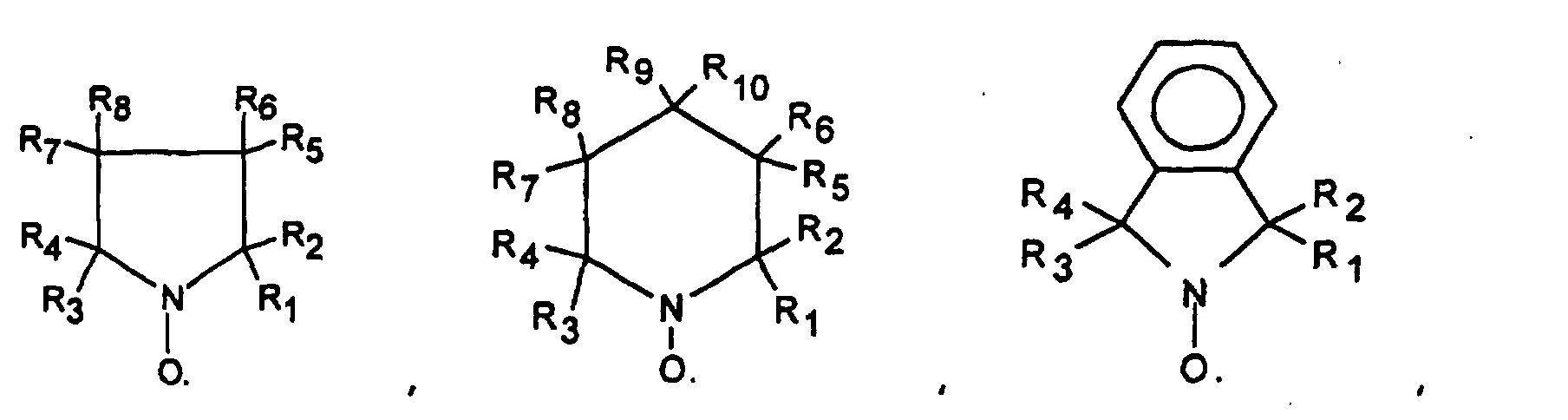

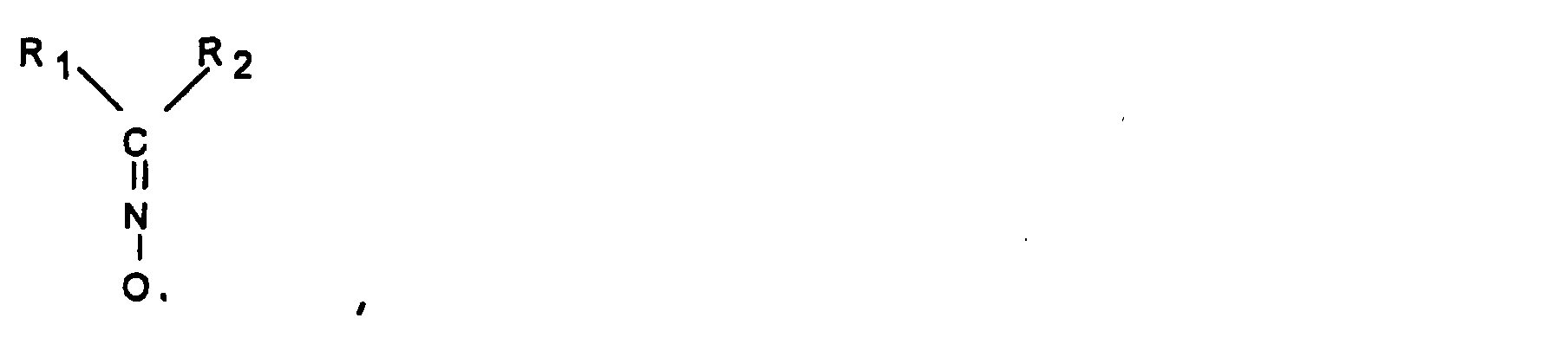
dans lesquelles R1, R2, R3, R4, R'1 et R'2 pouvant être identiques ou différents représentent un atome d'halogène tel que le chlore, le brome ou l'iode, un groupement hydrocarboné linéaire, ramifié ou cyclique, saturé ou insaturé tels qu'un radical alkyle ou phényle, ou un groupement ester - COOR ou un groupement alcoxyle -OR, ou un groupement phosphonate - PO(OR)2, ou une chaíne de polymère pouvant par exemple être un chaíne de polyméthacrylate de méthyle, de polybutadiène, de polyoléfine comme de polyéthylène ou de polypropylène, mais étant de préférence une chaíne de polystyrène, et dans lesquelles R5, R6, R7, R8, R9 et R10, pouvant être identiques ou différents, peuvent être choisis dans la même famille de groupements que celle qui vient d'être envisagée pour R1, R2, R3, R4, R'1 et R'2, et de plus peuvent représenter un atome d'hydrogène, un groupement hydroxyle -OH, un groupement acide tel que -COOH ou -PO(OH)2 ou -SO3H.in which R1, R2, R3, R4, R'1 and R'2 which may be identical or different represent a halogen atom such as chlorine, bromine or iodine, a saturated linear, branched or cyclic hydrocarbon group or unsaturated such as an alkyl or phenyl radical, or an ester group - COOR or an alkoxyl group - OR, or a phosphonate group - PO (OR) 2 , or a polymer chain which can for example be a polymethyl methacrylate chain , polybutadiene, polyolefin such as polyethylene or polypropylene, but preferably being a polystyrene chain, and in which R5, R6, R7, R8, R9 and R10, which may be identical or different, may be chosen from the same family of groups than that which has just been envisaged for R1, R2, R3, R4, R'1 and R'2, and moreover may represent a hydrogen atom, a hydroxyl group -OH, an acid group such as - COOH or -PO (OH) 2 or -SO 3 H.
En particulier, le radical libre stable peut être le 2,2,5,5-tétraméthyl-1-pyrrolidinyloxy commercialisé sous la marque PROXYL ou le 2,2,6,6-tétraméthyl-1-piperidinyloxy, généralement commercialisé sous la dénomination TEMPO.In particular, the stable free radical can be 2,2,5,5-tetramethyl-1-pyrrolidinyloxy marketed under the brand PROXYL or the 2,2,6,6-tetramethyl-1-piperidinyloxy, generally marketed under the name TEMPO.
Le radical libre stable peut également être choisi dans la liste suivante :
- N-tertiobutyl-1-phényl-2 méthyl propyl nitroxyde,
- N-tertiobutyl-1-(2-naphtyl)-2-méthyl propyl nitroxyde,
- N-tertiobutyl-1-diéthylphosphono-2,2-diméthyl propyl nitroxyde,
- N-tertiobutyl-1-dibenzylphosphono-2,2-diméthyl propyl nitroxyde,
- N-phényl-1-diéthyl phosphono-2,2-diméthyl propyl nitroxyde,
- N-phényl-1-diéthyl phosphono-1-méthyl éthyl nitroxyde,
- N-(1-phényl 2-méthyl propyl)-1-diéthylphosphono-1-méthyl éthyl nitroxyde.
- N-tertiobutyl-1-phenyl-2 methyl propyl nitroxide,
- N-tertiobutyl-1- (2-naphthyl) -2-methyl propyl nitroxide,
- N-tertiobutyl-1-diethylphosphono-2,2-dimethyl propyl nitroxide,
- N-tertiobutyl-1-dibenzylphosphono-2,2-dimethyl propyl nitroxide,
- N-phenyl-1-diethyl phosphono-2,2-dimethyl propyl nitroxide,
- N-phenyl-1-diethyl phosphono-1-methyl ethyl nitroxide,
- N- (1-phenyl 2-methyl propyl) -1-diethylphosphono-1-methyl ethyl nitroxide.
Le radical libre stable peut être introduit dans le milieu de polymérisation ou copolymérisation à raison de 0,005 % à 5 % en poids de la somme de la masse de monomère polymérisable et de radical libre stable.The stable free radical can be introduced into the medium of polymerization or copolymerization at a rate of 0.005% to 5% by weight of the sum of the mass of polymerizable monomer and free radical stable.
De préférence, le rapport molaire du radical libre stable sur l'initiateur est compris entre 1,5 et 2,5 et de manière encore préférée voisin de 2.Preferably, the molar ratio of the stable free radical over the initiator is between 1.5 and 2.5 and more preferably close to 2.
Dans le cadre de la présente invention, tout monomère présentant une double liaison carbone-carbone susceptible de polymériser ou copolymériser par voie radicalaire, peut être utilisé.In the context of the present invention, any monomer having a carbon-carbon double bond capable of polymerizing or free radical copolymerization can be used.
Au moins un monomère présent dans le milieu de polymérisation ou copolymérisation peut être un monomère vinylaromatique ou une oléfine ou un diène ou un monomère acrylique ou méthacrylique. Le monomère peut également être le difluorure de vinylidène ou le chlorure de vinyle.At least one monomer present in the polymerization medium or copolymerization can be a vinyl aromatic monomer or a olefin or a diene or an acrylic or methacrylic monomer. The monomer can also be vinylidene difluoride or chloride vinyl.
Par monomère vinylaromatique, on entend le styrène, le styrène substitué sur le groupement vinyle par un groupement alkyle tel que l'alphaméthylstyrène ou l'ortho-vinyltoluène, le para-vinyltoluène, l'ortho-éthylstyrène, le 2,4-diméthylstyrène, le styrène substitué sur le cycle par un halogène comme par exemple le 2,4-dichlorostyrène ainsi que le vinylanthracène, le chlorométhylstyrène, le para-acétoxystyrène.By vinyl aromatic monomer is meant styrene, styrene substituted on the vinyl group by an alkyl group such as alphamethylstyrene or ortho-vinyltoluene, para-vinyltoluene, ortho-ethylstyrene, 2,4-dimethylstyrene, styrene substituted on the ring with halogen such as 2,4-dichlorostyrene as well as vinylanthracene, chloromethylstyrene, para-acetoxystyrene.
Par diène, on entend en particulier un diène conjugué comprenant de 4 à 8 atomes de carbone tel que le 1,3-butadiène, l'isoprène, le 2,3-diméthyl1,3-butadiène, le pipérylène, le chloroprène.By diene is meant in particular a conjugated diene comprising from 4 to 8 carbon atoms such as 1,3-butadiene, isoprene, 2,3-dimethyl1,3-butadiene, piperylene, chloroprene.
Le procédé selon l'invention est plus particulièrement efficace dans le cas des monomères vinylaromatiques et des diènes.The method according to the invention is more particularly effective in the case of vinyl aromatic monomers and dienes.
Hormis les particularités de la présente invention pour ce qui concerne l'initiateur et le radical libre stable, la polymérisation ou copolymérisation est réalisée dans les conditions habituelles connues de l'homme du métier compte tenu du ou des monomères considérés, du moment que cette polymérisation ou copolymérisation intervient par un mécanisme radicalaire.Apart from the features of the present invention with regard to relates to the initiator and the stable free radical, the polymerization or copolymerization is carried out under the usual conditions known from the person skilled in the art taking into account the monomer (s) considered, the as soon as this polymerization or copolymerization occurs through a radical mechanism.
Dans le cas où le milieu comprend un monomère vinylaromatique et que l'on souhaite un excellent contrôle de la croissance du polymère ou copolymère de façon à ce que ce dernier soit de polymolécularité particulièrement étroite, il est préférable de mener la polymérisation ou copolymérisation à une température à laquelle aucune polymérisation ou copolymérisation n'est observée en l'absence de l'initiateur. Par exemple, dans le cas de la polymérisation ou copolymérisation d'au moins un monomère vinylaromatique, on est dans cette situation lorsque la température est inférieure à environ 120° C. Des vitesses appréciables de polymérisation ou copolymérisation sont néanmoins obtenues par le procédé de l'invention lorsque la température est comprise entre 90° C et 120° C.In the case where the medium comprises a vinyl aromatic monomer and that excellent control of the growth of the polymer is desired or copolymer so that the latter is polymolecularity particularly narrow, it is better to conduct the polymerization or copolymerization at a temperature at which no polymerization or copolymerization is observed in the absence of the initiator. For example, in the case of the polymerization or copolymerization of at least one vinyl aromatic monomer, we are in this situation when the temperature is less than about 120 ° C. Appreciable speeds of polymerization or copolymerization are nevertheless obtained by the process of the invention when the temperature is between 90 ° C and 120 ° C.
Néanmoins, si l'on accepte une polymolécularité plus élevée, il n'est pas exclu de chauffer le milieu à de plus fortes températures.However, if we accept a higher polymolecularity, it it is not excluded to heat the medium to higher temperatures.
Ainsi, dans le cas où le milieu comprend un monomère vinylaromatique, il est possible de réaliser la polymérisation ou copolymérisation entre 50° C et 120° C mais on peut également, chauffer jusqu'à 200° C, si l'on préfère une plus grande vitesse de polymérisation au détriment de la polymolécularité.Thus, in the case where the medium comprises a monomer vinyl aromatic, it is possible to carry out the polymerization or copolymerization between 50 ° C and 120 ° C but we can also heat up to 200 ° C, if faster polymerization rate is preferred at the expense of polymolecularity.
Le procédé selon l'invention peut être mené entre 50 et 200° C et de préférence entre 100 et 130° C.The process according to the invention can be carried out between 50 and 200 ° C and preferably between 100 and 130 ° C.
Le milieu de polymérisation ou copolymérisation peut être destiné à mener à un polymère vinylaromatique choc, auquel cas il comprend généralement au moins un monomère vinylaromatique et un caoutchouc, ce dernier étant généralement un polydiène conjugué tel qu'un ou plusieurs polybutadiènes.The polymerization or copolymerization medium can be intended for lead to a shock vinyl aromatic polymer, in which case it includes generally at least one vinyl aromatic monomer and one rubber, the latter generally being a conjugated polydiene such as one or more polybutadienes.
L'invention concerne également la préparation de copolymères. Par exemple, lorsqu'au moins un monomère vinylaromatique est présent dans le milieu, on peut copolymériser ce monomère avec, par exemple, au moins un monomère choisi parmi l'acrylonitrile, le méthacrylonitrile, l'acide acrylique, l'acide méthacrylique, un ester d'alkyle dont le groupement alkyle contient de 1 à 4 atomes de carbone, un N-alkylmaléimide dont le groupement alkyle contient de 1 à 4 atomes de carbone, le N-phénylmaléimide.The invention also relates to the preparation of copolymers. Through example, when at least one vinyl aromatic monomer is present in the medium, this monomer can be copolymerized with, for example, at least a monomer chosen from acrylonitrile, methacrylonitrile, acid acrylic, methacrylic acid, an alkyl ester whose group alkyl contains from 1 to 4 carbon atoms, an N-alkylmaleimide whose alkyl group contains from 1 to 4 carbon atoms, N-phenylmaleimide.
Le procédé selon l'invention permet la préparation de copolymères à blocs. En effet, la polymérisation d'un premier monomère en présence d'un radical libre stable mène à un bloc de polymère vivant. Il est alors possible d'accoler à ce premier bloc un bloc d'un autre polymère en plaçant le premier bloc de polymère vivant dans un milieu de polymérisation d'un second monomère. Il est ainsi possible de réaliser des copolymères à blocs, par exemple, des copolymères comprenant un ou plusieurs blocs de polystyrène et un ou plusieurs blocs de polybutadiène. La réalisation de tels copolymères par voie radicalaire nécessite un bon contrôle de la polymérisation de chacun des blocs. En effet, si une réaction de terminaison vient interrompre la croissance par polymérisation d'un bloc, il ne sera pas possible de lui accoler un bloc d'un autre monomère. Les réactions de terminaison doivent donc être les moins fréquentes possible. Il y a moins de réactions de terminaisons lorsqu'au cours de la polymérisation, la masse moléculaire moyenne en nombre est mieux linéairement proportionnelle au pourcentage de conversion. L'existence de réactions de terminaison se traduit par une diminution de la vitesse d'augmentation de la masse moléculaire moyenne en nombre en fonction du pourcentage de conversion.The process according to the invention allows the preparation of copolymers to blocks. Indeed, the polymerization of a first monomer in the presence of a stable free radical leads to a block of living polymer. So he is possible to attach to this first block a block of another polymer in placing the first block of living polymer in a medium of polymerization of a second monomer. It is thus possible to carry out block copolymers, for example, copolymers comprising one or more several blocks of polystyrene and one or more blocks of polybutadiene. The production of such copolymers by the radical route requires good control of the polymerization of each of the blocks. Indeed, if a reaction of termination stops growth by polymerization of a block, it will not be possible to attach a block of another monomer to it. The termination reactions must therefore be the least frequent possible. There are fewer termination reactions when during the polymerization, number average molecular weight is better linearly proportional to the percentage of conversion. The existence of termination reactions results in a decrease in speed increase in number-average molecular weight as a function of the conversion percentage.
Le procédé selon l'invention concerne les polymérisations ou copolymérisations en phase organique, en l'absence de phase aqueuse, comme c'est le cas dans les procédés en masse ou en solution dans un solvant organique.The method according to the invention relates to organic phase polymerizations or copolymerizations, in the absence of aqueous phase, as is the case in bulk or bulk processes solution in an organic solvent.
Bien entendu, suivant les conditions de polymérisation ou copolymérisation, et en particulier la durée, la température, le degré de conversion de monomère en polymère ou copolymère, il est possible de réaliser des produits de masse moléculaire très différente. Of course, depending on the polymerization conditions or copolymerization, and in particular the duration, the temperature, the degree of conversion of monomer into polymer or copolymer, it is possible to make products of very different molecular mass.
L'invention concerne à la fois la préparation d'oligomères, polymères ou copolymères de masse moléculaire moyenne en poids inférieure à 10 000, que celle de polymères ou copolymères de masse moléculaire moyenne en poids supérieure à 10 000, comme les hauts-polymères de masse moléculaire moyenne en poids allant généralement de 100 000 à 400 000.The invention relates both to the preparation of oligomers, weight average molecular weight polymers or copolymers less than 10,000, than that of polymers or copolymers by mass weight average molecular weight greater than 10,000, such as high polymers weight average molecular weight generally ranging from 100,000 to 400,000.
L'invention concerne à la fois les procédés de polymérisation ou copolymérisation dont le taux de conversion de monomère en polymère ou copolymère est inférieur à 50 % que ceux dont le taux de conversion de monomère en polymère ou copolymère est supérieur à 50 %. Par exemple, le taux de conversion de monomère en polymère ou copolymère peut dépasser 60 %, et va généralement de 65 % à 80 %.The invention relates to both polymerization processes or copolymerization including the rate of conversion of monomer into polymer or copolymer is less than 50% than those with a conversion rate of polymer or copolymer monomer is greater than 50%. For example, the conversion rate from monomer to polymer or copolymer can exceed 60%, and generally ranges from 65% to 80%.
Le procédé selon l'invention mène à un polymère ou copolymère (ce qui inclut les oligomères) à la polymolécularité généralement inférieure à 1,9 et à l'indice de jaune mesuré selon la norme ASTM D 1925 inférieur à 20, voire 10 et même 5.The process according to the invention leads to a polymer or copolymer (which includes oligomers) with generally lower polymolecularity at 1.9 and the yellowness index measured according to ASTM D 1925 less than 20, even 10 and even 5.
Lorsque le rapport molaire de la quantité de radical libre stable sur la quantité de monomère est supérieur à 1,2, la polymolécularité du polymère ou copolymère final est généralement inférieure à 1,5.When the molar ratio of the amount of stable free radical over the amount of monomer is greater than 1.2, the polymolecularity of the final polymer or copolymer is generally less than 1.5.
Les caractéristiques suivantes ont été utilisées pour les exemples :
- % de conversion : % de monomère converti en polymère. Il a été déterminé par RMN 1H sur un appareil Bruker 200 MHz avec intégration des pics correspondant au polymère et au monomère.
- Masse moléculaire moyenne en nombre (représenté par Mn) : Chromatographie à perméation de gel dans le THF à 30° C, après étalonnage avec des échantillons standarts de polystyrène.
- Indice de polymolécularité (représenté par Ip) : rapport de la masse moléculaire moyenne en poids sur la masse moléculaire moyenne en nombre, toutes deux mesurées par GPC (voir Mn ci-dessus).
- Efficacité : L'"efficacité" est égale au rapport de la masse
moléculaire moyenne en nombre théorique sur la masse moléculaire
moyenne en nombre expérimentale. La masse moléculaire moyenne en
nombre théorique est donnée par la formule :
- % conversion:% of monomer converted to polymer. It was determined by 1 H NMR on a Bruker 200 MHz device with integration of the peaks corresponding to the polymer and to the monomer.
- Number average molecular weight (represented by Mn): Gel permeation chromatography in THF at 30 ° C, after calibration with standard polystyrene samples.
- Polymolecularity index (represented by Ip): ratio of the weight average molecular weight to the number average molecular weight, both measured by GPC (see Mn above).
- Efficacy: The "efficiency" is equal to the ratio of the theoretical molecular weight in theoretical number to the molecular weight average in experimental number. The theoretical average molecular mass is given by the formula:
La concentration (I) en fonction du temps (t) est déterminée par
l'équation :

Plus l'efficacité se rapproche de la valeur 1, plus l'initiateur et le radical libre stable jouent efficacement leur rôle sur la maítrise de la polymérisation et participent peu aux réactions secondaires indésirables les détruisant partiellement.The closer the efficiency is to value 1, the more the initiator and the free radical stable effectively play their role on the control of polymerization and participate little in undesirable side reactions the partially destroying.
On purge par des cycles vide-azote un réacteur bicol de 100 ml muni d'un système d'agitation et d'une régulation de température, puis l'on introduit dans le réacteur sous azote et à la température ambiante :
- 50 g de styrène (0,481 mole), puis
- une quantité d'initiateur telle que le rapport molaire de l'initiateur sur le styrène soit égal à CInitiateur dont la valeur est indiquée en haut des tableaux 1 à 7 (CDicum lorsque l'initiateur utilisé est le peroxyde de dicumyle, CBenz lorsque l'initiateur utilisé est le peroxyde de benzoyle).
- une quantité de 2,2,6,6 tétraméthylpiperidinyloxy (communément appelé TEMPO) telle que le rapport molaire du Tempo sur l'initiateur soit de 2.
- 50 g of styrene (0.481 mole), then
- an amount of initiator such that the molar ratio of the initiator to the styrene is equal to C initiator , the value of which is indicated at the top of tables 1 to 7 (C Dicum when the initiator used is dicumyl peroxide, C Benz when the initiator used is benzoyl peroxide).
- an amount of 2,2,6,6 tetramethylpiperidinyloxy (commonly called TEMPO) such that the molar ratio of Tempo to the initiator is 2.
On porte alors le réacteur à 125° C sous agitation jusqu'à la prise en masse du milieu réactionnel. L'instant pour lequel le mélange atteint la température de 125° C est défini comme étant l'instant de départ de l'essai.The reactor is then brought to 125 ° C. with stirring until setting by mass of the reaction medium. The time at which the mixture reaches the temperature of 125 ° C is defined as the start time of test.
Le polymère est ensuite refroidi à la température ambiante, puis solubilisé dans 10 fois son poids de tétrahydrofuranne (THF). Le polymère est alors précipité en versant au goutte à goutte la solution dans le THF obtenue dans 10 fois son volume de méthanol. Le polystyrène recueilli est analysé par chromatographie à perméation de gel (GPC). Les tableaux 1 à 7 rassemblent les résultats.The polymer is then cooled to room temperature, then dissolved in 10 times its weight of tetrahydrofuran (THF). The polymer is then precipitated by pouring the solution dropwise into THF obtained in 10 times its volume of methanol. The polystyrene collected is analyzed by gel permeation chromatography (GPC). Tables 1 to 7 collect the results.
Ces derniers montrent l'évolution de la formation du polymère en fonction du temps. The latter show the evolution of the polymer formation in function of time.
Après purge par des cycles vide-azote, on introduit dans un réacteur en verre de 1 litre équipé d'un agitateur à ancre et d'une régulation de température, à 20° C et sous azote, 300 g de styrène, 4,5 millimole de peroxyde de dicumyle, 15 millimoles de radical libre stable TEMPO. L'ensemble est porté à 125° C. L'instant pour lequel le mélange atteint la température de 125° C est défini comme étant l'instant de départ de l'essai. Des prélèvements sont effectués au cours du temps pour analyse. Le tableau 8 rassemble les résultats concernant le suivi de la i formation du polymère au cours du temps.After purging by vacuum-nitrogen cycles, it is introduced into a 1 liter glass reactor equipped with an anchor stirrer and a temperature regulation, at 20 ° C and under nitrogen, 300 g of styrene, 4.5 millimole of dicumyl peroxide, 15 millimoles of stable free radical TEMPO. The whole is brought to 125 ° C. The instant for which the mixture reaches the temperature of 125 ° C is defined as the instant of start of the test. Samples are taken over time to analysis. Table 8 collates the results concerning the monitoring of i formation of the polymer over time.
Le polymère obtenu après 5 heures et 30 min de polymérisation est ensuité dégazé à l'étuve sous un vide de pression résiduelle de 25 mbar pendant 20 minutes à 200° C : il est ensuite mis en forme de plaque de 3 mm d'épaisseur dans une presse durant 10 minutes comprenant 5 minutes de préchauffage de la température ambiante jusqu'à 170° C, puis 5 minutes de pressage à 170° C sous 200 bars. On effectue alors une mesure d'indice de jaune sur la plaque, selon la norme ASTM D 1925. L'indice de jaune est de 2.The polymer obtained after 5 hours and 30 min of polymerization is then degassed in an oven under a residual pressure vacuum of 25 mbar for 20 minutes at 200 ° C: it is then shaped into a plate of 3 mm thick in a press for 10 minutes including 5 minutes preheating from room temperature to 170 ° C, then 5 pressing minutes at 170 ° C under 200 bars. We then perform a yellow index measurement on the plate, according to ASTM D 1925. The yellow index is 2.
On procède comme pour l'exemple 8, sauf que le peroxyde de
dicumyle est remplacé par la même quantité de peroxyde de benzoyle. Le
tableau 9 rassemble les résultats relatifs au suivi de la formation du
polymère au cours du temps. L'indice de jaune est ici de 34,9.
Claims (31)
- Process for the manufacture of a polymer or copolymer exhibiting a yellowing index, measured according to Standard ASTM D1925, of less than 20, comprising a stage of polymerization or copolymerization in an organic phase, in the absence of an aqueous phase, by the radical route of at least one monomer in the presence of a stable free radical and of an initiator of formula
- Process according to Claim 1, characterized in that at least one radical from R1 and R2 comprises an aromatic nucleus.
- Process according to Claim 2, characterized in that the initiator is dicumyl peroxide.
- Process according to one of the preceding claims, characterized in that the initiator exhibits a half life of one hour at a temperature of between 80°C and 150°C.
- Process according to one of Claims 1 to 3, characterized in that the initiator is introduced into the polymerization or copolymerization medium in a proportion of 50 to 50 000 ppm by weight on the basis of the mass of monomer and in that the stable free radical is introduced in a proportion of 0.005 to 5% by weight of the sum of the mass of monomer and of stable free radical.
- Process according to one of the preceding claims, characterized in that the stable free radical comprises the =N-O• group.
- Process according to one of the preceding claims, characterized in that the stable free radical is chosen from those having the following formulae:

 in which R1, R2, R3, R4, R'1, R'2, which can be identical or different, represent a halogen atom, such as chlorine, bromine or iodine, a saturated or unsaturated and linear, branched or cyclic hydrocarbonaceous group, such as an alkyl or phenyl radical, or an ester group -COOR or an alkoxy group -OR, or a phosphonate group -PO(OR)2, or a polymer chain which can be, for example, a poly(methyl methacrylate) chain, a polybutadiene chain or a polyolefin chain, such as a polyethylene or polypropylene chain, but which is preferably a polystyrene chain, and in which R5, R6, R7, R8, R9 and R10, which can be identical or different, can be chosen from the same family of groups as that which has just been envisaged for R1, R2, R3, R4, R'1 and R'2, and can furthermore represent a hydrogen atom, a hydroxyl group -OH or an acid group, such as -COOH or -PO(OH)2 or -SO3H,
or is chosen from the following list:tert-butyl 1-phenyl-2-methylpropyl nitroxide,tert-butyl 1-(2-naphthyl)-2-methylpropyl nitroxide,tert-butyl 1-diethylphosphono-2,2-dimethylpropyl nitroxide,tert-butyl 1-dibenzylphosphono-2,2-dimethylpropyl nitroxide,phenyl 1-diethylphosphono-2,2-dimethylpropyl nitroxide,phenyl 1-diethylphosphono-1-methylethyl nitroxide,1-phenyl-2-methylpropyl 1-diethylphosphono-1-methylethyl nitroxide. - Process according to one of the preceding claims, characterized in that the molar ratio of the stable free radical to the initiator is between 1.5 and 2.5.
- Process according to one of the preceding claims, characterized in that the polymerization or copolymerization temperature ranges from 100°C to 130°C.
- Process according to one of the preceding claims, characterized in that the degree of conversion of monomer to polymer is greater than 50%.
- Process according to the preceding claim, characterized in that the degree of conversion is greater than 60%.
- Process according to one of the preceding claims, characterized in that it leads to a polymer or copolymer with a weight-average molecular mass of greater than 10 000.
- Process according to the preceding claim, characterized in that it leads to a polymer or copolymer with a weight-average molecular mass ranging from 100 000 to 400 000.
- Process according to one of the preceding claims, characterized in that the molar ratio of the amount of stable free radical to the amount of monomer is greater than 1.2.
- Process according to one of the preceding claims, characterized in that it leads to a polymer or copolymer with a polydispersity of less than 1.9.
- Process according to one of the preceding claims, characterized in that it leads to a polymer or copolymer with a yellowing index of less than 10.
- Process according to one of the preceding claims, characterized in that it leads to a polymer or copolymer with a yellowing index of less than 5.
- Process according to one of the preceding claims, characterized in that it leads to a polymer or copolymer with a polydispersity of less than 1.5.
- Process according to one of the preceding claims, characterized in that it takes place in bulk or in solution in an organic solvent.
- Process according to one of the preceding claims, characterized in that at least one monomer is vinylaromatic or acrylic or methacrylic or is a diene.
- Process according to one of the preceding claims, characterized in that all monomers present are chosen from the following list: vinylaromatic monomer, diene, acrylic or methacrylic monomer, vinylidene difluoride, vinyl chloride and, when a vinylaromatic monomer is present, if appropriate, acrylonitrile, methacrylonitrile, acrylic acid, methacrylic acid, an alkyl ester, the alkyl group of which comprises from 1 to 4 carbon atoms, an N-alkylmaleimide, the alkyl group of which comprises from 1 to 4 carbon atoms, and N-phenylmaleimide.
- Process according to the preceding claim, characterized in that a vinylaromatic monomer is present and in that all monomers present are chosen from the following list: vinylaromatic monomer, acrylonitrile, methacrylonitrile, acrylic acid, methacrylic acid, alkyl ester, the alkyl group of which comprises from 1 to 4 carbon atoms, N-alkylmaleimide, the alkyl group of which comprises from 1 to 4 carbon atoms, and N-phenylmaleimide.
- Process according to the preceding claim, characterized in that all monomers present are vinylaromatic monomers.
- Polymer or copolymer obtained by radical polymerization of at least one monomer exhibiting a weight-average molecular mass of greater than 50 000, a polydispersity of less than 1.9 and a yellowing index, measured according to Standard ASTM D 1925, of less than 20.
- Polymer or copolymer according to the preceding claim, characterized in that the yellowing index is less than 10.
- Polymer or copolymer according to the preceding claim, characterized in that the yellowing index is less than 5.
- Polymer or copolymer according to one of Claims 24 to 26, characterized in that its polydispersity is less than 1.5.
- Polymer or copolymer according to one of Claims 24 to 27, characterized in that it exhibits a weight-average molecular mass ranging from 100 000 to 400 000.
- Polymer or copolymer according to one of Claims 24 to 28, characterized in that all monomers present during its polymerization or copolymerization are chosen from the following list: vinylaromatic monomer, diene, acrylic or methacrylic monomer, vinylidene difluoride, vinyl chloride and, when a vinylaromatic monomer is present, if appropriate, acrylonitrile, methacrylonitrile, acrylic acid, methacrylic acid, an alkyl ester, the alkyl group of which comprises from 1 to 4 carbon atoms, an N-alkylmaleimide, the alkyl group of which comprises from 1 to 4 carbon atoms, and N-phenylmaleimide.
- Polymer or copolymer according to the preceding claim, characterized in that all monomers present during its polymerization or copolymerization are chosen from the following list: vinylaromatic monomer, acrylonitrile, methacrylonitrile, acrylic acid, methacrylic acid, alkyl ester, the alkyl group of which comprises from 1 to 4 carbon atoms, N-alkylmaleimide, the alkyl group of which comprises from 1 to 4 carbon atoms, and N-phenylmaleimide, a vinylaromatic monomer necessarily being present.
- Polymer or copolymer according to the preceding claim, characterized in that all monomers present during its polymerization or copolymerization are vinylaromatic.
Applications Claiming Priority (2)
| Application Number | Priority Date | Filing Date | Title |
|---|---|---|---|
| FR9605909A FR2748484B1 (en) | 1996-05-13 | 1996-05-13 | POLYMERIZATION IN THE PRESENCE OF A STABLE FREE RADICAL AND A FREE RADICAL INITIATOR |
| FR9605909 | 1996-05-13 |
Publications (3)
| Publication Number | Publication Date |
|---|---|
| EP0807640A1 EP0807640A1 (en) | 1997-11-19 |
| EP0807640B1 true EP0807640B1 (en) | 2002-07-03 |
| EP0807640B2 EP0807640B2 (en) | 2009-02-18 |
Family
ID=9492064
Family Applications (1)
| Application Number | Title | Priority Date | Filing Date |
|---|---|---|---|
| EP97106251A Expired - Lifetime EP0807640B2 (en) | 1996-05-13 | 1997-04-16 | Polymerization in the presence of a stable free radical and free radical initiator |
Country Status (14)
| Country | Link |
|---|---|
| US (1) | US6346589B1 (en) |
| EP (1) | EP0807640B2 (en) |
| JP (1) | JPH1045817A (en) |
| KR (1) | KR100481267B1 (en) |
| CN (2) | CN1137143C (en) |
| AT (1) | ATE220075T1 (en) |
| CA (1) | CA2204780C (en) |
| DE (1) | DE69713681T2 (en) |
| ES (1) | ES2179976T3 (en) |
| FR (1) | FR2748484B1 (en) |
| NO (1) | NO324339B1 (en) |
| PL (1) | PL319929A1 (en) |
| SG (1) | SG78270A1 (en) |
| TW (1) | TW454018B (en) |
Families Citing this family (6)
| Publication number | Priority date | Publication date | Assignee | Title |
|---|---|---|---|---|
| KR970064016U (en) | 1996-05-31 | 1997-12-11 | Front panel of VSI | |
| FR2797878B1 (en) * | 1999-08-05 | 2003-10-17 | Atofina | CONTROLLED RADICAL POLYMERIZATION OR COPOLYMERIZATION PROCESS FOR ETHYLENE UNDER HIGH PRESSURE IN THE PRESENCE OF A PRIMER-CONTROLLER |
| US6734269B1 (en) | 1998-10-06 | 2004-05-11 | Atofina | Method for controlled free radical polymerization or copolymerization of ethylene under high pressure in the presence of an initiator-controller |
| US6653409B2 (en) | 2001-02-26 | 2003-11-25 | The Yokohama Rubber Co., Ltd. | Radical-modified polymer and polymer composition containing the same |
| CA2633263A1 (en) * | 2005-12-16 | 2007-07-12 | Arkema Inc. | Low surface energy block co-polymer preparation methods and applications |
| US10368053B2 (en) * | 2012-11-14 | 2019-07-30 | Qualcomm Incorporated | Structured light active depth sensing systems combining multiple images to compensate for differences in reflectivity and/or absorption |
Family Cites Families (21)
| Publication number | Priority date | Publication date | Assignee | Title |
|---|---|---|---|---|
| US3914339A (en) † | 1970-06-24 | 1975-10-21 | Sumitomo Chemical Co | Process for producing rubber-modified plastics |
| US4006283A (en) * | 1974-12-23 | 1977-02-01 | General Electric Company | Preparation of di-tertiary butyl peroxide crosslink polyolefin materials |
| DE3486145T2 (en) | 1983-07-11 | 1993-09-23 | Commw Scient Ind Res Org | METHOD FOR POLYMERIZATION AND POLYMERS PRODUCED BY THIS METHOD. |
| DE3942592A1 (en) * | 1989-12-22 | 1991-06-27 | Basf Lacke & Farben | RELATED NETWORK COPOLYMERIZES BASED ON VINYL REAGENTS, VINYAROMAT AND ACRYLATE MONOMERES, METHOD FOR THE PRODUCTION THEREOF AND THEIR USE IN COATING AGENTS |
| IT1241155B (en) * | 1990-05-18 | 1993-12-29 | Vedril | CONTINUOUS MASS ACRYLIC POLYMER PRODUCTION PROCESS |
| JPH04146908A (en) † | 1990-10-09 | 1992-05-20 | Monsant Kasei Kk | Production of styrene/acrylonitrile copolymer |
| US5344902A (en) * | 1991-06-18 | 1994-09-06 | Occidental Research Corporation | Polymerization with initiator and quaternary ammonium salt |
| US5322912A (en) * | 1992-11-16 | 1994-06-21 | Xerox Corporation | Polymerization processes and toner compositions therefrom |
| US5852140A (en) | 1993-03-25 | 1998-12-22 | Xerox Corporation | Semisuspension polymerization processes |
| DE4340887A1 (en) † | 1993-12-01 | 1995-06-08 | Roehm Gmbh | Polymethacrylate molding compound with high heat resistance and high stability against thermal degradation |
| WO1995026987A1 (en) * | 1994-04-04 | 1995-10-12 | Xerox Corporation | Aqueous polymerization processes |
| US5412047A (en) * | 1994-05-13 | 1995-05-02 | Xerox Corporation | Homoacrylate polymerization processes with oxonitroxides |
| JPH083208A (en) † | 1994-06-20 | 1996-01-09 | Nippon Steel Chem Co Ltd | Molecular weight regulator |
| DE4424300A1 (en) † | 1994-07-09 | 1996-01-11 | Roehm Gmbh | Continuous process for the production of a thermoplastic molding compound |
| US6084044A (en) | 1994-12-14 | 2000-07-04 | The Dow Chemical Company | Catalyzed process for producing high molecular weight monovinylidene aromatic polymers |
| JPH10510858A (en) | 1994-12-14 | 1998-10-20 | ザ ダウ ケミカル カンパニー | Production of high molecular weight polystyrene by free radical polymerization of vinyl acid catalyst |
| US5449724A (en) * | 1994-12-14 | 1995-09-12 | Xerox Corporation | Stable free radical polymerization process and thermoplastic materials produced therefrom |
| US5530079A (en) * | 1995-01-03 | 1996-06-25 | Xerox Corporation | Polymerization processes |
| FR2730240A1 (en) | 1995-02-07 | 1996-08-09 | Atochem Elf Sa | STABILIZATION OF A POLYMER BY A STABLE FREE RADICAL |
| JPH08269107A (en) | 1995-03-30 | 1996-10-15 | Xerox Corp | Free radical polymerization method |
| US5773510A (en) | 1995-03-30 | 1998-06-30 | Xerox Corporation | Processes for the preparation of branched polymers |
-
1996
- 1996-05-13 FR FR9605909A patent/FR2748484B1/en not_active Expired - Fee Related
-
1997
- 1997-04-16 ES ES97106251T patent/ES2179976T3/en not_active Expired - Lifetime
- 1997-04-16 DE DE69713681T patent/DE69713681T2/en not_active Expired - Lifetime
- 1997-04-16 EP EP97106251A patent/EP0807640B2/en not_active Expired - Lifetime
- 1997-04-16 AT AT97106251T patent/ATE220075T1/en not_active IP Right Cessation
- 1997-04-21 NO NO19971833A patent/NO324339B1/en unknown
- 1997-05-07 CA CA002204780A patent/CA2204780C/en not_active Expired - Fee Related
- 1997-05-08 SG SG1997001426A patent/SG78270A1/en unknown
- 1997-05-09 US US08/853,240 patent/US6346589B1/en not_active Expired - Fee Related
- 1997-05-12 PL PL97319929A patent/PL319929A1/en unknown
- 1997-05-13 CN CNB971135940A patent/CN1137143C/en not_active Expired - Fee Related
- 1997-05-13 JP JP9137616A patent/JPH1045817A/en active Pending
- 1997-05-13 KR KR1019970018573A patent/KR100481267B1/en not_active Expired - Fee Related
- 1997-05-13 CN CNA031458521A patent/CN1478798A/en active Pending
- 1997-05-22 TW TW086106888A patent/TW454018B/en not_active IP Right Cessation
Non-Patent Citations (1)
| Title |
|---|
| Swern D., Organic Peroxides; Swern D., Ed.; Wiley, New-York, Vol. II, 1971, pages 870-871. * |
Also Published As
| Publication number | Publication date |
|---|---|
| FR2748484B1 (en) | 1998-07-24 |
| DE69713681T2 (en) | 2003-02-27 |
| KR970074800A (en) | 1997-12-10 |
| NO971833L (en) | 1997-11-14 |
| NO324339B1 (en) | 2007-09-24 |
| TW454018B (en) | 2001-09-11 |
| KR100481267B1 (en) | 2005-09-16 |
| CA2204780A1 (en) | 1997-11-13 |
| FR2748484A1 (en) | 1997-11-14 |
| PL319929A1 (en) | 1997-11-24 |
| JPH1045817A (en) | 1998-02-17 |
| EP0807640B2 (en) | 2009-02-18 |
| US6346589B1 (en) | 2002-02-12 |
| DE69713681D1 (en) | 2002-08-08 |
| NO971833D0 (en) | 1997-04-21 |
| ES2179976T3 (en) | 2003-02-01 |
| CN1169437A (en) | 1998-01-07 |
| CN1478798A (en) | 2004-03-03 |
| EP0807640A1 (en) | 1997-11-19 |
| SG78270A1 (en) | 2001-02-20 |
| ATE220075T1 (en) | 2002-07-15 |
| CA2204780C (en) | 2007-11-13 |
| CN1137143C (en) | 2004-02-04 |
Similar Documents
| Publication | Publication Date | Title |
|---|---|---|
| EP0726280B1 (en) | Process fo the preparation of a composition containing a vinyl-aromatic polymer and a rubber by polymerization in the presence of a stable free radical | |
| EP0760824B1 (en) | Polymerisation in the presence of a beta-substituted nitroxide radical | |
| EP0903354B1 (en) | Preparation of a shock resistant vinyl aromatic polymer from a rubber which is carrier of a group generating a stable free radical | |
| EP0991683B1 (en) | Method for block polymer synthesis by controlled radical polymerisation | |
| EP0927727B1 (en) | Process for controlled radical polymerisation utilizing a low quantity of a stable free radical | |
| EP0992514B1 (en) | Radical polymerisation in the presence of several stable free radicals | |
| EP0807640B2 (en) | Polymerization in the presence of a stable free radical and free radical initiator | |
| EP0844256B1 (en) | Polymerization in the presence of a stable free radical and an iniferter | |
| EP0906937A1 (en) | Graft copolymer obtained by free-radical polymerisation with stable free-radicals, its preparation and uses | |
| US6815500B1 (en) | Shock vinylaromatic polymer by polymerization of a vinylaromatic monomer in the presence of free radical and a polymerization initiator | |
| FR2791060A1 (en) | PROCESS FOR PREPARING A STABLE FREE RADICAL CARRIER RUBBER AND USE OF THE SAID CARRIER RUBBER FOR THE PREPARATION OF A VINYLAROMATIC SHOCK POLYMER | |
| FR2768738A1 (en) | Preparation of shock absorbing composition | |
| EP0718329A1 (en) | Process for the preparation of a composition containing a vinylaromatic polymer, a rubber, a mineral filler and a coupling agent and the composition itself | |
| CA2185164C (en) | Polymerisation in the presence of a .beta.-substituted nitroxide radical |
Legal Events
| Date | Code | Title | Description |
|---|---|---|---|
| PUAI | Public reference made under article 153(3) epc to a published international application that has entered the european phase |
Free format text: ORIGINAL CODE: 0009012 |
|
| 17P | Request for examination filed |
Effective date: 19970416 |
|
| AK | Designated contracting states |
Kind code of ref document: A1 Designated state(s): AT BE DE ES FI FR GB IT NL SE |
|
| 17Q | First examination report despatched |
Effective date: 19990113 |
|
| RAP1 | Party data changed (applicant data changed or rights of an application transferred) |
Owner name: ATOFINA |
|
| GRAG | Despatch of communication of intention to grant |
Free format text: ORIGINAL CODE: EPIDOS AGRA |
|
| GRAG | Despatch of communication of intention to grant |
Free format text: ORIGINAL CODE: EPIDOS AGRA |
|
| GRAH | Despatch of communication of intention to grant a patent |
Free format text: ORIGINAL CODE: EPIDOS IGRA |
|
| GRAH | Despatch of communication of intention to grant a patent |
Free format text: ORIGINAL CODE: EPIDOS IGRA |
|
| GRAA | (expected) grant |
Free format text: ORIGINAL CODE: 0009210 |
|
| AK | Designated contracting states |
Kind code of ref document: B1 Designated state(s): AT BE DE ES FI FR GB IT NL SE |
|
| PG25 | Lapsed in a contracting state [announced via postgrant information from national office to epo] |
Ref country code: NL Free format text: LAPSE BECAUSE OF FAILURE TO SUBMIT A TRANSLATION OF THE DESCRIPTION OR TO PAY THE FEE WITHIN THE PRESCRIBED TIME-LIMIT Effective date: 20020703 |
|
| REF | Corresponds to: |
Ref document number: 220075 Country of ref document: AT Date of ref document: 20020715 Kind code of ref document: T |
|
| REF | Corresponds to: |
Ref document number: 69713681 Country of ref document: DE Date of ref document: 20020808 |
|
| GBT | Gb: translation of ep patent filed (gb section 77(6)(a)/1977) |
Effective date: 20021002 |
|
| NLV1 | Nl: lapsed or annulled due to failure to fulfill the requirements of art. 29p and 29m of the patents act | ||
| REG | Reference to a national code |
Ref country code: ES Ref legal event code: FG2A Ref document number: 2179976 Country of ref document: ES Kind code of ref document: T3 |
|
| PLBQ | Unpublished change to opponent data |
Free format text: ORIGINAL CODE: EPIDOS OPPO |
|
| PLBI | Opposition filed |
Free format text: ORIGINAL CODE: 0009260 |
|
| PLBQ | Unpublished change to opponent data |
Free format text: ORIGINAL CODE: EPIDOS OPPO |
|
| PLBI | Opposition filed |
Free format text: ORIGINAL CODE: 0009260 |
|
| PLBF | Reply of patent proprietor to notice(s) of opposition |
Free format text: ORIGINAL CODE: EPIDOS OBSO |
|
| 26 | Opposition filed |
Opponent name: ROEHM GMBH & CO. KG Effective date: 20030401 |
|
| 26 | Opposition filed |
Opponent name: THE DOW CHEMICAL COMPANY Effective date: 20030403 Opponent name: ROEHM GMBH & CO. KG Effective date: 20030401 |
|
| PLAX | Notice of opposition and request to file observation + time limit sent |
Free format text: ORIGINAL CODE: EPIDOSNOBS2 |
|
| PLBB | Reply of patent proprietor to notice(s) of opposition received |
Free format text: ORIGINAL CODE: EPIDOSNOBS3 |
|
| RAP2 | Party data changed (patent owner data changed or rights of a patent transferred) |
Owner name: ARKEMA |
|
| PLAQ | Examination of admissibility of opposition: information related to despatch of communication + time limit deleted |
Free format text: ORIGINAL CODE: EPIDOSDOPE2 |
|
| PLAR | Examination of admissibility of opposition: information related to receipt of reply deleted |
Free format text: ORIGINAL CODE: EPIDOSDOPE4 |
|
| PLBQ | Unpublished change to opponent data |
Free format text: ORIGINAL CODE: EPIDOS OPPO |
|
| PLAB | Opposition data, opponent's data or that of the opponent's representative modified |
Free format text: ORIGINAL CODE: 0009299OPPO |
|
| R26 | Opposition filed (corrected) |
Opponent name: THE DOW CHEMICAL COMPANY Effective date: 20030403 Opponent name: ROEHM GMBH & CO. KG Effective date: 20030401 |
|
| RAP2 | Party data changed (patent owner data changed or rights of a patent transferred) |
Owner name: ARKEMA FRANCE |
|
| RAP2 | Party data changed (patent owner data changed or rights of a patent transferred) |
Owner name: ARKEMA FRANCE |
|
| PLAB | Opposition data, opponent's data or that of the opponent's representative modified |
Free format text: ORIGINAL CODE: 0009299OPPO |
|
| R26 | Opposition filed (corrected) |
Opponent name: THE DOW CHEMICAL COMPANY Effective date: 20030403 Opponent name: EVONIK ROEHM GMBH Effective date: 20030401 |
|
| PGFP | Annual fee paid to national office [announced via postgrant information from national office to epo] |
Ref country code: FR Payment date: 20080312 Year of fee payment: 12 Ref country code: ES Payment date: 20080520 Year of fee payment: 12 Ref country code: DE Payment date: 20080424 Year of fee payment: 12 |
|
| PGFP | Annual fee paid to national office [announced via postgrant information from national office to epo] |
Ref country code: AT Payment date: 20080410 Year of fee payment: 12 |
|
| PGFP | Annual fee paid to national office [announced via postgrant information from national office to epo] |
Ref country code: FI Payment date: 20080411 Year of fee payment: 12 Ref country code: BE Payment date: 20080616 Year of fee payment: 12 Ref country code: IT Payment date: 20080428 Year of fee payment: 12 |
|
| RIC2 | Information provided on ipc code assigned after grant |
Ipc: C08F 20/12 20060101ALI20080923BHEP Ipc: C08F 36/02 20060101ALI20080923BHEP Ipc: C08F 12/02 20060101ALI20080923BHEP Ipc: C08F 4/34 20060101ALI20080923BHEP Ipc: C08F 2/00 20060101AFI20080923BHEP |
|
| PGFP | Annual fee paid to national office [announced via postgrant information from national office to epo] |
Ref country code: SE Payment date: 20080408 Year of fee payment: 12 |
|
| PGFP | Annual fee paid to national office [announced via postgrant information from national office to epo] |
Ref country code: GB Payment date: 20080416 Year of fee payment: 12 |
|
| PUAH | Patent maintained in amended form |
Free format text: ORIGINAL CODE: 0009272 |
|
| STAA | Information on the status of an ep patent application or granted ep patent |
Free format text: STATUS: PATENT MAINTAINED AS AMENDED |
|
| 27A | Patent maintained in amended form |
Effective date: 20090218 |
|
| AK | Designated contracting states |
Kind code of ref document: B2 Designated state(s): AT BE DE ES FI FR GB IT NL SE |
|
| PG25 | Lapsed in a contracting state [announced via postgrant information from national office to epo] |
Ref country code: ES Free format text: LAPSE BECAUSE OF FAILURE TO SUBMIT A TRANSLATION OF THE DESCRIPTION OR TO PAY THE FEE WITHIN THE PRESCRIBED TIME-LIMIT Effective date: 20090529 |
|
| PG25 | Lapsed in a contracting state [announced via postgrant information from national office to epo] |
Ref country code: AT Free format text: LAPSE BECAUSE OF FAILURE TO SUBMIT A TRANSLATION OF THE DESCRIPTION OR TO PAY THE FEE WITHIN THE PRESCRIBED TIME-LIMIT Effective date: 20020703 |
|
| BERE | Be: lapsed |
Owner name: *ATOFINA Effective date: 20090430 |
|
| GBPC | Gb: european patent ceased through non-payment of renewal fee |
Effective date: 20090416 |
|
| PG25 | Lapsed in a contracting state [announced via postgrant information from national office to epo] |
Ref country code: DE Free format text: LAPSE BECAUSE OF FAILURE TO SUBMIT A TRANSLATION OF THE DESCRIPTION OR TO PAY THE FEE WITHIN THE PRESCRIBED TIME-LIMIT Effective date: 20090519 |
|
| PG25 | Lapsed in a contracting state [announced via postgrant information from national office to epo] |
Ref country code: GB Free format text: LAPSE BECAUSE OF NON-PAYMENT OF DUE FEES Effective date: 20090416 |
|
| PG25 | Lapsed in a contracting state [announced via postgrant information from national office to epo] |
Ref country code: BE Free format text: LAPSE BECAUSE OF NON-PAYMENT OF DUE FEES Effective date: 20090430 |
|
| PG25 | Lapsed in a contracting state [announced via postgrant information from national office to epo] |
Ref country code: FI Free format text: LAPSE BECAUSE OF NON-PAYMENT OF DUE FEES Effective date: 20020703 |
|
| PG25 | Lapsed in a contracting state [announced via postgrant information from national office to epo] |
Ref country code: IT Free format text: LAPSE BECAUSE OF NON-PAYMENT OF DUE FEES Effective date: 20090416 |
|
| REG | Reference to a national code |
Ref country code: FR Ref legal event code: ST Effective date: 20110923 |
|
| PG25 | Lapsed in a contracting state [announced via postgrant information from national office to epo] |
Ref country code: FR Free format text: LAPSE BECAUSE OF NON-PAYMENT OF DUE FEES Effective date: 20090430 |
|
| PG25 | Lapsed in a contracting state [announced via postgrant information from national office to epo] |
Ref country code: FI Free format text: LAPSE BECAUSE OF FAILURE TO SUBMIT A TRANSLATION OF THE DESCRIPTION OR TO PAY THE FEE WITHIN THE PRESCRIBED TIME-LIMIT Effective date: 20090218 Ref country code: SE Free format text: LAPSE BECAUSE OF NON-PAYMENT OF DUE FEES Effective date: 20090714 |