EP0807427B1 - Modular Rollstuhl - Google Patents
Modular Rollstuhl Download PDFInfo
- Publication number
- EP0807427B1 EP0807427B1 EP97106524A EP97106524A EP0807427B1 EP 0807427 B1 EP0807427 B1 EP 0807427B1 EP 97106524 A EP97106524 A EP 97106524A EP 97106524 A EP97106524 A EP 97106524A EP 0807427 B1 EP0807427 B1 EP 0807427B1
- Authority
- EP
- European Patent Office
- Prior art keywords
- wheel
- chair
- risers
- disabled people
- brackets
- Prior art date
- Legal status (The legal status is an assumption and is not a legal conclusion. Google has not performed a legal analysis and makes no representation as to the accuracy of the status listed.)
- Expired - Lifetime
Links
- 230000000295 complement effect Effects 0.000 claims abstract description 4
- XEEYBQQBJWHFJM-UHFFFAOYSA-N Iron Chemical compound [Fe] XEEYBQQBJWHFJM-UHFFFAOYSA-N 0.000 claims description 22
- 229910052742 iron Inorganic materials 0.000 claims description 11
- 230000008878 coupling Effects 0.000 claims description 9
- 238000010168 coupling process Methods 0.000 claims description 9
- 238000005859 coupling reaction Methods 0.000 claims description 9
- 239000012260 resinous material Substances 0.000 claims description 2
- 230000000903 blocking effect Effects 0.000 claims 1
- 239000007769 metal material Substances 0.000 claims 1
- 230000000712 assembly Effects 0.000 description 3
- 238000000429 assembly Methods 0.000 description 3
- 239000004744 fabric Substances 0.000 description 3
- 238000004519 manufacturing process Methods 0.000 description 3
- 238000007789 sealing Methods 0.000 description 3
- 238000004026 adhesive bonding Methods 0.000 description 2
- 230000002860 competitive effect Effects 0.000 description 1
- 239000002131 composite material Substances 0.000 description 1
- 230000006835 compression Effects 0.000 description 1
- 238000007906 compression Methods 0.000 description 1
- 238000009826 distribution Methods 0.000 description 1
- 238000002347 injection Methods 0.000 description 1
- 239000007924 injection Substances 0.000 description 1
- 238000003780 insertion Methods 0.000 description 1
- 230000037431 insertion Effects 0.000 description 1
- 239000000463 material Substances 0.000 description 1
- 238000000034 method Methods 0.000 description 1
- 229920003023 plastic Polymers 0.000 description 1
- 239000004033 plastic Substances 0.000 description 1
- 238000000926 separation method Methods 0.000 description 1
- 239000000243 solution Substances 0.000 description 1
Images


Classifications
-
- A—HUMAN NECESSITIES
- A61—MEDICAL OR VETERINARY SCIENCE; HYGIENE
- A61G—TRANSPORT, PERSONAL CONVEYANCES, OR ACCOMMODATION SPECIALLY ADAPTED FOR PATIENTS OR DISABLED PERSONS; OPERATING TABLES OR CHAIRS; CHAIRS FOR DENTISTRY; FUNERAL DEVICES
- A61G5/00—Chairs or personal conveyances specially adapted for patients or disabled persons, e.g. wheelchairs
-
- A—HUMAN NECESSITIES
- A61—MEDICAL OR VETERINARY SCIENCE; HYGIENE
- A61G—TRANSPORT, PERSONAL CONVEYANCES, OR ACCOMMODATION SPECIALLY ADAPTED FOR PATIENTS OR DISABLED PERSONS; OPERATING TABLES OR CHAIRS; CHAIRS FOR DENTISTRY; FUNERAL DEVICES
- A61G5/00—Chairs or personal conveyances specially adapted for patients or disabled persons, e.g. wheelchairs
- A61G5/08—Chairs or personal conveyances specially adapted for patients or disabled persons, e.g. wheelchairs foldable
- A61G5/0808—Chairs or personal conveyances specially adapted for patients or disabled persons, e.g. wheelchairs foldable characterised by a particular folding direction
- A61G5/0816—Chairs or personal conveyances specially adapted for patients or disabled persons, e.g. wheelchairs foldable characterised by a particular folding direction folding side to side, e.g. reducing or expanding the overall width of the wheelchair
- A61G5/0825—Chairs or personal conveyances specially adapted for patients or disabled persons, e.g. wheelchairs foldable characterised by a particular folding direction folding side to side, e.g. reducing or expanding the overall width of the wheelchair comprising a scissor-type frame, e.g. having pivoting cross bars for enabling folding
-
- A—HUMAN NECESSITIES
- A61—MEDICAL OR VETERINARY SCIENCE; HYGIENE
- A61G—TRANSPORT, PERSONAL CONVEYANCES, OR ACCOMMODATION SPECIALLY ADAPTED FOR PATIENTS OR DISABLED PERSONS; OPERATING TABLES OR CHAIRS; CHAIRS FOR DENTISTRY; FUNERAL DEVICES
- A61G5/00—Chairs or personal conveyances specially adapted for patients or disabled persons, e.g. wheelchairs
- A61G5/10—Parts, details or accessories
- A61G5/12—Rests specially adapted therefor, e.g. for the head or the feet
- A61G5/125—Rests specially adapted therefor, e.g. for the head or the feet for arms
-
- A—HUMAN NECESSITIES
- A61—MEDICAL OR VETERINARY SCIENCE; HYGIENE
- A61G—TRANSPORT, PERSONAL CONVEYANCES, OR ACCOMMODATION SPECIALLY ADAPTED FOR PATIENTS OR DISABLED PERSONS; OPERATING TABLES OR CHAIRS; CHAIRS FOR DENTISTRY; FUNERAL DEVICES
- A61G5/00—Chairs or personal conveyances specially adapted for patients or disabled persons, e.g. wheelchairs
- A61G5/10—Parts, details or accessories
- A61G5/12—Rests specially adapted therefor, e.g. for the head or the feet
- A61G5/128—Rests specially adapted therefor, e.g. for the head or the feet for feet
Definitions
- the present invention deals with wheel-chairs for disabled people, and in particular with a wheel-chair for disabled people adapted to be reduced and obtained by assembling single parts, some of them being modular, without requiring heat seals.
- EP 0 702 945 illustrates a wheelchair with two facing, interconnected, adjustable sideframes having fit thereto a seat, backrest, driving wheels and guide wheels.
- Each sideframe has two rigid frame parts, which are adjustably interconnected in the longitudinal direction of the wheelchair by elongated frame sections. Simultaneously with the adjustment of the seat position, there is an adjustment of the wheels so that an optimum weight distribution over the wheelchair wheels is maintained.
- US 5 284 350 refers to a foldable wheelchair having a folding mechanism connecting two side frame assemblies to each other.
- the side frame assemblies are made of two halves that are secured together and may be fabricated from compression or injection molded composite plastics.
- the seat angle is adjusted by pivoting the side frame assemblies around a pivot point located in an upward and forward region of the side frame assembly.
- Purpose of the present invention is manufacturing at a competitive price wheel-chairs equipped with parts facilitating their use.
- the wheel-chair is not obtained any more by sealing a certain number of members one to the other, but assembling without sealing single component parts of the prefabricated type. These component parts too are obtained without seals. This is very important because thereby the different component parts can also be non-metallic. Complementary parts being required are assembled to the basic skeleton, obtained by assembling modular parts without sealing. By adequately choosing said complementary parts, wheel-chairs are obtained that can provide different performance or comfort.
- Assembly of the different parts is carried out with screws or rivets; but it could also be carried out by glueing, taking into account that said parts to be assembled can also be non-metallic.
- glueing taking into account that said parts to be assembled can also be non-metallic.
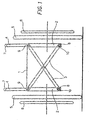
- numeral 1 denotes a seat made of tissue with two side frames 2; 3 denotes the cross rods that keep the side frames 2 parallel and defines the maximum opening thereof; 4 denotes the stakes to hold the sheet composing the back and whose extension over the back creates handles 7 to make third parties drive the wheel-chair; 5 denotes the wheels; 6 the rings integral with the wheels for possible handling of the wheel-chair by the user; 8 denotes the lower side frame cross members; 10 denotes the iron girders applied to lower ends of the rods 3 and 9 denotes the cross members applied to upper ends of the rods 3.
- cross rods 3 have not been included in the drawing for reasons of clarity.
- the basic structure is composed of a quadrilateral formed of box-type risers 2' and 2 and cylinder iron girders 4' and 10.
- Numeral 8 denotes the tubular cross member integral with the lower ends of the cross rods 3 suitable to rotate around the support iron girders 10 to which it is coupled;
- 9 denotes the cross member integral with the upper ends of the cross rods 3 and on which the seat made of fabric is applied;
- 4 denotes the stake operating as support for the back made of fabric and that extends upwards to realize the driving handle 7;
- 5 denotes the wheel integral with the driving ring 6.
- the support 18 is secured into the lower part of the riser 2 for the swingable fork 13 of the small wheel 14 and in the upper part of said riser the braking device 11 is secured to brake the wheel 5.
- the riser 2 is equipped with a shelf 15 supporting a rod 16 that can be blocked in the desired position. Coupling between shelf 15 and riser 2 is realized in such a way as to allow an easy assembly and as easy a separation.
- the bracket 17 is integral with the rod 16.
- the rod 20 is hinged onto the bracket 17 and supports the foot-rest 19.
- the equipment related to foot-rest has been modified and the arm-rest 24 appears equipped with a wall 23.
- the above-said arm-rest 24 with related wall 23, once released from the closure applied in 26, can be lifted backwards by rotating around the hinging point 25.
- Numerals 2' and 2 denote risers that, with the iron girders 10 and 4', compose the basic structure; 5 denotes the wheel; 6 denotes the driving ring integral with the wheel 5; 8 and 9 denote tubular longitudinal members applied to the ends of cross rods 3; 18 denotes the support secured to the riser 2 for the swingable fork 13 of the small wheel 14; 15 denotes the bracket secured to the riser 2 supporting the rod 20 supporting in turn the foot-rest 10; 11 denotes the braking apparatus for the wheel 5.
- Fig 4 shows how the bracket 15 is coupled with the riser 2.
- Numeral 21 denotes a cylindrical post with two facetings belonging to the riser 2, coupled with the seat 27 for the bracket 15. Coupling is made possible when the opening 30 for the seat 27 is placed next to the lower width of the post 21. Once having inserted the post 21 into the seat 27, by rotating the bracket 15 the coupling becomes a constraint.
- Numeral 20 denotes the rod supporting the foot-rest.
- Fig, 5 show in particular the coupling between bracket 15 and riser 2.
- the shelf is blocked by a stake connected to the lever 29. To release it, it is necessary to lift the lever 29 and rotate the bracket 15 outwards.
- Numerals 4' and 10 denote the iron girders that with the risers 2' and 2 compose the basic structure; 9 denote the longitudinal member located on the upper end of the cross rods 3; 24 denotes the lower end part of the arm-rest that is blocked by a bolt 28-31 on the stake 26; 11 denotes the braking apparatus for the wheel; 18 denotes the support, secured to the riser 2, for the swingable fork 13 of the small wheel 14.
- Fig. 6 shows the bracket 15 rotated outwards with respect to the riser 2.
- the opening 30 for the seat 27 is placed next to the lower width of the faceted post 21, ready to be disengaged.
- An identical position of the opening 30 of the bracket 15 with respect to the post 21 occurs when assembling the brackets on the riser 2. Insertion and removal of the bracket on the riser 2 are, in fact, carried out with the same methods.
- Numeral 20 denotes the rod held by the shelf; bracket; 19 denotes the foot-rest secured to the lower end of the rod 20; 18 denotes the support, secured to the riser 2, of the swingable fork 13 of the small wheel 14; 9 denotes the longitudinal member placed on the upper end of the cross rod 3; 24 denotes the lower end part of the arm-rest that is blocked by the bolt 28-31 on the stake 26; 11 denotes the braking apparatus of the wheel.
- Fig. 7 shows the bracket 15 separated from the riser 2.
- Numeral 3 denotes the cross roads; 8 denotes the longitudinal member joined to the lower end thereof; 10 denotes the iron girder of the basic structure; 29 denotes the lever operating the stake to block the bracket 15; 20 denotes the rods held by the bracket 15; 18 denotes the support for the swingable fork 13 of the small wheel 14 secured to the riser 2.
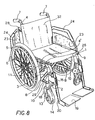
- Fig. 8 is a perspective view of the wheel-chair according to the invention completed with the seat 1 and the back 32 made of fabric and with side boards 23 with arm-rests 24.
- Numeral 2 denotes the front riser that, with the iron girders 4' and 10 and the rear riser 2' (not shown), compose the basic structure; 3-8-9 denote the members composing the cross connecting the two side frames.
- Numeral 5 denotes the wheel and numeral 6 denotes the driving ring integral therewith; 4 denotes the stakes supporting the back 32 and 7 denotes the handles to drive the wheel-chair by third parties.
- Numeral 18 denotes the support for the swingable fork 13 of the small wheel 14; 15 denotes the bracket supporting the rod 20 supporting in turn the foot-rest 19; 29 denotes the lever controlling the stake to block the bracket 15 to the riser 2; 26 denotes the stake with which the caliper 31 connected to the lever 28 comes to be engaged; 11 denotes the braking apparatus to block the wheel 5.
- the features of the invention stand out, that is, it is possible to manufacture a wheel-chair without intervening with heat seals, but instead assembling prefabricated parts, some of which are of the modular type (such as risers (2', 2) and iron girders 10 and 4') using only screws and rivets.
- the parts composing the wheel-chair are not necessarily metallic ones, being able to be obtained with particular resinous materials, in which case couplings can also be carried out by glueing.
- the basic structure is realized in such a way as to be completed without problems with some parts more than others depending on the application provided for the wheel-chair, interchangeability having been provided.
- the novel modular parts include assembly of the brackets 15 supporting the rods for the foot-rest, with the front risers 2.
Landscapes
- Life Sciences & Earth Sciences (AREA)
- Animal Behavior & Ethology (AREA)
- General Health & Medical Sciences (AREA)
- Public Health (AREA)
- Veterinary Medicine (AREA)
- Health & Medical Sciences (AREA)
- Carriages For Children, Sleds, And Other Hand-Operated Vehicles (AREA)
- Motorcycle And Bicycle Frame (AREA)
- Legs For Furniture In General (AREA)
- Installation Of Indoor Wiring (AREA)
- Chair Legs, Seat Parts, And Backrests (AREA)
- Inert Electrodes (AREA)
- Connection Of Plates (AREA)
- Massaging Devices (AREA)
- Infusion, Injection, And Reservoir Apparatuses (AREA)
- Automatic Cycles, And Cycles In General (AREA)
- Chairs Characterized By Structure (AREA)
Claims (9)
- Rollstuhl für Behinderte, der zusammenklappbar ist und durch Zusammenbauen von Einzelteilen hergestellt wird, von denen einige modulare Teile sind, ohne dass Heißsiegelungen erforderlich sind, mit:dadurch gekennzeichnet, dasszwei Seitenrahmen, von denen jeder eine Basisstruktur aufweist, die aus vorderen (2) und hinteren (2') kastenförmigen in Aufwärtsrichtung verlaufenden Elementen und zwei durch Schrauben und/oder Nieten miteinander verbundenen Eisenstreben (4',10) gebildet ist;einem scherenförmigen Gelenkkreuz mit aneinander angelenkten Stangen (3), die einstückig mit rohrförmigen in Längsrichtung verlaufenden an den oberen und unteren Enden der Stangen vorgesehenen Elementen (8,9) ausgebildet sind;zwei Haltelaschen (15), die von den vorderen in Aufwärtsrichtung verlaufenden Elementen (2) gehalten werden und Stangen (20) halten, deren untere Enden mit Fußstützen (19) versehen sind, wobei die Haltelaschen (15) bewegbar und von den in Aufwärtsrichtung verlaufenden Elementen (2) abnehmbar sind;zwei Stangen (4) an den hinteren in Aufwärtsrichtung verlaufenden Elementen (2') zum Halten eines Rückenteils (32);zwei Seitenplatten (23);zwei Paar Vorder- bzw. Hinterräder (5,14);zwei Vorrichtungen (11) zum Bremsen der Räder (5),
die vorderen in Aufwärtsrichtung verlaufenden Elemente (2) jeweils einen zylindrischen Pfosten (21) mit einem Paar gegenüberliegender ebener parallel verlaufender Flächen aufweist, wobei die zwischen den Flächen liegende Breite kleiner ist als der Durchmesser des zylindrischen Pfostens (21), und die Haltelaschen (15) jeweils einen Sitz (27) mit einer Öffnung (30) aufweisen, deren Breite kleiner ist als der Durchmesser des zylindrischen Pfostens (21) und größer als die Breite des Pfostens zwischen den gegenüberliegenden ebenen Flächen, und der Sitz (27) einen Durchmesser entsprechend dem Durchmesser des Pfostens (21) hat, so dass der Pfosten (21) in den Sitz (27) einsetzbar ist, wenn die Öffnung (30) mit der Breite des Pfostens zwischen den gegenüberliegenden ebenen Flächen ausgerichtet ist und dann gedreht wird, um die Haltelasche (15) mit dem Pfosten (21) zu verriegeln, wodurch ein Koppeln/Entkoppeln der Fußstützen relativ zu dem Rollstuhl allein durch Drehen der Haltelaschen (15) nach innen/außen ermöglicht wird, ohne dass eine vertikale Bewegung der Haltelaschen erforderlich ist. - Rollstuhl für Behinderte nach Anspruch 1, dadurch gekennzeichnet, dass die Stangen (4) an den hinteren in Aufwärtsrichtung verlaufenden Elementen (2') über das Rückenteil (32) vorstehen und Griffe (7) zum Schieben durch Dritte bilden.
- Rollstuhl für Behinderte nach Anspruch 1, dadurch gekennzeichnet, dass die Seitenplatten (23) mit Armstützen (24) versehen sind, die an den hinteren in Aufwärtsrichtung verlaufenden Elemente (2') angelenkt und an den vorderen in Aufwärtsrichtung verlaufenden Elementen (2) arretierbar sind, so dass es möglich ist, diese anzuheben oder abzunehmen.
- Rollstuhl für Behinderte nach Anspruch 1, dadurch gekennzeichnet, dass die hinteren Räder (5) mit einstückig mit den Rädern ausgebildeten Ringen (6) versehen sind, damit ein Benutzer den Rollstuhl bewegen kann.
- Rollstuhl für Behinderte nach Anspruch 1, dadurch gekennzeichnet, dass das Kreuz (3) derart an die Seitenrahmen angebaut ist, dass die unteren Eisenstreben (10) des Seitenrahmens über eine schwenkbare Kupplung mit seinen eigenen unteren rohrförmigen in Längsrichtung verlaufenden Elementen (8) in Eingriff gebracht werden, und dass seine eigenen Stangen (3) über Verbindungseinrichtungen mit den oberen Eisenstreben (4') der Seitenrahmen verbunden sind.
- Rollstuhl für Behinderte nach Anspruch 1, dadurch gekennzeichnet, dass die vorderen nach oben verlaufenden Elemente (2) mit einer mit einem entsprechenden manuell betätigbaren Hebel (29) verbundenen Stoppstange versehen sind, die bei nach innen gedrehten Haltelaschen (15) zum Arretieren der Haltelaschen (15) an dem entsprechenden vorderen in Aufwärtsrichtung verlaufenden Element vorgesehen ist.
- Rollstuhl für Behinderte nach Anspruch 1, dadurch gekennzeichnet, dass die Seitenrahmen und Haltelaschen aus einem nicht metallischen Material gefertigt sind.
- Rollstuhl für Behinderte nach Anspruch 8, dadurch gekennzeichnet, dass die Seitenrahmen und Haltelaschen aus einem Kunststoffmaterial gefertigt sind.
- Rollstuhl für Behinderte nach einem der vorhergehenden Ansprüche, dadurch gekennzeichnet, dass sämtliche Teile des Rollstuhls ohne Heißsiegelung nur unter Verwendung von Schrauben und/oder Nieten oder umgekehrt zusammengebaut sind, dies gilt sowohl für die Teile der Basisstruktur als auch für komplementäre Teile.
Applications Claiming Priority (2)
| Application Number | Priority Date | Filing Date | Title |
|---|---|---|---|
| IT96PD000124A IT1287901B1 (it) | 1996-05-17 | 1996-05-17 | Carrozzella per disabili,del tipo riducibile,che puo' essere ottenuta dallo assiemaggio delle singole parti,di cui alcune modulari,senza |
| ITPD960124 | 1996-05-17 |
Publications (3)
| Publication Number | Publication Date |
|---|---|
| EP0807427A2 EP0807427A2 (de) | 1997-11-19 |
| EP0807427A3 EP0807427A3 (de) | 1997-12-03 |
| EP0807427B1 true EP0807427B1 (de) | 2003-03-12 |
Family
ID=11391427
Family Applications (1)
| Application Number | Title | Priority Date | Filing Date |
|---|---|---|---|
| EP97106524A Expired - Lifetime EP0807427B1 (de) | 1996-05-17 | 1997-04-20 | Modular Rollstuhl |
Country Status (7)
| Country | Link |
|---|---|
| US (1) | US6126187A (de) |
| EP (1) | EP0807427B1 (de) |
| AT (1) | ATE234062T1 (de) |
| CA (1) | CA2205319A1 (de) |
| DE (1) | DE69719594T2 (de) |
| ES (1) | ES2195047T3 (de) |
| IT (1) | IT1287901B1 (de) |
Families Citing this family (3)
| Publication number | Priority date | Publication date | Assignee | Title |
|---|---|---|---|---|
| US6774100B2 (en) * | 2000-12-06 | 2004-08-10 | Imaginative Research Associates, Inc. | Anhydrous creams, lotions and gels |
| WO2010102028A1 (en) | 2009-03-03 | 2010-09-10 | Hector Melvin G | Structure, components and method for constructing and operating an automatically self locking manually propelled vehicle such as a wheel chair |
| US8888118B2 (en) * | 2011-11-27 | 2014-11-18 | Stryker Corporation | Bottle holder for mobile medical device |
Family Cites Families (15)
| Publication number | Priority date | Publication date | Assignee | Title |
|---|---|---|---|---|
| US3185527A (en) * | 1963-11-14 | 1965-05-25 | Mobilaid Inc | Swinging foot rest |
| US3453027A (en) * | 1966-10-31 | 1969-07-01 | Mobilaid Inc | Latch for swinging footrest |
| US3854774A (en) * | 1973-08-06 | 1974-12-17 | Gendron Diemer Inc | Swing-away footrest for invalid wheelchairs |
| US4120532A (en) * | 1977-08-01 | 1978-10-17 | Clanan Wayne N | Snap-on swing-away foot rest for wheel chairs |
| US4176879A (en) * | 1978-07-31 | 1979-12-04 | Everest & Jennings, Inc. | Wheelchair foot rest latch |
| JPS5919128U (ja) * | 1982-07-29 | 1984-02-06 | 工業技術院長 | 車いす |
| GB8330289D0 (en) * | 1983-11-14 | 1983-12-21 | Lieuse Techn Ltd | Wheelchair |
| DE3514572A1 (de) * | 1985-04-23 | 1986-10-30 | Günter Meier GmbH, 4952 Porta Westfalica | Krankenfahrstuhl |
| GB2200328B (en) * | 1987-01-28 | 1991-05-15 | Spastics Soc | Lightweight foldable wheelchair |
| US5186480A (en) * | 1990-12-05 | 1993-02-16 | Morgan Technology, Inc. | Lightweight transportable wheelchair |
| US5360224A (en) * | 1991-11-08 | 1994-11-01 | Medical Composite Technology, Inc. | Wheelchair frame assembly and components for use thereon |
| US5284350A (en) * | 1992-05-22 | 1994-02-08 | Medical Composite Technology | Foldable wheelchair and side frame assembly |
| US5333887A (en) * | 1993-11-16 | 1994-08-02 | Joe Sharp | Wheelchair/gurney |
| US5560627A (en) * | 1993-11-16 | 1996-10-01 | Guardian Products, Inc. | Low cost wheelchair |
| US5516226A (en) * | 1994-08-30 | 1996-05-14 | Wu; Johnson | Wheelchair frame assembly |
-
1996
- 1996-05-17 IT IT96PD000124A patent/IT1287901B1/it active IP Right Grant
-
1997
- 1997-04-20 DE DE69719594T patent/DE69719594T2/de not_active Expired - Lifetime
- 1997-04-20 ES ES97106524T patent/ES2195047T3/es not_active Expired - Lifetime
- 1997-04-20 AT AT97106524T patent/ATE234062T1/de not_active IP Right Cessation
- 1997-04-20 EP EP97106524A patent/EP0807427B1/de not_active Expired - Lifetime
- 1997-04-23 US US08/844,972 patent/US6126187A/en not_active Expired - Lifetime
- 1997-05-14 CA CA002205319A patent/CA2205319A1/en not_active Abandoned
Also Published As
| Publication number | Publication date |
|---|---|
| IT1287901B1 (it) | 1998-08-26 |
| ITPD960124A1 (it) | 1997-11-17 |
| DE69719594T2 (de) | 2004-03-11 |
| EP0807427A2 (de) | 1997-11-19 |
| CA2205319A1 (en) | 1997-11-17 |
| EP0807427A3 (de) | 1997-12-03 |
| ES2195047T3 (es) | 2003-12-01 |
| ITPD960124A0 (it) | 1996-05-17 |
| ATE234062T1 (de) | 2003-03-15 |
| DE69719594D1 (de) | 2003-04-17 |
| US6126187A (en) | 2000-10-03 |
Similar Documents
| Publication | Publication Date | Title |
|---|---|---|
| US5480179A (en) | Wheelchair chassis | |
| US5727809A (en) | Collapsible wheelchair | |
| US4981305A (en) | Symmetrically modular wheelchair | |
| US4736960A (en) | Folding wheelchairs | |
| EP0145278B1 (de) | Rollstuhl | |
| US6464243B2 (en) | Wheel chair | |
| US5076602A (en) | Seating system for a wheel chair | |
| US8622409B2 (en) | Structure, components and method for constructing and operating an automatically self locking manually propelled vehicle such as a wheel chair | |
| US5253888A (en) | Rigid frame weldless wheelchair | |
| EP0557440A1 (de) | Kippbarer rollstuhl mit bedienungsbetriebsart oder selbstantrieb | |
| US4790553A (en) | Lightweight wheelchair having swing-away footrest assembly | |
| MXPA06008422A (es) | Silla de ruedas plegable para silla de transporte plegable de medio de transporte desmontable. | |
| US4457535A (en) | Wheelchair | |
| EP1056635B1 (de) | Rollstuhl sowie an einem rollstuhl zu gebrauchende verbindungseinrichtung | |
| CN215779274U (zh) | 一种可折叠式支撑连接架及使用该支撑连接架的轮椅 | |
| EP0807427B1 (de) | Modular Rollstuhl | |
| US5529427A (en) | Wheelchair coupler apparatus | |
| HU213422B (en) | Wheal-chair | |
| EP0942703B1 (de) | Rollstuhl | |
| JPH0345706Y2 (de) | ||
| AU661936B2 (en) | Improvements in, or relating to wheelchairs | |
| CA2096459C (en) | Collapsible wheelchair | |
| GB2268134A (en) | Shopping trolley for use with wheelchair. | |
| RU2088184C1 (ru) | Кресло-коляска для инвалидов | |
| GB2304314A (en) | Collapsible wheelchair |
Legal Events
| Date | Code | Title | Description |
|---|---|---|---|
| PUAI | Public reference made under article 153(3) epc to a published international application that has entered the european phase |
Free format text: ORIGINAL CODE: 0009012 |
|
| PUAL | Search report despatched |
Free format text: ORIGINAL CODE: 0009013 |
|
| AK | Designated contracting states |
Kind code of ref document: A2 Designated state(s): AT BE CH DE ES FR GB GR IT LI SE |
|
| AK | Designated contracting states |
Kind code of ref document: A3 Designated state(s): AT BE CH DE ES FR GB GR IT LI SE |
|
| TPAD | Observations filed by third parties |
Free format text: ORIGINAL CODE: EPIDOS TIPA |
|
| 17P | Request for examination filed |
Effective date: 19980325 |
|
| 17Q | First examination report despatched |
Effective date: 20010330 |
|
| GRAG | Despatch of communication of intention to grant |
Free format text: ORIGINAL CODE: EPIDOS AGRA |
|
| GRAG | Despatch of communication of intention to grant |
Free format text: ORIGINAL CODE: EPIDOS AGRA |
|
| GRAH | Despatch of communication of intention to grant a patent |
Free format text: ORIGINAL CODE: EPIDOS IGRA |
|
| GRAH | Despatch of communication of intention to grant a patent |
Free format text: ORIGINAL CODE: EPIDOS IGRA |
|
| GRAA | (expected) grant |
Free format text: ORIGINAL CODE: 0009210 |
|
| AK | Designated contracting states |
Designated state(s): AT BE CH DE ES FR GB GR IT LI SE |
|
| REG | Reference to a national code |
Ref country code: GB Ref legal event code: FG4D |
|
| REG | Reference to a national code |
Ref country code: CH Ref legal event code: EP |
|
| REF | Corresponds to: |
Ref document number: 69719594 Country of ref document: DE Date of ref document: 20030417 Kind code of ref document: P |
|
| REG | Reference to a national code |
Ref country code: CH Ref legal event code: NV Representative=s name: KEMIA S.A. |
|
| REG | Reference to a national code |
Ref country code: SE Ref legal event code: TRGR |
|
| REG | Reference to a national code |
Ref country code: GR Ref legal event code: EP Ref document number: 20030402041 Country of ref document: GR |
|
| ET | Fr: translation filed | ||
| PLBE | No opposition filed within time limit |
Free format text: ORIGINAL CODE: 0009261 |
|
| STAA | Information on the status of an ep patent application or granted ep patent |
Free format text: STATUS: NO OPPOSITION FILED WITHIN TIME LIMIT |
|
| 26N | No opposition filed |
Effective date: 20031215 |
|
| REG | Reference to a national code |
Ref country code: CH Ref legal event code: PFA Owner name: VASSILLI S.R.L. Free format text: VASSILLI S.R.L.#VIA IRPINIA 1-3 - Z.A.I.#35020 SAONARA (PADOVA) (IT) -TRANSFER TO- VASSILLI S.R.L.#VIA IRPINIA 1-3 - Z.A.I.#35020 SAONARA (PADOVA) (IT) |
|
| PGFP | Annual fee paid to national office [announced via postgrant information from national office to epo] |
Ref country code: CH Payment date: 20100325 Year of fee payment: 14 |
|
| PGFP | Annual fee paid to national office [announced via postgrant information from national office to epo] |
Ref country code: GB Payment date: 20100322 Year of fee payment: 14 |
|
| PGFP | Annual fee paid to national office [announced via postgrant information from national office to epo] |
Ref country code: BE Payment date: 20100324 Year of fee payment: 14 Ref country code: AT Payment date: 20100324 Year of fee payment: 14 |
|
| PGFP | Annual fee paid to national office [announced via postgrant information from national office to epo] |
Ref country code: SE Payment date: 20100324 Year of fee payment: 14 |
|
| PGFP | Annual fee paid to national office [announced via postgrant information from national office to epo] |
Ref country code: GR Payment date: 20100326 Year of fee payment: 14 |
|
| BERE | Be: lapsed |
Owner name: *VASSILLI S.R.L. Effective date: 20110430 |
|
| REG | Reference to a national code |
Ref country code: SE Ref legal event code: EUG |
|
| REG | Reference to a national code |
Ref country code: CH Ref legal event code: PL |
|
| GBPC | Gb: european patent ceased through non-payment of renewal fee |
Effective date: 20110420 |
|
| REG | Reference to a national code |
Ref country code: AT Ref legal event code: MM01 Ref document number: 234062 Country of ref document: AT Kind code of ref document: T Effective date: 20110420 |
|
| REG | Reference to a national code |
Ref country code: GR Ref legal event code: ML Ref document number: 20030402041 Country of ref document: GR Effective date: 20111102 |
|
| PG25 | Lapsed in a contracting state [announced via postgrant information from national office to epo] |
Ref country code: CH Free format text: LAPSE BECAUSE OF NON-PAYMENT OF DUE FEES Effective date: 20110430 Ref country code: BE Free format text: LAPSE BECAUSE OF NON-PAYMENT OF DUE FEES Effective date: 20110430 Ref country code: LI Free format text: LAPSE BECAUSE OF NON-PAYMENT OF DUE FEES Effective date: 20110430 |
|
| PG25 | Lapsed in a contracting state [announced via postgrant information from national office to epo] |
Ref country code: AT Free format text: LAPSE BECAUSE OF NON-PAYMENT OF DUE FEES Effective date: 20110420 Ref country code: GB Free format text: LAPSE BECAUSE OF NON-PAYMENT OF DUE FEES Effective date: 20110420 Ref country code: GR Free format text: LAPSE BECAUSE OF NON-PAYMENT OF DUE FEES Effective date: 20111102 |
|
| PG25 | Lapsed in a contracting state [announced via postgrant information from national office to epo] |
Ref country code: SE Free format text: LAPSE BECAUSE OF NON-PAYMENT OF DUE FEES Effective date: 20110421 |
|
| PGFP | Annual fee paid to national office [announced via postgrant information from national office to epo] |
Ref country code: DE Payment date: 20140411 Year of fee payment: 18 Ref country code: IT Payment date: 20140409 Year of fee payment: 18 Ref country code: ES Payment date: 20140411 Year of fee payment: 18 |
|
| PGFP | Annual fee paid to national office [announced via postgrant information from national office to epo] |
Ref country code: FR Payment date: 20140411 Year of fee payment: 18 |
|
| REG | Reference to a national code |
Ref country code: DE Ref legal event code: R119 Ref document number: 69719594 Country of ref document: DE |
|
| PG25 | Lapsed in a contracting state [announced via postgrant information from national office to epo] |
Ref country code: DE Free format text: LAPSE BECAUSE OF NON-PAYMENT OF DUE FEES Effective date: 20151103 Ref country code: IT Free format text: LAPSE BECAUSE OF NON-PAYMENT OF DUE FEES Effective date: 20150420 |
|
| REG | Reference to a national code |
Ref country code: FR Ref legal event code: ST Effective date: 20151231 |
|
| PG25 | Lapsed in a contracting state [announced via postgrant information from national office to epo] |
Ref country code: FR Free format text: LAPSE BECAUSE OF NON-PAYMENT OF DUE FEES Effective date: 20150430 |
|
| REG | Reference to a national code |
Ref country code: ES Ref legal event code: FD2A Effective date: 20160526 |
|
| PG25 | Lapsed in a contracting state [announced via postgrant information from national office to epo] |
Ref country code: ES Free format text: LAPSE BECAUSE OF NON-PAYMENT OF DUE FEES Effective date: 20150421 |