EP0806922B1 - Cache-oreilles antibruit - Google Patents
Cache-oreilles antibruit Download PDFInfo
- Publication number
- EP0806922B1 EP0806922B1 EP96902042A EP96902042A EP0806922B1 EP 0806922 B1 EP0806922 B1 EP 0806922B1 EP 96902042 A EP96902042 A EP 96902042A EP 96902042 A EP96902042 A EP 96902042A EP 0806922 B1 EP0806922 B1 EP 0806922B1
- Authority
- EP
- European Patent Office
- Prior art keywords
- sealing ring
- earmuff
- ventilation
- ventilation apertures
- noise attenuation
- Prior art date
- Legal status (The legal status is an assumption and is not a legal conclusion. Google has not performed a legal analysis and makes no representation as to the accuracy of the status listed.)
- Expired - Lifetime
Links
Images

Classifications
-
- H—ELECTRICITY
- H04—ELECTRIC COMMUNICATION TECHNIQUE
- H04R—LOUDSPEAKERS, MICROPHONES, GRAMOPHONE PICK-UPS OR LIKE ACOUSTIC ELECTROMECHANICAL TRANSDUCERS; ELECTRIC HEARING AIDS; PUBLIC ADDRESS SYSTEMS
- H04R1/00—Details of transducers, loudspeakers or microphones
- H04R1/10—Earpieces; Attachments therefor ; Earphones; Monophonic headphones
- H04R1/1083—Reduction of ambient noise
-
- A—HUMAN NECESSITIES
- A61—MEDICAL OR VETERINARY SCIENCE; HYGIENE
- A61F—FILTERS IMPLANTABLE INTO BLOOD VESSELS; PROSTHESES; DEVICES PROVIDING PATENCY TO, OR PREVENTING COLLAPSING OF, TUBULAR STRUCTURES OF THE BODY, e.g. STENTS; ORTHOPAEDIC, NURSING OR CONTRACEPTIVE DEVICES; FOMENTATION; TREATMENT OR PROTECTION OF EYES OR EARS; BANDAGES, DRESSINGS OR ABSORBENT PADS; FIRST-AID KITS
- A61F11/00—Methods or devices for treatment of the ears or hearing sense; Non-electric hearing aids; Methods or devices for enabling ear patients to achieve auditory perception through physiological senses other than hearing sense; Protective devices for the ears, carried on the body or in the hand
- A61F11/06—Protective devices for the ears
- A61F11/14—Protective devices for the ears external, e.g. earcaps or earmuffs
-
- H—ELECTRICITY
- H04—ELECTRIC COMMUNICATION TECHNIQUE
- H04R—LOUDSPEAKERS, MICROPHONES, GRAMOPHONE PICK-UPS OR LIKE ACOUSTIC ELECTROMECHANICAL TRANSDUCERS; ELECTRIC HEARING AIDS; PUBLIC ADDRESS SYSTEMS
- H04R1/00—Details of transducers, loudspeakers or microphones
- H04R1/10—Earpieces; Attachments therefor ; Earphones; Monophonic headphones
Definitions
- the present invention relates generally to an earmuff of the type having a cup with an elastic sealing ring arranged along the opening circumference of the cup, said sealing ring comprising an annular covering and, arranged therein, elastic material, preferably foam material. More specifically, the invention relates to a method for changing the noise attenuation characteristic of such an earmuff, as well as an earmuff obtained in accordance therewith.
- the sealing ring of the earmuff can seal efficiently against the user's head.
- the covering of the sealing ring is, as a rule, provided with a small hole or some small holes, which permit pressure compensation as the sealing ring, while being compressed to some extent, is applied to the user's head around an ear. After that, no substantial penetration of noise into the sealing ring takes place.
- An earmuff according to the preamble of claim 12 is known from SE-B-450 546.
- the main object of the present invention is to indicate how to change the noise attenuation characteristic of an earmuff while using the sealing ring, especially how to increase its low frequency attenuation and/or to make its noise attenuation characteristic more even.
- a further object of the present invention is to indicate how such a change can occur selectively.
- the invention is thus based on the knowledge that the noise attenuation characteristic of the earmuff can be affected by manipulation of the effect of the inner air spring of the sealing ring. Such affecting can be achieved by providing the annular covering with ventilation apertures or passages, by means of which the interior of the sealing ring, after application of the earmuff, communicates with the environment without communicating with the interior of the cup. It is a matter of ventilation apertures of a substantially larger total area than the prior-art pressure compensation holes in the sealing ring covering, which are mentioned by way of introduction.
- the annular covering of the sealing ring is provided with ventilation apertures which are preferably uniformly distributed in the circumferential direction and which can suitably be ventilation holes, although it would be possible to have a different structure of the annular covering in order to provide the desired ventilation apertures.
- Ventilation apertures or holes each having an area of at least about 1 mm 2 , preferably at least about 2 mm 2 .
- a total aperture or hole area of at least about 20 mm 2 is preferred, more preferably at least about 30 mm 2 .
- an area of more than 100 mm 2 can be used, with excellent results.
- the ventilation apertures or holes should suitably have an area of at least about 1 mm 2 per centimetre of length, preferably at least about 5 mm 2 per centimetre of length.
- Ventilation apertures communicate with the environment through special ventilation ducts, which can advantageously be arranged in the cup and/or annular covering parts. These ducts yield a possibility of protection against penetration of dirt etc. into the sealing ring from the environment, as well as an additional possibility of selectively affecting the noise attenuation characteristic, as will be described in more detail below.
- the ventilation apertures are arranged in the annular covering of the sealing ring preferably in a lower or rear annular covering part, by means of which the sealing ring is attached to or abuts against the cup, ventilation ducts advantageously being arranged in the sealing ring connecting parts of the cup and/or in said lower or rear annular covering part, which can, in a manner known per se, be made stronger and stiffer than the remaining annular covering.
- the ventilation apertures and their communication with the environment are arranged such that, above all at low frequencies, the air can flow substantially unimpededly out of the interior of the sealing ring to the environment and vice versa, the air spring action of the sealing ring being reduced at least to a substantial extent, which results in a pronounced increase of the low frequency noise attenuation, while obtaining a certain reduction of the noise attenuation at higher frequencies.
- Ventilation apertures such that the attenuation in a frequency range from about 125 Hz to at least about 500 Hz, most advantageously at least to about 1000 Hz, is kept in an interval having a width of about 20 dB at most, especially about 15 dB at most.
- ventilation apertures and their communication with the environment are arranged such that a selective noise transmission is possible into the sealing ring for the purpose of affecting the noise attenuation characteristic of the earmuff.
- use can advantageously be made of special ventilation ducts of the above-mentioned type.
- ventilation ducts can be designed such that they affect the noise attenuation to a small extent, it is also easy to dimension all or selected ventilation ducts so as to produce a selectively increased noise transmission into the sealing ring in one or more frequency ranges, which results in the noise attenuation characteristic being affected.
- Frequency ranges which are of interest for such selective noise transmission are above all those in which the unaffected noise attenuation of the earmuff is high, thereby obtaining a more even noise attenuation characteristic.
- the latter aspect of the invention can be regarded as a possibility of providing selective "acoustic ducts" into the sealing ring from the environment.
- the noise transmission through each acoustic duct and, thus, the effect on the noise attenuation characteristic will be connected to the resonance frequency that applies to the duct at issue, said resonance frequency being determined by a spring-mass system, the spring being determined by an associated air spring inside the sealing ring and the mass being determined by the dimensions of the duct, above all its length and its area.
- a narrow and high resonance peak results in a narrower influence on the noise attenuation characteristic, while a wide and low resonance peak results in a wider influence on the noise attenuation characteristic.
- the appearance of the resonance peak can be affected by introducing a suitable acoustic resistance into the duct.
- an "acoustic duct" comprises one or more ventilation apertures in combination with a ventilation duct of the above-mentioned type
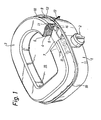
- Figs 1 and 2 illustrate a first embodiment of an earmuff according to the invention.
- the earmuff comprises in a known manner a cup 1 having a headband mounting 2 and a sealing ring 3 arranged around the rim area of the cup.
- the sealing ring 3 comprises an annular covering 5, 6 and, enclosed therein, foam material 4 of an open-cell structure.
- the foam is of a polyester type and typically has a density of about 25 kg/m 3 .
- the annular covering has a stiffer lower or rear part (bottom) 5 in the form of an annular plate and, connected therewith, outwardly directed elastic covering parts 6.
- the sealing ring 3 is arranged on a planar annular flange 7, which is attached to the cup shell 8 and extends inwardly from the circumference of the cup 1 and, thus, defines an opening 19 to the interior of the cup 1.
- the sealing ring 3 can be snapped on in the position shown, the outer annular edge of the annular plate 5 engaging with preferably slightly undercut projections 9 on the circumferential rim 10 of the cup, where the annular flange 7 passes into the rim 10.
- the projections 9 are distributed around the cup 1.
- a large number of holes 11 are uniformly distributed along the outer edge area of the bottom plate.
- Fig. 1 only a few holes 11 are illustrated for the purpose of elucidation.
- the holes 11 are here circular, but they could be designed in an optional manner.
- a number of ventilation ducts 12 are arranged in the portions of the cup 1 connecting with the annular covering 5, 6.
- the ducts 12 are uniformly distributed around the cup, and each duct 12 is, in the embodiment illustrated, adapted to provide air communication with two holes 11 in the bottom plate 5 of the sealing ring.
- the air flow which is thus made possible is illustrated by arrows 13 and 14 in Figs 1 and 2, respectively.
- Each duct 12 is formed of a rectangular recess 15 in the upwardly or forwardly facing surface of the annular flange 7 and the space 16 which is formed between the outer circumferential side portion 17 of the annular covering and the rim area 10 of the cup above the connection of the annular flange 7, between two successive projections 9.
- the ducts 12 open forwardly, laterally and externally of the sealing ring 3, thereby obtaining satisfactory protection against penetration of, for instance, impurities into the ducts 12.
- "forwards” here means inwardly in the direction of the user's head, when the earmuff is arranged over an ear.
- each duct 12 thus is of substantially rectangular cross-section having an essentially constant area.
- the curved configuration of the ducts 12 means that the length of the duct increases. It will be realised that it is possible to affect in a simple manner the length and the area of the duct by varying the duct configuration in the cup wall and/or the annular flange 7, thereby affecting the noise transmission from the environment into the sealing ring.
- a further possibility of easily changing the noise characteristic of an earmuff according to the invention is that the actual sealing ring can readily be exchanged for another sealing ring having a different configuration of the holes in the bottom plate 5.
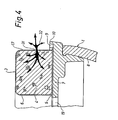
- Fig. 4 illustrates schematically a second embodiment of an earmuff according to the invention. This differs from the earmuff in Figs 1 and 2 merely by ventilation apertures 31 being arranged in the outer circumferential side portion 17 of the annular covering 5, 6. Thus, the bottom plate 5 has no ventilation apertures, and the annular flange 7 has no ventilation ducts.
- the ventilation apertures 31 consist of a large number of through holes in the side portion 17 of the annular covering.
- the holes which suitably are circular, are uniformly distributed along the sealing ring 3.
- the holes are here located on the same level in the side portion of the annular covering, more precisely at about half the height thereof.
- the holes could, however, be positioned on different levels on the ring in a certain pattern for the purpose of ensuring the desired ventilation of the interior of the sealing ring.
- the air flow into and out of the sealing ring 3 is illustrated by means of arrows 32.
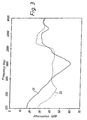
- Fig. 3 illustrates by means of a noise attenuation diagram an example of a change of the noise attenuation characteristic of an earmuff, while using the present invention.
- the diagram which shows "insertion attenuation" measured according to ISO 4869-3, indicates by a full line 21 the noise attenuation curve for an earmuff of the type illustrated in Figs 1 and 2, although without holes 11 and ducts 12. It is evident that the curve is very uneven, with a low low frequency attenuation and a pronounced attenuation peak at about 1000 Hz.
- the diagram also indicates by a dashed line 22 the noise attenuation curve for the earmuff after modification according to the invention.
- the sealing ring has 40 equally large circular holes which are uniformly distributed along the sealing ring, the total area of the holes being about 500 mm 2 .
- the number of ducts 12 is 20 and the duct length is about 5-10 mm, and the duct area is about 25 mm 2 .
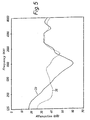
- Fig. 5 illustrates in the same manner as Fig. 3 the change of the noise attenuation characteristic obtained for an earmuff according to Fig. 4 while using the present invention.
- the noise attenuation curve for the earmuff before modification according to the invention is indicated by a full line 33.
- a dashed line 35 indicates the noise attenuation curve after modification, implying that the annular covering 6 of the sealing ring has been provided with 30 equally large and uniformly distributed holes having a total area of about 30 mm 2 .
- the thickness of the annular covering 6 ("acoustic duct length") was about 1 mm.
Landscapes
- Health & Medical Sciences (AREA)
- Life Sciences & Earth Sciences (AREA)
- Engineering & Computer Science (AREA)
- Acoustics & Sound (AREA)
- Physics & Mathematics (AREA)
- Public Health (AREA)
- Biophysics (AREA)
- Otolaryngology (AREA)
- Psychology (AREA)
- Biomedical Technology (AREA)
- Heart & Thoracic Surgery (AREA)
- Vascular Medicine (AREA)
- Animal Behavior & Ethology (AREA)
- General Health & Medical Sciences (AREA)
- Signal Processing (AREA)
- Veterinary Medicine (AREA)
- Soundproofing, Sound Blocking, And Sound Damping (AREA)
- Duct Arrangements (AREA)
- Headphones And Earphones (AREA)
- Pharmaceuticals Containing Other Organic And Inorganic Compounds (AREA)
- Helmets And Other Head Coverings (AREA)
- Adornments (AREA)
- Ventilation (AREA)
- Glass Compositions (AREA)
- Measuring Oxygen Concentration In Cells (AREA)
- Exhaust Silencers (AREA)
- Measuring Pulse, Heart Rate, Blood Pressure Or Blood Flow (AREA)
- Light Receiving Elements (AREA)
- Respiratory Apparatuses And Protective Means (AREA)
Claims (27)
- Procédé pour modifier l'atténuation de bruit d'un protège-oreille ayant une coupelle (1) munie d'un anneau d'étanchéité élastique (3) agencé le long de la circonférence d'ouverture de la coupelle, ledit anneau d'étanchéité comportant un recouvrement annulaire (5, 6) et, agencé dans celui-ci, un matériau élastique (4), caractérisé en ce qu'il comporte l'étape consistant à munir le recouvrement annulaire d'ouvertures de ventilation ou de passages (11) qui sont réparti(e)s circonférentiellement le long de l'anneau d'étanchéité (3), et qui communiquent avec l'environnement, mais qui ne communiquent pas avec l'intérieur de la coupelle, en affectant ainsi l'action de ressort pneumatique de l'anneau d'étanchéité, et ainsi la caractéristique d'atténuation de bruit du protège-oreille.
- Procédé selon la revendication 1, caractérisé en ce qu'il comporte l'étape consistant à répartir les ouvertures de ventilation (11) et/ou à donner aux ouvertures de ventilation (11) une surface d'ouverture ou différentes surfaces d'ouverture et/ou une longueur de conduit acoustique pour que la caractéristique d'atténuation de bruit du protège-oreille soit affectée de manière sélective.
- Procédé selon la revendication 1 ou 2, caractérisé en ce qu'il comporte l'étape consistant à munir le recouvrement annulaire (5, 6) d'ouvertures de ventilation (11) réparties au moins sensiblement de manière uniforme dans la direction circonférentielle, de sorte que l'air, à des fréquences basses, peut circuler sensiblement de manière non-gênée à l'extérieur de la partie intérieure de l'anneau d'étanchéité (3) vers l'environnement et vice versa, en réduisant ainsi l'action de ressort pneumatique de l'anneau d'étanchéité, au moins dans une mesure importante, et en augmentant l'atténuation de bruit à des fréquences basses.
- Procédé selon l'une quelconque des revendications précédentes, caractérisé en ce qu'il comporte l'étape consistant à agencer des ouvertures de ventilation ayant la forme de plusieurs trous de ventilation (11) dans le recouvrement annulaire (5, 6) qui sont répartis le long de l'anneau d'étanchéité (3), les trous de ventilation ayant une surface totale d'au moins environ 20 mm2, de préférence d'au moins environ 30 mm2, en particulier de plus d'environ 100 mm2.
- Procédé selon l'une quelconque des revendications précédentes, caractérisé en ce qu'il comporte l'étape consistant à agencer des ouvertures de ventilation (11) de telle sorte que l'atténuation de bruit dans une plage de fréquence d'environ 125 Hz à environ 500 Hz soit maintenue dans un intervalle ayant une largeur d'environ 20 dB au plus.
- Procédé selon la revendication 5, caractérisé en ce qu'il comporte l'étape consistant à agencer des ouvertures de ventilation (11) de telle sorte que l'atténuation de bruit dans ladite plage de fréquence soit maintenue dans un intervalle ayant une largeur d'environ 15 dB au plus.
- Procédé selon l'une quelconque des revendications 1 à 4, caractérisé en ce qu'il comporte l'étape consistant à agencer des ouvertures de ventilation (11) de telle sorte que l'atténuation de bruit dans une plage de fréquence d'environ 125 Hz à environ 1 000 Hz soit maintenue dans un intervalle ayant une largeur d'environ 20 dB au plus.
- Procédé selon la revendication 7, caractérisé en ce qu'il comporte l'étape consistant à agencer des ouvertures de ventilation (11) de telle sorte que l'atténuation de bruit dans ladite plage de fréquences soit maintenue dans un intervalle ayant une largeur d'environ 15 dB au plus.
- Procédé selon l'une quelconque des revendications précédentes, caractérisé en ce qu'il comporte l'étape consistant à amener les ouvertures de ventilation (11) à communiquer avec l'environnement par l'intermédiaire de conduits de ventilation (12), qui sont conçus pour produire une transmission de bruit sélective dans l'anneau d'étanchéité (3) dans le but d'affecter la caractéristique d'atténuation de bruit du protège-oreille.
- Procédé selon la revendication 9, caractérisé en ce qu'il comporte l'étape consistant à concevoir des conduits de ventilation (12) de manière à produire une transmission de bruit accrue dans l'anneau d'étanchéité (3) dans une ou plusieurs plages de fréquences, où l'atténuation de bruit non-affectée du protège-oreille est élevée, en obtenant ainsi une caractéristique d'atténuation de bruit plus régulière.
- Procédé selon la revendication 9 ou 10, caractérisé en ce qu'il comporte l'étape consistant à concevoir des conduits de ventilation (12) et des ouvertures de ventilation correspondantes (11), de manière à produire un pic de résonance de transmission de bruit dans une plage de fréquence sélectionnée se conformant à un pic d'atténuation dans la caractéristique d'atténuation de bruit du protège-oreille non-affecté.
- Protège-oreille ayant une coupelle (1) munie d'un anneau d'étanchéité élastique (3) agencé le long de la circonférence d'ouverture de la coupelle, ledit anneau d'étanchéité comportant un recouvrement annulaire (5, 6) et, agencé dans celui-ci, un matériau élastique (4), caractérisé en ce que le recouvrement annulaire (5, 6) est muni d'ouvertures de ventilation ou passages (11) dans une partie latérale circonférentielle extérieure (17) ou dans une partie arrière (5) de celui-ci, de sorte que l'intérieur de l'anneau d'étanchéité (3) communique avec l'environnement, mais ne communique pas avec l'intérieur de la coupelle (1), les ouvertures de ventilation (11) étant réparties circonférentiellement le long de l'anneau d'étanchéité (3), et ayant une surface ou des surfaces telles que de l'air peut circuler à l'extérieur de la partie inférieure de l'anneau d'étanchéité vers l'environnement et vice versa, de telle sorte que l'action de ressort pneumatique de l'anneau d'étanchéité est affectée ainsi dans une mesure importante.
- Protège-oreille selon la revendication 12, caractérisé en ce que l'anneau d'étanchéité (3) a des ouvertures de ventilation (11) d'une surface d'au moins environ 1 mm2 par centimètre de longueur.
- Protège-oreille selon la revendication 13, caractérisé en ce que l'anneau d'étanchéité (3) a des ouvertures de ventilation (11) d'une surface d'au moins environ 1 mm2, de préférence d'au moins environ 5 mm2 par centimètre de longueur.
- Protège-oreille selon la revendication 13 ou 14, caractérisé en ce que l'anneau d'étanchéité (3) a des ouvertures de ventilation (11) ayant une surface totale d'au moins environ 20 mm2.
- Protège-oreille selon la revendication 15, caractérisé en ce que l'anneau d'étanchéité (3) a des ouvertures de ventilation (11) ayant une surface totale d'au moins environ 30 mm2.
- Protège-oreille selon la revendication 15, caractérisé en ce que l'anneau d'étanchéité (3) a des ouvertures de ventilation (11) ayant une surface totale d'au moins environ 100 mm2.
- Protège-oreille selon l'une quelconque des revendications 12 à 17, caractérisé en ce que les ouvertures de ventilation (11) sont au moins réparties de manière sensiblement uniforme le long de l'anneau d'étanchéité (3), et ont une surface d'ouverture telle que de l'air, à des fréquences basses, peut circuler sensiblement de manière non-gênée à l'extérieur de l'anneau d'étanchéité et dans celui-ci, en augmentant ainsi l'atténuation de bruit à des fréquences basses.
- Protège-oreille selon l'une quelconque des revendications 12 à 18, caractérisé en ce que les ouvertures de ventilation (11) sont des trous de ventilation répartis de manière uniforme dans le recouvrement annulaire (5, 6) de l'anneau d'étanchéité (3), circonférentiellement le long dudit recouvrement annulaire, chaque ouverture ayant une surface d'au moins environ 1 mm2, de préférence d'au moins environ 2 mm2.
- Protège-oreille selon l'une quelconque des revendications 12 à 19, caractérisé en ce que la partie de recouvrement annulaire de l'anneau d'étanchéité dirigée vers l'environnement est constituée d'un matériau perméable à l'air.
- Protège-oreille selon l'une quelconque des revendications 12 à 19, caractérisé en ce que les ouvertures de ventilation (11) sont agencées dans une partie de recouvrement annulaire inférieure ou arrière (5), par l'intermédiaire de laquelle l'anneau d'étanchéité (3) est fixé contre la coupelle (1), ou vient en butée contre celle-ci, des conduits de ventilation (12) étant agencés dans les parties de coupelle (16) se connectant avec l'anneau d'étanchéité et/ou dans ladite partie de recouvrement annulaire inférieure ou arrière, conduits de ventilation (12) à travers lesquels les ouvertures de ventilation (11) communiquent avec l'environnement.
- Protège-oreille selon la revendication 21, caractérisé en ce que plusieurs conduits de ventilation (12) sont répartis autour de l'ouverture de la coupelle (1) pour ventilation des éléments d'anneau d'étanchéité correspondants.
- Protège-oreille selon la revendication 21 ou 22, caractérisé en ce que les conduits de ventilation (12) s'ouvrent extérieurement et latéralement par rapport à l'anneau d'étanchéité (3) dans la coupelle, les ouvertures de ventilation étant dirigées vers l'avant, s'éloignant de la coupelle.
- Protège-oreille selon l'une quelconque des revendications 21 à 23, caractérisé en ce que des conduits de ventilation (12) sont formés pour produire une transmission de bruit accrue dans au moins une plage de fréquences sélectionnée, dans laquelle l'atténuation de bruit non-affectée du protège-oreille est élevée, en affectant ainsi la caractéristique d'atténuation totale du protège-oreille.
- Protège-oreille selon l'une quelconque des revendications 21 à 24, caractérisé en ce que les conduits de ventilation (12) s'étendent d'une manière incurvée.
- Protège-oreille selon l'une quelconque des revendications 12 à 25, caractérisé en ce que le matériau élastique (4) est un matériau en mousse ayant une structure à cellules ouvertes.
- Protège-oreille selon la revendication 26, caractérisé en ce que le matériau en mousse à une densité comprise dans la plage allant d'environ 10 à environ 100 kg/m3, de préférence environ 25 kg/m3.
Applications Claiming Priority (3)
| Application Number | Priority Date | Filing Date | Title |
|---|---|---|---|
| SE9500368 | 1995-02-01 | ||
| SE9500368A SE505203C2 (sv) | 1995-02-01 | 1995-02-01 | Förfarande för att förändra ljuddämpningen hos en öronkåpa samt öronkåpa enligt förfarandet |
| PCT/SE1996/000105 WO1996023462A1 (fr) | 1995-02-01 | 1996-01-30 | Cache-oreilles antibruit |
Publications (2)
| Publication Number | Publication Date |
|---|---|
| EP0806922A1 EP0806922A1 (fr) | 1997-11-19 |
| EP0806922B1 true EP0806922B1 (fr) | 2003-09-03 |
Family
ID=20397057
Family Applications (1)
| Application Number | Title | Priority Date | Filing Date |
|---|---|---|---|
| EP96902042A Expired - Lifetime EP0806922B1 (fr) | 1995-02-01 | 1996-01-30 | Cache-oreilles antibruit |
Country Status (16)
| Country | Link |
|---|---|
| US (1) | US5970160A (fr) |
| EP (1) | EP0806922B1 (fr) |
| JP (1) | JP3655637B2 (fr) |
| KR (1) | KR100294748B1 (fr) |
| CN (1) | CN1146370C (fr) |
| AT (1) | ATE248565T1 (fr) |
| AU (1) | AU689370B2 (fr) |
| CA (1) | CA2208531C (fr) |
| DE (1) | DE69629798T2 (fr) |
| DK (1) | DK0806922T3 (fr) |
| ES (1) | ES2206556T3 (fr) |
| PL (1) | PL182115B1 (fr) |
| PT (1) | PT806922E (fr) |
| SE (1) | SE505203C2 (fr) |
| TW (1) | TW294880B (fr) |
| WO (1) | WO1996023462A1 (fr) |
Families Citing this family (40)
| Publication number | Priority date | Publication date | Assignee | Title |
|---|---|---|---|---|
| US6295366B1 (en) * | 1999-03-24 | 2001-09-25 | Flightcom Corporation | Aircraft headset |
| US6597792B1 (en) | 1999-07-15 | 2003-07-22 | Bose Corporation | Headset noise reducing |
| US6684976B1 (en) | 2002-04-12 | 2004-02-03 | David Clark Company Incorporated | Headset ear seal |
| SE528515C2 (sv) * | 2005-04-29 | 2006-12-05 | Peltor Ab | Hörselkåpa med mikrofonanordning |
| US20060269090A1 (en) * | 2005-05-27 | 2006-11-30 | Roman Sapiejewski | Supra-aural headphone noise reducing |
| US20070044206A1 (en) * | 2005-08-29 | 2007-03-01 | Sato Luciana M | Hearing protective earmuff device having frictionally engageable ear cups |
| US7444687B2 (en) * | 2005-08-29 | 2008-11-04 | 3M Innovative Properties Company | Hearing protective device that includes cellular earmuffs |
| US8571227B2 (en) | 2005-11-11 | 2013-10-29 | Phitek Systems Limited | Noise cancellation earphone |
| EP1891917A1 (fr) * | 2006-08-24 | 2008-02-27 | Unique Safety Equipment Co., Ltd. | Envelope de coussin pour des casques de protection auriculaire |
| WO2008070662A2 (fr) * | 2006-12-04 | 2008-06-12 | Adaptive Technologies, Inc. | Cache-oreilles d'atténuation sonore ayant une structure à double coque isolée |
| US8666085B2 (en) * | 2007-10-02 | 2014-03-04 | Phitek Systems Limited | Component for noise reducing earphone |
| US7717226B2 (en) * | 2008-02-20 | 2010-05-18 | Kimberly-Clark Worldwide, Inc. | Hearing protection cap |
| US20090307730A1 (en) * | 2008-05-29 | 2009-12-10 | Mark Donaldson | Media enhancement module |
| US20110002474A1 (en) * | 2009-01-29 | 2011-01-06 | Graeme Colin Fuller | Active Noise Reduction System Control |
| EP2226902A3 (fr) * | 2009-03-06 | 2013-03-13 | Phitek Systems Limited | Connecteur pour un système de divertissement en vol |
| JP5340833B2 (ja) * | 2009-07-06 | 2013-11-13 | 株式会社オーディオテクニカ | イヤーマフ及びヘッドホン |
| US20110188668A1 (en) * | 2009-09-23 | 2011-08-04 | Mark Donaldson | Media delivery system |
| US9818394B2 (en) | 2009-11-30 | 2017-11-14 | Graeme Colin Fuller | Realisation of controller transfer function for active noise cancellation |
| USD650356S1 (en) * | 2010-01-06 | 2011-12-13 | Skullcandy, Inc. | Eyeglass shaped headphones |
| US20110225705A1 (en) * | 2010-03-16 | 2011-09-22 | 3M Innovative Properties Company | Hearing protective device with moisture resistant earmuff sound absorbers |
| WO2011146429A1 (fr) | 2010-05-17 | 2011-11-24 | Thales Avionics, Inc. | Dispositif d'interface utilisateur modulaire de siège de passager d'une compagnie aérienne |
| EP2471710A1 (fr) | 2010-11-15 | 2012-07-04 | Nigel Greig | Système de distribution multimédia |
| US9154867B2 (en) | 2011-03-25 | 2015-10-06 | Honeywell Safety Products Usa, Inc. | Earmuff enclosure |
| US9654854B2 (en) | 2011-06-01 | 2017-05-16 | Paul Darlington | In-ear device incorporating active noise reduction |
| WO2013052881A2 (fr) | 2011-10-07 | 2013-04-11 | Hearing Components, Inc. | Coussin en mousse pour casque d'écoute |
| TWI457009B (zh) * | 2011-12-02 | 2014-10-11 | Giga Byte Tech Co Ltd | 耳機耳殼及耳機 |
| US8651229B2 (en) | 2012-06-05 | 2014-02-18 | Honeywell International Inc. | Hearing protection |
| USD709479S1 (en) * | 2013-01-04 | 2014-07-22 | Barak MELAMED | Headphones earpiece |
| TWD162726S (zh) * | 2013-08-14 | 2014-09-01 | 御穎有限公司 | 耳機飾蓋之部分 |
| USD736174S1 (en) | 2014-02-10 | 2015-08-11 | New Audio LLC | Headphone device |
| CN105516843B (zh) * | 2014-09-24 | 2019-02-15 | 美律电子(深圳)有限公司 | 具有复合包覆套的耳罩 |
| US9438980B2 (en) * | 2014-11-20 | 2016-09-06 | Merry Electronics (Shenzhen) Co., Ltd. | Headphone ear cup |
| AU2015401745B2 (en) * | 2015-07-06 | 2020-10-08 | Wikmanshyttan Safety Ab | A method for manufacturing a sealing ring, and a sealing ring |
| JP6549258B2 (ja) * | 2015-07-07 | 2019-07-24 | シェンゼン ロヨル テクノロジーズ シーオー.,エルティーディー | 耳当て |
| CN105213099A (zh) * | 2015-09-29 | 2016-01-06 | 苏州天裁纺织工艺品有限公司 | 一种双面可拆卸式长度可调耳罩 |
| USD868025S1 (en) * | 2018-03-22 | 2019-11-26 | Neal John Brace | Pair of ear pads |
| WO2019104172A1 (fr) * | 2017-11-21 | 2019-05-31 | 3M Innovative Properties Company | Coussin pour une protection auditive ou un casque audio |
| FI128530B (en) | 2017-11-29 | 2020-07-15 | Savox Communications Oy Ab Ltd | Ear cover for hearing protection |
| JP7358895B2 (ja) * | 2019-10-08 | 2023-10-11 | 株式会社Jvcケンウッド | イヤーマフ |
| FI130315B (en) | 2021-05-05 | 2023-06-14 | Fiskars Finland Oy Ab | Ear protection device |
Family Cites Families (6)
| Publication number | Priority date | Publication date | Assignee | Title |
|---|---|---|---|---|
| US2672864A (en) * | 1951-07-18 | 1954-03-23 | Makara Frank | Audio mask |
| FR2579455B3 (fr) * | 1985-03-27 | 1987-08-07 | Lemasson Yves | Dispositif pour proteger l'ouie contre les bruits de haut niveau |
| SE450546B (sv) * | 1985-04-12 | 1987-07-06 | Bilsom Ab | Horselskyddskapa med vermevexlarorgan |
| US4856118A (en) * | 1987-02-11 | 1989-08-15 | Bose Corporation | Headphone cushioning |
| US4993074A (en) * | 1988-04-13 | 1991-02-12 | Carroll Robert J | Earphone spacer |
| US5020163A (en) * | 1989-06-29 | 1991-06-04 | Gentex Corporation | Earseal for sound-attenuating earcup assembly |
-
1995
- 1995-02-01 SE SE9500368A patent/SE505203C2/sv not_active IP Right Cessation
-
1996
- 1996-01-30 WO PCT/SE1996/000105 patent/WO1996023462A1/fr not_active Ceased
- 1996-01-30 US US08/860,712 patent/US5970160A/en not_active Expired - Lifetime
- 1996-01-30 CA CA002208531A patent/CA2208531C/fr not_active Expired - Lifetime
- 1996-01-30 KR KR1019970705270A patent/KR100294748B1/ko not_active Expired - Fee Related
- 1996-01-30 DE DE69629798T patent/DE69629798T2/de not_active Expired - Lifetime
- 1996-01-30 JP JP52347296A patent/JP3655637B2/ja not_active Expired - Fee Related
- 1996-01-30 AU AU46380/96A patent/AU689370B2/en not_active Expired
- 1996-01-30 AT AT96902042T patent/ATE248565T1/de active
- 1996-01-30 CN CNB961917156A patent/CN1146370C/zh not_active Expired - Lifetime
- 1996-01-30 EP EP96902042A patent/EP0806922B1/fr not_active Expired - Lifetime
- 1996-01-30 PT PT96902042T patent/PT806922E/pt unknown
- 1996-01-30 PL PL96321632A patent/PL182115B1/pl not_active IP Right Cessation
- 1996-01-30 ES ES96902042T patent/ES2206556T3/es not_active Expired - Lifetime
- 1996-01-30 DK DK96902042T patent/DK0806922T3/da active
- 1996-01-31 TW TW085101180A patent/TW294880B/zh not_active IP Right Cessation
Also Published As
| Publication number | Publication date |
|---|---|
| PT806922E (pt) | 2003-12-31 |
| JP3655637B2 (ja) | 2005-06-02 |
| EP0806922A1 (fr) | 1997-11-19 |
| SE9500368L (sv) | 1996-08-02 |
| ATE248565T1 (de) | 2003-09-15 |
| DE69629798T2 (de) | 2004-07-01 |
| KR100294748B1 (ko) | 2002-06-20 |
| AU689370B2 (en) | 1998-03-26 |
| WO1996023462A1 (fr) | 1996-08-08 |
| CA2208531A1 (fr) | 1996-08-08 |
| TW294880B (fr) | 1997-01-01 |
| US5970160A (en) | 1999-10-19 |
| KR19980701873A (ko) | 1998-06-25 |
| CN1172423A (zh) | 1998-02-04 |
| ES2206556T3 (es) | 2004-05-16 |
| CN1146370C (zh) | 2004-04-21 |
| SE9500368D0 (sv) | 1995-02-01 |
| PL182115B1 (pl) | 2001-11-30 |
| DK0806922T3 (da) | 2003-10-27 |
| DE69629798D1 (de) | 2003-10-09 |
| SE505203C2 (sv) | 1997-07-14 |
| JPH10513068A (ja) | 1998-12-15 |
| AU4638096A (en) | 1996-08-21 |
| CA2208531C (fr) | 2006-04-04 |
| PL321632A1 (en) | 1997-12-08 |
Similar Documents
| Publication | Publication Date | Title |
|---|---|---|
| EP0806922B1 (fr) | Cache-oreilles antibruit | |
| US6683965B1 (en) | In-the-ear noise reduction headphones | |
| EP0688143B1 (fr) | Casques d'écoute supra-auriculaires à réduction active de bruit | |
| US6219850B1 (en) | Helmet | |
| US10171905B2 (en) | Headphones with frequency-targeted resonance chambers | |
| US8582796B2 (en) | Earmuff and headphone | |
| US6105713A (en) | Cover movable by rotation forming a cerumen barrier in a hearing aid | |
| EP0199689A2 (fr) | Coiffe-oreille | |
| KR101644738B1 (ko) | 케이블 스토퍼부재가 구비된 이어폰 | |
| US5815842A (en) | Ear protection cap with improved sound absorption | |
| US12464279B2 (en) | Ear pad or earmold for an earphone, and earphone with an ear pad or earmold | |
| GB2258619A (en) | Ear plug | |
| CN217643647U (zh) | 一种耳塞及耳机 | |
| US11089399B1 (en) | Ear tip with wedge-shaped apertures and earpiece with the same | |
| EP1629806B1 (fr) | Bouchon d'oreille et son procédé de fabrication | |
| US7542581B2 (en) | Ear insert for a hearing aid | |
| EP3720400B1 (fr) | Dispositif de protection auditive ayant une entrée sonore unidirectionnelle | |
| CN223540665U (zh) | 一种用于降噪的音乐耳塞 | |
| US20250220337A1 (en) | Open-back headphone | |
| JP2001189997A (ja) | 耳掛け式補聴器 | |
| GB2528119A (en) | Improvements in and relating to loudspeakers |
Legal Events
| Date | Code | Title | Description |
|---|---|---|---|
| PUAI | Public reference made under article 153(3) epc to a published international application that has entered the european phase |
Free format text: ORIGINAL CODE: 0009012 |
|
| 17P | Request for examination filed |
Effective date: 19970725 |
|
| AK | Designated contracting states |
Kind code of ref document: A1 Designated state(s): AT BE CH DE DK ES FR GB GR IE IT LI LU MC NL PT SE |
|
| 17Q | First examination report despatched |
Effective date: 20020125 |
|
| GRAH | Despatch of communication of intention to grant a patent |
Free format text: ORIGINAL CODE: EPIDOS IGRA |
|
| GRAS | Grant fee paid |
Free format text: ORIGINAL CODE: EPIDOSNIGR3 |
|
| RAP1 | Party data changed (applicant data changed or rights of an application transferred) |
Owner name: BACOU-DALLOZ AB |
|
| GRAA | (expected) grant |
Free format text: ORIGINAL CODE: 0009210 |
|
| AK | Designated contracting states |
Kind code of ref document: B1 Designated state(s): AT BE CH DE DK ES FR GB GR IE IT LI LU MC NL PT SE |
|
| REG | Reference to a national code |
Ref country code: GB Ref legal event code: FG4D |
|
| REG | Reference to a national code |
Ref country code: CH Ref legal event code: EP |
|
| REG | Reference to a national code |
Ref country code: CH Ref legal event code: NV Representative=s name: BRAUN & PARTNER PATENT-, MARKEN-, RECHTSANWAELTE |
|
| REF | Corresponds to: |
Ref document number: 69629798 Country of ref document: DE Date of ref document: 20031009 Kind code of ref document: P |
|
| REG | Reference to a national code |
Ref country code: IE Ref legal event code: FG4D |
|
| PG25 | Lapsed in a contracting state [announced via postgrant information from national office to epo] |
Ref country code: GR Free format text: LAPSE BECAUSE OF FAILURE TO SUBMIT A TRANSLATION OF THE DESCRIPTION OR TO PAY THE FEE WITHIN THE PRESCRIBED TIME-LIMIT Effective date: 20031203 |
|
| REG | Reference to a national code |
Ref country code: SE Ref legal event code: TRGR |
|
| PG25 | Lapsed in a contracting state [announced via postgrant information from national office to epo] |
Ref country code: LU Free format text: LAPSE BECAUSE OF NON-PAYMENT OF DUE FEES Effective date: 20040130 Ref country code: IE Free format text: LAPSE BECAUSE OF NON-PAYMENT OF DUE FEES Effective date: 20040130 |
|
| PG25 | Lapsed in a contracting state [announced via postgrant information from national office to epo] |
Ref country code: MC Free format text: LAPSE BECAUSE OF NON-PAYMENT OF DUE FEES Effective date: 20040131 |
|
| ET | Fr: translation filed | ||
| REG | Reference to a national code |
Ref country code: ES Ref legal event code: FG2A Ref document number: 2206556 Country of ref document: ES Kind code of ref document: T3 |
|
| PLBE | No opposition filed within time limit |
Free format text: ORIGINAL CODE: 0009261 |
|
| STAA | Information on the status of an ep patent application or granted ep patent |
Free format text: STATUS: NO OPPOSITION FILED WITHIN TIME LIMIT |
|
| 26N | No opposition filed |
Effective date: 20040604 |
|
| REG | Reference to a national code |
Ref country code: IE Ref legal event code: MM4A |
|
| PGFP | Annual fee paid to national office [announced via postgrant information from national office to epo] |
Ref country code: PT Payment date: 20111229 Year of fee payment: 17 |
|
| PGFP | Annual fee paid to national office [announced via postgrant information from national office to epo] |
Ref country code: CH Payment date: 20120126 Year of fee payment: 17 |
|
| PGFP | Annual fee paid to national office [announced via postgrant information from national office to epo] |
Ref country code: BE Payment date: 20120222 Year of fee payment: 17 Ref country code: IT Payment date: 20120123 Year of fee payment: 17 |
|
| REG | Reference to a national code |
Ref country code: DE Ref legal event code: R082 Ref document number: 69629798 Country of ref document: DE Ref country code: DE Ref legal event code: R082 Ref document number: 69629798 Country of ref document: DE Representative=s name: PATENTANWAELTE QUERMANN, STURM, WEILNAU, DE |
|
| PGFP | Annual fee paid to national office [announced via postgrant information from national office to epo] |
Ref country code: AT Payment date: 20111230 Year of fee payment: 17 |
|
| REG | Reference to a national code |
Ref country code: DE Ref legal event code: R082 Ref document number: 69629798 Country of ref document: DE Representative=s name: PATENTANWAELTE QUERMANN, STURM, WEILNAU, DE |
|
| REG | Reference to a national code |
Ref country code: DE Ref legal event code: R082 Ref document number: 69629798 Country of ref document: DE Representative=s name: PATENTANWAELTE QUERMANN, STURM, WEILNAU, DE |
|
| PGFP | Annual fee paid to national office [announced via postgrant information from national office to epo] |
Ref country code: ES Payment date: 20120124 Year of fee payment: 17 |
|
| BERE | Be: lapsed |
Owner name: *BACOU-DALLOZ A.B. Effective date: 20130131 |
|
| REG | Reference to a national code |
Ref country code: PT Ref legal event code: MM4A Free format text: LAPSE DUE TO NON-PAYMENT OF FEES Effective date: 20130730 |
|
| REG | Reference to a national code |
Ref country code: DE Ref legal event code: R082 Ref document number: 69629798 Country of ref document: DE Representative=s name: QUERMANN STURM WEILNAU PATENTANWAELTE PARTNERS, DE Effective date: 20130625 Ref country code: DE Ref legal event code: R082 Ref document number: 69629798 Country of ref document: DE Representative=s name: QUERMANN STURM WEILNAU PATENTANWAELTE PARTNERS, DE Effective date: 20121030 Ref country code: DE Ref legal event code: R082 Ref document number: 69629798 Country of ref document: DE Representative=s name: QUERMANN STURM WEILNAU PATENTANWAELTE PARTNERS, DE Effective date: 20130422 Ref country code: DE Ref legal event code: R082 Ref document number: 69629798 Country of ref document: DE Representative=s name: PATENTANWAELTE QUERMANN, STURM, WEILNAU, DE Effective date: 20130625 Ref country code: DE Ref legal event code: R082 Ref document number: 69629798 Country of ref document: DE Representative=s name: PATENTANWAELTE QUERMANN, STURM, WEILNAU, DE Effective date: 20121030 Ref country code: DE Ref legal event code: R082 Ref document number: 69629798 Country of ref document: DE Representative=s name: PATENTANWAELTE QUERMANN, STURM, WEILNAU, DE Effective date: 20130422 Ref country code: DE Ref legal event code: R081 Ref document number: 69629798 Country of ref document: DE Owner name: HONEYWELL SAFETY PRODUCTS SWEDEN AB, SE Free format text: FORMER OWNER: BACOU-DALLOZ AB, BILLESHOLM, SE Effective date: 20130625 |
|
| REG | Reference to a national code |
Ref country code: FR Ref legal event code: CD Owner name: HONEYWELL SAFETY PRODUCTS SWEDEN AB, SE Effective date: 20130719 Ref country code: FR Ref legal event code: CA Effective date: 20130719 |
|
| REG | Reference to a national code |
Ref country code: CH Ref legal event code: PL |
|
| REG | Reference to a national code |
Ref country code: AT Ref legal event code: MM01 Ref document number: 248565 Country of ref document: AT Kind code of ref document: T Effective date: 20130131 |
|
| REG | Reference to a national code |
Ref country code: NL Ref legal event code: TD Effective date: 20131009 |
|
| PG25 | Lapsed in a contracting state [announced via postgrant information from national office to epo] |
Ref country code: LI Free format text: LAPSE BECAUSE OF NON-PAYMENT OF DUE FEES Effective date: 20130131 Ref country code: AT Free format text: LAPSE BECAUSE OF NON-PAYMENT OF DUE FEES Effective date: 20130131 Ref country code: PT Free format text: LAPSE BECAUSE OF NON-PAYMENT OF DUE FEES Effective date: 20130730 Ref country code: CH Free format text: LAPSE BECAUSE OF NON-PAYMENT OF DUE FEES Effective date: 20130131 Ref country code: BE Free format text: LAPSE BECAUSE OF NON-PAYMENT OF DUE FEES Effective date: 20130131 |
|
| REG | Reference to a national code |
Ref country code: GB Ref legal event code: 732E Free format text: REGISTERED BETWEEN 20131017 AND 20131023 |
|
| PG25 | Lapsed in a contracting state [announced via postgrant information from national office to epo] |
Ref country code: IT Free format text: LAPSE BECAUSE OF NON-PAYMENT OF DUE FEES Effective date: 20130130 |
|
| REG | Reference to a national code |
Ref country code: ES Ref legal event code: FD2A Effective date: 20140321 |
|
| PG25 | Lapsed in a contracting state [announced via postgrant information from national office to epo] |
Ref country code: ES Free format text: LAPSE BECAUSE OF NON-PAYMENT OF DUE FEES Effective date: 20130131 |
|
| PGFP | Annual fee paid to national office [announced via postgrant information from national office to epo] |
Ref country code: DK Payment date: 20141230 Year of fee payment: 20 Ref country code: GB Payment date: 20141230 Year of fee payment: 20 |
|
| PGFP | Annual fee paid to national office [announced via postgrant information from national office to epo] |
Ref country code: FR Payment date: 20141226 Year of fee payment: 20 |
|
| PGFP | Annual fee paid to national office [announced via postgrant information from national office to epo] |
Ref country code: NL Payment date: 20150115 Year of fee payment: 20 |
|
| PGFP | Annual fee paid to national office [announced via postgrant information from national office to epo] |
Ref country code: DE Payment date: 20150126 Year of fee payment: 20 |
|
| PGFP | Annual fee paid to national office [announced via postgrant information from national office to epo] |
Ref country code: SE Payment date: 20150108 Year of fee payment: 20 |
|
| REG | Reference to a national code |
Ref country code: DE Ref legal event code: R071 Ref document number: 69629798 Country of ref document: DE |
|
| REG | Reference to a national code |
Ref country code: DK Ref legal event code: EUP Effective date: 20160130 |
|
| REG | Reference to a national code |
Ref country code: NL Ref legal event code: MK Effective date: 20160129 |
|
| REG | Reference to a national code |
Ref country code: GB Ref legal event code: PE20 Expiry date: 20160129 |
|
| REG | Reference to a national code |
Ref country code: SE Ref legal event code: EUG |
|
| PG25 | Lapsed in a contracting state [announced via postgrant information from national office to epo] |
Ref country code: GB Free format text: LAPSE BECAUSE OF EXPIRATION OF PROTECTION Effective date: 20160129 |