EP0806310A2 - Independent suspension for a steered air suspended wheel of a bus or lorry - Google Patents
Independent suspension for a steered air suspended wheel of a bus or lorry Download PDFInfo
- Publication number
- EP0806310A2 EP0806310A2 EP97104006A EP97104006A EP0806310A2 EP 0806310 A2 EP0806310 A2 EP 0806310A2 EP 97104006 A EP97104006 A EP 97104006A EP 97104006 A EP97104006 A EP 97104006A EP 0806310 A2 EP0806310 A2 EP 0806310A2
- Authority
- EP
- European Patent Office
- Prior art keywords
- bearing
- steering knuckle
- wheel suspension
- suspension according
- wishbone
- Prior art date
- Legal status (The legal status is an assumption and is not a legal conclusion. Google has not performed a legal analysis and makes no representation as to the accuracy of the status listed.)
- Granted
Links
Images



Classifications
-
- B—PERFORMING OPERATIONS; TRANSPORTING
- B62—LAND VEHICLES FOR TRAVELLING OTHERWISE THAN ON RAILS
- B62D—MOTOR VEHICLES; TRAILERS
- B62D7/00—Steering linkage; Stub axles or their mountings
- B62D7/18—Steering knuckles; King pins
-
- B—PERFORMING OPERATIONS; TRANSPORTING
- B60—VEHICLES IN GENERAL
- B60G—VEHICLE SUSPENSION ARRANGEMENTS
- B60G11/00—Resilient suspensions characterised by arrangement, location or kind of springs
- B60G11/26—Resilient suspensions characterised by arrangement, location or kind of springs having fluid springs only, e.g. hydropneumatic springs
- B60G11/27—Resilient suspensions characterised by arrangement, location or kind of springs having fluid springs only, e.g. hydropneumatic springs wherein the fluid is a gas
-
- B—PERFORMING OPERATIONS; TRANSPORTING
- B60—VEHICLES IN GENERAL
- B60G—VEHICLE SUSPENSION ARRANGEMENTS
- B60G3/00—Resilient suspensions for a single wheel
- B60G3/18—Resilient suspensions for a single wheel with two or more pivoted arms, e.g. parallelogram
- B60G3/20—Resilient suspensions for a single wheel with two or more pivoted arms, e.g. parallelogram all arms being rigid
-
- B—PERFORMING OPERATIONS; TRANSPORTING
- B60—VEHICLES IN GENERAL
- B60G—VEHICLE SUSPENSION ARRANGEMENTS
- B60G7/00—Pivoted suspension arms; Accessories thereof
- B60G7/008—Attaching arms to unsprung part of vehicle
-
- B—PERFORMING OPERATIONS; TRANSPORTING
- B60—VEHICLES IN GENERAL
- B60G—VEHICLE SUSPENSION ARRANGEMENTS
- B60G2200/00—Indexing codes relating to suspension types
- B60G2200/10—Independent suspensions
- B60G2200/14—Independent suspensions with lateral arms
- B60G2200/144—Independent suspensions with lateral arms with two lateral arms forming a parallelogram
-
- B—PERFORMING OPERATIONS; TRANSPORTING
- B60—VEHICLES IN GENERAL
- B60G—VEHICLE SUSPENSION ARRANGEMENTS
- B60G2200/00—Indexing codes relating to suspension types
- B60G2200/10—Independent suspensions
- B60G2200/18—Multilink suspensions, e.g. elastokinematic arrangements
-
- B—PERFORMING OPERATIONS; TRANSPORTING
- B60—VEHICLES IN GENERAL
- B60G—VEHICLE SUSPENSION ARRANGEMENTS
- B60G2200/00—Indexing codes relating to suspension types
- B60G2200/40—Indexing codes relating to the wheels in the suspensions
- B60G2200/44—Indexing codes relating to the wheels in the suspensions steerable
-
- B—PERFORMING OPERATIONS; TRANSPORTING
- B60—VEHICLES IN GENERAL
- B60G—VEHICLE SUSPENSION ARRANGEMENTS
- B60G2202/00—Indexing codes relating to the type of spring, damper or actuator
- B60G2202/10—Type of spring
- B60G2202/13—Torsion spring
- B60G2202/135—Stabiliser bar and/or tube
-
- B—PERFORMING OPERATIONS; TRANSPORTING
- B60—VEHICLES IN GENERAL
- B60G—VEHICLE SUSPENSION ARRANGEMENTS
- B60G2202/00—Indexing codes relating to the type of spring, damper or actuator
- B60G2202/10—Type of spring
- B60G2202/15—Fluid spring
- B60G2202/152—Pneumatic spring
-
- B—PERFORMING OPERATIONS; TRANSPORTING
- B60—VEHICLES IN GENERAL
- B60G—VEHICLE SUSPENSION ARRANGEMENTS
- B60G2204/00—Indexing codes related to suspensions per se or to auxiliary parts
- B60G2204/10—Mounting of suspension elements
- B60G2204/12—Mounting of springs or dampers
- B60G2204/126—Mounting of pneumatic springs
-
- B—PERFORMING OPERATIONS; TRANSPORTING
- B60—VEHICLES IN GENERAL
- B60G—VEHICLE SUSPENSION ARRANGEMENTS
- B60G2204/00—Indexing codes related to suspensions per se or to auxiliary parts
- B60G2204/10—Mounting of suspension elements
- B60G2204/14—Mounting of suspension arms
- B60G2204/148—Mounting of suspension arms on the unsprung part of the vehicle, e.g. wheel knuckle or rigid axle
- B60G2204/1484—Mounting of suspension arms on the unsprung part of the vehicle, e.g. wheel knuckle or rigid axle on an intermediate upright strut upon which the stub axle is pivoted
-
- B—PERFORMING OPERATIONS; TRANSPORTING
- B60—VEHICLES IN GENERAL
- B60G—VEHICLE SUSPENSION ARRANGEMENTS
- B60G2206/00—Indexing codes related to the manufacturing of suspensions: constructional features, the materials used, procedures or tools
- B60G2206/01—Constructional features of suspension elements, e.g. arms, dampers, springs
- B60G2206/10—Constructional features of arms
- B60G2206/121—Constructional features of arms the arm having an H or X-shape
-
- B—PERFORMING OPERATIONS; TRANSPORTING
- B60—VEHICLES IN GENERAL
- B60G—VEHICLE SUSPENSION ARRANGEMENTS
- B60G2206/00—Indexing codes related to the manufacturing of suspensions: constructional features, the materials used, procedures or tools
- B60G2206/01—Constructional features of suspension elements, e.g. arms, dampers, springs
- B60G2206/50—Constructional features of wheel supports or knuckles, e.g. steering knuckles, spindle attachments
-
- B—PERFORMING OPERATIONS; TRANSPORTING
- B60—VEHICLES IN GENERAL
- B60G—VEHICLE SUSPENSION ARRANGEMENTS
- B60G2300/00—Indexing codes relating to the type of vehicle
- B60G2300/02—Trucks; Load vehicles
-
- B—PERFORMING OPERATIONS; TRANSPORTING
- B60—VEHICLES IN GENERAL
- B60G—VEHICLE SUSPENSION ARRANGEMENTS
- B60G2300/00—Indexing codes relating to the type of vehicle
- B60G2300/14—Buses
-
- B—PERFORMING OPERATIONS; TRANSPORTING
- B60—VEHICLES IN GENERAL
- B60G—VEHICLE SUSPENSION ARRANGEMENTS
- B60G2300/00—Indexing codes relating to the type of vehicle
- B60G2300/38—Low or lowerable bed vehicles
Definitions
- the invention relates to an independent wheel suspension for an air-sprung, steerable wheel of a bus or truck with features of the type specified in the preamble of claim 1.
- the independent wheel suspension according to the invention can be used for any steerable wheel of a bus or truck.
- the independent wheel suspension according to the invention can be implemented with particular advantage on the front axle of a touring coach, because there the advantages of the same are particularly evident.
- the independent wheel suspension according to the invention for the steered front wheels with a very space-saving design creates a maximum of driving comfort due to the special elesto-kinematic design of the handlebar bearings and also fulfills demands for a high axle load-bearing capacity and the largest possible steering angle of, for example, 56 ° for the inside wheel
- the independent wheel suspension according to the invention ensures direct, precise and smooth steering of the wheels, is comparatively simple and quick to install and is very easy to service.
- the independent wheel suspension according to the invention also allows a comparatively low-lying floor level with a large central aisle width between the wheel arches.
- the serviceability of the independent wheel suspension according to the invention results, among other things, from the fact that maintenance-free, spherical molecular bearings are used to support the lower wishbone and maintenance-free, particularly torsion-resistant cylindrical molecular bearings are used to support the upper wishbones and the trailing arm.
- the upper handlebar system interacts with the lower wishbone for spring movements of a wheel completely neutral and free of torsion. Component tolerances, for example in the length of the handlebars, are practically meaningless and therefore also make the compensation measures that are otherwise often necessary with conventional solutions unnecessary during assembly.
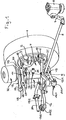
- part of the front axle shown is 1 with a steerable, air-sprung wheel and 2 with the wheel carrier supporting it.
- the latter is pivoted about a kingpin 3 on a kingpin 4.
- This is articulated to the vehicle frame 5, which is only schematically indicated in the drawing, via a plurality of links.
- a steering gear 6 can be seen in the drawing, which acts via a lever arm 7, a steering rod 8 connected to it, a toggle lever 9 articulated thereon and a tie rod 10 on a steering lever 11 arranged fixed to the wheel carrier.
- a middle tie rod 12 connects the toggle lever 9 to the wheel side opposite the axle side.
- the steering knuckle 4 can be realized to achieve high torsional rigidity as a cast, profiled hollow body made of cast steel or nodular cast iron, for example. Details and details of a steering knuckle support 4 cast in this way can be seen from FIGS. 6 to 9. In it, 4/1 designate the outer wall and 4/2 the enclosed cavity of the steering knuckle 4. 4/3 are cast iron eyes. Alternatively, the steering knuckle 4 can also be used as a die-forged part with a cross-sectional profile, e.g. B. made of tempered steel. Regardless of the non-cutting manufacturing method of its basic shape, the final shape of the axle body 4 is generated by appropriate machining post-processing of the blank at required locations.
- the wishbone 13 with its V-shaped legs 13/1, 13/2 overlaps the protruding axle support 4 and is articulated with its thigh-knee area to the outside of the latter.
- the wishbone 13 with its thigh-knee region - as the examples according to FIGS. 10 and 11 show - can be articulated on a bearing member 34 projecting at the lower end of the stub axle 4. This has been discussed in more detail later.
- the wishbone 13 is articulated on the inside of the leg as well as in the knee area of its legs 13/1, 13/2 via a spherical molecular spherical plain bearing 17/1, 17/2, 17/3 on the vehicle frame 5 or steering knuckle support 4.
- the two legs 13/1, 13/2 of the wishbone 13 each have a bearing eye 20/1 and 20/2 on the inside.
- a maintenance-free spherical molecular bearing is installed in each of these as part of a molecular ball claw spherical plain bearing 17/1 or 17/2 extending in the horizontal plane.
- the wishbone 13 is articulated to the vehicle frame 5 via the outer claws of the two spherical bearings 17/1, 17/2, and corresponding bearing blocks (not shown) there.
- the wishbone 13 also has a bearing eye 21 with a built-in maintenance-free spherical molecular bearing.
- this is part of a vertically extending molecular ball claw joint bearing 17/3, via the outer, vertically arranged claws of which the wishbone 13 is articulated on the outside of the steering knuckle 4.
- the latter has a wall-shaped indentation 22 in its lower region, into which the wishbone 13 with its bearing eye 21 is partially immersed.
- Above and below the indentation 22 there are 4 contact surfaces 23 for supporting the claws of the spherical plain bearing 17/3 and threaded bores 23/1 for fixing the same to the steering knuckle support by means of screws.
- the wishbone 13 with the maintenance-free spherical molecular bearing 17/3 installed in its bearing eye 21 is fastened to a conical bearing journal 34/1 via a conical bore formed therein.
- This part of the bearing member 34 forming tapered bearing journal 34/1 is attached to the lower end of the steering knuckle 4, projecting vertically downward.
- the bearing journal 34/1 is part of a double tapered bolt which, with its upper conical bolt section 34/2, dips into a conical bore formed at the bottom of the steering knuckle 4 and is locked in this in a positive and non-positive manner with a screw 34/3 is, which at the same time for the permanent storage of camp 17/3 on tapered bearing journal 34/1 is used.
- the tapered journal 34/1 is part of a holding plate 34/4 which is fastened to the lower end of the steering knuckle 4 by means of screws 34/5.
- the bearing 17/3 is in this case clamped by means of a screw 34/6 on the tapered bearing journal 34/1.
- Each of the two identical wishbones 14, 15 has an inner-end bearing eye 24 and an outer-end bearing eye 25, each with a through-hole running transversely to the longitudinal direction of the handlebar, in each of which a rotatable, cylindrical molecular bushing bearing 18 is installed with its cylindrical slot bushing.
- Tapered sleeves 26 are each supported on the mutually facing end faces of the slotted bushings on the inside of the handlebar, and also on the facing faces of the slotted bushings on the outside of the handlebar. These engage in corresponding conical bore sections which are formed in pairs opposite one another at the ends of a through bore in a frame-fixed bearing block (not shown) and on the other hand a through bore 27 in the upper region of the steering knuckle 4.
- a tie rod which penetrates the two inner-end molecular bearing slot bushings, the two tapered sleeves 26 supported thereon and the through-bore having the associated conical bore sections on the frame-side bearing block (not shown) and for the inner-end fastening of the two wishbones 14, 15 to the vehicle frame 5 serves.
- a tie rod arranged parallel to the tie rod 28 is designated, which penetrates the two outer-end molecular bearing slot bushings, the two tapered sleeves 26 supported thereon and the through-bore 27 in the steering knuckle support 4 which has the associated conical bore sections and for the outer-end fastening of the two wishbones 14, 15 on Stub axle 4 is used.
- the two links 14, 15 are each clamped from the outside by corresponding axial prestressing of each of the two tie rods 28, 29 to the bearing block or steering knuckle 4, the axial force being applied via the two molecular bearing slot bushings each seated on one of the tie rods 28, 29 to which cone sleeves 26 pressed in this way with high frictional force are transmitted.
- the trailing arm 16 which serves to stabilize the steering knuckle 4 in the longitudinal direction of the vehicle, is arranged in a horizontal plane that extends parallel to that receiving the wishbone 13, but is moved close to the upper wishbones 14, 15 just below (as shown) or above it.
- the trailing arm 16 can extend obliquely or parallel to the longitudinal axis of the vehicle in front of or behind the axle body 4, either under tension or pressure, in the horizontal plane.
- the trailing arm 16 has a bearing eye 30 and 31 at each of its two ends, each with a through hole running transversely to the longitudinal direction of the trailing arm, into each of which a molecular bushing bearing 19/1 or 19/2 with its cylindrical slot bushing is installed .
- connection of the trailing arm 16 to the upper region of the steering knuckle 4 is established, with corresponding contact surfaces 4/3 (see FIG. 6) for supporting the claws and threaded bores for fixing the latter are given on it via screws.
- the connection of the trailing arm 16 to a bearing block (not shown) fixed to the vehicle frame is established via the claws with associated screws of the other molecular bushing bearing 19/2.
- the links 14, 15, 16 are preferably each realized by a one-piece drop-forged part, but can also be represented as a cast part, the blank being machined accordingly at the necessary points after being removed from the mold.
- a stabilizer 37 which reduces the side tilt of the vehicle in curves and its sensitivity to side winds, as well as the roll behavior improved.
- a stabilizer 37 can be U-shaped in plan view, connect the two steering knuckle supports 4 provided for each axle in an articulated manner and can be suspended on the vehicle frame 5 via rockers or bearing blocks (not shown). The connection point on the steering knuckle is given by the 4/6 organ there.
- the momentary center of the axle is at the level of the roadway, which means that the lateral force lever arm responsible for the disturbing lateral acceleration is missing in some wheel suspensions.
- Body lateral accelerations can therefore be effectively avoided in a vehicle with the independent wheel suspension according to the invention.
- the entire axle guide, but especially the bearings themselves, keep road noise away from the vehicle body, are maintenance-free and practically wear-free, hardly flexible, yet easily rotatable and precise.
- the lower wishbone 13 because of its large projection length and the relatively small angle of rotation, is equipped with three molecular ball claw spherical bearings that are adapted to the loads that occur, cylindrical molecular slot bush bearings are used for the dissolved upper link system 14, 15, 16.
Landscapes
- Engineering & Computer Science (AREA)
- Mechanical Engineering (AREA)
- Chemical & Material Sciences (AREA)
- Combustion & Propulsion (AREA)
- Transportation (AREA)
- Vehicle Body Suspensions (AREA)
- Automobile Manufacture Line, Endless Track Vehicle, Trailer (AREA)
Abstract
Description
Die Erfindung betrifft eine Einzelradaufhängung für ein luftgefedertes, lenkbares Rad eines Omnibusses oder Lastkraftwagen mit Merkmalen der im Oberbegriff des Anspruches 1 angegebenen Art.The invention relates to an independent wheel suspension for an air-sprung, steerable wheel of a bus or truck with features of the type specified in the preamble of claim 1.
Aus der Einführungsschrift der Mercedes-Benz AG zu ihrem Omnibus des Typs O 404 geht für die Vorderachse eine Einzelradaufhängung hervor, bestehend aus einem oberen Dreieckslenker und einem unteren Dreieckslenker sowie aus einer über einen Hebel gelagerten Momentenstrebe, über welche Lenker der Achsschenkelträger mit dem Fahrgestellrahmen des Busses verbunden ist. Dabei ragen die beiden unteren Dreieckslenker der beiden Vorderräder ebenso wie die zugehörigen Momentenstreben weit bis nahe zur Fahrzeugmitte herein, was selbstredend einen relativ hoch darüber bauenden Fußboden bedeutet. Diese bekannte Einzelradaufhängung mag zwar ein komfortables Fahren des Busses gewährleisten, schränkt aber wegen ihrer sehr raumverzehrenden Bauweise den für andere Aggregate oder Fahrzeugteile noch verfügbaren bzw. nutzbaren Raum erheblich ein.The introduction of Mercedes-Benz AG to its O 404 omnibus shows that the front axle has independent suspension, consisting of an upper wishbone and a lower wishbone as well as a torque strut mounted via a lever, via which handlebars the steering knuckle with the chassis frame of the Busses is connected. The two lower wishbones of the two front wheels and the associated torque struts protrude far up to the center of the vehicle, which of course means that the floor is relatively high above. This known independent wheel suspension may ensure comfortable driving of the bus, but because of its very space-consuming construction it considerably limits the space still available or usable for other units or vehicle parts.
Desweiteren sei der Vollständigkeit wegen auch noch auf die EP 0 182 480 A2 und die EP 0 242 883 B1, dort die Version gemäß Fig. 14, verwiesen. Diese beiden Dokumente offenbaren jeweils Einzelradaufhängungen für ungelenkte Räder von Kraftfahrzeugen. Für den Fachmann ist jedoch klar, daß eine Aufhängung für ein ungelenktes Rad praktisch nicht für ein lenkbares Rad verwendbar ist, weil bei letzterem zusätzlich ein Achsschenkelträger notwendig ist und außerdem das Gestänge und die Hebelage des Lenkmechanismus sowie dessen Bewegungsbereiche berücksichtigt werden müssen.Furthermore, for the sake of completeness, reference is also made to EP 0 182 480 A2 and EP 0 242 883 B1, there the version according to FIG. 14. These two documents each disclose independent wheel suspensions for unguided wheels of motor vehicles. However, it is clear to the person skilled in the art that a suspension for an unguided wheel is practically not usable for a steerable wheel, because in the latter case a steering knuckle support is also necessary and, furthermore, the linkage and the lever position of the steering mechanism and its ranges of movement must be taken into account.
Es ist daher Aufgabe der Erfindung, eine Einzelradaufhängung für ein lenkbares, luftgefedertes Rad eines Omnibusses oder Lastkraftwagen Zu schaffen, die auf extrem platzsparende Bauweise ausgelegt ist, trotzdem ein Höchstmaß an Fahrkomfort garantiert und einen sehr hohen Radeinschlagwinkel zuläßt.It is therefore an object of the invention to provide an independent wheel suspension for a steerable, air-sprung wheel of a bus or truck, which is designed for an extremely space-saving design, nevertheless guarantees maximum driving comfort and permits a very high steering angle.
Diese Aufgabe ist erfindungsgemäß durch eine Einzelradaufhängung gelöst, die sich durch eine Kombination von Merkmalen, wie im Kennzeichen des Anspruches 1 angegeben, kennzeichnet.This object is achieved by an independent wheel suspension, which is characterized by a combination of features, as indicated in the characterizing part of claim 1.
Vorteilhafte Ausgestaltungen und Weiterbildungen dieser Lösung sind in den Unteransprüchen gekennzeichnet.Advantageous refinements and developments of this solution are characterized in the subclaims.
Die erfindungsgemäße Einzelradaufhängung ist für jedes lenkbare Rad eines Omnibusses oder Lastkraftwagen anwendbar. Mit besonderem Vorteil läßt sich die erfindungsgemäße Einzelradaufhängung an der Vorderachse eines Reisebusses realisieren, denn dort kommen die Vorteile derselben in besonders starker Weise zur Geltung. In bzw. an einem Solchen Reisebus schafft die erfindungsgemäße Einzelradaufhängung für die gelenkten Vorderräder bei sehr platzsparender Bauweise aufgrund spezieller elesto-kinematischer Auslegung der Lenkerlager ein Höchstmaß an Fahrkomfort und erfüllt auch Forderungen nach hoher Achstragfähigkeit und größtmöglichem Radeinschlagwinkel von zum Beispiel 56° für das kurveninnere Rad. Außerdem gewährleistet die erfindungsgemäße Einzelradaufhängung eine direkte, zielgenaue und leichtgängige Lenkung der Räder, ist vergleichsweise einfach und schnell montierbar sowie sehr servicefreundlich. In Verbindung mit einem Reisebus erlaubt die erfindungsgemäße Einzelradaufhängung außerdem eine vergleichsweise tiefliegende Fußbodenebene mit großer Mittelgangbreite zwischen den Radkästen. Die Servicefreundlichkeit der erfindungsgemäßen Einzelradaufhängung resultiert unter anderem daraus, daß zur Lagerung des unteren Dreieckslenkers wartungsfreie kuglige Molekularlager und zur Lagerung der oberen Querlenker und des Längslenkers wartungsfreie, besonders verdrehweiche zylindrische Molekularlager verwendet werden. Das obere Lenkersystem verhält sich in Zusammenwirkung mit dem unteren Dreieckslenker bei Federbewegungen eines Rades völlig neutral und verzwängungsfrei. Bauteiltoleranzen, zum Beispiel in den Längen der Lenker, sind praktisch bedeutungslos und machen somit auch die ansonsten bei herkömmlichen Lösungen oftmals notwendigen Ausgleichsmaßnahmen bei der Montage überflüssig. Die Verwendung von relativ kleinen, radial hochbelastbaren und präzisen Molekular-Zylinderlagern zur Anlenkung der oberen Querlenker und des Längslenkers wird ermöglicht durch den großen Wirkabstand zwischen unterem und oberem Querlenkersystem. Aufgrund einer gezielten elasto-kinematischen Auslegung der gesamten Radführung mit definierten Eigenlenk-Eigenschaften wird eine hohe Fahrstabilität und Fahrsicherheit erreicht.The independent wheel suspension according to the invention can be used for any steerable wheel of a bus or truck. The independent wheel suspension according to the invention can be implemented with particular advantage on the front axle of a touring coach, because there the advantages of the same are particularly evident. In or on such a coach, the independent wheel suspension according to the invention for the steered front wheels with a very space-saving design creates a maximum of driving comfort due to the special elesto-kinematic design of the handlebar bearings and also fulfills demands for a high axle load-bearing capacity and the largest possible steering angle of, for example, 56 ° for the inside wheel In addition, the independent wheel suspension according to the invention ensures direct, precise and smooth steering of the wheels, is comparatively simple and quick to install and is very easy to service. In conjunction with a coach, the independent wheel suspension according to the invention also allows a comparatively low-lying floor level with a large central aisle width between the wheel arches. The serviceability of the independent wheel suspension according to the invention results, among other things, from the fact that maintenance-free, spherical molecular bearings are used to support the lower wishbone and maintenance-free, particularly torsion-resistant cylindrical molecular bearings are used to support the upper wishbones and the trailing arm. The upper handlebar system interacts with the lower wishbone for spring movements of a wheel completely neutral and free of torsion. Component tolerances, for example in the length of the handlebars, are practically meaningless and therefore also make the compensation measures that are otherwise often necessary with conventional solutions unnecessary during assembly. The use of relatively small, radially heavy-duty and precise molecular cylinder bearings for the articulation of the upper wishbones and the trailing arms is made possible by the large effective distance between the lower and upper wishbone system. Due to a targeted elasto-kinematic design of the entire wheel guidance with defined self-steering properties, high driving stability and driving safety are achieved.
Nachstehend ist die erfindungsgemäße Einzelradaufhängung anhand mehrerer in der Zeichnung dargestellter Ausführungsbeispiele noch näher erläutert. Dabei ist die, hier für einen Reisebus als Teil der Vorderachse konzipierte Einzelradaufhängung gemäß der ersten Ausführungsform gezeigt
- in Fig. 1 in perspektivischer Ansicht schräg von vorne her,
- in Fig. 2 in perspektivischer Ansicht schräg von hinten her,
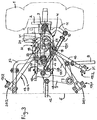
- in Fig. 3 in Draufsicht,
- in Fig. 4 in Seitenansicht, und
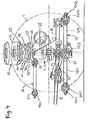
- in Fig. 5 in Vorderansicht.
- 1 in a perspective view obliquely from the front,
- 2 in a perspective view obliquely from behind,
- 3 in plan view,
- 4 in side view, and
- 5 in front view.
Die Fig. 6 bis 9 zeigen den zugehörigen Achsschenkelträger im Detail, nämlich
- Fig. 6
- in Vorderansicht,
- Fig. 7
- in Seitenansicht vom Rad her,
- Fig. 8
- im Schnitt entlang Schnittlinie D-D aus Fig. 6, und
- Fig. 9
- im Schnitt entlang Schnittlinie F-F aus Fig. 6.
- Fig. 6
- in front view,
- Fig. 7
- in side view from the bike,
- Fig. 8
- in section along section line DD of Fig. 6, and
- Fig. 9
- in section along section line FF from FIG. 6.
Fig. 10 und 11 zeigen alternative Anlenkungslösungen für den Dreieckslenker am Achsschenkelträger.10 and 11 show alternative articulation solutions for the wishbone on the steering knuckle.
In den Figuren sind der Übersichtlichkeit wegen gleiche bzw. einander entsprechende Teile mit gleichen Bezugszeichen angezogen.In the figures, for the sake of clarity, identical or corresponding parts are drawn with the same reference numerals.
In der Zeichnung ist als Teil der dargestellten Vorderachse mit 1 ein lenkbares, luftgefedertes Rad und mit 2 der dieses lagernde Radträger bezeichnet. Letzterer ist um einen Achsschenkelbolzen 3 schwenkbar an einem Achsschenkelträger 4 angelenkt. Dieser wiederum ist über mehrere Lenker an dem in der Zeichnung nur schematisch angedeuteten Fahrzeugrahmen 5 angelenkt. Vom Lenkmechanismus für die beiden Räder 1 der Achse sind in der Zeichnung ersichtlich ein Lenkgetriebe 6, das über einen Hebelarm 7, eine daran angeschlossene Lenkstange 8, einen an dieser angelenkten Kniehebel 9 und eine Spurstange 10 auf einen radträgerfest angeordneten Lenkhebel 11 wirkt. Eine mittlere Spurstange 12 verbindet den Kniehebel 9 mit der achsseitig gegenüberliegenden Radseite.In the drawing, part of the front axle shown is 1 with a steerable, air-sprung wheel and 2 with the wheel carrier supporting it. The latter is pivoted about a
Die Einzelradaufhängung für ein Rad 1 kennzeichnet sich erfindungsgemäß durch die Kombination
- a) eines als verwindungssteifes Guß- oder Schmiedeteil
ausgeführten Achsschenkelträgers 4 mit - b) einer Radführung mit einem
Dreieckslenker 13, zweiQuerlenkern Längslenker 16 in spezieller Anordnung, nämlich - b1) der
Dreieckslenker 13 ist - b1.1) in einer unteren Horizontalebene angeordnet und
- b1.2) schenkelinnenseitig am
Fahrteugrahmen 5 sowie mit seinem Schenkelkniebereich am unteren Bereich desAchsschenkelträgers 4 angelenkt - b1.2.1) über jeweils ein Gelenklager 17/1, 17/2, 17/3,
- b2) die beiden
Querlenker - b2.1) stabförmig und gleich ausgebildet,
- b2.2) in einer oberen Horizontalebene parallel oder leicht gepfeilt zueinander und quer zur Fahrzeuglängsachse angeordnet,
- b2.3) außenendig am oberen Bereich des
Achsschenkelträgers 4, vorn bzw. hinten an diesem, und innenseitigam Fahrzeugrahmen 5 angelenkt - b2.3.1) über jeweils
ein verdrehweiches Lager 18, - b3) der Längslenker 16 ist
- b3.1) in einer Horizontalebene sich nach vorne oder hinten erstreckend angeordnet, sowie
- b3.2) einenendes am
Fahrzeugrahmen 5 und andernendes am oberen Bereich desAchsschenkelträgers 4 zu dessen Stabilisierung angelenkt - b3.2.1) über jeweils ein verdrehweiches Lager 19/1, 19/2.
- a) a designed as a torsionally stiff cast or forged
axle beam 4 - b) a wheel guide with a
wishbone 13, twowishbones arm 16 in a special arrangement, namely - b1) is the
wishbone 13 - b1.1) arranged in a lower horizontal plane and
- b1.2) articulated on the inside of the thigh on the
vehicle frame 5 and with its thigh knee area on the lower area of thesteering knuckle 4 - b1.2.1) via a joint bearing 17/1, 17/2, 17/3,
- b2) the two
wishbones - b2.1) rod-shaped and of the same design,
- b2.2) arranged in an upper horizontal plane parallel or slightly swept to one another and transversely to the longitudinal axis of the vehicle,
- b2.3) externally articulated on the upper area of the
steering knuckle 4, at the front or rear thereof, and on the inside on thevehicle frame 5 - b2.3.1) via a
rotatable bearing 18, - b3) the trailing
arm 16 - b3.1) arranged in a horizontal plane extending forwards or backwards, and
- b3.2) one end articulated to the
vehicle frame 5 and the other end to the upper region of thesteering knuckle 4 for stabilizing it - b3.2.1) via a twist-soft bearing 19/1, 19/2.
Nachstehend ist auf Einzelheiten dieser Einzelradaufhängung näher eingegangen.The details of this independent suspension are discussed in more detail below.
Der Achsschenkelträger 4 ist zur Erzielung hoher Verwindungssteifigkeit als gegossener, in sich profilierter Hohlkörper beispielsweise aus Stahlguß oder Sphäroguß realisierbar. Einzelheiten und Details eines solchermaßen gegossenen Achsschenkelträger 4 sind aus den Figuren 6 bis 9 ersichtlich. Darin bezeichnen 4/1 die Außenwand und 4/2 den eingeschlossenen Hohlraum des Achsschenkelträgers 4. Mit 4/3 sind Guß-Kernaugen bezeichnet. Alternativ hierzu kann der Achsschenkelträger 4 aber auch als in sich querschnittsmäßig profiliertes Gesenkschmiedeteil, z. B. aus Vergütungsstahl realisiert sein. Unabhängig von der spanlosen Herstellungsart seiner Grundform wird die Endform des Achskörpers 4 durch entsprechende spanabhebende Nachbearbeitung des Rohlings an erforderliche Stellen erzeugt.The
Bei dem in den Figuren 1 bis 9 gezeigten Ausführungsbeispiel übergreift der Dreieckslenker 13 mit seinen V-förmig gespreizten Schenkeln 13/1, 13/2 den dazwischen durchragenden Achsschenkelträger 4 und ist mit seinem Schenkel-Kniebereich an letzterem unten außen angelenkt.In the embodiment shown in Figures 1 to 9, the
Alternativ hierzu kann der Dreieckslenker 13 mit seinem Schenkel-Kniebereich - wie die Beispiele gemäß Fig. 10 und 11 zeigen - fliegend an einem am unteren Ende des Achsschenkelträgers 4 abragenden Lagerorgan 34 angelenkt sein. Hierauf ist weiter hinten noch näher eingegangen.As an alternative to this, the
Der Dreieckslenker 13 ist schenkelinnenseitig wie auch im Kniebereich seiner Schenke 13/1, 13/2 über jeweils ein kugliges Molekular-Gelenklager 17/1, 17/2, 17/3 am Fahrzeugrahmen 5 bzw. Achsschenkelträger 4 angelenkt. Im einzelnen weisen die beiden Schenkel 13/1, 13/2 des Dreieckslenkers 13 innenendig jeweils ein Lagerauge 20/1 bzw. 20/2 auf. In jedes derselben ist als Bestandteil eines sich in der Horizontalebene erstreckenden Molekular-Kugelpratzen-Gelenklagers 17/1 bzw. 17/2 ein wartungsfreies kugliges Molekularlager eingebaut. Über die äußeren Pratzen der beiden Gelenklager 17/1, 17/2 ist der Dreieckslenker 13 am Fahrzeugrahmen 5, dort entsprechenden Lagerböcken (nicht dargestellt) angelenkt. Im Kniebereich seiner beiden Schenkel 13/1, 13/2 weist der Dreieckslenker 13 ebenfalls ein Lagerauge 21 mit eingebautem wartungsfreien kugligem Molekularlager auf. Dieses ist im Fall des Ausführungsbeispieles gemäß Fig. 1 bis 9 Bestandteil eines sich vertikal erstreckenden Molekular-Kugelpratzen-Gelenklagers 17/3, über dessen äußere, vertikal angeordnete Pratzen der Dreieckslenker 13 außen am Achsschenkelträger 4 angelenkt ist. Hierzu weist letzterer in seinem unteren Bereich außen eine mauförmige Einbuchtung 22 auf, in die der Dreieckslenker 13 mit seinem Lagerauge 21 partiell eintaucht. Oberhalb und unterhalb der Einbuchtung 22 sind am Achsschenkelträger 4 Anlageflächen 23 für die Abstützung der Pratzen des Gelenklagers 17/3 und Gewindebohrungen 23/1 für die Festlegung derselben daran mittels Schrauben gegeben.The
Im Fall der Beispiele gemäß Fig. 10 und 11 ist der Dreieckslenker 13 mit dem in seinem Lagerauge 21 eingebauten, wartungsfreien kugligen Molekularlager 17/3 über eine darin ausgebildete Konusbohrung auf einem kegligen Lagerzapfen 34/1 sitzend an diesem befestigt. Dieser ein Bestandteil des Lagerorgans 34 bildende keglige Lagerzapfen 34/1 ist am unteren Ende des Achsschenkelträgers 4 vertikal nach unten abragend befestigt. Im Fall der Ausführungsform gemäß Fig. 10 ist der Lagerzapfen 34/1 Bestandteil eines Doppelkegelbolzens, der mit seinem oberen kegligen Bolzenabschnnitt 34/2 in eine untenendig am Achsschenkelträger 4 ausgebildete Konusbohrung eintaucht und in dieser form- und kraftschlüssig mit einer Schraube 34/3 arretiert ist, die hier gleichzeitig auch zur Festlagerung des Lagers 17/3 am kegligen Lagerzapfen 34/1 dient. Im Fall der Ausführungsform gemäß Fig. 11 ist der keglige Lagerzapfen 34/1 Bestandteil einer Halteplatte 34/4, die mittels Schrauben 34/5 am unteren Ende des Achsschenkelträgers 4 befestigt ist. Das Lager 17/3 ist in diesem Fall mittels einer Schraube 34/6 am kegligen Lagerzapfen 34/1 festgespannt.In the case of the examples according to FIGS. 10 and 11, the
Jeder der beiden identischen Querlenker 14, 15 hat ein innenendiges Lagerauge 24 und ein außenendiges Lagerauge 25 mit jeweils einer quer zur Lenker-Längsrichtung verlaufenden Durchgangsbohrung, in die jeweils ein verdrehweiches, zylindrisches Molekular-Buchsenlager 18 mit seiner zylindrischen Schlitzbuchse eingebaut ist. An den einander zugewandten Stirnflächen der lenker-innenendigen Schlitzbuchsen, ebenso an den einander zugewandten Stirnflächen der lenkeraußenendigen Schlitzbuchsen sind jeweils Kegelhülsen 26 abgestützt. Diese greifen in entsprechende konische Bohrungsabschnitte ein, die paarweise einander gegenüberliegend an den Enden zum einen einer Durchgangsbohrung in einem rahmenfesten Lagerbock (nicht dargestellt) und zum anderen einer Durchgangsbohrung 27 im oberen Bereich des Achsschenkelträgers 4 ausgebildet sind. Mit 28 ist ein Zuganker bezeichnet, der die beiden innenendigen Molekularlager-Schlitzbuchsen, die beiden daran abgestützten Kegelhülsen 26 und die die zugehörigen konischen Bohrungsabschnitte aufweisende Durchgangsbohrung am (nicht dargestellten) rahmenseitigen Lagerbock durchdringt und zur innenendigen Befestigung der beiden Querlenker 14, 15 am Fahrzeugrahmen 5 dient. Mit 29 ist ein zum Zuganker 28 parallel angeordneter Zuganker bezeichnet, der die beiden außenendigen Molekularlager-Schlitzbuchsen, die beiden daran abgestützten Kegelhülsen 26 und die die zugehörigen konischen Bohrungsabschnitte aufweisende Durchgangsbohrung 27 im Achsschenkelträger 4 durchdringt und zur außenendigen Befestigung der beiden Querlenker 14, 15 am Achsschenkelträger 4 dient. Dabei werden die beiden Lenker 14, 15 jeweils von außen her durch entsprechende axiale Vorspannung jedes der beiden Zuganker 28, 29 am Lagerbock bzw. Achsschenkelträger 4 festgespannt, wobei die Axialkraft über die beiden jeweils auf einem der Zuganker 28, 29 sitzenden Molekularlager-Schlitzbuchsen auf die solchermaßen mit hoher Friktionskraft in die konischen Bohrungsabschnitte gepreßten Kegelhülsen 26 übertragen wird.Each of the two
Der zur Lagestabilisierung des Achsschenkelträgers 4 in Fahrzeuglängsrichtung dienende Längslenker 16 ist in einer Horizontalebene angeordnet, die sich parallel zu jener den Dreieckslenker 13 aufnehmenden erstreckt, jedoch nahe zu den oberen Querlenkern 14,15 hingerückt knapp unter (wie dargestellt) oder über diesen angeordnet ist. Der Längslenker 16 kann sich dabei in der Horizontalebene schräg oder parallel zur Fahrseuglängsachse verlaufend vor oder hinter dem Achskörper 4, entweder auf Zug oder Druck beansprucht, erstrecken. Unabhängig davon weist der Längslenker 16 an jedem seiner beiden Enden ein Lagerauge 30 bzw. 31 mit jeweils einer quer zur Lenker-Längsrichtung verlaufenden Durchgangsbohrung auf, in die jeweils ein Molekular-Buchsenlager 19/1 bzw. 19/2 mit seiner zylindrischen Schlitzbuchse eingebaut ist. Über die Pratzen des einen Molekular-Buchsenlagers 19/1 ist die Verbindung des Längslenkers 16 zum oberen Bereich des Achsschenkelträgers 4 hergestellt, wobei an diesem entsprechende Anlageflächen 4/3 (siehe Fig. 6) für die Abstützung der Pratzen und Gewindebohrungen zur Festlegung der letzteren daran über Schrauben gegeben sind. Über die Pratzen mit zugehörigen Schrauben des anderen Molekular-Buchsenlagers 19/2 ist die Verbindung des Längslenkers 16 zu einem nicht dargestellten fahrzeugrahmenfesten Lagerbock hergestellt.The trailing
Vorzugsweise sind die Lenker 14, 15, 16 jeweils durch ein einteiliges Gesenkschmiedeteil realisiert, können aber auch als Gußteil dargestellt werden, wobei das Rohteil nach dem Ausformen an den notwendigen Stellen entsprechend spanabhebend nachbearbeitet ist.The
Die vorbeschriebene Einzelradaufhängung ist ergänzt durch eine Feder-Dämpfer-Einrichtung je Rad 1. Dabei ist ein Luftfederbalg 32 mit seinem untenendigen Balgführungskopf 33 am oberen Ende 4/5 des entsprechend hochgezogenen Achsschenkelträgers 4 und mit seiner obenendigen Dichtplatte am Fahrzeugrahmen 5, dort einem (nicht dargestellten) Lagerbock, angeschlossen. Ein vertikal leicht schräg stehender Stoßdämpfer 35, der im Fall des Beispieles gemäß Fig. 1 bis 9 den Dreieckslenker 13 durchragt, ist obenendig am Fahrzeugrahmen, dort einem (nicht dargestellten) Lagerbock, sowie untenendig am unteren Bereich des Achsschenkelträgers 4 innenseitig an diesem angelenkt. Hierzu sind an letzterem etwa in Höhe der Einbuchtung 22 Mittel 36, beispielsweise ein Vorsprung oder Lageraugen, gegeben.The above-described independent wheel suspension is supplemented by a spring-damper device for each wheel 1. Here, an air bellows 32 with its lower-end bellows guide
Je nach Fahrzeugtyp und -art, zum Beispiel bei einem Omnibus der Hochdecker- und insbesondere der Doppeldecker-Bauart, kann es zweckmäßig sein bzw. sich als erforderlich erweisen, einen Stabilisator 37 vorzusehen, der die Seitenneigung des Fahrzeuges in Kurven und dessen Seitenwindempfindlichkeit reduziert sowie das Wankverhalten verbessert. Ein solcher Stabilisator 37 kann in Draufsicht gesehen U-förmig ausgebildet sein, die beiden je Achse gegebenen Achsschenkelträger 4 gelenkig miteinander verbinden und über (nicht dargestellte) Schwingen bzw. Lagerböcke am Fahrzeugrahmen 5 aufgehängt sein. Die Anschlußstelle am Achsschenkelträger ist duch das dortige Organ 4/6 gegeben.Depending on the type and type of vehicle, for example a high-decker and especially a double-decker omnibus, it may be expedient or may be necessary to provide a
Nachstehend noch einige Betrachtungen zu vorteilhaften Eigenschaffen einer Achse mit den erfindungsgemäßen Radaufhängungen.Below are some considerations of advantageous properties of an axle with the wheel suspensions according to the invention.
Aufgrund der Anordnung der in parallelen Ebenen bei Fahrniveaulage liegt das Momentanzentrum der Achse in Fahrbahnebene, es fehlt mithin der bei manchen Radaufhängungen für die störende Seitenbeschleunigung verantwortliche Querkrafthebelarm. Aufbau-Seitenbeschleunigungen sind daher bei einem Fahrzeug mit der erfindungsgemäßen Einzelradaufhängung wirksam vermeidbar. Die gesamte Achsführung, insbesondere aber die Lagerstellen selbst, halten Fahrbahngeräusche vom Fahrzeugaufbau fern, sind wartungs- und praktisch verschleißfrei, kaum nachgiebig, dennoch leicht drehbar und präzise. Während der unten liegende Dreieckslenker 13, wegen seiner großen Projektionslänge und der relativ kleinen Verdrehwinkel, mit drei den auftretenden Belastungen angepaßten Molekular-Kugelpratzen-Gelenklagern ausgerüstet ist, werden für das aufgelöste obere Lenkersystem 14, 15, 16 zylindrische Molekular-Schlitzbuchsenlager verwendet. Weil Einzellenker grundsätzlich nur Kräfte in Lenker-Längsrichtung übertragen, sind diese Lenker 14, 15, 16 mit einfachen Querdurchgangsbohrungen für die jeweilige Lageraufnahme auch besonders kostengünstig herzustellen. Schließlich zeichnen sich zylindrische Molekular-Schlitzbuchsenlager durch hohe radiale Belastbarkeit, Radialsteifigkeit und Präzision sowie große zulässige Verdrehwinkel und damit hohe Verdrehweichheit aus. Alle diese Eigenschatten sind letztendlich auch entscheidend für ein gutes Ansprechverhalten des gesamten Federungssystems, was sich voll auf den Fahrkomfort auswirkt. Bei der Entwicklung der Einzelradaufhängung für die Achse wurde auch besonders auf die Achseinbindungs-Peripherie am Fahrzeugrahmen geachtet, dessen Struktursteifheit ein entscheidendes Kriterium für den Fahrkomfort darstellt.Due to the arrangement of the axles at the vehicle level, the momentary center of the axle is at the level of the roadway, which means that the lateral force lever arm responsible for the disturbing lateral acceleration is missing in some wheel suspensions. Body lateral accelerations can therefore be effectively avoided in a vehicle with the independent wheel suspension according to the invention. The entire axle guide, but especially the bearings themselves, keep road noise away from the vehicle body, are maintenance-free and practically wear-free, hardly flexible, yet easily rotatable and precise. While the
Claims (17)
Applications Claiming Priority (2)
| Application Number | Priority Date | Filing Date | Title |
|---|---|---|---|
| DE19619189A DE19619189A1 (en) | 1996-05-11 | 1996-05-11 | Independent wheel suspension for an air-sprung, steerable wheel of a bus or truck |
| DE19619189 | 1996-05-11 |
Publications (3)
| Publication Number | Publication Date |
|---|---|
| EP0806310A2 true EP0806310A2 (en) | 1997-11-12 |
| EP0806310A3 EP0806310A3 (en) | 1999-05-12 |
| EP0806310B1 EP0806310B1 (en) | 2001-11-28 |
Family
ID=7794143
Family Applications (1)
| Application Number | Title | Priority Date | Filing Date |
|---|---|---|---|
| EP97104006A Expired - Lifetime EP0806310B1 (en) | 1996-05-11 | 1997-03-11 | Independent suspension for a steered air suspended wheel of a bus or lorry |
Country Status (5)
| Country | Link |
|---|---|
| EP (1) | EP0806310B1 (en) |
| DE (2) | DE19619189A1 (en) |
| ES (1) | ES2163675T3 (en) |
| HU (1) | HU223132B1 (en) |
| TR (1) | TR199700336A3 (en) |
Cited By (12)
| Publication number | Priority date | Publication date | Assignee | Title |
|---|---|---|---|---|
| WO1999030956A1 (en) * | 1997-12-12 | 1999-06-24 | Holland Neway International, Inc. | Independent front suspension |
| WO2001028791A1 (en) * | 1999-10-18 | 2001-04-26 | Volvo Lastvagnar Ab | Individual wheel suspension |
| EP1213206A2 (en) | 2000-12-09 | 2002-06-12 | ZF FRIEDRICHSHAFEN Aktiengesellschaft | Steering arrangement for steerable front wheels |
| WO2002053447A3 (en) * | 2000-12-28 | 2003-01-03 | Dana Corp | Modular cast independent front suspension subframe |
| US6783137B2 (en) | 2002-11-14 | 2004-08-31 | Tuthill Corporation | Steering knuckle carrier-to-suspension arm pivotal connection and method of assembling and preloading the pivotal connection |
| GB2405381A (en) * | 2003-09-01 | 2005-03-02 | Ford Global Tech Llc | Five-link vehicle suspension system |
| WO2007012324A1 (en) * | 2005-07-28 | 2007-02-01 | Zf Friedrichshafen Ag | Motor vehicle chassis |
| FR2914586A1 (en) * | 2007-04-03 | 2008-10-10 | Renault Sas | MULTI-ARM REAR TRAIN FOR MOTOR VEHICLE |
| EP2351656A1 (en) * | 2010-01-12 | 2011-08-03 | MAN Truck & Bus AG | Commercial vehicle with a triangular control arm |
| WO2014114087A1 (en) * | 2013-01-25 | 2014-07-31 | 安徽江淮汽车股份有限公司 | Guide spring assembly for air suspension |
| CN105059074A (en) * | 2015-09-08 | 2015-11-18 | 北京航天发射技术研究所 | Suspension limiting stopper with overload protection function, suspension system and vehicle |
| CN113635722A (en) * | 2021-08-16 | 2021-11-12 | 西南交通大学 | A semi-active suspension system suitable for in-wheel motor-driven virtual rail trains |
Families Citing this family (4)
| Publication number | Priority date | Publication date | Assignee | Title |
|---|---|---|---|---|
| DE10007192C2 (en) * | 2000-02-17 | 2002-10-24 | Benteler Werke Ag | Handlebars for motor vehicles |
| DE10061407A1 (en) * | 2000-12-09 | 2002-06-13 | Zahnradfabrik Friedrichshafen | Independent wheel suspension for a sprung, steerable wheel |
| ITTO20020268A1 (en) * | 2002-03-26 | 2003-09-26 | Iveco Fiat | INDEPENDENT SUSPENSION FOR A WHEEL OF AN INDUSTRIAL VEHICLE. |
| DE102006031708A1 (en) * | 2006-07-08 | 2008-01-10 | Daimlerchrysler Ag | Making axle pivot for motor vehicle involves producing functional surfaces of base body and brake carrier and of axle journal in separate components, inserting axle journal into base body opening, joining to counterpart by pressure welding |
Family Cites Families (12)
| Publication number | Priority date | Publication date | Assignee | Title |
|---|---|---|---|---|
| US2934352A (en) * | 1956-11-19 | 1960-04-26 | Gen Motors Corp | Vehicle fluid suspension |
| FR1232152A (en) * | 1958-08-12 | 1960-10-06 | Guy Motors Ltd | Suspension for vehicles with independent steered wheels |
| AT295337B (en) * | 1968-08-20 | 1971-12-27 | Bayerische Motoren Werke Ag | Independent suspension of the steered wheels of motor vehicles, especially passenger cars |
| BE789857A (en) * | 1971-10-13 | 1973-02-01 | Carrozzeria | FRONT PNEUMATIC SUSPENSION WITH INDEPENDENT WHEELS FOR BUSES AND INDUSTRIAL VEHICLES |
| DE2624704B1 (en) * | 1976-06-02 | 1978-04-27 | Georg Fischer Ag, Schaffhausen (Schweiz) | One-piece swivel bearing designed as a cast part for a steered vehicle wheel |
| DE2918605A1 (en) * | 1979-05-09 | 1980-11-13 | Daimler Benz Ag | SINGLE WHEEL SUSPENSION BY MEANS OF LEADERS |
| DE3345952A1 (en) * | 1983-12-20 | 1985-06-27 | Fa. Gotthard Drögmöller, 7100 Heilbronn | Rotary bearing connection between spring carrier and transverse link in the front axle suspension of a motor vehicle |
| JPS6121802A (en) * | 1984-07-10 | 1986-01-30 | Nissan Motor Co Ltd | Suspension of vehicle |
| DE3718137A1 (en) * | 1987-05-29 | 1988-12-15 | Man Nutzfahrzeuge Gmbh | Independent suspension for a steerable wheel on a commercial vehicle |
| DE4017210C1 (en) * | 1990-05-29 | 1991-10-31 | Mercedes-Benz Aktiengesellschaft, 7000 Stuttgart, De | |
| FR2675431B1 (en) * | 1991-04-16 | 1993-07-16 | Renault | VEHICLE SUSPENSION DEVICE WITH ARTICULATED LEG. |
| FR2707926B1 (en) * | 1993-06-29 | 1995-10-06 | Peugeot | Improved suspension device for a front wheel of a motor vehicle. |
-
1996
- 1996-05-11 DE DE19619189A patent/DE19619189A1/en not_active Withdrawn
-
1997
- 1997-03-11 EP EP97104006A patent/EP0806310B1/en not_active Expired - Lifetime
- 1997-03-11 ES ES97104006T patent/ES2163675T3/en not_active Expired - Lifetime
- 1997-03-11 DE DE59705492T patent/DE59705492D1/en not_active Expired - Lifetime
- 1997-03-21 HU HU9700626A patent/HU223132B1/en active IP Right Grant
- 1997-05-01 TR TR97/00336A patent/TR199700336A3/en unknown
Cited By (21)
| Publication number | Priority date | Publication date | Assignee | Title |
|---|---|---|---|---|
| CN1100689C (en) * | 1997-12-12 | 2003-02-05 | 荷兰新维国际有限公司 | independent front suspension |
| US6116626A (en) * | 1997-12-12 | 2000-09-12 | Holland Neway International, Inc. | Independent front suspension |
| AU738852B2 (en) * | 1997-12-12 | 2001-09-27 | Holland Neway International, Inc. | Independent front suspension |
| AU738852C (en) * | 1997-12-12 | 2003-04-10 | Holland Neway International, Inc. | Independent front suspension |
| WO1999030956A1 (en) * | 1997-12-12 | 1999-06-24 | Holland Neway International, Inc. | Independent front suspension |
| WO2001028791A1 (en) * | 1999-10-18 | 2001-04-26 | Volvo Lastvagnar Ab | Individual wheel suspension |
| US6685203B1 (en) | 1999-10-18 | 2004-02-03 | Volvo Lastvagner Ab | Individual wheel suspension |
| EP1213206A2 (en) | 2000-12-09 | 2002-06-12 | ZF FRIEDRICHSHAFEN Aktiengesellschaft | Steering arrangement for steerable front wheels |
| EP1559635A1 (en) | 2000-12-09 | 2005-08-03 | Zf Friedrichshafen Ag | Steering arrangement for steerable front wheels |
| WO2002053447A3 (en) * | 2000-12-28 | 2003-01-03 | Dana Corp | Modular cast independent front suspension subframe |
| US7380831B2 (en) | 2000-12-28 | 2008-06-03 | Dana Heavy Vehicle Systems Group, Llc | Modular cast independent front suspension subframe |
| US6866295B2 (en) | 2000-12-28 | 2005-03-15 | Dana Corporation | Modular cast independent front suspension subframe |
| US6783137B2 (en) | 2002-11-14 | 2004-08-31 | Tuthill Corporation | Steering knuckle carrier-to-suspension arm pivotal connection and method of assembling and preloading the pivotal connection |
| GB2405381A (en) * | 2003-09-01 | 2005-03-02 | Ford Global Tech Llc | Five-link vehicle suspension system |
| WO2007012324A1 (en) * | 2005-07-28 | 2007-02-01 | Zf Friedrichshafen Ag | Motor vehicle chassis |
| FR2914586A1 (en) * | 2007-04-03 | 2008-10-10 | Renault Sas | MULTI-ARM REAR TRAIN FOR MOTOR VEHICLE |
| WO2008129211A1 (en) * | 2007-04-03 | 2008-10-30 | Renault S.A.S | Multiple-arm rear axle for an automobile |
| EP2351656A1 (en) * | 2010-01-12 | 2011-08-03 | MAN Truck & Bus AG | Commercial vehicle with a triangular control arm |
| WO2014114087A1 (en) * | 2013-01-25 | 2014-07-31 | 安徽江淮汽车股份有限公司 | Guide spring assembly for air suspension |
| CN105059074A (en) * | 2015-09-08 | 2015-11-18 | 北京航天发射技术研究所 | Suspension limiting stopper with overload protection function, suspension system and vehicle |
| CN113635722A (en) * | 2021-08-16 | 2021-11-12 | 西南交通大学 | A semi-active suspension system suitable for in-wheel motor-driven virtual rail trains |
Also Published As
| Publication number | Publication date |
|---|---|
| TR199700336A2 (en) | 1998-10-21 |
| TR199700336A3 (en) | 1998-10-21 |
| DE59705492D1 (en) | 2002-01-10 |
| HUP9700626A3 (en) | 2000-02-28 |
| HUP9700626A2 (en) | 1998-11-30 |
| EP0806310A3 (en) | 1999-05-12 |
| DE19619189A1 (en) | 1997-11-13 |
| ES2163675T3 (en) | 2002-02-01 |
| HU223132B1 (en) | 2004-03-29 |
| HU9700626D0 (en) | 1997-05-28 |
| EP0806310B1 (en) | 2001-11-28 |
Similar Documents
| Publication | Publication Date | Title |
|---|---|---|
| EP0656270B1 (en) | Wheel suspension | |
| EP0141092B1 (en) | Independent motor vehicle wheel suspension | |
| DE102004058698B3 (en) | Adjustable spring wheel suspension for motor vehicle has coil spring arranged with force direction line deviating from geometrical center line of spring | |
| DE60125410T2 (en) | VEHICLE SUSPENSION SYSTEM | |
| DE3635612C2 (en) | ||
| DE10053411B4 (en) | vehicle axle | |
| DE19743736B4 (en) | front suspension | |
| EP0806310B1 (en) | Independent suspension for a steered air suspended wheel of a bus or lorry | |
| EP1404536A1 (en) | Rear axle of a passenger vehicle with five individual links | |
| DE102016220786B4 (en) | Rear suspension for motor vehicles | |
| EP1080953A1 (en) | Motor vehicle wheel suspension with a wheel guiding leaf spring | |
| DE3514788A1 (en) | WHEEL SUSPENSION | |
| DE3331282A1 (en) | WHEEL SUSPENSION FOR STEERING FRONT WHEELS OF MOTOR VEHICLES | |
| EP0199189A1 (en) | Independent wheel suspension for a motor vehicle | |
| DE102006044151A1 (en) | Independent suspension of double wishbone type | |
| DE4021059A1 (en) | AIR SUSPENSED CRANKSHAFT | |
| EP1592570A1 (en) | Wheel suspension for motor vehicles | |
| EP0873891A2 (en) | Independent suspension for steered wheels of motor vehicles, especially passenger vehicles | |
| DE102007047791A1 (en) | independent suspension | |
| DE60306730T2 (en) | Steering device for the carrying device of the rear hub in motor vehicles | |
| EP0452835A1 (en) | Rear axle of a motor car | |
| DE4136276B4 (en) | front suspension | |
| EP0464415B1 (en) | Suspension with longitudinal arms for motorvehicles and trailers | |
| DE69325134T2 (en) | Rear suspension for motor vehicles with independent wheels | |
| DE102017211277A1 (en) | Wheel suspension for a motor vehicle |
Legal Events
| Date | Code | Title | Description |
|---|---|---|---|
| PUAI | Public reference made under article 153(3) epc to a published international application that has entered the european phase |
Free format text: ORIGINAL CODE: 0009012 |
|
| AK | Designated contracting states |
Kind code of ref document: A2 Designated state(s): BE DE ES FR IT NL |
|
| PUAL | Search report despatched |
Free format text: ORIGINAL CODE: 0009013 |
|
| AK | Designated contracting states |
Kind code of ref document: A3 Designated state(s): BE DE ES FR IT NL |
|
| 17P | Request for examination filed |
Effective date: 19990616 |
|
| GRAG | Despatch of communication of intention to grant |
Free format text: ORIGINAL CODE: EPIDOS AGRA |
|
| 17Q | First examination report despatched |
Effective date: 20010302 |
|
| GRAG | Despatch of communication of intention to grant |
Free format text: ORIGINAL CODE: EPIDOS AGRA |
|
| GRAH | Despatch of communication of intention to grant a patent |
Free format text: ORIGINAL CODE: EPIDOS IGRA |
|
| GRAH | Despatch of communication of intention to grant a patent |
Free format text: ORIGINAL CODE: EPIDOS IGRA |
|
| ITF | It: translation for a ep patent filed | ||
| GRAA | (expected) grant |
Free format text: ORIGINAL CODE: 0009210 |
|
| AK | Designated contracting states |
Kind code of ref document: B1 Designated state(s): BE DE ES FR IT NL |
|
| REF | Corresponds to: |
Ref document number: 59705492 Country of ref document: DE Date of ref document: 20020110 |
|
| REG | Reference to a national code |
Ref country code: ES Ref legal event code: FG2A Ref document number: 2163675 Country of ref document: ES Kind code of ref document: T3 |
|
| ET | Fr: translation filed | ||
| PLBE | No opposition filed within time limit |
Free format text: ORIGINAL CODE: 0009261 |
|
| STAA | Information on the status of an ep patent application or granted ep patent |
Free format text: STATUS: NO OPPOSITION FILED WITHIN TIME LIMIT |
|
| 26N | No opposition filed | ||
| REG | Reference to a national code |
Ref country code: NL Ref legal event code: TD Effective date: 20110420 |
|
| REG | Reference to a national code |
Ref country code: FR Ref legal event code: CD |
|
| REG | Reference to a national code |
Ref country code: ES Ref legal event code: PC2A Owner name: "MAN TRUCK & Effective date: 20110620 Ref country code: ES Ref legal event code: PC2A Owner name: MAN TRUCK & BUS AG Effective date: 20110620 |
|
| REG | Reference to a national code |
Ref country code: DE Ref legal event code: R081 Ref document number: 59705492 Country of ref document: DE Owner name: MAN TRUCK & BUS AG, DE Free format text: FORMER OWNER: MAN NUTZFAHRZEUGE AG, 80995 MUENCHEN, DE Effective date: 20110518 |
|
| REG | Reference to a national code |
Ref country code: FR Ref legal event code: PLFP Year of fee payment: 20 |
|
| PGFP | Annual fee paid to national office [announced via postgrant information from national office to epo] |
Ref country code: NL Payment date: 20160324 Year of fee payment: 20 |
|
| PGFP | Annual fee paid to national office [announced via postgrant information from national office to epo] |
Ref country code: FR Payment date: 20160331 Year of fee payment: 20 Ref country code: BE Payment date: 20160324 Year of fee payment: 20 |
|
| PGFP | Annual fee paid to national office [announced via postgrant information from national office to epo] |
Ref country code: DE Payment date: 20160531 Year of fee payment: 20 Ref country code: ES Payment date: 20160422 Year of fee payment: 20 |
|
| PG25 | Lapsed in a contracting state [announced via postgrant information from national office to epo] |
Ref country code: IT Free format text: LAPSE BECAUSE OF NON-PAYMENT OF DUE FEES Effective date: 20160311 |
|
| REG | Reference to a national code |
Ref country code: DE Ref legal event code: R071 Ref document number: 59705492 Country of ref document: DE |
|
| REG | Reference to a national code |
Ref country code: NL Ref legal event code: MK Effective date: 20170310 |
|
| PG25 | Lapsed in a contracting state [announced via postgrant information from national office to epo] |
Ref country code: IT Free format text: LAPSE BECAUSE OF NON-PAYMENT OF DUE FEES Effective date: 20160311 |
|
| PGFP | Annual fee paid to national office [announced via postgrant information from national office to epo] |
Ref country code: IT Payment date: 20160325 Year of fee payment: 20 |
|
| PGRI | Patent reinstated in contracting state [announced from national office to epo] |
Ref country code: IT Effective date: 20170710 |
|
| REG | Reference to a national code |
Ref country code: ES Ref legal event code: FD2A Effective date: 20180508 |
|
| PG25 | Lapsed in a contracting state [announced via postgrant information from national office to epo] |
Ref country code: ES Free format text: LAPSE BECAUSE OF EXPIRATION OF PROTECTION Effective date: 20170312 |