EP0805850B1 - NOUVELLE SOUCHE DE KLEBSIELLA PNEUMONIAE SUBsp. PNEUMONIAE ET PROCEDE DE PRODUCTION D'UN POLYSACCHARIDE CONTENANT DU L-FUCOSE - Google Patents
NOUVELLE SOUCHE DE KLEBSIELLA PNEUMONIAE SUBsp. PNEUMONIAE ET PROCEDE DE PRODUCTION D'UN POLYSACCHARIDE CONTENANT DU L-FUCOSE Download PDFInfo
- Publication number
- EP0805850B1 EP0805850B1 EP96901854A EP96901854A EP0805850B1 EP 0805850 B1 EP0805850 B1 EP 0805850B1 EP 96901854 A EP96901854 A EP 96901854A EP 96901854 A EP96901854 A EP 96901854A EP 0805850 B1 EP0805850 B1 EP 0805850B1
- Authority
- EP
- European Patent Office
- Prior art keywords
- culture
- fucose
- pneumoniae
- polysaccharide
- subsp
- Prior art date
- Legal status (The legal status is an assumption and is not a legal conclusion. Google has not performed a legal analysis and makes no representation as to the accuracy of the status listed.)
- Expired - Lifetime
Links
Classifications
-
- C—CHEMISTRY; METALLURGY
- C12—BIOCHEMISTRY; BEER; SPIRITS; WINE; VINEGAR; MICROBIOLOGY; ENZYMOLOGY; MUTATION OR GENETIC ENGINEERING
- C12N—MICROORGANISMS OR ENZYMES; COMPOSITIONS THEREOF; PROPAGATING, PRESERVING, OR MAINTAINING MICROORGANISMS; MUTATION OR GENETIC ENGINEERING; CULTURE MEDIA
- C12N1/00—Microorganisms; Compositions thereof; Processes of propagating, maintaining or preserving microorganisms or compositions thereof; Processes of preparing or isolating a composition containing a microorganism; Culture media therefor
- C12N1/20—Bacteria; Culture media therefor
- C12N1/205—Bacterial isolates
-
- C—CHEMISTRY; METALLURGY
- C12—BIOCHEMISTRY; BEER; SPIRITS; WINE; VINEGAR; MICROBIOLOGY; ENZYMOLOGY; MUTATION OR GENETIC ENGINEERING
- C12P—FERMENTATION OR ENZYME-USING PROCESSES TO SYNTHESISE A DESIRED CHEMICAL COMPOUND OR COMPOSITION OR TO SEPARATE OPTICAL ISOMERS FROM A RACEMIC MIXTURE
- C12P19/00—Preparation of compounds containing saccharide radicals
- C12P19/04—Polysaccharides, i.e. compounds containing more than five saccharide radicals attached to each other by glycosidic bonds
-
- C—CHEMISTRY; METALLURGY
- C12—BIOCHEMISTRY; BEER; SPIRITS; WINE; VINEGAR; MICROBIOLOGY; ENZYMOLOGY; MUTATION OR GENETIC ENGINEERING
- C12R—INDEXING SCHEME ASSOCIATED WITH SUBCLASSES C12C - C12Q, RELATING TO MICROORGANISMS
- C12R2001/00—Microorganisms ; Processes using microorganisms
- C12R2001/01—Bacteria or Actinomycetales ; using bacteria or Actinomycetales
- C12R2001/22—Klebsiella
Definitions
- the invention relates to a new strain of Klebsiella pneumoniae, subsp. pneumoniae as well as a process for producing a polysaccharide containing L-fucose using this strain.
- BEC 1000 The new strain of Klebsiella pneumoniae subsp. pneumoniae (hereinafter called BEC 1000) of the invention was deposited on December 16, 1994 at the National Collection of Cultures of Microorganisms, 25, rue du Dondel Roux 75724 PARIS CEDEX 15, in accordance with the provisions of the Budapest Treaty. It was given registration number I-1507.
- JP JOSELEAU and M.-F. MARAIS, Carbohydrate Research, 77 (1979), pages 183-190 described a capsular polysaccharide containing D-galactose, L-fucose and D-galacturonic acid in report 1: 1: 1 from a strain of Klebsiella K-63.
- GT VEEDER and KS KANG, US-A-4,298,691 have described a process for the production of a heteropolysaccharide S-156 by culture of a strain of Klebsiella pneumoniae, close to the previous strain K-63, deposited under the No ATCC 31646 from the American Type Culture Collection on May 12, 1988, in an aqueous nutrient medium by aerobic fermentation of a source of assimilable carbohydrates, such as hydrolyzed starch.
- This heteropolysaccharide contains D-galacturonic acid, D-galactose and L-fucose in an approximate molar ratio of 23:21:26.
- BEC 1000 K. pneumoniae, subsp. pneumoniae, known as BEC 1000, which has proved capable of producing, with industrially useful yields, a polysaccharide containing L-fucose, having interesting properties in the cosmetic field, such as the touch, the hydrating power, the capacity of stabilize emulsions, and the persistence of perfumes.
- the BEC 1000 strain was isolated from sludge from a treatment plant.
- a 1g sample of mud was used to inoculate 10 ml of culture medium placed in a 100 ml Erlenmeyer flask.
- the culture medium contained per liter, 0.02 g of yeast extract, 10 g of glucose, 9 g of K 2 HPO 4 , 3 g of KH 2 PO 4 , 1 g of (NH 4 ) 2 SO 4 , and 0.2 g of MgSO 4 , 7H 2 O, had a pH of 7.2, and had been autoclaved at 110 ° C for 30 min beforehand.
- the culture lasted 6 days at 30 ° C, with stirring at 120 rpm.
- the BEC 1000 strain also has the following nutritional profile.
- the profile of the ATCC 31646 strain was also mentioned, by indicating with an asterisk the substrates giving a different response.
- strains BEC 1000 and ATCC 31646 give 11 different answers out of 99, which shows that these strains are distinct from each other.
- the BEC 1000 strain was examined from the point of view of its pathogenicity and was found to be absolutely devoid of virulence for humans.
- the present invention also relates to strains mutants obtained from the BEC 1000 strain.
- useful mutant strains can be obtained by simple selection of spontaneous mutants isolated from a culture as a fermenter, or by submitting a culture of BEC 1000 to the action of a mutagenic factor, for example radiation energy (UV rays, X-rays for example) or an agent chemical [e.g. ozone, nitrous acid, NTG (N-methyl-N'-nitro-N-nitrosoguanidine) or EMS (ethane-methane-sulfonate)] in order to kill a significant portion microorganisms, by cultivating microorganisms and by selecting those producing more polysaccharides.
- a mutagenic factor for example radiation energy (UV rays, X-rays for example) or an agent chemical [e.g. ozone, nitrous acid, NTG (N-methyl-N'-nitro-N-nitrosoguanidine) or EMS (ethane-me
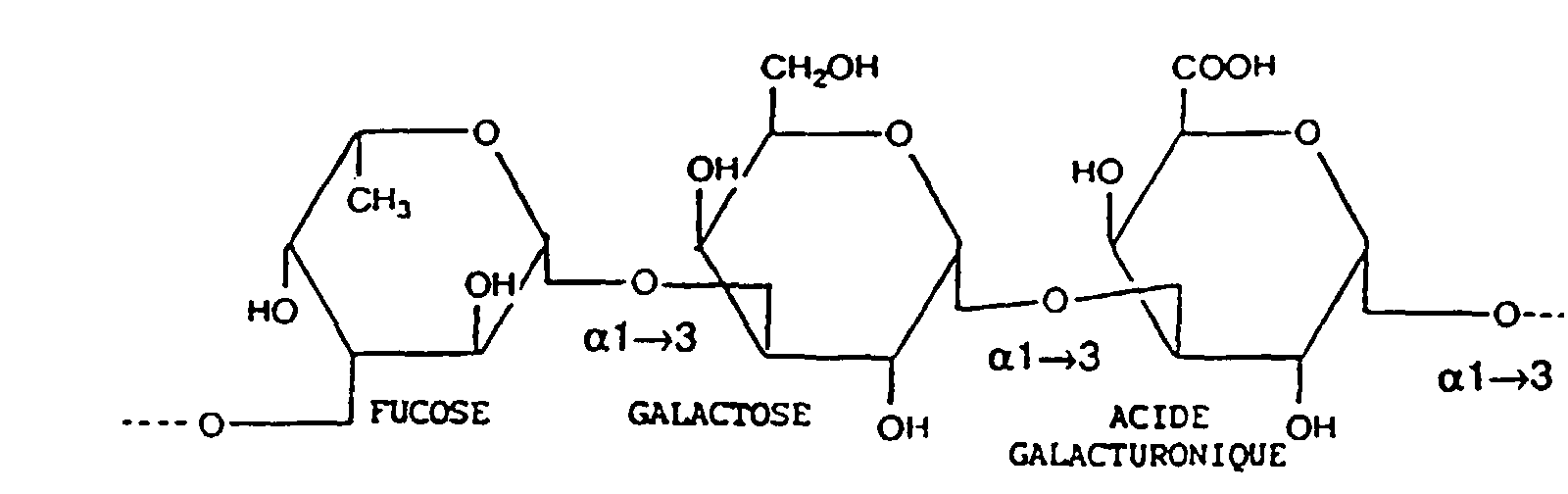
- the present invention finally relates to a process for producing a polysaccharide having the following chemical structure: where some of the hydroxyl groups are acetylated, this process comprising (a) the growth of a microorganism as defined in claim 1, in an aqueous nutritive medium by aerobic fermentation of a source of assimilable carbohydrate, then (b) the collection polysaccharide from the must obtained at the end of step (a).
- the polysaccharide is produced by aerobic fermentation under controlled conditions of an aqueous nutrient medium suitable, inoculated with the BEC 1000 strain.
- the medium can be any usual medium containing carbon sources, nitrogen and mineral salts.
- carbohydrates e.g. glucose, fructose, maltose, sucrose, mannitol, starch, corn syrup, sorbitol, etc.
- a source of preferred carbon is sorbitol.
- the quantity of carbohydrates in the middle will be between about 2 and 6% of the weight of the medium.
- Various nitrogen sources can be used proteinaceous materials, for example yeast extract, soy flour, protein hydrolysates, corn soaking liquor, etc.).
- the source nitrogen will represent between 0.05 and 0.5% of the weight of the medium.
- the salts can be used usually used in nutrient media.
- Fermentation can be carried out at temperatures of around 25 to 35 ° C, preferably 28 to 32 ° C, at a pH about 6.0 to 7.5, under aeration conditions and agitation, for periods of the order of 2 to 4 days.
- Fermentation can be carried out in a fermenter classic by inoculating nutrient medium beforehand sterilized, for example by heating to a temperature of around 120 ° C or by sterilizing filtration, using of a culture of the BEC 1000 strain.
- the must culture is subjected to proteolytic treatment and then autoclaved, cooled, salted and acidified.
- the resulting product is then treated to separate the polysaccharide, for example by precipitation of the latter with an alcohol (by example methanol, ethanol, propanol or isopropanol) or other non-solvent (such as acetone) of polysaccharide, then purified by wringing and washing the precipitate. If desired, you can repeat the purification process until a product is obtained of a purity suitable for the intended application.
- the purified product can be put in the form of a solution aqueous, in the presence of a preservative, for use, or, can be dried into a powder, if desired, for the storage.
- a polysaccharide containing L-fucose is produced by fermentation on a culture medium based on sorbitol.
- Her production results in a significant rise in the apparent viscosity of the medium. This viscosity constitutes end of fermentation an element limiting the aeration of the middle.
- the growth and production kinetics of polysaccharide is linked to the consumption of sorbitol.
- Culture centre Néosorb® 70-07 54.00 g / l (i.e. 38g / l sorbitol) Peptone Biokar® 104003 4.50 g / l Yeast extract 0.05 g / l KH 2 PO 4 1.50 g / l K 2 HPO 4 4.50 g / l MgSO 4 , 7H 2 O 0.20 g / l Pluronic® PE 61000 0.50 g / l Dissolution in water.
- 500 liters of culture wort were adjusted to pH 8.2 with sodium hydroxide, then subjected to a proteolytic treatment at 50 ° C for 6 hours, using 0.5 liters of Alcalase® ( Bacillus subtilisin A licheniformis sold by NOVO NORDISK, Denmark). After 6 hours, the pH was adjusted to 7.0 and the hydrolyzate was autoclaved at 120 ° C, with stirring, for 15 min to inactivate the microbial load, before rapidly cooling to 30 ° C and d '' stop the agitation. 20 kg of sodium chloride are then added with stirring, the pH is adjusted to 4.5-5.0 with HCl, and stirring is continued for 15 min to dissolve the salt well.
- Ethanol is added to the product at least 85 ° in a proportion corresponding to 1.1 times the volume of the product, with vigorous stirring.
- a product precipitates which is left to settle for 4 h to 12 h after cutting the agitation.
- the supernatant is filtered and returned to a distiller to recover ethanol for recycling in the precipitation step.
- the precipitate, soaked in a water-alcohol mixture, is drained on a Büchner, stirred in a pneumatic deflocculator to remove the agglomerates, washed with an equal volume of recycled ethanol with stirring, spun again on a Büchner, reacted in the deflocculator, washed with 95 ° ethanol, stirred and finally wrung on Büchner.
- the wrung precipitate obtained is then dried on trays in an oven at 40 ° C for 20 h.
- the dry product can be stored until use.
- the product is dissolved, for example at a rate of approximately 1% by weight, in water with vigorous stirring, preferably with the addition of a preservative, for example Phenonip® sold by SIPCA (Paris, France)
- the pH of the solution is adjusted to about 7.0.
Landscapes
- Chemical & Material Sciences (AREA)
- Organic Chemistry (AREA)
- Engineering & Computer Science (AREA)
- Life Sciences & Earth Sciences (AREA)
- Health & Medical Sciences (AREA)
- Zoology (AREA)
- Wood Science & Technology (AREA)
- Genetics & Genomics (AREA)
- Bioinformatics & Cheminformatics (AREA)
- Biotechnology (AREA)
- General Health & Medical Sciences (AREA)
- Biochemistry (AREA)
- General Engineering & Computer Science (AREA)
- Microbiology (AREA)
- Chemical Kinetics & Catalysis (AREA)
- General Chemical & Material Sciences (AREA)
- Medicinal Chemistry (AREA)
- Tropical Medicine & Parasitology (AREA)
- Virology (AREA)
- Biomedical Technology (AREA)
- Preparation Of Compounds By Using Micro-Organisms (AREA)
- Cosmetics (AREA)
- Micro-Organisms Or Cultivation Processes Thereof (AREA)
Description
- Dosage des 6-désoxyhexoses (méthylpentoses) selon la méthode spectrophotométrique de Z. DISCHE et L.B. SHETTLES: "A specific color reaction of methyl-pentoses and a spectrophotometric micromethod for their determination". J. Biol. Chem. 175, 595-603 (1948).
- Dosage du L-fucose par chromatographie couche mince (C.C.M.).
- Dosage du L-fucose par chromatographie liquide haute pression (HPLC).
IMAGES CELLULAIRES- Bacilles homogènes, sans arrangements notables
- Flagelles :
- souche immobile
- GRAM :
- coloration négative
Description des cultures : Culture luxuriante, non pigmentée, sur géloses et en bouillons
Culture aéro-anaérobie en gélose profonde
| SALINITES (milieu de culture contenant par litre : peptone : 10 g, extrait de levure : 3 g, glucose : 5 g ; Ph 7,0 - 7,2, 30°C, aération et agitation) | |||
| - NaCl 0% | 3 | 3 | 3 |
| - NaCl 2% | 3 | 3 | 3 |
| - NaCl 4% | 3 | 3 | 3 |
| - NaCl 6% | 3 | 3 | 3 |
| - NaCl 8% | 2 | 2 | 2 |
| - NaCl 10% | 0 | 1 | 1 |
| TEMPERATURES : (milieu Columbia, Ph 7,0 - 7,2, aération) | |||
| - 5° | 0 | 0 | 0 |
| - 10° | 0 | 1 | 2 |
| - 15° | 1 | 2 | 3 |
| - 30° | 3 | 3 | 3 |
| - 41° | 3 | 3 | 3 |
| - 45° | 3 | 3 | 3 |
| Culture prototrophe | 3 | 3 | 3 |
| Milieu de culture contenant par litre : KH2PO4 : 3,9 g, K2HPO4: 11,2 g (NH4)2 SO4 : 2 g, MgSO4, 7H2O : 200 mg, FeSO4, 7H2O : 1 ml d'une solution à 50 mg/l, Ph 7,1-7,3 | |||
| - CATALASE | 3 | ||
| - REACTION D'OXYDASE | 0 | ||
| - NITRATE REDUCTASE | 3 | 3 | |
| - TETRATHIONATE REDUCTASE | 0 | 0 | |
| - THIOSULFATE REDUCTASE | 0 | 0 | |
| PRODUCTION ACIDE (milieu de culture contenant par litre : bactopeptone : 3 g, NaCl : 5 g, glucose : 10 g, pH 7,2-7,4, en présence de rouge de phénol) | |||
| - tube ouvert | 3 | 3 | 3 |
| - tube fermé | 3 | 3 | 3 |
| REACTION VOGES-PROSKAUER | |||
| Milieu de culture BHI (Brain Heart Infusion), pH 7,0-7,2: | |||
| - Production de gaz (en mm) à partir de glucose | 70 | ||
| - UREASE | 0 | 0 | |
| - PRODUCTION D'INDOLE | 0 | 0 | |
| - Gamma-glutamyl transférase | 0 | 0 | |
| - Phénylalanine désaminase | 0 | 0 | |
| - Arginine dihydrolase | 0 | ||
| - Lysine décarboxylase | 3 | ||
| - Ornithine décarboxylase | 0 | ||
| - HYDROLYSE du o-nitrophényl-β-D-galactoside | 3 | 3 | |
| - HYDROLYSE du p-nitrophénylxyloside | 3 | 3 | |
| - HYDROLYSE d'ESCULINE | 3 | 3 | |
| - HYDROLYSE du TWEEN 80 | 0 | 0 | |
| - DNAse extracellulaire | 0 | 0 | |
| - Gélatinase (méthode de Frazier) | 0 | 0 | |
| CULTURE EN MILIEU SYNTHETIQUE : Milieu de culture contenant par litre : KH2PO4 : 3,9 g, K2HPO4 : 11 g (NH4)2 SO4 : 2 g, MgSO4, 7H2O : 200 mg, FeSO4,7H2O : 1 ml d'une solution à 50 mg/l, aération et agitation | |||
| - Citrate | 3 | 3 | 3 |
| - Glucose | 3 | 3 | 3 |
| - Hydroxy-3-benzoate | 0 | 0 | 0 |
| - Hydroxy-5-proline | 0 | 2 | 3 |
| - Malonate | 2 | 3 | 3 |
| Nota : les diverses colonnes de résultats correspondent à
des temps de lecture différents, pouvant varier d'un essai
à l'autre. Explication des symboles : 0 : réaction ou culture négative 1 : réaction positive faible 2 : réaction positive 3 : réaction positive intense |
| Source de carbone | Croissance/réaction | |
| BEC 1000 | ATCC 31646 | |
| N-Acétyl-D-glucosamine | + | + |
| cis-Aconitate | + | + |
| trans-Aconitate | + | + |
| Adonitol* | + | - |
| D-Alanine | + | + |
| L-Alanine | + | + |
| 4-Aminobutyrate | + | + |
| 5-Aminovalérate | + | + |
| L-Arabinose | + | + |
| D-Arabitol | + | + |
| L-Arabitol | - | - |
| D-Aspartate | + | + |
| Benzoate | + | + |
| Bétaïne | - | - |
| Caprate | - | - |
| Caprylate | - | - |
| D-Cellobiose | + | + |
| Citrate | + | + |
| m-Coumarate* | - | + |
| Dulcitol | - | - |
| i-Erythritol | - | - |
| Esculine (couleur noire) | + | + |
| Ethanolamine* | + | - |
| D-fructose | + | + |
| L-Fucose | + | + |
| Fumarate | + | + |
| D-Galactose | + | + |
| D-Galacturonate | + | + |
| Gentiobiose | + | + |
| Gentisate | - | - |
| D-Gluconate | + | + |
| D-Glucosamine | + | + |
| D-Glucose | + | + |
| D-Glucuronate | + | + |
| L-Glutamate | + | + |
| Glutarate | - | - |
| DL-Glycérate* | + | - |
| Glycérol | + | + |
| Histamine | - | - |
| L-Histidine (couleur rose) | - | - |
| 3-Hydroxybenzoate | - | - |
| 4-Hydroxybenzoate | + | + |
| 3-hydroxybutyrate | + | + |
| HQ-β-glucuronide | - | - |
| myo-Inositol | + | + |
| Itacoate | - | - |
| 2-cétogluconate | + | + |
| 5-cétogluconate* | - | + |
| 2-cétoglutarate | - | - |
| DL-Lactate | + | + |
| Lactose | + | + |
| Lactulose | (+) | (+) |
| D-Lyxose | - | - |
| D-Malate* | - | + |
| L-Malate | + | + |
| Malonate* | + | - |
| Maltitol* | - | + |
| Maltose | + | + |
| Maltotriose | + | + |
| D-Mannitol | + | + |
| D-Mannose | + | + |
| D-Mélézitose | - | - |
| D-Mélibiose | + | + |
| 1-O-Méthyl-α-galactoside | + | + |
| 1-O-Méthyl-β-galactoside | + | + |
| 3-O-Méthyl-D-glucose | - | - |
| 1-O-Méthyl-α-D-glucoside | (+) | (+) |
| 1-O-Méthyl-β-D-glucoside | + | + |
| Mucate | + | + |
| Palatinose | + | + |
| Phénylacétate | + | + |
| 3-phénylpropionate | - | - |
| L-Proline | + | + |
| Propionate | - | - |
| Protocatéchuate | + | + |
| Putrescine | + | + |
| Quinate | + | + |
| D-Raffinose | + | + |
| L-Rhamnose | + | + |
| D-Ribose | + | + |
| D-Saccharate | + | + |
| L-Sérine | + | + |
| D-Sorbitol | + | + |
| L-Sorbose | + | + |
| Succinate | + | + |
| Sucrose | + | + |
| D-Tagatose | - | - |
| D-Tartrate | - | - |
| L-Tartrate* | - | + |
| méso-Tartrate | - | - |
| D-Tréhalose | + | + |
| Tricarballylate* | - | + |
| Trigonelline | - | - |
| Tryptamine | - | - |
| Tryptophane (couleur orange) | - | - |
| D-Turanose | - | - |
| L-Tyrosine | - | - |
| Xylitol* | + | - |
| D-xylose | + | + |
Symboles : +, croissance en 1-2 jours ; (+), croissance en 3-4 jours ; -, pas de croissance en 4 jours.

| Néosorb® 70-07 (teneur en sorbitol : 70% M.S. ; vendu par ROQUETTE FRERES, Lille France) g/l | 17,90 g/l (soit 12,5 de sorbitol) |
| Peptone Biokar® 104003 (hydrolysat de protéines, vendu par SOLABIA-BIOKAR, Pantin, France) | 4,50 g/l |
| Extrait de levure | 0,05 g/l |
| KH2PO4 | 1,50 g/l |
| K2HPO4 | 4,50 g/l |
| MgSO4, 7H2O | 0,20 g/l |
| Pluronic® PE 61000 (agent anti-mousse, vendu par BASF, D-6700 Ludwigshafen, Allemagne) | 0,50 g/l |
Condition de culture :
Stérilisation à 121°C pendant 30 minutes
Température de culture : 30°C
Taux d'inoculation : 5 à 10%
Aération : 1 VVM
pH non régulé (pH d'environ 7,00)
Durée de culture : 24 heures
| Néosorb® 70-07 | 54,00 g/l (soit 38g/l de sorbitol) |
| Peptone Biokar® 104003 | 4,50 g/l |
| Extrait de levure | 0,05 g/l |
| KH2PO4 | 1,50 g/l |
| K2HPO4 | 4,50 g/l |
| MgSO4, 7H2O | 0,20 g/l |
| Pluronic® PE 61000 | 0,50 g/l |
Conditions de culture (Fermenteur Chemap ayant un volume utile de 350 litres) :
Stérilisation à 120°C pendant 45 minutes
Température de culture : 30°C
Taux d'inoculation : environ 5%
Agitation : 300 rpm (agitateur de type Rushton)
Aération : 1 VVM
pH régulé à 7,0 par NaOH 7 N
Pression : 100 à 200 mbars
Durée de culture : 60 à 65 heures
Valeurs moyennes obtenues en production :
| Viscosité en fin de cycle | 40000 Mpa.s (Viscosimètre Brookfield DV-II+ modèle LV, mobile SP 31, chambre SC4-34/13R, 30°C) |
| Concentration du polysaccharide produit dans le milieu, calculée en L-fucose | 2 g/l (méthode de Dische et Shettles) |
| Sorbitol consommé | > 35 g/l (en sorbitol) |
| NaOH à 20% en poids consommée | 15 litres/m3 |
| Début de régulation du pH | 16 à 17 heures après inoculation du fermenteur |
| Extrait sec final du milieu de fermentation | ≈ 20 g/l |
- une teneur relativement élevée en L-fucose, substance dont le pouvoir anti-allergénique a fait l'objet de nombreux travaux ;
- des propriétés viscosantes ;
- une grande stabilité dans une large gamme de pH, de température et de salinité ;
- un pouvoir "auto-émulsionnant" ;
- un comportement rhéofluidifiant
Claims (4)
- Microorganisme du genre Klebsiella pneumoniae, subsp. pneumoniae déposé à la Collection Nationale de Cultures de Microorganismes sous le numéro I-1507 et ses mutants, capables de former un polysaccharide contenant du L-fucose, du D-galactose et de l'acide D-galacturonique.
- Procédé de production d'un polysaccharide présentant la structure chimique suivante :où certains des groupes hydroxyles sont acétylés, ce procédé comprenant (a) la croissance d'un microorganisme tel que défini à la revendication 1, dans un milieu nutritif aqueux par fermentation aérobie d'une source de glucide assimilable, puis (b) le recueil du polysaccharide à partir du moût obtenu à la fin de l'étape (a).
- Procédé selon la revendication 2, caractérisé en ce que la source de glucide assimilable est du sorbitol.
- Procédé selon la revendication 2 ou 3, caractérisé en ce que l'étape (b) comprend la soumission du moût de culture à un traitement d'hydrolyse des protéines par voie enzymatique.
Applications Claiming Priority (3)
| Application Number | Priority Date | Filing Date | Title |
|---|---|---|---|
| FR9500898 | 1995-01-26 | ||
| FR9500898A FR2729969B1 (fr) | 1995-01-26 | 1995-01-26 | Nouvelle souche de klebsiella pneumoniae, subsp. pneumoniae et procede de production d'un polysaccharide contenant du l-fucose |
| PCT/FR1996/000127 WO1996023057A1 (fr) | 1995-01-26 | 1996-01-25 | NOUVELLE SOUCHE DE KLEBSIELLA PNEUMONIAE SUBsp. PNEUMONIAE ET PROCEDE DE PRODUCTION D'UN POLYSACCHARIDE CONTENANT DU L-FUCOSE |
Publications (2)
| Publication Number | Publication Date |
|---|---|
| EP0805850A1 EP0805850A1 (fr) | 1997-11-12 |
| EP0805850B1 true EP0805850B1 (fr) | 1999-12-15 |
Family
ID=9475526
Family Applications (1)
| Application Number | Title | Priority Date | Filing Date |
|---|---|---|---|
| EP96901854A Expired - Lifetime EP0805850B1 (fr) | 1995-01-26 | 1996-01-25 | NOUVELLE SOUCHE DE KLEBSIELLA PNEUMONIAE SUBsp. PNEUMONIAE ET PROCEDE DE PRODUCTION D'UN POLYSACCHARIDE CONTENANT DU L-FUCOSE |
Country Status (8)
| Country | Link |
|---|---|
| US (1) | US5876982A (fr) |
| EP (1) | EP0805850B1 (fr) |
| JP (1) | JP3555957B2 (fr) |
| CA (1) | CA2211826C (fr) |
| DE (1) | DE69605653T2 (fr) |
| ES (1) | ES2143750T3 (fr) |
| FR (1) | FR2729969B1 (fr) |
| WO (1) | WO1996023057A1 (fr) |
Families Citing this family (14)
| Publication number | Priority date | Publication date | Assignee | Title |
|---|---|---|---|---|
| FR2750864B1 (fr) * | 1996-07-10 | 1999-04-16 | Oreal | Utilisation d'un polyholoside dans une composition destinee a stimuler les defenses immunitaires, et composition le comprenant |
| ATE314397T1 (de) * | 2000-09-11 | 2006-01-15 | Ind E Com De Cosmeticos Natura | Eine mischung von nicht-sulfatierten oligosacchariden auf der basis von fukose, eine diese mischung enthaltende, kosmetische oder pharmazeutische zusammensetzung und deren verwendungen in der kosmetik und pharmazie |
| FR2813885B1 (fr) * | 2000-09-11 | 2003-03-14 | Ind E Com De Cosmeticos Natura | Nouveau melange d'oligosaccharides non sulfates a base de fucose, composition cosmetique ou pharmaceutique le comprenant, et son utilisation en cosmetique ou en pharmacie |
| RU2221864C2 (ru) * | 2002-02-07 | 2004-01-20 | Московская государственная академия ветеринарной медицины и биотехнологии им. К.И. Скрябина | Штамм бактерий klebsiella pneumoniae, депонированный в вгнки под № 23 мгавмиб-деп, для производства вакцины против клебсиеллеза молодняка сельскохозяйственных животных |
| RU2224019C2 (ru) * | 2002-02-07 | 2004-02-20 | Московская государственная академия ветеринарной медицины и биотехнологии им. К.И.Скрябина | Штамм бактерий klebsiella pneumoniae № 24 мгавмиб-деп для производства вакцины против клебсиеллеза молодняка сельскохозяйственных животных |
| FR2840920B1 (fr) * | 2002-06-18 | 2006-06-23 | Biochimie Appliquee Soc | Nouveau microorganisme de la famille des enterobacteriaceae |
| US7824882B2 (en) * | 2004-06-02 | 2010-11-02 | Dsm Ip Assets B.V. | Oligosaccharides in a test system for the determination of the presence of an antibiotic in a fluid |
| PT104888B (pt) * | 2009-12-15 | 2020-09-10 | 73100 - Setenta E Três Mil E Cem, Lda | Biopolímero bacteriano contendo fucose |
| US8748123B2 (en) * | 2009-12-15 | 2014-06-10 | 73100-Setenta e Tres Mil e Cem, Lda. | Fucose-containing bacterial biopolymer |
| IT1405680B1 (it) * | 2010-09-13 | 2014-01-24 | Inalco Spa | Processo per la produzione di l-fucosio. |
| ITFI20120052A1 (it) | 2012-03-13 | 2013-09-14 | Inalco Spa | Processo per il recovery di l-fucosio da esopolisaccaridi. |
| FR3074689B1 (fr) * | 2017-12-08 | 2020-10-16 | Soc La Biochimie Appliquee | Bio-saccharides et leur procede de preparation |
| RU2687137C1 (ru) * | 2018-10-11 | 2019-05-07 | Общество с ограниченной ответственностью "ГИПРОБИОСИНТЕЗ" | Штамм гетеротрофных бактерий Klebsiella pneumonia - ассоциант для получения микробной белковой массы |
| RU2733144C1 (ru) * | 2019-12-25 | 2020-09-29 | федеральное государственное бюджетное образовательное учреждение высшего образования Санкт-Петербургский государственный университет ветеринарной медицины (ФГБОУ ВО СПбГУВМ) | Штамм бактерий Klebsiella pneumoniae subsp.pneumoniae, обладающий способностью к биопленкообразованию |
Family Cites Families (4)
| Publication number | Priority date | Publication date | Assignee | Title |
|---|---|---|---|---|
| US4298691A (en) * | 1980-09-05 | 1981-11-03 | Merck & Co., Inc. | Preparation of heteropolysaccharide S-156 |
| JP2883712B2 (ja) * | 1990-10-15 | 1999-04-19 | ダイセル化学工業株式会社 | 光学活性1,3―ブタンジオールの製法 |
| US5330903A (en) * | 1991-11-27 | 1994-07-19 | California Institute Of Technology | Method for producing capsular polysaccharides |
| US5354671A (en) * | 1992-06-26 | 1994-10-11 | Shin-Etsu Chemical Co., Ltd. | Enzymatic clarification of polysaccharides |
-
1995
- 1995-01-26 FR FR9500898A patent/FR2729969B1/fr not_active Expired - Fee Related
-
1996
- 1996-01-25 ES ES96901854T patent/ES2143750T3/es not_active Expired - Lifetime
- 1996-01-25 DE DE69605653T patent/DE69605653T2/de not_active Expired - Lifetime
- 1996-01-25 US US08/875,388 patent/US5876982A/en not_active Expired - Lifetime
- 1996-01-25 EP EP96901854A patent/EP0805850B1/fr not_active Expired - Lifetime
- 1996-01-25 WO PCT/FR1996/000127 patent/WO1996023057A1/fr not_active Ceased
- 1996-01-25 JP JP52268596A patent/JP3555957B2/ja not_active Expired - Lifetime
- 1996-01-25 CA CA002211826A patent/CA2211826C/fr not_active Expired - Lifetime
Also Published As
| Publication number | Publication date |
|---|---|
| JP3555957B2 (ja) | 2004-08-18 |
| EP0805850A1 (fr) | 1997-11-12 |
| ES2143750T3 (es) | 2000-05-16 |
| JPH11500609A (ja) | 1999-01-19 |
| US5876982A (en) | 1999-03-02 |
| FR2729969A1 (fr) | 1996-08-02 |
| WO1996023057A1 (fr) | 1996-08-01 |
| CA2211826C (fr) | 2004-08-03 |
| FR2729969B1 (fr) | 1997-04-18 |
| DE69605653T2 (de) | 2000-06-21 |
| CA2211826A1 (fr) | 1996-08-01 |
| DE69605653D1 (de) | 2000-01-20 |
Similar Documents
| Publication | Publication Date | Title |
|---|---|---|
| US5356812A (en) | Processes for production of optically active 3-phenyl-1,3-propanediol by asymmetric assimilation | |
| AU602376B2 (en) | Process for production of eicosapentaenoic acid | |
| JP3608594B2 (ja) | バニリンの製造方法およびそのために適切な微生物 | |
| EP0805850A1 (fr) | NOUVELLE SOUCHE DE KLEBSIELLA PNEUMONIAE SUBsp. PNEUMONIAE ET PROCEDE DE PRODUCTION D'UN POLYSACCHARIDE CONTENANT DU L-FUCOSE | |
| JP3117714B2 (ja) | 発酵法によるアスタキサンチンの製造法 | |
| CA1040565A (fr) | Production de d-ribose par un bacillus | |
| JP4338080B2 (ja) | アイチュリンaおよびその同族体の製造法 | |
| EP1426450A1 (fr) | Microorganismes et procédé pour la production de riboflavin par fermentation | |
| BE1007064A3 (fr) | Enzyme de levane saccharase, procede pour sa preparation, micro-organismes qui le produisent et compositions le contenant. | |
| JPH02283295A (ja) | 光学活性(r)‐(‐)‐3‐ハロ‐1,2‐プロパンジオールの製造法 | |
| AU753590B2 (en) | Microbial production of actinol | |
| EP0389620B1 (fr) | Procede de preparation de l'acide pyruvique par fermentation | |
| US5130240A (en) | Process for producing d-alpha-alanine and/or l-alpha-alanineamide by arthrobacter sp | |
| FR2840920A1 (fr) | Nouveau microorganisme de la famille des enterobacteriaceae | |
| US4540665A (en) | Process for producing D-β-hydroxyalkanoic acid | |
| JP2837624B2 (ja) | 天然紫色色素の製造方法 | |
| EP1426446A1 (fr) | Microorganisme pour la production de riboflavine, et son utilisation pour la production de riboflavine | |
| EP0567644B1 (fr) | Procede permettant de produire la l-alanine par fermentation | |
| US4334021A (en) | Process for producing coproporphyrin III | |
| JPH0236201A (ja) | ラムノース含有多糖およびその製造方法 | |
| JP2892386B2 (ja) | ビタミンb▲下1▼▲下2▼生産性菌株とそれを用いたビタミンb▲下1▼▲下2▼の製造方法 | |
| EP0900840B1 (fr) | Procédé de préparation d'alcohols en C9,C11 et C13 et microorganisme apte à leur préparation | |
| JP2000078996A (ja) | ピルビン酸の製造方法 | |
| JPH0479892A (ja) | Fr901228物質の製造方法 | |
| JPH0660170B2 (ja) | 抗生物質調整の中間体デイフイコール |
Legal Events
| Date | Code | Title | Description |
|---|---|---|---|
| PUAI | Public reference made under article 153(3) epc to a published international application that has entered the european phase |
Free format text: ORIGINAL CODE: 0009012 |
|
| 17P | Request for examination filed |
Effective date: 19970806 |
|
| AK | Designated contracting states |
Kind code of ref document: A1 Designated state(s): BE CH DE ES FR GB IT LI NL |
|
| 17Q | First examination report despatched |
Effective date: 19981124 |
|
| GRAG | Despatch of communication of intention to grant |
Free format text: ORIGINAL CODE: EPIDOS AGRA |
|
| GRAG | Despatch of communication of intention to grant |
Free format text: ORIGINAL CODE: EPIDOS AGRA |
|
| GRAH | Despatch of communication of intention to grant a patent |
Free format text: ORIGINAL CODE: EPIDOS IGRA |
|
| GRAH | Despatch of communication of intention to grant a patent |
Free format text: ORIGINAL CODE: EPIDOS IGRA |
|
| GRAA | (expected) grant |
Free format text: ORIGINAL CODE: 0009210 |
|
| RAP1 | Party data changed (applicant data changed or rights of an application transferred) |
Owner name: BIOEUROPE |
|
| AK | Designated contracting states |
Kind code of ref document: B1 Designated state(s): BE CH DE ES FR GB IT LI NL |
|
| REG | Reference to a national code |
Ref country code: CH Ref legal event code: EP |
|
| REF | Corresponds to: |
Ref document number: 69605653 Country of ref document: DE Date of ref document: 20000120 |
|
| REG | Reference to a national code |
Ref country code: CH Ref legal event code: NV Representative=s name: AMMANN PATENTANWAELTE AG BERN |
|
| ITF | It: translation for a ep patent filed | ||
| GBT | Gb: translation of ep patent filed (gb section 77(6)(a)/1977) |
Effective date: 20000314 |
|
| REG | Reference to a national code |
Ref country code: ES Ref legal event code: FG2A Ref document number: 2143750 Country of ref document: ES Kind code of ref document: T3 |
|
| PLBE | No opposition filed within time limit |
Free format text: ORIGINAL CODE: 0009261 |
|
| STAA | Information on the status of an ep patent application or granted ep patent |
Free format text: STATUS: NO OPPOSITION FILED WITHIN TIME LIMIT |
|
| 26N | No opposition filed | ||
| REG | Reference to a national code |
Ref country code: GB Ref legal event code: IF02 |
|
| PGFP | Annual fee paid to national office [announced via postgrant information from national office to epo] |
Ref country code: FR Payment date: 20141113 Year of fee payment: 20 |
|
| PGFP | Annual fee paid to national office [announced via postgrant information from national office to epo] |
Ref country code: NL Payment date: 20141218 Year of fee payment: 20 |
|
| PGFP | Annual fee paid to national office [announced via postgrant information from national office to epo] |
Ref country code: CH Payment date: 20150121 Year of fee payment: 20 Ref country code: DE Payment date: 20150109 Year of fee payment: 20 Ref country code: ES Payment date: 20150126 Year of fee payment: 20 Ref country code: IT Payment date: 20150115 Year of fee payment: 20 |
|
| PGFP | Annual fee paid to national office [announced via postgrant information from national office to epo] |
Ref country code: GB Payment date: 20150114 Year of fee payment: 20 |
|
| PGFP | Annual fee paid to national office [announced via postgrant information from national office to epo] |
Ref country code: BE Payment date: 20150128 Year of fee payment: 20 |
|
| REG | Reference to a national code |
Ref country code: DE Ref legal event code: R071 Ref document number: 69605653 Country of ref document: DE |
|
| REG | Reference to a national code |
Ref country code: NL Ref legal event code: MK Effective date: 20160124 |
|
| REG | Reference to a national code |
Ref country code: CH Ref legal event code: PL |
|
| REG | Reference to a national code |
Ref country code: GB Ref legal event code: PE20 Expiry date: 20160124 |
|
| PG25 | Lapsed in a contracting state [announced via postgrant information from national office to epo] |
Ref country code: GB Free format text: LAPSE BECAUSE OF EXPIRATION OF PROTECTION Effective date: 20160124 |
|
| REG | Reference to a national code |
Ref country code: ES Ref legal event code: FD2A Effective date: 20160503 |
|
| PG25 | Lapsed in a contracting state [announced via postgrant information from national office to epo] |
Ref country code: ES Free format text: LAPSE BECAUSE OF EXPIRATION OF PROTECTION Effective date: 20160126 |