EP0805800B1 - Verfahren zur herstellung von (+)compactin und (+)mevinolin derivaten mit beta-hydroxy-delta-lactonresten - Google Patents
Verfahren zur herstellung von (+)compactin und (+)mevinolin derivaten mit beta-hydroxy-delta-lactonresten Download PDFInfo
- Publication number
- EP0805800B1 EP0805800B1 EP96938297A EP96938297A EP0805800B1 EP 0805800 B1 EP0805800 B1 EP 0805800B1 EP 96938297 A EP96938297 A EP 96938297A EP 96938297 A EP96938297 A EP 96938297A EP 0805800 B1 EP0805800 B1 EP 0805800B1
- Authority
- EP
- European Patent Office
- Prior art keywords
- alkyl
- hexanoate
- formula
- radical
- para
- Prior art date
- Legal status (The legal status is an assumption and is not a legal conclusion. Google has not performed a legal analysis and makes no representation as to the accuracy of the status listed.)
- Expired - Lifetime
Links
- 0 CC(C)C*C(CC(C)C(C)C1CCCC1)C1*CCC1 Chemical compound CC(C)C*C(CC(C)C(C)C1CCCC1)C1*CCC1 0.000 description 4
Classifications
-
- C—CHEMISTRY; METALLURGY
- C07—ORGANIC CHEMISTRY
- C07C—ACYCLIC OR CARBOCYCLIC COMPOUNDS
- C07C315/00—Preparation of sulfones; Preparation of sulfoxides
- C07C315/04—Preparation of sulfones; Preparation of sulfoxides by reactions not involving the formation of sulfone or sulfoxide groups
-
- C—CHEMISTRY; METALLURGY
- C07—ORGANIC CHEMISTRY
- C07C—ACYCLIC OR CARBOCYCLIC COMPOUNDS
- C07C317/00—Sulfones; Sulfoxides
- C07C317/44—Sulfones; Sulfoxides having sulfone or sulfoxide groups and carboxyl groups bound to the same carbon skeleton
-
- C—CHEMISTRY; METALLURGY
- C07—ORGANIC CHEMISTRY
- C07C—ACYCLIC OR CARBOCYCLIC COMPOUNDS
- C07C317/00—Sulfones; Sulfoxides
- C07C317/44—Sulfones; Sulfoxides having sulfone or sulfoxide groups and carboxyl groups bound to the same carbon skeleton
- C07C317/46—Sulfones; Sulfoxides having sulfone or sulfoxide groups and carboxyl groups bound to the same carbon skeleton the carbon skeleton being further substituted by singly-bound oxygen atoms
-
- C—CHEMISTRY; METALLURGY
- C07—ORGANIC CHEMISTRY
- C07D—HETEROCYCLIC COMPOUNDS
- C07D309/00—Heterocyclic compounds containing six-membered rings having one oxygen atom as the only ring hetero atom, not condensed with other rings
- C07D309/16—Heterocyclic compounds containing six-membered rings having one oxygen atom as the only ring hetero atom, not condensed with other rings having one double bond between ring members or between a ring member and a non-ring member
- C07D309/28—Heterocyclic compounds containing six-membered rings having one oxygen atom as the only ring hetero atom, not condensed with other rings having one double bond between ring members or between a ring member and a non-ring member with hetero atoms or with carbon atoms having three bonds to hetero atoms with at the most one bond to halogen, e.g. ester or nitrile radicals, directly attached to ring carbon atoms
- C07D309/30—Oxygen atoms, e.g. delta-lactones
-
- C—CHEMISTRY; METALLURGY
- C07—ORGANIC CHEMISTRY
- C07D—HETEROCYCLIC COMPOUNDS
- C07D319/00—Heterocyclic compounds containing six-membered rings having two oxygen atoms as the only ring hetero atoms
- C07D319/04—1,3-Dioxanes; Hydrogenated 1,3-dioxanes
- C07D319/06—1,3-Dioxanes; Hydrogenated 1,3-dioxanes not condensed with other rings
Definitions
- the subject of the invention is a new process for preparing compounds with ⁇ -hydroxy- ⁇ -lactone group analogues of (+) Compactine and (+) Mevinoline.
- the process for preparing these products involves new reaction intermediates, also objects of the invention as well as their respective preparation processes.
- HMG-CoA-reductase ⁇ -hydroxy- ⁇ -methyl Glutaryl - Coenzyme A-reductase
- HMG-CoA-reductase family to which belong (+) Compactine and (+) Mevinoline
- HMG-CoA-reductase family to which belong (+) Compactine and (+) Mevinoline
- HMG-CoA-reductase family to which belong (+) Compactine and (+) Mevinoline
- inhibitors are also used in the treatment of diseases related to excessive presence of cholesterol, such as arteriosclerosis.
- the main routes of synthesis of the lactonic fragment of lactone 1 use commercial chiral starting materials such as malic acid or 2-glutamic acid (M. Majewski & co Tet.Lett. 1984, 25 , 2101; T. Minami & co Tet.Lett. 1993, 34 , 513) or carbohydrates (M. Menges & co Synlett 1993, 901; MS Ernolenko & co, Tet.Lett. 1994, 35 , 715).
- Others include an asymmetric reduction step with Rhodium catalysts (M. Terada & co, Tet.Lett. 1991, 32 , 935; L. Shao & co, Tet.Lett. 1991, 32 , 7699) or reducers enzymatic (F. Bennet & co, J. Chem. Soci. Perkin Transfer I, 1991, 133; MH Ansari, Tet. Let. 1993, 34 , 8271).
- Formulas (la) and (Ib) cover a very large number of products, including the scope in the field of HMG - Coenzyme A-reductase inhibitors is illustrated by the documents "Progress in the chemical synthesis of Antibiotics and related microbial products ”Y. Chapleur, vol.2, 1993, 829-937, G. Lukacs Ed. Springer Verlag (Doc I); T. Rosen and C.H. Heathcock Tetrahedron, Vol. 42, No. 18, 4909-4951, 1986 (Doc II) and J. Prous "The year's drug news, therapeutic targets, 1994 edition ”, Prous science Publishers (Doc III).
- the process which is the subject of the present invention allows access easy to many other molecules corresponding to formulas la and lb.
- radicals represented by ⁇ there may be mentioned for example the radicals corresponding to the following formulas and which correspond to the formula products (la) known as inhibitors of HMG - Coenzyme A-reductase:
- the products of formula (la) and formula (Ib) contain at least two asymmetric carbons.
- the subject of the invention is also a method of preparation of each of the four diastereoisomers corresponding to one of the formulas (la) or (Ib) taken in isolation, as well as their racemic mixtures or not.
- step 7) it is possible after step 7) to go directly to step 9) without reducing the double bond to obtain the product of formula (Ib).
- Step 1
- the tri-anion of the alkyl 3,5-dioxohexanoate of formula (X) is reacted Y-CO-CH 2 -CO-CH 2 -CO-CH 3 in which Y has the same definition as above, with the (X's) -p-toluene sulfinate of (-) or (+) menthyl to obtain the (Xs) -3,5-di-oxo-6-p -tylyl-sulfinyl alkyl hexanoate.
- Y will be chosen from methoxy, ethoxy, ter-butyloxy radicals, 1-imidazolidinyl, benzyloxy, N (OMe) Q, with Q C1-C6 alkyl radical.
- the tri-anion of alkyl 3,5-di-oxo-hexanoate is preferably obtained by treatment with sodium hydride and either ter-butyl lithium or sec-butyl lithium in an anhydrous medium at low temperature. Even more preferential, this reaction is carried out in the presence of approximately one equivalent sodium hydride and two equivalents of ter-butyl lithium or in the presence about one equivalent of sodium hydride and two equivalents of sec-butyl lithium. Preferably, the reaction is carried out in a solvent chosen from ethers and even more preferably tetrahydrofuran. In a way preferential, this reaction is carried out at a temperature ranging from -10 ° C. to + 10 ° C. According to a preferred embodiment of the invention, this reaction is carried out a temperature close to 0 ° C.
- the choice of one or other of the R or S isomers of menthyl p-toluene sulfinate depends on the configuration which it is desired to obtain on carbon C 5 after step 2 of reduction of the ketone in C 5 .
- this reaction is carried out with an amount of menthyl p-toluene sulfinate substantially equal to 50% by number of moles relative to the number of moles of alkyl 3,5-di-oxo-hexanoate.
- (+) and (-) menthol can both lead to each of the R and S isomers of menthyl p-toluene sulfinate.
- G. Solladié, J. Hutt, A. Girardin, Synthesis, 1987, 173 there is a known method of synthesis extrapolable on an industrial scale and making it possible to prepare the ( S ) p-toluene sulfinate from (-) menthyl.
- This method analogously leads from (+) menthol to ( R ) p-toluene sulfinate from (+) menthyl.
- One of these two reagents is therefore preferably used.
- menthyl ( S ) -p-toluene sulfinate is preferably used in the first stage, and for the reasons set out above ((-) menthyl ( S ) -p-toluene sulfinate is preferably used.
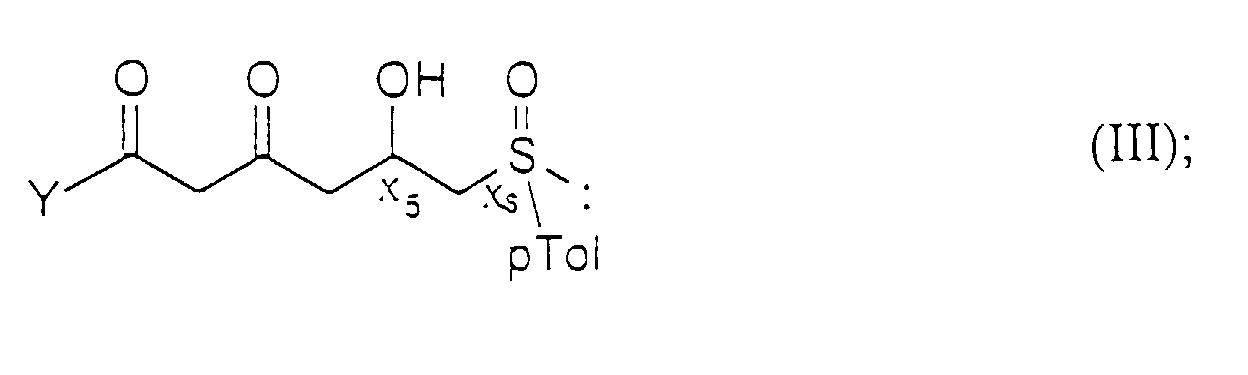
- the 5-carbonyl function of the (Xs) -3,5-di-oxo-6-paratolylsulfinyl hexanoate in alcohol is reduced enantioselectively to give the [5 (X 5 ), S (Xs)] - 5-hydroxy-3-oxo-6-paratolylsulfinyl-hexanoate, with X 5 ⁇ Xs.
- this reduction is made by treating the (Xs) -3,5-di-oxo-6-p-tolylsulfinyl alkyl hexanoate with a hydride respecting the stereochemical induction due to the radical (Xs) -paratolylsulfinyl and not not reducing the grouping -COY.
- a hydride respecting the stereochemical induction due to the radical (Xs) -paratolylsulfinyl and not not reducing the grouping -COY.
- di-isobutyl aluminum hydride which meets these conditions.
- This reaction is preferably carried out in an anhydrous medium and the reagents (product of formula II and reducing agent) are introduced at a temperature below -20 ° C.
- this reaction is carried out in tetrahydrofuran and the reagents are introduced at a temperature of -50 ° C. and even more preferably around -78 ° C. The medium is then left to return to ambient temperature.
- the purpose of starting the reaction at low temperature is to guarantee an exact stereochemistry of C 5 , however this condition is not imperative and certain derivatives treated at 0 ° C. will exhibit the desired stereochemistry.
- the reduction will be carried out by treating the starting product (formula III) with sodium borohydride in the presence of a chelating agent.
- a chelating agent Mention may be made, among the chelating agents, of metal derivatives such as, for example, zinc derivatives of titanium and boron.
- metal derivatives such as, for example, zinc derivatives of titanium and boron.
- tetraisopropyloxytitanium, zinc bromide, diethylmethoxyborane can be used for this reaction.
- diethylmethoxyborane is used as the chelating agent.
- the reaction is carried out in an anhydrous medium and the reagents (product of formula III, reducing agent and chelating agent) are introduced at a temperature below 0 ° C.
- this reaction is carried out in the presence of an excess of diethylmethoxyborane and sodium borohydride, in tetrahydrofuran by introducing the reagents at a temperature below -20 ° C and preferably at -78 ° C. of the reaction at low temperature is intended to guarantee an exact stereochemistry of C 3 . However, this condition is not imperative and certain derivatives treated at 0 ° C. will exhibit the desired stereochemistry.
- the reduction will preferably be carried out by treating the starting product (product of formula III) with tetramethylammonium triacetoxyborohydride.
- the starting product product of formula III
- tetramethylammonium triacetoxyborohydride tetramethylammonium triacetoxyborohydride.
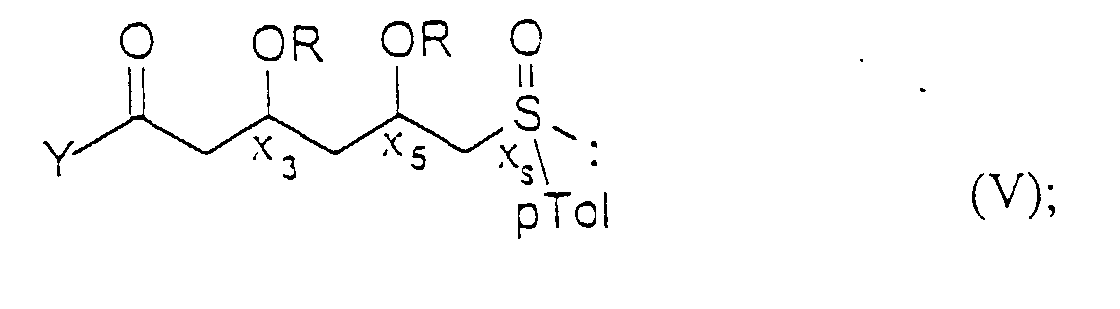
- the two hydroxyl functions are protected by C1-C8 alkyl or aryl or aralkyl radicals from tri-alkylsilyl radicals, or by a C1-C8 alkane di-yl radical, a benzylidene radical , radicals which will be designated R.
- R a C1-C8 alkane di-yl radical
- a benzylidene radical radicals which will be designated R.
- R a benzylidene radical
- the radicals capable of being used to protect the two hydroxyl functions there may be mentioned for example the methyl, benzyl, terbutyldimethylsilyl, terbutyldiphenylsilyl radicals, or the isopropylidene and benzylidene radicals, these latter two radicals allowing them alone to simultaneously protect the two hydroxyls.
- an isopropylidene radical is used for this protection.
- This protective reaction is carried out by means well known to those skilled in the art, for example it is possible to treat [3 (X 3 ), 5 (X 5 ), S (Xs)] - 3,5-di-hydroxy -6-alkyl paratolylsulfinylhexanoate with dimethoxypropane in the presence of catalytic amounts of para-toluene sulfonic acid in acetone.
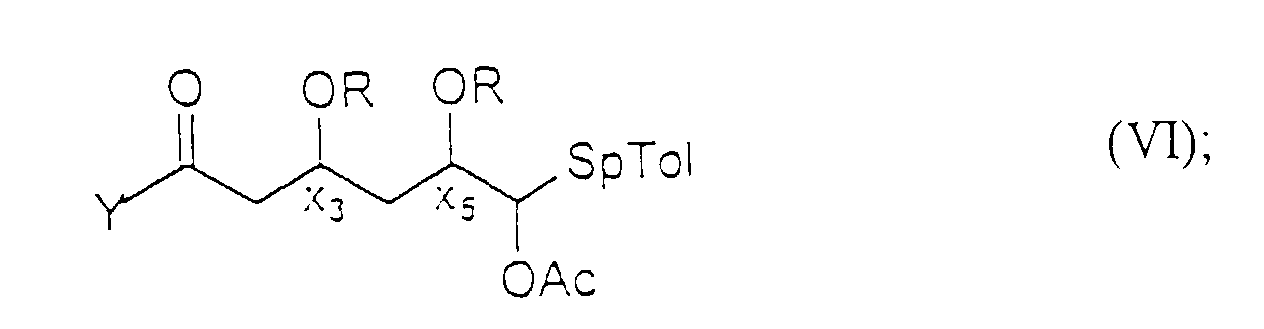
- the sulfoxide function of the product of formula (V) is reduced to thioether by a Pummerer reaction to obtain a [3 (X 3 ), 5 (X 5 )] - 6-acetoxy- Alkyl 3,5-di-alkyloxy-6-paratolyl-thio-hexanoate.
- this reaction is carried out in acetic anhydride or in trifluoroacetic anhydride, in the presence of a large excess of anhydrous sodium acetate.
- this reaction one can for example refer to Tet. Lett. 23 , 5541, 1982.
- the reduction of the double bond which constitutes the eighth step of the object process of the invention can be made by any means known to those skilled in the art, such as hydrogenation in the presence of a catalyst, for example palladium on coal.
- the ninth step which consists in deprotecting the protective groups R from hydroxyl calls upon the knowledge of a person skilled in the art.
- a acid treatment in an aqueous medium makes it possible to hydrolyze the groups isopropylidene and methyl ester.
- S. Nahm and S.M. Weinreb Tet. Lett. nineteen eighty one, Vol. 22, 3815-3818; T.A. Oster and T.M. Harris, Tet. Lett. 1983, Vol. 24, 1851-1854.
- the products of formula (la) can also be prepared by a process comprising steps 1 to 5 and 6.1.a, characterized in that the alcohol triflate or tosylate is made (XI) then that it is treated with a halide Hal ⁇ , Hal denoting a bromine or iodine chlorine atom under conditions known to a person skilled in the art to effect the substitution which leads to the product (IX): This can then be unprotected as described above to give (la).
- the NMR spectra were made on a 200MHz frequency device, the rotational power measurements are made at 25 ° C.
- the progress of the reaction is monitored by chromatography on silica plates.
- the medium is diluted with 20 ml of dichloromethane and 20 ml of a saturated aqueous solution of NH 4 Cl, then neutralized with 2 ml of an aqueous solution at 10% hydrochloric acid.
- the aqueous phase is washed three times with water and with brine and then dried over magnesium sulfate.
- the solvents are evaporated under vacuum to give 125 mg of a yellow oil: methyl [3 (R), 5 (S)] - (+) - 6-oxo-syn-3,5-dioxyisopropylidene-hexanoate.
- aqueous phase is extracted twice with 50 ml of dichloromethane and the organic phase is dried over sodium sulfate. magnesium, then the solvents are evaporated and the crude product is purified by chromatography on a silica column (eluent: CH 2 Cl 2 ). 79.1 mg of methyl [3 (R), 5 (S)] - (+) - 7-phenyl-syn-3,5-dioxyisopropylidene-6-heptenoate are recovered in the form of a mixture 85/15 d 'Z / E isomer.
Landscapes
- Chemical & Material Sciences (AREA)
- Organic Chemistry (AREA)
- Chemical Kinetics & Catalysis (AREA)
- Organic Low-Molecular-Weight Compounds And Preparation Thereof (AREA)
- Pyrane Compounds (AREA)
- Pharmaceuticals Containing Other Organic And Inorganic Compounds (AREA)
Claims (44)
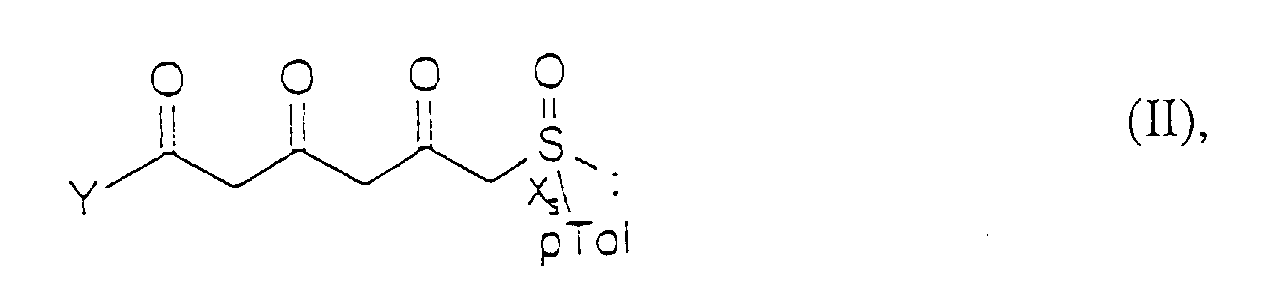
- Alkyl-(Xs)-3,5-dioxo-6-p-tolylsulfinylhexanoate der Formel (II),worin Xs die R- oder S-Konfiguration des Schwefels bezeichnet, gekennzeichnet durch Y = OCH3.
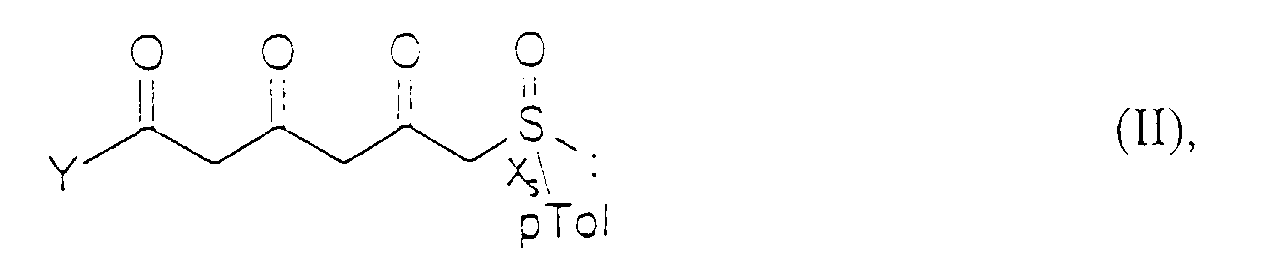
- Verbindung nach Anspruch 1, dadurch gekennzeichnet, daß es sich um das Methyl-(R)-3,5-dioxo-6-p-tolylsulfinylhexanoat handelt.
- Verfahren zur Herstellung von Alkyl-(Xs)-3,5-dioxo-6-p-tolylsulfinylhexanoaten der Formel (II)worin Xs und X's die Konfigurationen R oder S des Schwefelatoms bezeichnet und Y eine geradkettige oder verzweigte, gesättigte oder ungesättigte C1-18-Alkyloxygruppe, eine Aryloxygruppe oder eine Aralkyloxygruppe mit 1 bis 18 Kohlenstoffatomen, eine Imidazolidgruppe, eine geradkettige oder verzweigte, gesättigte oder ungesättigte C1-18-Alkylsulfidgruppe, Arylsulfid, C1-18-Aralkylsulfid oder eine Gruppe
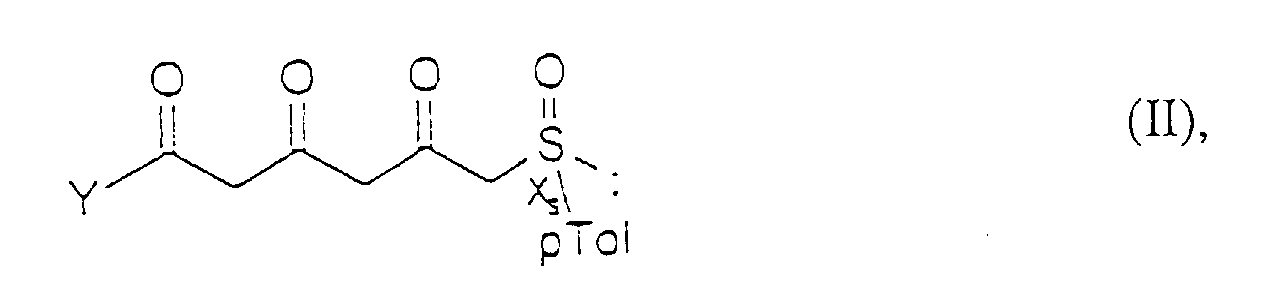 bedeutet, wobei Q eine geradkettige oder verzweigte, gesättigte oder ungesättigte C1-18-Alkylgruppe ist, dadurch gekennzeichnet, daß das Trianion des Alkyl-3,5-dioxo-hexanoats der Formel (X)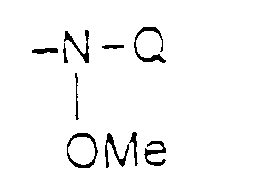
- Verfahren nach Anspruch 3, dadurch gekennzeichnet, daß das Trianion des Alkyl-3,5-dioxo-hexanoats durch Umsetzung mit Natriumhydrid und tert.-Butyllithium oder sek.-Butyllithium in einem wasserfreien Medium bei niedriger Temperatur hergestellt wird.
- Verfahren nach Anspruch 4, dadurch gekennzeichnet, daß das Trianion des Alkyl-3,5-dioxohexanoats durch Umsetzung mit etwa einem Äquivalent Natriumhydroxid und zwei Äquivalenten tert.-Butyllithium oder in Gegenwart von etwa einem Äquivalent Natriumhydrid und zwei Äquivalenten sek.-Butyllithium hergestellt wird.
- Verfahren nach einem der Ansprüche 3 bis 5, dadurch gekennzeichnet, daß die Umsetzung in einem Lösungsmittel durchgeführt wird, das unter den Ethern ausgewählt ist.
- Verfahren nach Anspruch 5, dadurch gekennzeichnet, daß die Reaktion in Tetrahydrofuran durchgeführt wird.
- Verfahren nach einem der Ansprüche 3 bis 7, dadurch gekennzeichnet, daß die Umsetzung bei einer Temperatur von -10 bis +10 °C durchgeführt wird.
- Verfahren nach Anspruch 8, dadurch gekennzeichnet, daß die Umsetzung bei einer Temperatur von etwa 0 °C durchgeführt wird.
- Verfahren nach einem der Ansprüche 3 bis 9, dadurch gekennzeichnet, daß die Umsetzung mit einer Menge von Menthyl-p-Toluolsulfinat durchgeführt wird, die etwa 50 % der Molzahl von Alkyl-3,5-dioxyhexanoat entspricht.
- Verfahren nach einem der Ansprüche 3 bis 10, dadurch gekennzeichnet, daß das (S)-p-Toluolsulfinat von (-)Menthyl oder das (R)-p-Toluolsulfinat von (+)Menthyl verwendet wird.
- Verfahren nach Anspruch 10, dadurch gekennzeichnet, daß das (S)-p-Toluolsulfinat von (-)Menthyl verwendet wird.
- Methyl-[5(S), S(R)]-5-hydroxy-3-oxo-6-paratolylsulfinalhexanoat.
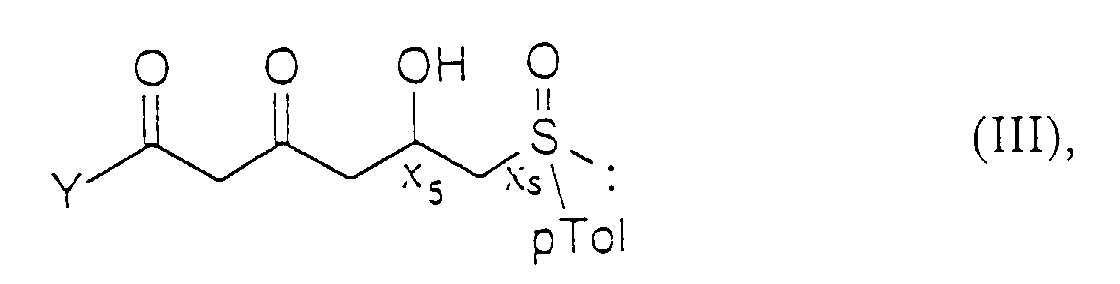
- Verfahren zur Herstellung von Alkyl-[5(X5), S(XS)]-5-hydroxy-3-oxo-6-para-tolylsulfinylhexanoaten der Formel (III)worin X5 die R- oder S-Konfiguration des Kohlenstoffs C5 mit X5 ≠ Xs bedeutet, Y die oben in Anspruch 3 angegebenen Bedeutungen aufweist, Xs die R- oder S-Konfiguration des Schwefels bedeutet, dadurch gekennzeichnet, daß die C5-Carbonylgruppe des Alkyl-(Xs)-3,5-dioxo-6-paratolylsulfinylhexanoats der Formel (II) enantioselektiv zur Alkoholgruppe reduziert wird:
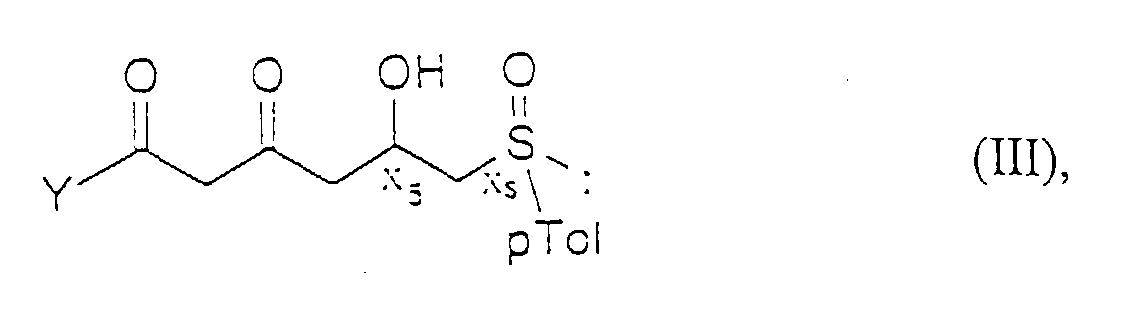 worin Xs die R- oder S-Konfiguration des Schwefels bedeutet.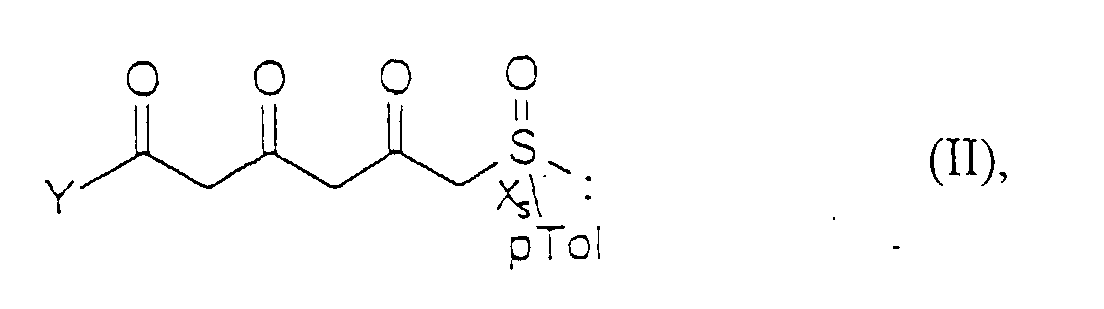
- Verfahren nach Anspruch 14, dadurch gekennzeichnet, daß die Reduktion mit einem Hydrid durchgeführt wird, das die stereochemische Induktion durch die (Xs)-p-Tolylsulfinylgruppe nicht verändert und die Gruppe -COY nicht reduziert.
- Verfahren nach einem der Ansprüche 14 und 15, dadurch gekennzeichnet, daß Diisobutylaluminiumhydrid verwendet wird.
- Verfahren nach einem der Ansprüche 14 bis 16, dadurch gekennzeichnet, daß die Umsetzung in einem wasserfreien Medium durchgeführt wird, wobei die Reaktanten bei einer Temperatur von -20 °C zugegeben werden und das Medium dann auf Raumtemperatur zurückkommen gelassen wird.
- Verfahren nach einem der Ansprüche 14 bis 17, dadurch gekennzeichnet, daß die Umsetzung in Tetrahydrofuran durchgeführt wird und die Reaktanten bei einer Temperatur von -50 °C zugegeben werden.
- Verfahren nach einem der Ansprüche 14 bis 18, dadurch gekennzeichnet, daß die Reaktanten bei einer Temperatur von etwa -78 °C zugegeben werden.
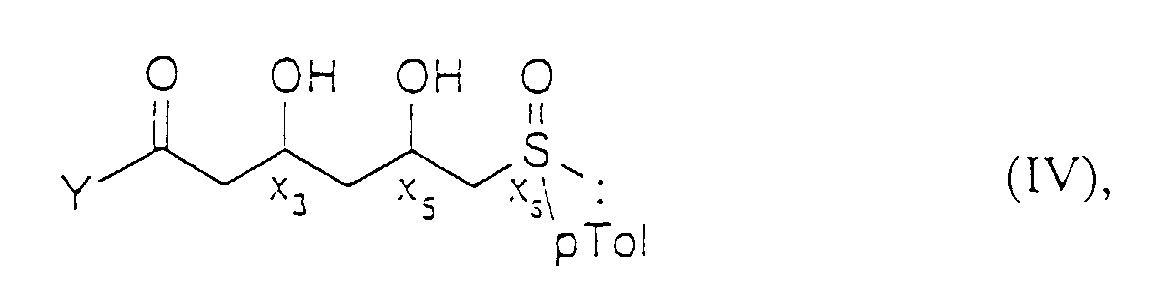
- Alkyl-[3(X3), 5(X5), S(Xs)]-3,5-dihydroxy-6-paratolylsulfinylhexanoat der Formel (IV)worin X3 die R- oder S-Konfiguration des Kohlenstoffs C3 bedeutet, Y die oben in Anspruch 3 angegebenen Bedeutungen aufweist, Xs die R- oder S-Konfiguration des Schwefels bedeutet und X5 die R- oder S-Konfiguration des Kohlenstoffs C5 mit X5 ≠ Xs bedeutet.
- Alkyl-[3(X3), 5(X5), S(Xs)]-3,5-dihydroxy-6-paratolylsulfinylhexanoat nach Anspruch 20, gekennzeichnet durch X5 = X3.
- Verfahren zur Herstellung von Verbindungen nach den Ansprüchen 20 und 21, dadurch gekennzeichnet, daß die C3-Carbonylgruppe des Alkyl-[5(X5), S(Xs)]-5-hydroxy-3-oxo-6-paratolylsulfinylhexanoats der Formel (III):worin X5 die R- oder S-Konfiguration des Kohlenstoffs C5 mit X5 ≠ Xs bedeutet, Y die in Anspruch 3 angegebenen Bedeutungen aufweist und Xs die R- oder S-Konfiguration des Schwefels bedeutet durch Umsetzung mit Tetramethylammoniumtriacetoxyborhydrid reduziert wird.
- Alkyl-[3(X3), 5(X5), S(Xs)]-3,5-dihydroxy-6-paratolylsulfinylhexanoat nach Anspruch 20, gekennzeichnet durch X5 ≠ X3.
- Verbindungen nach Anspruch 23, dadurch gekennzeichnet, daß es sich um das Methyl-[3(R), 5(S), S(R)]-3,5-dihydroxy-6-paratolylsulfinylhexanoat handelt.
- Verfahren zur Herstellung von Verbindungen nach den Ansprüchen 23 und 24, dadurch gekennzeichnet, daß ein Alkyl-[5(X5), S(Xs)]-5-hydroxy-3-oxo-6-paratolylsulfinylhexanoat der Formel (III)worin X5 die R- oder S-Konfiguration des Kohlenstoffs X5 mit X5 ≠ Xs bedeutet, Y die in Anspruch 3 angegebenen Bedeutungen aufweist und Xs die R- oder S-Konfiguration des Schwefels bedeutet, mit Natriumborhydrid in Gegenwart eines Chelatbildners umgesetzt wird.

- Verfahren nach Anspruch 25, dadurch gekennzeichnet, daß der Chelatbildner ein Derivat von Zink, Titan oder Bor ist.
- Verfahren nach Anspruch 26, dadurch gekennzeichnet, daß der Chelatbildner unter Tetraisopropyloxytitan, Zinkbromid und Diethylmethoxyboran ausgewählt ist.
- Verfahren nach Anspruch 27, dadurch gekennzeichnet, daß der Chelatbildner das Diethylmethoxyboran ist.
- Verfahren nach einem der Ansprüche 25 bis 28, dadurch gekennzeichnet, daß die Umsetzung in einem wasserfreien Medium durchgeführt wird.
- Verfahren nach einem der Ansprüche 25 bis 29, dadurch gekennzeichnet, daß die Reaktanten bei einer Temperatur unter 0 °C zugegeben werden.
- Verfahren nach einem der Ansprüche 25 bis 30, dadurch gekennzeichnet, daß die Umsetzung in Gegenwart eines Überschusses von Diethylmethoxyboran und Natriumborhydrid durchgeführt wird.
- Verfahren nach einem der Ansprüche 25 bis 31, dadurch gekennzeichnet, daß die Umsetzung in Tetrahydrofuran durchgeführt wird, wobei die Reaktanten bei einer Temperatur unter -20 °C und vorzugsweise bei -78 °C zugegeben werden.
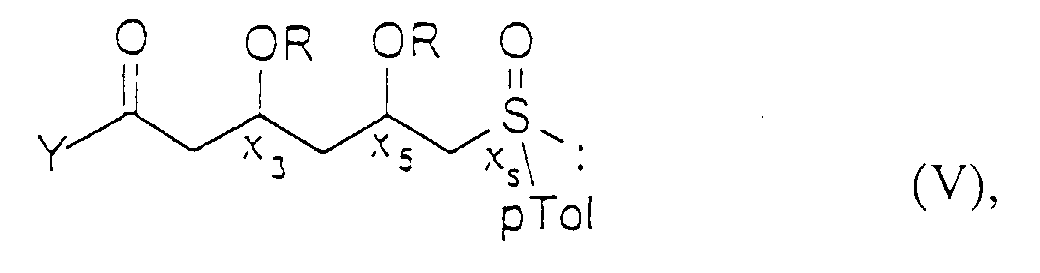
- Alkyl-[3(X3), 5(X5), S(Xs)]-3,5-dialkyloxy-6-paratolylsulfinylhexanoat der Formel (V)worin die beiden Hydroxygruppen mit X1-8-Alkyl, Aryl, Aralkyl, Trialkylsilyl, C1-8-Alkandiyl oder Benzyliden geschützt sind, wobei die Gruppen als R bezeichnet werden, Y die in Anspruch 3 angegebenen Bedeutungen aufweist, Xs die R- oder S-Konfiguration des Schwefels bedeutet, X3 die in Anspruch 20 angegebenen Bedeutungen aufweist und X5 die R- oder S-Konfiguration des Kohlenstoffatoms C5 mit X5 ≠ Xs bedeutet.
- Alkyl-[3(X3), 5(X5), S(Xs)]-3,5-dialkyloxy-6-paratolylsulfinylhexanoat nach Anspruch 33, dadurch gekennzeichnet, daß R ausgewählt ist unter den Gruppen Methyl, Benzyl, tert.-Butyldimethylsilyl, tert.-Butyldiphenylsilyl, Isopropyliden und Benzyliden, wobei die beiden letzten Gruppen alleine gleichzeitig beide Hydroxygruppen schützen können.
- Alkyl-[3(X3), 5(X5), S(Xs)]-3,5-dialkyloxy-6-paratolylsulfinylhexanoat nach Anspruch 34, dadurch gekennzeichnet, daß R die Diisopropylidengruppe ist.
- Verbindung nach Anspruch 35, dadurch gekennzeichnet, daß es sich um das Methyl-[3(R), 5(S), S(R)]-3,5-dioxyisopropyliden-6-paratolylsulfinylhexanoat handelt.
- Verfahren zur Herstellung der Verbindungen nach den Ansprüchen 35 und 36, dadurch gekennzeichnet, daß das Alkyl-[3(X3), 5(X5), S(Xs)]-3,5-dihydroxy-6-paratolylsulfinylhexanoat in Gegenwart von katalytischen Mengen von p-Toluolsulfonsäure in Aceton mit Dimethoxypropan umgesetzt wird.
- Alkyl-[3(X3), 5(X5)]-6-acetoxy-3,5-dialkyloxy-6-paratolylthiohexanoate der Formel (VI)worin Y die in den Ansprüchen 1 bis 3 angegebenen Bedeutungen aufweist, R die in Anspruch 33 angegebenen Bedeutungen aufweist, X3 die in Anspruch 20 angegebenen Bedeutungen aufweist und X5 die R- oder S-Konfiguration des Kohlenstoffatoms C5 bedeutet.
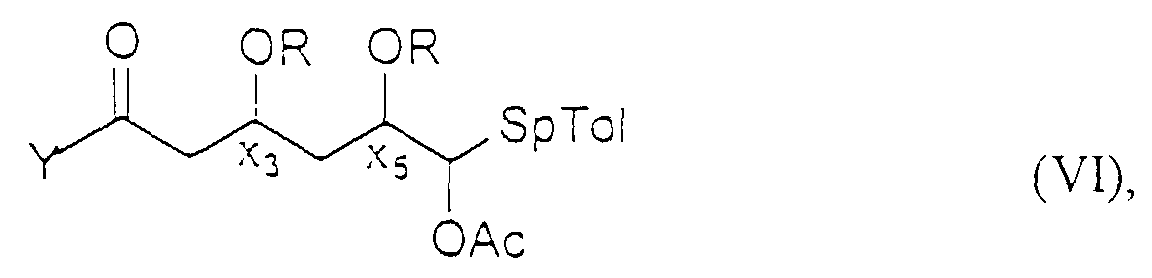
- Verbindungen nach Anspruch 38, dadurch gekennzeichnet, daß es sich um das Methyl-[3(R), 5(S)]-6-acetoxy-syn-3,5-dioxyisopropyliden-6-paratolylthiohexanoat handelt.
- Verfahren zur Herstellung von Alkyl-[3(X3), 5(X5)]-6-hydroxy-3,5-dialkyloxyhexanoaten der Formel (IX)worin Y die in Anspruch 3 angegebene Bedeutung aufweist, R die in Anspruch 33 angegebene Bedeutung aufweist, X3 die in Anspruch 20 angegebene Bedeutung aufweist und X5 die R- oder S-Konfiguration des Kohlenstoffatoms C5 bedeutet, dadurch gekennzeichnet, daß die Thioethergruppe der Verbindungen nach einem der Ansprüche 38 bis 39 reduziert und das Acetat hydrolysiert wird.

- Verfahren nach Anspruch 40, dadurch gekennzeichnet, daß eine Umsetzung mit Raney-Nickel in einem protischen Lösungsmittel oder in Ethylacetat durchgeführt wird und das Acetat durch Behandlung des Mediums mit einer Base entfernt wird.
- Verfahren nach Anspruch 41, dadurch gekennzeichnet, daß das Acetat durch eine Behandlung mit dem Carbonat oder Hydrid von Diisobutylaluminium entfernt wird.
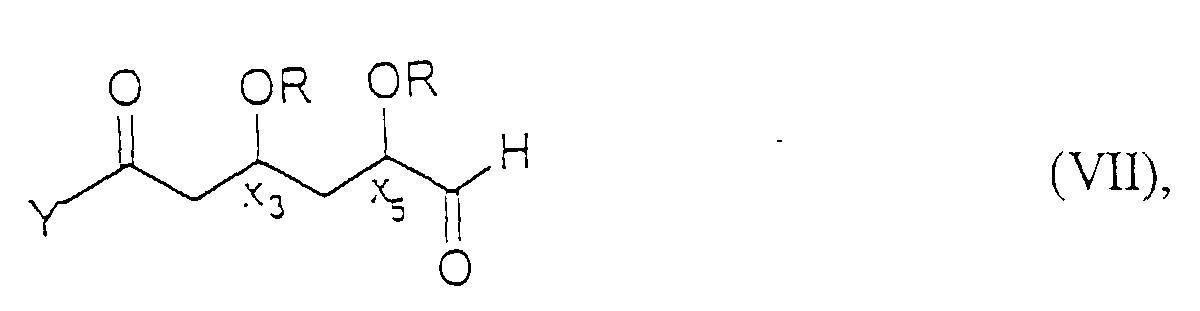
- Verfahren zur Herstellung von Alkyl-[3(X3), 5(X5)]-6-oxo-3,5-dialkyloxyhexanoaten der Formel (VII)worin Y die in Anspruch 3 angegebenen Bedeutungen aufweist, R die in Anspruch 33 angegebenen Bedeutungen aufweist, X3 die in Anspruch 20 angegebenen Bedeutungen aufweist und X5 die R- oder S-Konfiguration des Kohlenstoffatoms C5 mit X5 ≠ Xs bedeutet, dadurch gekennzeichnet, daß die Verbindung nach Anspruch 38 oder 39 in einem wäßrigen Medium mit einem Carbonat behandelt wird.
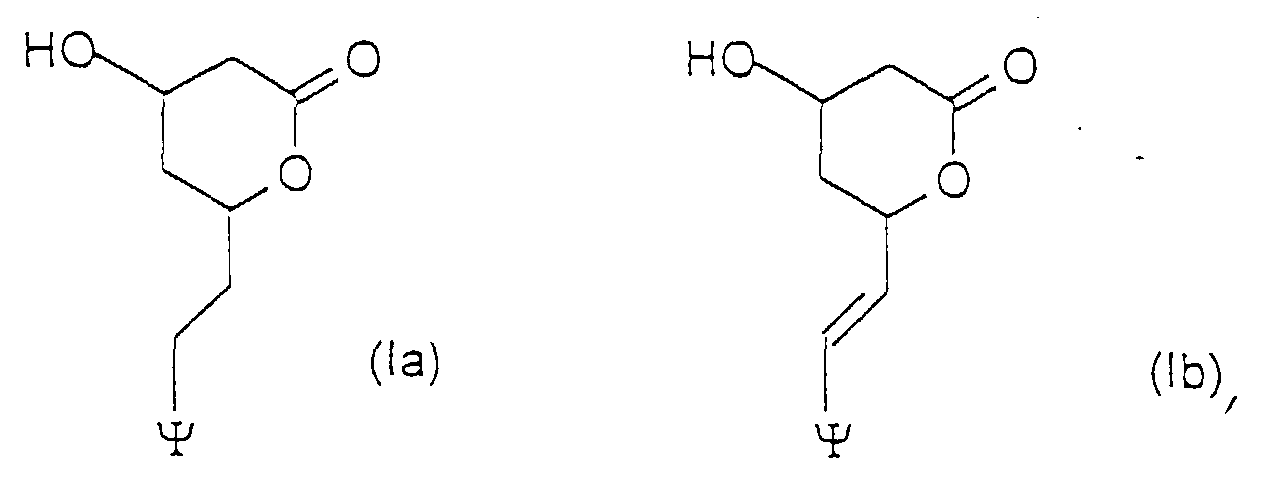
- Verfahren zur Herstellung von Verbindungen, die einer der Formeln (Ia) und (Ib) entsprechenworin Ψ die darunter angegebenen Bedeutungen aufweist, dadurch gekennzeichnet, daß es mindestens einen Schritt umfaßt, der unter den folgenden Schritten 1 bis 8 ausgewählt ist:
 1) in einem ersten Schritt wird das Trianion von Alkyl-3,5-dioxohexanoat der Formel (X) mit (X's)-p-Toluol (im folgenden als pTol bezeichnet)-sulfinat von (-) oder (+)Menthyl umgesetzt, wodurch das Alkyl (Xs)-3,5-dioxo-6-p-tolylsulfinylhexanoat der Formel (II) hergestellt wird:worin Xs und X's die Konfigurationen R oder S des Schwefelatoms in den beiden Molekülen bezeichnen, mit Xs ≠ X's; Y eine geradkettige oder verzweigte, gesättigte oder ungesättigte C1-18-Alkyloxygruppe, eine Aryloxygruppe oder eine Aralkyloxygruppe mit höchstens 18 Kohlenstoffatomen, eine Imidazolidgruppe, eine geradkettige oder verzweigte, gesättigte oder ungesättigte C1-18-Alkylsulfidgruppe, Arylsulfid, C1-18-Aralkylsulfid oder eine Gruppe
 bedeutet, wobei Q eine geradkettige oder verzweigte, gesättigte oder ungesättigte C1-18-Alkylgruppe ist;
 2) in einem zweiten Schritt wird die C5-Carbonylgruppe des Alkyl-(Xs)-3,5-dioxo-6-paratolylsulfinylhexanoats enantioselektiv zu einer Alkoholgruppe reduziert, wodurch das Alkyl-[5(X5), S(Xs)]-5-hydroxy-3-oxo-6-paratolylsulfinylhexanoat der nachfolgend angegebenen Formel (III) gebildet wird, wobei X5 die Konfiguration des Kohlenstoffatoms C5 mit X5 ≠ Xs bedeutet und Y die oben angegebenen Bedeutungen aufweist
 3) in einem dritten wird Schritt die C3-Carbonylgruppe des Alkyl-[5(X5). S(Xs)]-5-hydroxy-3-oxo-6-paratolylsulfinylhexanoats diastereoselektiv reduziert, wodurch das Alkyl-[3(X3), 5(X5), S(Xs)]-3,5dihydroxy-6-paratolylsulfinylhexanoat der folgenden Formel (IV) gebildet wird, wobei X3 die Konfiguration des Kohlenstoffatoms C3 bedeutet, wobei ein Reduktionsverfahren gewählt wird, das X5 = X3 ergibt, wenn eine Antikonfiguration gebildet werden soll, oder ein Reduktionsverfahren gewählt wird, das X5 ≠ X3 ergibt, wenn eine Synkonfiguration der beiden Alkoholgruppen gebildet werden soll, wobei Y die oben angegebenen Bedeutungen aufweist
 4) in einem vierten Schritt werden die beiden Hydroxygruppen mit C1-8-Alkyl, Aryl, Aralkyl, Trialkylsilyl, C1-8-Alkandiyl oder Benzyliden geschützt, wobei diese Gruppen als R bezeichnet werden, wodurch ein Alkyl-[3(X3), 5(X5), S(Xs)]-3,5-dialkyloxy-6-paratolylsulfinylhexanoat der Formel (V) hergestellt wird, wobei Y die oben angegebenen Bedeutungen aufweist und wobei diese Gruppen unter den Bedingungen der Schritte 5 und 6 nicht entfernt werden
 5) in einem fünften wird Schritt wird die Sulfoxidgruppe über eine Pummerer-Umlagerung in eine Thioethergruppe umgewandelt, wodurch ein Alkyl-[3(X3), 5(X5)]-6-acetoxy-3,5-dialkyloxy-6-paratolylthiohexanoat der folgenden Formel (VI) hergestellt wird, worin R und Y die oben angegebenen Bedeutungen aufweisen:
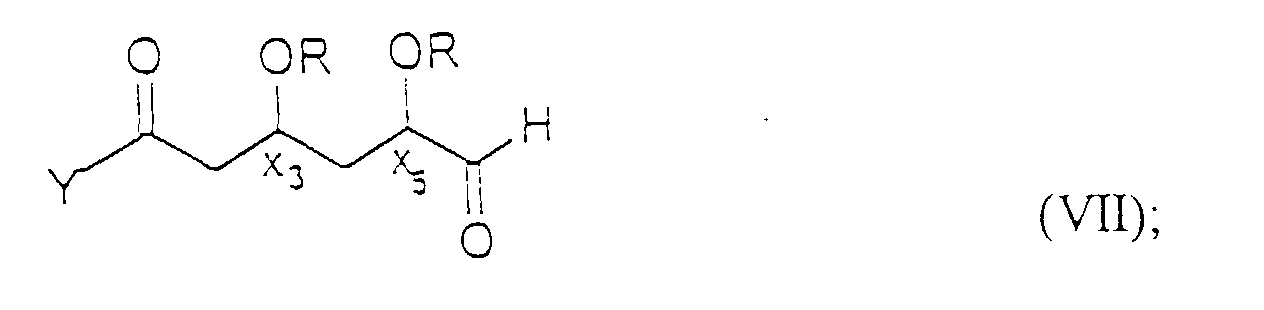
 6) in einem sechsten Schritt wird die Gruppe in C6-Stellung in einen Aldehyden umgewandelt, wodurch ein Alkyl-[3(X3), 5(X5)]-6-oxo-3,5-dialkyloxyhexanoat der Formel (VII) gebildet, wobei Y und R die oben angegebenen Bedeutungen aufweisen:
 7) in einem siebten Schritt wird das Alkyl-[3(X3), 5(X5)]-6-oxo-3,5-dialkyloxyhexanoat der Formel (VII) mit einem Wittig-Reagenz Ph3P=CHψ kondensiert, wobei ψ eine Gruppe bedeutet, die ausgewählt ist unter:den geradkettigen, verzweigten oder cyclischen, gesättigten oder ungesättigten C1-40-Alkylgruppen, die gegebenenfalls durch Etherbrücken unterbrochen sind und/oder gegebenenfalls mit einem oder mehreren Substituenten substituiert sind, die unter Halogen, Hydroxy, C1-20-Alkoxy, C1-20-Acyloxy, primären, sekundären oder tertiären Aminogruppen, Nitro, Thiol, Carboxy, Amido, C1-20-Alkylcarboxylat, Arylcarboxylat, C1-20-Aralkyl-carboxylat, C1 20-Alkylamido, Arylamido, C1-20-Aralkylamido und unter den Arylgruppen und Stickstoff-, Sauerstoff-, Phosphor- und Schwefelheterocyclen mit 1 bis 20 Kohlenstoffatomen, die gesättigt oder ungesättigt sind, ausgewählt sind;den Arylgruppen, die gegebenenfalls mit einem oder mehreren Substituenten substituiert sind, die unter Halogen, Hydroxy, C1-20-Alkoxy, C1-20-Acyloxy, Amino, C1-20-Alkylamino und C1-20-Dialkylamino, Nitro, Thiol, Carboxy, Amido, C1-20-Alkylcarboxylat, Arylcarboxylat, C1-20-Aralkylcarboxylat, C1-20-Alkylamido, Arylamido, C1-20-Aralkylamido, C1-20-Aryl und unter den gesättigten oder ungesättigten, geradkettigen, verzweigten oder cyclischen Alkyl- und Aralkylgruppen mit 1 bis 20 Kohlenstoffatomen und gesättigten oder ungesättigten Stickstoff-, Sauerstoff-, Phosphor- und Schwefelheterocyclen ausgewählt sind;den Aralkylgruppen, die gegebenenfalls mit einem oder mehreren Substituenten substituiert sind, die unter Halogen, Hydroxy, C1-20-Alkoxy, C1-20-Acyloxy, Amino, Alkylaniino und Dialkylamino mit 1 bis 20 Kohlenstoffatomen, Nitro, Thiol, Carboxy, Amido, C1-20-Alkylcarboxylat, Arylcarboxylat, C1-20-Aralkylcarboxylat, C1-20-Alkylamido, Arylamido, C1-20-Aralkylamido, C1-20-Aryl und unter den gesättigten oder ungesättigten, geradkettigen, verzweigten oder cyclischen Alkyl- und Aralkylgruppen mit 1 bis 20 Kohlenstoffatomen ausgewählt sind; undden Stickstoff-, Sauerstoff-, Phosphor- oder Schwefelheterocyclen, die gegebenenfalls mit einem oder mehreren Substituenten substituiert sind, die unter Halogen, Hydroxy, C1-20-Alkoxy, C1-20-Acyloxy, primären, sekundären oder tertiären Aminogruppen, Nitro, Thiol, Carboxy, Amido, C1-20-Alkylcarboxylat, Arylcarboxylat, C1-20-Aralkylcarboxylat, C1-20-Alkylamido, Arylamido, C1-20-Aralkylamido und unter den Gruppen Aryl, Aralkyl und Stickstoff-, Sauerstoff-, Phosphor- und Schwefelheterocyclen mit 1 bis 20 Kohlenstoffatomen, die gesättigt oder ungesättigt sind, ausgewählt sind, wodurch das Produkt der Formel (VIII) gebildet wird, worin R und Y die oben angegebenen Bedeutungen aufweisen:
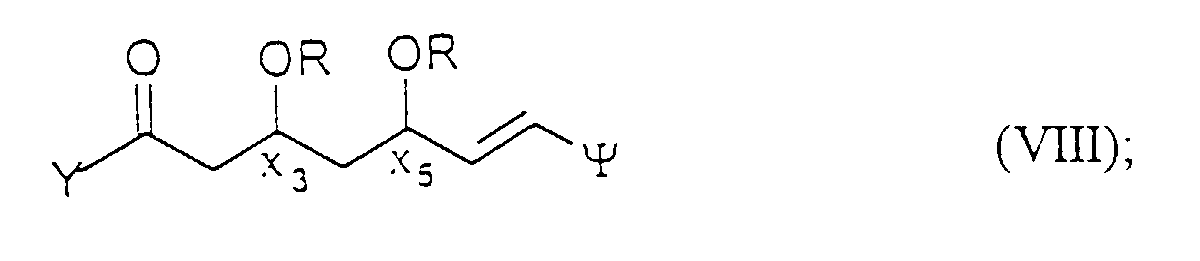 8) in einem achten Schritt wird die Doppelbindung reduziert, wodurch erhalten wird:und
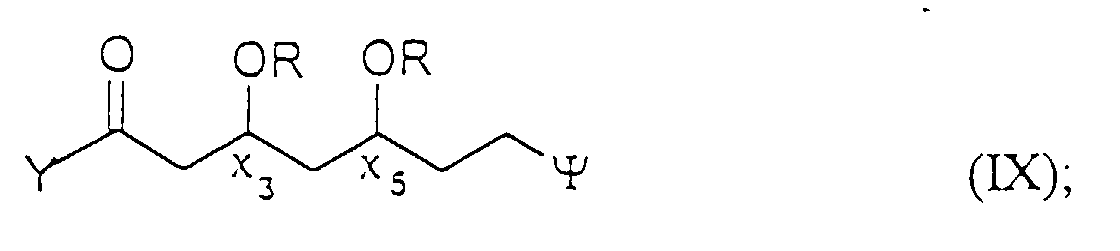 9) in einem neunten und letzten Schritt werden die Schutzgruppen der Hydroxygruppen entfernt und der Ester -COY der Verbindungen der Formel (VIII) und (IX) hydrolysiert, wodurch die Verbindung der Formel (Ia) bzw. (Ib) entsteht.
Applications Claiming Priority (3)
| Application Number | Priority Date | Filing Date | Title |
|---|---|---|---|
| FR9514093A FR2741620B1 (fr) | 1995-11-28 | 1995-11-28 | Procede de preparation de composes a groupement beta-hydroxy -delta-lactone analogues de la (+) compactine et de la (+) mevinoline |
| FR9514093 | 1995-11-28 | ||
| PCT/FR1996/001782 WO1997019917A1 (fr) | 1995-11-28 | 1996-11-12 | PROCEDE DE PREPARATION DE COMPOSES A GROUPEMENT β-HYDROXY-δ-LACTONE ANALOGUES DE LA (+) COMPACTINE ET DE LA (+) MEVINOLINE |
Publications (2)
| Publication Number | Publication Date |
|---|---|
| EP0805800A1 EP0805800A1 (de) | 1997-11-12 |
| EP0805800B1 true EP0805800B1 (de) | 2001-03-14 |
Family
ID=9484968
Family Applications (1)
| Application Number | Title | Priority Date | Filing Date |
|---|---|---|---|
| EP96938297A Expired - Lifetime EP0805800B1 (de) | 1995-11-28 | 1996-11-12 | Verfahren zur herstellung von (+)compactin und (+)mevinolin derivaten mit beta-hydroxy-delta-lactonresten |
Country Status (7)
| Country | Link |
|---|---|
| EP (1) | EP0805800B1 (de) |
| JP (1) | JP3119663B2 (de) |
| AT (1) | ATE199709T1 (de) |
| DE (1) | DE69612086T2 (de) |
| ES (1) | ES2157466T3 (de) |
| FR (1) | FR2741620B1 (de) |
| WO (1) | WO1997019917A1 (de) |
Families Citing this family (21)
| Publication number | Priority date | Publication date | Assignee | Title |
|---|---|---|---|---|
| JPH0623580B2 (ja) * | 1986-11-19 | 1994-03-30 | 株式会社三ッ葉電機製作所 | スタータのクラッチのアウタとインナ間の開放端を閉塞するカバ−の固定構造及び固定方法 |
| DE69824901D1 (de) * | 1997-04-16 | 2004-08-05 | Univ New Mexico Albuquerque | Cholesterin Esterase Inhibitoren |
| EP1323715B1 (de) * | 1997-04-16 | 2004-06-30 | The University of New Mexico | Cholesterin Esterase Inhibitoren |
| GB9903472D0 (en) | 1999-02-17 | 1999-04-07 | Zeneca Ltd | Chemical process |
| GB0011120D0 (en) | 2000-05-09 | 2000-06-28 | Avecia Ltd | Process |
| NL1015744C2 (nl) | 2000-07-19 | 2002-01-22 | Dsm Nv | Werkwijze voor de bereiding van 2-(6-gesubstitueerde-1,3-dioxan-4-yl) azijnzuurderivaten. |
| KR100888408B1 (ko) | 2001-07-13 | 2009-03-13 | 아스트라제네카 유케이 리미티드 | 아미노피리미딘 화합물의 제조 방법 |
| EP1323717A1 (de) | 2001-12-27 | 2003-07-02 | Dsm N.V. | Prozess für die Herstellung von 2-(6-Substituierten-1,3-Dioxan-4-yl) Essigsäure Derivaten |
| JP4251554B2 (ja) * | 2002-04-12 | 2009-04-08 | メルシャン株式会社 | 大腸菌における放線菌由来チトクロームp−450遺伝子の発現系 |
| EP1375493A1 (de) | 2002-06-17 | 2004-01-02 | Dsm N.V. | Verfahren zur Herstellung von Dioxanessigsäureester |
| GB0218781D0 (en) | 2002-08-13 | 2002-09-18 | Astrazeneca Ab | Chemical process |
| DE60330050D1 (de) | 2002-12-16 | 2009-12-24 | Astrazeneca Uk Ltd | Verfahren zur herstellung von pyrimidinverbindungen |
| GB0312896D0 (en) | 2003-06-05 | 2003-07-09 | Astrazeneca Ab | Chemical process |
| UY28501A1 (es) | 2003-09-10 | 2005-04-29 | Astrazeneca Uk Ltd | Compuestos químicos |
| GB0322552D0 (en) | 2003-09-26 | 2003-10-29 | Astrazeneca Uk Ltd | Therapeutic treatment |
| GB0324791D0 (en) | 2003-10-24 | 2003-11-26 | Astrazeneca Ab | Chemical process |
| GB0428328D0 (en) | 2004-12-24 | 2005-02-02 | Astrazeneca Uk Ltd | Chemical process |
| SI2024341T1 (sl) | 2006-05-03 | 2016-04-29 | Msn Laboratories Private Limited | Novi postopek za statine in njihove farmacevtsko sprejemljive soli |
| US8404841B2 (en) | 2006-10-09 | 2013-03-26 | Msn Laboratories Limited | Process for the preparation of statins and their pharmaceutically acceptable salts thereof |
| US8487105B2 (en) | 2009-01-19 | 2013-07-16 | Msn Laboratories Limited | Process for preparing pitavastatin, intermediates and pharmaceuctically acceptable salts thereof |
| EP2526099B1 (de) | 2010-01-18 | 2016-03-30 | MSN Laboratories Limited | Verbessertes verfahren zur herstellung von amid-zwischenprodukten und seine anwendung |
-
1995
- 1995-11-28 FR FR9514093A patent/FR2741620B1/fr not_active Expired - Fee Related
-
1996
- 1996-11-12 AT AT96938297T patent/ATE199709T1/de not_active IP Right Cessation
- 1996-11-12 WO PCT/FR1996/001782 patent/WO1997019917A1/fr not_active Ceased
- 1996-11-12 JP JP09520222A patent/JP3119663B2/ja not_active Expired - Fee Related
- 1996-11-12 ES ES96938297T patent/ES2157466T3/es not_active Expired - Lifetime
- 1996-11-12 DE DE69612086T patent/DE69612086T2/de not_active Expired - Fee Related
- 1996-11-12 EP EP96938297A patent/EP0805800B1/de not_active Expired - Lifetime
Also Published As
| Publication number | Publication date |
|---|---|
| DE69612086D1 (de) | 2001-04-19 |
| JPH10504845A (ja) | 1998-05-12 |
| FR2741620A1 (fr) | 1997-05-30 |
| DE69612086T2 (de) | 2001-06-21 |
| FR2741620B1 (fr) | 1997-12-26 |
| EP0805800A1 (de) | 1997-11-12 |
| ES2157466T3 (es) | 2001-08-16 |
| ATE199709T1 (de) | 2001-03-15 |
| JP3119663B2 (ja) | 2000-12-25 |
| WO1997019917A1 (fr) | 1997-06-05 |
Similar Documents
| Publication | Publication Date | Title |
|---|---|---|
| EP0805800A1 (de) | Verfahren zur herstellung von (+)compactin und (+)mevinolin derivaten mit beta-hydroxy-delta-lactonresten | |
| HUE025904T2 (en) | Methods for purifying trans-(-)-delta9-tetrahydrocannabinol and trans-(+)-delta9-tetrahydrocannabinol | |
| CA2185192C (fr) | Nouveaux acides et esters 2,2- dimethyl-w-phenoxy alcanoiques substitues, leur procede de preparation et les compositions pharmaceutiques qui les contiennent | |
| EP0515541B1 (de) | Verfahren zur herstellung von (2r,3r)-cis-beta-phenyl-glycidil-säure | |
| US6278001B1 (en) | Method for preparing (+) compactin and (+) mevinolin analog compounds having a β-hydroxy-δ-lactone grouping | |
| MC2028A1 (fr) | Procede de preparation de thiazepine-4(5h)-ones optiquement actives,intermediaires de synthese,et procede de preparation de ces intermediaires | |
| CA2107150C (fr) | Nouveaux derives chromeniques a chaine laterale trienique, leur procede de preparation et les compositions pharmaceutiques les renfermant | |
| EP0729936A1 (de) | Verfahren zur Synthese der alpha-substiuierten Akrylsäuren und deren Verwendung | |
| JP2018502886A (ja) | 多価不飽和ケトン化合物の製造方法 | |
| EP0338895B1 (de) | Heteroarotinoid-Derivate, Verfahren zu deren Herstellung und diese enthaltende pharmazeutische Zusammenstellungen | |
| CA2098185A1 (fr) | Procede de preparation de derives de l'acide dihydroxy-3,5 pentanoique | |
| EP0909268B1 (de) | Verfahren zur herstellung substituierter anthrachinone und ihre verwendung zur herstellung von rheinen | |
| EP0337885B1 (de) | Trienische Derivate mit chromenischer Struktur, Verfahren zu deren Herstellung und diese enthaltende pharmazeutische Zusammenstellungen | |
| EP1940770B1 (de) | Neues verfahren zur herstellung ungesättigter hydroxyfettsäuren | |
| FR3063729B1 (fr) | Nouvelle composition d'isomeres du 7,9-dodecadienyl-1-acetate et son procede de fabrication | |
| EP0647623B1 (de) | Zwischenprodukte zur Herstellung von Vitamin A und von Carotenoiden und Verfahren zu deren Herstellung | |
| WO1998008834A1 (fr) | Derives de benzylamine, leur preparation et leur application en therapeutique | |
| EP0802180A1 (de) | Beta-Methylen-Aldehyde insbesondere verwendbar bei der Herstellung von gewünschten Verbindungen wie Retinoiden oder Carotenoiden und Herstellung von gewünschten Verbindungen durch Mittel solcher Beta-Methylen-Aldehyden | |
| FR2488604A1 (fr) | Derives d'heteroprostaglandines ainsi que leurs procedes de preparation | |
| EP0430808A1 (de) | Dihydropyranderivate, ihre Verfahren zur Herstellung und ihre Verwendung | |
| FR2740772A1 (fr) | Procede de preparation d'anthraquinones substituees et application a la preparation de rheines | |
| WO2005058918A1 (fr) | Nouveaux derives d’acides phenyl-boronique et leurs procedes de preparation | |
| FR2818970A1 (fr) | Procede de preparation enantioselective d'adduits de phenylethylimino-cycloalcanes alpha substitues et de 2-acetoxyacrylonitrile, intermediaires dans la synthese enantoselective de la chaine laterale des harringtonines | |
| CH618174A5 (de) | ||
| CA2562354A1 (fr) | Procede de synthese et intermediaires de benzoxathiepines |
Legal Events
| Date | Code | Title | Description |
|---|---|---|---|
| PUAI | Public reference made under article 153(3) epc to a published international application that has entered the european phase |
Free format text: ORIGINAL CODE: 0009012 |
|
| AK | Designated contracting states |
Kind code of ref document: A1 Designated state(s): AT BE CH DE DK ES FR GB GR IE IT LI LU MC NL PT SE |
|
| 17P | Request for examination filed |
Effective date: 19971205 |
|
| 17Q | First examination report despatched |
Effective date: 19990406 |
|
| GRAG | Despatch of communication of intention to grant |
Free format text: ORIGINAL CODE: EPIDOS AGRA |
|
| GRAG | Despatch of communication of intention to grant |
Free format text: ORIGINAL CODE: EPIDOS AGRA |
|
| GRAH | Despatch of communication of intention to grant a patent |
Free format text: ORIGINAL CODE: EPIDOS IGRA |
|
| GRAH | Despatch of communication of intention to grant a patent |
Free format text: ORIGINAL CODE: EPIDOS IGRA |
|
| GRAA | (expected) grant |
Free format text: ORIGINAL CODE: 0009210 |
|
| AK | Designated contracting states |
Kind code of ref document: B1 Designated state(s): AT BE CH DE DK ES FR GB GR IE IT LI LU MC NL PT SE |
|
| PG25 | Lapsed in a contracting state [announced via postgrant information from national office to epo] |
Ref country code: IE Free format text: LAPSE BECAUSE OF FAILURE TO SUBMIT A TRANSLATION OF THE DESCRIPTION OR TO PAY THE FEE WITHIN THE PRESCRIBED TIME-LIMIT Effective date: 20010314 |
|
| RBV | Designated contracting states (corrected) |
Designated state(s): AT BE CH DE DK ES FR GB GR IE IT LI LU MC NL PT SE |
|
| REF | Corresponds to: |
Ref document number: 199709 Country of ref document: AT Date of ref document: 20010315 Kind code of ref document: T |
|
| ITF | It: translation for a ep patent filed | ||
| REG | Reference to a national code |
Ref country code: CH Ref legal event code: EP |
|
| REG | Reference to a national code |
Ref country code: IE Ref legal event code: FG4D Free format text: FRENCH |
|
| REF | Corresponds to: |
Ref document number: 69612086 Country of ref document: DE Date of ref document: 20010419 |
|
| GBT | Gb: translation of ep patent filed (gb section 77(6)(a)/1977) |
Effective date: 20010523 |
|
| PG25 | Lapsed in a contracting state [announced via postgrant information from national office to epo] |
Ref country code: DK Free format text: LAPSE BECAUSE OF FAILURE TO SUBMIT A TRANSLATION OF THE DESCRIPTION OR TO PAY THE FEE WITHIN THE PRESCRIBED TIME-LIMIT Effective date: 20010614 |
|
| PG25 | Lapsed in a contracting state [announced via postgrant information from national office to epo] |
Ref country code: PT Free format text: LAPSE BECAUSE OF FAILURE TO SUBMIT A TRANSLATION OF THE DESCRIPTION OR TO PAY THE FEE WITHIN THE PRESCRIBED TIME-LIMIT Effective date: 20010615 Ref country code: GR Free format text: LAPSE BECAUSE OF FAILURE TO SUBMIT A TRANSLATION OF THE DESCRIPTION OR TO PAY THE FEE WITHIN THE PRESCRIBED TIME-LIMIT Effective date: 20010615 |
|
| REG | Reference to a national code |
Ref country code: ES Ref legal event code: FG2A Ref document number: 2157466 Country of ref document: ES Kind code of ref document: T3 |
|
| PG25 | Lapsed in a contracting state [announced via postgrant information from national office to epo] |
Ref country code: MC Free format text: LAPSE BECAUSE OF NON-PAYMENT OF DUE FEES Effective date: 20011112 Ref country code: LU Free format text: LAPSE BECAUSE OF NON-PAYMENT OF DUE FEES Effective date: 20011112 |
|
| REG | Reference to a national code |
Ref country code: IE Ref legal event code: FD4D |
|
| REG | Reference to a national code |
Ref country code: GB Ref legal event code: IF02 |
|
| PLBE | No opposition filed within time limit |
Free format text: ORIGINAL CODE: 0009261 |
|
| STAA | Information on the status of an ep patent application or granted ep patent |
Free format text: STATUS: NO OPPOSITION FILED WITHIN TIME LIMIT |
|
| 26N | No opposition filed | ||
| PGFP | Annual fee paid to national office [announced via postgrant information from national office to epo] |
Ref country code: NL Payment date: 20051106 Year of fee payment: 10 |
|
| PGFP | Annual fee paid to national office [announced via postgrant information from national office to epo] |
Ref country code: SE Payment date: 20051107 Year of fee payment: 10 |
|
| PGFP | Annual fee paid to national office [announced via postgrant information from national office to epo] |
Ref country code: FR Payment date: 20051108 Year of fee payment: 10 |
|
| PGFP | Annual fee paid to national office [announced via postgrant information from national office to epo] |
Ref country code: GB Payment date: 20051109 Year of fee payment: 10 |
|
| PGFP | Annual fee paid to national office [announced via postgrant information from national office to epo] |
Ref country code: DE Payment date: 20051110 Year of fee payment: 10 |
|
| PGFP | Annual fee paid to national office [announced via postgrant information from national office to epo] |
Ref country code: AT Payment date: 20051111 Year of fee payment: 10 |
|
| PGFP | Annual fee paid to national office [announced via postgrant information from national office to epo] |
Ref country code: CH Payment date: 20051115 Year of fee payment: 10 |
|
| PGFP | Annual fee paid to national office [announced via postgrant information from national office to epo] |
Ref country code: ES Payment date: 20051219 Year of fee payment: 10 |
|
| PGFP | Annual fee paid to national office [announced via postgrant information from national office to epo] |
Ref country code: BE Payment date: 20060124 Year of fee payment: 10 |
|
| PG25 | Lapsed in a contracting state [announced via postgrant information from national office to epo] |
Ref country code: AT Free format text: LAPSE BECAUSE OF NON-PAYMENT OF DUE FEES Effective date: 20061112 |
|
| PG25 | Lapsed in a contracting state [announced via postgrant information from national office to epo] |
Ref country code: SE Free format text: LAPSE BECAUSE OF NON-PAYMENT OF DUE FEES Effective date: 20061113 |
|
| PG25 | Lapsed in a contracting state [announced via postgrant information from national office to epo] |
Ref country code: LI Free format text: LAPSE BECAUSE OF NON-PAYMENT OF DUE FEES Effective date: 20061130 Ref country code: CH Free format text: LAPSE BECAUSE OF NON-PAYMENT OF DUE FEES Effective date: 20061130 Ref country code: BE Free format text: LAPSE BECAUSE OF NON-PAYMENT OF DUE FEES Effective date: 20061130 |
|
| PGFP | Annual fee paid to national office [announced via postgrant information from national office to epo] |
Ref country code: IT Payment date: 20061130 Year of fee payment: 11 |
|
| PG25 | Lapsed in a contracting state [announced via postgrant information from national office to epo] |
Ref country code: NL Free format text: LAPSE BECAUSE OF NON-PAYMENT OF DUE FEES Effective date: 20070601 Ref country code: DE Free format text: LAPSE BECAUSE OF NON-PAYMENT OF DUE FEES Effective date: 20070601 |
|
| REG | Reference to a national code |
Ref country code: CH Ref legal event code: PL |
|
| EUG | Se: european patent has lapsed | ||
| GBPC | Gb: european patent ceased through non-payment of renewal fee |
Effective date: 20061112 |
|
| NLV4 | Nl: lapsed or anulled due to non-payment of the annual fee |
Effective date: 20070601 |
|
| REG | Reference to a national code |
Ref country code: FR Ref legal event code: ST Effective date: 20070731 |
|
| PG25 | Lapsed in a contracting state [announced via postgrant information from national office to epo] |
Ref country code: GB Free format text: LAPSE BECAUSE OF NON-PAYMENT OF DUE FEES Effective date: 20061112 |
|
| BERE | Be: lapsed |
Owner name: L'*OREAL Effective date: 20061130 |
|
| REG | Reference to a national code |
Ref country code: ES Ref legal event code: FD2A Effective date: 20061113 |
|
| PG25 | Lapsed in a contracting state [announced via postgrant information from national office to epo] |
Ref country code: FR Free format text: LAPSE BECAUSE OF NON-PAYMENT OF DUE FEES Effective date: 20061130 Ref country code: ES Free format text: LAPSE BECAUSE OF NON-PAYMENT OF DUE FEES Effective date: 20061113 |
|
| PG25 | Lapsed in a contracting state [announced via postgrant information from national office to epo] |
Ref country code: IT Free format text: LAPSE BECAUSE OF NON-PAYMENT OF DUE FEES Effective date: 20071112 |