EP0804574B1 - Humaner kappa opiatrezeptor, nukleinsäuren und ihre verwendungen - Google Patents
Humaner kappa opiatrezeptor, nukleinsäuren und ihre verwendungen Download PDFInfo
- Publication number
- EP0804574B1 EP0804574B1 EP95925024A EP95925024A EP0804574B1 EP 0804574 B1 EP0804574 B1 EP 0804574B1 EP 95925024 A EP95925024 A EP 95925024A EP 95925024 A EP95925024 A EP 95925024A EP 0804574 B1 EP0804574 B1 EP 0804574B1
- Authority
- EP
- European Patent Office
- Prior art keywords
- polypeptide
- sequence
- opioid
- sequences
- opioid receptor
- Prior art date
- Legal status (The legal status is an assumption and is not a legal conclusion. Google has not performed a legal analysis and makes no representation as to the accuracy of the status listed.)
- Expired - Lifetime
Links
- 108020001588 κ-opioid receptors Proteins 0.000 title claims abstract description 34
- 102000048260 kappa Opioid Receptors Human genes 0.000 title claims abstract description 33
- 150000007523 nucleic acids Chemical class 0.000 title claims description 10
- 108020004707 nucleic acids Proteins 0.000 title description 8
- 102000039446 nucleic acids Human genes 0.000 title description 8
- 108090000765 processed proteins & peptides Proteins 0.000 claims abstract description 66
- 102000004196 processed proteins & peptides Human genes 0.000 claims abstract description 57
- 229920001184 polypeptide Polymers 0.000 claims abstract description 55
- 230000000694 effects Effects 0.000 claims abstract description 22
- 239000002299 complementary DNA Substances 0.000 claims description 30
- 210000004027 cell Anatomy 0.000 claims description 25
- 238000000034 method Methods 0.000 claims description 23
- 239000003446 ligand Substances 0.000 claims description 21
- 102000003840 Opioid Receptors Human genes 0.000 claims description 19
- 108090000137 Opioid Receptors Proteins 0.000 claims description 19
- 239000002773 nucleotide Substances 0.000 claims description 17
- 125000003729 nucleotide group Chemical group 0.000 claims description 17
- 239000000523 sample Substances 0.000 claims description 17
- 230000014509 gene expression Effects 0.000 claims description 15
- 239000000203 mixture Substances 0.000 claims description 11
- 102000005962 receptors Human genes 0.000 claims description 10
- 108020003175 receptors Proteins 0.000 claims description 10
- 238000004519 manufacturing process Methods 0.000 claims description 9
- 230000035772 mutation Effects 0.000 claims description 9
- 240000004808 Saccharomyces cerevisiae Species 0.000 claims description 7
- 238000007792 addition Methods 0.000 claims description 7
- 230000002068 genetic effect Effects 0.000 claims description 7
- 238000012986 modification Methods 0.000 claims description 7
- 230000004048 modification Effects 0.000 claims description 7
- 230000003993 interaction Effects 0.000 claims description 6
- 241000233866 Fungi Species 0.000 claims description 5
- 230000000692 anti-sense effect Effects 0.000 claims description 5
- 230000000295 complement effect Effects 0.000 claims description 5
- 238000006467 substitution reaction Methods 0.000 claims description 5
- 238000012217 deletion Methods 0.000 claims description 4
- 230000037430 deletion Effects 0.000 claims description 4
- 230000002401 inhibitory effect Effects 0.000 claims description 3
- 210000001236 prokaryotic cell Anatomy 0.000 claims description 3
- 230000002526 effect on cardiovascular system Effects 0.000 claims description 2
- 230000000926 neurological effect Effects 0.000 claims description 2
- 208000024172 Cardiovascular disease Diseases 0.000 claims 1
- 208000012902 Nervous system disease Diseases 0.000 claims 1
- 208000025966 Neurological disease Diseases 0.000 claims 1
- 102000040430 polynucleotide Human genes 0.000 claims 1
- 108091033319 polynucleotide Proteins 0.000 claims 1
- 239000002157 polynucleotide Substances 0.000 claims 1
- 208000020016 psychiatric disease Diseases 0.000 claims 1
- 108090000623 proteins and genes Proteins 0.000 abstract description 16
- 102000004169 proteins and genes Human genes 0.000 abstract description 7
- 239000012634 fragment Substances 0.000 description 27
- 108020004414 DNA Proteins 0.000 description 18
- 230000003321 amplification Effects 0.000 description 12
- 238000003199 nucleic acid amplification method Methods 0.000 description 12
- 238000006243 chemical reaction Methods 0.000 description 10
- 108091028043 Nucleic acid sequence Proteins 0.000 description 9
- 241000699666 Mus <mouse, genus> Species 0.000 description 7
- 238000002955 isolation Methods 0.000 description 7
- 238000003752 polymerase chain reaction Methods 0.000 description 7
- 239000013598 vector Substances 0.000 description 7
- IAZDPXIOMUYVGZ-UHFFFAOYSA-N Dimethylsulphoxide Chemical compound CS(C)=O IAZDPXIOMUYVGZ-UHFFFAOYSA-N 0.000 description 6
- 108091034117 Oligonucleotide Proteins 0.000 description 6
- 238000010367 cloning Methods 0.000 description 6
- 238000001514 detection method Methods 0.000 description 6
- 230000001413 cellular effect Effects 0.000 description 5
- 239000012528 membrane Substances 0.000 description 5
- 241000588724 Escherichia coli Species 0.000 description 4
- LFQSCWFLJHTTHZ-UHFFFAOYSA-N Ethanol Chemical compound CCO LFQSCWFLJHTTHZ-UHFFFAOYSA-N 0.000 description 4
- 241000235648 Pichia Species 0.000 description 4
- 239000000556 agonist Substances 0.000 description 4
- 210000004102 animal cell Anatomy 0.000 description 4
- 238000009396 hybridization Methods 0.000 description 4
- 108091032973 (ribonucleotides)n+m Proteins 0.000 description 3
- 229920000936 Agarose Polymers 0.000 description 3
- 108700024394 Exon Proteins 0.000 description 3
- ISWSIDIOOBJBQZ-UHFFFAOYSA-N Phenol Chemical compound OC1=CC=CC=C1 ISWSIDIOOBJBQZ-UHFFFAOYSA-N 0.000 description 3
- 101100244562 Pseudomonas aeruginosa (strain ATCC 15692 / DSM 22644 / CIP 104116 / JCM 14847 / LMG 12228 / 1C / PRS 101 / PAO1) oprD gene Proteins 0.000 description 3
- JLCPHMBAVCMARE-UHFFFAOYSA-N [3-[[3-[[3-[[3-[[3-[[3-[[3-[[3-[[3-[[3-[[3-[[5-(2-amino-6-oxo-1H-purin-9-yl)-3-[[3-[[3-[[3-[[3-[[3-[[5-(2-amino-6-oxo-1H-purin-9-yl)-3-[[5-(2-amino-6-oxo-1H-purin-9-yl)-3-hydroxyoxolan-2-yl]methoxy-hydroxyphosphoryl]oxyoxolan-2-yl]methoxy-hydroxyphosphoryl]oxy-5-(5-methyl-2,4-dioxopyrimidin-1-yl)oxolan-2-yl]methoxy-hydroxyphosphoryl]oxy-5-(6-aminopurin-9-yl)oxolan-2-yl]methoxy-hydroxyphosphoryl]oxy-5-(6-aminopurin-9-yl)oxolan-2-yl]methoxy-hydroxyphosphoryl]oxy-5-(6-aminopurin-9-yl)oxolan-2-yl]methoxy-hydroxyphosphoryl]oxy-5-(6-aminopurin-9-yl)oxolan-2-yl]methoxy-hydroxyphosphoryl]oxyoxolan-2-yl]methoxy-hydroxyphosphoryl]oxy-5-(5-methyl-2,4-dioxopyrimidin-1-yl)oxolan-2-yl]methoxy-hydroxyphosphoryl]oxy-5-(4-amino-2-oxopyrimidin-1-yl)oxolan-2-yl]methoxy-hydroxyphosphoryl]oxy-5-(5-methyl-2,4-dioxopyrimidin-1-yl)oxolan-2-yl]methoxy-hydroxyphosphoryl]oxy-5-(5-methyl-2,4-dioxopyrimidin-1-yl)oxolan-2-yl]methoxy-hydroxyphosphoryl]oxy-5-(6-aminopurin-9-yl)oxolan-2-yl]methoxy-hydroxyphosphoryl]oxy-5-(6-aminopurin-9-yl)oxolan-2-yl]methoxy-hydroxyphosphoryl]oxy-5-(4-amino-2-oxopyrimidin-1-yl)oxolan-2-yl]methoxy-hydroxyphosphoryl]oxy-5-(4-amino-2-oxopyrimidin-1-yl)oxolan-2-yl]methoxy-hydroxyphosphoryl]oxy-5-(4-amino-2-oxopyrimidin-1-yl)oxolan-2-yl]methoxy-hydroxyphosphoryl]oxy-5-(6-aminopurin-9-yl)oxolan-2-yl]methoxy-hydroxyphosphoryl]oxy-5-(4-amino-2-oxopyrimidin-1-yl)oxolan-2-yl]methyl [5-(6-aminopurin-9-yl)-2-(hydroxymethyl)oxolan-3-yl] hydrogen phosphate Polymers Cc1cn(C2CC(OP(O)(=O)OCC3OC(CC3OP(O)(=O)OCC3OC(CC3O)n3cnc4c3nc(N)[nH]c4=O)n3cnc4c3nc(N)[nH]c4=O)C(COP(O)(=O)OC3CC(OC3COP(O)(=O)OC3CC(OC3COP(O)(=O)OC3CC(OC3COP(O)(=O)OC3CC(OC3COP(O)(=O)OC3CC(OC3COP(O)(=O)OC3CC(OC3COP(O)(=O)OC3CC(OC3COP(O)(=O)OC3CC(OC3COP(O)(=O)OC3CC(OC3COP(O)(=O)OC3CC(OC3COP(O)(=O)OC3CC(OC3COP(O)(=O)OC3CC(OC3COP(O)(=O)OC3CC(OC3COP(O)(=O)OC3CC(OC3COP(O)(=O)OC3CC(OC3COP(O)(=O)OC3CC(OC3COP(O)(=O)OC3CC(OC3CO)n3cnc4c(N)ncnc34)n3ccc(N)nc3=O)n3cnc4c(N)ncnc34)n3ccc(N)nc3=O)n3ccc(N)nc3=O)n3ccc(N)nc3=O)n3cnc4c(N)ncnc34)n3cnc4c(N)ncnc34)n3cc(C)c(=O)[nH]c3=O)n3cc(C)c(=O)[nH]c3=O)n3ccc(N)nc3=O)n3cc(C)c(=O)[nH]c3=O)n3cnc4c3nc(N)[nH]c4=O)n3cnc4c(N)ncnc34)n3cnc4c(N)ncnc34)n3cnc4c(N)ncnc34)n3cnc4c(N)ncnc34)O2)c(=O)[nH]c1=O JLCPHMBAVCMARE-UHFFFAOYSA-N 0.000 description 3
- 238000004458 analytical method Methods 0.000 description 3
- 239000005557 antagonist Substances 0.000 description 3
- 108700023159 delta Opioid Receptors Proteins 0.000 description 3
- 102000048124 delta Opioid Receptors Human genes 0.000 description 3
- 238000001962 electrophoresis Methods 0.000 description 3
- 238000002474 experimental method Methods 0.000 description 3
- 239000000499 gel Substances 0.000 description 3
- 230000036961 partial effect Effects 0.000 description 3
- 239000008188 pellet Substances 0.000 description 3
- 230000000144 pharmacologic effect Effects 0.000 description 3
- 210000002826 placenta Anatomy 0.000 description 3
- 239000013612 plasmid Substances 0.000 description 3
- 230000003362 replicative effect Effects 0.000 description 3
- 239000000126 substance Substances 0.000 description 3
- 238000003786 synthesis reaction Methods 0.000 description 3
- QKNYBSVHEMOAJP-UHFFFAOYSA-N 2-amino-2-(hydroxymethyl)propane-1,3-diol;hydron;chloride Chemical compound Cl.OCC(N)(CO)CO QKNYBSVHEMOAJP-UHFFFAOYSA-N 0.000 description 2
- FWMNVWWHGCHHJJ-SKKKGAJSSA-N 4-amino-1-[(2r)-6-amino-2-[[(2r)-2-[[(2r)-2-[[(2r)-2-amino-3-phenylpropanoyl]amino]-3-phenylpropanoyl]amino]-4-methylpentanoyl]amino]hexanoyl]piperidine-4-carboxylic acid Chemical compound C([C@H](C(=O)N[C@H](CC(C)C)C(=O)N[C@H](CCCCN)C(=O)N1CCC(N)(CC1)C(O)=O)NC(=O)[C@H](N)CC=1C=CC=CC=1)C1=CC=CC=C1 FWMNVWWHGCHHJJ-SKKKGAJSSA-N 0.000 description 2
- HRPVXLWXLXDGHG-UHFFFAOYSA-N Acrylamide Chemical compound NC(=O)C=C HRPVXLWXLXDGHG-UHFFFAOYSA-N 0.000 description 2
- 241000228212 Aspergillus Species 0.000 description 2
- 241000193830 Bacillus <bacterium> Species 0.000 description 2
- HEDRZPFGACZZDS-UHFFFAOYSA-N Chloroform Chemical compound ClC(Cl)Cl HEDRZPFGACZZDS-UHFFFAOYSA-N 0.000 description 2
- 108091026890 Coding region Proteins 0.000 description 2
- 108010065372 Dynorphins Proteins 0.000 description 2
- KCXVZYZYPLLWCC-UHFFFAOYSA-N EDTA Chemical compound OC(=O)CN(CC(O)=O)CCN(CC(O)=O)CC(O)=O KCXVZYZYPLLWCC-UHFFFAOYSA-N 0.000 description 2
- ZHNUHDYFZUAESO-UHFFFAOYSA-N Formamide Chemical compound NC=O ZHNUHDYFZUAESO-UHFFFAOYSA-N 0.000 description 2
- KFZMGEQAYNKOFK-UHFFFAOYSA-N Isopropanol Chemical compound CC(C)O KFZMGEQAYNKOFK-UHFFFAOYSA-N 0.000 description 2
- 241000235649 Kluyveromyces Species 0.000 description 2
- 241001529936 Murinae Species 0.000 description 2
- 102100024622 Proenkephalin-B Human genes 0.000 description 2
- 101000702488 Rattus norvegicus High affinity cationic amino acid transporter 1 Proteins 0.000 description 2
- 241000235070 Saccharomyces Species 0.000 description 2
- 241000311088 Schwanniomyces Species 0.000 description 2
- 241000187747 Streptomyces Species 0.000 description 2
- 241001080024 Telles Species 0.000 description 2
- 241000223259 Trichoderma Species 0.000 description 2
- 230000005856 abnormality Effects 0.000 description 2
- 239000011543 agarose gel Substances 0.000 description 2
- 230000000202 analgesic effect Effects 0.000 description 2
- 239000012472 biological sample Substances 0.000 description 2
- AIYUHDOJVYHVIT-UHFFFAOYSA-M caesium chloride Chemical compound [Cl-].[Cs+] AIYUHDOJVYHVIT-UHFFFAOYSA-M 0.000 description 2
- 238000012411 cloning technique Methods 0.000 description 2
- 230000006378 damage Effects 0.000 description 2
- 239000003814 drug Substances 0.000 description 2
- 239000006274 endogenous ligand Substances 0.000 description 2
- 230000002255 enzymatic effect Effects 0.000 description 2
- 210000003527 eukaryotic cell Anatomy 0.000 description 2
- 238000000605 extraction Methods 0.000 description 2
- 238000000338 in vitro Methods 0.000 description 2
- 238000011534 incubation Methods 0.000 description 2
- 108020004999 messenger RNA Proteins 0.000 description 2
- 238000010369 molecular cloning Methods 0.000 description 2
- 238000012216 screening Methods 0.000 description 2
- 238000012163 sequencing technique Methods 0.000 description 2
- 241000972773 Aulopiformes Species 0.000 description 1
- 241000894006 Bacteria Species 0.000 description 1
- 108091033380 Coding strand Proteins 0.000 description 1
- 108010017826 DNA Polymerase I Proteins 0.000 description 1
- 102000004594 DNA Polymerase I Human genes 0.000 description 1
- 108010014303 DNA-directed DNA polymerase Proteins 0.000 description 1
- 102000016928 DNA-directed DNA polymerase Human genes 0.000 description 1
- 229920002307 Dextran Polymers 0.000 description 1
- 241000701533 Escherichia virus T4 Species 0.000 description 1
- 102000003688 G-Protein-Coupled Receptors Human genes 0.000 description 1
- 108090000045 G-Protein-Coupled Receptors Proteins 0.000 description 1
- 102100034343 Integrase Human genes 0.000 description 1
- 108091092195 Intron Proteins 0.000 description 1
- 102000003960 Ligases Human genes 0.000 description 1
- 108090000364 Ligases Proteins 0.000 description 1
- 241000699670 Mus sp. Species 0.000 description 1
- 239000000020 Nitrocellulose Substances 0.000 description 1
- APSUXPSYBJVPPS-YAUKWVCOSA-N Norbinaltorphimine Chemical compound N1([C@@H]2CC3=CC=C(C=4O[C@@H]5[C@](C3=4)([C@]2(CC=2C=3C[C@]4(O)[C@]67CCN(CC8CC8)[C@@H]4CC=4C7=C(C(=CC=4)O)O[C@H]6C=3NC=25)O)CC1)O)CC1CC1 APSUXPSYBJVPPS-YAUKWVCOSA-N 0.000 description 1
- 101710163270 Nuclease Proteins 0.000 description 1
- 238000012408 PCR amplification Methods 0.000 description 1
- 102000035195 Peptidases Human genes 0.000 description 1
- 108091005804 Peptidases Proteins 0.000 description 1
- 239000004365 Protease Substances 0.000 description 1
- 108010092799 RNA-directed DNA polymerase Proteins 0.000 description 1
- 241000283984 Rodentia Species 0.000 description 1
- FAPWRFPIFSIZLT-UHFFFAOYSA-M Sodium chloride Chemical compound [Na+].[Cl-] FAPWRFPIFSIZLT-UHFFFAOYSA-M 0.000 description 1
- 108010006785 Taq Polymerase Proteins 0.000 description 1
- 108020005038 Terminator Codon Proteins 0.000 description 1
- 241000700605 Viruses Species 0.000 description 1
- 230000001594 aberrant effect Effects 0.000 description 1
- 239000004480 active ingredient Substances 0.000 description 1
- 229930013930 alkaloid Natural products 0.000 description 1
- 150000001413 amino acids Chemical class 0.000 description 1
- 239000000427 antigen Substances 0.000 description 1
- 102000036639 antigens Human genes 0.000 description 1
- 108091007433 antigens Proteins 0.000 description 1
- 230000004071 biological effect Effects 0.000 description 1
- 210000004899 c-terminal region Anatomy 0.000 description 1
- 238000005119 centrifugation Methods 0.000 description 1
- 238000012512 characterization method Methods 0.000 description 1
- YTRQFSDWAXHJCC-UHFFFAOYSA-N chloroform;phenol Chemical compound ClC(Cl)Cl.OC1=CC=CC=C1 YTRQFSDWAXHJCC-UHFFFAOYSA-N 0.000 description 1
- 230000002860 competitive effect Effects 0.000 description 1
- 150000001875 compounds Chemical class 0.000 description 1
- 238000010276 construction Methods 0.000 description 1
- 238000012258 culturing Methods 0.000 description 1
- 238000013461 design Methods 0.000 description 1
- 238000011161 development Methods 0.000 description 1
- 229950002494 diprenorphine Drugs 0.000 description 1
- 238000009826 distribution Methods 0.000 description 1
- 229940079593 drug Drugs 0.000 description 1
- 230000009144 enzymatic modification Effects 0.000 description 1
- 125000001495 ethyl group Chemical group [H]C([H])([H])C([H])([H])* 0.000 description 1
- 238000011049 filling Methods 0.000 description 1
- 238000013467 fragmentation Methods 0.000 description 1
- 238000006062 fragmentation reaction Methods 0.000 description 1
- 238000001415 gene therapy Methods 0.000 description 1
- 230000006801 homologous recombination Effects 0.000 description 1
- 238000002744 homologous recombination Methods 0.000 description 1
- 238000004845 hydriding Methods 0.000 description 1
- 230000005764 inhibitory process Effects 0.000 description 1
- 239000003999 initiator Substances 0.000 description 1
- 230000010354 integration Effects 0.000 description 1
- 230000003834 intracellular effect Effects 0.000 description 1
- 208000032839 leukemia Diseases 0.000 description 1
- 230000000670 limiting effect Effects 0.000 description 1
- 102000006240 membrane receptors Human genes 0.000 description 1
- 108020004084 membrane receptors Proteins 0.000 description 1
- 238000001823 molecular biology technique Methods 0.000 description 1
- 102000051367 mu Opioid Receptors Human genes 0.000 description 1
- 238000002703 mutagenesis Methods 0.000 description 1
- 231100000350 mutagenesis Toxicity 0.000 description 1
- 210000000653 nervous system Anatomy 0.000 description 1
- 229920001220 nitrocellulos Polymers 0.000 description 1
- 229940046166 oligodeoxynucleotide Drugs 0.000 description 1
- 230000008520 organization Effects 0.000 description 1
- 230000008058 pain sensation Effects 0.000 description 1
- 150000008300 phosphoramidites Chemical class 0.000 description 1
- 239000013600 plasmid vector Substances 0.000 description 1
- 238000001556 precipitation Methods 0.000 description 1
- 108010074732 preproenkephalin Proteins 0.000 description 1
- 230000008569 process Effects 0.000 description 1
- 239000000047 product Substances 0.000 description 1
- 230000000506 psychotropic effect Effects 0.000 description 1
- 238000000746 purification Methods 0.000 description 1
- 238000000163 radioactive labelling Methods 0.000 description 1
- 108091008146 restriction endonucleases Proteins 0.000 description 1
- 235000019515 salmon Nutrition 0.000 description 1
- 239000011780 sodium chloride Substances 0.000 description 1
- 239000006228 supernatant Substances 0.000 description 1
- 238000012360 testing method Methods 0.000 description 1
- 230000001225 therapeutic effect Effects 0.000 description 1
- 238000013518 transcription Methods 0.000 description 1
- 230000035897 transcription Effects 0.000 description 1
- 238000001890 transfection Methods 0.000 description 1
- 230000009466 transformation Effects 0.000 description 1
- 230000001052 transient effect Effects 0.000 description 1
- 238000013519 translation Methods 0.000 description 1
- 238000003828 vacuum filtration Methods 0.000 description 1
- 238000012795 verification Methods 0.000 description 1
- 108020001612 μ-opioid receptors Proteins 0.000 description 1
Images
Classifications
-
- C—CHEMISTRY; METALLURGY
- C07—ORGANIC CHEMISTRY
- C07K—PEPTIDES
- C07K14/00—Peptides having more than 20 amino acids; Gastrins; Somatostatins; Melanotropins; Derivatives thereof
- C07K14/435—Peptides having more than 20 amino acids; Gastrins; Somatostatins; Melanotropins; Derivatives thereof from animals; from humans
- C07K14/705—Receptors; Cell surface antigens; Cell surface determinants
-
- A—HUMAN NECESSITIES
- A61—MEDICAL OR VETERINARY SCIENCE; HYGIENE
- A61P—SPECIFIC THERAPEUTIC ACTIVITY OF CHEMICAL COMPOUNDS OR MEDICINAL PREPARATIONS
- A61P25/00—Drugs for disorders of the nervous system
- A61P25/04—Centrally acting analgesics, e.g. opioids
-
- A—HUMAN NECESSITIES
- A61—MEDICAL OR VETERINARY SCIENCE; HYGIENE
- A61K—PREPARATIONS FOR MEDICAL, DENTAL OR TOILETRY PURPOSES
- A61K38/00—Medicinal preparations containing peptides
Definitions
- the present invention relates to novel polypeptides and genetic material for their expression. More particularly, it relates to novel polypeptides having human kappa opioid receptor activity.
- Opioid receptors are membrane receptors of the nervous system that mediate the analgesic and psychotropic properties of morphine-type alkaloids (Brownstein, 1993, Proc Natl Acad Sci USA, vol 90, 5391). Pharmacological studies have demonstrated the existence of three receptor subtypes, called mu, delta and kappa, which differ in their ability to bind different opioid ligands (Goldstein et al., 1989, Mol., Pharmacol., Vol 36, 265 -272.) And by their distribution in the organism (Mansour et al, 1987, J. Neurosci., Vol 7, 2445). Recently, three opioid receptors have been cloned in rodents.
- the present invention resides in the identification, isolation and molecular characterization of the human kappa opioid receptor. It lies notably in the isolation and sequencing of the gene coding for this receptor, in the construction of recombinant strains allowing the expression of functional receptors, and in the development of tests allowing the isolation of active compounds on these receptors and possessing advantageous therapeutic properties.
- the DNA sequences of the invention also allow the production of probes capable of detecting in biological samples any irregularity in the expression of an opioid kappa receptor (non-expression, mutation, polymorphism, etc.). These probes can also be used for cloning by hybridization of any other cDNA coding for an opioid receptor, from tissues of various origins and in particular of human origin.
- a first subject of the invention therefore resides in a nucleotide sequence coding for a polypeptide having a human kappa opioid receptor activity.
- a very particular embodiment of the invention is represented by a nucleotide sequence comprising the nucleotide sequence SEQ ID No. 1 or its complementary strand.
- the invention also relates to a nucleotide sequence coding for a polypeptide having a human kappa opioid receptor activity, characterized in that it is chosen from sequences derived from SEQ ID No. 1 because of the degeneracy of the genetic code.
- the different nucleotide sequences of the invention may be of artificial origin or not. It can be genomic sequences, cDNA, RNA, hybrid sequences or synthetic or semi-synthetic sequences. These sequences can be obtained for example by screening of DNA libraries (cDNA library, genomic DNA library) using probes prepared on the basis of the sequence SEQ ID No. 1. Such libraries can be prepared from cells of different origins by conventional molecular biology techniques as those skilled in the art.
- the nucleotide sequences of the invention may also be prepared by chemical synthesis, in particular according to the phosphoramidite method, or by mixed methods including the chemical or enzymatic modification of sequences obtained by screening libraries.
- the nucleotide sequences of the invention can be used for the production of kappa opioid polypeptides.
- kappa opioid polypeptide refers to any polypeptide having kappa opioid receptor activity, and any fragment or derivative of such a polypeptide.
- the portion coding for said polypeptide is generally placed under the control of signals allowing its expression in a cellular host. The choice of these signals (promoters, terminators, etc.) may vary depending on the cellular host used.
- the nucleotide sequences of the invention may be part of a vector, which may be autonomously replicating or integrative.
- autonomously replicating vectors may be prepared using autonomously replicating sequences in the chosen host.
- these can be prepared for example by using sequences homologous to certain regions of the host genome, allowing, by homologous recombination, the integration of the vector.
- the cellular hosts which can be used for the production of the opioid polypeptides of the invention by the recombinant route are eukaryotic as well as prokaryotic hosts. Suitable eukaryotic hosts include animal cells, yeasts, or fungi. In particular, in the case of yeasts, mention may be made of the yeasts of the genus Saccharomyces, Kluyveromyces, Pichia, Schwanniomyces, or Hansenula.
- COS COS
- CHO CHO
- Cl27 NIH-3T3 cells
- fungi more particularly Aspergillus ssp. or Trichoderma ssp.
- prokaryotic hosts it is preferred to use the following bacteria, E. coli , Bacillus, or Streptomyces.
- nucleotide sequences of the present invention can also be used in the pharmaceutical field, either for producing antisense sequences that can be used in the context of gene therapy, or else for producing probes that make it possible to detect, by hybridization experiments, the expression of opioid receptors in biological samples and the demonstration of genetic abnormalities (polymorphism, mutations) or aberrant expressions.
- Antisense sequences are sequences whose transcription product is complementary to the coding strand of a given gene, and is therefore capable of specifically hybridizing with the transcribed mRNA, inhibiting its translation into protein (EP140 308).
- the invention thus relates to antisense sequences capable of at least partially inhibiting the production of kappa opioid polypeptides as defined above.
- Such sequences may consist of the nucleotide sequences defined above. These are generally sequences complementary to sequences coding for peptides of the invention. Such sequences can be obtained from the sequence SEQ ID No. 1, by fragmentation, etc., or by chemical synthesis.
- the invention also allows the production of nucleotide probes, synthetic or not, capable of hydriding with the nucleotide sequences defined above which encode opioid polypeptides of the invention, or with the corresponding mRNAs .
- probes can be used in vitro as a diagnostic tool, for the detection of the expression of an opioid kappa receptor, or for the detection of genetic abnormalities (poor splicing, polymorphism, point mutations, etc.). Given the multiple activities of the endogenous ligands of the opioid receptors, the probes of the invention can thus make it possible to identify neurological, cardiovascular or psychiatric affections.
- probes can also be used for the detection and isolation of homologous nucleic acid sequences coding for opioid polypeptides as defined above, from other cellular sources and preferably from cells of human origin.
- the probes of the invention comprise the entirety of the sequence SEQ ID No. 1 or its complementary strand.
- these probes are, prior to their use, labeled.
- various techniques known to those skilled in the art can be employed (radioactive labeling, enzymatic, etc.). Hybridization conditions in which these probes can be used are indicated in the following general cloning techniques as well as in the examples.
- the subject of the invention is also any polypeptide resulting from the expression of a nucleotide sequence as defined above. It is a polypeptide comprising the peptide sequence SEQ ID No. 1 or a derivative thereof.
- the term "derivative” denotes any molecule obtained by a modification of genetic and / or chemical nature of the peptide sequence SEQ ID No. 1 and retaining a kappa opioid receptor activity, by modification of genetic nature and / or chemical, we can hear any mutation, substitution, deletion, addition or modification of a residue.
- Such derivatives can be generated for different purposes, such as in particular that of increasing the affinity of the peptide for its ligand (s), that of improving its production levels, that of increasing its resistance to proteases, that of increasing and / or modifying its activity, or of giving it new pharmacokinetic and / or biological properties.
- the polypeptides of the invention are polypeptides having the ability to bind dynorphine and derivatives of the prodynorphin gene. Even more preferably, they have the ability to bind dynorphin agonists such as U-50,488, ethyl ketocyclasoncin and bremozacin, and dynorphin antagonists such as norbinaltorphimine. Still according to a preferred embodiment, the polypeptides of the invention are capable of being recognized by antibodies recognizing the complete peptide sequence SEQ ID No. 1. Such antibodies can be generated by any technique known to those skilled in the art, using as antigens the polypeptides described in the present application.
- these polypeptides can be expressed in different cell types to form functional opioid receptors.
- polypeptides of the invention may be obtained by expression in a cellular host of a nucleotide sequence as described above, by chemical synthesis, on the basis of the sequence SEQ ID No. 1 using the known techniques of the invention. skilled in the art, or by a combination of these techniques.
- Another object of the invention relates to recombinant cells capable of expressing on their surface a polypeptide having a human kappa opioid receptor activity. These cells can be obtained by introducing a nucleotide sequence as defined above, and then culturing said cells under conditions of expression of said sequence.
- the recombinant cells according to the invention may be both eukaryotic and prokaryotic cells.
- Suitable eukaryotic cells include animal cells, yeasts, or fungi.
- yeasts mention may be made of the yeasts of the genus Saccharomyces, Kluyveromyces, Pichia, Schwanniomyces, or Hansenula.
- animal cells mention may be made of COS, CHO, C127 and NIH-3T3 cells, etc.
- the fungi more particularly Aspergillus ssp. or Trichoderma ssp.
- prokaryotic cells it is preferred to use the following bacteria E. coli, Bacillus , or Streptomyces .
- the cells thus obtained can be used to measure the ability of different molecules to act as ligands or as modulators of opioid receptor activity.
- they can thus be used in a method for the detection and isolation of ligands or modulator of opioid receptor activity, and more preferably agonists and antagonists.
- this method of the invention is suitable for the detection and / or isolation of agonists and antagonists of dynorphine or other kappa receptor ligands for kappa opioid receptors.
- this method of the invention is suitable for the detection and / or isolation of modulators of the activity of dynorphine or other kappa receptor ligands on kappa opioid receptors.
- Another subject of the invention relates to the use of a ligand or a modulator identified and / or obtained according to the process described above as a medicament.
- ligands or modulators can indeed make it possible to treat certain affections related to opioid receptors.
- kappa opioid receptors being the mediators of an analgesic effect
- the agonists of these receptors can be used to reduce pain sensations.
- the invention also relates to any drug comprising as active ingredient at least one molecule acting on a receptor of the invention.
- the molecule is a ligand or a modulator identified and / or isolated according to the method described above.
- the DNA fragments are separated according to their size by electrophoresis in agarose or acrylamide gels, extracted with phenol or with a phenol / chloroform mixture, precipitated with ethanol and then incubated in the presence of DNA.
- phage T4 ligase according to the supplier's recommendations.
- the filling of the prominent 5 'ends is performed by the Klenow fragment of E.coli Polymerase I DNA according to the supplier's specifications.
- the Destruction of the protruding 3 'ends is carried out in the presence of T4 phage DNA polymerase used according to the manufacturer's recommendations.
- the destruction of prominent 5 'ends is accomplished by treatment with S1 nuclease.
- a human genomic library was screened using a probe from a cDNA encoding a mouse delta receptor (Kieffer et al., PNAS 1992, vol 89, 12048).
- the probe is a Pst I-Not I (976bp) fragment of the cDNA that corresponds to the majority of the coding portion of the cDNA.
- the bank was spread and transferred to nitrocellulose filters. These were hybridized to the 32 P-labeled probe under relatively stringent conditions (5XSSC, 5XDenhardt's, SDS O.1%, 40% Formamide, 0.05% NaPPi and 100 ⁇ g / ml salmon sperm DNA). The washes were made in 0.1% SSC up to 50 ° C and the filters exposed to X-ray film overnight.
- the human placenta expresses the kappa receptor (Meunier et al., 1988 Life Sci., Vol 43, 559).
- oligonucleotides used is as follows: RP69: 5 'GAGAGCTCGCGGCCGCGAGCTGCAGCGCTCACCATG (SEQ ID 2) RH84: 5 'CACGGGGTGGCACACGGCAA (SEQ ID NO: 3) RN6: 5 'GTCTACTTGATGAATTCCTGG (SEQ ID NO: 4) RP70: 5 'AGACCCAAGCTTGCCCGGGTCCACGACTAGTCATACTGG (SEQ ID NO: 5)
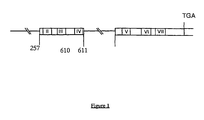
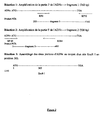
- Oligonucleotides RP70, RH84 and RN6 are derived from the human kappa sequence. Oligonucleotide RP69 corresponds to a 5 'non-coding sequence of mice (including initiator ATG at the 3' end) so as not to introduce a murine sequence into the human cDNA. The precise position of the regions of the cDNA that hybridize to the 4 primers is indicated in FIG. 2.
- the PCR fragments are repaired and cloned in the blunt ends of the pBluescript vector (Stratagene) linearized with EcoR V.
- the inserts are sequenced in both directions on an automatic DNA sequencer (373A DNA, Applied Bioystems Inc.). inserts are excised from the plasmid in the presence of EcoR I (3 'side cut of fragment 2 and 5' side of fragment 1) and a restriction enzyme of polylinker. Fragments were purified from a 1% agarose gel by the Gene Clean method and ligated into the pcDNA / Amp (Invitrogen) vector for transient receptor expression in Cos cells.
- the two fragments overlap on 140 bp.
- the overlap sequence is identical in both fragments.
- the sequences of the two fragments are compared to the sequence determined from the genomic DNA (position 257 at position 1143) and found to be perfectly identical. Concerning the portion of sequence 1 to 256, whose genomic sequence is unknown to us, we verified that the PCR amplification did not introduce errors: we compared the sequence of the fragment 2 obtained from three reactions. different amplification and found it identical in all 3 cases.
- sequence of the cDNA encoding the human kappa receptor according to the invention, as well as the deduced protein sequence, are presented in the sequence SEQ ID No. 1.
- the cDNA has a size of 1101 base pairs and encodes a protein of 380 amino acids.
- the nucleotide sequence is 86.7% homologous to the mouse cDNA encoding an opioid kappa receptor.
- the most important areas of divergence are located in the N- and C-terminal regions. These same areas are also the least conserved regions between the three subtypes mu, delta and kappa.
- the pcDNA / Amp vector containing the cDNA encoding the opioid receptor according to the invention isolated in example 2 is used to transfect Cos-1 cells.
- the membranes of the transfected cells obtained were then prepared and tested for their ability to bind certain labeled opioid ligands.
- the plasmid vector pcDNA / Amp purified on cesium chloride is used to transfect Cos-1 cells using the DEAE-dextran technique.
- the recombinant cells are harvested and the membranes are prepared in the following manner: the cell pellets are taken up at 4 ° C. in 60 ml of 50 mM Tris-HCl buffer pH 7.4; 10 mM EDTA, homogenized and centrifuged at 1100 g for 10 minutes. The pellet is then taken a second time in 30 ml of the same buffer, homogenized and centrifuged. The 2 supernatants are pooled and centrifuged at 110,000 g for 15 minutes. The membrane pellet is then taken up in 5 ml of the same buffer, aliquoted and stored at -80 ° C. Saturation binding and competitive experiments are then performed on these membranes in the presence of different ligands.
Landscapes
- Health & Medical Sciences (AREA)
- Chemical & Material Sciences (AREA)
- Life Sciences & Earth Sciences (AREA)
- Organic Chemistry (AREA)
- Medicinal Chemistry (AREA)
- General Health & Medical Sciences (AREA)
- Biophysics (AREA)
- Gastroenterology & Hepatology (AREA)
- Zoology (AREA)
- Biochemistry (AREA)
- Genetics & Genomics (AREA)
- Toxicology (AREA)
- Molecular Biology (AREA)
- Immunology (AREA)
- Proteomics, Peptides & Aminoacids (AREA)
- Cell Biology (AREA)
- General Chemical & Material Sciences (AREA)
- Biomedical Technology (AREA)
- Veterinary Medicine (AREA)
- Animal Behavior & Ethology (AREA)
- Pharmacology & Pharmacy (AREA)
- Nuclear Medicine, Radiotherapy & Molecular Imaging (AREA)
- Chemical Kinetics & Catalysis (AREA)
- Neurosurgery (AREA)
- Neurology (AREA)
- Public Health (AREA)
- Bioinformatics & Cheminformatics (AREA)
- Engineering & Computer Science (AREA)
- Pain & Pain Management (AREA)
- Peptides Or Proteins (AREA)
- Preparation Of Compounds By Using Micro-Organisms (AREA)
- Pharmaceuticals Containing Other Organic And Inorganic Compounds (AREA)
- Measuring Or Testing Involving Enzymes Or Micro-Organisms (AREA)
- Micro-Organisms Or Cultivation Processes Thereof (AREA)
- Medicines That Contain Protein Lipid Enzymes And Other Medicines (AREA)
- Saccharide Compounds (AREA)
Claims (12)
- Nukleotidsequenz die für ein Polypeptid codiert, das eine Aktivität als menschlicher kappa-Opioidrezeptor besitzt, wobei das Polypeptid umfassta) die Peptidsequenz SEQ ID Nr.1, oderb) ein Derivat der Peptidsequenz SEQ ID Nr.1, das durch Mutation, Substitution, Deletion, Addition oder Modifikation eines Restes erhalten wird.
- Nukleotidsequenz umfassenda) die Sequenz SEQ ID Nr.1, oderb) zu der Sequenz (a) komplementäre Sequenz.
- Nukleotidsequenz die für ein Polypeptid codiert, das eine Aktivität als menschlicher kappa-Opioidrezeptor besitzt, dadurch gekennzeichnet, dass sie ausgewählt ist aus den von der SEQ ID Nr.1 aufgrund der Degeneration des genetischen Codes abgeleiteten Sequenzen.
- Nukleotidsequenz gemäß Anspruch 1, 2 oder 3, dadurch gekennzeichnet, dass sie ausgewählt ist aus genomischen DNA-, cDNA-, RNA-Sequenzen, Hybridsequenzen oder synthetischen oder semi-synthetischen Sequenzen.
- Sequenz gemäß einem der Ansprüche 1 bis 4, dadurch gekennzeichnet, dass der Teil, der für das Polypeptid codiert, sich unter der Kontrolle von Signalen befindet, die dessen Expression in einer Wirtszelle erlauben.
- Polypeptid umfassend die Peptidsequenz SEQ ID Nr.1 oder ein Derivat dieser Sequenz, die durch Mutation, Substitution, Deletion, Addition oder Modifikation eines Restes erhalten wird, wobei das Polypeptid eine Aktivität als kappa-Opioidrezeptor besitzt.
- Antisense-Sequenz die in der Lage ist, mindestens teilweise die Erzeugung eines Polypeptids gemäß Anspruch 6 zu inhibieren.
- Verwendung einer Sonde, die eine Sequenz gemäß Anspruch 1, 2 oder 3 besitzt, zur Detektion der Expression eines Opioidrezeptors; oder zur Aufdeckung genetischer Anomalien (Fehlspleißen, Polymorphismus, Punktmutationen, usw.); oder zur Identifikation neurologischer, kardiovaskulärer oder psychiatrischer Leiden, die mit Opioidrezeptoren in Verbindung gebracht werden; oder auch zur Aufdeckung und Isolierung von homologen Nukleinsäuresequenzen, die für Opioid-Polypeptide codieren.
- Rekombinante Zelle die in der Lage ist, auf ihrer Oberfläche ein Polypeptid gemäß Anspruch 6 zu exprimieren, wobei die Zelle ausgewählt ist aus prokaryotischen Zellen, Hefen, Pilzen und COS-, CHO-, C127- und NIH-3T3-Zellen.
- Verfahren zur Aufdeckung und/oder Isolierung von Liganden von Opioidrezeptoren, dadurch gekennzeichnet, dass folgenden Schritte ausgeführt werden:- Inkontaktbringen eines Moleküls oder einer Mischung, die verschiedene Moleküle enthält, möglicherweise unbestimmter Art, mit einer rekombinanten Zelle gemäß Anspruch 9, die auf ihrer Oberfläche ein Opioid-Polypeptid exprimiert, unter Bedingungen, die die Interaktion zwischen dem Polypeptid und dem Molekül für den Fall erlauben, dass dieses eine Affinität für das Polypeptid besitzt, und- Nachweis und/oder Isolierung der mit diesem Polypeptid verbundenen Moleküle.
- Verfahren gemäß Anspruch 10 zur Aufdeckung und/oder Isolierung von Liganden von kappa-Opioidrezeptoren.
- Verfahren zur Aufdeckung und/oder Isolierung von Modulatoren von Opioidrezeptoren, dadurch gekennzeichnet, dass die folgenden Schritte ausgeführt werden:- Inkontaktbringen eines Moleküls oder einer Mischung, die verschiedene Moleküle enthält, möglicherweise unbestimmter Art, mit einer rekombinanten Zelle gemäß Anspruch 9, die auf ihrer Oberfläche ein Polypeptid exprimiert, das eine Aktivität als Opioidrezeptor besitzt, in Gegenwart eines Liganden dieses Rezeptors unter Bedingungen, die die Interaktion zwischen dem Polypeptid und dem Liganden erlauben, und- Nachweis und/oder Isolierung der Moleküle, die in der Lage sind, die Aktivität des Liganden auf dem Polypeptid zu modulieren.
Applications Claiming Priority (3)
| Application Number | Priority Date | Filing Date | Title |
|---|---|---|---|
| FR9408531 | 1994-07-11 | ||
| FR9408531A FR2722209B1 (fr) | 1994-07-11 | 1994-07-11 | Recepteur opioide kappa humain, acides nucleiques et utilisations |
| PCT/FR1995/000912 WO1996001898A1 (fr) | 1994-07-11 | 1995-07-07 | Recepteur opioide kappa humain, acides nucleiques et utilisations |
Publications (2)
| Publication Number | Publication Date |
|---|---|
| EP0804574A1 EP0804574A1 (de) | 1997-11-05 |
| EP0804574B1 true EP0804574B1 (de) | 2007-01-31 |
Family
ID=9465221
Family Applications (1)
| Application Number | Title | Priority Date | Filing Date |
|---|---|---|---|
| EP95925024A Expired - Lifetime EP0804574B1 (de) | 1994-07-11 | 1995-07-07 | Humaner kappa opiatrezeptor, nukleinsäuren und ihre verwendungen |
Country Status (9)
| Country | Link |
|---|---|
| US (1) | US6146835A (de) |
| EP (1) | EP0804574B1 (de) |
| JP (1) | JP3643598B2 (de) |
| AT (1) | ATE353103T1 (de) |
| CA (1) | CA2194768A1 (de) |
| DE (1) | DE69535380T2 (de) |
| ES (1) | ES2281073T3 (de) |
| FR (1) | FR2722209B1 (de) |
| WO (1) | WO1996001898A1 (de) |
Families Citing this family (4)
| Publication number | Priority date | Publication date | Assignee | Title |
|---|---|---|---|---|
| FR2750825B1 (fr) * | 1996-07-15 | 2002-08-23 | Centre Nat Rech Scient | Animal transgenique non humain dans lequel l'expression de l'un au moins des genes codant pour les recepteurs aux opiaces est modifiee |
| SE522192C2 (sv) * | 2000-05-17 | 2004-01-20 | Vaegverket Produktion | Krockdämpande anordning för fordon samt metod |
| WO2005015242A1 (en) * | 2003-08-06 | 2005-02-17 | Bayer Healthcare Ag | Diagnostics and therapeutics for diseases associated with g protein-coupled opioid receptor kappa 1 (opkr1) |
| US7874572B2 (en) * | 2005-01-10 | 2011-01-25 | Energy Absorption Systems, Inc. | Towable impact attenuator |
Family Cites Families (1)
| Publication number | Priority date | Publication date | Assignee | Title |
|---|---|---|---|---|
| US6096513A (en) * | 1993-05-20 | 2000-08-01 | Arch Development Corporation | Polynucleotides encoding KAPPA opiod receptors |
-
1994
- 1994-07-11 FR FR9408531A patent/FR2722209B1/fr not_active Expired - Fee Related
-
1995
- 1995-07-07 WO PCT/FR1995/000912 patent/WO1996001898A1/fr not_active Ceased
- 1995-07-07 EP EP95925024A patent/EP0804574B1/de not_active Expired - Lifetime
- 1995-07-07 US US08/765,743 patent/US6146835A/en not_active Expired - Fee Related
- 1995-07-07 CA CA002194768A patent/CA2194768A1/fr not_active Abandoned
- 1995-07-07 AT AT95925024T patent/ATE353103T1/de not_active IP Right Cessation
- 1995-07-07 JP JP50416096A patent/JP3643598B2/ja not_active Expired - Fee Related
- 1995-07-07 DE DE69535380T patent/DE69535380T2/de not_active Expired - Lifetime
- 1995-07-07 ES ES95925024T patent/ES2281073T3/es not_active Expired - Lifetime
Also Published As
| Publication number | Publication date |
|---|---|
| ES2281073T3 (es) | 2007-09-16 |
| US6146835A (en) | 2000-11-14 |
| JPH10507904A (ja) | 1998-08-04 |
| FR2722209A1 (fr) | 1996-01-12 |
| DE69535380D1 (de) | 2007-03-22 |
| ATE353103T1 (de) | 2007-02-15 |
| FR2722209B1 (fr) | 1996-08-14 |
| DE69535380T2 (de) | 2007-11-08 |
| CA2194768A1 (fr) | 1996-01-25 |
| EP0804574A1 (de) | 1997-11-05 |
| JP3643598B2 (ja) | 2005-04-27 |
| WO1996001898A1 (fr) | 1996-01-25 |
Similar Documents
| Publication | Publication Date | Title |
|---|---|---|
| WO1993025679A1 (fr) | Nouveaux polypeptides ayant une activite de recepteur nmda, acides nucleiques codant pour ces polypeptides et utilisations | |
| FR2696749A1 (fr) | Nouveaux polypeptides ayant une activité de récepteur sérotoninergique, acides nucléiques codant pour ces polypeptides et utilisations. | |
| JP2005519584A5 (de) | ||
| EP0745122B1 (de) | Galaninrezeptor, nukleinsäuren,transformierte zellen und verwendungen | |
| EP0651801B1 (de) | Polypeptide mit serotoninerger (5ht5a) rezeptor-aktivität, für sie kodierende nukleinsäuren und ihre verwendung | |
| EP0672139B1 (de) | Polypeptide mit opioider rezeptor-aktvität, für sie kodierende nukleinsäuren und ihre verwendungen | |
| EP0804574A1 (de) | Humaner kappa opiatrezeptor, nukleinsäuren und ihre verwendungen | |
| FR2701265A1 (fr) | Nouveaux polypeptides ayant une activité de récepteur sérotoninergique, acides nucléiques codant pour ces polypeptides et utilisations. | |
| WO1997004094A1 (fr) | Sequences nucleiques codant pour des recepteurs de la melatonine et leurs applications | |
| CA2072874C (fr) | Polypeptides ayant une activite de recepteur dopaminergique humain, acides nucleiques codant pour ces polypeptides et utilisation de ces polypeptides pour le criblage de substances actives sur ces polypeptides | |
| WO1994001556A1 (fr) | Polypeptides ayant une activite de recepteur serotoninergique (5ht6), acides nucleiques codant pour ces polypeptides et utilisations | |
| WO1997035973A2 (fr) | SEQUENCES CODANT POUR LES RECEPTEURS β2- ET β3-ADRENERGIQUES CANINS ET LEURS APPLICATIONS EN TANT QUE SONDES ET POUR L'EXPRESSION DE PEPTIDES | |
| FR2804690A1 (fr) | Nouvelles famille de proteines, denommees atip, les sequences nucleiques codant pour lesdites proteines et leurs applications | |
| WO1999009059A1 (fr) | Gene de la fievre mediterraneenne familiale |
Legal Events
| Date | Code | Title | Description |
|---|---|---|---|
| PUAI | Public reference made under article 153(3) epc to a published international application that has entered the european phase |
Free format text: ORIGINAL CODE: 0009012 |
|
| 17P | Request for examination filed |
Effective date: 19970127 |
|
| AK | Designated contracting states |
Kind code of ref document: A1 Designated state(s): AT BE CH DE DK ES FR GB GR IE IT LI LU MC NL PT SE |
|
| RAP1 | Party data changed (applicant data changed or rights of an application transferred) |
Owner name: ASTRAZENECA AB |
|
| 17Q | First examination report despatched |
Effective date: 20011122 |
|
| GRAP | Despatch of communication of intention to grant a patent |
Free format text: ORIGINAL CODE: EPIDOSNIGR1 |
|
| GRAS | Grant fee paid |
Free format text: ORIGINAL CODE: EPIDOSNIGR3 |
|
| GRAA | (expected) grant |
Free format text: ORIGINAL CODE: 0009210 |
|
| AK | Designated contracting states |
Kind code of ref document: B1 Designated state(s): AT BE CH DE DK ES FR GB GR IE IT LI LU MC NL PT SE |
|
| PG25 | Lapsed in a contracting state [announced via postgrant information from national office to epo] |
Ref country code: NL Free format text: LAPSE BECAUSE OF FAILURE TO SUBMIT A TRANSLATION OF THE DESCRIPTION OR TO PAY THE FEE WITHIN THE PRESCRIBED TIME-LIMIT Effective date: 20070131 Ref country code: IE Free format text: LAPSE BECAUSE OF FAILURE TO SUBMIT A TRANSLATION OF THE DESCRIPTION OR TO PAY THE FEE WITHIN THE PRESCRIBED TIME-LIMIT Effective date: 20070131 Ref country code: DK Free format text: LAPSE BECAUSE OF FAILURE TO SUBMIT A TRANSLATION OF THE DESCRIPTION OR TO PAY THE FEE WITHIN THE PRESCRIBED TIME-LIMIT Effective date: 20070131 Ref country code: AT Free format text: LAPSE BECAUSE OF FAILURE TO SUBMIT A TRANSLATION OF THE DESCRIPTION OR TO PAY THE FEE WITHIN THE PRESCRIBED TIME-LIMIT Effective date: 20070131 |
|
| REG | Reference to a national code |
Ref country code: GB Ref legal event code: FG4D Free format text: NOT ENGLISH |
|
| REG | Reference to a national code |
Ref country code: CH Ref legal event code: EP |
|
| REG | Reference to a national code |
Ref country code: IE Ref legal event code: FG4D Free format text: LANGUAGE OF EP DOCUMENT: FRENCH |
|
| REF | Corresponds to: |
Ref document number: 69535380 Country of ref document: DE Date of ref document: 20070322 Kind code of ref document: P |
|
| GBT | Gb: translation of ep patent filed (gb section 77(6)(a)/1977) |
Effective date: 20070321 |
|
| REG | Reference to a national code |
Ref country code: CH Ref legal event code: NV Representative=s name: ISLER & PEDRAZZINI AG |
|
| REG | Reference to a national code |
Ref country code: SE Ref legal event code: TRGR |
|
| PG25 | Lapsed in a contracting state [announced via postgrant information from national office to epo] |
Ref country code: PT Free format text: LAPSE BECAUSE OF FAILURE TO SUBMIT A TRANSLATION OF THE DESCRIPTION OR TO PAY THE FEE WITHIN THE PRESCRIBED TIME-LIMIT Effective date: 20070702 |
|
| NLV1 | Nl: lapsed or annulled due to failure to fulfill the requirements of art. 29p and 29m of the patents act | ||
| REG | Reference to a national code |
Ref country code: ES Ref legal event code: FG2A Ref document number: 2281073 Country of ref document: ES Kind code of ref document: T3 |
|
| REG | Reference to a national code |
Ref country code: IE Ref legal event code: FD4D |
|
| REG | Reference to a national code |
Ref country code: CH Ref legal event code: PCAR Free format text: ISLER & PEDRAZZINI AG;POSTFACH 1772;8027 ZUERICH (CH) |
|
| PLBE | No opposition filed within time limit |
Free format text: ORIGINAL CODE: 0009261 |
|
| STAA | Information on the status of an ep patent application or granted ep patent |
Free format text: STATUS: NO OPPOSITION FILED WITHIN TIME LIMIT |
|
| 26N | No opposition filed |
Effective date: 20071101 |
|
| BERE | Be: lapsed |
Owner name: ASTRAZENECA A.B. Effective date: 20070731 |
|
| PG25 | Lapsed in a contracting state [announced via postgrant information from national office to epo] |
Ref country code: MC Free format text: LAPSE BECAUSE OF NON-PAYMENT OF DUE FEES Effective date: 20070731 Ref country code: GR Free format text: LAPSE BECAUSE OF FAILURE TO SUBMIT A TRANSLATION OF THE DESCRIPTION OR TO PAY THE FEE WITHIN THE PRESCRIBED TIME-LIMIT Effective date: 20070501 |
|
| PG25 | Lapsed in a contracting state [announced via postgrant information from national office to epo] |
Ref country code: BE Free format text: LAPSE BECAUSE OF NON-PAYMENT OF DUE FEES Effective date: 20070731 |
|
| PG25 | Lapsed in a contracting state [announced via postgrant information from national office to epo] |
Ref country code: LU Free format text: LAPSE BECAUSE OF NON-PAYMENT OF DUE FEES Effective date: 20070707 |
|
| PGFP | Annual fee paid to national office [announced via postgrant information from national office to epo] |
Ref country code: GB Payment date: 20110622 Year of fee payment: 17 |
|
| PGFP | Annual fee paid to national office [announced via postgrant information from national office to epo] |
Ref country code: FR Payment date: 20110727 Year of fee payment: 17 Ref country code: CH Payment date: 20110729 Year of fee payment: 17 |
|
| PGFP | Annual fee paid to national office [announced via postgrant information from national office to epo] |
Ref country code: SE Payment date: 20110718 Year of fee payment: 17 Ref country code: DE Payment date: 20110729 Year of fee payment: 17 Ref country code: ES Payment date: 20110706 Year of fee payment: 17 |
|
| PGFP | Annual fee paid to national office [announced via postgrant information from national office to epo] |
Ref country code: IT Payment date: 20110719 Year of fee payment: 17 |
|
| REG | Reference to a national code |
Ref country code: CH Ref legal event code: PL |
|
| REG | Reference to a national code |
Ref country code: SE Ref legal event code: EUG |
|
| GBPC | Gb: european patent ceased through non-payment of renewal fee |
Effective date: 20120707 |
|
| REG | Reference to a national code |
Ref country code: FR Ref legal event code: ST Effective date: 20130329 |
|
| PG25 | Lapsed in a contracting state [announced via postgrant information from national office to epo] |
Ref country code: DE Free format text: LAPSE BECAUSE OF NON-PAYMENT OF DUE FEES Effective date: 20130201 Ref country code: SE Free format text: LAPSE BECAUSE OF NON-PAYMENT OF DUE FEES Effective date: 20120708 Ref country code: FR Free format text: LAPSE BECAUSE OF NON-PAYMENT OF DUE FEES Effective date: 20120731 Ref country code: LI Free format text: LAPSE BECAUSE OF NON-PAYMENT OF DUE FEES Effective date: 20120731 Ref country code: CH Free format text: LAPSE BECAUSE OF NON-PAYMENT OF DUE FEES Effective date: 20120731 Ref country code: GB Free format text: LAPSE BECAUSE OF NON-PAYMENT OF DUE FEES Effective date: 20120707 |
|
| REG | Reference to a national code |
Ref country code: DE Ref legal event code: R119 Ref document number: 69535380 Country of ref document: DE Effective date: 20130201 |
|
| PG25 | Lapsed in a contracting state [announced via postgrant information from national office to epo] |
Ref country code: IT Free format text: LAPSE BECAUSE OF NON-PAYMENT OF DUE FEES Effective date: 20120707 |
|
| REG | Reference to a national code |
Ref country code: ES Ref legal event code: FD2A Effective date: 20131018 |
|
| PG25 | Lapsed in a contracting state [announced via postgrant information from national office to epo] |
Ref country code: ES Free format text: LAPSE BECAUSE OF NON-PAYMENT OF DUE FEES Effective date: 20120708 |