EP0804399B1 - Verfahren zur hydroformylierung eines olefins in einem biphasischen medium - Google Patents
Verfahren zur hydroformylierung eines olefins in einem biphasischen medium Download PDFInfo
- Publication number
- EP0804399B1 EP0804399B1 EP96901399A EP96901399A EP0804399B1 EP 0804399 B1 EP0804399 B1 EP 0804399B1 EP 96901399 A EP96901399 A EP 96901399A EP 96901399 A EP96901399 A EP 96901399A EP 0804399 B1 EP0804399 B1 EP 0804399B1
- Authority
- EP
- European Patent Office
- Prior art keywords
- carbon atoms
- chosen
- olefin
- cyclodextrin
- different
- Prior art date
- Legal status (The legal status is an assumption and is not a legal conclusion. Google has not performed a legal analysis and makes no representation as to the accuracy of the status listed.)
- Expired - Lifetime
Links
Classifications
-
- C—CHEMISTRY; METALLURGY
- C07—ORGANIC CHEMISTRY
- C07C—ACYCLIC OR CARBOCYCLIC COMPOUNDS
- C07C67/00—Preparation of carboxylic acid esters
- C07C67/28—Preparation of carboxylic acid esters by modifying the hydroxylic moiety of the ester, such modification not being an introduction of an ester group
- C07C67/293—Preparation of carboxylic acid esters by modifying the hydroxylic moiety of the ester, such modification not being an introduction of an ester group by isomerisation; by change of size of the carbon skeleton
-
- C—CHEMISTRY; METALLURGY
- C07—ORGANIC CHEMISTRY
- C07C—ACYCLIC OR CARBOCYCLIC COMPOUNDS
- C07C45/00—Preparation of compounds having >C = O groups bound only to carbon or hydrogen atoms; Preparation of chelates of such compounds
- C07C45/49—Preparation of compounds having >C = O groups bound only to carbon or hydrogen atoms; Preparation of chelates of such compounds by reaction with carbon monoxide
-
- C—CHEMISTRY; METALLURGY
- C07—ORGANIC CHEMISTRY
- C07C—ACYCLIC OR CARBOCYCLIC COMPOUNDS
- C07C45/00—Preparation of compounds having >C = O groups bound only to carbon or hydrogen atoms; Preparation of chelates of such compounds
- C07C45/49—Preparation of compounds having >C = O groups bound only to carbon or hydrogen atoms; Preparation of chelates of such compounds by reaction with carbon monoxide
- C07C45/50—Preparation of compounds having >C = O groups bound only to carbon or hydrogen atoms; Preparation of chelates of such compounds by reaction with carbon monoxide by oxo-reactions
-
- C—CHEMISTRY; METALLURGY
- C07—ORGANIC CHEMISTRY
- C07C—ACYCLIC OR CARBOCYCLIC COMPOUNDS
- C07C67/00—Preparation of carboxylic acid esters
- C07C67/30—Preparation of carboxylic acid esters by modifying the acid moiety of the ester, such modification not being an introduction of an ester group
- C07C67/333—Preparation of carboxylic acid esters by modifying the acid moiety of the ester, such modification not being an introduction of an ester group by isomerisation; by change of size of the carbon skeleton
- C07C67/343—Preparation of carboxylic acid esters by modifying the acid moiety of the ester, such modification not being an introduction of an ester group by isomerisation; by change of size of the carbon skeleton by increase in the number of carbon atoms
- C07C67/347—Preparation of carboxylic acid esters by modifying the acid moiety of the ester, such modification not being an introduction of an ester group by isomerisation; by change of size of the carbon skeleton by increase in the number of carbon atoms by addition to unsaturated carbon-to-carbon bonds
Definitions
- the present invention relates to a process for hydroformylation an olefin.
- Russel describes the use as surfactant of dodecyl-trimethylammonium bromide intended to make an olefin fatty, 1-decene, soluble in aqueous medium.
- the yield remains however modest.
- WO 93/04029 the same catalytic system was used but by recovering the catalyst by membrane filtration, which allows achieve extremely high residual rhodium concentrations weak in the organic phase. However, this technique greatly complicates the recovery of the catalyst.
- ammonium salt or phosphonium salt as surfactant for hydroformylation of olefins fatty is described in EP-A-0602444 and EP-A-0602463.
- a rhodium salt, TTPTS as phosphine water soluble and sodium dodecyl sulfate as surfactant, in the presence of butanol to achieve a microemulsion is described in EP-380154 (Eniricerche).
- cyclodextrins are oligomers cyclic glucose bridged in ⁇ (1-4).
- the number of ⁇ -glucosic units reached respectively 6, 7 and 8 for ⁇ -cyclodextrin, ⁇ -cyclodextrin and ⁇ -cyclodextrin.
- Their implementation in reactions of homogeneous biphasic catalysis improved speed and the selectivity of certain reactions.
- H. Alper and al. performed the oxidation of olefins to ketones (J. Mol. Catal. 1986 Vol. 35 p. 249) using ⁇ -cyclodextrin as a phase transfer agent.
- Oxidation of alkenes into ketones in a biphasic medium, catalyzed by a system palladium / cyclodextrin has also been described by E. Monflier, et al. (Angew. Chemie 1994, 106, 20, 2183). The authors found that the presence of a cyclodextrin, substituted or unsubstituted, significantly improved yield from oxidation. Hydroformylation of olefins in the presence of ⁇ -cyclodextrin has been described by R. Anderson et al. (Catalysis Letters, 1991 Vol. 9 p. 55).
- the present inventors have now found that surprisingly, the use of a modified cyclodextrin instead of an unmodified cyclodextrin, not only had no inhibitory effect on the hydroformylation reaction, but substantially improved the yield hydroformylation compared to the process not using cyclodextrin.
- the subject of the present invention is a process for hydroformylation of an olefin chosen from the alkenes represented by the formula C n H 2n in which n is an integer less than or equal to 30 or from the functionalized olefins, by a gaseous CO / H 2 mixture in a two-phase medium, consisting in bringing into contact on the one hand an aqueous solution containing a catalytic system constituted by a water-soluble transition metal complex and a water-soluble phosphine, and on the other hand an olefin, with heating with stirring the reaction mixture obtained after putting it under a gas / CO 2 H 2 pressure, said process being characterized in that a modified cyclodextrin is introduced into the aqueous solution containing the catalytic system, said modified cyclodextrin being chosen from ⁇ -cyclodextrins, ⁇ -cyclodextrins and ⁇ -cyclodextrins consisting respectively of 6, 7
- alkenes which can be hydroformylated by the process of the invention can be linear or branched. Alkenes having 8 to 20 carbon atoms are preferred, in particular linear alkenes having 8 to 16 atoms carbon, especially alkenes having a double link in terminal position.
- alkenes mention may be made of 1-heptene, 1-octene, 1-nonene, 1-decene, 1-undecene, 1-dodecene, 1-tridecene and 1-tetradecene.
- the functionalized olefins those preferred are in which the carbon-carbon double bond leads to minus one hydrogen atom and more especially at least two hydrogen atoms.
- the olefins functionalized in which the carbon-carbon double bond carries three hydrogen atoms are particularly preferred.
- the process can be carried out for an olefin having a single double bond, in the terminal position or no, or for an olefin having several double bonds. It allows to hydroformylate an olefin alone, or a mixture of different olefins.
- the process of the present invention is particularly interesting for the hydroformylation of a linear alkene or branched having from 2 to 30 carbon atoms, more especially for alkenes having 8 to 30 carbon atoms, which do not can be hydroformylated with good yield by prior art methods.
- the catalyst used in the process of the present invention is a complex of a transition metal chosen from rhodium, ruthenium, palladium, iridium, cobalt, platinum, the couple platinum / tin, the couple platinum / iron, with a water-soluble phosphorus ligand. Rhodium complexes are particularly preferred.
- Rh 6 (CO) 16 Rh 4 (CO) 12 , HRhCO (PR 3 ) 3 and RhCl (PR 3 ) 3
- R represents a sulfonated aryl group, preferably a sulfonated phenyl group
- Rh (acac) (CO) 2 acac representing an acetylacetonate radical
- Rh 2 Cl 2 (CO) 4 rhodium oxides (Rh 2 O 3 ) and rhodium salts such as RhCl 3 , Rh (OAc) 3 .
- A, B and C each represent an aryl group, more particularly a phenyl group; the substituents X 1 to x 3 are -SO 3 Na or -CO 2 Na; the substituents R 1 to R 3 are hydrogen or an alkyl group; the numbers x1, x2 and x3 are equal to 1 or 0 (at least one of them being equal to 1); the numbers y1, y2 and y3 are equal to 4 or 5.
- TPPS trisulfonated triphenylphosphine
- TPPMS monosulfonated triphenylphosphine
- TPPMC monocarboxylic triphenylphosphine
- TPPTC tricarboxylic triphenylphosphine
- the phosphines which are particularly advantageous for the process of the present invention are TPPTS and TPPMS.
- A, B, C, D are aryl groups, in particular a phenyl group; E is a linear alkyl chain having 2 to 4 carbon atoms; the substituents X 1 to X 4 are -SO 3 Na and -CO 2 Na; the substituents R 1 to R 4 are hydrogen or an alkyl group; the numbers x1 to x4 are equal to 1 or 0 (at least one of them being equal to 1); the numbers y1 to y4 are equal to 4 or 5.
- a modified cyclodextrin used in the process of the present invention is a cyclodextrin which carries one or more identical or different substituents.
- the alkyl substituent a linear or branched alkyl radical having from 1 to 5 carbon atoms is preferred, more particularly a methyl or ethyl radical.
- a hydroxyalkyl substituent a hydroxyalkyl group having from 1 to 5 carbon atoms, more particularly a radical -CH 2 CH 2 OH or -CH 2 OH, is preferred.
- radical containing an ester function an ester group having from 1 to 5 carbon atoms is preferred, more particularly the groups -O (CO) CH 3 , -O (CO) CH 2 CH 3 .
- the modified cyclodextrin can be a modified ⁇ -cyclodextrin (6 glucosic units modified by a preceding substituent), whose entry diameter is 4.9 ⁇ , a ⁇ - modified cyclodextrin (7 modified glucosic units) whose diameter d entry is 6.2 ⁇ , or a modified ⁇ -cyclodextrin (8 modified glucose units) with an entry diameter of 7.9 ⁇ . It is also possible to use a mixture of two or more modified cyclodextrins mentioned above.
- the modified cyclodextrins can optionally be used in polymerized form with, for example, epichlorohydrin.
- cyclodextrin for the process of the present invention is dimethyl- ⁇ -cyclodextrin.
- the modified cyclodextrin can be introduced into the aqueous solution containing the front catalytic system addition of the olefin. It can also be introduced in said solution after the addition of the olefin.
- the phosphine / metal molar ratio transition is between 1 and 100, from preferably between 2 and 20, more particularly equal to 5.
- the modified cyclodextrin molar ratio to the transition metal is between 1 and 100, preferably between 2 and 20, more particularly equal to 7.
- the temperature and pressure conditions are those conventionally used in hydroformylation processes biphasic of the prior art.
- the temperature is advantageously between 20 ° C and 200 ° C.
- the pressure is between 1 and 300 bar, preferably between 2 and 100 bar, the partial pressure of carbon monoxide being between 0.5 and 95 bar.
- gas synthesis can be used as a convenient source of carbon monoxide and hydrogen.
- the reaction is carried out in the absence of solvent for facilitate recycling of the catalyst.
- the catalyst is in the aqueous phase and the separation between the aqueous phase and the organic phase containing the aldehyde is easy.
- Example 2 is a comparative example without cyclodextrin and is given as an indication.
- Examples 9 and 10 show that the present invention can be implemented works with other water-soluble phosphines such as monosulfonated triphenylphosphine (TPPMS).
- TPPMS monosulfonated triphenylphosphine
- Methyl undecenoate which is the basis of the synthesis of Nylon 11, is obtained industrially from a natural product, castor oil, and more particularly by pyrolysis of methyl ricinoleate. By hydroformylation, methyl undecenoate gives 10-formyl undecanoate which, by oxidation or reductive amination, can lead respectively to 1,12-dodecanedioic acid precursor of Nylon 6-12, or to acid ⁇ , ⁇ - aminododecanoic precursor of Nylon 12.
- Example 23 illustrates the hydroformylation of undecenate methyl, which was carried out under the conditions following.
- Example 24 is a comparative test carried out in the same conditions as example 23, but without adding any dimethyl- ⁇ -cyclodextrin.
- Examples 25 and 26 were carried out in the same conditions as example 23 but by modifying the ratio phosphorus / rhodium, pressure and temperature.
- the conversion rate of the olefin was determined after 5 hours of reaction.
- the conversion, selectivity and the ratio of linear aldehydes / branched aldehydes have the meaning given above.
- This example was carried out under experimental conditions similar to that of Example 23, but in the presence of heptane which is essential for dissolving the olefin used, vinylnaphthalene.
- the reaction was carried out in a 25 ml autoclave.
- the organic phase had a volume of 6 ml.
- the olefin to rhodium ratio was 500, the temperature was 80 ° C, the pressure (CO / H 2 ) was 50 bar.
- Table 4 The results are shown in Table 4 below.
- This example was carried out under experimental conditions analogous to that of Example 1, using 2-ethylhexyl acrylate as functionalized olefin, in the presence of toluene.
- the reaction was carried out in a 100 ml autoclave.
- the organic phase had a volume of 40 ml.
- the olefin / rhodium ratio was 500, the temperature was 50 ° C, the pressure (CO / H 2 ) was 50 bar.
- Table 4 The results are shown in Table 4 below.
Landscapes
- Chemical & Material Sciences (AREA)
- Organic Chemistry (AREA)
- Chemical Kinetics & Catalysis (AREA)
- Organic Low-Molecular-Weight Compounds And Preparation Thereof (AREA)
- Low-Molecular Organic Synthesis Reactions Using Catalysts (AREA)
Claims (15)
- Verfahren zur Hydroformylierung eines aus Alkenen der Formel CnH2n, worin n eine ganze Zahl ≤ 30 ist, oder aus Olefinen mit funktionellen Gruppen ausgewählten Olefins mittels eines CO/H2-Gasgemischs in einem zweiphasigem Medium, das darin besteht, einerseits eine wässrige Lösung, die ein aus einem wasserlöslichen Übergangsmetallkomplex und einem wasserlöslichen Phosphin bestehendes katalytisches System enthält, und andererseits ein Olefin miteinander in Kontakt zu bringen und das erhaltene Reaktionsgemisch unter Rühren zu erhitzen, nachdem es mit dem CO/H2-Gasgemisch unter Druck gesetzt wurde, wobei das Verfahren dadurch gekennzeichnet ist, dass ein modifiziertes Cyclodextrin der das katalytische System enthaltenden wässrigen Lösung zugeführt wird, wobei das modifizierte Cyclodextrin aus α-Cyclodextrinen, β-Cyclodextrinen und γ-Cyclodextrinen ausgewählt ist, die jeweils aus 6, 7 und 8 Glucoseeinheiten bestehen, und einen oder mehrere unterschiedliche oder identische Substituenten aufweist, ausgewählt aus unverzweigten oder verzweigten Alkylresten mit 1 bis 20 Kohlenstoffatomen, Hydroxyalkylresten mit 1 bis 20 Kohlenstoffatomen, Carboxyl-, Amino-, Phosphat-, Ether-, Polyetheresten, Resten mit einer Estergruppe mit 1 bis 20 Kohlenstoffatomen, vorzugsweise 1 bis 5 Kohlenstoffatomen, oder aus Cyclodextrinen in mit Epichlorhydrin polymerisierter Form.
- Verfahren nach Anspruch 1, dadurch gekennzeichnet, dass der das katalytische System enthaltenden wässrigen Lösung ein Gemisch aus modifizierten Cyclodextrinen zugeführt wird.
- Verfahren nach Anspruch 1, dadurch gekennzeichnet, dass das Olefin ein unverzweigtes oder verzweigtes Alken mit einer einzigen endständigen oder nicht-endständigen Kohlenstoff-Kohlenstoff-Doppelbindung oder mehreren Doppelbindungen ist.
- Verfahren nach Anspruch 3, dadurch gekennzeichnet, dass das Olefin ein unverzweigtes Alken mit 8 bis 30 Kohlenstoffatomen ist.
- Verfahren nach Anspruch 1, dadurch gekennzeichnet, dass es mit einem Olefin-Gemisch durchgeführt wird.
- Verfahren nach Anspruch 1, dadurch gekennzeichnet, dass der Katalysator ein Komplex eines Übergangsmetalls, ausgewählt aus Rhodium, Ruthenium, Palladium, Iridium, Kobalt, Platin, dem Paar Platin/Zinn, dem Paar Platin/Eisen, mit einem wasserlöslichen phoshorhältigen Liganden ist.
- Verfahren nach Anspruch 6, dadurch gekennzeichnet, dass der Katalysator ein Rhodium- oder Kobalt-Komplex ist.
- Verfahren nach Anspruch 7, dadurch gekennzeichnet, dass der Katalysator aus Rh6(CO)16, Rh4(CO)12, HRhCO(PR3)3 und RhCl(PR3)3 (worin R für eine sulfonierte Arylgruppe, vorzugsweise eine sulfonierte Phenylgruppe steht), Rh(acac)(CO)2 (worin acac für einen Acetylacetonat-Rest steht), Rh2Cl2(CO)4, Rhodiumoxiden (Rh2O3) und Rhodiumsalzen, wie z.B. RhCl3, Rh(OAc) ausgewählt ist.
- Verfahren nach Anspruch 1, dadurch gekennzeichnet, dass das wasserlösliche Phosphin aus jenen ausgewählt ist, die den folgenden allgemeinen Formeln entsprechen:oder
 worin:
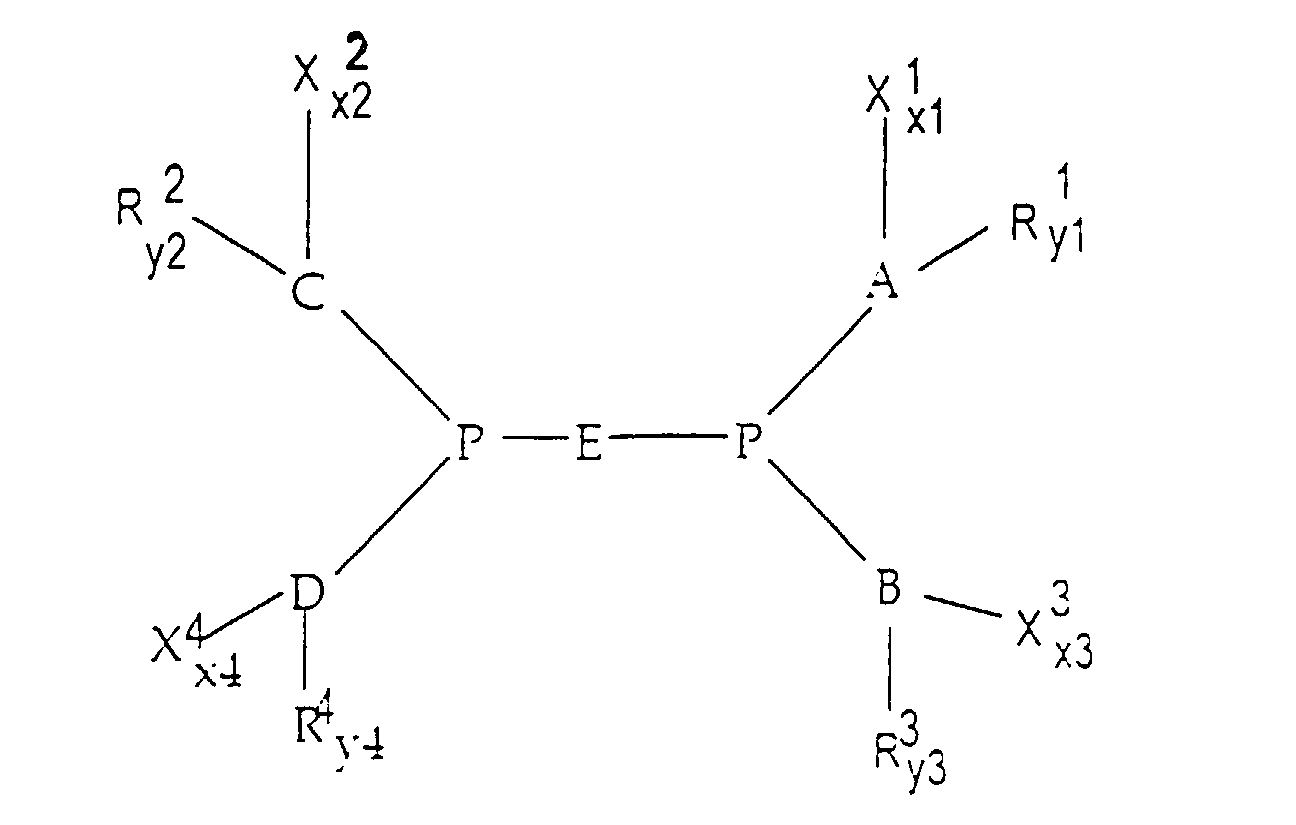 A, B, C, und gegebenenfalls D, die.identisch oder voneinander verschieden sein können, jeweils eine Arylgruppe, ausgewählt aus Phenylgruppen und Naphthylgruppen, oder eine Alkylgruppe mit 1 bis 10 Kohlenstoffatomen darstellen;E gegebenenfalls eine unverzweigte oder verzweigte Alkylkette mit 1 bis 10 Kohlenstoffatomen oder eine Kette, die eine oder mehrere substituierte oder nicht-substituierte Phenylgruppen umfasst, oder ein Cycloalkan darstellt, das gegebenenfalls unverzweigte oder verzweigte Alkylsubstituenten mit 1 bis 6 Kohlenstoffatomen trägt;die Substituenten R1, R2, R3 und gegebenenfalls R4, die identisch oder voneinander verschieden sein können, jeweils eine Gruppe darstellen, die aus Wasserstoff, Alkylresten mit 1 bis 4 Kohlenstoffatomen, Alkoxyresten mit 1 bis 4 Kohlenstoffatomen, Halogenatomen und den Gruppen -CN, -NO2, -OH und -N(Z1)(Z2) ausgewählt ist, worin Z1 und Z2 identisch oder voneinander verschieden sein können und jeweils einen Alkylrest mit 1 bis 5 Kohlenstoffatomen darstellen;die Substituenten X1, X2 und X3 und gegebenenfalls X4, die identisch oder voneinander verschieden sein können, jeweils eine Carbonsäuregruppe, eine Sulfonsäuregruppe oder deren Salze darstellen; wobei X1, X2 oder X3 und gegebenenfalls X4 ein Carbon- oder Sulfonsäuresalz darstellen, das Kation ein Alkali- oder Erdalkalimetall-Kation oder ein Ammonium-Kation der Formel N(T1T2T3T4)+ ist, worin T1, T2, T3, T4, die identisch oder voneinander verschieden sein können, jeweils eine Alkylgruppe mit 1 bis 4 Kohlenstoffatomen darstellen;x1, x2, x3 und gegebenenfalls x4 identische oder unterschiedliche Zahlen sind die zwischen 0 und 3 (Grenzen eingeschlossen) variieren, wobei zumindest eine davon ≥ 1 ist;y1, y2, y3 und gegebenenfalls y4 identische oder unterschiedliche Zahlen sind, die zwischen 2 und 5 (Grenzen eingeschlossen) variieren.
 - Verfahren nach Anspruch 1, dadurch gekennzeichnet, dass das Molverhältnis Phosphin:Katalysator zwischen 1 und 100, vorzugsweise zwischen 2 und 20, liegt.
- Verfahren nach Anspruch 1, dadurch gekennzeichnet, dass das Molverhältnis modifiziertes Cyclodextrin:Katalysator zwischen 1 und 100, vorzugsweise zwischen 2 und 20, liegt.
- Verfahren nach Anspruch 1, dadurch gekennzeichnet, dass die Reaktionstemperatur zwischen 20 °C und 200 °C liegt.
- Verfahren nach Anspruch 1, dadurch gekennzeichnet, dass der Druck zwischen 1 und 300 bar liegt, wobei der Partialdruck von Kohlenmonoxid zwischen 0,5 und 95 bar liegt.
- Verfahren nach Anspruch 1, dadurch gekennzeichnet, dass die Reaktion in Gegenwart eines organischen Lösungsmittels durchgeführt wird, das mit der wässrigen Phase nicht mischbar ist.
- Verfahren nach Anspruch 1, dadurch gekennzeichnet, dass die Reaktion in Gegenwart eines polaren Lösungsmittels durchgeführt wird, das mit der organischen Phase nicht mischbar ist.
Applications Claiming Priority (3)
| Application Number | Priority Date | Filing Date | Title |
|---|---|---|---|
| FR9500466A FR2729385B1 (fr) | 1995-01-17 | 1995-01-17 | Procede d'hydroformylation d'une olefine en milieu biphasique |
| FR9500466 | 1995-01-17 | ||
| PCT/FR1996/000069 WO1996022267A1 (fr) | 1995-01-17 | 1996-01-16 | Procede d'hydroformylation d'une olefine en milieu biphasique |
Publications (2)
| Publication Number | Publication Date |
|---|---|
| EP0804399A1 EP0804399A1 (de) | 1997-11-05 |
| EP0804399B1 true EP0804399B1 (de) | 2000-12-27 |
Family
ID=9475192
Family Applications (1)
| Application Number | Title | Priority Date | Filing Date |
|---|---|---|---|
| EP96901399A Expired - Lifetime EP0804399B1 (de) | 1995-01-17 | 1996-01-16 | Verfahren zur hydroformylierung eines olefins in einem biphasischen medium |
Country Status (7)
| Country | Link |
|---|---|
| US (1) | US5847228A (de) |
| EP (1) | EP0804399B1 (de) |
| JP (1) | JPH11500423A (de) |
| CA (1) | CA2210473A1 (de) |
| DE (1) | DE69611353T2 (de) |
| FR (1) | FR2729385B1 (de) |
| WO (1) | WO1996022267A1 (de) |
Families Citing this family (11)
| Publication number | Priority date | Publication date | Assignee | Title |
|---|---|---|---|---|
| DE19631322A1 (de) * | 1996-08-02 | 1998-02-05 | Studiengesellschaft Kohle Mbh | Verfahren zur Hydroformylierung von Olefinen im Zweiphasensystem |
| US6307108B1 (en) | 2000-03-15 | 2001-10-23 | Union Carbide Chemicals & Plastics Technology Corporation | Metal-ligand complex catalyzed processes |
| US6310260B1 (en) | 2000-03-15 | 2001-10-30 | Union Carbide Chemicals & Plastics Technology Corporation | Separation processes |
| US6294700B1 (en) | 2000-03-15 | 2001-09-25 | Union Carbide Chemicals & Plastics Technology Corporation | Separation processes |
| US6307110B1 (en) | 2000-03-15 | 2001-10-23 | Union Carbide Chemicals & Plastics Technology Corporation | Separation processes |
| US6303830B1 (en) | 2000-03-15 | 2001-10-16 | Union Carbide Chemicals & Plastics Technology Corporation | Metal-ligand complex catalyzed processes |
| US6303829B1 (en) | 2000-03-15 | 2001-10-16 | Union Carbide Chemicals & Plastics Technology Corporation | Separation processes |
| US6307109B1 (en) | 2000-03-15 | 2001-10-23 | Union Carbide Chemicals & Plastics Technology Corporation | Separation processes |
| US7803498B2 (en) * | 2006-08-25 | 2010-09-28 | The United States Of America As Represented By The Secretary Of The Navy | Materials and structures thereof useful as electrocatalysts |
| FR3006685B1 (fr) * | 2013-06-06 | 2016-07-22 | Arkema France | Procede d'hydroformylation et d'isomerisation controlees d'un nitril/ester/acide gras omega-insature. |
| FR3013045B1 (fr) * | 2013-11-12 | 2016-01-01 | Pivert | Procede d'hydroformylation de triglycerides en milieu auto-emulsifiant |
Family Cites Families (3)
| Publication number | Priority date | Publication date | Assignee | Title |
|---|---|---|---|---|
| GB2085874B (en) * | 1980-09-04 | 1984-08-08 | Johnson Matthey Plc | Hydroformylation of olefins |
| DE3412335A1 (de) * | 1984-04-03 | 1985-10-10 | Ruhrchemie Ag, 4200 Oberhausen | Verfahren zur herstellung von aldehyden |
| US5091350A (en) * | 1984-03-26 | 1992-02-25 | Hoechst Aktiengesellschaft | Process for hydroformylation with rhodium catalysts and the separation of rhodium therefrom |
-
1995
- 1995-01-17 FR FR9500466A patent/FR2729385B1/fr not_active Expired - Fee Related
-
1996
- 1996-01-16 CA CA002210473A patent/CA2210473A1/fr not_active Abandoned
- 1996-01-16 JP JP8522082A patent/JPH11500423A/ja active Pending
- 1996-01-16 WO PCT/FR1996/000069 patent/WO1996022267A1/fr not_active Ceased
- 1996-01-16 EP EP96901399A patent/EP0804399B1/de not_active Expired - Lifetime
- 1996-01-16 US US08/875,080 patent/US5847228A/en not_active Expired - Fee Related
- 1996-01-16 DE DE69611353T patent/DE69611353T2/de not_active Expired - Fee Related
Also Published As
| Publication number | Publication date |
|---|---|
| DE69611353T2 (de) | 2001-07-12 |
| FR2729385A1 (fr) | 1996-07-19 |
| DE69611353D1 (de) | 2001-02-01 |
| US5847228A (en) | 1998-12-08 |
| FR2729385B1 (fr) | 1997-04-04 |
| JPH11500423A (ja) | 1999-01-12 |
| CA2210473A1 (fr) | 1996-07-25 |
| EP0804399A1 (de) | 1997-11-05 |
| WO1996022267A1 (fr) | 1996-07-25 |
Similar Documents
| Publication | Publication Date | Title |
|---|---|---|
| EP0804399B1 (de) | Verfahren zur hydroformylierung eines olefins in einem biphasischen medium | |
| US5696297A (en) | Preparation of aldehydes | |
| KR19990082542A (ko) | 로듐 촉매를 사용한 히드로포르밀화에 의한 알데히드의제조 방법 및 추출에 의한 로듐 촉매의 회수 방법 | |
| JPH06126194A (ja) | オキソ合成の生成物の蒸留残留物からロジウムを回収する方法 | |
| CN101722048A (zh) | 一种两相催化氢甲酰化反应制备醛的催化剂及其应用 | |
| FR2999956A1 (fr) | Nano-catalyseurs metalliques dans le glycerol et applications en synthese organique | |
| Bricout et al. | Cyclodextrins as mass transfer additives in aqueous organometallic catalysis | |
| JPH09510219A (ja) | アルコール及び/又はアルデヒドの製造方法 | |
| FR2697836A1 (fr) | Procédé de préparation d'octadienols. | |
| HU200314B (en) | Process for regenerating rhodium from aquous solutions containing complexes of rhodium | |
| EP0389617B1 (de) | Behandlung von rhodium-katalysatoren | |
| WO2014016491A1 (fr) | Synthese de methyl propane diol a partir d'alcool allylique | |
| CA2433300A1 (fr) | Procede de preparation d'acides carboxyliques par carbonylation au palladium. | |
| RU2149156C1 (ru) | Способ получения 1,3-алкандиолов и 3-гидроксиальдегидов | |
| EP0882698A1 (de) | Verfahren zur Hydroformylierung von Olefininen | |
| EP0320339B1 (de) | Herstellungsverfahren von ungesättigten Alkoholen | |
| KR101604242B1 (ko) | 로듐 착물 결합을 포함하는 수용액으로부터의 로듐의 회수 방법 | |
| EP0362037A2 (de) | Verfahren zur Herstellung von gesättigten Aldehyden durch Hydrogenation von alfa-beta-ungesättigten Aldehyden | |
| FR2802203A1 (fr) | Procede ameliore d'hydroformylation au moyen d'un catalyseur a base de cobalt et/ou de rhodium mis en oeuvre en milieu biphasique | |
| FR2806079A1 (fr) | Procede d'oxydation d'hydrocarbures en acides | |
| CH643226A5 (fr) | Procede de fabrication de composes carbonyles par oxydation de composes olefiniques. | |
| WO2000027785A1 (fr) | Preparation d'acide acetique et/ou d'acetate de methyle en presence d'iridium et de platine | |
| EP0968220A1 (de) | 6, 6'-bis-(1-phosphanorbornadien)-diphosphine | |
| FR2661175A1 (fr) | Procede d'oxydation de composes organiques. | |
| JPH04230642A (ja) | オキソ合成の生成物の蒸留残留物からのロジウムの回収方法 |
Legal Events
| Date | Code | Title | Description |
|---|---|---|---|
| PUAI | Public reference made under article 153(3) epc to a published international application that has entered the european phase |
Free format text: ORIGINAL CODE: 0009012 |
|
| 17P | Request for examination filed |
Effective date: 19970809 |
|
| AK | Designated contracting states |
Kind code of ref document: A1 Designated state(s): DE FR GB IT |
|
| 17Q | First examination report despatched |
Effective date: 19990122 |
|
| GRAG | Despatch of communication of intention to grant |
Free format text: ORIGINAL CODE: EPIDOS AGRA |
|
| 17Q | First examination report despatched |
Effective date: 19990122 |
|
| GRAG | Despatch of communication of intention to grant |
Free format text: ORIGINAL CODE: EPIDOS AGRA |
|
| GRAH | Despatch of communication of intention to grant a patent |
Free format text: ORIGINAL CODE: EPIDOS IGRA |
|
| GRAH | Despatch of communication of intention to grant a patent |
Free format text: ORIGINAL CODE: EPIDOS IGRA |
|
| GRAA | (expected) grant |
Free format text: ORIGINAL CODE: 0009210 |
|
| AK | Designated contracting states |
Kind code of ref document: B1 Designated state(s): DE FR GB IT |
|
| PG25 | Lapsed in a contracting state [announced via postgrant information from national office to epo] |
Ref country code: IT Free format text: LAPSE BECAUSE OF FAILURE TO SUBMIT A TRANSLATION OF THE DESCRIPTION OR TO PAY THE FEE WITHIN THE PRE;WARNING: LAPSES OF ITALIAN PATENTS WITH EFFECTIVE DATE BEFORE 2007 MAY HAVE OCCURRED AT ANY TIME BEFORE 2007. THE CORRECT EFFECTIVE DATE MAY BE DIFFERENT FROM THE ONE RECORDED.SCRIBED TIME-LIMIT Effective date: 20001227 |
|
| REF | Corresponds to: |
Ref document number: 69611353 Country of ref document: DE Date of ref document: 20010201 |
|
| GBT | Gb: translation of ep patent filed (gb section 77(6)(a)/1977) |
Effective date: 20010227 |
|
| PLBE | No opposition filed within time limit |
Free format text: ORIGINAL CODE: 0009261 |
|
| STAA | Information on the status of an ep patent application or granted ep patent |
Free format text: STATUS: NO OPPOSITION FILED WITHIN TIME LIMIT |
|
| 26N | No opposition filed | ||
| REG | Reference to a national code |
Ref country code: GB Ref legal event code: IF02 |
|
| PGFP | Annual fee paid to national office [announced via postgrant information from national office to epo] |
Ref country code: GB Payment date: 20020103 Year of fee payment: 7 |
|
| PGFP | Annual fee paid to national office [announced via postgrant information from national office to epo] |
Ref country code: DE Payment date: 20020118 Year of fee payment: 7 |
|
| PGFP | Annual fee paid to national office [announced via postgrant information from national office to epo] |
Ref country code: FR Payment date: 20020130 Year of fee payment: 7 |
|
| PG25 | Lapsed in a contracting state [announced via postgrant information from national office to epo] |
Ref country code: GB Free format text: LAPSE BECAUSE OF NON-PAYMENT OF DUE FEES Effective date: 20030116 |
|
| PG25 | Lapsed in a contracting state [announced via postgrant information from national office to epo] |
Ref country code: DE Free format text: LAPSE BECAUSE OF NON-PAYMENT OF DUE FEES Effective date: 20030801 |
|
| GBPC | Gb: european patent ceased through non-payment of renewal fee | ||
| PG25 | Lapsed in a contracting state [announced via postgrant information from national office to epo] |
Ref country code: FR Free format text: LAPSE BECAUSE OF NON-PAYMENT OF DUE FEES Effective date: 20030930 |
|
| REG | Reference to a national code |
Ref country code: FR Ref legal event code: ST |