EP0804073B1 - Conservation par cryogenie et traitement a basse temperature d'objets biologiques - Google Patents
Conservation par cryogenie et traitement a basse temperature d'objets biologiques Download PDFInfo
- Publication number
- EP0804073B1 EP0804073B1 EP95935812A EP95935812A EP0804073B1 EP 0804073 B1 EP0804073 B1 EP 0804073B1 EP 95935812 A EP95935812 A EP 95935812A EP 95935812 A EP95935812 A EP 95935812A EP 0804073 B1 EP0804073 B1 EP 0804073B1
- Authority
- EP
- European Patent Office
- Prior art keywords
- objects
- substrate
- micro
- temperature
- cell
- Prior art date
- Legal status (The legal status is an assumption and is not a legal conclusion. Google has not performed a legal analysis and makes no representation as to the accuracy of the status listed.)
- Expired - Lifetime
Links
Images



Classifications
-
- A—HUMAN NECESSITIES
- A01—AGRICULTURE; FORESTRY; ANIMAL HUSBANDRY; HUNTING; TRAPPING; FISHING
- A01N—PRESERVATION OF BODIES OF HUMANS OR ANIMALS OR PLANTS OR PARTS THEREOF; BIOCIDES, e.g. AS DISINFECTANTS, AS PESTICIDES OR AS HERBICIDES; PEST REPELLANTS OR ATTRACTANTS; PLANT GROWTH REGULATORS
- A01N1/00—Preservation of bodies of humans or animals, or parts thereof
- A01N1/10—Preservation of living parts
-
- A—HUMAN NECESSITIES
- A01—AGRICULTURE; FORESTRY; ANIMAL HUSBANDRY; HUNTING; TRAPPING; FISHING
- A01N—PRESERVATION OF BODIES OF HUMANS OR ANIMALS OR PLANTS OR PARTS THEREOF; BIOCIDES, e.g. AS DISINFECTANTS, AS PESTICIDES OR AS HERBICIDES; PEST REPELLANTS OR ATTRACTANTS; PLANT GROWTH REGULATORS
- A01N1/00—Preservation of bodies of humans or animals, or parts thereof
- A01N1/10—Preservation of living parts
- A01N1/14—Mechanical aspects of preservation; Apparatus or containers therefor
- A01N1/142—Apparatus
- A01N1/144—Apparatus for temperature control, e.g. refrigerators or freeze-drying apparatus
- A01N1/145—Stationary or portable vessels generating cryogenic temperatures, e.g. liquid nitrogen baths
-
- A—HUMAN NECESSITIES
- A01—AGRICULTURE; FORESTRY; ANIMAL HUSBANDRY; HUNTING; TRAPPING; FISHING
- A01N—PRESERVATION OF BODIES OF HUMANS OR ANIMALS OR PLANTS OR PARTS THEREOF; BIOCIDES, e.g. AS DISINFECTANTS, AS PESTICIDES OR AS HERBICIDES; PEST REPELLANTS OR ATTRACTANTS; PLANT GROWTH REGULATORS
- A01N1/00—Preservation of bodies of humans or animals, or parts thereof
- A01N1/10—Preservation of living parts
- A01N1/16—Physical preservation processes
-
- A—HUMAN NECESSITIES
- A01—AGRICULTURE; FORESTRY; ANIMAL HUSBANDRY; HUNTING; TRAPPING; FISHING
- A01N—PRESERVATION OF BODIES OF HUMANS OR ANIMALS OR PLANTS OR PARTS THEREOF; BIOCIDES, e.g. AS DISINFECTANTS, AS PESTICIDES OR AS HERBICIDES; PEST REPELLANTS OR ATTRACTANTS; PLANT GROWTH REGULATORS
- A01N1/00—Preservation of bodies of humans or animals, or parts thereof
- A01N1/10—Preservation of living parts
- A01N1/16—Physical preservation processes
- A01N1/168—Physical preservation processes using electromagnetic fields or radiation; using acoustic waves or corpuscular radiation
Definitions
- the invention relates to a method and a device for microscopic objects, in particular biological objects, individual cells, cell groups or cell components or Macromolecules in a defined position according to predefined temperature programs in flat, possibly spatial patterns, to cryopreserve, change in the frozen state and under Preserve the vitality of the cells again.
- cryopreservatives such as dimethyl sulfoxide, glycerin
- Hybridoma cell production is used (B. Gustafsson, Cryopreservation of Hybridomas, in "Methods in Molecular Biology, Vol.5, Eds. J.W. Pollard and J.M. Walker, 619-621), as used for the production of monoclonal antibodies e.g.
- Cancer therapy is necessary and common in which usually only very few cells are formed from cell pairs (lymphocyte, myeloma cell) and need to be cryopreserved. Especially with the small number of cells common here, one is Cryopreservation is only possible to a limited extent (R. Ian Freshney: Animal Cell Cultures, Walter de Gruyter 1990, p.221), because when dealing with the small amounts of solution and the Recovery of the cells creates great difficulties. Furthermore, an individual Identification of the cells is not possible with suspension techniques, but this is the case with the above mentioned procedure is required.
- the gradient proves to be particularly disadvantageous when freezing cells in cell suspensions the temperature distribution in the solution since the freezing conditions for the single cell are not are known or very different because their position in the suspension is undefined and does not remain constant (M.J. Ashwood-Smith and J. Farrant, Low Temperature Preservation in Medicine and Biology, Kent, England (1980)).
- the reproducibility of the conditions and thus Standardization is, however, increasingly important if after cryopreservation to continue working with single cells.
- a modified type of cryopreservation, especially for adherent cells, is the preservation of cells grown on surfaces (T. Ohno, A simple method for in situ freezing of anchorage-dependent cells. In: A. Doyle, J.B. Griffiths, D.G. Newell, Cell and Tissue Culture, John Wiley & Sons, p. 4C: 2.1).
- suitable substrates treated glass or Plastic surfaces allowed to grow thin cell layers, so-called cell monolayers and subsequently frozen and thawed as a cell lawn.
- This method has the disadvantage that the cell growth occurs randomly and the single cell also heavily over the cryo period can also be located. Since so-called microtiter plates used to grow up location-specific conditions cannot be achieved here either. In addition comes that the method is only applicable for adherently growing cells.
- microdroplets can be used, e.g. for printers Generation of ink droplets, but also for applying glue and others Liquids on surfaces are known.
- the shooting of cells in microdrops is also known and used in cell sorting devices (M.R. Melamed, T. Lindmo and M.L. Mendelsohn (Eds), Flow Cytometry and Sorting, J. Wiley, New York (1990), 171-179).
- the Cells are shot individually in microdroplets, via a deflection device (e.g. electrical fields) spatially sorted and in collection vessels or on cell cultivation substrates upset. This also means that individual objects cannot be handled because they are larger Cell quantities (1000 to 1,000,000 cells) are sorted into relatively large vessels.
- the object of the present invention is to provide a method and a device with which it is possible to reproducibly, orderly, and fixate microscopic objects, in particular biological objects, individual cells, cell assemblies or cell components or macromolecule suspensions in a reproducible, ordered and fixed manner and thaw again at a later point in time while maintaining vitality, whereby individual identification of the frozen and cryopreserved objects should be possible.
- the targeted placement of biological objects can be closed by means of a microdroplet device or by positioning by means of a capillary or a carrier tip.
- a capillary or a carrier tip In the latter case, at the top, Example of the capillary, a microdrop with the biological object attached or generated.
- the Capillary or carrier tip is with a controllable speed profile in relation to the Movable substrate surface.
- the microscopic objects By separating or grouping the microscopic objects in a coating solution or by portioning the coating solution and thus enclosing the objects or the macromolecules or portioning the pure coating solution in microdroplets (picoliters to a few microliters) when applied to a temperature T 1
- T 1 Temperature
- the microscopic objects or macromolecules located in the microdrops are cryopreserved.
- Biological objects are to be understood in particular as individual cells, cell assemblies and cell components.
- the substrates can be brought to a storage temperature T 2 or processing temperature T 3 via predeterminable temperature profiles, which experience has shown to be below -80 ° C, often at -196 ° C. For short-term storage and treatments, higher storage temperatures are also possible, but in any case they are below the freezing point of the coating solution.
- the temperature of the substrate surface can preferably be achieved by means of a known cooling element (Peltier element) or through contact with cryogenic liquids (e.g. liquid nitrogen) respectively.
- the temperature of the sheathed coating solution is said to be for biological objects physiological areas.
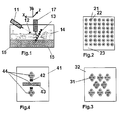
- a preferred device for separating and applying the biological objects are Micro-drop shot devices, in particular based on the principle of the piezoelectric effect based, whereby by a temporally and spatially freely selectable positioning of Micro drop device and substrate surface to each other and a timing During the separation and application process, the microdroplets in the desired structures or positions can be brought to the substrate surface. Through these microdroplets micro drops of the same size are generated, which are essential for the reproducible and defined Are cryopreservation.
- the transfer of the coating solution and thus the enclosed microscopic objects and macromolecules in aerosols (Microtrope cloud) preferred by known spraying methods the aerosols on the cooled surface are sprayed and form thin and frozen layers there.
- aerosols Microtrope cloud
- a two- and three-dimensional one should in particular Arrangement of the microdroplets on the substrate surface can be understood, the microdroplets be the same or different coating solution and / or the same or different microscopic objects and macromolecules can contain.
- the technical teaching according to the invention is suitable for a coating solution, spatial structures different biological objects, macromolecules or just different ones To produce coating solutions reproducible, defined, fixed and orderly.
- the free Combinability makes it possible to produce structures that were not previously feasible.
- By thawing the structures applied to the substrate surface the different components of the structures are brought into interaction with one another, where chemical reactions take place or biological objects with each other or with the changed environment can interact or even the thawing of biological material can take place under conditions other than freezing.
- Such Asymmetries between freezing and thawing conditions occur in the known cryogenic processes in part inevitably, but can not be as in the procedure described here vary and repeat reproducibly.
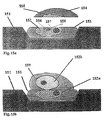
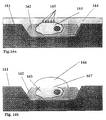
- the substrate on which the microdroplets with the cells are applied can be made of glass, plastic, Metal, semiconductors, ceramics or other temperature gradient resistant materials consist. In the simplest case, it is a smooth, unstructured surface on which the drops are applied at a definable distance from each other. Conveniently however, one structures the surface of the substrate in order to localize and To enable cell retrieval, on the other hand, the separation, selective measurement of the Cells, or to support and enable the freezing and thawing process. In this The connection between substrates from a size of a few square millimeters up to to some square centimeters (e.g. semiconductor wafers, semiconductor chips) using the methods semiconductor technology have been structured. Especially the good ones Temperature conductivity properties and the possibility of spatial structuring in the micrometer and Submicrometers favor silicon and its oxides as well as others Semiconductor substrates, but also metals and ceramics as the base material.
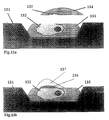
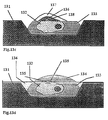
- Microstructuring is understood here to mean that hollows, channels, bridges, Breakthroughs or increases, individually or in patterns or alternately on the Substrate surface, whose dimensions are usually the size of the cells or Correspond to microdrops or are made finer or coarser. Typical dimensions for animal Cells are 5 to 100 ⁇ m. In the case of bacteria, mycoplasmas, viruses or similar small ones Particles are structures in the micrometer and submicron range.
- the cooling of the substrate to very low temperatures also allows the fastest freezing speeds that can be achieved so far.
- ⁇ - 100 to - 273 ° C also allows the fastest freezing speeds that can be achieved so far.
- Drop size and its deformation when striking the substrate surface, as well as their Structuring can be performed at cooling rates from a few to several thousand Achieve degrees / second.
- a particular advantage of corresponding substrates is their hot and cold sterilizability, if necessary also ultrasonic cleaning, which guarantees sterile and clinically customary conditions.
- An essential aspect of the invention is the pattern formation of the microdrop distribution of the substrate surface and the resulting micro-object arrangements different cells in small but also very large numbers in the immediate vicinity frozen, but their interactions can only begin after thawing.
- the method and the device are therefore suitable, medical-diagnostic as well prepare biotechnological-pharmaceutical test and sensor chips before use and over longer periods in unchanged position fixation and while maintaining the vitality of the Store and send cells.
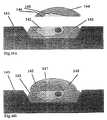
- microdrops on the surface also allows it to be frozen State to remove, exchange or else materials of the microdroplet or cells instead other materials (e.g. genetic material, enzymes, membrane materials etc.) to add. It can be both very small areas (micrometers, nanometers) as well also deal with the entire microdroplets or surfaces encompassing the substrate.
- the material can be applied using microdroplets. Possible are furthermore the application from an aerosol or vapor phase, sputtering in a gas atmosphere or precipitation in vacuo from a target. The removal of frozen fluids can also done in vacuum. This process can lead to freeze drying and freeze etching become.
- ultra-thin films can be applied to existing surface layers on the substrate carrier before or after setting the temperature T 1 (with or without microdroplets), so that after thawing, miscible and / or immiscible or themselves Form segregating liquid areas.
- the method also allows multiple cell layers to be stacked or separated to apply isolated from each other.
- One application of these test systems is the pharmaceutical and plant protection or Pollutant screening.
- An essential part of the inventive method is the relocation of a large number of Process steps in the low temperature range, below which the temperature range is understood, which varies from the freezing temperature of the coating solution to close to absolute zero of the temperature.
- This area allows living in and around Microsystems usually liquid and semi-liquid materials (cytoplasm, etc.) in the To transfer state of a solid. This is the only way to make manipulations on and in cells possible, which inevitably lead to loss of vitality at physiological temperatures would or are impossible due to time constraints.
- the transfer of the cells into the Solid state allows living systems to be under almost no time pressure and under Maintaining vitality to a significant extent and is referred to below as The term "low-temperature cytosurgery" summarized.
Landscapes
- Life Sciences & Earth Sciences (AREA)
- Health & Medical Sciences (AREA)
- Engineering & Computer Science (AREA)
- Dentistry (AREA)
- General Health & Medical Sciences (AREA)
- Wood Science & Technology (AREA)
- Zoology (AREA)
- Environmental Sciences (AREA)
- Apparatus Associated With Microorganisms And Enzymes (AREA)
- Micro-Organisms Or Cultivation Processes Thereof (AREA)
- Agricultural Chemicals And Associated Chemicals (AREA)
- Medicines Containing Material From Animals Or Micro-Organisms (AREA)
Claims (29)
- Procédé de cryoconservation et de manipulation à basse température d'objets microscopiques, en particulier d'objets, d'agglomérations de cellules, de cellules individuelles ou de fractions constitutives de cellules biologiques, sur des surfaces formant substrats, comprenant les étapes consistant à :placer les objets dans au moins un réservoir de stockage avec un solvant d'enrobage,transférer les objets d'au moins un réservoir de stockage sur un récepteur-substrat de température T1, susceptible d'être amené en équilibre de température, constituant la surface formant substrat, età maintenir les objets immobilisés en position sur le récepteur-substrat, caractérisé en ce que
lors de leur transfert, les objets sont enveloppés par le solvant d'enrobage dans des conditions telles que des microgouttes sont formées, le transfert s'effectuant par l'intermédiaire d'un dispositif de placement de microgouttes qui est prévu pour guider le mouvement des microgouttes portant les objets, dans le temps et dans l'espace et en ce que après l'immobilisation en position, la température du récepteur est fixée à une température de conservation T2 ou une température de manipulation T3, et en ce que le récepteur-substrat chargé est stocké et/ou traité. - Procédé selon la revendication 1, dans lequel le dispositif de placement des microgouttes est un dispositif de projection de microgouttes et le transfert des objets est guidé par une orientation modifiée, respectivement d'une projection à la projection suivante, de la trajectoire des microgouttes par rapport au récepteur et/ou du déplacement du récepteur par rapport au dispositif de projection de microgouttes, dans des conditions telles que les objets adhèrent sur la surface selon des intervalles d'écartement déterminés ou sous la forme de motifs.
- Dispositif selon la revendication 1 ou 2, dans lequel des objets peuvent être projetés simultanément ou successivement sur un ou plusieurs emplacements de réception au moyen de plusieurs dispositifs de projection de microgouttes.
- Dispositif selon l'une des revendications 1 à 3, dans lequel la température T1 se situe au-dessus du point de congélation de l'eau et les températures T2 et T3 se situent dans une fourchette comprise entre -2°C et -273°C.
- Procédé selon la revendication 4, dans lequel la surface du récepteur-substrat est revêtu, avant chargement, par l'intermédiaire d'un dispositif de projection de microgouttes, partiellement ou en totalité d'un gel, d'une couche moléculaire, d'un liquide ou d'un polymère, ou encore d'une pluralité ou d'une combinaison de ceux-ci.
- Procédé selon l'une des revendications 1 à 3, dans lequel les températures T1, T2 et T3 se situent dans une fourchette comprise entre -5°C et 273°C.
- Procédé selon l'une des revendications 1 à 6, dans lequel les objets et les microgouttes sont mesurés par un procédé électrique ou optique durant leur course de projection sur la surface du récepteur-substrat, l'emplacement d'impact de la microgoutte portant les objets pouvant être modifié en fonction des données recueillies lors de la mesure.
- Procédé selon l'une des revendications 1 à 7, dans lequel le stockage et/ou la manipulation du récepteur-substrat chargé s'effectue dans de l'azote liquide ou des liquides cryogéniques similaires ou dans leurs phases gazeuses.
- Procédé selon les revendications 1 à 8, dans lequel l'ensemble du procédé ou encore des étapes individuelles de celui-ci s'effectue(nt) à des pressions différentes de la pression atmosphérique standard.
- Procédé selon l'une des revendications 1 à 9, dans lequel le récepteur-substrat chargé est revêtu, avant stockage et/ou manipulation, d'autres couches minces, les couches minces étant constituées par exemple de solutions réfrigérées appliquées au moyen d'un dispositif de projection de microgouttes ou étant produites par exemple par nébulisation, pulvérisation dans une phase gazeuse ou précipitation sous vide, d'un matériau métallique par exemple.
- Procédé selon l'une des revendications 1 à 10, dans lequel les objets sont séchés par congélation dans leur état appliqué.
- Procédé selon l'une des revendications 1 à 11, dans lequel plusieurs microgouttes, avec ou sans cellules, de composition identique ou différente, sont placées l'une au-dessus de l'autre et réfrigérées ou sont déposées côte à côte.
- Procédé selon l'une des revendications 1 à 12, dans lequel une couche est déposée sur la surface du substrat, pour stockage et/ou manipulation, avec laquelle les microgouttes contenant les cellules ou des fractions de celles-ci sont susceptibles d'être décollées et fixées en position, en tirant.
- Procédé selon l'une des revendications 1 à 12, dans lequel les cellules, avant leur congélation et/ou après leur décongélation par chauffage du récepteur jusqu'à une température se situant au-dessus du point de congélation de la solution d'enrobage, sont manipulées au moyen de champs électriques ou maintenues en suspension dans la solution ambiante.
- Procédé de manipulation à basse température d'objets microscopiques, en particulier d'objets, d'agglomérations de cellules, de cellules individuelles ou de fractions constitutives de cellules biologiques, sur des surfaces formant substrats, se caractérisant par les étapes consistant à :faire adhérer avec immobilisation en position les objets sur la surface formant substrat à l'état réfrigéré, ettraiter les objets en retirant la substance constitutive des objets.
- Procédé selon la revendication 15, dans lequel les objets englobent des cellules ou des agglomérations de cellules ou des fractions constitutives de cellules biologiques et lors de la manipulation duquel de la substance constitutive de cellules est prélevée.
- Procédé selon la revendication 15 ou 16, dans lequel l'enlèvement ou le prélèvement de substance englobe un prélèvement mécanique, une ablation optique, une attaque caustique par congélation et/ou une évaporation sous vide.
- Procédé selon l'une des revendications 15 à 17, dans lequel, dans une autre étape, une substance d'apport est déposée et/ou échangée, la substance d'apport ayant une origine synthétique, génétique ou cellulaire ou étant prévue pour réaliser, après une décongélation des objets, un scellement des objets partiellement prélevés tout en leur conservant leur vitalité.
- Procédé selon l'une des revendications 15 à 18, dans lequel le maintien en position immobilisée s'opère à l'aide d'un procédé selon l'une des revendications 1 à 14.
- Dispositif de cryoconservation et de manipulation à basse température d'objets microscopiques, en particulier d'objets, d'agglomérations de cellules, de cellules individuelles ou de fractions constitutives de cellules biologiques, sur des surfaces formant substrats, caractérisé en ce qu'il comprend un dispositif de projection de microgouttes destiné à l'application contrôlée dans le temps et dans l'espace de gouttes d'une solution d'enrobage avec les objets biologiques enfermés dans celles-ci, sur un récepteur-substrat susceptible d'être amené en équilibre de température, qui constitue la surface formant substrat.
- Dispositif selon la revendication 20, dans lequel des moyens de manipulation pour le stockage et/ou la manipulation des objets déposés sont prévus.
- Dispositif selon la revendication 20 ou 21, dans lequel le récepteur-substrat possède une structure superficielle qui comprend notamment des microélectrodes, des éléments de détection ou des composants électroniques, des dépressions, de protubérances, des solutions de continuité ou des canaux, ou des structures fines telles que des rayures, des colonnes, des pointes, des remblais, qui agrandissent la surface, dont les dimensions sont d'un ordre micrométrique (µm) ou submicrométrique.
- Dispositif selon l'une des revendications 20 à 22, dans lequel le dispositif de projection de microgouttes et/ou le récepteur-substrat sont faits d'un matériau semi-conducteur, et sont notamment à base de silicium.
- Dispositif selon l'une des revendications 20 à 23, dans lequel le récepteur-substrat se trouve, lors de la projection, à une température T1 supérieure au point de congélation de l'eau et après la projection est susceptible d'être refroidi et maintenu à une température de conservation T2 se situant dans une fourchette de -5°C à -273°C, le récepteur-substrat pouvant être refroidi et/ou réchauffé suivant des programmes de régulation de température fixés dans le temps et étant susceptible d'être refroidi par exemple par un bain de fluide frigorigène, qui renferme notamment de l'azote liquide, ou l'atmosphère gazeuse du bain de fluide frigorigène.
- Dispositif selon l'une des revendications 20 à 24, dans lequel les moyens de manipulation comprennent une lame de microtome, une microperceuse ou une microfraiseuse, un rayon laser ou un autre élément, par l'intermédiaire desquels des fractions de substance sont prélevées dans ou retirées des microgouttes ou des cellules, à l'état congelé à très basse température, par voie mécanique, thermique ou optique.
- Dispositif selon l'une des revendications 20 à 25, dans lequel la température du substrat et la température des gouttes peuvent être réglées indépendamment l'une de l'autre et, pour les microgouttes à projeter, peut se situer également bien au-dessus du point de congélation de la solution constitutive des gouttes.
- Dispositif de manipulation à basse température d'objets microscopiques, en particulier d'objets, d'agglomérations de cellules, de cellules individuelles ou de fractions constitutives de cellules biologiques, sur des surfaces formant substrats, caractérisé en ce qu'il comprenddes moyens permettant de régler la température du substrat dans des conditions telles que les objets adhèrent, immobilisés en position, à l'état congelé sur la surface du substrat, etdes moyens de manipulation qui sont prévus pour le prélèvement de matière constitutive des objets.
- Dispositif selon la revendication 27, dans lequel les moyens de manipulation comprennent une lame de microtome, une microperceuse ou une microfraiseuse, un rayon laser ou un autre élément, par l'intermédiaire desquels des fractions de substance peuvent être prélevées dans ou retirées des microgouttes ou des cellules, à l'état congelé à très basse température, par voie mécanique, thermique ou optique.
- Mise en oeuvre du procédé ou du dispositif selon l'une des revendications 1 à 28 pour la cryoconservation de cellules destinées à une banque de cellules utilisable à des fins médicales, biologiques, pharmaceutiques ou autre, ou pour la fabrication de substrats sous la forme de microplaquettes d'essai, détecteur, élément de filtrage pour l'établissement des diagnostics médicaux, la technique de l'environnement et la recherche pharmaceutique.
Applications Claiming Priority (3)
| Application Number | Priority Date | Filing Date | Title |
|---|---|---|---|
| DE4438232A DE4438232A1 (de) | 1994-10-26 | 1994-10-26 | Kryokonservierung und Tieftemperaturbearbeitung von biologischen Zellen |
| DE4438232 | 1994-10-26 | ||
| PCT/DE1995/001490 WO1996013159A1 (fr) | 1994-10-26 | 1995-10-26 | Conservation par cryogenie et traitement a basse temperature d'objets biologiques |
Publications (2)
| Publication Number | Publication Date |
|---|---|
| EP0804073A1 EP0804073A1 (fr) | 1997-11-05 |
| EP0804073B1 true EP0804073B1 (fr) | 1999-01-07 |
Family
ID=6531736
Family Applications (1)
| Application Number | Title | Priority Date | Filing Date |
|---|---|---|---|
| EP95935812A Expired - Lifetime EP0804073B1 (fr) | 1994-10-26 | 1995-10-26 | Conservation par cryogenie et traitement a basse temperature d'objets biologiques |
Country Status (6)
| Country | Link |
|---|---|
| US (1) | US5925511A (fr) |
| EP (1) | EP0804073B1 (fr) |
| JP (1) | JP3821845B2 (fr) |
| AT (1) | ATE175306T1 (fr) |
| DE (2) | DE4438232A1 (fr) |
| WO (1) | WO1996013159A1 (fr) |
Cited By (8)
| Publication number | Priority date | Publication date | Assignee | Title |
|---|---|---|---|---|
| DE19921236A1 (de) * | 1999-05-07 | 2000-11-30 | Evotec Biosystems Ag | Verfahren und Vorrichtung zur Probenaufnahme an Kryosubstraten |
| DE10203644A1 (de) * | 2002-01-30 | 2003-08-07 | Fraunhofer Ges Forschung | Kryokonservierung an textilen Geweben |
| DE10251721A1 (de) * | 2002-11-06 | 2004-05-27 | Fraunhofer-Gesellschaft zur Förderung der angewandten Forschung e.V. | Verfahren zur Beschickung von Probenkammern mit Suspensionsproben |
| DE10251668A1 (de) * | 2002-11-06 | 2004-05-27 | Fraunhofer-Gesellschaft zur Förderung der angewandten Forschung e.V. | Tieftemperaturspeicherung von Suspensionsproben in hängenden Probenkammern |
| DE10251669B3 (de) * | 2002-11-06 | 2004-06-17 | Fraunhofer-Gesellschaft zur Förderung der angewandten Forschung e.V. | Kapillarsubstrat zur Tieftemperaturspeicherung von Suspensionsproben |
| US6931864B2 (en) | 2000-12-07 | 2005-08-23 | Fraunhofer-Gesellschaft zur Förderung der angewandten Forschung e.V. | Cryostorage method and device |
| DE10262157B4 (de) * | 2002-02-01 | 2006-11-09 | Fraunhofer-Gesellschaft zur Förderung der angewandten Forschung e.V. | Vorrichtung und Verfahren zur modularen Kryospeicherung |
| US7458285B2 (en) | 2003-06-26 | 2008-12-02 | Fraunhofer-Gesellschaft Zur Foerderung Der Angewandten Forschung E.V. | Device for cryopreservation of samples and method for producing the device |
Families Citing this family (41)
| Publication number | Priority date | Publication date | Assignee | Title |
|---|---|---|---|---|
| US6429356B1 (en) | 1996-08-09 | 2002-08-06 | Calgene Llc | Methods for producing carotenoid compounds, and specialty oils in plant seeds |
| FR2791439B1 (fr) * | 1999-03-26 | 2002-01-25 | Univ Joseph Fourier | Dispositif de centrage d'une goutte |
| US6653530B1 (en) | 1998-02-13 | 2003-11-25 | Calgene Llc | Methods for producing carotenoid compounds, tocopherol compounds, and specialty oils in plant seeds |
| US7132247B1 (en) | 1998-09-17 | 2006-11-07 | Regents Of The University Of Minnesota | Composite devices incorporating biological material and methods |
| EP1114319B1 (fr) * | 1998-09-17 | 2008-05-14 | Regents Of The University Of Minnesota | Dispositifs composites incorporant un materiau biologique et procedes |
| WO2000063389A1 (fr) | 1999-04-15 | 2000-10-26 | Calgene Llc | Sequences d'acide nucleique et proteines intervenant dans la synthese de l'isoprenoide |
| DE19932958C2 (de) * | 1999-07-14 | 2003-08-07 | Walter Schubert | Vorrichtung zur Bindung von Molekülen, Molekülgruppen, Molekülteilen und/oder Zellen |
| US6322994B1 (en) * | 1999-11-04 | 2001-11-27 | Genetix Limited | Method of freeze-drying organisms |
| US6649408B2 (en) * | 2000-03-24 | 2003-11-18 | George Mason University | Microdroplet cell culture technique |
| US6872815B1 (en) | 2000-10-14 | 2005-03-29 | Calgene Llc | Nucleic acid sequences to proteins involved in tocopherol synthesis |
| US6472206B1 (en) | 2000-04-28 | 2002-10-29 | Interthyr Corporation | In situ growth, freezing and testing of cultured cells |
| DE60140312D1 (en) | 2000-08-07 | 2009-12-10 | Monsanto Technology Llc | Am methyl-d-erythriol phosphat reaktionsweg beteiligte gene |
| US7161061B2 (en) | 2001-05-09 | 2007-01-09 | Monsanto Technology Llc | Metabolite transporters |
| JP2004533244A (ja) | 2001-05-09 | 2004-11-04 | モンサント テクノロジー リミテッド ライアビリティー カンパニー | TyrA遺伝子及びその使用法 |
| US7244877B2 (en) | 2001-08-17 | 2007-07-17 | Monsanto Technology Llc | Methyltransferase from cotton and uses thereof |
| US6418750B1 (en) | 2001-10-16 | 2002-07-16 | The United States Of America As Represented By The Secretary Of Agriculture | Multi-purpose cryogenic surface device |
| CA2463398A1 (fr) | 2001-10-25 | 2003-05-01 | Monsanto Technology Llc | Methyltransferases aromatiques et utilisations associees |
| DE10202302B4 (de) * | 2002-01-22 | 2005-06-02 | Fraunhofer-Gesellschaft zur Förderung der angewandten Forschung e.V. | Verfahren und Vorrichtung zur Steuerung des Zugriffs auf elektronische Datenspeicher |
| DE10203940B4 (de) * | 2002-02-01 | 2006-06-14 | Fraunhofer-Gesellschaft zur Förderung der angewandten Forschung e.V. | Kryoprobenträger zur modularen Kryospeicherung |
| US7112717B2 (en) | 2002-03-19 | 2006-09-26 | Monsanto Technology Llc | Homogentisate prenyl transferase gene (HPT2) from arabidopsis and uses thereof |
| WO2003092377A1 (fr) * | 2002-05-01 | 2003-11-13 | Cryoglass Llc | Systeme de cryopreservation pour des substances liquides |
| WO2004013312A2 (fr) | 2002-08-05 | 2004-02-12 | Monsanto Technology, Llc | Genes associes a la biosynthese du tocopherol et utilisation de ceux-ci |
| DE10237125A1 (de) * | 2002-08-13 | 2004-03-11 | Fraunhofer-Gesellschaft zur Förderung der angewandten Forschung e.V. | Kryokonservierung mit einem gas- oder dampfförmigen Kühlmedium |
| CA2521862C (fr) | 2003-04-10 | 2012-10-16 | President And Fellows Of Harvard College | Formation et regulation d'especes fluidiques |
| DE10326280B4 (de) * | 2003-06-11 | 2005-06-23 | Fraunhofer-Gesellschaft zur Förderung der angewandten Forschung e.V. | Untersuchungsverfahren für Kryoproben |
| US7745023B2 (en) | 2003-08-08 | 2010-06-29 | Regents Of The University Of Minnesota | Structured material for the production of hydrogen |
| EP2662135A3 (fr) | 2003-08-27 | 2013-12-25 | President and Fellows of Harvard College | Méthode de mélange de gouttelettes dans un microcanal |
| JP4632064B2 (ja) * | 2005-02-10 | 2011-02-16 | 日本電気株式会社 | 分析用の蓋付きマイクロチップ、該蓋付きマイクロチップのサンプル処理方法、該蓋付きマイクロチップの自動サンプル処理方法、該処理方法に基づく、自動サンプル処理装置、ならびに、該自動サンプル処理方法を応用する物質の分析装置 |
| US20080283775A1 (en) * | 2005-03-15 | 2008-11-20 | The Arizona Board Of Regents, A Body Corporate Acting For And On Behalf Of Arizona State Universi | Methods and Devices for Rapidly Forming Vitreous Ice-Jacketed Particle Droplets |
| US20060262317A1 (en) * | 2005-03-15 | 2006-11-23 | The Arizona Board Of Regents Acting On Behalf Of Arizona State University | Methods and devices for molecular structure determination |
| DE102005031648B4 (de) * | 2005-07-06 | 2010-06-10 | Fraunhofer-Gesellschaft zur Förderung der angewandten Forschung e.V. | Verfahren und Vorrichtung zur Kryokonservierung biologischer Proben |
| JP2009008657A (ja) * | 2007-05-25 | 2009-01-15 | Canon Inc | 固体試料、固体試料作製方法及び固体試料作製装置 |
| EP2471359B1 (fr) * | 2010-12-30 | 2016-03-30 | Cellulis S.L. | Procédé de congélation de cellules |
| GB201119032D0 (en) | 2011-11-03 | 2011-12-14 | Isis Innovation | Multisomes: encapsulated droplet networks |
| GB201219201D0 (en) | 2012-10-25 | 2012-12-12 | Isis Innovation | Hydrogel network |
| GB201219196D0 (en) | 2012-10-25 | 2012-12-12 | Isis Innovation | Droplet assembly method |
| KR102284661B1 (ko) * | 2012-12-07 | 2021-08-02 | 옥스포드 유니버시티 이노베이션 리미티드 | 3d 프린팅에 의한 비말 어셈블리 |
| WO2015173809A2 (fr) * | 2014-05-13 | 2015-11-19 | Mfc Global Ltd | Plateau de cellules |
| CN105132364B (zh) * | 2015-09-08 | 2018-12-14 | 徐小杨 | 精子选择方法及载体 |
| DE102017218262B4 (de) | 2017-10-12 | 2019-05-29 | Fraunhofer-Gesellschaft zur Förderung der angewandten Forschung e.V. | Verfahren zur Herstellung einer Vorrichtung zur sensorbasierten Untersuchung biologischer Zellen, hergestellte Vorrichtung und Verwendungen hiervon |
| WO2025225923A1 (fr) * | 2024-04-25 | 2025-10-30 | 주식회사 리센스메디컬 | Dispositif de pulvérisation de composition et système de pulvérisation le comprenant |
Family Cites Families (14)
| Publication number | Priority date | Publication date | Assignee | Title |
|---|---|---|---|---|
| US4142656A (en) * | 1976-12-17 | 1979-03-06 | Eastman Kodak Company | Drop former utilizing gas pressure |
| US4399219A (en) * | 1981-01-29 | 1983-08-16 | Massachusetts Institute Of Technology | Process for isolating microbiologically active material |
| DE3416789C2 (de) * | 1984-05-07 | 1986-09-04 | C. Reichert Optische Werke Ag, Wien | Vorrichtung zur alternativen Kryofixation biologisch-medizinischer oder technischer Objekte mit hohem Wasser-bzw. Flüssigkeitsgehalt durch Immersion bzw. am Metallspiegel |
| DE3416790C2 (de) * | 1984-05-07 | 1986-09-04 | C. Reichert Optische Werke Ag, Wien | Vorrichtung zur Kryofixation nativer Objekte mittels eines flüssigen Kühlmediums oder eines Metallspiegels |
| US4531373A (en) * | 1984-10-24 | 1985-07-30 | The Regents Of The University Of California | Directional solidification for the controlled freezing of biomaterials |
| US5108926A (en) * | 1987-09-08 | 1992-04-28 | Board Of Regents, The University Of Texas System | Apparatus for the precise positioning of cells |
| EP0331855B1 (fr) * | 1988-02-29 | 1995-03-08 | E.I. DU PONT DE NEMOURS & COMPANY, INC. | Appareil pour amener des substances dans des cellules et des tissus d'une manière non léthale |
| EP0397413B1 (fr) * | 1989-05-12 | 1994-01-12 | Pioneer Hi-Bred International, Inc. | Canon de particules |
| FR2651793B1 (fr) * | 1989-09-14 | 1991-12-06 | Cassou Robert | Tubes ou paillettes pour la conservation cryogenique d'echantillons biologiques tels que virus, et procede de remplissage. |
| SU1708835A1 (ru) * | 1989-11-22 | 1992-01-30 | Институт проблем криобиологии и криомедицины АН УССР | Способ консервировани посто нных клеточных линий |
| CA2051092C (fr) * | 1990-09-12 | 2002-07-23 | Stephen A. Livesey | Methode et appareillage pour la cryopreservation, la stabilisation a sec et la rehydratation de suspensions biologiques |
| US5132089A (en) * | 1991-01-31 | 1992-07-21 | Lightfoot Fred G | Hand-held cryofixation apparatus |
| WO1993003493A1 (fr) * | 1991-08-01 | 1993-02-18 | The Dow Chemical Company | Interface entre un appareil de chromatographie liquide et un spectrometre a transformee fourier |
| US5275016A (en) * | 1992-04-24 | 1994-01-04 | Abaxis, Inc. | Cryogenic apparatus |
-
1994
- 1994-10-26 DE DE4438232A patent/DE4438232A1/de not_active Withdrawn
-
1995
- 1995-10-26 WO PCT/DE1995/001490 patent/WO1996013159A1/fr not_active Ceased
- 1995-10-26 AT AT95935812T patent/ATE175306T1/de active
- 1995-10-26 EP EP95935812A patent/EP0804073B1/fr not_active Expired - Lifetime
- 1995-10-26 DE DE59504763T patent/DE59504763D1/de not_active Expired - Lifetime
- 1995-10-26 JP JP51424296A patent/JP3821845B2/ja not_active Expired - Lifetime
- 1995-10-26 US US08/836,092 patent/US5925511A/en not_active Expired - Lifetime
Cited By (13)
| Publication number | Priority date | Publication date | Assignee | Title |
|---|---|---|---|---|
| DE19921236C2 (de) * | 1999-05-07 | 2003-10-30 | Evotec Ag | Verfahren und Vorrichtung zur Probenaufnahme an Kryosubstraten |
| DE19921236A1 (de) * | 1999-05-07 | 2000-11-30 | Evotec Biosystems Ag | Verfahren und Vorrichtung zur Probenaufnahme an Kryosubstraten |
| EP2302351A1 (fr) | 2000-12-07 | 2011-03-30 | Fraunhofer-Gesellschaft zur Förderung der angewandten Forschung e.V. | Procédé et dispositif de cryostockage d' échantillons |
| CN1585894B (zh) * | 2000-12-07 | 2010-08-04 | 弗劳恩霍弗应用技术研究院 | 冷储存的方法和装置 |
| US6931864B2 (en) | 2000-12-07 | 2005-08-23 | Fraunhofer-Gesellschaft zur Förderung der angewandten Forschung e.V. | Cryostorage method and device |
| DE10203644A1 (de) * | 2002-01-30 | 2003-08-07 | Fraunhofer Ges Forschung | Kryokonservierung an textilen Geweben |
| DE10262157B4 (de) * | 2002-02-01 | 2006-11-09 | Fraunhofer-Gesellschaft zur Förderung der angewandten Forschung e.V. | Vorrichtung und Verfahren zur modularen Kryospeicherung |
| DE10251721A1 (de) * | 2002-11-06 | 2004-05-27 | Fraunhofer-Gesellschaft zur Förderung der angewandten Forschung e.V. | Verfahren zur Beschickung von Probenkammern mit Suspensionsproben |
| DE10251721B4 (de) * | 2002-11-06 | 2006-06-01 | Fraunhofer-Gesellschaft zur Förderung der angewandten Forschung e.V. | Verfahren zur Beschickung von Probenkammern mit Suspensionsproben |
| DE10251669B3 (de) * | 2002-11-06 | 2004-06-17 | Fraunhofer-Gesellschaft zur Förderung der angewandten Forschung e.V. | Kapillarsubstrat zur Tieftemperaturspeicherung von Suspensionsproben |
| DE10251668A1 (de) * | 2002-11-06 | 2004-05-27 | Fraunhofer-Gesellschaft zur Förderung der angewandten Forschung e.V. | Tieftemperaturspeicherung von Suspensionsproben in hängenden Probenkammern |
| US7984616B2 (en) | 2002-11-06 | 2011-07-26 | Fraunhofer-Gesellschaft Zur Forderung Der Angewandten Forschung E.V. | Low-temperature storage of suspension samples in suspended sample chambers |
| US7458285B2 (en) | 2003-06-26 | 2008-12-02 | Fraunhofer-Gesellschaft Zur Foerderung Der Angewandten Forschung E.V. | Device for cryopreservation of samples and method for producing the device |
Also Published As
| Publication number | Publication date |
|---|---|
| ATE175306T1 (de) | 1999-01-15 |
| EP0804073A1 (fr) | 1997-11-05 |
| US5925511A (en) | 1999-07-20 |
| DE4438232A1 (de) | 1996-05-02 |
| JP3821845B2 (ja) | 2006-09-13 |
| WO1996013159A1 (fr) | 1996-05-09 |
| JPH10509434A (ja) | 1998-09-14 |
| DE59504763D1 (de) | 1999-02-18 |
Similar Documents
| Publication | Publication Date | Title |
|---|---|---|
| EP0804073B1 (fr) | Conservation par cryogenie et traitement a basse temperature d'objets biologiques | |
| EP2302351B1 (fr) | Procédé et dispositif de cryostockage d' échantillons | |
| Demirci et al. | Cell encapsulating droplet vitrification | |
| EP2134831B1 (fr) | Procédé et dispositif de dépôt de matière biologique dans un substrat cible | |
| EP3229965A2 (fr) | Corps de régulation de température pour plaque multipuits et procédé et dispositif pour congeler et/ou décongeler des échantillons biologiques | |
| EP1177422B1 (fr) | Procede et dispositif de prise d'echantillons sur des cryosubstrats | |
| US20100216230A1 (en) | Systems for Increased Cooling and Thawing Rates of Protein Solutions and Cells for Optimized Cryopreservation and Recovery | |
| WO2014005690A1 (fr) | Système de substrat, appareil de cryoconservation et procédé de cryoconservation d'un échantillon biologique | |
| CN112292033A (zh) | 改进的超快冷却系统和使用方法 | |
| EP2877828B1 (fr) | Procédé et dispositif pour un conditionnement thermique très rapide d'un échantillon | |
| EP2550352B1 (fr) | Substrat, dispositif de culture et procédé de culture de cellules biologiques | |
| DE102020127787B4 (de) | Verfahren und Kryokonservierungsvorrichtung zur Kryokonservierung einer Vielzahl von Zellverbänden aus biologischen Zellen | |
| DE102005031648B4 (de) | Verfahren und Vorrichtung zur Kryokonservierung biologischer Proben | |
| WO2004017732A1 (fr) | Cryoconservation avec un agent de refroidissement gazeux ou a l'etat de vapeur | |
| DE102010053461A1 (de) | Verfahren und Vorrichtung zum Kryokonservieren von biologischem Material | |
| DE3930605C2 (fr) | ||
| Karahara et al. | A brief introductory guide to the ultrastructural analyses of plant tissues by using high-pressure freezing techniques | |
| DE2809880A1 (de) | Anordnung zur praeparation von suspensionen fuer die mikroskopie, insbesondere elektronenmikroskopie, durch kryofixation |
Legal Events
| Date | Code | Title | Description |
|---|---|---|---|
| PUAI | Public reference made under article 153(3) epc to a published international application that has entered the european phase |
Free format text: ORIGINAL CODE: 0009012 |
|
| 17P | Request for examination filed |
Effective date: 19970409 |
|
| AK | Designated contracting states |
Kind code of ref document: A1 Designated state(s): AT BE CH DE FR GB IT LI NL SE |
|
| GRAG | Despatch of communication of intention to grant |
Free format text: ORIGINAL CODE: EPIDOS AGRA |
|
| 17Q | First examination report despatched |
Effective date: 19980218 |
|
| GRAG | Despatch of communication of intention to grant |
Free format text: ORIGINAL CODE: EPIDOS AGRA |
|
| GRAH | Despatch of communication of intention to grant a patent |
Free format text: ORIGINAL CODE: EPIDOS IGRA |
|
| GRAH | Despatch of communication of intention to grant a patent |
Free format text: ORIGINAL CODE: EPIDOS IGRA |
|
| GRAA | (expected) grant |
Free format text: ORIGINAL CODE: 0009210 |
|
| AK | Designated contracting states |
Kind code of ref document: B1 Designated state(s): AT BE CH DE FR GB IT LI NL SE |
|
| REF | Corresponds to: |
Ref document number: 175306 Country of ref document: AT Date of ref document: 19990115 Kind code of ref document: T |
|
| REG | Reference to a national code |
Ref country code: CH Ref legal event code: EP |
|
| ITF | It: translation for a ep patent filed | ||
| REG | Reference to a national code |
Ref country code: CH Ref legal event code: NV Representative=s name: DIPL.-ING. ETH H. R. WERFFELI PATENTANWALT |
|
| REF | Corresponds to: |
Ref document number: 59504763 Country of ref document: DE Date of ref document: 19990218 |
|
| ET | Fr: translation filed | ||
| GBT | Gb: translation of ep patent filed (gb section 77(6)(a)/1977) |
Effective date: 19990408 |
|
| PLBE | No opposition filed within time limit |
Free format text: ORIGINAL CODE: 0009261 |
|
| STAA | Information on the status of an ep patent application or granted ep patent |
Free format text: STATUS: NO OPPOSITION FILED WITHIN TIME LIMIT |
|
| 26N | No opposition filed | ||
| REG | Reference to a national code |
Ref country code: GB Ref legal event code: IF02 |
|
| REG | Reference to a national code |
Ref country code: CH Ref legal event code: PFA Owner name: FRAUNHOFER-GESELLSCHAFT ZUR FOERDERUNG DER ANGEWA Free format text: FRAUNHOFER-GESELLSCHAFT ZUR FOERDERUNG DER ANGEWANDTEN FORSCHUNG E.V.#LEONRODSTRASSE 54#80636 MUENCHEN (DE) -TRANSFER TO- FRAUNHOFER-GESELLSCHAFT ZUR FOERDERUNG DER ANGEWANDTEN FORSCHUNG E.V.#HANSASTRASSE 27 C#80686 MUENCHEN (DE) |
|
| REG | Reference to a national code |
Ref country code: FR Ref legal event code: D3 |
|
| PGFP | Annual fee paid to national office [announced via postgrant information from national office to epo] |
Ref country code: GB Payment date: 20141024 Year of fee payment: 20 Ref country code: CH Payment date: 20141024 Year of fee payment: 20 Ref country code: SE Payment date: 20141024 Year of fee payment: 20 Ref country code: FR Payment date: 20141021 Year of fee payment: 20 Ref country code: DE Payment date: 20141024 Year of fee payment: 20 |
|
| PGFP | Annual fee paid to national office [announced via postgrant information from national office to epo] |
Ref country code: AT Payment date: 20141022 Year of fee payment: 20 Ref country code: NL Payment date: 20141023 Year of fee payment: 20 |
|
| PGFP | Annual fee paid to national office [announced via postgrant information from national office to epo] |
Ref country code: IT Payment date: 20141027 Year of fee payment: 20 |
|
| PGFP | Annual fee paid to national office [announced via postgrant information from national office to epo] |
Ref country code: BE Payment date: 20141020 Year of fee payment: 20 |
|
| REG | Reference to a national code |
Ref country code: DE Ref legal event code: R071 Ref document number: 59504763 Country of ref document: DE |
|
| REG | Reference to a national code |
Ref country code: NL Ref legal event code: MK Effective date: 20151025 |
|
| REG | Reference to a national code |
Ref country code: CH Ref legal event code: PL |
|
| REG | Reference to a national code |
Ref country code: CH Ref legal event code: PL |
|
| REG | Reference to a national code |
Ref country code: GB Ref legal event code: PE20 Expiry date: 20151025 |
|
| REG | Reference to a national code |
Ref country code: AT Ref legal event code: MK07 Ref document number: 175306 Country of ref document: AT Kind code of ref document: T Effective date: 20151026 Ref country code: SE Ref legal event code: EUG |
|
| PG25 | Lapsed in a contracting state [announced via postgrant information from national office to epo] |
Ref country code: GB Free format text: LAPSE BECAUSE OF EXPIRATION OF PROTECTION Effective date: 20151025 |