EP0803350A2 - Produit multicouche et méthode pour la production d'un produit multicouche plat à base de résine flexible, exempte d'halogène - Google Patents
Produit multicouche et méthode pour la production d'un produit multicouche plat à base de résine flexible, exempte d'halogène Download PDFInfo
- Publication number
- EP0803350A2 EP0803350A2 EP97250128A EP97250128A EP0803350A2 EP 0803350 A2 EP0803350 A2 EP 0803350A2 EP 97250128 A EP97250128 A EP 97250128A EP 97250128 A EP97250128 A EP 97250128A EP 0803350 A2 EP0803350 A2 EP 0803350A2
- Authority
- EP
- European Patent Office
- Prior art keywords
- polymer
- region
- sheet
- fibrous
- melt
- Prior art date
- Legal status (The legal status is an assumption and is not a legal conclusion. Google has not performed a legal analysis and makes no representation as to the accuracy of the status listed.)
- Withdrawn
Links
Images
Classifications
-
- B—PERFORMING OPERATIONS; TRANSPORTING
- B32—LAYERED PRODUCTS
- B32B—LAYERED PRODUCTS, i.e. PRODUCTS BUILT-UP OF STRATA OF FLAT OR NON-FLAT, e.g. CELLULAR OR HONEYCOMB, FORM
- B32B5/00—Layered products characterised by the non- homogeneity or physical structure, i.e. comprising a fibrous, filamentary, particulate or foam layer; Layered products characterised by having a layer differing constitutionally or physically in different parts
- B32B5/22—Layered products characterised by the non- homogeneity or physical structure, i.e. comprising a fibrous, filamentary, particulate or foam layer; Layered products characterised by having a layer differing constitutionally or physically in different parts characterised by the presence of two or more layers which are next to each other and are fibrous, filamentary, formed of particles or foamed
- B32B5/24—Layered products characterised by the non- homogeneity or physical structure, i.e. comprising a fibrous, filamentary, particulate or foam layer; Layered products characterised by having a layer differing constitutionally or physically in different parts characterised by the presence of two or more layers which are next to each other and are fibrous, filamentary, formed of particles or foamed one layer being a fibrous or filamentary layer
- B32B5/26—Layered products characterised by the non- homogeneity or physical structure, i.e. comprising a fibrous, filamentary, particulate or foam layer; Layered products characterised by having a layer differing constitutionally or physically in different parts characterised by the presence of two or more layers which are next to each other and are fibrous, filamentary, formed of particles or foamed one layer being a fibrous or filamentary layer another layer next to it also being fibrous or filamentary
-
- B—PERFORMING OPERATIONS; TRANSPORTING
- B32—LAYERED PRODUCTS
- B32B—LAYERED PRODUCTS, i.e. PRODUCTS BUILT-UP OF STRATA OF FLAT OR NON-FLAT, e.g. CELLULAR OR HONEYCOMB, FORM
- B32B27/00—Layered products comprising a layer of synthetic resin
- B32B27/12—Layered products comprising a layer of synthetic resin next to a fibrous or filamentary layer
-
- B—PERFORMING OPERATIONS; TRANSPORTING
- B32—LAYERED PRODUCTS
- B32B—LAYERED PRODUCTS, i.e. PRODUCTS BUILT-UP OF STRATA OF FLAT OR NON-FLAT, e.g. CELLULAR OR HONEYCOMB, FORM
- B32B5/00—Layered products characterised by the non- homogeneity or physical structure, i.e. comprising a fibrous, filamentary, particulate or foam layer; Layered products characterised by having a layer differing constitutionally or physically in different parts
- B32B5/02—Layered products characterised by the non- homogeneity or physical structure, i.e. comprising a fibrous, filamentary, particulate or foam layer; Layered products characterised by having a layer differing constitutionally or physically in different parts characterised by structural features of a fibrous or filamentary layer
- B32B5/024—Woven fabric
-
- D—TEXTILES; PAPER
- D06—TREATMENT OF TEXTILES OR THE LIKE; LAUNDERING; FLEXIBLE MATERIALS NOT OTHERWISE PROVIDED FOR
- D06N—WALL, FLOOR, OR LIKE COVERING MATERIALS, e.g. LINOLEUM, OILCLOTH, ARTIFICIAL LEATHER, ROOFING FELT, CONSISTING OF A FIBROUS WEB COATED WITH A LAYER OF MACROMOLECULAR MATERIAL; FLEXIBLE SHEET MATERIAL NOT OTHERWISE PROVIDED FOR
- D06N3/00—Artificial leather, oilcloth or other material obtained by covering fibrous webs with macromolecular material, e.g. resins, rubber or derivatives thereof
- D06N3/04—Artificial leather, oilcloth or other material obtained by covering fibrous webs with macromolecular material, e.g. resins, rubber or derivatives thereof with macromolecular compounds obtained by reactions only involving carbon-to-carbon unsaturated bonds
- D06N3/045—Artificial leather, oilcloth or other material obtained by covering fibrous webs with macromolecular material, e.g. resins, rubber or derivatives thereof with macromolecular compounds obtained by reactions only involving carbon-to-carbon unsaturated bonds with polyolefin or polystyrene (co-)polymers
-
- D—TEXTILES; PAPER
- D06—TREATMENT OF TEXTILES OR THE LIKE; LAUNDERING; FLEXIBLE MATERIALS NOT OTHERWISE PROVIDED FOR
- D06N—WALL, FLOOR, OR LIKE COVERING MATERIALS, e.g. LINOLEUM, OILCLOTH, ARTIFICIAL LEATHER, ROOFING FELT, CONSISTING OF A FIBROUS WEB COATED WITH A LAYER OF MACROMOLECULAR MATERIAL; FLEXIBLE SHEET MATERIAL NOT OTHERWISE PROVIDED FOR
- D06N3/00—Artificial leather, oilcloth or other material obtained by covering fibrous webs with macromolecular material, e.g. resins, rubber or derivatives thereof
- D06N3/04—Artificial leather, oilcloth or other material obtained by covering fibrous webs with macromolecular material, e.g. resins, rubber or derivatives thereof with macromolecular compounds obtained by reactions only involving carbon-to-carbon unsaturated bonds
- D06N3/10—Artificial leather, oilcloth or other material obtained by covering fibrous webs with macromolecular material, e.g. resins, rubber or derivatives thereof with macromolecular compounds obtained by reactions only involving carbon-to-carbon unsaturated bonds with styrene-butadiene copolymerisation products or other synthetic rubbers or elastomers except polyurethanes
-
- B—PERFORMING OPERATIONS; TRANSPORTING
- B32—LAYERED PRODUCTS
- B32B—LAYERED PRODUCTS, i.e. PRODUCTS BUILT-UP OF STRATA OF FLAT OR NON-FLAT, e.g. CELLULAR OR HONEYCOMB, FORM
- B32B2471/00—Floor coverings
Definitions
- the invention is effective in the field of the production of covering-like flexible plastic sheets or sheets made of a thermoplastic with a wear-resistant surface, these having a single-colored or a multi-colored or color-patterned design, in particular that of surface-wear-resistant floor coverings, and relates to a composite construction of a floor covering from one PVC-free plastic and a process for producing a homogeneous sheet-like composite material.
- Polyvinyl chloride has been offered as a thermoplastic as a starting material for floor coverings made of a plastic. With the addition of a plasticizer, it becomes PVC-soft using fillers to form a homogeneous, sheet-like flooring is processed.
- the good properties of this material which is used in powder form as a tasteless and odorless product as a feed, are that it is flame-retardant, has a low water absorption capacity and good electrical insulation properties.
- the PVC is characterized by good processing properties at low material costs. Once processed into products, they are resistant to many cleaning agents and solvents that occur in normal applications as flooring and are not attacked by them.
- the floor covering made of PVC and made of plastic sheets is physiologically perfect and is characterized by a wear-resistant surface, whereby its abrasion resistance depends on the filler content.
- the surface can be colored and patterned.
- the PVC-based plastic sheets can be easily processed into large-area structures by welding.
- the plastic sheets are made from a plasticized PVC.
- the PVC powder is mixed with a plasticizer, for example to form a paste or a free-flowing dry mix (Dryblend), which is then gelled to a homogeneous mass by heating.
- a plasticizer for example to form a paste or a free-flowing dry mix (Dryblend)
- Dryblend free-flowing dry mix
- plasticizers of which more or less harmful Influences arise when plasticizer components diffuse out of the processed material.
- ethylene-vinyl acetate copolymer has been used as a binder for floor coverings in high mass proportions.
- This material is too soft and sheets or panels made from this raw material are not suitable as flooring. Furthermore, printing on this material is not easily possible.
- Colored pigment carriers in the form of colored granules were added to this feedstock for color design.
- this starting material is melted and rolled into foils in known calender rolling mills and then duplicated or triplicated as a calendered product in order to obtain a usable floor covering with a defined layer thickness from the foils, possibly with different colors, or to lay these foils on a tile - And / or to be able to apply a lower layer of fabric.
- the films obtained in this way eliminate the lack of sticky surface inherent in the PVC-free feed material, the pure ethylene-vinyl acetate copolymer, without creating the conditions for a color design of the surface.
- duplicating foils of different colors it is possible to obtain a color structure, but a color sample is excluded, since the foils cannot be printed, but only by using color granules, a material coloring is possible.
- the floor covering made of duplicated or triplicated foils shows that the foil layers can separate again under greater loads due to shear forces.
- the multilayer film obtained by this process is mainly used as a translucent covering layer for flooring.
- the multilayer film produced by this process is not sufficiently suitable as a floor covering because it cannot compete with a floor covering produced on the basis of PVC with regard to the possibility of a colored and patterned design.
- This multilayer film is therefore only used as a cover layer for other softer plastic sheets. Since the abrasion resistance of this multilayer film is also not sufficient for floor coverings, this solution does not eliminate the poor wear resistance of PVC-free floor coverings.
- DE 43 24 137 A1 has disclosed a method for producing multilayer plastic sheets or sheets.
- These multilayer plastic sheets or sheets consist of individual layers, at least one layer consisting of ethylene-alkyl acrylate copolymer and the cover layer being transparent.
- This multilayer plastic sheet or plate can be provided with a pattern, this pattern by back-printing the transparent cover layer and / or printing on the intermediate layer underneath he follows. For printing on the transparent cover layer or an intermediate layer, this is subjected to a corona discharge; the surface is subjected to a pretreatment so that it can absorb the printing inks.
- the individual layers ie. H. produced by premixing and plasticizing the components of the layers and then bringing the plasticized mass into the form of a flat layer in a suitable manner, optionally providing at least the intermediate layer or an underlayer with a nonwoven or reinforcing fabric.
- the underside of the cover layer and / or the top of the underlying intermediate layer is printed.
- the intermediate layers obtained in this way are welded to one another in a known manner and the welded composite is optionally provided on its underside with a heat and / or soundproofing layer.
- the polymeric binder and any auxiliaries, fillers and the like used are premixed and aggregates such as. B. plasticized internal mixer, twin-screw extruder, planetary roller extruder or rolling mills.
- suitable machines such as calenders or double belt presses, optionally together with a fleece or reinforcing fabric to form a layer of the desired thickness.
- the individual foils are connected by welding is carried out, for example, by means of an Auma or double belt press with a cooling zone, the latter being preferred because of the reduction in adhesive problems on the machine. Simultaneously or subsequently, if necessary, a heat and / or soundproofing layer can be applied in the usual way on the underside of the plastic sheet.
- plastic webs or sheets have the disadvantage that the color design and / or the color sampling is limited in terms of design due to the material. Furthermore, the manufacturing process is very complex and thus the product made with it is very expensive. The reason for an expensive manufacturing process lies in the fact that the individual layers have to be produced separately as foils and then have to be welded together again using thermal energy. Moreover, the pretreatment of the surface of the layers by subjecting them to a corona discharge, which must be carried out at a speed of 40 m / min, causes additional costs. Due to the layer structure of these sheets or plates, the mechanical properties are limited and if gravity occurs, there is the possibility that the individual layers can separate from each other again.
- the aim of the invention is, on the one hand, to avoid a health hazard and an environmental hazard that cannot be completely ruled out, which is given when using or using plasticized, PVC-based flooring, and on the other hand, when using other chlorine compounds - and plasticizer-free raw materials, both in maintaining the positive properties of PVC-based plastic sheets with regard to wear resistance, color and motif design and the favorable conditions for use, ie the positive possibilities when laying, and moreover, when using chlorine-free plastics, in ensuring a high utility value of fabrics for floor coverings with regard to the plan behavior and the installation requirements and in addition to the required wear resistance in a high resistance to pressure and tensile loads.
- the invention has for its object a flexible web-shaped, halogen-free plastics, a pattern design with a wear-resistant surface, especially for floor coverings, consisting of a multi-composite of at least two homogeneous feedstocks, a homogeneous polymer or a polymer mixture with or without additives and from a fibrous sheet-like material that has a surface design, for example with regard to a pattern and the colors that can be used, and to develop an energy-saving method for producing a web-shaped heterogeneous sheet-like multi-material composite material.
- a multi-material composite material and a method for producing sheet-like multi-material composite material from a halogen-free flexible plastic with a high mechanical resistance, suitable as a floor covering was developed, which according to the invention has a heterogeneous structure and from at least one homogeneous, PVC-free, sheet-like Polymer region, consists of a penetration region and a sheet-like, fibrous base region, wherein in the penetration region there are lateral deposits from the polymer of the polymer region between the fibers from the base region to a defined depth of the fibrous base region and a positive connection between polymer and fibers of the sheet-like region fibrous base region.
- a multi-material composite material made of a halogen-free plastic with a wear-resistant surface which according to the invention has a heterogeneous structure and consists of several, at least two homogeneous, PVC-free polymer regions, a polymeric wear application and a flat, fibrous middle region, this flat fibrous middle region between the polymeric wear application and the polymer region is provided and a penetration region extends both between the polymer region and the wear application on the one hand and the sheet-like fibrous middle region on the other hand, with lateral deposits between the fibers of the sheet-like fibrous middle region on both sides up to a defined embedment depth from the polymer region and from the Wear order exist and within the sheet-like fibrous middle region a boundary layer and from the lies between the two polymeric materials, and fibers of the sheet-like, fibrous central region extend in a bridge-like manner between the two polymeric materials of the polymer region and the wear application, and the fibers form a positive connection both with the material of the polymer region and with
- a multi-material composite material was developed from a flexible halogen-free plastic with a wear-resistant surface, especially for a colored or colored structured floor covering, in which the flat, fibrous base region is provided with a specific design zone, which mainly consists of colored motifs, and the polymer region as a transparent wear application is trained.
- the flat, fibrous middle region is provided with a specific design zone, consisting predominantly of colored motifs, and the polymer region is transparent or colored and the wear application is transparent or colored.
- the sheet-like fibrous base region or middle region which serves as a bonding bridge and is provided between two homogeneous, non-bondable PVC-free polymer materials, is designed as a support for the pattern consisting of monochrome or multi-colored motifs as a design zone, the sheet-like fibrous base region or middle region consisting of a material arranged therein or disordered, textile and / or mineral fibers.
- the patterning of the design zone in the sheet-like fibrous base region or the central region consists of a partial sheet-like application, produced in the printing process, of organic or / and inorganic color pigments contained in a thermoplastic binder on an inner surface thereof, the fibers to which the print pattern is applied as the design zone are completely enclosed by the polymer.
- the wear application consists of a mixture of one or more olefin components and one or more thermoplastic elastomer components, the molecular groups of the material components forming a penetration network in which the thermoplastic elastomer components are contained as a discontinuous phase and the olefin components as the continuous phase in the network .
- the sheet-like fibrous base region is specifically designed as an adhesive bridge between the polymer region and a laying level for the multi-material composite material constructed according to the invention, which is used as a floor covering.
- the multi-material composite material has, between two homogeneous, non-composite PVC-free polymer materials, a flat, fiber-like region designed as an adhesive bridge.
- the wear application of the flexible multi-material composite material has a relief-like structure, which is preferably created by thermoplastic deformation, for the design of the surface.
- the object of developing a method for producing proposed multi-material composite material according to the invention was achieved in that a method for producing a heterogeneous sheet-like multi-material composite material consisting of at least one homogeneous plastic material free of halogen compounds and one as a design material and or as a bonding agent to one Laying plane serving fiber material, developed in which, according to the invention, a polymer is melted, a melted polymer is produced from this polymer melt via a shaping device as a melt zone with a defined thickness and in the state of the thermoplastic Melt the polymer simultaneously with the sheet-like fibrous base region or middle region, which has no or a colored and / or a sample design on the surface facing the thermoplastic, polymer melt film, is introduced into the joint gap of a press unit consisting of at least two joining agents and under which The action of a line or sheet-like pressing force exerted on the sheet-like fibrous regions and the melt zone consisting of a polymer forms a multi-material composite by pressing the polymer out
- a method in which a polymer is melted according to the invention is made from this polymer melt a shaping device is used to produce a planar preformed polymer melt with a defined thickness and in the state of the planar preformed polymeric thermoplastic melt, the polymer simultaneously with the sheet-like fibrous base region or middle region, which preferably consists of a nonwoven fabric, which has a color on the surface facing the thermoplastic polymer melt and / or has an exemplary design, in a joining gap consisting of at least two joining agents Pressing machine is introduced and under the action of a linear or sheet-like pressure exerted on the sheet-like fibrous base region or middle region and the sheet-like preformed melt made of a polymer, a multi-material composite by pressing the
- the first homogeneous PVC-free polymer region is produced from a polymer melt using known technology and this is made as a flat preformed melt in the thermoplastic state on one side with an unprinted fibrous sheet-like base region serving as an adhesive bridge to the laying level and on the other hand with one as between two non-joinable polymer materials of the polymer region and the adhesive bridging agent designed to serve as a wear layer is made of a fibrous sheet-like central region that can be designed by means of a contact force exerting contact pressure, with a further, homogeneous wear application consisting of a PVC-free polymer consisting of a same process technology on the fiber-containing flat central region formed as a bonding agent Polymer melt is produced, introduced in the state of the thermoplastic melt into the fiber structure of the fibrous sheet-like region by means of a pressure exerting joining agent and a positive connection with the fibers of the fibrous sheet-like central region is produced as an adhesive bridge.
- a positive adhesive bond is formed between a first homogeneous PVC-free polymer using a known technique made from a polymer melt and a printed central region serving as an adhesive bridge, in the thermoplastic state
- Polymer melt is produced under the influence of a force exerted by the joining agent, and then this is made beforehand from the wear application and the printed, multi-regional adhesive bond, which serves as a bonding bridge between two polymer materials that cannot be joined, and at the same time with a fibrous sheet-like base region serving as a bonding bridge to the laying plane, a joining gap of one consisting of at least two joining agents Pressing unit is supplied, at the same time one made from a polymer melt in a known manner llth, preformed polymer melt is introduced in the state of the thermoplastic melt between the multi-regional adhesive bond and the fibrous sheet-like base region, a positive connection being produced between this and the polymer region of the adhesive bond on
- the fibrous sheet-like base region or the central region is, before being fed with a joining mechanism, into the joining gap between two joining agents provided for this purpose in a printing process using organic or / and inorganic color pigments mixed in as a binder in a thermoplastic polymer partially printed with a pattern consisting of colored motifs.
- the fibrous sheet-like base region or the central region is printed with a rotogravure printing process or in a rotary screen printing process or a thermal printing process with a one- or multi-colored pattern consisting of motifs.
- the heated i.e.
- thermoplastic state which heats a fibrous sheet-like base region or the middle region printed with a motif and thereby fuses the thermoplastic polymer used for the printing inks as a binder and thus promotes adhesion in the form-fitting connection between the fibers of the fibrous sheet-like base region or the agent and the polymer melt integrated.
- a polymer alloy with the following material composition and properties is used as the polymer for the transparent wear application:
- Component 1 copolymer polypropylene, preferably graft polymer of maleic anhydride grafted onto polypropylene.
- Component 2 Thermoplastic elastomer compounds based on styrene-ethylene-butylene-CO block polymer
- the alloy of both components is in the range 70 mass% component 1 30 mass% component 2 preferably 85 - 80 mass% component 1 15 - 20 mass% component 2
- a filled polymer is used as material for the polymer region, which does not serve as a transparent wear application, as follows:
- Polyolefin elastomers preferably copolymers of ethylene and building blocks of the series C 4 H 8 to C 8 H 6, preferably octene 1 Melting range 80-120 ° C Density range: 0.80-0.9 g / cm 3 , preferably 0.86-0.88 g / cm 3
- Calcium carbonate preferably finely ground crystalline product Density: 2.60 - 2.90 g / cm 3 preferably 2.65 - 2.75 g / cm 3 Mohs hardness: 2.90 - 3.10
- Polymer blend consists of: Component 1: 30 - 40 mass% polyolefin elastomer Component 2: 20 - 40 mass% calcium carbonate Component 3: 10 - 40 mass% magnesium hydroxide Component 4: 0 - 20 mass% heavy spar we prefer the following polymer mixture: Component 1: 30 - 35% polyolefin elastomer (octene-1 copolymer with ethylene) Component 2: 30-40% calcium carbonate Component 3: 35 - 40% magnesium hydroxide
- Plastics in particular for use as floor covering, are available as a surface material which, on the one hand, can be produced inexpensively due to the manufacturing process which continues to be designed according to the invention with low energy costs and on the other hand by the use of inexpensive insert materials, and at the same time has a high quality which has the known positive properties of PVC-based floor coverings in terms of plan behavior, the abrasion resistance of the surface of the floor covering, the resistance to tensile and compressive loads and to solvents contained in cleaning agents.
- the high tensile and compressive strength as well as the good plan behavior of the surface material can be attributed to the sheet-like fiber layer (s), which in combination act as surface reinforcement.
- the structure according to the invention provides the possibility of a plastic motif design provided with effects.
- a web-shaped flexible multi-material composite material which is used in particular for a single or multi-colored patterned or unpatterned floor covering, has a multi-regional structure.
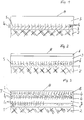
- the bottom region is often a base region 1 consisting of a fibrous sheet-like structure, that of ordered or disordered textile and / or mineral Fibers are provided, which serve to promote the adhesion of the multi-material composite material to the laying surface 2 on the one hand and on the other hand to a homogeneous, PVC-free, thermoplastic polymer region 3.
- the fiber-containing base region 1 is the carrier for a patterning / design of the multi-material composite material provided with single or multi-colored motifs.
- This colored or patterned design is applied to or into the fibers in a printing process on the fibrous sheet-like structure which forms the base region 1, and there it is made up of a partial sheet-like inorganic or / and organic contained in a thermoplastic binder
- the design zone 5 is located within the upper penetration region 4.
- the homogeneous thermoplastic polymer region 3 consisting of a PVC-free plastic is designed here as a transparent wear layer, which advantageously increases the abrasion resistance from a mixture of one or more olefin components (n) and one or more thermoplastic elastomer component (s).
- the molecular groups of the material components form a penetration network in which the thermoplastic elastomer components are contained as a discontinuous phase and the olefin components as a continuous phase in the network.
- a wear layer 6 made of PVC on the polymer region 3 free plastic provided. If the materials used for the wear application 6 and for the polymer region 3 cannot be joined / joined with the known agents on account of their material properties, there is a fiber-containing middle region 7 between the polymer wear application 6 and the polymer region 3 corresponds, provided.
- the fiber-containing central region 7 can be used in the same way as the fiber-containing base region 1- as a carrier of a design / pattern zone 5 in the multi-material composite material consisting of single or multi-colored motifs.
- a penetration region 4 is formed on both sides of the fiber-containing central region 7 between this and the respectively adjacent polymer region 3 or the wear application 6 consisting of PVC-free plastic.
- material from the wear application 6 or that from the polymer region 3 is embedded between the fibers and forms a positive adhesive bond between the fiber surface and the polymer through the incorporation of polymers into the fiber matrix.
- the wear application 6 is provided on its surface 8 with a relief-like structure (not shown) which is preferably formed by a thermoplastic deformation.
- the web-shaped flexible multi-material composite material according to the invention is preferably produced in conventional multi-roll mills, with the three-region structure of the multi-material composite material the roller gap, not shown, between a pair of rollers, also not shown, on the one hand, the fiber-containing material of a base region 1 or a central region 7 and, on the other hand, simultaneously immediately before in an extruder melted polymer as a thermoplastic melt can be fed via a shaping device as a melt surface for a polymer region 3 or for a wear application 6.
- a polymer alloy with the following material composition and properties is used as the polymer for the transparent wear application 6:
- Component 1 copolymer polypropylene, preferably graft polymer of maleic anhydride grafted onto polypropylene.
- Component 2 Thermoplastic elastomer compounds based on styrene-ethylene-butylene-CO block polymer
- the alloy of both components is in the range 70 mass% component 1 30 mass% component 2 preferably 85 - 80 mass% component 1 15 - 20 mass% component 2
- a filled polymer is used as material for the polymer region, which does not serve as a transparent wear application, as follows:
- Polyolefin elastomers preferably copolymers of ethylene and building blocks of the series C 4 H 8 to C 8 H 6, preferably octene 1 Melting range 80-120 ° C Density range: 0.80-0.9 g / cm 3 , preferably 0.86-0.88 g / cm 3
- Calcium carbonate preferably finely ground crystalline product Density: 2.60 - 2.90 g / cm 3 preferably 2.65 - 2.75 g / cm 3 Mohs hardness: 2.90 - 3.10
- Polymer blend consists of: Component 1: 30 - 40 mass% polyolefin elastomer Component 2: 20 - 40 mass% calcium carbonate Component 3: 10 - 40 mass% magnesium hydroxide Component 4: 0 - 20 mass% heavy spar we prefer the following polymer mixture: Component 1: 30 - 35% polyolefin elastomer (octene-1 copolymer with ethylene) Component 2: 30-40% calcium carbonate Component 3: 35 - 40% magnesium hydroxide
Landscapes
- Engineering & Computer Science (AREA)
- Textile Engineering (AREA)
- Chemical & Material Sciences (AREA)
- Chemical Kinetics & Catalysis (AREA)
- Synthetic Leather, Interior Materials Or Flexible Sheet Materials (AREA)
- Floor Finish (AREA)
- Laminated Bodies (AREA)
Applications Claiming Priority (2)
| Application Number | Priority Date | Filing Date | Title |
|---|---|---|---|
| DE19616862A DE19616862C1 (de) | 1996-04-26 | 1996-04-26 | Mehrstoffverbundmaterial aus einem halogenverbindungsfreien flexiblen Kunststoff und Verfahren zur Herstellung desselben |
| DE19616862 | 1996-04-26 |
Publications (2)
| Publication Number | Publication Date |
|---|---|
| EP0803350A2 true EP0803350A2 (fr) | 1997-10-29 |
| EP0803350A3 EP0803350A3 (fr) | 1998-10-28 |
Family
ID=7792607
Family Applications (1)
| Application Number | Title | Priority Date | Filing Date |
|---|---|---|---|
| EP97250128A Withdrawn EP0803350A3 (fr) | 1996-04-26 | 1997-04-20 | Produit multicouche et méthode pour la production d'un produit multicouche plat à base de résine flexible, exempte d'halogène |
Country Status (2)
| Country | Link |
|---|---|
| EP (1) | EP0803350A3 (fr) |
| DE (1) | DE19616862C1 (fr) |
Cited By (1)
| Publication number | Priority date | Publication date | Assignee | Title |
|---|---|---|---|---|
| EP1857267A1 (fr) * | 2006-05-19 | 2007-11-21 | K+S GmbH Modell-und Formenbau | Pièce plastique bi-composant et procédé de fabrication de cette pièce |
Families Citing this family (1)
| Publication number | Priority date | Publication date | Assignee | Title |
|---|---|---|---|---|
| DE102006002541B4 (de) * | 2006-01-18 | 2010-02-18 | Sven Hunze | Verbundmaterial mit sichtbarer Gewebeschicht und Herstellungsverfahren |
Family Cites Families (5)
| Publication number | Priority date | Publication date | Assignee | Title |
|---|---|---|---|---|
| GB1532621A (en) * | 1974-11-14 | 1978-11-15 | Nairn Floors Ltd | Bonded glass fibre substrate for flooring material |
| JPS6047955B2 (ja) * | 1979-08-02 | 1985-10-24 | 東レ株式会社 | 透湿性、防水性コーテイング生地 |
| DE4028475A1 (de) * | 1990-09-07 | 1992-03-12 | Phoenix Ag | Hochhitzbestaendige elastomer-platte |
| CH687492B5 (de) * | 1992-08-28 | 1997-06-30 | Textilma Ag | Verfahren und Anlage zur Beschichtung von textilen Flachkoerpern, insbesondere von Teppichplatten. |
| DE4438888C2 (de) * | 1994-10-17 | 1996-08-14 | Debolon Dessauer Bodenbelaege | Bahnenförmiges flexibles Flächenmaterial aus einem halogenverbindungsfreien Kunststoff mit einer verschleißfesten Oberfläche, insbesondere für einen gemusterten Fußbodenbelag, und Verfahren zur Herstellung eines heterogenen Flächenmaterials |
-
1996
- 1996-04-26 DE DE19616862A patent/DE19616862C1/de not_active Expired - Fee Related
-
1997
- 1997-04-20 EP EP97250128A patent/EP0803350A3/fr not_active Withdrawn
Cited By (2)
| Publication number | Priority date | Publication date | Assignee | Title |
|---|---|---|---|---|
| EP1857267A1 (fr) * | 2006-05-19 | 2007-11-21 | K+S GmbH Modell-und Formenbau | Pièce plastique bi-composant et procédé de fabrication de cette pièce |
| DE102006023847A1 (de) * | 2006-05-19 | 2007-11-22 | K + S Gmbh Modell- Und Formenbau | Zwei-Komponenten-Kunststoffbauteil und Verfahren zum Herstellen dieses Zwei-Komponenten-Kunststoffbauteils |
Also Published As
| Publication number | Publication date |
|---|---|
| DE19616862C1 (de) | 1997-10-30 |
| EP0803350A3 (fr) | 1998-10-28 |
Similar Documents
| Publication | Publication Date | Title |
|---|---|---|
| EP0046526B1 (fr) | Procédé pour la fabrication en continue de bandes en matières thermoplastiques | |
| DE3432813C2 (de) | Laminierte bituminöse Abdeckhaut | |
| EP0621128A2 (fr) | Revêtement de sol multicouche thermoplastique à base de polyoléfine et son procédé de fabrication | |
| EP0710179B1 (fr) | Bandes ou plaques de plastique multicouches pourvues d'une couche de recouvrement transparente | |
| EP2605908B1 (fr) | Matériau composite comportant un matériau de revêtement | |
| DE2555840A1 (de) | Boden- oder wandbelag und verfahren zu seiner herstellung | |
| DE4438888C2 (de) | Bahnenförmiges flexibles Flächenmaterial aus einem halogenverbindungsfreien Kunststoff mit einer verschleißfesten Oberfläche, insbesondere für einen gemusterten Fußbodenbelag, und Verfahren zur Herstellung eines heterogenen Flächenmaterials | |
| WO1989005835A1 (fr) | Bande ou plaque homogene, notamment multicolore, en plastique et son procede de production | |
| EP1144752B1 (fr) | Structure plane multicouche flexible avec couche de protection renforcee | |
| WO2017133716A1 (fr) | Procédé de fabrication de film, système de fabrication de film et film en matière plastique | |
| DE69419983T2 (de) | Vorgefertigtes mehrschichtiges Produkt zum Abdichten von einer Eindeckung und von Dachabdeckungen und Verfahren zur seiner Herstellung | |
| DE19616862C1 (de) | Mehrstoffverbundmaterial aus einem halogenverbindungsfreien flexiblen Kunststoff und Verfahren zur Herstellung desselben | |
| US5997782A (en) | Multi-component composite material and method for producing a laminar multi-component composite material from a halogen compound-free flexible plastic | |
| EP0460375A2 (fr) | Bande textile pour la fabrication des bâches pour les véhicules et des choses similaires | |
| EP0755764B1 (fr) | Procédé pour la fabrication des revêtements de sol au tapis de plancher homogènes avec un motif coloré non-orienté | |
| DE4209342A1 (de) | Dichtungsbahn | |
| DE4215755C1 (en) | Polyolefin edging material for wood and fibre boards - is extruded with a fine bulking material for adhesion surface to be closed by corona gas discharge | |
| EP1088129B1 (fr) | Nouvelle structure de linoleum et son procede de fabrication | |
| EP0839948A2 (fr) | Produits en feuilles de matériaux naturels ou synthétiques comportant un motif prédéterminé et durable | |
| DE69927885T2 (de) | Bodenbelag insbesondere für Kraftfahrzeuge und Verfahren zu dessen Herstellung | |
| EP1648678B1 (fr) | Feuille de linoleum a motifs et son procédé de production | |
| DE4238764C2 (de) | Verfahren zum einseitigen Beschichten von Flächengebilden aus Fasern mit Kunststoff, Vorrichtung zur Durchführung des Verfahrens und Verwendung der Verfahrensprodukte | |
| DE3737675A1 (de) | Verfahren zur herstellung von kunststoffabdichtungsbahnen | |
| WO2001032417A1 (fr) | Demi-produit multicouche a surface structuree en matieres thermoplastiques et procede de structuration de film | |
| DE3743297A1 (de) | Verfahren zur herstellung von mehrfarbig strukturierten, homogenen kunststoffbahnen oder -platten |
Legal Events
| Date | Code | Title | Description |
|---|---|---|---|
| PUAI | Public reference made under article 153(3) epc to a published international application that has entered the european phase |
Free format text: ORIGINAL CODE: 0009012 |
|
| AK | Designated contracting states |
Kind code of ref document: A2 Designated state(s): AT BE CH FI FR GB IE IT LI NL SE |
|
| PUAL | Search report despatched |
Free format text: ORIGINAL CODE: 0009013 |
|
| AK | Designated contracting states |
Kind code of ref document: A3 Designated state(s): AT BE CH FI FR GB IE IT LI NL SE |
|
| STAA | Information on the status of an ep patent application or granted ep patent |
Free format text: STATUS: THE APPLICATION IS DEEMED TO BE WITHDRAWN |
|
| 18D | Application deemed to be withdrawn |
Effective date: 19990429 |