EP0802364A2 - Blende zum Kaschieren von Wanddurchbrüchen - Google Patents
Blende zum Kaschieren von Wanddurchbrüchen Download PDFInfo
- Publication number
- EP0802364A2 EP0802364A2 EP97105825A EP97105825A EP0802364A2 EP 0802364 A2 EP0802364 A2 EP 0802364A2 EP 97105825 A EP97105825 A EP 97105825A EP 97105825 A EP97105825 A EP 97105825A EP 0802364 A2 EP0802364 A2 EP 0802364A2
- Authority
- EP
- European Patent Office
- Prior art keywords
- wall
- locking
- retaining
- panel according
- feature
- Prior art date
- Legal status (The legal status is an assumption and is not a legal conclusion. Google has not performed a legal analysis and makes no representation as to the accuracy of the status listed.)
- Granted
Links
Images


Classifications
-
- H—ELECTRICITY
- H02—GENERATION; CONVERSION OR DISTRIBUTION OF ELECTRIC POWER
- H02G—INSTALLATION OF ELECTRIC CABLES OR LINES, OR OF COMBINED OPTICAL AND ELECTRIC CABLES OR LINES
- H02G3/00—Installations of electric cables or lines or protective tubing therefor in or on buildings, equivalent structures or vehicles
- H02G3/22—Installations of cables or lines through walls, floors or ceilings, e.g. into buildings
-
- F—MECHANICAL ENGINEERING; LIGHTING; HEATING; WEAPONS; BLASTING
- F16—ENGINEERING ELEMENTS AND UNITS; GENERAL MEASURES FOR PRODUCING AND MAINTAINING EFFECTIVE FUNCTIONING OF MACHINES OR INSTALLATIONS; THERMAL INSULATION IN GENERAL
- F16L—PIPES; JOINTS OR FITTINGS FOR PIPES; SUPPORTS FOR PIPES, CABLES OR PROTECTIVE TUBING; MEANS FOR THERMAL INSULATION IN GENERAL
- F16L5/00—Devices for use where pipes, cables or protective tubing pass through walls or partitions
Definitions
- the invention relates to panels for installation ducts such as cable routing ducts, device installation ducts, cable trays, etc. for covering wall openings, in accordance with the preamble of claim 1.
- a so-called corner bracket kit is commercially available, consisting of two corner pieces with locking bars, a wall sheet profile guide piece and aluminum wall sheet profile rails. The latter are cut to length from a standard rail according to the channel height and depth and clipped onto the corner bracket kit.
- corner bracket kit is commercially available, consisting of two corner pieces with locking bars, a wall sheet profile guide piece and aluminum wall sheet profile rails. The latter are cut to length from a standard rail according to the channel height and depth and clipped onto the corner bracket kit.
- the present invention has for its object to provide an aperture of the type mentioned, which is simple and inexpensive, which sits firmly, but can also be quickly assembled and disassembled, which can be adapted to any channel size and which in particular produces an optically satisfactory image .
- the panel according to the invention uses four prefabricated lamination corners, in particular molded from plastic, and four matching profile rails, which are cut to length by a prefabricated profile bar.
- the connection takes place by means of a snap-in connection, the snap-in means being arranged in such a way that the cut edges of the profile rails are covered by the lamination corners, so that any inaccuracies remain invisible. Thanks to the snap-in connection, length compensation is also possible within certain limits, so that a cover that exactly matches the respective installation duct can be produced in any case.
- the wall bracket is fixed to the perforated wall and / or the duct. It has special retaining lugs with a toothed active surface, which interact with retaining springs provided on the back of the lamination corners, which also have a toothed active surface.
- the locking slide which has a corresponding bracket, ensures that the retaining springs on the lamination corners are freely movable during assembly and can be removed from the retaining lugs of the wall bracket; in the end or locking position, however, the retaining springs are blocked so that the panel can no longer be removed.
- a retaining strip is formed on the back of the profile rail, specifically on the longitudinal edge adjacent to the channel, which is oriented parallel to the surface of the channel. Formed into a retaining edge in this retaining strip, which corresponds to a locking lug on the locking tongue of the locking slide and fixes the locking slide in the locked position.
- the side edges of the lamination corners preferably form an obtuse angle to one another. This ensures a wide coverage of the cut edges of the profile rails.
- the visible surfaces of the screen form an acute angle to the wall surface. This gives the cover a visually pleasing impression and reduces the installation on the wall.
- the wall brackets are preferably equipped with an adhesive layer on their surface facing the duct, which facilitates the assembly of the wall brackets and improves the correct fit of the panel.
- Fig. 1 shows a perspective view of a cable duct 1 with cover 2, which breaks through a wall 3.
- the wall opening is covered with a panel 10.
- This consists of four laminating corners 20.1 ... 20.4 and four profile rails 40.1 ... 40.4.
- Kaschierecken 20 and profile bars 40 are plugged together.
- a locking slide 50 makes it possible to fix the panel 10 after positioning in front of the wall opening.
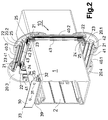
- FIG. 2 shows a view of the rear of channel 1, 2 and panel 10.
- a wall holder 30 is mounted on a narrow side of the channel 1 with the aid of an adhesive layer 39. Whose surface facing the wall surface is equipped with two holes 31 for a possible screw assembly. Parallel to channel 1, a tongue 32 can be seen which interacts with the profile rails 40. In addition, one can see on the wall bracket 30 two retaining lugs 33, 34 with a toothed active surface 35 which interacts with the liner corners 20.
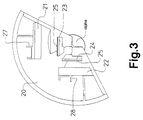
- the construction of the liner corners 20 results from the top view of the back of a liner corner 20 in an enlarged view according to FIG. 3.
- Two latching tongues 21, 22 oriented at right angles to one another can be seen, which cooperate with the teeth 41, 42.
- the side edges of the liner corners 20 mutually form an obtuse angle alpha.
- the locking slide 50 is provided. This is pushed onto the holding bar 43 of a profile rail 40.4, for which purpose it is equipped with a corresponding holder 53. This is shown in FIGS. 4, 5 and 6.
- the locking slide 50 also has a central recess 54 in which a resilient locking tongue 52 is seated, which is equipped with a locking lug 55. Finally, a visible part 51 is also provided, which defines the end or locked state of the locking slide 50.
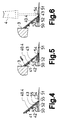
- Fig. 4 shows excerpts of the relative position of locking slide 50 and rail 40.4 in the delivery state.
- the locking slide 50 is pulled out so far that the locking lug 55 is visible.
- FIG. 5 shows the combination of FIG. 4 in the final or locked state in front of a wall 3.
- the locking slide 50 is pushed so far below the profile rail 40.4 that the locking lug 55 engages behind a locking edge 45 provided on the retaining strip 43.
- FIG. 6 shows the situation when dismantling the panel 10. With the tip of a screwdriver 4, the locking tab 55 is released from the locking edge 45 by bending the locking tongue 52 and the locking slide 50 is pulled forward.
- Fig. 7 shows in part the combination of profile rail 40.4, locking slide 50 and wall bracket 30 in front of the perforated wall 3.
- a bracket 53 is formed on the rear of the locking slide 50, which corresponds to the retaining spring 23 on the back of the concealment corner 20.
- the holder 53 and the holding spring 23 are separated.
- the retaining spring 23 is resiliently movable, the liner corner 20 and thus the entire panel 10 can be removed from the retaining lugs 33, 34 of the wall bracket 30.
- Fig. 8 shows the situation in the final or locked state.
- the bracket 53 now blocks the retaining spring 23.
- the latching connection between the retaining spring 23 and the latch 33 can no longer be released, the panel 10 is permanently fixed.
- Fig. 9 shows the situation during disassembly.
- the locking slide 50 is moved into the released position.
- the holder 53 has released the retaining spring 23, so that the panel 10 can be removed from the toothed active surfaces 35 of the retaining lugs 33, 34 of the wall holder 30.
- the tongues 32 on the wall bracket 30 are arranged so that they clamp the retaining bar 43, as is necessary for a firm but releasable hold of the panel 10.
Landscapes
- Engineering & Computer Science (AREA)
- Architecture (AREA)
- Civil Engineering (AREA)
- Structural Engineering (AREA)
- General Engineering & Computer Science (AREA)
- Mechanical Engineering (AREA)
- Professional, Industrial, Or Sporting Protective Garments (AREA)
- Finishing Walls (AREA)
- Fire-Detection Mechanisms (AREA)
- Air Bags (AREA)
- Drilling And Exploitation, And Mining Machines And Methods (AREA)
- Turbine Rotor Nozzle Sealing (AREA)
- Farming Of Fish And Shellfish (AREA)
- Details Of Indoor Wiring (AREA)
- Emergency Lowering Means (AREA)
- Building Environments (AREA)
Abstract
Description
- Die Erfindung betrifft Blenden für Installationskanäle wie Leitungsführungskanäle, Geräteeinbaukanäle, Kabelbahnen usw. zum Kaschieren von Wanddurchbrüchen gemäß dem Oberbegriff des Anspruchs 1.
- Werden Installationskanäle durch Wände hindurchgeführt, muß der Mauerdurchbruch durch eine geeignete Blende kaschiert werden. Hierzu ist ein sogenannter Eckwinkel-Bausatz handelsüblich, bestehend aus zwei Eckstücken mit Raststegen, einem Wandblechprofil-Führungsstück und Aluminium-Wandblechprofilschienen. Letztere werden von einer Standardschiene entsprechend der Kanalhöhe und -tiefe abgelängt und auf den Eckwinkel-Bausatz aufgeclipst. Mit Hilfe einer solchen aus Einzelteilen zusammengesteckten Wandblende läßt sich der Wanddurchbruch kaschieren; das optische Bild der Blende ist jedoch wenig befriedigend, insbesondere da die Schnittkanten der Aluminium-Wandblendprofilschienen sichtbar bleiben.
- Der vorliegenden Erfindung liegt die Aufgabe zugrunde, eine Blende der eingangs genannten Art anzugeben, die einfach und preiswert ist, die fest sitzt, jedoch auch schnell montiert und demontiert werden kann, die an jede Kanalabmessung angepaßt werden kann und die insbesondere ein optisch befriedigendes Bild erzeugt.
- Diese Aufgabe wird gelöst durch eine Blende mit den Merkmalen des Anspruchs 1.
- Die erfindungsgemäße Blende verwendet vier vorgefertigte, insbesondere aus Kunststoff gespritzte Kaschierecken und vier dazu passende Profilschienen, die von einem vorgefertigten Profilstab abgelängt werden. Die Verbindung erfolgt durch eine Rastverbindung, wobei die Rastmittel so angeordnet sind, daß die Schnittkanten der Profilschienen von den Kaschierecken verdeckt werden, so daß etwaige Ungenauigkeiten unsichtbar bleiben. Dank der Rastverbindung ist außerdem in gewissen Grenzen ein Längenausgleich möglich, so daß in jedem Fall eine zu dem jeweiligen Installationskanal genau passende Blende hergestellt werden kann.
- Damit die Blende an ihrem Montageort fest montiert, bei Bedarf jedoch wieder gelöst werden kann, sind zusätzlich ein oder zwei Wandhalter und ein Rastschieber vorgesehen. Der Wandhalter wird an der durchbrochenen Wand und/oder am Kanal fixiert. Er besitzt spezielle Haltenasen mit einer gezahnten Wirkfläche, die mit an der Rückseite der Kaschierecken vorgesehenen Haltefedern mit ebenfalls gezahnter Wirkfläche zusammenwirken. Dabei sorgt der Rastschieber, der eine entsprechende Halterung besitzt, dafür, daß die Haltefedern an den Kaschierecken während der Montage frei beweglich sind und von den Haltenasen der Wandhalter abgezogen werden können; in der End- bzw. Sperrposition dagegen werden die Haltefedern so blockiert, daß die Blende nicht mehr abgezogen werden kann.
- Um den Rastschieber montieren zu können, ist an der Rückseite der Profilschiene, und zwar an der an den Kanal angrenzenden Längskante, eine Halteleiste angeformt, die parallel zur Oberfläche des Kanals orientiert ist. In diese Halteleiste in eine Rastkante eingeformt, die mit einer Rastnase an der Rastzunge des Rastschiebers korrespondiert und den Rastschieber in der Sperrposition fixiert.
- Vorzugsweise schließen die Seitenkanten der Kaschierecken einen stumpfen Winkel zueinander ein. Dies sorgt für eine breite Überdeckung der Schnittkanten der Profilschienen.
- Gemäß einer Weiterbildung der Erfindung schließen die Sichtflächen der Blende einen spitzen Winkel zur Wandfläche ein. Dies verleiht der Blende einen optisch gefälligen Eindruck und reduziert die Anlage an der Wand.
- Vorzugsweise sind die Wandhalter an ihrer dem Kanal zugewandten Fläche mit einer Klebeschicht ausgerüstet, wodurch die Montage der Wandhalter erleichtert und der korrekte Sitz der Blende verbessert wird.
- Weitere Ausgestaltungen der Erfindung sind Gegenstand der restlichen Unteransprüche.
- Anhand der Zeichnung soll die Erfindung in Form von Ausführungsbeispielen näher erläutert werden. Es zeigen
- Fig. 1
- eine perspektivische Darstellung eines Leitungsführungskanals mit Blende zum Kaschieren eines Wanddurchbruchs, auf die Sichtseite gesehen,
- Fig. 2
- eine perspektivische Darstellung von Kanal und Blende, hier von der Rückseite gesehen,
- Fig. 3
- eine Draufsicht auf die Rückseite einer Kaschierecke,
- Fig. 4
- einen Schnitt durch eine Profilschiene mit montiertem Rastschieber im Anlieferungszustand,
- Fig. 5
- eine Darstellung der Kombination aus Profilschiene und Rastschieber gemäß Fig. 4 im End- bzw. Sperrzustand,
- Fig. 6
- die Kombination von Profilstab und Rastschieber gemäß Fig. 4 im Demontagezustand,
- Fig. 7
- einen Schnitt durch die Kombination aus Profilstab, Rastschieber und Wandhalter im Bereich von Haltefeder und Haltenase im werksseitigen Lieferzustand,
- Fig. 8
- einen Schnitt durch die Kombination der Fig. 7 im End- bzw. Sperrzustand und
- Fig. 9
- einen Schnitt durch die Kombination der Fig. 7 im Demontagezustand.
- Fig. 1 zeigt in perspektivischer Darstellung einen Leitungsführungskanal 1 mit Deckel 2, der eine Wand 3 durchbricht. Der Wanddurchbruch ist mit Hilfe einer Blende 10 kaschiert. Diese besteht aus vier Kaschierecken 20.1 ... 20.4 und vier Profilschienen 40.1 ... 40.4. Kaschierecken 20 und Profilstäbe 40 sind zusammengesteckt. Ein Rastschieber 50 macht es möglich, die Blende 10 nach der Positionierung vor dem Wanddurchbruch zu fixieren.
- Fig. 2 zeigt einen Blick auf die Rückseite von Kanal 1, 2 und Blende 10.
- Auf einer Schmalseite des Kanals 1 ist mit Hilfe einer Kleberschicht 39 ein Wandhalter 30 montiert. Dessen der Wandoberfläche zugewandte Fläche ist mit zwei Bohrungen 31 ausgerüstet für eine eventuelle Schraubmontage. Parallel zum Kanal 1 erkennt man eine Zunge 32, die mit den Profilschienen 40 zusammenwirkt. Außerdem erkennt man am Wandhalter 30 zwei Haltenasen 33, 34 mit einer gezahnten Wirkfläche 35, die mit den Kaschierecken 20 zusammenwirkt.
- An der Rückseite der Profilschienen 40 erkennt man angrenzend an den Kanal 1 eine Halteleiste 43, die sich parallel zu den Oberflächen des Kanals 1 erstreckt. Des weiteren erkennt man zwei Zahnungen 41, 42, mit deren Hilfe die Rastverbindung zu den Kaschierecken 20 hergestellt wird.
- Die Konstruktion der Kaschierecken 20 ergibt sich aus der Draufsicht auf die Rückseite einer Kaschierecke 20 in vergrößerter Darstellung gemäß Fig. 3. Man erkennt zwei rechtwinklig zueinander orientierte Rastzungen 21, 22, die mit den Zahnungen 41, 42 zusammenwirken. Man erkennt des weiteren zwei Anschläge 27, 28, die die Eintauchtiefe der Profilschienen 40 begrenzen. Schließlich erkennt man zwei rechtwinklig zueinander orientierte Haltefedern 23, 24 mit gezahnter Wirkfläche 25. Diese korrespondiert mit der gezahnten Wirkfläche 35 der Haltenase 33, 34 des Wandhalters 30. Dank der federnden Eigenschaften der Haltefedern 23, 24 können die Kaschierecken 20 von dem Wandhalter 30 abgezogen werden.
- Die Seitenkanten der Kaschierecken 20 schließen gegenseitig einen stumpfen Winkel alpha ein.
- Um die Blende 10 in ihrer Endposition vor dem Wanddurchbruch fixieren zu können, ist der Rastschieber 50 vorgesehen. Dieser wird auf die Halteleiste 43 einer Profilschiene 40.4 aufgeschoben, wozu er mit einer entsprechenden Halterung 53 ausgerüstet ist. Dies zeigen die Fig. 4, 5 und 6.
- Der Rastschieber 50 besitzt des weiteren eine zentrale Aussparung 54, in der eine federnde Rastzunge 52 sitzt, die mit einer Rastnase 55 ausgerüstet ist. Schließlich ist noch ein Sichtteil 51 vorgesehen, welches den End- oder Sperrzustand des Rastschiebers 50 definiert.
- Fig. 4 zeigt auszugsweise die Relativposition von Rastschieber 50 und Profilschiene 40.4 im Lieferzustand. Der Rastschieber 50 ist so weit herausgezogen, daß die Rastnase 55 sichtbar ist.
- Fig. 5 zeigt die Kombination der Fig. 4 im End- oder Sperrzustand vor einer Wand 3. Der Rastschieber 50 ist so weit unter die Profilschiene 40.4 geschoben, daß die Rastnase 55 hinter einer an der Halteleiste 43 vorgesehenen Rastkante 45 einrastet.
- Fig. 6 zeigt die Situation beim Demontieren der Blende 10. Mit der Spitze eines Schraubendrehers 4 wird durch Verbiegen der Rastzunge 52 die Rastnase 55 von der Rastkante 45 gelöst und der Rastschieber 50 nach vorne gezogen.
- Anhand der Fig. 7, 8 und 9 wird die Wirkung der anhand der Fig. 4, 5 und 6 beschriebenen Stellungen des Rastschiebers 50 erläutert.
- Fig. 7 zeigt auszugsweise die Kombination aus Profilschiene 40.4, Rastschieber 50 und Wandhalter 30 vor der durchbrochenen Wand 3. An der Hinterseite des Rastschiebers 50 ist eine Halterung 53 angeformt, die mit der Haltefeder 23 an der Rückseite der Kaschierecke 20 korrespondiert. In dem in Fig. 7 dargestellten Lieferzustand sind Halterung 53 und Haltefeder 23 getrennt. Die Haltefeder 23 ist federnd beweglich, die Kaschierecke 20 und damit die gesamte Blende 10 können von den Haltenasen 33, 34 der Wandhalter 30 abgezogen werden.
- Fig. 8 zeigt die Situation im End- bzw. Sperrzustand. Die Halterung 53 blockiert jetzt die Haltefeder 23. Die Rastverbindung zwischen Haltefeder 23 und Rastnase 33 läßt sich nicht mehr lösen, die Blende 10 ist dauerhaft fixiert.
- Fig. 9 zeigt die Situation während der Demontage. Der Rastschieber 50 ist in die gelöste Position verschoben.
- DieHalterung 53 hat die Haltefeder 23 freigegeben, so daß die Blende 10 von den gezahnten Wirkflächen 35 der Haltenasen 33, 34 des Wandhalters 30 abgezogen werden kann.
- Die Zungen 32 am Wandhalter 30 sind so angeordnet, daß sie die Halteleiste 43 festklemmen, wie es für einen festen, jedoch lösbaren Halt der Blende 10 erforderlich ist.
Claims (9)
- Blende (10) für Installationskanäle (1, 2) wie Leitungsführungskanäle, Geräteeinbaukanäle usw. zum Kaschieren von Wanddurchbrüchen, zusammengesteckt aus vorgefertigten bzw. entsprechend der Kanal-Abmessungen abgelängten Teilen (20, 30, 40, 50), gekennzeichnet durch die Merkmale:- es sind vier Kaschierecken (20.1 ... 20.4) vorgesehen,- jede Kaschierecke (20) besitzt auf ihrer Rückseite-- zwei winklig zueinander orientierte Rastzungen (21, 22) und-- zwei winklig zueinander orientierte Haltefedern (23, 24) mit einer gezahnten Wirkfläche (25),- es sind zwei Wandhalter (30.1, 30.2) vorgesehen,- jeder Wandhalter (30) besitzt wenigstens eine Haltenase (33, 34)- die Haltenase (33, 34) besitzt eine gezahnte Wirkfläche (35), die mit der Wirkfläche (25) der Haltefedern (23, 24) kooperiert,- es sind vier Profilschienen (40) vorgesehen, deren Länge an die Abmessungen des Kanals (1, 2) angepaßt ist,- jede Profilschiene (40) besitzt auf ihrer Rückseite-- wenigstens eine Zahnung (41, 42), mit mit den Rastzungen (21, 22) kooperiert, und-- eine Halteleiste (43), die an der an den Kanal (1, 2) anstoßenden Längsseite positioniert und parallel zur Kanaloberfläche orientiert ist,- es ist ein Rastschieber (50) vorgesehen,- der Rastschieber (50) besitzt-- auf seiner Rückseite eine Halterung (53), die auf die Profilschiene (40) aufsteckbar ist,-- einen Ausschnitt (54) und darin-- eine federnde Rastzunge (52), die mit der Profilschiene (40) kooperiert,- die Halterung (53) greift so hinter die Haltefedern (23, 24), daß diese-- in der Montageposition des Rastschiebers (50) frei beweglich,-- in seiner Endposition dagegen blockiert sind.
- Blende nach Anspruch 1, gekennzeichnet durch die Merkmale:- es sind zwei Zahnungen (41, 42) vorgesehen,- die Zahnungen (41, 42) sind einander entgegengesetzt sägezahnförmig profiliert.
- Blende nach Anspruch 1 oder 2, gekennzeichnet durch das Merkmal:- der Wandhalter (30) besitzt wenigstens eine Zunge (32), die die Halteleiste (43) festklemmt.
- Blende nach einem der Ansprüche 1 bis 3, gekennzeichnet durch das Merkmal:- die Kanten (29) der Kaschierecken (20) schließen einen stumpfen Winkel (alpha) ein.
- Blende nach einem der Ansprüche 1 bis 4, gekennzeichnet durch das Merkmal:- die Kaschierecken (20) besitzen auf ihrer Rückseite je einen Anschlag (27, 28) für die Profilschienen (30).
- Blende nach einem der Ansprüche 1 bis 5, gekennzeichnet durch das Merkmal:- die Sichtflächen der Blende (10) schließen einen spitzen Winkel (beta) zur Wandfläche (3) ein.
- Blende nach einem der Ansprüche 1 bis 6, gekennzeichnet durch die Merkmale:- der Wandhalter (30) besteht aus Metall,- die anderen Teile (20, 40, 50) aus Kunststoff.
- Blende nach einem der Ansprüche 1 bis 7, gekennzeichnet durch das Merkmal:- der Wandhalter (30) trägt an seiner dem Kanal (1, 2) zugewandten Fläche eine Klebeschicht (39).
- Blende nach einem der Ansprüche 1 bis 8, gekennzeichnet durch die Merkmale.- in die Halteleiste (43) ist eine Rastkante (45) eingeformt,- eine Rastnase (55) an der Rastzunge (52) korrespondiert mit der Rastkante (45).
Applications Claiming Priority (2)
| Application Number | Priority Date | Filing Date | Title |
|---|---|---|---|
| DE29606987U | 1996-04-19 | ||
| DE29606987U DE29606987U1 (de) | 1996-04-19 | 1996-04-19 | Blende zum Kaschieren von Wanddurchbrüchen |
Publications (3)
| Publication Number | Publication Date |
|---|---|
| EP0802364A2 true EP0802364A2 (de) | 1997-10-22 |
| EP0802364A3 EP0802364A3 (de) | 1998-04-08 |
| EP0802364B1 EP0802364B1 (de) | 1999-08-04 |
Family
ID=8022718
Family Applications (1)
| Application Number | Title | Priority Date | Filing Date |
|---|---|---|---|
| EP97105825A Expired - Lifetime EP0802364B1 (de) | 1996-04-19 | 1997-04-09 | Blende zum Kaschieren von Wanddurchbrüchen |
Country Status (5)
| Country | Link |
|---|---|
| EP (1) | EP0802364B1 (de) |
| AT (1) | ATE182969T1 (de) |
| DE (2) | DE29606987U1 (de) |
| DK (1) | DK0802364T3 (de) |
| ES (1) | ES2137032T3 (de) |
Cited By (1)
| Publication number | Priority date | Publication date | Assignee | Title |
|---|---|---|---|---|
| FR2805095A1 (fr) * | 2000-02-14 | 2001-08-17 | Planet Wattohm Sa | Adaptateur pour le raccordement de deux conduits de cablage intervenant de part et d'autre d'un faux-plafond |
Families Citing this family (1)
| Publication number | Priority date | Publication date | Assignee | Title |
|---|---|---|---|---|
| DE29922514U1 (de) * | 1999-12-22 | 2001-05-31 | Tehalit GmbH & Co. KG, 67716 Heltersberg | Blende zum Kaschieren von Wanddurchbrüchen |
Family Cites Families (2)
| Publication number | Priority date | Publication date | Assignee | Title |
|---|---|---|---|---|
| DE2809463C2 (de) * | 1978-03-04 | 1982-09-30 | Neuwalzwerk Bettermann Ohg, 5750 Menden | Brandabweisende Kabeldurchführung durch Trennwände o.dgl. |
| DE9003636U1 (de) * | 1990-03-28 | 1990-05-31 | CSD International B.V., Opmeer | Anordnung zur Vermeidung der Fortpflanzung von beispielsweise Feuer, Wasser oder (Rauch-) Gas über Kabel |
-
1996
- 1996-04-19 DE DE29606987U patent/DE29606987U1/de not_active Expired - Lifetime
-
1997
- 1997-04-09 DK DK97105825T patent/DK0802364T3/da active
- 1997-04-09 ES ES97105825T patent/ES2137032T3/es not_active Expired - Lifetime
- 1997-04-09 EP EP97105825A patent/EP0802364B1/de not_active Expired - Lifetime
- 1997-04-09 DE DE59700299T patent/DE59700299D1/de not_active Expired - Fee Related
- 1997-04-09 AT AT97105825T patent/ATE182969T1/de not_active IP Right Cessation
Cited By (3)
| Publication number | Priority date | Publication date | Assignee | Title |
|---|---|---|---|---|
| FR2805095A1 (fr) * | 2000-02-14 | 2001-08-17 | Planet Wattohm Sa | Adaptateur pour le raccordement de deux conduits de cablage intervenant de part et d'autre d'un faux-plafond |
| EP1126570A1 (de) * | 2000-02-14 | 2001-08-22 | Planet Wattohm | Adapter zur Verbindung von zwei Kabelrinnen an jeder Seite einer aufgehängten Decke |
| US6479750B1 (en) | 2000-02-14 | 2002-11-12 | Planet Wattohm | Adapter for interconnecting two wiring ducts on opposite sides of a suspended ceiling |
Also Published As
| Publication number | Publication date |
|---|---|
| EP0802364A3 (de) | 1998-04-08 |
| ATE182969T1 (de) | 1999-08-15 |
| DK0802364T3 (da) | 2000-03-06 |
| DE59700299D1 (de) | 1999-09-09 |
| ES2137032T3 (es) | 1999-12-01 |
| DE29606987U1 (de) | 1997-08-14 |
| EP0802364B1 (de) | 1999-08-04 |
Similar Documents
| Publication | Publication Date | Title |
|---|---|---|
| DE102012101220A1 (de) | Schubkasten | |
| DE29623551U1 (de) | Schaltschrank | |
| DE10107864A1 (de) | Halteelement für Abdeckleisten | |
| WO2006042591A1 (de) | Gehäuse oder rahmenartige aufnahmeeinheit | |
| DE19837367C2 (de) | Rahmenprofil für einen Schaltschrank | |
| EP1072179B1 (de) | Baugruppenträger | |
| EP0802364B1 (de) | Blende zum Kaschieren von Wanddurchbrüchen | |
| EP1260002A1 (de) | Gehäuse zur aufnahme von elektrischen und/oder elektronischen einbauten | |
| DE3241016C2 (de) | Baugruppenträger für elektronische Baugruppen, insbesondere Leiterplatten | |
| DE29909946U1 (de) | Leitungsführungskanal für den frontseitigen Einbau von Elektroinstallationsgeräten | |
| EP0903063B1 (de) | Gehäuse | |
| DE8707366U1 (de) | Büro-Arbeitstisch | |
| EP1671039A1 (de) | Mittels einer clipverbindung an einem funktionsprofil oder einem beschlag befestigbares abdeckelement | |
| DE69113590T2 (de) | Leuchte mit zugehörigem Gitter. | |
| DE19821898C1 (de) | Regalsystem | |
| DE102013103594B4 (de) | Halteteil für eine Montageplatte, Türbetätiger-Anordnung und Verfahren zum Montieren einer Türbetätiger-Anordnung | |
| DE10061033B4 (de) | Blende zum Kaschieren von Wanddurchbrüchen | |
| DE4214443C1 (de) | Verbindungsbeschlag fuer kranzleisten u. dgl. | |
| DE4137687C2 (de) | ||
| EP1635006B1 (de) | Deckenkassette | |
| DE10218128C1 (de) | Bauteil zur Befestigung in einer Gehäuseöffnung | |
| DE29600186U1 (de) | Kastenmöbel, insbesondere Küchenmöbelschrank mit integrierter Rückwandleuchte | |
| EP3244001A1 (de) | Tor mit kraftschlüssigem klemmteil sowie ein verfahren zur montage dieses tores | |
| DE2909521C2 (de) | Hängeschrank mit einer an seinem Unterboden befestigten Lichtblende | |
| DE102019121529A1 (de) | Längliche Leuchte |
Legal Events
| Date | Code | Title | Description |
|---|---|---|---|
| PUAI | Public reference made under article 153(3) epc to a published international application that has entered the european phase |
Free format text: ORIGINAL CODE: 0009012 |
|
| AK | Designated contracting states |
Kind code of ref document: A2 Designated state(s): AT BE CH DE DK ES FI FR GB IT LI NL SE |
|
| PUAL | Search report despatched |
Free format text: ORIGINAL CODE: 0009013 |
|
| AK | Designated contracting states |
Kind code of ref document: A3 Designated state(s): AT BE CH DE DK ES FI FR GB IT LI NL SE |
|
| 17P | Request for examination filed |
Effective date: 19980428 |
|
| GRAG | Despatch of communication of intention to grant |
Free format text: ORIGINAL CODE: EPIDOS AGRA |
|
| 17Q | First examination report despatched |
Effective date: 19981222 |
|
| GRAG | Despatch of communication of intention to grant |
Free format text: ORIGINAL CODE: EPIDOS AGRA |
|
| GRAH | Despatch of communication of intention to grant a patent |
Free format text: ORIGINAL CODE: EPIDOS IGRA |
|
| GRAH | Despatch of communication of intention to grant a patent |
Free format text: ORIGINAL CODE: EPIDOS IGRA |
|
| GRAA | (expected) grant |
Free format text: ORIGINAL CODE: 0009210 |
|
| AK | Designated contracting states |
Kind code of ref document: B1 Designated state(s): AT BE CH DE DK ES FI FR GB IT LI NL SE |
|
| REF | Corresponds to: |
Ref document number: 182969 Country of ref document: AT Date of ref document: 19990815 Kind code of ref document: T |
|
| REG | Reference to a national code |
Ref country code: CH Ref legal event code: EP |
|
| REF | Corresponds to: |
Ref document number: 59700299 Country of ref document: DE Date of ref document: 19990909 |
|
| ITF | It: translation for a ep patent filed | ||
| REG | Reference to a national code |
Ref country code: CH Ref legal event code: NV Representative=s name: PATENTANWAELTE SCHAAD, BALASS, MENZL & PARTNER AG |
|
| GBT | Gb: translation of ep patent filed (gb section 77(6)(a)/1977) |
Effective date: 19991019 |
|
| ET | Fr: translation filed | ||
| REG | Reference to a national code |
Ref country code: ES Ref legal event code: FG2A Ref document number: 2137032 Country of ref document: ES Kind code of ref document: T3 |
|
| REG | Reference to a national code |
Ref country code: DK Ref legal event code: T3 |
|
| PLBE | No opposition filed within time limit |
Free format text: ORIGINAL CODE: 0009261 |
|
| STAA | Information on the status of an ep patent application or granted ep patent |
Free format text: STATUS: NO OPPOSITION FILED WITHIN TIME LIMIT |
|
| 26N | No opposition filed | ||
| REG | Reference to a national code |
Ref country code: GB Ref legal event code: IF02 |
|
| PGFP | Annual fee paid to national office [announced via postgrant information from national office to epo] |
Ref country code: GB Payment date: 20030317 Year of fee payment: 7 |
|
| PGFP | Annual fee paid to national office [announced via postgrant information from national office to epo] |
Ref country code: DE Payment date: 20030328 Year of fee payment: 7 |
|
| PGFP | Annual fee paid to national office [announced via postgrant information from national office to epo] |
Ref country code: NL Payment date: 20030416 Year of fee payment: 7 |
|
| PGFP | Annual fee paid to national office [announced via postgrant information from national office to epo] |
Ref country code: FR Payment date: 20030417 Year of fee payment: 7 |
|
| PGFP | Annual fee paid to national office [announced via postgrant information from national office to epo] |
Ref country code: ES Payment date: 20030422 Year of fee payment: 7 |
|
| PGFP | Annual fee paid to national office [announced via postgrant information from national office to epo] |
Ref country code: AT Payment date: 20030424 Year of fee payment: 7 |
|
| PGFP | Annual fee paid to national office [announced via postgrant information from national office to epo] |
Ref country code: SE Payment date: 20030425 Year of fee payment: 7 Ref country code: FI Payment date: 20030425 Year of fee payment: 7 Ref country code: DK Payment date: 20030425 Year of fee payment: 7 Ref country code: CH Payment date: 20030425 Year of fee payment: 7 Ref country code: BE Payment date: 20030425 Year of fee payment: 7 |
|
| PG25 | Lapsed in a contracting state [announced via postgrant information from national office to epo] |
Ref country code: GB Free format text: LAPSE BECAUSE OF NON-PAYMENT OF DUE FEES Effective date: 20040409 Ref country code: FI Free format text: LAPSE BECAUSE OF NON-PAYMENT OF DUE FEES Effective date: 20040409 Ref country code: AT Free format text: LAPSE BECAUSE OF NON-PAYMENT OF DUE FEES Effective date: 20040409 |
|
| PG25 | Lapsed in a contracting state [announced via postgrant information from national office to epo] |
Ref country code: SE Free format text: LAPSE BECAUSE OF NON-PAYMENT OF DUE FEES Effective date: 20040410 Ref country code: ES Free format text: LAPSE BECAUSE OF NON-PAYMENT OF DUE FEES Effective date: 20040410 |
|
| PG25 | Lapsed in a contracting state [announced via postgrant information from national office to epo] |
Ref country code: LI Free format text: LAPSE BECAUSE OF NON-PAYMENT OF DUE FEES Effective date: 20040430 Ref country code: DK Free format text: LAPSE BECAUSE OF NON-PAYMENT OF DUE FEES Effective date: 20040430 Ref country code: CH Free format text: LAPSE BECAUSE OF NON-PAYMENT OF DUE FEES Effective date: 20040430 Ref country code: BE Free format text: LAPSE BECAUSE OF NON-PAYMENT OF DUE FEES Effective date: 20040430 |
|
| BERE | Be: lapsed |
Owner name: *TEHALIT G.M.B.H. Effective date: 20040430 |
|
| PG25 | Lapsed in a contracting state [announced via postgrant information from national office to epo] |
Ref country code: NL Free format text: LAPSE BECAUSE OF NON-PAYMENT OF DUE FEES Effective date: 20041101 |
|
| PG25 | Lapsed in a contracting state [announced via postgrant information from national office to epo] |
Ref country code: DE Free format text: LAPSE BECAUSE OF NON-PAYMENT OF DUE FEES Effective date: 20041103 |
|
| EUG | Se: european patent has lapsed | ||
| GBPC | Gb: european patent ceased through non-payment of renewal fee |
Effective date: 20040409 |
|
| REG | Reference to a national code |
Ref country code: CH Ref legal event code: PL |
|
| PG25 | Lapsed in a contracting state [announced via postgrant information from national office to epo] |
Ref country code: FR Free format text: LAPSE BECAUSE OF NON-PAYMENT OF DUE FEES Effective date: 20041231 |
|
| NLV4 | Nl: lapsed or anulled due to non-payment of the annual fee |
Effective date: 20041101 |
|
| REG | Reference to a national code |
Ref country code: FR Ref legal event code: ST |
|
| PG25 | Lapsed in a contracting state [announced via postgrant information from national office to epo] |
Ref country code: IT Free format text: LAPSE BECAUSE OF NON-PAYMENT OF DUE FEES Effective date: 20050409 |
|
| REG | Reference to a national code |
Ref country code: ES Ref legal event code: FD2A Effective date: 20040410 |