EP0797672B1 - Utilisation d'un systeme de secretion sec-dependant pour secreter des proteines normalement secretees par un systeme de secretion sec-independant - Google Patents
Utilisation d'un systeme de secretion sec-dependant pour secreter des proteines normalement secretees par un systeme de secretion sec-independant Download PDFInfo
- Publication number
- EP0797672B1 EP0797672B1 EP96933496A EP96933496A EP0797672B1 EP 0797672 B1 EP0797672 B1 EP 0797672B1 EP 96933496 A EP96933496 A EP 96933496A EP 96933496 A EP96933496 A EP 96933496A EP 0797672 B1 EP0797672 B1 EP 0797672B1
- Authority
- EP
- European Patent Office
- Prior art keywords
- sec
- secretion
- secretion system
- independent
- bacteriocin
- Prior art date
- Legal status (The legal status is an assumption and is not a legal conclusion. Google has not performed a legal analysis and makes no representation as to the accuracy of the status listed.)
- Expired - Lifetime
Links
Images


Classifications
-
- C—CHEMISTRY; METALLURGY
- C07—ORGANIC CHEMISTRY
- C07K—PEPTIDES
- C07K14/00—Peptides having more than 20 amino acids; Gastrins; Somatostatins; Melanotropins; Derivatives thereof
- C07K14/195—Peptides having more than 20 amino acids; Gastrins; Somatostatins; Melanotropins; Derivatives thereof from bacteria
- C07K14/315—Peptides having more than 20 amino acids; Gastrins; Somatostatins; Melanotropins; Derivatives thereof from bacteria from Streptococcus (G), e.g. Enterococci
-
- C—CHEMISTRY; METALLURGY
- C12—BIOCHEMISTRY; BEER; SPIRITS; WINE; VINEGAR; MICROBIOLOGY; ENZYMOLOGY; MUTATION OR GENETIC ENGINEERING
- C12N—MICROORGANISMS OR ENZYMES; COMPOSITIONS THEREOF; PROPAGATING, PRESERVING, OR MAINTAINING MICROORGANISMS; MUTATION OR GENETIC ENGINEERING; CULTURE MEDIA
- C12N15/00—Mutation or genetic engineering; DNA or RNA concerning genetic engineering, vectors, e.g. plasmids, or their isolation, preparation or purification; Use of hosts therefor
- C12N15/09—Recombinant DNA-technology
- C12N15/11—DNA or RNA fragments; Modified forms thereof; Non-coding nucleic acids having a biological activity
- C12N15/62—DNA sequences coding for fusion proteins
- C12N15/625—DNA sequences coding for fusion proteins containing a sequence coding for a signal sequence
-
- C—CHEMISTRY; METALLURGY
- C12—BIOCHEMISTRY; BEER; SPIRITS; WINE; VINEGAR; MICROBIOLOGY; ENZYMOLOGY; MUTATION OR GENETIC ENGINEERING
- C12N—MICROORGANISMS OR ENZYMES; COMPOSITIONS THEREOF; PROPAGATING, PRESERVING, OR MAINTAINING MICROORGANISMS; MUTATION OR GENETIC ENGINEERING; CULTURE MEDIA
- C12N15/00—Mutation or genetic engineering; DNA or RNA concerning genetic engineering, vectors, e.g. plasmids, or their isolation, preparation or purification; Use of hosts therefor
- C12N15/09—Recombinant DNA-technology
- C12N15/63—Introduction of foreign genetic material using vectors; Vectors; Use of hosts therefor; Regulation of expression
- C12N15/74—Vectors or expression systems specially adapted for prokaryotic hosts other than E. coli, e.g. Lactobacillus, Micromonospora
- C12N15/746—Vectors or expression systems specially adapted for prokaryotic hosts other than E. coli, e.g. Lactobacillus, Micromonospora for lactic acid bacteria (Streptococcus; Lactococcus; Lactobacillus; Pediococcus; Enterococcus; Leuconostoc; Propionibacterium; Bifidobacterium; Sporolactobacillus)
-
- C—CHEMISTRY; METALLURGY
- C12—BIOCHEMISTRY; BEER; SPIRITS; WINE; VINEGAR; MICROBIOLOGY; ENZYMOLOGY; MUTATION OR GENETIC ENGINEERING
- C12N—MICROORGANISMS OR ENZYMES; COMPOSITIONS THEREOF; PROPAGATING, PRESERVING, OR MAINTAINING MICROORGANISMS; MUTATION OR GENETIC ENGINEERING; CULTURE MEDIA
- C12N9/00—Enzymes; Proenzymes; Compositions thereof; Processes for preparing, activating, inhibiting, separating or purifying enzymes
- C12N9/14—Hydrolases (3)
- C12N9/48—Hydrolases (3) acting on peptide bonds (3.4)
- C12N9/50—Proteinases, e.g. Endopeptidases (3.4.21-3.4.25)
- C12N9/52—Proteinases, e.g. Endopeptidases (3.4.21-3.4.25) derived from bacteria or Archaea
-
- C—CHEMISTRY; METALLURGY
- C07—ORGANIC CHEMISTRY
- C07K—PEPTIDES
- C07K2319/00—Fusion polypeptide
-
- C—CHEMISTRY; METALLURGY
- C07—ORGANIC CHEMISTRY
- C07K—PEPTIDES
- C07K2319/00—Fusion polypeptide
- C07K2319/01—Fusion polypeptide containing a localisation/targetting motif
- C07K2319/02—Fusion polypeptide containing a localisation/targetting motif containing a signal sequence
-
- C—CHEMISTRY; METALLURGY
- C07—ORGANIC CHEMISTRY
- C07K—PEPTIDES
- C07K2319/00—Fusion polypeptide
- C07K2319/01—Fusion polypeptide containing a localisation/targetting motif
- C07K2319/036—Fusion polypeptide containing a localisation/targetting motif targeting to the medium outside of the cell, e.g. type III secretion
Definitions
- the present invention relates to the use of a Sec-dependent secretion system for secreting proteins normally secreted by a Sec-independent secretion system. It also relates to lactic acid bacteria containing this Sec-dependent secretion system, in particular lactococci belonging to the species Lactococcus lactis , the use of certain strains of these lactococci to transfer said secretion system to strains of interest particularly in the dairy industry, and the use of certain Lactococcus lactis strains to obtain this secretion system.
- Protein secretion in bacteria usually follows two pathways. The best known is the Sec-dependent transport. In this way, the protein is exported through the presence in the N-terminal position of a signal peptide which is cleaved in the secreted protein.
- SecA protein involved in this secretion
- SecY protein involved in this secretion
- the dry gene Y has been demonstrated: it has a large homology with the dry gene Y of E. coli indicating that this secretory system is very likely also present in L. lactis (Koivula et al . , 1991, FEBS Lett 228: 114-118).
- the second secretory pathway in bacteria involves transmembrane translocators, called the A, B, C protein family (Pugsley, 1993, Microbiol, Rev. 57: 50-108).
- L. lactis translocators have been found; they are involved in the secretion of the bacteriocins LcnA, LcnB, LcnM1 and antibiotics lacticin 481, nisin A and nisin Z (de Vos and Simons, Genetics and Biotechnology of LAB, Blackie Academic and Professional, 1994).
- bacteriocins found in lactic acid bacteria are almost all secreted by the Sec-independent system (Dodd and Gasson, Genetics and Biotechnology of LAB, Blackie Academic and Professional, 1994). However, for reasons of increasing the secretion of these bacteriocins, it may be important to secrete these bacteriocins by another secretion system.
- the Applicant has carried out work in this field and has surprisingly found that a Sec-dependent secretion system can be used to secrete proteins normally secreted by a Sec-independent secretion system.
- the Sec-dependent secretion system is used in combination with the DNA sequence coding for a mature protein and normally secreted by a Sec-independent system, the lactococcal P32 promoter, the signal sequence sp of the lactococcal protease and the terminator of the LcnB immunity gene (lciB) for secreting said mature protein normally secreted by a Sec-independent secretion system.
- the subject of the invention is also the construction of DNA for secretion by a Sec-dependent system of proteins normally secreted by a Sec-independent system, which comprises the lactococcus P32 promoter, the sp signal sequence of the protease protease. lactocoque, the DNA sequence encoding a mature protein and normally secreted by a Sec-independent system, the terminator of the LcnB (lciB) immunity gene.
- This DNA construct may be present on an expression vector, such as a plasmid, in genomic DNA or any other DNA fragment.
- any Sec-dependent secretion system may be used in combination with a gene encoding a protein of interest that is normally secreted by a Sec-independent system.
- genes coding for a protein of interest it is possible to use in particular the genes coding for bacteriocins, in particular bacteriocin Lcn B, which is a bacteriocin secreted by L. lactis under the control of a secretion system. Sec-independent (Van Belkum et al., 1992, Applied Environ., Microbiol., 58: 572-577).
- the invention also relates to lactic acid bacteria, preferably lactis secreting one or more bacteriocins which contain a construct according to the invention, as defined above, which allows the secretion of these bacteriocins.
- This construct can be introduced into lactic acid bacteria by conjugation, transformation, protoplast fusion or by another method of gene transfer.
- the lactic acid bacteria which can advantageously be converted using the construction according to the invention are, for example, Lactococcus lactis ssp cremoris, Lactococcus lactis ssp lactis and Lactococcus lactis ssp lactis var diacetylactis .
- strains thus transformed can be used to transmit by conjugation, transformation, transduction, protoplast fusion or another method of gene transfer, a construction according to the invention to a strain of industrial interest.
- This construct may be carried by a plasmid or other part of the genome of the bacterium.
- the invention also relates to strains of industrial interest secreting proteins thus obtained, such as, for example, bacteriocins.
- bacteria secreting bacteriocins can be used to inhibit the development of pathogenic bacteria, to lyse bacteria so that their enzymatic content participates in the ripening of products fermented by these bacteria, or to have bacteria for any use involving a secretion of bacteriocins by a construction according to the invention.
- the PCR technique was used under the following conditions: 1 minute at 94 ° C (denaturation), 2 minutes at 45 ° C (hybridization) and 2 minutes at 73 ° C (polymerization) , 30 cycles.
- the oligonucleotides were synthesized with an Applied Biosystems 381A DNA synthesizer (Applied Biosystems).
- oligonucleotides A, B, C, D were used.
- PCR (Polymerase Chain Reaction) products containing the ORF32 ribosome binding site (RBS) promoter and ribosome binding site (ORP32) were obtained from the plasmid pMG36c (Van de Guchte et al ., 1989, Applied Environ. Microbiol., 55: 224-228) derived from the plasmid pMG36e used hereinafter.
- PrtP lactococcal protease The sp signal sequence of the PrtP lactococcal protease was obtained from the prtP gene present in plasmid pGKV500 (Kok et al. , 1988, Applied Environ, Microbiol., 54: 221-228).
- PCR products were cloned after digestion with restriction enzymes BgIII and PstI, in plasmid pUK21 (Vieira and Messing, 1991, Gene, 100: 189-194), to give plasmids pSV1 and pSV23 (FIG. 1). Then, plasmid pSV23 was digested with ClaI and NdeI restriction enzymes, and the fragment containing the signal sequence was cloned into plasmid pSV1 previously digested with ClaI and NdeI restriction enzymes to give plasmid pSV123 ( figure 1).
- the pMB580 plasmid (plasmid conferring resistance to erythromycin, derived from plasmid pGK210 containing the operon lactococcin B, that is to say Syl lci B and B - Van Belkum et al, 1992 Applied Approximately Microbiol. 58: 572-577) was digested with restriction enzymes to Nsi I and Hind III. The Hind III end has been hydrolysed to turn it into a blunt end.
- the Hind III- Nsi I fragment was ligated to the plasmid pSV previously digested with the PstI and SacII restriction enzymes, and whose SacII end was hydrolyzed to make it blunt-ended, to give the plasmid pSV Lcn B (FIG. 3).
- the resulting amino acid sequence of this Lcn B derivative with the signal sequence of the PrtP protein is the following sequence:
- the plasmid derived from plasmid pSV (pSV Syl B), containing the lactococcin LcnB structural gene (LCN B) and immunity gene Syl B (Here B), was used to transform E. coli strain JM101 (Maniatis et al ., 1982, Molecular Cloning: a laboratory manual, Cold Spring Harbor, NY, Cold Spring Harbor Laboratory), Lactococcus lactis strain MG1363 (Gasson, 1983, J. Bacteriol., 154: 1-9) and strain Lactococcus lactis IL1403 (Chopin et al ., 1984, Plasmid, 11: 260-263). In these constructs, the N-terminal extension of the prebacteriocin was replaced by the PrtP signal peptide ( Figures 1, 2 and 3).
- Colonies containing the construct (pSV Lcn B) were incubated for 16 h at 30 ° C on M17 dishes (Terzaghi and Sandine, 1975, Appl., Microbiol, 29: 807-813) + glucose 5 g / l + agar g / l. After exposure to chloroform vapors for 20 minutes, the dishes were partially air dried to remove residual traces of chloroform. 4 ml of M17 + glucose 5 g / l agar + 7 g / l agar inoculated with 40 ⁇ l of night culture of the L. lactis IL1403 indicator strain containing pMG36e or pMG36c were then plated on these plates.
- the gels were then examined for bactericidal activity. The results show that there is a growth inhibition in the region of 3, 4 KDa, corresponding to the size of the bacteriocin LcnB matured, that is to say free of the sp signal sequence. Since the strain Lactococcus lactis MG1363 does not possess the Sec-independent secretion system of bacteriocins, the bacteriocin LcnB produced by plasmid pSV Lcn B was secreted via the Sec-dependent secretion system, using the signal sequence sp protease of lactococcus PrtP.
Landscapes
- Health & Medical Sciences (AREA)
- Genetics & Genomics (AREA)
- Life Sciences & Earth Sciences (AREA)
- Chemical & Material Sciences (AREA)
- Engineering & Computer Science (AREA)
- Organic Chemistry (AREA)
- Wood Science & Technology (AREA)
- Bioinformatics & Cheminformatics (AREA)
- Zoology (AREA)
- Biomedical Technology (AREA)
- General Engineering & Computer Science (AREA)
- Molecular Biology (AREA)
- Biotechnology (AREA)
- General Health & Medical Sciences (AREA)
- Biochemistry (AREA)
- Biophysics (AREA)
- Microbiology (AREA)
- Physics & Mathematics (AREA)
- Medicinal Chemistry (AREA)
- Plant Pathology (AREA)
- Proteomics, Peptides & Aminoacids (AREA)
- Gastroenterology & Hepatology (AREA)
- Micro-Organisms Or Cultivation Processes Thereof (AREA)
- Preparation Of Compounds By Using Micro-Organisms (AREA)
- Peptides Or Proteins (AREA)
Description
- La présente invention a pour objet l'utilisation d'un système de sécrétion Sec-dépendant pour sécréter des protéines normalement sécrétées par un système de sécrétion Sec-indépendant. Elle a également pour objet les bactéries lactiques contenant ce système de sécrétion Sec-dépendant, en particulier les lactocoques appartenant à l'espèce Lactococcus lactis, l'utilisation de certaines souches de ces lactocoques pour transférer ledit système de sécrétion à des souches d'intérêt industriel, en particulier dans l'industrie laitière, et l'emploi de certaines souches Lactococcus lactis pour obtenir ce système de sécrétion.
- La sécrétion de protéines chez les bactéries suit en général deux voies. La plus connue est le transport Sec-dépendant. Selon cette voie, la protéine est exportée grâce à la présence en position N-terminale d'un peptide-signal qui est clivé dans la protéine sécrétée. Chez E.coli, plusieurs protéines impliquées dans cette sécrétion ont été mises en évidence, en particulier SecA, SecY et SecE. Chez L.lactis, le gène secY a été mis en évidence : il possède une homologie importante avec le gène secY de E.coli indiquant que ce système de sécrétion est très vraisemblablement présent également chez L.lactis (Koivula et al., 1991, FEBS Lett. 228 : 114-118).
- La seconde voie de sécrétion chez les bactéries, ne dépendant pas des protéines Sec, implique des translocateurs transmembranaires, appelés famille des protéines A, B, C (Pugsley, 1993, Microbiol. Rev. 57 : 50-108).
- Chez L.lactis des translocateurs ont été mis en évidence ; ils sont impliqués dans la sécrétion des bactériocines LcnA, LcnB, LcnM1 et des antibiotiques lacticin 481, nisine A et nisine Z (de Vos et Simons, Genetics and Biotechnology of L.A.B., Blackie Academic and Professional, 1994).
- L'étude de ces deux voies de sécrétion chez L.lactis a été mise à profit pour mettre au point différents systèmes de sécrétion de protéines hétérologues. L'ensemble des vecteurs de sécrétion mis au point est contenu dans la revue de de Vos et Simons, Genetics and Biotechnology of L.A.B., Blackie Academic and Professional, 1994.
- Les bactériocines mises en évidence chez les bactéries lactiques sont presque toutes sécrétées par le système Sec-indépendant (Dodd et Gasson, Genetics and Biotechnology of L.A.B., Blackie Academic and Professional, 1994). Cependant, pour des raisons d'augmentation de la sécrétion de ces bactériocines, il peut être important de faire sécréter ces bactériocines par un autre système de sécrétion.
- Des auteurs ont récemment montré que la Divergicin A, bactériocine produite par Carnobacterium divergens, est sécrétée via un système Sec-dépendant (Worobo et al., J. Bacteriol. 177 : 3143-3149.). Il n'a toutefois jamais été montré chez les bactéries lactiques qu'une bactériocine sécrétée par un système Sec-indépendant pouvait être sécrétée par un système Sec-dépendant.
- La Demanderesse a effectué des travaux dans ce domaine et a trouvé de manière surprenante que l'on peut utiliser un système de sécrétion Sec-dépendant, pour sécréter des protéines normalement sécrétées par un système de sécrétion Sec-indépendant.
- Selon l'invention, le système de sécrétion Sec-dépendant est utilisé en combinaison avec la séquence d'ADN codant pour une protéine mature et normalement sécrétée par un système Sec-indépendant, le promoteur P32 de lactocoque, la séquence-signal sp de la protéase de lactocoque et le terminateur du gène de l'immunité à LcnB (lciB) pour sécréter ladite protéine mature normalement sécrétée par un système de sécrétion Sec-indépendant.
- Ainsi l'invention a également pour objet la construction d'ADN pour la sécrétion par un système Sec-dépendant de protéines normalement sécrétées par un système Sec-indépendant, qui comprend le promoteur P32 de lactocoque, la séquence-signal sp de la protéase de lactocoque, la séquence d'ADN codant pour une protéine mature et normalement sécrétée par un système Sec-indépendant, le terminateur du gène de l'immunité à LcnB (lciB). Cette construction d'ADN peut être présente sur un vecteur d'expression, tel qu'un plasmide, dans l'ADN génomique ou tout autre fragment d'ADN.
- Selon l'invention, on peut utiliser un système de sécrétion Sec-dépendant quelconque en combinaison avec un gène codant pour une protéine d'intérêt qui est normalement sécrétée par un système Sec-indépendant.
- A titre d'exemples de gènes codant pour une protéine d'intérêt, on peut utiliser notamment les gènes codant pour les bactériocines en particulier la bactériocine LcnB, qui est une bactériocine sécrétée par L.lactis sous la dépendance d'un système de sécrétion Sec-indépendant (Van Belkum et al., 1992, Applied Environ. Microbiol., 58 : 572-577).
- L'invention a également pour objet les bactéries lactiques de préférence L.lactis sécrétant une ou plusieurs bactériocines qui contiennent une construction, selon l'invention, telle que définie ci-dessus, qui permet la sécrétion de ces bactériocines. Cette construction peut être introduite dans les bactéries lactiques par conjugaison, transformation, fusion de protoplastes ou par une autre méthode de transfert de gènes.
- Les bactéries lactiques qui peuvent avantageusement être transformées à l'aide de la construction selon l'invention sont par exemple Lactococcus lactis ssp cremoris, Lactococcus lactis ssp lactis, Lactococcus lactis ssp lactis var diacetylactis.
- Ces souches ainsi transformées peuvent être utilisées pour transmettre par conjugaison, transformation, transduction, fusion de protoplastes ou une autre méthode de transfert de gènes, une construction selon l'invention à une souche d'intérêt industriel. Cette construction peut être portée par un plasmide ou par une autre partie du génome de la bactérie.
- L'invention a également trait aux souches d'intérêt industriel sécrétant des protéines ainsi obtenues telles que par exemple les bactériocines. Ces bactéries sécrétant des bactériocines peuvent être utilisées afin d'inhiber le développement de bactéries pathogènes, de lyser des bactéries afin que leur contenu enzymatique participe à l'affinage des produits fermentés par ces bactéries, ou afin d'avoir des bactéries pour tout usage impliquant une sécrétion de bactériocines par une construction selon l'invention.
- L'invention sera mieux comprise à l'aide des exemples illustratifs mais non limitatifs ci-après.
- Une grande partie de l'ensemble des techniques décrites dans ces exemples, bien connues de l'homme de l'art, est exposée en détail dans l'ouvrage de Sambrook, Fritsch et Maniatis : "Molecular cloning ; a laboratory manual" publié en 1989 par les éditions Cold Spring Harbor Press à New York (2e édition).
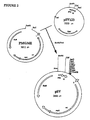
- La description ci-après sera mieux comprise à l'aide des figures 1 à 3 ci-après qui représentent respectivement :
- Figure 1 : Construction du vecteur pSV123
- Figure 2 : Construction du vecteur de sécrétion pSV
- Figure 3 : Construction du plasmide pSVLcnB permettant la sécrétion de LcnB
- Afin de pouvoir sécréter une bactériocine dont la sécrétion est Sec-indépendante, il a fallu au préalable construire un vecteur de sécrétion Sec-dépendant. Cette construction a été faite de la façon suivante :
- Pour chacun des clonages où cela a été nécessaire, la technique PCR a été utilisée dans les conditions suivantes : 1 minute à 94°C (dénaturation), 2 minutes à 45°C (hybridation) et 2 minutes à 73°C (polymérisation), 30 cycles. Les oligonucléotides ont été synthétisés avec un synthétiseur Applied Biosystems 381A DNA (Applied Biosystems).
- Pour la construction du vecteur de sécrétion pSV, les oligonucléotides A, B, C, D ont été utilisés.
- Les séquences de ces oligonucléotides sont les suivantes (les sites de restriction utilisés pour le clonage sont soulignés, le RBS dans l'oligonucléotide B apparaît en gras) :




- Des produits de PCR (Polymerase Chain Reaction) contenant le promoteur et le site de liaison aux ribosomes RBS (Ribosome Binding Site) de l'ORF32 (Open Reading Frame = phase de lecture ouverte) ont été obtenus à partir du plasmide pMG36c (Van de Guchte et al., 1989, Applied Environ. Microbiol., 55 : 224-228) qui dérive du plasmide pMG36e utilisé ci-après.
- La séquence-signal sp de la protéase de lactocoque PrtP a été obtenue à partir du gène prtP présent dans le plasmide pGKV500 (Kok et al, 1988, Applied Environ. Microbiol, 54 : 221-228).
- Ces produits de PCR ont été clonés après digestion par les enzymes de restriction BgIII et PstI, dans le plasmide pUK21 (Vieira et Messing, 1991, Gene, 100 : 189-194), pour donner les plasmides pSV1 et pSV23 (figure 1). Ensuite, le plasmide pSV23 a été digéré par les enzymes de restriction à ClaI et NdeI, et le fragment contenant la séquence-signal a été cloné dans le plasmide pSV1 préalablement digéré par les enzymes de restriction ClaI et Ndel, pour donner le plasmide pSV123 (figure 1). Enfin, le fragment EcoRI-SacI de pSV123, contenant le promoteur P32 et la séquence-signal sp, a été cloné dans le plasmide pMG36e (Van de Guchte et al., 1989, Applied Environ. Microbiol., 55 : 224-228), pour donner le vecteur de sécrétion pSV (figure 2).
- Le plasmide pMB580 (plasmide conférant la résistance à l'érythromycine, dérivé du plasmide pGK210, contenant l'opéron de la lactococcine B, c'est-à-dire LcnB et lciB - Van Belkum et al, 1992 Applied Environ. Microbiol., 58 : 572-577) a été digéré par les enzymes de restriction à NsiI et HindIII. L'extrémité HindIII a été hydrolysée pour la transformer en extrémité franche. Le fragment HindIII-NsiI a été ligaturé au plasmide pSV préalablement digéré par les enzymes de restriction à PstI et SacII, et dont l'extrémité SacII a été hydrolysée pour la transformer en extrémité franche, pour donner le plasmide pSVLcnB (figure 3). La séquence résultante en acides aminés de ce dérivé de LcnB avec la séquence-signal de la protéine PrtP est la séquence ci-après :

- Le plasmide dérivé du plasmide pSV (pSVLcnB), contenant le gène de structure de la lactococcine LcnB (lcnB) et le gène de l'immunité à LcnB (lciB), a servi à transformer la souche E.coli JM101 (Maniatis et al., 1982, Molecular Cloning : a laboratory manual. Cold Spring Harbor, New York, Cold Spring Harbor Laboratory), la souche Lactococcus lactis MG1363 (Gasson, 1983, J. Bacteriol., 154 : 1-9) et la souche Lactococcus lactis IL1403 (Chopin et al., 1984, Plasmid, 11, : 260-263). Dans ces constructions, l'extension N-terminale de la prébactériocine a été remplacée par le peptide signal de PrtP (figures 1, 2 et 3).
- Afin de tester l'activité bactériocine, les souches ont été recouvertes par une surcouche de la souche IL1043 contenant, soit pMG36e, soit pMG36c. Ce test a été réalisé de la façon suivante :
- Des colonies contenant la construction (pSVLcnB) ont été incubées 16 h à 30° C sur des boîtes de M17 (Terzaghi et Sandine, 1975, Appl. Microbiol, 29: 807-813) + glucose 5 g/l + agar 5 g/l. Après exposition à des vapeurs de chloroforme pendant 20 minutes, les boîtes ont été partiellement séchées à l'air pour éliminer les traces résiduelles de chloroforme. Puis, on a étalé sur ces boîtes 4 ml de gélose M17 + glucose 5 g/l + agar 7 g/l inoculé avec 40 µl de culture de nuit de la souche indicatrice L.lactis IL1403, contenant pMG36e ou pMG36c. Après incubation à 30° C pendant 12 à 18 h, les boîtes ont été analysées pour les zones d'inhibition (halos) autour des clones. Les essais de surcouche sur des gels de tricine ont été effectués selon le mode opératoire décrit par Van Belkum et al., 1992, dans Applied Environ. Microbiol., 58 : 572-577.
- Les résultats ont montré que l'on a un halo d'inhibition autour des clones contenant pSVLcnB. Ce halo est plus large autour des clones contenant pSVLcnBc. Cela indique que la bactériocine LcnB a bien été sécrétée grâce à pSVLcnB et pSVLcnBc. Afin de confirmer ce résultat, et surtout de savoir si l'activité bactériocine est due à une forme maturée (sans le peptide signal sp) ou non maturée (avec le peptide signal sp), des sumageants de culture de souche IL1403 contenant pSVLcnB ont été soumis à une précipitation au sulfate d'ammonium, et le précipité a été testé sur gel d'électrophorèse tricine SDS-PAA. Les gels ont ensuite été examinés pour l'activité bactéricide. Les résultats montrent que l'on a une inhibition de croissance dans la zone des 3, 4 KDa, correspondant à la taille de la bactériocine LcnB maturée, c'est-à-dire débarrassée de la séquence-signal sp. Comme la souche Lactococcus lactis MG1363 ne possède pas le système de sécrétion Sec-indépendant des bactériocines, la bactériocine LcnB produite grâce au plasmide pSVLcnB a bien été sécrétée via le système de sécrétion Sec-dépendant, en utilisant la séquence-signal sp de la protéase de lactocoque PrtP.
-
- (1) INFORMATIONS GENERALES:
- (i) DEPOSANT:
- (A) NOM: BIOGHURT BIOGARDE GmbH & Co. KG
- (B) RUE: Lise-Meitner-Strasse 34
- (C) VILLE: FREISING
- (E) PAYS: ALLEMAGNE
- (F) CODE POSTAL: 85354
- (G) TELEPHONE:
- (H) TELECOPIE:
- (ii) TITRE DE L' INVENTION: Utilisation d'un système de sécrétion Sec-dépendant pour sécréter des protéines normalement sécrétées par un système de sécrétion Sec-indépendant, bactéries les contenant et leur utilisation
- (iii) NOMBRE DE SEQUENCES: 5
- (iv) FORME DECHIFFRABLE PAR ORDINATEUR:
- (A) TYPE DE SUPPORT: Floppy disk
- (B) ORDINATEUR: IBM PC compatible
- (C) SYSTEME D'EXPLOITATION: PC-DOS/MS-DOS
- (D) LOGICIEL: PatentIn Release #1.0, Version #1.30 (OEB)
- (i) DEPOSANT:
- (2) INFORMATIONS POUR LA SEQ ID NO: 1:
- (i) CARACTERISTIQUES DE LA SEQUENCE:
- (A) LONGUEUR: 33 paires de bases
- (B) TYPE: nucléotide
- (C) NOMBRE DE BRINS: simple
- (D) CONFIGURATION: linéaire
- (ii) TYPE DE MOLECULE: ADN (génomique)
- (iii) HYPOTHETIQUE: OUI
- (xi) DESCRIPTION DE LA SEQUENCE: SEQ ID NO: 1:

- (i) CARACTERISTIQUES DE LA SEQUENCE:
- (2) INFORMATIONS POUR LA SEQ ID NO: 2:
- (i) CARACTERISTIQUES DE LA SEQUENCE:
- (A) LONGUEUR: 44 paires de bases
- (B) TYPE: nucléotide
- (C) NOMBRE DE BRINS: simple
- (D) CONFIGURATION: linéaire
- (ii) TYPE DE MOLECULE: ADN (génomique)
- (iii) HYPOTHETIQUE: OUI
- (xi) DESCRIPTION DE LA SEQUENCE: SEQ ID NO: 2:

- (i) CARACTERISTIQUES DE LA SEQUENCE:
- (2) INFORMATIONS POUR LA SEQ ID NO: 3:
- (i) CARACTERISTIQUES DE LA SEQUENCE:
- (A) LONGUEUR: 49 paires de bases
- (B) TYPE: nucléotide
- (C) NOMBRE DE BRINS: simple
- (D) CONFIGURATION: linéaire
- (ii) TYPE DE MOLECULE: ADN (génomique)
- (iii) HYPOTHETIQUE: OUI
- (xi) DESCRIPTION DE LA SEQUENCE: SEQ ID NO: 3:

- (i) CARACTERISTIQUES DE LA SEQUENCE:
- (2) INFORMATIONS POUR LA SEQ ID NO: 4:
- (i) CARACTERISTIQUES DE LA SEQUENCE:
- (A) LONGUEUR: 44 paires de bases
- (B) TYPE: nucléotide
- (C) NOMBRE DE BRINS: simple
- (D) CONFIGURATION: linéaire
- (ii) TYPE DE MOLECULE: ADN (génomique)
- (iii) HYPOTHETIQUE: OUI
- (xi) DESCRIPTION DE LA SEQUENCE: SEQ ID NO: 4:

- (i) CARACTERISTIQUES DE LA SEQUENCE:
- (2) INFORMATIONS POUR LA SEQ ID NO: 5:
- (i) CARACTERISTIQUES DE LA SEQUENCE:
- (A) LONGUEUR: 80 acides aminés
- (B) TYPE: acide aminé
- (C) NOMBRE DE BRINS:
- (D) CONFIGURATION: linéaire
- (ii) TYPE DE MOLECULE: peptide
- (xi) DESCRIPTION DE LA SEQUENCE: SEQ ID NO: 5:

- (i) CARACTERISTIQUES DE LA SEQUENCE:
Claims (6)
- Utilisation d'un système de sécrétion Sec-dépendant en combinaison avec la séquence d'ADN codant pour une protéine mature et normalement sécrétée par un système Sec-indépendant, le promoteur P32 de lactocoque, la séquence-signal sp de la protéase de lactocoque et le terminateur du gène de l'immunité à LcnB (lciB) pour sécréter ladite protéine mature normalement sécrétée par un système de sécrétion Sec-indépendant.
- Utilisation selon la revendication 1, caractérisée en ce que la séquence d'ADN codant pour la protéine mature est la séquence d'ADN codant pour une bactériocine.
- Utilisation selon l'une des revendications 1 ou 2, caractérisée en ce que la bactériocine est la bactériocine LcnB.
- Construction d'ADN pour la sécrétion par un système Sec-dépendant d'une protéine normalement sécrétée par un système Sec-indépendant, caractérisée en ce qu'elle comprend le promoteur P32 de lactocoque, la séquence-signal sp de la protéase de lactocoque, la séquence d'ADN codant pour une protéine mature et normalement sécrétée par un système Sec-indépendant, le terminateur du gène de l'immunité à LcnB (lciB).
- Construction selon la revendication 4, caractérisée en ce que la séquence d'ADN codant pour la protéine est la séquence d'ADN codant pour une bactériocine.
- Construction selon la revendication 5, caractérisée en ce que la bactériocine est la bactériocine LcnB.
Applications Claiming Priority (3)
| Application Number | Priority Date | Filing Date | Title |
|---|---|---|---|
| FR9511778 | 1995-10-06 | ||
| FR9511778A FR2739629B1 (fr) | 1995-10-06 | 1995-10-06 | Utilisation d'un systeme de secretion sec-dependant pour secreter des proteines normalement secretees par un systeme de secretion sec-independant, bacteries les contenant et leur utilisation |
| PCT/FR1996/001560 WO1997013863A1 (fr) | 1995-10-06 | 1996-10-07 | Utilisation d'un systeme de secretion sec-dependant pour secreter des proteines normalement secretees par un systeme de secretion sec-independant |
Publications (3)
| Publication Number | Publication Date |
|---|---|
| EP0797672A1 EP0797672A1 (fr) | 1997-10-01 |
| EP0797672B1 true EP0797672B1 (fr) | 2006-01-11 |
| EP0797672B8 EP0797672B8 (fr) | 2006-04-26 |
Family
ID=9483320
Family Applications (1)
| Application Number | Title | Priority Date | Filing Date |
|---|---|---|---|
| EP96933496A Expired - Lifetime EP0797672B8 (fr) | 1995-10-06 | 1996-10-07 | Utilisation d'un systeme de secretion sec-dependant pour secreter des proteines normalement secretees par un systeme de secretion sec-independant |
Country Status (5)
| Country | Link |
|---|---|
| US (1) | US5939317A (fr) |
| EP (1) | EP0797672B8 (fr) |
| DE (1) | DE69635739T2 (fr) |
| FR (1) | FR2739629B1 (fr) |
| WO (1) | WO1997013863A1 (fr) |
Families Citing this family (8)
| Publication number | Priority date | Publication date | Assignee | Title |
|---|---|---|---|---|
| AU2002353111A1 (en) * | 2002-01-09 | 2003-07-30 | Genencor International, Inc. | Oxa1p enhanced protein secretion |
| WO2006062398A2 (fr) * | 2004-12-07 | 2006-06-15 | Applied Nanosystems B.V. | Methodes de production et de secretion de peptides modifies |
| DK2102239T3 (da) | 2006-11-30 | 2012-05-29 | Res Dev Foundation | Forbedrede immunoglobulin-biblioteker |
| US8629245B2 (en) * | 2007-05-01 | 2014-01-14 | Research Development Foundation | Immunoglobulin Fc libraries |
| CN102549016B (zh) * | 2009-06-30 | 2015-05-06 | 研究发展基金会 | 免疫球蛋白fc多肽 |
| GB201003738D0 (en) | 2010-03-05 | 2010-04-21 | Univ Newcastle | Micro-organism of the class bacilli and method of producing a micro-organism |
| CA2826467C (fr) | 2011-02-07 | 2019-11-12 | Research Development Foundation | Polypeptides fc modifies d'immunoglobuline |
| JP6724023B2 (ja) | 2015-02-09 | 2020-07-15 | リサーチ ディベロップメント ファウンデーション | 改善された補体活性化を示す操作された免疫グロブリンfcポリペプチド |
Family Cites Families (4)
| Publication number | Priority date | Publication date | Assignee | Title |
|---|---|---|---|---|
| ES2061482T3 (es) * | 1986-05-02 | 1994-12-16 | Gist Brocades Nv | Metodo para la identificacion de secuencias de señal secretora para sintesis de proteina extracelular en bacillus. |
| NL9000753A (nl) * | 1990-03-30 | 1991-10-16 | Nl Zuivelonderzoek Inst | Dna-fragment, ten minste coderend voor een deel van het extracellulaire eiwit met een schijnbaar molecuulgewicht van 60 kda van lactococcus lactis stammen zoals de lactococcus lactis ssp. lactis stam mg1363, combinaties hiervan met voor homologe of heterologe eiwitten coderende dna-sequenties alsmede de hiermee verkregen homologe en heterologe eiwitten. |
| AU8081691A (en) * | 1990-06-18 | 1992-01-07 | Norwegian Dairies Association | Novel bacteriocin from a strain of lactococcus lactis subsp. cremoris |
| EP0550428A1 (fr) * | 1990-08-30 | 1993-07-14 | Genesit Oy | Vecteurs sondes de promoteurs pouvant se repliquer en e.coli, b.subtilis, lactococci et lactobacillus, ainsi que leurs utilisations |
-
1995
- 1995-10-06 FR FR9511778A patent/FR2739629B1/fr not_active Expired - Fee Related
-
1996
- 1996-10-07 US US08/849,373 patent/US5939317A/en not_active Expired - Fee Related
- 1996-10-07 DE DE69635739T patent/DE69635739T2/de not_active Expired - Fee Related
- 1996-10-07 WO PCT/FR1996/001560 patent/WO1997013863A1/fr not_active Ceased
- 1996-10-07 EP EP96933496A patent/EP0797672B8/fr not_active Expired - Lifetime
Also Published As
| Publication number | Publication date |
|---|---|
| FR2739629A1 (fr) | 1997-04-11 |
| WO1997013863A1 (fr) | 1997-04-17 |
| US5939317A (en) | 1999-08-17 |
| DE69635739D1 (de) | 2006-04-06 |
| EP0797672B8 (fr) | 2006-04-26 |
| EP0797672A1 (fr) | 1997-10-01 |
| DE69635739T2 (de) | 2006-11-02 |
| FR2739629B1 (fr) | 1997-12-26 |
Similar Documents
| Publication | Publication Date | Title |
|---|---|---|
| Loessner et al. | The two-component lysis system of Staphylococcus aureus bacteriophage Twort: a large TTG-start holin and an associated amidase endolysin | |
| Maguin et al. | Efficient insertional mutagenesis in lactococci and other gram-positive bacteria | |
| Buist et al. | Autolysis of Lactococcus lactis caused by induced overproduction of its major autolysin, AcmA | |
| KR102769515B1 (ko) | 세포 또는 유기체의 게놈으로의 DNA 서열의 표적화 혼입을 위한 Cas 9 레트로바이러스 인테그라제 시스템 및 Cas 9 재조합효소 시스템 | |
| EP1300082A2 (fr) | Une lysine du bacteriophage de Clostridia sp | |
| EP0797672A1 (fr) | Utilisation d'un systeme de secretion sec-dependant pour secreter des proteines normalement secretees par un systeme de secretion sec-independant | |
| Hagting et al. | Membrane topology of the di-and tripeptide transport protein of Lactococcus lactis | |
| Prévots et al. | Nucleotide sequence and analysis of the new chromosomal abortive infection gene abiN of Lactococcus lactis subsp. cremoris S114 | |
| Muscholl‐Silberhorn | Cloning and functional analysis of Asa373, a novel adhesin unrelated to the other sex pheromone plasmid‐encoded aggregation substances of Enterococcus faecalis | |
| JPH10500013A (ja) | 乳酸菌の培養物の増殖を阻害し、所望により該細菌細胞を溶解する方法および得られる溶菌培養物の用途 | |
| Renye Jr et al. | Cloning of milk-derived bioactive peptides in Streptococcus thermophilus | |
| Christensson et al. | Nucleotide sequence and characterization of the cell envelope proteinase plasmid in Lactococcus lactis subsp. cremoris HP | |
| JP2678156B2 (ja) | 微生物により産生されるレンネツト、その産生に使用する発現ベクター及びレンネツトの産生方法 | |
| US7186815B2 (en) | Method of isolating secretion signals in lactic acid bacteria and novel secretion signals isolated from Lactococcus lactis | |
| AU706127B2 (en) | Process for the lysis of a culture of lactic acid bacteria by means of a lysin, and uses of the resulting lysed culture | |
| JPH11500604A (ja) | 変性ニシンの製造 | |
| Martínez‐Cuesta et al. | Biological and molecular characterization of a two‐peptide lantibiotic produced by Lactococcus lactis IFPL105 | |
| Manganelli et al. | The Joint of Tn916 Circular Intermediates Is a Homoduplex inEnterococcus faecalis | |
| Wells et al. | Cloning and expression vectors for lactococci | |
| CA3169644A1 (fr) | Bacteries gram-positives de l'espece lactococcus lactis ou streptococcus thermophilus ayant une tres faible proteolyse de surface, leurs methodes d'obtention et leurs utilisations | |
| US5858727A (en) | Secretion of outer membrane proteins of gram-negative bacteria by means of gram-positive host organisms | |
| Charneco et al. | Discovering genetic determinants for cell-to-cell adhesion in two prevalent conjugative lactococcal plasmids | |
| Stentz et al. | The Tra domain of the lactococcal CluA surface protein is a unique domain that contributes to sex factor DNA transfer | |
| JP3060399B2 (ja) | ラクトバチルス・デルブリュエキイ由来のプラスミド | |
| Broadbent et al. | Conversion of Lactococcus lactis cell envelope proteinase specificity by partial allele exchange |
Legal Events
| Date | Code | Title | Description |
|---|---|---|---|
| PUAI | Public reference made under article 153(3) epc to a published international application that has entered the european phase |
Free format text: ORIGINAL CODE: 0009012 |
|
| 17P | Request for examination filed |
Effective date: 19970702 |
|
| AK | Designated contracting states |
Kind code of ref document: A1 Designated state(s): DE FR GB NL |
|
| RAP1 | Party data changed (applicant data changed or rights of an application transferred) |
Owner name: SKW BIOSYSTEMS |
|
| 17Q | First examination report despatched |
Effective date: 20020213 |
|
| GRAP | Despatch of communication of intention to grant a patent |
Free format text: ORIGINAL CODE: EPIDOSNIGR1 |
|
| GRAS | Grant fee paid |
Free format text: ORIGINAL CODE: EPIDOSNIGR3 |
|
| GRAA | (expected) grant |
Free format text: ORIGINAL CODE: 0009210 |
|
| AK | Designated contracting states |
Kind code of ref document: B1 Designated state(s): DE FR GB NL |
|
| PG25 | Lapsed in a contracting state [announced via postgrant information from national office to epo] |
Ref country code: NL Free format text: LAPSE BECAUSE OF FAILURE TO SUBMIT A TRANSLATION OF THE DESCRIPTION OR TO PAY THE FEE WITHIN THE PRESCRIBED TIME-LIMIT Effective date: 20060111 |
|
| RAP2 | Party data changed (patent owner data changed or rights of a patent transferred) |
Owner name: BIOGHURT BIOGARDE GMBH & CO. KG |
|
| NLT2 | Nl: modifications (of names), taken from the european patent patent bulletin |
Owner name: BIOGHURT BIOGARDE GMBH & CO. KG Effective date: 20060118 |
|
| REF | Corresponds to: |
Ref document number: 69635739 Country of ref document: DE Date of ref document: 20060406 Kind code of ref document: P |
|
| GBT | Gb: translation of ep patent filed (gb section 77(6)(a)/1977) |
Effective date: 20060412 |
|
| NLV1 | Nl: lapsed or annulled due to failure to fulfill the requirements of art. 29p and 29m of the patents act | ||
| PLBE | No opposition filed within time limit |
Free format text: ORIGINAL CODE: 0009261 |
|
| STAA | Information on the status of an ep patent application or granted ep patent |
Free format text: STATUS: NO OPPOSITION FILED WITHIN TIME LIMIT |
|
| 26N | No opposition filed |
Effective date: 20061012 |
|
| PGFP | Annual fee paid to national office [announced via postgrant information from national office to epo] |
Ref country code: DE Payment date: 20071011 Year of fee payment: 12 |
|
| PGFP | Annual fee paid to national office [announced via postgrant information from national office to epo] |
Ref country code: FR Payment date: 20071009 Year of fee payment: 12 |
|
| PGFP | Annual fee paid to national office [announced via postgrant information from national office to epo] |
Ref country code: GB Payment date: 20081001 Year of fee payment: 13 |
|
| REG | Reference to a national code |
Ref country code: FR Ref legal event code: ST Effective date: 20090630 |
|
| PG25 | Lapsed in a contracting state [announced via postgrant information from national office to epo] |
Ref country code: DE Free format text: LAPSE BECAUSE OF NON-PAYMENT OF DUE FEES Effective date: 20090501 |
|
| PG25 | Lapsed in a contracting state [announced via postgrant information from national office to epo] |
Ref country code: FR Free format text: LAPSE BECAUSE OF NON-PAYMENT OF DUE FEES Effective date: 20081031 |
|
| PG25 | Lapsed in a contracting state [announced via postgrant information from national office to epo] |
Ref country code: GB Free format text: LAPSE BECAUSE OF NON-PAYMENT OF DUE FEES Effective date: 20091007 |