EP0794170A1 - Verfahren zur Schwersiederabtrennung bei der Diamono-toluol-Herstellung - Google Patents
Verfahren zur Schwersiederabtrennung bei der Diamono-toluol-Herstellung Download PDFInfo
- Publication number
- EP0794170A1 EP0794170A1 EP97102725A EP97102725A EP0794170A1 EP 0794170 A1 EP0794170 A1 EP 0794170A1 EP 97102725 A EP97102725 A EP 97102725A EP 97102725 A EP97102725 A EP 97102725A EP 0794170 A1 EP0794170 A1 EP 0794170A1
- Authority
- EP
- European Patent Office
- Prior art keywords
- tda
- mixture
- isomer
- column
- diaminotoluene
- Prior art date
- Legal status (The legal status is an assumption and is not a legal conclusion. Google has not performed a legal analysis and makes no representation as to the accuracy of the status listed.)
- Granted
Links
- 238000000034 method Methods 0.000 title claims abstract description 20
- 238000009835 boiling Methods 0.000 title claims abstract description 13
- DYFXGORUJGZJCA-UHFFFAOYSA-N phenylmethanediamine Chemical compound NC(N)C1=CC=CC=C1 DYFXGORUJGZJCA-UHFFFAOYSA-N 0.000 title claims abstract description 7
- 238000002360 preparation method Methods 0.000 title description 3
- 150000001875 compounds Chemical class 0.000 title 1
- 239000000203 mixture Substances 0.000 claims abstract description 34
- 238000004821 distillation Methods 0.000 claims abstract description 17
- 238000005984 hydrogenation reaction Methods 0.000 claims abstract description 10
- 239000002904 solvent Substances 0.000 claims abstract description 7
- 150000001412 amines Chemical class 0.000 claims abstract description 6
- 238000006243 chemical reaction Methods 0.000 claims abstract description 5
- XLYOFNOQVPJJNP-UHFFFAOYSA-N water Substances O XLYOFNOQVPJJNP-UHFFFAOYSA-N 0.000 claims abstract description 5
- 238000004519 manufacturing process Methods 0.000 claims abstract 2
- 238000010790 dilution Methods 0.000 claims 1
- 239000012895 dilution Substances 0.000 claims 1
- 238000002156 mixing Methods 0.000 abstract description 3
- 239000007788 liquid Substances 0.000 description 7
- 239000012141 concentrate Substances 0.000 description 4
- 238000000926 separation method Methods 0.000 description 4
- VOZKAJLKRJDJLL-UHFFFAOYSA-N 2,4-diaminotoluene Chemical compound CC1=CC=C(N)C=C1N VOZKAJLKRJDJLL-UHFFFAOYSA-N 0.000 description 3
- LFQSCWFLJHTTHZ-UHFFFAOYSA-N Ethanol Chemical compound CCO LFQSCWFLJHTTHZ-UHFFFAOYSA-N 0.000 description 3
- OKKJLVBELUTLKV-UHFFFAOYSA-N Methanol Chemical compound OC OKKJLVBELUTLKV-UHFFFAOYSA-N 0.000 description 3
- 239000011552 falling film Substances 0.000 description 3
- 238000012856 packing Methods 0.000 description 3
- 239000011541 reaction mixture Substances 0.000 description 3
- 238000010626 work up procedure Methods 0.000 description 3
- RLYCRLGLCUXUPO-UHFFFAOYSA-N 2,6-diaminotoluene Chemical compound CC1=C(N)C=CC=C1N RLYCRLGLCUXUPO-UHFFFAOYSA-N 0.000 description 2
- KFZMGEQAYNKOFK-UHFFFAOYSA-N Isopropanol Chemical compound CC(C)O KFZMGEQAYNKOFK-UHFFFAOYSA-N 0.000 description 2
- WYURNTSHIVDZCO-UHFFFAOYSA-N Tetrahydrofuran Chemical compound C1CCOC1 WYURNTSHIVDZCO-UHFFFAOYSA-N 0.000 description 2
- 150000001298 alcohols Chemical class 0.000 description 2
- 150000004984 aromatic diamines Chemical class 0.000 description 2
- 238000002485 combustion reaction Methods 0.000 description 2
- 238000004094 preconcentration Methods 0.000 description 2
- 238000004064 recycling Methods 0.000 description 2
- 229930000044 secondary metabolite Natural products 0.000 description 2
- 238000011144 upstream manufacturing Methods 0.000 description 2
- GWXQNFKETHVQIZ-UHFFFAOYSA-N 2-methylbenzene-1,3-diamine;4-methylbenzene-1,3-diamine Chemical compound CC1=CC=C(N)C=C1N.CC1=C(N)C=CC=C1N GWXQNFKETHVQIZ-UHFFFAOYSA-N 0.000 description 1
- ZXVONLUNISGICL-UHFFFAOYSA-N 4,6-dinitro-o-cresol Chemical group CC1=CC([N+]([O-])=O)=CC([N+]([O-])=O)=C1O ZXVONLUNISGICL-UHFFFAOYSA-N 0.000 description 1
- 125000003118 aryl group Chemical group 0.000 description 1
- 239000003054 catalyst Substances 0.000 description 1
- 238000009903 catalytic hydrogenation reaction Methods 0.000 description 1
- 238000009833 condensation Methods 0.000 description 1
- 230000005494 condensation Effects 0.000 description 1
- 230000018044 dehydration Effects 0.000 description 1
- 238000006297 dehydration reaction Methods 0.000 description 1
- 150000004985 diamines Chemical class 0.000 description 1
- VMMLSJNPNVTYMN-UHFFFAOYSA-N dinitromethylbenzene Chemical class [O-][N+](=O)C([N+]([O-])=O)C1=CC=CC=C1 VMMLSJNPNVTYMN-UHFFFAOYSA-N 0.000 description 1
- 239000004744 fabric Substances 0.000 description 1
- 238000001914 filtration Methods 0.000 description 1
- 239000012535 impurity Substances 0.000 description 1
- 238000012432 intermediate storage Methods 0.000 description 1
- 150000002894 organic compounds Chemical class 0.000 description 1
- 230000000149 penetrating effect Effects 0.000 description 1
- 238000011084 recovery Methods 0.000 description 1
- 229930195734 saturated hydrocarbon Natural products 0.000 description 1
- 238000004062 sedimentation Methods 0.000 description 1
- 239000007858 starting material Substances 0.000 description 1
- 239000000126 substance Substances 0.000 description 1
- YLQBMQCUIZJEEH-UHFFFAOYSA-N tetrahydrofuran Natural products C=1C=COC=1 YLQBMQCUIZJEEH-UHFFFAOYSA-N 0.000 description 1
Images
Classifications
-
- C—CHEMISTRY; METALLURGY
- C07—ORGANIC CHEMISTRY
- C07C—ACYCLIC OR CARBOCYCLIC COMPOUNDS
- C07C209/00—Preparation of compounds containing amino groups bound to a carbon skeleton
- C07C209/82—Purification; Separation; Stabilisation; Use of additives
- C07C209/86—Separation
-
- C—CHEMISTRY; METALLURGY
- C07—ORGANIC CHEMISTRY
- C07C—ACYCLIC OR CARBOCYCLIC COMPOUNDS
- C07C209/00—Preparation of compounds containing amino groups bound to a carbon skeleton
- C07C209/82—Purification; Separation; Stabilisation; Use of additives
- C07C209/84—Purification
Definitions
- the invention relates to a new process for the distillative workup of amine mixtures, as are obtained in the hydrogenation of technical dinitroaromatics, the organic compounds (high boilers) boiling higher than meta-diaminotoluene (hereinafter referred to as m-TDA) as the bottom product with only a small amount of isomer separation Proportion of m-TDA and a high proportion of the volatile ortho-diaminotoluene (hereinafter referred to as o-TDA).
- m-TDA meta-diaminotoluene
- aromatic diamines can be obtained by catalytic hydrogenation of corresponding aromatic ones Can produce dinitro compounds.
- the hydrogenation can be carried out using solvents such as low-boiling alcohols such as methanol, ethanol or isopropanol or saturated hydrocarbons such as e.g. Tetrahydrofuran but also without such foreign solvents.
- the hydrogenation can be carried out with the aid of catalysts dispersed in the reaction mixture, which are then separated off by sedimentation or filtration and, if appropriate, returned to the process.
- reaction mixture has been worked up by subjecting a mixture of aromatic diamines with any organic impurities still present after separation of the auxiliary solvent and water of reaction, if any, to isomer separation in a TDA distillation column under vacuum, the main product being discharged as the bottom product.
- the low-boiling secondary compounds such as core-hydrogenated TDA and the ortho-permanent isomers of TDA are separated off at the top of the column and sent for further chemical or thermal use.
- the bottom product ultimately remaining in this workup is mixed together with the organics to be thermally recycled and used thermally after intermediate storage, this bottom product advantageously containing substantially less m-TDA than according to known workup methods.
- the m-TDA content is below 10% by weight.
- the starting materials for the process according to the invention are aqueous amine solutions such as are obtained in the hydrogenation of dinitroaromatics.
- Amine mixtures of the type obtained in the hydrogenation of industrial dinitrotoluenes, and which have been freed beforehand by distillation from auxiliary solvents which may also be used in the hydrogenation, such as the simple alcohols mentioned above, and from the water of reaction, are particularly preferably used in the process according to the invention.
- These diamines are, for example, pure 2,4-diaminotoluene or in general their technical mixtures with the TDA isomer compositions of approx. 92 to 96% meta, 3 to 5% ortho, ⁇ 1% para and 0.2 to 2% high boilers, with the percentages complementing each other to 100%.
- a TDA isomer distillation column equipped with a fabric packing, for example, is used to carry out the process according to the invention.
- the column preferably has 30 to 60, in particular 45 to 55, theoretical plates.
- the column is operated at a bottom temperature of 180 to 220 ° C. and under a pressure (at the top of the column) of 3,000 to 120,000 pas, these parameters of course depending on the nature of the mixtures to be worked up and on the desired vapor temperature.
- the heat of condensation of the vapors can vary depending on the energy recovery by a dephlegmator at the top of the column, depending on the steam to be recovered.
- the dewatered, crude TDA mixture can be fed to the TDA isomer distillation column in liquid or gaseous form, the low-boiling TDA isomers being separated off as pure approx. 95 to 99% by weight m / o isomer fraction.
- a column sump with approx. 98% m-TDA and approx. 2% high boilers remains.
- the bottom of the column is concentrated in a downstream evaporator stage to about 50% high boilers, the m-TDA being distilled off and condensed for further use.
- the high boiler concentrate is mixed with o-TDA distilled off in the distillation column using a mixing device in such a way that the stripped mixtures of m / o-TDA are separated off in a downstream evaporator step and these vapors, preferably condensed, are returned to the TDA isomer distillation column at a suitable point.
- the m-TDA is thus advantageously largely replaced by the o-TDA, containing approx. 40%.
- the TDA isomers are evaporated after dehydration in a pre-concentration to such an extent that the effluent contains about 50% high boilers
- the TDA isomer vapors are fed to the distillation column and separated accordingly into the ortho- and meta-TDA isomers.
- the bottom of the column then contains the m-TDA freed from the high boilers, which is carried out for further processing.
- the high-boiling concentrate obtained in the preconcentration stage is, as described above, mixed with distilled o-TDA using a mixing device in such a way that the mixture m / o-TDA is added in a subsequent evaporator step is separated off and these vapors are preferably returned condensed to the distillation column at a suitable point.
- 2.3 kg / h of a solvent-free, dewatered reaction mixture from the DNT hydrogenation are added to the 8th tray in a packing column DN 50 with 50 theoretical plates.
- the mixture is a composition of essentially TDA isomers with 76.5% by weight of 2,4-diaminotoluene, 18.5% by weight of 2,6-diaminotoluene and 4% by weight of hydrogenated TDA and 0.9% by weight high boilers (stream 1).
- the column is operated under a pressure at the top of 8,000 Pas and a bottom temperature of 203 ° C.
- the o-TDA is totally condensed at a top temperature of 160 ° C.
- the bottom consisting of 99% by weight of 2,4- / 2,6-diaminotoluene mixture and 1% by weight of high boilers, is freed from the m-TDA in a downstream falling film evaporator under the same negative pressure to such an extent that the high boilers are reduced to approx. 50 wt .-% are concentrated.
- the vapors, 2.15 kg / h m-TDA, are condensed and outsourced for further processing or for sale (stream 4).
- the concentrate 70 g / h
- the vapors (250 g / h) are condensed and returned to the isomer column in liquid form on the 25th tray.
- the bottom product 70 g / h consisting of 50% by weight of high boilers, 40% by weight of o-TDA and 10% by weight of m-TDA (stream 3) is placed in the template for thermal recycling, with an organic Mixture with the main component o-TDA (stream 2) for combustion with a calorific value of approx. 33,000 kcal / kg.
- the high-boiling concentrate (70 g / h) running off the upstream falling-film evaporator is mixed with liquid ortho-TDA (250 g / h) in a ratio of 1: 3.5 and the TDA isomers are evaporated together at a pressure of 4,000 Pas.
- the vapors (250 g / h) are condensed and returned to the isomer column in liquid form on the 25th tray.
- the bottom product 70 g / h consisting of 50% by weight of high boilers, 40% by weight of o-TDA and 10% by weight of m-TDA (stream 3) is placed in the template for thermal recycling, with an organic Mixture with the main component o-TDA (stream 2) for combustion with a calorific value of approx. 33,000 kcal / kg.
Landscapes
- Chemical & Material Sciences (AREA)
- Organic Chemistry (AREA)
- Organic Low-Molecular-Weight Compounds And Preparation Thereof (AREA)
- Vaporization, Distillation, Condensation, Sublimation, And Cold Traps (AREA)
Abstract
Description
- Die Erfindung betrifft ein neues Verfahren zur destillativen Aufarbeitung von Amingemischen, wie sie bei der Hydrierung von technischen Dinitroaromaten anfallen, wobei bei der Isomerentrennung die höher als meta-Diaminotoluol (nachfolgend m-TDA genannt) siedenden organischen Verbindungen (Schwersieder) als Sumpfprodukt mit nur geringem Anteil m-TDA und hohem Anteil des leichtflüchtigen ortho-Diaminotoluol (nachfolgend o-TDA genannt) anfällt.
- Es ist bekannt (vgl. z.B. DE-OSen 1 542 544, BE-PSen 631 964, 661 047, 661 946, FR-PS 1 359 438 oder GB-PS 768 111), daß man aromatische Diamine durch katalytische Hydrierung von entsprechenden aromatischen Dinitroverbindungen herstellen kann. Die Hydrierung kann unter Mitverwendung von Lösungsmitteln wie beispielsweise niedrigsiedenden Alkoholen wie Methanol, Ethanol oder Isopropanol oder gesättigten Kohlenwasserstoffen wie z.B. Tetrahydrofuran aber auch ohne solche Fremdlösungsmittel erfolgen. Die Hydrierung kann mit Hilfe von im Reaktionsgemisch dispergierten Katalysatoren durchgeführt werden, die dann durch Sedimentation oder Filtration abgetrennt und gegebenenfalls in den Prozeß zurückgeführt werden.
- Bislang erfolgte die Aufarbeitung des Reaktionsgemisches, indem man ein nach Abtrennung des gegebenenfalls mitverwendeten Hilfslösungsmittels und Reaktionswassers vorliegendes Gemisch aus aromatischen Diaminen mit noch vorliegenden organischen Verunreinigungen einer Isomeren-Trennung in einer TDA-Destillationskolonne unter Vakuum unterzieht, wobei das Hauptprodukt als Sumpfprodukt ausgetragen wird. Die leichtsiedenden Nebenverbindungen wie z.B. kernhydriertes TDA und die orthoständigen Isomeren des TDA werden über den Kopf der Kolonne abgetrennt und einer weiteren chemischen oder thermischen Verwendung zugeführt.
- Es war die der Erfindung zugrundeliegende Aufgabe, ein Verfahren zur Abtrennung der schwersiedenden Nebenverbindungen von den destillierbaren m-TDA-Isomeren bei der Diaminotoluol-Herstellung zur Verfügung zu stellen, bei welchem ein thermisch verwertbarer organischer Rückstand anfällt, der nur einen geringen Anteil des Hauptproduktes m-TDA enthält.
- Diese Aufgabe konnte mit dem nachstehend näher erläuterten erfindungsgemäßen Verfahren gelöst werden. Außerdem ist der zusätzlich energetische Aufwand der Schwersiederabtrennung durch die Verwendung eines nicht artfremden Schleppmittels sehr gering.
- Gegenstand der Erfindung ist ein Verfahren zur Aufarbeitung von Amingemischen bei der Diaminotoluol-Herstellung aus der Hydrierung von aromatischen Dinitroverbindungen, bei dem man nach Entfernung von gegebenenfalls Lösungsmittel und Reaktionswasser aus dem TDA-Isomeren-Gemisch über eine TDA-Isomeren Destillationskolonne die leichtsiedenden TDA-Isomeren als o- und m-Isomerenfraktion destillativ abtrennt, wobei man
- a) die zurückbleibende Sumpfphase als m-TDA/Schwersiedergemisch abtrennt und auf ca. 25 bis 60 Gew.-% Schwersiedergehalt aufkonzentriert,
- b) die aufkonzentrierte Sumpfphase in einem Verhältnis von 1:1 bis 1:5 mit einem ortho-Isomerengemisch abmischt und ein meta/ortho-TDA-Gemisch abdestilliert und anschließend
- c) das nach b) erhaltene m-/o-TDA-Gemisch in die TDA-Isomerendestillationskolonne zurückführt.
- Das bei dieser Aufarbeitung letztlich zurückbleibende Sumpfprodukt wird zusammen mit den thermisch zu verwertenden Organika abgemischt und nach Zwischenlagerung thermisch genutzt, wobei in vorteilhafter Weise dieses Sumpfprodukt wesentlich weniger m-TDA als nach bisher bekannten Aufarbeitungsmethoden enthält. Erfindungsgemäß liegt der m-TDA-Gehalt unter 10 Gew.-%.
- Ausgangsmaterialien für das erfindungsgemäße Verfahren sind wäßrige Aminlösungen, wie sie bei der Hydrierung von Dinitroaromaten anfallen. Besonders bevorzugt werden beim erfindungsgemäßen Verfahren Amingemische eingesetzt, wie sie bei der Hydrierung von technischen Dinitrotoluolen anfallen, und die von gegebenenfalls bei der Hydrierung mitverwendeten Hilfslösungmittel, wie den obengenannten einfachen Alkoholen, genauso wie vom Reaktionswasser vorab destillativ befreit worden sind. Bei diesen Diaminen handelt es sich z.B. um reines 2,4-Diaminotoluol oder im allgemeinen um dessen technische Gemische mit den TDA-Isomerenzusammensetzungen von ca. 92 bis 96 % meta, 3 bis 5 % ortho, <1 % para und 0,2 bis 2 % Schwersiedern, wobei sich die Prozentsätze jeweils zu 100 % ergänzen.
- Zur Durchführung des erfindungsgemäßen Verfahrens wird eine beispielsweise mit einer Gewebepackung bestückte TDA-Isomerendestillationskolonne verwendet. Vorzugsweise weist die Kolonne 30 bis 60, insbesondere 45 bis 55, theoretische Böden auf. Die Kolonne wird bei einer Sumpftemperatur von 180 bis 220°C und unter einem Druck (am Kopf der Kolonne) von 3 000 bis 120 000 pas betrieben, wobei diese Parameter selbstverständlich von der Natur der aufzuarbeitenden Gemische und von der angestrebten Brüdentemperatur abhängen. So kann die Kondensationswärme der Brüden in Abhängigkeit zur Energierückgewinnung durch einen Dephlegmator am Kopf der Kolonne, entsprechend dem zu gewinnenden Dampf, variieren.
- Das entwässerte, rohe TDA-Gemisch kann flüssig oder gasförmig der TDA-Isomerendestillationskolonne zugeführt werden, wobei die leichtsiedenen TDA-Isomeren als reine ca. 95 bis 99 Gew.-% m/o-Isomerfraktion abgetrennt werden. Im Falle der flüssigen Aufgabe bleibt ein Kolonnensumpf mit ca. 98 % m-TDA und ca. 2 % Schwersiedern zurück. Der Kolonnensumpf wird in einer nachgeschalteten Verdampferstufe auf ca. 50 % Schwersieder aufkonzentriert, wobei das m-TDA abdestilliert und kondensiert zur weiteren Verwendung abläuft. Das Schwersiederkonzentrat wird mit in der Destillationskolonne abdestilliertem o-TDA über ein Mischorgan so abgemischt, daß in einem nachgeschalteten Verdampferschritt das gestrippte Gemische m/o-TDA abgetrennt wird und diese Brüden, vorzugsweise kondensiert, an geeigneter Stelle in die TDA-Isomerendestillationskolonne zurückgeführt werden. Im Sumpfprodukt mit ca. 50 % Schwersiedern und 10 % m-TDA wird das m-TDA somit vorteilhaft weitgehend durch das o-TDA, mit ca. 40 % enthalten, ausgetauscht.
- Verdampft man die TDA-Isomeren nach der Entwässerung in einer Vorkonzentrierung soweit auf, daß der Ablauf ca. 50 % Schwersieder enthält, so werden die TDA-Isomerenbrüden der Destillationskolonne zugeführt und entsprechend in die ortho- und meta-TDA-Isomeren aufgetrennt. Der Sumpf der Kolonne enthält dann das von den Schwersiedern befreite m-TDA, was zur weiteren Verarbeitung geführt wird. Das bei der Vorkonzentrierstufe anfallende Schwersiederkonzentrat wird, wie oben beschrieben, mit abdestilliertem o-TDA über ein Mischorgan so abgemischt, daß in einem nachgeschalteten Verdampferschritt das Gemisch m/o-TDA abgetrennt wird und diese Brüden vorzugsweise kondensiert an geeigneter Stelle in die Destillationskolonne zurückgeführt werden.
- Das folgende Beispiel dient zur weiteren Erläuterung des erfindungsgemäßen Verfahrens.
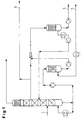
- Fig. 1:
- Schema der Aufarbeitung gemäß Beispiel 1.
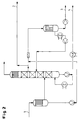
- Fig. 2:
- Schema der Aufarbeitung gemäß Beispiel 2.
- In eine Packungskolonne DN 50 mit 50 theoretischen Trennstufen gibt man 2,3 kg/h eines lösungsmittelfreien, entwässerten Reaktionsgemisches aus der DNT-Hydrierung auf den 8. Boden auf. Es handelt sich bei dem Gemisch um eine Zusammensetzung von im wesentlichen TDA-Isomeren mit 76,5 Gew.-% 2,4-Diaminotoluol, 18,5 Gew.-% 2,6-Diaminotoluol und 4 Gew.-% kernhydriertem TDA und 0,9 Gew.-% Schwersiedern (Strom 1) auf. Die Kolonne wird unter einem Druck am Kopf von 8 000 Pas und einer Sumpftemperatur 203°C betrieben. Das o-TDA wird bei einer Kopftemperatur von 160°C total kondensiert und 0,3 kg/h 99 gew.-%ig entsprechend temperaturgeregelt, flüssig auf 45. Boden entnommen. Die 20 g/h durch den Dephlegmator durchschlagenden Brüden, die ca. 30 Gew.-% kernhydriertes TDA in o-TDA enthalten, werden kondensiert und bei ca. 100°C in die Vorlage der thermischen Verwertung abgeleitet.
- Der Sumpf, bestehend aus 99 Gew.-% 2,4-/2,6-Diaminotoluolgemisch und 1 Gew.-% Schwersiedern, wird in einem nachgeschalteten Fallfilmverdampfer soweit unter gleichem Unterdruck vom m-TDA befreit, daß die Schwersieder bis auf ca. 50 Gew.-% aufkonzentriert werden. Die Brüden, 2,15 kg/h m-TDA, werden kondensiert und zur Weiterverarbeitung oder zum Verkauf ausgelagert (Strom 4). Das Konzentrat (70 g/h) wird mit flüssig entnommenem o-TDA 250 g/h im Verhältnis 1:3,5 abgemischt und die TDA-Isomeren gemeinsam bei einem Druck von 8 000 Pas verdampft. Die Brüden (250 g/h) werden kondensiert und am 25. Boden flüssig in die Isomerenkolonne zurückgeführt. Das Sumpfprodukt, 70 g/h bestehend aus 50 Gew.-% Schwersiedern, 40 Gew.-% o-TDA und 10 Gew.-% m-TDA (Strom 3) wird in die Vorlage zur thermischen Verwertung gegeben, wobei sich ein organisches Gemisch mit dem Hauptbestandteil o-TDA (Strom 2) zur Verbrennung mit einem Heizwert von ca. 33.000 kcal/kg ergibt.
- In eine Packungskolonne DN 50 mit 50 theoretischen Trennstufen gibt man 2,2 kg/h eines Brüdenstromes aus einem Fallfilmverdampfer, der der Isomerenkolonne vorgeschaltet ist, bestehend aus 77,9 Gew.-% 2,4-Diaminotoluol, 17,6 Gew.-% 2,6-Diaminotoluol, 4,2 Gew.-% restliche Diaminotoluole und 0,1 Gew.-% kernhydriertes TDA (Strom 1). Die TDA-Isomeren werden wie im Beispiel 1 destillativ bei einem Kolonnenkopfdruck von 4 000 Pas und Sumpftemperatur 192°C aufgetrennt, wobei das Sumpfprodukt direkt von Schwersiedern befreit auf ca. 120°C gekühlt zur Weiterverarbeitung oder zum Verkauf gelagert wird (Strom 4).
- Das vom vorgeschalteten Fallfilmverdampfer ablaufende Schwersiederkonzentrat (70 g/h) wird mit flüssig entnommenem ortho-TDA (250 g/h) im Verhältnis 1:3,5 abgemischt und die TDA-Isomeren gemeinsam bei einem Druck von 4 000 Pas verdampft. Die Brüden (250 g/h) werden kondensiert und am 25. Boden flüssig in die Isomerenkolonne zurückgeführt. Das Sumpfprodukt, 70 g/h bestehend aus 50 Gew.-% Schwersiedern, 40 Gew.-% o-TDA und 10 Gew.-% m-TDA (Strom 3) wird in die Vorlage zur thermischen Verwertung gegeben, wobei sich ein organisches Gemisch mit dem Hauptbestandteil o-TDA (Strom 2) zur Verbrennung mit einem Heizwert von ca. 33.000 kcal/kg ergibt.
Claims (6)
- Verfahren zur Aufarbeitung von Amingemischen bei der Diaminotoluol-Herstellung aus der Hydrierung von aromatischen Dinitroverbindungen, bei dem man nach Entfernung von Reaktionswasser und gegebenenfalls Lösungsmittel aus dem Diaminotoluol-Isomeren-Gemisch (TDA-Gemisch) über eine TDA-Isomerendetilationskolonne die leichtsiedenden TDA-Isomeren destillativ abtrennt, dadurch gekennzeichnet,a) daß man die zurückbleibende m-TDA und Schwersieder im Gemisch enthaltene Sumpfphase abtrennt und auf ca. 25 bis 60 Gew.-% Schwersiedergehalt aufkonzentriert,b) die aufkonzentrierte Sumpfphase in einem Verhältnis von 1:1 bis 1:5 mit einem ortho-TDA-Isomerengemisch abmischt und ein m/o-TDA-Gemisch abdestilliert und anschließendc) das nach b) erhaltene m/o-TDA-Gemisch in die TDA-Isomerendestillationskolonne zurückführt.
- Verfahren gemäß Anspruch 1, dadurch gekennzeichnet, daß man in Schritt a) die Sumpfphase in einem Verdampfer und/oder einer Abtriebskolonne mit 2 bis 10 theoretischen Böden aufkonzentriert.
- Verfahren gemäß einem der Ansprüche 1 bis 2, dadurch gekennzeichnet, daß man in Schritt b) das m/o-TDA-Gemisch in einer Destillationskolonne mit 2 bis 30, insbesondere 2 bis 10, theoretischen Böden abdestilliert.
- Verfahren gemäß einem der Ansprüche 1 bis 3, dadurch gekennzeichnet, daß in Schritt a) die Sumpfphase so aufkonzentriert wird, daß das Verhältnis der Schwersieder zu meta-TDA 1:1 bis 1:10 beträgt.
- Verfahren gemäß einem der Ansprüche 1 bis 4, dadurch gekennzeichnet, daß die nach Schritt b) zurückbleibende Sumpfphase nach Abdestillieren des meta-/ortho-TDA-Gemisches ein Verhältnis von Schwersieder zu ortho-TDA von 5:1 bis 1:10 aufweist.
- Verfahren gemaß einem der Ansprüche 1 bis 5, dadurch gekennzeichnet, daß man die einzelnen Destillationsstufen bei einem Kolonnenkopfdruck von 3 000 bis 120 000 Pas betreibt.
Applications Claiming Priority (2)
| Application Number | Priority Date | Filing Date | Title |
|---|---|---|---|
| DE19608443A DE19608443C1 (de) | 1996-03-05 | 1996-03-05 | Verfahren zur Aufarbeitung von Amingemischen bei der Diaminotoluol-Herstellung unter Abtrennung der Schwersieder |
| DE19608443 | 1996-03-05 |
Publications (2)
| Publication Number | Publication Date |
|---|---|
| EP0794170A1 true EP0794170A1 (de) | 1997-09-10 |
| EP0794170B1 EP0794170B1 (de) | 2001-10-31 |
Family
ID=7787260
Family Applications (1)
| Application Number | Title | Priority Date | Filing Date |
|---|---|---|---|
| EP97102725A Expired - Lifetime EP0794170B1 (de) | 1996-03-05 | 1997-02-20 | Verfahren zur Schwersiederabtrennung bei der Diamono-toluol-Herstellung |
Country Status (7)
| Country | Link |
|---|---|
| US (1) | US5728880A (de) |
| EP (1) | EP0794170B1 (de) |
| JP (1) | JPH09241223A (de) |
| CA (1) | CA2198815A1 (de) |
| DE (2) | DE19608443C1 (de) |
| ES (1) | ES2166920T3 (de) |
| TW (1) | TW353061B (de) |
Cited By (2)
| Publication number | Priority date | Publication date | Assignee | Title |
|---|---|---|---|---|
| EP1602640A1 (de) * | 2004-06-01 | 2005-12-07 | Bayer MaterialScience AG | Verfahren zur destillativen Trennung von wässrigen Aminlösungen |
| WO2013164308A1 (de) | 2012-05-04 | 2013-11-07 | Bayer Materialscience Ag | Verfahren zur behandlung eines ein aromatisches amin umfassenden stoffgemisches, insbesondere von roh-anilin |
Families Citing this family (15)
| Publication number | Priority date | Publication date | Assignee | Title |
|---|---|---|---|---|
| FR2777560B1 (fr) * | 1998-04-17 | 2000-06-09 | Rhodia Chimie Sa | Procede de purification de polyamines aromatiques |
| DE59902100D1 (de) * | 1998-09-10 | 2002-08-29 | Basf Ag | Verfahren zur Abtrennung von Verunreinigungen aus 3-(2 -Acetoxy-ethyl)-dihydro-2(3H)furanon |
| US6359177B1 (en) | 2000-12-15 | 2002-03-19 | Bayer Corporation | Process for separating mixtures of materials having different boiling points |
| RU2224573C1 (ru) * | 2003-03-11 | 2004-02-27 | Недд Маркетинг Са | Ректификационная установка для очистки третичных аминов |
| DE10349095A1 (de) * | 2003-10-17 | 2005-05-19 | Basf Ag | Verfahren zur Herstellung von Aminen |
| DE102004001456A1 (de) * | 2004-01-08 | 2005-08-11 | Basf Ag | Verfahren zur destillativen Aufbereitung von Toluylendiamin |
| KR101200218B1 (ko) * | 2004-06-01 | 2012-11-09 | 바이엘 머티리얼사이언스 아게 | 아민 수용액 증류적 분리 방법 |
| DE102005032430A1 (de) * | 2005-07-12 | 2007-01-25 | Bayer Materialscience Ag | Verfahren zur Herstellung von Toluylendiamin |
| CN100455559C (zh) * | 2006-11-08 | 2009-01-28 | 大连理工大学 | 芳香族硝基化合物还原制备芳胺的方法 |
| CN101848885B (zh) * | 2007-11-27 | 2013-05-08 | 三井化学株式会社 | 甲苯二胺的脱水方法及脱水装置 |
| DE102008063991A1 (de) | 2008-12-19 | 2010-06-24 | Bayer Materialscience Ag | Verfahren zur Herstellung von Isocyanaten in der Gasphase |
| EP3523272B1 (de) * | 2016-10-10 | 2020-09-23 | Basf Se | Verfahren zur hydrierung von toluendiamin (tda)-teer |
| CN106748811B (zh) * | 2017-01-06 | 2018-09-14 | 浙江建业化工股份有限公司 | 三正丁胺回收法及所用回收装置 |
| HUE054424T2 (hu) * | 2017-01-27 | 2021-09-28 | Covestro Llc | Eljárás stabil toluol-diamin származék/víz elegyek elõállítására, kapcsolódó készítmények, és az elegyek üzemanyagként történõ alkalmazásának eljárásai |
| CN114516802B (zh) * | 2020-11-19 | 2023-12-19 | 万华化学集团股份有限公司 | 一种甲苯二胺精制的方法 |
Citations (1)
| Publication number | Priority date | Publication date | Assignee | Title |
|---|---|---|---|---|
| DE4230098C1 (de) * | 1992-09-09 | 1993-06-03 | Bayer Ag, 5090 Leverkusen, De |
Family Cites Families (6)
| Publication number | Priority date | Publication date | Assignee | Title |
|---|---|---|---|---|
| BE631964A (de) * | ||||
| GB768111A (en) * | 1953-11-13 | 1957-02-13 | Bayer Ag | Production of toluylene diamine |
| BE661047A (de) * | 1964-03-12 | 1965-09-13 | ||
| BE661946A (de) * | 1964-04-01 | 1965-10-01 | ||
| FR1482056A (fr) * | 1966-03-10 | 1967-05-26 | Melle Usines Sa | Procédé d'hydrogénation |
| US3428531A (en) * | 1967-06-01 | 1969-02-18 | Du Pont | Distillation recovery of metaphenylenediamine |
-
1996
- 1996-03-05 DE DE19608443A patent/DE19608443C1/de not_active Expired - Fee Related
-
1997
- 1997-02-20 EP EP97102725A patent/EP0794170B1/de not_active Expired - Lifetime
- 1997-02-20 DE DE59705126T patent/DE59705126D1/de not_active Expired - Lifetime
- 1997-02-20 ES ES97102725T patent/ES2166920T3/es not_active Expired - Lifetime
- 1997-02-25 US US08/806,139 patent/US5728880A/en not_active Expired - Lifetime
- 1997-02-28 CA CA002198815A patent/CA2198815A1/en not_active Abandoned
- 1997-03-03 JP JP9061721A patent/JPH09241223A/ja not_active Abandoned
- 1997-03-03 TW TW086102466A patent/TW353061B/zh active
Patent Citations (1)
| Publication number | Priority date | Publication date | Assignee | Title |
|---|---|---|---|---|
| DE4230098C1 (de) * | 1992-09-09 | 1993-06-03 | Bayer Ag, 5090 Leverkusen, De |
Non-Patent Citations (1)
| Title |
|---|
| KIRK-OTHMER: "Encyclopedia of Chemical Technology, 3rd ed., vol. 2, 1978", JOHN WILEY & SONS, NEW YORK, XP002031539 * |
Cited By (2)
| Publication number | Priority date | Publication date | Assignee | Title |
|---|---|---|---|---|
| EP1602640A1 (de) * | 2004-06-01 | 2005-12-07 | Bayer MaterialScience AG | Verfahren zur destillativen Trennung von wässrigen Aminlösungen |
| WO2013164308A1 (de) | 2012-05-04 | 2013-11-07 | Bayer Materialscience Ag | Verfahren zur behandlung eines ein aromatisches amin umfassenden stoffgemisches, insbesondere von roh-anilin |
Also Published As
| Publication number | Publication date |
|---|---|
| DE59705126D1 (de) | 2001-12-06 |
| CA2198815A1 (en) | 1997-09-05 |
| TW353061B (en) | 1999-02-21 |
| DE19608443C1 (de) | 1997-07-24 |
| US5728880A (en) | 1998-03-17 |
| JPH09241223A (ja) | 1997-09-16 |
| EP0794170B1 (de) | 2001-10-31 |
| ES2166920T3 (es) | 2002-05-01 |
Similar Documents
| Publication | Publication Date | Title |
|---|---|---|
| DE19608443C1 (de) | Verfahren zur Aufarbeitung von Amingemischen bei der Diaminotoluol-Herstellung unter Abtrennung der Schwersieder | |
| EP0236839B1 (de) | Verfahren zur Aufarbeitung wässriger Aminlösungen | |
| EP1935871B1 (de) | Verfahren zur Herstellung von aromatischen Aminen | |
| EP1602640B1 (de) | Verfahren zur destillativen Trennung von wässrigen Aminlösungen | |
| EP3201169B1 (de) | Abgasreinigung in einem verfahren zur kontinuierlichen herstellung von dinitrotoluol | |
| EP2598474B1 (de) | Verfahren zur kontinuierlichen herstellung von nitrobenzol | |
| EP2877443B1 (de) | Verfahren zur herstellung von nitrobenzol durch adiabate nitrierung | |
| EP1984320B1 (de) | Verfahren zur herstellung von reinem xylylendiamin (xda) | |
| DE3930323A1 (de) | Verfahren zur aufarbeitung von in abwasser aus einer nitrierung enthaltenen nitrophenolischen nebenprodukten | |
| EP1746083B1 (de) | Verfahren zur Herstellung von Toluylendiamin | |
| DD142041A5 (de) | Verfahren zur abtrennung von acrylsaeure aus einer waessrigen loesung | |
| EP0659173B1 (de) | Verfahren zur herstellung von rückstandsfreiem 2,4/2,6-diaminotoluolgemisch | |
| DE69803854T2 (de) | Verfahren zur aufarbeitung von säure und nitroverbindungen enthaltenden wässrigen lösungen | |
| EP3994121B1 (de) | Verfahren zur reinigung von anilin | |
| EP0046534B1 (de) | Verfahren zur Herstellung von Brenzcatechin und Hydrochinon | |
| EP0022534B1 (de) | Verfahren zur Gewinnung von Brenzkatechin und Hydrochinon | |
| DE69014482T2 (de) | Verfahren zur Gewinnung von Salpetersäure. | |
| EP2828233A1 (de) | Verfahren zur reinigung von anilin aus gasphasenhydrierungen | |
| EP0696571A2 (de) | Verfahren zur Herstellung von Dinitrotoluol | |
| DE69813420T2 (de) | Entfernung von neutralem Öl aus Mischungen von natürlicher Kresylsäure | |
| EP1292569B1 (de) | Verfahren zur abtrennung von 6-aminocapronitril aus gemischen, die 6-aminocapronitril, adipodinitril und hexamethylendiamin enthalten | |
| EP0003570B1 (de) | Verfahren zur kontinuierlichen Aufarbeitung von bei der Phosgenierung von Monoaminen anfallenden Lösungen | |
| EP0908442B1 (de) | Verfahren zur Herstellung von Dinitrotoluol in adiabatischer Fahrweise | |
| DE1805957A1 (de) | Verfahren zur Reinigung von Xylylendiisocyanat | |
| WO2021233887A1 (de) | Verfahren zur aufarbeitung von toluylendiamin-gemischen |
Legal Events
| Date | Code | Title | Description |
|---|---|---|---|
| PUAI | Public reference made under article 153(3) epc to a published international application that has entered the european phase |
Free format text: ORIGINAL CODE: 0009012 |
|
| AK | Designated contracting states |
Kind code of ref document: A1 Designated state(s): BE DE ES FR GB IT NL |
|
| 17P | Request for examination filed |
Effective date: 19980310 |
|
| 17Q | First examination report despatched |
Effective date: 19990526 |
|
| GRAG | Despatch of communication of intention to grant |
Free format text: ORIGINAL CODE: EPIDOS AGRA |
|
| GRAG | Despatch of communication of intention to grant |
Free format text: ORIGINAL CODE: EPIDOS AGRA |
|
| GRAH | Despatch of communication of intention to grant a patent |
Free format text: ORIGINAL CODE: EPIDOS IGRA |
|
| GRAH | Despatch of communication of intention to grant a patent |
Free format text: ORIGINAL CODE: EPIDOS IGRA |
|
| GRAA | (expected) grant |
Free format text: ORIGINAL CODE: 0009210 |
|
| AK | Designated contracting states |
Kind code of ref document: B1 Designated state(s): BE DE ES FR GB IT NL |
|
| REF | Corresponds to: |
Ref document number: 59705126 Country of ref document: DE Date of ref document: 20011206 |
|
| REG | Reference to a national code |
Ref country code: GB Ref legal event code: IF02 |
|
| GBT | Gb: translation of ep patent filed (gb section 77(6)(a)/1977) |
Effective date: 20020111 |
|
| ET | Fr: translation filed | ||
| REG | Reference to a national code |
Ref country code: ES Ref legal event code: FG2A Ref document number: 2166920 Country of ref document: ES Kind code of ref document: T3 |
|
| PLBE | No opposition filed within time limit |
Free format text: ORIGINAL CODE: 0009261 |
|
| STAA | Information on the status of an ep patent application or granted ep patent |
Free format text: STATUS: NO OPPOSITION FILED WITHIN TIME LIMIT |
|
| 26N | No opposition filed | ||
| PGFP | Annual fee paid to national office [announced via postgrant information from national office to epo] |
Ref country code: ES Payment date: 20050202 Year of fee payment: 9 |
|
| PGFP | Annual fee paid to national office [announced via postgrant information from national office to epo] |
Ref country code: FR Payment date: 20050214 Year of fee payment: 9 |
|
| PGFP | Annual fee paid to national office [announced via postgrant information from national office to epo] |
Ref country code: GB Payment date: 20050216 Year of fee payment: 9 |
|
| PGFP | Annual fee paid to national office [announced via postgrant information from national office to epo] |
Ref country code: BE Payment date: 20050223 Year of fee payment: 9 |
|
| PGFP | Annual fee paid to national office [announced via postgrant information from national office to epo] |
Ref country code: NL Payment date: 20050228 Year of fee payment: 9 |
|
| PG25 | Lapsed in a contracting state [announced via postgrant information from national office to epo] |
Ref country code: GB Free format text: LAPSE BECAUSE OF NON-PAYMENT OF DUE FEES Effective date: 20060220 |
|
| PG25 | Lapsed in a contracting state [announced via postgrant information from national office to epo] |
Ref country code: ES Free format text: LAPSE BECAUSE OF NON-PAYMENT OF DUE FEES Effective date: 20060221 |
|
| PG25 | Lapsed in a contracting state [announced via postgrant information from national office to epo] |
Ref country code: BE Free format text: LAPSE BECAUSE OF NON-PAYMENT OF DUE FEES Effective date: 20060228 |
|
| PGFP | Annual fee paid to national office [announced via postgrant information from national office to epo] |
Ref country code: IT Payment date: 20060228 Year of fee payment: 10 |
|
| PG25 | Lapsed in a contracting state [announced via postgrant information from national office to epo] |
Ref country code: NL Free format text: LAPSE BECAUSE OF NON-PAYMENT OF DUE FEES Effective date: 20060901 |
|
| GBPC | Gb: european patent ceased through non-payment of renewal fee |
Effective date: 20060220 |
|
| NLV4 | Nl: lapsed or anulled due to non-payment of the annual fee |
Effective date: 20060901 |
|
| REG | Reference to a national code |
Ref country code: FR Ref legal event code: ST Effective date: 20061031 |
|
| REG | Reference to a national code |
Ref country code: ES Ref legal event code: FD2A Effective date: 20060221 |
|
| BERE | Be: lapsed |
Owner name: *BAYER A.G. Effective date: 20060228 |
|
| PG25 | Lapsed in a contracting state [announced via postgrant information from national office to epo] |
Ref country code: FR Free format text: LAPSE BECAUSE OF NON-PAYMENT OF DUE FEES Effective date: 20060228 |
|
| PG25 | Lapsed in a contracting state [announced via postgrant information from national office to epo] |
Ref country code: IT Free format text: LAPSE BECAUSE OF NON-PAYMENT OF DUE FEES Effective date: 20070220 |
|
| REG | Reference to a national code |
Ref country code: DE Ref legal event code: R081 Ref document number: 59705126 Country of ref document: DE Owner name: COVESTRO DEUTSCHLAND AG, DE Free format text: FORMER OWNER: BAYER MATERIALSCIENCE AKTIENGESELLSCHAFT, 51373 LEVERKUSEN, DE Effective date: 20140317 Ref country code: DE Ref legal event code: R081 Ref document number: 59705126 Country of ref document: DE Owner name: BAYER INTELLECTUAL PROPERTY GMBH, DE Free format text: FORMER OWNER: BAYER MATERIALSCIENCE AKTIENGESELLSCHAFT, 51373 LEVERKUSEN, DE Effective date: 20140317 |
|
| REG | Reference to a national code |
Ref country code: DE Ref legal event code: R081 Ref document number: 59705126 Country of ref document: DE Owner name: COVESTRO DEUTSCHLAND AG, DE Free format text: FORMER OWNER: BAYER INTELLECTUAL PROPERTY GMBH, 40789 MONHEIM, DE |
|
| PGFP | Annual fee paid to national office [announced via postgrant information from national office to epo] |
Ref country code: DE Payment date: 20160216 Year of fee payment: 20 |
|
| REG | Reference to a national code |
Ref country code: DE Ref legal event code: R071 Ref document number: 59705126 Country of ref document: DE |