EP0793484B1 - Adjuvant pour composition vaccinale - Google Patents
Adjuvant pour composition vaccinale Download PDFInfo
- Publication number
- EP0793484B1 EP0793484B1 EP95940309A EP95940309A EP0793484B1 EP 0793484 B1 EP0793484 B1 EP 0793484B1 EP 95940309 A EP95940309 A EP 95940309A EP 95940309 A EP95940309 A EP 95940309A EP 0793484 B1 EP0793484 B1 EP 0793484B1
- Authority
- EP
- European Patent Office
- Prior art keywords
- vaccine composition
- use according
- chol
- amphipathic compound
- cholesterol
- Prior art date
- Legal status (The legal status is an assumption and is not a legal conclusion. Google has not performed a legal analysis and makes no representation as to the accuracy of the status listed.)
- Expired - Lifetime
Links
- 229960005486 vaccine Drugs 0.000 title claims abstract description 61
- 239000000203 mixture Substances 0.000 title claims abstract description 56
- 239000002671 adjuvant Substances 0.000 title claims abstract description 21
- 150000001875 compounds Chemical class 0.000 claims abstract description 34
- 239000000427 antigen Substances 0.000 claims abstract description 19
- 102000036639 antigens Human genes 0.000 claims abstract description 19
- 108091007433 antigens Proteins 0.000 claims abstract description 19
- 125000002091 cationic group Chemical group 0.000 claims abstract description 14
- 229930182558 Sterol Natural products 0.000 claims abstract description 9
- 150000003432 sterols Chemical class 0.000 claims abstract description 9
- 235000003702 sterols Nutrition 0.000 claims abstract description 9
- 150000001841 cholesterols Chemical class 0.000 claims abstract description 4
- 150000001412 amines Chemical class 0.000 claims abstract description 3
- 125000001453 quaternary ammonium group Chemical group 0.000 claims abstract description 3
- SNKAWJBJQDLSFF-NVKMUCNASA-N 1,2-dioleoyl-sn-glycero-3-phosphocholine Chemical compound CCCCCCCC\C=C/CCCCCCCC(=O)OC[C@H](COP([O-])(=O)OCC[N+](C)(C)C)OC(=O)CCCCCCC\C=C/CCCCCCCC SNKAWJBJQDLSFF-NVKMUCNASA-N 0.000 claims description 23
- 239000002502 liposome Substances 0.000 claims description 18
- MWRBNPKJOOWZPW-CLFAGFIQSA-N dioleoyl phosphatidylethanolamine Chemical compound CCCCCCCC\C=C/CCCCCCCC(=O)OCC(COP(O)(=O)OCCN)OC(=O)CCCCCCC\C=C/CCCCCCCC MWRBNPKJOOWZPW-CLFAGFIQSA-N 0.000 claims description 13
- 150000002632 lipids Chemical class 0.000 claims description 12
- 230000007935 neutral effect Effects 0.000 claims description 10
- 238000004519 manufacturing process Methods 0.000 claims description 9
- HIHOWBSBBDRPDW-PTHRTHQKSA-N [(3s,8s,9s,10r,13r,14s,17r)-10,13-dimethyl-17-[(2r)-6-methylheptan-2-yl]-2,3,4,7,8,9,11,12,14,15,16,17-dodecahydro-1h-cyclopenta[a]phenanthren-3-yl] n-[2-(dimethylamino)ethyl]carbamate Chemical compound C1C=C2C[C@@H](OC(=O)NCCN(C)C)CC[C@]2(C)[C@@H]2[C@@H]1[C@@H]1CC[C@H]([C@H](C)CCCC(C)C)[C@@]1(C)CC2 HIHOWBSBBDRPDW-PTHRTHQKSA-N 0.000 claims description 7
- 241000712461 unidentified influenza virus Species 0.000 claims description 7
- RTZKZFJDLAIYFH-UHFFFAOYSA-N Diethyl ether Chemical compound CCOCC RTZKZFJDLAIYFH-UHFFFAOYSA-N 0.000 claims description 4
- 125000003917 carbamoyl group Chemical group [H]N([H])C(*)=O 0.000 claims description 4
- HVYWMOMLDIMFJA-DPAQBDIFSA-N cholesterol Chemical compound C1C=C2C[C@@H](O)CC[C@]2(C)[C@@H]2[C@@H]1[C@@H]1CC[C@H]([C@H](C)CCCC(C)C)[C@@]1(C)CC2 HVYWMOMLDIMFJA-DPAQBDIFSA-N 0.000 claims description 4
- XMBWDFGMSWQBCA-UHFFFAOYSA-N hydrogen iodide Chemical compound I XMBWDFGMSWQBCA-UHFFFAOYSA-N 0.000 claims description 4
- 150000001408 amides Chemical class 0.000 claims description 3
- 150000002148 esters Chemical class 0.000 claims description 3
- 125000000217 alkyl group Chemical group 0.000 claims description 2
- 125000004432 carbon atom Chemical group C* 0.000 claims description 2
- 235000012000 cholesterol Nutrition 0.000 claims description 2
- 241000124008 Mammalia Species 0.000 claims 1
- 241000699670 Mus sp. Species 0.000 description 27
- 239000000725 suspension Substances 0.000 description 17
- 230000004044 response Effects 0.000 description 15
- 210000004027 cell Anatomy 0.000 description 14
- 238000000034 method Methods 0.000 description 12
- HEDRZPFGACZZDS-UHFFFAOYSA-N Chloroform Chemical compound ClC(Cl)Cl HEDRZPFGACZZDS-UHFFFAOYSA-N 0.000 description 8
- 208000037797 influenza A Diseases 0.000 description 7
- 238000002360 preparation method Methods 0.000 description 7
- 230000035931 haemagglutination Effects 0.000 description 6
- 230000028993 immune response Effects 0.000 description 6
- 230000003053 immunization Effects 0.000 description 6
- 238000002649 immunization Methods 0.000 description 6
- 206010022000 influenza Diseases 0.000 description 6
- 238000002347 injection Methods 0.000 description 6
- 239000007924 injection Substances 0.000 description 6
- 230000003472 neutralizing effect Effects 0.000 description 6
- 238000002965 ELISA Methods 0.000 description 5
- 230000005764 inhibitory process Effects 0.000 description 5
- 230000003248 secreting effect Effects 0.000 description 5
- XLYOFNOQVPJJNP-UHFFFAOYSA-N water Substances O XLYOFNOQVPJJNP-UHFFFAOYSA-N 0.000 description 5
- 101710154606 Hemagglutinin Proteins 0.000 description 4
- 101710093908 Outer capsid protein VP4 Proteins 0.000 description 4
- 101710135467 Outer capsid protein sigma-1 Proteins 0.000 description 4
- 101710176177 Protein A56 Proteins 0.000 description 4
- 241000700605 Viruses Species 0.000 description 4
- WNROFYMDJYEPJX-UHFFFAOYSA-K aluminium hydroxide Chemical compound [OH-].[OH-].[OH-].[Al+3] WNROFYMDJYEPJX-UHFFFAOYSA-K 0.000 description 4
- 238000006243 chemical reaction Methods 0.000 description 4
- 210000001151 cytotoxic T lymphocyte Anatomy 0.000 description 4
- 239000000185 hemagglutinin Substances 0.000 description 4
- 230000005847 immunogenicity Effects 0.000 description 4
- 230000006698 induction Effects 0.000 description 4
- 229960003971 influenza vaccine Drugs 0.000 description 4
- 102000004169 proteins and genes Human genes 0.000 description 4
- 108090000623 proteins and genes Proteins 0.000 description 4
- 210000002966 serum Anatomy 0.000 description 4
- 239000000243 solution Substances 0.000 description 4
- NHBKXEKEPDILRR-UHFFFAOYSA-N 2,3-bis(butanoylsulfanyl)propyl butanoate Chemical compound CCCC(=O)OCC(SC(=O)CCC)CSC(=O)CCC NHBKXEKEPDILRR-UHFFFAOYSA-N 0.000 description 3
- LFQSCWFLJHTTHZ-UHFFFAOYSA-N Ethanol Chemical compound CCO LFQSCWFLJHTTHZ-UHFFFAOYSA-N 0.000 description 3
- 102000011931 Nucleoproteins Human genes 0.000 description 3
- 108010061100 Nucleoproteins Proteins 0.000 description 3
- 230000000240 adjuvant effect Effects 0.000 description 3
- 238000010790 dilution Methods 0.000 description 3
- 239000012895 dilution Substances 0.000 description 3
- 210000000987 immune system Anatomy 0.000 description 3
- 230000001939 inductive effect Effects 0.000 description 3
- 108090000765 processed proteins & peptides Proteins 0.000 description 3
- 238000007920 subcutaneous administration Methods 0.000 description 3
- 241001465754 Metazoa Species 0.000 description 2
- QNEPTKZEXBPDLF-JDTILAPWSA-N [(3s,8s,9s,10r,13r,14s,17r)-10,13-dimethyl-17-[(2r)-6-methylheptan-2-yl]-2,3,4,7,8,9,11,12,14,15,16,17-dodecahydro-1h-cyclopenta[a]phenanthren-3-yl] carbonochloridate Chemical compound C1C=C2C[C@@H](OC(Cl)=O)CC[C@]2(C)[C@@H]2[C@@H]1[C@@H]1CC[C@H]([C@H](C)CCCC(C)C)[C@@]1(C)CC2 QNEPTKZEXBPDLF-JDTILAPWSA-N 0.000 description 2
- 230000009471 action Effects 0.000 description 2
- 238000003556 assay Methods 0.000 description 2
- 230000008901 benefit Effects 0.000 description 2
- 230000015572 biosynthetic process Effects 0.000 description 2
- 230000009089 cytolysis Effects 0.000 description 2
- 239000006185 dispersion Substances 0.000 description 2
- 239000012636 effector Substances 0.000 description 2
- 230000000694 effects Effects 0.000 description 2
- 238000003114 enzyme-linked immunosorbent spot assay Methods 0.000 description 2
- 230000002209 hydrophobic effect Effects 0.000 description 2
- 230000001965 increasing effect Effects 0.000 description 2
- 230000002401 inhibitory effect Effects 0.000 description 2
- 230000007108 local immune response Effects 0.000 description 2
- 210000004072 lung Anatomy 0.000 description 2
- 239000000693 micelle Substances 0.000 description 2
- DILRJUIACXKSQE-UHFFFAOYSA-N n',n'-dimethylethane-1,2-diamine Chemical compound CN(C)CCN DILRJUIACXKSQE-UHFFFAOYSA-N 0.000 description 2
- 230000001681 protective effect Effects 0.000 description 2
- 239000007929 subcutaneous injection Substances 0.000 description 2
- 238000010254 subcutaneous injection Methods 0.000 description 2
- 238000003786 synthesis reaction Methods 0.000 description 2
- 230000001988 toxicity Effects 0.000 description 2
- 231100000419 toxicity Toxicity 0.000 description 2
- 238000005406 washing Methods 0.000 description 2
- OILXMJHPFNGGTO-UHFFFAOYSA-N (22E)-(24xi)-24-methylcholesta-5,22-dien-3beta-ol Natural products C1C=C2CC(O)CCC2(C)C2C1C1CCC(C(C)C=CC(C)C(C)C)C1(C)CC2 OILXMJHPFNGGTO-UHFFFAOYSA-N 0.000 description 1
- RQOCXCFLRBRBCS-UHFFFAOYSA-N (22E)-cholesta-5,7,22-trien-3beta-ol Natural products C1C(O)CCC2(C)C(CCC3(C(C(C)C=CCC(C)C)CCC33)C)C3=CC=C21 RQOCXCFLRBRBCS-UHFFFAOYSA-N 0.000 description 1
- OQMZNAMGEHIHNN-UHFFFAOYSA-N 7-Dehydrostigmasterol Natural products C1C(O)CCC2(C)C(CCC3(C(C(C)C=CC(CC)C(C)C)CCC33)C)C3=CC=C21 OQMZNAMGEHIHNN-UHFFFAOYSA-N 0.000 description 1
- 238000012286 ELISA Assay Methods 0.000 description 1
- DNVPQKQSNYMLRS-NXVQYWJNSA-N Ergosterol Natural products CC(C)[C@@H](C)C=C[C@H](C)[C@H]1CC[C@H]2C3=CC=C4C[C@@H](O)CC[C@]4(C)[C@@H]3CC[C@]12C DNVPQKQSNYMLRS-NXVQYWJNSA-N 0.000 description 1
- 241000725303 Human immunodeficiency virus Species 0.000 description 1
- 229940124873 Influenza virus vaccine Drugs 0.000 description 1
- 101710085938 Matrix protein Proteins 0.000 description 1
- 101710127721 Membrane protein Proteins 0.000 description 1
- 241000699666 Mus <mouse, genus> Species 0.000 description 1
- 238000005481 NMR spectroscopy Methods 0.000 description 1
- 229920002873 Polyethylenimine Polymers 0.000 description 1
- 241000831652 Salinivibrio sharmensis Species 0.000 description 1
- 108020000999 Viral RNA Proteins 0.000 description 1
- 230000001154 acute effect Effects 0.000 description 1
- 230000004520 agglutination Effects 0.000 description 1
- 238000013019 agitation Methods 0.000 description 1
- 230000001476 alcoholic effect Effects 0.000 description 1
- ILRRQNADMUWWFW-UHFFFAOYSA-K aluminium phosphate Chemical compound O1[Al]2OP1(=O)O2 ILRRQNADMUWWFW-UHFFFAOYSA-K 0.000 description 1
- 239000012062 aqueous buffer Substances 0.000 description 1
- 239000012928 buffer substance Substances 0.000 description 1
- 210000000234 capsid Anatomy 0.000 description 1
- 230000006037 cell lysis Effects 0.000 description 1
- 230000000052 comparative effect Effects 0.000 description 1
- 238000009833 condensation Methods 0.000 description 1
- 230000005494 condensation Effects 0.000 description 1
- 231100000433 cytotoxic Toxicity 0.000 description 1
- 230000001472 cytotoxic effect Effects 0.000 description 1
- 230000003013 cytotoxicity Effects 0.000 description 1
- 231100000135 cytotoxicity Toxicity 0.000 description 1
- 238000010586 diagram Methods 0.000 description 1
- 230000009881 electrostatic interaction Effects 0.000 description 1
- DNVPQKQSNYMLRS-SOWFXMKYSA-N ergosterol Chemical compound C1[C@@H](O)CC[C@]2(C)[C@H](CC[C@]3([C@H]([C@H](C)/C=C/[C@@H](C)C(C)C)CC[C@H]33)C)C3=CC=C21 DNVPQKQSNYMLRS-SOWFXMKYSA-N 0.000 description 1
- 238000001704 evaporation Methods 0.000 description 1
- 230000008020 evaporation Effects 0.000 description 1
- 238000002474 experimental method Methods 0.000 description 1
- 238000001914 filtration Methods 0.000 description 1
- 230000036571 hydration Effects 0.000 description 1
- 238000006703 hydration reaction Methods 0.000 description 1
- 230000001571 immunoadjuvant effect Effects 0.000 description 1
- 239000000568 immunological adjuvant Substances 0.000 description 1
- 238000000338 in vitro Methods 0.000 description 1
- 238000011534 incubation Methods 0.000 description 1
- 208000015181 infectious disease Diseases 0.000 description 1
- 238000011068 loading method Methods 0.000 description 1
- 210000004698 lymphocyte Anatomy 0.000 description 1
- 238000004949 mass spectrometry Methods 0.000 description 1
- 201000006512 mast cell neoplasm Diseases 0.000 description 1
- 208000006971 mastocytoma Diseases 0.000 description 1
- 239000011159 matrix material Substances 0.000 description 1
- 238000002156 mixing Methods 0.000 description 1
- 150000003904 phospholipids Chemical class 0.000 description 1
- -1 phytosterol Chemical compound 0.000 description 1
- 239000000843 powder Substances 0.000 description 1
- 230000001737 promoting effect Effects 0.000 description 1
- 230000002285 radioactive effect Effects 0.000 description 1
- 238000001953 recrystallisation Methods 0.000 description 1
- 238000000638 solvent extraction Methods 0.000 description 1
- 238000000527 sonication Methods 0.000 description 1
- 125000006850 spacer group Chemical group 0.000 description 1
- 210000004989 spleen cell Anatomy 0.000 description 1
- 239000000021 stimulant Substances 0.000 description 1
- 230000000638 stimulation Effects 0.000 description 1
- 238000003756 stirring Methods 0.000 description 1
- 238000004448 titration Methods 0.000 description 1
- 229960000172 trivalent influenza vaccine Drugs 0.000 description 1
- 238000002255 vaccination Methods 0.000 description 1
Images


Classifications
-
- C—CHEMISTRY; METALLURGY
- C12—BIOCHEMISTRY; BEER; SPIRITS; WINE; VINEGAR; MICROBIOLOGY; ENZYMOLOGY; MUTATION OR GENETIC ENGINEERING
- C12N—MICROORGANISMS OR ENZYMES; COMPOSITIONS THEREOF; PROPAGATING, PRESERVING, OR MAINTAINING MICROORGANISMS; MUTATION OR GENETIC ENGINEERING; CULTURE MEDIA
- C12N7/00—Viruses; Bacteriophages; Compositions thereof; Preparation or purification thereof
-
- A—HUMAN NECESSITIES
- A61—MEDICAL OR VETERINARY SCIENCE; HYGIENE
- A61K—PREPARATIONS FOR MEDICAL, DENTAL OR TOILETRY PURPOSES
- A61K39/00—Medicinal preparations containing antigens or antibodies
- A61K39/12—Viral antigens
-
- A—HUMAN NECESSITIES
- A61—MEDICAL OR VETERINARY SCIENCE; HYGIENE
- A61K—PREPARATIONS FOR MEDICAL, DENTAL OR TOILETRY PURPOSES
- A61K39/00—Medicinal preparations containing antigens or antibodies
- A61K39/12—Viral antigens
- A61K39/145—Orthomyxoviridae, e.g. influenza virus
-
- A—HUMAN NECESSITIES
- A61—MEDICAL OR VETERINARY SCIENCE; HYGIENE
- A61K—PREPARATIONS FOR MEDICAL, DENTAL OR TOILETRY PURPOSES
- A61K39/00—Medicinal preparations containing antigens or antibodies
- A61K39/39—Medicinal preparations containing antigens or antibodies characterised by the immunostimulating additives, e.g. chemical adjuvants
-
- A—HUMAN NECESSITIES
- A61—MEDICAL OR VETERINARY SCIENCE; HYGIENE
- A61K—PREPARATIONS FOR MEDICAL, DENTAL OR TOILETRY PURPOSES
- A61K47/00—Medicinal preparations characterised by the non-active ingredients used, e.g. carriers or inert additives; Targeting or modifying agents chemically bound to the active ingredient
- A61K47/06—Organic compounds, e.g. natural or synthetic hydrocarbons, polyolefins, mineral oil, petrolatum or ozokerite
- A61K47/16—Organic compounds, e.g. natural or synthetic hydrocarbons, polyolefins, mineral oil, petrolatum or ozokerite containing nitrogen, e.g. nitro-, nitroso-, azo-compounds, nitriles, cyanates
- A61K47/18—Amines; Amides; Ureas; Quaternary ammonium compounds; Amino acids; Oligopeptides having up to five amino acids
- A61K47/186—Quaternary ammonium compounds, e.g. benzalkonium chloride or cetrimide
-
- A—HUMAN NECESSITIES
- A61—MEDICAL OR VETERINARY SCIENCE; HYGIENE
- A61K—PREPARATIONS FOR MEDICAL, DENTAL OR TOILETRY PURPOSES
- A61K9/00—Medicinal preparations characterised by special physical form
- A61K9/0012—Galenical forms characterised by the site of application
- A61K9/0019—Injectable compositions; Intramuscular, intravenous, arterial, subcutaneous administration; Compositions to be administered through the skin in an invasive manner
-
- A—HUMAN NECESSITIES
- A61—MEDICAL OR VETERINARY SCIENCE; HYGIENE
- A61K—PREPARATIONS FOR MEDICAL, DENTAL OR TOILETRY PURPOSES
- A61K9/00—Medicinal preparations characterised by special physical form
- A61K9/0012—Galenical forms characterised by the site of application
- A61K9/0043—Nose
-
- A—HUMAN NECESSITIES
- A61—MEDICAL OR VETERINARY SCIENCE; HYGIENE
- A61K—PREPARATIONS FOR MEDICAL, DENTAL OR TOILETRY PURPOSES
- A61K9/00—Medicinal preparations characterised by special physical form
- A61K9/10—Dispersions; Emulsions
- A61K9/127—Synthetic bilayered vehicles, e.g. liposomes or liposomes with cholesterol as the only non-phosphatidyl surfactant
- A61K9/1271—Non-conventional liposomes, e.g. PEGylated liposomes or liposomes coated or grafted with polymers
- A61K9/1272—Non-conventional liposomes, e.g. PEGylated liposomes or liposomes coated or grafted with polymers comprising non-phosphatidyl surfactants as bilayer-forming substances, e.g. cationic lipids or non-phosphatidyl liposomes coated or grafted with polymers
-
- A—HUMAN NECESSITIES
- A61—MEDICAL OR VETERINARY SCIENCE; HYGIENE
- A61P—SPECIFIC THERAPEUTIC ACTIVITY OF CHEMICAL COMPOUNDS OR MEDICINAL PREPARATIONS
- A61P31/00—Antiinfectives, i.e. antibiotics, antiseptics, chemotherapeutics
- A61P31/12—Antivirals
-
- A—HUMAN NECESSITIES
- A61—MEDICAL OR VETERINARY SCIENCE; HYGIENE
- A61P—SPECIFIC THERAPEUTIC ACTIVITY OF CHEMICAL COMPOUNDS OR MEDICINAL PREPARATIONS
- A61P31/00—Antiinfectives, i.e. antibiotics, antiseptics, chemotherapeutics
- A61P31/12—Antivirals
- A61P31/14—Antivirals for RNA viruses
- A61P31/16—Antivirals for RNA viruses for influenza or rhinoviruses
-
- A—HUMAN NECESSITIES
- A61—MEDICAL OR VETERINARY SCIENCE; HYGIENE
- A61K—PREPARATIONS FOR MEDICAL, DENTAL OR TOILETRY PURPOSES
- A61K39/00—Medicinal preparations containing antigens or antibodies
- A61K2039/54—Medicinal preparations containing antigens or antibodies characterised by the route of administration
- A61K2039/541—Mucosal route
- A61K2039/543—Mucosal route intranasal
-
- A—HUMAN NECESSITIES
- A61—MEDICAL OR VETERINARY SCIENCE; HYGIENE
- A61K—PREPARATIONS FOR MEDICAL, DENTAL OR TOILETRY PURPOSES
- A61K39/00—Medicinal preparations containing antigens or antibodies
- A61K2039/545—Medicinal preparations containing antigens or antibodies characterised by the dose, timing or administration schedule
-
- A—HUMAN NECESSITIES
- A61—MEDICAL OR VETERINARY SCIENCE; HYGIENE
- A61K—PREPARATIONS FOR MEDICAL, DENTAL OR TOILETRY PURPOSES
- A61K39/00—Medicinal preparations containing antigens or antibodies
- A61K2039/555—Medicinal preparations containing antigens or antibodies characterised by a specific combination antigen/adjuvant
- A61K2039/55511—Organic adjuvants
- A61K2039/55555—Liposomes; Vesicles, e.g. nanoparticles; Spheres, e.g. nanospheres; Polymers
-
- C—CHEMISTRY; METALLURGY
- C12—BIOCHEMISTRY; BEER; SPIRITS; WINE; VINEGAR; MICROBIOLOGY; ENZYMOLOGY; MUTATION OR GENETIC ENGINEERING
- C12N—MICROORGANISMS OR ENZYMES; COMPOSITIONS THEREOF; PROPAGATING, PRESERVING, OR MAINTAINING MICROORGANISMS; MUTATION OR GENETIC ENGINEERING; CULTURE MEDIA
- C12N2760/00—MICROORGANISMS OR ENZYMES; COMPOSITIONS THEREOF; PROPAGATING, PRESERVING, OR MAINTAINING MICROORGANISMS; MUTATION OR GENETIC ENGINEERING; CULTURE MEDIA ssRNA viruses negative-sense
- C12N2760/00011—Details
- C12N2760/16011—Orthomyxoviridae
- C12N2760/16111—Influenzavirus A, i.e. influenza A virus
- C12N2760/16134—Use of virus or viral component as vaccine, e.g. live-attenuated or inactivated virus, VLP, viral protein
Definitions
- the present invention relates to the field of vaccine compositions. More in particular, the invention relates to new adjuvants used to increase the immunogenicity of vaccine compositions.
- antigens which, when injected into animals, go provoke the production of antibodies specific to them.
- One of the principles of vaccination is to stimulate the body's production of antibodies or of an animal, by administering selected antigens to it. The antibodies thus produced will then allow the body to defend itself against a subsequent infection.
- some antigens do not cause sufficient stimulation of the system immune when administered alone. It is therefore necessary to add a adjuvant that will increase the body's immune response so to obtain a sufficient amount of antibody to be protective.
- the invention proposes the use of an amphipathic compound comprising a lipophilic group derived from a sterol linked to a cationic group for the manufacture of a vaccine composition.
- the invention also relates to the use of such an amphipathic compound for the manufacture of an adjuvant for vaccine administration.
- the subject of the invention is also a vaccine composition comprising at least at least one antigen, characterized in that it further comprises at least one compound amphipathic having a lipophilic group derived from a sterol linked to a cationic group.
- amphipathic designates a compound which has both a hydrophobic portion and a hydrophilic portion.
- the cationic grouping of the amphipathic compounds according to the invention can be constituted by a quaternary ammonium or a protonable amine.
- the lipophilic group is linked to the cationic group by means of a bond ester, ether, amide or carbamoyl among which the ester, amide and carbamoyl have the advantage of being hydrolyzable in the cell.
- connection between the 2 groups is preferably carried out through a spacer arm consisting of a branched or unbranched alkyl chain comprising from 1 to 20 Carbon atoms.
- amphipathic compounds according to the invention can be obtained by condensation between a sterol derivative and a compound with a cationic group. according to one of the methods described in "Advanced Organic Chemistry” Part B: Reactions and Synthesis (F.A. Carey and R.J. Sundberg - Plenum Publishing Corp.). More in particular, some of the compounds according to the invention can be produced according to the methods described in US Patent 5,283,185.
- amphipathic compounds obtained in alcoholic solution can then be dispersed in water or in an aqueous buffer and lead to a suspension of micelles or liposomes.
- the amphipathic compounds of the invention are associated with a neutral lipid such as a phospholipid, for example the dioleoyl phosphatidylethanolamine (DOPE) or dioleoyl phosphatidylcholine (DOPC).
- DOPE dioleoyl phosphatidylethanolamine
- DOPC dioleoyl phosphatidylcholine
- the molar proportion of neutral lipid associated with the compounds amphipathic is preferably greater than 20%.
- the products obtained according to the invention did not lead to any toxicity reaction acute when inoculated into mice.
- the antigen used to induce a protective immune response consists of by any antigen usually used in a vaccine composition, that either alone or in combination with another antigen.
- amphipathic compounds according to the invention prove to be good immuno-adjuvants when combined with the flu virus vaccine which includes in particular: the HA protein which is a hemagglutinin located on the surface of the envelope of the Influenza virus, the NP protein which is a capsid nucleoprotein linked to viral RNA and an M protein or protein "matrix" of the envelope.
- the flu virus vaccine which includes in particular: the HA protein which is a hemagglutinin located on the surface of the envelope of the Influenza virus, the NP protein which is a capsid nucleoprotein linked to viral RNA and an M protein or protein "matrix" of the envelope.
- the association between the antigen whose immunogenicity is to be increased and the micellar or liposomal suspension of amphipathic compounds is carried out spontaneously by hydrophobic and electrostatic interaction when mixing components.
- the vaccine compositions obtained have good stability. However, the liposomal suspension seems preferable to the micellar suspension.
- the liposomal suspension is sterilizable by filtration and lyophilizable.
- the administration of the vaccine compositions obtained according to the invention can be carried out by all the routes usually used for the administration of vaccines and, in particular, by subcutaneous or intranasal route. It is also possible to choose for first immunization and booster immunization a different route.
- composition comprising the antigen and the composition containing the amphipathic compounds according to the invention; however, the administration of a liposomal composition of amphipathic compounds according to the invention associated with the antigen not only increases the response humoral type immune system, but also to induce cytotoxic T lymphocytes specific.
- Figure 1 illustrates the reaction scheme for the manufacture of DC chol.
- the figures 2 to 6 represent the results of the induction tests of cytotoxic T lymphocytes for each group of mice mentioned in Example 8.
- FIG. 7 represents the results mentioned in Example 11.
- FIGS 10 and 11 show the results mentioned in Example 13.
- FIGS 12 and 13 show the results mentioned in Example 14.
- FIGS 14 and 15 show the results mentioned in Example 15.
- FIG. 16 represents the results mentioned in Example 16.
- Example 1 synthesis of 3 ⁇ - [N- (N ', N'-dimethylaminoethane) -carbamoyl] -cholesterol (DC chol)
- DC chol is synthesized by reaction of cholesteryl chloroformate and N, N-dimethylethylenediamine according to the diagram in FIG. 1, as described in the article by X. Gao and L. Huang (BBRC 179 (1): 280 -285).
- micellar suspension obtained is mixed with 200 ⁇ l of the monovalent influenza virus vaccine (strain A Singapore) including especially as antigens: hemagglutinin HA, nucleoprotein NP and protein Mr.
- strain A Singapore monovalent influenza virus vaccine
- the mixture obtained is divided into 0.3 ml vaccine doses. Each dose includes 5 ⁇ g of HA and 2.3 mg of DC chol.
- Example 2 The procedure is as in Example 2, starting with 6 mg of DC chol obtained according to Example 1.
- the chloroform is evaporated under vacuum to form a lipid film which is subjected to vacuum desiccation, then resuspended in 3 ml of water.
- the dispersion After hydration for 24 hours at 4 ° C, the dispersion is subjected to sonication for 5 to 10 minutes in an ultrasonic bath (Laboratory Supplies - Hicksville - N.Y.) to form liposomes.
- an ultrasonic bath Laboratory Supplies - Hicksville - N.Y.
- This suspension is stable for at least 6 months at 4 ° C.
- the procedure is as in Example 4, replacing the 18 mg of DOPE with 18 mg dioleoylphosphatidylcholine (DOPC).
- DOPC dioleoylphosphatidylcholine
- a stable liposomal suspension is obtained for at least 6 months at 4 ° C.
- Example 6 Preparation of a vaccine composition against the influenza virus from a DC chol / DOPE liposomal suspension
- a liposomal suspension obtained according to example 4 3 ml of a liposomal suspension obtained according to example 4 are mixed with 0.2 ml of the monovalent influenza A / Singapore strain vaccine containing the equivalent of 50 ⁇ g of the hemagglutinin HA antigen.
- the mixture obtained is then divided into 10 vaccine doses of 0.3 ml, each containing 5 ⁇ g of HA and 0.45 mg of DC chol.
- Example 7 Preparation of a vaccine composition against the influenza virus from a DC chol / DOPC liposomal suspension
- the mixture obtained is then divided into 10 vaccine doses of 0.3 ml each containing 5 ⁇ g of HA and 0.45 mg of DC chol.
- the sera from mouse on D21, D36 and D51 and the anti-HA antibody titration is carried out using the technique for inhibiting hemagglutination induced by the influenza virus.
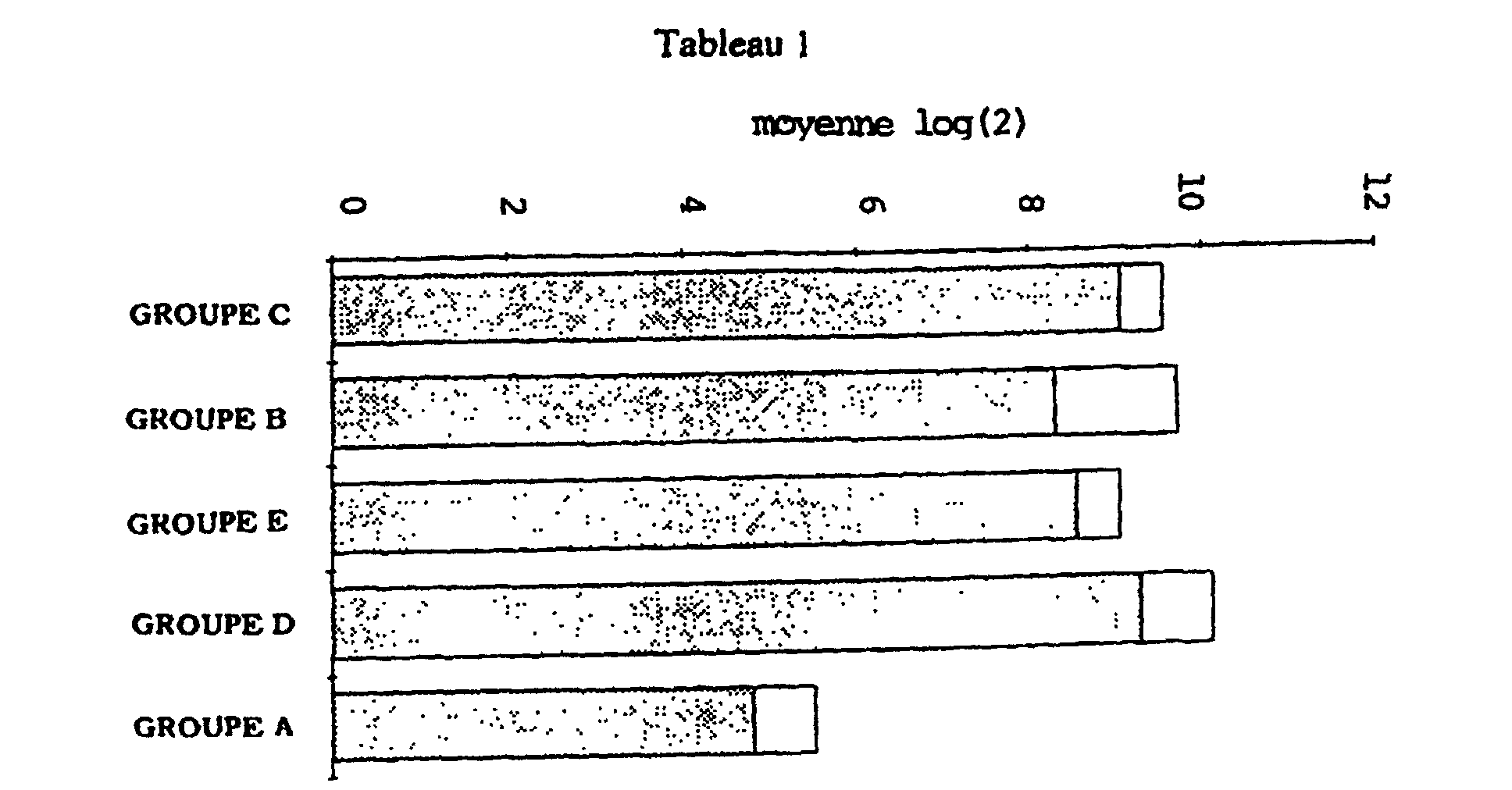
- Table 1 illustrates the results obtained for each group of mice after an injection and Table 2 the results after 2 injections.
- the neutralizing antibody titers in the sera of the mice are presented in log2 of the highest dilution inducing the inhibition of hemagglutination.
- mice of each of the groups are taken at D51 mentioned in Example 8.
- effector cells are restimulated in vitro in the presence of cells syngeneic stimulants infected with the corresponding strain A / Singapore virus to the vaccine tested.
- the specific cytotoxic function of these stimulated cells is enhanced evidence using as target cells the line of sensitized mastocytomas P815 by incubation with a CTL epitope peptide of the virus hemagglutinin (response specific against HA) or with a CTL epitope peptide of the virus nucleoprotein (specific response against NP).
- Non-specific lysis background noise is measured on P815 cells not sensitized or sensitized with a CTL epitope peptide from HIV virus (V3MN).
- the lysis of target cells is measured by a radioactive technique based on the loading of the target cells in Cr-51 and on the release of this radioelement during the cell lysis.
- 300 ⁇ l vaccine compositions are produced, each comprising the vaccine monovalent influenza A / Singapore strain and containing either 15 or 5 ⁇ g HA. associated with DC chol / DOPC liposomes at a variable concentration.
- the preparation of the liposomal suspension is produced in a similar manner to that of Example 4, in replacing the 18 mg of dioleoylphosphatidylethanolamine (DOPE) with 13.5 mg of dioleoyl phosphatidylcholine (DOPC) and taking up the lipid film obtained by a variable amount of water depending on the concentration of DC chol desired.
- DOPE dioleoylphosphatidylethanolamine
- DOPC dioleoyl phosphatidylcholine
- the vaccine compositions obtained are injected into groups of 5 Balb / c mice females from 8 to 10 weeks old on D 0 and D 28.
- the sera are taken on D 42 and the Anti-HA antibodies by the agglutination inhibition technique (IHA).
- mice The sera of the mice are taken on D 28 and D 42 and assayed by the technique ELISA the IgG1 and IgG2 produced.
- mice tested are 20-22 month old mice that are more difficult to stimulate.
- DC chol has an adjuvant effect both for the primary response and for the secondary response and in particular with respect to the induction of IgG2a antibodies.
- mice immune neutralizing antibodies by hemagglutination inhibition test (IHA).
- vaccine compositions are prepared 50 ⁇ l this time, comprising 5 ⁇ g of HA (in the form of a monovalent influenza vaccine, strain A / Singapore) combined with 200 ⁇ g of DC chol present as DC chol / DOPC liposomes (in a 1: 4 mass proportion).
- mice Two groups of 4 BALB / c mice are immunized intranasally twice to 4 times weeks apart.
- the first group of mice (G 1 ) receives 50 ⁇ l of the vaccine composition containing 200 ⁇ g of DC chol while the second group (G 2 ) receives 50 ⁇ l of the same monovalent influenza vaccine but without adjuvant.
- the immune responses of each group are analyzed by ELISA assay of the sera collected 3 weeks after the booster immunization.
- the DC chol / DOPC liposomes increase local immune responses and at least a factor of 2.
- the adjuvant role played by DC chol / DOPC liposomes in responses general immune systems has also been observed when, instead of measuring IgG and IgA by ELISA, the anti-HA antibody titers were measured by IHA; the increase of the local immune response was also observed during an ELISPOT count of number of IgG-secreting cells and number of IgA-secreting cells in lungs of immunized mice, as well as when determining the ratio between specific IgG (respectively IgA) levels and the level of IgG (respectively IgA) total measured by ELISA in nasopharyngeal washings of immunized mice.
- mice The sera of the immunized mice are taken 3 weeks after the administration of booster and we dose, for each, the level of neutralizing antibodies by the IHA technique hemagglutination inhibition.
- results obtained are shown in the figure 16 and show that, in a mixed administration protocol combining the subcutaneous routes and intranasal, DC chol has an adjuvant effect and that increasing the dose of DC chol from 6 to 200 ⁇ g increases the immune response.
Landscapes
- Health & Medical Sciences (AREA)
- Life Sciences & Earth Sciences (AREA)
- Chemical & Material Sciences (AREA)
- Medicinal Chemistry (AREA)
- General Health & Medical Sciences (AREA)
- Veterinary Medicine (AREA)
- Pharmacology & Pharmacy (AREA)
- Animal Behavior & Ethology (AREA)
- Public Health (AREA)
- Epidemiology (AREA)
- Virology (AREA)
- Microbiology (AREA)
- Immunology (AREA)
- Mycology (AREA)
- Engineering & Computer Science (AREA)
- Organic Chemistry (AREA)
- Chemical Kinetics & Catalysis (AREA)
- General Chemical & Material Sciences (AREA)
- Genetics & Genomics (AREA)
- Bioinformatics & Cheminformatics (AREA)
- Zoology (AREA)
- Wood Science & Technology (AREA)
- Molecular Biology (AREA)
- Pulmonology (AREA)
- Proteomics, Peptides & Aminoacids (AREA)
- Oil, Petroleum & Natural Gas (AREA)
- Nuclear Medicine, Radiotherapy & Molecular Imaging (AREA)
- Dermatology (AREA)
- Otolaryngology (AREA)
- Oncology (AREA)
- Biomedical Technology (AREA)
- Biotechnology (AREA)
- Communicable Diseases (AREA)
- Dispersion Chemistry (AREA)
- Biophysics (AREA)
- Biochemistry (AREA)
- General Engineering & Computer Science (AREA)
- Medicines Containing Antibodies Or Antigens For Use As Internal Diagnostic Agents (AREA)
- Medicinal Preparation (AREA)
- Preparation Of Compounds By Using Micro-Organisms (AREA)
Description
- l'iodure de cholestéryl-3β-carboxamidoéthylènetriméthylammonium,
- la cholestéryl-3β-carboxyamidoéthylènamine,
- l'iodure de cholestéryl-3β-oxysuccinamidoéthylènetriméthylammonium,
- le 3β-[N-(N',N'-diméthylaminoéthane)-carbamoyl]-cholestérol,
- le 3β-[N-(polyéthylènimine)-carbamoyl]-cholestérol.

- 15 µg de HA + 0 µg de DC chol
15 µg de HA + 400 µg de DC chol - 5 µg de HA + 0 µg de DC chol
5 µg de HA + 25 µg de DC chol
5 µg de HA + 50 µg de DC chol
5 µg de HA + 100 µg de DC chol
5 µg de HA + 200 µg de DC chol
5 µg de HA + 300 µg de DC chol
5 µg de HA + 400 µg de DC chol
- 1er groupe :
- 0,3 ml de vaccin grippe monovalent souche A/Singapour dilué à 5 µg de HA dans 0,3 ml de PBS,
- 2ème groupe :
- 0,3 ml de vaccin grippe monovalent souche A/Singapour dilué à 5 µg de HA adjuvé avec 0,1 mg d'hydroxyde d'aluminium,
- 3ème groupe :
- 0,3 ml de composition vaccinale obtenue selon l'exemple 11 et contenant 5 µg de HA et 400 µg de DC chol associé à du DOPC.
- Groupe 3 (G3) :
- une composition vaccinale de 300 µl injectée en sous-cutané comprenant 4 µg de HA (sous forme de vaccin grippe monovalent souche A/Singapour) combinés avec 6 µg de DC chol (sous forme de liposomes DC chol/DOPC) et,
- une composition vaccinale de 50 µl administrée par voie intranasale comprenant 0,25 µg de HA (sous forme de vaccin grippe monovalent souche A/Singapour) combinés avec 6 µg de DC chol (sous forme de liposomes DC chol/DOPC),
- Groupe 4 (G4):
- une composition vaccinale de 300 µl injectée en sous-cutané comprenant 4 µg de HA combinés avec 200 µg de DC chol et,
- une composition vaccinale de 50 µl administrée par voie intranasale comprenant 0,25 µg de HA combinés avec 200 µg de DC chol.
Claims (22)
- Utilisation d'un composé amphipathique comprenant un groupement lipophile dérivé d'un stérol lié à un groupement cationique pour la fabrication d'une composition vaccinale.
- Utilisation selon la revendication 1, caractérisée en ce que le groupement lipophile est un dérivé de cholestérol.
- Utilisation selon une des revendications précédentes, caractérisée en ce que le groupement cationique est un ammonium quaternaire ou une amine protonable.
- Utilisation selon une des revendications précédentes caractérisée en ce que le groupement lipophile est relié au groupement cationique par une liaison ester, éther, amide ou carbamoyle.
- Utilisation selon une des revendications précédentes, caractérisée en ce que le groupement lipophile est séparé du groupement cationique par une chaíne alkylique ramifiée ou non comprenant de 1 à 20 atomes de Carbone.
- Utilisation selon une des revendications précédentes, caractérisée en ce que le composé amphipathique est choisi parmi les composés suivants :l'iodure de cholestéryl-3β-carboxamidoéthylènetriméthylammonium,la cholestéryl-3β-carboxyamidoéthylènamine,l'iodure de cholestéryl-3β-oxysuccinamidoéthylènetriméthylammonium,le 3β-[N-(N',N'-diméthylaminoéthane)-carbamoyl]-cholestérol,le 3β-[N-(polyéthylènamine)-carbamoyl]-cholestérol.
- Utilisation de 3β-[N-(N',N'-diméthylaminoéthane)-carbamoyl]-cholestérol pour la fabrication d'une composition vaccinale.
- Utilisation selon une des revendications précédentes, caractérisée en ce que le composé amphipathique est associé à un lipide neutre.
- Utilisation selon la revendication 8 caractérisée, en ce que la proportion de lipide neutre associé est d'au moins 20 %.
- Utilisation selon une des revendications 8 et 9, caractérisée en ce que le lipide neutre est la dioleoyl phosphatidyléthanolamine (DOPE) ou la dioleoyl phosphatidylcholine (DOPC).
- Utilisation selon une des revendications précédentes, caractérisée en ce que le composé amphipathique est dispersé dans un environnement aqueux sous forme de liposomes.
- Utilisation d'un composé amphipathique comprenant un groupement lipophile dérivé d'un stérol lié à un groupement cationique pour la fabrication d'un adjuvant destiné à une administration vaccinale.
- Utilisation selon la revendication 12, caractérisée en ce que ledit composé amphipathique est le 3β-[N-(N',N'-diméthylaminoéthane)-carbamoyl]cholestérol.
- Utilisation selon une des revendications 12 ou 13, caractérisée en ce que ledit composé amphipathique est associé à un lipide neutre.
- Utilisation selon une des revendications précédentes, caractérisée en ce que ladite composition vaccinale est destinée à être administrée à des mammifères.
- Utilisation selon une des revendications précédentes, caractérisée en ce que ladite composition vaccinale est destinée à être administrée par voie infra-nasale.
- Composition vaccinale comprenant au moins un antigène, caractérisée en ce qu'elle comprend en outre au moins un composé amphipathique possédant un groupement lipophile dérivé d'un stérol lié à un groupement cationique.
- Composition vaccinale selon la revendication 17, caractérisée en ce que ledit groupement lipophile est un dérivé de cholestérol.
- Composition vaccinale selon une des revendications 17 ou 18, caractérisée en ce que ledit composé amphiphatique est le 3β-[N-(N',N'-diméthylaminoéthane)-carbamoyl]cholestérol.
- Composition vaccinale selon une des revendications 17 à19, caractérisée en ce que ledit composé amphiphathique se présente sous forme de liposomes incluant au moins un antigène.
- Composition vaccinale selon une des revendications 17 à 20, caractérisée en ce que ledit composé amphipathique est associé à un lipide neutre.
- Composition vaccinale selon une des revendications 17 à 21, caractérisée en ce qu'elle comprend au moins un antigène du virus de la grippe.
Applications Claiming Priority (3)
| Application Number | Priority Date | Filing Date | Title |
|---|---|---|---|
| FR9413606A FR2726764B1 (fr) | 1994-11-14 | 1994-11-14 | Adjuvant pour composition vaccinale |
| FR9413606 | 1994-11-14 | ||
| PCT/FR1995/001495 WO1996014831A1 (fr) | 1994-11-14 | 1995-11-14 | Adjuvant pour composition vaccinale |
Publications (2)
| Publication Number | Publication Date |
|---|---|
| EP0793484A1 EP0793484A1 (fr) | 1997-09-10 |
| EP0793484B1 true EP0793484B1 (fr) | 2003-02-19 |
Family
ID=9468771
Family Applications (1)
| Application Number | Title | Priority Date | Filing Date |
|---|---|---|---|
| EP95940309A Expired - Lifetime EP0793484B1 (fr) | 1994-11-14 | 1995-11-14 | Adjuvant pour composition vaccinale |
Country Status (15)
| Country | Link |
|---|---|
| US (2) | US6780421B1 (fr) |
| EP (1) | EP0793484B1 (fr) |
| JP (1) | JP3923518B2 (fr) |
| CN (1) | CN1096851C (fr) |
| AT (1) | ATE232720T1 (fr) |
| AU (1) | AU706131B2 (fr) |
| CA (1) | CA2205022C (fr) |
| DE (1) | DE69529684T2 (fr) |
| DK (1) | DK0793484T3 (fr) |
| ES (1) | ES2187580T3 (fr) |
| FR (1) | FR2726764B1 (fr) |
| MX (1) | MX9703505A (fr) |
| NZ (1) | NZ297032A (fr) |
| PT (1) | PT793484E (fr) |
| WO (1) | WO1996014831A1 (fr) |
Families Citing this family (52)
| Publication number | Priority date | Publication date | Assignee | Title |
|---|---|---|---|---|
| AU710170B2 (en) | 1996-05-08 | 1999-09-16 | Nika Health Products Limited | Cationic virosomes as transfer system for genetic material |
| DE19631189A1 (de) * | 1996-08-02 | 1998-02-05 | Max Delbrueck Centrum | Neuartige kationische Amphiphile für den liposomalen Gentransfer |
| FR2781160B1 (fr) * | 1998-07-03 | 2000-08-18 | Pasteur Merieux Serums Vacc | Utilisation d'un compose amphipathique pour adjuver un vaccin sous-unitaire |
| US6686339B1 (en) | 1998-08-20 | 2004-02-03 | Aventis Pasteur Limited | Nucleic acid molecules encoding inclusion membrane protein C of Chlamydia |
| US6693087B1 (en) | 1998-08-20 | 2004-02-17 | Aventis Pasteur Limited | Nucleic acid molecules encoding POMP91A protein of Chlamydia |
| AU5366099A (en) | 1998-08-20 | 2000-03-14 | Connaught Laboratories Limited | Nucleic acid molecules encoding inclusion membrane protein of (chlamydia) |
| US20030095973A1 (en) | 1999-05-03 | 2003-05-22 | Murdin Andrew D. | Chlamydia antigens and corresponding DNA fragments and uses thereof |
| FR2797188A1 (fr) * | 1999-08-04 | 2001-02-09 | Univ Paris Nord Laboratoire De | Composes lipidiques cationiques et leurs utilisation pour le transfert de substances d'interet therapeutique chargees negativement |
| AU1013601A (en) | 1999-10-22 | 2001-05-08 | Aventis Pasteur Limited | Method of inducing and/or enhancing an immune response to tumor antigens |
| EP1792995A3 (fr) | 2000-05-08 | 2007-06-13 | Sanofi Pasteur Limited | Antigènes de chlamydia et fragments d'adn correspondants, et utilisations de ceux-ci |
| ATE346925T1 (de) | 2000-05-10 | 2006-12-15 | Sanofi Pasteur Ltd | Durch mage minigene kodierte immunogene polypeptide und ihre verwendungen |
| US7713942B2 (en) * | 2001-04-04 | 2010-05-11 | Nordic Vaccine Technology A/S | Cage-like microparticle complexes comprising sterols and saponins for delivery of polynucleotides |
| US7303881B2 (en) * | 2004-04-30 | 2007-12-04 | Pds Biotechnology Corporation | Antigen delivery compositions and methods of use |
| FR2881050B1 (fr) * | 2005-01-25 | 2007-02-23 | Sanofi Pasteur Sa | Dcchol chez les nouveaux-nes |
| US20060165717A1 (en) * | 2005-01-25 | 2006-07-27 | Sanofi Pasteur | DCchol in newborns |
| DK2514823T3 (en) | 2006-03-03 | 2018-07-23 | Promis Neurosciences Inc | Methods and compositions for treating and detecting failed SOD1-mediated diseases |
| US8080645B2 (en) | 2007-10-01 | 2011-12-20 | Longhorn Vaccines & Diagnostics Llc | Biological specimen collection/transport compositions and methods |
| US9481912B2 (en) | 2006-09-12 | 2016-11-01 | Longhorn Vaccines And Diagnostics, Llc | Compositions and methods for detecting and identifying nucleic acid sequences in biological samples |
| US8652782B2 (en) | 2006-09-12 | 2014-02-18 | Longhorn Vaccines & Diagnostics, Llc | Compositions and methods for detecting, identifying and quantitating mycobacterial-specific nucleic acids |
| US8097419B2 (en) | 2006-09-12 | 2012-01-17 | Longhorn Vaccines & Diagnostics Llc | Compositions and method for rapid, real-time detection of influenza A virus (H1N1) swine 2009 |
| US8877206B2 (en) * | 2007-03-22 | 2014-11-04 | Pds Biotechnology Corporation | Stimulation of an immune response by cationic lipids |
| US11041215B2 (en) | 2007-08-24 | 2021-06-22 | Longhorn Vaccines And Diagnostics, Llc | PCR ready compositions and methods for detecting and identifying nucleic acid sequences |
| US9683256B2 (en) | 2007-10-01 | 2017-06-20 | Longhorn Vaccines And Diagnostics, Llc | Biological specimen collection and transport system |
| US10004799B2 (en) | 2007-08-27 | 2018-06-26 | Longhorn Vaccines And Diagnostics, Llc | Composite antigenic sequences and vaccines |
| EP3058954B1 (fr) | 2007-08-27 | 2017-03-01 | Longhorn Vaccines and Diagnostics, LLC | Compositions immunogènes et procédés |
| CA2698157C (fr) | 2007-09-11 | 2016-10-11 | University Of Guelph | Nouveaux polysaccharides immunogenes issus de clostridium difficile |
| JP5731198B2 (ja) | 2007-09-27 | 2015-06-10 | イムノバクシーン・テクノロジーズ・インコーポレイテッドImmunovaccine Technologies Inc. | インビボでのポリヌクレオチドの送達のための連続疎水相を含む担体におけるリポソームの使用 |
| DK2195466T3 (da) | 2007-10-01 | 2013-01-14 | Longhorn Vaccines & Diagnostics Llc | Fremgangsmåde til opbevaring af biologiske prøver |
| US11041216B2 (en) | 2007-10-01 | 2021-06-22 | Longhorn Vaccines And Diagnostics, Llc | Compositions and methods for detecting and quantifying nucleic acid sequences in blood samples |
| US20100209452A1 (en) * | 2007-10-03 | 2010-08-19 | Immunovaccine Technologies, Inc | Compositions comprising an antigen, an amphipathic compound and a hydrophobic carrier, and uses thereof |
| US9416165B2 (en) | 2007-10-26 | 2016-08-16 | The Regents Of The University Of California | Methods of inhibiting viral replication and improving T cell function employing soluble Tim-3 inhibitors |
| AU2009236306B2 (en) | 2008-04-17 | 2015-04-02 | Pds Biotechnology Corporation | Stimulation of an immune response by enantiomers of cationic lipids |
| CN102056622B (zh) * | 2008-06-05 | 2016-04-06 | 免疫疫苗技术有限公司 | 包含脂质体、抗原、多核苷酸和含疏水物质的连续相的载体的组合物 |
| GB201116248D0 (en) * | 2011-09-20 | 2011-11-02 | Glaxosmithkline Biolog Sa | Liposome production using isopropanol |
| CN113876945A (zh) | 2011-10-06 | 2022-01-04 | 免疫疫苗技术有限公司 | 包括激活或增加tlr2活性的佐剂的脂质体组合物及其应用 |
| WO2013112916A1 (fr) | 2012-01-26 | 2013-08-01 | Longhorn Vaccines And Diagnostics, Llc | Séquences et vaccins antigéniques composites |
| US10286064B2 (en) | 2012-06-15 | 2019-05-14 | Pds Biotechnology Corporation | Cationic lipid vaccine compositions and methods of use |
| TWI672149B (zh) | 2012-09-21 | 2019-09-21 | 美商Pds生技公司 | 改良之疫苗組成物及使用方法 |
| US10098940B2 (en) | 2014-06-20 | 2018-10-16 | University Of Saskatchewan | Exotoxin/thermolysin compositions and methods and uses for treating or preventing laminitis |
| US9976136B2 (en) | 2015-05-14 | 2018-05-22 | Longhorn Vaccines And Diagnostics, Llc | Rapid methods for the extraction of nucleic acids from biological samples |
| JP7452829B2 (ja) | 2015-11-09 | 2024-03-19 | ザ・ユニバーシティ・オブ・ブリティッシュ・コロンビア | アミロイドベータのエピトープおよびそれに対する抗体 |
| AU2016354688B2 (en) | 2015-11-09 | 2021-12-16 | The University Of British Columbia | Epitopes in Amyloid beta mid-region and conformationally-selective antibodies thereto |
| EP3374379A4 (fr) | 2015-11-09 | 2019-05-15 | The University Of British Columbia | Épitopes n-terminaux dans la bêta-amyloïde et anticorps conformationnellement sélectifs associés |
| EP4092112A1 (fr) | 2015-11-13 | 2022-11-23 | PDS Biotechnology Corporation | Lipides en tant que vecteurs synthétiques pour améliorer le traitement et la présentation de l'antigène ex-vivo en thérapie cellulaire dendritique |
| KR102550991B1 (ko) | 2016-07-18 | 2023-07-04 | 더 유니버시티 오브 브리티쉬 콜롬비아 | 아밀로이드 베타에 대한 항체 |
| US20180125920A1 (en) | 2016-11-09 | 2018-05-10 | The University Of British Columbia | Methods for preventing and treating A-beta oligomer-associated and/or -induced diseases and conditions |
| US12286469B2 (en) | 2017-07-18 | 2025-04-29 | The University Of British Columbia | Humanized antibodies binding to amyloid-beta (A-beta) |
| AU2018378588A1 (en) | 2017-12-05 | 2020-06-25 | Pds Biotechnology Corporation | Methods and compositions comprising cationic lipids for stimulating type 1 interferon genes |
| IT201900007060A1 (it) | 2019-05-21 | 2020-11-21 | St Superiore Di Sanita | Cellule tumorali ingegnerizzate e loro usi |
| IT201900012540A1 (it) | 2019-07-22 | 2021-01-22 | Humanitas Mirasole Spa | Inibitori di CHI3L1 e loro usi |
| US12485166B2 (en) | 2020-02-06 | 2025-12-02 | Longhorn Vaccines And Diagnostics, Llc | Vaccines for the treatment and prevention of zoonotic infections |
| WO2022087122A1 (fr) | 2020-10-20 | 2022-04-28 | Longhorn Vaccines And Diagnostics, Llc | Antigènes immunogènes |
Family Cites Families (8)
| Publication number | Priority date | Publication date | Assignee | Title |
|---|---|---|---|---|
| GB1502774A (en) * | 1974-06-25 | 1978-03-01 | Nat Res Dev | Immunological preparations |
| US4261975A (en) * | 1979-09-19 | 1981-04-14 | Merck & Co., Inc. | Viral liposome particle |
| US4971803A (en) * | 1985-04-08 | 1990-11-20 | California Institute Of Technology | Lamellar vesicles formed of cholesterol derivatives |
| AU627226B2 (en) * | 1988-08-25 | 1992-08-20 | Liposome Company, Inc., The | Influenza vaccine and novel adjuvants |
| US5100662A (en) * | 1989-08-23 | 1992-03-31 | The Liposome Company, Inc. | Steroidal liposomes exhibiting enhanced stability |
| US5283185A (en) * | 1991-08-28 | 1994-02-01 | University Of Tennessee Research Corporation | Method for delivering nucleic acids into cells |
| WO1993014744A1 (fr) * | 1992-02-04 | 1993-08-05 | Chiron Corporation | Formulations de vaccins lipidiques non toxiques |
| FR2732895B1 (fr) * | 1995-04-11 | 1997-05-16 | Pasteur Merieux Serums Vacc | Utilisation d'un compose amphipathique cationique comme agent de transfection, comme adjuvant de vaccin, ou comme medicament |
-
1994
- 1994-11-14 FR FR9413606A patent/FR2726764B1/fr not_active Expired - Fee Related
-
1995
- 1995-11-14 ES ES95940309T patent/ES2187580T3/es not_active Expired - Lifetime
- 1995-11-14 CN CN95196601A patent/CN1096851C/zh not_active Expired - Fee Related
- 1995-11-14 EP EP95940309A patent/EP0793484B1/fr not_active Expired - Lifetime
- 1995-11-14 JP JP51580096A patent/JP3923518B2/ja not_active Expired - Fee Related
- 1995-11-14 US US08/836,576 patent/US6780421B1/en not_active Expired - Fee Related
- 1995-11-14 CA CA002205022A patent/CA2205022C/fr not_active Expired - Fee Related
- 1995-11-14 WO PCT/FR1995/001495 patent/WO1996014831A1/fr not_active Ceased
- 1995-11-14 NZ NZ297032A patent/NZ297032A/xx not_active IP Right Cessation
- 1995-11-14 DE DE69529684T patent/DE69529684T2/de not_active Expired - Lifetime
- 1995-11-14 AT AT95940309T patent/ATE232720T1/de active
- 1995-11-14 PT PT95940309T patent/PT793484E/pt unknown
- 1995-11-14 DK DK95940309T patent/DK0793484T3/da active
- 1995-11-14 MX MX9703505A patent/MX9703505A/es not_active IP Right Cessation
- 1995-11-14 AU AU41802/96A patent/AU706131B2/en not_active Ceased
-
2004
- 2004-04-29 US US10/834,616 patent/US20050002952A1/en not_active Abandoned
Non-Patent Citations (2)
| Title |
|---|
| Gupta et al "Adjuvants - a balance between toxicity and adjuvanticity", Vaccine, Vol. 11, 1993, p. 293 * |
| Li et al. "DC-Chol lipid system in gene transfer", Journal of Controlled Release, Vol. 39, 1996, p. 373-381 * |
Also Published As
| Publication number | Publication date |
|---|---|
| US20050002952A1 (en) | 2005-01-06 |
| ES2187580T3 (es) | 2003-06-16 |
| CN1168629A (zh) | 1997-12-24 |
| FR2726764B1 (fr) | 1997-01-31 |
| CN1096851C (zh) | 2002-12-25 |
| NZ297032A (en) | 1999-11-29 |
| CA2205022C (fr) | 2009-12-22 |
| MX9703505A (es) | 1997-07-31 |
| ATE232720T1 (de) | 2003-03-15 |
| AU706131B2 (en) | 1999-06-10 |
| PT793484E (pt) | 2003-06-30 |
| DE69529684T2 (de) | 2003-09-18 |
| JP3923518B2 (ja) | 2007-06-06 |
| DK0793484T3 (da) | 2003-06-02 |
| FR2726764A1 (fr) | 1996-05-15 |
| US6780421B1 (en) | 2004-08-24 |
| CA2205022A1 (fr) | 1996-05-23 |
| JPH11500409A (ja) | 1999-01-12 |
| AU4180296A (en) | 1996-06-06 |
| EP0793484A1 (fr) | 1997-09-10 |
| WO1996014831A1 (fr) | 1996-05-23 |
| DE69529684D1 (en) | 2003-03-27 |
Similar Documents
| Publication | Publication Date | Title |
|---|---|---|
| CA2205022C (fr) | Adjuvant pour composition vaccinale | |
| CA1047921A (fr) | Liposomes utilises comme adjuvants des vaccins | |
| EP0356339B1 (fr) | Vaccin contre l'influenza et adjuvants | |
| EP0634937B1 (fr) | Vaccins contenant des vesicules tensio actives non ioniques | |
| US4117113A (en) | Immunological preparations | |
| FR2814958A1 (fr) | Composition vaccinale | |
| CA2192597A1 (fr) | Utilisation d'un compose amphipathique cationique comme agent de transfection, comme adjuvant de vaccin, ou comme medicament | |
| JP2000502087A (ja) | アジュバンドおよび送達賦形剤としての、アーケオソーム類、補酵素q▲下10▼を含有するアーケオソーム類、および補酵素q▲下10▼を含有する他の種類のリポソーム類 | |
| EP1121148A2 (fr) | Emulsion immunostimulante | |
| KR20250031230A (ko) | 핵산 전달을 위한 지질 나노입자 및 이의 사용 방법 | |
| TW201427686A (zh) | 改良之疫苗組成物及使用方法 | |
| WO1993017702A1 (fr) | Vaccin oral | |
| KR20140119362A (ko) | 리포펩티드 및 폴리(i:c)를 포함하는 아쥬반트 및 이를 이용한 개선된 제형의 백신 조성물 | |
| EP1696954B1 (fr) | Composition vaccinale adjuvantée par une alkylphosphatidylcholine | |
| HU176180B (en) | Process for preparing antigenic compositions | |
| FR3002454A1 (fr) | Composition immunogene sous forme d'emulsion | |
| US20180318415A1 (en) | Novel adjuvant formulations | |
| WO2024261351A2 (fr) | Fractions de saponine immunologiquement actives et formulations d'adjuvant | |
| FR2781160A1 (fr) | Utilisation d'un compose amphipathique pour adjuver un vaccin sous-unitaire | |
| EP4115901A1 (fr) | Nanoparticules mimétiques d'agent pathogène vivant basées sur un squelette de paroi cellulaire d'agent pathogène, et leur procédé de production | |
| EP0748214B1 (fr) | Liposomes, et leur utilisation notamment pour l'obtention de compositions immunomodulatrices | |
| de Haan | Mucosal immunoadjuvant activity of liposomes | |
| FR2692148A1 (fr) | Composition adjuvante de l'immunité humorale et à médiation cellulaire n'induisant pas de réponse vis-à-vis de déterminants auto-antigéniques. | |
| WO1993025236A1 (fr) | Composition adjuvante de l'immunite humorale et a mediation cellulaire n'induisant pas de reponse vis-a-vis de determinants auto-antigeniques | |
| PL231158B1 (pl) | Szczepionka, kompozycja farmaceutyczna, nośnik kwasów nukleinowych oraz innych substancji aktywnych biologicznie, zastosowanie kompozycji do wytwarzania szczepionki oraz zastosowanie kationowych pochodnych poliprenoli PTAI do wytwarzania substancji immunomodulujących |
Legal Events
| Date | Code | Title | Description |
|---|---|---|---|
| PUAI | Public reference made under article 153(3) epc to a published international application that has entered the european phase |
Free format text: ORIGINAL CODE: 0009012 |
|
| 17P | Request for examination filed |
Effective date: 19970513 |
|
| AK | Designated contracting states |
Kind code of ref document: A1 Designated state(s): AT BE CH DE DK ES FR GB GR IE IT LI LU NL PT SE |
|
| RIN1 | Information on inventor provided before grant (corrected) |
Inventor name: RONCO, JORGE Inventor name: TRANNOY, EMMANUELLE Inventor name: HAENSLER, JEAN |
|
| 17Q | First examination report despatched |
Effective date: 20000405 |
|
| RAP1 | Party data changed (applicant data changed or rights of an application transferred) |
Owner name: AVENTIS PASTEUR |
|
| GRAG | Despatch of communication of intention to grant |
Free format text: ORIGINAL CODE: EPIDOS AGRA |
|
| GRAG | Despatch of communication of intention to grant |
Free format text: ORIGINAL CODE: EPIDOS AGRA |
|
| GRAH | Despatch of communication of intention to grant a patent |
Free format text: ORIGINAL CODE: EPIDOS IGRA |
|
| GRAH | Despatch of communication of intention to grant a patent |
Free format text: ORIGINAL CODE: EPIDOS IGRA |
|
| GRAA | (expected) grant |
Free format text: ORIGINAL CODE: 0009210 |
|
| AK | Designated contracting states |
Designated state(s): AT BE CH DE DK ES FR GB GR IE IT LI LU NL PT SE |
|
| REG | Reference to a national code |
Ref country code: GB Ref legal event code: FG4D Free format text: NOT ENGLISH |
|
| REG | Reference to a national code |
Ref country code: CH Ref legal event code: EP |
|
| REG | Reference to a national code |
Ref country code: IE Ref legal event code: FG4D Free format text: FRENCH |
|
| REF | Corresponds to: |
Ref document number: 69529684 Country of ref document: DE Date of ref document: 20030327 Kind code of ref document: P |
|
| REG | Reference to a national code |
Ref country code: CH Ref legal event code: NV Representative=s name: PATENTANWAELTE SCHAAD, BALASS, MENZL & PARTNER AG |
|
| GBT | Gb: translation of ep patent filed (gb section 77(6)(a)/1977) |
Effective date: 20030401 |
|
| REG | Reference to a national code |
Ref country code: GR Ref legal event code: EP Ref document number: 20030401365 Country of ref document: GR |
|
| REG | Reference to a national code |
Ref country code: SE Ref legal event code: TRGR |
|
| REG | Reference to a national code |
Ref country code: DK Ref legal event code: T3 |
|
| REG | Reference to a national code |
Ref country code: ES Ref legal event code: FG2A Ref document number: 2187580 Country of ref document: ES Kind code of ref document: T3 |
|
| REG | Reference to a national code |
Ref country code: PT Ref legal event code: SC4A Free format text: AVAILABILITY OF NATIONAL TRANSLATION Effective date: 20030423 |
|
| PLBE | No opposition filed within time limit |
Free format text: ORIGINAL CODE: 0009261 |
|
| STAA | Information on the status of an ep patent application or granted ep patent |
Free format text: STATUS: NO OPPOSITION FILED WITHIN TIME LIMIT |
|
| 26N | No opposition filed |
Effective date: 20031120 |
|
| REG | Reference to a national code |
Ref country code: FR Ref legal event code: CD |
|
| PGFP | Annual fee paid to national office [announced via postgrant information from national office to epo] |
Ref country code: IE Payment date: 20120917 Year of fee payment: 18 |
|
| PGFP | Annual fee paid to national office [announced via postgrant information from national office to epo] |
Ref country code: GR Payment date: 20120927 Year of fee payment: 18 Ref country code: LU Payment date: 20121015 Year of fee payment: 18 |
|
| PGFP | Annual fee paid to national office [announced via postgrant information from national office to epo] |
Ref country code: FR Payment date: 20120927 Year of fee payment: 18 Ref country code: DK Payment date: 20121105 Year of fee payment: 18 |
|
| PGFP | Annual fee paid to national office [announced via postgrant information from national office to epo] |
Ref country code: CH Payment date: 20121101 Year of fee payment: 18 Ref country code: PT Payment date: 20120515 Year of fee payment: 18 Ref country code: DE Payment date: 20121130 Year of fee payment: 18 Ref country code: BE Payment date: 20120928 Year of fee payment: 18 |
|
| PGFP | Annual fee paid to national office [announced via postgrant information from national office to epo] |
Ref country code: SE Payment date: 20121107 Year of fee payment: 18 Ref country code: GB Payment date: 20121114 Year of fee payment: 18 Ref country code: IT Payment date: 20121025 Year of fee payment: 18 Ref country code: ES Payment date: 20121015 Year of fee payment: 18 |
|
| PGFP | Annual fee paid to national office [announced via postgrant information from national office to epo] |
Ref country code: AT Payment date: 20121109 Year of fee payment: 18 Ref country code: NL Payment date: 20121115 Year of fee payment: 18 |
|
| REG | Reference to a national code |
Ref country code: PT Ref legal event code: MM4A Free format text: LAPSE DUE TO NON-PAYMENT OF FEES Effective date: 20140514 |
|
| BERE | Be: lapsed |
Owner name: *AVENTIS PASTEUR Effective date: 20131130 |
|
| REG | Reference to a national code |
Ref country code: NL Ref legal event code: V1 Effective date: 20140601 |
|
| REG | Reference to a national code |
Ref country code: DK Ref legal event code: EBP Effective date: 20131130 |
|
| REG | Reference to a national code |
Ref country code: CH Ref legal event code: PL |
|
| REG | Reference to a national code |
Ref country code: SE Ref legal event code: EUG |
|
| REG | Reference to a national code |
Ref country code: AT Ref legal event code: MM01 Ref document number: 232720 Country of ref document: AT Kind code of ref document: T Effective date: 20131114 |
|
| GBPC | Gb: european patent ceased through non-payment of renewal fee |
Effective date: 20131114 |
|
| PG25 | Lapsed in a contracting state [announced via postgrant information from national office to epo] |
Ref country code: CH Free format text: LAPSE BECAUSE OF NON-PAYMENT OF DUE FEES Effective date: 20131130 Ref country code: LI Free format text: LAPSE BECAUSE OF NON-PAYMENT OF DUE FEES Effective date: 20131130 |
|
| REG | Reference to a national code |
Ref country code: GR Ref legal event code: ML Ref document number: 20030401365 Country of ref document: GR Effective date: 20140603 |
|
| REG | Reference to a national code |
Ref country code: FR Ref legal event code: ST Effective date: 20140731 |
|
| REG | Reference to a national code |
Ref country code: IE Ref legal event code: MM4A |
|
| PG25 | Lapsed in a contracting state [announced via postgrant information from national office to epo] |
Ref country code: IT Free format text: LAPSE BECAUSE OF NON-PAYMENT OF DUE FEES Effective date: 20131114 Ref country code: PT Free format text: LAPSE BECAUSE OF NON-PAYMENT OF DUE FEES Effective date: 20140514 Ref country code: DE Free format text: LAPSE BECAUSE OF NON-PAYMENT OF DUE FEES Effective date: 20140603 Ref country code: GR Free format text: LAPSE BECAUSE OF NON-PAYMENT OF DUE FEES Effective date: 20140603 Ref country code: AT Free format text: LAPSE BECAUSE OF NON-PAYMENT OF DUE FEES Effective date: 20131114 Ref country code: SE Free format text: LAPSE BECAUSE OF NON-PAYMENT OF DUE FEES Effective date: 20131115 Ref country code: NL Free format text: LAPSE BECAUSE OF NON-PAYMENT OF DUE FEES Effective date: 20140601 |
|
| REG | Reference to a national code |
Ref country code: DE Ref legal event code: R119 Ref document number: 69529684 Country of ref document: DE Effective date: 20140603 |
|
| PG25 | Lapsed in a contracting state [announced via postgrant information from national office to epo] |
Ref country code: BE Free format text: LAPSE BECAUSE OF NON-PAYMENT OF DUE FEES Effective date: 20131130 |
|
| PG25 | Lapsed in a contracting state [announced via postgrant information from national office to epo] |
Ref country code: IE Free format text: LAPSE BECAUSE OF NON-PAYMENT OF DUE FEES Effective date: 20131114 Ref country code: DK Free format text: LAPSE BECAUSE OF NON-PAYMENT OF DUE FEES Effective date: 20131130 |
|
| PG25 | Lapsed in a contracting state [announced via postgrant information from national office to epo] |
Ref country code: FR Free format text: LAPSE BECAUSE OF NON-PAYMENT OF DUE FEES Effective date: 20131202 Ref country code: GB Free format text: LAPSE BECAUSE OF NON-PAYMENT OF DUE FEES Effective date: 20131114 |
|
| REG | Reference to a national code |
Ref country code: ES Ref legal event code: FD2A Effective date: 20150331 |
|
| PG25 | Lapsed in a contracting state [announced via postgrant information from national office to epo] |
Ref country code: ES Free format text: LAPSE BECAUSE OF NON-PAYMENT OF DUE FEES Effective date: 20131115 |
|
| PG25 | Lapsed in a contracting state [announced via postgrant information from national office to epo] |
Ref country code: LU Free format text: LAPSE BECAUSE OF NON-PAYMENT OF DUE FEES Effective date: 20131114 |