EP0790035A2 - Verbesserungen für Blutentnahmegeräte - Google Patents
Verbesserungen für Blutentnahmegeräte Download PDFInfo
- Publication number
- EP0790035A2 EP0790035A2 EP97300997A EP97300997A EP0790035A2 EP 0790035 A2 EP0790035 A2 EP 0790035A2 EP 97300997 A EP97300997 A EP 97300997A EP 97300997 A EP97300997 A EP 97300997A EP 0790035 A2 EP0790035 A2 EP 0790035A2
- Authority
- EP
- European Patent Office
- Prior art keywords
- needle
- lancet
- tip
- rear end
- cap
- Prior art date
- Legal status (The legal status is an assumption and is not a legal conclusion. Google has not performed a legal analysis and makes no representation as to the accuracy of the status listed.)
- Granted
Links
- 238000010241 blood sampling Methods 0.000 title description 2
- 239000007937 lozenge Substances 0.000 claims description 6
- 239000000463 material Substances 0.000 claims description 6
- 239000002991 molded plastic Substances 0.000 claims description 4
- 239000012528 membrane Substances 0.000 claims description 3
- 239000004033 plastic Substances 0.000 abstract description 4
- 229920003023 plastic Polymers 0.000 abstract description 4
- 238000010304 firing Methods 0.000 description 2
- 229910000831 Steel Inorganic materials 0.000 description 1
- 239000008280 blood Substances 0.000 description 1
- 210000004369 blood Anatomy 0.000 description 1
- 238000010276 construction Methods 0.000 description 1
- 230000003014 reinforcing effect Effects 0.000 description 1
- 239000010959 steel Substances 0.000 description 1
Images
Classifications
-
- A—HUMAN NECESSITIES
- A61—MEDICAL OR VETERINARY SCIENCE; HYGIENE
- A61B—DIAGNOSIS; SURGERY; IDENTIFICATION
- A61B5/00—Measuring for diagnostic purposes; Identification of persons
- A61B5/15—Devices for taking samples of blood
- A61B5/151—Devices specially adapted for taking samples of capillary blood, e.g. by lancets, needles or blades
- A61B5/15186—Devices loaded with a single lancet, i.e. a single lancet with or without a casing is loaded into a reusable drive device and then discarded after use; drive devices reloadable for multiple use
-
- A—HUMAN NECESSITIES
- A61—MEDICAL OR VETERINARY SCIENCE; HYGIENE
- A61B—DIAGNOSIS; SURGERY; IDENTIFICATION
- A61B5/00—Measuring for diagnostic purposes; Identification of persons
- A61B5/15—Devices for taking samples of blood
- A61B5/150007—Details
- A61B5/150015—Source of blood
- A61B5/150022—Source of blood for capillary blood or interstitial fluid
-
- A—HUMAN NECESSITIES
- A61—MEDICAL OR VETERINARY SCIENCE; HYGIENE
- A61B—DIAGNOSIS; SURGERY; IDENTIFICATION
- A61B5/00—Measuring for diagnostic purposes; Identification of persons
- A61B5/15—Devices for taking samples of blood
- A61B5/150007—Details
- A61B5/150374—Details of piercing elements or protective means for preventing accidental injuries by such piercing elements
- A61B5/150381—Design of piercing elements
- A61B5/150412—Pointed piercing elements, e.g. needles, lancets for piercing the skin
-
- A—HUMAN NECESSITIES
- A61—MEDICAL OR VETERINARY SCIENCE; HYGIENE
- A61B—DIAGNOSIS; SURGERY; IDENTIFICATION
- A61B5/00—Measuring for diagnostic purposes; Identification of persons
- A61B5/15—Devices for taking samples of blood
- A61B5/150007—Details
- A61B5/150374—Details of piercing elements or protective means for preventing accidental injuries by such piercing elements
- A61B5/150381—Design of piercing elements
- A61B5/150503—Single-ended needles
- A61B5/150519—Details of construction of hub, i.e. element used to attach the single-ended needle to a piercing device or sampling device
-
- A—HUMAN NECESSITIES
- A61—MEDICAL OR VETERINARY SCIENCE; HYGIENE
- A61B—DIAGNOSIS; SURGERY; IDENTIFICATION
- A61B5/00—Measuring for diagnostic purposes; Identification of persons
- A61B5/15—Devices for taking samples of blood
- A61B5/150007—Details
- A61B5/150374—Details of piercing elements or protective means for preventing accidental injuries by such piercing elements
- A61B5/150534—Design of protective means for piercing elements for preventing accidental needle sticks, e.g. shields, caps, protectors, axially extensible sleeves, pivotable protective sleeves
- A61B5/150541—Breakable protectors, e.g. caps, shields or sleeves, i.e. protectors separated destructively, e.g. by breaking a connecting area
- A61B5/150549—Protectors removed by rotational movement, e.g. torsion or screwing
-
- A—HUMAN NECESSITIES
- A61—MEDICAL OR VETERINARY SCIENCE; HYGIENE
- A61B—DIAGNOSIS; SURGERY; IDENTIFICATION
- A61B5/00—Measuring for diagnostic purposes; Identification of persons
- A61B5/15—Devices for taking samples of blood
- A61B5/150007—Details
- A61B5/150374—Details of piercing elements or protective means for preventing accidental injuries by such piercing elements
- A61B5/150534—Design of protective means for piercing elements for preventing accidental needle sticks, e.g. shields, caps, protectors, axially extensible sleeves, pivotable protective sleeves
- A61B5/15058—Joining techniques used for protective means
- A61B5/150618—Integrally moulded protectors, e.g. protectors simultaneously moulded together with a further component, e.g. a hub, of the piercing element
-
- A—HUMAN NECESSITIES
- A61—MEDICAL OR VETERINARY SCIENCE; HYGIENE
- A61B—DIAGNOSIS; SURGERY; IDENTIFICATION
- A61B5/00—Measuring for diagnostic purposes; Identification of persons
- A61B5/15—Devices for taking samples of blood
- A61B5/150007—Details
- A61B5/150374—Details of piercing elements or protective means for preventing accidental injuries by such piercing elements
- A61B5/150534—Design of protective means for piercing elements for preventing accidental needle sticks, e.g. shields, caps, protectors, axially extensible sleeves, pivotable protective sleeves
- A61B5/150694—Procedure for removing protection means at the time of piercing
- A61B5/150717—Procedure for removing protection means at the time of piercing manually removed
-
- A—HUMAN NECESSITIES
- A61—MEDICAL OR VETERINARY SCIENCE; HYGIENE
- A61B—DIAGNOSIS; SURGERY; IDENTIFICATION
- A61B5/00—Measuring for diagnostic purposes; Identification of persons
- A61B5/15—Devices for taking samples of blood
- A61B5/150007—Details
- A61B5/150374—Details of piercing elements or protective means for preventing accidental injuries by such piercing elements
- A61B5/150534—Design of protective means for piercing elements for preventing accidental needle sticks, e.g. shields, caps, protectors, axially extensible sleeves, pivotable protective sleeves
- A61B5/150633—Protective sleeves which are axially extensible, e.g. sleeves connected to, or integrated in, the piercing or driving device; pivotable protective sleeves
Definitions
- This invention relates to blood sampling devices, and in particular to a lancet for pricking the skin to draw a small drop of blood for analysis.
- prickers are widely used by diabetics, for example, who need to know their sugar level.
- diabetics for example, who need to know their sugar level.
- lancet has a steel needle encased in an elongate plastics body.
- a cap is moulded integrally with this body and initially the tip of the needle is embedded in it. But the connection between the cap and the body is weak and the cap can be pulled free to expose the tip. After use, the cap may be used to cover the needle tip again, and it may be re-oriented to fit over the forward end of the body.
- the needle tends to be smooth and the plastics material of the body does not have much grip on it. It can happen that, when breaking the cap free, the cap is squeezed or angled with respect to the body sufficiently to pull the needle forwardly by its tip with respect to the body. There is then a lancet with a needle tip extending too far.
- the needle also serves to give some strength to the lancet as a whole, providing a reinforcing rod along its axis. If it is too thin, the lancet is able to bend rather easily, and this is unsatisfactory.
- the needle is pushed backwards in relation to the body until the tip is flush with or recessed into the forward end.
- This pushing may be done using the original cap, which may be adapted for the operation.
- the leading end of the body may be recessed, and the cap may have a projection which can enter the recess when pushing the tip of the needle.
- a lancet for a skin pricker comprising a needle with a tip and an elongate body of moulded plastics material encasing most of the needle, which is movable rearwardly with respect to the body to retract the needle tip within the body after use, the needle tip being initially encased by a breakaway cap integrally moulded with the body at its forward end to be exposed when the cap is removed, the mutual engagement of the needle and body being such that the needle cannot move forwards from its initial position relative to the body, and the needle and body remaining effectively integral and moving together during the act of skin pricking, characterised in that the body has a forward and rearward part joined by a bridge which acts as a spring normally holding the parts distanced but which is compressible to allow the parts to approach, the hold on the needle of the rearward part being greater than that of the forward part whereby, when the needle is pushed rearwardly with a pusher also acting on the forward part, the latter closes up towards the rearward part and
- the bridge is provided by an aperture diametrally through the body, and this may be an enlargement of one of the apertures which are formed by elements which hold the needle while the body is moulded around it.
- the aperture is generally elliptical or lozenge shaped in cross section, the major axis of that section being transverse to the length of the body whereby in the normal, relaxed position, the ellipse or lozenge has a significant minor axis, but when the parts are pressed together this axis is reduced while the major axis slightly lengthens.
- the difference in hold may be achieved by different frictional grips, the rearward part being substantially longer than the forward part and thus having a much greater surface area in contact with the needle.
- the hold on the needle of the rearward part may be a membrane at the rear end of the body against which the rear end of the needle bears during skin pricking, but which can be broken when the needle is urged rearwardly by a substantial force.
- a further option is for the hold on the needle of the rearward part to be a throat at the rear end of the body in which the rear end of the needle is trapped during skin pricking, but through which that rear end of the needle can be urged by a substantial force.
- the cap is adapted to serve as an implement for pushing the tip of needle, after use, back into the body.
- the forward end of the body may be recessed and the cap may have a projection which can enter the recess when pushing the tip of the needle.
- the rear end of the body is adapted to shield the rear end of the needle when the needle is retracted.
- the impediment to forward movement of the needle from its initial position relative to the body may be provided by a forwardly facing shoulder where the needle reduces in cross section to a leading length portion projecting from the body and terminating in the tip.
- the needle will generally be cylindrical with a flat formed over the leading length portion to make the reduced cross section.
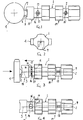
- the lancet has an elongate body 1 of moulded plastics material. It resembles the spool of a spool valve, having alternating large and small diameter sections. The three rearmost larger diameter portions have ribs to co-operate with the interior of the firing device and stop the body 1 rotating.
- Co-axially encased within the body 1 there is a needle 2 which projects in a sharp tip 3 at the forward end.
- This tip is initially encased in a cap 4 which is in the form of a disc with a central domed stud 5 on one face.
- the cap is integrally moulded with the body 1 and connects to it by a neck 6 which will be weak enough to be sheared off from the end surface 7 by a twisting action.
- the forward end of the body has a transverse recess 8 in which the surface 7 forms the base.
- the body has a recess 9, initially empty but into which the rear end of the needle 2 projects when retracted.
- the needle 2 is cylindrical over most of its length, but at its forward end a flat 10 is formed which extends back from the extremity of the tip to a radial, semicircular shoulder 11.
- the forward recess 14 opens into an enlarged aperture 16 whose cross section is substantially elliptical or lozenge shaped with the major axis transverse to the length of the body 1. This creates a narrow bridge 17 at each side dividing the body into a forward part 18 and a rearward part 19.
- the minor axis of the ellipse or lozenge is about two thirds the length of the major axis.
- the cap 4 is twisted off and the lancet is fired in the usual way. Afterwards, the cap 4 may be used to press the needle to a retracted position, using the stud 5 as shown in Figure 3. As it is pressed against the needle tip 3, that will embed itself slightly, but the needle will be shifted rearwardly until the stud 5 meets the surface 7. Continued pressure, with the user holding the rearward part 19, forces the forward part 18 back and causes the aperture 16 to contract along its minor axis and expand slightly along its major axis as shown in Figure 3. Meanwhile, the rear end of the needle projects into the recess 9.
Landscapes
- Health & Medical Sciences (AREA)
- Life Sciences & Earth Sciences (AREA)
- Heart & Thoracic Surgery (AREA)
- Surgery (AREA)
- Biophysics (AREA)
- Pathology (AREA)
- Engineering & Computer Science (AREA)
- Biomedical Technology (AREA)
- Hematology (AREA)
- Medical Informatics (AREA)
- Molecular Biology (AREA)
- Physics & Mathematics (AREA)
- Animal Behavior & Ethology (AREA)
- General Health & Medical Sciences (AREA)
- Public Health (AREA)
- Veterinary Medicine (AREA)
- Dermatology (AREA)
- Measurement Of The Respiration, Hearing Ability, Form, And Blood Characteristics Of Living Organisms (AREA)
- Infusion, Injection, And Reservoir Apparatuses (AREA)
Applications Claiming Priority (2)
| Application Number | Priority Date | Filing Date | Title |
|---|---|---|---|
| GB9603311 | 1996-02-17 | ||
| GBGB9603311.3A GB9603311D0 (en) | 1996-02-17 | 1996-02-17 | Improvements relating to blood sampling devices |
Publications (3)
| Publication Number | Publication Date |
|---|---|
| EP0790035A2 true EP0790035A2 (de) | 1997-08-20 |
| EP0790035A3 EP0790035A3 (de) | 1997-09-10 |
| EP0790035B1 EP0790035B1 (de) | 2002-11-13 |
Family
ID=10788900
Family Applications (1)
| Application Number | Title | Priority Date | Filing Date |
|---|---|---|---|
| EP97300997A Expired - Lifetime EP0790035B1 (de) | 1996-02-17 | 1997-02-17 | Verbesserungen für Blutentnahmegeräte |
Country Status (4)
| Country | Link |
|---|---|
| EP (1) | EP0790035B1 (de) |
| DE (1) | DE69716977T2 (de) |
| ES (1) | ES2186841T3 (de) |
| GB (1) | GB9603311D0 (de) |
Cited By (1)
| Publication number | Priority date | Publication date | Assignee | Title |
|---|---|---|---|---|
| GB2426709A (en) * | 2005-05-31 | 2006-12-06 | Owen Mumford Ltd | Lancet |
Family Cites Families (3)
| Publication number | Priority date | Publication date | Assignee | Title |
|---|---|---|---|---|
| US4388925A (en) * | 1981-03-23 | 1983-06-21 | Becton Dickinson And Company | Automatic retractable lancet assembly |
| IL101720A (en) * | 1992-04-29 | 1998-09-24 | Mali Tech Ltd | Needle for syringe or the like |
| GB9414143D0 (en) * | 1994-07-13 | 1994-08-31 | Owen Mumford Ltd | Improvements relating to blood sampling devices |
-
1996
- 1996-02-17 GB GBGB9603311.3A patent/GB9603311D0/en active Pending
-
1997
- 1997-02-17 ES ES97300997T patent/ES2186841T3/es not_active Expired - Lifetime
- 1997-02-17 DE DE69716977T patent/DE69716977T2/de not_active Expired - Lifetime
- 1997-02-17 EP EP97300997A patent/EP0790035B1/de not_active Expired - Lifetime
Cited By (2)
| Publication number | Priority date | Publication date | Assignee | Title |
|---|---|---|---|---|
| GB2426709A (en) * | 2005-05-31 | 2006-12-06 | Owen Mumford Ltd | Lancet |
| US8377088B2 (en) | 2005-05-31 | 2013-02-19 | Owen Mumford Ltd. | Lancet |
Also Published As
| Publication number | Publication date |
|---|---|
| EP0790035A3 (de) | 1997-09-10 |
| EP0790035B1 (de) | 2002-11-13 |
| ES2186841T3 (es) | 2003-05-16 |
| DE69716977D1 (de) | 2002-12-19 |
| GB9603311D0 (en) | 1996-04-17 |
| DE69716977T2 (de) | 2003-09-04 |
Similar Documents
| Publication | Publication Date | Title |
|---|---|---|
| EP0433050B1 (de) | Verbesserungen für Blutentnahmegeräte | |
| US5913868A (en) | Blood sampling devices | |
| JP2635823B2 (ja) | 使い捨て穿刺装置 | |
| EP0427406B1 (de) | Verbesserungen für Blutentnahmegeräte | |
| US4139011A (en) | Device for driving a needle into a patient | |
| KR100570387B1 (ko) | 개선된 스킨 프릭커 | |
| CN104825173B (zh) | 柳叶刀穿刺装置 | |
| JP2788249B2 (ja) | 廃棄式プリッカ | |
| JP4642082B2 (ja) | ランセットアッセンブリおよび穿刺デバイス | |
| EP0858289B1 (de) | Blutentnahme-vorrichtung | |
| JP2004514496A (ja) | スキンプリッカに関する改良 | |
| EP0926985B1 (de) | Verbesserung an lanzetten zum punktieren der haut | |
| US20090228035A1 (en) | Lancet Assembly | |
| KR20090018810A (ko) | 란셋 어셈블리 | |
| EP1913872A1 (de) | Nadeleinführvorrichtung und lanzetten-anordnung und injektionsanordnung, die diese bilden | |
| CN103153187B (zh) | 穿刺装置以及构成该穿刺装置的柳叶刀组件和注射器组件 | |
| JP2019217300A (ja) | インジェクター、ランセットアッセンブリおよび穿刺デバイス | |
| EP0790035B1 (de) | Verbesserungen für Blutentnahmegeräte | |
| CN111200968A (zh) | 采血装置 | |
| HK1115521A (en) | Needle insertion device, and lancet assembly and injector assembly that form the same |
Legal Events
| Date | Code | Title | Description |
|---|---|---|---|
| PUAI | Public reference made under article 153(3) epc to a published international application that has entered the european phase |
Free format text: ORIGINAL CODE: 0009012 |
|
| PUAL | Search report despatched |
Free format text: ORIGINAL CODE: 0009013 |
|
| AK | Designated contracting states |
Kind code of ref document: A2 Designated state(s): DE ES FR GB IT |
|
| AK | Designated contracting states |
Kind code of ref document: A3 Designated state(s): DE ES FR GB IT |
|
| 17P | Request for examination filed |
Effective date: 19980309 |
|
| R17P | Request for examination filed (corrected) |
Effective date: 19980227 |
|
| 17Q | First examination report despatched |
Effective date: 20011228 |
|
| GRAG | Despatch of communication of intention to grant |
Free format text: ORIGINAL CODE: EPIDOS AGRA |
|
| RIC1 | Information provided on ipc code assigned before grant |
Free format text: 7A 61B 5/15 A |
|
| GRAG | Despatch of communication of intention to grant |
Free format text: ORIGINAL CODE: EPIDOS AGRA |
|
| GRAH | Despatch of communication of intention to grant a patent |
Free format text: ORIGINAL CODE: EPIDOS IGRA |
|
| GRAH | Despatch of communication of intention to grant a patent |
Free format text: ORIGINAL CODE: EPIDOS IGRA |
|
| GRAA | (expected) grant |
Free format text: ORIGINAL CODE: 0009210 |
|
| AK | Designated contracting states |
Kind code of ref document: B1 Designated state(s): DE ES FR GB IT |
|
| REG | Reference to a national code |
Ref country code: GB Ref legal event code: FG4D |
|
| REF | Corresponds to: |
Ref document number: 69716977 Country of ref document: DE Date of ref document: 20021219 |
|
| REG | Reference to a national code |
Ref country code: ES Ref legal event code: FG2A Ref document number: 2186841 Country of ref document: ES Kind code of ref document: T3 |
|
| ET | Fr: translation filed | ||
| PLBE | No opposition filed within time limit |
Free format text: ORIGINAL CODE: 0009261 |
|
| STAA | Information on the status of an ep patent application or granted ep patent |
Free format text: STATUS: NO OPPOSITION FILED WITHIN TIME LIMIT |
|
| 26N | No opposition filed |
Effective date: 20030814 |
|
| PGFP | Annual fee paid to national office [announced via postgrant information from national office to epo] |
Ref country code: ES Payment date: 20100225 Year of fee payment: 14 |
|
| PGFP | Annual fee paid to national office [announced via postgrant information from national office to epo] |
Ref country code: IT Payment date: 20100224 Year of fee payment: 14 |
|
| PG25 | Lapsed in a contracting state [announced via postgrant information from national office to epo] |
Ref country code: IT Free format text: LAPSE BECAUSE OF NON-PAYMENT OF DUE FEES Effective date: 20110217 |
|
| REG | Reference to a national code |
Ref country code: ES Ref legal event code: FD2A Effective date: 20120411 |
|
| PG25 | Lapsed in a contracting state [announced via postgrant information from national office to epo] |
Ref country code: ES Free format text: LAPSE BECAUSE OF NON-PAYMENT OF DUE FEES Effective date: 20110218 |
|
| PGFP | Annual fee paid to national office [announced via postgrant information from national office to epo] |
Ref country code: FR Payment date: 20140228 Year of fee payment: 18 |
|
| PGFP | Annual fee paid to national office [announced via postgrant information from national office to epo] |
Ref country code: GB Payment date: 20140325 Year of fee payment: 18 |
|
| PGFP | Annual fee paid to national office [announced via postgrant information from national office to epo] |
Ref country code: DE Payment date: 20140429 Year of fee payment: 18 |
|
| REG | Reference to a national code |
Ref country code: DE Ref legal event code: R119 Ref document number: 69716977 Country of ref document: DE |
|
| GBPC | Gb: european patent ceased through non-payment of renewal fee |
Effective date: 20150217 |
|
| REG | Reference to a national code |
Ref country code: FR Ref legal event code: ST Effective date: 20151030 |
|
| PG25 | Lapsed in a contracting state [announced via postgrant information from national office to epo] |
Ref country code: GB Free format text: LAPSE BECAUSE OF NON-PAYMENT OF DUE FEES Effective date: 20150217 Ref country code: DE Free format text: LAPSE BECAUSE OF NON-PAYMENT OF DUE FEES Effective date: 20150901 |
|
| PG25 | Lapsed in a contracting state [announced via postgrant information from national office to epo] |
Ref country code: FR Free format text: LAPSE BECAUSE OF NON-PAYMENT OF DUE FEES Effective date: 20150302 |