EP0789247A2 - Verfahren und Vorrichtung zur Erkennung und Erfassung der Spannungspulsbreite einer Kraftfahrzeugeinspritzanlage - Google Patents
Verfahren und Vorrichtung zur Erkennung und Erfassung der Spannungspulsbreite einer Kraftfahrzeugeinspritzanlage Download PDFInfo
- Publication number
- EP0789247A2 EP0789247A2 EP97102206A EP97102206A EP0789247A2 EP 0789247 A2 EP0789247 A2 EP 0789247A2 EP 97102206 A EP97102206 A EP 97102206A EP 97102206 A EP97102206 A EP 97102206A EP 0789247 A2 EP0789247 A2 EP 0789247A2
- Authority
- EP
- European Patent Office
- Prior art keywords
- event
- signal
- pulse
- timer
- event signal
- Prior art date
- Legal status (The legal status is an assumption and is not a legal conclusion. Google has not performed a legal analysis and makes no representation as to the accuracy of the status listed.)
- Granted
Links
- 238000000034 method Methods 0.000 title claims abstract description 13
- 239000000446 fuel Substances 0.000 title abstract description 42
- 238000001514 detection method Methods 0.000 title abstract description 4
- 238000001914 filtration Methods 0.000 claims description 5
- 230000006870 function Effects 0.000 claims 4
- 238000005070 sampling Methods 0.000 claims 2
- 238000012544 monitoring process Methods 0.000 claims 1
- 230000000630 rising effect Effects 0.000 abstract description 14
- 230000008569 process Effects 0.000 abstract description 4
- QVGXLLKOCUKJST-UHFFFAOYSA-N atomic oxygen Chemical compound [O] QVGXLLKOCUKJST-UHFFFAOYSA-N 0.000 description 7
- 230000001939 inductive effect Effects 0.000 description 7
- 229910052760 oxygen Inorganic materials 0.000 description 7
- 239000001301 oxygen Substances 0.000 description 7
- 230000008901 benefit Effects 0.000 description 4
- 238000005259 measurement Methods 0.000 description 4
- 230000004044 response Effects 0.000 description 4
- 239000000523 sample Substances 0.000 description 4
- 230000001960 triggered effect Effects 0.000 description 4
- 230000009471 action Effects 0.000 description 3
- 238000002485 combustion reaction Methods 0.000 description 3
- 230000007423 decrease Effects 0.000 description 3
- 238000010586 diagram Methods 0.000 description 3
- 239000000203 mixture Substances 0.000 description 3
- 230000001133 acceleration Effects 0.000 description 2
- 230000004075 alteration Effects 0.000 description 2
- 238000012986 modification Methods 0.000 description 2
- 230000004048 modification Effects 0.000 description 2
- 230000008439 repair process Effects 0.000 description 2
- 230000004913 activation Effects 0.000 description 1
- 230000003466 anti-cipated effect Effects 0.000 description 1
- 239000006227 byproduct Substances 0.000 description 1
- 230000001143 conditioned effect Effects 0.000 description 1
- 230000003750 conditioning effect Effects 0.000 description 1
- 238000003745 diagnosis Methods 0.000 description 1
- 230000000737 periodic effect Effects 0.000 description 1
Images



Classifications
-
- G—PHYSICS
- G01—MEASURING; TESTING
- G01R—MEASURING ELECTRIC VARIABLES; MEASURING MAGNETIC VARIABLES
- G01R29/00—Arrangements for measuring or indicating electric quantities not covered by groups G01R19/00 - G01R27/00
- G01R29/02—Measuring characteristics of individual pulses, e.g. deviation from pulse flatness, rise time or duration
Definitions
- the present invention relates generally to electronic signal measurement apparatus, and more particularly to a system for detection and acquisition of automotive fuel injector voltage signal pulse width regardless of the fuel injector type.
- a signal of particular interest is the voltage signal of a fuel injector, more specifically, the pulse width of the voltage signal as detected at the fuel injector.
- Fuel injectors of an automobile receives periodic voltage pulses of a duration as specified by the computer module of the automobile.
- the computer module receives a signal from the oxygen sensor indicating the amount of oxygen remaining after combustion of the air-fuel mixture.
- the computer module adjusts the amount of fuel to be injected by the injectors by varying the pulse width of the voltage signal sent to the fuel injectors.
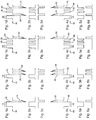
- Figs. 1a - 1d illustrate four feed-side controlled pulse types that may be detected at the fuel injector voltage terminals. The ground symbols serves as a reference point for the depicted voltage signals.
- Fig. 1a a Port Fuel Injector (PFI) type pulse 10 comprising of a base pulse 12 and a kickback pulse 14 is illustrated.
- Fig. 1b illustrates a "peak & hold" or "current limited” pulse 16 comprising of a base pulse 18 and two kickback pulses as indicated at 20 and 22.
- Fig. PFI Port Fuel Injector
- FIG. 1c illustrates a Modulated with One Kickback pulse 24 comprising of one base pulse 26 immediately followed by two (or more) shorter pulses (28 and 30) and a kickback pulse 32.
- a Modulated with Two Kickback pulse 34 is comprised of a base pulse 36 followed by a kickback pulse 38, two (or more) shorter pulses (40 and 42), and another kickback pulse 44. Note that the kickback pulses typically are much larger than the base pulses and they are illustrated with broken dots to emphasize the voltage differences.
- Figs. 4a - 4d illustrate four ground-side pulse types that may be detected at a fuel injector.
- Fig. 4a there is a PFI type pulse 46 with a downward base pulse 48 followed by a kickback pulse 50.
- Fig. 4b there is a "peak & hold" or “limited current" pulse 52 comprising of a base pulse 54 followed by two kickback pulses (56 and 58).
- Fig. 4c illustrates a Modulated with One Kickback pulse 60 with a base pulse 62 followed immediately by two (or more) shorter pulses (64 and 66) and a kickback pulse 68.
- Fig. 4a illustrate four ground-side pulse types that may be detected at a fuel injector.
- Fig. 4a there is a PFI type pulse 46 with a downward base pulse 48 followed by a kickback pulse 50.
- Fig. 4b there is a "peak & hold" or “limited current” pulse 52 comprising of a base pulse 54 followed by two kickback pulses
- a Modulated with Two Kickback pulse 70 is comprised of a base pulse 72 followed by a kickback pulse 74, two (or more) shorter pulses (76 and 78) and another kickback pulse 80. All of the detected kickback pulses are byproducts of the operation of the fuel injector coil and are further explained below.
- the number of 'shorter' base pulses on all modulated injectors (1 or 2 kickbacks, feed-side or ground-side) varies with the duration of the total injector event.
- the duration of the first (wider) base pulse is relatively fixed, and that is the amount of time it takes for the current flowing into the injector to actuate the pintle. To maintain the pintle in the actuated state allowing a greater amount of fuel injected, shorter base pulses are provided.
- the figures of the voltage signals of the moduled injectors depict the waveforms at one particular pulse width (around 2.5 ms).
- the wider base pulse is generally fixed, and the number of shorter base pulses increases or decreases to adjust the total pulse width.
- a positive voltage signal is applied by the vehicle's computer module which causes a current to flow through the injector coil to produce a magnetic field that activates a pintle to allow fuel to be injected through a valve opening into the combustion chamber of a cylinder.
- the pulse width of the voltage signal corresponds to the duration or amount of time the pintle remains actuated and therefore the amount of fuel injected into the cylinder. If a high level of oxygen remains after combustion (indicating a 'lean' air-fuel mixture), the oxygen sensor detects and reports such a condition to the computer module and the computer module in response increases the pulse width of the voltage signal sent to the fuel injector and thereby increases the amount of fuel injected into the cylinder.
- the computer module in response to such condition decreases the duration of the voltage signal to decrease the amount of fuel injected into the cylinder.
- the computer module Upon turning off the voltage to the injector coil (after the falling edge of the pulse), there is a kickback pulse having a magnitude far exceeding the magnitude of the base pulse due to the collapsing magnetic field within the injector.
- Ground-side controlled injectors operate in likewise manner as that of the feed-side controlled injectors with the difference being that the injectors are supplied with constant voltage by the vehicle's electrical system, and the computer module supplies or removes a ground path to the injector to control current flow.
- the pintle is actuated to allow fuel to be injected into the cylinder.
- the computer module receives other input signals that may cause the computer module to adjust the pulse width of the voltage signal to the fuel injectors in response to the input signals.
- the computer module receives other input signals that may cause the computer module to adjust the pulse width of the voltage signal to the fuel injectors in response to the input signals.
- Prior art measurement systems for observation of injector voltage pulse width modulation proves to be difficult to use or inaccurate.
- Such systems include oscilloscopes, digital multimeters with capability for measuring pulse width, and digital multimeters with special capability for measuring fuel injector pulse width.
- oscilloscopes the user must manually synchronize the voltage signal from the injector and manually measure and calculate the start and stop times of the pulse event in order to obtain the pulse width. This is a very time consuming process prone to mistakes in the measurement of the pulses.
- the pulse width of a fuel injector voltage signal generally comprises one or more base pulses and one or more inductor kickback pulses.
- a single-point voltage reference measures either the base pulse width or the kickback pulse width but not both, and is therefore unable to correctly detect the true pulse width.
- Prior art digital multimeters featuring capability for measuring fuel injector pulse width require the user to first identify whether the injector is a feed-side controlled or ground side controlled injector before connecting the probes of the multimeter to the injector. This additional step of identifying the injector type prior to the using of the multimeter hinders efficient diagnosis of an automobile and requires the user to have a higher knowledge level of the fuel injector system. Additionally, some of these multimeters use pattern matching to identify the pulse type. However, pattern matching methods are unable to detect new pulse types that may be later developed by the automobile manufacturers.
- the present invention is embodied in the form of a hand-held instrument which includes signal detection circuits for capturing the rising (or leading) and falling (or trailing) edges of an input signal having positive and negative voltage swings.
- signal detection circuits for capturing the rising (or leading) and falling (or trailing) edges of an input signal having positive and negative voltage swings.
- a corresponding software routine is executed to carry out the process of measuring the pulse width of a pulse of the input signal.
- the measured pulse width is then displayed in numerical and/or histogramic formats.
- An important advantage of the present invention is that the type of fuel injector signal is automatically detected.
- Another advantage of the present invention is that the user is not required to have any knowledge regarding the type of the fuel injector in order to operate the apparatus embodying the present invention.
- Still another advantage of the present invention is that new pulse types are easily detected without resorting to pattern matching or templates.
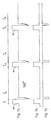
- a typical feed-side controlled PFI voltage signal as detected at the voltage terminals of a fuel injector is shown here with several pulses over several time periods.
- the pulses, 82, 84, and 86 are in time periods t1, t3, and t5. Pulses 82 and 84 are separated by time period t2, and pulses 84 and 86 are separated by time period t4.
- the event time could range from 2 ms to 3 ms at 1000 RPM (idle) engine speed. Under heavy acceleration (high engine load), the event time typically ranges around 20 ms at about 1000 RPM to 2000 RPM.
- the typical time between events at about 1000 RPM is around 120 ms (based on a typical 4-stroke spark-ignition engine cycle). Under rapid acceleration, the time between events are shortened to a certain extent. Nevertheless, the time lapsed between events is much greater than the event time.
- the start of a pulse event is marked by the occurrence of a base pulse edge after an idle period and the end of a pulse event is marked by the occurrence of a kickback pulse edge followed by an idle period.
- a generalized block diagram illustrating the major subsystems of the preferred embodiment of the present invention includes a signal conditioner 102 for receiving and conditioning the input signal 100, a microcontroller 104 for receiving user signals from a user input device 106 and the conditioned input signals from the signal conditioner 102, and a graphical display device 108 for displaying processed signals received from the microcontroller 104.
- the signal conditioner 102 is comprised of a Ranging and Protection circuitry 110, comparators 112 and 114, and Filtering and Triggering circuits 118 and 120.
- the protection circuitry protects the circuit from excessive power or power surges and the ranging circuitry adjusts the input voltage to a level acceptable to the downstream circuitry.
- a typical acceptable signal level is within the range of plus/minus 2.5 volts.
- the adjusted input signal 101 from the Ranging and Protection circuitry 110 is then sampled by the analog-to-digital converter 116 to provide digital values for input to the microcontroller.
- the digital sample values provide a basis for the microcontroller to determine the voltage swing of the adjusted input signal appearing on line 101, and to generate reference threshold voltages at digital/analog output ports 122 and 124 for input to comparator 112 at 123 and comparator 114 at 125.
- the reference threshold voltages are typically a positive and a negative threshold voltage that the adjusted input signal on line 101 must exceed in order to cause comparator 112 to generate a signal on lines 113 or comparator 114 to generate a signal on line 115. More specifically, comparator 112 detects the base portion of the adjusted input signal appearing on line 101. Figs.
- FIG. 2a-2d illustrate the detected base portions of the corresponding input signals depicted at Figs. 1a-1d
- Figs 5a-5d illustrate the detected base portion for the corresponding input waveforms of Figs. 4a-4d
- Fig. 7b depicts the base portion of Fig. 7a.
- Comparator 114 detects the inductive kickback portion of the adjusted input signal.
- Figs. 3a-3d show the detected inductive kickback portions for the corresponding input waveforms of Figs. 1a-1d
- Figs. 6a-6d show the detected inductive kickback portions for the corresponding input signals of Figs. 4a-4d
- Fig. 7c illustrates the detected kickback portion of the signal depicted by Fig. 7a.
- the signals generated by the comparators are filtered and the signal edges are made sharp by the Filtering and Trigger circuitries 118 and 120.
- the signal is then passed on to event input ports 126 and 128 of the microcontroller 104. Note that the threshold voltages are set only once for a particular input signal.
- the microcontroller 104 evaluates the digital sample values received from A/D converter 116 over a certain period of time, determines whether the voltage signal is a feed-side controlled signal or a ground-side controlled signal, and sets the threshold voltage levels that the adjusted input voltage on line 101 must exceed in order to be detected as a rising edge (or a falling edge).
- the microcontroller looks at the digital sample values representing the adjusted input signal appearing on line 101.
- a feed-side signal is typically at near-zero voltage while the injector is 'off', rises to vehicle battery voltage when 'on' (reflecting the base pulse(s)), and drops to about negative 30 to 40 volts due to the inductive kickback spikes.
- the microcontroller can thus determine a feed-side signal from the maximum and minimum voltages observed (typically +12 volts to around -40 volts).
- the observed signal is typically at vehicle battery voltage while 'off', drops to near-zero voltage while 'on', and inductive kickbacks result in peaks near positive 50 to 60 volts.
- the microcontroller is able to determine a ground-side signal by observing signals in the range of 0 volt to +60 volts.
- the microcontroller 104 After determining the injector type, the microcontroller 104 then sets an appropriate threshold voltage for comparator 112 and a threshold voltage for comparator 114 where each threshold voltage is at a sufficient level to identify the occurrence of an edge. Should the adjusted input signal on line 101 exceed either of the threshold voltages it will cause the corresponding comparator to generate a signal which is then filtered and pulse shaped by the Filtering and Trigger circuitry 118 or 120. The microcontroller then receives the processed signal at event input port 126 or 128 as a signal event.
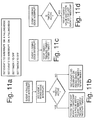
- the microcontroller upon receiving the event signals identifies a rising edge or a falling edge and executes the corresponding software routine depicted in the flow charts of Figs. 10a-10d and 11a-11d in accordance with another aspect of the present invention.
- two count-down timers timer1 and timer2 are maintained where a timer1 or timer2 interrupt is triggered when the corresponding count-down timer has reached zero.
- Timer1 is used to determine the end of an event
- timer2 is used to measure the pulse width.
- the two event signals are referred to as event1 and event2 signals in the following description where event1 refers to the base portion of a signal and event2 refers to the kickback portion.
- the microcontroller having already determined the input voltage signal as a feed-side controlled or a ground-side controlled voltage signal selects the corresponding set of software routines to process the signals received from the event input ports.
- the initialization step sets event1 and event2 to interrupt on rising edges (meaning that only a rising edge will trigger a corresponding software routine and no action will be taken on a falling edge), and both timers are turned off.
- the event1 interrupt is reset to trigger on a falling edge as indicated at 132.
- timer2 is not active (138)
- event2 is set to interrupt on falling edges, timer2 is initialized and started. If timer2 has been active (136), the last recorded time stamp for the occurrence of event2 is taken as the pulse width and is transferred to storage for later use. Timer2 is then cleared, initialized, and restarted again.
- timer1 is stopped, reloaded to expire at some point in the future where no further event interrupts are expected, and restarted as indicated at box 142.
- the routine as depicted in Fig. 10d is executed. If timer2 is active, the time of timer2 is recorded as the latest event2 time-stamp. If timer2 is not active, no action is taken. Note that no action is taken for an event2 rising edge interrupt.
- timer1 In the event that a timer1 interrupt occurs due to the fact that timer1 has counted down to zero, timer1 is stopped and event1 is reset to trigger on a rising edge.
- the occurrence of timer1 interrupt indicates that a prescribed amount of time has elapsed without receiving any event1 edges, and so the next rising edge indicates the start of a new pulse event.
- timer1 is typically initialized to 5 ms and timer2 is typically initialized to 21 ms.
- the algorithm is the same as that of the algorithm for a feed-side controlled signal except that what was triggered on rising edges now triggers on falling edges and what was triggered on falling edges now triggers on rising edges.
- the detected pulse width stored in memory is processed and displayed on the monitor.
- the resulting pulse width is either displayed numerically or in a histograph showing pulse width variation over time.
- average pulse width over specified duration can be calculated and displayed.
- the present invention forms part of a graphing, digital multimeter and diagnostic database instrument manufactured by Balco, a division of Snap-on Incorporated, of San Jose, California. It will be appreciated, however, that the invention could be embodied as a stand-alone unit or as a component part of another indicator or diagnostic system.
Landscapes
- Physics & Mathematics (AREA)
- General Physics & Mathematics (AREA)
- Combined Controls Of Internal Combustion Engines (AREA)
- Measuring Volume Flow (AREA)
- Investigating Or Analyzing Materials Using Thermal Means (AREA)
Applications Claiming Priority (2)
| Application Number | Priority Date | Filing Date | Title |
|---|---|---|---|
| US589035 | 1996-02-12 | ||
| US08/589,035 US5804970A (en) | 1996-02-12 | 1996-02-12 | Method and apparatus for detection and acquisition of automotive fuel injector voltage signal pulse width |
Publications (3)
| Publication Number | Publication Date |
|---|---|
| EP0789247A2 true EP0789247A2 (de) | 1997-08-13 |
| EP0789247A3 EP0789247A3 (de) | 1998-04-15 |
| EP0789247B1 EP0789247B1 (de) | 2002-11-20 |
Family
ID=24356328
Family Applications (1)
| Application Number | Title | Priority Date | Filing Date |
|---|---|---|---|
| EP97102206A Expired - Lifetime EP0789247B1 (de) | 1996-02-12 | 1997-02-12 | Verfahren und Vorrichtung zur Erkennung und Erfassung der Spannungspulsbreite einer Kraftfahrzeugeinspritzanlage |
Country Status (6)
| Country | Link |
|---|---|
| US (2) | US5804970A (de) |
| EP (1) | EP0789247B1 (de) |
| KR (1) | KR100304545B1 (de) |
| AU (1) | AU711068B2 (de) |
| CA (1) | CA2196950C (de) |
| DE (1) | DE69717178T2 (de) |
Cited By (3)
| Publication number | Priority date | Publication date | Assignee | Title |
|---|---|---|---|---|
| RU2215182C2 (ru) * | 2001-06-22 | 2003-10-27 | Ламм Александр Борисович | Способ компьютерного анализа вторичного напряжения системы зажигания двигателя внутреннего сгорания |
| WO2005076019A3 (en) * | 2004-01-30 | 2005-12-08 | 3M Innovative Properties Co | Digital kick meter and graphical user interface (gui) |
| WO2008071160A1 (de) * | 2006-12-11 | 2008-06-19 | Webasto Ag | Verfahren zum auswerten eines pwm-signalverlaufs |
Families Citing this family (6)
| Publication number | Priority date | Publication date | Assignee | Title |
|---|---|---|---|---|
| US6754604B2 (en) * | 2002-11-01 | 2004-06-22 | Snap-On Incorporated | Method and apparatus for diagnosing fuel injectors |
| TWI222783B (en) * | 2002-11-01 | 2004-10-21 | Winbond Electronics Corp | Differential comparison circuit system |
| CN108506134A (zh) * | 2018-05-10 | 2018-09-07 | 江苏康沃动力科技股份有限公司 | 一种发电机喷油嘴检测装置及其检测方法 |
| CN112242828A (zh) * | 2020-09-11 | 2021-01-19 | 深圳市杉川机器人有限公司 | 一种脉冲宽度调制信号的捕获方法、装置及设备 |
| US12136160B2 (en) | 2022-04-27 | 2024-11-05 | Snap Inc. | Augmented reality experience power usage prediction |
| US20240255546A1 (en) * | 2023-01-27 | 2024-08-01 | Snap-On Incorporated | Diagnostic instrument |
Family Cites Families (11)
| Publication number | Priority date | Publication date | Assignee | Title |
|---|---|---|---|---|
| US3543156A (en) * | 1967-11-03 | 1970-11-24 | Us Army | Automatic digital pulse analyzer |
| IT1119341B (it) * | 1979-08-02 | 1986-03-10 | Cselt Centro Studi Lab Telecom | Analizzatore di tensioni impulsive |
| DE2940102A1 (de) * | 1979-10-03 | 1981-04-16 | Robert Bosch Gmbh, 7000 Stuttgart | Tastverhaeltnis-messgeraete, inbesondere fuer das ansteuersignal eines elektromagnetischen ventils bei einem kraftstoffzumessgeraet |
| JPS5749026A (en) * | 1980-09-09 | 1982-03-20 | Nissan Motor Co Ltd | Crank position signal adjusting device |
| JPS60182354A (ja) * | 1984-02-28 | 1985-09-17 | Nippon Denso Co Ltd | インジエクタ駆動パルス幅の測定装置 |
| IT1206836B (it) * | 1987-01-09 | 1989-05-11 | Fiat Auto Spa | Procedimento e dispositivo per il rilievo e la segnalazione di anomalie di funzionamento dell impianto di accensione di motori a combustione interna particolarmente per autoveicoli provvisti di marmitta catalitica |
| GB2224854A (en) * | 1988-06-06 | 1990-05-16 | Ferocem Pty Ltd | Testing fuel infection and ignition systems |
| US5028914A (en) * | 1988-06-23 | 1991-07-02 | Motorola, Inc. | Method and apparatus for waveform digitization |
| US5194813A (en) * | 1991-09-16 | 1993-03-16 | Hannah Kenneth H | Spark ignition analyzer |
| US5475312A (en) * | 1994-06-07 | 1995-12-12 | Iris Power Engineering Inc. | Method and device for distinguishing between partial discharge and electrical noise |
| US5841283A (en) * | 1997-08-12 | 1998-11-24 | Fluke Corporation | Discriminator circuit for detecting the event spark plug in a distributorless ignition system |
-
1996
- 1996-02-12 US US08/589,035 patent/US5804970A/en not_active Expired - Lifetime
-
1997
- 1997-02-06 CA CA002196950A patent/CA2196950C/en not_active Expired - Fee Related
- 1997-02-10 KR KR1019970003911A patent/KR100304545B1/ko not_active Expired - Fee Related
- 1997-02-11 AU AU12633/97A patent/AU711068B2/en not_active Ceased
- 1997-02-12 DE DE69717178T patent/DE69717178T2/de not_active Expired - Lifetime
- 1997-02-12 EP EP97102206A patent/EP0789247B1/de not_active Expired - Lifetime
-
1998
- 1998-06-15 US US09/097,495 patent/US6018245A/en not_active Expired - Lifetime
Cited By (4)
| Publication number | Priority date | Publication date | Assignee | Title |
|---|---|---|---|---|
| RU2215182C2 (ru) * | 2001-06-22 | 2003-10-27 | Ламм Александр Борисович | Способ компьютерного анализа вторичного напряжения системы зажигания двигателя внутреннего сгорания |
| WO2005076019A3 (en) * | 2004-01-30 | 2005-12-08 | 3M Innovative Properties Co | Digital kick meter and graphical user interface (gui) |
| US7295654B2 (en) | 2004-01-30 | 2007-11-13 | 3M Innovative Properties Company | Digital kick meter and graphical user interface (GUI) |
| WO2008071160A1 (de) * | 2006-12-11 | 2008-06-19 | Webasto Ag | Verfahren zum auswerten eines pwm-signalverlaufs |
Also Published As
| Publication number | Publication date |
|---|---|
| AU1263397A (en) | 1997-08-21 |
| US6018245A (en) | 2000-01-25 |
| DE69717178D1 (de) | 2003-01-02 |
| KR100304545B1 (ko) | 2001-11-22 |
| CA2196950C (en) | 1999-08-24 |
| CA2196950A1 (en) | 1997-08-13 |
| DE69717178T2 (de) | 2003-10-09 |
| US5804970A (en) | 1998-09-08 |
| AU711068B2 (en) | 1999-10-07 |
| KR970062316A (ko) | 1997-09-12 |
| EP0789247A3 (de) | 1998-04-15 |
| EP0789247B1 (de) | 2002-11-20 |
Similar Documents
| Publication | Publication Date | Title |
|---|---|---|
| CA1191201A (en) | Automotive battery test apparatus | |
| US7846313B2 (en) | Controller for gas concentration sensor | |
| US5804970A (en) | Method and apparatus for detection and acquisition of automotive fuel injector voltage signal pulse width | |
| US6453250B1 (en) | Method and apparatus for detection of missing pulses from a pulse train | |
| US6456085B1 (en) | Diagnostic device for detecting short circuits or line interruptions in an inductive sensor | |
| US5663493A (en) | Apparatus and method for measuring relative compression | |
| WO1992015893A1 (de) | Ladezustandsanzeige einer batterie | |
| US6646561B1 (en) | Method and device for in-use detecting low cranking strength of a combustion engine battery during engine starting | |
| DE19601393B4 (de) | Verfahren zum Erfassen von Störungen in einem Kurbelwinkelsensor und Vorrichtung zum Erfassen von Störungen in einem Kurbelwinkelsensor | |
| AU715105B2 (en) | Electronic signal measurement apparatus and method for the acquisition and display of short-duration analog signal events | |
| US4761609A (en) | Tachometer signal conditioner | |
| JP2001349807A (ja) | 車載制御装置 | |
| JPH04326001A (ja) | トリガプローブ用信号調整回路 | |
| MXPA97001038A (en) | Method and apparatus for the detection and acquisition of the impulse width of an automot fuel injector | |
| US7246006B2 (en) | Method and systems for determining internal combustion engine cylinder condition | |
| EP1314968A1 (de) | System zum Anzeigen des Kraftstoffniveaus in einem Kraftstofftank | |
| CN116324437B (zh) | 对传感器布置结构在不稳定故障方面的故障分析 | |
| JPH0552777U (ja) | ソレノイド負荷短絡検出回路 | |
| JPS62168968A (ja) | 自動車用点火装置の火花放電持続時間測定システム | |
| RU2078322C1 (ru) | Устройство для контроля работы дизеля |
Legal Events
| Date | Code | Title | Description |
|---|---|---|---|
| PUAI | Public reference made under article 153(3) epc to a published international application that has entered the european phase |
Free format text: ORIGINAL CODE: 0009012 |
|
| AK | Designated contracting states |
Kind code of ref document: A2 Designated state(s): DE FR GB IT |
|
| PUAL | Search report despatched |
Free format text: ORIGINAL CODE: 0009013 |
|
| AK | Designated contracting states |
Kind code of ref document: A3 Designated state(s): DE FR GB IT |
|
| 17P | Request for examination filed |
Effective date: 19981007 |
|
| RAP1 | Party data changed (applicant data changed or rights of an application transferred) |
Owner name: SNAP-ON TECHNOLOGIES, INC. |
|
| 17Q | First examination report despatched |
Effective date: 20011002 |
|
| GRAG | Despatch of communication of intention to grant |
Free format text: ORIGINAL CODE: EPIDOS AGRA |
|
| GRAG | Despatch of communication of intention to grant |
Free format text: ORIGINAL CODE: EPIDOS AGRA |
|
| GRAH | Despatch of communication of intention to grant a patent |
Free format text: ORIGINAL CODE: EPIDOS IGRA |
|
| GRAH | Despatch of communication of intention to grant a patent |
Free format text: ORIGINAL CODE: EPIDOS IGRA |
|
| GRAA | (expected) grant |
Free format text: ORIGINAL CODE: 0009210 |
|
| AK | Designated contracting states |
Kind code of ref document: B1 Designated state(s): DE FR GB IT |
|
| REG | Reference to a national code |
Ref country code: GB Ref legal event code: FG4D |
|
| REF | Corresponds to: |
Ref document number: 69717178 Country of ref document: DE Date of ref document: 20030102 |
|
| ET | Fr: translation filed | ||
| PLBE | No opposition filed within time limit |
Free format text: ORIGINAL CODE: 0009261 |
|
| STAA | Information on the status of an ep patent application or granted ep patent |
Free format text: STATUS: NO OPPOSITION FILED WITHIN TIME LIMIT |
|
| 26N | No opposition filed |
Effective date: 20030821 |
|
| REG | Reference to a national code |
Ref country code: GB Ref legal event code: 732E |
|
| PGFP | Annual fee paid to national office [announced via postgrant information from national office to epo] |
Ref country code: IT Payment date: 20060228 Year of fee payment: 10 |
|
| PG25 | Lapsed in a contracting state [announced via postgrant information from national office to epo] |
Ref country code: IT Free format text: LAPSE BECAUSE OF NON-PAYMENT OF DUE FEES Effective date: 20070212 |
|
| PGFP | Annual fee paid to national office [announced via postgrant information from national office to epo] |
Ref country code: FR Payment date: 20100303 Year of fee payment: 14 |
|
| PGFP | Annual fee paid to national office [announced via postgrant information from national office to epo] |
Ref country code: GB Payment date: 20100224 Year of fee payment: 14 |
|
| GBPC | Gb: european patent ceased through non-payment of renewal fee |
Effective date: 20110212 |
|
| REG | Reference to a national code |
Ref country code: FR Ref legal event code: ST Effective date: 20111102 |
|
| PGFP | Annual fee paid to national office [announced via postgrant information from national office to epo] |
Ref country code: DE Payment date: 20110727 Year of fee payment: 15 |
|
| PG25 | Lapsed in a contracting state [announced via postgrant information from national office to epo] |
Ref country code: FR Free format text: LAPSE BECAUSE OF NON-PAYMENT OF DUE FEES Effective date: 20110228 |
|
| PG25 | Lapsed in a contracting state [announced via postgrant information from national office to epo] |
Ref country code: GB Free format text: LAPSE BECAUSE OF NON-PAYMENT OF DUE FEES Effective date: 20110212 |
|
| REG | Reference to a national code |
Ref country code: DE Ref legal event code: R119 Ref document number: 69717178 Country of ref document: DE Effective date: 20120901 |
|
| PG25 | Lapsed in a contracting state [announced via postgrant information from national office to epo] |
Ref country code: DE Free format text: LAPSE BECAUSE OF NON-PAYMENT OF DUE FEES Effective date: 20120901 |