EP0781565B1 - Ionomeric modified poly-ether-esther plastic tube for use in conveying medical solutions and the like - Google Patents
Ionomeric modified poly-ether-esther plastic tube for use in conveying medical solutions and the like Download PDFInfo
- Publication number
- EP0781565B1 EP0781565B1 EP95120739A EP95120739A EP0781565B1 EP 0781565 B1 EP0781565 B1 EP 0781565B1 EP 95120739 A EP95120739 A EP 95120739A EP 95120739 A EP95120739 A EP 95120739A EP 0781565 B1 EP0781565 B1 EP 0781565B1
- Authority
- EP
- European Patent Office
- Prior art keywords
- assembly
- tubing
- ether
- psi
- ester
- Prior art date
- Legal status (The legal status is an assumption and is not a legal conclusion. Google has not performed a legal analysis and makes no representation as to the accuracy of the status listed.)
- Expired - Lifetime
Links
- 229920003023 plastic Polymers 0.000 title claims abstract description 9
- 239000004033 plastic Substances 0.000 title claims abstract description 9
- 239000008155 medical solution Substances 0.000 title 1
- 239000000463 material Substances 0.000 claims abstract description 71
- 239000004800 polyvinyl chloride Substances 0.000 claims abstract description 70
- 229920000915 polyvinyl chloride Polymers 0.000 claims abstract description 69
- 238000012545 processing Methods 0.000 claims abstract description 14
- 239000008280 blood Substances 0.000 claims description 32
- 210000004369 blood Anatomy 0.000 claims description 32
- 229920000554 ionomer Polymers 0.000 claims description 23
- 239000004014 plasticizer Substances 0.000 claims description 19
- 238000000034 method Methods 0.000 claims description 18
- 239000012530 fluid Substances 0.000 claims description 7
- 230000002485 urinary effect Effects 0.000 claims description 7
- WQZGKKKJIJFFOK-GASJEMHNSA-N Glucose Chemical compound OC[C@H]1OC(O)[C@H](O)[C@@H](O)[C@@H]1O WQZGKKKJIJFFOK-GASJEMHNSA-N 0.000 claims description 5
- 238000002512 chemotherapy Methods 0.000 claims description 5
- 238000012258 culturing Methods 0.000 claims description 2
- 230000001580 bacterial effect Effects 0.000 abstract description 11
- 230000008901 benefit Effects 0.000 abstract description 10
- 241000700605 Viruses Species 0.000 abstract description 4
- 230000007717 exclusion Effects 0.000 abstract description 3
- 210000004027 cell Anatomy 0.000 description 24
- 239000000047 product Substances 0.000 description 18
- 239000000203 mixture Substances 0.000 description 14
- 238000012360 testing method Methods 0.000 description 13
- 238000005516 engineering process Methods 0.000 description 12
- 238000011109 contamination Methods 0.000 description 11
- 238000000855 fermentation Methods 0.000 description 10
- 230000004151 fermentation Effects 0.000 description 10
- 210000004962 mammalian cell Anatomy 0.000 description 10
- 239000000779 smoke Substances 0.000 description 10
- 230000001954 sterilising effect Effects 0.000 description 10
- 238000004659 sterilization and disinfection Methods 0.000 description 9
- 238000003466 welding Methods 0.000 description 8
- 235000015097 nutrients Nutrition 0.000 description 7
- 230000008569 process Effects 0.000 description 7
- 239000000243 solution Substances 0.000 description 7
- XLYOFNOQVPJJNP-UHFFFAOYSA-N water Substances O XLYOFNOQVPJJNP-UHFFFAOYSA-N 0.000 description 7
- 238000011161 development Methods 0.000 description 6
- 230000018109 developmental process Effects 0.000 description 6
- 238000000502 dialysis Methods 0.000 description 6
- 238000002386 leaching Methods 0.000 description 6
- 238000004519 manufacturing process Methods 0.000 description 6
- 238000007789 sealing Methods 0.000 description 6
- 230000012010 growth Effects 0.000 description 5
- 230000036512 infertility Effects 0.000 description 5
- 238000011160 research Methods 0.000 description 5
- 210000003811 finger Anatomy 0.000 description 4
- 230000036541 health Effects 0.000 description 4
- 238000002156 mixing Methods 0.000 description 4
- 102000004169 proteins and genes Human genes 0.000 description 4
- 108090000623 proteins and genes Proteins 0.000 description 4
- 241000894006 Bacteria Species 0.000 description 3
- VGGSQFUCUMXWEO-UHFFFAOYSA-N Ethene Chemical compound C=C VGGSQFUCUMXWEO-UHFFFAOYSA-N 0.000 description 3
- 206010028980 Neoplasm Diseases 0.000 description 3
- 239000004698 Polyethylene Substances 0.000 description 3
- 238000012356 Product development Methods 0.000 description 3
- 201000011510 cancer Diseases 0.000 description 3
- 238000004113 cell culture Methods 0.000 description 3
- 239000000385 dialysis solution Substances 0.000 description 3
- 238000001125 extrusion Methods 0.000 description 3
- 239000007788 liquid Substances 0.000 description 3
- 239000000155 melt Substances 0.000 description 3
- 239000008188 pellet Substances 0.000 description 3
- -1 polyethylene Polymers 0.000 description 3
- 229920000573 polyethylene Polymers 0.000 description 3
- 239000008174 sterile solution Substances 0.000 description 3
- 239000000126 substance Substances 0.000 description 3
- 239000002699 waste material Substances 0.000 description 3
- 239000005977 Ethylene Substances 0.000 description 2
- IAYPIBMASNFSPL-UHFFFAOYSA-N Ethylene oxide Chemical compound C1CO1 IAYPIBMASNFSPL-UHFFFAOYSA-N 0.000 description 2
- 241000282412 Homo Species 0.000 description 2
- 239000008037 PVC plasticizer Substances 0.000 description 2
- 239000004721 Polyphenylene oxide Substances 0.000 description 2
- 229920003182 Surlyn® Polymers 0.000 description 2
- 229920001400 block copolymer Polymers 0.000 description 2
- 230000036770 blood supply Effects 0.000 description 2
- 230000010261 cell growth Effects 0.000 description 2
- 239000011248 coating agent Substances 0.000 description 2
- 238000000576 coating method Methods 0.000 description 2
- 230000006835 compression Effects 0.000 description 2
- 238000007906 compression Methods 0.000 description 2
- 229920001577 copolymer Polymers 0.000 description 2
- 238000012864 cross contamination Methods 0.000 description 2
- 201000010099 disease Diseases 0.000 description 2
- 208000037265 diseases, disorders, signs and symptoms Diseases 0.000 description 2
- 230000000694 effects Effects 0.000 description 2
- 229920001971 elastomer Polymers 0.000 description 2
- 150000002148 esters Chemical class 0.000 description 2
- 238000002474 experimental method Methods 0.000 description 2
- 238000000605 extraction Methods 0.000 description 2
- 238000010438 heat treatment Methods 0.000 description 2
- 238000002955 isolation Methods 0.000 description 2
- 229920001684 low density polyethylene Polymers 0.000 description 2
- 231100000053 low toxicity Toxicity 0.000 description 2
- 239000004702 low-density polyethylene Substances 0.000 description 2
- 238000002844 melting Methods 0.000 description 2
- 230000008018 melting Effects 0.000 description 2
- 229910052751 metal Inorganic materials 0.000 description 2
- 239000002184 metal Substances 0.000 description 2
- 239000003607 modifier Substances 0.000 description 2
- 239000003921 oil Substances 0.000 description 2
- 210000000056 organ Anatomy 0.000 description 2
- 238000004806 packaging method and process Methods 0.000 description 2
- 229920000728 polyester Polymers 0.000 description 2
- 230000001698 pyrogenic effect Effects 0.000 description 2
- 230000011218 segmentation Effects 0.000 description 2
- 239000007787 solid Substances 0.000 description 2
- 238000001179 sorption measurement Methods 0.000 description 2
- 238000010998 test method Methods 0.000 description 2
- 238000002560 therapeutic procedure Methods 0.000 description 2
- 229920001169 thermoplastic Polymers 0.000 description 2
- 239000004416 thermosoftening plastic Substances 0.000 description 2
- 238000011282 treatment Methods 0.000 description 2
- 239000004803 Di-2ethylhexylphthalate Substances 0.000 description 1
- DGAQECJNVWCQMB-PUAWFVPOSA-M Ilexoside XXIX Chemical compound C[C@@H]1CC[C@@]2(CC[C@@]3(C(=CC[C@H]4[C@]3(CC[C@@H]5[C@@]4(CC[C@@H](C5(C)C)OS(=O)(=O)[O-])C)C)[C@@H]2[C@]1(C)O)C)C(=O)O[C@H]6[C@@H]([C@H]([C@@H]([C@H](O6)CO)O)O)O.[Na+] DGAQECJNVWCQMB-PUAWFVPOSA-M 0.000 description 1
- FYYHWMGAXLPEAU-UHFFFAOYSA-N Magnesium Chemical compound [Mg] FYYHWMGAXLPEAU-UHFFFAOYSA-N 0.000 description 1
- CERQOIWHTDAKMF-UHFFFAOYSA-N Methacrylic acid Chemical compound CC(=C)C(O)=O CERQOIWHTDAKMF-UHFFFAOYSA-N 0.000 description 1
- 239000004677 Nylon Substances 0.000 description 1
- 229920012485 Plasticized Polyvinyl chloride Polymers 0.000 description 1
- KEAYESYHFKHZAL-UHFFFAOYSA-N Sodium Chemical compound [Na] KEAYESYHFKHZAL-UHFFFAOYSA-N 0.000 description 1
- 238000005299 abrasion Methods 0.000 description 1
- 238000002835 absorbance Methods 0.000 description 1
- 238000010521 absorption reaction Methods 0.000 description 1
- 239000000443 aerosol Substances 0.000 description 1
- 238000004458 analytical method Methods 0.000 description 1
- 239000002246 antineoplastic agent Substances 0.000 description 1
- 230000009286 beneficial effect Effects 0.000 description 1
- 229920000249 biocompatible polymer Polymers 0.000 description 1
- 230000033228 biological regulation Effects 0.000 description 1
- 239000010796 biological waste Substances 0.000 description 1
- BJQHLKABXJIVAM-UHFFFAOYSA-N bis(2-ethylhexyl) phthalate Chemical compound CCCCC(CC)COC(=O)C1=CC=CC=C1C(=O)OCC(CC)CCCC BJQHLKABXJIVAM-UHFFFAOYSA-N 0.000 description 1
- 239000006227 byproduct Substances 0.000 description 1
- 230000000711 cancerogenic effect Effects 0.000 description 1
- 231100000357 carcinogen Toxicity 0.000 description 1
- 239000003183 carcinogenic agent Substances 0.000 description 1
- 230000015556 catabolic process Effects 0.000 description 1
- 230000001413 cellular effect Effects 0.000 description 1
- 230000008859 change Effects 0.000 description 1
- 230000000739 chaotic effect Effects 0.000 description 1
- 238000006243 chemical reaction Methods 0.000 description 1
- 239000007795 chemical reaction product Substances 0.000 description 1
- 239000012829 chemotherapy agent Substances 0.000 description 1
- 229940044683 chemotherapy drug Drugs 0.000 description 1
- 238000005352 clarification Methods 0.000 description 1
- 239000002131 composite material Substances 0.000 description 1
- 150000001875 compounds Chemical class 0.000 description 1
- 238000010276 construction Methods 0.000 description 1
- 238000005520 cutting process Methods 0.000 description 1
- 230000007423 decrease Effects 0.000 description 1
- 230000007547 defect Effects 0.000 description 1
- 238000006731 degradation reaction Methods 0.000 description 1
- 230000001419 dependent effect Effects 0.000 description 1
- 230000000994 depressogenic effect Effects 0.000 description 1
- 238000013461 design Methods 0.000 description 1
- 238000003745 diagnosis Methods 0.000 description 1
- 238000002405 diagnostic procedure Methods 0.000 description 1
- 210000002249 digestive system Anatomy 0.000 description 1
- 238000006073 displacement reaction Methods 0.000 description 1
- 239000003814 drug Substances 0.000 description 1
- 229940079593 drug Drugs 0.000 description 1
- 239000000806 elastomer Substances 0.000 description 1
- 239000003623 enhancer Substances 0.000 description 1
- 229920006242 ethylene acrylic acid copolymer Polymers 0.000 description 1
- 230000008014 freezing Effects 0.000 description 1
- 238000007710 freezing Methods 0.000 description 1
- 230000005484 gravity Effects 0.000 description 1
- 238000001631 haemodialysis Methods 0.000 description 1
- 210000004247 hand Anatomy 0.000 description 1
- 230000000322 hemodialysis Effects 0.000 description 1
- 210000000987 immune system Anatomy 0.000 description 1
- 239000007943 implant Substances 0.000 description 1
- 238000002513 implantation Methods 0.000 description 1
- 238000010348 incorporation Methods 0.000 description 1
- 238000001990 intravenous administration Methods 0.000 description 1
- 125000003010 ionic group Chemical group 0.000 description 1
- 150000002500 ions Chemical class 0.000 description 1
- 230000007774 longterm Effects 0.000 description 1
- 229910052749 magnesium Inorganic materials 0.000 description 1
- 239000011777 magnesium Substances 0.000 description 1
- 230000014759 maintenance of location Effects 0.000 description 1
- 150000002734 metacrylic acid derivatives Chemical class 0.000 description 1
- 150000002739 metals Chemical class 0.000 description 1
- 238000012986 modification Methods 0.000 description 1
- 230000004048 modification Effects 0.000 description 1
- 238000006386 neutralization reaction Methods 0.000 description 1
- 229920001778 nylon Polymers 0.000 description 1
- 239000012785 packaging film Substances 0.000 description 1
- 229920006280 packaging film Polymers 0.000 description 1
- 238000012856 packing Methods 0.000 description 1
- 229920000570 polyether Polymers 0.000 description 1
- 229920000642 polymer Polymers 0.000 description 1
- 238000006116 polymerization reaction Methods 0.000 description 1
- 230000008092 positive effect Effects 0.000 description 1
- 230000002035 prolonged effect Effects 0.000 description 1
- 238000003908 quality control method Methods 0.000 description 1
- 230000008439 repair process Effects 0.000 description 1
- 229920005989 resin Polymers 0.000 description 1
- 239000011347 resin Substances 0.000 description 1
- 238000000926 separation method Methods 0.000 description 1
- 238000004513 sizing Methods 0.000 description 1
- 229910052708 sodium Inorganic materials 0.000 description 1
- 239000011734 sodium Substances 0.000 description 1
- 239000003381 stabilizer Substances 0.000 description 1
- 238000003860 storage Methods 0.000 description 1
- 210000001321 subclavian vein Anatomy 0.000 description 1
- 238000006467 substitution reaction Methods 0.000 description 1
- 210000003813 thumb Anatomy 0.000 description 1
- 238000012546 transfer Methods 0.000 description 1
- 230000000007 visual effect Effects 0.000 description 1
- 150000003751 zinc Chemical class 0.000 description 1
Images

Classifications
-
- A—HUMAN NECESSITIES
- A61—MEDICAL OR VETERINARY SCIENCE; HYGIENE
- A61L—METHODS OR APPARATUS FOR STERILISING MATERIALS OR OBJECTS IN GENERAL; DISINFECTION, STERILISATION OR DEODORISATION OF AIR; CHEMICAL ASPECTS OF BANDAGES, DRESSINGS, ABSORBENT PADS OR SURGICAL ARTICLES; MATERIALS FOR BANDAGES, DRESSINGS, ABSORBENT PADS OR SURGICAL ARTICLES
- A61L29/00—Materials for catheters, medical tubing, cannulae, or endoscopes or for coating catheters
- A61L29/04—Macromolecular materials
- A61L29/049—Mixtures of macromolecular compounds
-
- A—HUMAN NECESSITIES
- A61—MEDICAL OR VETERINARY SCIENCE; HYGIENE
- A61L—METHODS OR APPARATUS FOR STERILISING MATERIALS OR OBJECTS IN GENERAL; DISINFECTION, STERILISATION OR DEODORISATION OF AIR; CHEMICAL ASPECTS OF BANDAGES, DRESSINGS, ABSORBENT PADS OR SURGICAL ARTICLES; MATERIALS FOR BANDAGES, DRESSINGS, ABSORBENT PADS OR SURGICAL ARTICLES
- A61L31/00—Materials for other surgical articles, e.g. stents, stent-grafts, shunts, surgical drapes, guide wires, materials for adhesion prevention, occluding devices, surgical gloves, tissue fixation devices
- A61L31/04—Macromolecular materials
- A61L31/041—Mixtures of macromolecular compounds
-
- C—CHEMISTRY; METALLURGY
- C08—ORGANIC MACROMOLECULAR COMPOUNDS; THEIR PREPARATION OR CHEMICAL WORKING-UP; COMPOSITIONS BASED THEREON
- C08L—COMPOSITIONS OF MACROMOLECULAR COMPOUNDS
- C08L67/00—Compositions of polyesters obtained by reactions forming a carboxylic ester link in the main chain; Compositions of derivatives of such polymers
- C08L67/02—Polyesters derived from dicarboxylic acids and dihydroxy compounds
- C08L67/025—Polyesters derived from dicarboxylic acids and dihydroxy compounds containing polyether sequences
Definitions
- Polyvinylchloride is the accepted material for use as tubing in various medical applications, such as peritoneal dialysis, blood processing, chemotherapy and other uses. In such uses, a consumable is conveyed through the tubing from one location to another.
- peritoneal dialysis CPD
- PVC is also the generally accepted material for forming bags and other medical containers and is commonly used as tubing in food processing particularly for fluids and semi-solids.
- PVC is the material generally used for forming sheets and films for bacterial and virus exclusion.
- PVC has a number of disadvantages which would be desirable to overcome in such uses.
- conventional PVC includes a plasticizer (DOP) which might leach into the solutions in the bag. Further, after PVC has leached its DOP, large volumes of PVC particulates are released.
- DOP plasticizer
- An object of this invention is to provide a material which will act as an improved replacement for PVC in the conventional uses of PVC.
- a further object of this invention is to provide such a material which can be used as tubing for medical applications, as bags and other medical containers, for tubing food processing and as sheets and films for bacterial and virus exclusion.
- the material which meets the above objects is an ionomeric modified poly-ether-ester.
- the ionomeric modifier is added in a range of 1% to 20% depending upon the end use requirement.
- the present invention is directed to providing a material which can be used as a substitute for PVC in the conventional uses of PVC while having advantages over such PVC material.
- the material of this invention is an ionomeric modified poly-ether-ester.
- Poly-ether-ester is a well known material generally used to take advantage of its high strength characteristics. Such material is used, for example, in clothing generally referred to as polyester clothing. Ordinarily, the strength of such material would make it unsuitable for use as a substitute for PVC in the uses of PVC with which this invention deals.
- the poly-ether-ester material can be modified by incorporation of a small amount of an ionomer which would modify the characteristics of the poly-ether-ester by giving it sufficient frigility to, for example, permit the material when used as a sealed tube to pop open.
- the specific amount of ionomer would depend upon the end use.
- the ionomeric modifier comprises from 0.5-50% and preferably from 1% to 25% of the combination depending upon the end use requirement.
- the broad ionomer composition range would be 2% to 15%, a more preferred range of 3% - 10%.
- a range of 7-10% is ideal.
- the result is a tube which is strong, sufficiently rubber like, and a degree of fracture to make reopening of the sealed tubes by finger pressure.
- the ionomer would be present in a range of from 1% to 50% of the combination depending on the end use requirements.
- a range of 10% to 20% is desirable.
- the range of 0.5 to 1% is preferred.
- the material of this invention is thus an ionomeric modified poly-ether-ester wherein the material has from 1% to 25% ionomer and from 99% to 75% poly-ether-ester with mixtures of 50-50% being feasible.
- the basic material components are as follows:
- IONOMER Trade name Surlyn, among others.
- the resultant ionic groups tend to aggregate to form domains which act as physical crosslinks for the polyethylene. However, the domains break down on heating, so the material may be melt processed as other thermoplastics.
- the copolymers are produced by the high pressure ethylene polymerization process and so are similar to low density polyethylene.
- the comonomer decreases crystallinity but consequent loss of stiffness is restored by the physical crosslinks.
- the material is more transparent than LDPE and shows better adhesion, which makes it useful as a layer in laminated coextruded packaging films and in, therefore, homogenous mixing.
- Poly-ether-esters are valuable materials because they have excellent low temperature properties (freezing) and are impervious to chemicals, oils and tissue. They have one serious negative, however, for many end-uses: They stretch 7x their length under low stress. For example, a tube one foot long will stretch to seven feet before breaking. Industrial goods such as bags, films, tubes, etc. readily warp out of shape and become unacceptable as end-use products.
- the present invention adds an ionomer to the composition to make useful, thin products.
- Ionomers are somewhat like polyethylene in that they are useful as films because they are excellent for food wrapping, medical and pharmaceutical packing and are impervious to most oils and chemicals. Like polyethylene, they puncture readily and only stretch 3x before fracture.
- a common use is a coating over stronger materials and are frequently used as a co-extrusions on nylon and other films to provide heat sealing.
- the invention makes use of the fact that both poly-ester-ethers and ionomers melt at the same temperature. (191°C) Instead of a coating, the invention mixes them together. In this way, the negatives of the two materials could be adjusted in a variety of ways to make new materials that are stronger than the ionomers, and less stretchy than the poly-ether-esters.
- P.E.E. poly-ester-ethers
- They can absorb excessive moisture depending upon temperature and humidity.
- the moisture pick-up makes the tubing unacceptable for further processing.
- Adding 5% to 7% ionomer to the composition reduces the moisture absorbance to less than 1% by weight.
- the following process may be used.
- the two materials are fed separately in pellet form into a single screw extruder.
- a twin screw extruder could be used satisfactorily but a single screw is sufficient and simpler to control.
- the two pellet streams are mixed to the required ratios and fed into the extruder. Extrusion rates of 4.5 to 113,4 kg (10 to 250 lbs) per hour are practical at melt temperatures of 180°C to 200°C, with 191°C being ideal.
- the melt is fed through a sizing die and liquid quenched as it exists the die for accuracy and handling purposes.
- a typical extruder heating and mixing profile would involve feeding the ionomeric and P.E.E. pellets from individual feed hoppers into the extruder where the feed zone of the extruder is at 149°C (300°F). The material would then pass to a compression zone at 177°C (350°F). The materials would then pass into a melting zone at 191°C (375°F). Finally, the material would be extruded into the desired shapes. Techniques such as conventionally used for PVC could then be used for forming the end products.
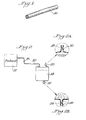
- Figure 1 illustrates a tube 10 made from an ionomeric modified poly-ether-ester in accordance with this invention.
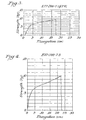
- Tube 10 has characteristics which make it ideally suited for its intended uses as an improved replacement for PVC. For example, using a modification ratio of 3% to 10%, the material will provide seal strengths in excess of 60 psi internal pressure as indicated in Table 1. The material will weld to itself with tensile strengths of 10 kgs for tubes of 5.4 mm outside diameter and a wall thickness of 0.7 mm as indicated in Figure 4. Such tensile strengths can even exceed 10 kgs.
- the welds for tube 10 can be reopened with the same ease as PVC by external finger pressure such as by squeezing.
- the ionomeric modified poly-ether-ester of this invention can be steam or ETO sterilized without geometry changes.
- the material will permit steam sterilization of itself and the tube contents without changing the sealing or welding conditions because of extremely low water (steam) adsorption or retention.
- FIGS 2, 2A and 2B illustrate use of this invention for urinary drainage application.
- tubing 10 is 5% ionomer modified and is utilized as the tubing which leads from an operative site, such as the patient 12 to a urinary bag 14.
- Urinary bag 14 may also be made of the ionomeric modified poly-ether-ester of this invention.
- DOP di-octyl-phlate
- the invention has advantages over medical grade (Class VI) di-octyl-phlate (DOP) plasticized PVC. For example, since there is no plasticizer with the material of this invention there is no leaching of plasticizer into the bag solutions as is common with PVC. Additionally, after PVC has leached its DOP, large volumes of PVC particulates are released. This does not happen with the material of this invention.
- Class VI medical grade
- DOP di-octyl-phlate
- the full bag 14 is to be separated from the patient discharge line so that it can be replaced by a fresh bag.
- a preferred practice of accomplishing such substitution would be to use the total containment sterile connection device as described in U.S. Patent Nos. 5,141,592; 5,156,701; 5,158,630; 5,209,800; 5,244,522 and 5,279,685.
- Such sterile connection device is referred to as TCD®.
- TCD® sterile connection device
- the discharge line is disconnected at any suitable location such as the location 16. This leaves a portion of the tubing extending from the operative site or patient 12.
- a new bag 14 is attached by welding a tubing 10 leading from the new bag so that the tube sections become integral at the weld connection at location 16.
- FIG. 1 shows a seal 18 formed at the top of bag 14 and Figure 2B shows a seal 20 formed at the discharge line of bag 14 by use of TCD®.
- the full bag 14 and its contents can be disposed of as a sealed biological waste.
- the bag 14 can be suspended on a standard bag holding pole over a commode and the bottom seal 20 can be opened by use of the fingers and thumb as is possible from seals formed by the total containment sterile discharge connection use for PVC.
- the bag contents will not drain at this point because of lack of air displacement.
- the top seal 18 is opened again by finger pressure if desired the bag contents will immediately begin draining.
- the use of these two seals 18,20 created by the total containment device have the advantage of draining the bag contents without tools and in the manner that the bag contents do not contact the nurse's hands. This feature is of extreme importance to protect the nurses from contamination and also prevents cross-contamination with a hospital ICU facility. Cross-contamination in ICUs is currently a major problem.
- the new or empty and sterile bag 14 is welded to the patient line at welding site 16 immediately after removing the full bag to provide uninterrupted flow from the patient.
- the E77-200-7-3 was made from a blend of 90% Hytrel poly-ether-ester and 10% Surlyn ionomer.
- the poly-ether-ester had a hardness of Durometer 30 on the D scale and a melt flow rate of 5 grams/10 minutes.
- the ionomer had a hardness of Durometer 60 on the D scale and a melt flow rate of 1.3 grams/10 minutes.
- An advantage of the ionomeric modified poly-ether-ester is its ability to be effectively welded to conventional PVC. This is important because it permits the replacement of some of the PVC components with the new material. Thus, for example, in CAPD usage it is necessary to remove a used filled bag for replacement by a new empty bag. The conventional PVC tubing could be cut and tubing from the new material could be welded to the remaining PVC tube segment. The new material components could thus gradually replace their PVC counterparts.
- Figure 3 demonstrates the weld strength of PVC tubing to ionomeric modified poly-ether-ester tubing.
- Figures 3 and 4 are graphs illustrating the ability of the weld to pop open. As shown therein with use of the ionomeric modified poly-ether-ester of this invention ( Figure 4) the unsealing characteristic is accomplished with approximately the same ease as in PVC tubing welded to the modified poly-ether-ester tubing ( Figure 3).
- Figures 5-6 illustrate use of the invention with respect to peritoneal dialysis (CAPD).
- Figure 5 represents the prior art practices wherein a tube 22 is utilized made from PVC.
- PVC is the material of choice of the health care industry for both the tubing and the solution bags 24.
- the reasons for favoring PVC are that its long standing use started early in the 1960s. Additionally, there is film clarity for visual clarification and PVC provides low cost and abundant supplies.
- the PVC used for peritoneal dialysis must undergo bulk sterilization after packaging to insure sterility to the entire product offering prior to patient use. Steam sterilization (121°C) (250°F) for thirty minutes) of PVC in contact with dialysis solutions causes several serious problems.
- the PVC plasticizer (DI-OCTYL-PHLATE), DOP, leaches out of the PVC composition during steam sterilization and into the dialysis solution. DOP is under suspicion of being a low level carcinogen. A further product that is after DOP leaching the residual PVC composition is vulnerable to particulates being formed and entering the dialysis solution which in turn enters the patient's body. Further, water adsorption (from the steam sterilization) into the patient tubing and bags reduces the plastic strength by approximately 50% causing bag leakage and sterility failures.
- Figure 5 illustrates the conventional practice of using PVC as a material for the tubing 22 and bag 24 wherein the solution 26 in the bag 24 is caused to flow through tubing 22 to the patient's site 28. Steam sterilization takes place in chamber 30. Figure 5 also illustrates the separation and connection area 32 used for replacing solution bags by separating and then rejoining the PVC transfusion line 22.
- Figure 6 illustrates use of the ionomeric modified poly-ether-ester for the tube 10 and bag 14.
- This material overcomes the PVC problems in several ways without sacrificing the positive attributes of PVC.
- the material of this invention there is no plasticizer, thus leaching is not a problem.
- the material also does not form particulates and is impervious to steam sterilization to retain 100% of its strength.
- the ionomeric modified poly-ether-ester has another positive feature that is unique to sterile connection devices that use a heated blade to achieve sterility. The material does not make smoke.
- the plasticizer DOP evolves as fine aerosol droplets that gives the appearance of smoke. Means must be provided therefore to contain and dispose of the smoke harmlessly. Since the poly-ether-ester of this invention has no plasticizer, no smoke is formed using the TCDTM process.
- the use of the total containment device TCDTM has a more significant potential for peritoneal dialysis, however, in that steam sterilization and its problems can be avoided entirely.
- the ionomeric modified poly-ether-ester consumable bags, tubes, etc. can be bulk sterilized by ethylene oxide at the point of manufacture.
- the solutions can also be sterilized in bulk storage tanks and made ready to fill the previously sterilized bags.
- the sterile solutions can be fed to the sterile consumable thus avoiding steam sterilization.
- Figure 6 illustrates by use of the connect/disconnect areas 16 how the ionomeric modified poly-ether-ester of this invention for tubing 10 can be used for replacing bags thereby resulting in a plurality of filled bags 34 with the unfilled bags 36 ready to be connected by weld 16 which would join its tubing 10 to the tubing leading from the sterile solution container 14.
- Figure 7 illustrates use of the invention for blood processing.
- the use of ionomeric modified poly-ether-ester materials has several end-use advantages. Since the material has no plasticizers the problems of plasticizer leaching into the blood are eliminated. The problems of mixing and matching of various sources of blood bags and tubing are also eliminated. Mixing and matching is viewed by the FDA as a health threat when bags and tubing of unknown source and composition are introduced into blood centers because of cost or availability. Eventually the material can be frozen and retain its flexibility, thus avoiding brittle fracture.
- Mix and match is considered by the FDA as a serious quality control and safety problem in the blood processing industry.
- Mix and match is an expression used to describe the chaotic situation in blood banks brought on by economics. Blood banks buy blood bags and tubing strictly on price without too much regard to source. Global dumping practices, questionable polymer compositions and tube size variation all contribute to the problem. In order to exercise a measure of control the FDA would prefer to be able to mandate a set of regulations regarding tube quality and be able somehow to exclude tubing that does not meet the FDA criteria.
- the ionomeric modified poly-ether-ester material meets this requirement again because the material does not contain plasticizers.
- Commonly used medical grade PVC contains up to 40% DOP as a plasticizer that vaporizes to a smoke when the welding temperature exceeds 200°C.
- DOP a plasticizer that vaporizes to a smoke when the welding temperature exceeds 200°C.
- ionomeric modified poly-ether-esters have a positive effect when used in conjunction with TCDTM in that tube sealing (separating) can be accomplished in the TCD as well as connections.
- Blood banks have the capability of sealing off tubing by radio frequencies (RF) sealers. Because of the radio frequency, however, the equipment is normally located away from the blood processing areas and shielded for safety (booths). The inconvenience of going to a sealer encourages people to make poor seals via hot plates and bunsen flames rather than taking the bags to the RF sealer.
- Use of the TCDTM avoids this problem.
- the TCDTM is located in the work place. The use of the TCDTM in blood banking has another important advantage.
- the four unused satellite bags 42 are separated and discarded. At approximately $2.00 per bag this loss is keenly felt by the blood bank. Moreover, if the bags are used and sealed it is not possible to enter the bags to enhance the cell life by the addition of stabilizers, nutrients or enhancers without compromising sterility.
- the use of the TCDTM has made "un-bundling" possible.
- the TCDTM is designed to sterilely disconnect and connect sterile containers at will thereby providing the medical profession a desired level of flexibility and at lower consumable costs.
- poly-ether-ester material has proven to be non-pyrogenic to human tissue through wide spread use of permanently placed interval sutures. For this reason, the poly-ether-ester material is approved by the FDA for internal human use and is ideal for blood bags.
- Figures 8-9 relate to use of the invention for chemotherapy.
- Figure 8 illustrates the conventional practice to administer chemo-therapeutic drugs for cancer patients by introducing the drugs via syringe 44 or a pump into the intra-venous transfer tubing 22. Solution would also flow into PVC tubing 22 from PVC bag 24.
- the syringe port is a convenient entry site for bacteria. For patients whose immune system is depressed from the therapy bacteria entry is life threatening. This problem can be eliminated by the use of the TCDTM instrument.
- TCDTM instrument in combination with the ionomeric modified poly-ether-ester material for chemotherapy application has several end use advantages. Since there is no plasticizers involved, the danger of plasticizer leaching into the patient is eliminated. Since there are no particulates this form of contamination into the patient's blood stream is also eliminated.
- the poly-ether-esters are already used widely within humans for sutures and arterial repair. They present no pyro-genic defects therefore for human use.
- Figure 9 illustrates use of ionomeric modified poly-ether-ester material for bag 14 and tubing 10.
- a ionomeric modified poly-ether ester tube 48 is spliced into the line 50 also made of ionomeric modified poly-ether-ester and is terminated with a closed (sealed) distal end 52.
- the syringe 44 or pump is sterilely enclosed in a sheath 54 and terminated with a closed sealed distal end.
- connection is totally contained. No bio-burden can enter the patient and no chemotherapy agents can escape outside the system.
- the syringe can also be sterilely disconnected by the TCDTM when the procedure is complete.
- Figure 10 illustrates use of the invention for parenteral feeding.
- feeding is accomplished by liquid nutrients fed into the patient's blood stream by way of a tube inserted into a sub-clavian vein and then into the heart.
- PVC tubing Long term implantation of PVC tubing is also a problem. PVC plasticizer extraction directly into a patient's blood stream is particularly troublesome.
- flexible PVC compounds can contain up to 40% plasticizer. While the chosen material is very carefully selected for its high purity and low toxicity, it can be extracted from PVC by contact with some fatty substances, such as by blood or the digestive system. When contact times are short there is no difficulty, but for a number of applications in which PVC may be in contact with the patient's system for longer periods extraction of plasticizer is much less acceptable. Stiffening of PVC due to plasticizer being extracted may cause patient's considerable discomfort when a feeding or wound drainage tube is removed after prolonged use.
- ionomeric modified poly-ether-ester materials for tubing is beneficial in two ways. There is no leaching of plasticizers into the patient's system from the implanted tube. Additionally, the poly-ether-ester material is compatible with the TCDTM for making sterile connects and disconnects from the implant.
- Figure 10 illustrates the use of a poly-ether-ester bag 14 supplying the liquid nutrients through poly-ether-ester tubing 10 into the patient's heart 56. By use of the TCDTM a sterile connect/disconnect procedure 16 can be effectively used to replace the bag 14 with a new bag 14.
- the invention may also be used for cell culturing and particularly has applications in connection with the TCDTM in biotechnology.
- the ionomeric modified poly-ether-ester would be used as tubing from the reactor.
- TCDTM Biotechnology is a rapidly growing business area with R&D expenditures of $2BLN in 1994 (U.S.). TCDTM technology can fill unmet needs for improved connections in several segments of this market. The value-in-use is a $2-10/connection with a total market opportunity of $28MM (1990) and estimated to grow to $78MM (1995). Mammalian cell fermentation is targeted as the market entry segment for the TCDTM technology.
- the biotechnology business utilizes many techniques developed by molecular and cellular biologists in the 1980's for increasing the production of a specific protein in a cell by redesigning, or engineering, its DNA. This business area produced high value proteins which are used in diagnosis or therapy of diseases as well as cost reducing processes in energy conversion and agriculture processes.
- the common factors in all biotechnology segments are the creation and isolation of a unique cell type and then the growth of this cell to isolate product(s).
- Preventing non-unique cells from entering the fermentation system is important for all types of cells.
- contamination is not as significant because of the design of fermentors and the length of the fermentation process, a few days.
- a typical mammalian cell fermentation cycle is three weeks long but the nutrients and wastes are exchanged several times a day.
- Accidentally introducing bacterial contamination when exchanging the fluids is a real possibility. Such contamination destroys the mammalian cells in several days.
- the biotechnology market may be segmented in several different ways, the preferred methods are by product source and by stage of the product development cycle.
- Product source defines the type of cell the protein is isolated from and product development cycle defines whether the product is in the stage of research, development, or manufacturing.
- the following charts give more information on segmentation and estimates of value-in-use (VIU) and market opportunity for the TCDTM technology. To date, market analysis has been focused on the high value products for health care applications. The segmentation and rest of this discussion focuses on this area.
- the initial targets for the TCDTM are the development and manufacturing phases of mammalian cell culture. The reasons for this choice are:
- TCDTM as the standard connection technology for biotechnology depends on demonstrating its effectiveness in reducing contamination. Its convenience and simplicity will also be important. Effectively demonstrating these attributes requires information collected under normal use conditions.
- TCDTM Developing and publishing the experience of TCDTM in cell culture will create the exposure to develop a demand for this technology in the other biotechnology applications and help establish the TCDTM as the state-of-the-art connection technology for this market.
- the ionomeric modified poly-ether-ester may also be used in food processing particularly as tubing for fluids and semi-solids and as the material for making sheets and films for bacterial and virus extrusion. When used as sheets or films, the sheet could be draped over the patient and the surgeon would cut through the sheet into the patient.
- the ionomeric modified poly-ether-ester may in effect be used as a suitable replacement for PVC in virtually all uses of PVC.
Landscapes
- Health & Medical Sciences (AREA)
- Epidemiology (AREA)
- Life Sciences & Earth Sciences (AREA)
- Animal Behavior & Ethology (AREA)
- General Health & Medical Sciences (AREA)
- Public Health (AREA)
- Veterinary Medicine (AREA)
- Chemical & Material Sciences (AREA)
- Surgery (AREA)
- Vascular Medicine (AREA)
- Heart & Thoracic Surgery (AREA)
- Chemical Kinetics & Catalysis (AREA)
- Medicinal Chemistry (AREA)
- Polymers & Plastics (AREA)
- Organic Chemistry (AREA)
- Materials For Medical Uses (AREA)
- Other Resins Obtained By Reactions Not Involving Carbon-To-Carbon Unsaturated Bonds (AREA)
- Polyesters Or Polycarbonates (AREA)
- Treatments Of Macromolecular Shaped Articles (AREA)
Priority Applications (4)
| Application Number | Priority Date | Filing Date | Title |
|---|---|---|---|
| EP95120739A EP0781565B1 (en) | 1995-12-29 | 1995-12-29 | Ionomeric modified poly-ether-esther plastic tube for use in conveying medical solutions and the like |
| DK95120739T DK0781565T3 (da) | 1995-12-29 | 1995-12-29 | Ionomerisk modificeret poly-ether-plastrør til anvendelse ved transport af medicinske opløsninger og lignende |
| DE69531249T DE69531249T2 (de) | 1995-12-29 | 1995-12-29 | Schläuche aus mit Ionomer modifiziertem Polyetherester zum Transport von medizinischen und ähnlichen Flüssigkeiten |
| AT95120739T ATE244583T1 (de) | 1995-12-29 | 1995-12-29 | Schläuche aus mit ionomer modifiziertem polyetherester zum transport von medizinischen und ähnlichen flüssigkeiten |
Applications Claiming Priority (1)
| Application Number | Priority Date | Filing Date | Title |
|---|---|---|---|
| EP95120739A EP0781565B1 (en) | 1995-12-29 | 1995-12-29 | Ionomeric modified poly-ether-esther plastic tube for use in conveying medical solutions and the like |
Publications (2)
| Publication Number | Publication Date |
|---|---|
| EP0781565A1 EP0781565A1 (en) | 1997-07-02 |
| EP0781565B1 true EP0781565B1 (en) | 2003-07-09 |
Family
ID=8219937
Family Applications (1)
| Application Number | Title | Priority Date | Filing Date |
|---|---|---|---|
| EP95120739A Expired - Lifetime EP0781565B1 (en) | 1995-12-29 | 1995-12-29 | Ionomeric modified poly-ether-esther plastic tube for use in conveying medical solutions and the like |
Country Status (4)
| Country | Link |
|---|---|
| EP (1) | EP0781565B1 (da) |
| AT (1) | ATE244583T1 (da) |
| DE (1) | DE69531249T2 (da) |
| DK (1) | DK0781565T3 (da) |
Families Citing this family (6)
| Publication number | Priority date | Publication date | Assignee | Title |
|---|---|---|---|---|
| EP1068872A1 (en) * | 1999-07-12 | 2001-01-17 | IsoTis B.V. | Sutures |
| US20030021945A1 (en) * | 2001-06-15 | 2003-01-30 | Kelch Robert H. | High-frequency active polymeric compositions and films |
| US7834127B2 (en) | 2001-07-18 | 2010-11-16 | Eastman Chemical Company | Amorphous copolyesters |
| US20030060596A1 (en) | 2001-07-18 | 2003-03-27 | Turner Sam Richard | Amorphous copolyesters |
| US20040151854A1 (en) | 2003-02-03 | 2004-08-05 | Pecorini Thomas Joseph | Extrusion blow molded articles |
| CN114773714B (zh) * | 2022-05-26 | 2023-04-28 | 鹰潭荣嘉集团医疗器械实业有限公司 | 一种可循环使用的环保型病毒采样管及其制备方法 |
Family Cites Families (2)
| Publication number | Priority date | Publication date | Assignee | Title |
|---|---|---|---|---|
| US5089553A (en) * | 1988-08-30 | 1992-02-18 | Idemitsu Petrochemical Co., Ltd. | Copolymerized polyester compositions |
| US5496291A (en) * | 1994-03-30 | 1996-03-05 | Spencer; Dudley W. C. | Ionomeric modified poly-ether-ester plastic tube for use in conveying medical solutions and the like |
-
1995
- 1995-12-29 AT AT95120739T patent/ATE244583T1/de not_active IP Right Cessation
- 1995-12-29 DE DE69531249T patent/DE69531249T2/de not_active Expired - Fee Related
- 1995-12-29 EP EP95120739A patent/EP0781565B1/en not_active Expired - Lifetime
- 1995-12-29 DK DK95120739T patent/DK0781565T3/da active
Also Published As
| Publication number | Publication date |
|---|---|
| DE69531249D1 (de) | 2003-08-14 |
| DE69531249T2 (de) | 2004-05-27 |
| ATE244583T1 (de) | 2003-07-15 |
| EP0781565A1 (en) | 1997-07-02 |
| DK0781565T3 (da) | 2003-10-06 |
Similar Documents
| Publication | Publication Date | Title |
|---|---|---|
| US5496291A (en) | Ionomeric modified poly-ether-ester plastic tube for use in conveying medical solutions and the like | |
| US5919173A (en) | Medical tubing and containers for use in conveying medical solutions and the like | |
| US5928216A (en) | Surgical/medical tubing and containers for use in conveying medical solutions and the like | |
| US6348049B1 (en) | Surgical/medical tubing and containers for use in conveying medical solutions and the like | |
| EP0380270B1 (en) | Flexible medical solution tubing | |
| JP3236937B2 (ja) | 医療用グレードの製品のための材料及びそれから作られた製品 | |
| EP3302601B1 (en) | System of multiple bags for the preparation of hemocomponents | |
| EP0781565B1 (en) | Ionomeric modified poly-ether-esther plastic tube for use in conveying medical solutions and the like | |
| US6071690A (en) | Ionomeric modified poly-ether-ester plastic container for cryogenic fluids | |
| US7275543B2 (en) | Coupler member for joining dissimilar materials | |
| Lantos | Plastics in medical applications | |
| CA2165587A1 (en) | Ionomeric modified poly-ether-ester plastic tube for use in conveying medical solutions and the like | |
| JPH0147188B2 (da) | ||
| JPH09196246A (ja) | 流体移送用組立体 | |
| Blass | The role of poly (vinyl chloride) in healthcare | |
| JPS6034455A (ja) | 無菌接続方法、装置及びシステム | |
| Blass | Polymers in disposable medical devices: A European perspective | |
| JPH0678991A (ja) | 生体臨床用の造形品 | |
| JP3625497B2 (ja) | 医療容器用基材 | |
| MXPA99001064A (en) | Quirérgicos / medical pipe and container for use in transporting medical and similar solutions | |
| Jose et al. | Containers Based on Polymers | |
| JPH0243507B2 (da) | ||
| JPH02205563A (ja) | 低温冷凍保存用容器 | |
| Walter | Milestones in Blood Transfusion and Immunohaematology | |
| Azman | The effect of surface property towards bacterial biofilm formation |
Legal Events
| Date | Code | Title | Description |
|---|---|---|---|
| PUAI | Public reference made under article 153(3) epc to a published international application that has entered the european phase |
Free format text: ORIGINAL CODE: 0009012 |
|
| AK | Designated contracting states |
Kind code of ref document: A1 Designated state(s): AT BE CH DE DK ES FR GB GR IE IT LI LU MC NL PT SE |
|
| 17P | Request for examination filed |
Effective date: 19971231 |
|
| 17Q | First examination report despatched |
Effective date: 20010601 |
|
| GRAH | Despatch of communication of intention to grant a patent |
Free format text: ORIGINAL CODE: EPIDOS IGRA |
|
| GRAH | Despatch of communication of intention to grant a patent |
Free format text: ORIGINAL CODE: EPIDOS IGRA |
|
| GRAA | (expected) grant |
Free format text: ORIGINAL CODE: 0009210 |
|
| AK | Designated contracting states |
Designated state(s): AT BE CH DE DK ES FR GB GR IE IT LI LU MC NL PT SE |
|
| PG25 | Lapsed in a contracting state [announced via postgrant information from national office to epo] |
Ref country code: LI Free format text: LAPSE BECAUSE OF FAILURE TO SUBMIT A TRANSLATION OF THE DESCRIPTION OR TO PAY THE FEE WITHIN THE PRESCRIBED TIME-LIMIT Effective date: 20030709 Ref country code: IT Free format text: LAPSE BECAUSE OF FAILURE TO SUBMIT A TRANSLATION OF THE DESCRIPTION OR TO PAY THE FEE WITHIN THE PRESCRIBED TIME-LIMIT;WARNING: LAPSES OF ITALIAN PATENTS WITH EFFECTIVE DATE BEFORE 2007 MAY HAVE OCCURRED AT ANY TIME BEFORE 2007. THE CORRECT EFFECTIVE DATE MAY BE DIFFERENT FROM THE ONE RECORDED. Effective date: 20030709 Ref country code: CH Free format text: LAPSE BECAUSE OF FAILURE TO SUBMIT A TRANSLATION OF THE DESCRIPTION OR TO PAY THE FEE WITHIN THE PRESCRIBED TIME-LIMIT Effective date: 20030709 Ref country code: AT Free format text: LAPSE BECAUSE OF FAILURE TO SUBMIT A TRANSLATION OF THE DESCRIPTION OR TO PAY THE FEE WITHIN THE PRESCRIBED TIME-LIMIT Effective date: 20030709 |
|
| REG | Reference to a national code |
Ref country code: GB Ref legal event code: FG4D |
|
| REG | Reference to a national code |
Ref country code: CH Ref legal event code: EP |
|
| REF | Corresponds to: |
Ref document number: 69531249 Country of ref document: DE Date of ref document: 20030814 Kind code of ref document: P |
|
| REG | Reference to a national code |
Ref country code: IE Ref legal event code: FG4D |
|
| REG | Reference to a national code |
Ref country code: DK Ref legal event code: T3 |
|
| PG25 | Lapsed in a contracting state [announced via postgrant information from national office to epo] |
Ref country code: GR Free format text: LAPSE BECAUSE OF FAILURE TO SUBMIT A TRANSLATION OF THE DESCRIPTION OR TO PAY THE FEE WITHIN THE PRESCRIBED TIME-LIMIT Effective date: 20031009 |
|
| PG25 | Lapsed in a contracting state [announced via postgrant information from national office to epo] |
Ref country code: ES Free format text: LAPSE BECAUSE OF FAILURE TO SUBMIT A TRANSLATION OF THE DESCRIPTION OR TO PAY THE FEE WITHIN THE PRESCRIBED TIME-LIMIT Effective date: 20031020 |
|
| REG | Reference to a national code |
Ref country code: SE Ref legal event code: TRGR |
|
| PG25 | Lapsed in a contracting state [announced via postgrant information from national office to epo] |
Ref country code: PT Free format text: LAPSE BECAUSE OF FAILURE TO SUBMIT A TRANSLATION OF THE DESCRIPTION OR TO PAY THE FEE WITHIN THE PRESCRIBED TIME-LIMIT Effective date: 20031209 |
|
| PGFP | Annual fee paid to national office [announced via postgrant information from national office to epo] |
Ref country code: GB Payment date: 20031224 Year of fee payment: 9 |
|
| PG25 | Lapsed in a contracting state [announced via postgrant information from national office to epo] |
Ref country code: LU Free format text: LAPSE BECAUSE OF NON-PAYMENT OF DUE FEES Effective date: 20031229 |
|
| PGFP | Annual fee paid to national office [announced via postgrant information from national office to epo] |
Ref country code: NL Payment date: 20031229 Year of fee payment: 9 |
|
| PG25 | Lapsed in a contracting state [announced via postgrant information from national office to epo] |
Ref country code: IE Free format text: LAPSE BECAUSE OF NON-PAYMENT OF DUE FEES Effective date: 20031230 |
|
| PG25 | Lapsed in a contracting state [announced via postgrant information from national office to epo] |
Ref country code: MC Free format text: LAPSE BECAUSE OF NON-PAYMENT OF DUE FEES Effective date: 20031231 |
|
| PGFP | Annual fee paid to national office [announced via postgrant information from national office to epo] |
Ref country code: FR Payment date: 20031231 Year of fee payment: 9 Ref country code: BE Payment date: 20031231 Year of fee payment: 9 |
|
| PGFP | Annual fee paid to national office [announced via postgrant information from national office to epo] |
Ref country code: SE Payment date: 20040102 Year of fee payment: 9 |
|
| PGFP | Annual fee paid to national office [announced via postgrant information from national office to epo] |
Ref country code: DK Payment date: 20040105 Year of fee payment: 9 |
|
| REG | Reference to a national code |
Ref country code: CH Ref legal event code: PL |
|
| PGFP | Annual fee paid to national office [announced via postgrant information from national office to epo] |
Ref country code: DE Payment date: 20040202 Year of fee payment: 9 |
|
| PLBE | No opposition filed within time limit |
Free format text: ORIGINAL CODE: 0009261 |
|
| STAA | Information on the status of an ep patent application or granted ep patent |
Free format text: STATUS: NO OPPOSITION FILED WITHIN TIME LIMIT |
|
| ET | Fr: translation filed | ||
| 26N | No opposition filed |
Effective date: 20040414 |
|
| REG | Reference to a national code |
Ref country code: IE Ref legal event code: MM4A |
|
| PG25 | Lapsed in a contracting state [announced via postgrant information from national office to epo] |
Ref country code: GB Free format text: LAPSE BECAUSE OF NON-PAYMENT OF DUE FEES Effective date: 20041229 |
|
| PG25 | Lapsed in a contracting state [announced via postgrant information from national office to epo] |
Ref country code: SE Free format text: LAPSE BECAUSE OF NON-PAYMENT OF DUE FEES Effective date: 20041230 |
|
| PG25 | Lapsed in a contracting state [announced via postgrant information from national office to epo] |
Ref country code: BE Free format text: LAPSE BECAUSE OF NON-PAYMENT OF DUE FEES Effective date: 20041231 |
|
| PG25 | Lapsed in a contracting state [announced via postgrant information from national office to epo] |
Ref country code: DK Free format text: LAPSE BECAUSE OF NON-PAYMENT OF DUE FEES Effective date: 20050103 |
|
| BERE | Be: lapsed |
Owner name: *DENCO INC. Effective date: 20041231 |
|
| PG25 | Lapsed in a contracting state [announced via postgrant information from national office to epo] |
Ref country code: NL Free format text: LAPSE BECAUSE OF NON-PAYMENT OF DUE FEES Effective date: 20050701 Ref country code: DE Free format text: LAPSE BECAUSE OF NON-PAYMENT OF DUE FEES Effective date: 20050701 |
|
| REG | Reference to a national code |
Ref country code: DK Ref legal event code: EBP |
|
| EUG | Se: european patent has lapsed | ||
| GBPC | Gb: european patent ceased through non-payment of renewal fee |
Effective date: 20041229 |
|
| PG25 | Lapsed in a contracting state [announced via postgrant information from national office to epo] |
Ref country code: FR Free format text: LAPSE BECAUSE OF NON-PAYMENT OF DUE FEES Effective date: 20050831 |
|
| NLV4 | Nl: lapsed or anulled due to non-payment of the annual fee |
Effective date: 20050701 |
|
| REG | Reference to a national code |
Ref country code: FR Ref legal event code: ST |
|
| BERE | Be: lapsed |
Owner name: *DENCO INC. Effective date: 20041231 |