EP0779977B1 - Diamantenuntersuchung - Google Patents
Diamantenuntersuchung Download PDFInfo
- Publication number
- EP0779977B1 EP0779977B1 EP95930636A EP95930636A EP0779977B1 EP 0779977 B1 EP0779977 B1 EP 0779977B1 EP 95930636 A EP95930636 A EP 95930636A EP 95930636 A EP95930636 A EP 95930636A EP 0779977 B1 EP0779977 B1 EP 0779977B1
- Authority
- EP
- European Patent Office
- Prior art keywords
- diamond
- radiation
- infra red
- zones
- wavelength
- Prior art date
- Legal status (The legal status is an assumption and is not a legal conclusion. Google has not performed a legal analysis and makes no representation as to the accuracy of the status listed.)
- Expired - Lifetime
Links
- 239000010432 diamond Substances 0.000 title claims description 200
- 229910003460 diamond Inorganic materials 0.000 title claims description 197
- 230000005855 radiation Effects 0.000 claims description 111
- 238000000034 method Methods 0.000 claims description 31
- 238000012360 testing method Methods 0.000 claims description 9
- 230000001678 irradiating effect Effects 0.000 claims description 8
- 238000010438 heat treatment Methods 0.000 claims description 7
- 239000000203 mixture Substances 0.000 claims description 6
- 238000001816 cooling Methods 0.000 claims description 3
- 238000010998 test method Methods 0.000 claims description 2
- 230000004907 flux Effects 0.000 claims 1
- 239000000463 material Substances 0.000 description 20
- 238000005229 chemical vapour deposition Methods 0.000 description 16
- 239000000523 sample Substances 0.000 description 14
- 239000004575 stone Substances 0.000 description 9
- 238000003384 imaging method Methods 0.000 description 8
- 238000012545 processing Methods 0.000 description 4
- 230000001419 dependent effect Effects 0.000 description 3
- 238000000151 deposition Methods 0.000 description 3
- 230000008021 deposition Effects 0.000 description 3
- 239000000758 substrate Substances 0.000 description 3
- 238000001931 thermography Methods 0.000 description 3
- 101100387915 Caenorhabditis elegans dop-4 gene Proteins 0.000 description 2
- 239000003086 colorant Substances 0.000 description 2
- 230000003287 optical effect Effects 0.000 description 2
- 238000012549 training Methods 0.000 description 2
- 238000010521 absorption reaction Methods 0.000 description 1
- 239000011248 coating agent Substances 0.000 description 1
- 238000000576 coating method Methods 0.000 description 1
- 239000010437 gem Substances 0.000 description 1
- 238000003331 infrared imaging Methods 0.000 description 1
- 239000007788 liquid Substances 0.000 description 1
- 238000012986 modification Methods 0.000 description 1
- 230000004048 modification Effects 0.000 description 1
- 229930014626 natural product Natural products 0.000 description 1
- 230000000704 physical effect Effects 0.000 description 1
- 238000012800 visualization Methods 0.000 description 1
Images
Classifications
-
- G—PHYSICS
- G01—MEASURING; TESTING
- G01N—INVESTIGATING OR ANALYSING MATERIALS BY DETERMINING THEIR CHEMICAL OR PHYSICAL PROPERTIES
- G01N21/00—Investigating or analysing materials by the use of optical means, i.e. using sub-millimetre waves, infrared, visible or ultraviolet light
- G01N21/84—Systems specially adapted for particular applications
- G01N21/87—Investigating jewels
Definitions
- the present invention relates to a method of and apparatus for examining a diamond.
- the invention may be used to test whether a diamond has had a layer of synthetic diamond deposited thereon. This is of particular importance in detecting whether the diamond comprises CVD diamond material and also in locating such material if present.
- the synthetic diamond material may be deposited on an uncut or part-worked natural diamond which is then worked, for example, into a round brilliant cut.
- the synthetic diamond coating may be deposited onto a fully fashioned brilliant stone after working of the stone.
- the thickness of the synthetic diamond material layer may be very thin - it could be in the range from 1 ⁇ m to 0.1 mm.
- the value of a diamond is in part dependent upon its weight. Accordingly, synthetic diamond material may be deposited onto natural gem diamonds, before or after cutting of the diamond, to increase the weight of the finished product.
- a diamond also resides in its qualities of authenticity and uniqueness and in the fact that it is an entirely natural product.
- a diamond that has not been enlarged by deposition of synthetic diamond material has a value over a diamond that has.
- CVD chemical vapour deposition
- a diamond artificially enlarged by deposition of CVD diamond material is referred to in this specification as a "CVD/natural diamond doublet".
- CVD diamond material may be deposited on a diamond substrate.
- the CVD diamond material can replicate the structure of the diamond substrate (referred to "homoepitaxial growth").
- the CVD/natural diamond doublet produced can be identical in appearance, density and other common physical properties to an entirely natural stone and there may be a problem in identifying such a CVD/natural diamond doublet.
- the apparatus should be simple and inexpensive and may be put into operation by a person with relatively little training.
- the method and apparatus should be capable of being operated reliably and consistently by a practiced jeweller who has no training in laboratory gemological analysis.
- the present invention provides a method of testing whether a diamond has had a layer of synthetic diamond deposited thereon, comprising comparing observations of infra red radiation emanating from each of a plurality of zones of the diamond, to detect differences between the compositions of different zones of the diamond, the radiation observed including radiation of wavelength substantially in the range 7 ⁇ m to 25 ⁇ m, preferably 7 ⁇ m to 10 ⁇ m.
- the present invention also provides apparatus for testing whether a diamond has had a layer of synthetic diamond deposited thereon, comprising means for observing infra red radiation emanating from a zone of the diamond which is substantially smaller than the total surface area of the diamond, the radiation observed including radiation of wavelength substantially in the range 7 ⁇ m to 25 ⁇ m, preferably 7 ⁇ m to 10 ⁇ m.
- the present inventors have discovered that where the intensity of infra red radiation of the abovementioned waveband emanating from a diamond is different between different zones, it may be concluded that the diamond has had a layer of synthetic diamond deposited thereon. Where there are no such differences, it may be concluded that the diamond is substantially of one type. Care should be taken, as explained below, to distinguish low observed intensities of radiation caused by internal reflection within the diamond from low observed intensities caused by different compositions of diamond.
- the present inventors have further discovered that the observations of infra red radiation may be compared with similar observations for a diamond of known type, to indicate whether the diamond under test is of the same type as the known diamond. If the known diamond is type IaAB, the diamond under test can be classified as definitely natural (type IaAB) or not definitely natural, because type IaAB diamonds are always natural.
- radiation emanating from a diamond is meant radiation transmitted by the diamond, or emitted by the diamond, or both.
- the present invention is based upon the observation that the majority of natural diamonds are type IaA or IaAB, whereas CVD diamond material is normally type II, which transmits infra red radiation more strongly than type IaAB and IaA diamond in the waveband 7 ⁇ m to 25 ⁇ m, the band of interest.
- the present inventors have further discovered that observations of the infra red radiation emitted from a diamond in the band of interest can be used to detect a layer of synthetic diamond material deposited on a natural stone. It is simpler and more effective to observe emitted infra red radiation than transmitted radiation.
- a large number of zones of the diamond are observed, as CVD diamond material, if present, may be localised on a part of the surface of the diamond.
- An image may of course be thought of as composed of a plurality of zones.
- a preferred method of observing a large number of zones of the diamond at once comprises forming an image of the infra red radiation emanating from the diamond.
- An image may of course be thought of as composed of a plurality of zones.
- the zones observed are small, being less than 1 mm, preferably less than 0.5 mm across. Where an image is formed, the size of the zones observed is only limited by the resolution of the imaging system.
- An image of the diamond may be formed as viewed in a first direction relative to the diamond, at least one further image of the diamond being formed as viewed in a different direction relative to the diamond. In this way, zones not visible from the first direction may be examined.
- the normal to the interface of a synthetic diamond layer and natural stone should be substantially normal to the optical axis of the imaging means, in order to be detected.
- an image of the diamond is formed using a long-wavelength thermal imaging camera, for example an Agema 900 Series thermal imaging camera.
- a long-wavelength thermal imaging camera for example an Agema 900 Series thermal imaging camera.
- an infra red imaging system having a cooled infra red filter passing radiation substantially in the waveband of interest may be used.
- Image processing means may be provided to improve contrast between areas of different emissivity. For example, areas of different temperature range may be presented in different colours. In order to distinguish the thermal emission of the diamond from that of the background, the image of the diamond may be formed against a background at a different temperature to the diamond. A temperature difference in the range 5 to 50°C may be used, preferably in the range 20 to 30°C. Such a temperature difference will give adequate distinction between the diamond and the background, without the problems associated with greater temperature differences.
- the diamond is at a higher temperature than the background, which may be achieved by heating the diamond or cooling the background, or both.
- the diamond could instead be cooled and/or the background heated.
- the emission properties of the background in the waveband substantially 7 ⁇ m to 25 ⁇ m may be tailored to enhance the view taken.
- the background could be made of a very good infra red emitter (for example, a matt black material) or a very poor emitter (for example, a mirror-polished surface), instead of or in addition to being of a different temperature.
- the diamond or background may be heated by being placed in contact with a heated support, by pre-heating it before placing it in the apparatus, by heating it in a warm air stream, or by using an infra red heating source or by a combination of these methods. If an infra red source is used, the source irradiation direction should not be coincident with the imaging direction, in order to avoid flooding the image of the diamond with background radiation.
- the background or the diamond may be cooled by being placed in contact with a cool support, by pre-cooling or by directing cold air onto the surface of the diamond or background or by a combination of these methods.
- the diamond may be irradiated with radiation which is substantially transmitted by all types of diamond, such as visible radiation, or which is transmitted by no type of diamond, such as radiation of wavelength less than 230nm, so that a dark or light image of the entire diamond or a reference image may be formed.
- This reference image may then be compared to the image taken at the first mentioned wavelength, preferably with the diamond in the same configuration.
- the reference image can be used to distinguish features caused by different zones having different emissivity from artifacts caused by internal reflection of infra red radiation in the diamond.
- the reference image may be taken against a light background or against a dark background, and/or by irradiating the diamond with light in a different direction to the direction of imaging.
- the infra red radiation emitted by a zone of the diamond may be observed by using radiation collecting means, such as a light guide (advantageously a fibre-optic probe) and a radiation detector to which the collected radiation is directed.
- radiation collecting means such as a light guide (advantageously a fibre-optic probe) and a radiation detector to which the collected radiation is directed.
- a light guide advantageousously a fibre-optic probe
- a radiation detector to which the collected radiation is directed.
- Any suitable known type of apparatus for measuring the intensity of radiation emanating from the zone may be used.
- a fibre-optic probe may be fixed in means for mounting the diamond, different zones of the diamond being placed in contact with the end of the probe by manipulating the diamond. Any suitable known means may be used for mounting the diamond, such as a plinth or ledge. Alternatively, the diamond may be stationary and the fibre-optic probe manipulated around the diamond. When a light guide such as a fibre-optic probe is used, a "map" or crude image of the emissivity at different zones of the diamond may be produced by testing each such zone in turn. A crude image can be produced without expensive imaging apparatus. The apparatus in this form may be suitable for automation.
- a plurality of fibre-optic probes may be used for contacting different zones of the diamond at the same time.
- a plurality of observations at the same wavelength may be made for the same zone and combined statistically to provide a statistically improved reading.
- Optical means may be provided to allow a visible check to ensure that the end of the probe is in contact with the desired zone of the diamond before the intensity of radiation emitted is observed.
- the image formed may be interpreted by the operator by comparing the apparent intensity of emission of different parts of the diamond or the intensities of radiation emitted by different parts of the diamond may be measured and their differences calculated. Assuming that the diamond is at a substantially uniform temperature, parts of the diamond which have different infra red emissivity will appear to have different intensities of emission.
- Emissivity may be defined as the ratio of the power per unit area radiated by the surface to that radiated by a black body at the same temperature.
- Emissivity as a function of wavelength is defined as the ratio of the power per unit area per unit wavelength interval radiated by a surface at a given wavelength and temperature to that radiated by a black body at the same wavelength and temperature.
- Synthetic diamond material deposited on a natural stone will have a lower emissivity than the neighbouring natural diamond material and will appear to be cooler.
- a light guide is used to measure the intensity of radiation emitted by a zone of the diamond, a signal dependent upon the emission intensity can be read directly for each of the zones.
- a fibre-optic probe may be used, being moved over the diamond to look for parts which have an abnormally low emission intensity.
- the radiation observed may comprise a narrow band of wavelengths lying in the band of interest or a number of such narrow bands, but is preferably a relatively broad band lying substantially in the band of interest, as this maximises the amount of radiation observed.
- the radiation studied may comprise radiation of wavelengths falling outside the above-mentioned range, for example as low as 6 ⁇ m or as high as 30 ⁇ m. It is preferred that the power of radiation falling within the band of interest will not be swamped out by radiation of wavelength falling outside this band.
- the radiation observed should include radiation falling substantially in the range 7 ⁇ m to 10 ⁇ m.
- the absorption coefficient of natural diamond is significantly higher (being three or more times higher) than that of synthetic diamond. Therefore the contrast between the intensity of radiation emitted by natural and artificial diamond material is good.
- the intensity of radiation emitted by a natural diamond is detectably larger than that emitted by artificial diamond.
- the difference is small and if this band is observed, the observing means should be very sensitive to small differences in intensity of radiation observed.
- an emissivity difference of 0.5-5% or more, preferably 1% or more between different areas is interpreted to indicate that diamond material of different compositions is present.
- the diamond may be observed using image processing means such as a computer.
- the image processing means may be set up to present the image using false colours to represent areas of different emission intensity bands.
- the threshold between the two emission intensity bands may be set such that areas of the diamond which are of different composition but which are otherwise identical in orientation, temperature, surface finish etc fall into different colour bands. This will make visualisation of areas of different composition easier.
- the threshold may be set by the operator. For example, the operator could select an area of the image and program the image processing means to assign a different colour to an area of the diamond having an emissivity difference of 0.5 - 5% or more, preferably 1% or more, from it.
- the diamond It is possible to irradiate the diamond with infra red radiation and observe infra red radiation transmitted by different zones of the diamond, the observed radiation including radiation substantially of wavelength substantially 7 ⁇ m to 25 ⁇ m.
- the diamond comprises a synthetic diamond layer.
- the observed radiation should include radiation substantially of wavelength 7 ⁇ m to 10 ⁇ m.
- the means for observing radiation transmitted by parts of the stone may be the same as for the emission technique discussed above.
- the diamond may be irradiated with infra red radiation by diffusely irradiating one side of the diamond and viewing it from the other side, by placing the diamond in an integrating sphere irradiated with infra red radiation or by irradiation with a fibre-optic probe.
- the radiation used to irradiate the diamond preferably falls only in the band of interest. However, it would be possible to obtain results even if radiation falling outside the band of interest were also included.
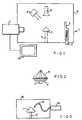
- the apparatus shown in Figure 1 comprises apparatus for observing the infra red radiation emanating from a diamond, comprising imaging means 2 in the form of a thermal camera set up to image radiation of wavelengths falling in the range 8-12 ⁇ m.
- imaging means 2 in the form of a thermal camera set up to image radiation of wavelengths falling in the range 8-12 ⁇ m.
- a diamond 3 can be placed in the apparatus, mounted on conventional diamond mounting means such as a dop 4 which allows the diamond to be manipulated and moved with respect to the thermal imaging camera 2 to allow different views of the diamond 3 to be taken.
- the diamond 3 is viewed against a background 5.
- Means 6 and 7 may be provided to create a temperature difference between the diamond and the background to allow the diamond to be more clearly imaged.
- the means 6 comprise radiative heating means, for heating the diamond by infra red radiation.
- the means 6 emits radiation in a very broad band of wavelengths.
- the background 5 is cooled by a cooled liquid pumped through the background by apparatus 7.
- a lamp 8 is provided to illuminate the diamond 3 with visible radiation.
- the camera 2 may be such that it can image visible radiation, or an extra camera may be required.
- the apparatus is contained in a light tight box 9 to prevent stray infra red radiation entering the imaging system 2.
- the imaging system 2 produces an output on monitor 10 which can be studied by the operator.
- Figure 2 shows a typical image produced on the monitor 10.
- a CVD/natural diamond doublet mounted on a dop 4 is shown. Natural parts 11 of the stone appear relatively bright, CVD diamond material parts 12 appearing comparatively dark.
- the image will show a complex pattern of facets.
- a reference image may be produced using visible light from lamp 8, to distinguish such facets from features of different emissivity.
- Figure 3 shows an alternative apparatus according to the invention.
- the apparatus comprises diamond mounting means 13 such as a dop for mounting a diamond 3.
- a fibre-optic probe 14 is provided which may be contacted with the surface of the diamond 3 at a number of positions.
- the fibre-optic probe 14 passes infra red radiation to a detector 15 which produces a reading or signal dependent upon the intensity of radiation emitted by the part of the stone in contact with the end of the fibre-optic probe 14.
- the fibre-optic probe 14 and diamond may be contained in a light tight box 16 to prevent stray infra-red radiation entering the detector 15.
Landscapes
- Immunology (AREA)
- Pathology (AREA)
- Life Sciences & Earth Sciences (AREA)
- Chemical & Material Sciences (AREA)
- Analytical Chemistry (AREA)
- Biochemistry (AREA)
- Health & Medical Sciences (AREA)
- General Health & Medical Sciences (AREA)
- Physics & Mathematics (AREA)
- General Physics & Mathematics (AREA)
- Radiation Pyrometers (AREA)
- Investigating Materials By The Use Of Optical Means Adapted For Particular Applications (AREA)
- Investigating Or Analysing Materials By Optical Means (AREA)
- Carbon And Carbon Compounds (AREA)
- Crystals, And After-Treatments Of Crystals (AREA)
- Investigating Or Analyzing Materials Using Thermal Means (AREA)
Claims (36)
- Verfahren zum Prüfen, ob auf einen Diamanten eine Schicht aus synthetischem Diamant aufgebracht worden ist, mit vergleichenden Beobachtungen von Infrarotstrahlung, die von jeder von mehreren Zonen des Diamanten ausgeht, um Unterschiede in der Zusammensetzung der verschiedenen Diamantzonen festzustellen, wobei die Infrarotstrahlung Strahlung mit Wellenlängen von 7 µm bis 25 µm aufweist.
- Verfahren nach Anspruch 1, wobei die von den Zonen emittierte Infrarotstrahlung beobachtet wird.
- Verfahren nach Anspruch 2, wobei die von den Zonen emittierte Infrarotstrahlung durch Erzeugen einer Abbildung des Diamanten beobachtet wird.
- Verfahren nach Anspruch 3, wobei die Abbildung des Diamanten gegen einen Hintergrund erzeugt wird, der eine andere Temperatur als der Diamant aufweist.
- Verfahren nach Anspruch 4, wobei der Diamant eine höhere Temperatur als der Hintergrund aufweist.
- Verfahren nach Anspruch 4 oder 5, wobei der Diamant erwärmt wird.
- Verfahren nach Anspruch 4 oder 5 oder 6, wobei der Hintergrund abgekühlt wird.
- Verfahren nach einem der Ansprüche 2 bis 7, wobei eine Abbildung des Diamanten unter einem ersten Blickwinkel bezüglich des Diamanten und mindestens eine weitere Abbildung des Diamanten unter einem anderen Blickwinkel bezüglich des Diamanten erzeugt werden.
- Verfahren nach Anspruch 1, wobei die von den Zonen ausgehende Strahlung mit Hilfe einer Strahlungsauffangeinrichtung und eines Strahlungsdetektors beobachtet wird.
- Verfahren nach Anspruch 9, wobei der Diamant in ein integrierendes Gehäuse gesetzt und die Lichtstromintensität der zuerst erwähnten Strahlung in dem Gehäuse durch den Detektor erfaßt wird.
- Verfahren nach Anspruch 9, wobei von den Zonen emittierte Infrarotstrahlung durch einen Lichtleiter aufgefangen und dem Detektor zugeführt wird.
- Verfahren nach einem der vorstehenden Ansprüche, das ferner eine Bestrahlung mehrerer verschiedener Zonen des Diamanten mit Vergleichsstrahlung, die im wesentlichen durch alle Diamanttypen ausgesandt oder im wesentlichen durch alle Diamanttypen absorbiert wird, sowie einen Vergleich von Beobachtungen der durch den Diamanten ausgesandten oder reflektierten Vergleichsstrahlung mit Beobachtungen der zuerst erwähnten, vom Diamanten ausgehenden Strahlung aufweist.
- Verfahren nach Anspruch 12, wobei eine Abbildung der von dem Diamanten ausgesandten oder reflektierten Vergleichsstrahlung erzeugt wird.
- Verfahren nach Anspruch 12 oder 13, wobei die Vergleichsstrahlung sichtbare Strahlung aufweist.
- Verfahren nach einem der vorstehenden Ansprüche, das ferner den Schritt zum Beobachten von Infrarotstrahlung. die Strahlung mit Wellenlängen von 7 µm bis 25 µm enthält, welche von Zonen eines Diamanten bekannten Typs ausgeht, und des Vergleichs der Beobachtungen des bekannten Diamanten mit dem zu prüfenden Diamanten aufweist, um festzustellen, ob der zu prüfende Diamant vom gleichen Typ wie der bekannte Diamant ist.
- Verfahren nach einem der vorstehenden Ansprüche, das ferner den Schritt zur Identifikation des Diamanten als Dublette aus chemisch aufgedampfter Schicht (CVD) und Naturdiamant aufweist, wenn die Intensität der von bestimmten Zonen des Diamanten ausgehenden Strahlung sich von der Strahlung unterscheidet, die von anderen Zonen ausgeht.
- Verfahren nach einem der vorstehenden Ansprüche, wobei die beobachtete Strahlung eine Strahlung mit Wellenlängen im Bereich von 7 µm bis 10 µm enthält.
- Verfahren nach Anspruch 1, das die Bestrahlung des Diamanten mit Infrarotstrahlung, die eine Strahlung mit Wellenlängen von 7 µm bis 25 µm enthält, und das Beobachten der Strahlung mit Wellenlängen von 7 µm bis 25 µm aufweist, die von verschiedenen Zonen des Diamanten ausgesandt wird.
- Verfahren nach Anspruch 18, wobei die von den Zonen ausgesandte Strahlung durch Erzeugen einer Abbildung des Diamanten beobachtet wird.
- Vorrichtung zum Prüfen, ob auf einen Diamanten eine Schicht aus synthetischem Diamant aufgebracht worden ist, mit einer Einrichtung zur Beobachtung von Infrarotstrahlung, die einer Zone des Diamanten ausgeht, welche erheblich kleiner ist als die Gesamtoberfläche des Diamanten, wobei die Infrarotstrahlung eine Strahlung mit Wellenlängen von 7 µm bis 25 µm enthält.
- Vorrichtung nach Anspruch 20, wobei die beobachtete Infrarotstrahlung eine Strahlung mit Wellenlängen von 7 µm bis 10 µm enthält.
- Vorrichtung nach Anspruch 20 oder 21, die ferner eine Einrichtung zum Erzeugen einer Abbildung von einer Fläche des Diamanten aufweist, welche die Zone einschließt.
- Vorrichtung nach Anspruch 22, die ferner eine Einrichtung zur Definition eine Hintergrundes aufweist, gegen den der Diamant abgebildet wird.
- Vorrichtung nach Anspruch 23, die ferner eine Einrichtung zum Erzeugen einer Temperaturdifferenz zwischen dem Diamanten und dem Hintergrund aufweist.
- Vorrichtung nach Anspruch 24, wobei die Einrichtung zum Erzeugen der Temperaturdifferenz zum Erhitzen des Diamanten dient.
- Vorrichtung nach Anspruch 24, wobei die Einrichtung zum Erzeugen der Temperaturdifferenz zum Abkühlen des Hintergrunds dient.
- Vorrichtung nach einem der Ansprüche 20 bis 26, die ferner eine Montageeinrichtung für die veränderliche Montage des Diamanten in einer Position bezüglich der Beobachtungseinrichtung aufweist.
- Vorrichtung nach Anspruch 20, wobei die Einrichtung zum Beobachten der emittierten Infrarotstrahlung eine Strahlungsauffangeinrichtung und einen Detektor aufweist.
- Vorrichtung nach Anspruch 28, wobei die Strahlungsauffangeinrichtung einen Lichtleiter zum Auffangen der Infrarotstrahlung, die von der Zone des Diamanten emittiert wird, und zur Abgabe der so aufgefangenen Strahlung an den Detektor aufweist.
- Vorrichtung nach einem der Ansprüche 20 bis 29, die ferner eine Einrichtung zum Bestrahlen des Diamanten mit Vergleichsstrahlung, die im wesentlichen durch alle Diamanttypen ausgesandt oder im wesentlichen durch alle Diamanttypen absorbiert wird, sowie eine Einrichtung zum Beobachten von Vergleichsstrahlung aufweist, die durch den Diamanten ausgesandt oder reflektiert wird.
- Vorrichtung nach Anspruch 30, wobei eine Abbildung der ausgesandten oder reflektierten Vergleichsstrahlung erzeugt wird.
- Vorrichtung nach Anspruch 30 oder 31, wobei die Vergleichsstrahlung sichtbare Strahlung aufweist.
- Vorrichtung nach Anspruch 20, die ferner eine Einrichtung zum Bestrahlen des Diamanten mit Infrarotstrahlung aufweist, die Strahlung mit Wellenlängen von 7 µm bis 25 µm enthält, wobei die Beobachtungseinrichtung zur Beobachtung von Strahlung mit Wellenlängen von 7 µm bis 25 µm dient, die durch die Zone des Diamanten ausgesandt wird.
- Vorrichtung nach Anspruch 33, wobei die Bestrahlungseinrichtung zum Bestrahlen des Diamanten mit Infrarotstrahlung dient, die Strahlung mit Wellenlängen von 7 µm bis 10 µm enthält, und wobei die Beobachtungseinrichtung zum Beobachten von Strahlung mit Wellenlängen von 7 µm bis 10 µm dient.
- Vorrichtung nach einem der Ansprüche 20 bis 34, die zur Ausführung des Verfahrens nach einem der Ansprüche 2 bis 19 konfiguriert ist.
- Vorrichtung nach einem der Ansprüche 20 bis 35, wobei die Einrichtung zum Beobachten von Infrarotstrahlung zur Untersuchung einer Zone des Diamanten konfiguriert ist, wobei die Zone einen Durchmesser von weniger als 1 mm, vorzugsweise 0,5 mm, aufweist.
Applications Claiming Priority (3)
| Application Number | Priority Date | Filing Date | Title |
|---|---|---|---|
| GB9418050 | 1994-09-07 | ||
| GB9418050A GB9418050D0 (en) | 1994-09-07 | 1994-09-07 | Examining a diamond |
| PCT/GB1995/002092 WO1996007895A1 (en) | 1994-09-07 | 1995-09-05 | Examining a diamond |
Publications (2)
| Publication Number | Publication Date |
|---|---|
| EP0779977A1 EP0779977A1 (de) | 1997-06-25 |
| EP0779977B1 true EP0779977B1 (de) | 1998-11-25 |
Family
ID=10760995
Family Applications (1)
| Application Number | Title | Priority Date | Filing Date |
|---|---|---|---|
| EP95930636A Expired - Lifetime EP0779977B1 (de) | 1994-09-07 | 1995-09-05 | Diamantenuntersuchung |
Country Status (11)
| Country | Link |
|---|---|
| US (1) | US5883388A (de) |
| EP (1) | EP0779977B1 (de) |
| JP (1) | JPH10505160A (de) |
| KR (1) | KR970705751A (de) |
| CA (1) | CA2199242A1 (de) |
| DE (1) | DE69506268T2 (de) |
| ES (1) | ES2126312T3 (de) |
| GB (2) | GB9418050D0 (de) |
| IL (1) | IL115208A (de) |
| WO (1) | WO1996007895A1 (de) |
| ZA (1) | ZA957477B (de) |
Families Citing this family (18)
| Publication number | Priority date | Publication date | Assignee | Title |
|---|---|---|---|---|
| US5823677A (en) * | 1996-03-18 | 1998-10-20 | The Board Of Trustees Of Western Michigan | Method of identifying a substance by infrared imaging |
| US6422743B1 (en) | 1999-03-26 | 2002-07-23 | Allison Advanced Development Company | Method for determining heat transfer performance of an internally cooled structure |
| US6377340B1 (en) * | 1999-10-29 | 2002-04-23 | General Electric Company | Method of detection of natural diamonds that have been processed at high pressure and high temperatures |
| US7105822B1 (en) * | 2000-09-29 | 2006-09-12 | American Gemological Laboratories, Inc. | Characterization of clarity and color enhancement agents in gems |
| DE60218188T2 (de) * | 2001-09-12 | 2007-10-25 | Gersan Establishment | Untersuchung eines diamanten |
| ES2219483T3 (es) * | 2001-12-13 | 2004-12-01 | Overseas Diamonds Technologies N.V. | Aparato para generar datos para determinar una propiedad de una piedra preciosa y procedimientos para determinar una propiedad de una piedra preciosa. |
| US6786733B2 (en) * | 2002-10-15 | 2004-09-07 | Overseas Diamonds Inc. | Computer-implemented method of and system for teaching an untrained observer to evaluate a gemstone |
| US20040076216A1 (en) * | 2002-10-18 | 2004-04-22 | Chamberlain Craig A. | Thermographic system and method for detecting imperfections within a bond |
| US20040259234A1 (en) * | 2003-06-06 | 2004-12-23 | Northrop Grumman Corporation | Detection and analysis of chemical and biological materials |
| US20050056785A1 (en) * | 2003-09-16 | 2005-03-17 | Northrop Grumman Corporation | Detection and analysis of chemical and biological materials by passive emission of terahertz wave against a cold background target |
| US20050117145A1 (en) * | 2003-11-28 | 2005-06-02 | Joshua Altman | Detection of imperfections in precious stones |
| US20090070236A1 (en) * | 2005-05-21 | 2009-03-12 | Ehud Cohen | Diamond and Precious Stone Trading Platform with Funding and Delivery Transparency |
| US9058615B2 (en) | 2007-10-02 | 2015-06-16 | Elady Limited | Product evaluation system and product evaluation method |
| US20090125435A1 (en) * | 2007-11-14 | 2009-05-14 | Ehud Cohen | Trading Plaftorm System and Method for Diamond and Precious Stone Transactions |
| US20090234754A1 (en) * | 2008-03-11 | 2009-09-17 | Dave Lapa | Apparatus, a method, and a system for gemstone evaluation and gemology tutoring over the internet |
| US20120268728A1 (en) * | 2011-04-20 | 2012-10-25 | GemEx Systems, Inc., a Wisconsin corporation | Gem positioning and analysis system |
| CN118974548A (zh) | 2022-01-18 | 2024-11-15 | 美国杰莫洛吉克尔研究所有限公司 (Gia) | 宝石的表面分析 |
| US12259334B1 (en) | 2023-11-27 | 2025-03-25 | Ogi Systems Ltd. | Method and apparatus for analyzing a gemstone |
Family Cites Families (9)
| Publication number | Priority date | Publication date | Assignee | Title |
|---|---|---|---|---|
| NL6903862A (de) * | 1969-03-13 | 1970-09-15 | ||
| GB2076146A (en) * | 1980-01-25 | 1981-11-25 | Gunsons Sortex Mineral & Autom | Method and Apparatus for Sorting |
| EP0064842A1 (de) * | 1981-05-12 | 1982-11-17 | Sphere Investments Limited | Materialsortierung |
| US4394580A (en) * | 1981-07-27 | 1983-07-19 | L.C.E. Ltd. | Method and apparatus for analyzing gems |
| GB8531330D0 (en) * | 1985-12-19 | 1986-01-29 | British Petroleum Co Plc | Differentiation process |
| US4915827A (en) * | 1988-05-19 | 1990-04-10 | Trebor Industries, Inc. | Method and apparatus for optical sorting of materials using near infrared absorbtion criteria |
| IL92133A (en) * | 1989-10-27 | 1993-01-31 | Uri Neta Haifa And Aharon Yifr | Method and apparatus for identifying gemstones, particularly diamonds |
| US5396068A (en) * | 1993-03-30 | 1995-03-07 | At&T Corp. | Method of making a semiconductor device including infrared imaging, and apparatus for use in the imaging |
| US5386117B1 (en) * | 1993-06-07 | 1997-06-10 | Computational Systems Inc | Infrared thermography system including mobile unit |
-
1994
- 1994-09-07 GB GB9418050A patent/GB9418050D0/en active Pending
-
1995
- 1995-09-05 EP EP95930636A patent/EP0779977B1/de not_active Expired - Lifetime
- 1995-09-05 ES ES95930636T patent/ES2126312T3/es not_active Expired - Lifetime
- 1995-09-05 KR KR1019970701463A patent/KR970705751A/ko not_active Ceased
- 1995-09-05 DE DE69506268T patent/DE69506268T2/de not_active Expired - Fee Related
- 1995-09-05 JP JP8509300A patent/JPH10505160A/ja active Pending
- 1995-09-05 CA CA002199242A patent/CA2199242A1/en not_active Abandoned
- 1995-09-05 US US08/809,150 patent/US5883388A/en not_active Expired - Fee Related
- 1995-09-05 WO PCT/GB1995/002092 patent/WO1996007895A1/en not_active Ceased
- 1995-09-06 ZA ZA957477A patent/ZA957477B/xx unknown
- 1995-09-06 GB GB9518227A patent/GB2293250B/en not_active Expired - Fee Related
- 1995-09-07 IL IL11520895A patent/IL115208A/en active IP Right Grant
Also Published As
| Publication number | Publication date |
|---|---|
| GB9518227D0 (en) | 1995-11-08 |
| ES2126312T3 (es) | 1999-03-16 |
| DE69506268D1 (de) | 1999-01-07 |
| GB9418050D0 (en) | 1994-10-26 |
| JPH10505160A (ja) | 1998-05-19 |
| EP0779977A1 (de) | 1997-06-25 |
| ZA957477B (en) | 1997-03-06 |
| GB2293250B (en) | 1998-06-24 |
| DE69506268T2 (de) | 1999-06-24 |
| CA2199242A1 (en) | 1996-03-14 |
| KR970705751A (ko) | 1997-10-09 |
| AU698438B2 (en) | 1998-10-29 |
| GB2293250A (en) | 1996-03-20 |
| US5883388A (en) | 1999-03-16 |
| AU3395395A (en) | 1996-03-27 |
| IL115208A (en) | 1998-07-15 |
| IL115208A0 (en) | 1995-12-31 |
| WO1996007895A1 (en) | 1996-03-14 |
Similar Documents
| Publication | Publication Date | Title |
|---|---|---|
| US5883388A (en) | Examining a diamond | |
| EP1938088B1 (de) | Verfahren zur bewertung eines diamanten | |
| US6014208A (en) | Examining a diamond | |
| EP1158293A2 (de) | Untersuchung eines Diamanten | |
| EP0741862B1 (de) | Untersuchung eines diamanten | |
| US6331708B2 (en) | Examining a diamond | |
| US7193694B2 (en) | Method for grading gemstone cut and symmetry | |
| EP3729063B1 (de) | System und verfahren zur spektroskopieanalyse von diamanten | |
| GB2293236A (en) | Examining a diamond | |
| US7105822B1 (en) | Characterization of clarity and color enhancement agents in gems | |
| EP0041348B1 (de) | Verfahren zur Beurteilung der Farbe von Diamanten und anderen Edelsteinen | |
| AU698438C (en) | Examining a diamond | |
| AU711507B2 (en) | Examining a diamond | |
| JP2005083929A (ja) | 食肉の品質計測方法及び装置 | |
| US7324188B1 (en) | Characterization of color and clarity enhancement agents in gems | |
| HK1118909A (en) | A method for evaluation of a diamond | |
| HK1118909B (en) | A method for evaluation of a diamond | |
| TH19494A (th) | การตรวจสอบเพชร |
Legal Events
| Date | Code | Title | Description |
|---|---|---|---|
| PUAI | Public reference made under article 153(3) epc to a published international application that has entered the european phase |
Free format text: ORIGINAL CODE: 0009012 |
|
| 17P | Request for examination filed |
Effective date: 19970228 |
|
| AK | Designated contracting states |
Kind code of ref document: A1 Designated state(s): BE CH DE ES FR IT LI NL |
|
| GRAG | Despatch of communication of intention to grant |
Free format text: ORIGINAL CODE: EPIDOS AGRA |
|
| 17Q | First examination report despatched |
Effective date: 19971208 |
|
| GRAG | Despatch of communication of intention to grant |
Free format text: ORIGINAL CODE: EPIDOS AGRA |
|
| GRAH | Despatch of communication of intention to grant a patent |
Free format text: ORIGINAL CODE: EPIDOS IGRA |
|
| GRAH | Despatch of communication of intention to grant a patent |
Free format text: ORIGINAL CODE: EPIDOS IGRA |
|
| GRAA | (expected) grant |
Free format text: ORIGINAL CODE: 0009210 |
|
| AK | Designated contracting states |
Kind code of ref document: B1 Designated state(s): BE CH DE ES FR IT LI NL |
|
| REG | Reference to a national code |
Ref country code: CH Ref legal event code: EP |
|
| REG | Reference to a national code |
Ref country code: CH Ref legal event code: NV Representative=s name: RITSCHER & SEIFERT |
|
| REF | Corresponds to: |
Ref document number: 69506268 Country of ref document: DE Date of ref document: 19990107 |
|
| ET | Fr: translation filed | ||
| ITF | It: translation for a ep patent filed | ||
| REG | Reference to a national code |
Ref country code: ES Ref legal event code: FG2A Ref document number: 2126312 Country of ref document: ES Kind code of ref document: T3 |
|
| PLBE | No opposition filed within time limit |
Free format text: ORIGINAL CODE: 0009261 |
|
| STAA | Information on the status of an ep patent application or granted ep patent |
Free format text: STATUS: NO OPPOSITION FILED WITHIN TIME LIMIT |
|
| 26N | No opposition filed | ||
| PGFP | Annual fee paid to national office [announced via postgrant information from national office to epo] |
Ref country code: DE Payment date: 20010828 Year of fee payment: 7 |
|
| PGFP | Annual fee paid to national office [announced via postgrant information from national office to epo] |
Ref country code: FR Payment date: 20010911 Year of fee payment: 7 |
|
| PGFP | Annual fee paid to national office [announced via postgrant information from national office to epo] |
Ref country code: CH Payment date: 20010914 Year of fee payment: 7 |
|
| PGFP | Annual fee paid to national office [announced via postgrant information from national office to epo] |
Ref country code: ES Payment date: 20010920 Year of fee payment: 7 |
|
| PGFP | Annual fee paid to national office [announced via postgrant information from national office to epo] |
Ref country code: NL Payment date: 20010927 Year of fee payment: 7 |
|
| PGFP | Annual fee paid to national office [announced via postgrant information from national office to epo] |
Ref country code: BE Payment date: 20011106 Year of fee payment: 7 |
|
| PG25 | Lapsed in a contracting state [announced via postgrant information from national office to epo] |
Ref country code: ES Free format text: LAPSE BECAUSE OF NON-PAYMENT OF DUE FEES Effective date: 20020906 |
|
| PG25 | Lapsed in a contracting state [announced via postgrant information from national office to epo] |
Ref country code: LI Free format text: LAPSE BECAUSE OF NON-PAYMENT OF DUE FEES Effective date: 20020930 Ref country code: CH Free format text: LAPSE BECAUSE OF NON-PAYMENT OF DUE FEES Effective date: 20020930 Ref country code: BE Free format text: LAPSE BECAUSE OF NON-PAYMENT OF DUE FEES Effective date: 20020930 |
|
| BERE | Be: lapsed |
Owner name: *GERSAN ESTABLISHMENT Effective date: 20020930 |
|
| PG25 | Lapsed in a contracting state [announced via postgrant information from national office to epo] |
Ref country code: NL Free format text: LAPSE BECAUSE OF NON-PAYMENT OF DUE FEES Effective date: 20030401 Ref country code: DE Free format text: LAPSE BECAUSE OF NON-PAYMENT OF DUE FEES Effective date: 20030401 |
|
| REG | Reference to a national code |
Ref country code: CH Ref legal event code: PL |
|
| PG25 | Lapsed in a contracting state [announced via postgrant information from national office to epo] |
Ref country code: FR Free format text: LAPSE BECAUSE OF NON-PAYMENT OF DUE FEES Effective date: 20030603 |
|
| REG | Reference to a national code |
Ref country code: FR Ref legal event code: ST |
|
| REG | Reference to a national code |
Ref country code: ES Ref legal event code: FD2A Effective date: 20031011 |
|
| PG25 | Lapsed in a contracting state [announced via postgrant information from national office to epo] |
Ref country code: IT Free format text: LAPSE BECAUSE OF NON-PAYMENT OF DUE FEES;WARNING: LAPSES OF ITALIAN PATENTS WITH EFFECTIVE DATE BEFORE 2007 MAY HAVE OCCURRED AT ANY TIME BEFORE 2007. THE CORRECT EFFECTIVE DATE MAY BE DIFFERENT FROM THE ONE RECORDED. Effective date: 20050905 |